My Daughter Removed My Chair at Her Bakery Dinner, Then My Friend Opened My Cream Binder
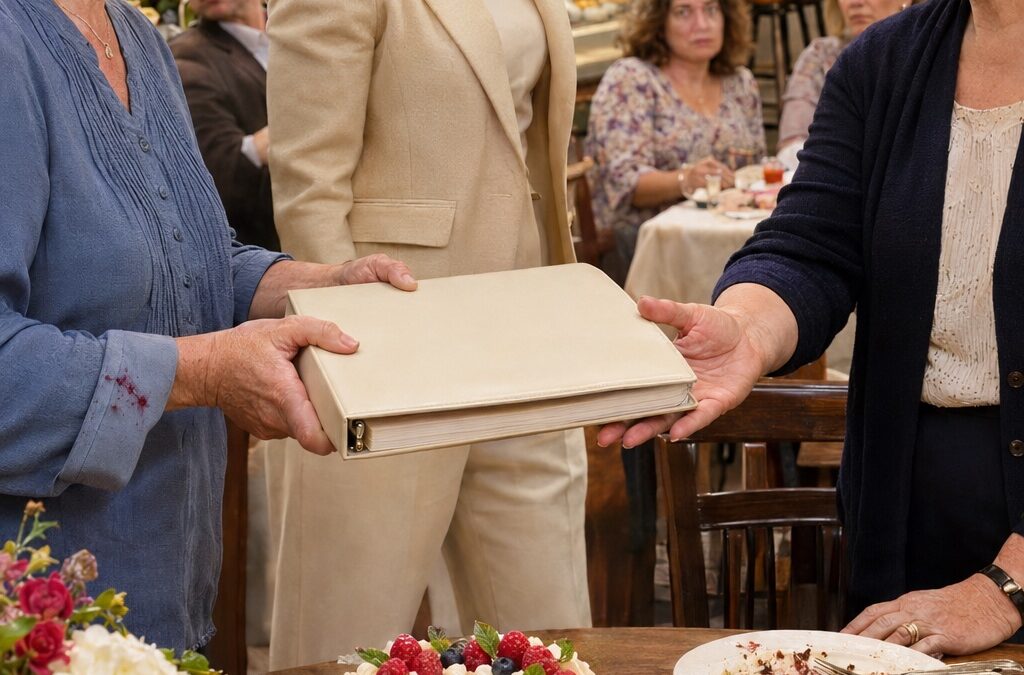
“It means I own the company,” I said.
“The company owns this building.”
Marissa stared at me, then back at Ruth.
For once, she had no quick answer ready.
Owen carried my chair around the cake table.
He placed it in the gap beside my purse.
Nobody moved their glass to block his way.
“Here, Grandma,” he said. “This is your place.”
I sat before my knees could start shaking.
Ruth kept her finger beside my printed name.
“That agreement identifies Elaine as the sole owner.”
Marissa pushed a loose strand behind her ear.
“You said you managed the place,” she told Ruth.
“I do. I never said I owned it.”
“But I send the rent to your office.”
“You send it where your lease instructs you.”
My daughter looked toward her guests for help.
Most were suddenly studying that cream binder.
One cousin quietly folded her napkin in half.
“Mom, why wouldn’t you tell me this?”
“You never asked who owned the building.”
“That’s not the same as telling me.”
“No,” I said. “It isn’t.”
I wasn’t going to pretend secrecy had helped.
I had thought distance would protect our relationship.
Ruth could handle repairs and collect the rent.
I could remain her mother instead of her landlord.
For several years, that arrangement had worked well.
Marissa called when ovens broke or sales slowed.
I brought soup when she worked through dinner.
She gave me misshapen rolls for my freezer.
Then the calls became requests instead of conversations.
The jokes about my job became sharper, too.
I kept telling myself she was simply tired.
Across the table, Marissa tapped the plastic sleeve.
“This doesn’t mean you built my bakery.”
“I never said I built your business.”
“I developed every recipe in this place.”
“Yes,” I said. “You did.”
“I hired people. I worked every holiday.”
“Yes. That belongs to you.”
I let her finish listing her own work.
She deserved credit for every bit of it.
Then I touched the edge of the binder.
“I bought the place where you did it.”
Ruth turned to the next marked section.
A copy of the recorded deed rested there.
The company’s name matched the one on Marissa’s lease.
“You own it outright?” Marissa asked.
“The company does. There isn’t a mortgage.”
She pulled out the chair beside her husband’s cousin.
For the first time all evening, she sat.
I noticed a small smear on her sleeve.
It matched the raspberry filling drying on mine.
“How could you afford that?” she asked.
Owen looked at me before answering anything.
He knew that part already.
In April, he had helped organize my bank statements.
My old filing drawer had finally broken apart.
We spent a Sunday sorting papers on my kitchen floor.
He made piles while I checked the dates.
There were bank records from the year I bought it.
There were also papers from his grandfather’s death.
“You can tell them,” I said to him.
He swallowed, then looked directly at his mother.
“Grandma bought these walls. I’ve seen the papers.”
He spoke before anyone touched the anniversary cake.
Marissa’s face changed at the word “papers.”
I recognized that look from her childhood.
It meant she knew which conversation came next.
“Your father had life insurance,” I told her.
“He died in 2016. The money came to me.”
She looked toward the windows, then the kitchen.
“You told us there wasn’t anything,” someone said.
It was my niece, seated near the doorway.
Marissa had repeated that story for years.
Her father left us nothing, she always said.
She used it whenever she described starting alone.
Sometimes she said it while I stood nearby.
I had corrected her privately more than once.
She always answered that she meant no inheritance.
Eventually, I stopped arguing over the distinction.
That silence had cost more than I understood.
“He didn’t leave money directly to you,” I said.
“He left insurance money to his wife.”
“And you spent it on this place?”
“I used $210,000 to buy the storefront.”
I still remembered signing that bank transfer.
My hand had cramped around the pen.
I had been widowed less than a year.
Buying those walls felt both hopeful and frightening.
Marissa had found the location that spring.
She loved the front windows and deep kitchen.
The seller wanted a clean sale, not installments.
She couldn’t afford to buy the building herself.
I could, because my husband had planned ahead.
I kept enough aside for my own emergencies.
Then I made a choice for our family.
“I thought it would give you a start.”
“You let me believe Ruth was the owner.”
“I let Ruth handle the business.”
“That’s a pretty convenient difference, Mom.”
“No,” Ruth said. “It was an actual arrangement.”
Her voice stayed level, which made everyone listen.
“The lease identifies the landlord as the LLC.”
“You signed it. You received copies.”
Marissa rubbed the bridge of her nose.
“I was busy trying to open a bakery.”
“And your mother was making that possible.”
I held up a hand toward Ruth.
I didn’t need anybody turning this into a trial.
My daughter had earned her customers and her reputation.
I wanted the facts clear, not her work erased.
“You made the bakery,” I told her.
“I gave it a very inexpensive home.”
She glanced at the guests again.
“Can we please talk about this privately?”
“We could have talked privately about the plates.”
Her eyes went to the stack beside the cake.
Nobody laughed this time.
Owen stood behind my chair, hands at his sides.
I touched his wrist for just a second.
He didn’t need to fight his mother for me.
“Go sit down, honey,” I told him.
“You’ve done enough.”
He took his seat across from mine.
Marissa looked at him but said nothing.
One of her friends reached for the plates.
“I can take these into the back.”
“Leave them,” I said, more firmly than intended.
Then I softened my voice.
“Marissa knows where the sink is.”
The friend withdrew her hands.
My daughter stared at me for several seconds.
Then she stood and gathered the dirty plates.
She needed two trips to carry them safely.
I stayed seated while she cleared the table.
There was no applause, and I wanted none.
It was uncomfortable enough without an audience cheering.
Ruth closed the binder when Marissa returned.
“Would you like this back?” she asked me.
“Yes. Thank you.”
I put it beside my purse again.
The cake still waited on its silver stand.
Marissa picked up the knife, then put it down.
“I don’t know what you want me to say.”
“I wanted you to give me my chair.”
That was the simplest truth I had.
Not a speech, not a tribute, not repayment.
Just a place at the table with everybody else.
Someone eventually asked whether we should cut the cake.
I said yes, because food wasn’t the enemy.
Owen passed plates while Marissa cut uneven slices.
I ate three bites of white cake.
Then I said goodnight without collecting any dishes.
Ruth walked me to my car.
The June air smelled like rain and warm pavement.
I set the binder on the passenger seat.
“Do you want company tonight?” she asked.
“I want to go home and think.”
“Call me before you make any decisions.”
I nodded, although part of me already knew.
The building could not keep being a hidden gift.
Not after she used that gift to humiliate me.
At home, I hung my stained blouse up.
I didn’t put it straight into the washer.
For once, something dirty could wait until morning.
My phone rang twice before ten o’clock.
Both calls were from Marissa.
I answered the second one.
“You embarrassed me in front of everybody.”
“I answered what you said in front of everybody.”
“You could have pulled me aside.”
“You could have left my chair alone.”
She exhaled sharply into the phone.
“Are you going to hold this over me forever?”
“No,” I said. “I’m going to read our lease.”
She went quiet at that.
I told her we would speak after I had.
Then I ended the call and made tea.
The next morning, I opened the binder again.
The current lease expired August 31, 2025.
Its nonrenewal provision required at least 60 days’ notice.
Ruth had flagged that page weeks before dinner.
We were approaching an ordinary business decision.
Until Saturday, I had expected to renew again.
I might even have kept the rent unchanged.
That realization made me sit very still.
I had been prepared to pay for more silence.
On Monday, June 9, I met with my lawyer.
I brought the whole binder, not selected pages.
He read the lease and the amendments carefully.
He asked what outcome I actually wanted.
“I don’t want her equipment,” I told him.
“I don’t want her recipes or business name.”
“What do you want, Elaine?”
“To stop subsidizing a place where I’m treated badly.”
He nodded and took notes.
We reviewed the notice provision word by word.
He explained that expiration was not immediate eviction.
I couldn’t change locks or shut off utilities.
I couldn’t seize her mixers against future rent.
None of those things had crossed my mind.
Still, I appreciated hearing the boundaries stated plainly.
He prepared the written notice of nonrenewal.
Acting for my LLC, he delivered it June 9.
He used the delivery methods required by the lease.
Ruth kept the delivery records in her management file.
The notice identified August 31 as the ending date.
It gave substantially more than the required 60 days.
There was no demand that Marissa leave sooner.
Her $600 monthly rent continued through the term.
She called me shortly after receiving it.
“This is because of one stupid dinner?”
“It’s because I’m finished with this arrangement.”
“You’re taking away my bakery.”
“No. Your bakery belongs to you.”
“The location is part of my business.”
“Yes. And the location belongs to my company.”
She began crying, which hurt more than anger.
I pressed my free hand flat against the counter.
I could love her and still let this end.
Those two facts did not cancel each other.
“You can look for another space,” I said.
“With what money?”
“I can’t answer that for you.”
For years, that question would have opened my checkbook.
This time, I stayed beside the quiet kitchen counter.
She hung up before I said goodbye.
That week, three relatives called on her behalf.
Each conversation began with some version of motherhood.
A mother shouldn’t make her daughter start over.
A mother should understand the pressure of business.
A mother should keep family arguments inside the family.
I listened longer than I needed to.
Then I gave each person the same facts.
“She’s paying $600 for a commercial storefront.”
“I paid $51,200 in taxes and insurance.”
“The roof cost another $18,000.”
Nobody offered to purchase the building from me.
Nobody offered to subsidize her next location, either.
My niece called later with a different message.
“I should have said something about the chair.”
“Yes,” I said. “You should have.”
“I’m sorry I didn’t.”
“Thank you for saying that.”
I didn’t need to punish every silent guest.
But I wasn’t comforting them about their silence.
Owen called me from his mother’s porch one evening.
His voice sounded smaller than it had at dinner.
“Did I make everything worse with the papers?”
“No, honey. You told the truth.”
“She says you wanted me on your side.”
“I want you to be 17.”
He let out a long breath.
“You don’t have to carry messages between us.”
“And you don’t have to defend me at work.”
He still needed his weekend cashier wages.
He was saving for classes after high school.
I wasn’t going to turn his job into a loyalty test.
“Can I still come Sunday?” he asked.
“I’ve already bought the potatoes.”
He laughed, and I finally did, too.
Through June, Ruth handled the property communications.
She scheduled inspections with the required notice.
Marissa continued operating and paying her monthly rent.
There were no surprise visits or public confrontations.
I didn’t post the paperwork or contact her customers.
The business dispute stayed in the business file.
My daughter’s pride didn’t need additional witnesses.
In July, she asked for another meeting.
We sat at a library table near closing time.
She brought a notebook and two rental listings.
One place wanted $2,100 a month.
The other needed electrical work before opening.
“I didn’t know rent was like this,” she said.
“I know you didn’t.”
“You could have explained what you were paying.”
“I could have. I should have.”
She seemed surprised that I admitted it.
“I thought protecting you meant staying in the background.”
“It also meant I never knew,” she said.
“That part is true.”
We let that truth sit between us.
It did not excuse what happened at dinner.
It did explain one piece of our arrangement.
“Can I have another year?” she asked.
“I’m not renewing the lease.”
“Even if I apologize?”
“An apology isn’t a rental payment.”
She closed her notebook with both hands.
“I was awful to you that night.”
“Yes.”
“I wanted everybody to see me as successful.”
“You were successful before you moved my chair.”
Her eyes filled, but she kept looking at me.
“I’m sorry I said that about Dad, too.”
I took a breath before answering.
“You can be proud without making him disappear.”
She nodded slowly.
I accepted her apology without changing the notice.
That was new for both of us.
By August, she had arranged shared commercial kitchen hours.
She planned to concentrate on advance orders.
Her overhead would change, and her schedule would tighten.
She would lose walk-in sales from those front windows.
Those were real consequences. I didn’t minimize them.
But they were not the same as losing everything.
Her mixers, display cases, and tools remained hers.
So did her recipes and the bakery’s name.
Ruth arranged reasonable access for the equipment movers.
My lawyer confirmed the surrender arrangements in writing.
I kept working my hospital laundry shifts.
Some mornings, I still felt guilty folding blankets.
Then I remembered holding those plates beneath my chin.
Guilt wasn’t always proof I was doing wrong.
Sometimes it meant I had stopped doing something familiar.
On Sunday, August 31, I met Ruth at the storefront.
Marissa’s final load had already left.
The room looked much larger without the display cases.
Pale rectangles marked where her photographs had hung.
I could smell flour near the kitchen doorway.
Marissa stood beside the empty counter with three keys.
Owen was outside carrying flattened cardboard to a car.
Ruth completed the agreed walk-through and took photographs.
We noted ordinary wear and the items remaining.
There was no argument about keeping business property.
Marissa handed the keys directly to Ruth.
“That’s all of them,” she said.
Ruth gave her a signed acknowledgment of receipt.
The storefront was surrendered that afternoon, August 31.
Nobody changed the locks while she was still occupying it.
Nobody carried her belongings onto the sidewalk.
My daughter left with what belonged to her.
Before she walked out, she looked toward me.
“I really did love this place.”
“I know you did.”
“I thought it would always be here.”
“It was here for eight years.”
She nodded and stepped into the afternoon light.
I didn’t follow her out demanding a hug.
Later that week, Ruth showed the storefront to prospects.
We had already checked comparable commercial rents nearby.
In September, my LLC signed a new lease.
The monthly rent was $1,800.
The new tenants planned a small alterations shop.
They measured the front windows with a yellow tape.
One asked whether the roof had been replaced.
“Yes,” I said. “I have the records.”
For once, that answer felt ordinary instead of secret.
Marissa still called about Sunday dinner that month.
She asked whether she should bring something.
“Bread would be nice,” I told her.
When she arrived, she put it on the counter.
Then she asked where I wanted her to sit.
I pointed to a chair already waiting for her.
We were not fixed. We were sitting down.
That was enough for one Sunday.
After she and Owen left, I cleared my table.
I washed my own plate and dried my hands.
Then I opened the new lease beneath the kitchen light.
The amount was there in plain print: $1,800 monthly.
I checked the signatures before filing it away.
The cream binder lay beneath my hands.
You Might Also Enjoy




