My Father Said I Spent Grandma’s Money While I Grieved — Then Her Papers Arrived
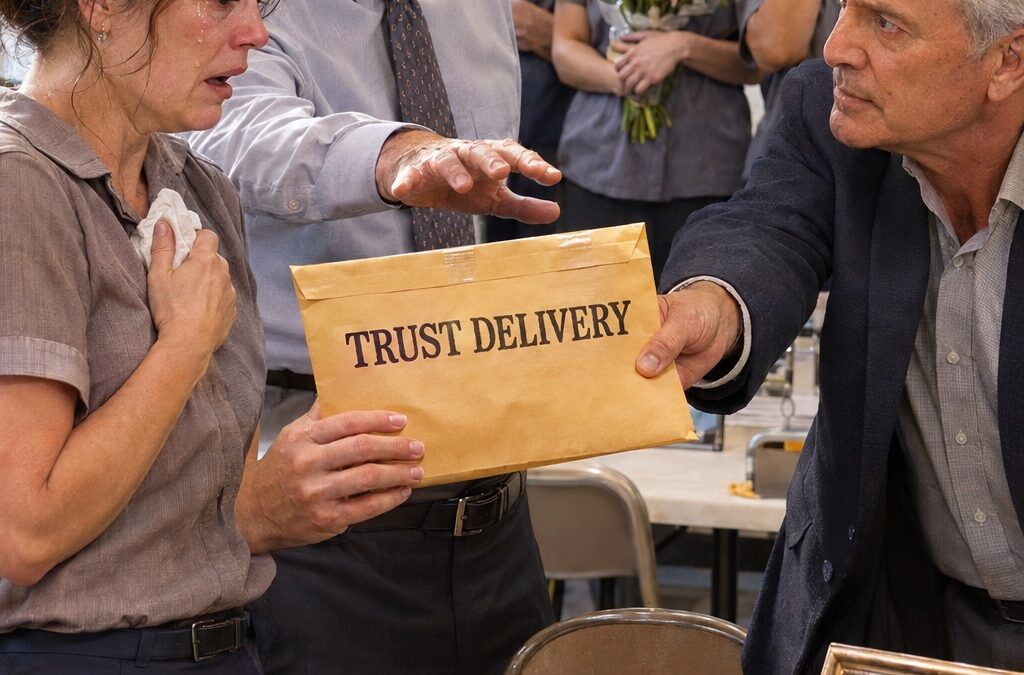
Part 3: The Named Recipient
“The laundry building is designated for distribution to Colleen.”
Arthur read the provision, then turned it toward me.
My name appeared beside the description of the property.
I put my palm flat against the table.
My father bent forward, reading without touching the page.
“That doesn’t make her the owner today.”
“No,” Arthur said. “The transfer still has to happen.”
He separated the proposed deed from the signed trust provision.
“This directs the distribution. This will transfer title.”
My mother looked between the pages.
“You brought all this here for her?”
“Yes. I arranged to deliver it directly to Colleen.”
Arthur tapped the acknowledgment waiting for my signature.
“She hadn’t been told she was the designated recipient.”
My father straightened and pulled his chair closer.
“Then nobody should make decisions over a sandwich.”
“I haven’t asked anyone to,” Arthur said.
I took my name badge off the packet.
It had fallen there when I leaned against the table.
Behind my father, employees still held their paper plates.
Rosa set hers beside the untouched sandwich tray.
My mother reached toward the papers, then withdrew.
“Edith could change her mind about things.”
“She could amend her trust while she was alive.”
Arthur placed the controlling provision over the proposed deed.
“This is her final signed instrument. It governs distribution.”
My father looked toward the office door.
Arthur waited until he looked back at the table.
Then he brought out the reimbursement records.
“These also concern what everyone just heard.”
He opened them beside the cup with the chipped handle.
The receipts were attached to the reimbursement approvals.
I recognized the folded edge of a supply receipt.
I had carried it home in my work pocket.
“Those payments repaid Colleen for care supplies,” Arthur said.
“They weren’t payments for providing overnight care.”
My mother touched the back of Jill’s chair.
“We didn’t say she never helped.”
“You said I spent Grandma’s money,” I said.
Arthur slid the approvals toward the employees nearest him.
“I approved these documented purchases. They weren’t personal spending.”
He laid his visit notes beside the receipts.
“When I visited, Colleen was doing the care.”
My father studied the papers rather than answering.
“Did you see every night?” my mother asked.
“No. I’m explaining what I personally observed.”
Arthur turned toward Jill.
“Do you dispute that Colleen provided the overnight care?”
Jill picked a loose leaf from the bouquet wrapping.
“I visited Grandma. She liked having me there.”
“I haven’t questioned your visits,” I said.
My mother moved her hand from Jill’s chair.
Nobody offered Jill another thank-you.
Rosa came closer and looked at the receipt attachments.
“I saw you coming straight in,” she told me.
“I didn’t know what happened after you went back.”
“I changed clothes there,” I said.
I pulled my work sleeve over a damp wrist.
For months, I had kept clean socks beside Grandma’s bed. Sometimes I found them beneath the blanket while checking her feet. Now my mother was examining the receipt for those same care supplies.
Arthur gathered the reimbursement pages into their own stack.
Then he opened the lease and its rent ledger.
“The building also comes with an existing tenancy.”
My father put his napkin over his plate.
“We don’t need our business accounts discussed here.”
“You asked me to support forgiveness here,” I said.
Arthur looked at me before continuing.
“Please explain what they’re asking me to forgive.”
He placed the ledger where I could read it.
“January through June 2025 rent remains unpaid.”
The total at the bottom was $36,000.
“The monthly rent is $6,000,” he said.
“July is a separate current obligation.”
My father didn’t challenge the total.
Instead, he rested his fingertips on the lease.
“My mother understood this was a family arrangement.”
Arthur turned to the provision about written waivers.
“The lease requires a written waiver.”
“She knew we were keeping the operation going.”
“Is there a written waiver?” I asked.
My father looked at Arthur, not at me.
Arthur answered after leaving him time to speak.
“There is none in the trust’s records.”
My mother pulled out the chair beside mine.
“Colleen, you can still tell him what you want.”
I didn’t sit beside her.
“You want this debt forgiven.”
“We want the family to handle it together.”
“The amount is $36,000,” I said.
My father lowered his voice without moving closer.
“Your wages have kept coming. Remember that.”
I pressed the ledger’s curled corner flat.
“I earned those wages at work.”
“And we need someone we can work with.”
Arthur brought the guarantees out from beneath the lease.
My parents’ signatures were already on those documents.
“The company is the tenant,” he said.
“You both personally guaranteed its payment obligations.”
My father read the page carefully.
He didn’t reach for the envelope again.
“We should review this properly,” he said.
“Yes,” I answered. “I intend to.”
My mother pushed the acknowledgment toward my hand.
“Then tell Arthur you support a family resolution.”
“I won’t sign a rent concession.”
I gathered the lease, ledger, and reimbursement records.
Arthur helped me keep the proposed deed separate.
My father watched every page go into the packet.
“Don’t take employment advice from trust papers,” he said.
I slid the packet into the torn envelope.
The flap wouldn’t lie flat over the thick stack.
Arthur placed his hand beside it, not on it.
“You may review everything before acknowledging the distribution.”
“I’ll take it home.”
My mother stood in the doorway while I collected my purse.
I waited until she moved, then carried the envelope out.
At home, I laid it beside my work keys.
Before I could open it, my phone lit up.
My father’s message read, “We need to discuss your position.”
Part 4: The Written Demand
I put the phone facedown beside the envelope.
Then I cleared the kitchen table.
The lease went beside the ledger, not underneath it.
I clipped the guarantees to the unpaid rent pages.
The reimbursement records stayed in a separate pile.
I didn’t want another argument about those purchases.
When I met with counsel, I brought every page.
I also brought my father’s message about my position.
My lawyer read the lease before discussing any demand.
“Your employment and the tenancy are separate matters.”
“They haven’t treated them that way.”
“Then keep the documents separate even if they don’t.”
We checked the rent provision against the ledger.
We checked the guarantees against the tenant’s obligations.
The lease ran through December 31, 2026.
Neither my father’s management job nor my mother’s ownership changed that.
“What about Jill using space?” I asked.
My lawyer turned to the assignment and subletting language.
“That requires the landlord’s written consent.”
There wasn’t an approved sublease in the packet.
Jill’s plans weren’t property rights.
I asked about the expenses of administering Grandma’s trust.
I didn’t want the building promised and then withdrawn.
Arthur confirmed the trust had other assets for expenses and reserves.
There was no mortgage requiring an immediate sale.
I signed the distribution acknowledgment after reviewing the documents.
I didn’t sign anything forgiving rent.
On July 14, 2025, Arthur completed the transfer.
The deed was executed, delivered, and recorded.
The accrued rent claim was expressly assigned to me.
Arthur showed me the completed papers across a desk.
“This is different from the provision you saw Friday.”
He placed the recorded deed beside the assignment.
“The building has transferred. The accrued claim goes with it.”
I checked my name on each document.
Then I checked the property description against the lease.
For the first time, I put the empty envelope aside.
The originals went into a folder for safekeeping.
My lawyer preserved copies of the ledger and guarantees.
The demand identified the assigned $36,000 in arrears.
It also required payment of the current July rent.
Nothing in it authorized me to stop the laundry.
“What do I do about the doors?” I asked.
“You leave lawful access alone. No lockout.”
“The utilities?”
“They stay on. We enforce the lease through proper steps.”
I went back to work carrying my ordinary lunch bag.
The machines were running when I opened the office door.
My father had the demand spread across his desk.
My mother stood beside him with her arms folded.
They closed the door after I stepped inside.
“So this is how you repay us,” she said.
“The letter asks for rent the company owes.”
My father pointed at the assignment.
“You can withdraw that demand. You’re the landlord now.”
“I won’t waive the arrears.”
“We could decide we need a different shift manager.”
I kept my hand on the back of the chair.
“Are you asking me to trade my wages for forgiveness?”
“We’re asking whether we can count on you.”
“My work and the rent are separate.”
My mother glanced toward the production floor.
“Jill needs cooperation if she’s going to get started.”
“Her business has no approved right to this building.”
My father stopped mentioning Jill.
He asked whether payment could resolve the demand.
“That goes through counsel,” I said.
He sat down and pulled the letter toward himself.
July rent was paid after the demand.
I filed the confirmation apart from the arrears ledger.
At work, I kept checking carts and assigning stations.
I didn’t tell employees the building might change operators.
There wasn’t an agreement yet.
Rosa found me checking the next shift’s work.
“Are they taking your job?”
“They’ve threatened it. I’m making arrangements.”
She held the cart steady while I cleared its wheel.
“I’d rather hear it from you.”
“You will, when there’s something definite.”
A prospective laundry operator toured while operations continued.
The visit was arranged, not a surprise inspection.
I opened the loading area and showed the workflow.
My parents remained in possession under their lease.
The prospective operator asked about the staff and opening routines.
I described the work without offering anybody’s job away.
“I manage shifts,” I said. “I’d want to keep doing that.”
The operator discussed hiring me if a lease went forward.
I had counsel review that arrangement separately.
My wages would pay for managing shifts.
Rent would pay for occupying the building.
Neither would depend on erasing my parents’ debt.
I checked the proposed job terms at my kitchen table.
My lunch bag still smelled faintly of the laundry.
I placed the employment papers away from the property folder.
Then I called counsel about a negotiated surrender.
My parents could pay the arrears and current rent.
They could leave on an agreed date.
The remaining term would be resolved in writing.
I wouldn’t collect their future rent while collecting replacement rent.
I authorized that proposal instead of demanding an immediate departure.
Counsel sent it to my parents for review.
My father called with the surrender agreement before him.
“This ends our lease on September 30, 2025.”
“Yes, if we reach and complete the written settlement.”
He turned a page close enough for me to hear.
“And Jill can’t start her business under our lease.”
“No,” I said. “Your lease would be surrendered.”
He stopped turning pages.
“Your mother wants you here while we read the rest.”
Part 5: The Next Opening Shift
I met them in the office with the proposal.
My father had marked passages along the margins.
My mother had folded the corner of the payment page.
Jill stood beside a stack of proposed business materials.
Nobody asked me to sit in my usual chair.
My father started with the remaining lease term.
“If we pay and surrender, this actually ends it?”
My lawyer had explained that provision before I came.
“The written settlement resolves the remaining term.”
“You don’t get to demand it again afterward?”
“Not after you complete what we’ve agreed.”
He read the release language without speaking.
My mother turned back to the arrears provision.
“You’re still requiring the whole $36,000.”
“Yes.”
“And current rent until we leave.”
“Through September 30, 2025.”
Jill pulled a sample sheet from her stack.
“What about the work I’ve already done?”
My father kept his eyes on the agreement.
I looked at the sheet she held against herself.
“It doesn’t give you rights under their lease.”
“You knew they were making room for me.”
“I knew you were discussing it.”
My mother pressed her folded page flat.
“We could have handled this without involving lawyers.”
“You threatened my job over unpaid rent.”
She moved the payment page back beneath the others.
My father asked for the signature copies.
They reviewed the settlement with their own advice before signing.
I didn’t demand an answer across the office desk.
When the signed agreement came back, I checked every attachment.
The guarantees and assigned claim were addressed in writing.
The surrender date matched the end of their current rent obligations.
I signed my copy at the kitchen table.
Then I put the completed agreement in the property folder.
The $36,000 payment came through under the settlement.
I waited for confirmation before marking the arrears paid.
Current rent was paid through September 30, 2025.
I kept those confirmations with the settlement, not the receipts.
Grandma’s care purchases no longer belonged in that conversation.
At the laundry, my father stopped asking for forgiveness.
Our conversations became carts, schedules, and the agreed handover.
He still owned the operating business with my mother.
He no longer spoke as though they owned the walls.
Jill came to remove her proposed business materials.
She spread them over the office counter before packing.
There were linen samples and printed plans for the space.
I moved the shift clipboard so she could stack them.
“You could have said something before all this,” she said.
“I didn’t know I was receiving the building.”
“I mean about the flowers.”
“You heard what Rosa thanked you for.”
Jill squared the edges of the printed sheets.
“I didn’t want to argue at Grandma’s luncheon.”
“You let them say I hadn’t done the care.”
She put the samples into the box.
I held the office door while she carried it through.
My mother followed with the remaining loose papers.
They didn’t leave any proposed business materials behind.
Rosa watched them pass, then returned to her cart.
Later, she joined me beside the schedule.
“I owe you something about that luncheon.”
“You didn’t know whether she shared the nights.”
“I should have let her answer before thanking her.”
I slid the clipboard onto its hook.
“She could have corrected it.”
Rosa nodded, looking at the hook instead of me.
The employees had heard Arthur’s explanation at the same table.
They had seen the reimbursement approvals and rent ledger.
Still, questions came quietly while we worked.
Was my job going away?
Would their jobs go away?
Was the building being sold out from under them?
I answered only what had been settled.
“A new operator has signed a lease.”
“The staff is staying.”
“I’ve accepted the shift manager position.”
Rosa asked whether my parents could reverse it.
“They signed the surrender. The handover is arranged.”
She carried that answer back without adding anything.
On September 30, 2025, my parents completed their departure.
We checked possession against the written surrender terms.
My father handed over the keys he had kept.
My mother checked the office drawers before closing them.
I didn’t search their bags or stop their vehicle.
Counsel confirmed completion under the settlement.
There was no unpaid balance left from the assigned arrears.
There was no claim for duplicate rent afterward.
My father paused at the office doorway.
“You’ll still be opening tomorrow?”
“Yes. I’m the shift manager.”
He looked toward the machines, then left with my mother.
On October 1, 2025, I arrived carrying my lunch.
The new operator opened under its own lease.
It was unrelated to my parents’ business.
The rent was $6,000 monthly, paid separately from my wages.
I checked that distinction before signing either agreement.
Then I put on my name badge and checked attendance.
The employees reported to their familiar work areas.
Rosa found a cart blocking the route and moved it.
I checked the opening work instead of checking my phone.
Nobody called me into the office about forgiving rent.
At lunch, I took the same seat as before.
I had brought the delivery envelope from home.
Its papers were filed, and its torn flap lay flat.
Rosa set her lunch beside mine and pulled out a chair.
“Mind if I sit here?”
I moved my bag off the seat for her.
We opened our lunches while the next shift settled in.
Beside my own lunch lay the emptied envelope marked “TRUST DELIVERY.”
You Might Also Enjoy




