My Husband Announced His Mistress Was Taking My Cottage — Then I Asked About My Supposed Signature
Part 3: The Paragraph He Added
“Your coordination fee is $12,000?” I asked.
Wade pressed his fingers against the paper, but I lifted it before he could cover the rest.
The price was $120,000, including the advance Celia had already paid. His fee came out of that price, leaving $108,000 for the person whose cottage he was selling.
Me.
Below that, he had personally promised to return Celia’s entire $18,000 advance if the owner had not authorized the sale.
His initials sat beside the promise. His signature was below it.
I read that portion aloud. Celia leaned closer, following along, while Wade pulled at the front of his gray jacket.
“You weren’t supposed to need that part,” he told her.
“Where is her money?” I asked.
He looked at Celia instead.
“Wade.”
“I used it.”
“For what?”
“Existing bills. My credit card.”
Celia put her hand against the table. She had paid him three days before the party, she said. He had already spent it.
I checked the paragraph again, following each line with my finger. My payroll job had taught me to slow down when somebody wanted me to hurry past an amount.
The advance wasn’t extra money.
It was part of the purchase price, and he had spent it before getting my permission to sell anything.
“You can still agree,” he said.
“No.”
He glanced toward Brent, who was standing near the end of the table. June moved the empty plates away from my elbow without speaking.
I spread the agreement flat again.
“You signed this promise,” I told Wade. “I didn’t.”
“That doesn’t mean you can’t finish the arrangement.”
“There is no arrangement with me.”
He drew his mouth tight, then asked whether I understood how much trouble I was causing over something we could settle ourselves.
I placed my ownership printout beside the agreement again.
The county record showed my name alone. It did not tell anyone who had written the other signature, and I didn’t claim it did.
“This shows who owns the cottage,” I said. “I’m telling you separately that I never signed this.”
Celia looked between the papers.
“Then he owes me the advance back.”
“That’s something to take up with him.”
Wade reached for the agreement again, this time asking to read his own paragraph.
I turned it toward him without letting go.
He read silently. Celia watched his face.
Nobody needed to explain the refund promise to him.
June cleared a dry space farther down the table, away from the cake. I moved the papers there because frosting had touched the edge of my handbag.
My empty plate stayed behind.
Celia followed me. Wade did too.
“I said you could keep it,” Celia told me when he objected. “I still mean that.”
I asked her to look through the pages with me before I put them away. Nothing would be separated or written on.
She nodded.
We checked the printed terms, the signature attributed to me, and the paragraph she said Wade had added. His initials were easy to find once I knew where to look.
I took photographs with my phone.
Then I photographed the entire agreement again with its edges visible, so there would be no question about something being left out.
Wade watched me do it.
“You’re treating me like a stranger.”
I kept the phone over the paper until the picture was clear.
“You offered my cottage without asking me.”
“We’ve talked about selling.”
“You talked. I said I was renting it again.”
He lowered his voice.
There had been plenty of room for him to speak normally when he thought I would accept what he had done. Now he wanted every word kept close.
I asked Celia where she wanted her copies sent.
She gave me the information, checked that the photographs arrived, and opened them on her phone. Only then did I put the original inside my handbag beside the ownership printout.
Wade saw exactly where it went.
“You don’t need to keep both.”
“Yes, I do.”
Brent came closer as I closed the clasp.
“Can we at least stop standing by the cake?”
June looked at him.
“Mara didn’t bring this here.”
He rubbed his palm down his trousers and stepped aside.
I picked up my plate because leaving it there suddenly bothered me. There were crumbs stuck to it, though I couldn’t remember eating anything.
Celia walked with me toward the edge of the room.
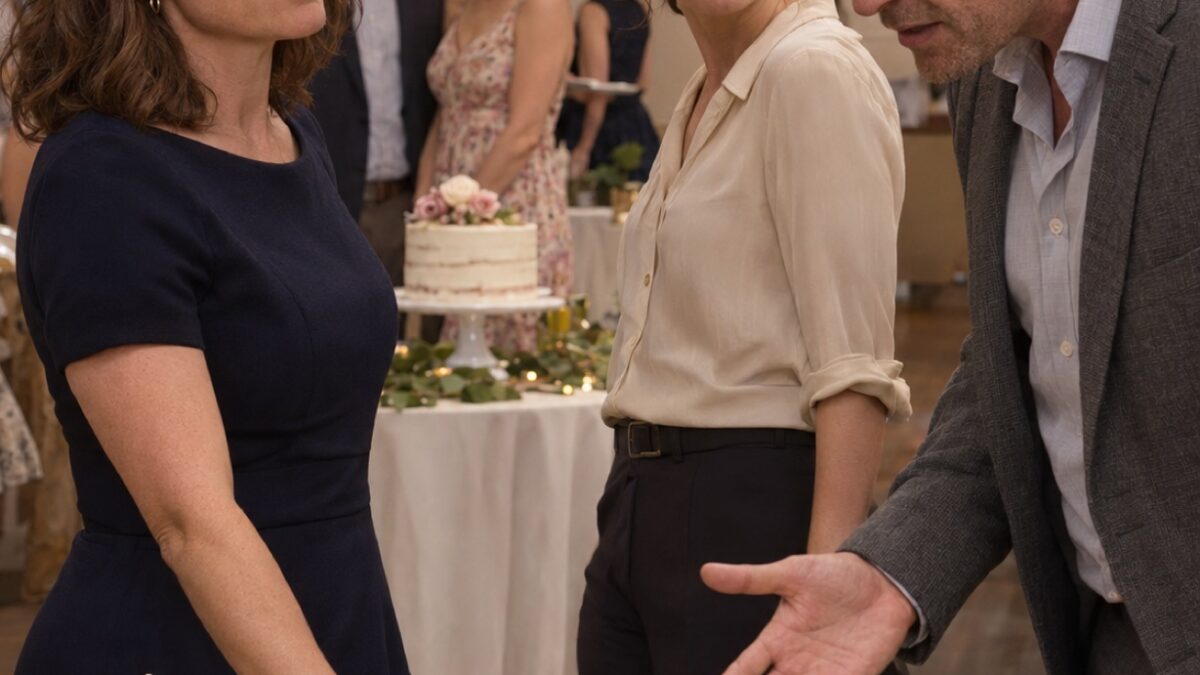
She kept enough distance that our shoulders didn’t touch. Her cream blouse had a crease across the front from leaning over the table.
“I thought you knew,” she said.
“About which part?”
Her eyes dropped.
“The sale. The separation.”
“I knew neither.”
She didn’t argue.
I told her I would have the agreement reviewed the next business morning. I was not accepting her advance, her price, or any obligation Wade had made.
“I’m not asking you to,” she said.
Wade came up behind her.
“We don’t need to turn a misunderstanding into something permanent.”
I turned toward him.
“I’m keeping the paper.”
He looked at my handbag, then at Celia’s phone.
Celia tightened her grip on it.
I remembered him standing in our kitchen during those months of pushing a sale, waiting for me to agree that the cottage was too much work.
He had never mentioned her price.
He had never mentioned paying himself.
Now he asked if I would at least consider the offer after I had calmed down.
“No.”
Celia moved her thumb across her phone screen.
“There’s more you should have,” she told me.
Wade stopped talking.
She held the phone close while she searched, then turned it so I could see a conversation with his name at the top.
“These are about the cottage.”
“Don’t send private conversations around,” he said.
She looked at him.
“You brought me here with an agreement you said she signed.”
I asked her to preserve the conversation as it was, not just the messages that looked important. She nodded and began finding the earlier exchanges.
Wade tried to speak to her quietly.
She stepped away.
I had been ready to leave with the paper. Now I stood still, my handbag against my side, waiting while she moved back through their messages.
Celia found an exchange, held the screen toward me, and said, “Read what he told me about getting your permission.”
Part 4: What He Put in Writing
“He said he would get you to agree afterward,” Celia said.
She held the phone steady while I read his message.
The words weren’t about collecting a signature he already had.
They were about persuading me later.
Farther down, Wade had told her not to contact me directly. He would handle the conversation, he said, because hearing from her would make it harder.
I read that message again.
He had told Celia I had signed while privately planning how to obtain the consent he didn’t have.
“That’s out of context,” he said.
Celia scrolled upward and handed me the phone.
“Then read the rest.”
I did.
The surrounding messages concerned the cottage, the proposed sale, and how he wanted the handover discussed. They did not turn his promise to get my consent later into proof that I had already given it.
I handed the phone back.
“Send the whole conversation about the property.”
Wade put his hands on his hips.
“You’re making copies of things that have nothing to do with you.”
“My cottage is the subject.”
Celia sent the messages while we stood there. I waited until they arrived and checked that I could open them.
Then I asked her not to delete anything.
She said she wouldn’t.
Brent came over as I put my phone away.
“Are you leaving?”
“Yes.”
He glanced toward Wade, but I didn’t wait for either of them to suggest another private discussion.
I went back to June.
“I’m sorry this happened here.”
She took the plate I was still holding.
“You don’t have to carry that.”
I let her have it.
Outside the rented room, I opened my handbag to make certain both papers were inside. The agreement rested against the ownership printout, folded along the creases Celia had made.
Wade followed me into the hallway.
He asked where I thought this would go if I involved an attorney.
“To someone who can review what you did.”
“You could have asked me.”
“I did. At the table.”
He looked back toward the party door.
I left without giving him the original.
The next business morning, I laid the papers on a clear part of my table before getting ready for work. I saved the photographs and messages somewhere other than just my phone.
Then I checked the copies against the original.
Nothing was missing.
I put the ownership printout, our marriage agreement, and the sale agreement together for the property attorney. The printout had come home from an ordinary insurance errand.
Now it was going with a signature I hadn’t written.
At the attorney’s office, I kept my handbag on my lap until I was asked for the documents.
“Start with what you personally know,” the attorney said.
I explained where I had been standing, what Wade had announced, and how Celia had given me the agreement after I asked to see my supposed consent.
I described his attempt to call it a sample.
Then I described his claim that I had agreed verbally.
The attorney made notes.
“Did you?”
“No.”
“Did you authorize anyone to sign for you?”
“No.”
I was asked about access, a deed, and any closing arrangements.
I had approved none of them.
I explained that the cottage was between tenants. That did not mean it was available for Wade to sell or hand over.
The attorney examined the marriage agreement and my ownership information, then looked through the messages Celia had sent.
“This needs a clear written response,” the attorney said.
That suited me.
I didn’t want another conversation where Wade could later claim I had nodded, softened, or asked for time to decide.
The notice stated that I had not signed or authorized the agreement, had given Wade no authority to sell, and would not approve access or a transfer.
I read it before it went out.
The attorney also explained that the county record established the reported ownership, not who had made the false signature. We would keep those facts separate.
I asked that the original remain available.
It was copied without being altered, and I took it home.
Making the police report was harder than handing over the papers at the attorney’s office.
I had to say my husband’s name and describe the signature again.
I kept to what I could establish.
I had not seen anyone write my name. I knew I had not written it, and I had never authorized anyone else to write it for this sale.
I provided the agreement copies and the messages.
I reported what Wade had said about spending the advance, making clear that this was his admission at the party.
Nobody promised me an arrest.
I didn’t ask for a promise.
I wanted an accurate report made while the events were fresh and the documents were preserved.
When I returned home, I set my work bag down without opening it. Payroll would be easier to concentrate on than this, but I still had Wade’s messages to answer.
He had begun calling the attorney’s notice unnecessary.
Then he changed his approach.
He said there was still a practical solution.
I let him explain it in writing.
He proposed going forward at the same price. I could sign properly now, Celia would get the cottage, and his refund obligation would no longer be the immediate problem.
He called it the least expensive way out.
I read that sentence with my thumb resting against the edge of the screen.
The cottage had been mine before our marriage. Its rent paid its expenses, and money left after those expenses had also paid for groceries we both ate.
Now he wanted the whole property used to settle his promise to Celia.
He said he had savings but should not have to drain them when the sale could still happen.
I placed the phone beside the attorney’s notice.
Before I could answer, another message appeared.
“Will you sign now so I don’t have to return money I already spent?”
Part 5: The Empty Signature Space
“No,” I wrote.
Then I added, “I will not sell the cottage, and none of my money will be used for your refund.”
I read the reply before sending it.
There was no apology in it and no invitation to bargain.
Wade called immediately.
I let it ring while I forwarded the exchange to the attorney. Then I answered his next message in writing, telling him to address the agreement through the attorney.
He wanted to discuss what I would be keeping if I sold.
He listed the work I wouldn’t have to do anymore. No rental calls. No maintenance arrangements. No empty cottage while I found another tenant.
Those were familiar arguments.
The refund was new.
I opened my rental folder and looked at the expense records before answering anything else. The cottage’s bills were paid from its own income. There was no unpaid property problem requiring this sale.
I closed the folder.
His existing personal debt was not a cottage expense.
When I spoke with the attorney again, I put Wade’s proposed solution beside the original agreement.
“He says signing now would straighten it out.”
“Only if you chose to enter a sale,” the attorney said. “You’ve said you don’t.”
“I don’t.”
The attorney explained that the agreement bearing a signature I had not made or authorized did not establish my consent. The ownership record supported whose approval was needed, but my denial and the other evidence still mattered.
I wanted that understood precisely.
Not just by me.
The attorney checked the property records and the claims around the proposed transaction. No deed had transferred ownership. There was no scheduled closing to stop and no completed sale to undo.
I still owned the cottage.
The relief was practical.
I could keep arranging the next rental. I did not have to negotiate with Celia about leaving, because she had never been given possession by me.
I asked whether anything in the notice could be mistaken for agreement to sell later.
The attorney reviewed it with me.
It could not.
At home, I put a copy of that notice in the rental folder, separate from ordinary repair receipts. I wanted to be able to find it without searching through everything else.
Then I answered a property message I had left sitting since the party.
For the first time since Celia unfolded the agreement, I did something about the cottage that wasn’t about Wade.
Celia contacted me after receiving the written notice.
She said she was pursuing her advance directly from him.
I did not ask how their relationship stood. She did not offer to explain it.
“I’m relying on what he signed,” she said.
“That’s between you and Wade.”
“I know.”
She sent the relevant exchange so it could be preserved with the rest. Her demand was directed to him personally, citing his promise to return the entire $18,000 if the owner had not authorized the sale.
There was no demand that I reimburse her.
I read it, saved it, and acknowledged receiving it.
Wade sent me a message afterward accusing me of encouraging her.
I had not negotiated her demand or promised to pay it.
I answered with that fact.
He said Celia had misunderstood how the advance would be used.
I did not know what he had told her before she paid. I did know what he had admitted beside June’s cake table.
I would not improve that account for him.
He had separate savings. He had said so while asking me to rescue the sale, and the money he owed was not being held in my rental account.
I kept paying the cottage’s expenses as usual.
Nothing went to Wade.
Brent asked to speak with me while the written account was being put together.
I agreed to hear him.
He arrived looking as though he had practiced an apology and then forgotten where to begin.
“I should have checked with you,” he said.
“Yes.”
He sat with his hands together. I left my papers in their folder instead of spreading them out.
“I didn’t know the signature wasn’t yours.”
“I haven’t said you did.”
He nodded quickly.
That mattered to him.
It mattered to me too. He had known about a proposed sale. That was not the same as knowing someone had put my name on an agreement without permission.
I said that plainly.
For a moment, he seemed ready to leave it there.
Then he asked what exactly I was putting in writing.
“What happened.”
“About the property?”
“And what was said when I found out.”
He glanced at the folder.
I could still see him beside the cake table, looking toward June before admitting Wade had told him. He had been more concerned with the party being disrupted than with checking whether I knew my cottage was being offered.
“I said something stupid,” he told me.
“You said you thought warning me would ruin the party.”
“I know.”
He rubbed his hands together.
He wasn’t disputing the words. He wanted them left out.
I opened the folder and took out my notes, not the original agreement. His name appeared in the account where he had admitted learning of the proposed sale.
There was no claim that he had seen the false signature beforehand.
I showed him that portion.
“That’s accurate,” he said.
Then he asked me to remove it anyway.
I put the page down between us.
He talked about June, their engagement, and how the account would look to anyone who read it later. He said he was trying to keep his own mistake from becoming part of Wade’s problem.
I waited until he finished.
He leaned forward and tapped the place where his admission appeared.
“Can you leave the family out of the written account?”
Part 6: The Account I Kept
“I can leave out anything that isn’t true,” I said.
Brent stopped tapping the page.
“I’m not saying it’s false.”
“Then it stays.”
He looked at the wording again. I let him read without interrupting.
The account said he had known of the proposed sale before the party and had not checked with me. It also said he had not known the signature was false.
Both belonged there.
I was not going to accuse him of helping create the agreement. I was not going to pretend he had been as surprised by the proposed sale as I was.
“You knew about the sale,” I told him. “You didn’t know about that signature. That’s what I’ve written.”
He pushed the page back.
“I wish I’d called you.”
“So do I.”
There wasn’t much else to say.
When he left, I returned the notes to the folder and sent the accurate account to the attorney. I did not add what Brent had looked like or what I thought he might have meant.
His own words were enough.
Later, June sent a brief message asking whether I needed anything from the room that had been left behind.
I told her I had everything.
I did not use her message to ask about Brent.
The cancellation was ready two weeks after the party.
I read the proposed wording at the attorney’s office with the original sale agreement beside it. My ownership printout was underneath, its corner showing.
The cancellation identified the agreement Celia had brought to the party and ended the proposed transaction. Wade’s acknowledgment stated that I had never authorized him to sell the cottage or sign on my behalf.
I checked that line carefully.
I did not want a cancellation that made it sound as though I had changed my mind about a sale I had previously approved.
Wade wanted different language.
He preferred an arrangement that had “not proceeded,” without stating why his supposed permission was absent.
The attorney brought the issue back to me.
“No,” I said. “I never authorized him.”
That fact remained.
I was not being asked to sign a replacement sale agreement, and I would not have done so.
Celia’s advance remained his responsibility. The cancellation did not convert it into money I had received or a debt attached to the cottage.
Wade read the papers in front of him.
He asked whether signing would end the property dispute.
“It ends this proposed sale on the stated terms,” the attorney explained.
It did not promise him a particular result from the factual report I had already made. It did not require me to withdraw truthful information.
He read again.
Then he signed.
I watched the pen leave the paper before I touched my copy.
His genuine signature was there beside an acknowledgment that the authority he had claimed at the party had never existed.
I took my copy home.
That week, Celia confirmed that the full $18,000 had been returned.
Not a partial payment.
Not a promise to pay when something else sold.
Wade used his separate savings, and the refund was made in full. The records provided through the attorney matched Celia’s confirmation.
I checked the amount and put the confirmation away.
The advance had been included in his proposed purchase price, not added on top. Nothing about returning it entitled him to collect a fee or substitute money from my rental income.
His $12,000 coordination fee was gone with the sale he had never been authorized to arrange.
Celia did not ask for access again.
I did not offer it.
The cottage stayed off the market for sale. I went there with my rental folder and walked through the rooms without taking a call from Wade.
The windows needed checking before the next viewing.
I tested them, made my notes, and closed them again.
In the kitchen, I set the folder on the counter. There was room to work without moving anybody else’s things.
The vacancy had been his excuse.
For me, it was simply the time between tenants, when I could look carefully and get the place ready.
I had been doing that for eight years.
I still knew how.
When divorce negotiations began, I gathered the papers that existed before the party as carefully as the ones created afterward.
The marriage agreement went with the purchase records. The cottage’s rental records stayed together, showing its income and expenses.
I also provided the records for the household grocery spending.
I had nothing to hide there.
Part of the net rent had helped feed us during our marriage. That had been my choice, not a sale of part of the cottage to Wade.
The attorney asked me to keep property discussions in the written process.
I was glad to.
At home, Wade had begun talking about fairness rather than permission. He no longer insisted that the party agreement had been authorized.
He had signed the acknowledgment that it hadn’t.
Now he said marriage should count for something when the cottage’s value was discussed.
I put the request with the other divorce correspondence.
He had not managed the property. I had not given him an interest in it. Our marriage agreement had expressly kept it separate.
Still, seeing the request made me sit down.
I had listened to him tell Celia she could measure the windows. I had watched him admit spending her advance. Now the sale had been canceled, the refund paid, and he was asking for the property another way.
I took out the marriage agreement rather than calling him.
The pages were familiar. We had agreed to them before marrying, when keeping the cottage separate had not seemed controversial.
I brought them to the next discussion.
Wade’s request had been put in writing by then, where it could be answered without another argument in our kitchen.
He asked for a share of the cottage’s value in the divorce.
Part 7: The Cabinet Beside My Desk
“The cottage remains yours under the settlement,” the attorney said.
I moved the final papers closer and read the property provision again.
Eight months after the party, the divorce was final.
The settlement honored the separate ownership we had agreed to before marrying. Wade received no interest in the cottage, no proceeds from a sale, and no coordination fee.
There had been no sale.
I checked my name and the description of the property, then read the provision once more before putting the papers down.
I had expected to feel ready to leave as soon as the result was explained.
Instead, I asked for a moment.
My handbag was on the chair beside me. Inside were the documents I had brought because I still disliked arriving anywhere without what I might need.
The attorney waited while I checked the copies I was taking home.
Nothing required Wade’s permission for me to continue renting the cottage.
Nothing gave him access.
I asked whether any property-related matter between us remained to be signed.
For the settlement, there was nothing further.
I closed my folder.
There was no new outcome to report from the police matter, and I did not invent one when anyone asked. I had made a factual report and provided the evidence.
The property result was clear without adding anything to it.
Wade’s acknowledgment remained in writing. Celia had received her refund from his savings. The agreement he had presented as settled business had not transferred my cottage.
I went home with my own copies.
At my desk, I took the sale agreement out of its temporary folder.
The crease across it had become soft from being opened and closed. I remembered Celia smoothing it near June’s cake table, still believing she had brought something legitimate.
I set it aside while I dealt with the rental papers.
There was work waiting.
I reviewed the cottage’s expenses and the money available for maintenance. The records were still mine to keep, not something to prepare for Wade’s approval.
I arranged what needed doing before the next tenant.
The calls came to me.
When somebody needed an answer about the cottage, I gave it instead of checking whether Wade had already promised something else.
That took getting used to.
Not because I had needed his permission before.
Because I no longer had to wonder what he might say behind my back and call a conversation we had already had.
At the cottage, I checked the windows again.
The rooms were empty, and I moved through them with my notes. I looked at the places a prospective tenant would notice and the things I needed to check before handing over keys.
I did not think about curtains until I reached the window Celia had been told she could measure.
Then I tested the latch.
It worked.
I wrote that down and went on to the next room.
The property wasn’t a prize I had won from Wade. It was still a rental cottage with ordinary work attached to it.
That was what I had wanted to keep.
I could manage the work around payroll, as I had before. I could set aside its income for its expenses, decide what was available afterward, and make those decisions without a husband selling them as proof of his ownership.
I put the rental folder on the kitchen counter while I checked my messages.
An inquiry had come in about a viewing.
I answered the practical questions first.
Brent contacted me after the divorce became final.
His message did not ask me to change anything this time. He said he hoped we could talk.
I read it while eating at my own table.
Then I finished my meal before replying.
I told him I was willing to keep contact limited and in writing for now. I wasn’t ready for family conversations about Wade or explanations of what everyone had meant at the party.
Brent said he understood.
I did not promise that things would return to the way they had been.
June sent her good wishes separately. I thanked her.
There was no need to make her carry messages between us, and I didn’t ask her to.
My reply to Brent stayed short.
He had apologized, and I had kept the distinction in my account: he knew about a proposed sale, not the false signature. That accuracy had mattered even when I was angry.
It did not require me to spend my evenings making him comfortable.
I put the phone down and cleared my plate.
Later, I returned to the cabinet beside my desk.
The retained original agreement was still waiting where I had set it, along with the county ownership printout I had obtained on the morning of the party.
I placed them next to each other.
The printout had never been something Wade signed or approved. I had requested it for an insurance review, put it in my handbag, and carried it into that rented room without knowing I would need it there.
It showed my name alone.
The other paper held the price Wade had chosen, the signature I hadn’t written, and the paragraph that made his refund promise personal.
I did not mark either original.
Copies could be used if the papers were ever needed again. These would stay together, where I knew exactly how to find them.
I added the cancellation and the refund confirmation to the file.
The divorce papers had their own place.
Then I checked that no rental application or ordinary maintenance receipt had slipped between the agreement’s pages.
My phone sounded on the desk.
The prospective tenant had another question.
“Can we see the cottage before deciding?”
I set the phone beside the open cabinet while I finished filing.
“Yes,” I wrote. “I handle the viewings. We can arrange a time.”
I sent the answer myself.
Then I put the phone down and closed the drawer, leaving the original sale agreement in my own file, away from Wade, with my county ownership printout resting directly beneath it.
You Might Also Enjoy




