My Husband Declared My Furniture Business Finished While I Was Grieving — Then My Daughter Stepped In
Chapter 1: Dinner Was Supposed to Help
My husband called me a burden over dinner at an upscale restaurant and announced my furniture business was finished, eighteen days after my aunt’s funeral.
Wade leaned toward me, throwing an arm toward the dining room doorway before lowering it.
“You’re a burden. Your furniture business is finished.”
He wasn’t whispering.
The woman at the nearby table stopped talking about dessert. I could still see her spoon held above her plate.
“A burden?”
I took a breath before saying anything else. My napkin had slipped against my navy dress, and I pulled it back onto my lap.
“I’ve booked the clear-out,” he said. “You’re selling everything and quitting weekends.”
He settled back as though he had finally explained something difficult.
I looked at his charcoal shirt, neatly buttoned at the cuffs. He had changed before we left home. Apparently, this was something he had dressed for.
“What clear-out?”
“The furniture. The units.”
Those units held my business stock. My business paid for them, and only I could end the rentals. Wade wasn’t even listed for access.
Inside was furniture with an estimated retail value of $38,000.
Estimated retail.
Not guaranteed sale proceeds, not cash waiting for him to allocate, and certainly not a pile of unwanted belongings taking up space.
Some pieces were ready for customers. Others needed repairs, cleaning, or photographs. I knew which drawers stuck and which chair seats needed attention.
He knew almost none of that.
“You mean you called somebody for an estimate?”
“No. I booked them.”
I set my fork down beside my plate.
Wade had picked the restaurant. He had called it “somewhere nice” when he invited me, and he had reminded me that Erin would join us after her shift.
We were supposed to have dinner.
Before the food arrived, he had said it would be good to spend an evening without business talk. I had agreed because I was tired, not because I intended to give up the business.
Now he was discussing its end within hearing of strangers.
I started that business eight years ago, before Wade and I married. For the six years we’d been married, its earnings had paid our groceries and utilities. At first, he liked telling people what I did, especially when somebody admired furniture I had found and restored. The complaints came later, when customers wanted weekend pickups and he wanted me available without having to ask. I kept moving appointments because I thought that was an ordinary part of being married.
Not this.
“You booked somebody to move my stock?”
“To clear it,” he said. “There’s a difference.”
“I understand the difference.”
“Then don’t make it sound like I hired a moving company.”
I looked toward the doorway. A service employee stepped aside for someone carrying plates, and the ordinary movement of the restaurant continued around us.
Nobody was coming over.
I didn’t expect them to. Still, I noticed.
“What exactly are these people doing?”
“Collecting it. Selling it somewhere else. You won’t have to organize buyers.”
“I already have buyers.”
“You have messages. Then you spend your weekends waiting around.”
I pressed my knees together beneath the table.
During my aunt’s final weeks, I had paused sales. After the funeral, I began answering customers again, slowly, checking old conversations before promising appointments.
Wade had handled some ordinary arrangements while I was distracted. He had taken care of meals and household errands without asking me to decide every detail.
I had thanked him.
I hadn’t asked him to decide whether I would keep working.
“You’ve barely been doing it lately,” he said.
“My aunt died.”
“I know.”
“Then why are we having this conversation here?”
“Because at home you keep putting things off.”
I had stopped reaching for my phone whenever I remembered something I wanted to tell her. Sometimes I still opened our messages before remembering there wouldn’t be an answer.
That wasn’t putting off a business decision.
There hadn’t been a business decision.
“When were you going to ask me?”
“I’m telling you now.”
“That isn’t asking.”
“You would have made it complicated.”
The woman nearby lowered her eyes to her plate. Her companion moved a glass farther from the edge of the table.
I kept my voice low.
“When are they coming?”
“Tomorrow morning.”
That changed what I needed to do.
I had been trying to understand why my husband would say this over dinner. Now I needed to find out who might be arriving at my storage units while I was still trying to stop them.
“Who authorized it?”
“I did.”
“You can’t authorize that.”
“I’m your husband, Tessa.”
He said my name like a correction.
I was 44. Wade was 47. We had been married six years, and until that moment I hadn’t realized he thought those facts gave him control of work I had started before we met.
“They’ll empty the units,” he continued, “and I’ll tell the facility we’re done.”
“We?”
“You know what I mean.”
The rental payments were current. My business had paid $480 monthly for the units for four years.
There was no unpaid bill forcing this.
He wanted my weekends.
“Erin knows how those rentals work,” I said.
“She manages the place. She’ll understand.”
He knew my daughter’s job. Somehow, he had never thought to ask what it actually allowed him to do.
I moved my plate away without taking another bite.
“Give me the service’s name.”
“You don’t need to call them and confuse everything.”
“If somebody is coming for my stock, I need to know who.”
“They have the information.”
“From you.”
“Yes. I handled it.”
He picked up his glass, then put it down again when I didn’t answer.
For the first time that evening, he seemed irritated that his announcement hadn’t produced relief.
“How much did you spend booking this?”
“Six hundred.”
I watched his face.
He wasn’t embarrassed. He seemed to expect appreciation for advancing the money.
“You paid that yourself?”
“On my card. You can reimburse me.”
The amount sat between us while someone at the next table asked for the check.
I hadn’t hired anybody. I hadn’t agreed to sell anything.
Wade glanced at my untouched plate, then back at me.
“You can pay me back when they collect it tomorrow.”
Chapter 2: Who Rents the Units
“No,” I said.
Wade stopped reaching for his glass.
“It’s for your business.”
“I didn’t hire them.”
“You’re being difficult over a reservation payment?”
“You booked it without asking. I’m not paying your clearing service.”
He leaned back.
That bothered him more visibly than my questions about the furniture. He had expected the business to repay the expense of shutting itself down.
“You’ll have money when the furniture sells.”
“You don’t get to spend that for me.”
“I’m trying to get our weekends back.”
“You could have asked about a weekend.”
“I’m talking about all of them.”
I folded the napkin and placed it beside my plate. I needed my hands free, even though I hadn’t decided what I would do next.
He watched me.
“Don’t make a scene.”
I looked toward the nearby diners, then back at him.
“You called me a burden.”
“I’m saying this has become too much.”
“For whom?”
“For us.”
He had switched from announcing a decision to describing a shared problem. The collection was still scheduled for morning.
“My business pays that rent.”
He gave a short laugh through his nose and tilted his head.
“I’ve already taken care of it.”
I saw Erin beyond the dining room doorway.
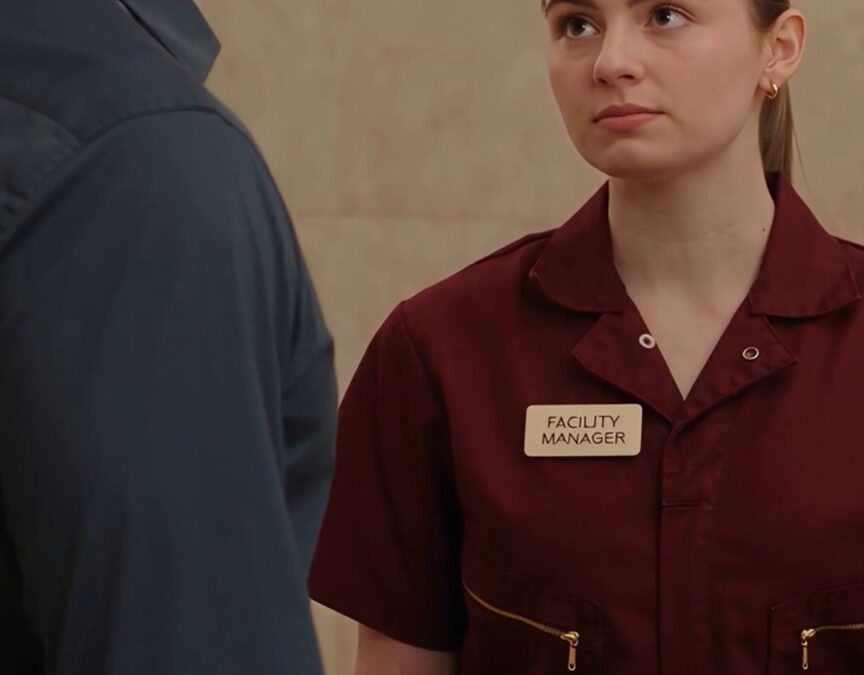
She was standing in the adjoining foyer, still wearing her burgundy uniform jumpsuit. Her work bag rested against her hip.
I stood.
Wade said my name as I moved away from the table.
I didn’t answer until I reached my daughter.
Erin stepped beside me. Wade followed, stopping just behind me, close enough that I could hear him take a breath before she spoke.
“What’s going on?”
“He booked somebody to clear my units.”
“I’m helping your mother close this down,” Wade said.
Erin turned toward him.
Her badge was pinned to her chest where it always was during work. The lettering caught the foyer light.
FACILITY MANAGER.
“Wade, Mom rents those units. You can’t give them up.”
“Wait.”
His expression changed.
He had followed me out of the dining room still looking impatient. Now he looked at Erin’s badge, then at me, as though some necessary part of the conversation had been left out.
“The clearing service called about access this afternoon,” Erin said. “I told them they needed the renter’s permission.”
“I’m her husband.”
“You’re not on her account.”
“I know where the units are.”
“That doesn’t give you access.”
A service employee passed the foyer entrance and slowed enough to avoid us. Behind Wade, diners were still close enough to hear.
Erin didn’t raise her voice.
Neither did I.
“Only I can end those rentals,” I said.
“Only you,” she confirmed.
I turned slightly away from Wade, facing the open space near the entrance.
“I’m not paying your clearing service.”
He didn’t laugh this time.
Erin was 25, independently employed at the facility, and very careful about keeping my account separate from our relationship. She had never treated my rentals as a family favor.
That was why I trusted her answer.
“I wasn’t asking for special treatment,” Wade said.
“You were asking to surrender space you don’t rent,” Erin replied.
“I assumed we could handle it as a household.”
“You should have checked.”
He glanced toward the dining room.
The nearby witnesses mattered to him now. They hadn’t mattered when he announced I was finished working.
“What did the service ask you?” I said.
“Whether they could come in for a collection tomorrow morning. I told them entry required your authorization.”
“Did you give them a code?”
“No.”
“Did you approve anything?”
“No, Mom.”
I let my shoulders settle.
Nothing had left yet.
The stock was still where I had put it. The collection had been arranged, but Wade hadn’t somehow made the facility accept his authority.
Erin shifted her work bag farther behind her.
“I hadn’t approved access,” she said to Wade. “That wasn’t a detail you could sort out after they arrived.”
“I thought you’d understand what I was trying to do.”
“I understand what you asked.”
He rubbed a thumb along the side of his phone without unlocking it.
“I was trying to help. She’s been carrying too much.”
For a moment, I could see how he expected that explanation to work.
I had been grieving. I had been tired. I had accepted help with meals and ordinary errands. He wanted those things to make the rest seem reasonable.
Erin looked at me.
I straightened the strap of my purse.
“The business isn’t behind on anything,” I said. “It’s been paying the same household expenses it always paid.”
Wade moved his mouth as though he was about to interrupt.
Erin faced him before he could.
“The business you called a burden has been paying your groceries and utilities.”
He looked past her.
There was nowhere private for him to put that sentence. It had been said in the same restaurant where he had announced my business was finished.
“I pay other expenses,” he said.
“Nobody said you didn’t,” I answered.
Erin stayed beside me.
I appreciated that she hadn’t turned it into a contest over every household payment. The issue wasn’t whether Wade contributed. The issue was that he had dismissed my contribution while trying to dispose of it.
“I didn’t know you’d discussed our finances with her,” he said.
“She knows I work.”
“You know what I mean.”
“Yes,” I said. “I do.”
I took my phone from my purse.
I wanted the service’s contact information, not another argument about what he thought marriage entitled him to arrange.
“Give me the booking information.”
“We can discuss it at home.”
“The collection is tomorrow morning.”
“It doesn’t have to be a confrontation.”
“Then give it to me.”
He looked down at his phone but didn’t open it.
Erin watched that delay. Then she turned fully toward me, no longer asking Wade to explain himself.
“Mom, did you give anybody permission to sell that stock?”
Chapter 3: What He Told Them
“No, I didn’t.”
I said it to Erin while looking at Wade.
“I haven’t approved a collection, a sale, or closing the rentals.”
Erin nodded once.
“Then tell the service that directly.”
Wade unlocked his phone.
“I already explained the arrangement.”
“Not to me.”
I held out my hand, but I didn’t try to take his phone. I wanted him to show me the booking contact, not give him another subject to argue about.
He opened a confirmation message and turned the screen.
I copied the contact information into my phone.
The screen on his went dark before I had seen the full message.
“What did you tell them?” I asked.
“That there was furniture to clear.”
“And what happens after they collect it?”
“They resell it. I told you.”
Erin moved enough to let someone pass through the foyer. Then she returned beside me.
I called the service.
Wade remained behind my shoulder as I explained who I was, which facility held the stock, and that a collection had apparently been booked without my permission.
The employee asked for the booking contact.
I gave Wade’s name.
Then I said, “I own the business whose furniture you’ve been asked to collect.”
Wade shifted closer.
“I’m here,” he said toward the phone.
I put the call on speaker, keeping the volume low enough for our small group.
The employee asked whether we were disputing authorization.
“Yes,” I said. “I didn’t authorize anybody to remove or sell my stock.”
A pause followed.
I could hear typing.
“We can suspend the collection while ownership is verified.”
“Please do.”
Wade lifted his hand, palm up.
“I booked a service. Nobody was trying to steal anything.”
“I’m not calling it theft,” I said. “I’m saying you didn’t have permission.”
The employee asked whether I could identify the business and provide an email address for the disputed-ownership correspondence.
I gave the information requested.
They explained that they could send the booking details concerning the collection and the disposition instructions, with payment-card information excluded.
“Send those,” I said. “I need to know what was arranged.”
Wade looked toward the entrance.
“I could have forwarded it.”
“You haven’t.”
The employee confirmed that collection would remain suspended pending verification. That wasn’t cancellation yet, and I repeated it back to make sure I understood.
“No one comes while this is unresolved?”
“That’s correct.”
I thanked the employee and ended the call.
For the first time since Wade said “tomorrow morning,” I could stop imagining a vehicle at the facility while I argued over dinner.
I opened my email.
Nothing yet.
Erin pointed toward the bench along the foyer wall.
“Do you want to sit?”
“Not yet.”
My knees felt stiff from holding myself still at the table. I walked to the bench anyway and set my purse beside me.
Wade stayed standing.
“You could have let me explain it privately.”
“You announced it publicly.”
“I didn’t expect this reaction.”
“What reaction did you expect?”
He glanced at Erin.
I waited.
He didn’t answer.
A restaurant employee approached to ask whether we needed anything. I said we were handling a problem and would settle our dinner before leaving.
The employee nodded and returned to the dining room.
It was such an ordinary exchange that I nearly cried.
Instead, I checked my phone again.
The message arrived while Wade was saying that these services were designed to save people time.
I opened it.
There were booking details at the top, followed by a description of the collection. The furniture would be taken offsite for resale.
That matched what he had finally told me.
I scrolled farther.
The disposition section was short.
I read it again because I thought I must have misunderstood what “remaining items” referred to.
Then I read it aloud.
“Anything unsold after a week is to be donated.”
Erin looked at Wade.
He didn’t look surprised.
I lowered the phone.
“A week?”
“It’s a clear-out service.”
“After a week, they give it away?”
“They have to move things through.”
I had a chair in storage that needed a repair before I would even offer it to a customer. There were pieces whose buyers needed time to arrange transport.
A week wasn’t a sales plan for my inventory.
It was his deadline for having none of it left.
“You never asked what was ready,” I said.
“They handle furniture.”
“You never asked what customers were waiting for.”
“They’d sell what they could.”
“And donate the rest.”
He looked annoyed by the word now that I was saying it.
“It’s standard with this kind of arrangement.”
Erin leaned close enough to read the screen when I turned it toward her.
She didn’t take my phone. She read the instructions, then stepped back.
“Mom didn’t agree to that,” she said.
“We’ve established that,” Wade answered.
“No,” I said. “We established you couldn’t close my rentals. I didn’t know you’d arranged to give away anything that didn’t sell quickly enough.”
He put his phone in his pocket.
I kept mine open.
The written instruction was there. Nobody had to remember his wording later or decide which of us had sounded more convincing.
He had not shown it to me before dinner.
He had not asked what that instruction would cost my business.
I stood, picking up my purse.
Wade started to speak, but I turned the screen toward him and waited until he looked at the line I had just read.
“Why would you tell them to give my furniture away?”
Chapter 4: Only Contact Him
“It’s routine,” Wade said.
I kept the phone between us.
“Routine for whom?”
“For a company that clears stock. They can’t keep everything indefinitely.”
“You chose that arrangement.”
“I chose a way to finish this.”
There it was again.
Not an attempt to help me catch up. Not a proposal I could review when I was ready. He wanted my work finished, with the leftovers gone before I could reconsider.
Erin folded her hands around the strap of her bag.
“The facility wouldn’t have approved removal without Mom,” she said.
“I understand that now.”
His tone had changed.
He wasn’t arguing that he controlled the rentals anymore. Instead, he wanted us to treat the donation instruction as an ordinary feature of a service I happened not to like.
I scrolled back toward the beginning of the email.
I wanted to see what else had been described as routine.
Wade watched my thumb move.
“What are you looking for?”
“The rest of what you arranged.”
“You have it.”
“I’m reading it.”
The booking record listed the customer who had requested collection.
Wade’s name.
Below that was the statement the service had recorded about authority to dispose of the stock.
I read it silently before saying anything.
He had identified himself as the owner authorized to sell or otherwise dispose of the furniture.
There was also a contact instruction.
All communication was to go through him.
Not the business.
Not the renter.
Him.
I turned the screen toward Erin, then toward Wade.
“You told them you owned it.”
“I told them I could make the arrangements.”
“That isn’t what this says.”
He looked at the screen.
His jaw moved before he answered.
“They needed somebody responsible for the booking.”
“They asked whether you owned the stock.”
“I’m your husband.”
“We already covered that.”
A diner passed us on the way toward the entrance. Wade waited until the person was out of hearing before lowering his voice further.
“I wasn’t making some legal declaration.”
“You were telling them they could take my furniture.”
Erin looked at the contact instruction.
“Why were they supposed to deal only with you?” she asked.
“So there wouldn’t be confusion.”
I stared at him.
He had planned to tell me over dinner and have the stock collected the next morning. Meanwhile, the people collecting it had been told I wasn’t the person they should contact.
There had been a practical reason I knew nothing.
“You made sure they wouldn’t call me,” I said.
“I was managing it.”
“Without my permission.”
He didn’t answer.
I saved the email to the folder where I kept business correspondence. Then I saved a copy of the attachment separately.
I wasn’t hiding what I was doing.
Wade watched.
“You don’t need to build a case against me.”
“I need a record of what somebody was told about my stock.”
Erin stayed quiet.
That helped more than another argument would have. I could read, save, and decide without having to answer him after every sentence.
I called the service again.
The employee located the disputed booking. I identified myself and confirmed that I had received the instructions.
“I want the collection canceled before dispatch.”
Wade leaned forward.
“Hold on.”
I looked at him.
“Do you have permission to collect my stock?”
He didn’t answer the question.
“You haven’t even considered whether some of this could be useful.”
“I have considered it.”
I returned my attention to the call.
“I’m not authorizing removal, resale, or donation.”
The employee asked whether I was claiming ownership of all the stock scheduled for collection.
“Yes. It belongs to my business.”
“And the booking customer is making a conflicting ownership representation?”
I looked directly at Wade.
“He identified himself as the owner. That’s incorrect.”
“I’m right here,” he said.
The employee asked him to confirm that he had made the booking.
He did.
That was all he confirmed.
The employee explained that, because the booking contained an ownership claim that now conflicted with mine, they needed records establishing whose stock was involved before closing it.
The collection would remain suspended.
I asked what records they could accept.
Existing purchase documentation and inventory information connecting my business to the furniture would help. They would send the request in writing so I could respond to the same correspondence.
I wrote that down in the notes on my phone.
Wade watched me do it.
“You’re making a simple cancellation complicated.”
“The ownership claim made it complicated.”
“I’m not trying to take anything now.”
“Then don’t interfere while I correct it.”
The employee asked us not to arrange collection separately while the dispute was being reviewed.
“I won’t,” I said.
Wade finally said he understood.
I could hear Erin breathe out beside me.
I asked whether we needed to keep talking from the restaurant.
“No,” the employee said. “Send the records through the email thread.”
I repeated that no access had been authorized and that the facility had already declined advance entry.
The employee noted it.
My dinner was still in the dining room, probably cold. I could see our table through the doorway, the napkin I had folded beside the plate.
I hadn’t imagined leaving a restaurant with homework proving that my business furniture was mine.
But that was what his booking required.
Before I ended the call, the employee stated the condition plainly enough that Wade couldn’t mistake it for my preference.
“We need to establish whose stock this is before we close the booking.”
Chapter 5: Getting Ready Before Morning
I opened my inventory folder at the kitchen table.
Wade set his keys down near my elbow, then moved them when I pulled the laptop closer.
We had settled the restaurant check and left without finishing dinner. Erin had gone from the foyer knowing I would use the facility’s regular process to confirm my instructions.
She wasn’t going to resolve an account matter by being my daughter.
I appreciated that.
At home, I changed out of the navy dress and returned to the table with my phone, laptop, and the folder where I kept purchase receipts that hadn’t started as digital files.
Wade remained standing.
“What do they actually need?”
“Records showing what I bought.”
“I could just tell them to cancel.”
“You can tell them you no longer want the service. I still need the ownership issue corrected.”
He pulled out a chair.
I didn’t ask him to help sort the records.
That wasn’t punishment. I knew where things were, and I didn’t want the person who had misrepresented them deciding which documents mattered.
The inventory descriptions matched photographs I had taken when pieces arrived. Purchase receipts and messages showed where stock had come from and that my business had acquired it.
I opened the relevant records.
Then I compared them with the inventory list before attaching anything.
My aunt had once asked how I remembered so many drawer pulls and table legs. I had shown her the pictures on my phone.
That small memory made me stop with my hand on the mouse.
Wade mistook the pause.
“You don’t have to do all this tonight.”
“The collection was scheduled for morning.”
“They said it was suspended.”
“And I want it canceled.”
I continued.
I sent existing purchase records with the inventory information tying them to the stock. I didn’t send unrelated household records or turn the message into a description of our marriage.
I kept it practical.
The stock belonged to my business. I had not authorized its collection or disposal. I wanted written confirmation that the booking would be closed before dispatch.
I read the email before sending it.
Then I read it again for anything I had accidentally left unclear.
Wade watched the screen from his side of the table.
“That makes it sound like I was pretending to be someone else.”
“It says what you told them.”
“I used my own name.”
“You claimed authority you didn’t have.”
He pushed his chair back a little.
I sent the email.
Next, I opened the facility’s regular account channel. My name was on the rentals, just as it had been for four years.
The total monthly charge was $480.
I checked that the account details were unchanged and submitted written instructions denying access for the proposed collection. I also requested confirmation of who could authorize entry or end the rentals.
I didn’t ask for a favor.
I didn’t put Erin in the position of choosing whether to protect her mother or follow facility rules. The rules already required my authorization.
Wade leaned toward the laptop.
“Do you think I’m going to sneak in?”
“You booked people to collect the furniture.”
“That isn’t what I asked.”
“I’m making sure the instructions are clear.”
He sat back.
The facility’s normal acknowledgment arrived. I saved it with the other correspondence and checked that my denial of access was included.
I kept the service’s response too.
The employee confirmed receipt of the purchase records and said the collection remained on hold during review. They would address cancellation through the booking correspondence.
I didn’t mistake that for the final cancellation.
I left the thread open.
The house was quiet except for the refrigerator and Wade shifting in his chair.
Usually, if I worked at the table after dinner, I would clear everything away when he looked impatient. I would tell myself I could finish later.
Not that evening.
I put the receipts back in order.
I needed to be able to find them again without rummaging through a pile while someone waited on the phone.
Wade picked up a photograph from the edge of the folder.
“This one’s ready to sell, isn’t it?”
“Yes.”
“And that table?”
“Yes.”
He pointed toward the inventory screen.
“Those could go. You wouldn’t have to give up everything.”
I took the photograph from him and returned it to the folder.
“No collection is authorized.”
“I’m suggesting a compromise.”
“A compromise would require me wanting part of this.”
“You want to sell furniture.”
“To customers, through my business.”
“They sell furniture too.”
I closed the image he was pointing at.
He had stopped trying to surrender the rentals. He had stopped defending the donation instruction. Now he was choosing the pieces he thought would turn into money fastest.
That still left him deciding how my stock should leave.
“Some customers have already asked about those pieces,” I said.
“Then let this service sell something else.”
“You don’t know which pieces are committed.”
“You can tell them.”
“I’m not hiring them.”
He rubbed his face and looked toward the dark window above the sink.
“I’m trying to find something we can agree on.”
“We can agree that you don’t arrange removal of stock you don’t own.”
He didn’t take that answer.
Instead, he leaned forward again, looking at the inventory list as though a smaller quantity would change who had authority to decide.
“Then let them take part of it.”
Chapter 6: His Booking, His Payment
“No,” I said.
I moved the inventory folder away from his reach.
Wade looked at the folder, then at me.
“You won’t even consider it.”
“I considered it. I’m not authorizing a partial collection.”
“You’re going to sell those pieces eventually.”
“That doesn’t mean you choose the buyer or the terms.”
He opened his mouth and stopped.
The service’s message arrived while we were still at the table.
I recognized the subject line and opened it before touching anything else.
They had reviewed the material I sent. The collection was canceled before dispatch, and no removal would take place under that booking.
I read the sentence aloud.
Wade leaned closer.
“Does it say anything about the payment?”
“Keep reading.”
I turned the laptop enough for him to see.
The employee had addressed the reservation payment separately to him as the booking customer. The cancellation terms he had accepted made the $600 nonrefundable.
There was no further cancellation fee.
I read that carefully too.
I didn’t want to win an argument in the kitchen and discover later that he had been charged something neither of us understood.
The terms were straightforward.
He had paid to reserve the service. Canceling before dispatch stopped the collection, but it didn’t return that payment.
Wade stared at the screen.
“They haven’t done anything.”
“They reserved the collection.”
“They didn’t send anybody.”
“That’s why there isn’t an additional charge.”
He reached for his phone.
I didn’t stop him.
If he wanted the company to explain its terms directly, that was between him and the service. I had already said I wouldn’t reimburse a booking I hadn’t made.
He called, identified himself, and asked about the money.
I stayed at the table.
He put the call on speaker after the employee located the booking.
“I understand it’s canceled,” he said. “I’m asking why you’re keeping the reservation payment.”
The employee referred him to the terms accepted when he booked.
He opened the confirmation on his phone.
This time he didn’t turn the screen away.
The employee explained that the payment reserved capacity for the collection and was nonrefundable under the terms he had accepted. No vehicle would be dispatched, and no further cancellation fee would be due.
“I didn’t realize that was absolute,” he said.
“It was part of the booking terms.”
He scrolled.
I watched him find the relevant wording.
He didn’t accuse them of changing it.
He asked whether they could make an exception.
The employee said the reservation payment would be retained.
That answer annoyed him, but he didn’t keep arguing. He asked for written confirmation of the cancellation and payment status.
It was a sensible request.
The employee said it would be sent.
After he ended the call, he placed the phone faceup between us.
For a while, neither of us spoke.
I gathered the loose receipts and put them into the folder.
The collection had been stopped before anybody entered the units. The stock hadn’t moved. My rentals remained mine to continue.
There was still a husband sitting across from me who thought I should have helped make his plan less expensive.
“You could reimburse me,” he said.
“No.”
“I’m not asking the business to shut down anymore.”
“That doesn’t make this my expense.”
“I booked it because of your furniture.”
“You booked it because you wanted me to stop working weekends.”
He looked down.
I wanted him to say that part himself.
Instead, he picked up the phone and checked whether the written confirmation had arrived.
When it did, he opened it.
I asked him to forward the cancellation confirmation so I could keep the complete record with the service correspondence. He did.
I saved it.
The message identified the canceled collection and the retained reservation payment. There was no remaining collection to approve and no extra fee waiting behind the cancellation.
I closed the laptop.
Wade seemed to take that as a sign the disagreement was finished.
“So we can stop going over it.”
“The collection is stopped.”
“That’s what I said.”
“No. You said we could stop going over what you did.”
He pushed his chair back.
“What else do you want tonight?”
“I want you to stop asking me to pay for it.”
He stood, then sat again.
I could see him reconsidering his argument.
He couldn’t say I had hired the service. He couldn’t say he controlled the stock. The employee had pointed him to terms he had accepted himself.
So he made the cancellation my decision instead.
“You could have let some furniture go. You chose not to.”
“Yes.”
“And now the payment’s gone.”
“The terms were the same when you booked.”
“You’re acting like I threw money away for no reason.”
I rested my palm on the closed folder.
I knew his reason.
He wanted weekends that he didn’t have to negotiate, and he had spent his own money trying to make that happen without my agreement.
He looked at the cancellation email again, then turned the phone toward me.
“You stopped it, so why should I lose the money?”
Chapter 7: The Morning Nobody Came
“Because you hired them,” I said.
I left the folder closed beneath my hand.
Wade waited, apparently expecting more.
There wasn’t more.
I hadn’t accepted the booking terms, used my card, or authorized the work. Canceling an unauthorized collection didn’t make me responsible for the expense of arranging it.
He took his phone from the table.
“I understand you’re not going to change your mind.”
“Correct.”
We left it there for the night.
In the morning, I opened the service correspondence before making breakfast. The cancellation was still plainly stated, but I wanted the dispatch question answered without any room for misunderstanding.
I replied to the thread.
Please confirm no vehicle will be dispatched and no additional amount is due.
Wade came into the kitchen while I was setting a cup beside the laptop.
“Checking again?”
“Yes.”
“They already told us.”
“I want the final status together.”
He looked over the chair back without sitting.
I didn’t apologize for checking. The original collection had been scheduled for that morning, and I wasn’t interested in discovering that separate parts of the service had received different instructions.
The reply arrived while I was putting things away.
No vehicle would be dispatched. The booking was canceled. The $600 reservation payment would be retained under the accepted terms, and no additional cancellation fee was owed.
I saved the reply.
Then I closed the laptop.
Wade watched me put it away.
“That’s it, then.”
“For the service.”
He understood the distinction, even if he didn’t like it.
I went to the facility during normal business hours.
I didn’t arrive expecting a confrontation at the gate or a stranger standing with my furniture. The collection had been canceled, and the facility had never approved access.
Still, I wanted to see the stock.
Erin was at work when I entered the office.
She looked up from what she was doing.
“Everything canceled?”
“Yes. In writing.”
“Good.”
I asked about the account confirmation through the normal process. She checked what had been recorded and confirmed that I remained the renter and authorized account holder.
Wade had no authority to end the rentals.
My denial of collection access was documented.
Erin didn’t turn the screen into a family discussion. She checked the account, answered the question, and returned to the ordinary steps of her job.
That steadied me.
“Do you need anything else?” she asked.
“I’m going to check the units.”
“All right.”
I walked out with my keys.
The corridor looked exactly as it had before dinner. There was no evidence that my husband had tried to make it the last morning of my business.
I opened the unit and stood just inside.
Everything was there.
The furniture pads were where I had left them. A drawer I had removed for cleaning sat on its shelf. The chairs were grouped so I could reach the piece behind them without dragging anything across the floor.
I touched the edge of a table.
Then I checked the inventory on my phone against what was in front of me.
Not because I thought Erin had missed something.
I needed to replace the imagined clear-out with the ordinary work of knowing what I had.
I moved through the stock, looking at condition notes and photographs. Some customer messages needed answers. Some pictures needed updating.
Those were manageable things.
I opened the other unit and checked that too.
Nothing had been collected.
Nothing had been prepared for somebody else’s truck.
I crouched to inspect the foot of a cabinet, then stood and brushed dust from my trousers.
At the restaurant, Wade had called the entire business a burden. Here, it was furniture I had bought, repaired, documented, and planned to sell.
I could decide what happened next.
Before leaving, I returned to the office.
Erin was occupied, so I waited until she looked up.
“All there,” I said.
She smiled briefly.
“Of course.”
I didn’t tell her she had saved me by being my daughter. She had done her job correctly, and that was what had prevented someone’s assumption from becoming access.
“Thank you for keeping it straight,” I said.
“That’s how the account works, Mom.”
“I know.”
I went home with the keys in my purse and customer messages waiting on my phone.
Wade was in the kitchen when I came in.
“Everything okay?”
“The stock is untouched.”
“I told you I wasn’t going to go there.”
“The service isn’t going either.”
He nodded.
I put my purse on a chair and opened a customer conversation. The message concerned availability, not the argument at dinner.
Wade watched me begin typing.
“So you’re just going back to how it was?”
“I’m answering a customer.”
“I mean us.”
I set the phone down.
He wasn’t asking for reimbursement now. He wasn’t suggesting a smaller collection.
He wanted the result he had originally tried to buy, without moving the furniture.
“I still want time with you,” he said.
“You can ask for that.”
“I don’t want to keep checking whether you’re free.”
“You still have to ask.”
He pulled out the chair opposite mine.
“Can you at least promise me your weekends?”
Chapter 8: Not an Agreement
“No, I can’t.”
I left the customer message open beside my hand.
Wade looked at the phone.
“All of them matter more than spending time together?”
“That isn’t what I said.”
“What are you saying?”
“You can ask for shared time. You can’t cancel my work to get it.”
He sat back.
I could see how easily we might spend the morning arguing about whether wanting time together was reasonable. Of course it was reasonable.
That had never been the problem.
“If you want dinner together, ask,” I said. “If you want to go somewhere, ask. I’ll tell you what I have scheduled.”
“And if you’re working?”
“Then we discuss another time.”
“You used to move things.”
“Sometimes I still will.”
He glanced at the phone again.
“But not because you’ve already promised somebody I’m free,” I added.
He rubbed the edge of the table with his thumb.
I had done that too, at the restaurant, staring at a surface because looking at him made the words harder to get out.
Now I waited.
“I thought getting rid of the stock would make it easier for you,” he said.
“No.”
“You’d been overwhelmed.”
“My aunt was dying. Then I was grieving.”
“That affected everything.”
“Yes. It did.”
I picked up my cup, found it empty, and set it back down.
He wasn’t wrong that grief had affected our household. I had eaten meals he arranged and let ordinary tasks go longer than usual.
But a temporary pause in work wasn’t permission to end it.
“You could have asked whether I needed help,” I said.
“I did help.”
“With ordinary things. I thanked you.”
“And apparently that counts for nothing.”
“It doesn’t authorize the rest.”
He looked away.
I let him.
I didn’t need to deny every helpful thing he had done to say that this had been wrong. I could remember the meals and still remember the donation instruction.
My phone lit with the customer’s follow-up.
I answered the practical question, checked the wording, and sent it.
Wade waited until I put the phone down.
“We probably need counseling.”
I looked at him.
That was the first suggestion he had made that didn’t require giving up furniture.
“What would we be going to discuss?”
“Us. The business. How much it takes over.”
“No.”
His face tightened.
“You won’t even try?”
“I won’t attend counseling framed as fixing my business habits.”
“That’s not fair.”
“I’m willing to discuss our marriage.”
“Then what’s the difference?”
“The difference is whether you’re asking somebody to help you understand what you did or help you persuade me to quit.”
He opened his mouth, then closed it.
I stood to rinse the cup.
It gave me something ordinary to do while he considered his answer. I ran water, washed it, and put it on the rack.
When I turned around, he was still at the table.
“I don’t want to be treated like a villain in front of a stranger.”
“I’m not asking for that.”
“What are you asking for?”
“For you to describe what happened accurately.”
“I booked a clearing service.”
“And?”
“I tried to close the rentals.”
“And?”
He frowned.
“You’re making me recite it.”
“You keep leaving parts out.”
I dried my hands on the towel and hung it back where it belonged.
The conversation didn’t improve because I said the right sentence. He remained defensive. I remained tired.
But I no longer had a collection to stop before morning, and that changed what I could refuse.
I could let him be dissatisfied without rushing to provide a softer version.
He got up and walked toward the doorway.
I returned to the customer messages.
Later, he came back while I was sorting appointment requests at the table.
He didn’t ask which pieces would sell fastest.
“Can we talk about counseling again?”
“Yes.”
“I understand you don’t want it to be about making you stop working.”
“Correct.”
“I still want us to have more time together.”
“We can discuss that too.”
He pulled out a chair but waited before sitting.
“What if I explain the booking?”
“Not as something you did for me.”
He looked down at the chair seat.
I could see him deciding whether he wanted the discussion enough to say what had actually happened.
“I wanted the weekends,” he said.
“I know.”
“I thought if the stock was gone, you’d stop taking appointments.”
“Yes.”
He sat.
That was closer than “trying to help,” but it wasn’t all of it.
I didn’t fill in the remaining facts for him.
The purchase records were saved. The cancellation was saved. The instructions existed in writing whether he chose to describe them or not.
He folded his hands on the table, then unfolded them.
“If I admit exactly what I arranged, will you come with me?”
Chapter 9: Saying What Happened
“Yes, if you acknowledge what you actually authorized.”
I closed the customer conversation so I could listen without looking back at the screen.
Wade sat opposite me.
He didn’t start with my schedule this time.
“I told them I owned the furniture and could authorize getting rid of it.”
I waited.
“That wasn’t true.”
“No,” I said. “It wasn’t.”
“I asked them to deal only with me.”
“Why?”
“Because I didn’t want you stopping it before I explained.”
I looked at him for a moment.
At the restaurant, he had called that avoiding confusion.
Now he was saying what the contact instruction had been meant to accomplish.
He continued before I had to ask.
“I agreed they could donate anything they hadn’t sold after a week.”
“Without asking what was in the units.”
“Yes.”
“Or which pieces customers were considering.”
“Yes.”
He looked down at his hands.
“I wanted it finished.”
I didn’t tell him it was all right.
It wasn’t.
But I stayed at the table.
“The reservation payment was mine,” he said. “I booked it. I accepted the terms. You don’t owe me the $600.”
“Correct.”
“And I can’t end your rentals.”
“No.”
He swallowed.
“I know you paid for groceries and utilities from the business. I shouldn’t have called you a burden.”
I picked up the folded towel I had left near my laptop and carried it to the drawer.
It was a small task, but I needed the movement before sitting down again.
When I returned, he hadn’t changed the subject.
“I still want us to talk to somebody.”
“I’ll go.”
He nodded, then reached for his phone to begin arranging it.
I asked to see the appointment options before anything was confirmed.
He stopped, looked at me, and turned the screen so we could both read it.
That was a small change.
It mattered because I hadn’t had to discover the appointment after he made it.
We began counseling.
At the appointment, Wade described the booking himself. He said he had falsely represented himself as authorized to dispose of the stock, included the donation instruction, and tried to end rentals that were in my name.
He didn’t blame the service for accepting his booking.
He didn’t claim Erin had embarrassed him by following the account rules.
I listened with my hands resting around the strap of my purse.
When it was my turn, I described dinner.
I said what it had been like to sit in a public dining room, grieving my aunt, while my husband announced that the business I had built was finished.
I didn’t need to repeat the insult loudly.
Saying it in that room was difficult enough.
We discussed shared time too.
I hadn’t refused that subject. I wanted evenings together that didn’t begin with resentment about work, and I wanted to be able to move an appointment as a choice rather than a duty.
My business hours remained mine.
Nobody needed to agree that every customer request was perfectly timed. We needed to agree that Wade couldn’t dispose of the inventory to prevent me from accepting requests.
After the appointment, he didn’t ask whether counseling had convinced me to cut back.
He asked whether I wanted to talk or go home quietly.
“Quietly,” I said.
“All right.”
I watched the streets through the window.
We were still married.
That didn’t make the restaurant disappear. It meant we had gone home with the facts said aloud and another conversation ahead of us.
Back at the house, I opened the customer messages I had left unanswered during the appointment.
Wade came into the room with his phone.
“I was thinking about making plans,” he said. “What does your schedule look like?”
I turned mine toward him.
There were customer appointments I intended to keep.
He read them.
Instead of asking which could be canceled, he pointed to an open stretch.
“What about then?”
“That works.”
He checked with me before confirming.
I didn’t praise him for asking a basic question. I told him the time worked, and we made the plan.
That was what I had wanted him to do before dinner ever happened.
The business resumed in ordinary pieces.
I answered questions about condition. I checked measurements against my notes. I arranged a pickup and put it on my schedule.
I stopped treating every appointment request as something I had to apologize for before accepting.
Wade saw me working at the table and asked whether I needed the space left clear.
“Yes, please.”
He moved his things.
Later, he asked about a household errand and checked whether it interfered with the pickup.
It didn’t.
I told him.
These weren’t grand gestures, and I didn’t want them turned into proof that we were finished dealing with what had happened.
They were different routines.
We kept the counseling appointment.
He stopped asking me to repay the reservation payment.
The service didn’t contact us about further charges, and no collection was revived. The cancellation remained closed, with his payment retained under his terms.
My rentals continued.
I put the inventory folder back where it belonged instead of keeping it at the kitchen table in case I had to defend it again.
As I closed the drawer, Wade stopped in the doorway with his phone in his hand.
“Are you still working this weekend?”
Chapter 10: Back at the Units
“Yes,” I said.
“I have a scheduled pickup.”
Wade looked at his phone, then back at me.
“Do you know when you’ll be home?”
“I’ll message when I finish.”
“All right. I’ll make my own plans.”
He didn’t sound delighted that I was working.
I didn’t need him to.
He hadn’t committed me to anything, promised my availability, or suggested another way to clear the stock. He had asked, received an answer, and arranged his own time.
I checked the pickup conversation once more before leaving.
The customer knew where to meet me. I had confirmed which furniture was being collected and what needed to be brought for loading.
No sudden sale changed everything.
It was an ordinary appointment, the kind Wade had wanted to eliminate when he said I was quitting weekends.
I put my keys in my purse.
He was looking over his own plans when I passed through the kitchen.
“Have a good pickup,” he said.
“Thanks.”
I left without explaining again why I was allowed to go.
At the facility, I stopped in the office before meeting the customer.
Erin was behind the counter, wearing the burgundy uniform jumpsuit I had seen in the restaurant foyer.
Her badge was pinned to her chest.
FACILITY MANAGER.
She looked up.
“Pickup today?”
“Yes.”
“Everything arranged?”
“Yes. I’m early enough to get the pieces ready.”
She nodded and returned to the screen long enough to finish what she had been doing.
I waited.
It felt good to wait for my daughter to finish her work without worrying that somebody else’s plan was about to erase mine.
When she looked up again, I asked about the practical side of getting the furniture out without blocking anyone.
She answered as the manager.
We discussed where I should bring the pieces and keeping the passage clear. I didn’t have to explain that the stock belonged to my business.
I didn’t have to mention Wade.
Erin didn’t either.
“Need anything else?” she asked.
“No. I’ll let you get back to it.”
She glanced at my purse.
“You’ve got your keys?”
I held them up.
That made her smile.
I went to the units.
Inside, I set my bag out of the way and opened the inventory notes. The furniture for the pickup was where I expected it to be.
I checked it before moving anything.
A drawer needed to be secured for transport. I wrapped the loose part separately so it wouldn’t shift and marked what belonged with it.
These were the details that disappeared when Wade called it all a clear-out.
A customer wasn’t taking an anonymous portion of a pile. They were collecting furniture I had described, photographed, and prepared.
I knew what I was handing over.
I knew what remained.
Before moving the chosen pieces, I shifted a chair far enough to make a safe route through the unit. Then I returned it to a position where I could reach it later.
There was no deadline requiring everything unsold to be donated.
There was no stranger deciding which pieces were worth the trouble.
The stock could sell on the schedule my business required.
My phone lit with a message from Wade.
He had arranged his own afternoon and wanted to know whether I needed anything picked up on his way home.
I answered the question.
I didn’t send him a defense of the pickup or an estimate of how much I expected to earn.
He hadn’t asked for either.
Then the customer arrived.
I met them where we had agreed and brought them to the prepared furniture. We went over the condition details I had already disclosed and checked the pieces before loading.
The conversation stayed on the furniture.
That was all it needed to be.
I pointed out the separately wrapped part and explained where it belonged. The customer checked it, asked a practical question, and helped arrange the load so nothing would shift.
When the pickup was complete, I returned to the unit.
There was space where the furniture had stood.
I updated my inventory notes and checked that the remaining stock was secure. Then I locked up.
I hadn’t finished the business.
I had finished an appointment.
Before leaving, I stopped at the office again.
Erin was handling work at the counter, so I waited near the doorway until she could speak.
“All done?” she asked.
“All done.”
“How did it go?”
“Fine. Everything fit.”
She asked whether the drawer had been the one I had mentioned while preparing.
“Yes. Wrapped it separately.”
“Good.”
That was our conversation.
Ordinary work.
I didn’t tell her I was keeping my weekends. She already knew I was working. I didn’t have to promise that things at home were perfect, either.
We were attending counseling. Wade had acknowledged the false ownership claim, the donation instruction, and the payment he alone owed.
He was making plans after checking my schedule instead of making commitments for me.
Those changes needed to continue.
I could leave that work for the conversations where it belonged.
Here, I had inventory to update and a daughter who was on the clock.
I told Erin I was heading home.
She nodded toward the paperwork waiting beside her keyboard.
“I need to get back to this.”
“I know.”
I picked up my purse and checked that my keys were inside.
The next furniture I intended to prepare was already chosen in my notes. I would return for it according to the appointments I made, using the rentals my business continued to pay.
Erin turned back to her own job, reaching for the paperwork beneath the light that fell across her badge.
You Might Also Enjoy




