My Husband Ordered Me Out of Christmas Dinner Before His Mother’s Lawyer Recognized My Work

Part 3: The Room Beside The Kitchen
Malcolm set his bag on a folding table.
I left my coat on.
“What does his objection say?”
“He alleges Alma couldn’t understand the care agreement.”
Dean stopped just inside the doorway.
For a moment, I watched him straighten his cuff.
Then I put my purse on the table.
“Your mother understood it,” I said.
“That’s what the court will have to determine.”
Malcolm’s answer was directed at both of us.
He explained that the filing had arrived before Christmas. The mailed notice to my lawyer was still in transit.
He had brought the agreement because Dean had requested an estate discussion after dinner. He hadn’t known Dean planned to bring Tessa.
“I intended to speak with you separately,” he said.
Dean pulled a chair away from the wall.
“Mom was sick. Everybody knows that.”
“Sick is not the same as unable to understand.”
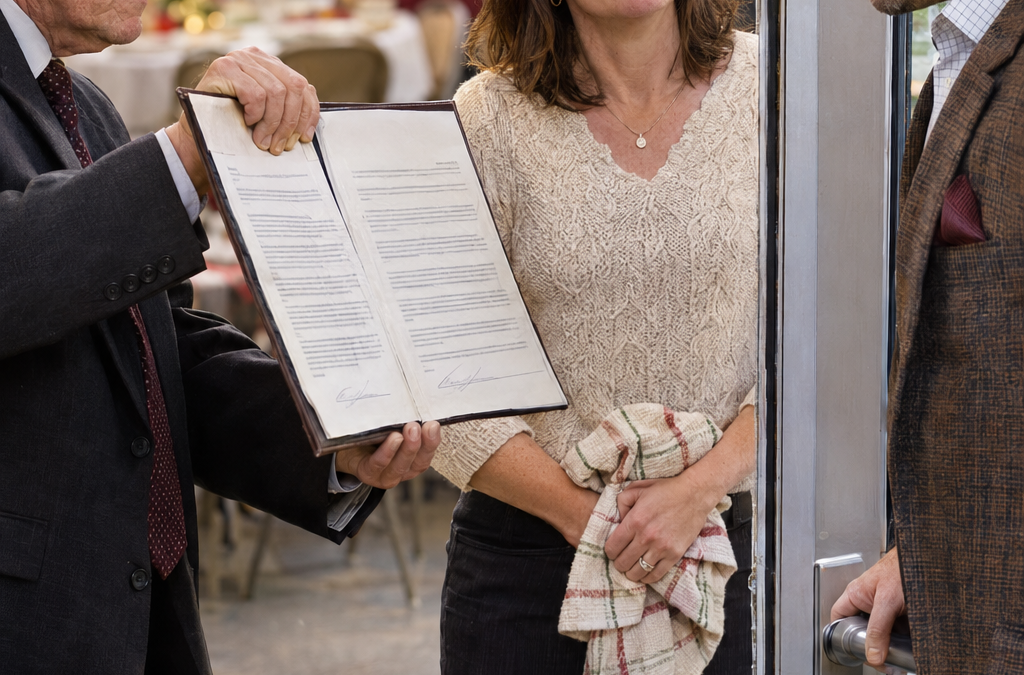
Malcolm opened the agreement to its final page.
He turned it toward me, keeping his hand underneath.
There was Alma’s signature, small but legible.
Below it was Dean’s.
I leaned closer before touching the edge.
Dean had signed as a witness to her acknowledgment. The language stated that she understood the arrangement she was signing.
I remembered him coming into Malcolm’s office that afternoon.
He had complained about finding somewhere to park.
At the time, I’d barely noticed his signature.
I was concentrating on whether Alma needed the bathroom.
“You signed this,” I said.
“I witnessed a family arrangement.”
“It describes paid care,” Malcolm said.
He didn’t raise his voice or lean toward Dean.
“The witness acknowledgment describes her understanding of that arrangement.”
Dean pushed the chair back without sitting.
“She wasn’t supposed to leave us with nothing.”
Malcolm closed the agreement.
“Nobody has said that she did.”
June appeared at the doorway carrying my dish towel.
She had folded it into a narrow rectangle.
“Can I come in?”
I nodded, and she shut the door behind her.
Outside, someone began moving dishes across the serving table.
June set the towel beside my purse.
“Mom told me about the agreement,” she said.
Dean looked at her.
“She said Nora couldn’t keep losing work indefinitely.”
“Then why didn’t you say that out there?”
June looked at me rather than answering him.
“I should have.”
I pulled out a chair and finally sat down.
My coat caught beneath me, so I stood again.
I took it off and folded it carefully.
“What happens now?” I asked Malcolm.
He explained what his position required.
He couldn’t represent me in a dispute with beneficiaries. Independent estate counsel would handle the contested claim.
My own lawyer would receive the filing and respond.
The probate court, not the dinner guests, would decide.
“Please preserve your calendars and any care records,” he said.
“I have them.”
I had written appointments beside library shifts.
I had noted which evenings Alma needed additional help.
Some pages held ordinary reminders about laundry and groceries. Others recorded when she couldn’t safely bathe alone.
Dean gave a short, irritated laugh.
“You kept notes on my mother?”
“I kept track of what she needed.”
“She was family.”
“She was also frightened of falling in the bathroom.”
June pressed the towel flat with her fingertips.
“She called Nora when she needed help,” she said.
Dean looked toward the closed door.
I could hear Tessa speaking in the hall.
I couldn’t make out her words.
For once, I didn’t try.
Malcolm asked whether Alma had discussed the agreement afterward.
“She brought it up when I offered extra library shifts,” I said. “She told me not to leave myself short.”
June nodded.
“She told me the house would cover what she owed.”
Dean put his hands on the chair back.
“That house was supposed to come to us.”
“It went into the estate,” Malcolm said. “Valid debts are addressed before the residue.”
He didn’t say what the court would find.
He didn’t promise I would receive anything immediately.
That helped more than a grand announcement would have.
I needed an explanation I could take to my lawyer.
I asked for a copy of the complete agreement.
Malcolm said he would provide it through the proper channels.
Then I asked whether medical records might matter.
“They may,” he said. “Counsel will obtain what’s appropriate.”
Alma had needed help with her body.
She had still corrected me when I bought the wrong vegetables.
She had still checked the calendar before appointments.
Those memories weren’t a medical opinion.
I understood that.
But Dean had been there for plenty of them.
“You asked her about your property taxes,” I said.
Dean looked at me without answering.
“You expected her to understand that conversation.”
“I’m not doing this here.”
“You followed us in.”
June drew the spare chair away from the doorway.
Dean stepped aside, and she sat beside me.
Malcolm put the agreement back in its protective sleeve.
“I suggest we stop discussing the merits tonight.”
He asked us not to argue over the original.
Then he gave me the information my attorney needed.
I entered it in my phone while he waited.
Dean opened the door before Malcolm finished speaking.
Tessa stood outside with her coat over her arm.
“Are we leaving?” she asked him.
He told her to wait near the entrance.
She looked at me, then turned away.
Malcolm left to collect his coat from the hall.
June stayed while I put mine back on.
“I’ll keep the pitcher safe,” she said.
“Thank you.”
“I’m sorry I didn’t get your purse sooner.”
I checked that my wallet was still inside.
“I needed you before it went outside.”
She nodded and didn’t ask me to excuse her.
That was the first useful thing she had said.
I carried my coat over my arm to the entrance.
The tables still held half-finished Christmas dinners.
I didn’t look for the place where I’d been sitting.
Dean came after me as I reached the door.
“We could settle this without making everybody miserable.”
“Have your lawyer contact mine.”
“There’s already a proposal.”
I stopped with my hand against the push bar.
“What proposal?”
“The dissolution agreement,” he said. “It includes a release of claims against my family.”
Part 4: The Places We Set
“Send it to my lawyer,” I told him.
“You could at least read it first.”
“I will. With my lawyer.”
He followed me onto the concrete outside the hall.
My purse had left a damp mark near the door.
I stepped around it while putting on my coat.
Dean stayed beneath the light by the entrance.
I went to my car without discussing his proposal.
At home, I put the dish towel beside the sink.
I hadn’t realized June had tucked it into my purse.
There was a faint gravy stain along its fold.
I left it there while I called my attorney.
When the office reopened, we reviewed everything together.
The objection had arrived by then.
So had Dean’s proposed dissolution agreement.
The release extended beyond ordinary property division between spouses.
My lawyer pointed to the language covering his family.
“This needs to come out.”
“I’m not giving up Alma’s agreement.”
She made a note and turned the page.
We dealt with the marriage and probate matters separately.
That meant more paperwork, not a dramatic shortcut.
I supplied account information and retirement records.
Dean had to disclose his finances as well.
We worked through ownership, balances, and the required forms.
The estate claim remained expressly mine under the eventual agreement.
Neither of us could later call it an accidental omission.
Meanwhile, I brought my care calendars to my lawyer.
I carried them inside a reusable grocery bag.
The corners had curled from years beside Alma’s telephone.
My lawyer asked me to explain the ordinary entries.
I told her what bathing assistance involved.
I explained why helping with supper could take an evening.
I described staying nearby while Alma used the bathroom.
None of it sounded impressive when separated into tasks.
Together, it had occupied the hours Dean called free.
June supplied her own account through the proper process.
She didn’t exaggerate how often she had visited.
She described the help she actually saw me provide.
That included the meal with the spoon and washcloth.
She also described Alma discussing the deferred payment.
Independent estate counsel obtained records relevant to Alma’s capacity.
Those records supported her ability to understand the agreement.
They didn’t claim she had never been tired or confused.
They addressed her condition around the time she signed.
Malcolm’s records showed Alma’s instructions about compensation.
The agreement stated the rate and period of service.
And Dean’s witness acknowledgment remained attached to the original.
His signature wasn’t the only evidence the court considered.
It was evidence he had to explain.
At the probate proceeding, Dean wore a suit I recognized.
I sat beside my lawyer with my calendars underneath.
He did not look toward me while counsel spoke.
When my turn came, I answered the questions asked.
I didn’t describe Christmas until it became relevant.
The claim was for work under an agreement.
It wasn’t a request to punish Dean for dinner.
That distinction mattered, and my lawyer kept it clear.
Dean maintained that Alma had been unwell.
He also admitted he knew she wanted me compensated.
His explanation returned to the same word: family.
The court considered the documents, records, and testimony.
It allowed my claim for $86,400.
I heard the amount and looked down at my bag.
A loose thread had caught around the calendar spiral.
I unwound it while my attorney explained the next steps.
There was still an accounting to finish.
The estate did not hand me a check outside court.
Malcolm’s office completed the remaining administration.
The final net estate, before my claim, was $140,000.
That was after other obligations and administration expenses.
My allowed claim reduced the residue to $53,600.
Dean and June received $26,800 each.
June never asked me to reduce her share’s reduction.
She called to confirm the accounting had reached me.
Dean communicated through counsel about the distribution.
The dissolution took its own course.
We each retained our own accounts under the agreement.
Our joint savings were divided equally.
Retirement rights and the remaining property were fully addressed.
There was no release of my estate claim.
There was no statement calling Alma’s compensation a gift.
By the time the court approved the dissolution, the payment had arrived.
I deposited it into the account identified for it.
Then I filed the confirmation with my other papers.
I didn’t buy something large to mark the day.
I worked my scheduled library shift and went home.
June called later about the pitcher.
“I’d like to bring it over,” she said.
“You can leave it with me.”
“I’d also like to apologize without asking you for anything.”
I told her when I would be home.
She arrived carrying it in the same dish towel.
The chipped handle showed through a gap in the wrapping.
I cleared a place on the kitchen table.
June set the pitcher down and removed her coat.
“I let him make you stand there,” she said.
“Yes.”
“I knew you had worked. I knew Mom wanted payment.”
She kept her hands on her folded coat.
“I didn’t want him turning on me.”
I put the towel beside the sink.
“I can’t promise what we’ll be like now.”
“I understand.”
She didn’t reach for a hug or ask about forgiveness.
Before leaving, she asked whether I wanted company sometime.
I said we could start with supper.
When she came back, I had potatoes on the stove.
She washed her hands and asked where I kept plates.
I showed her the cupboard.
She set them out without moving anything I’d placed.
The pitcher sat beside the pan, its handle turned toward me.
June carried the potatoes to the table and waited.
I filled Alma’s blue ceramic pitcher, lifted it by the chipped handle, and poured gravy onto my plate.
You Might Also Enjoy




