My Husband Promised My House To His First Love While I Was Pregnant — Then I Spoke Up
Chapter 1: Beside the Open Trunk
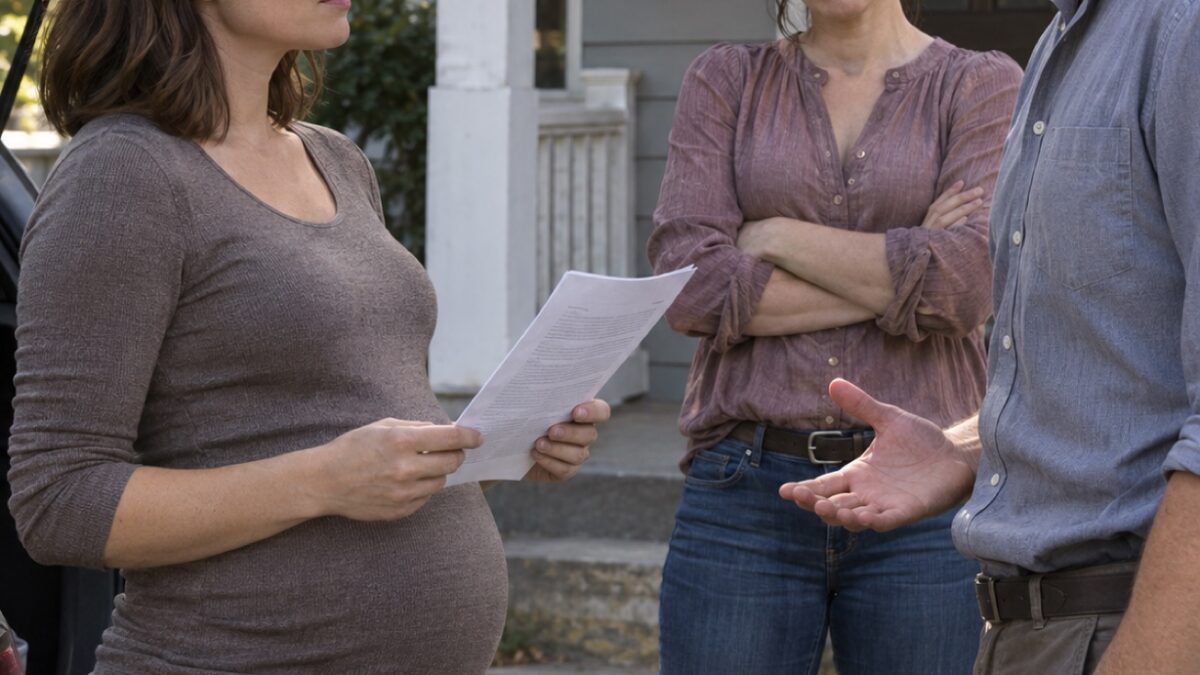
My husband was waiting by my car with his first love when I got home, ready to explain why her children should have the house where we planned to raise our baby.
I had groceries in the trunk.
The cold things were tucked into my reusable bag, with the bread balanced above them so it wouldn’t get crushed. I remember reaching back to move the bread before I understood what Evan was holding.
He stayed beside the driver’s door.
Jocelyn stood nearer the porch, her purse hanging from her shoulder. She looked at the house while he spoke, like someone waiting for a showing to begin.
“We need to settle something,” he said.
I glanced at the paper pressed against his work trousers.
“About what?”
“Where everybody’s going to live.”
I was six months pregnant. Bending over the trunk had become awkward, and I wanted to get the milk inside before discussing anybody’s living arrangements.
Evan lifted the paper instead.
He was 38. I was 35, and until that afternoon, I thought we understood what our home was going to look like when the baby arrived.
Apparently not.
Jocelyn was 37, his first love, the woman he had started talking to again last winter. According to him, she had needed a friend.
Now she was waiting beside my porch while he explained a plan they had made without me.
At first, I thought they needed somewhere to stay.
He had mentioned that her rental was ending. I expected a request involving a spare room, some boxes, an uncomfortable conversation about how long.
Then he said he wanted my signature.
“Before we carry everything in,” he added.
I looked down at the groceries.
Nothing about his tone suggested that he thought he was interrupting my afternoon with something extraordinary. He sounded prepared. He had a paper, an explanation, and Jocelyn nearby to support him.
“What am I signing?”
“An agreement about the house.”
I pulled the reusable bag toward me.
The fabric caught under a carton, and I freed it carefully. I needed something ordinary to do while I worked out why my husband was discussing my house with another woman in the driveway.
I had bought it outright for $240,000 seven years earlier.
It had been mine for four years before we married. There was no mortgage, and I had never added an owner.
Evan knew I had lived there before the wedding.
What he apparently didn’t know was how.
We had been married for three years, all of them spent in the house I had already paid for. He moved his clothes into the bedroom and his dishes into the cabinets, and we arranged our ordinary expenses around the fact that there was no house payment. I paid the property taxes and insurance from my earnings as a payroll clerk. Evan contributed to the things we used together. There had been no agreement giving him part of the house, no shared money spent on a major improvement, no conversation about transferring ownership. Last winter, when Jocelyn’s name began appearing on his phone, he said an old friend was having a difficult stretch. I believed that explanation because he offered it casually, while standing in our kitchen, with no apparent reason to make it complicated.
I got the bag out.
“I’ve provided our home the whole time we’ve been married,” I said, shifting the handles in my hand. “What exactly have you worked out with my house?”
He looked toward Jocelyn.
That small movement stopped me.
He wasn’t checking whether I understood. He was checking whether she wanted to add anything.
Then he began describing bedrooms.
Her children would use the rooms down the hall. The room where I had started placing baby things would become theirs to arrange. The larger bedroom would stay available for Evan and Jocelyn.
He spoke about it without hesitation.
I looked past him toward the porch, trying to fit those words to the house behind it.
“And where would I be?”
“We can talk about that inside.”
“You’re talking about the rooms now.”
“Because that’s what makes sense about this place.”
I set the grocery bag beside my shoe. The handles had left narrow marks across my fingers.
Jocelyn shifted her purse higher on her shoulder.
“Your baby won’t need the room my children already need,” she said.
She looked at my stomach when she said it.
Not for long. Just enough that I noticed.
Evan nodded.
“Her children need the house more than our baby does.”
I bent to straighten the bread sticking out of the bag.
I didn’t need to straighten it. I needed a moment before answering a husband who had just compared our unborn child’s place in our home with the needs of the woman beside him.
“Give me the agreement.”
He passed it over easily.
He expected me to read where he pointed. Instead, I turned the pages toward myself and started at the top.
“PROPERTY AGREEMENT.”
Below that, the language concerned the whole property.
Not rooms.
Not a temporary stay.
The proposal asked me to agree to transfer the entire house to Jocelyn without payment. Other documents would follow to complete it.
I read the paragraph again, moving my thumb beneath the line so I wouldn’t skip anything.
Evan watched me.
Jocelyn stopped looking toward the porch.
“This says the entire house.”
“Yes,” Evan said. “That keeps it simple.”
“For whom?”
He started talking about stability for the children.
I kept reading.
The house was worth about $360,000 now. I knew that was important, but the amount wasn’t what kept pulling my eyes away from the page.
It was the front door.
I had imagined coming through it with the baby. I had already made room inside for the things we would need. Those weren’t plans for some future property we might buy.
They were plans for my home.
I lifted the agreement a little.
“Explain why you thought you could offer this.”
“I’m trying to be fair about what everybody needs.”
“I asked about the house.”
“Clara, this is why I wanted us to talk before you got upset.”
“I’m reading what you brought me.”
He held out his hand, indicating a place farther down the page. I moved the paper away from his finger and kept it facing me.
For the first time, he stopped directing the conversation.
Jocelyn watched us both.
I could feel the milk getting warm beside my foot. I could hear the trunk shifting slightly in the breeze. Evan had brought me something he expected me to accept before I even put away supper.
“I bought this house before we got married, Evan. I never added another owner.”
He looked at the paper, then at Jocelyn.
She wasn’t watching him anymore.
She was watching me.
He opened his mouth, closed it, and looked back toward the house.
“You owned it before we got married?”
Chapter 2: What He Had Assumed
“Yes,” I said. “Before.”
Evan reached toward the agreement and caught its edge between his fingers. I kept hold of it.
He rubbed the paper with his thumb.
“I thought you rented it.”
“When?”
“Before. When you were living here.”
“I was living here when we met.”
“I know. I thought you bought it later.”
“After we married?”
He nodded.
There it was, said out loud in my driveway.
He had built this entire proposal around something he had never checked.
I asked him when I had told him I rented the house. He looked toward the open trunk as though the answer might come to him if he stopped looking at me.
He couldn’t name a conversation.
I waited anyway.
“I must have misunderstood,” he said.
“You assumed.”
“I didn’t think it mattered then.”
“It matters to the agreement in your hand.”
He let go of the edge.
I folded neither the page nor my arms. I held it flat, where all of us could still see what he had brought.
He hadn’t known my purchase history because he had never asked. I hadn’t hidden it. I had simply lived in my own house without giving him a presentation about how I acquired it.
That was apparently enough room for him to invent another explanation.
He stepped away from the car.
His voice got quieter, but his attention stayed on the proposal.
“Well, you can still agree to it,” he said. “That’s why I brought something for you to sign.”
That part was true.
He needed me.
He could describe bedrooms and discuss moving plans with Jocelyn, but neither of them could give away my house on my behalf.
I looked at her.
“Did he tell you I’d already said yes?”
Her fingers tightened around her purse strap.
She looked toward Evan, giving him a chance to answer. He didn’t take it.
“I knew we still had to talk to you,” she said.
“Before today?”
“Yes.”
“You knew this wasn’t something I’d agreed to?”
“We knew we needed to ask.”
I looked down at the agreement again.
They had chosen the recipient, the arrangement, and the language before making the request. Jocelyn had just told me my baby needed less space while knowing the owner had never been consulted.
She began explaining her rental.
It ended in six weeks. She wanted the children settled somewhere she wouldn’t have to move them out of again.
I listened without interrupting.
There was no eviction happening in my driveway. Her children weren’t standing there with suitcases. They weren’t there at all.
This was a housing problem she had time to address.
They had decided I should solve it by leaving.
“I don’t want to keep moving them,” she said.
“I understand that.”
“Then you can see why we’re trying to make something permanent.”
“I can understand wanting a home without agreeing to give you mine.”
Evan stepped closer.
He didn’t challenge the ownership history again. He had heard enough to know that claim would not help him.
Instead, he talked about how practical the house was.
The rooms were already there. The kitchen had space. He knew the place and could help get everybody settled.
“Help from where?” I asked.
“What?”
“Where would you be living?”
“Here.”
He said it quickly.
Then he started describing mornings, meals, getting children ready, all the ordinary work of living together.
Those were things I had expected us to figure out with our baby. Hearing him assign himself those duties in another household made the paper feel heavier in my hand.
I looked between them.
“Are you and Jocelyn together?”
Evan turned his face toward the driveway before answering.
“Yes.”
Jocelyn didn’t correct him.
She stood still, her purse pulled close to her side, waiting for whatever I would do with that answer.
I looked at his shirt collar.
I had seen him in that shirt over breakfast. He had stood in this house that morning while I got ready for work, knowing he intended to ask me to leave it.
“How long have you been planning to live here together?”
“We’ve been trying to work out something that makes sense,” he said.
“That wasn’t what I asked.”
“We haven’t moved anything.”
I didn’t follow him into that distinction.
He had admitted the relationship. I didn’t need to turn the driveway into an argument over every call since winter to understand the proposal in front of me.
I bent for the groceries.
Evan reached toward the handles, but I already had them. I pulled the bag up carefully and carried it toward the porch.
The agreement rested against the bag under my thumb.
Behind me, the car trunk closed.
I went through the front door without waiting for them, crossed into the kitchen, and set the groceries on the counter.
They followed.
For a moment, nobody spoke while I put the milk away.
I moved the bread clear of the edge, opened a cabinet, and set the other groceries where they belonged. I wasn’t going to leave food warming on the counter because they preferred to finish giving instructions.
Then I pulled out a chair.
“Sit down.”
Evan took the chair across from mine. Jocelyn sat beside him, placing her purse where it touched his leg.
I laid the agreement on the table.
The kitchen looked exactly as it had when I left. My work things were where I had put them. The baby items down the hall were still waiting to be arranged.
They were sitting in my everyday life discussing its transfer.
“Are you planning to buy the house from me?” I asked Evan.
“That isn’t what we can afford.”
I turned to Jocelyn.
“Are you?”
“If I could buy a house, we wouldn’t be having this conversation.”
I rested my hands on the table.
She said it as though the answer should settle my question. It settled something else instead.
Neither of them intended to pay me.
Evan leaned forward.
“You’re focusing on the property part instead of the whole situation.”
“The property is what this agreement is about.”
“It’s about making things work.”
“For you and Jocelyn.”
“For everybody.”
I looked at the empty space at the end of the table, where I had recently set things aside for the baby.
“Then explain my part.”
“You’ll still have your job.”
“That isn’t housing.”
“You’ve always been able to manage.”
I moved the paper closer to him.
“What do you expect me to receive in exchange for leaving the place I bought?”
He looked annoyed that we were still discussing the same basic problem.
“We can’t buy another house like this.”
“I heard you.”
“I’m trying to avoid everybody scrambling.”
“Where would I sleep, Evan?”
He straightened in his chair.
For the first time since I had come home, he seemed ready with an answer he thought would settle things.
He told me he had already found where I would live.
Chapter 3: The Place He Found
“Where?” I asked.
“An apartment.”
I waited.
Evan looked at Jocelyn, then back at me.
“There’s availability.”
“Do you have something for me to look at?”
“I asked about it.”
“Did you reserve it?”
“No. We need to settle this first.”
“Did you pay anything?”
“No.”
I moved my hand away from the agreement.
He had spoken as though there were a place waiting for me. Now, at my kitchen table, it became an inquiry somebody had answered.
Nothing had been reserved.
There was no application in my name and no payment holding anything. Nobody had looked at whether I could qualify while preparing to take leave from work.
He hadn’t arranged a home.
He had asked whether an apartment was available.
“Does anybody there know I’m pregnant?” I asked.
“I didn’t discuss all your personal information.”
“But you discussed where I should live.”
“I was looking at options.”
“Then call it an option.”
Jocelyn adjusted her chair.
She looked impatient again, as though the details of my proposed departure were taking time away from the plan that mattered to her.
I asked who would pay the rent.
Evan frowned.
“You have your income.”
“And that would cover it?”
“You managed before we got married.”
“Yes,” I said. “In the house I had already paid for.”
He looked down.
I pressed my palm onto the page to flatten a corner that had curled during the trip inside.
His plan depended on my continuing to work, pay my bills, prepare for the baby, and find a way to manage leave. The difference was that I would begin paying rent while he lived with Jocelyn in my house.
“And what would I receive for the house?”
He exhaled through his nose.
“We’ve been over that.”
“I’m asking you to answer it.”
“We can’t pay you what a house costs.”
“Anything?”
“No.”
Jocelyn looked toward the counter instead of at me.
I left the question there.
There wasn’t some provision farther down the page that I had overlooked. They weren’t offering money, another property, or a home for me.
They wanted my agreement to a gift.
I read the document from the top again.
The opening language sounded formal. Farther down, the wording became ordinary and uneven, referring to other paperwork that would need to be prepared after I agreed.
I followed a sentence with my fingertip.
“Which lawyer wrote this?”
Evan shifted.
“It hasn’t needed a lawyer yet.”
“Who prepared it?”
“I did.”
“From what?”
“A sample.”
I looked up.
“An online sample?”
“Yes. I changed it for our situation.”
Jocelyn reached across and straightened the paper near her side of the table.
“Nobody’s reviewed it,” she said.
Her irritation seemed directed at Evan for not making that clearer, not at the fact that he had handed it to me beside a bag of groceries.
“Then why present it for a signature today?” I asked.
“So we could know whether you were willing,” Evan said. “We’d get the rest handled properly.”
I read the heading again.
“PROPERTY AGREEMENT.”
It wasn’t a completed transfer, and signing it wouldn’t have magically changed the ownership that afternoon. But he had put a request for my written commitment in front of me before anybody independent had explained what it meant.
I pushed the paper back to the center.
“Jocelyn, you discussed this before he spoke with me?”
“We talked about possibilities.”
“And you knew he needed my agreement?”
“Yes.”
“Not that I had given it.”
“No. That we needed it.”
I nodded.
She had now said it directly in front of Evan.
He couldn’t later pretend that he had brought her over to carry out something I had already accepted.
Jocelyn folded her hands, then unfolded them.
“My children need bedrooms now,” she said. “Your baby isn’t even using that room yet.”
I glanced toward the doorway.
I had put baby things in that room because I expected to use it soon. Their presence wasn’t a claim I needed to prove by having the baby early.
“I’m asking about what you planned,” I said.
“That is what we planned for.”
“I’m not comparing the children.”
Evan leaned back.
“She’s explaining why this house works.”
“For her,” I said.
“For us.”
That word needed its own explanation.
I set the agreement completely flat between us. There was no pen in my hand, and I didn’t reach for one.
“Tell me where you fit in this.”
He looked at me steadily now.
“I’d stay here.”
“With Jocelyn.”
“Yes.”
“And her children.”
“Yes.”
“What about our baby?”
“Our baby would have a home here with me, too.”
I looked past his shoulder.
From my chair I could see the doorway leading toward the room he had already offered to somebody else’s children.
He had imagined our baby arriving for visits at the house I owned.
He had imagined me bringing the baby to the door and leaving.
“Would Jocelyn be staying until she found another rental?” I asked.
“That wouldn’t solve the problem.”
“Would the house stay mine?”
“That defeats what we’re trying to arrange.”
“So this isn’t somewhere for her to stay temporarily.”
“No.”
I moved the page slightly so the unsigned space was visible to all of us.
“So you’re asking me to give her the house permanently.”
“Yes,” he said.
At last, there wasn’t another explanation wrapped around it.
He wasn’t asking me to help with a difficult month. He wanted me to transfer my whole home to his current partner so he could remain there with her.
Without buying it.
Without buying another place for me.
Jocelyn sat with her hands in her lap.
Evan watched me, waiting. He had stopped making assumptions about the purchase history, but he was still relying on the same thing he had relied on outside.
He thought I would agree because refusing would make me responsible for what happened next.
I touched the edge of the paper.
The corner was damp where condensation from the groceries had reached my fingers earlier. That small mark made me angrier than the stiff wording.
I had come home thinking about putting food away.
They had made arrangements for my departure.
Evan leaned forward before I could speak.
“Before you answer,” he said, “if you keep the house, are you choosing a divorce?”
Chapter 4: The Answer at My Table
“Yes,” I said.
Evan stayed leaning over the table.
I slid the agreement toward my side.
“I’m not transferring the house. I’ll pursue a divorce.”
Jocelyn looked at him.
He didn’t look surprised by the word divorce so much as by my answer to the condition he had attached to it.
“I’m asking whether we can work something out,” he said.
“You asked whether keeping my home meant divorce.”
“We don’t have to decide everything right now.”
“I’ve decided about this.”
I tapped the unsigned page.
There was no speech in me. My mouth felt dry, and I wanted them out of the kitchen long enough to sit without being watched.
But Evan lived there.
I knew that refusing his proposal didn’t mean I could throw his things outside or tell him he had no right to come through the door that night.
“We’ll get advice about what happens next,” I said.
“What am I supposed to tell her?”
I looked at Jocelyn.
“The house isn’t being transferred.”
She reached for her purse.
Her rental problem had not disappeared. It also had not become my obligation because they had spent an afternoon describing what they wanted.
“You could have at least considered it,” she said.
“I read it. I asked questions. My answer is no.”
Evan pushed his chair back.
He asked if I would give him the agreement.
“I’m keeping it.”
“It’s just a proposal.”
“Yes,” I said. “The proposal you brought me.”
I didn’t tear it up.
I didn’t write across it.
I placed it on the counter away from the groceries and watched Jocelyn stand. Nobody carried baby things out of the room down the hall. Nobody began packing me an overnight bag.
Jocelyn left.
Evan stayed.
After the front door closed, I picked up the reusable bag and folded it along its worn seams.
He stood near the table.
“We’ll need to talk.”
“After we each get advice.”
“You’re making this formal.”
“You brought an agreement.”
He looked at the counter, where it lay.
That night, we stayed in the same house without pretending the conversation had been settled in some harmless way. We used different spaces. I didn’t change locks, move his belongings, or make decisions about his lawful access on my own.
I ate because I needed to eat.
I checked the refrigerator without remembering why I had opened it, then shut it and sat down again.
The next morning, I put his proposed agreement on a clear section of the kitchen table.
I photographed every page.
Then I made a copy and placed the original in a folder. I wanted its wording preserved, including the proposed recipient, the absence of payment, and the empty signature space.
I wrote down what had happened while I could still remember the order.
The driveway.
The room comparison.
His assumption that I had rented.
Jocelyn saying she knew I hadn’t agreed.
His admission that they were together.
I kept my notes factual. I didn’t need to improve his words.
Then I got my house records.
The purchase file was where I had always kept it, stored with the papers I rarely needed but never threw away. I carried it to the kitchen and opened it beside his proposal.
There was my purchase from seven years ago.
There was the $240,000 payment.
There was my name.
I had never shown Evan those records during the confrontation because I hadn’t needed to fetch a file to tell him what I owned. Now I needed more than a spoken correction.
I needed to prepare for the process he had forced us toward.
I gathered the records showing the taxes and insurance I had paid from my earnings. I pulled together account information and the ordinary household expenses we had shared.
I didn’t leave out his contributions.
He had paid toward our life together. That was different from buying the house, and I wanted the distinction documented accurately.
My job involved getting details right before money went out.
I treated this pile the same way.
When Evan came into the kitchen, the folder was open in front of me.
He looked at the old purchase record.
“You really paid for it then.”
“Yes.”
He didn’t pick it up.
Instead, he asked what that meant for him.
“I’m getting advice,” I said. “You should, too.”
I wasn’t going to tell him what he might receive in a divorce, or promise that my name on the house settled every other issue between us.
I didn’t know that yet.
What I knew was that his proposal would stay unsigned.
When I spoke privately with a lawyer, I described the ownership history before describing the affair. I wanted advice about the house, our finances, the pregnancy, and what living separately would require.
I explained that Evan still lived there.
I asked what not to do.
That question mattered.
I was told not to treat an argument as a substitute for an agreement or an order. I needed to preserve records, avoid rash financial changes, and address the house and the rest of our marriage through the proper process.
I took notes.
The eventual settlement would leave the house with me, and Evan would move out under terms we agreed to. That did happen.
But it wasn’t accomplished by waving my purchase file over the kitchen table.
There were accounts to disclose, living arrangements to negotiate, and a child whose needs would continue after our marriage ended.
That afternoon, I returned the originals to a safe place and kept copies ready for my lawyer.
Evan had been quiet while I worked.
Now he stood in the doorway, looking toward the folder.
“If I’m still living here,” he said, “we need to decide how that’s supposed to work.”
Chapter 5: What I Would Agree To
My lawyer started with the records, not Evan’s behavior in the driveway.
That helped.
I had brought the proposed agreement because it explained what had happened, but I had also brought proof of what had existed before our marriage.
The house purchase.
The payment.
The ownership history.
The tax and insurance records.
I answered questions about money used during the marriage and work done to the property. There had been no joint-funded capital improvement and no agreement giving Evan an ownership share.
Ordinary living expenses were another matter.
He had contributed, and I said so.
“I don’t want to say he paid nothing,” I explained. “That wouldn’t be true.”
My lawyer told me to keep that distinction.
The evidence supported treating the house I brought into the marriage as mine. That did not mean we could ignore other assets, debts, support questions, or any issue that needed individual attention.
I wrote that down.
I had wanted reassurance that the house couldn’t simply be promised to Jocelyn. I got it, along with a list of practical work that still belonged to me.
I would have to disclose financial information.
I would have to review proposed terms.
I would have to separate my anger from decisions affecting the baby.
There was no rule making Evan lose everything because he had behaved badly, and I didn’t ask my lawyer to find one.
I wanted a fair process that did not require me to give away my home.
Back in the kitchen, I opened my laptop beside the folder.
The table was still the same table where Evan had placed his demand. Now I used it to make a list of recurring expenses.
Food.
Utilities.
Insurance.
Taxes.
The costs we shared were marked separately from the costs tied to the house. I checked statements rather than relying on memory.
When I found a payment I wasn’t sure about, I looked it up.
I didn’t move shared funds out of reach.
I didn’t stop paying something essential just because I was angry.
Following advice, I began separating future discretionary spending from what we still needed to maintain while arrangements were unresolved.
Evan saw me checking a statement.
“Are you cutting me off?”
“No.”
“What are you changing?”
“How I handle my future personal spending. Shared obligations still need to be handled.”
He pulled out a chair.
“I’m not going to agree to being treated like a guest.”
“I’m not asking you to.”
“Then what are you asking?”
“For written arrangements while we separate.”
I had a draft of the practical points I wanted addressed. It wasn’t a surprise contract demanding his signature before dinner.
It was a proposal for our lawyers to review.
Separate sleeping spaces.
Use of the kitchen and other shared areas.
Payment of ongoing bills.
Privacy.
How we would communicate about moving and belongings.
No promise that Jocelyn or her children would move in.
I pushed the list toward him.
He read it without speaking.
Then he asked whether I expected him to leave immediately.
“No. We negotiate that.”
“I need somewhere to go.”
“I understand.”
“You didn’t say that yesterday.”
“Yesterday you asked me to leave permanently without compensation.”
He looked back at the page.
I didn’t add anything.
He could disagree with the arrangements. He could have his own advice. What he couldn’t do was turn the absence of my consent into an agreement to his plan.
Evan obtained his own lawyer.
When he told me, I said that was appropriate.
He seemed to expect an argument, but I wasn’t asking him to rely on mine. Independent advice was part of making any arrangement something we could both understand and follow.
The purchase records went through the lawyers.
So did the payment records.
His assumption about when I had bought the house could not survive documents showing the purchase before our marriage.
He didn’t repeat it.
Instead, the discussion moved to the matters that actually required negotiation: when he would leave, what he would take, how expenses would be handled, and what remained open for the divorce.
That was harder in quieter ways.
I would finish work, come home, and find a message about a proposed term waiting beside an ordinary question about groceries.
Sometimes I had to read the message, close it, and make myself eat before answering.
I was pregnant.
I was still working.
There were afternoons when I wanted to agree to anything that would stop another conversation at the kitchen table.
I didn’t.
I sent questions to my lawyer and waited for answers when an issue wasn’t urgent.
One evening, Evan asked whether Jocelyn could use a room while he sorted out another arrangement.
“No,” I said.
“It wouldn’t change ownership.”
“I haven’t agreed to her moving in.”
“She still needs somewhere.”
“That doesn’t change my answer.”
He stopped there.
There was no ownership promise left for him to offer her, and I wasn’t going to create a new occupancy problem while we were trying to resolve his.
The proposed temporary arrangement came back with changes.
I read them at the counter, resting my hip against it because sitting had become uncomfortable.
I checked the expense provisions.
I checked the move-out terms.
I checked that the list of belongings would be agreed rather than decided during an argument.
Evan stood across from me, holding his copy.
“This says before the baby comes.”
“Yes.”
He looked toward the hallway.
The room intended for the baby had not become Jocelyn’s children’s bedroom. The things I had placed there were still there.
“Once I leave, we still have to work out the rest.”
“I know.”
“And parenting.”
“Yes.”
Neither of us signed without review.
When the terms were settled, we each had advice about them. The written arrangement gave us something more useful than another promise made across the kitchen.
It said what would happen.
I put my copy into the folder with the other papers.
Evan checked the belongings list again.
Then he looked up.
“We need to agree on the day I collect everything.”
Chapter 6: The Things He Took
Moving day was arranged before the baby was born.
It wasn’t an eviction.
Nobody arrived to throw Evan’s belongings onto the lawn, and I didn’t stand at the door holding a changed lock.
He was moving under the written arrangement we had negotiated with separate advice.
I put our agreed list on the kitchen table.
His clothes.
His personal belongings.
The household items we had settled on.
I kept a pen beside the list so I could mark what had been collected without turning every box into a fresh argument.
Evan came into the kitchen carrying an empty carton.
“Where do you want me to start?”
“With what’s on the list.”
He nodded.
I had cleared space near the door so he could set things down without blocking the hallway. I had also moved the baby items away from the path.
That was preparation, not punishment.
I didn’t want a box knocking into something, and I didn’t want to spend the afternoon arguing about whether a loose item had been included.
He packed from the rooms where his belongings had stayed.
I checked what came through.
When I recognized something from the agreed list, I marked it.
When I wasn’t sure, I asked.
“Was that included?”
He looked down into the carton.
“It’s mine.”
“I’m asking whether we listed it.”
He set it on the table while we checked.
There was no need to turn uncertainty into a claim that he was stealing. There was also no need for me to wave something through because asking felt awkward.
We looked.
We resolved it.
He put it with the appropriate belongings and kept packing.
The house became noisy in a different way.
Tape pulled from a roll. A drawer opened and shut. His footsteps went between the bedroom and the door.
I stood in the kitchen and drank water.
At times I had to sit.
The baby pressed against my ribs while I checked a line on the list, and I thought about how recently Evan had described where our child would visit him in this house.
He was not getting that arrangement.
Jocelyn wasn’t moving in.
Her children weren’t being brought over to choose rooms.
They had received neither ownership nor permission to make this their home. Whatever housing choices they made next, they could not use my house as the answer.
Evan brought another carton through.
“Is that everything from the closet?” I asked.
“Almost.”
“Check before you seal it.”
He went back.
I didn’t follow him into the room. We had agreed how this would work, and I wanted to follow it rather than supervise every hanger.
A little later, he stood at the kitchen doorway.
“Do you want to go through the list together?”
“Yes.”
We sat on opposite sides of the table.
There was no Jocelyn beside him this time.
He read the descriptions while I checked the marks. We noted what had been collected and addressed what remained under the terms we had already made.
He asked about an item that would be handled later.
I pointed to the relevant part of the arrangement.
“That stays as agreed.”
“All right.”
His voice was tired.
Mine probably was, too.
We were doing practical work after a marriage had failed, and neither of us could make it less tedious by pretending the driveway conversation had been a misunderstanding.
He knew what he had asked for.
I knew what I had refused.
Once the last belongings for that day had been carried out, Evan returned to the kitchen without a box.
He looked around.
The grocery bag was hanging where I kept it. I had continued using it, though every time I pulled it out, I remembered setting it on the driveway beside my shoe.
“Are you going to change everything?” he asked.
“The house?”
“The rooms.”
“I’m going to use them.”
He looked toward the hallway.
I didn’t explain the nursery to him again. He knew why I had started putting things there.
We completed the access arrangements laid out in writing. I did not improvise extra conditions at the door.
He left with what we had agreed he would take.
Then I closed the door.
I stood with my hand on the knob until I heard him drive away.
After that, I went back to the kitchen and checked the list again.
Not because I thought he had hidden something.
Because there had been so much attention on getting through the afternoon that I needed to see the ordinary facts on paper.
Collected.
Not collected.
Handled later as agreed.
I filed it.
The house still contained gaps where his things had been. I noticed them while moving through familiar tasks: an emptier section of the closet, room in a drawer, a place on a shelf.
I didn’t rush to fill them.
I washed a cup and put it away.
I ate at the table without making space for another conversation about who needed my bedrooms.
Later, I walked down the hall.
The baby things were still where I had left them before that afternoon in the driveway. I picked up a small piece of clothing, folded it properly, and set it down again.
There was work to do in that room.
Useful work.
I could move things according to how I expected to reach for them with a baby in my arms, not according to a plan Evan and Jocelyn had made for someone else’s household.
I shifted what needed shifting.
I stopped when I got tired.
The next time Evan contacted me, it concerned an unresolved part of the separation, not an instruction about the house.
I answered the question that needed answering.
Then I returned to what I was doing.
There were still legal issues ahead. Moving out hadn’t finished the divorce, decided support, or established every detail of parenting after the birth.
I knew that.
But that evening, I could leave the baby’s room arranged for the baby.
I brought my folder to the kitchen table and opened the latest message from my lawyer.
It concerned what we would need to settle once our child arrived.
Chapter 7: Coming Home With the Baby
When I brought the baby home, I carried the seat through the front door I had kept looking at during the driveway argument.
I set it down carefully.
Then I stood there longer than I needed to, checking the strap and the blanket even though there was nothing wrong with either.
The house was ready enough.
Not perfect.
There were things within reach that I had once thought should be put away, and things put away that I immediately needed within reach.
I learned.
The kitchen bassinet became useful because I could keep the baby nearby while I ate, washed something, or tried to remember what I had opened a cabinet to find.
Some meals were barely meals.
I would sit down, hear a small noise, and get up before taking a bite.
None of that resembled the smooth household arrangements Evan had described while asking for my signature.
It was ordinary work, done with a baby who needed me.
I was glad to be doing it at home.
There were messages to answer as well.
Parenting couldn’t remain an abstract part of the divorce now that our child was here. We worked through the appropriate arrangements with advice, attending to the baby’s needs rather than using the house argument to decide everything else.
Evan was still the baby’s father.
Refusing to give him my home did not mean refusing him lawful parenting time.
I kept those matters separate even when I didn’t feel separate about them.
Before an arranged visit, I checked what the baby would need and put it together.
Clothes.
Supplies.
The information we needed to exchange.
I didn’t send remarks about Jocelyn with the baby’s things.
When Evan arrived, I met him at the door.
He looked past me at first.
“The baby ready?”
“Almost.”
I told him what he needed to know about feeding and sleep. He listened, asked a question, and waited while I checked the bag.
That was the exchange.
He wasn’t arriving home from work.
He wasn’t deciding what happened in the rooms down the hall.
He was there as a parent under the arrangements we were working through.
After he left, I went into the kitchen and sat down.
The quiet wasn’t automatically restful. I checked the time, then made myself put the phone down.
There was laundry.
There were settlement materials.
There was food I could eat while it was still warm.
I chose the food first.
The negotiations continued around ordinary days with the baby. Sometimes I reviewed a document while the bassinet was beside me. Sometimes I had to stop reading because the baby woke before I had understood a paragraph.
I wrote questions in the margin.
I didn’t sign something merely because I was exhausted.
My lawyer went through the remaining financial issues with me. Evan had his own advice. We exchanged the information required and worked toward terms that addressed the marriage we had actually had.
The house records remained important.
They showed the purchase before our marriage and supported leaving the house with me. The original proposal did not give Jocelyn an interest, and Evan’s mistaken assumption did not turn into ownership.
Other matters required their own answers.
Support.
Parenting.
Separate finances.
The remaining obligations that had to be resolved.
There was no automatic forfeiture because of the affair, and no secret penalty hidden in the house terms.
I wanted the settlement to be clear enough that I could follow it when I was tired.
That became a practical test.
If I read a provision and couldn’t tell what I was expected to do, I asked.
If a parenting term needed clarification, we addressed it.
If a financial issue belonged outside the house discussion, we treated it separately rather than saying my ownership answered everything.
Evan did not get the house.
He did not get a share of ownership through the settlement.
He could not provide it to Jocelyn.
That part of the proposal had ended when I refused to agree, and the legal process gave us final terms instead of leaving us to argue about it indefinitely.
The day I reviewed the finished settlement, the baby was asleep nearby.
I checked the house provision carefully.
Then I checked the rest.
My lawyer explained what remained to be completed through the ordinary process, and I asked the questions I had saved instead of pretending I understood every phrase.
I was a payroll clerk.
I knew how expensive an unchecked assumption could become. Evan had supplied a very personal example.
When the divorce was final, I placed the completed papers in the folder.
The original purchase records were still there.
So was the agreement Evan had adapted from an online sample, unsigned.
I didn’t pull it out to read again.
I had kept it because it was part of what happened, not because I wanted to spend the rest of my life sitting at that kitchen table with them.
There were other papers to keep current now.
Parenting information.
Household records.
The things needed to run a home and care for a child.
I made room for those.
Daily life changed in small, visible ways.
I stopped listening for Evan’s key when the baby stirred.
I checked the parenting schedule before planning errands instead of assuming another adult would be home.
I bought groceries according to what I could carry and put away while keeping an eye on the bassinet.
On an ordinary afternoon after the divorce, I checked what we needed and reached for my reusable bag.
The handles were still sound.
I folded it into the car, checked the baby’s things, and went out to get the groceries.
Chapter 8: The Bag on the Counter
After the divorce, I came home with groceries in the same reusable bag.
This time there was no one standing beside my car with a document.
I got the baby settled inside first.
By the time I brought the groceries through, the baby was asleep in the kitchen bassinet, mouth relaxed, blanket tucked safely below the face.
I set the bag on the counter.
Then I stood still to see whether the small noise from the bassinet meant waking up.
It didn’t.
I took out the milk.
There were cold things to put away, bread to keep from getting crushed, the same little decisions I had expected to make on the afternoon Evan met me in the driveway.
I moved quietly.
Not because I was afraid of another conversation.
Because I had a sleeping baby nearby.
The bag slumped as I emptied it. I held the sides apart and checked the bottom for anything I had missed.
A grocery receipt had caught in a fold.
I pulled it out and set it with the things I needed to sort later.
Outside, a car arrived.
I glanced at the time.
Evan was there for agreed parenting time.
I finished placing the milk in the refrigerator before going to the door. He didn’t live there now, and his arrival no longer meant that he would let himself into the kitchen.
He knocked.
When I opened the door, he stood back from it.
“Still sleeping?” he asked.
“Yes.”
“I can wait while you get everything together.”
“Thank you.”
I didn’t move aside to turn that into an invitation to wander through the house.
He waited where we made the handoff.
That wasn’t a performance for either of us. It was how the arrangement worked now.
I went back to the kitchen.
The baby stretched without waking fully. I watched for a moment, then checked the supplies I had prepared for the visit.
I had learned to do that before the knock whenever I could.
There were still days when something had to be found at the last minute. This wasn’t one of them.
I checked the clothes.
I checked the supplies.
I added the information Evan needed to know.
The grocery bag remained open on the counter beside me.
For a moment, I remembered its handles cutting into my fingers while he stood outside explaining why somebody else should have the bedrooms.
Then the baby made a small, impatient sound.
I turned toward the bassinet.
That was what needed my attention.
I picked the baby up carefully and waited while the little face settled against me. Then I brought the baby and the prepared things to Evan.
We spoke about the last feeding and what to expect next.
He asked a practical question.
I answered it.
There was no discussion about whether Jocelyn’s children needed more space, whether I could manage an apartment, or whether keeping my house meant I had caused the divorce.
Those questions had been used to push for something I had not agreed to give.
The divorce was finished.
The house stayed mine.
Parenting continued.
Evan adjusted his hold on the baby and checked the belongings I passed him. I waited until everything was secure before letting go.
“Anything else?” he asked.
“No. You have what you need.”
He looked toward the kitchen.
I couldn’t tell what he was thinking, and I no longer needed to ask.
The bassinet was visible from where he stood. So was the counter, with the groceries not quite finished and my reusable bag folded inward at the sides.
He had once planned to remain in that house while I came to the door for exchanges.
Instead, he waited for me to hand him what our child needed.
He didn’t ask to go down the hall.
He didn’t refer to any room as his.
When he left, I closed the door and checked that it caught.
Then I returned to the kitchen.
There was work to finish.
I put away the last groceries and wiped a damp patch from the counter. I checked the parenting arrangement for the return time, then set my phone aside where I could hear it.
The house wasn’t an argument anymore.
It was where I needed to unload food, wash baby things, answer work messages, and decide what could wait until tomorrow.
I opened a cabinet and found room for what I had bought.
There were no empty spaces I was saving for Evan.
The belongings he had collected were gone, and the remaining matters had been handled through the settlement. I didn’t keep discovering another drawer that needed his decision.
I could put something where it worked for me.
I could leave the baby’s things close to where I used them.
That practical freedom was what I noticed most often, not the number attached to the house.
The $360,000 had mattered enormously when he proposed giving it away.
So had the $240,000 I had paid seven years before the confrontation.
But standing in the kitchen after the exchange, I was thinking about whether I should start food before sorting the laundry.
I chose food.
While it warmed, I checked the bassinet sheet and straightened it for when the baby came home. Then I carried a few things out of the kitchen and returned with my hands empty.
I stopped beside the table.
There was room to sit without opening a folder.
I sat for a while.
Later, I ate. I rinsed the dish and left it where it could dry.
Nothing important happened during those ordinary minutes.
Nobody asked me to surrender the house.
Nobody told me which child deserved which room.
I didn’t have to defend the purchase history while holding groceries or explain why I expected to bring my own baby home.
Before the return time, I cleared the counter so I would have space for the baby’s things.
The reusable bag was the last thing left.
I picked it up by the handles and checked the inside again out of habit. Empty.
There was a worn place near the seam where I had caught it on something long before that afternoon in the driveway. The stitching still held.
I smoothed the fabric with my palm.
Then I folded it the way I always had, tucked the handles inside, and placed it beside the kitchen bassinet, ready for the next groceries.
You Might Also Enjoy




