My Mother Called Me a Liar After Dad’s Funeral, Then Her Invited Lawyer Changed Sides
Part 3: The Page He Turned
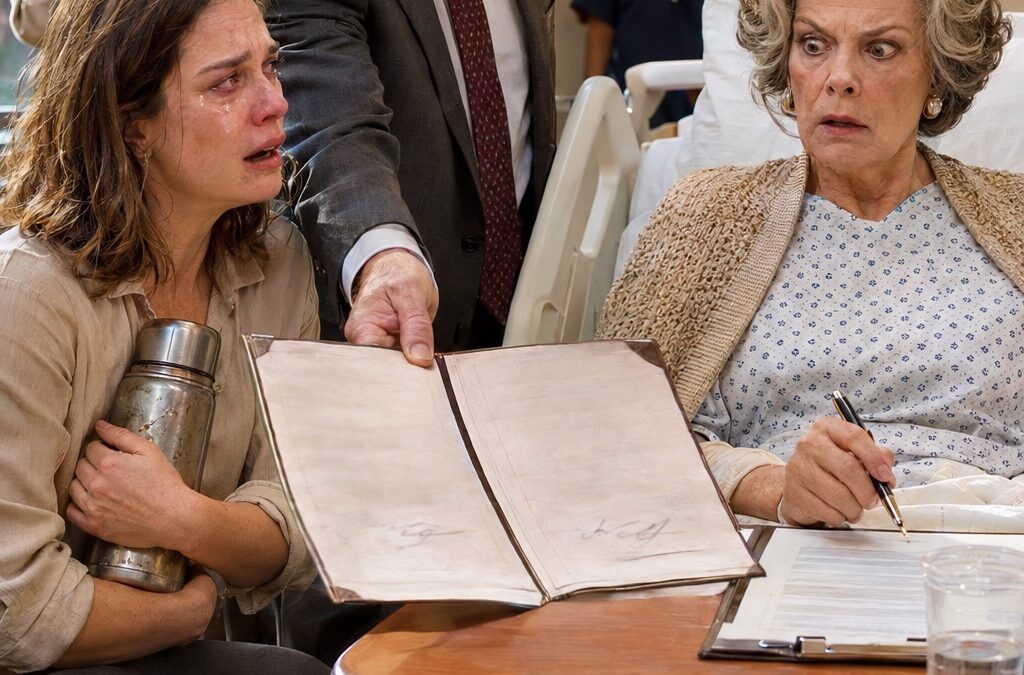
“This is a loan agreement for $48,000,” Paul said.
He kept the page flat against the hospital tray.
“Rachel advanced the money. Both of you signed.”
Mom stared at the place beneath his finger.
“The balance became payable upon either borrower’s death.”
I could see Joyce reading the signatures for herself.
Dad’s handwriting leaned into the edge of Mom’s name. He had always crowded whatever line he was given.
Paul brought out the final acknowledgment of the balance.
“The advances reached $48,000. That amount remains unpaid.”
Mom pressed her lips together and looked at me.
“So that’s what this visit was about.”
“You asked me here,” I said.
“I thought you’d behave like his daughter.”
I touched the dent in the side of his thermos.
“I did. While he was alive, I did.”
Paul waited until Mom looked back at him.
“This is not a request for additional inheritance.”
He tapped the agreement, not the proposed release.
“Rachel is a creditor. The estate owes this debt.”
Mom had been counting on him to say family money didn’t count.
Instead, he explained it in front of everyone.
The money had come from my savings account. It had gone into my parents’ joint account for Dad’s care.
Both parents had agreed it wasn’t a gift.
I hadn’t wanted interest or some share of their house. I had wanted Dad cared for without losing everything I’d saved.
We signed before the advances began, on March 1, 2024.
The money went out through February 28, 2025.
When the advances ended, they acknowledged the final balance.
Paul had the agreement and that acknowledgment together.
Dad died on April 2, 2025.
That made the debt due under the agreement.
None of this depended on Mom deciding I deserved it.
She knew the terms before I transferred the money.
“Your father asked you to help,” she said.
“Yes. And you both agreed to repay it.”
“He was sick.”
“He understood the agreement,” Paul said.
Mom looked offended that he had answered.
He didn’t raise his voice or lean toward her.
“I have no basis to treat this as a gift.”
Joyce took her glasses from her pocket.
“May I look at that?”
I said yes before Mom could answer for me.
Paul passed the acknowledgment across the foot of the bed.
Joyce read it slowly, holding it away from herself.
Mom watched her sister’s face instead of the paper.
“Rachel provided the funds that made the home care possible,” Paul said.
Then he looked straight at me.
“The estate records will reflect that contribution.”
I wiped the thermos rim with my thumb.
It wasn’t anything like hearing it from Dad.
But nobody in that room could pretend otherwise now.
Mom made a small sound and shifted her pillow.
“You could have explained without embarrassing me.”
“I asked you not to call me a liar.”
“You didn’t need to bring lawyers into this.”
“Paul is here because you invited him.”
She reached for her water, then put it down.
Joyce returned the acknowledgment without looking away from Mom.
“Why did you tell me they paid for everything?”
“We did pay,” Mom said. “It went through our account.”
“That doesn’t make it your money,” Joyce answered.
Paul gathered the pages back into their original order.
Then he placed a printed email beside the release.
“There is something else we need to clarify.”
Mom recognized that page before I could read it.
“That’s private correspondence.”
“You sent it to me as the estate’s executor.”
He reminded her he wasn’t her personal attorney.
She had not hired him to advise her privately.
The email was dated April 14, 2025.
He let me read it before saying anything more.
Mom had called it “Rachel’s unpaid loan.”
She had asked him to get me to forgive it.
I read that phrase again while Mom adjusted her blanket.
She hadn’t misunderstood what the agreement meant.
She hadn’t believed Dad had already repaid me.
She had written the opposite herself.
“You knew,” I said.
Mom stared toward the door.
“You knew when you called me a liar.”
“I was trying to keep the estate from disappearing.”
Paul didn’t let that pass without correcting it.
“The estate is not disappearing.”
He explained the available funds without promising immediate payment.
After the other obligations, there was $96,000 remaining.
Dad had owned those funds in his own name.
His will left the residue to Mom.
But the residue meant what remained after valid debts.
My loan didn’t become Mom’s inheritance because Dad died.
Paying me would leave $48,000 for her.
She had wanted the whole $96,000 instead.
Mom folded the edge of the blanket between her fingers.
“That money is what I have to live on.”
“You also knew what I had given up,” I said.
“You have a job.”
“I still have to pay for my own life.”
Paul put the proposed release in front of me.
He said I could seek independent legal advice.
He wasn’t asking me to decide inside a hospital room.
And he couldn’t use the release without my signature.
I slid it back across the tray.
“I won’t forgive the loan.”
Mom looked at Joyce for help.
Joyce took her purse from the windowsill.
“You shouldn’t have brought me here to watch that.”
Mom’s eyes filled, but she kept looking at her sister.
“I just buried my husband.”
“I buried my father,” I said.
I hadn’t said that aloud since the funeral.
Nobody answered immediately.
A cart rolled past outside the closed door.
Paul explained there would still be an administration process.
He couldn’t simply write me a check beside her bed.
He would review the claim and supporting documents properly.
The money available was enough to satisfy it.
Until payment, he would not describe it as forgiven.
Mom listened without interrupting this time.
Then she asked whether paying me released her, too.
Paul said the same debt couldn’t be collected twice.
Once the estate paid the full balance, it was satisfied.
I wasn’t trying to collect again from Mom.
I wanted back what I had actually advanced.
She looked down at the unsigned release.
Then her eyes moved to the discharge papers.
“So you won’t pay for my housekeeper, either?”
Part 4: What I Would Sign
“No,” I said. “I’m not paying for a housekeeper.”
Mom stared at me like I’d taken something away.
We had never agreed that I would hire one.
She had mentioned it while discussing her surgery.
I had told her to ask about discharge planning.
Somewhere between that conversation and the hospital, she’d decided.
Now she wanted me to accept her decision publicly.
“You know I can’t scrub floors like this.”
“Then the floors can wait.”
“What about the bathroom?”
“Tell the discharge staff what help you actually need.”
Paul quietly closed the envelope while we talked.
I didn’t want a medical decision turned into an argument.
Mom needed a safe plan after hip surgery.
That didn’t make every household expense mine to cover.
Joyce moved her chair closer to the bed.
“We can speak to the nurse about the plan.”
Mom gave her a sharp look.
“I don’t need everyone deciding my business.”
“Then don’t promise Rachel’s money,” Joyce said.
I stood and put Dad’s thermos into my bag.
Mom watched me pull the zipper around it.
“Are you really leaving me here?”
“You’re staying here until your team discharges you.”
I would not confuse leaving that meeting with abandoning her.
The nurse had already checked on her during the afternoon.
Joyce was still beside the bed.
Paul was putting the estate papers back in order.
Mom had water, her call button, and her telephone.
I asked whether she needed the cup moved closer.
She pushed it toward herself without answering.
Paul gave me a copy of the proposed release.
“You don’t need to sign this to receive information.”
I folded it without putting it near my pen.
He would communicate about the claim in writing.
That sounded much better than another meeting like this.
Mom wanted to know what she should sign.
Paul said she could obtain her own legal advice.
He wasn’t going to advise her against the estate.
He also wasn’t going to advise me personally.
His responsibility was to administer Dad’s estate correctly.
Mom had invited someone she thought would pressure me.
Instead, he kept telling everyone what his job actually was.
Joyce asked to speak with me in the hallway.
I waited while she made sure Mom could reach everything.
Then we stepped out beside a cart of folded linens.
Joyce touched my sleeve, then took her hand away.
“I should have asked you what was happening.”
I looked through the narrow window in Mom’s door.
Mom was staring down at the papers on her tray.
“You believed her,” I said.
“Yes.”
Joyce didn’t add an excuse after it.
That made it easier to stand there with her.
“She said you only came when he needed nothing.”
I thought about that saucepan drying beside Dad’s sink.
There had usually been something to do when I arrived.
Sometimes he just wanted someone to stay until he slept.
I hadn’t kept a record of every sock or spoonful.
The money had documents because the money needed documents.
The rest had been ordinary things Dad needed.
“Please don’t repeat that story again,” I said.
“I won’t.”
“And tell the people you already told.”
Joyce nodded and took her telephone from her purse.
She didn’t start calling people outside Mom’s hospital room.
She asked which relatives had spoken to me about it.
We discussed it quietly, without making another hospital audience.
Then she went back inside to discuss discharge arrangements.
I went home with the release still unsigned.
The next communications came in writing, as Paul had promised.
There were documents to review and questions to answer.
I supplied the transfer records supporting the advances.
He already had the signed agreement and final acknowledgment.
The estate process took time.
I kept working, and I didn’t spend expected money early.
Mom sent a message asking whether I felt better.
I knew she meant after embarrassing her in front of Joyce.
I answered only the part I could answer honestly.
“I want the estate handled according to the documents.”
She said Dad would hate us arguing over money.
I didn’t answer that message.
He had signed the agreement while he could decide.
I wasn’t going to invent a different wish for him.
Joyce corrected the story she had helped pass around.
She told relatives I had funded Dad’s home care.
She also said she had personally seen the signed agreement.
I didn’t send the family copies of private financial papers.
I didn’t need everyone examining my savings.
When someone called to apologize, I accepted the apology.
When someone wanted more details, I referred to the correction.
Mom did not apologize for calling me a liar.
But she stopped telling people I had contributed nothing.
When she called about the estate, she used the word loan.
That was different from what she’d said in her room.
Her discharge arrangements stayed with her and the hospital staff.
I didn’t cancel any necessary service or block her care.
I also didn’t put optional housekeeping on my account.
She had to arrange what she wanted without my savings.
Eventually, the lawful claims process and estate administration were complete.
Paul confirmed the debt would be paid in full.
The estate paid me $48,000.
Mom received the remaining $48,000 under Dad’s will.
There was no second claim against her for that debt.
After the payment cleared, I signed the acknowledgment of satisfaction.
I read every line before I picked up my pen.
It said the loan had been paid.
It didn’t say I had invented it.
It didn’t say the advances had been gifts.
It didn’t say Mom had covered Dad’s care alone.
I kept the confirmation with my copy of the agreement.
Then I put the unsigned release behind those pages.
I didn’t throw it out.
I wanted my own records complete.
Mom called after her distribution arrived.
“The estate’s finished,” she said.
“Yes,” I told her.
She asked whether I would visit that weekend.
I said we could arrange a visit without discussing money.
She didn’t argue, and I didn’t promise anything else.
The next morning, I packed lunch before leaving for work.
I filled Dad’s thermos and checked the bent lid.
It needed the same small adjustment it always had.
Then I set his dented thermos beside my lunch bag.
You Might Also Enjoy




