My Mother-in-Law Banished Me With My Newborn, Then I Read Her Husband’s Letter
Part 3: What Tessa Brought Inside
Tessa set the envelope beside my diaper bag.
“I already complained to the foundation,” she said.
She pulled out a letter with the college foundation’s heading.
It named me as the approved volunteer honoree.
Walter had nominated me before he died.
Claudia had replaced my name in the dinner program.
Tessa had discovered that before coming to the restaurant.
“I thought it was about the caregiving,” she said. “I didn’t know about the donation.”
I sat down before I opened the letter.
Ben positioned the stroller where I could reach it.
Our daughter had started rooting against his shirt.
He handed her back and opened the diaper bag.
Tessa turned toward the wall while I settled her.
She didn’t make a speech about giving me privacy.
She simply moved a chair where it blocked the doorway.
Then she waited until I said she could sit.
“What did you complain about?” I asked.
“Mom sent me the final program to check.”
Tessa placed the program beside the foundation’s letter.
The award title matched on both pages.
The name beneath it did not.
“She said you didn’t want to be recognized.”
“I never said that.”
“I asked her to forward your message.”
Claudia had not forwarded any message from me.
Instead, she told Tessa I was overwhelmed by motherhood.
She said speaking would put unnecessary pressure on me.
Tessa had contacted the foundation instead of accepting that explanation.
The reply confirmed that I was still the approved honoree.
They had attached a copy of the original letter.
Nobody there had authorized a replacement.
Tessa had asked them to hold the award presentation.
Her complaint was waiting for review after the dinner.
“I should have called you,” she said.
“Yes.”
She nodded and kept her hands on her knees.
“I thought you might actually want the privacy.”
“You could have asked me privately.”
“I should have.”
Ben pulled the room’s door almost closed.
Through the opening, I heard cutlery being moved.
Dinner service was continuing without the family photograph.
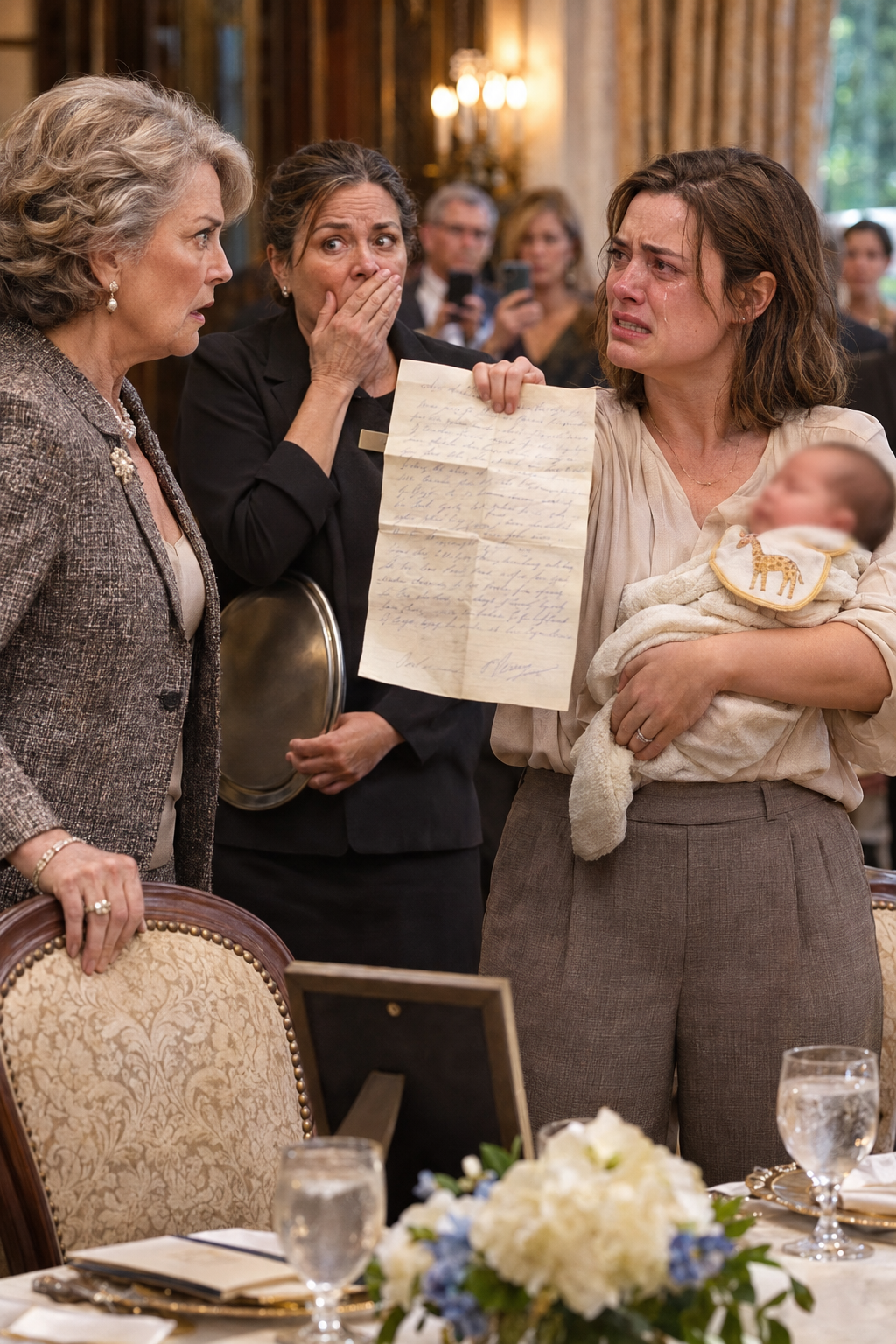
I straightened the baby’s cloth giraffe bib.
One corner had folded beneath her cheek.
Then I read the foundation letter from the beginning.
Walter’s nomination described the recovery help I had provided.
It did not identify his donor or describe his diagnosis.
He had written about patience and reliable help.
He remembered kitchen walks and rides to appointments.
He also mentioned my work as an occupational therapy assistant.
The award recognized service, not organ donation.
I read that distinction aloud to Ben and Tessa.
“I don’t want those things mixed together.”
Ben nodded.
“You don’t have to describe surgery to accept an award.”
Walter had understood that when he nominated me.
He had asked whether recognition for caregiving was all right.
I had agreed to that, not a medical profile.
I laid his personal letter beside the foundation’s approval.
They were separate documents with separate purposes.
His private letter belonged to me.
The approval showed what the foundation had authorized.
Neither gave Claudia permission to invent a donor.
Tessa looked at Walter’s signature on the private letter.
“Mom never told me you were the donor.”
“I know.”
“She always said he wanted that kept private.”
“He did. So did I.”
Tessa had known about my help after he came home.
She had seen me put his breakfast within reach.
She had not known why I also moved slowly.
Ben and I had respected Walter’s request for privacy.
That did not make the donation available for reassignment.
Tessa rubbed the edge of her envelope.
“I didn’t ask to take your place.”
“I believe you.”
She looked at me then.
“I should have checked with you before tonight.”
“Yes. But you did question the program.”
I could acknowledge that without pretending the rest hadn’t hurt.
She had usually received Claudia’s praise without asking many questions.
This time, she had requested the original paperwork.
She had complained before anyone handed her an award.
Irene knocked against the open door.
She had brought my plate with a cover over it.
“I can leave this here.”
“Thank you. Could you also save my program?”
“The one at your place?”
“Yes. Please don’t let anybody throw it away.”
She brought it back without asking me to explain.
Then she asked what we needed from the restaurant.
“I’m not asking you to settle this,” I said.
“I just need you to remember what you heard.”
“I heard it.”
She also remembered receiving my name as the speaker.
She had arranged the microphone around my brief reading.
That was something she could confirm if asked.
“I can write down what I heard tonight.”
“Please do.”
Irene left us the room while I finished feeding.
My plate sat beside the foundation’s letter.
Ben offered to take the baby when she finished.
I handed him the burp cloth and adjusted my blouse.
He settled her against his shoulder.
Tessa uncovered my plate and found the fork.
“Would you like me to cut that?”
“Yes, please.”
She cut the food into pieces I could manage.
Then she pushed the plate within reach.
I ate while Ben walked beside the stroller.
Every few steps, he checked our daughter’s face.
The room was small enough that he kept turning.
My water glass left a ring beside the approval letter.
I moved the paper before the edge got wet.
Walter had written about the same sort of ordinary help.
Toast cut before it cooled.
The medication organizer opened when his fingers wouldn’t cooperate.
Someone beside him while he practiced walking to the kitchen.
I had still been recovering during those visits.
Eight weeks away from work had cost me $9,600.
I had never sent Claudia an accounting of it.
I wasn’t preparing one now.
I wanted her to stop crediting somebody else.
Ben asked what I wanted to happen next.
“I want the statement corrected where people heard it.”
“Tonight?”
“Yes. Not a private apology that leaves everybody guessing.”
Tessa agreed to stand beside me.
She would plainly state that she had not donated.
I would decide what to say about myself.
We would not read the entire private letter again.
There were details in it I hadn’t intended to share.
I folded it along its existing creases.
Then I slid it back into the envelope.
The foundation’s approval stayed on the table.
A knock came before we could leave.
Claudia stood in the doorway holding a dinner program.
She looked at the documents, then at Tessa.
“You’ve made this bigger than it needed to be.”
Tessa stood but didn’t move the chair.
“You changed the approved honoree.”
“I was sparing Nina another obligation.”
“You could have asked me,” I said.
Claudia glanced at Ben holding the baby.
“Can we at least finish the evening pleasantly?”
“After you correct what you said.”
“I used the wrong wording.”
“You named the wrong donor.”
She pressed the program flat against her skirt.
“Well, the printed program was the only mistake.”
Part 4: The Draft Waiting For Approval
Tessa looked down at the envelope.
“There’s another attachment in that email thread.”
Claudia told her to leave it alone.
Tessa stopped reaching for the papers.
Then she took out her phone instead.
“I haven’t read this one yet.”
She opened the correspondence she had already saved.
The foundation’s approval letter appeared in the recent replies.
Below it was the earlier exchange about promotional materials.
Tessa tapped the attachment and enlarged the page.
She read for several seconds without looking up.
Then she turned the phone toward me.
The draft brochure described Walter and the memorial scholarship.
Below that was a paragraph about his kidney transplant.
It named Tessa as his living donor.
Her photograph appeared beside the paragraph.
I read the name twice before scrolling down.
Claudia’s reply approved the wording for publication.
She had written that the family confirmed the account.
The brochure had not yet been published.
The foundation correspondence requested confirmation before its release.
Tessa had been copied because the draft featured her.
“I thought it was another program proof,” she said.
“I should have opened it.”
I handed the phone to Ben.
He read it with our daughter against his shoulder.
Then he shifted her carefully into his other arm.
“This isn’t something you misspoke at dinner.”
Claudia stepped inside and pulled the door closer.
There was nowhere clear for her program.
She held it against herself while we waited.
“The scholarship needed something people would understand.”
“They understand a kidney donation,” I said.
“Walter wanted this fund to succeed.”
“He didn’t ask you to give Tessa my surgery.”
Claudia looked toward the baby.
Tessa moved the phone away from her mother’s hand.
“I didn’t agree to this either.”
“I was going to explain it.”
“Before or after you printed it?”
Claudia didn’t answer that.
I asked Tessa to save the complete thread.
“Not just the paragraph. Keep the messages around it.”
She nodded and opened the forwarding options.
I wanted the original attachment and the approval together.
I did not want an argument about missing context.
Ben asked whether publication could still be stopped.
Tessa found the existing foundation contact in the thread.
She started a reply and copied Ben and me.
She wrote that the donor identification was false.
She wrote that she had never donated a kidney.
Then she requested an immediate publication hold.
She offered the original program and approval letter for review.
She did not call it fraud.
She did not claim a court had decided anything.
She described what the documents actually showed.
I read her message before she sent it.
“Add that I didn’t authorize my medical information.”
She handed me the phone.
I typed that sentence myself and checked the address.
Then I returned it so she could send it.
Claudia watched her thumb touch the screen.
“Did that need to be another complaint?”
“There already is one,” Tessa said.
“About the honoree substitution.”
Claudia stared at her daughter.
“You contacted them behind my back?”
“I asked why the approved name had changed.”
“I would have fixed it.”
“You said Nina asked you to change it.”
Tessa pointed toward me without raising her voice.
“She didn’t.”
I asked Ben to save copies for our records.
He handed me the baby before using his phone.
Tessa forwarded us the complete thread and attachment.
We kept the printed program with the approval letter.
Nothing was deleted, rewritten, or marked on the originals.
I put Walter’s private letter deeper inside my bag.
It wasn’t evidence I wanted passed around without asking.
The foundation could review the brochure without owning his words.
Irene returned to ask whether she should hold dessert.
“We’ll be back shortly,” I told her.
She noticed the papers spread across the table.
“Do you need an envelope for those?”
“Tessa brought one. Thank you.”
Claudia stepped toward the doorway as Irene left.
“Everyone will think I deliberately lied.”
Ben looked directly at her.
“You approved a statement you knew wasn’t true.”
His mother began describing the work after Walter died.
The calls, the arrangements, the scholarship planning.
I knew there had been plenty to handle.
Ben had helped carry boxes from Walter’s garage.
Tessa had answered calls when Claudia couldn’t manage them.
I had helped sort appointment cards after the funeral.
Nobody was disputing that she had been busy.
“I know you’ve had a lot to do.”
“Then why are you treating me like this?”
“Because the brochure names the wrong donor.”
She glanced at my bag.
“Walter was grateful to all of us.”
“Yes. That was never in dispute.”
I checked the baby’s diaper while they stood there.
Ben held the clean one ready without being asked.
Claudia kept talking while I fastened the tabs.
I let her finish before answering.
“I’m not discussing the donor paragraph again.”
“The foundation has it now.”
Ben folded the changing pad and put it away.
Then he asked his mother to move from the doorway.
She stepped aside but followed us toward the dining room.
Irene met us near the entrance.
She asked if I wanted her to gather everyone’s attention.
“Not yet. I need to settle the baby.”
Our daughter had fallen asleep against my chest.
We put her in the stroller beside my chair.
Ben sat where he could see her face.
Tessa took the chair on my other side.
Claudia remained near the empty photograph chair.
I remembered how her hand had stopped against it.
She had recognized Walter’s signature before I finished reading.
Now she held the program folded in half.
Relatives watched us return with their forks lowered.
I took a drink of water.
Tessa’s phone vibrated on the table.
The foundation contact had seen her message.
Publication would be held while the facts were reviewed.
They asked us to preserve the draft and correspondence.
They also confirmed that no substitute honoree was approved.
The reply did not decide every issue that evening.
It did stop the brochure from proceeding.
Tessa let me read before she answered.
Claudia leaned toward her, asking what it said.
“The brochure is on hold.”
“That’s unnecessary.”
“It names me as a donor. I said it’s false.”
Claudia sat down.
Irene approached to ask about the planned speeches.
“I’ll make a brief factual statement,” I said.
I would not conduct an award presentation myself.
That approval belonged to the foundation.
My private medical information was a separate matter.
I could correct the dinner account without releasing everything.
Ben moved my plate closer while we waited.
I ate a few bites and checked the stroller.
Then my phone lit up with another foundation reply.
They needed a statement directly from me.
They wanted the exact correction I would authorize.
Part 5: What We Would Not Sign
I opened a reply on my own phone.
Ben held the program while I checked its wording.
I started with the statement everyone had heard.
The claim that Tessa donated a kidney was false.
I confirmed that I had donated to Walter.
Then I limited what the foundation could use.
They could correct the account given at dinner.
They could identify me as the donor for that correction.
They could not publish Walter’s private letter.
They could not use my medical details for fundraising.
I asked to review any correction naming me.
I also asked them to keep the honoree review separate.
Walter’s nomination concerned practical service and caregiving.
It was not permission to advertise through my surgery.
Tessa read the message before I sent it.
“That says what happened.”
Claudia asked if I intended to mention her approval email.
“The foundation already has it.”
I sent the message and set my phone down.
For a moment, I watched the baby sleeping.
Her bib had twisted beside her shoulder.
I unclipped it carefully and put it in my bag.
Then I asked Irene for the microphone.
She checked that I was ready before bringing it.
I stayed beside my chair rather than crossing the room.
Our daughter remained within reach.
Tessa stood beside me with her hands at her sides.
“I need to correct something said before dinner.”
I stopped there and let Tessa speak.
“I was not Dad’s kidney donor,” she said.
“I have never donated a kidney.”
Then she handed the microphone back.
“I was Walter’s donor,” I said.
“Our immediate family had kept that information private.”
“What Claudia said before the photograph was not accurate.”
I asked that nobody repeat the false account.
That was the whole medical correction.
I did not describe tests, surgery, or hospital stays.
I did not read Walter’s private letter again.
I did not ask the room to judge our marriage.
Then I placed the microphone on the table.
A relative asked whether the program was wrong too.
“The foundation is reviewing that,” Tessa answered.
Claudia rose partway from her chair.
“There has been some confusion.”
Ben looked up from beside the stroller.
“Nina wasn’t confused.”
His mother sat back down.
Nobody applauded.
I was glad nobody tried.
A relative lowered the phone she was holding.
“I took pictures before dinner. Would you like them deleted?”
“Please delete the photograph attempt.”
She did it in front of me.
I asked the people nearby not to circulate it.
I did not ask to inspect anyone’s device.
Irene took the microphone and returned it to its stand.
Then dessert arrived in small dishes.
People resumed talking, though nobody beside us mentioned photographs.
Claudia spoke with relatives farther down the table.
I could see her holding the folded program.
I did not follow her from chair to chair.
The foundation had the documents.
The people who heard her claim had heard my correction.
I needed to finish feeding our daughter and go home.
Ben waited until I put down my spoon.
“Ready?”
“Yes. I’d like to put her to bed.”
We gathered the baby’s things without rushing.
Tessa checked beneath the table for anything dropped.
Irene handed me the envelope I had set beside my water.
“Don’t forget this.”
Walter’s letter was still inside.
I put it into the diaper bag and fastened the pocket.
Claudia met us at the dining room door.
“Before you leave, we need the gift form.”
Ben looked at me before answering.
“We’re not signing it.”
“This is for your father.”
“We discussed a possible gift. We didn’t make a pledge.”
That was exactly what had happened.
We had considered a voluntary $18,000 contribution.
We had not signed an agreement or authorized payment.
Claudia had been asking for signatures because none existed.
She turned toward me.
“You’re withholding money because you’re upset.”
“We’re deciding where our money goes,” I said.
“We’ll tell the foundation directly.”
She looked at Ben again.
He adjusted the stroller handle rather than changing his answer.
At home, we put the unsigned form with our records.
Then we wrote the foundation together.
We thanked them for stopping the brochure.
We withdrew the proposed voluntary gift.
We did not demand that the scholarship close.
We did not ask for control over its money.
It was the foundation’s scholarship, not ours.
We simply declined to make the contribution.
The foundation acknowledged that decision without arguing.
Its staff also asked for accounts of the dinner.
Irene described the speaking instructions and the confrontation she witnessed.
Tessa supplied her earlier complaint and complete correspondence.
Ben explained what happened after he returned with the stroller.
I submitted my account without adding anything I hadn’t witnessed.
I included the dates of my donation and Walter’s letter.
I did not send my medical chart.
The foundation had not requested one.
The disputed brochure and Claudia’s approval were already preserved.
During the review, we kept copies of every response.
We didn’t post them for strangers to examine.
We didn’t send relatives a collection of hospital paperwork.
When people asked, Ben directed them to the dinner correction.
Claudia called him repeatedly about the gift.
He gave her the same answer each time.
The decision was ours and would not change.
The foundation’s review took longer than the dinner correction.
Its staff confirmed that Claudia could not approve publications meanwhile.
The foundation controlled its materials and volunteer appointments.
She had been an unpaid dinner chair, not an employee.
When the review ended, they removed her from that role.
They also cancelled the false brochure entirely.
A written correction went to the dinner’s invitation list.
I reviewed the wording about my donation before release.
It corrected the donor claim without describing my treatment.
The recognition record was corrected to match Walter’s nomination.
The foundation sent that confirmation directly to me.
I read it while holding our daughter.
Then I put it in a drawer.
Ben asked whether I wanted to display it.
“Not right now.”
He closed the drawer without another question.
Our conversations at home became practical after that.
Who would answer Claudia’s calls?
What if she arrived without asking?
Could she photograph the baby during a visit?
We agreed that home visits required an invitation.
There would be no retelling my medical history.
There would be no posting our daughter’s picture without permission.
Neither of us would hand her the baby during an argument.
Ben gave his mother those conditions himself.
She called after receiving the foundation’s final letter.
This time, she asked when she could visit.
Then she said we still owed her a proper family photograph.
Part 6: The Photograph We Actually Kept
Ben did not bring the phone into the nursery.
He stayed in the kitchen and answered her there.
“We don’t owe you a photograph.”
I heard him through the open doorway.
Our daughter was asleep across my lap.
I kept a hand beneath her neck.
His mother spoke long enough for him to sit down.
Then he said, “That still isn’t a correction.”
When the call ended, he came to the doorway.
“She says she didn’t intend to hurt you.”
“Did she say what she actually did?”
“No.”
“Then I’m not ready for a visit.”
He nodded and went back to the dishes.
He did not ask me to call her.
He did not ask me to make the invitation easier.
He had heard her account and seen the documents.
I didn’t need to explain the photograph again.
Claudia sent a message after that.
It described grief and the pressure of arranging dinner.
It said things had come out badly.
It did not mention the brochure she approved.
It did not mention replacing my name in the program.
I saved it with the other correspondence.
Then I asked Ben not to forward more explanations.
“If she corrects it, I’ll read that.”
He told her exactly what I had asked.
There were no unannounced visits.
Ben made clear that we would not open the door.
An invitation would need agreement from both of us.
Meanwhile, the corrected recognition arrived from the foundation.
My name appeared where Walter had originally put it.
The accompanying letter confirmed Claudia’s volunteer appointment had ended.
It also confirmed that the false brochure was never distributed.
I read that sentence more than once.
Nobody would receive it in a scholarship packet.
Nobody would copy it into another fundraising announcement.
The foundation’s account now matched the approved documents.
Its correction did not include Walter’s private letter.
It did not authorize future use of my medical story.
Any new request would have to come to me.
I put the recognition letter in its envelope.
Walter’s letter went somewhere different.
I tucked it into the drawer beside our bed.
He had written it on January 18, 2025.
At the restaurant, I had needed his signature.
At home, I could read the rest without watching Claudia.
He thanked me for the donation on September 12, 2023.
Then he thanked me for staying through the tedious parts.
The toast, the organizer, the walks to his kitchen.
He remembered asking me to sit before helping him again.
I folded the letter and put it away.
Then I went downstairs because the baby was crying.
Ben and I returned to the proposed gift afterward.
We reviewed our savings with her asleep nearby.
We could still afford the amount we had discussed.
We wanted it to help with immediate patient needs.
We contacted a hospital patient-assistance fund directly.
Its staff explained how donations supported approved expenses.
Transportation and temporary lodging were among the practical needs.
We remembered how many arrangements came with medical care.
We gave the fund $18,000 without a dinner or photograph.
We did not offer my donor history for publicity.
We did not ask to choose an individual patient.
The acknowledgment came addressed to both of us.
I filed it with our household records.
The memorial scholarship continued without our proposed gift.
We did not object to its name or its students.
We just stopped signing anything Claudia placed before us.
At home, most days involved much smaller decisions.
Whether the baby needed another layer.
Whether I could finish lunch before she woke.
Whether the clean laundry could stay in its basket.
Tessa began visiting without bringing foundation documents.
Sometimes she brought food in containers she wanted returned.
Sometimes she held our daughter while I showered.
She asked before taking pictures.
She also asked before discussing my donation with anyone.
Usually, I told her not to discuss it.
She accepted that answer.
During a visit, she apologized for not calling earlier.
“I thought checking the paperwork was enough.”
“It helped,” I told her.
“But I still needed you to ask me.”
“I know.”
She didn’t add anything about her mother’s intentions.
Then she folded burp cloths while I fed the baby.
We talked about the food she had brought.
Eventually, Claudia sent a different message.
Ben showed it to me before answering.
She named what she had done without softening it.
She had ordered me out of the photograph.
She had falsely named Tessa as Walter’s donor.
She had replaced me in the dinner program.
She had approved the brochure without either woman’s consent.
She acknowledged that grief did not excuse those decisions.
She said she had sent the correction to the relatives.
Tessa confirmed receiving the same message.
Claudia had not attached Walter’s letter or medical records.
She had not asked anyone to defend her.
I read it again while our daughter slept.
I wasn’t ready for another restaurant gathering.
I was willing to consider a short visit.
Ben and I agreed he would remain home.
There would be no surprise guests or staged photograph.
He explained that before inviting her.
Claudia arrived carrying food instead of a camera.
She waited on the porch until Ben opened the door.
Inside, she asked where to put the dish.
I pointed toward the kitchen counter.
She did not reach for the baby.
We sat while our daughter rested against my chest.
Claudia looked at me before speaking.
“I should never have told you to leave.”
“No. You shouldn’t have.”
She accepted that without explaining the dinner again.
The visit stayed short, as we had agreed.
Ben remained in the room with us.
When Claudia left, she asked before leaning close.
I let her kiss our daughter’s head.
Then she went home.
Later visits were arranged the same way.
She asked, and Ben and I decided together.
The photograph we kept happened in our living room.
Tessa took it while sitting on the floor.
Ben had a dish towel over his shoulder.
I had just finished feeding the baby.
Nobody moved me out of the frame.
Afterward, I laid our daughter against Ben’s chest.
Her little cloth giraffe bib rested beneath her chin.
You Might Also Enjoy




