My Son Handed Me a Mop at Our Anniversary Dinner, Until My Granddaughter Opened My Folder
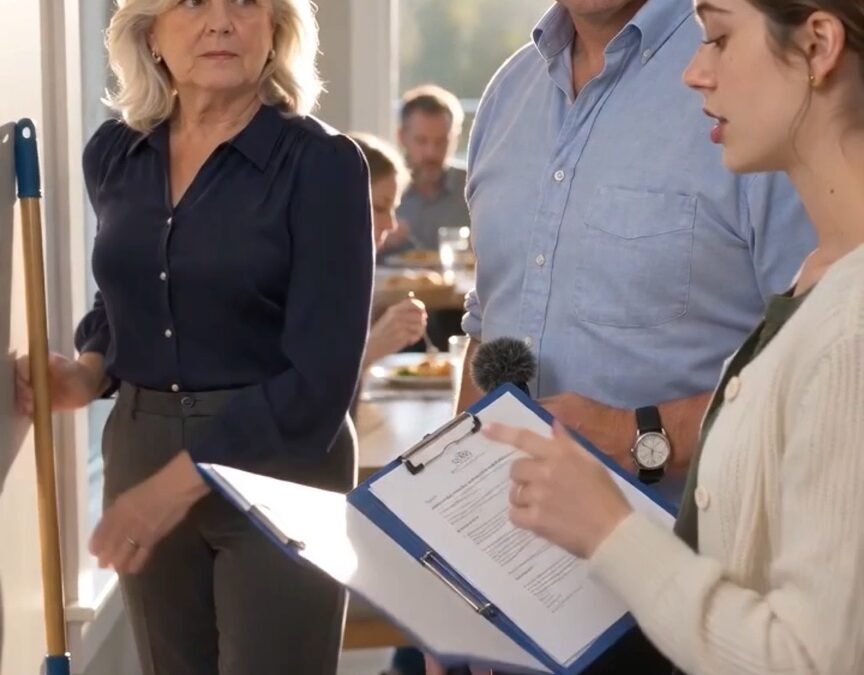
Audrey opened it beside Travis’s microphone.
She turned the folder slightly toward him.
Then she pressed one finger against the page.
“Read that part,” she told him.
Travis looked down without lowering the microphone.
I watched his mouth tighten around nothing.
“My grandmother’s name,” Audrey said. “And her ownership.”
She looked up at the tables.
“Denise owns seventy-five percent of this diner.”
Nobody clapped. I was grateful for that.
I wasn’t trying to put on a show.
I wanted the truth spoken in that room.
Travis reached toward the folder’s edge.
Audrey kept her hand resting on the page.
“Both signatures are here,” she said.
“I know what I signed.”
“Then why did you say that?”
He looked at me instead of answering.
For a moment, I saw something familiar.
He expected me to make this easier.
Usually, I would have laughed things off.
I would have blamed a misunderstanding or exhaustion.
That night, I set his mop against the wall.
I placed it carefully beside the cleaning bucket.
Then I came back to my chair.
My hands were empty when I faced him.
“You said I wasn’t an owner.”
“Mom, that’s not how I meant it.”
“You said it into a microphone.”
“I meant you don’t run this place.”
“That isn’t what you said.”
My voice wasn’t loud. It didn’t need to be.
The microphone was still switched on beside us.
Travis finally lowered it toward his waist.
Around us, thirty-six relatives and regular customers waited.
Their dinners sat beneath the warm ceiling lights.
October 12 was supposed to celebrate eight years.
Instead, we were looking at our founding agreement.
It was inside an ordinary blue folder.
The bottom corner had softened from handling.
I had bought it when we opened.
There wasn’t anything impressive about the folder itself.
What mattered was what we had put inside.
My $96,000 investment appeared in our opening records.
The signed operating agreement established my ownership interest.
Seventy-five percent belonged to me.
The remaining twenty-five percent belonged to Travis.
His work as manager was a separate arrangement.
That distinction had apparently become inconvenient for him.
“I built this business,” he said.
“You worked in it,” I answered.
“So did I.”
“I’m here every day.”
“And I’ve washed dishes every Friday and Saturday.”
“That’s not the same responsibility.”
“No,” I said. “You were paid for yours.”
Audrey looked down at the open folder.
She wasn’t smiling. Neither was I.
I had no appetite for making him small.
I knew too well how that felt.
But I wasn’t going to rescue him anymore.
Not from the meaning of his own words.
His manager’s salary was $3,200 a month.
That was compensation for doing his job.
It wasn’t proof that he owned my share.
My unpaid labor hadn’t erased my ownership, either.
Those were separate facts, all plainly documented.
For years, I had let them blur together.
Mother. Investor. Dishwasher. Emergency pair of hands.
I had answered to all of them.
Eventually, Travis had stopped noticing the difference.
Or perhaps I had stopped requiring him to.
Audrey moved her finger farther down the agreement.
“This section concerns the manager,” she said.
Travis glanced toward the dining room.
“Not here.”
“You chose here,” I told him.
He set the microphone in its stand.
The little metal base scraped against the table.
That sound carried farther than it should have.
Audrey read the provision without raising her voice.
A majority ownership vote could remove the manager.
The agreement also permitted action by written consent.
There was no promise of lifetime employment.
There was no requirement that I keep funding him.
There was certainly no dishwashing condition attached to ownership.
“Are you threatening to fire me?” Travis asked.
“I’m reading what we both signed.”
“Over a mop?”
“No. Don’t reduce this to the mop.”
He glanced toward the wall where it stood.
The wet strands had spread across the bucket’s rim.
“It was a spill,” he said.
“Then you could have asked politely.”
“You’re making this bigger than it is.”
“You told this room I owned nothing.”
“I didn’t say nothing.”
“You said I wasn’t an owner.”
There wasn’t anywhere for that sentence to go.
He had spoken it clearly before witnesses.
Audrey hadn’t twisted it or embellished it.
Neither had I.
I pulled my chair out and sat down.
My knees had started trembling beneath my skirt.
I didn’t want him to mistake that for surrender.
“Sit if you want to talk,” I said.
He stayed standing beside the microphone.
Audrey remained beside the open blue folder.
For once, I let the silence stay uncomfortable.
I had spent years rushing to fill it.
Offering excuses. Offering help. Offering money.
That morning had followed the same familiar pattern.
Travis needed something, and I had savings.
Only this time, he had asked for $18,000.
I looked up at him.
“You called me this morning.”
His expression changed before I said anything else.
“Mom, that’s business.”
“Yes,” I said. “It certainly is.”
Audrey turned toward him.
“What did you ask her for?”
“Equipment money. You know we need equipment.”
“How much?” she asked.
I answered before he could soften the number.
“Another eighteen thousand dollars.”
A chair shifted somewhere behind me.
I kept looking at my son.
“He wanted replacement kitchen equipment,” I said.
“I asked for details before making any decision.”
Travis rubbed a hand across his forehead.
“We can’t keep putting those purchases off.”
“Then bring me the estimates and the books.”
“Audrey has the books.”
“And I’m right here,” she said.
She sounded exactly like our bookkeeper then.
Not a granddaughter trying to protect her grandmother.
Just someone asking for an ordinary business process.
“Nothing was approved,” she continued.
Travis looked at me.
“You know I wouldn’t ask without a reason.”
“I didn’t accuse you of that.”
“Then why bring it up now?”
“Because you asked an owner for money.”
I paused until he met my eyes.
“Then you called her the cleanup help.”
He opened his mouth, then closed it again.
I had expected anger to feel hotter.
Mostly, I felt worn out and terribly clear.
Those two things can exist together.
“I haven’t agreed to invest,” I said.
“I haven’t signed anything.”
“You were going to help.”
“I said to send me the details.”
“That’s usually what you say first.”
There it was, spoken without much thought.
My questions had become steps toward his yes.
He hadn’t considered that I might refuse.
For eight years, I had made that assumption easy.
The first unpaid dishwashing shift had seemed reasonable.
A new diner needed everybody pitching in.
I knew commercial kitchens from my school job.
I could work a dish station efficiently.
I knew how to keep a sink moving.
At 59, I still had good stamina.
I thought a few months would be manageable.
Then we needed another month, another busy season.
Friday and Saturday evenings became my standing assignment.
There was always a reason to keep going.
I understood thin margins and unexpected repairs.
What I hadn’t understood was the permanence.
Nobody formally asked for eight unpaid years.
They arrived one weekend at a time.
I missed quiet dinners and evening walks.
I planned errands around the dishwashing schedule.
I bought shoes based on their nonslip soles.
Even after retiring, I watched the Friday clock.
By four, I was gathering my work clothes.
By five, I was pushing through the kitchen.
Travis knew where I would be.
Eventually, he stopped asking whether I could come.
“Your help mattered,” he said finally.
I looked at the mop against the wall.
“That isn’t what you told everyone.”
“I was trying to make a joke.”
“Who was supposed to enjoy it?”
He didn’t answer.
Audrey closed the folder halfway, keeping our place.
“Grandma doesn’t have to decide anything here.”
That was the kindest thing anyone had said.
Not because it excused what had happened.
Because it gave me back some room.
I didn’t have to match his public behavior.
I didn’t have to announce a punishment immediately.
I could make a business decision while rested.
I could read every relevant paragraph again.
And I could stop holding that mop tonight.
“Thank you,” I told Audrey.
Travis leaned closer across the table.
“Can we please finish the dinner?”
“We can stop this conversation,” I said.
“That isn’t the same as settling it.”
His jaw moved slightly.
“What am I supposed to tell everybody?”
“The truth would be a start.”
He looked toward the waiting tables.
I didn’t supply a speech for him.
After a moment, he faced the room.
“My mother does own seventy-five percent.”
His voice sounded smaller without the microphone.
I waited for something more.
An apology, perhaps. Something about the unpaid work.
Nothing else came.
Still, the correction belonged in that room.
I was glad everyone had heard it.
Audrey slipped the agreement back into its folder.
She placed the folder beside my water glass.
I ate a few bites after that.
The food had cooled, but I barely noticed.
Travis moved away from our table.
I let him.
When dinner ended, I collected my tote myself.
I didn’t carry plates into the kitchen.
I didn’t check whether the dish racks needed emptying.
That took more effort than I expected.
My hands kept wanting to find a task.
Audrey walked with me toward the entrance.
“You didn’t do anything wrong,” she said.
“I know.”
“You look like you’re apologizing anyway.”
“I’m practicing not doing that.”
She gave me a small, tired smile.
At home, I put the folder beside my chair.
I changed into slippers and washed my face.
Then I sat beneath my reading lamp.
I read the operating agreement from the beginning.
Not just the ownership page Audrey had shown.
Not just the provision concerning the manager.
I read the notice and written-consent provisions, too.
I checked them against the decision I was considering.
There was no need to invent authority.
We had agreed on it eight years earlier.
I had simply stopped using it.
That was uncomfortable to admit.
It was also something I could change.
I didn’t write anything while I was crying.
I let that part finish first.
Then I made notes on a yellow pad.
Ownership and employment needed to remain separate.
His unpaid wages, if any, must be paid.
His ownership interest would remain exactly as written.
I wasn’t taking his twenty-five percent.
I wasn’t canceling his lawful distribution rights.
I was deciding who should manage my investment.
I could love my son without employing him.
That sentence took me several tries to write.
It still looked harsh on the paper.
But harsh wasn’t the same as untrue.
On October 13, I sat at my kitchen table.
The blue folder lay open beside my coffee.
I prepared the written majority-owner consent.
It identified the diner’s business entity correctly.
It cited the operating agreement’s manager-removal provision.
It ended Travis’s manager appointment effective that morning.
I signed and dated it as majority owner.
I kept the original with the company records.
Then I delivered a copy to Travis.
Audrey received one for the diner’s records, too.
There was no microphone and no audience.
I didn’t need either one.
Travis read the first page standing up.
Then he read it again.
“You actually did this?”
“Yes.”
“You’re ending my job?”
“Your manager position, yes.”
“And my salary?”
“The salary ends with that position.”
He pulled a chair out but didn’t sit.
“That’s thirty-two hundred dollars a month.”
“I know the amount.”
“Mom, I depend on that.”
“I depended on you treating me honestly.”
He looked down at the paper again.
“So I lose everything over one bad night.”
“No. Read the rest.”
I waited while his eyes moved down.
His twenty-five percent ownership remained unchanged.
So did his rights under the operating agreement.
Any distributions would follow that agreement and applicable requirements.
I wasn’t replacing wages with promised distributions.
Those weren’t the same thing.
He would receive all compensation already earned.
I would not use his final pay as leverage.
Nothing in the consent transferred his ownership to me.
“This says I’m still an owner.”
“Because you are.”
“But I can’t manage.”
“Correct.”
“You’re keeping your part and taking mine.”
“No. Your job wasn’t your ownership.”
He stared at me for a long moment.
That distinction had been useful to him yesterday.
Today, he wanted it to disappear.
I kept my voice even.
“You retain your twenty-five percent.”
“You’re removing me.”
“From the manager position. Not from the family.”
He finally sat down.
“What happens to the equipment?”
“The diner still needs a responsible equipment plan.”
“So you’re paying the eighteen thousand?”
“No.”
He looked up sharply.
“I’m declining that additional investment.”
“You know we need replacements.”
“Then we evaluate what the business can afford.”
I wasn’t declaring the equipment unnecessary.
I wasn’t risking anyone’s safety to prove something.
Anything unsafe had to remain out of service.
But an equipment need wasn’t a personal invoice.
Not one automatically payable from my retirement savings.
Audrey joined us with the current financial records.
She placed them on the table between us.
There were no accusations hidden inside those pages.
No secret theft. No miraculous pile of cash.
Just the ordinary numbers of a small diner.
Income. Expenses. Obligations. Choices we needed to make.
“I can prepare comparisons,” Audrey said.
“Repair costs, replacement costs, and available cash.”
Travis leaned back in his chair.
“That all takes time.”
“Yes,” I answered. “Management usually does.”
He looked away.
I didn’t enjoy saying it.
I also didn’t take it back.
We discussed the practical handover that morning.
Keys and business records had to be accounted for.
Manager-only access would be changed through proper channels.
His ownership information would remain in the records.
Audrey would keep doing the bookkeeping.
I would oversee the transition as majority owner.
There were already kitchen and counter shifts scheduled.
We kept the work within safe operating limits.
I handled decisions I was authorized to make.
I did not promise to cover every empty hour.
That was the hardest habit to interrupt.
Each problem still sounded like a personal summons.
A gap on a schedule. A delivery question.
A sink full of dishes on Friday evening.
But owning a business didn’t require unpaid servitude.
If work needed doing, it needed a plan.
And where appropriate, it needed paid hours.
Audrey helped me list the actual management duties.
We included scheduling, purchasing, and daily supervision.
We included equipment planning and clear financial reporting.
Then we looked for someone experienced in that work.
Not someone I needed to rescue.
Not someone expecting ownership because they held keys.
Someone who understood a manager’s responsibilities.
Within three weeks, we hired an experienced manager.
I won’t pretend that solved every problem.
Small diners don’t become simple because someone leaves.
The equipment still required careful decisions.
The books still needed checking.
People still called with questions.
But the questions came to me differently.
I was asked for approval, not automatic sacrifice.
I received information before requests for money.
We discussed costs without treating my savings as inventory.
Audrey stayed our bookkeeper.
She didn’t become my shield against her father.
I made sure she understood that.
“You shouldn’t have to referee us,” I said.
“I wasn’t trying to referee.”
“I know.”
“I just knew what that paper said.”
“And you helped me remember it mattered.”
She looked toward my reading chair.
“Are you keeping it right there?”
“For now.”
“Good.”
Travis and I didn’t suddenly become easy together.
He was angry about losing the salary.
I understood that without reversing my decision.
He called twice to discuss his ownership.
I answered both calls.
When he asked about business records, I provided them.
When he returned to the dinner, I listened.
“I shouldn’t have said you weren’t an owner.”
“No,” I said. “You shouldn’t have.”
“I was frustrated.”
“That explains a feeling. Not your choice.”
He was quiet after that.
I didn’t turn the silence into forgiveness.
Forgiveness wasn’t a form I needed to sign.
It could wait for more than one conversation.
My first free Friday felt strangely unfinished.
At four, I checked the kitchen clock.
At four-thirty, I almost reached for work clothes.
Then I remembered I wasn’t scheduled.
I made myself a grilled cheese sandwich.
I put it on an actual plate.
There was no rack waiting beside my chair.
No wet apron hanging against my knees.
I ate slowly while the room grew dim.
Later, I called Audrey.
“Everything all right?” she asked.
“Yes. That’s why I’m calling.”
She laughed softly.
“What are you doing?”
“Nothing that needs rubber gloves.”
“That sounds promising.”
“It does, doesn’t it?”
I was still a mother and grandmother.
I was still a retired school cook.
I still owned seventy-five percent of our diner.
But Friday nights finally belonged to me again.
I could visit if I wanted dinner.
I could stay home if I wanted quiet.
Neither choice required anybody’s permission.
Sometimes I thought about those thirty-six guests.
I remembered the microphone and my son’s sentence.
I remembered how quickly I accepted the mop.
Then I remembered setting it against the wall.
That mattered more than getting the last word.
I had put down work I never owed.
I had kept rights I already possessed.
And I had done it without taking his.
Beside my reading chair stayed the blue folder.
You Might Also Enjoy




