My Son Offered My Car To Bidders After Mom’s Funeral — Then I Showed What I’d Signed
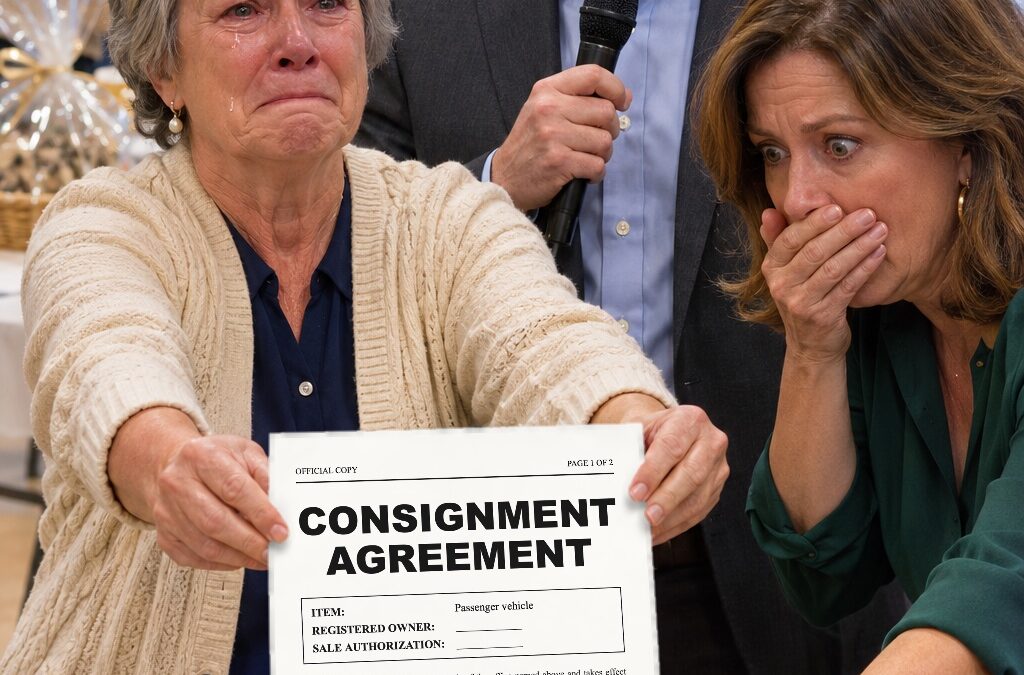
Part 3: The Missing Approval
“Separate written approval from the registered owner is required before bidding or sale,” Denise read.
She kept her finger beneath the printed paragraph.
“This agreement permits preliminary display and valuation only.”
Curtis stood beside her with his empty hand extended.
Denise turned the page toward me, not toward him.
“Bonnie, have you signed a separate sale approval?”
“No.”
“Have you given the school written permission to donate it?”
“No. I came to discuss what it might bring.”
She checked the papers beneath my agreement. Then she looked inside the folder beside her phone.
“There is no separate approval in our records.”
The nearest parents could hear without the microphone. Denise used it anyway.
“The vehicle is not authorized for bidding.”
Curtis lowered his hand and adjusted his jacket.
He had wanted us in the hallway before this. Now he stayed close enough to see the paper.
“I understood there was room to discuss the arrangement.”
“There was,” I said. “There still wasn’t permission.”
Denise placed her retained agreement beside my copy. She matched the signed pages and the controlling paragraph.
The papers lay flat beneath the gym lights.
Nothing had changed between my kitchen and that table. The permission Curtis needed was still missing.
Felicia stepped nearer, keeping her voice low.
“Could we let Denise finish privately?”
“She’s correcting a public announcement,” I said.
A parent turned a bidding sheet facedown. Another moved a chair away from Denise’s table.
Nobody resumed clapping.
Denise kept the microphone near her mouth.
“Please leave the vehicle out of your bidding plans. We have not opened it for bids.”
She stopped there and rested the microphone against her shoulder.
I could hear someone moving baskets behind us. The ordinary sounds made me notice my handbag strap. I had twisted it tightly around my fingers.
I unwound it and laid it across my lap.
Curtis watched that movement instead of looking at me.
Denise slid my copy closer.
“Would you like to explain what you authorized?”
I stood because I wanted the back tables to hear.
“I authorized a display and a discussion about value.”
Denise angled the microphone toward me.
“This car carries my paid sewing work,” I said. “I collect clothes and take finished work back.”
I could see the gym doors beyond Curtis’s shoulder.
“My customers aren’t all able to come to me. I haven’t bought another car.”
Curtis looked toward the doors, too.
“I’m not retiring,” I added. “I haven’t agreed to give away my transportation.”
Felicia pressed her lips together.
I remembered the garment bag across my back seat. It was empty that evening, ready for work afterward. I had left it there because this was supposed to be a discussion, not the last trip in my car.
Denise brought the microphone back toward herself.
“Preliminary display does not authorize a sale or donation.”
She said it without looking at Curtis.
“We should not have had a donation announcement.”
That was the first time anyone from the school had said it plainly.
I sat down again.
The metal chair felt cold through my skirt. I put both feet flat beneath it and straightened the agreement.
Curtis leaned toward Denise.
“I wasn’t trying to stop her from working.”
I looked up at him.
“You offered the car I use.”
“I thought another arrangement could be made.”
“There isn’t another arrangement.”
He glanced toward Felicia, who was examining the table.
I had heard that same suggestion about rides already. It sounded easy while nobody had to name a customer, carry a garment bag, or rearrange a workday.
Denise moved the key envelope away from her paperwork. She placed it where I could still see it.
The worn cloth loop remained caught beneath the flap.
She did not hand it over yet. She was checking what had been entered beside the pending vehicle listing.
I watched her pen move down the sheet.
There was a difference between hearing that I was right and seeing what would happen next. I needed the listing removed. I needed the keys back in my own hand.
Curtis bent slightly toward me.
“Can we at least talk about helping?”
“We can finish checking the paperwork.”
He straightened without answering.
The gym doors opened as someone came inside. For a moment I could see the ribbon outside. It stretched across the car I had driven there myself.
I looked back at the agreement.
On May 13, 2026, Denise had sat across from me while we signed it. Curtis had proposed the possibility of a smaller car. I had asked what happened if the figure disappointed me.
Denise had shown me where approval would be required.
I remembered folding my copy before leaving. I had not expected to need it in public. I had brought it because I was still deciding.
Now Denise touched that same paragraph again.
“Your copy matches the school’s copy,” she told me.
“And nothing else was signed.”
“Nothing authorizing bidding or sale,” she confirmed.
Curtis drew his chair closer but did not sit.
He was reading the part Denise had just identified. I could see his eyes move across the page.
He had not asked to inspect my copy before this. He had counted on a different answer in the gym.
Felicia finally looked at him.
“Did you know that was in there?”
He answered without turning toward her.
“I knew she was considering the sale.”
“That’s different,” I said.
He rubbed the side of his jaw.
Denise pulled the pending sheet beside the agreements. She left her phone where its screen remained visible.
“I need the listing and the records to match,” she said.
The wording mattered to her now. I appreciated that, even though I wished she had stopped Curtis sooner.
I folded my hands over my handbag.
For years, I had brought Owen home from school and moved work around him. Those arrangements had usually happened without paperwork. A message arrived, and I made space.
This was not a pickup time.
My car was paid off. It had been mine alone since 2021. The title was at home, where it had stayed.
Denise asked whether anyone else owned it.
“No. Nobody else owns it or holds my title.”
She nodded and made a note.
Curtis turned his attention to the waiting tables.
“We shouldn’t leave everyone sitting here all evening.”
Denise answered before I could.
“Then we need an accurate explanation.”
Her microphone remained in her hand.
I watched Curtis calculate what he could say next. His mouth opened, then closed when Denise tapped her phone.
The message was still there.
Until then, the paper had answered whether the car could be sold. The phone held another question.
Why had the listing become his family’s donation?
I knew the expected amount because he had announced it. I did not yet know what he had told Denise to do with it.
She adjusted the phone so she could read comfortably.
“Before I change the pending record, I need to address this message.”
Curtis placed his palm on the table edge.
“It concerns the same discussion.”
Denise looked directly at him.
“It contains instructions about the proceeds.”
I slid my handbag beneath my chair. I wanted nothing between my hands and the papers now.
Felicia took her hand off Curtis’s sleeve.
Denise checked the sender again, then the date.
She brought the microphone closer.
“Curtis, will you explain the email you sent me?”
Part 4: His Donation Instructions
Curtis looked at the phone without reaching for it.
“I was trying to make the family’s support clear.”
Denise kept her eyes on the screen.
“This message is dated May 14, 2026.”
She read the portion saying I had decided to donate all proceeds. Then she read that confirmation would follow.
My chair scraped when I sat farther forward.
“That confirmation never came,” she said.
Curtis nodded, as though that settled the problem.
But Denise continued reading his instructions.
He wanted the expected $16,500 credited toward his household’s auction pledge.
She stopped with the phone still in her hand.
“That is what you asked us to record.”
I looked at Curtis.
“You told her to give your household the credit?”
“Our family,” he said. “You’re part of the family.”
“The car belongs to me.”
“I understand that now.”
“You knew whose car it was.”
He glanced at the agreement rather than answering.
Denise lowered the microphone briefly.
“I relied on his statement that your confirmation was coming. That allowed staging, not bidding.”
Then she raised it again for the waiting room.
“The expected amount was not money the school received.”
The words reached the tables behind Curtis. A parent who had been standing near the aisle sat down.
I kept looking at my son.
The email had been sent after we signed the limited agreement. He had not waited for me to decide anything.
He had supplied the answer himself.
My mother’s glasses were still beside my kitchen telephone. While I was deciding where her belongings belonged, Curtis had been arranging public credit for my car.
I pressed my thumbnail against the handbag clasp.
Denise turned the phone toward me.
I read the instructions for myself.
There was no question asking whether I might donate part of a sale. There was no request to call me before making an announcement.
He had told Denise what I had supposedly decided.
Below that, he had directed where the credit should go.
“I didn’t send this,” I said.
“No,” Denise answered. “It came from Curtis.”
I looked at the signed agreement beside the phone.
“If I had approved a sale, where would the proceeds go?”
“To you, less the school’s fundraising fee.”
“And that fee?”
“$500, only after a completed sale.”
Curtis shifted his weight.
Denise traced the relevant provision with her pen.
“That is the arrangement Bonnie and I signed.”
There it was in the same document. My money had not become a family contribution simply because Curtis described it that way.
I had been considering whether selling made practical sense. He had been considering how the expected amount would look beside his household’s pledge.
Felicia leaned over far enough to read the screen.
“Curtis, you said she was thinking about helping.”
“She was thinking about selling,” he said.
“That isn’t what your message says,” Denise answered.
He stepped back from the table.
He did not argue that I had already signed approval. He could see that claim would fail beside the matching agreements.
Instead, he turned toward me.
“You could still choose to help now.”
I kept my hands on my handbag.
“The school still needs support,” he continued. “That part hasn’t changed.”
“I’m keeping my car.”
“You don’t have to decide while you’re upset.”
“I’m deciding about my property.”
He looked toward the parents again.
“I’m asking whether we can find a way forward.”
“Not by donating my car.”
Felicia pulled out the chair beside mine but stayed standing. The chair legs caught against my shoe.
I moved my foot and waited.
Curtis spoke more softly.
“We could talk about the amount afterward.”
“There is no amount from me.”
He had tried to make the donation sound settled. Now he was trying to make refusal sound premature.
I did not explain my sewing income to him again.
He knew what was carried in my back seat. He had seen finished clothes hanging beside my ironing board.
Denise placed her phone flat on the table.
“I cannot credit your household for Bonnie’s proceeds without her authorization.”
“There aren’t any proceeds,” I said.
“That is also correct.”
Curtis looked at the pending sheet.
“What if the pledge stays pending while we discuss it?”
Denise did not pick up her pen.
“Is Bonnie agreeing to a donation?”
“No,” I said.
He drew a breath through his nose.
“I was asking Denise.”
“She needs my answer.”
For a moment he watched me as though waiting for another sentence. I had spent years adding explanations when he disliked the first answer.
I left this one alone.
A paper corner lifted in the breeze from the gym doors. I flattened it with my palm.
The agreement was warm beneath the overhead lights.
Denise asked whether I wanted more time to consider a sale.
“No. I want the vehicle withdrawn.”
Curtis turned back toward us.
“You can withdraw it without making this sound intentional.”
“I’m asking for the record to be accurate.”
Denise looked from him to me.
“Do you want formal withdrawal of the pending listing?”
“Yes. Please remove it entirely.”
“And no donation authorization will be supplied?”
“None.”
She reached for her pen.
Curtis rested his fingers on the back of Felicia’s chair.
“Mom, this is still a school fundraiser.”
“I know where we are.”
“I don’t want our family remembered for this.”
“Then correct what you told them.”
His fingers tightened around the chair back.
Denise moved the key envelope farther from the pending sheet. She needed space to mark the record.
I watched the envelope instead of my son.
Those keys had been handed over for a display. I had done what Curtis requested because Denise was there and the agreement was signed.
I had not handed over a title. I had not accepted a replacement. I had not decided to stop collecting work.
The difference was written down in front of everyone.
Felicia finally sat, leaving room between our chairs.
“Could you contribute something else later?” she asked.
“I’m not making another promise tonight.”
She looked down at her folded hands.
I was not going to replace his announcement with another obligation just to make the table more comfortable.
Denise gathered the agreements into a neat stack.
“Your original copy will go back with you.”
“Thank you.”
“The school’s copy stays with our records.”
“Yes.”
She left Curtis’s email open on her phone.
He watched as she placed it beside the pending sheet again. The papers and message were no longer separate conversations he could describe differently.
Denise lifted her pen.
“I will record withdrawal before this proceeds any further.”
Curtis glanced toward the gym doors.
“Can we at least keep the explanation brief?”
“Brief and accurate,” Denise said.
I stood and moved the chair beneath the table. My knees had stiffened while we sat there.
Denise turned the pending sheet so I could see the vehicle entry.
“Bonnie, I’m going to remove this listing now.”
Part 5: Off the Auction List
Denise drew her pen through the pending vehicle entry.
She wrote beside it, then checked the sheet underneath.
I stayed standing until she finished.
Curtis watched the pen instead of the microphone.
Denise held the marked sheet where I could see it.
“The vehicle is withdrawn before bidding.”
“Please tell everyone who heard the announcement.”
She nodded and raised the microphone.
“I need to correct the earlier vehicle announcement.”
People turned from the baskets and their conversations.
“Bonnie did not donate her car. The display agreement did not authorize bidding or sale.”
Felicia stood beside the chair she had pulled out.
Denise continued before Curtis could speak.
“The vehicle has been withdrawn from the pending list. No bids were taken.”
She let that sentence stand before adding anything else.
“No vehicle sale has occurred.”
I watched the parents nearest us look toward the doors. Someone folded a bidding sheet and slipped it beneath a program.
Nobody needed to wonder whether I had interrupted a purchase. There had never been a buyer to disappoint.
Curtis put his hands into his pockets.
Denise lowered the microphone and faced him.
“Please leave the auction announcements with me.”
He glanced at the microphone but did not reach for it.
Then she opened the key envelope.
The cloth loop had twisted around the edge. She eased it free instead of pulling the keys through.
I held out my hand.
She placed the keys and worn wrist loop in it.
“Your car remains yours.”
I closed my fingers around them.
The metal pressed into my palm, familiar and ordinary. I slipped the loop over my wrist before gathering anything else.
Curtis stepped nearer the table.
“I can help take the ribbon off.”
“I’ll take it off.”
He stopped beside the empty chair.
Denise handed back my signed agreement. I checked the pages before folding them along the existing crease.
Her retained copy went into her folder.
“Will the school send written confirmation?” I asked.
“Yes. Please send me anything you want addressed.”
“I will.”
She glanced toward the waiting tables and then back at me.
“I’m sorry this announcement happened before we verified it.”
“Thank you for stopping it.”
I did not tell her it was all right.
She had kept bidding from beginning. She had also relied on Curtis longer than I wished.
Both things were true.
I put the agreement into my handbag. The wrist loop caught against the zipper, and I freed it carefully.
For the first time since standing up, I could leave.
Felicia moved into the space beside me.
“Are you going home?”
“Yes.”
“Curtis and I should probably talk to you.”
“Not here.”
She glanced toward the people nearest the aisle.
“That’s what we were trying to avoid.”
“I was trying to keep my car.”
She opened her mouth, then pressed it closed.
Denise returned her attention to the auction table. She moved the crossed-out sheet beneath the papers she still needed.
The car would not be announced again.
Curtis stood back to let me pass, but his shoulders stayed turned toward me.
“Mom, wait.”
I stopped beside the gym doors.
He looked over his shoulder before speaking.
“We don’t need to make this worse.”
“Then don’t announce anything else about my property.”
He rubbed his forehead and looked away.
I pushed the door open.
The air outside felt cooler than the gym. My car sat exactly where I had parked it.
The ribbon looked larger from the sidewalk.
I set my handbag on the passenger seat and left the door open. Then I worked at the ribbon where it had been fastened.
I did not yank it across the paint.
A knot had tightened against itself. I loosened it with my thumbnail until the ends separated.
Inside the gym, the microphone sounded again.
Denise was continuing the fundraiser without my car.
I pulled the ribbon free and folded it over my arm. There was no reason to tear it or leave it blowing across the school entrance.
Curtis came through the doors while I was folding it.
“I said I could do that.”
“I have it.”
He stopped on the sidewalk.
I carried the folded ribbon back to the entrance. I left it just inside, away from the path people were using.
When I returned, Curtis was looking through the car window.
The empty garment bag lay across the back seat. He could see it without my pointing.
“That could go in another car,” he said.
“I don’t have another car.”
He nodded slowly.
He knew that was not a problem he could solve by suggesting it. Buying a replacement would require money I had not agreed to spend.
I opened the driver’s door.
Felicia had come outside and stood near Curtis.
“We weren’t trying to leave you stranded,” she said.
“You offered rides after you asked me to surrender it.”
She looked at the car, then at him.
I settled into the seat and put my handbag beside me.
The keys went into the ignition.
I did not start the engine yet. I wanted the door shut before the conversation continued.
Curtis kept his hand away from it.
“Will you call when you get home?”
“I’m going straight home.”
He stepped back, and I closed the door.
For a moment I sat looking through the windshield.
The place where the ribbon had crossed the hood was bare. My route home did not need anyone’s permission.
I started the engine and checked behind me.
Curtis and Felicia remained on the sidewalk as I pulled away.
At home, I carried my handbag inside before doing anything else. I laid the agreement on the kitchen table and put the keys beside it.
Alma’s glasses were still near the telephone.
I moved them farther from the table edge. Then I took off my shoes and set them beneath my chair.
My sewing room door was open.
A pair of trousers waited beside the machine. I checked the pinned hem, though I did not start working.
I wanted to see something I had actually agreed to do.
The customer’s note was tucked beneath the hanger. I read it, then placed the trousers back carefully.
My phone sounded from the kitchen.
Curtis’s name appeared on the screen.
I stood beside the table while I read his message. He did not ask whether Denise had returned my agreement.
He knew I had it.
He did not ask whether the car was safely home.
He wanted to discuss the correction.
I took the keys out of the middle of the table. The cloth loop had a loose thread that brushed my wrist.
Then I read his request again.
“Please keep any further correction inside the family.”
Part 6: What I Put in Writing
I left his message unanswered while I cleared the table.
There were sewing notes beneath an envelope and a folded towel waiting to be put away. I moved those things without moving Alma’s glasses again.
Then I sat with the agreement in front of me.
Across the top were the words “CONSIGNMENT AGREEMENT.”
Below were the template fields I had seen before:
“Item: Passenger vehicle | Registered owner: ____________ | Sale authorization: ____________”
The completed details were elsewhere in the document.
So were our signatures and the controlling provision.
I turned to those pages and read them slowly.
The blank template lines had never supplied permission. The signed terms explained exactly what could happen.
Display and valuation were allowed.
Bidding and sale required separate written approval.
I put my finger beneath the proceeds provision next. Had I approved a sale, the proceeds belonged to me, less the stated school fee.
There had been no completed sale.
There would be no fee.
I took the original title from its storage place. My name was there, with nobody else’s beside it.
Curtis had never held it.
I laid it beside the agreement only long enough to check everything. Then I put the title back where it belonged.
The agreement went into the same protected storage area.
I kept a copy available for correspondence.
Nothing needed to sit on my kitchen table overnight. I wanted those papers safe, not displayed beside my supper.
Before closing the drawer, I checked that it shut properly.
Then I returned to Curtis’s message.
He wanted the correction kept inside the family. The announcement had gone through a microphone in a school gym.
I typed a reply, read it, and deleted a sentence about how embarrassed I had felt.
That was not what I needed recorded.
“You cannot offer my property for sale or donation again. You cannot promise proceeds or donor credit in my name.”
I paused, then added the part he had asked about.
“The correction needs to reach the people who heard your announcement.”
I sent it before I could begin explaining again.
The phone stayed quiet while I prepared my email.
I addressed it to Denise.
I identified the withdrawn vehicle listing and the agreement we had signed. I asked for written confirmation that bidding had never begun.
Then I asked that any projected proceeds be removed from the fundraiser’s expected revenue.
The household donor credit needed to be removed, too.
I did not want a pending entry left behind for someone else to misunderstand.
I read the email from the top.
It did not accuse the school of selling anything. It did not call the expected $16,500 a debt.
I asked for the records to show what happened.
The car had been withdrawn.
No sale or donation had occurred.
No money was owed by me.
I asked Denise to confirm that no fundraising fee applied.
Then I sent the message and closed the screen.
My shoulders hurt from sitting upright so long. I stood at the sink and rinsed a cup that was already nearly clean.
The water ran over my fingers until it warmed.
I dried the cup and put it away.
There were still work calls to return after the weekend. There were still garments waiting in my sewing room.
I took the empty garment bag out of the car. Then I hung it beside the items ready for delivery.
I had not lost that part of my week.
When I returned to the kitchen, Curtis had replied.
“I understand you’re keeping the car. I’m asking not to make the family look dishonest.”
I sat down before answering.
“The correction should say I never donated it.”
His response did not come immediately.
I could picture him deciding which words would be easiest to send. That was his work to do, not mine.
I put the phone facedown and checked my appointment book.
The weekday spaces already had customers written into them. Some needed collection, and others needed finished work delivered.
I had spent years arranging those spaces around Owen.
Since 2019, the childcare had cost Curtis and Felicia $0. It had cost me appointments I could not accept.
I did not write a bill for the past.
I drew a clean line beneath the existing work arrangements. Going forward, I needed to agree before anyone treated my time as available.
Denise’s reply arrived while I was checking garment notes.
I opened it at the kitchen table.
She confirmed that the school had spent nothing against the projected pledge.
The expected amount could be removed without billing me.
I read that paragraph again.
There was no school purchase waiting for my car to cover it. There was no shortage I had created by refusing.
The promise had been Curtis’s, and it had not produced money.
Denise said the formal written withdrawal confirmation would follow through the school’s records.
She would include the status of the listing, proceeds, and donor credit.
I replied with thanks and saved the exchange.
Then I placed the copy of my agreement with the correspondence. It was easier to breathe when everything was together.
Curtis called while I was putting the folder away.
I answered from my kitchen chair.
“I saw what you wrote,” he said.
“Then you know what I’m asking.”
“Couldn’t I just say the vehicle is no longer available?”
“That leaves your donation announcement uncorrected.”
He was quiet for a moment.
“I don’t want to send something that sounds worse than what happened.”
“Say what happened.”
“I announced it before everything was settled.”
“You announced a donation I hadn’t made.”
He did not dispute that.
I watched the curtain lift slightly above the kitchen window. The room was finally quiet enough to hear traffic outside.
“I need time to think about the wording,” he said.
“Use the facts.”
When the call ended, I put the phone on its charger.
I took Alma’s glasses to the small box where I was keeping her things. I could do that slowly, without answering questions about a car.
I left the box open while I checked the sewing room.
The trousers still waited beside the machine.
I threaded the needle and tested a stitch on scrap fabric. The ordinary motion helped me settle into the chair.
Then the phone sounded again.
This time it was Felicia.
She wanted to know about Owen’s school pickups.
“Can we go back to the usual arrangement for Owen?”
Part 7: The Following School Week
I called Felicia instead of answering with a quick yes.
My appointment book was open beside the machine.
“Tell me what you need,” I said.
“The usual after-school help.”
“I need you to ask about specific arrangements.”
She made a small impatient sound.
“Bonnie, he’s used to coming to you.”
“He can come when I’ve agreed.”
“I don’t want him feeling punished.”
“Neither do I. This is about my schedule.”
I could hear movement on her end of the call. I waited while she moved somewhere quieter.
“Are you saying you won’t watch him anymore?”
“No. I’m saying you need an answer from me first.”
I looked at the customer names already written down.
“I have paid work to collect and deliver.”
“We’ve always worked around that.”
“I’ve moved appointments.”
She did not answer that sentence.
I asked her to send the arrangements she needed. I would check them against the work already promised.
Until I accepted, she and Curtis needed another plan.
I said it calmly, though I had pressed my pencil hard enough to dent the paper.
After we hung up, I sharpened it over the wastebasket.
Then I went back to the hem on my table.
The following school week began with garment bags in my back seat.
I checked the addresses before leaving home. The agreement stayed put away; I did not need to carry it on an ordinary work trip.
My keys were enough.
At a customer’s door, I held finished trousers over my arm while she checked the hem.
She smoothed the cloth and smiled.
“That’s where I wanted them.”
“I left the extra fabric inside.”
She thanked me and brought out another item needing work.
I wrote her instructions before returning to the car.
Nothing about that visit required Curtis or Felicia to arrange a ride. I did not have to wait until someone’s lunch break.
I placed the new work behind my seat.
At the next stop, I collected curtains folded inside a bag. They were awkward rather than heavy.
I opened the back door fully and laid them flat.
That was the sort of detail lost when someone said we would figure out transportation later.
The bag needed space.
The customer needed a collection she could depend on.
I needed to reach her when I had promised.
Back home, I carried everything into the sewing room. I separated completed work from incoming work before making tea.
The phone contained a request from Felicia.
This time she had described the pickup and visit she wanted.
I checked the book and accepted the part I could manage. I declined the part that overlapped a delivery.
“I can do the agreed visit,” I wrote. “I can’t collect him during that appointment.”
She replied that she would handle the collection.
I did not offer to move the customer.
That afternoon, my car stayed outside the customer’s house instead of in the school pickup line.
I measured a curtain while kneeling beside the customer’s table. Then I marked the fabric and wrote the instructions down.
When I returned home, I checked for any change in Owen’s arrangement.
There wasn’t one.
Felicia had handled what I had declined.
I hung my cardigan on the chair and resumed sewing.
The school’s written confirmation arrived during the week after May 16, 2026.
I opened it with my copy of the agreement nearby.
The vehicle listing had been withdrawn before bidding.
No bids had been accepted.
No sale had occurred, and no proceeds had been received.
The projected revenue and household donor credit were removed.
I read the fee paragraph before anything else.
No completed sale meant no fundraising fee.
There was no payment due from me.
I set the message beside my earlier request and checked each point. Nothing was left hanging as a future obligation.
Then I read Denise’s accompanying note.
The school had removed Curtis from his volunteer auction duties.
I sat back in the chair.
He had wanted the family credit without providing his own money. Instead, he no longer had the role that let him make the announcement.
That consequence had not come from a private argument at my table.
The school had its agreement, its pending record, and his email.
Denise had seen them together in front of the parents.
I saved the written confirmation with the rest.
Then I replied that I had received it.
I did not ask the school to reverse its decision about Curtis. I did not offer an explanation for him.
He could speak for himself.
Later, he called while I was pressing a finished seam.
I unplugged the iron before answering.
“They’ve taken me off the auction work,” he said.
“I received the confirmation.”
“I put a lot of time into that.”
“I know you volunteered.”
“It feels like they’re treating me as if I took money.”
“No money changed hands.”
“Exactly.”
“You still announced a donation I hadn’t made.”
He exhaled slowly.
I laid the pressed fabric across the board so it would not wrinkle.
“What do you want me to do now?” he asked.
“Correct your announcement.”
“I’ve already spoken to Denise.”
“The parents heard you, too.”
He said nothing for a while.
I did not fill the gap with suggestions about how to make it painless.
The correction needed to come from him.
Denise had corrected the listing in the gym. Curtis had made the original claim and called me selfish when I objected.
Those were separate responsibilities.
He asked whether I would be satisfied with the car remaining mine.
“The car was always mine.”
“I mean, can we stop arguing now?”
“I’m not arguing about ownership.”
“Then what’s left?”
“Your correction.”
I heard him set something down.
He understood the choice. He could leave his mother publicly described as withdrawing a generous donation, or he could tell the people who heard him that no donation had existed.
I could not write his choice for him.
After the call, I returned to the ironing board.
The seam had cooled properly.
I slipped the garment over its hanger and covered it for delivery.
My work had kept moving all week.
That did not make the phone calls easy. I still checked messages longer than I needed to, hoping one would contain a plain acknowledgment.
I stopped checking when the next customer arrived.
We discussed the fit, marked the adjustment, and agreed on collection.
When she left, Curtis had sent another message.
“Would you read a correction before I send it?”
“I’ll read it for accuracy,” I replied.
I left my phone on the worktable and finished removing the fitting pins.
His draft arrived while the pins were going back into their cushion.
He had begun by saying there had been confusion.
I read the sentence again, then typed beneath it.
“Please say who announced the donation and that I never made it.”
Part 8: The Correction He Sends
Curtis called after reading my response to his draft.
“I don’t want this to become an attack on me.”
“It needs to be accurate.”
“I’m trying to fix it.”
“Then don’t call my refusal confusion.”
I sat at the kitchen table with the draft open.
He had removed the claim that the car was no longer available. He had not yet said that it had never been offered as a donation by its owner.
That omission mattered.
People had heard him tell me not to take it back. The correction needed to explain that there had been nothing to take back.
He asked me how I wanted that phrased.
“In your own words. State what you did.”
“I announced it before getting your approval.”
“You announced a family donation I had not made.”
He repeated the sentence more quietly.
I did not soften it for him.
Outside the kitchen window, my car was parked where I always left it. I could see the empty passenger seat.
There was no ribbon, no display envelope, and no pending discussion about selling.
Curtis asked whether the expected amount had to be included.
“Yes. You announced the credit.”
“It makes the whole thing sound calculated.”
“I didn’t write your email.”
He was quiet after that.
I placed the phone flat on the table while keeping the call connected. My ear hurt from holding it so tightly.
“I’m not asking you to describe your intentions,” I said. “I’m asking you to correct the facts.”
He agreed to revise it.
When the next draft arrived, I read every line.
He identified the vehicle announcement as his.
He stated that I had not donated my car.
He said I had authorized only preliminary display and valuation, not bidding or sale.
He stated that his household would receive no $16,500 donation credit.
The message also made clear that no vehicle sale had occurred.
I compared it with Denise’s written confirmation.
The facts matched.
I replied that the correction was accurate.
I did not add praise or promise that everyone would forget.
Curtis still had to send it.
I went into the sewing room and began removing a damaged hem. The stitches were small, and the fabric needed care.
Each time the phone sounded, I set the seam ripper down safely before looking.
For a while, the messages were about work.
A customer confirmed a delivery arrangement.
Felicia confirmed Owen’s agreed visit.
Then Curtis sent me the correction as it had gone to the event’s attendee mailing list.
I checked the recipient information before reading it again.
It had gone beyond our family.
The people who heard the announcement could now read his correction.
He had not changed the important sentences.
“Bonnie never donated the car,” he had written.
His household would receive no $16,500 credit.
I sat on the edge of the sewing chair with the phone in both hands.
The wording did not give me back that evening. It did not remove the moment when people had clapped for something I could not afford to surrender.
But it stopped leaving his version unanswered.
I saved the correction beside the school’s confirmation.
Then I sent him a short reply.
“I received it. Thank you for correcting the record.”
He answered with a request to talk.
I checked the garment spread across my table.
“I can talk after I finish this seam.”
I finished it before calling.
He answered without his usual greeting.
“I sent you something else.”
The separate message was already waiting.
I read it while he stayed on the line.
He apologized for invoking Alma at the auction.
He wrote that he should not have used my mother’s funeral against me.
I read that part slowly.
There was no claim that I had misunderstood him. There was no explanation about being under pressure from the school.
He named what he had said.
I reached for the small box holding Alma’s glasses. I did not open it.
“Did you read it?” he asked.
“Yes.”
“I shouldn’t have brought Grandma into it.”
“No. You shouldn’t have.”
“I knew you were still dealing with everything.”
“You had been at the funeral with me.”
“I know.”
I looked at the lid beneath my palm.
He had carried flowers that day. That memory had made his microphone remark hurt worse, not less.
I was not going to argue about what Alma might have wanted. She had not offered my car either.
“I wanted you to know I’m sorry,” he said.
“I’ve read your apology.”
He waited.
I could hear his breathing, then movement on his end.
“Can we come over and have dinner sometime?”
“Not to settle this tonight.”
“I wasn’t trying to rush you.”
“I need you not to.”
He said he understood.
I accepted the correction and the apology. I did not promise that our conversations would feel normal immediately.
There was no useful date I could give him for that.
I told him the childcare arrangements would stay scheduled.
He did not object.
“Felicia showed me what you agreed to,” he said.
“That’s what I can do.”
“We’ll ask before adding anything.”
“Yes.”
It was a small exchange, but it was the part I could actually use.
An apology could sit in my saved messages. A changed pickup arrangement would show up in my workday.
When we ended the call, I opened Alma’s box.
Her glasses lay inside a soft folded cloth. I adjusted the cloth so the arm would not catch.
Then I shut the lid.
I did not spend the rest of the evening rereading what Curtis had sent.
There was a customer’s sleeve waiting on the table.
I marked the alteration and put the garment on a hanger. Then I carried finished work to the car so it would be ready.
The keys slipped against my fingers as I opened the door.
The cloth wrist loop was worn where my thumb usually rested.
I checked the back seat before locking up.
The garment bags were secure.
Inside, Felicia had sent another message about Owen.
She asked whether the visit we had agreed on still worked.
“Yes,” I wrote. “That arrangement still works.”
She replied that she would bring him and collect him as agreed.
I put the phone away.
The next morning, I left for a delivery without waiting for another household’s plans.
I carried the finished clothes to the customer’s door. She examined the work while I held the empty garment bag.
We discussed another alteration before I left.
At home, the school correspondence remained filed away.
The correction did not need another revision from me.
Curtis had sent it to the people who mattered. The school had removed the projected credit and his auction duties.
My worktable was clear enough to spread out curtains.
I unrolled them and smoothed the fabric with both hands.
Then I checked the note for Owen’s visit and left room beside the table for his backpack.
Part 9: My Keys Beside the Door
Owen arrived for the visit we had actually arranged.
Felicia came to the door with him.
She confirmed the collection plan before leaving.
I nodded and repeated what we had agreed.
There was no added request while she backed away. Nobody asked whether I could manage something else first.
Owen carried his backpack into the kitchen.
He set it on the chair, then picked it up again.
“Grandma, can you look at this?”
The strap had started pulling away beside my earlier repair.
I turned it over in my hands.
“You’ve been carrying quite a load.”
He opened the bag and began taking things out.
Books and loose papers covered his end of the table. I moved a cup before it could get knocked over.
He found the place where the fabric had frayed.
“Can you fix that part, too?”
“Yes. Let’s empty it first.”
He smiled and tipped out the remaining papers.
I brought my sewing things from the workroom.
The repair from April 22, 2026, still held. The worn fabric beside it needed reinforcement.
I found suitable cloth among my scraps.
Owen watched me turn the edge under.
“Is that going inside?”
“Yes. It’ll spread the pull.”
He held the strap where I asked.
There was no school microphone in my kitchen. Nobody needed to announce what the repair was worth.
He needed his backpack mended, and I had agreed to spend the visit with him.
I threaded the needle.
“Do you have spelling to practice?”
He pulled a paper from the pile.
We worked the same way we had before the funeral. He tried a word while I pushed the needle through.
When he hurried, I asked him to slow down.
When I needed both hands, he held the fabric flat.
I did not tell him what his father had written. I did not ask him whether anyone at home had discussed the auction.
The papers belonged in my file, not in his backpack.
He leaned close when I tied off the thread.
“Will that hold?”
“Let’s test it gently.”
He lifted the empty bag by the repaired strap.
I checked the stitches while he held it.
Then we packed his books back inside.
I left the needle and scissors away from the edge.
He stayed at the table while I put the scraps aside. We had time for his work because I had not promised the same time to a customer.
That was the difference I could see.
I was not sewing with my eye on a delivery I was already late to make.
When Felicia came back, she knocked and waited.
Owen showed her the repaired strap.
“Grandma fixed the other part.”
She looked at the stitching.
“Thank you, Bonnie.”
“You’re welcome.”
She checked that he had all his papers.
Then she asked about a future visit instead of telling me when he would arrive.
“I’ll check my work,” I said. “I’ll let you know.”
“All right.”
She did not ask me to decide at the door.
After they left, I cleared the kitchen table. I brushed the thread ends into my palm and carried them to the wastebasket.
Owen’s chair was pushed in.
My appointment book was where I had left it.
I checked the request against the work already scheduled. There was room for some help, but not everything.
I sent Felicia the arrangement I could accept.
She confirmed it.
I wrote it into the book beside my customers, not over them.
Curtis continued handling his own conversations with the school.
He no longer had volunteer auction duties to arrange. The donor record did not carry the expected amount beside his household.
I did not receive another request to make that credit real.
The correction had gone to the attendee mailing list. His separate apology remained saved with our messages.
We spoke when there was something to arrange.
Sometimes the calls were brief.
He asked before making plans involving me, and I answered what I could do. I did not turn every conversation back to the gym.
I also did not tell him we had returned to how things were.
We hadn’t.
My weekday sewing appointments stayed in place.
I collected trousers and curtains in my own car. Finished garments traveled in the back seat, covered and ready.
At customers’ doors, I checked fit and discussed the next job.
The money was for work I had completed.
No part of it went toward a pledge Curtis had announced for me.
The car had never left my ownership.
There had been no sale, no buyer, and no transfer of title.
The original title remained stored at home.
No fundraising fee was due.
The school had confirmed there was no financial claim against me.
I did not need to keep checking the auction records. The written withdrawal, canceled credit, and correction were together if I ever needed them.
I put the file away and used my table for sewing.
Some afternoons I still moved Alma’s box when I needed space. I had not finished deciding where every one of her belongings should go.
I handled them when I was ready.
Curtis no longer received an answer just because he asked while I was grieving or tired.
If I needed to check something, I checked it.
If I had work, I said so.
There was no speech about it at dinner or another gathering. It happened in ordinary messages and ordinary plans.
“Can you collect Owen?”
“I have a delivery. I can’t.”
“All right. We’ll arrange it.”
Or I checked my book and said yes.
The yes meant I was available.
It did not mean every afternoon after that belonged to them.
After Owen’s visit, I returned to the sewing room and finished a customer’s hem.
I removed the pins and counted them back into their cushion. Then I pressed the fabric and covered the garment.
Outside, my car waited for the delivery.
I carried the finished work out before locking the house.
The drive took me through familiar streets in Lancaster, Pennsylvania. I parked near the customer’s entrance and lifted the garment without dragging its cover.
She checked the alteration and thanked me.
I wrote down her next request before leaving.
When I came home, the back seat held only the empty bag. I brought it inside and hung it ready for more work.
There was a message from Curtis asking about a visit.
I checked the appointment book before replying.
Then I put the phone down.
The repaired backpack was gone with Owen. The table was clear. My next customer’s work waited beside the machine.
I closed the sewing-room door partway.
Beside it, I hung my car keys by their worn cloth wrist loop.
You Might Also Enjoy




