My Supervisor Called Me A Cleaner At Christmas Dinner, So I Kept My Seat And Questioned Her Credit
Complete story · 10 chapters · about 40 minutes · ending included
Chapter 1 · Chapter 2 · Chapter 3 · Chapter 4 · Chapter 5 · Chapter 6 · Chapter 7 · Chapter 8 · Chapter 9 · Chapter 10
Chapter 1: The Cart Between the Tables
“You’re the cleaner. Know your place.”
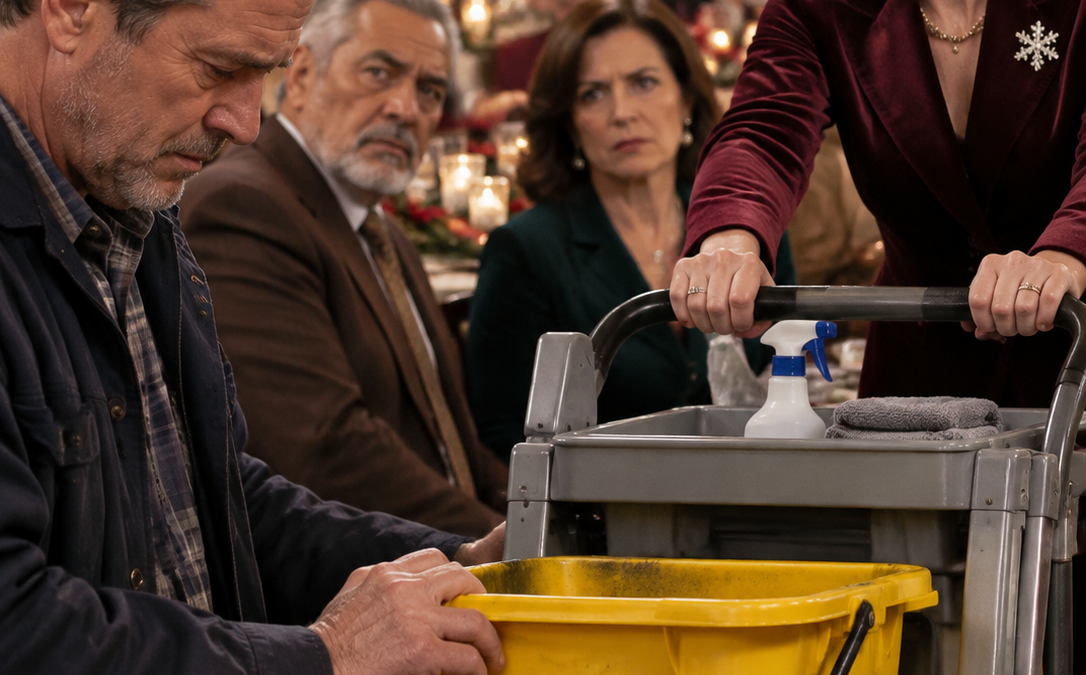
Stacie Montgomery pushed the gray cleaning cart toward my chair.
Christmas lights reflected in its yellow bucket as it rolled.
My carefully washed work jacket caught against the black handle.
Forty-eight guests watched from the dining tables.
Nobody seemed sure whether to look at me or their plates.
Stacie kept one hand on the cart and wore her usual pleasant smile.
She was dressed for the donor dinner, not the workroom.
I was fifty-three, and I had spent much of my working life keeping school boilers running.
I could tell an ordinary maintenance issue from a dangerous failure.
I knew how much work went into keeping a building warm.
But Stacie had a way of making my job sound smaller whenever other people were listening.
It had been happening long enough that I recognized the pattern.
She could give me an assignment in private, then speak about the result as if I had merely been nearby.
The word cleaner was her favorite way to remind me where she thought I belonged.
My face grew hot.
I felt the embarrassment before I felt the anger.
The worst part was knowing that people had heard her.
I reached for the yellow bucket before the cart could tip.
My jacket pulled against the handle.
I freed the fabric carefully and looked straight at Stacie.
“Cleaning isn’t the insult. That was.”
My voice stayed level.
My stomach did not.
I had worked alongside custodians for years.
They noticed leaks, strange smells, broken fixtures, and problems other people walked past.
Their observations helped keep a school running.
I had never considered their work beneath mine.
Stacie had managed to make a room full of school employees feel otherwise.
Tracie Guzman stepped toward us from the dining area.
“Please clear the aisle,” Tracie said.
Her voice was calm, but her expression had changed.
The aisle mattered because guests were moving between the tables.
Stacie glanced toward the service door and gestured in that direction.
She wanted the cart moved out of sight.
She also wanted me to follow it.
I understood the suggestion.
The service door was where she expected me to go.
My dinner was still waiting at my assigned place.
My chair had not been offered to anyone else.
I looked down at the plate I had not touched.
Then I looked at Stacie.
I had spent too much of my working life making uncomfortable situations easier for people who caused them.
I was tired of doing that.
I guided the gray cart beside my chair and pressed its brake.
The aisle was clear.
“I’d like my seat back and my dinner left untouched,” I said.
Stacie glanced from my chair to my face.
She did not answer.
Ernest Figueroa closed a thick repair folder beside his plate.
I noticed the folder, but I kept my attention on my place at the table.
I remained beside my chair.
The cart stood next to me, its yellow bucket catching the warm lights overhead.
I could feel people watching without turning their heads.
Some guests returned to their meals.
Others stayed quiet.
I knew how awkward a public disagreement could make a room.
I also knew who had started it.
Tracie moved back toward the front of the dining hall.
Stacie straightened her jacket and walked toward the head table.
She looked entirely at ease.
I resented how quickly she seemed to move on.
She had humiliated me before the donors and my coworkers.
Now she seemed ready to continue the evening as if she had simply moved a piece of equipment.
I pulled my chair out and sat down.
My dinner had gone cold around the edges.
I spread my napkin over my knees.
My hands trembled enough to make the fabric shift.
I considered walking out.
But leaving would make it easier for Stacie to tell the story her way.
So I stayed.
I had not come to the dinner expecting an award.
I had come because the school had invited its staff and donors to share a meal.
I was proud of the work I did there.
A boiler did not care about somebody’s job title.
It either worked or it did not.
When the heating system failed, classrooms got cold.
When a repair was delayed, people noticed.
That was why the proposed repair project mattered.
The school needed a careful plan.
The donor gift was intended to address those needs, not decorate somebody’s career.
Stacie had assigned me the inspections and estimates.
I had taken that responsibility seriously.
I understood the importance of accurate figures.
A repair estimate was not a number someone could casually type into a page.
It represented actual work, materials, and decisions about what the building needed.
I had wanted the school to get those decisions right.
I had also wanted the people doing the work to receive proper recognition.
That was never an unreasonable request.
A small printed program rested beside my plate.
I had barely noticed it when I arrived.
Now I picked it up.
The cover carried the school’s name and a simple Christmas design.
Inside were the dinner schedule, acknowledgments, and information about the repair project.
I turned the page.
The first section thanked the donors.
The next described the proposed improvements to the school’s heating system.
I recognized the project immediately.
I knew the scope of the work.
I knew the figures that had gone into preparing the estimates.
My eyes moved down the page.
There was a section about the person responsible for creating the repair plan.
I stopped.
The room continued around me.
A glass touched a plate somewhere behind my shoulder.
Someone laughed near the head table.
Most of those sounds passed without reaching me.
I looked at the printed credit.
I knew what work had gone into those estimates.
I knew who had been assigned to inspect the systems.
And I knew whose name should have appeared beside that work.
The program gave the repair plan one creator.
Stacie Montgomery.
Beneath her name were the words:
You may also like
My Sister Knocked My Birthday Plate Down, So I Kept The Receipts She Signed
My Son Stranded Me Before Our Family Reunion, So I Called The Driver And Heard What He Sent
My Son Called My Gift Garbage At His Housewarming, So I Asked His Wife About The Bill
Fourteen original repair estimates.
My name was nowhere on the page.
Picking up where the Facebook post left off
Chapter 2: The Supervisor’s Version
The printed program felt stiff between my fingers.
“Stacie, can we speak privately before the presentation?”
She glanced at the page in my hand.
Her smile stayed in place.
“Of course, Shaun.”
I stepped away from the table, toward the wall beside the service entrance.
The guests were occupied with their meals and the conversation near the head table.
I kept my voice low.
“I need you to correct the program,” I said. “The repair plan lists you as its creator.”
Stacie lowered her eyes to the page.
“I understand why that wording might confuse you.”
That careful tone made my stomach tighten.
She was speaking as if I had misunderstood a simple instruction.
“You assigned me the inspections and estimates,” I said.
“You entered the figures I gave you,” she replied. “That is different from preparing the plan.”
I felt my jaw stiffen.
I had inspected the equipment.
I had worked through the repair needs.
I had prepared the estimates she was now claiming as her own.
But she reduced all of that to typing.
“Those were my estimates,” I said.
Stacie gave me a small, patient smile.
“The figures came from me, Shaun. You put them into the format.”
I could hear the guests behind us.
A fork scraped against a plate.
Someone asked for more coffee.
I wanted to raise my voice so the room would hear the answer.
I did not.
I wanted the program corrected before she stood up and accepted praise for my work.
“Please fix it before the presentation,” I said.
Stacie looked past me toward my chair.
Then she took hold of the cart.
The gray wheels made a short rattling sound as she rolled it back across my dinner place.
The yellow bucket stopped between my chair and the table.
My plate was still there.
My napkin lay beside it.
Stacie kept her voice soft.
“You can have a meal in the kitchen if you’d be more comfortable there.”
The offer was meant to sound considerate.
It felt like another instruction to disappear.
I looked at the cart blocking my place.
Then at the untouched dinner.
“I’m staying at the guest table.”
Her smile thinned.
“Of course,” she said.
She did not move the cart.
She left it across my place and returned toward the head table.
I stood there for a few seconds.
My cheeks burned again.
The kitchen meal was not the point.
The cart was not the point either.
She wanted the room to see where she thought I belonged.
I pulled the program closer and turned past the project description.
A smaller section explained the school’s honor terms.
I read the conditions carefully.
The honor was noncash.
The school could correct it or withdraw it.
Tracie, as director, had authority over that decision.
I turned to the section about the repair project.
The internal policy assigned Tracie control of donor submissions and the people presenting them.
I held the pages flat with my palm.
Those lines mattered.
Stacie could not settle the authorship question by smiling at me.
The person responsible for the school record had the authority to correct it.
I had spent years fixing equipment that other people depended on.
I knew a loose connection could make an entire system fail.
A loose account of who did the work could do damage too.
I moved around the cart and carried the program toward Tracie.
She was standing near the head table, speaking with one of the guests.
I waited until the guest stepped away.
“Tracie, may I speak with you?”
“Certainly, Shaun.”
I showed her the program.
“I asked Stacie to correct this before the presentation.”
Tracie read the credit beneath the repair plan.
Her expression stayed courteous.
“Stacie told me you typed the figures she supplied,” she said.
My stomach sank.
So that was the version she had already given the director.
“She assigned me to inspect the systems and prepare the estimates,” I said.
Tracie folded the program closed.
“What establishes that you prepared them?”
The question was fair.
It still stung.
I had expected her to ask Stacie why my name was missing.
Instead, I was being asked to prove I had done the work.
My job title was printed in the staff directory.
It did not describe the inspections I had completed.
It did not show the hours spent checking equipment or calculating repair needs.
And it could not explain why fourteen estimates had been prepared under my name before the donor copies changed.
“I have something that shows what I was assigned,” I said.
Tracie waited.
“Can you show me?”
I nodded.
I did not want to argue beside the head table.
I wanted her to see the original communication, with the full thread intact.
Could I prove more than my job title?
I took out my phone.
The dining hall noise continued behind us.
I opened my work inbox and found the received assignment thread.
You may also like
My Husband Shamed Me At Our Anniversary, So I Called The Jeweler He Named
My Fundraiser Chair Sent Me To Eat By The Trash, So I Refused To Keep Serving
My Brother Accused Me Of Selling Mom’s China At Thanksgiving, So I Asked For The Buyer
The first message was from Stacie Montgomery.
Her original instructions were still there.
Chapter 3: What She Put In Writing
I turned the phone so Tracie could read the screen.
The email had come from Stacie on Monday.
Inspect the fourteen boiler repair needs and prepare an estimate for each.
I watched Tracie’s eyes move across the message.
There was no mention of typing figures someone else had supplied.
The instructions were direct.
I had been assigned the inspections and the estimates.
The next part of the thread showed Stacie’s approval for me to send the original estimates to Ernest for the budget discussion.
At Tracie’s gesture, I scrolled down.
I felt my shoulders tighten while she read.
I had kept the thread because it was part of my work.
I had never expected to use it to defend the fact that I had done my work.
The next message came from Stacie on Thursday.
Remove your name from the donor-facing copies. I’ll sign as facilities supervisor.
I stopped scrolling.
Tracie looked at me.
“Why was your name being removed?”
“I understood that she was signing the donor copies as supervisor,” I said. “I wanted the technical work credited separately.”
I scrolled to my reply.
I can route the copies through you, but please keep my name as technical preparer.
Tracie read the line without speaking.
I felt my throat tighten.
That reply had been polite.
Maybe too polite.
I had been trying to protect my job and keep the project moving.
I had not wanted a fight with my supervisor.
But I had not agreed to disappear from the work.
Tracie asked to see the beginning of the conversation again.
I scrolled back to the first message while keeping the phone in my hand.
She read the entire thread from the beginning, including the replies and the approval.
I moved through the messages at her pace, stopping whenever she wanted to examine a particular line.
I did not hand her a cropped screenshot.
I did not select three convenient lines and ask her to trust me.
The entire received conversation was there.
She could see the sender, the order, and the words surrounding each instruction.
When she finished, I lowered the phone but kept it in my hand.
“Stacie told me you entered figures she supplied,” she said.
“I know.”
“That’s not what this thread says.”
My stomach eased for a second, then tightened again.
A written assignment was important.
It was not yet the whole answer.
Stacie could still claim that I had misunderstood what I was asked to prepare.
I wanted the school to compare the work itself.
“Before the honor is presented, could we compare the original estimates with the final copies?” I asked.
Tracie looked toward the dining hall.
The presentation was still ahead of us.
She glanced at the program in her hand.
“I’ll pause that part of the program,” she said.
I felt a small lift in my chest.
Then fear came back.
I knew Stacie would not like being questioned in front of the director.
I also knew Ernest had the folder beside his dinner plate.
Tracie turned toward the dining room entrance.
“Ernest, could you join us in the adjoining office?”
Then she looked toward Stacie.
“I’d like you there too.”
Stacie gave a small nod.
“I’ll be there in a moment.”
Ernest rose with the thick folder.
He followed Tracie and me into the office.
The adjoining office was small and quiet.
A desk stood beneath a row of filing cabinets.
The dining hall sounds reached us through the open doorway, softened by the wall.
Ernest set the folder on the desk.
The first section held fourteen original estimates, one for each repair.
He had kept them for the scheduled budget discussion, just as I had sent them.
I stayed beside Tracie.
Ernest opened the folder and separated the first section.
“These are the original estimates Shaun sent for my budget discussion,” he said.
My pulse quickened.
I knew the pages.
I had prepared them after inspecting the boiler systems.
I had checked the repair needs and worked through the figures.
Ernest laid the first estimate flat.
My name appeared in the preparer field.
Below it was Stacie’s approval as facilities supervisor.
The same arrangement appeared on the next page.
Then the next.
Tracie leaned closer.
“Shaun is listed as preparer,” she said.
“And Stacie approved the estimates,” Ernest replied.
I felt the tightness in my chest loosen.
Not relief exactly.
More like the first sign that someone else could finally see the work as it had happened.
The original pages were clear.
My name was there.
Stacie’s supervisory approval was there.
The work had not vanished.
But the program in the dining hall still credited her with creating fourteen original estimates.
Stacie had not joined us yet.
I could not tell what had happened between the pages Ernest kept and the copies the donors received.
That was the question now.
What changed in the final submission?
Tracie looked from the original estimates to Ernest.
“Please open the replacement section,” she said.
You may also like
My Husband Humiliated My Son At His Academy Banquet, So I Checked The Mail He Handled
My Mom Mocked My Job At Thanksgiving, So I Asked Questions And Uncovered My Brother’s Secret
My Stepdaughter Locked Me Out Of My Own Cabin Bedroom, So I Read Her Group Text Out Loud
A second set of pages waited behind the originals.
The final copies were next.
Chapter 4: The Wrong Box
The office went still.
Ernest’s fingers rested on the folder’s second section.
Stacie appeared in the doorway before he could open it.
She looked at the pages spread across the desk and gave a short, dismissive smile.
“Those are drafts,” she said. “The final versions are what the donors received.”
My stomach tightened.
She had called them drafts without asking who prepared them or why Ernest had kept them.
Tracie stood beside the desk.
“Then let’s look at the final versions,” she said.
Stacie stepped into the office.
Her eyes moved from Ernest to me.
I could tell she was angry, but her voice stayed polished.
“I don’t think we need to turn a routine document process into a dispute,” she said.
Ernest did not answer.
He opened the second section of the folder.
“These are the replacements I received Friday,” he said.
The pages had been printed and kept behind the originals.
Ernest turned the first replacement toward us.
A signature sat in the preparer field.
Stacie Montgomery.
Beneath it, the label read:
Prepared by
My mouth went dry.
The first original had my name in that field.
The replacement carried hers.
I looked at the two pages side by side.
Stacie’s approval had appeared on the original as the supervisor’s sign-off.
Now her name sat where the preparer’s name belonged.
I had not expected to see it so plainly.
I had thought there might be a clerical mistake.
A copied field.
A confusing layout.
But the replacement did not look like an accidental blank or a misplaced approval.
It named Stacie as the person who had prepared the estimate.
“Shaun,” Tracie said, “which original is this?”
I leaned toward the first page without touching it.
“The boiler room circulation pump estimate,” I said. “I inspected that unit and prepared the scope.”
Ernest kept one hand on the folder.
With the other, he turned the first original so its replacement sat beside it.
He did not lift the folder or pass the papers to anyone.
The figures matched.
The work described was the same.
The scope had not changed.
I checked the equipment description and the listed repair work.
Then I looked at the total.
It was the same number I had put on the original.
The only change I could see was the name in the preparer field.
I felt my ears grow hot.
I knew the inspection behind that page.
I had checked the equipment, identified the repair need, and put the work into an estimate the school could use.
Those details had not appeared by accident.
They came from looking at the actual system and deciding what it needed.
Ernest had kept the originals for his budget discussion.
When the replacements arrived, he had placed them in the same folder rather than throwing the first set away.
Until now, he had not compared the pages as pairs.
That was why the folder mattered.
The work had stayed mine.
The credit had been moved.
Stacie folded her arms.
“You’re comparing a working draft with a formatted submission,” she said. “That’s exactly why I handle the donor copies.”
Her tone made it sound as if I had caused the problem by asking to see it.
I wanted to tell her that formatting did not require changing the author.
I wanted to ask why a supervisor’s approval had become a claim of preparation.
Instead, I kept my eyes on the pages.
Tracie spoke before I could answer.
“Let’s stay with what the documents show.”
Stacie turned toward her.
“I have a department to run,” she said. “I can’t have Shaun challenging my decisions in front of donors.”
The word challenging made my stomach knot.
I had asked for a comparison.
I had not interrupted the dinner or accused her in front of the guests.
I had asked the director to check the records before an honor was announced.
That was all.
Still, I could see what Stacie was doing.
She was making my request sound like insubordination.
I had spent years worrying that one disagreement could cost me the work I loved.
Now she was using that fear in the room where the evidence sat open.
Tracie’s expression hardened.
“Stacie, stop,” she said.
Stacie looked at her.
“We are reviewing the documents,” Tracie continued. “Ernest, please keep the folder open and show us every remaining pair.”
Ernest nodded.
He kept the originals and replacements together.
The folder remained in his hands.
I looked at the first matching set again.
One page named me as preparer.
The next named Stacie.
Same figures.
Same scope.
Different author.
The other thirteen pairs were still behind them.
I felt the question pressing against my thoughts.
Was this one careless signature, or had every estimate been changed the same way?
Stacie glanced at the open folder.
Then she looked directly at me.
“You won’t represent my department again.”
Her voice was quiet.
The threat was not.
You may also like
My Son-in-Law Sent Me To A Motel For Christmas, So I Came Back With A Pie And His Own Texts
My Daughter-in-Law Trashed Sunday Lunch, So I Brought Proof That Silenced Her Celebration
My grandson skipped my 70th birthday for Vegas. Monday he stormed into my bingo night, furious his truck payment bounced, but the truck was in my name.
She was taking away my place on the project team.
And she said it before Ernest opened the other thirteen pairs.
Chapter 5: The Fourteen Matching Pages
The office seemed smaller after Stacie’s threat.
I looked at the folder.
Ernest kept his hand on the open pages.
Tracie did not look away from Stacie.
“Let’s finish the comparison,” she said.
Stacie pressed her lips together.
Ernest turned to the next pair.
I leaned closer to the original.
“The second estimate covers the heating valve assembly,” I said. “I noted the pressure loss during my inspection.”
Ernest placed the replacement beside it.
My name appeared under the preparer field on the original.
Stacie’s name appeared under the same heading on the replacement.
The figures matched.
The scope matched.
I recognized the inspection notes from my own work.
Ernest turned another page.
“The third one is the classroom circulation line,” I said. “The original notes include the leak location and the recommended repair.”
Again, the replacement carried Stacie’s signature.
I felt my stomach tighten.
The pattern was becoming harder to explain away.
Page after page, Ernest kept the originals and replacements together.
I identified the equipment.
I pointed out the inspection notes.
I explained the repair scope whenever Tracie asked.
Ernest did not rush.
He checked each pair before moving to the next.
Stacie stood beside the desk with her arms folded.
Her polished expression had become stiff.
I recognized the fourth estimate.
Then the fifth.
By the sixth, I knew what the remaining pages would show.
I still watched every comparison.
I wanted the record to be complete.
The seventh replacement carried Stacie’s name.
So did the eighth.
The ninth had the same figures as my original inspection estimate.
The tenth showed no change in the proposed work.
I could remember the equipment behind each one.
The worn components.
The maintenance concerns.
The repairs that could not be postponed indefinitely.
These were not imaginary numbers.
They came from actual school systems that needed attention.
Ernest reached the last four pairs.
I identified the inspection notes on each original.
He turned each replacement toward Tracie.
The same pattern continued.
Fourteen originals.
Fourteen replacements.
My name on the original preparer fields.
Stacie’s name on the replacement preparer fields.
Her supervisory approvals remained visible on the originals.
I felt anger in my chest, but I also felt something else.
I felt tired.
I had spent hours doing work that mattered to the school.
Now I was standing in a small office explaining why my name belonged on it.
Ernest checked the aggregate figure at the bottom of his budget summary.
“The proposed repair budget totals $67,200,” he said.
Tracie looked at the folder.
“All fourteen match?”
“All fourteen,” Ernest replied.
I curled my fingers against my palms.
I did not want to touch anything.
The records were clear without my fingerprints on them.
Stacie finally unfolded her arms.
“You’re making too much of the preparer field,” she said.
Tracie turned toward her.
“Can you identify a technical revision you personally made to any of these estimates?”
Stacie looked at the pages.
“I standardized the formatting,” she said.
She pointed toward the headings.
“The donor-facing copies needed to look consistent. I cleaned up the presentation.”
I felt my jaw tighten.
Formatting was not an inspection.
It was not a repair assessment.
It was not identifying the equipment that needed work.
Tracie waited.
“Which technical revision did you make?” she asked.
Stacie tapped the edge of one page.
“I’ve already explained that I made the documents presentable.”
Her voice sharpened slightly.
“This should be handled privately. We can correct the wording without embarrassing anyone.”
I looked at Tracie.
That was the opening I had been afraid of.
The school could quietly change a printed program.
The guests could hear nothing.
Stacie could keep her reputation.
And I could return to work with my name restored in a file nobody outside the office would ever see.
I knew how tempting that would be.
I also knew what the guests had already heard.
The program had named Stacie as the creator of the repair plan.
The honor was being presented before donors.
A private correction would leave the public claim untouched.
“I want the correction where the claim was made,” I said.
My voice was quieter than I expected.
Stacie turned toward me.
“Shaun, there’s no reason to make this personal.”
I felt my face grow warm.
“It became personal when my work was presented under your name.”
Nobody spoke for a few seconds.
I looked at the folder.
I looked at the original estimates.
Then I looked at Tracie.
“I don’t want an argument,” I said. “I want the school record to be accurate.”
Tracie closed the program in her hand.
“You’re right,” she said.
I felt my stomach tighten again.
She turned toward Stacie.
“I’ll give you the opportunity to answer in front of the same guests who heard the original introduction.”
Stacie’s eyes narrowed.
“You intend to do this tonight?”
“The guests are still here,” Tracie said. “The honor has not been presented.”
I could hear the dining hall through the open doorway.
Plates were being cleared.
Someone was laughing near the dessert table.
The evening had continued while we examined the folder.
I had no idea how Stacie would react when we returned.
She might deny everything.
She might blame the documents.
She might say I had misunderstood the assignment.
I wanted the truth spoken plainly.
I also feared what would happen to my place in the department afterward.
Stacie had already threatened me.
That threat had not disappeared because fourteen pages matched.
Tracie gathered the program and turned toward the doorway.
“Come with me,” she said.
I followed her.
Stacie came behind us.
We returned to the dining hall without waiting for another discussion.
The guests were still seated.
Dessert plates had begun appearing on the tables.
The gray cart remained beside my chair.
Its yellow bucket reflected the Christmas lights.
I could see the place where my dinner had been interrupted.
My chair was still there.
The program lay open near the head table.
Stacie’s name remained printed beneath the repair project heading.
I wondered whether Tracie would protect the evening.
She could make a quiet announcement and move on.
She could preserve the planned celebration and avoid upsetting the donors.
Or she could correct the claim in the same room where Stacie had presented my work as her own.
I watched her approach the front of the room.
The person holding the microphone was preparing to introduce the honor.
Tracie raised her hand.
The introduction stopped.
Then she called Shaun Pearson and Stacie Montgomery forward.
You may also like
My Son-in-Law Called Me Forgetful On Mother’s Day, So I Took Notes And Exposed His Plan
My Cousin Called Me A Thief At Thanksgiving, So I Checked The Log And Found What He Hid
My Son-in-Law’s Mother Locked Me Out On MEA Weekend, So I Photographed What She Left Behind
My name was going to be heard beside hers.
In front of all forty-eight guests.
Chapter 6: The Donor Asks
The dining hall quieted as Stacie and I reached the front.
Stacie stepped toward the microphone.
“I prepared all fourteen estimates myself,” she said.
The claim tightened something low in my gut.
Stacie had just seen the original pages.
She had seen the replacement signatures.
She knew Ernest had kept the documents.
Still, she repeated the claim in front of forty-eight guests.
I stood beside her, listening.
My face felt hot.
I wanted to interrupt, but I waited.
Ernest rose from his place near the table.
He carried the thick repair folder.
“Stacie,” he said, “why did you sign Shaun’s fourteen repair estimates as their author?”
Nobody moved.
Stacie turned toward him.
“I signed the final versions because I supervise facilities,” she said.
Ernest opened the folder.
He held it firmly and turned the pages toward the guests.
He did not hand it to Stacie.
He did not give it to Tracie.
The first original showed my name under the preparer field.
Stacie’s approval appeared beneath it.
Ernest turned to the matching replacement.
Her name appeared under Prepared by.
The figures were identical.
He showed the next pair.
Then another.
The same work appeared on both pages.
The same estimates.
The same repair scope.
Different names in the preparer field.
I watched people at the nearest tables lean forward.
Someone put down a dessert fork.
Stacie’s smile had disappeared.
“Those were only rough drafts. I made them presentable.”
Her voice remained controlled.
She pointed toward the printed pages.
“The donor copies needed consistency. I was responsible for making sure they were suitable for presentation.”
My jaw tightened.
She was calling my completed inspections rough drafts.
She was making the work sound like a collection of unfinished numbers.
I knew what I had inspected.
I knew what I had calculated.
And I knew the difference between approving an estimate and preparing one.
“Your approval means you reviewed the work,” I said.
I looked at the original beside its replacement.
“It doesn’t mean you performed the inspection or prepared the estimate.”
Stacie turned toward me.
“Shaun, you were working under my supervision.”
“I know.”
“You were assigned to help with the project.”
“I was assigned to inspect the systems and prepare the estimates.”
My voice stayed steady.
A hard beat thudded beneath my jaw.
I wanted the guests to understand that I was not claiming to be the supervisor.
I was asking them to recognize the work I had actually done.
A supervisor could approve an estimate.
That did not make the supervisor its author.
Tracie stepped closer to the microphone.
“Stacie, is there anything else you want to clarify?”
Stacie looked at her, then at Ernest’s folder.
“Shaun asked me to take the credit.”
Her accusation hit like a shove.
My stomach dropped.
She had moved from claiming the work to claiming I had given it away.
I looked at Tracie.
Then I took out my phone.
I had kept the original email thread open in my work inbox.
The same thread Tracie had examined in the office.
I did not need to search for another explanation.
“That’s not what I wrote,” I said.
Stacie folded her arms.
“You understood what I was asking.”
“I understood that you wanted your supervisor signature on the donor copies.”
I opened the Thursday message.
My thumb felt unsteady against the screen.
I turned the phone toward myself and read Stacie’s instruction aloud.
Remove your name from the donor-facing copies. I’ll sign as facilities supervisor.
The guests were quiet.
I could hear the faint movement of plates near the dessert table.
I scrolled to my reply.
I had written it because I wanted the project handled properly.
I had wanted the supervisor’s approval recorded without losing the technical credit.
I read my words aloud.
I can route the copies through you, but please keep my name as technical preparer.
I lowered the phone.
I did not add anything.
The messages had already said enough.
Stacie stared at me.
Her expression had changed.
She had expected me to argue from memory.
She had expected the room to hear two different versions of a conversation nobody else had witnessed.
But the conversation was written down.
Tracie looked at Stacie.
“You said you would sign as facilities supervisor,” she said.
Stacie did not answer immediately.
Tracie continued.
“Why did your name appear under Prepared by on the replacements instead?”
Stacie shifted her attention toward Ernest.
“I was responsible for the final submission.”
“That doesn’t answer the question,” Tracie said.
I felt my chest tighten.
Tracie was no longer repeating Stacie’s explanation.
She was asking her to account for the difference between the instruction and the documents.
That was what I had wanted from the beginning.
Not a fight.
Not an argument about who deserved more respect.
An accurate account of the work.
Stacie looked toward the guests.
“I had to make decisions about how the department was represented,” she said.
Ernest held the folder open.
“The original estimates identify Shaun as preparer,” he said. “Your approvals are on those same documents.”
He turned the replacement pages toward her again.
“The final versions identify you as preparer. The figures and scope did not change.”
Stacie’s cheeks had grown pink.
I remembered her threat in the office.
You won’t represent my department again.
I had been afraid when she said it.
I was still afraid.
I needed my job.
I loved the work, and I did not want a disagreement to end my place in the school.
Silence would leave her version standing.
I looked at Tracie.
She was waiting for Stacie to answer.
Would Stacie finally acknowledge whose inspections had become her honor?
Stacie looked at the folder.
Then she looked at the guests.
Her voice became sharper.
“He cleans. He doesn’t do the technical work.”
The room went still.
You may also like
My Son-in-Law Banished Me At Christmas Dinner, So I Checked The Papers He Thought I’d Ignore
My Daughter Mocked My Seventieth Birthday, So I Checked A File That Changed Her Party
My Son Called Me His Dependent At Thanksgiving, So I Stopped Paying And Found His Family’s Secret
She had denied my work.
And now she was denying my ability to do it.
Chapter 7: The Assignment Comes Back
For a moment, nobody moved.
I stood beside the microphone, looking at Stacie.
She had called me a cleaner in front of the donors, as if that settled everything.
Silverware clinked against a plate near the back table.
I took out my phone again.
The original email thread was still open.
“I’m going to read the assignment,” I said.
Stacie gave a small shake of her head.
“Shaun, this is becoming unnecessary.”
I kept the phone where Tracie and the guests could see it.
“Your message said:”
Inspect the fourteen boiler repair needs and prepare an estimate for each.
I read the sentence aloud.
Then I looked up.
“You didn’t ask me to type figures you supplied,” I said. “You told me to inspect the systems and prepare the estimates.”
The words sounded plain.
They were plain.
I had done exactly what she assigned.
Ernest opened the folder wider.
He kept it in his hands and turned the remaining matching pairs toward the guests.
The originals showed my name as preparer.
The replacements showed Stacie’s name in that same field.
Her supervisory approvals remained on the originals.
Ernest turned another pair.
Then another.
The work and figures matched.
The names did not.
A woman near the front leaned closer to see the pages.
Someone at the next table stopped eating.
Stacie looked from the folder to Tracie.
“Those were only rough drafts. I made them presentable.”
She spoke as if repeating the explanation could make it fit.
I had heard that excuse already.
Now the people who had received the program could see the pages themselves.
Stacie pointed toward the folder.
“You’re ruining Christmas over a name on a page.”
The line was delivered softly.
That made it worse.
She was asking the room to treat the work as a small matter.
Fourteen inspections.
Fourteen estimates.
A proposed repair budget of $67,200.
She wanted all of it reduced to a name.
I stepped closer to the microphone.
“You told me, ‘You’re the cleaner. Know your place.’”
Stacie’s eyes narrowed.
I looked toward the guests.
“Cleaners deserve respect too. Their work keeps this school running. You used that label to make people overlook the technical work you took from me.”
I kept my tone even.
There was no reason to shout.
I wanted anyone who cleaned this school to know I was not ashamed of their work.
I also wanted them to know I would not let Stacie use their job as a way to erase mine.
The room stayed quiet.
Tracie left the front of the room and walked toward my table.
The gray cart still stood across my dinner place.
Its yellow bucket caught the Christmas lights.
Tracie stopped beside the black handle.
Her hand rested near it.
She looked at me, then at the guests.
“I accepted your word,” she said. “I should have asked the person who did the work.”
Her admission was direct.
No excuse followed it.
I felt my eyes sting.
I had wanted her to say that earlier.
I had wanted her to ask me before printing the program.
But she was saying it now, where everyone could hear.
Tracie turned toward the room.
“I am withdrawing the honor as it was announced,” she said.
Stacie stood rigidly beside the microphone.
Tracie continued.
“The corrected record will name Shaun Pearson as the preparer of all fourteen estimates. Stacie Montgomery’s role was facilities supervisor and approver.”
A few guests looked down at their programs.
Others watched Tracie.
I could not tell whether the correction would last beyond the dinner.
A public statement could be changed later.
A printed program could remain on a shelf with the wrong name.
I wanted the correction to survive after the guests went home.
Tracie turned back toward my place.
Her hand closed around the cart handle.
She slid the gray cart sideways half a meter.
The wheels rolled across the floor.
My chair and untouched dinner were clear again.
“Your place is here,” she said.
I looked at the chair.
Then at the yellow bucket.
The same cart that had been pushed across my place now stood beside it.
I faced Stacie.
“My work never needed your name.”
The words came out quietly.
They were enough.
I sat down without moving equipment out of my way.
But I kept wondering what would happen after the guests left.
Would the school keep the correction?
Would the next project carry my name?
Would Stacie still be allowed to speak for work she had not done?
Tracie came back to the table before I could ask.
“Shaun, bring your records to Monday’s review,” she said. “Send them directly to me.”
She had addressed the request to me.
The request did not go through Stacie.
You may also like
My Stepmother Demanded My Guest Cottage, So I Locked The Gate And Let Her Story Unravel
On Thanksgiving, my daughter told 31 relatives I was too confused to handle money and had filed for guardianship. In June she’d had me co-sign her $38,000 car loan.
My Ex Stole My Ring For His Wedding, So I Went Home And Found What He Forgot
It did not go through the department.
It came straight to me.
Chapter 8: The Corrected Record
The yellow bucket stood beside my chair.
“I’ll bring the records,” I said.
Tracie nodded.
She did not offer another promise.
I appreciated that.
I had heard enough promises during the dinner.
I wanted to see what happened when the room was empty and the guests were gone.
I wanted to know whether my name would remain on the work after the celebration ended.
The next review came on Monday, December 21, 2026.
I arrived with my records organized in a folder.
My original inspection notes were there.
I had the assignment thread on my phone and copies of the estimates.
Tracie met with me first.
Her office door was closed.
She asked me to explain the inspections, the estimates, and the way the donor copies had been prepared.
I answered each question.
I explained how I had identified the repair needs.
I described the work behind the figures.
I also explained why I had requested technical credit in my email.
“I wasn’t asking to supervise the department,” I said. “I wanted the record to show who prepared the estimates.”
Tracie listened without interrupting.
She wrote down a few things.
Then she asked whether I had made any changes after the original estimates were submitted.
I told her I had not.
The original scope and figures had remained the same in the replacements.
When the meeting ended, she thanked me for bringing the records.
I left her office feeling nervous.
The school had heard the correction at dinner.
That did not mean the paperwork would be corrected properly.
I knew how easily a spoken promise could disappear into another meeting.
Tracie met with Stacie separately.
I was not in that conversation.
I did not know what Stacie said behind the closed door.
I only knew what appeared afterward in the written outcome.
When Tracie called us back together, a printed document was waiting on her desk.
Stacie sat across from me.
Her expression was controlled.
She did not look at me.
Tracie placed the document between us.
“I’ve completed the review,” she said.
She explained that she had examined the assignment, the email thread, the original estimates, and the replacements.
Then she addressed the authorship question.
“Stacie has not identified any technical revisions she personally authored.”
Stacie shifted in her chair.
She said nothing.
Tracie continued.
“The original estimates identify Shaun as the technical preparer. The replacement documents changed the preparer attribution without changing the repair scope or figures.”
I felt my shoulders loosen.
Those words were more useful than another public apology.
They described what had happened.
They also put it into the school’s record.
Tracie turned to Stacie.
“Your supervisory role remains separate from the technical preparation.”
Stacie looked down at the document.
“I understand,” she said.
Her answer was quiet.
There was no admission.
There was no explanation.
But there was no technical revision to support her earlier claim either.
Tracie handed us the written outcome.
I read the section identifying the work.
My name appeared beside the preparer role.
Stacie’s name appeared beside the supervisor and approver role.
I stopped at those lines.
For weeks, those responsibilities had been treated as if they belonged to the same person.
Now the document separated them.
I checked the wording carefully.
I wanted the record to be accurate before I left the office.
Tracie watched me.
“Is there anything incorrect?” she asked.
I pointed to the two fields.
“No. These are separate now.”
She nodded.
“That is how they will remain.”
The next part concerned donor submissions.
Tracie explained that she would take oversight of those submissions herself.
Stacie would no longer have sole control over what went to Ernest or other donors.
I felt a small release of tension.
The problem had not been limited to one dinner program.
It had involved who prepared the work and who controlled the version other people saw.
The school needed a process that kept those responsibilities clear.
Tracie also told us she would issue a corrected announcement.
The school would identify me as the preparer of the fourteen repair estimates.
Stacie would be identified as the facilities supervisor who approved them.
I did not ask for a bigger title.
I did not ask for a promotion.
I wanted the work described honestly.
Ernest joined us before the review ended.
He had brought confirmation about the repair gift.
“The $67,200 remains available for the proposed repairs,” he said.
I looked at him.
“So the project can still move forward?”
“Yes,” Ernest said. “The gift was for the school repairs. That hasn’t changed.”
I felt relieved.
That had mattered to me from the beginning.
The school needed those repairs.
The classrooms needed reliable heat.
The equipment needed attention.
I had never wanted the dispute to damage the project or take anything away from the students.
Ernest closed his folder.
“I wanted the money used for the work we discussed,” he said.
Tracie thanked him.
Then she returned to the agenda lying beside her papers.
Stacie’s name appeared beside the solo project presentation.
Tracie took a pen and crossed that presentation off.
The line disappeared beneath the ink.
I watched her make the change.
She did not announce a punishment.
She did not discuss Stacie’s employment.
She simply changed who would control the donor presentation.
That was the decision the project required.
I looked at the revised record again.
My name was there.
The technical work was there.
The supervisor’s approval was separate.
Still, I wondered who would explain the repairs to Ernest and the school staff.
Who would speak for the work now?
Tracie turned to the final page of the revised agenda.
She slid it across the desk.
A new line had been added beneath the project presentation.
Technical Presenter: Shaun Pearson.
My name.
You may also like
My Daughter-in-Law Excluded Me From Christmas Eve, So I Made A Delivery She Never Expected
My Daughter-in-Law Soaked My Dress With Wine At Her Fundraiser, So I Read What She Wanted Hidden
My Son-in-Law Trashed My Retirement Lunch, So I Went For Ice And Found His Secret
Beside the repair project.
This time, it was printed correctly.
Chapter 9: His Own Explanation
I folded the revised agenda and carried it to the workroom.
My name was printed beside the technical presentation.
I kept looking at that line.
For years, I had explained repairs to people who needed to understand them.
I had never expected the school to announce that I was allowed to do it.
Ernest was already there when I arrived.
Several staff members had gathered around the worktable.
Stacie stood near the filing cabinets.
She had not been removed from the department.
She was still the facilities supervisor.
But she was no longer the person listed to present my estimates.
I placed my notes on the table.
Ernest opened his folder.
“Whenever you’re ready, Shaun,” he said.
I started with the first estimate.
I explained the equipment, the inspection findings, and the recommended repair.
I kept the language simple.
People needed to understand what was wrong and why the work mattered.
I moved through the estimates one at a time.
Some involved worn components.
Others involved problems with circulation and heating equipment.
I explained the figures and the work included in each scope.
Nobody needed a speech.
They needed to know what the school was paying to repair.
A staff member near the end of the table raised a hand.
“Shaun, does that mean our classroom could still have trouble keeping warm?”
Before I could answer, Stacie spoke.
“The department is already monitoring those rooms,” she said. “We have a plan for that.”
I stopped.
The question had been addressed to me.
I knew the equipment involved.
I knew what had been inspected and what still needed attention.
But Stacie had answered as if I were not standing there.
My face warmed.
I remembered the dinner.
I remembered the cart across my chair.
I also remembered her saying I would never represent her department again.
Tracie was standing near the workroom door.
“Stacie, the question was for Shaun,” she said.
Stacie looked toward her.
Tracie turned to me.
“Please finish your explanation.”
I looked back at the staff member.
“Yes,” I said. “That room needs attention, but the estimate identifies the work required. We can explain what needs to happen before anyone promises a result.”
The staff member nodded.
I continued.
Another coworker asked about a different classroom.
Then someone asked whether a heating problem could be reported before it became an emergency.
I explained what signs to watch for.
I also explained why early reports mattered.
A small leak could become a larger repair.
An unusual sound could point to a worn component.
A room that stayed colder than the others could be telling us something about the system.
I answered each question directly.
People began asking me instead of looking toward Stacie.
That felt different.
Not because I needed everyone watching me.
Because the questions were finally reaching the person who had done the inspections.
One custodian mentioned that cleaners often noticed problems before anyone else.
I nodded.
“They do,” I said.
I looked around the workroom.
“Cleaners notice leaks, damp spots, strange smells, and things that change from one day to the next. They see parts of the building that other people might pass without noticing.”
I wanted to make something clear.
“Some of the information that helps us prevent larger repairs comes from their reports. That work deserves respect.”
Nobody laughed.
Nobody looked toward the floor.
I felt proud saying it.
Stacie remained beside the cabinets.
She did not interrupt again.
Ernest closed the folder after the questions ended.
“That was a clear explanation,” he said.
I thanked him.
I was pleased, but I was also aware of how unusual the moment felt.
I had spent years doing the technical work.
Now my coworkers had heard me explain it without someone speaking over me.
After the meeting, Tracie approached with a sheet of paper.
“I want you to see the corrected acknowledgment,” she said.
She placed it on the worktable.
My name appeared in the technical preparer field.
Stacie was listed separately as facilities supervisor and approver.
The wording was direct.
Technical preparation: Shaun Pearson.
Facilities supervision and approval: Stacie Montgomery.
I stood looking at the page.
There was no elaborate description.
No flattering language.
Just the truth.
Tracie watched me.
“Where would you like this displayed?”
I looked around the workroom.
A framed certificate already hung near the filing cabinets.
There were old equipment diagrams on another wall.
I did not want the acknowledgment in the dining hall.
I did not want it displayed where donors would see it and forget it after the dinner.
“This wall,” I said.
I pointed toward the open space near the worktable.
“I’d like the people who work on these systems to see it.”
Tracie nodded.
“We can put it there.”
I felt my throat tighten.
I had wanted recognition.
But I had wanted it connected to the work, not separated from it.
A name on a wall in the workroom meant something to me.
It belonged among the people who understood what those estimates represented.
Tracie picked up her folder.
“I also want to invite the facilities staff to a shared lunch in January,” she said.
She explained that the invitation would include custodians as well as the other facilities employees.
The lunch would be held in the dining hall.
I thought about the Christmas dinner.
The gray cart.
The yellow bucket.
My untouched plate.
I remembered how Stacie had pushed the cart across my place and offered me a kitchen meal.
Now Tracie was talking about bringing the people who maintained the building together at the same table.
I wanted to believe the invitation meant something.
But an invitation on paper was easy.
A place at the table was different.
Would everyone actually be welcome?
Would the custodians sit with the rest of the staff?
Would anyone make them feel they had been invited only because somebody wanted to look generous?
I looked at Tracie.
“I’d be glad to come,” I said.
Then I added one request.
“Please reserve a chair for the custodian too.”
Tracie nodded.
“I will.”
You may also like
At my 68th birthday in the church hall, my son-in-law informed 40 guests I had skipped paying the caterer. My grandson’s phone video showed him canceling my $1,200 order.
My husband left his son the $1.2M lake house and me his old feed store. At the funeral lunch, my stepson laughed, not knowing the lake road crosses my lot.
My late husband’s brother charged his wife’s 17 relatives $2,400 to spend Thanksgiving at the hunting cabin I inherited. I found the rental listing with my porch on it.
I accepted the invitation.
And I made sure that chair was included.
Chapter 10: A Place At The Table
The corrected acknowledgment hung on the workroom wall.
My name appeared beside the technical work.
The chair I had requested was waiting in the dining hall.
Monday, January 11, 2027, was twenty-four days after the Christmas dinner.
I arrived for the staff lunch and found the same table.
The same dining hall.
The same place where Stacie had pushed the gray cart across my dinner.
But my chair was clear.
I had spent the weeks since the reckoning doing the work I had always loved.
The repair project continued.
The $67,200 gift remained available.
The fourteen estimates stayed in the corrected record.
Tracie had taken oversight of donor submissions.
Stacie remained facilities supervisor, but she no longer controlled those submissions alone.
She had lost the solo project presentation.
The school had also stopped treating her as the automatic voice for my technical work.
When coworkers had questions about the estimates, they came directly to me.
I was still a school boiler technician.
I had not received some miraculous new title.
I had something more important.
People knew whose work they were looking at.
I was setting my napkin beside my bowl when I heard wheels near the doorway.
The gray cleaning cart appeared.
Its black handle was familiar.
The yellow bucket wobbled as the adult custodian pushed it toward the doorway.
The custodian pressed the brake.
The bucket rocked dangerously close to the edge.
I stood and reached for it.
I steadied the yellow bucket with one hand.
“Careful,” I said. “That one still likes to move.”
The custodian looked at me.
“Thank you.”
I smiled.
“Would you join us for lunch?”
The custodian glanced toward the tables.
“I don’t want to interrupt.”
“You aren’t interrupting anything.”
I pulled out the chair beside mine.
“That’s your seat.”
The custodian hesitated.
I held the chair while they sat down.
Then I rested my hand briefly on their shoulder.
Nobody pointed toward the service door.
Nobody suggested a kitchen meal.
The chair was there because someone belonged at the table.
I understood how much that simple gesture could mean.
A person could spend years keeping a building running and still be made to feel unwelcome in the room.
I didn’t want anyone else at that school to feel that way.
Tracie came over carrying two bowls of soup.
She placed one in front of me and the other in front of the custodian.
“I’m glad you both made it,” she said.
The custodian thanked her.
Tracie took the empty chair across from us.
There were conversations around the table.
People talked about classrooms, repairs, and the work waiting after lunch.
Nobody treated the custodian as an interruption.
I looked at Tracie.
Then I looked at the person sitting beside me.
“Wanting credit didn’t mean I thought another worker mattered less.”
Tracie nodded.
“I know, Shaun.”
I had wanted credit for my inspections.
I had wanted my estimates under my name.
That had never meant another worker deserved less respect.
The custodian reached for the bread basket.
I passed it across the table.
“Here you go,” I said.
“Thank you.”
I watched the custodian take a piece.
Their yellow work shirt was clean at the collar, but there was a small dark mark near one sleeve.
I recognized the look of someone who had already put in a morning’s work.
I knew what it meant to spend years doing something necessary while people noticed only when it went wrong.
The cart remained beside the doorway.
Nobody asked the custodian to move it before finishing lunch.
Nobody treated the equipment as a reason to send its owner away.
I looked toward the workroom entrance in my mind.
The corrected acknowledgment was hanging there.
I had chosen that wall because the people who did the work deserved to see it.
I had learned that credit belonged beside the work.
Respect belonged to the people doing it.
And a place at the table should never depend on somebody else’s job title.
My dinner place had stayed clear.
You may also like
On Christmas Eve, my dad thanked my brother for paying his $31,400 knee surgery and gave him Grandpa’s watch in front of 22 relatives. His card was in my purse.
At Mom’s 75th birthday dinner, my brother told 22 relatives I let scammers take her $40,000. Then Mom called the number that texted her, and his jacket started ringing.
At my 71st birthday lunch, my son-in-law told 18 relatives I’d signed a power of attorney online to sell my $640,000 lake house. That Tuesday I was in surgery.
This time, nobody had to defend it.
Steam curled from our bowls as the gray cart waited by the door.
THE END
More stories
My Mom Mocked My Job At Thanksgiving, So I Asked Questions And Uncovered My Brother’s Secret
My Husband Humiliated My Son At His Academy Banquet, So I Checked The Mail He Handled
My Neighbor Chainsawed My Late Husband’s Maple and Told 30 People It Was Dead—Then a Librarian Signed Up for Three Minutes at City Council
My Boss Handed Me a $25 Gift Card After 26 Years and Replaced Me With Software—Then the Buyer Opened the Folder I Carried In
My Stepdaughter Locked Me Out Of My Own Cabin Bedroom, So I Read Her Group Text Out Loud
My Son-in-Law Sent Me To A Motel For Christmas, So I Came Back With A Pie And His Own Texts
You Might Also Enjoy




