On Halloween, my neighbor sent his crew to rip out my wife’s wheelchair ramp in front of 70 trick-or-treating families. I spent 28 years enforcing the law he broke.
Complete story · 7 parts · about 29 minutes · ending included
Part 1 · Part 2 · Part 3 · Part 4 · Part 5 · Part 6 · Part 7
Part 1 of 7
Rodney’s crew brought crowbars to my wife’s ramp at 5:42 p.m.
It was Saturday, October 31, and costumes filled Larkspur Court.
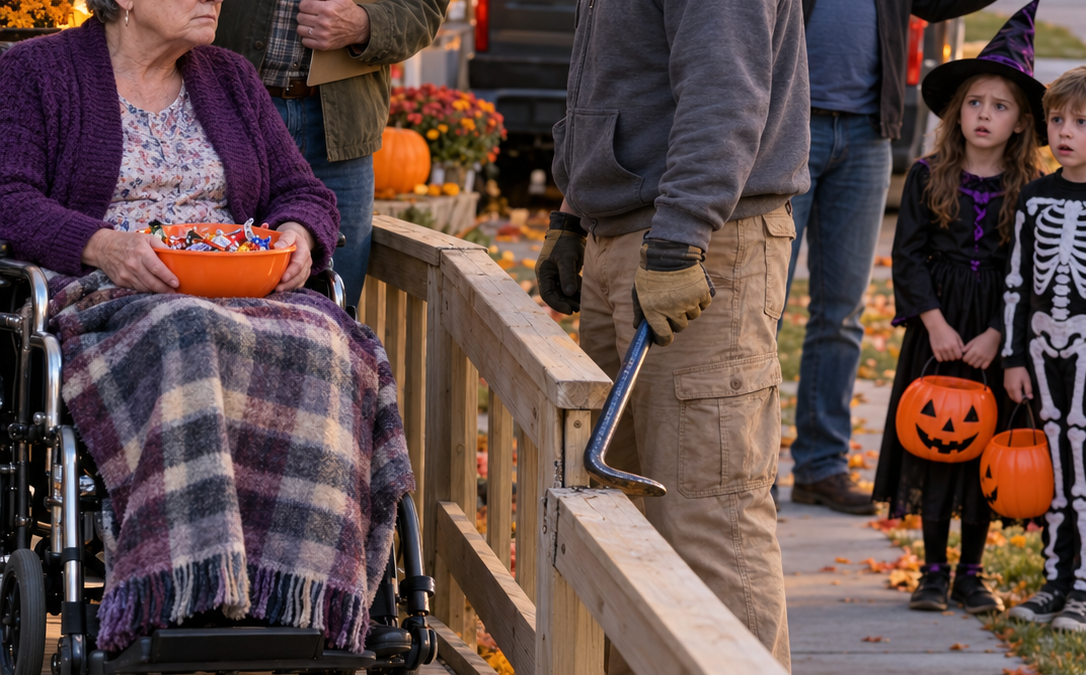
Cindy sat in her wheelchair atop the landing, holding our candy bowl.
James Santiago climbed out of Rodney’s pickup with a crowbar against his leg.
Two workers followed him, carrying their own.
I stepped off the bottom of the ramp.
“That’s my wife’s only way out of this house.”
Rodney turned toward the families on the sidewalk.
“She can use the back door with the trash cans.”
A few parents laughed.
Cindy’s fingers tightened around the bowl.
A child dressed as a dinosaur had stopped beside our driveway.
The child’s father smiled at Rodney, then noticed me watching.
He looked down and adjusted the handle of his son’s candy bag.
My face burned.
Cindy had wanted to hand out candy from our own front door.
The bowl rested on a towel across her lap.
I had carried it outside, but Cindy had insisted on arranging the candy herself.
Now a man with a crowbar stood below her feet.
“Move aside, Doug,” Rodney said.
He waved James toward the ramp.
I stayed where I was.
“Not tonight, Rodney.”
James brought his tool toward the wood.
I dug my phone out with cold fingers.
The screen showed 5:46 when I called 911, standing in front of everyone.
I gave dispatch our location in Loveland.
“My neighbor brought a crew to tear out my wife’s wheelchair ramp,” I said.
“They have crowbars. They’re starting now.”
Mia stood near the sidewalk in her firefighter coat.
At eight, our granddaughter still carried her pumpkin bucket with two hands.
She stared at the crowbar instead of the candy.
Jillian came up beside Mia and drew her closer.
“Stay here with me,” our daughter said.
I answered the dispatcher’s questions without taking my eyes off James.
Rodney folded his arms.
“Tell them it’s a property dispute,” he said.
I repeated what I had seen.
The pickup. The tools. Cindy sitting above the men.
When the call ended, I slid the phone into my shirt pocket.
Cindy looked toward the street.
“Douglas,” Cindy said. “Come up here a second.”
I walked up the ramp.
The boards stayed firm under my shoes.
We had paid $6,400 for that ramp.
Since Cindy began using a wheelchair in 2023, leaving the house took planning.
This entrance let her reach the sidewalk beside me.
Now James waited at the bottom with his hand around a steel bar.
“Do you want to go inside?” I said.
“I want to give that dinosaur his candy.”
The child had already moved to another house.
Cindy watched the small green tail disappear behind a parked car.
My hands had started shaking with anger.
Cindy noticed.
“Get your clipboard,” Cindy said.
It was just inside the front door.
I brought it out and loosened the metal clip.
Rodney’s letter was underneath.
October 12 was printed above his words.
I had kept the paper flat, without folding it.
From below the landing, Rodney called to James.
“We’ve got a parade at seven.”
I walked down to the foreman with the letter facing outward.
“Read this.”
James kept the crowbar in his right hand.
He leaned forward.
The page said, “Nobody pays full price next to a wheelchair ramp.”
Below that was the rest.
“Take it down by Halloween, or my crew will.”
James looked toward Rodney.
“Those are his words,” I said.
“He’s the client. He says it’s his land.”
“This ramp serves our front door.”
“I understand, sir.”
James sounded polite.
His hand stayed on the tool.
Behind me, Cindy turned her chair toward the doorway.
Jillian left Mia by my side and went up the ramp.
“Mom, let me get the door.”
“I can open it,” Cindy said.
“I know. You’re holding the bowl.”
Cindy handed the candy to Jillian.
Then Cindy rolled across the threshold under her own power.
I watched until her wheels were inside.
The front door stayed open.
Rodney pointed at the landing.
“Now you’ve got room to work.”
“Police are coming,” I said.
“Good,” Rodney said. “They can explain it to you.”
I held the letter where James could still see it.
“Wait for them.”
James glanced at the empty landing.
For a moment, I thought he might lower the crowbar.
Instead, James bent beside the top board.
I moved onto the grass, keeping clear of his arm.
The tool scraped against the wood.
“James,” I said.
He pushed down.
The first board lifted at one end.
A fastener squealed, and Cindy’s chair stopped moving inside the doorway.
My stomach tightened.
“That’s enough,” I said.
James eased the pressure, but the board stayed raised.
One worker stepped closer to look at it.
The other waited near Rodney’s pickup.
Nobody on the sidewalk was laughing now.
Mia moved against my leg.
“Grandpa, is he breaking it?”
“Yes,” I said.
I wouldn’t tell her it was fine while she watched it happen.
Jillian came back down carrying the candy bowl.
“Come stand with me, Mia.”
Our daughter took Mia toward the sidewalk, away from the tools.
The pumpkin bucket knocked against Mia’s knee.
I could still hear candy shifting inside it.
Cindy remained in the open doorway.
Jillian set the bowl on the porch within Cindy’s reach.
A family approached our walk, then continued past without stopping.
Rodney checked the street as if we were holding up traffic.
I went to the curb, looking for a police car.
There were porch lights, plastic pumpkins, and children crossing between houses.
No officer had arrived.
Behind me, wood scraped against metal.
I wondered if anyone would stop the crew before Cindy’s ramp was gone.
I turned back with the clipboard against my chest.
Rodney saw me coming.
I pulled his October 12 letter free of the clip.
“Your name is on this,” I said.
Rodney reached into the pickup and took out his parade megaphone.
I held up the page as he raised it toward the waiting families.
“Ramp’s gone before the parade, folks.”
Picking up where the Facebook post left off
Part 2 of 7
Officer Tara Fenwick pulled up at 6:05 p.m., beside Rodney’s pickup.
James stopped with his crowbar under the raised landing board.
I stood on the grass, holding my clipboard against my chest.
“Put the tools down while we talk,” Fenwick said.
James lowered his bar.
The workers stepped away from the ramp.
Rodney reached into his pickup and came back waving a single sheet.
“My survey puts that ramp on my land.”
He held it toward Fenwick, keeping his thumb across the bottom.
“That ramp never had a permit.”
Cindy sat inside our open front door.
The candy bowl was still on the porch.
I pointed toward the doorway.
“My wife uses a wheelchair. That’s her way out.”
Fenwick looked from Cindy to the lifted board.
“Who owns this house?” Fenwick said.
“We do.”
“And you hired these men?” Fenwick said to Rodney.
“I’m clearing my property.”
I turned back a page on my clipboard.
The city’s October 19 email was underneath Rodney’s letter.
I had printed it after the city copied me on its answer.
“That email answers his own complaint,” I said.
Fenwick took the page.
I pointed to the permit information.
“Issued April 8, 2024. Final inspection passed May 20, 2024.”
Rodney shook his head.
“City people don’t come out here and measure property lines.”
Fenwick held up a hand without looking at him.
Then Fenwick returned the email.
“A permit isn’t a property line. Boundary fights are civil. Bring me a filed survey and I’ll write it up.”
I looked at the page Rodney was holding.
“Let her see the survey.”
Rodney lifted the sheet higher.
“I just showed her.”
“That’s a cover page.”
“It’s my paperwork, Doug.”
Fenwick reached toward him.
Rodney handed over the sheet.
There was no drawing behind it.
I watched Fenwick turn it over, then hand it back.
“Do you have the actual survey here?” Fenwick said.
“Everything you need is on that page,” Rodney said.
I felt my jaw tighten.
On October 20, Rodney had stood in his driveway showing me that same cover.
He had refused to give me a copy.
I had called the surveyor afterward.
The answer had been plain: the survey belonged to the client until filed.
I had checked county records on Monday, October 26.
Nothing had been filed then.
My own survey was booked for November 9, the earliest appointment available.
I gave Fenwick those dates.
“Then get me the filed document when you have it,” Fenwick said.
Behind us, Cindy’s chair moved against the threshold.
I went up the ramp, stepping around the loosened board.
“Stay inside for now,” I said.
“I can see what they’re doing from here,” Cindy said.
“I know.”
Cindy looked past me at the officer.
“Does that paper let him take it apart?”
“We’re still talking,” I said.
My answer sounded weak to me.
Cindy’s hands stayed on the wheels.
I wanted to promise the ramp would still be there after the officer left.
I couldn’t make that promise.
Jillian came to the foot of the ramp with Mia.
“Dad, watch that board,” Jillian said.
I stepped over it on my way down.
Mia’s firefighter coat had slipped off one shoulder.
Jillian straightened it while Mia watched Fenwick.
Cars moved slowly past the families gathering farther down Larkspur Court.
Someone tested a drum near the parade staging area.
Rodney looked toward the sound, then checked his watch.
“We have a schedule,” Rodney said.
Fenwick spoke to James.
“Who told you where to work?”
“He did,” James said, pointing to Rodney.
“Did you see a boundary drawing?”
James looked at the paper in Rodney’s hand.
“He showed us that.”
I held my clipboard tighter.
“Then leave the ramp alone until we can establish the line.”
Rodney started to answer.
Fenwick’s radio cut across him.
It was 6:18.
A crash at the parade staging area.
Fenwick answered the call and turned toward the patrol car.
“Hold off on the work,” Fenwick said to the crew.
“We’ll get this sorted out.”
I followed Fenwick as far as the curb.
“My wife needs that entrance.”
“I heard you,” Fenwick said.
Then Fenwick got into the car.
I watched the brake lights reach the corner.
The patrol car turned out of sight.
Rodney tucked his cover page under his arm.
“She said it’s civil.”
“She told you to hold off,” I said.
Rodney pointed at the landing.
James picked up his crowbar.
“Wait,” I said.
The steel went beneath the board.
This time James kept pressing.
Wood cracked near the fastener.
The workers moved in beside him, and the top landing began coming apart.
I stepped toward them.
Jillian caught my sleeve.
“Dad. Stay clear of the tools.”
I stopped on the grass.
My hands were shaking again.
A board came free and struck the ground.
Through the open door, Cindy rolled backward.
Cindy’s face had gone pale.
“Don’t come toward the edge,” I said.
“I can see the hole, Douglas.”
The remaining landing boards came up.
There was no level place left outside our front door.
Mia pulled away from Jillian and came beside me.
“Grandpa, Grandma can’t get out. The back door has stairs.”
Three steps.
I pictured them behind the house, beside the trash cans Rodney had mentioned.
Cindy couldn’t roll down those steps.
“I know,” I said.
Jillian took Mia’s hand.
“I’m going inside with Grandma,” Jillian said.
Jillian walked around the torn landing and stepped carefully into the doorway.
I stayed on the lawn.
Rodney’s crew worked close to the fence between our side yards.
I remembered the surveyor working there on October 6.
I needed to see where the surveyor had set the marker.
My flashlight was inside, beside the clipboard’s usual place.
“Jillian, hand me the flashlight.”
Jillian brought it to the doorway.
I reached up from the grass and took it.
Then I followed the beam past the ramp toward Rodney’s driveway.
At 6:24, four feet past the ramp, the light caught an orange cap.
It topped an iron pin at the edge of his driveway.
Stamped into the cap were the words “PLS 38214.”
Part 3 of 7
Jillian opened the county records on her laptop at 6:30 p.m.
My flashlight lay beside the computer on the kitchen table.
I wrote “PLS 38214” on a blank page of my clipboard.
“That was on the cap?” Jillian said.
“At the edge of his driveway.”
Cindy waited near the kitchen doorway, still in her wheelchair.
From there, Cindy could hear the tools outside.
Mia stood beside the table with her pumpkin bucket.
“Start with Rodney’s address,” I said.
Jillian moved the cursor into the search field.
“What exactly are we looking for?”
“A land survey plat. Something filed since Monday.”
I pulled a chair close enough to see the screen.
Then I told Jillian what I needed beside it.
“Section 3617 of the Fair Housing Act.”
Jillian glanced at me.
“You think that applies here?”
“I spent twenty-eight years building cases involving interference with housing rights.”
Our daughter knew my old job.
Rodney and the rest of the block didn’t.
To them, I was a retired man who carried a clipboard.
I had worked as a federal fair housing investigator from 1996 until 2024.
I hadn’t mentioned it while handing out candy or bringing in trash cans.
Now I needed those years to keep Cindy from being trapped indoors.
“What did you need for those cases?” Jillian said.
“Dates. What people did. What they said in writing.”
I tapped Rodney’s letter.
“And proof connecting the interference to the person’s disability.”
Jillian looked toward Cindy.
“I kept asking him to wait,” I said.
“Then we document what happened after you asked,” Jillian said.
Cindy moved closer to the table.
“Start with him saying I could go out with the trash.”
I wrote that down beneath the pin number.
Jillian entered Rodney’s address.
The search results appeared.
Then Jillian stopped moving the cursor.
“Dad.”
A land survey plat had been deposited with the Larimer County Clerk and Recorder.
The filing date was Thursday, October 29.
Three days after my last search.
“Open it,” I said.
Jillian enlarged the document until the lettering was clear.
The client’s name was Rodney Becker.
I put my finger beside it without touching the screen.
“His survey.”
Jillian followed the boundary drawing with the cursor.
There was our ramp.
There was the edge of Rodney’s driveway.
And there was the property line, 4.2 feet east of the ramp.
On his side of the space he had claimed.
Jillian enlarged the marker information.
“PLS 38214,” Jillian said.
I looked down at the number I had copied.
It matched the cap outside.
The boundary ran beneath the edge of Rodney’s own driveway.
Our ramp stood on our land.
My hands stopped moving.
For several seconds, I stared at the drawing.
Rodney had paid for this.
The document he wouldn’t show me placed the ramp on our property.
“He had this while he was pointing at his cover page,” Jillian said.
“The survey was his before it was filed.”
Cindy rolled closer.
“Is the ramp ours?”
“Yes,” I said. “It’s on our land.”
Cindy closed her eyes, then opened them.
“Then get somebody to stop him.”
A scraping sound came through the kitchen window.
I got up.
Outside, James and a worker bent over the second section.
The crowbar went down.
A length of wood rose.
“Dad, don’t go out without the paper,” Jillian said.
I stayed at the window.
Another worker carried a loose board toward the pile near the pickup.
I wanted to bang on the glass.
Instead, I checked the time and wrote it down.
On a clean line, I printed “damage so far.”
I listed the top landing and the second section being pulled apart.
I left room beneath them.
There would be a total later.
From the table, Mia lifted her pumpkin bucket.
“Mom, the other kids are going.”
Jillian looked outside.
Children were heading toward the parade gathering for their costume walk.
Cindy had planned to be at the curb when Mia passed.
I had heard Cindy ask Mia to practice the firefighter wave.
Now Cindy couldn’t reach the sidewalk.
“Take her,” Cindy said.
“Mom, I can stay,” Jillian said.
“Don’t make Mia miss it too.”
Jillian pulled Mia’s coat straight.
“I’ll bring her right back.”
Mia went to Cindy before leaving.
“Watch for my helmet, Grandma.”
“I will,” Cindy said.
Jillian took Mia out through the back.
I heard their footsteps on the three steps.
Cindy turned toward the front of the house, then stopped.
From the kitchen, we could hear children calling to their parents.
Cindy missed Mia’s costume walk.
“I told her I’d be out there,” Cindy said.
“I know.”
“Print the survey, Douglas.”
I went back to the laptop.
I clicked Print and waited through the machine’s low, uneven hum.
I stood beside it until the first sheet fed through.
Then I printed the next copy and the third.
Three copies of Rodney’s plat.
His name, his filing date, his boundary line.
I checked that the marker number remained clear on each.
When Jillian returned with Mia, I had the statute open.
I printed the page of Section 3617 I had quoted in a hundred reports.
Jillian read over my shoulder.
“How long would a complaint take?”
“Months. It won’t stop that crowbar tonight.”
“Then keep the survey on top.”
I laid the papers on the kitchen table.
The October 19 city email stayed behind the plat.
Rodney’s October 12 letter went beneath it.
Outside, his megaphone crackled.
I couldn’t make out the words through the window.
Would paper stop a man who could talk over me?
Cindy watched me straighten the pages.
“Let James read it,” Cindy said.
“I will.”
My shirt pocket still held the phone I had used to call 911.
I checked it, then tightened the clipboard’s metal clip over the plat.
At 6:58, the parade drums started.
I went down the back steps, crossed the grass, and walked out to the street.
Rodney stood ahead with his megaphone.
“We aren’t finished, Rodney,” I said.
Part 4 of 7
Rodney raised his megaphone at 7:00 p.m., facing the costumed families down Larkspur Court.
“Short delay at the Parsons place, folks. Cleaning up an eyesore.”
I stood near our driveway with his filed survey on my clipboard.
The parade drums kept going.
A parent near the front pointed toward our house.
Rodney waved as if we had agreed to this.
I lifted my phone and called 911 again.
The clipboard stayed tucked under my arm.
“I called earlier about men tearing out a wheelchair ramp,” I said.
“An officer came. They started again after she left.”
Dispatch asked for the location.
I gave our address and Officer Fenwick’s name.
Then I looked down at the document beneath the clip.
“I have the filed survey now. It’s the neighbor’s own survey.”
I gave the filing date.
October 29.
“It shows the ramp on our property,” I said.
“They’re still taking it apart. My wife can’t get outside.”
The dispatcher asked whether anyone was hurt.
“No.”
I watched James carry his crowbar toward the pickup.
The workers stayed beside what remained of the ramp.
“They still have their tools,” I said.
Dispatch told me Fenwick would return once the crash cleared.
“How soon?”
The dispatcher couldn’t give me a time.
I looked toward the corner where the patrol car had disappeared.
“Please tell her I have the filed plat.”
I stayed on the call until the dispatcher confirmed the message.
Then I lowered the phone.
Rodney had moved farther down the street toward the parade’s front rows.
He pointed along the route with his free hand.
People followed his directions.
Nobody came over to ask what he meant by an eyesore.
Through our open doorway, I could see Cindy’s chair.
Jillian stood beside Cindy, looking out at me.
I held up the clipboard.
Jillian nodded.
I wanted to get the papers to James before anything else came loose.
But at 7:04, the workers bent beside the handrail.
One held a wrench against a bolt.
The other steadied the rail.
“Stop there,” I said.
The wrench turned.
I opened the camera on my phone.
From the grass, I photographed the bolt still in place.
Then I took a picture as the worker backed it out.
I stayed clear of his elbow.
“Police told you to hold off,” I said.
The worker glanced toward Rodney.
His partner kept a hand around the rail.
I photographed the next bolt, then followed the wrench to another fastening point.
Each time, I made sure the railing and the tool were visible.
The phone slipped against my damp palm.
I tightened my grip and kept taking pictures.
I wanted a record of what they removed.
A bolt dropped into the grass near my shoe.
I left it where it fell.
Jillian came around from the back of the house.
“Dad, come over here a second.”
I stepped away from the workers.
Jillian looked at my phone, then at the pages under my arm.
“Did dispatch get the new information?”
“Yes. Fenwick comes back when the crash clears.”
“Then let me hold the phone.”
I handed it over with the camera still open.
Jillian aimed it toward the remaining handrail.
“What are you doing next?” Jillian said.
“Giving James the survey.”
“Stay out of their reach.”
I looked toward the pickup.
James was near its open bed.
Rodney’s cover page had been enough to put a crowbar in his hand.
I needed James to see the drawing behind that cover.
“He’s the foreman,” I said. “The papers go to him.”
Jillian pointed toward the tools.
“You don’t touch those.”
“I won’t.”
“And don’t try to hold the railing.”
I had wanted to do exactly that.
My mouth felt dry.
“I’m handing him paper,” I said.
Jillian kept the phone raised.
I checked the clipboard before moving.
The plat was on top.
The city email and Rodney’s letter stayed beneath it.
I could pull out a copy without losing the rest.
From inside the house, Mia called for her mother.
Jillian turned toward the sound.
“I’m right here,” Jillian said.
Then Jillian looked back at me.
“Keep your hands where people can see them.”
I nodded and crossed the grass toward the pickup.
James looked up.
“Mr. Santiago,” I said.
Rodney heard me from the street.
He stopped speaking into the megaphone.
I held the clipboard away from my body so James could see the page.
“I have something you need to read.”
James set a tool inside the truck bed.
Before he could come toward me, Rodney crossed between us.
“Talk to me, Doug.”
“The foreman needs this.”
“You’ve had your say.”
Rodney planted himself close enough that I had to stop.
I could have gone around him.
But he moved when I moved, keeping his shoulder in my path.
I stepped back instead.
Behind Rodney, James rested his hand on the pickup’s tailgate.
The workers continued beside the ramp.
I heard another fastener hit the ground.
My face grew hot.
I wanted to push past Rodney and put the drawing in James’s hands.
One shove would give Rodney something else to call the police about.
He could point at me instead of the torn boards.
I kept my free hand open at my side.
“James can read it without you answering for him,” I said.
Rodney glanced at the phone Jillian was holding.
Then he looked toward the approaching families.
The drums were louder now.
I shifted the clipboard into my left hand.
There was room to reach James from the street side of the pickup.
I took a step toward that opening.
Rodney followed.
I stopped before our shoulders met.
“I’m not touching anyone,” I said.
Rodney lowered the megaphone.
“Touch my crew and you’re the one in cuffs tonight, old man.”
Part 5 of 7
The parade reached our house at 7:12 p.m., with Rodney blocking my path.
About seventy families stopped along Larkspur Court.
I held his filed plat above the clipboard’s metal clip.
Rodney turned toward the children gathering behind him.
That gave me room to step around his shoulder.
I handed James the page.
“Look at the drawing,” I said.
James rested his crowbar across the pickup’s tailgate and took the paper.
Rodney raised his voice.
“My survey puts that ramp on my land.”
James looked down at the document.
Then James looked at the broken ramp.
I pointed to the marker information.
“There’s a pin at the edge of your client’s driveway.”
James took a flashlight from the pickup.
I walked beside him, leaving space between us.
Jillian followed with my phone still raised.
The parade stayed where it was.
A child’s plastic helmet knocked against a parent’s coat.
I could hear that small sound after the drums stopped.
James aimed his flashlight along the driveway’s edge.
“There,” I said.
The orange cap showed beneath the beam.
James bent closer.
“PLS 38214,” James said.
He held the plat beside the light and checked the number.
I waited while he traced the boundary.
The line ran 4.2 feet east of our ramp.
Under the edge of Rodney’s driveway.
James straightened and looked toward the fence.
Then James studied the drawing once more.
“This is the marker on here,” James said.
“Yes.”
Rodney came up behind us.
“Surveyors make mistakes. Everybody on this street knows the fence is the line.”
I pointed to the client’s name.
“You paid for it. Client, Rodney Becker.”
James kept the flashlight on the page.
Rodney reached toward the document.
James drew it closer to his chest.
“I’m looking at it,” James said.
We walked back toward the pickup.
People moved aside to let us through.
Cindy sat inside our front doorway, with Mia beside the chair.
Our granddaughter’s pumpkin bucket rested between her feet.
Cindy watched the paper in James’s hand.
I held up my empty hand so Cindy knew he had it.
Rodney faced the families.
“That ramp never had a permit.”
I opened the clipboard.
“The city answered that,” I said.
I pulled out the October 19 email.
Rodney looked toward James.
“You don’t need to listen to him read his mail.”
“This reply went to you,” I said. “The city copied me.”
I read the permit information aloud.
“Permit issued April 8, 2024. Final inspection passed May 20, 2024.”
Then I read the city’s confirmation that the permit remained valid.
Nobody called out.
A father near the sidewalk lowered his phone.
I recognized him from earlier.
He had smiled when Rodney mentioned the trash cans.
Now he looked toward Cindy’s doorway.
Rodney swung the megaphone against his leg.
“This has nothing to do with her wheelchair.”
I slid the email beneath the clip.
His October 12 letter was next.
The edge had softened where I had held it outside.
“This is what you wrote,” I said.
I turned the page toward him before reading it.
“Nobody pays full price next to a wheelchair ramp.”
Cindy’s hand moved to the wheel beside her hip.
I read the next sentence.
“Take it down by Halloween, or my crew will.”
James looked from the letter to the boards on the ground.
Rodney pointed at the torn landing.
“I was fixing a hazard before some kid tripped on it in the dark.”
“The landing was together when you got here,” I said.
Jillian kept recording.
One worker stepped away from the remaining handrail.
The other lowered his wrench.
James returned to the pickup and lifted his crowbar from the tailgate.
My shoulders tightened.
Then James set the tool on the grass.
“He showed us one page. We don’t tear out what isn’t the client’s.”
Rodney’s face reddened.
“I hired you to finish.”
James handed me the plat.
“I’m stopping the work,” James said.
From the doorway, Cindy spoke.
“Douglas. Is he done?”
“He’s stopped,” I said.
I couldn’t tell Cindy the ramp was safe.
The landing was gone, and loose fasteners lay beside the remaining posts.
But the tools had stopped moving.
At 7:25, Officer Fenwick’s patrol car pulled up.
I met Fenwick at the curb with a copy of the filed plat.
“This is what you asked for.”
Fenwick took it and stood beneath the pickup’s work light.
I showed the filing date, Rodney’s name, and the marker number.
James pointed toward the driveway.
“I checked the pin. It matches.”
Fenwick walked over to the orange cap.
Then Fenwick returned to the ramp and took photographs.
The empty landing space.
The damaged second section.
The handrail and the scattered boards.
Jillian stood beside me, holding my phone down at her side.
Fenwick opened a notebook.
“Who directed the work?” Fenwick said.
James looked at Rodney.
“He did.”
“I told them it was my property,” Rodney said.
Fenwick held up the plat.
“This puts the ramp on the Parsons’ property.”
Rodney began talking about the fence.
Fenwick wrote while he spoke.
“I’m writing a criminal mischief report,” Fenwick said.
I gave Fenwick the letter and the city email.
My fingers were steady when I released them.
Rodney looked past me toward the waiting parade.
The megaphone hung at his side.
I stood where the families could hear me.
“Your survey, Rodney. Your pin. My wife’s ramp.”
Rodney said nothing.
Cindy remained inside the open door.
The candy bowl sat beyond the gap where the landing had been.
“Who pays to put it back?” I said.
James turned toward his workers.
“Stack every board neatly on the Parsons’ side of the line.”
Part 6 of 7
James’s boss called Sunday, November 1, while I stood beside the broken ramp.
“The final damage is $3,850, Mr. Parsons.”
I wrote the amount beneath “damage so far” on my clipboard.
“Who gets the bill?” I said.
“Rodney Becker. He hired us. You don’t owe us for this.”
“And the rebuild?”
“That’s what he’s paying for. We’ll put back what we damaged.”
I looked at the empty space outside our front door.
“When?”
“I need to confirm the crew. James will call you.”
I asked him to send the amount and payment arrangement in writing.
He agreed.
Then I went around to the back steps and into the kitchen.
Cindy waited at the table with the candy bowl beside her.
“What did he say?”
“Thirty-eight hundred fifty dollars. Rodney pays.”
“When do they start?”
“They haven’t given us a day.”
Cindy looked toward the front of the house.
I sat beside her.
I was relieved about the bill.
I was still afraid of what would happen if Cindy needed to leave.
The back door had the same three steps it had yesterday.
Cindy turned the bowl until the fullest side faced the empty chair.
“Help yourself,” Cindy said. “Business has been slow.”
I took a piece of chocolate.
Neither of us opened it.
On Monday, November 2, I set the laptop between us.
Cindy’s HUD fair housing complaint was on the screen.
I filled in the form while Cindy sat beside me.
Name. Address. Contact information.
When I reached the description, I moved the computer closer to Cindy.
“This is your complaint,” I said. “Tell me what you want included.”
“The letter. What he said about the back door. The crew.”
I typed while Cindy spoke.
We entered Rodney’s October 12 threat.
Then the October 31 destruction of the ramp.
I attached his letter to the complaint.
The permit email and filed plat were beside the laptop for reference.
I checked the dates against those pages.
Cindy leaned forward when I reached the part about being unable to leave.
“Don’t write that I preferred the front door,” Cindy said.
“I didn’t.”
“Write that I couldn’t get out.”
I did.
The complaint concerned interference with Cindy’s housing rights under Section 3617.
I had helped document that kind of interference for years.
This time, my wife sat beside me with her feet on wheelchair rests.
I read the completed description aloud.
Cindy stopped me when I reached Rodney’s letter.
“Read his exact words.”
“Nobody pays full price next to a wheelchair ramp.”
Cindy nodded.
“Leave that in.”
We finished the form together.
Cindy checked the screen before submitting it.
When the confirmation appeared, I printed a copy for the clipboard.
Filing it hadn’t changed the doorway.
Cindy turned her chair away from the table.
“Still no date from James?”
“Not yet.”
Later Monday, Officer Fenwick called.
Rodney had received a criminal mischief summons.
I wrote that beneath the report information.
Fenwick asked whether the crew’s company had contacted us about repairs.
I gave the amount and told Fenwick who would pay.
After the call, I checked outside.
Rodney stood in his driveway with his realtor.
I had gone out to collect the mail when I heard the realtor speak.
“We’re postponing the listing photos.”
Rodney pointed toward our house.
The realtor looked at the missing landing, then back at him.
I kept walking.
There was nothing I needed to add from the sidewalk.
By that evening, a neighborhood message confirmed the block had chosen a new parade organizer.
I showed it to Cindy.
Cindy looked at the screen, then handed the phone back.
“Maybe next year I’ll get to see the whole parade.”
Before I could answer, someone knocked at the front.
I went around outside.
A family stood beyond the torn landing, holding a bag of candy.
I recognized the father.
He had laughed at Rodney’s trash-can joke.
“Can we speak to Cindy?” he said.
“You’ll have to come around back.”
I led the family along the grass.
The visitors climbed the steps while Cindy waited inside the kitchen doorway.
The father held out the bag.
“We brought these for you,” he said.
Cindy took it.
The father kept his hand on the doorframe.
“I laughed Saturday. I’m sorry.”
Cindy looked directly at him.
“I heard you.”
He nodded.
The second family came with chocolates.
The apology came before the candy changed hands.
“We should have said something,” one parent said.
Cindy held the package against her lap.
“Thank you for coming.”
The third family brought a bag tied with orange ribbon.
The mother stood on the back step, looking past Cindy toward the kitchen.
“I’m sorry I laughed,” the mother said.
Cindy nodded.
I carried the candy to the table after the visitors left.
Three families.
Three apologies.
Cindy stayed near the doorway until I closed it.
Then Cindy rolled back to the kitchen table.
“Put that ribbon with Mia’s bucket,” Cindy said.
I laid it beside the pumpkin handle.
Outside, a car door shut.
Cindy looked toward the sound.
I knew what she wanted to ask.
“When will they call?” Cindy said.
“I don’t know.”
I checked my phone.
No missed call.
I put it on the table with the volume turned up.
Cindy moved the candy bowl aside to make room for the clipboard.
I covered the repair amount with the company’s written confirmation.
Rodney’s name was on the bill.
I left space above it for the start date.
Then the phone rang.
James’s name appeared.
I answered and put him on speaker.
Cindy stopped turning her chair.
“Saturday, eight a.m. We’ll put it back.”
Part 7 of 7
James set his toolbox beside our front walk at 8:00 a.m.
It was Saturday, November 7.
I carried three cups of coffee down the back steps.
The workers were unloading boards when I came around the house.
James took a cup and nodded toward the doorway.
“Your wife up?”
“Since before you got here.”
Cindy had parked her chair inside the front door.
The candy bowl sat on the kitchen table, ready to come outside.
James stepped where Cindy could see him.
“We’ll do the landing, then finish the rail,” James said.
“I’ll be here,” Cindy said.
I handed the workers their coffee.
One set his cup on the pickup’s bumper.
The other held his between his palms before taking a drink.
Then the tools came out.
I stood on the grass while James checked the remaining structure.
The damaged boards were gone.
New wood lay beside the posts.
When the first board settled into place, Cindy leaned forward in her chair.
I could see Cindy watching through the doorway.
“Coffee?” I said when I went back inside.
“After they finish.”
“You can have some while they work.”
“I’d spend the whole time holding it.”
I put a mug on the kitchen table anyway.
Then I moved a chair beside Cindy and sat down.
We listened to the crew working.
A drill stopped.
James spoke to a worker.
Then the sound began again.
Cindy kept her hands loose in her lap.
I wanted to ask whether Cindy was nervous.
Instead, I stayed beside her.
After a while, Cindy reached for the mug.
By late morning, the new landing reached our threshold.
I stood inside while James checked the fastenings.
He tested the handrail along its length.
The workers gathered loose screws and wood scraps from the grass.
James ran his palm over the rail, then checked underneath.
I watched his hands.
He didn’t hurry.
Jillian arrived with Mia while the crew loaded the unused boards.
Our granddaughter still wore her firefighter coat.
The pumpkin bucket swung from one hand.
Mia stopped at the foot of the ramp.
“Can Grandma come down now?”
James looked toward Cindy.
“It’s ready.”
Cindy set the coffee mug on the table.
I rose and slid my chair aside, clearing space for Cindy’s wheels.
“Do you want me beside you?” I said.
“Beside me is fine.”
I opened the door wide.
Cindy placed her hands on the wheels.
The front tires crossed the threshold onto the new landing.
I stepped outside alongside the chair.
For a moment, Cindy stayed still.
The workers stood back.
Jillian rested a hand against Mia’s coat, keeping the path clear.
Cindy looked down the slope toward the sidewalk.
Then the wheels moved.
I walked beside Cindy without taking the handles.
The chair rolled over the repaired section.
At the bottom, Cindy turned toward the curb.
Mia lifted her free hand in a firefighter wave.
Cindy waved back.
Jillian covered her mouth.
I stopped beside my wife.
Cindy looked up the street, then down toward the corner.
“Cold out here,” Cindy said.
“Want your sweater?”
“In a minute.”
I went inside for the candy bowl.
When I came back, Cindy was still at the curb.
Mia was describing the pockets on her coat.
“This one holds my flashlight.”
“Useful,” Cindy said.
“This one’s for candy.”
“Also useful.”
I held the bowl where Mia could reach it.
“Those men haven’t had their Halloween candy yet.”
Mia took the bowl with care.
Jillian walked beside Mia toward the pickup.
Our granddaughter offered it to James first.
He bent to look inside.
“Am I allowed two?”
Mia considered that.
“You fixed Grandma’s ramp. Two.”
James chose his candy.
Mia moved to the workers, holding the bowl high enough for them.
One worker crouched so Mia could keep it level.
The other thanked Mia and tucked his choice into his shirt pocket.
Cindy watched from the sidewalk.
I bent beside the wheelchair and rested my hand on Cindy’s shoulder.
“Wanting to come out your own front door wasn’t asking too much.”
Cindy covered my hand.
Her fingers tightened, and a tear slipped down her cheek.
I stayed there until Cindy lifted her chin toward Mia.
“Bring that bowl back before James negotiates for three.”
Mia hurried over, and Jillian steadied the bowl as Cindy took it.
I stepped aside to give them room.
James shut the pickup’s tailgate.
Mia looked toward the truck, then back into the candy.
Cindy tipped the bowl so our granddaughter could see what remained.
“There’s one you missed,” Cindy said.
On the sidewalk, Cindy held out the candy bowl, and Mia took the last peanut-butter cup.
THE END
More stories
At Thanksgiving, my son told 14 guests I’d never paid a dime toward his house. The county tax office had my name on six years of receipts.On the Fourth of July, my stepdad handed my late father’s pickup keys to his son in front of 30 neighbors. Dad’s title had one name after his: mine.My cousin took Dad’s deed with his spare key and told a lawyer he couldn’t remember his address. Dad, 76, had his neurologist’s report ready.At Thanksgiving my boyfriends mother handed me $500 for the bus in front of 16 relatives. Her bakerys lease renewal was on my desk.My nephew’s wife sent my 69-year-old mother to eat in the kitchen at the christening. Mom had already traced the missing $38,400.On Christmas Eve my son shut his door on me in front of 12 carolers. The SUV in his driveway is still titled in my name.
You Might Also Enjoy




