The Answer She Changed
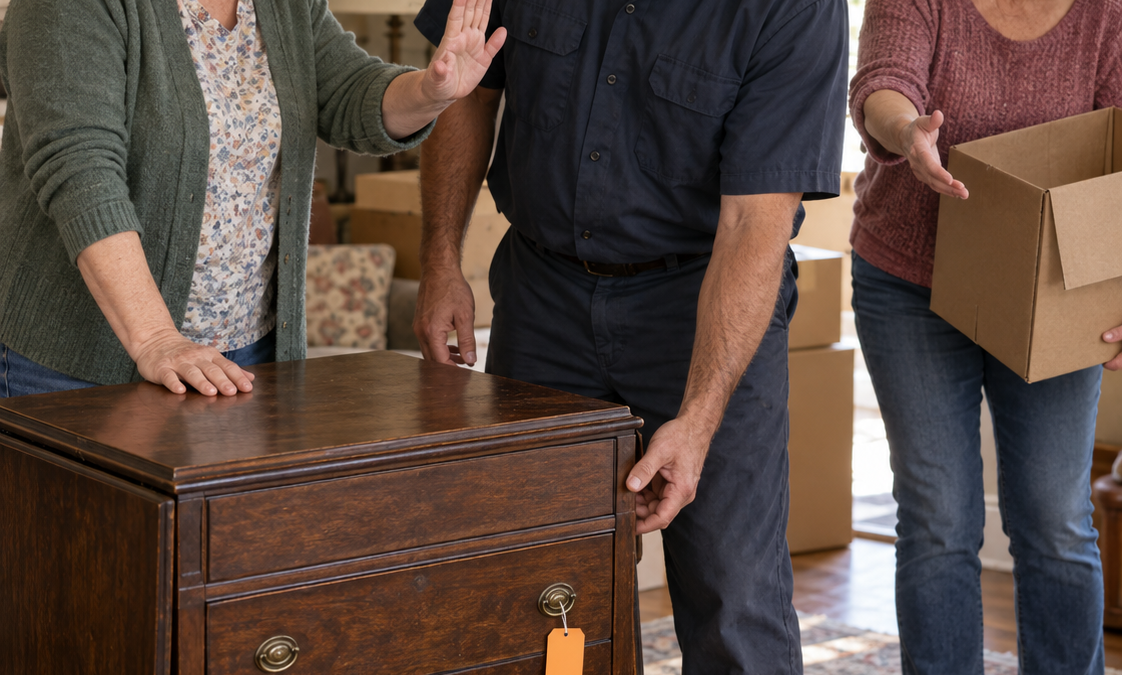
Original fiction. AI-generated illustration.
Read the story from the beginning

Chapter 1: The Answer She Changed
Jo Miller had been inside her mother’s house for less than a minute when she saw a man reach for the sewing cabinet.
“Wait,” she said.
Cal stopped with one hand under the cabinet’s folded top. An orange donation tag hung from its brass pull.
Jo crossed the front room and put her palm flat on the dark wood.
“Could you leave this one for a minute?”
Before Cal could answer, Lorraine came through the hall carrying an empty cardboard box.
“She’s still deciding,” Lorraine said. “You can come back to it.”
Jo looked at her sister.
Cal straightened. “Sure. I’ve got plenty else.”
He moved toward a stack of cartons near the front door.
Jo kept her hand on the cabinet.
She had known the charity pickup was Friday morning. The boxes, lamps, den bookcase, and two dining chairs had all been agreed on. She had not expected the cabinet to be tagged with them.
On Tuesday, Jo had believed she made herself clear.
At least she thought she had.
“Can we talk in the kitchen?”
Lorraine’s mouth tightened. “We’re already behind.”
“Five minutes.”
Lorraine glanced toward Cal carrying a box outside.
“Fine.”
Eight months after their mother’s death, Doris’s kitchen looked barer every time Jo came. One drawer stood open beneath the counter, its contents divided between a trash bag and a box marked KEEP. A damp dish towel was bunched beside the sink.
Lorraine hung it over the oven handle.
“What?”
“The cabinet.”
“You saw the tag.”
“That’s why I stopped him.”
“I thought we settled this Tuesday.”
“I thought we settled it a month ago.”
“We did. It went to you.”
“Right.”
“And Tuesday you said to let the tagged furniture go.”
Jo stared at her.
“No. I said the other furniture could go. I told you I was keeping the cabinet.”
“That is not what you said.”
“It’s what I remember saying.”
“Well, it isn’t what I remember hearing.”
Jo had driven seventy minutes that morning thinking about pantry shelves, the hall closet, and what would fit in her compact car. She had not rehearsed defending a phone conversation.
“I already booked somebody for Saturday.”
“I know you talked about booking somebody.”
“I booked them.”
“And then you told me everything tagged could go.”
“No, Lorraine.”
“You did.”
Jo reached backward in her mind.
Tuesday evening. Her own kitchen. Lorraine on the phone while Jo measured the wall beside the living-room window. They had discussed the charity pickup and the remaining cleaning.
Jo remembered saying the cabinet was staying.
She could not summon every sentence around it.
“I know I said I wanted it.”
“You wanted it a month ago.”
“I still want it.”
Lorraine rubbed both hands over her face.
“Jo, I spent a year and a half going over decisions with Mom. Sheets, groceries, meals, appointments, things she swore had been moved when they hadn’t. Now I’m trying to finish this house, and every time I think something is settled, it opens again.”
“This isn’t Mom changing her mind.”
“No. It’s me trying to finish one house while you come in at the end and reopen things.”
Jo felt her defenses gather: I worked. I lived seventy minutes away. I came when I could.
All true.
None erased Lorraine’s eighteen months of daily practical care—prescriptions, meals, laundry, rides, repairs, the ordinary jobs that multiplied around an aging parent.
“I’m not saying you didn’t carry most of it,” Jo said.
Lorraine began gathering loose twist ties from the open drawer.
“You get to say that because you weren’t here for most of it.”
“I’m saying the cabinet was allotted to me.”
“And I’m saying you later agreed to donate it.”
Jo wanted Lorraine to admit Tuesday had happened the way she remembered. That admission would make everything easier.
Lorraine watched her hesitate.
“You don’t remember exactly, do you?”
“I remember what I meant.”
“That isn’t the same thing.”
Jo almost said, Maybe I wasn’t clear.
It was the sort of sentence that ended arguments.
Instead she looked through the doorway at the cabinet. One corner bore a pale nick from years ago. Whatever had been said Tuesday, both sisters agreed on one thing: the cabinet belonged to Jo.
“I’m saying now that I don’t want it donated.”
Lorraine closed her eyes briefly.
“So we’re doing this again.”
“No. I’m telling you what I want now.”
“And Cal is standing out there with a truck because I arranged this.”
“The other things can go.”
“For free.”
“I know.”
“And instead you want to pay somebody tomorrow for one cabinet.”
“I already arranged it.”
“That makes no sense.”
“It doesn’t have to make sense to you.”
The words came out sharper than Jo intended.
She softened her voice, not the decision.
“My car can’t carry it. That’s why I booked the mover.”
She opened the reservation on her phone.
Saturday morning. Pickup at Doris’s house. Delivery to Jo’s address.
One hundred forty-five dollars.
The money would come from what she had saved to replace two warped sections of baseboard in her hallway. Affordable, but not painless.
Lorraine leaned against the counter.
“You could save that money today.”
“I could.”
“And get the house closer to done.”
“Yes.”
Lorraine waited for the obvious conclusion.
Jo tapped the mover’s number.
“I’m confirming the reservation.”
“You don’t have to.”
“I do if I’m keeping it.”
She stepped into the hall and called.
A woman confirmed Jo’s name, Saturday morning, and the $145 quote.
“Keep it scheduled, please,” Jo said.
When she returned, Lorraine was holding the trash bag.
“I’m here until noon like I promised,” Jo said. “I’ll finish the pantry and hall closet. Tomorrow the mover handles the cabinet.”
“So now I stay here tomorrow too.”
“You already knew there was a Saturday arrangement.”
“I knew there might be.”
“There is.”
Lorraine shook her head. “Apparently every plan is final except the ones you decide aren’t.”
Jo felt the temptation to return to Tuesday.
But whether she could reconstruct that call no longer changed what she was saying now.
She walked into the front room.
Cal was returning after taking out the last dining chair. He pointed at the cabinet.
“This one?”
“Yes,” Lorraine said behind Jo. “She booked somebody, but there’s really no reason to—”
“No,” Jo said.
Cal looked between them.
Heat rose into Jo’s face. She hated having a stranger stand there while two sisters argued over furniture in a half-empty house.
“Please don’t take the cabinet,” she said. “It belongs to me. I have a mover coming tomorrow.”
Cal nodded. “Okay.”
Lorraine stepped closer.
“She’s worried she’ll regret letting it go. We’ve been going back and forth.”
“I’m not asking for more time,” Jo said.
Lorraine’s jaw tightened.
Jo looked directly at Cal.
“I’ve decided. Please leave it.”
“All right.”
He pulled the orange tag from the cabinet handle and placed it on a nearby carton.
Lorraine picked it up.
“We already agreed this was part of the pickup.”
Cal glanced at Jo.
“I’m not donating it,” Jo said.
Lorraine spoke before he could answer.
“She means she wants to hold it until tomorrow.”
“No.”
The word came easily this time.
“I mean I’m keeping it.”
Cal tucked his gloves into his back pocket.
“Got it. I’ll leave it.”
He walked away to finish the other items.
Lorraine remained beside the cabinet, the orange tag folded between her fingers.
“You made that sound like I was giving away something behind your back.”
“You told him I hadn’t decided.”
“You were changing what we agreed.”
“I told him no.”
“And I explained the situation.”
“You changed my no into something else.”
Lorraine gave a short, incredulous laugh.
“I’m dealing with somebody who changes course and then expects me to pretend the earlier conversation never happened.”
“I’m not asking you to pretend Tuesday never happened.”
“You’re asking me to say it happened your way.”
Jo almost said yes.
Instead she pointed toward the door Cal had just passed through.
“He asked whether the cabinet was going. I said no. You told him I meant something different. That happened right here. We don’t have to agree about Tuesday to know what I just said.”
Lorraine folded the tag again.
“He has a schedule.”
“So do I. I’m not asking him to wait. He can take everything else.”
Cal and his helper moved the remaining donations. The lamp went, then the kitchenware, then the bookcase.
On his final walk-through, Cal stopped near the cabinet.
“Everything else is done.”
“Thank you,” Jo said.
Cal nodded toward the cabinet. “Leaving that one.”
“Yes.”
Lorraine said nothing.
After the truck left, the refrigerator hum seemed loud from the kitchen.
Lorraine dropped the orange tag on the counter.
“You embarrassed me.”
“I didn’t want to.”
“You corrected me in front of a stranger.”
“I corrected what you said I meant.”
“You could have waited until he left.”
“Then the cabinet might have left.”
“I would have stopped it if we decided—”
“I had decided.”
Lorraine pressed her lips together.
Jo stepped farther into the kitchen.
“I’m not asking you to admit I remember Tuesday perfectly.”
“Good, because you don’t.”
“Maybe I don’t. I’m not fighting about the call again.”
“Convenient.”
“But I know what happened in the front room. I told Cal I was keeping the cabinet. You said I was still deciding. Then you said I only wanted it held until tomorrow.”
“You were making a bad decision because you were upset.”
“That’s not the same as me not making one.”
Lorraine stared at her, then pulled out a chair and sat.
The movement looked tired rather than angry.
“There are still three kitchen cabinets to empty,” she said. “The garage shelves need wiping down. People have canceled on me twice this month. Every time I think one room is finished, somebody finds another box.”
Jo sat across from her.
“I know you’ve carried most of this.”
Lorraine looked at the table.
“No. You know sentences about it.”
The remark stung because there was truth inside it.
“I wasn’t here every day,” Jo said. “I’m not going to pretend I was.”
Lorraine’s shoulders eased slightly.
“But that still doesn’t make you my answer.”
Lorraine looked up.
Jo kept her voice level.
“I want you to correct what you told Cal.”
“For what purpose? He already left the cabinet.”
“I know.”
“So you want an apology.”
“No. I want you to tell the person you spoke to that you described my answer inaccurately.”
“That is splitting hairs.”
“It doesn’t feel small to me.”
Lorraine went to the sink and ran water over a sponge, then shut it off.
“What exactly do you want me to say?”
“That when I said I was keeping the cabinet, you shouldn’t have told him I was still deciding.”
“You really need that?”
“Yes.”
Not proof of Tuesday.
Not an admission about their whole history.
Just yes.
Lorraine took out her phone.
“I’m not calling the office and turning this into some ridiculous report.”
“I didn’t ask you to.”
Cal had called Lorraine earlier that morning, and his number remained in her recent calls. She tapped it.
“Hi, Cal. Lorraine Evans.”
She listened.
“Yes, from the pickup.”
Another pause.
“I wanted to correct something I said. When my sister told you she was keeping the sewing cabinet, I described it like she was still deciding. That wasn’t accurate. She had told you she was keeping it.”
She listened again.
“Right. Nothing else changes.”
Lorraine ended the call.
“Satisfied?”
“No,” Jo said.
Lorraine’s expression hardened.
“But I appreciate that you did it.”
Lorraine picked up the trash bag.
“There’s a shelf in the pantry with expired cans.”
“I’ll do it.”
They worked separately for most of the remaining time.
Jo cleared the pantry and wiped the shelves. Lorraine sorted utensils at the kitchen table.
Once Lorraine held up their mother’s battered roasting pan.
“You want this?”
“No.”
Lorraine placed it in the donation box.
At noon Jo tied the trash bag.
“I’m leaving.”
Lorraine nodded.
“The mover said morning?”
“Yes.”
“I’ll be here.”
In the front room Jo paused beside the sewing cabinet.
“Tomorrow, then.”
“Tomorrow,” Lorraine said.
It was not warmth, but it was an arrangement.
The mover arrived Saturday morning within the scheduled window.
Jo stayed home while Lorraine let the two men into Doris’s house. Less than two hours later, a small box truck stopped in front of Jo’s place.
The cabinet came through her doorway wrapped in a quilted pad.
Jo directed the movers to the living-room wall beside the window, the space she had measured Tuesday evening.
When they finished, she paid the agreed $145.
The baseboard repair would have to wait another month.
She did not like that.
She was still glad the cabinet was there.
That afternoon Lorraine sent one message.
Delivered?
Jo answered.
Yes.
Lorraine replied a minute later.
Good.
Nothing more.
A week later, Jo carried her coffee into the living room and opened the cabinet.
The foldout work surface lowered stiffly beneath her hands.
Inside were ordinary things: a tin of straight pins, wooden spools, a faded measuring tape, two packets of needles, and scraps of fabric Doris had never used.
No letter waited beneath them. No forgotten explanation.
Jo put the pins and needles into a small box. She folded the fabric scraps into a drawer. The measuring tape stayed on the work surface for now, simply because she had not decided what to do with it.
She pulled over the chair she had chosen for the space.
Her phone remained on the side table.
Jo did not call Lorraine to ask what their mother would have kept in each drawer.
She did not call to revisit Tuesday.
She rested one hand on the open cabinet and began deciding for herself what belonged there.
End of story.