At Thanksgiving, my daughter-in-law handed me a $47.50 bill for my plate in front of 14 relatives and said, “Nothing’s free in this house”—she forgot whose house she was standing in.
Part 1
Brittany set a bill beside my Thanksgiving plate and tapped the total with one red fingernail.
“Forty-seven dollars and fifty cents, Margaret. Nothing’s free in this house.”
Fourteen relatives were close enough to hear her. My son was close enough to stop her.
He reached for the gravy instead.
Three weeks later, I would put a different bill on that same table, in front of the same fourteen people. But that night, I didn’t know it yet.
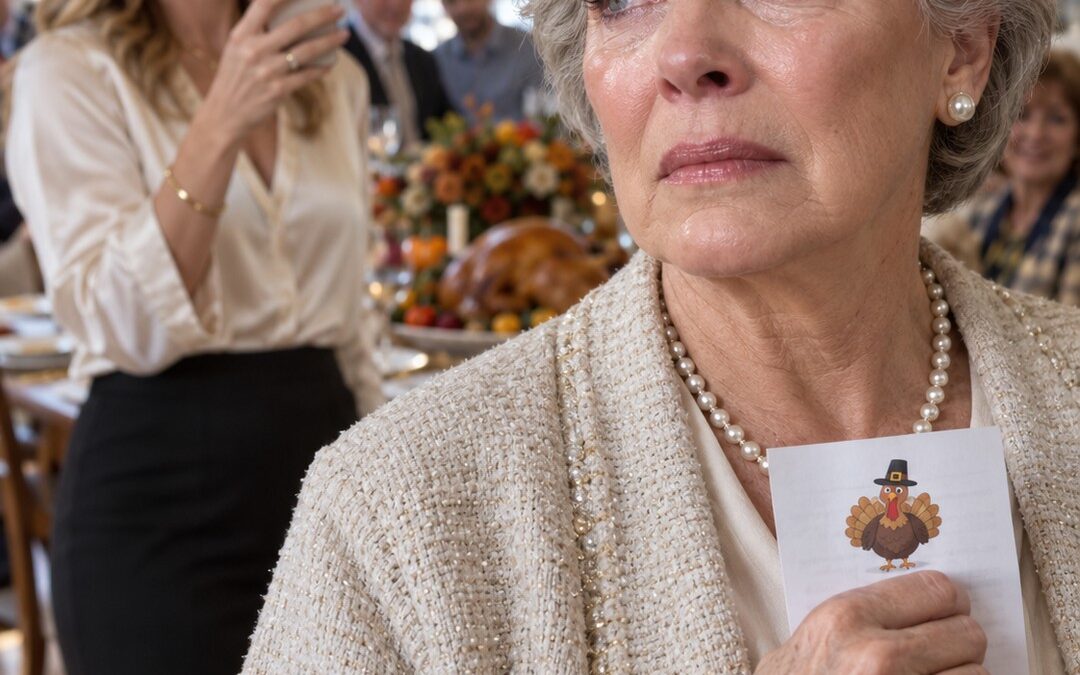
At first, I thought she was joking. There was a little turkey printed at the top of the paper, wearing a pilgrim hat. Beneath it, someone had typed out my meal.
Turkey dinner: $32.00.
Dessert: $8.00.
Beverages: $7.50.
At the bottom, in bold letters, it said PAYMENT DUE TODAY.
I looked around for another bill.
There wasn’t one.
Brittany’s mother, Sharon, pressed her napkin against her mouth. Her brother gave a short laugh. At the far end of the table, someone said, “Well, that’s one way to handle it.”
I was sixty-four years old. I had balanced a school district’s accounts for thirty-one years, buried my husband, and learned to live alone.
Still, I couldn’t make my hand move toward that piece of paper.
“Is something wrong?” Brittany asked.
She stood behind my chair with her phone in her other hand. Her blouse was cream-colored, and she had changed into it after I finished washing the mixing bowls.
“No,” I said. “I’m just reading.”
“We figured it was time everybody contributed.”
Everybody.
I glanced at Kevin.
My son kept his eyes on his plate.
“Kevin?”
He swallowed before answering.
“Mom, don’t make it awkward.”
That was when Sharon laughed openly.
“Oh, Kevin. She knows Brittany’s teasing.”
Brittany didn’t say she was teasing.
She held out her hand.
Across from me, my granddaughter Lily put down her fork.
“Grandma brought the pies.”
“Lily,” Brittany said.
“And she made the stuffing.”
“That’s enough.”
Lily’s cheeks went pink. She looked at her father, waiting for him to say something.
Kevin cut another piece of turkey.
I folded the bill once, carefully, along the edge of the printed turkey.
“The food was very good,” I said.
Brittany’s hand stayed open.
I had brought cash because Lily’s school was collecting donations for the Christmas coat drive. There were two twenties, a five, and three ones in the side pocket of my purse. I counted out forty-seven dollars.
Then I found two quarters in my change pouch.
One slipped from my fingers and rolled beneath the edge of my plate.
Nobody helped me retrieve it.
I set the money beside Brittany’s hand.
“There you are.”
She looked almost disappointed.
“Oh, Margaret. You don’t have to be so formal.”
“You asked for a specific amount.”
Her brother laughed again, but it came out differently that time.
Brittany gathered the cash and lifted her phone.
“Hold on. This is too funny.”
She took a picture of the bill with the money beside it.
I didn’t cover my face. I didn’t cry. I sat still while the little click sounded.
“Does anyone want coffee?” Kevin asked.
I stood.
“Not for me.”
“Mom, we haven’t even cut the pies.”
“You can cut them without me.”
I pushed my chair in. The legs made a small scrape against the hardwood, loud enough that the conversation at the other end stopped.
Brittany slipped the money into her pocket.
“You’re leaving because of a joke?”
I picked up my purse.
“Thank you for dinner.”
My coat was on a hook in the mudroom, squeezed beneath three newer coats. I had bought it at Macy’s with a retirement gift card seven years earlier. One button was loose. I’d meant to fix it that morning, before Brittany called and asked me to come early.
“Could you be here by nine?” she had said. “I’m completely overwhelmed.”
I’d arrived at eight forty-five.
Now it was three seventeen.
I buttoned my coat as far as the loose button and let that one hang.
Behind me, chairs shifted. Then someone asked whether the cranberry sauce was homemade, and the room started talking again.
Kevin followed me into the mudroom.
“Mom.”
I waited.
He was thirty-eight, with his father’s broad shoulders and a face that had grown careful around his wife.
“You know how she is.”
“Yes,” I said.
“She spent a lot on this dinner.”
“So did I.”
He looked toward the kitchen.
“Can we please not do this today?”
I had heard that sentence at Christmas, on my birthday, and beside Tom’s hospital bed.
There was always a reason today couldn’t be the day.
“I’m going home, Kevin.”
He rubbed a hand over his mouth.
“At least take some leftovers.”
For a second, I thought he might apologize. I waited long enough for him to notice.
Instead, he opened the refrigerator and handed me a plastic container.
It held the chopped celery I had brought that morning. Brittany hadn’t needed all of it.
I took it.
“Drive safe,” he said.
Then he went back to dinner.
Outside, the neighborhood smelled of wood smoke and roasted meat. A boy on a bicycle rode past with a football tucked under one arm. Someone two houses down had already turned on Christmas lights.
I stood beside my twelve-year-old Honda and tried to find my keys.
They were in my hand.
I looked back at the house.
Tom had loved the deep front porch. He said it was a place where a family could sit together without a television talking over them.
Now there were matching planters beside the door and a camera above the porch light. Brittany had replaced the swing with two white chairs nobody used.
I opened my car door.
“Grandma!”
Lily came down the walk without a coat.
She was fourteen, all elbows and long brown hair, wearing the blue sweater we had picked out together at Kohl’s. She had gravy on one cuff.
“Your mom will want you inside,” I said.
“I told her I was getting my charger.”
She stopped beside me, breathing hard.
“I’m sorry.”
“You have nothing to be sorry for.”
“That was mean.”
I set the celery container on the passenger seat.
“People sometimes say things they shouldn’t.”
Lily shook her head.
“She printed it yesterday.”
My hand stayed on the door.
“What?”
“I saw it by the printer. She showed Nana Sharon, and they were laughing.”
I could hear the furnace running through the vent beside the porch.
Inside the dining room, someone lifted a wineglass.
“She planned it,” Lily said.
I looked down at my granddaughter. Her lower lip was trembling, and she was pressing it between her teeth the way she had when she was little.
“Come here.”
She leaned into me, and I held her with one arm.
For six years, I had told myself Brittany was tired.
When she snapped at me, she was tired.
When she forgot to invite me, she was busy.
When she introduced me to a neighbor as “our built-in babysitter,” she didn’t mean anything by it.
Those explanations had become a habit. I could supply them before she even finished hurting my feelings.
Lily pulled away.
“There’s something else.”
I touched her cold wrist.
“First, put on your coat.”
“Grandma, please listen.”
Something in her voice made me stop.
“Okay.”
She glanced toward the camera above the porch.
“Can we get in your car?”
I unlocked the passenger door.
We sat with the doors shut and the engine off. Lily tucked her hands beneath her legs.
“Mom’s been talking about your house,” she said.
“What about it?”
“She says it’s too much for you.”
“My house has two bedrooms.”
“I know.”
“What exactly did she say?”
Lily looked at the dashboard.
“She wants you to move to one of those places where old people live.”
I waited.
“There’s a brochure in her desk. It has a lady painting flowers on the front. Mom said they could get you a room there.”
A retirement community. Maybe assisted living. Either way, it was something I had never discussed with Brittany.
“Did your dad hear her say that?”
Lily nodded.
“What did he say?”
“He asked how much it cost.”
I gripped the steering wheel.
Lily noticed. I loosened my fingers.
“Then Mom said it wouldn’t matter after they sold your house.”
“Sold my house?”
“She said you’d fight about it at first, but Dad needed to stop letting you run everything.”
I stared through the windshield.
Across the street, a man was carrying a covered dish out to his truck. His wife held the door for him. Ordinary people finishing an ordinary holiday.
Inside my car, my granddaughter was trying to explain a conversation she should never have had to hear.
“When was this?”
“Sunday. They thought I had my headphones on.”
“Did she say anything else?”
Lily hesitated.
“You can tell me.”
“She said the money could help with some things they needed. And you’d be taken care of, so everybody would win.”
My little house stood twelve minutes away, on a street of maples and uneven sidewalks. Tom and I had bought it when Kevin was four. The kitchen drawer still stuck in the summer. Tom’s reading glasses were still in the nightstand.
I lived there because I wanted to.
I drove, paid my bills, shoveled my steps, and volunteered at the library twice a month.
“Have I seemed confused to you?” I asked.
“No.”
“Have you been worried about me living alone?”
“No, Grandma.”
Her answer came so quickly that I could finally breathe.
“Then we won’t borrow trouble today.”
“But what if she makes you?”
“She can’t simply decide where I live.”
“She said Dad could handle the paperwork.”
There it was again.
Paperwork.
People who never paid attention to mine had suddenly developed an interest in it.
I turned toward Lily.
“Listen to me. You did the right thing by telling me. But this is for the adults to handle now. You don’t need to listen at doors or get into arguments.”
“Are you mad at Dad?”
I looked at the celery container between her feet.
“Yes,” I said. “I am.”
She nodded, almost relieved.
I wouldn’t teach her that loving someone required pretending everything was fine.
“Are you still coming to my concert?”
“Of course.”
“Even if Mom—”
“I will do everything I can to be there.”
Her eyes filled.
I reached into my purse for a tissue, and the folded bill came out with it.
Lily stared at the paper.
“I hate that.”
“So do I.”
A knock sounded on her window.
Kevin stood outside.
Lily wiped her face quickly.
I lowered the window.
“Britt’s asking where she is,” he said.
“We were talking.”
He glanced at Lily.
“Come on, honey. Dessert.”
She didn’t move.
“Lily,” he said, more firmly.
I squeezed her hand.
“Go warm up. Call me tomorrow.”
She got out and shut the door gently.
Kevin stayed by my window.
“What was that about?”
“Your daughter was upset.”
“Mom, please don’t turn her against us.”
I looked at him until he dropped his eyes.
Then I started the car.
Six years earlier, he had stood on that same walk holding a cardboard box of Lily’s toys.
She was eight then. He had lost his job at a building supply company, and their landlord was selling the rental.
Tom was still alive.
“We just need somewhere to land,” Kevin told us. “Six months, maybe a year.”
Tom put a hand on his shoulder.
“Get your family settled. We’ll talk about the rest.”
There were arrangements made in Tom’s office, with folders and signatures. At the time, Kevin was too embarrassed to explain much to Brittany, and Tom let him keep his pride.
I let him, too.
That had seemed like kindness.
For the first year, Brittany thanked us. She sent pictures of Lily’s room. She invited us for Sunday dinner.
Then the invitations began coming with instructions.
Could I pick Lily up?
Could I stay until the delivery arrived?
Could I bring groceries because they were having a tight month?
I was retired. Tom was slowing down. Helping gave our days shape, and I loved being useful to my granddaughter.
After Tom died, useful became expected.
Brittany gave me a key and a list.
On Mondays, I picked Lily up from school. On Wednesdays, I waited for the cleaning service because Brittany didn’t trust them alone. On Fridays, I started dinner if Kevin worked late.
The cleaning service lasted three months.
After that, Brittany would leave the vacuum in the hallway when she knew I was coming.
One afternoon, I arrived to find a load of wet towels in the washer and a note on the kitchen counter.
Please finish these before pickup. Thanks!
I finished them.
I told myself a young family needed help. I told myself Kevin was under pressure.
Meanwhile, Brittany started saying “our house” in a particular way.
“We’re doing the kitchen.”
“We’re thinking about refinancing.”
“Kevin worked hard for this place.”
The first time she said that in front of me, Kevin looked down and changed the subject.
I should have asked him then what his wife believed.
Instead, I carried a basket of folded towels upstairs.
By the time I pulled into my own driveway that Thanksgiving afternoon, the celery had tipped over on the passenger seat.
I gathered the pieces with both hands.
Such a small, foolish job.
It was the one that finally made me cry.
I stood in my kitchen, holding chopped celery that nobody wanted, while tears dripped onto my coat.
Then I put the container in the refrigerator.
I washed my hands. Hung up my coat. Set my purse on the table.
The kitchen clock clicked toward four.
Usually, after a holiday at Kevin’s, I called to make sure they had found the serving spoons or put the leftovers away.
That afternoon, I left my phone face down.
I made tea and sat in Tom’s chair.
Across from me was the picture Lily had drawn when she was seven: four stick people and a dog we had never owned. Tom had insisted on framing it.
“Every family needs a dog on paper,” he’d said.
I looked at his empty coffee mug on the shelf.
“You should have made him tell her,” I said aloud.
Then I heard my own words.
Tom was gone. Kevin was grown. I had been there all six years.
I set down the tea.
At school, when an account didn’t balance, I never fixed it by hoping the next month would be better. I pulled the records and found the problem.
I had given my family more patience than I would ever have given a missing receipt.
Upstairs, the closet in Tom’s study smelled faintly of cedar.
His steel document box sat on the bottom shelf behind a stack of old road atlases. I hadn’t opened it since the month after his funeral, when I needed the life insurance papers.
I carried it to the desk.
The small key was on my ring, between the Honda key and the one to Kevin’s back door.
My hands were steady now.
Inside were labeled folders, our marriage certificate, and an envelope of savings bonds. Beneath them lay a second key I didn’t recognize.
It was attached to an envelope with my name in Tom’s handwriting.
Margaret.
I sat down.
The envelope wasn’t sealed. Inside was a single sheet of paper, folded around a business card.
Walter Briggs.
Attorney at Law.
Tom’s lawyer for almost thirty years.
I unfolded the letter.
My husband had written only one sentence.
“If they ever forget who you are, call Walter.”
I laid the Thanksgiving bill beside it and reached for my phone.
Part 2
Walter’s voicemail answered on the third ring.
“Walter, it’s Margaret Hale. I found a letter Tom left in his document box. He told me to call you if I ever needed help with the house Kevin lives in.”
I gave him my number.
Then, because I had spent thirty-one years teaching people to put dates on things, I added, “It’s Thanksgiving afternoon.”
As though he wouldn’t know.
I set the phone beside the bill and went into the kitchen. I scrambled two eggs, made toast, and put both on one of our good plates.
Halfway through supper, I caught myself listening for someone to ask me for something.
The refrigerator hummed. That was all.
At 7:18, Diane sent me a screenshot.
Please don’t let a little joke spoil Christmas, Margaret.
My sister hadn’t asked whether I got home safely.
In the photograph, Brittany’s bill lay beside my forty-seven fifty. The edge of my coat sleeve showed in one corner.
The caption read:
“Finally teaching my MIL that groceries, utilities, and hospitality cost money. $47.50 won't kill her 😂 Nothing's free in this house!”
Twenty-three reactions.
Some laughing faces. Some hearts.
Sharon had commented, “Good for you, honey. Boundaries matter.”
I put down my fork.
Brittany had watched me count those bills. She had watched me reach under my plate for a quarter. Then she had decided that people who weren’t at dinner ought to enjoy it, too.
I saved the screenshot.
I knew what happened when people wished they had kept a receipt.
Diane called while I was still looking at the picture.
“You saw my message?”
“Yes.”
“I thought you should hear it from me before somebody else sent it.”
“You could have told Brittany to take it down.”
“She’s upset, too.”
“About what?”
“The way you left. Sharon said you made everyone uncomfortable.”
I pushed my plate away.
“Was everyone comfortable when she charged me?”
“Greg thought it was funny. Linda says we ought to settle this before the family starts choosing sides.”
“Did either of them get a bill?”
“Margaret, you’re there all the time.”
“Picking up Lily. Cooking. Waiting for deliveries.”
“I’m sure Brittany appreciates that.”
“Then she can say so.”
Diane sighed into the phone.
“You’ve been so touchy since we lost Tom.”
I looked at the chair across from mine.
“You lost your brother-in-law, Diane. I lost my husband. Neither one explains why Brittany printed a bill for me.”
“I’m only trying to help.”
“Help me get my pie carriers back.”
“What?”
“I brought two pies in them. They’re still at the house.”
She had plenty to say about my attitude. She had nothing to say about the pies.
“I’ll speak to Kevin,” she finally said.
“Thank you.”
I ended the call before she could tell me to apologize.
Kevin called at 9:42.
“Mom, Aunt Diane says you’re furious.”
“I’m upset.”
“Brittany feels attacked.”
“By whom?”
“She thinks everybody’s judging how she runs her home.”
“I haven’t posted anything.”
He breathed out.
“Can we get past the Facebook thing?”
“Ask her to remove it.”
“That’ll make her look like she did something wrong.”
I held the phone away from my ear and looked at it.
When I brought it back, he was still talking.
“She worked hard yesterday. She wanted people to appreciate it.”
“Yesterday?”
“Today. You know what I mean.”
“Yes. I worked hard today, too.”
“Mom, I should have said something at dinner.”
“You still can.”
“She’s already upset.”
I rubbed a crumb from the table with my thumb.
“Kevin, did your father ever charge you for needing help?”
“That’s different.”
“How?”
“We’re his family.”
I stopped rubbing.
“So am I.”
He didn’t answer.
Then his voice changed.
“What did Lily tell you outside?”
“That she was hurt by what happened.”
“She hears things and gets them mixed up.”
“What things?”
“Conversations. Adults making plans.”
“About selling my house?”
“Nothing’s been decided.”
My feet went cold against the kitchen floor.
“There is nothing for you to decide.”
“Don’t twist my words.”
“Then choose them carefully.”
He lowered his voice.
“Are you still getting Lily Monday?”
“I’ll let you and Brittany know in the morning.”
“Mom, don’t take this out on her.”
“Good night, Kevin.”
I set the phone down.
He had apologized for his silence, then asked me to keep doing what made that silence convenient.
Before bed, I put the bill, Tom’s letter, Walter’s card, and the unfamiliar key into an envelope.
I left it beside my purse.
Friday morning, I woke before six.
My first thought was that Brittany would need help putting away the extra folding chairs. Usually, I went back the day after Thanksgiving to clean whatever hadn’t fit in the dishwasher.
I got as far as reaching for my jeans.
Then I chose my gray slacks.
At 7:36, I opened a group text with Kevin and Brittany.
Starting this week, I won’t be picking Lily up Monday, waiting for deliveries Wednesday, or starting dinner Friday. Please make other arrangements. I’ll speak with Lily separately about visiting and her concert.
I checked the days. Then I sent it.
Brittany answered three minutes later.
Seriously? You’re going to disrupt our whole schedule over $47.50? Lily is the one who’ll suffer. I have clients and Kevin WORKS. Must be nice to have nothing to do.
I set the phone on the counter and poured my coffee.
My hand shook enough to spill some into the saucer.
I wiped it up.
Then I replied.
This gives you the weekend to arrange Monday pickup.
Kevin sent a separate message.
Can we talk before you make this permanent?
I answered in the group.
You can both see what I’ve written. Please make the arrangements.
I buttered my toast while the three little dots appeared beneath Brittany’s name.
They disappeared.
Nothing else came.
At eight fifteen, Walter sent a message saying he had received my voicemail. He would be in his office that morning catching up on work, and Ellen could let me in at ten.
I replied that I would be there.
Then I called Lily.
She answered sleepily.
“Grandma?”
“I didn’t mean to wake you.”
“It’s okay.”
“I’ve told your parents they need to arrange your ride Monday. I wanted you to hear that from me.”
“Mom’s mad.”
“I know.”
“Did I make everything worse?”
I sat down hard enough that the chair creaked.
“No, honey. You told me something I needed to know.”
“She says you don’t want to help us anymore.”
“I want to see you because you’re my granddaughter. I don’t want our time together to depend on a list of chores.”
“Can we still bake cookies?”
“Yes.”
“The ones with the Hershey’s Kisses?”
“I already bought the chocolate.”
She went quiet, then said, “Good.”
I heard a door open on her end.
“I’d better go.”
“Love you.”
“Love you, Grandma.”
Afterward, I stood at the sink until my coffee stopped trembling in my hand.
At nine, I got dressed. I fastened the loose button on my coat with a safety pin from the sewing drawer.
Tom’s envelope went into my purse beside the screenshot I had printed.
I drove downtown.
The stores had signs out for Black Friday. A woman carried a television toward her minivan while her husband held the rear hatch open.
I almost turned into the shopping center. I needed wrapping paper.
I kept driving.
Walter’s office was upstairs in the same brick building where Tom had taken me to sign our wills. The pharmacy below it had become a hearing-aid clinic.
Ellen looked up when I came through the door.
“Margaret. Come in.”
She took my coat without asking me to carry anything, wipe anything, or stop at the grocery store on my way home.
That small courtesy nearly undid me.
“Coffee?”
“Water, please.”
Walter came out holding a folder against his chest.
His glasses hung from a cord, and his hair had gone completely white. He took my hand in both of his.
“I’m glad you called.”
“I nearly didn’t.”
“Most people nearly don’t.”
He led me into his office.
I laid the envelope on his desk and took everything out.
The little turkey on Brittany’s bill looked foolish beside Tom’s handwriting.
Walter read the letter first.
Then the bill.
“She gave you this at dinner?”
“Yes.”
“Only you?”
“Yes.”
I showed him the photograph and its caption.
He adjusted his glasses.
“Do you want help with the family argument, Margaret, or with the property?”
“The property. But I need to understand the family argument, too. My son keeps talking about his house.”
Walter picked up the key.
“This opens the narrow drawer in Tom’s desk. The locked one on the right.”
“I thought it held his old business papers.”
“Some working copies. The house documents are there.”
I leaned forward.
“I knew Tom bought the place. I knew there were arrangements. He said we were giving Kevin’s family somewhere to land.”
“Yes.”
“But after he died, Kevin spoke as though it had become his. I didn’t know whether Tom had changed something.”
“Did you ever sign a transfer?”
“No.”
“Did Tom tell you he had given Kevin the property?”
“No.”
Walter opened his folder.
“I remember the original instructions clearly. I pulled the documents before you arrived.”
He took out several pages and separated one from the rest.
The address was at the top.
I had put it on Christmas cards, school forms, and packages for six years.
Below it was a name I recognized from our estate paperwork.
Walter laid the recorded deed in front of me.
“The house belongs to your trust, Margaret. You are its sole beneficiary and trustee—you own it.”
Part 3
“Then Kevin knows it isn’t his.”
Walter slid another page beside the deed.
“He signed an agreement to live there. That arrangement never transferred ownership.”
I recognized my son’s signature before I read his name.
For six years, I had carried groceries through his garage because Brittany didn’t want anyone tracking dirt across the front hall.
“Find out whether they borrowed against it,” I said.
Walter looked up.
“Brittany mentioned refinancing. I want to know what she meant.”
He reached for his legal pad.
This time, I didn’t tell myself I had probably misunderstood.
At home, I used Tom’s key to open the narrow drawer.
The property folder was right where Walter said it would be. I took it out, along with the insurance papers, and left everything in its original order.
Then I cleared the Christmas catalogs off my kitchen table.
I made three piles: papers for Walter, things I needed to check, and things I knew only because someone had told me.
That last pile included Lily’s account of the conversation about selling my house. I wrote her words down as carefully as I could.
I hated putting my granddaughter’s name on that page.
But I hated the thought of leaving her alone with what she had heard even more.
Brittany’s spa had a public Facebook page. I found the opening announcement, the photographs of new treatment beds, and a picture of her beside a white Mercedes SUV.
She held an enormous red bow against the hood.
Finally investing in myself!
The photograph had been posted in August.
I saved it with the date showing. Then I saved the spa announcement.
Neither photograph proved where the money came from. I wrote that on the printouts.
At school, I had watched perfectly respectable people turn suspicions into facts simply by repeating them. I wasn’t going to do that.
On Tuesday, Diane called.
“Kevin says you’re making other arrangements for Lily.”
“Her parents are.”
“You know what I mean.”
“Yes.”
She started to say something about Christmas. I interrupted.
“Do you remember your cataract surgery?”
“Of course I do.”
“August fourteenth?”
“That was the first eye. Why?”
“I may need you to confirm that I drove you.”
“Confirm it to whom?”
“My attorney.”
The line went quiet.
“Margaret, what are you doing?”
“Checking some paperwork.”
“You drove me to Dayton. Stayed until they discharged me. Took me home and heated up that chicken soup.”
“Would you write that down?”
“Is Kevin in trouble?”
“I don’t know yet.”
She didn’t promise to write it down.
After we hung up, I found the parking receipt tucked behind my insurance card. Diane had wanted to reimburse me, and I had kept it to show her the amount.
I put it in Walter’s pile.
By Friday morning, my folder held the receipt, my driver’s license, several canceled checks, and a copy of my retirement paperwork.
I took it downtown.
Walter had asked Ellen to hold his calls. A stack of documents lay between two yellow pads on his desk.
“The updated title search found a mortgage recorded in August,” he said. “Two hundred and eighteen thousand dollars. Lakeshore Savings Bank.”
I sat without taking off my coat.
“Against that house?”
“Yes.”
“Tom bought it without a mortgage.”
“I know.”
Walter set the recorded mortgage in front of me.
The signature read Margaret Hale.
The M had three sharp points, as though someone had drawn a little fence.
I put one of my canceled checks beside it.
Margaret E. Hale.
My rounded M. My middle initial. The signature I had used for forty years.
“That isn’t mine.”
“The trust certification carries the same signature,” Walter said. “The bank’s counsel supplied copies after we raised the dispute. Their investigation is beginning.”
He placed a second document beside the first.
Same pointed M. Same missing initial.
“The notary acknowledgment says you appeared on August fourteenth.”
“I was taking Diane to her cataract surgery in Dayton.”
I handed him the parking receipt.
“She remembers. I asked her Tuesday.”
“We’ll request her statement and preserve whatever other records establish your whereabouts.”
“Does this mean the mortgage disappears?”
“Your denial and these records give us grounds to challenge it. The bank still has to investigate. A recorded lien requires formal correction or release.”
I nodded. I preferred an honest answer to a comforting one that would fail me later.
Walter opened the loan file.
“Brittany was the principal contact. The application used an email address in your name and a telephone number you’ve never given us.”
He showed me both.
“Neither is mine.”
“We’ve notified the bank of that.”
A transaction summary followed. Part of the proceeds had gone to an auto dealership. More had gone into Brittany’s business account. Other payments went to a contractor and a salon-equipment supplier.
The Mercedes. The heated treatment beds. The gold lettering above her reception desk.
I had admired the photographs and told her she must be proud.
She had answered, “Some of us still have goals.”
“Kevin?” I asked.
“He signed a related acknowledgment. There’s also an email forwarded to him stating that you had approved the borrowing.”
“Had I?”
“No. But we cannot determine from his signature alone what he believed.”
I looked at the trust certification again.
Brittany had used my name as trustee. She couldn’t have thought it was absent from the papers.
Then I remembered Kevin at a Sunday dinner, waving away Sharon’s question about the house.
“It’s a tax thing of Dad’s,” he had said.
Brittany had nodded and continued talking about their kitchen renovation.
She must have believed him. My name belonged on a form; the house belonged to Kevin. Perhaps that was how she had made signing for me seem harmless to herself.
It still meant she had signed.
“What about my own house?” I asked. “Can Kevin sell it or move me somewhere?”
“He has no authority to do either. If anyone seeks guardianship, that requires a separate legal process. Tell me immediately if you receive anything.”
Walter made copies of my records.
I watched the machine pull each page through.
“Please put my denial in writing today,” I said.
“We will.”
“And send me a copy.”
He handed back my folder.
“Keep these secure. If you speak with either of them, don’t go looking for a confession. You have enough to start protecting the property.”
I fastened my coat.
“I do have one question for her.”
The spa occupied two storefronts in a shopping plaza outside town. I had driven past it before, usually on my way to collect Lily.
That afternoon, I pulled in.
The white Mercedes sat near the entrance beneath a sign reserving the space for the owner.
I parked my Honda two spaces away and stood beside the SUV.
Through the glass, I could see Brittany talking to a woman at the reception desk. There were little bottles arranged on white shelves and a Christmas tree decorated entirely in gold.
Brittany saw me.
Her smile stayed in place while she said something to the woman. Then she came outside.
“Margaret? Is Lily with you?”
“No.”
“Then what are you doing here?”
I rested my hand on my purse.
“Who signed for this car?”
She glanced toward the window.
“What?”
“Who signed for this car?”
“Kevin and I handle our own finances.”
“I’ve seen the mortgage.”
Her mouth opened slightly.
Then she looked at my Honda, as if my presence were the embarrassing thing.
“You came to my business to start this?”
“I asked you quietly.”
“You need to leave.”
“Did you sign my name?”
“Keep your voice down.”
It hadn’t risen.
Inside, the woman at the desk picked up the telephone. Brittany moved closer to me.
“Kevin told me all that trust stuff was just how Tom arranged things.”
“He could have told you the house was on the moon. That wouldn’t give you permission to sign my name.”
She stared at me.
I had never spoken to her that way. Usually, by this point, I would have softened something or asked whether she was tired.
“I have clients,” she said.
“I know. I’m leaving.”
“You can’t just make accusations and walk away.”
“Then answer me.”
She folded her arms.
“You were always helping us. Suddenly every little thing needs a permission slip?”
“Two hundred and eighteen thousand dollars isn’t a little thing.”
Her eyes went back to the window.
I took out my keys.
“I’m disputing the loan. Walter is handling it.”
“You hired a lawyer against your own family?”
“I hired one to protect my property.”
She followed me two steps toward my car.
“Kevin won’t forgive you for this.”
I opened the door.
“He can speak for himself.”
I drove home without stopping at the grocery store.
In my kitchen, I wrote down the time, where we had stood, and what she had said about Tom’s arrangements.
Then I put Walter’s folder in the locked drawer.
At four twenty, while I was putting potatoes in the oven, the Mercedes stopped outside my house.
Brittany knocked hard enough to rattle the little brass wreath on the door.
I opened it.
“You went there to humiliate me.”
“I asked you a question.”
“At my business.”
“Would you have preferred I printed it on a bill?”
Her face changed.
I wished I hadn’t said it. I didn’t need to enjoy hurting her to insist she answer for what she had done.
“I want this handled through Walter now,” I said.
“So you can hide behind him?”
“No. So there’s a record.”
She looked past me toward the kitchen.
I stepped onto the porch and pulled the door nearly closed.
“You’ve been waiting for an excuse,” she said. “You never wanted Kevin to have anything without thanking you for it.”
“He’s lived there six years without paying rent.”
“We have bills. A child. A business.”
“And you put my signature on a loan.”
“Kevin said you’d get confused about those old papers.”
I held the edge of the door.
“Did he?”
“You need to talk to him.”
“I will.”
She glanced at my purse through the opening behind me.
“Have you been telling Lily things?”
“I’ve told her none of this is her responsibility.”
“She’s our daughter.”
“Yes. And she shouldn’t have to worry about which adult is angry with which.”
Brittany stepped closer. Her voice dropped so low I could barely hear it over the traffic at the corner.
“Here’s what you need to understand. Try anything and you’ll never see Lily again.”
Part 4
“You don’t get to use Lily that way,” I said.
Brittany glanced toward my kitchen window.
“Then stop giving me reasons.”
She walked down the steps before I could answer. Her car door slammed, and I stood on the porch until her taillights disappeared.
Inside, the oven timer was beeping.
I turned it off. Then I called Walter and repeated her words while they were still fresh.
“Write down the time,” he said. “And don’t meet with her alone again.”
“I was on my own porch.”
“I understand.”
That gentleness nearly undid me.
I wrote everything on a yellow legal pad, including the sentence about Kevin saying I would get confused over old papers.
Walter asked me to read that part twice.
On Saturday morning, Kevin called.
“Lily won’t be coming today.”
I had already set out the mixing bowl. We were going to make the cinnamon ornaments she had made every Christmas since second grade.
“Is she sick?”
“No. We need a quiet weekend.”
“Put her on for a minute.”
“She’s upstairs.”
“Then take the phone upstairs.”
“Mom.”
I said nothing.
Finally, he said, “Brittany told me what happened yesterday.”
“Did she tell you what she said about Lily?”
“She said things got heated.”
“That isn’t an answer.”
He breathed into the phone.
“You’re scaring her with this lawyer business.”
“Your wife?”
“Yes.”
“Has she shown you the mortgage papers?”
Silence.
“Kevin?”
“I’m trying to keep my family together.”
I looked at the two bottles of cinnamon beside the bowl.
“So am I.”
He ended the call without letting me speak to Lily.
By Monday, my sister Diane knew that I was “having trouble.”
She called while I was sorting the mail.
“Kevin says you’ve been forgetting things.”
“Such as?”
“Something about a loan you agreed to.”
“I didn’t agree to it.”
“That’s what concerns him.”
I put the electric bill down.
“Do you hear what you just said?”
“Margaret, don’t snap at me. He’s worried.”
“Did he mention that the house is in my trust?”
“He said you keep bringing that up.”
For a moment, I couldn’t speak.
My son had turned the truth into a symptom.
“Diane, I’m going to send you Walter’s number. You can ask him what the documents say.”
“I don’t want to get involved in a legal fight.”
“You’re already involved. You called to tell me I can’t remember my own decisions.”
She softened her voice.
“We just don’t want you alone if something’s wrong.”
After we hung up, I stood at the sink with a glass of water I hadn’t touched.
For thirty-one years, parents had called the school office insisting a lunch payment had vanished. I had found every deposit, corrected every error, and explained every balance.
Now a woman who had charged me for Thanksgiving dinner had told my family I couldn’t handle my own checkbook.
And they had believed her.
Tuesday’s mail included an envelope addressed in Kevin’s handwriting.
Inside was a letter from a medical practice outside Dayton, confirming an appointment for Thursday at ten.
Cognitive and functional assessment.
Below it was Kevin’s note.
Mom, please do this for us. No one is trying to hurt you.
I called the practice.
A woman named Megan checked the schedule.
“Your son requested the appointment,” she said. “He reported changes in memory and judgment.”
“What changes?”
“I can’t interpret the intake information for you. Dr. Reed can discuss it when you come.”
“Does he understand I didn’t request this?”
A pause.
“I’ll add that to the chart.”
I took the letter to Walter.
He read it, then set it beside the loan documents.
“An appointment doesn’t give them control over your affairs,” he said.
“Brittany wants me in a nursing home.”
“Then we need to take this seriously without helping her make it sound inevitable.”
He asked whether I had noticed any difficulties myself.
“No.”
“Your medications?”
“One for blood pressure. The same dose for four years.”
“Any recent illness? Falls?”
“No.”
He nodded.
“You can decline. But if you choose to attend, I recommend an independent assessment and a clear record of what prompted it.”
“I want to go.”
He looked up.
“If I refuse, they’ll tell everybody I’m afraid of what the doctor will find.”
“We don’t have to make decisions based on what they’ll say.”
“I know. I still want to go.”
He agreed to come with me.
Wednesday evening, Kevin appeared at my door with Lily.
I hadn’t expected either of them.
She came inside quickly and put her arms around me. Her coat smelled of cold air and the strawberry shampoo I kept meaning to buy for my guest bathroom.
“Dad said ten minutes,” she whispered.
Kevin stayed near the door.
“I thought you two should see each other before tomorrow.”
The words made tomorrow sound like a departure.
Lily pulled away.
“Can I use the bathroom?”
“Of course.”
She took her school tote down the hall.
Kevin watched her go.
“Brittany wants everybody there at the appointment. So we all hear the same thing.”
“Walter is coming with me.”
His face changed.
“To a doctor?”
“Yes.”
“That makes it look like a confrontation.”
“You booked an assessment of my judgment without speaking to me.”
“I knew you’d say no.”
“You didn’t give me the chance.”
He rubbed his forehead.
“Can you just try to see this from our side?”
“Your side has a mortgage with my name on it.”
“I know about the mortgage.”
It was the first time he had said it plainly.
“What do you know?”
“That Dad wanted us taken care of.”
“Your father wanted you housed. He didn’t give anyone permission to sign my name.”
Lily returned before Kevin answered.
She hugged me again. When she stepped back, her tote was beside the narrow table under my mirror.
“Ready?” Kevin asked.
She nodded.
At the door, she looked back at me.
“Call me after, Grandma.”
“I will.”
When they left, I found the tote.
Inside were her algebra binder, a sweatshirt, and a folded note.
Please keep this here until tomorrow. Don’t call me about it. My phone is downstairs now.
I stood holding the paper.
Then I called Walter.
He listened without interrupting.
“Bring the bag,” he said. “Don’t question her by text. We’ll look at what she left together.”
“Something is happening in that house.”
“I know.”
I slept badly. At six, I got up and made oatmeal anyway.
I took my medicine. Washed the bowl. Checked that the stove was off.
Then I went back and checked it again.
That made me angry enough to put on my shoes.
Walter met me outside the medical building at nine forty-five. I carried my purse, a folder of records, and Lily’s tote.
Brittany was already in the waiting room beside Kevin.
Diane sat across from them.
She looked embarrassed when she saw me.
“You asked my sister to come?”
Brittany stood.
“We thought you’d appreciate family support.”
She wore a navy blazer and had brought a thick folder of her own.
Kevin reached for my coat.
“I’ve got it,” I said.
Dr. Reed came out a few minutes later. He was in his fifties, with gray at his temples and a pen clipped to his shirt pocket.
He looked at our group.
“Mrs. Hale?”
“Yes.”
“I’d like to speak with you first.”
Brittany lifted her folder.
“We have some information you should see.”
“You can leave it with my assistant.”
“I really think—”
“I’ll speak with Mrs. Hale first.”
Walter introduced himself and asked whether I wanted him present.
“I do.”
In the exam room, Dr. Reed asked ordinary questions. Where I lived. What I did before retirement. How I managed groceries, bills, transportation.
Then he asked why the appointment had been arranged.
“My son says I’m forgetting a loan. I say somebody signed my name.”
His pen stopped.
Walter placed a copy of the disputed mortgage on the desk.
“There’s an active investigation into these documents,” he said. “Mrs. Hale’s disagreement with her family concerns ownership and authorization.”
Dr. Reed read the first page.
“That wasn’t mentioned in the appointment request.”
I folded my hands to keep from picking at a loose thread on my sleeve.
“What was mentioned?”
“Difficulty managing finances. Increasing suspicion of family members. A recent incident involving cash at a holiday meal.”
I stared at him.
“I paid a bill.”
“Tell me about that.”
So I did.
Every word sounded worse spoken in that clean little room.
The plate. The photograph. Fourteen relatives. My forty-seven fifty.
Dr. Reed let me finish.
Then he conducted his assessment.
Some questions were easy. Others made me feel like a student called to the board without warning. Once, I lost the word I wanted and felt my face go hot.
He waited.
The word came.
Afterward, he asked permission to bring Kevin and Brittany in so we could discuss their concerns.
I agreed.
Brittany took the chair closest to his desk.
“She’s always been independent,” she began. “That’s why this has been so hard.”
Kevin sat beside her, eyes on the floor.
“We’re worried about her making decisions she doesn’t understand,” Brittany continued. “Selling things. Giving money away. Accusing people.”
“Which things has she sold?” Dr. Reed asked.
“She’s talking about throwing us out.”
“That concerns a property dispute.”
“It concerns our daughter’s home.”
Walter shifted forward.
Dr. Reed held up a hand.
“Mrs. Hale is my patient. I need concrete examples of difficulty with daily functioning.”
Brittany opened her folder.
“We brought forms. For someone to manage her affairs.”
Kevin looked up then.
“Brittany—”
“You said we had to protect her.”
She laid the papers on the desk.
There were places for a physician’s findings and signature.
For the first time that morning, my knees began to shake.
She had arrived expecting to leave with something signed.
Dr. Reed didn’t touch the forms.
“I haven’t agreed to support that request.”
“She can seem perfectly normal for an hour,” Brittany said. “Ask Kevin.”
Everyone looked at my son.
He opened his mouth.
Nothing came out.
I reached down for Lily’s tote.
Brittany recognized it immediately.
“Why do you have that?”
I set it on my lap and opened the front pocket.
Beneath a packet of colored pencils was a small digital recorder, the one Tom had used to practice reading his retirement speech.
A note was wrapped around it.
I recorded myself practicing my school presentation. They came into the kitchen and didn’t know it was still on. Listen to the second file.
Walter read the note over my shoulder.
“Margaret,” he said quietly, “would you like us to hear it?”
Brittany stood.
“That belongs to my daughter.”
I pressed play.
There was a scrape of a chair. Then Kevin’s voice.
“What happens if the doctor asks about the signature?”
Brittany answered clearly enough that nobody in the room could pretend they hadn’t heard.
“Then you tell him your mother signed it and forgot.”
Part 5
Brittany reached for the recorder.
Walter moved it beside my purse.
“Let her finish.”
On the recording, a cupboard closed. Then Kevin spoke.
“I looked at the signature. Mom doesn’t write her name like that.”
“You already agreed to the loan.”
“Because you said she approved it.”
“And now you want to blow up our lives over handwriting?”
My son sat with his hands between his knees.
Brittany’s recorded voice continued.
“If she keeps telling people it’s forged, we need someone authorized to make decisions for her.”
I pressed stop.
Dr. Reed pushed the forms back across his desk.
“My findings today do not support this request. I’ll document the assessment, including the circumstances you’ve described.”
“She can seem fine for an hour,” Brittany said.
He turned toward me.
“Would you like my report sent to your attorney?”
“Yes.”
Kevin followed us into the parking lot.
“Mom, please.”
“Did you know what those forms were for?”
“Yes.”
“And you came anyway.”
He looked toward the building.
“Brittany said we needed—”
“I heard what Brittany said. I’m asking what you did.”
His eyes dropped.
“I came anyway.”
I tightened my grip on Lily’s tote.
“Your daughter shouldn’t have needed to protect me from you.”
He flinched.
“Don’t question her about the recording,” I said. “And don’t let Brittany punish her for it.”
“I’ll take her out tonight.”
“Then listen to her.”
Walter waited until Kevin walked away before speaking.
“We’ll preserve the original file and her note.”
“And I want a notice prepared ending their permission to live in the house.”
He nodded.
“Tell me what you want to happen.”
“I want the people who laughed at that table to see whose table it is.”
That evening, I sent Kevin and Brittany a message.
As trustee, I am calling a meeting at the house Saturday at four. Walter will attend. I am inviting everyone who witnessed Thanksgiving dinner.
Brittany answered immediately.
You cannot invite people into OUR HOME.
I wrote back.
That is what the meeting will address.
Diane agreed to contact Greg, Linda, and the others. I called Sharon myself.
“My daughter has enough pressure without a family tribunal,” she said.
“Then come hear the documents.”
“Kevin bought that house.”
“Ask him to show you the deed.”
She went quiet.
“I’ll be there.”
Friday, Walter reviewed the notice with me. It allowed the legally required time to leave. Handing it over would not authorize changing locks or putting belongings outside.
“I understand,” I said.
“And six years of free occupancy doesn’t automatically become six years of collectible rent.”
“I understand that, too.”
He looked at the other paper I had brought.
The little turkey wore the same pilgrim hat.
“I want her to recognize it,” I said.
Saturday afternoon, I parked beside the porch Tom had loved.
Kevin opened the door before I knocked.
“I brought your pie carriers down.”
He pointed toward the mudroom bench.
“Thank you.”
Such an ordinary exchange. I nearly wished we could leave it there.
Then I saw the dining room.
The same table. The same chairs. Brittany’s cream-colored runner still stretched down the middle.
Fourteen relatives had returned.
Diane stood beside Linda. Greg helped unfold a chair. Ashley sat near her mother, Sharon. Brittany’s brother looked at his phone.
Lily watched from beside Kevin.
I touched her shoulder.
“You don’t have to stay for this.”
“I want to.”
“You can leave whenever you need to.”
She nodded.
Susan Mercer from Lakeshore Savings Bank arrived with Walter. She was handling the disputed loan and had agreed, with my permission, to hear Kevin’s account and explain what the bank could confirm.
Brittany looked at Susan’s business card.
“You brought the bank into this?”
“The loan brought the bank into it,” I said.
I took the chair Brittany had stood behind on Thanksgiving.
For a second, my hand remembered searching beneath my plate for that quarter.
Kevin sat beside Lily. Walter remained standing near me. Susan took a folding chair against the wall.
Brittany stayed at the other end.
“Can we get this over with? I canceled appointments.”
I opened my folder.
First, I placed the printed bill in front of her.
The little turkey looked up from the page.
Occupancy, 72 months — rent at fair market value — PAYMENT DUE TODAY.
Brittany stared at it.
“What is this?”
“You recognized yours quickly enough.”
Sharon leaned over to read it. Her mouth tightened.
“You’re charging them rent now?”
“This shows what six years of housing meant,” I said. “Walter has explained that I can’t turn a gift of free occupancy into back rent simply by printing a bill.”
Brittany gave a short laugh.
“So it’s meaningless.”
“No. It’s the help you left out when you decided I needed a lesson about contributing.”
I laid the recorded deed beside it.
Then the trust document.
Brittany stopped smiling.
“Read the owner’s name,” I said.
“I know what those papers say.”
“Then say it.”
She looked at Kevin.
He didn’t rescue her.
“The trust,” she said.
Walter pointed to the document naming me.
“Margaret is its trustee and sole beneficiary. The trust owns this house. Kevin was given permission to live here. Ownership was never transferred.”
Linda leaned forward.
“Kevin, you’ve always said you bought it.”
“I let people think that.”
“Including me,” Brittany said.
“Yes.”
“You said the trust was a tax thing of Tom’s.”
“I did.”
“And you said the house was ours.”
“I should have told you the truth.”
Brittany pushed the bill away.
“So this is his fault.”
“You had my name in front of you when you borrowed against it,” I said.
Walter placed the mortgage beside the deed.
“You forged her signature as trustee. You knew her name was on it. You just thought it didn’t mean anything.”
Nobody moved.
Brittany looked at Susan.
“The bank approved everything.”
Susan kept her voice even.
“The bank is investigating how documents bearing a disputed signature were accepted. Approval doesn’t establish that Mrs. Hale signed them.”
I put one of my canceled checks beside the mortgage.
“Margaret E. Hale,” I said. “My middle initial. My rounded M.”
The signature on the mortgage read Margaret Hale.
Three sharp points formed the M.
Diane bent closer.
“Margaret drove me to Dayton that day. She was with me for my surgery.”
She had finally supplied Walter with her written statement.
“I should have answered you when you first asked,” she told me.
“Yes.”
Brittany folded her arms.
“People sign differently sometimes.”
“Did you see me sign?” I asked.
She looked down.
“Did you?”
“No.”
“Then who wrote that?”
Her brother put his phone away.
Brittany rubbed at a spot on the runner.
“I handled the paperwork.”
“Whose hand held the pen?”
“Mine.”
Lily’s chair creaked beside Kevin.
I kept my eyes on Brittany.
“You could have called me.”
“Kevin said you wanted us taken care of.”
“I did. That wasn’t permission.”
Sharon looked from the mortgage to the little turkey.
“You knew all this when you gave her that dinner bill?”
“I was trying to make a point.”
“You printed it before dinner,” I said.
Brittany glanced toward Lily.
Kevin moved his chair closer to his daughter.
“Answer Mom.”
“Yes,” Brittany snapped. “The day before. I printed it Wednesday. She comes here constantly, and everybody acts like I’m supposed to be grateful.”
Greg put both palms on the table.
“She was helping you.”
“She volunteered.”
“And you accepted,” Linda said.
Brittany turned toward me.
“You paid it. You even smiled.”
“I was trying to leave without crying in front of my granddaughter.”
Sharon lowered her head.
At Thanksgiving, she had watched me count the money. She had laughed while I looked for the quarter.
Now she couldn’t look at me.
I slid the occupancy bill back in front of Brittany.
“You’re right, Brittany. Nothing’s free in this house. You owe me six years.”
Her lips parted.
I let her sit with that before Walter brought out the recorder.
“You already played that at the doctor’s,” she said.
“These people weren’t there,” I answered.
Walter asked my permission, then pressed play.
Kevin’s voice filled the dining room.
“What happens if the doctor asks about the signature?”
“Then you tell him your mother signed it and forgot.”
Diane closed her eyes.
The recording continued through Kevin questioning the handwriting and Brittany proposing that someone else take control of my affairs.
Walter stopped it.
Sharon’s napkin lay untouched beside her hand.
“You told us Margaret was getting confused,” she said.
“She was threatening our family.”
“I was disputing a loan.”
“You were going to ruin my business.”
Susan looked up.
“Some loan proceeds went to your business account. Others went to the dealership. We’re tracing those disbursements.”
Brittany’s brother spoke quietly.
“The Mercedes?”
Brittany didn’t answer.
Kevin opened a manila envelope.
“I brought the emails.”
Brittany reached toward him.
He held them against the table.
“No.”
He passed the first page to Susan.
Then he looked at me.
“Before closing, she wrote that you’d agreed. She told me not to bother you about details because she was handling them.”
“And you agreed?”
“I said okay.”
His printed reply lay beneath Brittany’s message.
Okay.
“I assumed she’d spoken to you,” he said. “I should have called.”
“When did you know?”
“After Thanksgiving. When you started asking about the mortgage, I asked to see it.”
He looked at the pointed M.
“That was when I knew the signature wasn’t yours.”
“And then you helped arrange the assessment.”
“Yes.”
His voice cracked, but I wouldn’t make this easier for him.
“Why?”
“I was scared we’d lose everything. She said if we could get control of the paperwork, we could straighten it out.”
“With control of me.”
He nodded.
“I knew better.”
Brittany stood.
“Watch what you’re saying, Kevin.”
He stood, too.
“I’m giving Susan the messages. All of them.”
“You’ll destroy our family.”
“You asked me to tell a doctor my mother couldn’t remember something that never happened.”
Lily had her hands tucked beneath her thighs.
Kevin looked down at her.
“And we made our daughter afraid to tell the truth in her own home.”
Ashley rose from her chair.
“Britt, come sit down.”
“No. I’m done.”
“So am I,” I said.
I took the notice from Walter’s folder and held it out.
“This ends your permission to live here. The date and terms are in writing. Walter will handle questions about the property.”
Brittany looked around the table.
Nobody reached for the paper on her behalf.
She took it.
“You’re putting Lily out?”
“Lily has a home here,” I said. “Kevin and I will arrange his continued occupancy separately.”
Kevin nodded.
Brittany turned to Ashley.
“Can I stay with you?”
“Yes,” Ashley said. “Tonight.”
There was no triumphant speech. Brittany went upstairs. We heard drawers opening while everyone remained around the table.
Twenty minutes later, she came down with an overnight bag.
She stopped beside Lily.
“Are you coming?”
Lily looked at her father.
“She’s staying here tonight,” Kevin said. “We’ll discuss arrangements tomorrow.”
Brittany pressed her lips together and walked out with Ashley.
The porch door closed.
Kevin stayed.
Before leaving, Linda touched my arm.
“I laughed because you smiled,” she said. “I’m ashamed of that.”
“Please remember it the next time somebody smiles through something cruel.”
“I will.”
Diane carried my pie carriers to the Honda.
At home, I put them on the counter and washed the lids.
My phone rang before I finished drying them.
Susan.
“Mrs. Hale, is Walter available to join us?”
I called him into the conversation and sat at the kitchen table.
“We’re preserving the original messages and recording,” Susan said. “Our review has reached the point where we’re making a referral.”
Walter’s voice sharpened.
“To whom?”
“The county prosecutor. The forged loan file is going to that office.”
I looked at Tom’s card beside the phone.
Until then, I had been deciding what my family could ask of me.
Now someone else would decide what they had to answer for.
Part 6
“Please make sure they get all of it,” I told Susan. “Including what happened after I disputed the signature.”
Walter stayed on the line while she explained how the records would be preserved. When the call ended, I sat with my hands flat on the kitchen table.
Then I called Diane.
“The photograph is still on Facebook.”
“I know.”
“You helped tell people I was confused. I need you to help tell them I’m not.”
“I’ll come over.”
She arrived with her laptop and the reading glasses she could never find when we ate out.
On the screen was Brittany’s photograph: the bill beside my forty-seven fifty, with a corner of my sleeve caught in the picture.
No pies. No mixing bowls. No granddaughter trying to defend me.
The caption still read:
“Finally teaching my MIL that groceries, utilities, and hospitality cost money. $47.50 won't kill her 😂 Nothing's free in this house!”
Twenty-three reactions.
Underneath, Sharon’s comment remained.
“Good for you, honey. Boundaries matter.”
Diane adjusted her glasses.
“What should I write?”
“What you saw. What you know. And your part in it.”
She typed slowly.
I was at this dinner. Margaret brought food, helped prepare the meal, and was the only person charged. I laughed instead of speaking up. That was wrong.
She stopped and looked at me.
I nodded.
She continued.
The house belongs to Margaret’s trust. Kevin and Brittany lived there rent-free for six years. Margaret did not authorize the loan taken against it. I have personally confirmed that she was with me in Dayton on the day the documents claim she signed them.
I also repeated claims about Margaret’s memory without checking them. Her independent medical assessment did not support those claims. I apologize for helping spread them.
“I don’t want you posting my medical report,” I said.
“I won’t.”
She put the correction directly beneath Brittany’s post.
Within minutes, Linda answered.
I was there, too. Margaret brought the pies and made the stuffing. I’m sorry I laughed.
Greg wrote that he should have said something.
Diane’s phone rang while we were reading his comment.
Sharon.
My sister glanced at me. I nodded, and she turned on the speaker.
“Is Margaret with you?”
“I’m here,” I said.
“I said I was sorry at your table. I meant it.”
“Then say it where you clapped.”
The television in Sharon’s room went silent.
“I didn’t clap.”
“You laughed at dinner and congratulated her online. Those people haven’t heard your apology.”
Diane sat back.
“I don’t know what to write,” Sharon said.
“You knew what to write the first time.”
She took a breath.
“All right.”
After we hung up, Diane refreshed the screen.
Sharon’s new comment appeared beneath her old one.
I encouraged this, and I was wrong. Margaret was singled out and humiliated after helping with our dinner. I apologized to her in person. I am apologizing here because I praised it here. She deserved better from me.
I read the last sentence aloud.
Diane took off her glasses.
“You did.”
There were more replies. A retired school secretary wrote that she had known me for twenty-two years and had wondered what was missing from the photograph.
Brittany answered her.
Nobody knows what happens inside a family.
Linda replied.
You invited everyone to look.
Then the post disappeared.
Diane refreshed the page twice.
“She took it down.”
“Save your correction.”
“I already did.”
My phone lit up.
Brittany: Was embarrassing me in person not enough?
I left it on the table.
Diane stood.
“Where do you keep the tea?”
“Same cupboard as always.”
She found the cups herself.
*
The white Mercedes was parked beneath the spa’s reserved-owner sign when Walter and I arrived.
Brittany had requested that the recovery inventory happen before opening hours. Her attorney had arranged for the car and equipment bought with the loan proceeds to be surrendered that morning.
As trustee, I had come to review the documents releasing the fraudulent mortgage against the house.
Ashley waited in her Ford near the road.
Brittany had been staying with her since the night she left our dining table. Her remaining belongings were out of the house, and Walter had the returned keys.
The recovery agent stood beside a flatbed with a clipboard.
Brittany came out carrying a canvas tote.
“Both keys, please, Mrs. Hale.”
She held one out.
“The spare is inside.”
He waited while she went back for it.
I watched the spa door close. Through the glass, a woman checked serial numbers against an inventory sheet.
Brittany returned with the second key on a gold ring. She struggled to work it loose.
“I can return the ring once I remove it,” the agent said.
“No. I can do it.”
She pulled until her fingernail bent.
Finally, she dropped both keys into his hand.
“I need my charger.”
“I’ll open it for you.”
He unlocked the Mercedes. Brittany leaned into the driver’s seat and gathered the charger, sunglasses, and a packet of parking receipts.
She wiped the seat with her palm before shutting the door.
The agent wrote something on his clipboard.
“You must be pleased,” she said to me.
“I would rather be here for an appointment you could afford to offer.”
“I built this business.”
“With money you borrowed using my name.”
Her attorney stepped into the doorway.
“Brittany. We need you inside.”
She didn’t move.
Two workers were setting a ladder against the storefront. One held a drill. The other spread a blanket on the pavement beneath the gold spa sign.
“Wait,” Brittany said.
The man on the ladder looked down.
“I want a picture.”
He stepped back.
She took out her phone and pointed it toward the letters. For several seconds, she held it there.
Then she lowered it.
“Go ahead.”
The drill started.
Brittany watched the first bracket come free. The second worker climbed another ladder, and together they eased the sign away from the wall.
They lowered it carefully, one end at a time.
Her name lay facedown on the blanket.
She looked past it toward the Mercedes as the agent began securing the car.
“Where are you taking the sign?”
“The property manager has storage,” one worker said.
“Don’t bend it.”
“We won’t.”
Walter handed me the release papers. The bank had accepted my denial and the supporting evidence. The house would no longer secure a debt I had never authorized.
The recoveries would be credited against the documented loss. Brittany would still owe the remaining balance.
I signed Margaret E. Hale.
She watched the pen.
That was the last conversation we had before court.
At sentencing, Kevin sat behind me. Lily was at school. He had asked whether she wanted to attend and accepted her answer.
Sharon and Ashley sat across the aisle.
Brittany stood beside her attorney while the prosecutor described the false signatures and the attempt to disguise my complaint as memory loss.
Her attorney emphasized her lack of a prior conviction, her guilty plea, and the assets already surrendered.
The judge turned toward her.
“Mrs. Brittany Hale.”
He used her full name. There were two Mrs. Hales in that room, and I was grateful he made the distinction.
“Do you wish to say anything before sentence is imposed?”
“I intended to repay the loan,” she said. “I never intended for anyone to lose a house.”
The judge glanced at the file.
“When Mrs. Margaret Hale challenged the documents, you attempted to undermine her ability to challenge them. You sought support for taking control of her affairs.”
Brittany looked down.
He sentenced her for felony forgery to eighteen months in prison and ordered restitution, with credit for the money already recovered.
Sharon pressed a tissue against her mouth.
When the deputy approached, Brittany turned toward Kevin.
He remained seated.
Outside the courtroom, he caught up with me near the elevator.
“I’m sorry, Mom.”
“I heard you.”
“I knew before the doctor’s appointment. I could have stopped it.”
“Yes.”
He looked at Walter, then back at me.
“I keep trying to explain why I was scared.”
“I know you were scared. You still brought me there.”
His eyes filled.
“I did.”
The elevator arrived.
I stepped inside, and he followed.
“Your father let you keep your pride,” I said. “You let me lose mine.”
He covered his mouth with his hand.
I didn’t reach for it.
*
The next Thanksgiving, Kevin opened the same front door wearing an apron Lily had bought him.
ASK ME ABOUT MY TURKEY.
“How’s the turkey?” I asked.
“Ask me in twenty minutes.”
I handed him the sweet potatoes.
He took them straight into the kitchen instead of setting them down for me to finish.
His rent arrived every month under the new lease he had signed with the trust. He handled utilities and ordinary upkeep. When he needed help with Lily, he asked before putting my name on the calendar.
Sometimes I said yes.
Sometimes I already had plans.
Neither answer started a family argument.
In the dining room, Lily was folding napkins beside the same table.
She was fifteen now. Her blue sweater sleeves reached her wrists, and her hair was tucked behind one ear.
“Grandma, don’t help.”
“I wasn’t.”
“You were looking at the forks.”
“One’s crooked.”
She straightened it.
“There.”
I kissed her cheek.
Sharon arrived with cranberry sauce. She greeted me before going to find Lily.
They had learned how to spend time together without making my granddaughter carry messages between adults.
Lily had spoken with Brittany that morning. After the call, she had needed a little time alone. Kevin gave it to her.
Now she was arguing with Greg about whether canned cranberry sauce counted as cooking.
“It counts as opening,” she said.
Sharon laughed.
“I’ll accept that.”
Diane carried a basket of rolls from the kitchen. Linda brought extra serving spoons. When gravy splashed beside Greg’s plate, he got up and fetched a towel.
Nobody looked toward me.
Kevin pulled out the chair at the head of the table.
“Mom.”
I sat.
He set the turkey platter within reach.
“White meat?”
“Two slices. Some crispy skin.”
“Got it.”
The conversation wandered from school to Linda’s knee surgery to the neighbor who had put Christmas lights on his riding mower.
I ate while my food was hot.
Nobody paid for dinner.
Afterward, Kevin gathered the plates. Diane started the coffee. Sharon asked where the dish towels were.
I began to stand.
Lily put her hand on my arm.
“I haven’t finished telling you about the concert.”
I sat back down.
When she finished, she reached into her pocket.
“I made something.”
She unfolded a paper and placed it in front of me.
At the top was a turkey wearing a pilgrim hat. Underneath, she had drawn a little pie, a pair of mittens, and four stick people beside a dog.
“Grandpa’s dog,” she said.
I touched the corner of the paper.
“Still looks like he needs a walk.”
“He can wait until after dessert.”
Kevin leaned over my shoulder to read it. Then he put a plate of pie beside my hand and went back for the others.
I kept Lily’s paper in front of me.
Grandma — $0.00.
Paid in full.



