At My Family Diner’s 50th Anniversary Party, My Sister Slapped Me in Front of 61 People and Said, “You Have Ten Minutes to Get Your Apron and Get Out of My Restaurant.” Our Mother Clapped—Nobody in That Room Knew Who Had Owned the Building Since 2011
Part 1
My sister Kendra slapped me between the sheet cake and the coffee urn at our diner's fiftieth anniversary party, in front of sixty-one people, and said, "You have ten minutes to get your apron and get out of my restaurant." Our mother clapped. Thirty-four years I had worked that grill for a paycheck and a free lunch, and in the front pocket of my apron was the last check my father ever signed, for one dollar, made out to a company nobody in that room knew owned the building they were standing in.
Her diamond had caught me just under the left eye. I put two fingers there and they came away pink.
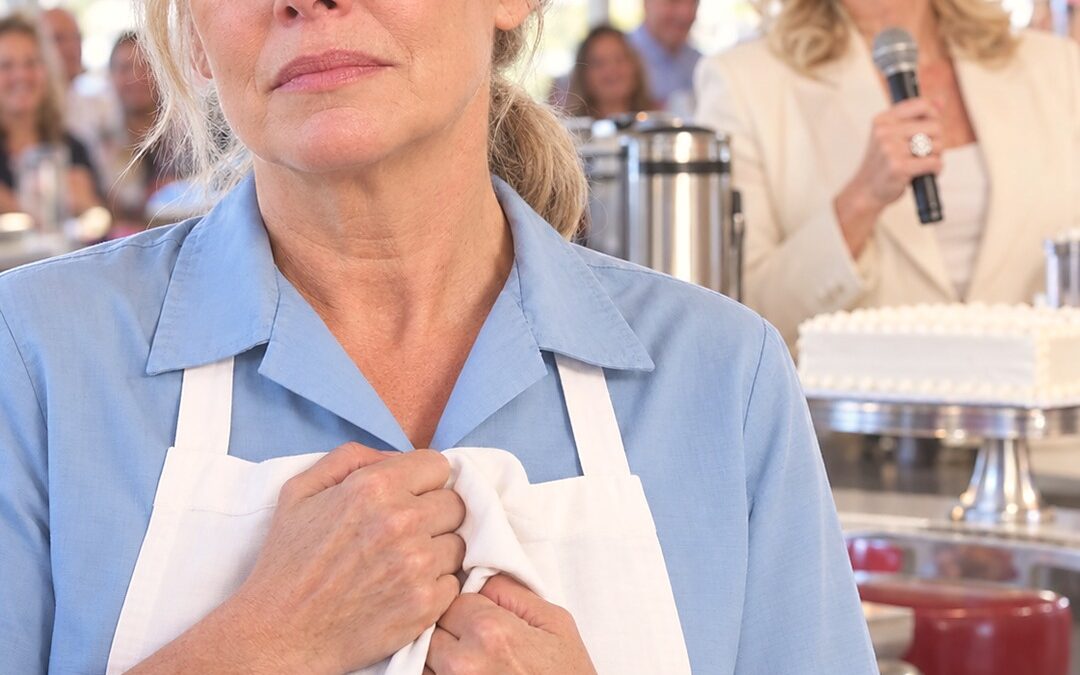
The whole thing took about a minute. Kendra had borrowed the microphone off the karaoke speaker Hector's cousin lent us, and she tapped it twice and thanked everybody for fifty years of pancakes, and then she said, "Mom signed the restaurant over to me." She turned around with her palm up, right there in front of the urn, in front of the Rotary men and the Chamber of Commerce lady and Father Dombrowski's sister and a man I'm fairly sure walked in off Sheridan Road for the free cake, and asked for my office keys.
I had a cake server in one hand and a stack of paper plates in the other.
"Not today, Kendra. We're serving cake."
I said it loud enough. I'll own that. Carl Nygaard laughed first, from stool number three, and then about half the room did, and Kendra's hand came across before the laughing was done. Tessa Moline from the Kenosha News had been taking a picture of the cake, and her flash went off a foot from my nose.
"Hired help doesn't get a speech, Joanie."
$780 a week. I'd never once asked for a raise, and the reason why was folded up against my stomach in that apron pocket.
"Well," I said. "That's going to look nice in the anniversary pictures."
Carl pushed himself halfway off his stool. His wife Lois caught his sleeve and pulled him back down.
Kendra stood beside the coffee urn, breathing hard, the microphone still in her left hand.
Mom was on stool number one, where she'd sat every morning since 1976, hip or no hip. She gave another little clap.
"After what you did with the register," she said, "you ought to be grateful your sister's giving you ten minutes."
Over in the kitchen doorway Hector had stopped cutting cake and was holding the knife over a paper plate.
"Kendra," I said, "did you turn the grill off?"
"What?"
"The grill. Hector's out here serving cake. Somebody needs to turn it off."
She stared at me like I'd asked her to change a tire.
I slid my father's check out of the apron pocket and pushed it down into the front pocket of my jeans. Then I reached behind me and started on the knot.
"Don't you walk away while I'm talking to you."
"I'm taking off the apron. That's what you asked."
She put the microphone down beside the urn. The cord knocked a stack of saucers and three of them slid sideways, and Hector came around the counter to catch the top one.
"Leave it," Kendra told him.
He set the saucer down anyway.
I'd tied that apron so many times the strings had gone thin where they crossed behind my back, and one end had caught under the other, so it took me a while. I worked it loose, pulled it over my head, and folded it with the stained side in.
"Your ten minutes started when I said it," Kendra told me.
The clock over the grill said 2:41.
"Then we're down to nine, I suppose."
I put the folded apron on the counter beside the register.
Mom leaned forward on her stool. "Joan, you owe your sister an apology."
"For what?"
"You know perfectly well."
"Mom, she just hit me."
"Kendra has had enough of your attitude."
Lois pushed Carl's coffee cup out of his reach. He was trying to stand again, and his knee had caught on the underside of the counter.
Kendra picked the microphone back up, then seemed to remember it was still hooked to the karaoke speaker on the pie case.
"Everybody, I'm sorry about this little interruption. Please enjoy the cake. We've got coffee, and there's plenty to take home."
A man near the front window set his paper plate on the sill. His wife pulled him toward the door.
We'd run out of forks, so half the guests were eating cake with soup spoons.
Kendra came around the counter. "Office keys. Safe key. All of them."
"I heard you."
"Then hand them over."
People were filing out the front door now, the ones who'd come for cake and not for this.
"Did you fire me, Kendra?"
"Yes."
"As head cook?"
"As everything."
"Then who's opening tomorrow?"
"I've handled it."
Hector had been in that kitchen twelve years, counting the six months he spent arguing with me about hash browns.
"Hector, check the grill, would you?"
He went through the swinging door.
"See?" Kendra said. "Somebody else can follow instructions."
"He's been following them for twelve years."
"Eight minutes, Joanie."
Mom was watching me from stool one. Dad had made me promise something in 2011, at their kitchen table, when the bank was ready to take the building, and I hadn't broken that promise in fifteen years.
"I'll get my things from the office," I said.
"Nothing belonging to the restaurant."
"All right."
"And I want those keys before you leave."
I walked behind the counter. My cheek had started to sting. It was a small scratch, but when I leaned past the coffee maker I could feel it pull.
The kitchen smelled like hot shortening and the onions Hector had cooked that morning. The bread drawer was hanging open. I pushed it shut with my hip.
Hector was at the grill, turning down the right burner.
"Boss."
"Don't."
"I saw her."
"So did Tessa. Probably got a nice sharp picture."
He set the spatula on its hook. "I should've said something."
"You were holding a cake knife, Hector. I'm glad you didn't."
He checked the swinging door. "She was in the office earlier."
"Who?"
"Kendra. Before everybody came."
"She's been back there all week."
"No. I mean this morning."
I stopped beside the refrigerator.
He pulled a towel off his shoulder and wiped the steel edge of the prep table, which was already clean.
"Doing what?"
He opened his mouth, and from the dining room came Kendra's voice, telling the Altar Society ladies to cut the rest of the cake into smaller pieces. Forty-nine years of avoiding this kitchen and now she was supervising portions.
"Go finish the orders," I told Hector. "And don't let anybody send out yesterday's soup. I marked it."
"You're coming back?"
I didn't answer fast enough.
"Joanie?"
"Keep the burners low."
Dad built the office out of a storage room in 1984, and the desk drawer had stuck ever since.
I closed the door, though it wouldn't latch unless you lifted it.
There was a framed picture of Dad above the filing cabinet. He was standing outside the diner in his old Brewers cap, holding a red grease pencil. His apron had flour on it because he'd been helping me make dumplings that morning.
I left the picture.
Dad kept the green box under the desk with its padlock turned toward the wall. It was about eighteen inches long, with a dented lid and a brass padlock he'd put on after Mom started throwing away old bank statements. The key for it rode on Dad's own key ring, and that ring went missing the week he died. We never did find it.
I crouched and pulled it out by the handle. Dust had collected around the little feet, and the metal scraped the tile loud enough to carry into the hall.
His old ledgers were in there, and the 2011 lease Ruth Teske drew up, with every renewal Dad signed. He'd wanted the originals together and Mom left out of it. Whenever Kendra used to bring up selling, Dad told her to stick to houses.
From the dining room a woman asked whether the party was still going on.
"Of course," Kendra said. "We're just taking care of an employee matter."
Through the little office window I could see her shaking hands with the Chamber lady. Her black leather tote sat open on the counter, a thick blue folder sticking out, and I could read the words printed near the top.
Harborline Partners.
Under that was a Milwaukee address. Harborline had been buying up lots down by the lake there for condos. I couldn't make out the smaller print.
Kendra caught me at the window and came straight down the hall. I picked up the ledger box. She opened the office door before I reached it.
"What's that?"
"Dad's box."
"I know what it is. Put it down."
I stayed where I was.
"That's property of my restaurant."
"It's Dad's."
"Dad kept every old company paper in there," Kendra said. "I want them back in the office before the closing paperwork is finished."
"Then you'll know where to find it."
She blocked the doorway. "Those are company records, Joanie."
"Dad's personal papers. Move, please."
"Give me the keys."
I took the office key off my ring, and the one for the old register drawer, and reached past her and set both on the desk.
She checked the desk to make sure I'd actually done it. "The safe."
"There's no safe. The filing cabinet key is in the top drawer."
I shifted the box against my hip. It was heavier than I remembered, and the handle pressed a narrow line into my palm.
"That box stays."
"I'm carrying it to my car, Kendra."
"I'll call the police."
"You can."
She left just enough room for me to turn sideways. The corner of the box caught the door frame.
"Ope," I said, and then it brushed her jacket too.
"You're going to regret being difficult," she said to my back.
In the kitchen Hector glanced up from the grill. "You need help?"
"No, thanks."
"Boss, that thing weighs a ton."
I pushed through the swinging door. The dining room had thinned out. Carl and Lois were still at the counter, and Tessa was by the front window, scrolling back through the screen on her camera.
Mom had a piece of cake in front of her, and she quit eating it when she saw the box.
"Joan, what are you doing with your father's things?"
"Taking them home."
"He wouldn't have liked that."
"He didn't like people fighting in his diner either."
She put her fork down. "Don't you bring him into this."
The stool beside her was empty. Dad sat there until he died in March 2023, and for months after that she still ordered two coffees, and I poured both.
Now she was pointing at the door.
"Your sister's trying to make something of this place."
"Mom, it's been something since 1976."
"Then why was the register short?"
Kendra came out of the hallway behind me. "Because somebody thought working here thirty-four years meant she could do what she pleased."
Carl cleared his throat the way he does before he sends back eggs. "Kendra, I have eaten breakfast in this place longer than you've been old enough to drive. Your sister never charged me for the toast when I lost my job."
"That's exactly the sort of thing we're fixing."
"Two slices of rye bread?"
"Carl," Lois said. "Sit back down."
He sat. He didn't turn back around to his cake.
"The register numbers are wrong, Mom," I said.
"Your sister showed me the printout."
"Then somebody should've gone over the closing slips too."
Kendra moved between us. "You're done here."
The clock over the grill said 2:51.
"Eleven minutes," I said. "You gave me ten."
"Get out."
Tessa stepped aside to let me through. "Mrs. Pulaski?"
"Joanie's fine."
"Can I ask about the restaurant?"
"You'll have to ask Kendra."
She looked at my cheek. "Do you want a picture of that?"
"You already got one."
I pushed the door open with my shoulder.
My blue 2014 Malibu was by the dumpster enclosure, silver duct tape still holding the passenger mirror together after a pickup clipped it outside Pick 'n Save last winter. I'd bought more tape the week before and left it in the glove compartment.
I set the ledger box on the passenger seat. The old suspension dipped when I let go.
Then the diner door banged open and Hector came running across the lot with a paper coffee cup.
"Joanie!"
"You're supposed to be working."
"Made you coffee."
"I've had six cups today."
"Then make it seven." He held it out.
On the lid he'd written CHEF in black marker. The E was backward. He'd been doing that since he was seventeen.
I took it from him, and that was when my hand started going. Coffee came up through the little hole in the lid and ran down over my knuckles.
"Go back in before she docks you."
"She can try."
"Hector."
Through the front window I could see Kendra talking to Tessa, one hand up, the ring catching the afternoon light.
"She didn't even let you get your coat," he said.
"Keep my sweater in the back for now."
He rubbed the back of his neck. "Boss, I went in the office for the tablecloths this morning, and she had papers all over your desk. That blue folder. There was a page with the diner address on it."
"What else was on it?"
He swallowed and looked down at the pocket of his whites, where his phone made a square. "I took pictures. I didn't look close."
A gravel truck went by on Sheridan Road, rattling over the patched pavement.
"Okay," I said.
"Are you calling somebody?"
"Yes."
He shifted his weight. "You're not quitting, are you?"
"She fired me, Hector."
"That's not what I asked."
"Finish your shift."
He went back toward the diner, stopping once to check over his shoulder.
I set the cup on the roof of the Malibu and stood beside the car until my fingers quit doing that. My keys were in my other hand. The little button on the fob was hard to press, and the first time nothing happened, and the second time the horn gave a short chirp.
My cheek was starting to swell under the scratch. I wiped the coffee off my hand on my jeans, then opened the driver's door and sat down.
I took the check out of my jeans.
January 2, 2023. Henry J. Zelinski. One dollar.
Dad had handed it to me across the counter and told me to frame it or cash it. I'd laughed and said he could afford to make it two. He died eleven weeks later.
I folded it along the old creases and put it in my wallet. Then I found Ruth Teske's number and pressed Call. She'd been Dad's lawyer since I was in high school, and she'd drawn up the 2011 papers.
Ruth Teske had been retired for four years, and she answered on the first ring like she'd been waiting fifteen. "Is it the building?" she said. "Joanie, tell me it isn't the building."
Part 2
At six fifty-eight that Saturday night, I pulled into Ruth's driveway on Racine Street.
Her porch light was on. A plastic pumpkin sat beside the door, left over from goodness knew which Halloween. Ruth opened up before I could knock twice.
She was seventy-four, wearing slippers and a green cardigan with one button missing.
"Let me see your face."
"It's fine."
She tilted my chin toward the porch light.
"That ring did that?"
"Big diamond. Right hand."
"And the newspaper girl got a picture of it?"
"Tessa Moline. Flash went off a foot from my nose."
"Hang on to that. Where's your father's box?"
"Passenger seat."
"Bring it in. And you didn't tell your mother you were coming here."
"I didn't tell anybody."
"Good. Come inside."
Her office was the back bedroom. There was a printer on a folding table and a gray metal file safe against the wall. Above it hung a photograph of Ruth with Dad at some Kiwanis dinner twenty years ago.
I put the green ledger box on her desk.
Ruth flicked the padlock with one fingernail.
"His key ring never turned up?"
"Nope. Not in the hospital bag, not at the house."
"He made me buy that lock for him. Sixteen dollars at Ace Hardware. Then he accused me of charging too much for the paperwork."
She went to the safe and entered a combination.
Inside were four hanging folders.
"Still practicing?" I asked.
"Four old clients. You were told that at his funeral."
"You were busy criticizing the church coffee."
"It was terrible coffee."
She pulled out a folder marked SHERIDAN HOLDINGS LLC, 2011 and laid it beside Dad's box.
"Sit down, Joanie."
I took the chair opposite her.
She opened the file.
On top was the operating agreement from June 2011. Under it sat a thicker packet with my signature on the last page.
I'd signed it at forty-five, seven months after Ed died. Ruth tapped the line.
"Who's the only member?"
"Me."
"Good. I wanted to make sure thirty-four years of cooking breakfast hadn't knocked everything else out of your head."
She slid a creased letter out of the back of the file and pushed it across to me. SOUTHPORT SAVINGS, FINAL NOTICE, and a balance due of $236,000.00 with two of the zeros gone soft where Dad had folded it too many times.
"Your father came here with that in his shirt pocket," Ruth said, "and he kept smoothing it out on this desk."
She touched the wood.
"He said, 'Ruth, I can lose my house. I can lose my car. But Bernie built that counter with me, and I won't have a banker put a chain across the door while she's sitting there.'"
Up on the wall Dad was grinning at the Kiwanis dinner with a paper napkin tucked in his collar, twenty years younger than the man she was describing.
"He cried, Joanie. Right here. Your father put his head down on this desk and cried."
I picked at a loose thread on the chair cushion. Ruth waited until I stopped.
"Then you came in with Ed's insurance paperwork. $250,000. I told you to put the building in a company you controlled, and Henry said yes before I finished the sentence."
Ed had filled out that beneficiary form at our kitchen table the year we got married, in blue ballpoint, and spelled my middle name wrong because he'd never once had a reason to use it.
She turned another page. The deed carried Dad's signature and Mom's.
"Your mother signed at their kitchen table."
"She thought it was refinancing papers."
"Henry told her that's what they were."
"She never asked afterward."
"No." Ruth squared the papers on the desk. "Your father kept the originals in that ridiculous box."
I touched the padlock.
"One thing I don't understand," Ruth said. "Sixty-one people, Joanie. You could have ended it in one sentence. Why didn't you?"
"I promised Dad."
"And?"
"And Mom was sitting right there, clapping."
Ruth uncapped her pen.
"Now tell me everything Kendra said today. Start before she hit you."
I told her. She filled three pages of a yellow legal pad and only stopped me twice, once to ask what time it happened and once to ask whether Mom had her hearing aid in.
"Has Kendra ever seen the lease?"
"No. Dad kept it locked up."
"Your mother?"
"She signs the renewal every January second."
"Does she read it?"
I gave Ruth a look.
"All right," she said. "Stupid question."
Since Dad died, I'd prepared the diner's annual renewal myself. Mom signed for Zelinski's Grill Inc. I signed the landlord's copy as Joan Pulaski, Member, Sheridan Holdings LLC. Those three renewals were in an accordion folder in my hall closet on 22nd Avenue, since nobody could get into Dad's box anymore.
Mom usually asked whether I had any more papers for her before she put her glasses away.
Ruth found the current LLC information on her computer.
"Henry J. Zelinski," she read. "Registered agent."
"Dad's still listed?"
"Yes. That should've been updated after he died. The public page doesn't show members."
"Kendra probably thinks it's his company."
"Then she thinks it passed to Bernie."
"She's been telling people Mom handed her the place."
"Restaurant company or building?"
"She didn't make a distinction."
Ruth pushed her chair away from the desk.
"That's what worries me."
I asked whether we should call Mom.
Ruth's answer came before I'd finished.
"Not a word to anyone, your mother included. Bernie tells Kendra everything, and Kendra will run it through a shredder."
"That's my mother you're talking about."
"I know your mother. She came to me for forty years with questions about Henry's business affairs, and the next morning Kendra always knew the answers."
It was going on nine.
"What do I do Monday?"
"Nothing until we know what Harborline is buying. Leave the box here."
"Here? Overnight?"
"I want it somewhere your sister can't reach."
She took her yellow pad and flipped to a clean page.
"One other thing. You've been running that place since 1992. Why are you still taking $780 a week?"
"Because that's what I get paid."
"Why didn't you give yourself a raise?"
I lined up the edge of her legal pad with the edge of the desk.
"Dad asked me to let her keep it. You don't give yourself a raise in a place you're pretending not to own."
"Pretending," Ruth said. She put her pen down. "Does Kendra?"
Ruth closed the file, opened the safe again, and cleared the bottom shelf so Dad's green box would fit.
She had to turn it sideways.
Tuesday, October 6, I stopped at the Kwik Trip on Sheridan Road for a bottle of water I didn't need.
Carl Nygaard was by the coffee station with a black coffee in one hand and the Kenosha News folded under his arm. He'd sold Snap-on tools all over southeastern Wisconsin for thirty years and still wore the brown jacket from the tool-truck days. Stool number three at our diner had been his since 1981.
"Joanie."
"Morning, Carl."
He squinted at the scratch under my eye. "That looks worse today."
"That's because you're looking at it."
He followed me toward the register.
"Lois wanted me to find you."
"How's she doing?"
"Mad. She's been mad since Saturday."
"She should save some for the Packers."
Carl didn't smile.
"Kendra's been telling people you skimmed money from the register for years."
I set my bottle of water down.
"Who'd she tell?"
"Everybody who came for breakfast Sunday. She had a spreadsheet sitting next to the register. Told two fellows from the Rotary Club she'd found shortages on your closing nights."
"Did she show them the closing slips?"
"Didn't see any."
"Of course."
Carl shifted his coffee to his other hand.
"She changed the locks too."
"When?"
"Sunday morning. Fellow from a locksmith outfit had the front door apart when I pulled in. Wouldn't let me in until he finished."
I paid for the water. Carl walked out with me.
"There's something else," he said.
"What?"
"She put up one of her signs."
"On the door?"
"Window. Big red letters. She put it up Sunday, same morning the locksmith came."
"What's it say?"
"Couldn't tell you." He tapped the newspaper against his leg. "Joanie, your dad would be tearing that place apart looking for an answer."
I opened my car door.
"Dad would've checked the paperwork first."
Carl nodded, then reached into his jacket for his keys.
"Well, you'd better drive by."
I took Sheridan Road north instead of going home.
The diner sat at 3810, the same address we'd put on menus since I was eleven. Zelinski's Grill had been there fifty years that October.
The parking lot was half empty at eleven in the morning. Kendra's new white Lexus RX was parked right by the entrance, where the delivery truck usually stopped.
I pulled into the lot across the road and got out.
Through the diner's front window I could see Mom at stool one. Kendra stood behind the counter, talking to a man wearing a sport coat.
I crossed at the light. There was a square of red low by the door, but above it was a city notice, and I read that first.
CITY OF KENOSHA PLAN COMMISSION
PUBLIC HEARING, MONDAY, OCTOBER 19
Proposed redevelopment: multifamily residential condominiums.
The address was ours.
The application listed Sheridan Holdings LLC as the property owner.
Below it was a signature line.
Bernadette Zelinski, Member, Sheridan Holdings LLC.
Mom had never been a member of anything but the Altar Society at St. Mark's. She didn't know Sheridan Holdings existed.
I took out my phone and photographed the notice.
Inside, Kendra turned toward the window.
I stepped back before she could reach the door.
Kendra's real-estate sign was taped under the zoning notice, her smiling face above the words ANOTHER ONE SOLD.
Part 3
My mother talked to me through the screen door on Wednesday, October 7, like I was selling something she didn't need.
"Joan, I told you on the phone. Kendra's handling the restaurant now."
"I'm not here about the restaurant."
"Then what?"
"I came to see you."
She stood in the doorway in her blue housecoat and the slippers I'd bought her last Christmas. One slipper had a piece of masking tape across the toe.
"Well, you've seen me."
"Can I come in?"
She glanced back toward the kitchen. "I've got things to do."
It was ten thirty in the morning, for cripes' sake, and the whole house smelled like cabbage.
She moved aside enough to let me through, but she kept one hand on the screen door until I was past her.
Mom lived in the same little house on Pershing Boulevard where Kendra and I grew up. Dad replaced the kitchen cabinets in 1998 and she still called them the new cabinets.
I set my grocery bag on the counter. "Got you some bananas. And the bread you like."
"How's your hip?"
"Same as yesterday."
"Did you call Dr. Maloney?"
"Your sister's taking care of it."
She went back to the stove and stirred with a wooden spoon.
On the refrigerator was a glossy brochure I'd never seen before. WILLOWCREST SENIOR LIVING. On the front an old couple sat at a white tablecloth.
I took it off the magnet. "What's this?"
Mom turned around. "Put that back."
"Willowcrest?"
"Kendra brought it."
"Why?"
"She thinks I ought to look at my options."
"You're moving?"
"I haven't decided anything."
"Then why are we reading about nursing homes?"
"It's assisted living. There's a difference."
She took the brochure out of my hand and put it back under the magnet shaped like Wisconsin.
"Kendra says I shouldn't be alone with this hip. They have nurses there."
"Who's paying for it?"
"That's being worked out."
"By Kendra?"
Mom stirred the soup. "Your sister knows about money."
Over by the window was the little table where Dad used to sit filling out order tickets in red grease pencil, and I kept my eyes on that instead of on her. "Does she?"
Mom put the spoon down. "Don't start."
I sat at the kitchen table while she made herself tea. She'd given me coffee in that kitchen for forty years. That morning she didn't offer.
"About Saturday," I said.
"I don't want another argument."
"I didn't come to argue."
"Then leave Kendra alone."
"She hit me, Mom."
"You embarrassed her."
"She slapped me in front of sixty-one people."
"Because you laughed at her."
"Carl laughed."
"You encouraged it."
On the calendar beside the refrigerator WILLOWCREST TOUR was written across Thursday, October 8, in Kendra's big loopy yard-sign handwriting.
"Mom, did you see her hand come across?"
"Of course I did."
"And you clapped."
She picked up her teabag by the string and squeezed it against the side of the mug. "She'd been trying to talk to you all week, Joan. You wouldn't cooperate."
"About my office keys."
"About the restaurant."
"She asked me for those keys Friday with eleven tickets on the wheel, Mom."
Mom brought her mug to the table and settled into her chair. "Your sister found money missing from the register."
"She found a spreadsheet."
"I know what a register shortage looks like."
"You ran that register until 2015. You know we count the drawer against the closing slips."
"Don't explain my own business to me."
Mom turned toward the window over the sink. "Kendra says it's been happening for years."
"How much does she say I took?"
She turned the mug so the handle faced away from me. "She showed me the numbers, Joan. I'm not discussing them again."
The refrigerator motor kicked on. It had been making that rough noise since August and I'd been meaning to replace the fan.
"Your sister's trying to make sure I have something to live on," Mom said.
Ruth's voice from Saturday night was right there in my ear. "Not a word to anyone, your mother included. Bernie tells Kendra everything, and Kendra will run it through a shredder."
The spot beside my hand where Mom always put my coffee was empty. I could have told her all of it, the loan Dad couldn't pay, Ed's insurance, the papers she signed at this same table in 2011 where he pointed, and she would have been on the phone to Kendra before I got the Malibu out of the driveway.
Instead I asked, "Do you have the bill for the refrigerator repair?"
"It's in that drawer."
She dug in the drawer. Under the table the masking tape on her slipper had started peeling off.
At eleven twenty a car pulled into the driveway.
"There's your sister," Mom said.
A white Lexus RX had parked behind my Malibu. Kendra bought it in September. She'd been driving a Ford Explorer before that, and every time she got out of the new one she walked around it checking the paint.
She came through the side gate carrying a leather portfolio. "Mom! I brought those forms."
Then she saw me. "Well. Look who's here."
"Morning, Kendra."
She set the portfolio on the counter. "What are you doing?"
"Visiting Mom."
"After what you pulled Saturday?"
Mom went to the stove. "Girls, please."
Kendra poked at the grocery bag. "I've been getting her groceries. You don't need to come over here and interfere."
I stood. "Her hip's bothering her. I wanted to check on her."
"Mom's tour is Thursday."
"You're going, Mom?"
She kept stirring. "I said I'd look."
Kendra took the brochure off the refrigerator. "They have a ground-floor room available. Mom wants to see it."
"Who's paying for that room?"
"We're handling the financial arrangements."
Kendra opened her portfolio and took out a paper. "Mom, I just need your signature on this before tomorrow."
"What is it?"
"Paperwork for Thursday. So they hold the room."
Mom reached for the pen Kendra held out.
I leaned closer. "Can she read it first?"
Kendra turned all the way around. "Excuse me?"
"Let Mom read what she's signing."
"It's a standard form."
"Then she won't mind."
Mom put the pen down. "Joan, for heaven's sake."
Kendra slid the paper back into her portfolio. "We'll do it after she leaves."
I got my jacket. "Fine."
I went out the side door onto the little concrete landing. Kendra followed me down the steps. Her Lexus had my car boxed in, so I stood by the Malibu's door with my keys out until she got there.
"You need to quit coming around here stirring Mom up."
"I brought her groceries."
"You know what you're doing."
"Move your car, Kendra."
She stopped beside the Lexus and folded her arms. "You were always the help, Joanie. Help doesn't own things."
"Is that what you told Mom?"
"It's what Dad knew. He let you cook, he let you do the books, and you got a paycheck for it."
"Thirty-four years of paychecks."
"And free meals. Don't forget those."
"I rarely did."
She pulled out her Lexus key but didn't press the button. "You took Dad's box. I could have the police at your door. I'm letting Mom's wishes keep that off the table."
"Dad's box has been in my care since he died."
"It was in the restaurant office. That's a business asset."
"Did you open it?"
She looked over at my car. "No. Because you stole it before I could."
"Then how do you know what's inside?"
"Don't play games."
I let that one sit there. A school bus went by on Pershing with nobody in it.
She took out her phone and tapped the screen. "Dad's LLC, Dad's name on the state site."
She turned the phone around. The state page had Henry J. Zelinski as registered agent, same as it had for fifteen years.
"See? Mom inherited Dad's company."
Three and a half years he'd been dead, and there he was in a phone.
"Does Mom know you're using that company?"
"Of course."
"Has she seen the paperwork?"
"She doesn't need to."
Kendra put the phone away. "Mom signed the restaurant over to me."
"I heard you Saturday."
"Then understand what that means." She opened the Lexus door. "Stay away from the office. Stay away from the customers. And bring Dad's box back."
She backed out over the patch of gravel Dad spread there in 2006, and the front tire kicked one stone against my bumper on the way.
Mom was watching from the kitchen window. I raised a hand. She turned away.
That night I ate a bowl of canned chicken noodle at my kitchen table in the duplex on 22nd Avenue. Without the diner I didn't have anything to do after supper. Usually I'd be going over tomorrow's prep sheet, and on Wednesdays the bread man called around seven.
My phone stayed quiet.
At eight forty-six Hector texted.
Joanie. You awake?
Yeah. Everything okay?
Three dots came, went away, came back.
I got something. Photos from Saturday morning. Didn't know if I should send them.
I put my bowl in the sink.
Send them.
The first photograph came through a few seconds later. It was our office, I knew the corner of my desk and the scratched black stapler Dad had used since the nineties, and spread across the desk was a document headed HARBORLINE PARTNERS. PROPERTY PURCHASE AGREEMENT.
The second showed the address. 3810 Sheridan Road, Kenosha, Wisconsin. The purchase price was $1,400,000.
I sat back down.
The third had an October 30 closing date. Harborline wanted a tenant estoppel letter and the building empty before closing. Kendra had asked for my office keys before she'd even cut the cake.
The fourth one said Earnest money: $50,000, and under that, Wire transfer date: September 11.
I called him. He picked up before the second ring.
"Joanie?"
"Four days, Hector."
"I know. She went up front and I took them fast, and after that I kept thinking she'd ask for my phone. I was scared."
"Don't tell anybody about these. And don't send them to anybody else."
"Boss, is she really selling the building?"
"That's what the papers say."
"Where's everybody supposed to work?"
Twenty-three days until closing.
"I'll find out."
He stayed on the line another few seconds. "She told me I need to start looking for another job."
"What?"
"She called me Sunday morning. Said don't bother coming in. I didn't tell you because you had enough going on."
"She fired you?"
"Said I was your guy. Said she didn't need your guy."
I got up and ran the tap over my empty bowl. Twelve years. I'd taught that boy to crack eggs one-handed the summer he turned eighteen, over a bus tub, so the shells wouldn't matter.
"Hector, you call Culver's tomorrow. Tell them I said you can work a flat-top."
After we hung up I forwarded the photos to Ruth. Then I went back to the last one and spread my fingers on the screen to make the signature block bigger.
SHERIDAN HOLDINGS LLC, by Kendra Hollis, attorney-in-fact for Bernadette Zelinski, Sole Member, per Amended Operating Agreement dated September 10.
The earnest money had been wired on September eleventh. According to the paperwork, the day before that, my mother had become the sole owner of a company she'd never heard of.
Part 4
Ruth called Pike River Title on Thursday, October 8, from my kitchen table, with Hector's photographs still open on my phone between us. Dana Wojcik was on vacation until the fifteenth. Ruth left a message about the Sheridan Holdings closing, told the receptionist she represented the owner, and then pointed her pen at me. "Don't go near your sister until Dana gets back."
Friday morning Lois Nygaard came up my steps on 22nd Avenue with a tuna casserole in a Pyrex dish, and Carl waited in the car with the engine running.
"I took your mother one of these last night," she said. "Bernie never went to Willowcrest."
"What happened?"
"She called them herself and canceled. Told me, 'My hip.' Then she said, 'I'm not going anywhere.' Said it twice."
I took the dish. It was still warm through the towel. "Did she sign that paper Kendra brought?"
"I asked. Bernie said you made a fuss about her reading it, so Kendra took it home."
"Tell Carl thanks. You guys didn't have to do that."
"He wanted to come in. I told him he'd only ask about your face." She went back down the steps holding the railing. "Three-fifty for forty minutes, Joanie. Foil stays on."
Hector had picked up shifts at the Culver's on Green Bay Road, and the next Wednesday he called me from the diner lot to say a kid from the Applebee's on 75th was standing at my grill in my whites, burning the toast.
Friday, October 16, I walked into Pike River Title on 52nd Street with Ruth and her 2011 file in a brown envelope.
Dana Wojcik met us in a conference room with a glass wall facing the parking lot. She was forty-four, with reading glasses on a chain and a yellow legal pad that said SHERIDAN across the top.
"I got Ruth's message yesterday," she said. "I spent most of the afternoon pulling the seller's documents."
She laid out the one the seller had given her, headed AMENDED OPERATING AGREEMENT, dated September 10, with Kendra's name at the bottom beside a notary stamp. Brianna Ketter. Kendra's twenty-six-year-old office assistant.
"This makes Bernadette Zelinski the sole member of Sheridan Holdings," Dana said. "Kendra signed for her under a power of attorney. We accepted a notarized member certificate and asked for the company records afterward."
"Meaning you never saw the original," Ruth said.
"Meaning no."
Ruth slid the June 2011 agreement out of the envelope and set it beside the other one. "Page four."
Dana took her time. She went line by line with the cap of her pen, back and forth between the two, then pulled up the recorded deed on her laptop, where Mom's name sat beside Dad's.
"Mrs. Pulaski, you're the sole member?"
"Always have been."
She took her glasses off and let them drop on the chain. "Then there's a serious problem with the seller's authority."
She picked up the conference phone and called Spencer Pell, the vice president of development at Harborline. I could hear him asking whether October thirtieth was still possible.
"Not until ownership is resolved," Dana told him. "We have conflicting company records and a questioned amendment. You'll get copies through counsel."
She hung up, sat there a second with her hand still on the receiver, and then dialed again. This time she asked for financial crimes.
"I need one more thing from you while we wait," she said to me after. "The original lease between Sheridan Holdings and the restaurant, with every renewal."
"Dad's are locked in his ledger box," I said. "The last three are in my hall closet."
"We'll open it tonight," Ruth said.
Detective Amy Kreuger came through the conference-room door about forty minutes later, carrying a thin folder and a paper cup from the gas station across the street. She introduced herself and sat down opposite me.
"Mrs. Pulaski, I understand your sister's company received earnest money."
"Fifty thousand dollars," I said.
"Where did you see that?"
I showed her Hector's photograph of the contract. She held my phone a long way from her face, then closer.
"Do you know where the wire went?"
"The paperwork names Hollis Home Group's trust account."
"That's what I'll be checking. Please keep this quiet while I trace the money." She turned to Dana. "Ask Harborline to keep the closing on the calendar. If Kendra thinks it's still happening, she won't move what's left."
"What happens to the closing?" I asked.
"Dana can deal with the title. I'm dealing with what happened to the money." She took my number. "Keep Hector's original photographs. I'll want to talk to him."
Then she turned to Ruth. "And save everything you brought today."
Ruth closed her envelope. "Detective, I haven't thrown away a business document since 1973."
Hector came to my duplex Friday evening carrying bolt cutters borrowed from his uncle.
Ruth got there ten minutes later. Dad's green box had come out of her safe and ridden over in her trunk under a stadium blanket, and Hector carried it up and set it on my kitchen table.
He tapped the padlock with the bolt cutters. "You sure?"
"Nobody's seen that key since the funeral," I said.
"Stand back."
He fitted the jaws around the brass shackle and leaned on it. The lock snapped, and a little piece struck the table and rolled against Ruth's elbow.
"That's sixteen dollars gone," she said.
I lifted the lid.
Inside were envelopes tied with kitchen string, Dad's old rent ledgers, and the original lease. The first renewal was January 2, 2012. The last one in there was January 2023, in Dad's hand. I got my accordion folder out of the hall closet and laid the three newer ones on top, my name on the landlord's line and Mom's on the other, in the same blue pen she uses for Christmas cards.
Ruth went through each page. "Good. All here."
Something had been taped to the inside of the lid, under the faded manufacturer's sticker. An old order ticket in Dad's red grease pencil, clipped to the stub from his first one-dollar rent check.
There was writing on the back. I turned it over.
"J — Don't tell your mother. Let her keep it. Let me keep it too. —Dad"
Ruth read it over my arm. She started to say something and didn't.
Hector stood by the stove, still holding the bolt cutters. "That's your dad's handwriting?"
"Yes."
I set the ticket down next to the rent-check stub and went to the sink.
There was a stack of clean cereal bowls in the dish rack. I took them out, filled the sink with hot water, and washed them again.
Ruth didn't come over. She kept sorting the renewals into a pile by year.
After a few minutes Hector put the bolt cutters back in their case and picked up his jacket.
"I'll get out of your way, Joanie. Anything else you need cut open, call me."
"Let's hope that's the last one."
He let himself out the back door without asking about the ticket.
I rinsed the last bowl and set it upside down. Behind me Ruth squared the renewals and snapped a rubber band around them.
"I'm taking the lease copies to Dana Monday," she said.
"Take the originals too."
"I'll make sure you get them back."
I dried my hands and sat down across from Dad's ticket.
Monday, October 19, Ruth and I sat in the back row of the Kenosha Plan Commission on folding chairs. The microphone popped every time a commissioner leaned in. Two of the men from the anniversary party were there about a car wash on 60th Street. Neither came over.
Ruth had filed her objection that afternoon on behalf of Sheridan Holdings LLC. It said the applicant lacked authority to act for the record owner, and my name wasn't anywhere in it. "They don't need to know who owns it tonight," she'd told me in the car. "Only that somebody's saying they don't."
Kendra didn't come. Rob did. He was in the third row in his green Menards jacket, fifty-seven years old and still dressed like the store on Highway 50 might call him in. He gave me a small nod. I nodded back.
When our address came up, the city planner read through the condo proposal and said the owner had signed off. Ruth was on her feet before he'd turned the page.
"I'm counsel for Sheridan Holdings LLC. The applicant's authority has been formally challenged. I'd ask that the item be tabled."
A commissioner wanted to know whether the ownership dispute would be settled by the next meeting.
"We're working on it," Ruth said.
They tabled it. Rob was out of his chair before the car wash came up.
He caught me by the bubbler in the hallway. Ruth went on ahead to the parking lot.
"Joanie. Is Kendra in some kind of trouble?"
"You'd have to ask Kendra."
"I did. She says it's paperwork. She's in Milwaukee tonight going over closing papers, and she sent me to hear how it went."
"Then it's paperwork."
"She said Spencer told her the sale doesn't depend on zoning."
"Rob, I can't help you tonight."
"Is that lawyer yours?"
"She's been Dad's lawyer a long time."
"Okay." He looked down the hall at the doors. "I better call her and tell her some old lady lawyer got it tabled."
Ruth was waiting beside my Malibu with her coat buttoned to the neck.
"What did Rob want?"
"To know if Kendra's in trouble."
"What did you tell him?"
"To ask her."
"Good."
"He thinks she can still close."
"She can't convey title she doesn't own."
"Will that stop her trying?"
"No," Ruth said, and got in.
At nine seventeen that night, Kendra texted me.
"Come get your junk Saturday at 8. You'll have ten minutes."
I was at my kitchen table with Ruth's photocopies of the lease renewals spread out in front of me. I checked the date. Saturday was October 24. The closing was six days after that.
A second text came in under the first. And bring Dad's box.
Detective Kreuger's card was propped against the sugar bowl, where it had been since Friday.
I typed back Okay, and then I called Detective Amy Kreuger and asked her how she took her coffee.
Part 5
Kendra had put a sign on the front door that said LAST BREAKFAST AT ZELINSKI'S, and at 7:55 Saturday morning, October 24, she was standing behind my father's counter in a white blazer. She'd never worked a breakfast shift in her life, and she'd already put the coffee filters in upside down.
"Ten minutes, Joanie. Clock's running."
The clock over the grill said 7:56. It runs a minute fast.
"Morning, Kendra."
"Did you bring Dad's box?"
"It's where it's safe."
She set the coffee pot down. "I specifically told you to bring everything belonging to the restaurant."
"You told me to come get my junk."
"Don't start."
I'd come five minutes early because Ruth Teske told me to. She was right behind me with her leather briefcase, in the navy coat she'd worn to Dad's funeral.
"Why is she here?" Kendra said.
"Morning, Mrs. Hollis," Ruth said.
"I wasn't asking you."
"Then you should stop staring at me, dear."
I walked around Kendra toward the coffee urn.
The place was about full. Carl had stool number three with Lois beside him, and the two Rotary men from the anniversary party were back in their booth like they'd bought season tickets. Tessa Moline from the Kenosha News stood by the front window with her camera. On the counter sat another sheet cake, THANK YOU KENOSHA in blue on white, and Kendra had stuck a little paper flag in it.
Mom was on stool number one in her good purple sweater. She'd had her hair done.
"Joan."
"Morning, Mom."
"Your sister said you're picking up your belongings. Please don't make a fuss."
"I brought some people you ought to meet first."
Kendra stepped out from behind the register. "Absolutely not. This is a private family matter."
Carl didn't bother turning around. "Then why'd you invite half of Kenosha?"
One of the Rotary men set his fork down without a sound.
I took two papers out of Ruth's briefcase and laid them flat beside the coffee urn, right about where Kendra had set the microphone three weeks before.
"Can you read these, Kendra?"
"What's that supposed to be?"
"The operating agreement for Sheridan Holdings LLC. June 2011. And the quitclaim deed Dad and Mom signed that same month."
Kendra laughed. "That's Dad's LLC."
Ruth set her briefcase under a stool. "The company on that deed is the record owner, Kendra. That's why I filed the objection."
"My mother is the owner." Kendra turned. "Right, Mom?"
Mom squinted at the deed. "Henry handled all that."
The front door opened and a man in a charcoal coat came in, taking off his gloves one finger at a time. Kendra came around the counter to meet him.
"Spencer! You made it." She turned to the room. "Everybody, this is Spencer Pell from Harborline Partners. We're doing the handover right after breakfast."
"Morning, Kendra."
"I said eight thirty."
"Dana suggested I come at eight."
Dana Wojcik had come in behind him with a slim folder. "Dana Wojcik, Pike River Title."
"You told me we were reviewing the title issue next week," Kendra said.
"We've finished reviewing it." Dana opened her folder and laid a document beside the 2011 agreement I'd put down. "This is the amendment your office submitted September tenth."
"My father's name is on the state website," Kendra said.
"He's listed as registered agent," Dana said.
"That's the owner."
"Show me where Bernadette first became a member."
Kendra turned the new one over and checked the back of the last page, like it might be written there in pencil.
"Tell them," she said to Spencer. "We have a signed contract. One point four million dollars."
Spencer took a letter out of his coat. "Harborline Partners is canceling the $1,400,000 purchase contract."
Kendra took a step toward him. "You can't cancel."
"We wanted to buy it from someone authorized to sell it."
"Mom gave me power of attorney!"
"Power of attorney doesn't make your mother the owner," Dana said.
The door opened again and Rob Hollis came in wearing his green Menards jacket.
"Kendra? You said this was breakfast with the family."
"It is."
Then he saw Spencer. "What's going on?"
"We're also demanding return of the $50,000 earnest money wired September eleventh." Spencer laid the letter in front of her. "Our attorneys will contact your brokerage about the funds."
"Fifty thousand?" Rob said from the door.
"Standard earnest money," Kendra told him.
"You didn't tell me you'd gotten it."
"Rob, don't."
Ruth leaned toward Mom. "Bernie, look at the signature on that second paper."
Mom pushed her glasses up and carried the deed a step closer to the window. "That's mine. And Henry's. What's Sheridan Holdings?"
"The company that paid off Southport Savings in 2011," Ruth said.
Dana held up the original lease. "The diner has leased the building from that company since 2011. One dollar a year."
Carl sat up. "A dollar? That's less than my toast."
Kendra turned on me. "You worked here. You were an employee."
"Head cook and manager. Thirty-four years."
"And you got paid."
"$780 a week and lunch."
Kendra picked up Spencer's letter, found the signature, and pushed it toward Dana. "Can't you give us one more week? Mom can sign something new."
"Your mother can't sign for that company," Dana said. "Your father was never a member. Your mother was never a member. The only member since June 2011 is standing in front of you."
Mom leaned in with her right ear. "Who?"
The clock over the grill said 8:03.
I came around the coffee urn and stopped between it and the sheet cake, on the same square of linoleum, with the same clock over the grill and Mom on the same stool and Carl and Lois and the Rotary men and Tessa all right where they'd been the first time. The scratch she gave me had healed to a thin pink line under my eye. I could feel it when I talked.
"You gave me ten minutes to get my apron and get out of your restaurant, Kendra. Take five. It's my building."
Her right hand went up to her own cheek, to the same spot under the eye, and stayed there a second before it dropped. The new keys in her other hand rattled against the counter edge, tick, tick, like a turn signal somebody forgot to shut off.
Tessa's flash went off. This time it was a foot from Kendra's nose.
One of the Rotary men set his fork down on his plate so carefully you could hear it touch. Carl turned all the way around on stool three.
"That's the whole speech?" he said to Lois.
"She's hired help," Lois said. "They don't get one."
"You're really doing this to me?" Kendra said.
"You hit me in front of everybody here. I asked you to read a deed."
Mom stood up, picked up the quitclaim deed and held it close to her face, her own signature, then turned to face the dining room, all of it, the booths and the counter and the people with forks halfway up.
"I clapped. I'd like to say that out loud, since I did it out loud."
"Mom, don't," Kendra said.
"I clapped when you hit your sister. I saw Joan standing there with a mark on her cheek, and I clapped."
I turned stool one around for her. She didn't sit.
"Kendra told me you took money from the register," she said.
"She showed you a spreadsheet."
"I believed it."
Ruth opened her briefcase. "Bernie, we need to talk about the power of attorney you signed in April."
"I thought that was for my Medicare."
"It gave Kendra your finances. You can take that back whether she agrees or not. Joanie and I went over it Thursday, and the bank gets a copy of the revocation Monday morning."
Kendra reached for the paper. "Mom asked me to handle her money."
Ruth slid it out of reach. "This is a revocation. Signing it ends that authority."
Mom took Ruth's pen. "Where?"
Ruth pointed. Mom signed. Carl and Lois came around the counter and signed underneath as witnesses, Carl pressing so hard the pen went through to the Formica, while Tessa photographed the page from a respectful distance.
"My attorney will have this in front of a judge by Tuesday," Kendra said.
Mom nodded at the key ring in Kendra's hand. "Give your sister the keys."
Kendra didn't move.
"Kendra. I asked you."
The keys landed on the counter beside the urn. Office key, front door key, the new locks she'd had put in the Sunday after the party. I picked them up.
Hector was in the kitchen doorway. I'd asked him to come, fired or not, and he'd been waiting in back with two of the old dishwashers and Kendra's new cook from the Applebee's, watching through the pass.
I held up the ring. "Think the grill still works?"
"Only one way to find out, Boss," he said, and went back into the kitchen.
Rob stepped toward his wife. "Kendra, where's the fifty thousand?"
"It's being handled."
"By who?"
"Rob, please."
In booth six a woman stood up and folded her newspaper. Detective Amy Kreuger had been sitting there since before seven thirty.
"Maybe I can help with that."
"Who are you?" Kendra said.
"Detective Amy Kreuger. Kenosha Police, financial crimes." She showed her badge. Dana stepped back from the counter to give her room.
"Mrs. Hollis, the account that earnest money went into is frozen as of yesterday."
"Frozen?" Kendra said. "I would've known."
"The bank was asked not to tell you, Mrs. Hollis."
"How much is in it?" Rob said.
"Nine thousand dollars."
"What happened to the rest?"
Kreuger opened her folder. "Forty-one thousand dollars went to Lexus of Pleasant Prairie."
Rob took a step back and looked at his wife. "You said the commission came early."
Kendra reached for his arm. He moved it out of her way.
"It was money I was going to put back after closing."
Out the front window the white RX sat in the delivery spot with the dealer's plate frame still on it.
"She bought that car in September," Rob said to the detective. "She told me she'd had a good month."
"The payment went from the brokerage trust account to the dealership a few days after the earnest money came in." Kreuger laid a copy of Brianna Ketter's notary stamp on the counter. "We've requested the original records from your office."
Kendra's voice went up. "Am I under arrest?"
"Not today."
"Then why are you doing this in front of everybody?"
"You invited the public, Mrs. Hollis. I just came for breakfast."
"You planned this," Kendra said to me.
"I came for my keys."
Mom lowered herself onto stool one. Carl slid her coffee over so she wouldn't have to reach.
Rob sat down on the stool nearest the door, still zipped into his jacket. "Kendra, you need to tell me what else you've signed."
She didn't answer him.
A man by the door put five dollars on the counter for his eggs and left. Hector came out and started bussing plates.
I went behind the counter and poured Mom a fresh cup.
"Need anything else?"
"Could I have some toast?"
"Rye?"
"Please."
I wrote it on a ticket and clipped it to the order wheel.
Behind me Kendra got her tote off the end of the counter and went for the door. The clock over the grill said 8:07. Her sign was still taped to the glass beside the door, facing Sheridan Road.
Detective Kreuger had already set a five-dollar bill under her saucer, because she had told me on the phone she didn't drink free coffee on the job. She got to the door first and stood in it.
"Mrs. Hollis, I'll need to see you Monday. Bring the Lexus paperwork."
Part 6
Kendra wore the same white blazer to her first court appearance that she'd worn the morning she tried to sell my building.
Thursday, November 5. Kenosha County Courthouse.
The blazer had a loose thread hanging off the right cuff, and she kept pulling at it while we waited for the judge. Mom sat between Ruth Teske and me. Carl had offered to drive, and Lois wanted to come with, but Mom said she wanted to arrive in my Malibu, duct tape and all.
Rob Hollis sat three rows behind his wife, not beside her.
When the clerk called her name she stood up so fast her chair scraped.
The prosecutor read the charges. Forgery. Theft by fraud. Battery.
The battery was the slap. Tessa Moline's photograph showed Kendra's hand against my cheek with the diamond turned outward and the microphone still in her other hand. I'd seen it once. Once was plenty.
Her attorney entered a not-guilty plea. The prosecutor said the financial charges concerned the amended Sheridan Holdings operating agreement and the $41,000 taken out of the earnest money. Brianna Ketter, Kendra's twenty-six-year-old assistant, was cooperating with the state, and she'd already lost her notary commission.
Kendra kept turning around to find Rob. Rob turned his cap over on his knee.
The judge released her on a signature bond, told her to show up for future hearings, and told her not to contact Brianna about the case.
Mom put her mouth by my ear. "Did he say she can go home?"
"Yes."
"Without paying anything?"
"It's a signature bond, Mom."
She nodded, and I could tell she'd caught about half of that.
Ruth had the charging papers on her knee. She put the tip of her pen on the word Forgery and left it there until the clerk called the next case.
Out in the hall, Kendra came up to us while Ruth was putting papers in her bag.
"Mom?"
Mom stopped buttoning her coat.
Kendra checked my face first, then went back to Mom. "I'm sorry. I never wanted any of this to happen."
Mom took a folded tissue out of her coat pocket and held it.
"You wanted the money, Kendra. You just didn't want us finding out."
She put the tissue back in her pocket and walked to the elevator.
Rob came through the courtroom doors.
"You coming home tonight?" Kendra asked him.
"Not tonight. I'm at my brother's in Racine."
He stopped at the stairwell door. "Did you know about the operating agreement?"
"I knew Mom gave me permission."
"That isn't what I asked." He took the stairs.
We got to the courthouse lot a few minutes before eleven. Kendra's white Lexus RX was parked two rows over from my Malibu, with a thin coat of road dust across the back window, and I was helping Mom into the passenger seat when a flatbed turned in off 56th Street and slowed beside it. Behind it came Detective Kreuger's gray sedan, and out of the passenger side climbed a man in a Lexus of Pleasant Prairie polo with a clipboard.
Kendra came out of the courthouse with her attorney and stopped dead.
"What's he doing?"
Kreuger crossed the lot with a paper folded in thirds. "Mrs. Hollis, the RX is being held as evidence. The gentleman from the dealership is confirming the VIN for the tow. You can take your personal things out first."
"You said they couldn't just take my car," Kendra said to her attorney.
"It's a seizure order, Mrs. Hollis," Kreuger said. "The car was bought with the earnest money."
"My purse is inside."
The driver waited while she got her purse and a pair of sunglasses out. Then she stood there with the fob in her hand.
"I paid for this car."
Her attorney put his hand on her arm. "Not here, Kendra."
The driver held out his palm. She held onto the fob a few more seconds and then dropped it in.
The ramps came down with a bang. Mom watched through the windshield.
"Is that her new car?"
"Yes."
"The one she brought over to show me in September?"
"Same one."
The front wheels climbed the ramp. Kendra reached out for the driver's door as it went past her, like she was going to hold it shut, and then put her hand in her blazer pocket instead. When the truck pulled out onto 56th she took two steps after it and stopped at the curb.
Ruth came across the lot with an envelope. "Dana forwarded me the state's answer to her complaint. It came yesterday."
The Wisconsin Department of Safety and Professional Services had opened an investigation into Kendra's real estate license. On the second page it said her MLS access had been shut off.
Over by the curb Kendra had her phone out, trying to pull up her listings. She tried twice and then let her arm hang.
"Can she still sell houses?" Mom asked.
"Not today," Ruth said.
Mom pulled her seat belt across her coat. "Take me home, Joan. I've got soup in the refrigerator."
On Sunday, November 8, Mom called at nine and asked if I wanted chicken noodle for lunch.
"Did you make it?"
"Yes. And Joan? Bring your father's papers. The ones from the box."
I picked up a loaf of rye and drove to Pershing Boulevard. She had the screen door open before I knocked.
"Your car's leaking something."
"That's condensation."
"It's November."
"I'll look at it."
The Willowcrest brochure was gone off the refrigerator. Her church calendar was back in its spot.
She'd made enough soup for six people and put a dish of pickles between our bowls. After lunch she washed the spoons and I dried, and then she hung her apron on the hook by the refrigerator and said, "Sit down a minute."
I brought Dad's green box in from the living room. The broken padlock still hung off one side.
Mom touched the dent in the lid. "Henry dropped this when we lived on 39th Street."
"That's what he told me."
"He blamed the dog."
"You didn't have a dog."
"Exactly."
I took out the red grease-pencil order ticket and set it in front of her. She turned it over.
"J — Don't tell your mother. Let her keep it. Let me keep it too. —Dad"
She held it up to the window. "That's Henry's writing. What did he mean?"
I didn't answer that one. I got up and put the kettle on, and when I sat back down she was still holding the ticket up to the light.
"He told me the bank was taken care of," she said. "He came home from Ruth's and said it like he'd paid the gas bill."
"It was two hundred thirty-six thousand dollars. I was sitting next to him when Ruth did the papers."
"With Ed's money."
"With Ed's money."
Mom turned toward Dad's chair, which nobody sits in. "Why didn't you tell me?"
"Dad asked me not to."
"And after he died?"
"You were still getting up every morning and going down to the diner. I figured you had enough."
She rubbed the edge of the ticket with her thumb, back and forth, the way you'd work a stain.
"He let me keep it. Twelve years he let me keep it."
Then, to the cabinets more than to me, "I gave him a terrible time after his surgery. Kept telling him we ought to sell before the next big repair. He'd sit right there and tell me we'd manage."
I took out my wallet. The last check Dad ever signed was folded behind my driver's license, one dollar, payable to Sheridan Holdings LLC, January 2, 2023. He'd handed it to me across the counter and said, "Frame it or cash it, J." I never cashed it. I'd counted that year's rent as paid and kept the check.
I slid it across the table.
Mom put her glasses on. "That's his signature."
"Last rent check he wrote. One dollar, every January second, at the counter, before he turned on the grill."
"Two months before he died."
"Almost three."
She lined it up next to the order ticket, bottom edges even, and then moved Dad's check a little closer to her side of the table and kept her hand on it.
After a while she went to the drawer where Dad used to keep the restaurant stamps and came back with an envelope. Ruth had brought it Friday. Inside were the papers transferring Mom's shares in Zelinski's Grill Inc. to me, with little yellow flags where she was supposed to sign.
"Mom, you don't have to do this today."
"I called Ruth twice this morning, Joan. I've made up my mind." She moved the papers out of a soup ring on the oilcloth. "Show me where."
She had me turn on the overhead light so she could read the small print, and she read all of it, every page, which I'd never once seen her do, and then she signed.
"You've run it since 1992. I was the last one to find out."
She pushed the papers over to me.
"Now will you please get somebody to fix that refrigerator?"
It was making the same grinding noise. "I'll call Monday."
We'd been closed three weeks, waiting on the state to put the restaurant company in my name and on a county health inspector who only came out Thursdays. Saturday, November 14, I got to Zelinski's Grill at six twenty in the morning and went at the SOLD sign with a razor blade. The paper came off easy. The glue took longer. Kendra's smiling face came away in two pieces.
Hector showed up at six thirty. "Boss, that's been up since October. You could've had it off weeks ago."
"I'd been saving it."
He went in and fired up the grill.
By seven the first bacon was on, the coffee was fresh, and the exhaust fan still needed its switch hit twice. Carl and Lois came in at seven ten, and Carl lowered himself onto stool number three and said "Uff da," which is what he says when his knee's bad. Mom came in behind them and settled onto stool one.
I poured her coffee. She opened her purse and slid something stiff across the counter, about the size of a postcard, the way she used to pay for pie.
Two checks under one sheet of plastic, laminated at the UPS Store on 75th Street. On the left, Dad's, January 2, 2023, his big slanted H. On the right, hers, dated Friday, one dollar to Sheridan Holdings LLC, the first one she'd ever written knowing who she was writing it to. In the memo line, in her careful Palmer handwriting, it said "For 2011. And for the apron."
"You can't cash that now," I said.
"I know. That's the idea."
I pinned it to the order wheel over the window, between Carl's rye and a Rotary man's two over easy. It hung crooked. I took it down and pinned it again and it hung crooked again, so I let it.
My apron was on its hook by the walk-in, still folded the way I'd left it on the counter six weeks before, stained side in. Hector, probably. Mom had the menu open, though she'd eaten breakfast there for fifty years.
I tied my apron, took Mom's order myself, and gave her ten minutes to decide between the pancakes and the hash, which turned out to be about nine more than she needed.



