My Parents Spent Christmas on Brett’s Two Kids While My 8-Year-Old Shook an Empty Stocking—Then Grandma Hazel’s Tin Exposed Dad Before He Could Give Brett the House
Complete story · 7 parts · about 32 minutes · ending included
Part 1 · Part 2 · Part 3 · Part 4 · Part 5 · Part 6 · Part 7
Part 1 of 7
Theo turned his wool stocking upside down over my parents’ living room rug, and nothing fell out. I had sent Mom and Dad $700 on the first of every month for five years to cover the taxes and insurance on their house on Highland, and my eight-year-old son had just found out there wasn’t a single present for him.
Across the rug, Brett’s two children were opening tablets, each still in its box. His eleven-year-old daughter peeled the plastic from hers while her brother, nine, held up the charging cord like another gift. Courtney had already taken pictures of them beside the tree.
The stocking stayed empty when Theo shook it once more. He reached inside with two fingers and felt along the seam, hoping a gift might have caught in the toe.
“Did I do something?”
From the kitchen doorway, I watched with dishwater still wet on my hands. Brett sat with his coffee, smiling at his own two. Wrapping paper covered the floor near his shoes.
My mother, Lois, came past the end of the couch and stopped where Theo could see her.
“Honey, you know how it is. We ran short this year. Taxes went up.”
The wool cuff folded over Theo’s fingers as he lowered the stocking.
“Did Grandma forget mine?”
“Now, sweetheart,” Mom said. “Christmas isn’t only about presents.”
Courtney told her younger child to hold his tablet higher for a picture.
His cousins had stockings too. Their candy and small wrapped gifts were spread near the boxes, mixed into the paper from the larger presents. Theo looked once at that pile, then pushed his thumb along the empty heel of his own stocking.
I dried my palms against my jeans. Dad had blamed taxes for years, and I had paid what he asked without missing a month. I rented a chair at a salon on Santa Fe, so I knew exactly what $700 meant in haircuts.
“Those taxes, Dad?” I asked quietly.
Dad sat in his chair facing the television. A football show was on, and he never looked away.
“You’re the help with a checkbook, Shawna. Brett’s the family.”
Brett took another drink of coffee.
On the rug, my son glanced toward his uncle, then back at me. The empty stocking lay across his knees. He did not ask what Dad meant by family.
I had plenty I could have said. Instead, I used the same words I gave clients while trimming the back of the neck.
“Chin down.”
I went into the kitchen for a towel.
Through the window above the counter, Dad’s trailer sat near the driveway. A new fishing boat rested on it under a fitted tarp. The bow stood high over the hitch, and a strip of bright metal showed beneath the cover.
I took the towel back to Theo and wiped orange juice from his fingers. He held still the way he did when I cleaned a scrape.
Gail sat on the edge of the sofa with a paper plate of cake balanced on one knee. She studied the stocking, then looked at her brother.
“Dwight, Mother always—”
“Not today, Gail.”
Dad kept his eyes on the screen.
Gail lowered her face to her cake and pressed a few crumbs together with her fork. Grandma Hazel had never let a child leave Christmas morning empty-handed.
Courtney raised her phone toward her children.
“So cute!”
On her screen, the frame held the two kids and their tablets. Theo was cut out. He noticed, because his eyes followed the phone before dropping to the stocking in his lap.
Brett called toward the kitchen.
“Shawn, we out of coffee?”
I folded the damp towel and helped Theo to his feet.
“Can we go home now?”
“Yes.”
At the entryway, I took his coat from the hook and slipped it onto him. He tucked the stocking under one arm and waited while I buttoned the top.
Mom went upstairs while I was getting him ready.
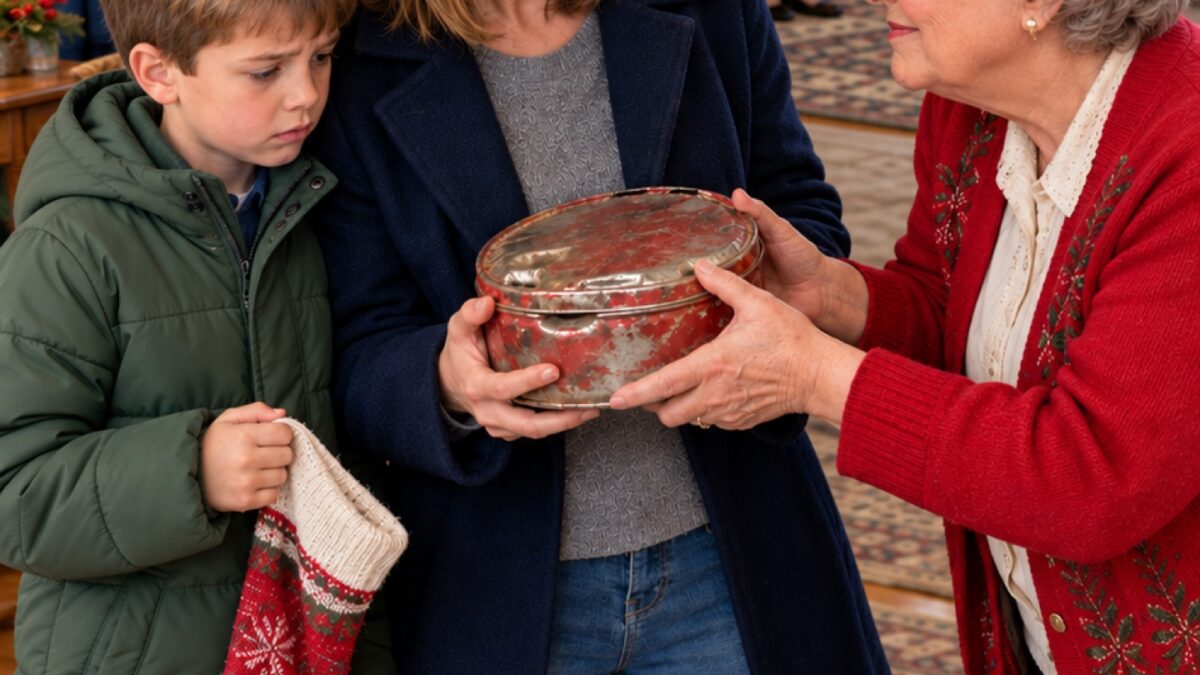
She came back down from the attic with a dented tin in her hands.
Its painted lid had once been red, though most of the color had rubbed away around the edge.
She pushed it at me.
“Take your grandmother’s junk. We’re clearing the attic.”
I caught it against my coat.
“These were Grandma’s?”
“That’s what was left up there.”
Mom stepped past us.
I eased the lid up a crack and looked inside. Faded silver ornaments lay in a heap, their finish worn dark in places. Among them was a small tin star snapped in two and held together with yellowed tape.
I’d broken that star myself, at eight.
Grandma Hazel had fixed it and kept it.
Beside me, my son leaned closer. Theo’s father had left long ago, and there was nobody else coming to gather his coat or tell him we should stay.
“Can I keep the broken star?”
“Yes. We’ll take it home.”
Outside, I helped him into the passenger seat and set the tin on his lap.
We were still on Highland when he set the stocking inside with the ornaments. He did not cry. He moved one silver ball aside so the wool would not crush it, then rested a finger on the yellowed tape across the star.
“Was Grandma Hazel mad when you broke it?”
“No.”
That was all I remembered clearly.
At home, I put the tin on the kitchen table beside my bill folder. The house was quiet except for the furnace starting under the floor vent.
I pulled my calendar from among the bills. January 1 had the next transfer written in the square.
With my pen, I crossed out $700.
The black mark went straight through the amount.
I looked at the calendar entry, then wrote $700 back above the line.
January now held two payments, one canceled and one not.
My son climbed into the chair beside me and drew the tin closer.
“Can I look again?”
“Careful with the ornaments.”
He opened the tin and moved the stocking aside. A faded silver ball rolled softly against the metal edge. The star stayed where he had left it.
Then he tipped the lid up to the kitchen light.
Picking up where the Facebook post left off
Inside the lid, in Grandma Hazel’s pencil:
“For Shawna. Not before I’m gone. — H.”
Hazel had been dead five years.
Part 2 of 7
Seven days before my next $700 was due, I held the tin lid over my kitchen table and called Mom.
When she answered at Highland, I read Grandma Hazel’s pencil line word for word.
“‘For Shawna. Not before I’m gone. — H.’ Did Grandma leave this for me?”
“Honey, she wrote on everything. It’s a box. Brett’s kids will want that attic.”
I set the lid beside the tin.
“Then why put my name in it?”
Mom made a small sound like I had asked why a grocery sack had handles.
“Because she was old, Shawna. You know how Grandma was.”
I did know. She labeled Christmas bulbs by year and kept the warranty cards for toasters that had been gone ten years.
That did not answer me.
I took out the faded silver ornaments one at a time and lined them along the table. The taped star came next. Theo’s stocking was folded under two of the balls, so I lifted that out too.
That was all the tin held.
The bottom was covered in old felt, worn flat and dark around the edges.
I left the felt alone.
“Nothing in here,” I said.
“See? A box.”
Mom said she still had attic boxes to sort, and she hung up. I put the stocking back, then the star, then the ornaments. The lid went on last.
After Theo was asleep that night, I opened my bank app and pulled up my transfer history.
I went to the first payment I had sent Dad in 2021 and scrolled forward.
January 1, 2021. $700. taxes/ins.
February 1. $700. taxes/ins.
March 1. The same.
I kept going until December 1, 2025.
Sixty lines.
Every one was $700 and carried the same note.
I had always known the total. Forty-two thousand dollars was not a surprise to me. Seeing the whole five years in one narrow column was different from doing the math in my head while I swept hair around my chair between clients.
I put the phone beside my bill folder.
Dad had handed me one renewal bill every November.
Five of them sat together inside.
Each year, he had given me the paper and said, “So you see it’s real.”
At the very back was the oldest form.
The date at the top was January 13, 2021.
It was an insurance policy change form, the one Dad had pushed across the table at me that first month. I remembered his finger tapping the page while I was sorting mail.
“You won’t read it. Just file it, that’s what you’re good at.”
On the front, in an interest box beside his signature, was L/E.
I had always taken that for an insurance company code.
The back was packed with small print.
I did not read it.
The form went back behind the renewal bills, and I tore a corner from an old envelope and wrote on it.
ask Dad for receipts
I stuck the scrap to the folder with tape.
From now on, I would pay only when I saw a receipt.
Friday morning, Mom was in my chair at the salon on Santa Fe by 10:00, wearing a black cape and studying herself in the mirror.
She wanted a cut and a trial roller set, to see how the curl would hold before the New Year’s Eve party.
I combed the back of her hair straight.
“Chin down.”
She lowered her head.
I trimmed the neckline, brushed the loose ends away, and asked, “Can Dad give me the receipts for the taxes and insurance?”
Mom laughed.
Not quietly.
“Receipts? For what? It’s the taxes on your dad’s house. You’ve never once said no, honey. You’re doing your part.”
Two chairs down, a woman stopped winding a perm rod.
Under the dryer next to Mom, Marlene Vogt looked up from her book.
Marlene was seventy-two and came in most Fridays. She got a wash and dry each time, the same short cut every fourth week, and she paid in exact bills. If she decided I had trimmed one side too fast, she made me check it before she stood up.
She said nothing now.
Scissors down, I began rolling Mom’s hair.
“I just want to know where the money goes.”
Mom lifted her chin toward the glass.
“You’re paying what families pay.”
“I’ve sent $700 every month.”
“Yes, and your father appreciates it.”
Her smile stayed in place while I wrapped the first section around a pink roller.
“He’s been running himself ragged over this party, setting up every last chair. The veterans post ordered the cake, thank goodness, because I told him I was not hauling one across town.”
I clipped the next section near her temple.
Mom patted the cape at her collar.
“And your father tied the keys up with a red ribbon. He thinks presentation matters.”
My fingers stopped on the end paper.
“Keys to what?”
Mom turned her face slightly instead of answering.
“Don’t pull that one so tight.”
I finished the row.
The dryer beside us clicked off.
Marlene tucked in her bookmark and closed her book while the shampoo girl combed her out. She paid at the front, then came back past my station.
An old business card came out of her wallet.
The print on the front said:
Title examiner (ret.)
Marlene turned it over and wrote one line by hand.
If you ever want a deed read.
She laid the card beside my combs without explaining anything.
I looked at Marlene.
She picked up her purse and walked out the front door.
Mom was still admiring her rollers in the mirror.
I slid the card into the pocket of my apron.
“Mom. Keys to what?”
This time she looked at me in the glass.
“To the house, honey. New Year’s Eve, in front of everybody, your dad hands it to Brett. You’ll come, you’ll clap, and you’ll keep the taxes current till it’s clean.”
Part 3 of 7
Friday night, I set my bill folder on Dad’s kitchen table at Highland, with sixty $700 transfers printed and clipped inside.
“Sixty payments, Dad. You could have told me whose house I was paying for.”
Mom sat across from him, picking a loose thread from her sweater. Theo was at a neighbor’s.
Dad didn’t touch the folder.
“Your key.”
He held out his open hand.
I took my ring from my pocket. The brass house key had been on it since I was twelve, when Grandma Hazel still answered the door in her slippers and kept peppermints beside the telephone.
I worked its teeth past the tight metal coil. Dad watched without offering to help.
I put it in his palm.
He closed his fingers.
“Now, about this business with receipts,” he said. “You’re making work where there wasn’t any.”
“Then show me what you’ve paid.”
“I’ve kept a roof over this family’s head.”
“I sent money every month.”
Mom stopped worrying the thread.
“Honey, you know how it is. Your father doesn’t keep every little piece of paper.”
Dad leaned back.
“And the boy can skip Sunday pancakes till you learn how this family works.”
I picked up my folder.
“Chin down.”
Dad frowned.
“What?”
“You heard me.”
I left before Mom could explain what I ought to be grateful for.
Saturday morning at the salon on Santa Fe, my first regular canceled by text.
I erased her name from the book.
The next message came before I had finished rinsing my coffee cup. Another woman wanted to reschedule.
Then my last morning customer canceled.
I knew all three from Mom’s church.
None gave a reason.
Next month’s chair rent would come up short.
Theo had lost his Sunday pancakes too.
My phone lit up beside the appointment book.
Dad.
“January’s $700 is due Thursday. My house, my say.”
I took a screenshot and typed nothing back.
On Sunday morning, Theo sat on our kitchen floor with the tin between his knees.
He had already taken off the lid and set it beside him. Half of the silver ornaments rested on a dish towel, away from the chair legs.
“Grandpa didn’t call,” he said.
“No.”
“Are we going later?”
“We aren’t going today.”
He took his empty stocking from the tin and laid it across his lap. His name was stitched on the cuff in crooked green letters. Grandma Hazel had sewn it when he was born.
“Did I do something?”
I had no answer I could give an eight-year-old.
I opened my wallet at the counter.
Two twenties, a five, and some singles. I counted them, straightened the edges, and put them back behind my driver’s license.
“Grandpa said I was getting better at flipping pancakes,” he said.
“You were.”
“He let me do the little ones.”
Theo flattened the stocking with his palm.
“I could put something in here myself.”
I sat on the floor beside him.
“Maybe an ornament Grandma Hazel kept.”
He picked up the taped star. I had snapped it in two when I was eight, and Grandma Hazel had fitted it back together with a strip of yellowing tape.
Theo inspected the repair.
He set the star on the dish towel and reached into the tin again, searching beneath the remaining decorations.
The old felt at the bottom had pulled loose along one edge.
His fingertip slipped underneath.
“Mom, there’s paper.”
I moved the ornaments aside and lifted the lining.
A sheet lay against the metal. Beneath it was a photocopy folded in quarters, with dense legal type running nearly to the margins.
I took both into my hands.
Grandma Hazel’s pencil writing ran across the page in short, sloping lines.
I read the whole thing silently.
“I told him the tin was yours too. If you’re late reading this, he kept it. I didn’t tell you because you’d have told him. You can’t help it. Bergman won’t say unless you ask. Gail would fold by supper. Mend the star when you’re ready. I never could.”
There was another line about the house that I couldn’t yet say aloud.
Below the writing, she had penciled a number.
Doc. No. 2018-04417.
“What’s it say?” Theo asked.
I found the part I could give him.
I read him only the line about mending the star.
“Then she wanted us to fix it?”
“I think she meant us to keep it.”
I unfolded the photocopy. There were names, dates, and blocks of print with words I’d never had to use in the salon. I recognized Grandma’s name and Highland’s address.
The rest might as well have been written upside down.
I folded the page along its old creases and kept it with the letter.
Marlene’s card was still in my work apron. I took it from the pocket, read the printed digits, and dialed.
She answered herself.
“Marlene? It’s Shawna.”
“I know.”
“I found something in Grandma Hazel’s things. There’s a letter, and another paper with a recording number.”
“Tell me what kind of paper.”
“I don’t know. I was going to read you what Grandma wrote.”
“Don’t read it to me over the phone.”
I stopped.
“Can you come over?”
“Tonight. Have the other papers ready.”
After Theo went to bed, Marlene took a chair opposite me at the kitchen table.
The photocopy was in her hands. The folder lay open between us.
She finished examining the folded page, then asked, “What has your father given you since the funeral?”
I took the 2021 insurance form from the very back, behind five renewal bills.
Marlene pointed to the interest box beside his signature.
“What’s this mean to you?”
“L/E. I thought it was an insurance code.”
She turned the form over and read the small print aloud.
“L/E: Life tenant.”
She placed her finger beside Dad’s name on the front.
“And that’s his signature, dated after she died. He’s known for five years.”
“Mom says Dad is giving the house to Brett on New Year’s Eve. He already has the keys tied up for the party. He took mine Friday.”
Marlene kept reading silently.
“Read the fine print.”
She tapped her nail on a clause.
“Taxes and insurance are on him. Monday, get the certified copy at the Register of Deeds, a later paper could sit on top of this. Then the Treasurer, same building. Have them read you the tax for every year since she died.”
“Does this copy settle anything?”
“A photocopy isn’t where I stop checking.”
She handed it back.
“The county opens at eight.”
On Monday, with Theo at a neighbor’s, I was outside Room 212 when the lock turned at 8:00 a.m.
People were already lined up to file year-end papers.
The clerk pulled the number, ran the Reinke names, and found nothing recorded later. She charged me $13 for certification, stamped the copy, and passed it across the counter.
I read it there, with the next person waiting behind me.
The deed said:
“to Dwight L. and Lois A. Reinke, for life, and for the life of whichever of them survives, remainder to Shawna Rae Reinke.”
Part 4 of 7
With my bill folder under my arm, I carried the stamped copy of Grandma Hazel’s deed into Room 214, County Treasurer, to find out what sixty payments of $700 had really paid for.
At the counter, I read out the Highland address.
The clerk entered it into her computer and brought up the property tax history. I asked her to start with 2021.
She read each year aloud, and the amounts barely moved.
“About twenty-nine hundred a year,” she said. “The first half of this year’s tax was paid on time.”
I opened my folder to the insurance renewals Dad had given me. The premiums averaged about $2,400 a year.
That put the real yearly cost around $5,300.
I had sent $8,400.
About $3,100 extra, year after year.
I slid the certified copy behind the renewal bills and closed the cover.
“Thank you,” I told the clerk.
That afternoon, in the salon’s back room, I found the number for Ted Becker, a lawyer in town, and called. His receptionist checked the calendar before putting him on the line.
“January second is my first opening,” Becker said. “Friday after New Year’s.”
I told him what the recorded document said and what Dad was planning.
“Don’t sign anything. He can sign away his own right to live there. Not the house.”
“What if he says Grandma didn’t mean to leave it to me?”
“He can say she wasn’t competent in 2018. Then it’s a lawsuit, and you’ll need somebody living who saw her that day.”
I read him Bergman’s name and the notary’s from the certified copy.
“Bergman’s dead and his office is closed. That notary was his secretary, and she left Kansas.”
I thought of Aunt Gail.
She had driven Grandma Hazel to appointments throughout her last years. On Christmas morning, she’d started, “Dwight, Mother always—” and stopped.
In forty years, Gail had never argued with her brother.
I had no idea whether she’d been there that particular day.
At 3:40 Monday afternoon, Dad walked into the salon.
He had never come there before.
I was cleaning my scissors at my chair when he stopped in front of the mirror and laid a white envelope beside my combs.
“Got a little paperwork for you.”
Theo was at the neighbor’s, and my bill folder was shut in the back room, where Dad couldn’t see it.
I opened his envelope.
Inside was a quitclaim form with a yellow sticky note attached.
Insurance thing. Sign by the X.
Dad’s handwriting.
The form named Shawna Rae Reinke as the person signing and Brett Reinke as the person receiving. Whatever interest I held in Highland would go to my brother.
“Why the hurry?”
“Brett’s bank needs it by Friday. He’s borrowing $60,000 against that house to move his tire shop somewhere bigger, and he’s already put $4,500 down.”
I turned the page enough to see the signature line.
“Your grandmother’s lawyer put your name on a line. It’s nothing.”
Now I knew why Dad needed me.
“Don’t sign it here. Roberta Haas from the post is a notary, she’ll have her stamp at the head table. Bring your license, Roberta has to see it. Tell Brett and you’re the sister who took his house at Christmas. I’ll call you up, you sign with sixty people watching and hand it to your brother. He thinks it’s an insurance thing for the house, and that’s all he needs. Then maybe the boy gets pancakes.”
He had chosen the party because he believed I wouldn’t dare refuse him in that room.
I folded the papers into their envelope.
“Chin down.”
Dad frowned at my reflection.
“I’m trying to keep things pleasant, Shawna.”
I put the envelope in my work apron without signing.
He watched me return the scissors to their case.
“Be there before the toast,” he said.
I said nothing about Grandma’s letter, the certified copy, the 2021 insurance form, or what the Treasurer had told me.
He walked out past the empty waiting chairs.
On Wednesday, December 31, I called Aunt Gail at noon.
Her answering machine picked up. I hung up and tried once more.
This time I left a message.
“Aunt Gail, it’s Shawna. Please come tonight.”
I gave her no reason over the telephone.
I could stay home and leave the quitclaim unsigned. Dad would still hold up those keys and tell everyone he had given Brett the house, with me cast as the selfish daughter.
I wanted Theo and my brother to hear the truth in the same room.
Before we left, I arranged the papers in my bill folder on the kitchen table.
The quitclaim form went first, with Dad’s sticky note still attached. Behind it I placed Grandma Hazel’s pencil letter, followed by the certified copy and the January 13, 2021 insurance form.
I checked that Dad’s text was still on my phone.
Theo came in carrying the taped Christmas star.
“Are we bringing this?”
“No, honey. The star stays home.”
“Even if Grandpa asks?”
“Even then.”
He took the lid off the tin on the kitchen counter, settled the star among the ornaments, and put the lid back.
Then he pushed a chair to the refrigerator, climbed up, and set the tin on top.
“Grandma Hazel would know where to find it,” he said.
I put on my coat and took the folder with me.
By the time we arrived at the veterans hall that evening, Dad had arranged sixty folding chairs around the tables.
American flags stood beside the head table. A big white cake took up the middle, with red and blue icing along the edges.
Roberta Haas had the seat near one end, her stamp bag zipped beside her plate.
Outside, Dad’s fishing boat waited on its trailer in the parking lot. He had towed it over so Hank Tolliver, the post commander, could see it.
Inside, Hank called everyone to stand.
“Face the flag, folks.”
He led the salute, then motioned for people to sit.
Dad picked up the microphone, wearing his veterans post jacket. The keys tied with a red ribbon made a lump in his pocket.
Mom had taken a chair at the head table, directly beside the cake. Brett sat with Courtney and their children a few tables away.
Courtney already had her phone raised.
“So cute!” she said as she filmed the decorations.
Aunt Gail had come after all.
She sat at the last table, with her purse on the empty chair beside her. When I passed through the room with Theo, she kept her eyes on the paper napkin in her lap.
Dad had put us at the table nearest the kitchen door.
Every time a server came through with coffee or another tray, we had to move our chairs closer together.
Theo watched his cousins across the room.
“Can I go sit with them?”
“Stay with me until Grandpa finishes talking.”
He nodded and pulled his chair in so a woman carrying a pitcher could pass.
I kept the bill folder on my lap.
Dad tapped the microphone.
“Everybody, before we cut that cake, I want to say something about family.”
The talking stopped.
He smiled toward Brett’s table, then turned to the room.
“To a family where everybody does their part. Some carry the name. Some carry the checkbook.”
A light laugh passed around the chairs.
Theo looked at me.
Dad reached into his jacket and lifted the red-ribboned keys high enough for the people at the back to see.
“Brett, get up here. Shawna’s got something to sign for her brother.”
I told Theo to stay in his seat, picked up the bill folder, stood from our table by the kitchen door, and walked down between the sixty chairs.
Part 5 of 7
At the head table, I drew the unsigned quitclaim form from the bill folder, Dad’s yellow sticky note still fixed to the front, and held it out to Brett.
He had come up when Dad called him, smiling at the red-ribboned keys raised over Dad’s shoulder.
Brett took the quitclaim form but did not move toward Roberta.
“What is this?”
Courtney swung her phone from Dad to Brett. She was still filming.
“Read it out, Brett. It’s your house.”
His smile left.
“‘Quitclaim Deed. Shawna Rae Reinke, Grantor.'” He glanced at Dad. “Dad, why’s she signing my house?”
The keys stopped in midair. Dad kept the microphone near his mouth.
“It’s an insurance thing.”
Brett tilted the quitclaim form toward the light and read Dad’s handwriting on the sticky note.
“‘Insurance thing. Sign by the X.'”
He looked up.
“It says deed.”
At the end of the table, Roberta Haas unzipped her stamp bag. She took out the notary stamp and held it over the table for one second.
Then she capped it.
“Not tonight, Dwight. Not unless she says it’s her own free will.”
Dad turned toward the sixty chairs with the smile he used when somebody had spoiled a joke but he still expected the room to laugh.
“Now, folks, nobody needs to make a federal case out of a little family—”
I opened Grandma Hazel’s letter.
“Dwight has the house for his life and your mother’s. After that it’s yours.”
Dad knew the voice in those words.
His mouth stayed open, but the rest of his sentence never came. The keys were still raised, only lower now.
I folded Grandma Hazel’s letter and returned it to the bill folder.
Only then did I set the certified copy on the head table beside the cake.
I read the line.
“‘to Dwight L. and Lois A. Reinke, for life, and for the life of whichever of them survives, remainder to Shawna Rae Reinke.'”
A few people near the front leaned far enough to see the county seal.
“Grandma recorded this in 2018. Anybody can walk in and read it. The stamp costs thirteen dollars.”
“That’s a sick old woman’s paper,” Dad said. “Mother didn’t know what day it was.”
A chair scraped hard at the last table.
Aunt Gail stood so fast her folding chair fell over behind her.
“I drove her there, Dwight. She did the crossword in pen in that waiting room.” Gail’s hand stayed on the table edge. “She told me, ‘I fixed it so he can’t sell it.’ I should have said so at Christmas.”
Dad brought the microphone closer as if he could answer that too.
Hank Tolliver was already beside him.
He took it from Dad’s hand, set it in the stand beside Mom, and said, “Let her finish, Reinke.”
I waited until Hank stepped clear of the cake.
Then I took out the January 13, 2021 insurance form.
“‘Insured’s interest: L/E. Signed, Dwight L. Reinke.'”
I turned it over.
“Back of the sheet: ‘L/E: Life tenant.’ That’s your signature, Dad, two months after her funeral. You said I wouldn’t read it.”
Dad looked at the paper in my hand, not at me.
“I was keeping this family together. You’d have let that house fall down.”
I slid it back into the bill folder and opened my phone.
Dad’s text was still there.
“‘January’s $700 is due Thursday. My house, my say.'”
Courtney’s phone stayed up at Brett’s table, and by the kitchen door Theo sat exactly where I had told him to.
I closed Dad’s message and reached into the bill folder for the printed transfers clipped together inside.
“I sent sixty payments of $700. Forty-two thousand dollars in all. Each one marked taxes slash ins.”
The top entry said January 1, 2021, and the bottom one December 1, 2025.
Nobody in the sixty chairs laughed now.
Brett looked down at the quitclaim form in his hand.
I pointed to the certified copy.
“This puts the taxes and insurance on him to pay.”
Mom pushed her chair back and stood beside the cake.
“Honey, we ran short—”
“Taxes went up, Mom. I know. I paid them. About twenty-nine hundred a year, and twenty-four for the insurance. I sent eighty-four. About fifteen thousand five hundred extra.”
Mom’s mouth closed.
Through the hall window, Dad’s fishing boat sat on its trailer under the parking-lot lights.
I lifted my hand toward the glass.
Mom followed my hand, then sat back down.
The microphone in the stand beside her caught her voice.
“I told you to get it signed at home.”
Dad turned his head toward her.
I faced Brett.
“Your bank needs my name on this by Friday. He told me so.”
Brett lowered the quitclaim form to his chest.
“They said a family signature.” He looked at Dad. “Whose signature, Dad? How long have you known?”
Dad did not answer.
He set the keys down on the head table.
The red ribbon rested near the certified copy.
I turned toward the room.
“Nobody’s moving out. The paper says they stay for life. He just can’t give it away. All he can sign over is his own right to live there, and that ends with him and Mom.”
Dad’s hand remained flat on the table beside the keys.
I looked at him.
“‘You’re the help with a checkbook, Shawna. Brett’s the family.’ Your words, Christmas morning, in front of my son.”
I closed the bill folder.
“The help with a checkbook is done paying, Dad.”
Part 6 of 7
The keys to the Highland house still lay on the head table when Hank Tolliver, the post commander, pulled the microphone out of the stand beside Mom and held it toward Dad.
Then he waited.
Dad looked past him at the sixty folding chairs he had set up himself, hunting for the laugh that usually came when he wanted one. His eyes moved toward Brett’s table, Roberta Haas with her capped notary stamp, and Aunt Gail at the back.
Nobody helped him.
Hank kept his arm out.
Dad finally took the microphone.
“I can’t give what I don’t own.”
No one clapped.
He held it up a moment longer, the way he did after every toast.
Brett laid the quitclaim form on the head table, Dad’s sticky note still on the front. He picked up the keys, red ribbon and all, and walked out without looking at anyone.
Courtney lowered her phone and followed him.
That ended the filming.
I took the certified copy from beside the cake, collected what Brett had left, and put both documents into the bill folder.
By the time people started stacking chairs, Dad had moved away from the head table.
Hank stopped him near the coat rack.
“Eleven years you’ve run this party, Reinke. Next year somebody else runs it.”
Dad said nothing.
Later, in my parked car, Theo sat beside me while I opened my bank app.
I tapped the scheduled January payment.
The cancel button sat at the bottom of the screen.
One more tap, and the app confirmed the $700 would not be sent.
“That’s the last one,” I told Theo.
On Thursday, New Year’s Day, the $700 did not go. By then, the town had heard about the party.
Brett told me Saturday that he called off Friday’s closing on the $60,000 loan for a bigger shop, because the bank would not lend on the house without my signature. The shop’s owner kept Brett’s $4,500 deposit. When Brett called Highland, Dad did not argue.
That same Friday morning, I left copies of my papers at the office of my lawyer, Ted Becker.
Becker had someone carry a letter to Highland: pay what the deed says, or hear from him.
I was back in Becker’s side chair that afternoon when Dad and Mom walked in.
Becker stayed behind his desk.
“I represent Shawna, not you. I can’t advise you. You can get your own lawyer before you sign this.”
Dad held out his hand.
“Give me the pen.”
Becker turned the letter toward them.
“If you fail to pay the taxes or keep the insurance, the deed gives Shawna the right to sue to end your right to live there.”
Mom stared at the page.
Becker tapped the signature lines.
“This says you will pay the taxes and insurance yourselves, as the deed requires, and send Shawna a copy of each receipt every time.”
Dad signed.
Mom signed after him.
“With what money?” Mom asked.
“That’s in the deed, ma’am,” Becker said.
He kept the signed original and handed me a copy.
I slid mine into the bill folder.
Dad and Mom stepped out to the waiting room.
I stayed.
“What about the money I already paid?” I asked.
Becker folded his hands on the desk.
“You can try. But no contract, paid to family: a court may call it a gift, and anything past three years is likely gone. It’s a hard case.”
He reached for another sheet.
“Your father phoned me at noon with an offer.”
I looked at him.
“Brett isn’t answering your father’s calls. With your signature, Brett could still put the loan application back in.”
Becker turned the paper so I could see the number.
“The boat should bring $18,000. Your father will sell it and give you every dollar if you sign the quitclaim form.”
He took his hand off the page. “It’s your call. It’s real money.”
Eighteen thousand against forty-two thousand.
Less than half.
Still real.
My chair rent for January was already short after the three cancellations. I could see the numbers the way I saw a bad color formula: what went in, what came out, what could still be saved.
“I need the weekend,” I said.
Becker nodded and left the sheet on the desk.
My appointment book was still in my bag from the salon, and I had it out when I reached the waiting room door.
Mom smiled at me.
“Honey, could you do my perm next week?”
I opened the book.
The three Saturday customers who had canceled had called back and taken their spots again.
“I don’t have room until March.”
Saturday, Brett stood at my front door with the keys in one hand and a hastily wrapped box of building bricks in the other.
He had never brought Theo a present before.
“I didn’t know, Shawn. I didn’t ask, either.”
He stepped inside and set the keys on the kitchen counter.
Brett held out the box.
Theo took it, studied the wrapping, then set it down.
“Does Uncle Brett stay for lunch?”
I took one more plate from the cabinet.
At the kitchen table, Brett glanced toward the bill folder beside my elbow.
Then he asked me straight.
“Should you keep paying since they can stay for life anyway?”
I did not answer right away.
I took my copy of the signed letter from Becker out of the bill folder and handed it across the table.
Brett read the page without speaking.
Theo pushed a chair to the refrigerator and lifted down the tin.
He carried it to the table, took out the star, and brought over a roll of clear tape.
“Grandma Hazel said mend it.”
That was the one line from her letter I had read aloud to him.
Theo picked at the yellowed tape along the broken edge.
The old strip cracked under his fingernail and came free.
A small folded piece of paper dropped onto the table.
Theo unfolded it.
The pencil writing was faint. Brett leaned close and helped him with one word.
Theo read aloud.
“Dec. 24, 1992. Shawna, age 8, broke this. Dwight told her to blame the cat. She came and told me anyway. That’s who gets the house.”
“Aug. 14, 2018. Still true. Did it. — H.”
Part 7 of 7
“Tell him no,” I said.
Ted Becker, my lawyer, was quiet on the phone Monday morning, January 5, with Dad’s $18,000 offer in front of him.
“You could use it.”
“I know what I could use.”
Becker said he would give Dad my answer. I thanked him and ended the call.
That evening, Theo sat at my kitchen table building the brick set Brett had brought him.
I took Grandma Hazel’s pencil paper from my bill folder, opened the tin, and taped the paper inside the lid, right under the line “For Shawna.”
Theo watched me smooth the edge flat.
“I had forgotten the cat until I saw what Grandma Hazel wrote,” I said.
I told him about Christmas Eve when I was eight, how I broke the star, how Dad said to blame the cat, and how I went straight to Grandma Hazel anyway.
“Did the cat get in trouble?”
“No. The cat had a pretty good night.”
Theo laughed.
It was the first time I had heard that laugh since before Christmas.
In March, I drove down Highland after work.
The place in front of the house where the boat had sat on Dad’s trailer was empty.
I kept driving toward home.
Aunt Gail called me two days later. She still had a habit of leaving half a thought in the middle of the road.
“The sheet your dad pinned up at the veterans hall to sell the boat,” she said. “It came off the board.”
“Okay.”
She waited.
I changed lanes and said, “Thanks for telling me.”
On Friday, May 8, an envelope came to my house with Mom’s handwriting across the front.
Inside was the receipt for the second half of the property tax, and nothing else.
I put the receipt on the refrigerator beside my $13 receipt from Room 212, the one from the morning I got the certified copy.
On my phone, I opened my banking app, moved the $700 I used to send to Highland into a savings account in Theo’s name, and closed the screen.
That was my answer to Brett’s question.
Later that Friday, a young woman sat in my chair at the salon on Santa Fe while I cleaned the line at the back of her neck.
“My mother-in-law’s place needs everything,” she said. “Roof patch, water heater, front steps. We’ve all been chipping in.”
“Chin down.”
She lowered her head.
I worked the clippers under the cape line, then brushed the loose hair from her neck.
“Go up to Room 212 first. It’s thirteen dollars.”
Her head came up.
“What’s there?”
“The Register of Deeds at the county building, where anybody can read what is recorded on that house.”
She studied me in the mirror.
“Before I pay for anything?”
“Before you pay for anything.”
I turned the chair and showed her the back with my hand mirror.
She tipped her head left, then right.
“That’s straight.”
“That’s the idea.”
That evening, Marlene Vogt, my retired title-examiner regular, came in to pick up her appointment card.
She nodded toward the empty chair.
“New one?”
“She’s been in three times.”
I told Marlene about the house repairs and Room 212.
Marlene slid her card into her purse. “Five years and $42,000, for a house you can’t even live in yet?”
“I wasn’t paying for a house. I was paying to be counted. You’re allowed to want that,” I said, and reached for the broom.
She looked over the top of her glasses.
“Read the fine print.”
We both laughed.
More than seven months later, on Christmas morning, one year after the empty stocking, my small house was crowded before breakfast was cleared.
Aunt Gail came early with a cake balanced on one palm.
Courtney sat on the floor with her two children while Theo sorted wrapping paper into a trash bag.
This year I stayed in my chair.
Brett washed the dishes.
The wool stocking hung by the window, full enough that its weight pulled it sideways.
At 10:15, Dad’s car rolled up out front.
Dad and Mom came to the door carrying no big gift.
I opened the door.
Dad held one small envelope.
He gave it to Theo and said nothing.
Theo looked inside, then brought it to me.
It held copies of the receipts for the whole year.
I kept the envelope in my hand.
“Coffee’s on.”
Mom sat in one of the two chairs waiting by the wall.
Dad took the other.
Nobody hugged anyone.
Aunt Gail cut the cake. Courtney helped the younger child with a ribbon that had knotted around a box. Brett kept washing until the sink was empty.
I poured coffee for Dad and Mom.
Dad took his cup with both hands.
Theo went to the window and lifted down the wool stocking.
He carried it to the rug and turned it upside down exactly as he had the year before.
A tangerine rolled toward the couch.
Then came a small brick set, a pair of socks, and a candy cane Aunt Gail had slipped inside while Theo was in the kitchen. I had seen her do it and kept my mouth shut.
Theo lined everything up and went to the tin.
Grandma Hazel’s pencil paper stayed taped inside the lid.
He took out the star, climbed onto a chair, and reached for a branch near the front of the tree.
The new tape showed along the old break.
The star still leaned a little to one side.
Dad’s eyes stopped on the break and dropped to the cup in his hands.
Theo stepped down, studied the branch, and climbed back up.
“Should I fix it?”
“Leave it. It tells the truth.”
He left it where it was.
Theo’s stocking had hung too full to sit straight all morning, and the star stayed crooked on purpose.
THE END
More stories
My husband hid my sister’s letters for 7 years — Then a mailman brought envelope “#29,” and he was served divorce papers at work with employees and customers present.My Sister Gave Mom’s Bedroom to Her In-Laws and Put Mom on a Cot in the Sewing Room, Then Threw Them a Party, Until Mom Showed Everyone the Credit Cards Opened in Her Name.My boss gave his daughter until Friday to leave her home after 16 years—then the folder he left on my counter helped stop his auctionMy brother-in-law used a $180 drill in Mom’s purse to push care-home papers—Until the store owner checked his cameras and my sister tore up the forms.My HOA president sent two men with shovels into my late husband’s memorial garden and fined me $2,400—Then her own financial records cost her the presidency.
You Might Also Enjoy

My Daughter-In-Law Told Me To Stay Elsewhere While Strangers Took My Condo — Then I Pushed Back







