At the HOA Fall Picnic, the President Handed Me a $4,800 Fine in Front of Sixty Neighbors and Said, “Pay It by Friday or the Lien Goes on That Shack”—She Was Standing on My Land When She Said It
Part 1
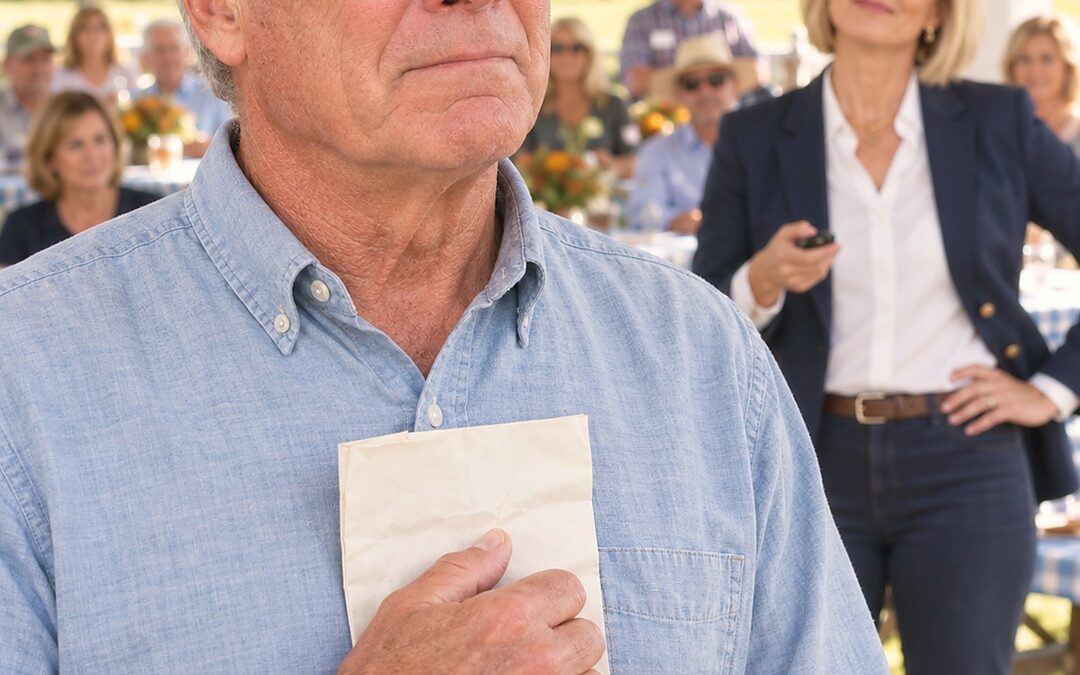
Celeste Vaughn slapped a $4,800 invoice on the picnic table in front of sixty of my neighbors and said, "Some of us paid six hundred thousand dollars to live next to your junk, Hank. Pay it by Friday or the lien goes on that shack." The $4,800 was her bill for tearing out the cedar fence my father built in 1958, which her crew did while I was in Knoxville for my sixty-eighth birthday. Then they ran their new line twenty-two feet onto my farm, around the pecan tree he planted the week I was born. She said it standing under the pavilion, on four acres of grass I have paid the property taxes on every year since 2001.
Brent Kowalski said, "Finally."
That got a laugh. Three or four grown men, and a teenage boy by the drink cooler who laughed because they did and then looked around to see if he'd done it right.
"Who told you where the line was?" I said.
"The HOA did. Read your mail."
"I read my mail."
"Then read it slower." She tapped the invoice with the little black slide clicker she carries to every board meeting like it's a gavel. "Removal, disposal, encroachment fine. It's itemized. We even hauled your trash off for you."
"That trash was my daddy's fence."
"About time somebody cleaned that place up," a man in a Titans shirt called from the barbecue line, and that got a bigger laugh than the first one.
Rachel Marsh set down her paper plate. "Celeste, that fence was there when we bought. It was there when everybody bought."
"The association corrected an encroachment."
"So the old one was in the wrong place?"
"That's what encroachment means, Rachel." Celeste didn't even look at her when she said it. She was looking at me, and she leaned in over the invoice so the people at the back could hear the next part too.
"I run this neighborhood, Hank. You just live next to it."
Brent laughed with a mouthful of pulled pork and had to cough into his fist.
Rachel's girl, Lily, was standing at her mother's hip holding a hot dog by the very end of the bun with two fingers. She was nine. She was the only one at that end of the table not laughing, and she kept looking from Celeste to me like she was waiting for somebody to tell her which one of us was in trouble.
I could have said plenty. But I hadn't brought paper, and I'd only been home an hour.
"Friday, Hank," she said, and pushed the invoice an inch toward me with one fingernail. Then she turned around to the rest of them. "And if anybody wants a souvenir, his daddy's fence is in the dumpster behind the pavilion. Help yourselves."
The Titans shirt said he could use some kindling. Somebody's wife slapped his arm, but she was laughing when she did it.
I folded the invoice in thirds and put it in my shirt pocket behind my reading glasses.
Monday, I thought. With paper.
I left before they served the peach cobbler.
*
The new fence ran behind Rachel's yard straight as a chalk line for about four hundred feet. White vinyl, six feet high, every post sunk in fresh concrete with the bags still lying in the grass. Somebody had run a skid steer across my pasture while the ground was soft, and the ruts were deep enough to hold water till Christmas.
Daddy's fence had been cedar posts and woven wire, with a gate at the north end that hung low and drug in the mud every spring. I'd patched the wire in April. I paced it off from the first empty post hole to the vinyl anyway, heel to toe, and came up with twenty-two and some. I'd check it with a tape later.
They had fenced around the pecan.
Daddy planted it the week I was born, October of 1958. Mama said he carried the sapling home from the nursery wrapped in wet newspaper because the man told him the roots would dry out, and he watered it the first summer out of the same galvanized bucket she used for diapers. It grew broad and crooked. One limb hangs low enough that I've been ducking it on the mower for fifty years.
Somebody had strapped a board to the trunk and zip-tied a green plastic sign to the board.
HARPETH MEADOWS COMMON AREA — PRIVATE.
There were a few pecans in the grass, still in their green husks. June used to gather them in a Folgers can, spread them on newspaper on the mudroom floor to dry, and tell Daddy the squirrels had to eat too. June died in March of 2022. Lung cancer, sixty-four. The newspaper's still down on that mudroom floor. I keep meaning to pick it up.
A pickup slowed along Pecan Hollow Lane behind me. The Titans shirt, behind the wheel. He took a good look at the fence and kept going.
There was a construction dumpster behind the pavilion, rust on the corners, one door that wouldn't latch. The square top of a cedar post was sticking out of it.
I climbed up on the side rail. They'd thrown Daddy's fence in with the vinyl packaging and the empty Quikrete bags, the wire rolled up in a rough bundle, half the posts split where the machine yanked them. I pulled the square one free of a coil of wire and turned it over.
E.O. 1958.
He cut those letters with his Case knife. The E is deeper than the O because he slipped on the first stroke and had to go back over it.
It had been the corner post nearest the tree. There was a chunk of concrete still hanging off the bottom where the skid steer had broken it out.
I tried to lift it over the wall and got it about halfway before my left knee told me what it thought of that. I set it down and climbed off and backed the F-250 up to the dumpster and dropped the tailgate. Second try I got the heavy end up on the tailgate and walked the rest of it in, scraping the bed liner the whole way, carved side up.
I stood there a minute getting my wind back.
"Mr. Hank?"
Lily Marsh, a few steps off, holding one of my work gloves.
"You dropped this."
"Thank you, ma'am."
She handed it up and then looked in the truck bed. "What's E.O.?"
"My daddy. Earl Odell."
"Is he dead?"
"A good while now."
She thought about that. "My grandpa writes his name on all his screwdrivers. Mom says it's so nobody steals them."
"Your grandpa's not wrong."
She looked over at the white fence. "Mom says they weren't supposed to do that."
"Your mom's a smart woman."
Rachel called her from the pavilion and she ran off, one sneaker squeaking every other step.
I put the glove on the passenger seat. Daddy was twenty-nine when he set that post. I was three days old. In 2000, when we surveyed the subdivision, he walked that whole line beside me with a brush hook he swore was better than anything with a motor, stopping every fifty feet or so to tell me which post was going soft. He never once asked me to move the fence.
I sat in the truck till the windshield fogged up at the corners. Then I turned the key and drove home, and the post knocked against the bed every time I hit a rut.
*
At five-thirty I got the old metal detector out of the barn.
It lives in a cabinet next to the survey gear I never got around to selling, under a yellow hard hat I wore for twenty years. Odell Land Surveying, 1985 to 2004, then fifteen years as Williamson County surveyor until I retired in 2019. Most of that time somebody was paying me to find things other people had buried, lost, moved, or swore up and down never existed.
The detector takes two nine-volts and one was dead. I stole one out of the smoke alarm in the barn office, then stood on a bucket and put a fresh one back in the alarm, because June would have.
Dolly followed me halfway across the pasture. Dolly is a goat. She goes through your pockets and then complains about what she finds.
"Go on back," I told her. She went as far as the water trough and watched me from there.
I knew where the pins should be. The south end, near the pecan, was behind their vinyl now, but the crew hadn't carried the fence all the way down to the creek, so I could reach around the end panel and work up the strip from below.
The detector hollered at a horseshoe nail. Then a scrap of wire. Ten feet past that, by a flat rock, it hollered louder, and I scraped back three inches of dirt and grass with the short shovel and found a red plastic cap.
ODELL RLS 1647.
My license number. I set that pin the summer of 2000. Daddy had argued with me about the spring in the lower pasture, so I drew a little bend in the boundary to follow it, and he made me measure twice to be sure the pecan stayed on our side.
I hooked the tape on the pin and ran it to the nearest vinyl post. Twenty-two feet and a little change.
I took a picture with the tape stretched out, and then got down on my bad knee and took another one low, so the red cap and the white fence were both in the frame. The second one was better. I wrote the measurement in the field book I still carry in my back pocket, and the date, and the time off my watch.
Headlights came down Pecan Hollow Lane and stopped on the other side of the vinyl. A white Lexus. The window slid down and Celeste held her phone out of it and took my picture, flash and all, an old man on one knee in the dirt with a short shovel.
"That's association property you're digging in, Hank. I'll put the damage on Friday's bill."
"There's a survey pin under here with my name on it."
"Then I'll put that on the bill too." The window went back up before I could answer. She sat there another half a minute with the engine running, typing something on her phone, and then the Lexus rolled on down to the cul-de-sac and turned around and came back past me slower.
A back door opened at Rachel's house. She came out on her deck in gray sweatpants with a coffee mug, the night-shift kind of tired, where you're up when everybody else is winding down.
"Mr. Odell? Everything okay?"
"Found my survey pin."
"Where?"
"Twenty-two feet on the wrong side of their fence."
She came down the steps and stopped short of the vinyl like it might be wired. "Celeste told everybody the contractor checked the line."
"I'd like to see what he checked."
"I was home Thursday. Got off shift at seven, and the trucks came around nine. Orange shirts. Ridgeline, I think it said on them. Four guys and that skid steer."
I wrote it down. "Thank you, Rachel."
"Lily asked me tonight why everybody was being so mean to the goat man." She said it and then looked like she wished she hadn't.
"Tell her the goats don't take it personal."
She went back in. I covered the pin loose, with the red cap showing, and walked up to the barn in the last of the light with Dolly checking my pockets the whole way.
*
The kitchen clock said 8:17 when I spread out the tax bill.
The table is the oak one June and I bought secondhand in 1986. One leg's short, so there's a folded square of cardboard under it. June used to change that cardboard whenever it got dirty. Mine's been down there about two years.
The bill said Common Area C, Harpeth Meadows Subdivision, 4.21 acres, and $1,912, paid. June paid it every year from 2001 through 2021. I've paid it since 2022. The county mails it to Bethesda Road because that's where the owner lives.
When Daddy sold the hundred and eighty acres in 2000, he kept the four acres by the pond and let the families use it by easement, recorded at the courthouse. He read that easement twice at the clerk's counter before he signed it, moving his lips, and then asked the girl for a copy to take home.
I opened the laptop.
The county planning website had been redone since I retired. It made me reset a password I didn't remember setting, and the reset email took four minutes to show up, which was long enough to make coffee.
There was an application under Harpeth Meadows. Phase 4. Applicant, Crestline Homes. One hundred forty townhomes.
In August a Crestline man had sat on my porch and offered me $6.2 million for the farm. I told him no. They sent an email. I told the email no.
I clicked the site plan. The access road ran along the open grass beside the pavilion and up my east line, fifty feet wide. I went to get a ruler and then remembered the plan had dimensions printed on it, like I'd have put on it myself. Twenty-eight feet of that road came out of the Commons. The other twenty-two came out of my pasture, right where the new fence had gone in Thursday morning.
So that was the twenty-two feet.
Under the owner of the access land it said: Harpeth Meadows HOA (Celeste Vaughn, President).
Hearing date, Thursday, November 12. I checked the calendar on the refrigerator. November 12 was already circled for Dolly's checkup with the vet, so I wrote PLANNING above it in pencil.
Then I opened the ownership exhibit.
A green blob marked Common Area C, and under the green, a subdivision plat. Mine. I'd know it anywhere. The creek in a narrow dashed line, the spring marked at the south end, the lot numbers in the lettering a man named Franklin Price taught me before computers made half of us lazy.
The bottom right corner was gone. The border just stopped at a ragged white edge where somebody's paper copy had torn, and with it went my seal, my signature, and Note 7, the four lines Daddy had made me put on that sheet so nobody could ever say the Commons was anything but his.
I went to the website of the management company, Pinnacle Community Management, who'd been running Harpeth Meadows since 2008, the year the developer went broke. Every map they had posted was the same scan. Commons in green. Corner gone.
I saved the file and printed the pages with the road on them. The printer jammed on the third sheet. I pulled it out, flattened the corner with my thumb, and ran it again.
At 9:06 I called Marian Cole. She's been our real-estate lawyer since the eighties, sixty-three now, office on Main Street in Franklin. She and June used to get going about the county commission and my job was to keep the coffee coming. It went to voicemail.
"Marian, it's Hank Odell. Sorry to call on a Saturday night. Somebody moved my east fence twenty-two feet while I was in Knoxville, and there's a planning application out there that says the HOA owns the access land. There's something wrong with the plat they attached. Call me Monday. I've got pictures."
I gave her my number, though she's had it thirty years.
Then I tore a sheet off the pad by the phone and wrote down what Celeste said at the picnic, word for word, and under it every name I could put to a face. Brent Kowalski. Rachel Marsh. Doug Pettis, the treasurer, who'd spent the whole thing studying the grass between his shoes. Then the rest. I know most of those people by their dogs and their trucks and whose packages end up in my mailbox. Sixty people had been standing under that pavilion. I could name twenty-three without guessing, so I stopped at twenty-three.
Out the window the porch light caught the bed of the Ford, and Daddy's post lying crossways in it. I went out and carried it into the barn and laid it across two sawhorses, carved side up, and switched on the work light over it. Then I stood in the barn door a while with my hand on the switch. The deep E threw a little shadow under the bulb. I left the light burning and the door open a crack, so I could see it from the kitchen window.
Part 2
Marian Cole put my $4,800 invoice down next to her coffee and said, "She called your house a shack. Out loud. In front of people."
"Sixty, give or take."
"And you said what?"
"Asked her who told her where the line was."
She looked at me over her glasses. "That's all?"
"I went over there for barbecue, Marian."
Monday morning, October 5, and her office over the insurance agency on Main Street smelled like a coffeepot somebody had left on since Friday. I'd brought a manila folder with the invoice, my pictures of the pin, and the pages I'd printed off the county site. She had the pictures spread across her blotter before I got my jacket off.
"Twenty-two feet," she said. "You're sure."
"I set that pin myself in 2000."
"Henry Odell. You ever get tired of being right about dirt?"
"All the time. It doesn't help."
She tapped the exhibit, the green blob with the corner torn off. "Walk me through it. Plain."
"Daddy stopped at the pecan the morning we walked that line and said, 'That stays with us, Henry.' Then he looked down at the pond. 'Put it in writing.' So I put Note 7 on the plat, and he signed the easement that fall."
Marian had helped June sort the estate papers after Daddy died in 2009. She knew most of this already. She let me say it anyway.
"I pulled the recorded plat at the Register of Deeds on my way in," she said, and turned her screen around. "The county scanned the old books off microfilm, and their copy of your sheet is gray in that bottom corner. You can see there's a Note 7. You can't read a word of it. A judge isn't going to take your memory and a gray smudge over a picture with a green blob on it."
"So it's the mylar."
"It's the mylar, with the raised seal. Who tore that corner off Pinnacle's copy, Hank?"
"My guess is a box in Brookfield's storage room when they went broke in 2008. Nobody's ever said. I'd like to know too."
"Where's your original?"
"In the house somewhere. June put the originals someplace safe."
"How safe?"
"That's what worries me."
She almost laughed and then didn't. She'd sat next to me at the funeral home when the director asked whether I wanted the music changed. June had picked it out herself and written it on the back of an electric bill, and I'd left the bill on the counter that morning. Marian had brought it in her purse.
"Does Celeste know where your fence belongs?" she said.
"Her crew went in the one week I was out of town."
"That's not an answer."
"She knows. That's why she's billing me for it."
Marian nodded slowly. "Then don't tell her about Common Area C."
"Why not?"
"If you tell her today, she'll go find a better lie by Friday."
She pulled a legal pad over. "One. You report that fence to the sheriff today, as property destroyed without permission, not some boundary squabble. Two. We find the mylar. Not another copy, Hank. The original sheet, with your seal and Note 7 on it. Three, we let her say what she thinks she owns at a meeting, in front of her own residents, with somebody writing it down."
"She's already said plenty."
"She's told them you're a nuisance. I want her to tell them she owns the land." She slid the invoice back to me. "Don't pay that. Don't sign anything she brings you. And find the mylar."
*
Deputy Ray Tolliver took my report at the Sheriff's Office that afternoon. He was about fifty, heavy through the middle, with reading glasses he kept pushing up onto his head and forgetting about.
"You give anybody permission to take that fence down?"
"I was in Knoxville eating birthday pancakes."
He looked at the picture of the red cap with the tape stretched out to the vinyl. "You're a surveyor."
"Retired. Forty years licensed."
"I figured you weren't eyeballing it." He picked up the invoice and read it with his glasses actually on his nose. "They charged you for tearing down your own fence."
"That part I understood right off."
He flipped to the picture of the carved post I'd taken in the barn. "Your father's?"
"He set it in 1958. The year I was born."
Ray wrote 1958 on his pad and underlined it twice.
"I'll call Ridgeline and find out who signed for the job."
"I'd appreciate it if you'd ask to see the work order."
He wrote that down and gave me an incident number on the back of his card, and told me not to touch their fence or the survey markers. I told him those markers had sat there twenty-six years without any help from me.
*
By Wednesday, October 7, forty-seven people had commented on pictures of my place.
Rachel came to the vinyl at ten, right after I'd fed the goats, still in her scrubs with her phone in her hand. "Mr. Odell, are you on Facebook?"
"Technically."
"You need to look at the neighborhood group."
She held the phone up over the top rail so I could see it. Celeste had posted three pictures in Harpeth Meadows Neighbors. My tractor by the barn. The shed with the paint coming off it. Dolly standing on a pallet by the feed bin, looking about like Dolly always looks. Over them she'd written, "This is what our property values sit next to."
One man wanted to know if the county had an ordinance on junk machinery. Somebody called the goats a health hazard. Brent Kowalski wrote, "Thank you, Celeste. Leadership at last." The Titans shirt wrote, "Maybe it finally gets cleaned up."
"The tractor runs," I told Rachel.
"I know it does. Lily saw it on my phone. She wanted to know why anybody would call Dolly a health hazard."
"Dolly's had every shot the vet sells. I've got the paper on it."
"I told her to stay out of the comments." She was quiet a second, scrolling. "Is there anything I can do?"
"Keep those pictures you took Thursday morning. The trucks."
Down near the bottom Ann Whitford, who lives by the pond, had written, "I have walked past Mr. Odell's property for ten years. His animals have never been a problem." Somebody told her she was missing the point. Ann wrote back, "I believe I understand the point."
At eleven-thirty Beth called from Knoxville. She's forty-one, does taxes for half of Knox County, and she can find a bad decision in a spreadsheet from across the room.
"Dad. A girl I went to high school with lives in that neighborhood. She just sent me pictures of your shed."
"Does she want to paint it?"
"Dad."
"Celeste Vaughn. HOA president."
"It says they're putting a lien on the house."
"They're threatening to."
"Over what?"
I told her about the fence. She didn't interrupt, which meant she was doing arithmetic.
"Crestline offered you six-point-two in August, Dad. Take it."
"We talked about that."
"You could buy something in Franklin with a dishwasher and back steps that don't move when you stand on them."
"I fixed the steps."
"You put another board on them."
"A good board."
"You're out there by yourself, you're sixty-eight…"
"Since Thursday."
"This isn't funny." Somebody asked her something in the background and she covered the phone and came back. "Mom's gone. I can't drive four hours every time a woman with a clipboard comes after you."
"Nobody's asked you to."
"Just think about it."
"I did. In August."
She said she'd call Sunday. After we hung up I went out and tightened the screws on the bottom hinge of the barn door, which had been loose since about Easter.
*
On Friday, October 9, the lien showed up in the county records. Five thousand five hundred and fifty dollars, the $4,800 plus $750 for the HOA's lawyer.
"They're claiming authority under the subdivision restrictions," Marian said on the phone. "Trouble is, your farm isn't a subdivision lot. Recording a claim doesn't mean you had the right to record it. I'm challenging it. You find that mylar."
"I've been through the barn and the drafting cabinet."
"Look where June kept things."
"June had a system."
"I know. It was better than yours. And Hank, don't answer that Facebook post. Let them keep talking."
At six-thirty that evening a white Lexus pulled up to my gate. I was putting chicken wire around a young pear tree, which has no chickens anywhere near it. Dolly ate half the bark off it last spring.
Celeste got out in a cream jacket, carrying a leather folder. A man about her age got out the passenger side and stayed there, leaning on the car, looking out over my pasture. I knew him from August. Grant Whitley, Crestline's vice president for land, the one who'd sat on my porch.
"Evening, Hank."
"Celeste."
"Can we talk privately?"
"We're about as private as it gets out here."
She came up to the gate. "I understand you've involved an attorney. And the sheriff."
"Pulling up four hundred feet of a man's fence usually gets his attention."
"That fence was an encroachment."
"On whose land?"
"We've been over that."
"Then it shouldn't take long to go over it again."
She looked past me at the barn. "I came out here to offer you a reasonable way out of this."
"Did you bring my cedar posts back?"
She let a breath out through her nose. A pickup came along Bethesda Road and slowed, and the driver lifted two fingers off the wheel at me. I lifted two back. Celeste waited for him to pass.
"The association votes on the access sale October twenty-seventh. It's an opportunity for the whole neighborhood."
"Does the whole neighborhood know you're building their road on twenty-two feet of my pasture?"
"The roadway serves an approved planning purpose."
"That's not what I asked."
"Mr. Whitley," I called over her shoulder, "you want to come up here and hear this?"
Grant looked up from his phone. "I'm just here with Celeste."
She opened the folder and took out a sheet with Crestline's name across the top, and laid it on the flat board of my gate, turned so I could read it. There was a signature line at the bottom. I thought about Daddy's post up there on the sawhorses with the light on over it.
"Crestline already has you down as a seller, Hank," she said, low, so it wouldn't carry to the car. "Their legal department just wants an original with your real signature on it before the vote. Ink. Not a copy. It's a formality."
"Down as a seller since when?"
She didn't answer that. Celeste held out a pen and said, "Crestline's at five-point-four for the whole farm, Hank. After the vote on the twenty-seventh, the HOA forecloses on the lien, and the number goes down."
Part 3
"I'm not selling to you, Celeste. Or through you."
Celeste kept the pen stuck out over my gate. "Hank, I'm offering you five-point-four million dollars."
"Crestline offered me six-point-two in August. That's eight hundred thousand dollars of difference since I said no, and the only thing that's changed out here is my fence."
"Conditions change."
"Somebody changed them."
She put the pen back in her folder and looked over at Grant, who was still leaning on the Lexus reading something on his phone like it was the sports page. "Grant, would you give us a minute?"
"I'm fine here," he said, and didn't look up.
She turned back to me. "After the twenty-seventh your property gets a whole lot less attractive. I've tried to be reasonable with you."
"Good night, Celeste."
I was halfway to the house when she said, "You'll regret making this personal."
I stopped and checked the chain on the gate, since I was there anyway. "Your crew pulled up my daddy's fence while I was eating birthday cake. I'd say it got personal Thursday."
She shut her car door hard enough that Dolly lifted her head out of the feed trough. Grant got in the other side. He hadn't said ten words the whole time, and I noticed he never once looked at the paper she'd put on my gate.
*
Rachel Marsh came up my driveway Monday, October 12, with one sheet of paper folded in half and the crease of a surgical mask still pressed across the bridge of her nose. She didn't say hello. She unfolded it on the hood of my truck and held it flat with both hands against the wind.
Ridgeline Fence Co. letterhead. A work schedule revised September 28, a dozen jobs down Pecan Hollow Lane, and near the bottom, in bold:
Remove pecan, clear access corridor — Mon Nov 2.
I took my glasses off and put them back on. It still said it.
"I asked Pinnacle for the HOA records as a homeowner," she said. "Ninety-five dollars a month buys me that much. This was stapled to the minutes."
Typed across the top of the sheet, above the jobs: Per HOA Resolution 2026-14, closed session 9/22.
"What's 2026-14?"
"They voted to take your strip. Closed door, three to two. Celeste, Doug, Brent. Ann and Luis voted no." She let go of one corner and the paper flapped. "Mr. Odell, Lily picks up pecans under that tree every fall. She's got a shoebox of them in her closet from last year."
"That's three weeks," I said.
"Can they do that?"
"Not legally. I'm not real sure that's ever stopped anybody with a chainsaw."
I took a picture of the sheet with my phone and sent it to Marian. Before Rachel had the sheet folded back up, my phone rang and Marian said, without hello, "I'm putting Ridgeline on formal notice. Don't call them yourself. Make three copies of that sheet, and thank that girl for me."
Rachel was looking off toward the east pasture, where the pecan stood up over the white vinyl like it was waiting on somebody.
"Lily keeps asking me if the tree's safe," she said. "She's nine. She thinks grown-ups know what they're doing."
I didn't have anything good to say to that, so I didn't say anything, and after a minute she folded her sheet back up and went home to sleep.
*
The lawyer's letter came Tuesday afternoon in a big envelope from a Nashville firm I'd heard of and never once needed. My complaint to the sheriff, it said, was a pattern of harassment against Celeste Vaughn and the Harpeth Meadows Homeowners Association. I was to withdraw it, stop defaming the board, and quit interfering with contractors performing authorized community improvements, or face civil proceedings.
I took it out to the truck with me. The driver's window on the F-250 had been sticking again, and I was spraying WD-40 down in the channel when I heard Celeste's voice over at the brick mailbox stands on Pecan Hollow Lane. She had two women cornered there with their mail. One of them was Mrs. Gentry, who walks a fat dachshund past my fence every morning at seven and has never in her life said a word to me about my goats.
"He's a confused old man. I'm trying to help him."
I've been called worse by better people, most of them county commissioners. None of them ever said it to my neighbors with a hand resting on their mailbox.
Mrs. Gentry asked whether I had any family close by.
"A daughter in Knoxville," Celeste said. "She doesn't seem very involved."
I set the can down on the running board. Celeste saw me then, and she didn't look the least bit sorry about it.
"Afternoon, Hank. I see you got our attorney's letter."
"I'm going to give it to mine."
"This is exactly what I deal with," she said to the women, smiling. "Every reasonable offer, and he escalates."
"Did you sign the work order for Ridgeline yourself, Celeste?"
The smile didn't move. "That's an administrative matter."
"All right."
"We're following the law, Hank. I'd appreciate it if you'd try it."
Mrs. Gentry shifted her mail from one arm to the other and studied the sidewalk. I went back to the truck. The window stuck halfway, and I got it up on the third try.
*
Wednesday, October 14, about twenty to three, a county cruiser came down Bethesda Road and stopped in the grass by my east line. I was out in the pasture with my hands in a busted water line.
Deputy Tolliver got out with a sheet of paper in a plastic sleeve and walked the vinyl down to me, slow, looking at the concrete around every post like he was counting bags.
"Ridgeline's work order, Mr. Odell." He held it up. "Signed by Celeste Vaughn, for the HOA. It cites their September resolution and calls the job removal of an encroaching fence."
"They have a survey?"
"Not one they can find. Their foreman says he asked her twice whether she had one." He pushed his glasses up onto his head. "She told him, 'The HOA is the survey.'"
He didn't say anything else for a bit. He was looking up into the pecan, at the low limb I duck on the mower, and the green sign zip-tied to the board on the trunk.
"How old's that tree?"
"Sixty-eight."
"That's pretty exact."
"Daddy planted it the week I was born."
He wrote that down against the hood of his cruiser. Then he walked over and put two fingers on the zip tie, didn't cut it, and took a picture of it instead. He said the case was open and he'd want my lawyer's letter to Ridgeline when she sent it. After he drove off I turned the valve back on and the coupling sprayed me in the face, so I shut it off and started over.
*
Thursday, October 15, the special-meeting notice went out by email to all 212 homes, with paper copies in the mail and a line at the bottom saying only members in good standing could vote. Rachel forwarded it to me at 8:12 in the morning.
Tuesday, October 27, seven p.m., under the pavilion. Item one, approve the sale of the Phase 4 access easement to Crestline Homes for $1,200,000, plus five years of no HOA dues for every household. The picture with it showed the road running right up my east line and across the Commons, like the association could sell it by the yard.
I called Marian. "Five years without dues. That'll get votes."
"Of course it will. Read item two."
I scrolled down. "Well, I'll be."
"We have twelve days," she said. "Find the mylar."
I spent that afternoon in the office closet. Field books back to 1985. Warranty papers for equipment I sold in 2019. A box of June's Christmas ornaments that had somehow migrated in with the survey files, and on top of it the one with Beth's picture in it, six years old and missing both front teeth. I put that one back on top. No mylar.
About five-thirty somebody knocked at the kitchen door and it was Lily, by herself, holding a paper lunch sack with the top rolled down twice.
"These are from your tree," she said. "They fall in our yard now, since the new fence. Mom said I should bring them to you."
The sack had maybe two dozen pecans in it, still a little damp from the grass.
"Thank you, Lily."
"Mom says you used to draw maps."
"I did."
"Of our street?"
"Of your whole street. Your house was lot 131 before it was a house."
She thought about that like it was the most interesting thing she'd heard all week. Then Rachel hollered from the property line and Lily ran off before I could find her a cookie.
I found June's old Folgers can under the sink, the one she gathered pecans in, and poured Lily's in. They didn't come close to filling it. I set it on the counter anyway and walked down to the pavilion in the last of the light, because I wanted to see the notice where everybody else was going to see it. Somebody had taped a copy to the west post, facing the parking area, right over the spot where my father had carved his initials. That post went up in 2001. The contractor let Daddy cut them before they stood it, E.O., about shoulder high, and he took his time about it. I lifted the bottom of the paper and they were still there, and I let it back down, and read the line I'd come to read. Item two: "Authorize enforcement of the Odell lien."
Part 4
Somebody had spray-painted SELL across my mailbox in red letters that ran from the flag all the way around the back, where the paint had run down the post and dried in drips.
Saturday, October 17, a little after seven. I'd walked down for the Tennessean, and it was still in there, rolled up, with a little red overspray on the plastic sleeve. I took a picture and called Deputy Tolliver at home, which I'm not proud of.
"Don't clean it off," he said.
"I wasn't going to. I want people to drive past it."
At nine-thirty Rachel called. "Have you seen the petition?"
"What petition?"
"Brent's been going door to door since Thursday. It supports the Crestline sale and asks the board to take, I'm reading it, 'all necessary enforcement action against the adjacent Odell property.' One hundred twelve signatures."
"Out of two hundred twelve houses."
"Half of them think they signed to quit paying dues. They don't know it's got your name in it." She stopped. "Celeste's telling people you're going to cost every family about six thousand dollars in dues if you wreck the vote."
I looked out the kitchen window at the east pasture. "Well. That narrows it down to me."
"Lily wants to know if they're cutting the tree."
"I'm working on it."
"That's what I told her Thursday, Mr. Odell."
After she hung up I got the Ridgeline schedule out of my folder and counted on the calendar. Sixteen days. I had a recorded easement at the courthouse, an original survey somewhere in this house I couldn't put my hands on, and a lawyer. Ridgeline had a crew and a chainsaw. A chainsaw takes care of a sixty-eight-year-old tree in about fifteen minutes.
*
Beth's silver Honda came up the drive at eleven. She got out with an overnight bag, saw the mailbox, and said, "Oh, Dad."
"Morning, sweetheart."
"You called the police?"
"I did."
"Of course you did." She came in and opened the refrigerator, which is what June did when she was worried, looked in, shut it again. "There's a petition."
"I heard."
"A hundred and twelve people, Dad. They hate you."
"Not all of them."
"More than half."
"That leaves a hundred that didn't sign."
"Please don't do that. Don't make a little joke every time it gets bad."
I poured her a cup of coffee. She held it and didn't drink it, and then she pulled up Celeste's Facebook post on her phone and turned it around to me. Sixty-eight comments now. One woman thought I was letting the place go on purpose to scare Crestline into paying more.
"Have you read these?"
"Some."
"And you're just sitting here."
"Where would you like me to sit?"
She put the phone face down. Out in the lot Dolly was butting the pasture gate till the latch rattled.
"That tree," Beth said. "They're really going to cut Grandpa's tree?"
"November second."
She went and stood at the window a long time. "I don't see how you stop them."
"I don't either. Yet."
*
After supper she found me in June's sewing room going through the closet for the third time.
June's room is at the north end of the house, two windows on the garden. I haven't changed it much. The Singer is still under the blue cover she sewed for it, and the ironing board's folded up behind the door where she left it.
"What are you looking for?"
"A map tube. About so long. Cardboard, with a plastic cap."
"Where have you looked?"
"Barn. Office. Attic. The filing cabinets twice."
Beth reached past me into the closet and started shoving June's winter coats down the rod. "Did you look behind these?"
I hadn't. I'd walked past that long navy coat a dozen times since 2022 and never once moved it. Standing up behind it, against the back wall, was a cardboard tube with my own block lettering down the side: HARPETH MEADOWS — FINAL PLAT. There was a yellow sticky note on the cap in June's handwriting.
"Hank — your daddy said keep this where you can't lose it. — J."
Beth read it over my shoulder. "She knew you'd lose it."
"She knew I'd look in the wrong place."
"That's the same thing, Dad."
I carried it to June's cutting table and slid the mylar out and rolled it flat under her pattern weights. It was all there. The lots. The creek. The little bend around the spring. And the bottom right corner, whole, with my seal pressed into the sheet so it caught the lamp when I tipped it, and my old signature, Henry E. Odell, RLS 1647. Under the title block, in my lettering, Note 7:
"Common Area C is not conveyed to the Association. Title remains with Earl W. Odell and his heirs. Use by residents is by recorded easement, Book 2112, Page 340."
"Wait," Beth said. "The HOA doesn't own the picnic place?"
"Your grandpa kept it. It's mine now. They've got the right to use it, is all."
"Does Celeste know that?"
"I don't believe she's got the faintest idea."
Beth went back to the closet and opened the low wooden drawer under the wrapping paper. Envelopes, one for every year, in June's handwriting. She took out the first one. "What's Common C?"
"Taxes."
2001 through 2021. A county receipt in each one and June's note across the front, the same three words most years. Common C — paid. Beth sat down on the step stool with them in her lap and started going through them, slower as she went.
The 2021 envelope was the last one. June's writing was shakier on that one. She'd been in treatment that fall and couldn't sit up at the table long. Across the bottom of the receipt she'd written:
"last one I'll do, you do the rest"
There was a ring from a coffee cup next to the date. I remember her setting the cup down on it and saying a word she didn't usually say, and then drying it with the hair dryer before she'd file it.
"Mom paid their taxes for twenty years," Beth said.
"Twenty-one. Since 2022 I've paid it myself."
She pressed the corner of the receipt flat with her thumb. "I called her that November. She told me she'd been doing paperwork. I thought she meant medical bills." She tried to slide it back into the envelope, but the corner caught, and she handed it to me instead. Then she got her phone out. "I'm calling Mike. I'm telling him we're done talking about you selling."
I put 2021 back on top of the stack, squared it up, and capped the tube. Then I took the tube out on the porch with me and sat there with it across my knees. Dolly lay down by the bottom step. Two of the young goats were nosing through the leaves along the fence. I stayed till it got dark enough I had to turn the porch light on to find the door.
*
Beth drove home Sunday. On Tuesday, October 20, Marian sent Ridgeline a letter by certified mail and email both, and I drove into Franklin to sign an affidavit about where the old line ran. She read me the one line she cared about: "Any entry upon Mr. Odell's property for the purpose of removing or damaging the pecan tree will constitute criminal trespass."
Before I had my coat back on, her assistant brought in Ridgeline's answer. They'd pause the November 2 work "pending the association vote."
"Pending the vote," I said. "So if she wins next Tuesday night, they come back Monday with the saw."
"If the vote passes, I'll be at the courthouse the next morning." She tapped the tube I'd brought in under my arm. "Keep that in the house. Don't tell anybody from that association you have it. Not even Ann."
*
Wednesday, October 21, at nine o'clock at night, somebody knocked on my kitchen door.
It was Doug Pettis, the HOA treasurer, on my back steps with a brown envelope under his arm. Sixty years old, ran a parts warehouse till he retired, the kind of man who'd rather talk about freight schedules than people.
"Evening, Hank. Could I come in?"
I stepped back. He hung his jacket on a chair and didn't sit down in it.
"Carol sent me."
"How's Carol?"
"Mad." He rubbed his forehead. "Celeste brought the lien papers to our house for me to sign as treasurer. I left them on the kitchen table. Carol worked twenty-two years at the Register of Deeds. Marriage licenses and car titles, not land, but she knows the Odell name. She read it and looked at me and said, 'Did you even pull the plat?'"
"What'd you tell her?"
"That Pinnacle had a copy." He sat down then. "She asked if I'd looked at the recorded one. I hadn't. Ann and Luis asked us to back in September, before the resolution. Celeste said we had legal advice. I voted with her anyway."
He opened the envelope and took out a few stapled pages. "She emailed me this for budgeting. Said don't send it to the board, it was just so I'd know the costs."
CONSULTING AGREEMENT. Crestline Homes and Vaughn Land Group. Vaughn Land Group was Celeste's own company in Brentwood. The fee was $410,000. I turned to the payment terms. One condition. The money was "payable upon HOA approval of the access easement sale."
"That's not the association's money," Doug said. "That goes to her."
"That's what it says."
"Carol made me call Marian Cole before I drove over. Marian's going to read it in the morning. She wants Deputy Tolliver at the meeting Tuesday." He looked at the dark window over my sink. "I've sat next to that woman two years, Hank. I signed whatever she put in front of me."
"Then you know what you signed."
He swallowed and nodded, and put the pages back in the envelope, and for a minute he just sat there holding it in his lap.
Then he set it on my kitchen table and got up and put his jacket on. At the door he stopped with his hand on the knob.
"Brent counted heads at the mailboxes this afternoon. She's got the votes for Tuesday, Hank. Easy." He looked at the envelope, not at me. "And she told the two of us standing there she'd have your signature by Tuesday, one way or another."
Part 5
"You're not supposed to be here, Hank," Brent Kowalski said, and he put his hand flat on the sign-in sheet like I might try to write my name on it.
He had a card table set up at the edge of the pavilion with a clipboard, a can of pens, and a roll of HELLO MY NAME IS stickers nobody was using. Tuesday, October 27, seven o'clock, and the string lights were on over the same picnic table where Celeste had slapped down my $4,800 invoice twenty-four days before. About ninety people in folding chairs. More than came to the picnic.
"I saw the notice," I said. "Item two has my name on it."
He looked past me at Marian, who was carrying a long cardboard tube under her arm. "Is that your lawyer?"
"It is."
"Celeste won't like it."
"She can tell me herself."
A projector screen stood against the west post, right over Daddy's initials. On it, in big blue letters: PHASE 4 ACCESS — $1.2M FOR OUR COMMUNITY. Grant Whitley stood by the drink cooler in a quarter-zip with a Crestline logo on it. Deputy Tolliver stood at the very back in uniform with his hat in his hand. Rachel and Lily were in the second row. The board had the long table up front, Ann Whitford and Luis Ortega on one end, Doug Pettis by himself in the middle with a folded paper in front of him, and Celeste on her feet beside the projector in a navy jacket, clicker in her hand.
She saw me and smiled for the room.
"Mr. Odell isn't a member. He can listen from his side of the fence."
Brent laughed. A few others did too.
Rachel stood up. "Madam President, I move Mr. Odell gets three minutes. That road runs down his property line."
"I'll second it," Luis said.
Celeste turned all the way around to face me. "Three minutes? As the owner of what, the goats?"
That got the biggest laugh of the night. The Titans shirt laughed loudest, two rows back, next to Mrs. Gentry and her husband.
"There's a motion on the floor, Celeste," Ann said, without looking up from her folder. "Call it."
Celeste called it. Ann, Luis and Doug said aye. Brent said no. She pressed the clicker so hard the slide jumped two ahead and she had to go back. "Fine. Three minutes, Hank. After Mr. Whitley."
Grant gave it short. One million two hundred thousand dollars for the access easement, a fifty-foot road, one hundred forty townhomes. "The agreement is subject to title review within sixty days after the HOA vote."
"So nobody's checked the title yet," Marian said from beside me.
Grant looked at her. "Not yet."
Celeste clicked again, and there was my lien, $5,550, under PROPERTY ENFORCEMENT UPDATE. "This is what we're dealing with. Mr. Odell refuses to cure his violation."
"Three minutes," Ann said. "Now, Celeste."
*
I walked up to the picnic table. Marian handed me the tube, and I pulled the cap and rolled the mylar out across the boards. Ann got up and held down the far corner with both hands. Marian laid one more paper beside it, the recorded easement, Book 2112, Page 340. That was all. Two papers.
"Before I start," I said, "would everybody who was at the picnic on October third raise a hand?"
About forty hands went up. Brent got his halfway and then put it down when he saw Rachel watching him. The Titans shirt kept his up. So did Mrs. Gentry.
"Thank you. I wrote twenty-three of your names down that night. I'm not going to read them."
"Your three minutes are running," Celeste said.
"I'm Henry Odell. I was Williamson County surveyor fifteen years. In 2000 my father sold Brookfield the hundred and eighty acres you're sitting on, and I drew this plat. That's my license number down in the corner. RLS 1647."
"Our survey shows the strip as common property," Celeste said.
"Bring it here, then."
She looked at Brent. Brent brought a folded printout from his folder and laid it next to mine. The green blob. The torn corner.
"See?" Celeste said. "Green is ours."
I put my finger on the bottom right of her copy. "Where's the rest of it?"
Brent bent down and looked. "The rest of what?"
"My seal goes there. My signature. And Note 7." I moved my finger over to the mylar, where the corner was whole and the seal stood up off the sheet in the lights. Then I read it the same way I wrote it.
"Common Area C is not conveyed to the Association. Title remains with Earl W. Odell and his heirs. Use by residents is by recorded easement, Book 2112, Page 340."
Mrs. Gentry stood up. "Does that mean the picnic ground is his?"
"Yes, ma'am."
Celeste laughed, one hard note. "That is absurd."
Marian held up the easement and then handed a stack of copies to Rachel, who started passing them down the rows. "This gives every household in Harpeth Meadows the right to use the Commons," Marian said. "It doesn't give the association the land."
"My father kept title," I said. "I inherited it in 2009. You've all got a recorded right to use it. Nobody here has the right to sell it."
The Titans shirt was standing now. "You're telling me we don't own this place?"
"The association never did."
He looked down at the grass under his chair.
Mrs. Gentry had walked up to the end of the board table, where Celeste had left a stack of my invoices for the enforcement item, and picked one up. She held it out at arm's length to read it. "Celeste. You billed him for taking down his own fence?" Celeste reached for it. Mrs. Gentry kept it. "You stood at my mailbox and told me he was a confused old man."
I took the invoice out of Mrs. Gentry's hand, folded it in thirds the way I'd folded the first one, and laid it on the mylar in front of Celeste, right on top of Note 7.
"Some of you paid six hundred thousand dollars to live next to my junk. I've paid the taxes on the grass under your picnic table since 2001. The neighbors are welcome, Celeste. They always were."
Her thumb stopped on the clicker. She took a step back from the table, then another, off the edge of the concrete slab, and her heel went down into the wet grass, my grass, about an inch. She looked down at it and didn't move her foot.
Brent sat down.
Up front Lily had climbed up on her chair to see the map, and for once Rachel didn't tell her to get down.
Grant had come over from the cooler. "May I?" He opened his phone to the application file and held it next to the mylar, then next to Brent's printout, and looked at the three of them for a while. "Celeste, the ownership exhibit you certified to us is this scan." He tapped the torn corner. "This is the original."
"It's the same survey."
"It's missing the part that says who owns it."
She put her hand on his sleeve. "Grant, we can talk about this privately."
He stepped back out of reach. "I'd rather hear the rest."
*
Doug Pettis pushed his chair back. The legs screeched on the concrete and half the pavilion turned around.
"I need to say something."
"Doug, we're in the middle of an agenda."
"I know where we are." He stood up with the folded paper. His shirt collar was dark with sweat. He looked at me first.
"I signed your lien, Hank. Celeste said the strip was ours. I never pulled the plat."
Carol was in the third row with her purse in her lap. She didn't nod. She just watched him till he kept going.
"There's a consulting contract. Celeste emailed it to me for budgeting and told me not to share it with the board. Crestline Homes and Vaughn Land Group."
"Who's Vaughn Land Group?" somebody called.
"Her company." Doug unfolded the paper. "Four hundred and ten thousand dollars. One condition. 'Payable upon HOA approval of the access easement sale.'"
Rachel said it out loud, not really to anybody. "If we vote yes, she gets four hundred and ten thousand dollars."
"That is confidential," Celeste said.
Brent was staring at her. "You told me it was a development fee. You never said four hundred thousand."
Grant didn't argue the contract. He made one call, walked a few steps off into the dark past the lights, and came back. "Crestline Homes is withdrawing its offer to the association. The access transaction is suspended as of tonight. Celeste, you signed the ownership certification. Our legal department will contact you. Please don't contact anyone at Crestline before then."
"You can't just take a million dollars away from us!" Brent said.
"We can't buy land from people who don't own it."
Ann had the bylaws open. "I move to suspend Celeste Vaughn as president, effective now, pending an investigation. Conflict of interest. The president doesn't vote on her own suspension."
"Second," Luis said.
Ann called the roll herself. Doug, yes. Luis, yes. Brent, no. "And I vote yes. Three to one. Celeste, you're suspended."
Celeste didn't move. Ann got up, walked down the table to the president's chair, picked up the little wooden nameplate that said CELESTE VAUGHN, PRESIDENT, and set it face down beside her own folder. Then she pulled the chair out and held it there.
After a while Celeste came and took her jacket off the back of it.
Deputy Tolliver had walked up the side aisle without anybody noticing. "Mrs. Vaughn. Who signed the Ridgeline work order to take down Mr. Odell's cedar fence?"
"I did. For the HOA."
"Did he give permission?"
"We believed the strip was ours."
"Did you check the recorded plat before you signed it?"
She looked at Brent. Brent looked at the sign-in sheet. "I relied on our management company."
Ray wrote that down.
Grant's phone buzzed. He kept his eyes on the screen a long time before he spoke, and his voice had gone flatter. "Mr. Odell. Our land office has a letter of intent in your file, dated September fourteenth. You agreeing to sell. Celeste delivered it to them herself."
"I never sent Crestline anything."
"That's what I was afraid of. It went straight to land acquisition. They told me the owner wanted to deal through her, so I never asked to see the file. I never saw it till tonight." He looked at Celeste. "That letter is the reason we kept Phase 4 alive after you turned me down in August, Mr. Odell. It's why the application draws a fifty-foot road through twenty-two feet of your pasture. And it's why we signed a consulting agreement with Vaughn Land Group."
Celeste said, "Grant, that letter is a formality."
"Then you won't mind if he looks at it."
He opened the file the land office had sent him, the original, and turned the phone around and laid it on the mylar next to my hand. Then he put two fingers on the glass and spread them till the bottom of the page filled the screen.
It said I'd agreed to sell. It was signed Henry E. Odell, RLS 1647, in lettering that matched the corner of the mylar lying right there under his phone, hook for hook.
Part 6
"That's not my signature," I said. "I quit signing with the E in 2009."
"People don't change their signatures because they get old, Hank," Celeste said from the edge of the slab. She still hadn't moved her foot out of the grass.
"I did. The week we buried my father."
Deputy Tolliver had come up to the table. Grant looked from his phone to me. "Then how did it get on our letter?"
"Celeste, your house is 118 Pecan Hollow Lane."
"You know it is."
"I surveyed that lot for the closing in 2003. Every owner since has gotten a copy of that survey in their closing papers, and you bought in 2021. Bottom right corner, my old signature. Henry E. Odell, RLS 1647." I put my finger on Grant's screen, on the little hook at the bottom of the E where my pen always caught before it went on into Odell. "Same hook. Same gap before the license number. Same everything, because it's a copy."
Grant enlarged the original file on his phone till the signature was the size of a dollar bill. Ray leaned in over his shoulder.
"She copied it off a survey she never read."
"That is a ridiculous accusation," Celeste said.
Ray asked Grant to send that file to the Sheriff's Office, the original, right now, and stood there while he did it. Then he took two clear evidence sleeves out of his jacket and laid them on the picnic table. From his inside pocket he drew out the Ridgeline work order with Celeste's signature on it, folded once, and it went in the first sleeve. Brent's printout with the torn corner went in the second, the exhibit she'd certified to Crestline. He wrote on both sleeves with a marker and asked Grant and Brent, one at a time, where each paper had come from. Mrs. Gentry had moved up close enough to read Celeste's name through the plastic.
"Does this have to happen in front of everybody?" Celeste said.
"They're witnesses, ma'am." Ray sealed the second sleeve. "You'll need to come talk to our investigators. Tomorrow's fine."
She looked around for Brent. He was at the back folding chairs and stacking them on the cart, and he didn't turn around when she said his name.
I rolled up the mylar while Marian collected easement copies. Lily came over and picked up one of the pattern weights.
"Mr. Hank? Are they still going to cut your tree?"
"No, ma'am. Nobody's touching that tree."
She carried the weight back to Marian like it was made of glass. Out past the lights, Celeste's white Lexus sat by itself under the lamp in the parking area. I heard it unlock from a long way off.
*
On Thursday, November 19, Celeste made her first appearance in General Sessions Court in Franklin. Forgery, and vandalism over $1,000. I sat on the second row with Rachel and Doug. Doug had on a brown sport coat Carol bought him for retirement dinners, and the sleeves came up short of his wrists.
She had on a charcoal suit and flat shoes and nothing in her hands. I'd never once seen her without a clicker or a folder or a pen to hold out at somebody. The judge read the charges, made sure she had a lawyer, and set the next date. It took less time than my drive in from Bethesda Road. She never once looked over at our row. When she came down the aisle on her way out Doug pulled his feet in to let her by, and she went past him like he was a chair.
"That's it?" Rachel said.
"For today," Marian said. "She hasn't been convicted of anything. That takes a while."
Out on the courthouse steps the wind was moving the wet leaves around, and a maintenance man was trying to sweep them without sending them down into Main Street. Marian stopped at the railing with her folder.
"Crestline pulled Phase 4, and Grant Whitley's no longer with the company," she said. "They sent her contract to the Real Estate Commission themselves, and the Commission's opened an investigation." She handed me a paper with the county stamp on it. "Your lien. Released. And it says on its face you paid nothing."
Five thousand five hundred fifty dollars, discharged. I folded it once and put it in my shirt pocket, about where I'd put her invoice.
The courthouse door opened behind us. Celeste and her lawyer came out and stopped under the arch while he showed her something on his phone. She saw the papers in my hand, and she came down three steps instead of going around.
"Are you satisfied now, Hank?"
I didn't say anything. Marian did.
"Counsel, while you're here. Your client pays Mr. Odell's legal fees, personally. Your client and Ridgeline pay for the new fence, cedar, on the original line. The association pays nothing. Correct?"
The lawyer looked at Celeste before he answered. "My client has executed the civil settlement and provided the payment documents. The criminal matter is separate."
"Thank you," Marian said.
Celeste turned on Doug. "You could have handled this privately."
"Ann asked you to pull the plat in September." Doug's voice wasn't loud. "Carol asked me. I should've listened to one of them."
Her lawyer touched her elbow, and she shook him off and went down the rest of the steps. At the curb she set her bag on the hood of the Lexus and dug through it a long time for her keys.
Doug watched her pull out. "Carol says I'm helping with your fence Saturday."
"Does she."
"She already put my posthole digger in the truck."
"Coffee'll be on at seven."
I drove home the long way, up through Brentwood, which I had no business doing. The Vaughn Land Group sign was gone off the front of the little brick office on Franklin Road. There was a square of cleaner brick where it had hung and four screw holes, and somebody had left one of the plastic anchors in. Two doors down, the window at Brentwood Premier Realty had a row of agent pictures in it with a gap in the middle where one had been taken out.
*
By eight o'clock Saturday morning, November 21, there were fourteen people in my east pasture.
The vinyl was gone. Ridgeline had hauled it off Thursday and dropped a stack of new cedar posts by the barn, and their foreman, Travis, set his stakes off my iron pins while I stood over him. His crew kept the auger on the right side of the line this time. The owner had sent a letter saying sorry, in more words than he needed.
Carol brought sausage biscuits in a box from a place on Murfreesboro Road. Doug already had a shovel in his hand.
"Eat that before it gets cold," she told him.
"I will."
"You said that at breakfast." She handed me one and kept a second one back for him. "I made him bring the good level, Hank." Ann and Luis carried the last scraps of vinyl to the trailer. The Titans shirt showed up in a red pickup, and stood next to me a while with his hands in his jacket.
"I said some things at that picnic, Mr. Odell."
"I remember."
"I was wrong."
I handed him the spare shovel. "There's a hole down there needs cleaning out."
About ten-thirty Brent Kowalski came through the gate with a pair of wire cutters. He walked straight to the pecan, cut the zip ties, and lowered the board and the sign together.
HARPETH MEADOWS COMMON AREA — PRIVATE.
He held it out to me. "Sorry, Hank."
"Thank you, Brent."
He stood there like there ought to be more to it. Then he went down to help Doug on the north corner.
Before noon Travis and I set Daddy's post back in the corner hole by the pecan. They'd chipped the old concrete off the bottom for me. E.O. 1958, facing the pasture, the way it always did. I put Carol's level on it and it was plumb.
At one-thirty we went down under the pavilion. Ann laid the new maintenance agreement on the same picnic table where Celeste had slapped down my invoice, and read it out loud before I signed. Title stays with me. The easement stays recorded. The HOA keeps up the pavilion and pays back the tax on Common C every year, $1,912 this year. I signed it and then I wrote one more line at the bottom by hand.
"the pecans belong to whoever gets there first."
Ann laughed. "You want that in a legal document?"
"I'm the landowner."
Lily signed under me as witness, in pencil, with her tongue out the corner of her mouth while she made the Y. Then she handed me a brown paper sack with the top rolled down. Pecans from Daddy's tree. On the front she'd drawn the corner post with the letters on it. E.O. 1958.
"You got the date right."
"I copied it off the post."
Ann took a picture of the new fence with the pecan behind it and posted it to the neighborhood group with the same words Celeste had used. "This is what our property values sit next to." By Monday it had more than two hundred comments, most of them some way of saying thank you.
I drove the sack up to the house and opened the drawer in the office where I keep the maps. June's 2021 receipt was on top of the mylar. One pecan rolled out through a fold in the bottom of the sack, and I picked it up and put it back in, and shut the drawer slow so the paper wouldn't catch.
When I walked back down it was getting on toward four. Everybody had gone home but Rachel, who was picking up paper cups around the pond. Lily was at the corner post with a bucket balanced on one knee, filling it from the grass under the tree. She put her hand on top of the post, right on the carving, the way you'd pat a dog.
"Twelve," she said, and held the bucket out so I could count them. "I got here first."
I counted them, and she was right, and I went up to the house for June's Folgers can.



