My stepmother’s son shoved an $11,400 funeral bill at me in front of 60 coworkers—Then the burial-fund file reached the memorial, the $9,000 relief motion vanished, and his truck was towed.
Complete story · 7 parts · about 32 minutes · ending included
Part 1 · Part 2 · Part 3 · Part 4 · Part 5 · Part 6 · Part 7
Part 1 of 7
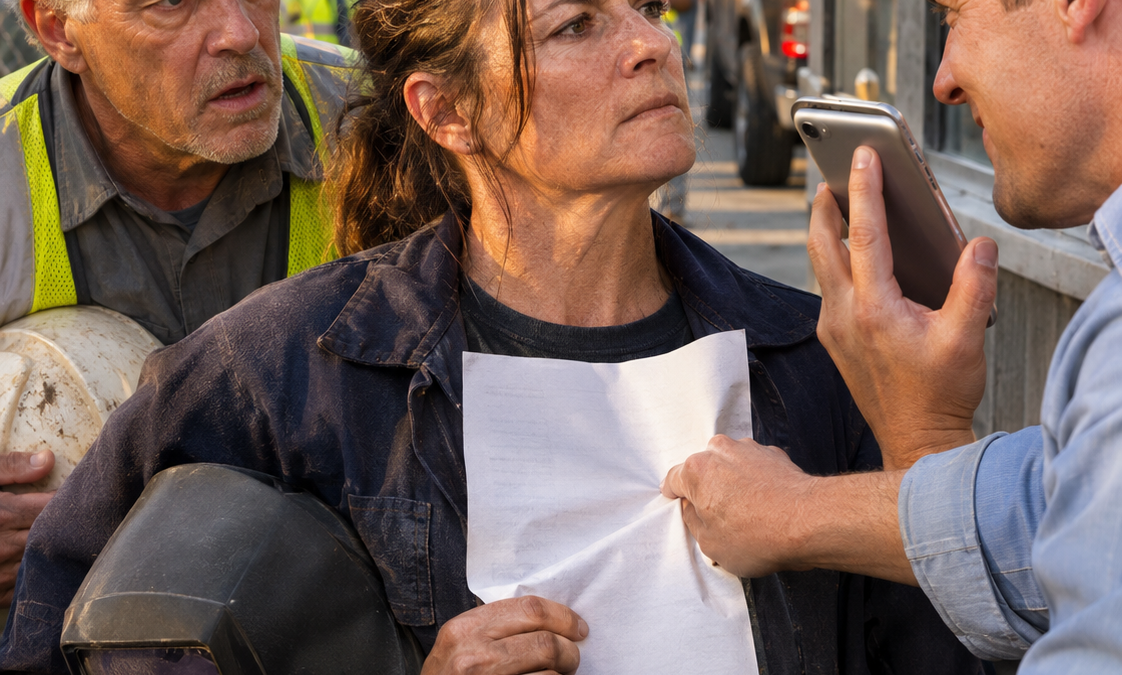
Troy Gaddis, my stepmother’s son, shoved a paper against my chest at shift change and said, “Your dad’s been in the ground five weeks. Eleven thousand four hundred. Mom says cashier’s check.” About sixty workers were filing out through the Bayou Casotte Marine shipyard gate, and I was standing there with a welding hood clamped under my arm and a rod box in my hand when I learned Eugene Ballew had been buried without anybody telling me.
I took the paper.
The top carried my father’s full name.
Eugene Ballew.
Below it was the date of service, five weeks back, and Lasater funeral home in Joplin, Missouri. The bottom showed $11,400 due.
Troy’s finger tapped the amount.
“Mom says she gave you long enough.”
I kept my eyes on the bill.
“Let it cool.”
“What?”
“Give it a minute.”
He pulled out his phone instead.
Troy was forty, broad through the shoulders, wearing a clean work shirt that had never met the inside of my welding booth. He had parked his truck beside the gate before the evening rush and caught me where the day crew funneled out past the guard shack.
His thumb moved across the screen.
“Fine. Tell her yourself.”
He put the phone on speaker.
Lenore Ballew, my father’s second wife, answered almost at once.
“Troy?”
“She’s right here, Mom.”
Her voice carried through the exit lane.
“Roxanne, bless your heart. A daughter would have been here. You’re just a hired torch who sends postcards.”
Boots stopped behind me.
Stu Landry, our shift foreman, had come up close enough that I could see his reflection in the guard shack window. Stu was fifty-six, blunt, and usually moving three people at once with one hand gesture.
He did not move anybody now.
The workers behind him had stopped too.
Lenore kept talking over the phone.
“Your father had a proper funeral. Somebody has to pay for it.”
I looked at Troy.
“Take her off speaker.”
He smiled.
“Why? Everybody here ought to hear what family means.”
I turned to the security booth and set my rod box on its concrete ledge.
The steel case had followed me through yards from Texas to Virginia and back along the Gulf. I flipped the two catches and lifted the lid.
Under spare lenses and wrapped soapstone was the place where I kept the one thing my father had handed me when I left Joplin eighteen years earlier.
His original union card.
The men at his local called it the book.
Number 2186.
Its edge had worn soft from years in the box. The burial fund’s phone line was printed on the back. Under it, in an old stamp, were six characters I had never asked anybody to explain.
LKR 114.
I tried to fold the bill once, and my hands would not make the corners meet.
The day I left home, Dad had pressed the book into my palm.
“Hold my book till you’re back. Stay on the job.”
He kept working on a yearly dues card carrying the same number. The original stayed with me.
Eleven years ago, he called and said he had put me down as contingent beneficiary on that fund.
That was all we said about it.
For eighteen years, I mailed one postcard a month from wherever the work took me. Shipyard towns, motels, rented rooms, places where the coffee was bad and the steel was steady.
The first paper from home to reach my hands in eighteen years was a bill.
I slid the photocopy beneath the book.
Across from me, Troy lowered the phone.
“Friday the sixth. Or she goes to the hall about you.”
“About what?”
“About what kind of daughter leaves her father with a funeral debt hanging over him.”
Stu spoke from behind me.
“Gaddis.”
Without answering, Troy glanced past my shoulder.
Stu pointed toward the pedestrian gate.
“You’re blocking my people.”
“I’m here on family business.”
“Take it to the parking lot.”
Instead, Troy pocketed his phone and headed for the entrance.
“I need the contract office anyway. I’ll tell them what kind of person they’re sending checks to.”
I closed one catch on the case, then stopped.
There was no use arguing with a man who wanted an audience.
His hand reached for the gate.
I turned to the guard.
He sat inside the shack with a radio clipped beside his shoulder.
I held up my gate badge.
“He’s not on my visitor list. That his truck in the fire lane?”
The guard leaned toward the window.
Troy’s lifted truck sat exactly where he had left it, oversized wheels angled against the red curb while outgoing workers had to bend around it.
The guard picked up his radio.
“Need a tow at the east gate. Fire lane.”
Troy turned so fast his boot scraped the pavement.
“No.”
The guard spoke into the radio again.
“Tow confirmed. Pickup.”
Troy’s face went white.
“No. No tow. Don’t call a tow truck. I’m moving it!”
He ran.
A minute earlier, he had held up his phone so Lenore could insult me in front of sixty people. Now he was sprinting through the workers for the red curb with one hand digging into his pocket.
Stu laughed out loud.
Troy reached the driver’s door, yanked it open, and climbed behind the wheel.
His keys slipped from his hand.
They hit the floorboard.
He bent down, came back up, missed the ignition once, then jammed the key in.
The workers had made a clear lane for him.
Nobody had left.
I opened the rod box again.
The bill lay flat beneath the worn edge of number 2186.
$11,400.
Five weeks in the ground.
I shut the lid, fastened both catches, and picked it up.
Then I pulled out my phone.
One message sat near the top.
Yesterday.
Sunday.
It came from my father’s number.
Doing ok. Stay on the job. Proud of you.
I walked over to the truck.
Troy had the engine running. His window was down, and one hand rested on the gearshift.
I held my phone where he could see the screen.
“He texted me yesterday.”
Troy did not look at it.
His fingers curled tighter around the lever.
“Why are you still texting that number?”
Part 2 of 7
My father’s phone was still texting me five weeks after his funeral, and Troy had just told me he knew it. “Why are you still texting that number?” stayed in my ear after I sat behind the wheel of my truck in the yard parking lot.
I opened the thread and counted backward.
September 27. October 4. October 11. October 18. October 25.
Each Sunday carried the same line.
“Doing ok. Stay on the job. Proud of you.”
Dad had already been buried before the first one arrived.
Those five messages could not be his.
Since May, he had been on oxygen, and Lenore said he could only text, not take a phone call. In August, I asked if I should come home, and his number answered, “Don’t come. Stay on the job.” I believed it because those were the words Dad had given me the day I left, and my contract ran through the end of November.
I had not spoken with Roger, Dad’s older brother and a retired pipefitter, since my mother’s funeral.
Joplin had no shipyard, so I followed contracts. I came back a few times through 2014 and offered Dad the book each time, and each time he refused it because a visit was not coming back. Once he moved into Lenore’s house, the only place left for me was on the postcards I mailed.
I held the phone over the steering wheel.
Somebody had been using Dad’s number.
Troy knew enough to wonder why I was still using it.
That was all I knew.
At 9:10 Monday night, Troy sent me a sharp photo of the bill lying on a kitchen table with a message under it: “So you can’t say you never saw it. Pay by Friday the 6th.” A small pink sheet lay near the edge of the frame, but my eyes stayed on the $11,400.
Tuesday morning, I called Lasater from the yard.
“I can only speak with the person who signed the contract, ma’am.”
That ended the call.
Stu Landry, my shift foreman, had heard enough at the gate to find me before work with a leave slip held between two fingers. I left it in his hand because my contract paid a completion bonus only if I missed no shift.
At lunch, I sat on the step beside my welding spot and opened the rod box.
The bill was still flat beneath Dad’s book.
I lifted the old union card and turned it over.
Number 2186.
The burial fund’s phone line was printed below it.
Eleven years earlier, Dad had called to tell me he had listed me as contingent. I had never asked the fund for anything.
I dialed.
A woman answered on the fourth ring.
“Tri-State Metal Trades Burial Fund. Beth Tate.”
“My name is Roxanne Ballew. I’m calling about member number 2186.”
Keys clicked at the other end.
“One moment.”
I could hear papers move.
Beth Tate was the records manager at the fund in Kansas City. Her voice stayed level when she came back.
“Name of member?”
“Eugene Ballew.”
Another pause.
“Your full name?”
I gave it.
More keys.
“For the record, you are listed as contingent. I can give you claim status in writing. Send me that request today.”
I rested the book across my knee.
“Claim status means whether anything was paid?”
“It means the status of the claim.”
Beth did not offer another word.
I looked at the steel case beside my boot.
The copy of the bill was mine because Troy had put it in my hands.
The agreement behind it belonged to somebody else.
“I signed nothing with the funeral home,” I said. “Does that make the bill mine?”
Beth answered without pausing.
“You didn’t sign that contract? Then that bill isn’t yours.”
I rubbed my thumb over the worn edge of number 2186.
“Can you tell me who did sign?”
“Not from a status call.”
“Can you tell me whether the account is open?”
“I can put claim status in writing.”
“How fast?”
“Send the request today.”
“All right.”
“For the record, include the address where you want delivery.”
I gave her the main office at the shipyard.
Before I hung up, Beth said, “Put member 2186 on the request.”
“I will.”
The book went back into the steel case, the lid came down, and my written ask went to Beth by the end of lunch.
I did not send Lenore a dollar.
I did not send Troy one either.
Paper first.
Wednesday afternoon, I was running a bead when Stu came all the way out to my work area.
I finished the pass before I lifted my hood.
“Ballew, office got a call about you. I told them you weld better than they read. Next time it goes on paper.”
I took off my safety glasses.
“Who called?”
“Gaddis.”
“What did he say?”
Stu’s mouth flattened.
“Said you skip out on family debts.”
The steel beside me still glowed at the seam.
I laid the pair on the bench.
“Let it cool.”
Stu gave one short nod.
“That’s what I’m doing.”
He walked back toward the main building.
I lowered my hood and finished the joint.
Thursday at six, I clocked off and stopped at the yard office.
A courier envelope from the fund was waiting for me.
My name was typed across the front.
I carried it outside without opening it.
At my truck, I set my rod box on the passenger-side floor, climbed in, and laid the envelope on my lap.
My phone buzzed before I touched the flap.
Troy.
This time he had sent a photograph of a flyer.
LOCAL 1187 ran along the top.
Below that was my father’s name and the date of his memorial.
Saturday, November 7.
Near the bottom, one line had been set apart.
“Passing the boot for Lenore, left alone with Gene’s funeral bill.”
My thumb stayed above the screen.
Monday, Troy had come after me for $11,400.
Now somebody planned to walk a boot around a hall full of Dad’s coworkers and ask them to help Lenore pay the same bill.
I laid the phone on the dash with the screen hidden.
The courier envelope was still across my legs.
I slid one finger beneath the sealed edge and pulled.
One sheet came out.
“Member 2186. Funeral account, Lasater: PAID IN FULL, September 25, on assignment signed by the primary beneficiary.”
Part 3 of 7
PAID IN FULL, the fund had written, yet Troy still wanted $11,400 by November 6, and the only place left to look was a grave I had never seen, about seven hundred miles away.
Friday night, October 30, I clocked off with no weekend shift to cost me the bonus, pointed my truck north, and drove until daylight, with stiff fingers on the wheel and my right calf jumping at every brake.
I reached Fairlawn cemetery Saturday morning, October 31, in my welding boots.
The rod box stayed on the passenger-side floor of my truck, holding Dad’s book, the copy of the bill, and the fund’s letter.
The caretaker met me near the office and led me past older stones toward a patch of new grass.
He stopped beside a tin stake.
A faded paper tag sat inside its little frame.
That was all.
No stone carried Eugene Ballew’s name.
I looked at the bare patch until he shifted his weight.
“Marker? Lasater pulled that order back at the start of the month. Lot’s in the widow’s name. Nothing goes on it without her signature.”
I kept my hands at my sides.
Forty days earlier, they had lowered Dad here while I was welding hundreds of miles away.
Now the place gave a stranger nothing to read.
The man waited.
I stayed where I was until both legs went numb.
Then I walked back to my truck without speaking.
The union hall named on Troy’s flyer was locked, with a taped note saying the office opened weekdays only and listing the clerk’s number.
I copied it into my phone, unsure what I could say to a local that had already printed Lenore’s version.
At the Joplin police station, one officer listened while I explained the paid account and the demand for money.
“You pay her anything? No? Then it’s civil, ma’am.”
A plastic pumpkin of fun-size candy waited on Lenore’s porch rail for the trick-or-treaters.
I climbed the front step and knocked.
The inside door opened.
Lenore stood behind the glass screen door and left it latched.
She wore a pale house sweater and held one hand against the frame.
The words came ready.
“He was my husband. The law says I decide, and I decided. You want his things? Pay the bill. And bring that union card. It’s his property.”
I watched Lenore through my reflection in the glass.
The card she wanted lay out in my truck.
“Let it cool.”
Her mouth tightened.
I stepped down from the porch.
Lenore did not open the door, and I did not turn back.
That night, I took a motel room off the highway and sat on the edge of the bed with my phone.
I scrolled the thread back toward May, looking for the last message Dad had actually written.
The farther I went, the worse the words became.
“Proud of you.”
May had it.
June had it.
July had it.
The Sunday messages after his burial had it too.
I could not tell where Dad stopped and somebody else began.
My October postcard had gone out four weeks earlier.
It was still somewhere between my hands and wherever Lenore had decided mail belonged.
I opened Troy’s flyer photo.
“Passing the boot for Lenore, left alone with Gene’s funeral bill.”
Left alone.
The words made Dad sound childless.
I reached Roger once that night and told him I knew about the burial.
“That so. Lenore said you couldn’t get off shift.”
Then the line carried nothing.
Sunday, November 1, I drove south again to clock in Monday, my shoulders burning and my left knee needing straightening at every fuel stop.
At one station, I forwarded Beth the flyer photo at the address I had used Tuesday and asked whether the fund could do anything about it.
Monday, November 2, at lunch, my phone rang while I was beside the scaffold.
I had not expected Beth to call.
“Roxanne Ballew.”
“Beth Tate.”
I sat on the lowest step.
Beth’s voice was as flat and exact as it had been Tuesday.
“I pulled the whole file. A paid account collected again on a hall floor is ours to correct on that floor. Article 9. A trustee has to sign, and he’s slow.”
I switched the phone to speaker and held it near my knee.
“So the flyer matters.”
“It reports a collection.”
Papers moved on her end.
“There is one more item I can read to you now.”
I waited.
“Since the report came in, Article 9 lets me read related documents to the contingent.”
“Go ahead.”
Beth read the entry from Kansas City.
“Credit memo, bronze marker cancelled, twelve hundred fifty dollars, signature L. Ballew.”
My boot rested against the scaffold brace.
The grave came back as bare ground, the metal stake, and its faded tag.
That lot took nothing without the widow’s signature, the caretaker had told me.
Now Beth had a paper saying Lenore had signed the bronze marker away.
Beth said, “I need you to check a date on the bill you were shown.”
“The copy is in my truck.”
“The photo will do if you still have it.”
I opened the photo Troy himself sent Monday night.
The bill filled most of the frame on the kitchen table.
I read her the date of service under Dad’s name, and she said it matched her file. I had stared at the $11,400 when it arrived.
Now I looked past it.
A small pink sheet sat almost whole along the edge of the picture.
Troy’s face at the gate came back to me, white when the guard said tow.
“Beth, stay with me.”
“I’m here.”
I put two fingers on the screen and spread them apart.
The pink sheet grew.
Small print turned into words.
I moved the image until the top line reached the center.
Then I read aloud, one line at a time.
“Notice of right to cure. Borrower: Troy Gaddis. Cosigner: Lenore Ballew. Received October 6: $4,850. Pay $11,372 by November 9 or the truck may be repossessed. Total balance $38,372.”
Beth was quiet for one beat.
“For the record, that is not a funeral.”
Part 4 of 7
By Tuesday, November 3, the board had promised Lenore $9,000, and Troy’s deadline left me three days to decide what one missed Saturday was worth.
At lunch, I dialed the number I had copied from the taped note on the hall door.
Cliff Rucker, Local 1187’s recording clerk and Dad’s friend, answered on the fourth ring.
I read him the fund’s document exactly as Beth had sent it.
“She told the board his burial benefit lapsed when he got sick and quit paying. A status letter to you against a widow’s word?”
My thumb stopped at the edge of my phone.
“Hall won’t stop a boot on that. Only the fund can correct the floor, and only with the file.”
I leaned my shoulder against the steel column beside the break area.
“Board’s already promised her nine thousand out of relief. I can’t move the board on a letter. I can hold the motion till good of the order.”
He kept going.
“And bring his book to the monthly meeting, the twelfth. A dead member’s book gets hung by whoever holds it. The rest I don’t discuss on a phone.”
I did not mention the pink sheet.
Cliff needed the letter to delay the vote, and he had just told me one paper would change no minds.
Lenore was treasurer of the local’s women’s auxiliary.
One word reaching her could alter how she collected before Monday.
The photo mattered only if the fund’s file stood behind it.
The lawyer I called after shift listened for less than five minutes.
“You don’t owe it. I can send a letter, two, three weeks.”
Two or three weeks might as well have been January.
I called Beth and told her what Cliff said about the lapsed benefit.
She said the trustee had to sign before Friday night.
Without that signature, all she could send was a private letter weeks later.
By Monday, the money would be gone.
“Will Lenore see it coming?”
“She only deals with us by mail.”
That left Saturday.
The yard had ordered a Saturday shift for the ship delivery deadline.
Missing it meant losing my completion bonus.
Thursday, November 5, Cliff called while I was washing grit from my hands at the yard sink.
He said Lenore had ordered fried chicken for a hundred and put herself on the program as “Words from Gene’s widow.”
She had taped the flyer to the coffee shop door near the hall.
The evening’s running order also listed a relief decision, and the board’s $9,000 stood against the funeral bill.
That left the hall believing the boot needed $2,400.
I opened Troy’s photo on my phone and found the cure notice again.
$11,372 minus $9,000 left $2,372.
I said nothing about that to Cliff.
Before hanging up, he mentioned Troy’s truck was back in town.
Cliff had heard Troy tell helpers in the local’s parking lot, “Truck’s handled by Monday.”
He knew nothing about the debt.
I did.
Any truck that close to repossession would have been hiding somewhere, and this one had just come out.
A text from Lenore’s number came ten minutes later.
“Stay on your job, honey. We’ve got this.”
I did not answer.
Friday, November 6, at 4:00 p.m., Troy’s deadline had arrived, and I had paid nothing.
Beth reached me at the fabrication rack.
“Signed. I’m driving down in the morning. You just come. You don’t have to say one word.”
She had told Cliff only that the fund would attend.
She had not told him what it would read.
I took off my safety glasses and handed Stu the slip giving up Saturday’s shift.
He read it.
“That’s six grand, Ballew.”
“I know what it is.”
Stu knew only that it was family.
I left it there.
The steel case went behind my seat.
I got in my truck and drove north.
By Saturday evening, the miles had turned into exit signs, fuel stops, and one stiff shoulder.
At 6:40 p.m., I walked into the Local 1187 hall wearing my yard jacket.
The burn mark still showed on the sleeve.
The rod box hung from my hand.
Eighty signatures filled the sign-in book near Cliff’s gavel.
Dad’s photo stood on an easel at the front.
The smell of fried chicken covered the room.
I took a printed program from the table and read the order.
Collection ran until 7:20, then came “good of the order,” and the relief vote followed that. If the boot was unfinished, it finished before the vote.
The floor microphone stood untouched on its stand in the middle aisle.
Lenore saw me on my way to a chair.
She stood at the podium microphone with a program folder tucked against one side.
The edge of the original funeral bill showed from the pocket.
“Well, bless her heart. Seven weeks, and she shows up for the chicken.”
A few people laughed.
Roger lowered his eyes to his plate.
At the back sat a woman in a gray vest with a brown folder on her lap.
Nobody looked at her.
I sat down with the steel case against my boot.
Lenore kept the microphone.
“Eleven thousand four hundred dollars is still owing on Gene’s funeral, and I’m a widow on a fixed income.”
Heads turned toward her.
I kept mine level.
“I called that girl the night he died. She said she couldn’t get off shift.”
Roger did not look up.
Lenore pulled a tissue from her folder.
“I wasn’t even able to put a stone on him. It’s on that same bill. This boot is for Gene’s stone.”
The tin stake at Fairlawn stayed in my mind.
Troy started between the tables carrying a welding boot.
Bills folded into it from hands that had worked beside Dad.
A man near me put in forty.
Across the aisle, a woman added twenty and looked up at Lenore with wet eyes.
Lenore received each look like it belonged to her.
Troy moved to the next row.
People reached for wallets before he arrived.
I kept my hands on the table.
The number that mattered sat on my phone.
I did not touch it.
Troy carried the boot back toward the podium and called the running count up to Lenore, who read it into the microphone.
“Sixteen hundred forty so far.”
Three tables were still waiting.
Someone near the kitchen said they would get there.
Lenore smiled into the room.
Troy turned back toward those three.
I watched him hold the boot out to open hands.
Cliff checked the wall clock.
At exactly 7:20, he tapped his gavel.
“Boot can finish after. Good of the order.”
I stood, set the rod box on the table, and took out Dad’s old union card, number 2186.
I held it in my hand without speaking.
Beth walked to the floor microphone.
Part 5 of 7
“Beth Tate, Tri-State Metal Trades Burial Fund, under Article 9. For the record.”
The brown folder in her hands held the benefit Lenore had told the board had lapsed, and the memorial flyer lay on top of it.
Beth lifted the flyer where the tables could see it.
“‘Left alone with Gene’s funeral bill.’ That’s the statement printed here.”
Lenore’s smile went out at the podium.
Beth opened the folder beneath the flyer.
“Roxanne, what number is on the card you’re holding?”
I kept Dad’s card above the rod box.
“Twenty-one eighty-six.”
Beth drew out a single sheet.
“Funeral account for Eugene Ballew. Member card 2186. Paid in full the week of burial, on assignment signed Lenore Ballew.”
The room stayed still enough for me to hear paper move in Beth’s hands.
She faced Cliff at the head table.
“This benefit never lapsed.”
Lenore leaned toward the podium microphone.
Her voice went high.
“That fund money was left to me. I can spend it how I please.”
Beth did not change her tone.
“Yes, ma’am. You did. Thirty-six hundred, balance of the benefit, paid to you.”
She moved to the next paper.
“Credit memo dated October fifth. Bronze marker cancelled. Refund, twelve hundred fifty dollars, paid to Lenore Ballew over her signature.”
I faced Lenore.
“There’s a tin stake on him tonight. I went and looked.”
Heads turned across the tables.
A few went toward Troy, standing between two rows with the boot in his hands.
Nobody reached for a wallet anymore.
Dad’s card stayed in my left hand.
With my free hand, I went into my yard jacket pocket, took out my phone, and opened Troy’s photo.
I held the screen up.
“This was in the picture Troy sent me.”
I had no microphone.
I did not need one.
“Troy Gaddis, borrower. Lenore Ballew, cosigner.”
Troy stopped moving.
I read the next line.
“‘Received October 6: $4,850.'”
Thirty-six hundred plus twelve hundred fifty.
Exactly the two payments Beth had just read.
I kept going.
“‘Pay $11,372 by November 9.'”
I lowered the phone a few inches.
“That’s Monday.”
The man beside me who had put forty dollars into the boot folded his arms.
Troy’s fingers tightened around the leather.
Lenore spoke before Beth could turn another page.
“I called that girl the night he died.”
I opened the text thread on my phone.
The dates ran down the screen.
September 27.
October 4.
October 11.
October 18.
October 25.
Five Sundays after Dad had been buried.
Each message from Dad’s phone said the same thing.
“Doing ok. Stay on the job. Proud of you.”
I looked at Troy.
“Why are you still texting that number?”
A chair scraped somewhere behind me.
Troy did not answer.
Both of Lenore’s hands closed on the sides of the podium.
“I kept his phone because I couldn’t stand to let him go. You’d take that from a widow?”
“You told me to stay on the job five times after you buried him.”
Her mouth opened.
I kept my voice where it had been.
At the shipyard gate, with Troy standing in front of me and Lenore coming through his speaker, I had heard the words clearly enough to keep them.
“A daughter would have been here. You’re just a hired torch who sends postcards.”
From the podium, Lenore stared down the room at me.
I set Dad’s card on the table in front of the rod box.
“I’d have been here. You made sure I wasn’t.”
Roger pushed his chair back.
It was the first time he had stood all night.
He left his plate at the table and walked straight to Troy.
Troy watched him come.
Roger took the boot out of his hands.
Troy let go.
Roger turned toward the nearest table.
“I told people for seven weeks she wouldn’t come. I never once picked up a phone.”
He reached into the boot, pulled out two twenties, and walked to the man with the folded arms.
“Here’s your forty back.”
The man took it.
Roger moved on.
Ten dollars went back to a woman near the kitchen.
A twenty returned across the aisle.
One more folded bill went back.
Then another.
Nobody ate.
Forks stayed beside chicken going cold while Roger worked from table to table, checking faces before placing money back into hands.
Troy stood where Roger had taken the boot from him.
His hands hung empty at his sides.
Lenore watched Roger make the round.
“Roger.”
He kept walking.
“Roger, that money was given for Gene.”
Roger handed another bill back.
“Wasn’t told the truth.”
At the podium, Lenore had stopped looking at anyone.
Beth stood in the middle aisle with the brown folder open in her hands and the flyer still on it.
Cliff sat behind his gavel.
Roger was two tables from the end.
Lenore shoved one hand into the pocket of her program folder.
The original funeral bill came out.
She raised it beside her face.
“You still owe this family.”
The paper shook once in her hand.
She spoke into the microphone as though the amount printed across it were still waiting to be paid.
Cliff picked up his gavel, then set it down without striking it.
“The relief motion’s off the floor.”
Lenore turned toward him.
“What?”
“The relief motion’s off the floor.”
The promised $9,000 went with those words.
Beth closed the brown folder and stayed in her spot by the microphone.
Roger finished the last table and came back through the aisle carrying the boot with no money left to return.
Cliff drew his pen across the relief item on his program.
My phone was still in my hand.
One thumb brought Troy’s photo back, and the pink sheet said November 9.
Lenore stood at the podium holding the $11,400 funeral bill.
I put my hand on the rod box.
“Keep the bill, Lenore. My dad already paid it.”
Part 6 of 7
At the end of my Monday shift, a photo from Cliff Rucker lit my phone in the shipyard parking lot: a letter with Lenore Ballew’s signature at the bottom. It said she had received the burial fund money, cancelled the marker on Dad’s grave, kept his phone since May, and agreed that I owed nothing.
Before I left the hall Saturday, I had picked the card up off the table and returned it to the rod box. Now the box sat behind my truck seat while I looked at Lenore’s name.
My phone rang.
Cliff said, “Board met in the back room this afternoon.”
“How’d you get her signature?”
“We read the minutes to her.”
Lenore was out as treasurer of the women’s auxiliary, and she had handed over its ledger.
“Troy?”
“Struck from the helpers’ list. His helper permit was a courtesy. It’s done.”
Afterward, Troy caught him in the parking lot and finally gave him the part he had left hanging Saturday.
“She told me part of it was still owing. I knew the rest was the truck. Pink notice came and she said go get it off the daughter. The Sunday texts were just to keep her down there till Mom needed her.”
Then Cliff told me Roger had demanded his brother’s phone in front of the board. Lenore gave it to him.
Cliff had read Section 14 to her.
“Section 14, Lenore. Money raised on this floor on a false statement stays open in the minutes, read out every meeting, your name on it, till it’s answered in writing. Sign what happened, sign the stone permit, and I close it.”
She signed the short letter and the stone permit Fairlawn needed from the plot’s owner. Both stayed with Cliff at the hall.
“Anybody call the police?”
Cliff answered me.
“Every dollar went back that night. Nobody’s out a cent. The hall settles its own.”
He also gave me Roger’s words to Lenore.
“You don’t sit at Gene’s people’s table, Lenore. Not at Christmas, not at the hall.”
Monday was the last day printed on the pink sheet.
I paid nothing.
By Thursday I had driven roughly seven hundred miles back to Joplin on leave from the yard, my shoulders stiff from the wheel. The $6,000 completion bonus was already gone.
Roger was waiting in the hall parking lot shortly before the meeting.
“Tuesday. Five in the morning. Tow truck took Troy’s pickup out of Lenore’s drive. Troy says it didn’t wake a single porch light.”
He said Troy had called him for a ride to an extra early shift at a warehouse, because there was nobody else left to call.
“You went.”
“Couldn’t leave him.”
Roger rubbed his thumb along one knuckle.
“When I pulled in, driveway was empty. Troy was standing in it in his house slippers.”
At 7:00 p.m., I carried the rod box into the monthly meeting.
Members filled the folding chairs under the memorial board. I still had my yard jacket on.
When Cliff came over, I flipped the latch and took out the card Dad had handed me the morning I left Joplin.
I held it toward him so it could be hung with the others.
Cliff took the card and turned it over.
His thumb stopped under the stamped letters.
“LKR 114. You ever read that?”
“I’ve seen it.”
“For how long?”
“Eighteen years.”
“And never asked?”
“No.”
He held the card under the ceiling light.
Then he read the hall custom to me.
“Living member uses his key. Dues card dies with him. Dead member’s locker opens only to whoever holds his book. Nobody else’s say-so. Lenore came twice. Figured he kept cash in there.”
Two trips to a door she could not open, and only then had she demanded the card from me through her screen door.
He gave the card back.
I closed my fingers around it.
He took the hall’s key from his pocket.
The steel lockers ran along the side wall past the meeting tables, each door painted with a black number.
The one marked 114 was chest high.
He put the key into the lock.
One hard click came from inside the door.
He pulled it open.
Dad’s old welding hood sat on the upper shelf.
The shell was dull around the lower edge from years of sparks. The dark lens faced the room, and the headband was folded inside.
Below it were postcards.
Stacks of them.
Each stack was clipped by year.
I did not reach in at first.
The nearest card was from a yard in Louisiana. My handwriting crossed the back in black ink.
Behind it I saw Texas.
Virginia.
Other contract towns came back by return address and postmark.
I put two fingers against the edges and moved only enough to see the years.
The first set started the June I left.
The rows kept going.
At the edge of each card was the same small pin mark.
Cliff stood beside me without touching anything.
“He came by every month since he married, envelope under his arm, straight to this locker. Never said what. Last trip, August, he came out and said, ‘She’s got my book. She’ll come.'”
I looked deeper into the lower shelf.
The stacks ran on, one for every year, the yard names changing on the fronts.
The final clipped bundle ended in May.
Nothing in my handwriting came after that.
I counted them where they sat, lifting none from the place Dad had put them.
The count came to 216.
My fingers rested against the May stack.
Cliff stayed beside the open locker.
I slid my hand under the postcard lying on top.
It was not one of mine.
There was no stamp.
Dad’s handwriting leaned unevenly across the back, the letters smaller and shakier than I remembered.
I lifted the postcard free and read.
“Rox. Yours quit coming in June. I know you didn’t quit. Burial’s paid up, you owe nobody. Stay on the job. Proud of you. This one’s really me. Dad.”
Part 7 of 7
Dad’s unsent postcard was still in my hand when Cliff Rucker told me Dad had refused to let anyone track me down.
Cliff kept his voice low, the key still in his fist.
“August, I asked Gene if I ought to find you. He shook his head. Then he looked at this locker and put a finger to his lips. Didn’t want any of it getting back to Lenore. Said whoever had his book would come.”
I studied Dad’s uneven writing.
“He had my number.”
“In Gene’s phone. Phone was at Lenore’s house. He didn’t know it by heart. I never had it. Later she told me she’d already called you.”
I tucked Dad’s postcard inside my yard jacket. His book was still in my other hand.
I handed the card to Cliff.
He carried it to the memorial board and pinned it among the others before the meeting broke up. Then he came back and put the stone permit in my hand.
“You’ll be setting it.”
Outside, Roger was waiting at my truck and handed me Dad’s phone.
He made no speech.
I sat behind the wheel and switched Dad’s cell on. My own phone lay next to it, open to Cliff’s photo of the letter Lenore had signed, with the words since May bright on the screen.
I scrolled to the last message sent before May, the one I had seen in the motel without knowing which words were really his.
Stay steady, Rox, and stay on the job.
I shut Dad’s phone off.
Two weeks later, on Thanksgiving Day, I left Pascagoula at the end of my contract. There was no completion bonus waiting for me, and the rod box rode behind the seat.
In December, Roger called with the amount left on Troy’s truck: $14,972.
Troy was still riding with Roger to the early warehouse shift because he had no truck. On one of those rides, he told Roger the truck had sold at auction after the notice of sale, and the letter for what remained had come in Lenore’s name.
“She took a loan against the house and paid it,” Roger said.
According to Troy, the house was the one thing she owned free and clear, and she had refused to put it at risk for him. A house loan could not have come through by that Monday deadline anyway. Now the shortfall carried her name, so there was no choice left.
A few days later, an envelope from Lenore reached me at the hall.
There was no note inside, only the original bill folded in quarters and “Paid” written in one corner.
I put it away and never answered.
That winter, the steel marker was still mine to make.
At the same hall, I taught the Tuesday evening apprentice class, and one night in the local’s shop I clipped two papers to the bench: the copy of the credit memo Beth had mailed me after the memorial, and the permit Lenore had signed.
I cut thick plate.
Dad’s name went on the top line, with number 2186 below it. My bead ran across the face in short, even passes, and no years went on the marker.
Roger stood near the tool cabinet and watched until I finished the last line.
“Should you have let them read it out at your dad’s memorial? I’ve asked myself.”
I set the rod down.
Then I lifted my hood.
The tin stake was still in Dad’s grave on the second Saturday in April.
At Fairlawn, the caretaker had the permit in his hand and the same patch of grass marked before I arrived.
The local had turned out in full, more than eighty people standing along the drive and between the rows. They had come on their own, with no phone tree and no sign-up sheet.
Cliff wore his local jacket. Roger stood a few feet from him with his cap in his hands.
The caretaker took the other end of the marker, and I carried mine from the truck. The plate was heavier than it had felt on the bench.
At the grave, he pointed to the marks.
“Right there.”
I set my end down in the grass.
Five months earlier, I had stood here after driving through the night and found only the stake. I had not known where to put my feet then.
Now I stepped forward and stood exactly where I should have stood in September.
The caretaker worked the stake loose and pulled it from the ground. Dirt clung to the bottom.
We set the marker.
The steel caught the light without much shine. Dad’s name sat above his number, and my bead held both to the plate.
Cliff waited until the caretaker had picked up his shovel.
Then he faced the people from the hall.
“Gene Ballew. Number 2186.”
No boot went around.
Nobody asked anyone for a dollar.
A man from the back row pulled off his knit hat. Somebody beside me cleared his throat. Roger looked down at the grass and rubbed his thumb once across the bill of his cap.
I kept my hands at my sides.
The wind moved along the row of jackets.
Cliff touched two fingers to the edge of the marker, then stepped away.
I stayed until the last person from the local started toward the parking lane.
That afternoon, the card was still hanging on the board at the hall.
Cliff stood under it.
“Want his book back?”
“No.”
He waited.
I said, “The ones who stay get called good. The ones who go send what they can and get called gone. I sent everything I had.”
Cliff nodded once.
Before I left, he reached up and took the card down.
He turned it over and checked the LKR 114 stamp the way the custom required. Then he walked with me to the row of lockers, used the hall’s key on Locker 114, and opened the door.
Dad’s old welding hood sat on the upper shelf.
The 216 postcards were still clipped below it.
Cliff handed me the card.
“Hang his book back up when you’re done.”
He left me there.
I stood alone in front of Dad’s locker with the card in my hand.
For eighteen years, I had mailed a postcard every month. I had bought stamps at truck stops, grocery counters, motel desks, and little post offices in towns where I knew the welding crew better than I knew the street names.
My thumb ran down the clipped edges, one year at a time.
I put the card back on the board myself.
Then I went back and took a fresh postcard from my jacket pocket.
The front showed the shipyard at Pascagoula.
I turned it over against the locker door and wrote only:
“Back on the job. Let it cool, Dad. Rox.”
I found a pin on the shelf.
I pinned it up inside Locker 114, and for the first time since I left home, I didn’t need a stamp.
THE END
More stories
My Food Services Director Mocked the 14 on My Spiral Notebook After 22 Years and Told Me to Take It Home—Then 14 Kids Cost Him His $15,000 BonusI Pulled My Orange Gloves Out of the Trash Before 11 Drivers—Then My Brother-in-Law Took My Seat—Until the Hidden Bank Packet’s Loan Made Me Owner, and His Promotion VanishedMy Parents Spent Christmas on Brett’s Two Kids While My 8-Year-Old Shook an Empty Stocking—Then Grandma Hazel’s Tin Exposed Dad Before He Could Give Brett the HouseI saw the market president order two volunteers to carry my 66-year-old mother’s table to the curb—then the borough’s signed map restored Table 1 before 150 shoppers.My dad’s girlfriend asked a court to put her son in charge—But Dad’s saved captions exposed the cabin plan and left them owing $6,500 in attorney fees.My customer’s husband claimed everything before 18 customers—then I opened my notary record book, and the wife he expected to sign said the one word he hadn’t planned for.
You Might Also Enjoy

My Daughter-In-Law Told Me To Stay Elsewhere While Strangers Took My Condo — Then I Pushed Back







