The Hotel Manager Carried My Wet Grocery Sack Out Into the Rain in Front of the Whole Lobby and Said, “Lobbies Are for People With Room Keys”—I’d Been Carrying the Key to That Lobby Since 1986
Part 1
Trent Haldane picked my wet Hy-Vee sack up off the lobby carpet, carried it out through the revolving door, set it down on the sidewalk in the rain, and came back in and said it loud enough for the whole Tuesday wine reception to hear: "Lobbies are for people with room keys, ma'am. You've got a grocery sack." Then he turned on the desk clerk who had brought me a towel, Len Maddox, sixty and two years short of the retiree plan that pays for his wife's insulin. He had no idea the hotel had been mine since my husband died, or that the brass key that locks that revolving door was in my coat pocket.
"Mind the carpet!" a man called from the wine table, and maybe half the room laughed with him.
That was Dale Feeney, a Gold member from Lincoln, seventy if he was a day, holding a plastic cup of free merlot against his belly. His wife Barb pulled at his sleeve. Behind the front desk a young clerk with a ponytail had her phone up, and the little lens was pointed at me and my towel.
"Mr. Haldane, it's coming down sideways," Len said.
"Write yourself up, Len. That makes two."
He held up three fingers so Len could see them over the counter. "Three means the door."
"For a towel?"
"For bringing a non-guest into a guest area." Trent smiled out at the wine table while he said it, pleasant as a man reading the specials. "Before you leave tonight."
"She came in the front door. Everybody comes in the front door, Mr. Haldane, that's what it's for."
"Leonard," Trent said, and Len shut his mouth.
Then Trent leaned in over the marble and dropped his voice, which with me standing two feet away dripping on his carpet meant only the desk and I could hear it. "You've been busy on the phone this week, Len."
Len's hand went flat on the counter. "If this is about Monday, I had every right to make that call."
"Then you'll have every right to look for work." Trent straightened up, turned around to the room, and found his smile again. "Thursday after next I'm running nine of these, Len. Try to still have a job when I do."
"Moving up in the world, Trent?" Dale said.
"Big things, Dale. Enjoy the wine, folks."
A woman on the fireplace bench slid her handbag over onto the spot where I'd been sitting, and she didn't look at me while she did it. Somebody by the Brass Rail asked the bartender if the reception was ending early. The ponytail kept filming. I learned later her name was Kayla Brandt and that she'd send that video to her manager before he even got his raincoat on.
I gave Len back his towel. "Thank you."
"Let me get your groceries, at least."
"You've done plenty for one night," I said, and it came out wrong, and I watched him take it the wrong way and not argue.
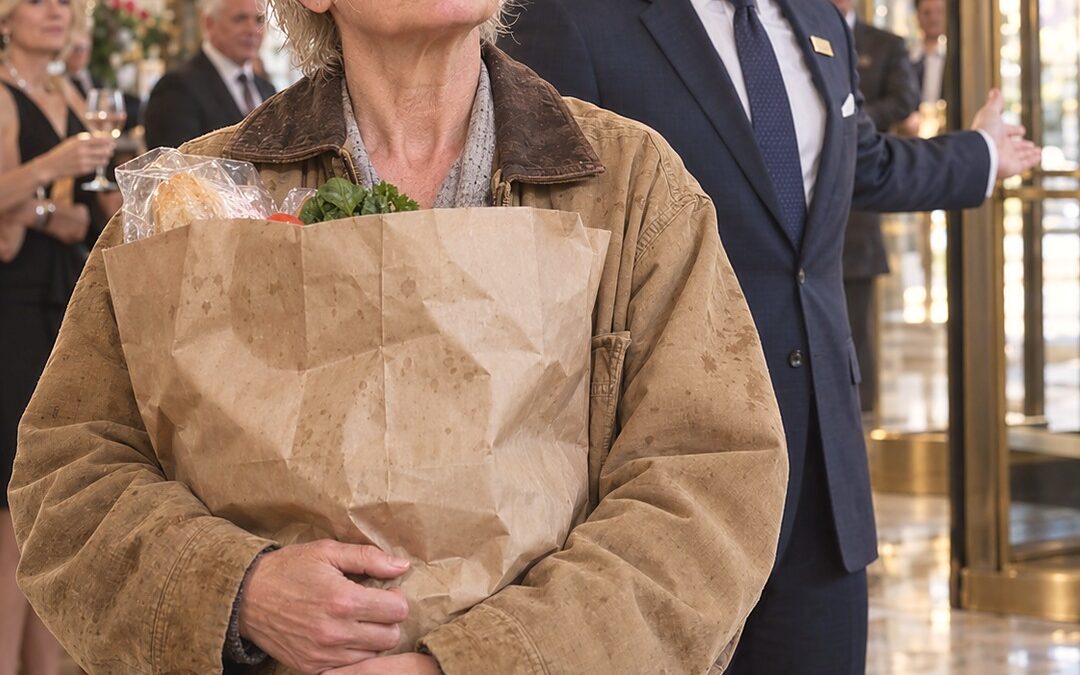
I went out through the revolving door myself. The sack was sitting exactly where Trent had put it, a good foot past the edge of the awning, and the rain had soaked the paper until the red Hy-Vee letters ran pink. A can of Campbell's tomato soup had rolled out against the curb. I fished it out of the gutter, picked the sack up from underneath so I wouldn't put my fingers through the bottom, and stood under the awning with everything balanced on my knee.
Beside the door, in the limestone, there were four small screw holes.
There used to be a brass plaque there. "COME IN OUT OF THE WEATHER — W.J. Calloway, 1928." Walt's grandfather put it up the day he opened the place, and Walt polished it himself the winter we were short a maintenance man, with Brasso and one of my good dish towels, which I never got back. Trent had taken it down in 2023. The work order said "updating the entrance." I'd read that work order at my kitchen table the week before, along with a lot of other paper.
I was downtown that night because of a number. The audit committee's report had thirteen ethics-hotline complaints from this one hotel in eighteen months, and all thirteen said the same thing in the last column: "closed by CEO office — unsubstantiated." The CEO office was my brother-in-law Gordon, in Kansas City. I kept books for a living once. Nothing comes out thirteen for thirteen unless somebody's been cleaning it. So I'd put on Walt's brown duck coat from Mills Fleet Farm, which I hadn't worn since his funeral, and bought a sack of groceries so I'd have something to carry, and I'd come to see the building at night the way I used to see it, as nobody.
I hadn't planned on the rain.
I could have walked back in and said my name. But a man who does that to a wet old woman in front of forty people doesn't stop when she says a name, he just gets careful, and I wanted to know what "busy on the phone" meant first.
Through the glass I watched Len fill out a form at the desk. He rubbed his forehead once and looked toward the manager's office and bent over the paper again.
At 10:02 Trent came out from behind the desk in a black raincoat. Somebody pushed through the door on their way out, and for a second I could hear him.
"Send me that video, Kayla."
"Already did."
"Good. If she comes back in, I want it documented."
At 10:05 his black Tahoe pulled out from the curb and turned up Farnam, and a minute later the revolving door went around again and it was Len, without a coat.
"Ma'am?"
"Joan," I said.
"Joan. Come back inside."
"I don't have a room key."
He looked at me a second, and then he looked up the street where the Tahoe had gone. "He goes home at ten on Tuesdays. The building stays open."
A tall boy in a bellman's vest came out behind him and got both hands under my sack before I could say anything about it. His name tag said ANDRE. "Careful," I told him. "It's mostly paper now."
"You're dripping something, ma'am."
"That'll be the potatoes."
"Potatoes don't drip."
"These have had a night."
He carried it in like it was somebody's wedding cake, set it on two bar towels he got from the Brass Rail, and started blotting the bottom. Len pointed me to the bench by the fireplace. The woman with the handbag had gone upstairs.
At 10:15 Len came over on his break with a paper-wrapped sandwich and a cup of water and sat down at the other end of the bench, which I suppose made it his bench too. He unwrapped it on his knee. Rye bread, bologna and pepper jack, cut corner to corner. There was a folded note on top in blue ballpoint.
"Eat the WHOLE thing, Leonard. —D"
"My wife," he said, because he'd seen me reading it. "Thirty-six years, she knows what I do with lunch."
"What do you do with it?"
"Give it away, mostly." He moved one half onto a clean corner of the wax paper and held it out.
"I've got groceries."
"Your groceries are drying on a bar towel. Hotel food's for guests. This is Donna's food."
I took it. It was a minute before I noticed he'd handed me the bigger half.
"You kept the small one."
"Donna knows how much I eat," he said, and that was the end of that.
I asked how long he'd been there, which I already knew, and he said since 1995, and that he'd been front office manager until February. "Snow," he said, when I asked what happened. "That blizzard. Twenty-three Amtrak people stuck at the station with no place to go, and every room we had was full. So I opened the Regency Ballroom, set out banquet chairs, and had the kitchen bring up the leftover chili. They slept there. A couple of them wrote thank-you notes before the trains ran."
"Did Mr. Haldane read the notes?"
"He read the expense report." Len looked at the fire. "Gave away company property, he said. Took me from thirty-one fifty an hour down to nineteen seventy-five, evening desk, three to eleven-thirty, and a first written warning to go with it. Tonight was two."
"And three is the door."
"Three is the door." He folded the wax paper over his half. "Donna's diabetic. Insulin. She's on my insurance. The company's retiree plan starts at sixty-two with twenty-five years in, and I've got the years. I need two more birthdays."
"And if they fire you?"
"Not if it's for cause." He brushed rye crumbs off his knee. "I called the hotline Monday. For all the good."
"About the snow?"
"No. Something else." He stood up because the desk phone was ringing. "I shouldn't talk about it."
At 10:30 Kayla came over and stood in front of the fire and pointed her phone at me again. "Mr. Haldane says we're documenting further incidents."
"What am I doing that's an incident?"
"You're occupying guest seating." She held the phone steady with both hands, like it might get away from her. "He's going to get fired because of you, you know."
"I heard who said what tonight," I told her. "I don't think it was me."
She went back behind the desk, and a little before eleven she walked past me toward the back hallway with her phone in one hand and one of those little black vape pens in the other. Andre ran packing tape twice around the bottom of my sack, said it should get me home, and set it by my shoes. At eleven he came through in his own jacket with a backpack.
"All clocked out, Len."
"Go study."
"Night, Ms. Joan." He pushed through the door and headed down Sixteenth.
A few minutes later there was a scrape under the counter, and Len hauled out a binder and dropped it on the marble, and I knew it from across the lobby. Cracked green vinyl. Brass corners gone nearly brown. The night-audit binder.
"That thing's still here?"
"Older than most of the staff," he said. "Mr. Haldane wants it thrown out. Nobody's told me where."
He turned it around so I could see. Page one had a coffee ring at the bottom and yellow tape on the torn corner, and the handwriting was mine, from when I was twenty-three years old and standing right where he stood.
"Read the seal number out loud and write it down. Every time. —J.N. '88"
"Whoever J.N. was," Len said, tapping the page, "she saved my neck more than once."
I had about a third of Donna's half left. I set it down on its wax paper on the bench and went and sat by it and watched the fire. One of the logs had split open along the top and showed a stripe of new wood. I kept watching it until I heard Len go back to counting.
At 11:10 he brought out the night's deposit, a clear plastic bank bag with a tamper strip across the top, and checked the cash against his worksheet. Somewhere behind the desk a metal door banged shut. Then he held the bag up to the light and read the seal out loud, the way the binder told him.
"Oh-oh-four-one-one-eight-seven, twenty-three forty even."
He wrote it on the drop-log clipboard and then again in a little pocket notebook. And I took a hotel pen out of Walt's coat and wrote 0041187 on the back of my Hy-Vee receipt before I'd decided to. My hand did it. I'd written seven digits on the back of something every night for three years, and apparently thirty-seven years off hadn't taught it any better.
He carried the bag into the cash-safe room and came out and tried the handle twice.
"Who takes it to the bank in the morning?" I asked.
"Mr. Haldane does the bank himself now. Since March. Saves the armored car fee, he says."
"A general manager carrying his own deposits."
"That's what I thought." He put the clipboard back on its nail and lined it up square with the edge of the shelf, and then lined it up again.
I looked up at the corner over the cash-safe room door. There was a camera there, a little black dome, with no light on it.
"Down since August," Len said, watching me look. "Work order never approved. I've put it in twice."
"Who approves it?"
"Mr. Haldane." He squinted at me. "You've worked a hotel desk."
"Night audit. A few years."
"Thought so. Regular guests don't ask about deposit seals."
At 11:30 he turned the desk over to the overnight man and came out in a jacket with a broken zipper pull, a paper clip where the tab should be. He asked if I wanted a cab and I said I had a truck two blocks over, and he lifted my sack once to test Andre's tape and handed it back.
"You coming back?"
"I think so."
"Then ask for me," he said, and went out the employee door to catch his bus.
At 11:40 I walked the two blocks to the Sixteenth Street garage. Walt's gray 2009 Silverado was on the second level where I'd left it, and it still smelled like his coffee and the leather cleaner he bought at Walmart and never once used on leather. I set the groceries on the passenger floor.
He'd died a year ago August, mowing the lawn, sixty-six. The funeral was private, out in Blair, the way he wanted it. At the lunch afterward Gordon sat next to me with a plate of ham he didn't eat and patted my hand.
"Leave the hotels to the people who run them, Joanie. You counted the money at night."
I'd done the company's books at our kitchen table in Dundee for fifteen years before Gordon ever ran anything. He knew that. He was patting my hand when he said it.
So that's who I was, sitting in that truck. Chair of the board of Calloway Hospitality since Walt died, nine hotels in Nebraska, Iowa, Kansas and Missouri, fifty-two percent of the voting shares in my name. I went to board meetings by phone. My picture wasn't on the website. I hadn't been to a staff party since I quit the desk in 1989, and Trent came in 2022 and Len in 1995, and neither of them had any reason on God's earth to know my face.
I laid the receipt on the steering wheel and looked at it, and at 11:52 I called Dwight Okafor at home. Dwight's the retired banker who chairs our audit committee. He picked up on the fifth ring.
"Joan? What's wrong?"
"I'm in the garage across from the Omaha hotel."
"At midnight?"
"I want the newest hotline complaint from Omaha, Dwight. The complaint itself, not the summary. And the sixth-floor room-status report, the long one, with maintenance history."
I heard him sit up. "Those go through the CEO office."
"Pull them through audit. Not through Kansas City. And Gordon is not to know I asked."
He didn't say anything for long enough that I checked the screen to see if we'd been cut off.
"That's a serious instruction, Joan."
"A desk clerk with thirty-one years got his second written warning tonight for bringing me a towel. His name's Leonard Maddox. His manager thinks he's been on the phone, and I want to know why that scares him."
"I'll call you first thing," Dwight said.
I put the receipt in the glove box, then took it back out and put it in my coat pocket with the brass key, and drove home to Happy Hollow Boulevard with the wipers on low.
Dwight called back at 6:40 the next morning. "Complaint fourteen came in Monday from a Leonard Maddox," he said. "Gordon's office forwarded the whole thing to Trent Haldane at 2:12 yesterday afternoon. Joan, it had Len's name right at the top."
Part 2
"You're the chair. Walk in there and fire him."
Dwight had been up for an hour and had already decided what I ought to do with my day. I was standing at the kitchen counter in my robe, watching two finches fight over Walt's feeder outside the window. He hung it eleven years ago and one perch has been bent since the first winter, and neither the birds nor I have done anything about it.
"Fire him for what, Dwight? Being rude in a lobby?"
"For whatever's in complaint fourteen. And then ask Gordon why his office mailed a confidential complaint to the man it's about."
"Thirteen people complained about that hotel before Len did," I said. "Gordon closed every one. If I say my name tonight, the sixth floor gets a coat of paint by Friday and Gordon closes complaint number fourteen."
"Why the sixth floor?"
"You tell me. You've got the report."
Papers moved on his end. "Nine rooms out of order. Six-eleven through six-nineteen. Water damage. Since last November."
"Nine rooms for ten months. Is there an insurance claim attached?"
"Nothing attached."
I got a pencil out of the junk drawer, the one with the rubber bands and the dead batteries Walt always meant to recycle. "Get me the laundry vendor's invoices, broken out by floor if they do it that way. Sheets have to go somewhere."
"And keep Gordon out of it," Dwight said, before I could.
By eight the Hy-Vee receipt was in a clear plastic sleeve on the counter by the phone. 0041187 in hotel ballpoint, a little smeared at one corner where the rain got it. I didn't know yet what I'd need it for. I only knew I wasn't going to be the one who threw it out.
At 2:55 that Wednesday afternoon I went back through the revolving door, dry this time, same coat, no sack. I'd come for one thing. The three passenger elevators face the fireplace bench, and if nine rooms on six were really full of wet drywall, nobody but housekeeping and engineering had any business getting off on six. I wanted to sit on that bench for an hour and watch the little numbers over the doors.
I got about four minutes.
Len was at the desk checking in a man with a rolling suitcase, and Kayla was beside him, and she saw me and turned her monitor a few degrees toward him without saying anything. He looked up and came around the counter fast.
"Joan, you can't be in here today. He's already been at me about last night. He's seen her video, the one by the fire."
"I'm only sitting."
"Please. Go sit somewhere else."
Then the office door opened and Trent came out with a manila folder, in a navy suit that was either yesterday's or its twin.
"Leonard. Why aren't you behind the desk?" He looked at me and smiled. "Well. Our friend from last night."
"I'm not a guest," I said.
"Exactly." He opened the folder right there at the counter, in front of Kayla and a check-in line of maybe six people. "Effective immediately, you're reassigned to PM houseman. Same three to eleven-thirty shift."
Len just looked at him. "Houseman."
"Front desk is for people who follow instructions. Vacuum's in the second-floor closet."
"Mr. Haldane, I've worked this desk thirty-one years."
"You've worked this building thirty-one years. Kayla has the desk." Kayla looked at Len and then at the carpet.
"I've got a conference group at four," Len said. "Sixty rooms. I did the assignments by hand this morning, half of them asked for low floors."
"Give them to Kayla."
"She doesn't know which ones are—"
"Give them to Kayla, Leonard. And the deposits are mine, same as always." He closed the folder. "You ought to be grateful. I could've done this with a box."
A woman in line moved her suitcase out of the way with her foot, like it had done something. Her husband pulled his reading glasses off and folded them and put them in his shirt pocket and took them out again. The man at the front of the line kept his credit card pinched between two fingers and held it close against his chest.
"He told me to leave," I said. "I came back on my own."
"Then you can leave on your own. Hector?"
The security man came over from the luggage carts without hurrying. Broad, fifties, a mustache he'd had since the eighties, I'd bet money on it. Trent pointed at the revolving door like he was showing a cab where the curb was.
"If she's in my lobby again, Len, you're done, and she leaves with the police."
Hector walked me out. He didn't touch my arm. At the door he held one of the panels still so I wouldn't have to push it, and he said it low, to the glass more than to me.
"Sorry, ma'am. Bus shelter's dry."
Through the window I watched Len hand his room-assignment sheets to Kayla and point at something on her screen, still doing the job while they took it off him. I'd come in to watch an elevator, and it cost him his chair before I saw anybody ride it up to six.
I went home. I made toast I didn't eat. At 10:45 that night I parked the Silverado in the Sixteenth Street garage again and walked across Farnam to the bus shelter. There was an empty Mountain Dew bottle under the bench and somebody had scratched a crooked heart in the plexiglass, and the wind came in where the side panel didn't quite meet the roof. From there I could see the lobby through the big front windows and, if I leaned, the side door on Sixteenth.
At 11:12 a white van turned onto Sixteenth and stopped at that side door. Blue letters down the side: GATEWAY CORPORATE LODGING. Four men got out in orange rail-crew vests, one of them dragging a duffel, and the first one held a card to the reader by the door. It clicked. Nobody came out to meet them, nobody from the front desk, and they didn't come through the lobby. I took two pictures with my phone, and the last man looked across Farnam right at the shelter before he went in, and I looked at my shoes.
The van pulled off at 11:15.
A few minutes later Len came across the street in a gray houseman's shirt with the hotel crest on the pocket, carrying two QuikTrip coffees. "Figured you'd be out here," he said. "Kayla saw you from the desk."
"She'll tell him."
"Probably already has. I'm cleaning toilets now, Joan. There's not a lot of downstairs left." He handed me a cup and sat at the other end of the bench. "You see that van?"
"Gateway. Who are they?"
"Rail contractors, I hear. They come most nights. Go up the side stairs." He blew on his coffee. "Room-service trays outside 614 and 617 every night. Out of order since November."
"Are the rooms damaged?"
"Don't look damaged from the hall. I push a vacuum past them now, I'd know." He turned the cup around in his hands. "Marisol used to inspect that floor. Marisol Peña, twelve years in housekeeping, best inspectress we ever had. Last Friday she asked why she was turning down beds in 611 when 611's supposed to be out of order. Trent fired her that afternoon. Failure to follow supervisory instructions, the paper said. She's got two kids and a mortgage and a husband who does drywall when there's drywall to do."
"That's what you called the hotline about."
"Monday, on my break, on my own phone, out on the dock where nobody could hear me. They gave me a number and said it was confidential." He laughed a little, without much in it. "Tuesday afternoon Trent wants to know who I've been calling."
The coffee was too hot to drink and I held it anyway. Len looked at me sideways.
"Why do you care, Joan?"
"I used to work nights."
"You said." He waited, and when I didn't say anything else, he let it go. Then he said, "Ever know Mr. Calloway? Walt, I mean. The old owner."
"I knew him."
"He used to come through when I was working late, back when I was new. Always asked how Donna was. By name. I'd met him maybe three times and he had her name." Len looked at the revolving door across the street. "His brother doesn't come around. Trent's on the phone to Kansas City all day, though. Office walls in there are about as thick as a saltine."
I drank some of the coffee. It was still too hot, and I drank it anyway, and burned the roof of my mouth, and kept it to myself for about a week.
"If you know anybody up at corporate from back then," he said, "could you ask them to look at Marisol's firing? She needs that job."
"I can ask," I said.
Len set his cup down on the bench between us and rubbed his thumb along the crest on his shirt pocket, back and forth, like he was trying to get a spot out. "Donna says I didn't put thirty-one years into that building to hand him the last two. So I'm not quitting."
"Then keep that pocket notebook at home. Not in your locker. And if anybody puts a paper in front of you, don't sign it until you've read every word."
"Every word," Len said back to me, slow, like he was memorizing it. He got up and collected both cups, though mine was still half full. "Stay out of the lobby."
"That's the plan."
He crossed at the light. I stayed until midnight and the van didn't come back. At home I emailed the two pictures to Dwight and asked him who owned Gateway Corporate Lodging, and hung Walt's coat on the back of the kitchen chair, and found a brown ring on the knee of my slacks where I'd rested the cup.
Dwight read it to me off the laundry invoices at seven Thursday morning. Rooms 611 through 619 had been out of order since November. In August they sent eleven hundred pounds of sheets to the laundry.
Part 3
"Joanie. How's Omaha?"
Gordon called at 8:30, and Gordon doesn't call before ten unless he wants something signed. The laundry printout was on the kitchen table in front of me, eleven hundred pounds circled twice in pencil.
"Wet," I said.
"Well, that's September." He's sixty-four, Walt's little brother, CEO since 2019, and Walt used to say he could spend twenty minutes explaining a five-minute decision. He spent about four on the weather in Kansas City before he got there. "Founders' Night's next Thursday. Ninety-eight years. I want the board to approve Trent Haldane as Vice President of Operations. In the lobby, so the staff can see it."
"All nine hotels?"
"He's earned it. Revenue's up, expenses are tight. Trent and I settled the date and the slot back in August, Joanie. I just need the board to say yes where the staff can see it."
"Have you told the other directors?"
"Pete knows. Carol's aware we're discussing it. Dwight'll want to see numbers, but Dwight wants to see numbers on the coffee budget."
So that was why a general manager could stand in his own lobby on a Tuesday and tell a room full of strangers he'd be running nine of them. It had been on Gordon's calendar for a month.
"How's the sixth floor in Omaha?" I asked.
He took a second. "What about it?"
"Nine rooms out of service since November. That's a lot of room nights."
"Water damage. Insurance is slow."
"Which carrier?"
"I'd have to look it up." Then he sighed into the phone like I was a parking ticket. "Leave the hotels to the people who run them, Joanie. You counted the money at night."
Word for word, same as the funeral lunch. I wondered if he kept it on a card.
"You'll have your board meeting Thursday," I told him.
"That's my girl. I'll tell Trent."
At nine I called Maureen Vance, our corporate secretary, who has done my paperwork since Walt died and knows the difference between when I want a question answered and when I want something typed.
"I need written notice of a special board meeting. Thursday, September twenty-fourth, six-thirty in the evening, in the lobby of The Calloway. All five directors."
"The lobby. Not the mezzanine boardroom?"
"There'll be a hundred and twenty people at Founders' Night anyway. They can listen." I read her the agenda off my legal pad. "Item 1: Appointment of Trent Haldane as Vice President of Operations. Item 2: Other officer matters."
"Item two's awfully broad, Joan."
"It's meant to be. And post a copy on the staff board by the front desk. Sign it Mrs. W. Calloway, Chair."
"Not your first name?"
"The formal one," I said, and she typed it.
"Twenty-four hours is all the bylaws want from you," Maureen said. "And it takes three of five to put him in or take him out."
"Three," I said. I wrote the five names on the kitchen calendar and put a check by mine, and a question mark by Carol Lindqvist, who ran operations for a hotel group in Minneapolis for twenty years and doesn't vote for anything she hasn't read. Gordon's son Pete sits on the board too. I didn't bother with a question mark for Pete.
By 11:15 that night I was back on the bench in the bus shelter. It had turned cold, and through the windows I could see a man in houseman gray running a vacuum past the elevators. When he came across on his break he didn't have any coffee, and he sat down closer than he had the night before.
"Trent called me in at three-fifteen. The bank says Tuesday's bag came up twelve hundred short."
"The twenty-three forty?"
"The one I logged while you were sitting right there by the fire. Bank counted eleven forty, he says. He waved the paper at me, wouldn't let me hold it." Len put his hands between his knees. "And Tuesday's page is gone off the drop-log clipboard. The page I signed. Just gone."
"Did you take the money, Len?"
"Joan."
"I have to hear you say it."
"No. I didn't take it."
"All right."
"He asked me who else was at the desk at the drop. So I told him. The lady by the fire." Len looked down at the sidewalk between his shoes. "He said, 'A vagrant on a bench isn't a witness, Len. She's a smell.'"
A bus pulled up at the corner and let off two women with Bag'n Save sacks, and its brakes squealed, and it pulled away. My Tuesday receipt was in my coat pocket, in its plastic sleeve, and I put my hand on it.
"Did the bank's paper show a seal number?"
"Probably. I saw it for a second."
"I need that number. You read the real one out loud Tuesday night."
"I know what I read."
"So do I. I wrote it down. On the back of my grocery receipt."
Len turned on the bench and stared at me. His mouth came open a little and stayed that way, and then he rubbed the back of his neck with one hand and looked across Farnam at the revolving door.
"Well, I'll be," he said, slow.
"Don't argue with him about the money. Ask to see the bank's paper. Get the seal number off it if you can."
"He's reviewing my employment status. Tomorrow. Donna wants me to quit before he can fire me, says we'll find something." He rubbed his palms on his knees. "At sixty. Maybe Hy-Vee would take me bagging. They won't cover insulin."
"Don't resign."
"I'm trying not to." He stood up and pulled his gray sweatshirt tighter. "Joan, who exactly were you when you worked here?"
"A night auditor."
"You're an awful persistent night auditor."
"It was a long three years," I said, and he shook his head and went back across Farnam to his vacuum.
Dwight came by my kitchen at eight Friday morning on his way downtown, still in his topcoat, and I asked him to get Trent suspended while we looked. He didn't sit down.
"Only the CEO can suspend a GM, Joan, and the CEO is Gordon. Call an emergency meeting any sooner than the notice you already sent and Gordon hears about it first."
He drank half a cup of my coffee standing up, looked at the five names on my calendar with the check marks and the question mark, said "Carol's going to want paper, Joan, real paper," and left. I was at the shelter again by two.
The Gateway van came to the Sixteenth Street door at 2:30, broad daylight. Two men in orange vests stood at the curb smoking while the driver loaded duffels in the back, and one of them was holding a little paper key sleeve with The Calloway's gold crest on it, the kind the desk puts your room key in. I got that one in focus. He tapped it against his palm while he talked, then folded it in half and stuck it in the chest pocket of his vest, and flicked his cigarette into the gutter on Sixteenth. My hands were cold enough that I had to take the picture twice. Nine rooms closed for water damage since November, and a man coming out of one of them with his key sleeve and a duffel bag.
At 2:50 my phone buzzed. Len. Office at 3.
I typed I'm across the street and put the phone away.
The Friday check-in line was twenty people deep, roller bags and a soccer team in matching warmups. At three Len walked up to the desk in his gray houseman shirt. Trent stood behind the counter with Kayla on one side and Hector off by the luggage carts. Trent handed Len a sheet of paper, and I watched Len read it and shake his head. A family came in through the revolving door with a stroller, and while the door was going around I heard Trent clear across the street, because he'd raised his voice on purpose.
"Termination for cause. Theft of company funds. I filed a police report this morning."
"I didn't take twelve hundred dollars."
"Then where'd it go, Len? It left this desk in your bag with your log." Trent spread his hands for the line of guests, a man being reasonable. "Mr. Maddox has been with us a long time, folks. That's what makes this hard. Kayla. Read your statement."
She had a typed page. She looked at Trent before she started, and her voice carried out into the lobby where twenty guests had stopped pretending not to listen.
"No one other than Leonard Maddox was at the front desk or in the lobby seating area at the time of the 11:10 p.m. drop."
"Kayla, you were out back," Len said. "You know you were."
"That's enough," Trent said.
"Read the seal on the bank's paper, Mr. Haldane. Just read it out."
Trent took a photocopy out of his folder and tossed it on the counter. "For your lawyer."
I was on my feet by then. Walk across, I thought, walk in there and tell him whose lobby it is. But in Walt's coat I'd be walked out by the elbow in front of twenty guests, and Trent would have a better story by suppertime. And I still didn't have the bank's number.
Len got a cardboard box out from under the desk and filled it while the soccer team watched. A photo of Donna went in first, then a QuikTrip mug full of pens. Kayla kept her eyes on her screen. Hector stepped aside to let him by and looked like he wanted to say something and didn't. And Trent came around the counter and took the box right out of Len's hands and carried it out the revolving door himself.
"Lobbies are for people with jobs, Len."
He set Len's box down on the wet sidewalk in the same spot he'd set my groceries. Then he looked across Farnam Street at the bus shelter, right at me, and lifted two fingers off the door glass like he was waving to a neighbor.
Part 4
Len came across Farnam at 3:25 carrying his box in front of him with both arms, and by the time he got to the shelter the wet bottom had started to give. He sat down and put it on his knees and took a folded paper out of his shirt pocket.
"Got it," he said. "He threw it at me. I picked it up."
I unfolded it on top of the box.
"Deposit bag seal no. 0052260. Declared: $2,340.00. Counted: $1,140.00. Difference: $1,200.00."
I took the Hy-Vee receipt out of Walt's coat, still in its plastic sleeve, and laid it next to the bank's paper on the lid of Len's box. 0041187. The rain had got into one corner of the sleeve, and the 4 had a little halo around it, but you could read every digit from the bench.
"Desk seals are the 0041 series, and the 0052 roll lives in the GM's locked drawer," I said. "He can't throw the roll away, or the GM seal log either, because the quarterly audit reconciles that log against the roll, and a missing number gets asked about."
Len looked at me. "That's in the binder."
"I know."
He opened his mouth and shut it, and I could see him trying to put it together, the binder and the night audit and the lady by the fire who asked about deposit seals. He didn't ask. He looked down at the two papers instead.
"So he opened my bag," he said. "Took the twelve hundred. Had to close it back up with something, and all he had in that office was his own roll."
"And then your log page walked off the clipboard."
"Then we've got him."
"We've got two pieces of paper that don't agree. He's got a police report and a signed statement and an office I can't get into." Across the street Trent was at the desk shaking hands with a man in a fleece vest. "Come on. I'm taking you home."
"You have a truck?"
"My husband's."
I carried the box from underneath, the way I'd carried my groceries, and we walked to the garage. He gave me directions to South Omaha with the termination letter folded on his thigh, and he didn't say much else except, once, at a red light on Twenty-fourth, "Donna's going to ask how we pay for the insulin."
A block later he asked me to pull into the QuikTrip on Twenty-fourth and L. He didn't go inside. We sat in the truck at the edge of the lot with the heater running and the box on his knees, and he watched people pump gas for better than two hours, and every so often he picked at the wet corner of the cardboard and said, "Few more minutes." I didn't hurry him. I'd have sat there all night.
They had a little brick bungalow on Polk Street with a plastic geranium pot tipped over on the porch steps. It was 6:30 when Donna opened the door, short gray-brown hair, reading glasses on a beaded cord. She looked at the box first, then at him.
"Oh, Leonard."
"They're saying I stole."
She caught the edge of the doorframe and held on to it, and then she said, "Well, that's stupid," and let go and took his arm and brought us both back to the kitchen.
There was a yellow oilcloth on the table and a legal pad on top of it, and she'd already been at it. Mortgage. Electric. Groceries. Insulin, with a number next to it that she'd written over twice. Her pen was lying on the windowsill by the African violets. At the bottom of the page, pressed in hard enough to show through to the next sheet, she'd written COBRA $1,900/month.
"Nineteen hundred," she said, seeing me look. "Every month. Just to keep what we've got."
"I was supposed to make it to sixty-two," Len said.
"I know how old you are." She sat down and pulled the pad toward her and crossed out a number and started writing another one and stopped halfway. "And for cause, there's no retiree plan. There's nothing. Is that right?"
"That's right."
"You're soaked through," she said to me then, like she'd just noticed I was a person. "Take that off before you catch something."
She hung Walt's coat over a chair by the furnace register and put the kettle on. When she straightened the coat on the chair back, a folded square of paper slid out of the inside pocket and landed on the linoleum, and she picked it up and smoothed it open on the oilcloth in front of me before I could get to it.
"Joanie's tea (the good kind). Thistle for the finches."
Walt's handwriting. His last grocery list. He wrote it at the counter that August morning before he went out to mow, and I looked for it for weeks after, in the junk drawer and his truck and the pockets of his good suit, and decided I must have thrown it away with the Sunday circulars. I hadn't worn that coat from Blair until this September, and in all those weeks of wearing it downtown I'd never once put my hand in the inside pocket.
I held the paper flat on the table with two fingers. The dot over the i in thistle sat way up high, nearly at the line above. He'd dotted his i's like that since I met him.
Donna ran the faucet into the kettle a lot longer than a kettle takes.
"Your husband?" Len asked.
"Walt." I put my other hand in the coat pocket and took out the key and set it on the oilcloth beside Donna's legal pad. Brass, heavy, worn smooth around the bow.
Len tilted it toward the light over the sink. "W.J.C. No. 1. Where'd you get this?"
"Walt gave it to me in 1989, when I quit the desk to marry him. It still locks the revolving door. I wrote that page in the night-audit binder in 1988. My name was Novak then. It's Calloway now."
Donna shut off the faucet.
"Calloway," Len said.
"Walt's widow. I chair the board. I hold fifty-two percent of the voting shares." I watched him look at the key and not touch it. "I came downtown Tuesday because thirteen complaints out of that hotel had been closed by Gordon's office without anybody looking. Yours was fourteen. I wanted to see how the building treats a person when nobody important is watching."
"Well," Len said. "You saw."
"And you let that man throw your groceries in the street," Donna said. "And then he fired Leonard."
"Yes."
I didn't argue with her. Len reached over and took her pen off the windowsill and put it in her hand, and she held it and didn't write anything.
"Here's what I can do," I said. "I can call the company's lawyer tonight. We can take the seal numbers to the police in the morning, and start getting you back behind that desk Monday, and have someone outside Kansas City look at the firing. I can't promise the police will open his desk. But I can start tonight."
Donna had both palms pressed flat on the legal pad. "Leonard. Let her."
Len picked the key up. He held it under the light a long time, turning it, and then he set it back down in front of me.
"If you fix it tonight, it's because the owner likes me. Fix it Thursday, in the lobby, and you fix it for Marisol too."
"Leonard."
"Five days, Donna."
"Five days with no paycheck and a nineteen-hundred-dollar line on that pad."
I reached across the oilcloth and put my hand flat on her legal pad, right on the line that said Insulin, over the number she'd written twice. "I'll pay for the insulin," I said, "until this is done. Please let me do that much."
She looked at me for a long time over her glasses, the way you'd look at a cantaloupe at the Hy-Vee.
"All right," she said, and the kettle started to go.
Len called Marisol from the kitchen phone before the tea was steeped and put her on speaker.
"Mr. Haldane told me I'm barred from employee areas," Marisol said. "He had Hector walk me to my car."
"You won't be coming as an employee," I said.
"I've got two kids to get to St. Agnes in the morning, ma'am. I can't afford another mess."
"I'm not asking you to accuse anybody of anything you didn't see. Just tell the board what you found in those rooms."
"I inspected those rooms every morning," she said.
"Then that's what you'll tell them."
Saturday morning I had Maureen send an amended notice to every director, well over twenty-four hours ahead, with one line added: "Three guests of the chair." No names. Maureen wrote the three names on a sheet of her own letterhead and kept it in her folder, to have with her at the podium.
Monday at ten Len and I sat across from Detective Sergeant Ana Ruiz at Omaha Police headquarters on Fifteenth Street, in an interview room with a table that rocked whenever anybody put an elbow on it. She was about forty-five, dark hair pulled back tight. Len gave her his pocket notebook open to 0041187, in his handwriting, dated Tuesday. I gave her my receipt and my statement under my own name, Joan Novak Calloway, and she wrote it down and looked up at me once and went on writing.
She laid the bank notice between the notebook and the receipt.
"A receipt and a notebook against a bank notice. I can't open a manager's desk on that. I need the company's consent or a warrant, and right now your CEO is the company."
"He's going to get rid of everything," Len said.
"Maybe. But I can't cut open a man's drawer on what you two think." She tapped my photograph of the van. "Who's Gateway?"
"I don't know yet whose name is behind that van. I know five directors will be in that lobby at 6:30 Thursday, and the company may have a different CEO by seven."
Ruiz looked at the board notice a while. Then she capped her pen.
"Then I'll be in that lobby at six."
Out on the front steps my phone buzzed. A text from Dwight, one line. "Carol's in if the Gateway address checks out."
Len read it over my shoulder. "Who's Carol?"
"A vote," I said.
Tuesday I washed a load of towels that didn't need it and drove to the Hy-Vee on Dodge and bought the good tea, the kind on the list.
Tuesday night Dwight read me Gateway's registered address off the Secretary of State's website. 41 Osage Point Road, Sunrise Beach, Missouri. I'd spent twenty-two Fourths of July on that dock. It was Gordon's lake house.
Part 5
By 6:20 Thursday there were a hundred and twenty people in that lobby, and I'd guess forty of them had been there nine days before.
The Gold regulars were back for Founders' Night, Dale and Barb Feeney right up front by the wine table, Dale already on his second. The staff had on their good white shirts. A string quartet from the university was sawing through something by the Brass Rail, and up on the mezzanine the five directors of Calloway Hospitality stood along the railing looking down, Gordon in the middle in a gray suit with a sheet cake's worth of carnation on his lapel. Beside the podium stood an easel with a white cloth draped over it.
Len and Donna and Marisol had come in at six and taken the fireplace bench. Len had on his brown suit. Detective Sergeant Ruiz stood next to him in a dark blazer, and if you looked, you could see the badge clipped on her belt.
Trent saw them before he saw me.
"Hector." He didn't even lower his voice. "Those people are terminated staff. Walk them out."
Hector started over, and Maureen Vance leaned into the podium mic. "They're on the chair's list, Mr. Haldane."
"I didn't approve any guests."
"You don't have to," Maureen said, and went back to her binder.
Hector got as far as the bench. He looked at Ruiz standing at Len's elbow, and at her belt, and he stopped where he was and folded his hands in front of him and stayed there.
That was when I came through the revolving door in Walt's coat, with a Hy-Vee sack in my arms.
Trent caught me before I made it past the bench. He glanced up once at the mezzanine, at Gordon, and then he put on a smile for the room and moved in close enough that I could smell his aftershave, something with a lot of cedar in it.
"I don't know how you got past my door," he said, low, "but you are not doing this in front of my board." And then, louder, for Dale and the wine table and the quartet: "Lobbies are for people with room keys, ma'am. You've got a grocery sack."
He took hold of the handles. Behind the desk Kayla laughed, once, like somebody laughing at a video on her phone, and then stopped.
"Joanie?"
It came through every speaker in the place. Gordon had a wireless microphone of his own up there at the mezzanine railing, in one hand, and his reading glasses in the other, and he was squinting down at me over the rail.
"Joanie, what in the world?"
I took my sack back out of Trent's hand. He let go of it. I don't think he decided to. I walked past him to the podium and set the sack down on the floor beside it, and Maureen tapped the mic.
"The special meeting of the board of directors of Calloway Hospitality is called to order at 6:30 p.m. Written notice was given September seventeenth to all five directors. All five are present. We have a quorum."
The quartet quit in the middle of a measure. Dwight and Carol came down the mezzanine stairs, then Pete. Gordon stayed up at the railing with his microphone. Maureen handed me the one from the podium.
"My name is Joan Calloway. I chair the board of this company, and nine days ago I sat on that bench."
I pointed at it. Donna had hold of Len's sleeve. Dale Feeney put his wineglass down on the mantel, very carefully, like it might go off.
I looked at Trent.
"Nine days ago you carried my groceries out into the rain and told me lobbies are for people with room keys. Trent, I've had a key to this lobby since you were in diapers."
I took the brass key out of Walt's pocket and walked it over to the front desk and laid it on the marble, right where Len used to keep the drop-log clipboard. W.J.C. No. 1.
Trent stepped back, and stepped right into the easel. The cloth slid off and puddled on the carpet, and underneath, in gold letters a foot high, it said Congratulations Trent Haldane, Vice President of Operations. The easel tipped, and he caught it with one hand, and then he just kept holding it, like that was a thing a person would choose to do.
Up on the mezzanine Gordon set his microphone down on the railing without switching it off. The thump went through every speaker in the lobby.
"Item one, Maureen," I said.
Gordon came down the stairs then, slowest of anybody, holding the rail, and took his place with the others while Maureen opened her binder.
Maureen called the roll, and Trent Haldane's appointment as Vice President of Operations failed three to two, Joan Calloway, Dwight Okafor and Carol Lindqvist voting no, Gordon and Pete Calloway voting yes.
Trent was four feet from me with his hand on his own sign. "That's it? That's the vote?"
"Thought you were running nine of these, Trent," Dale Feeney said from the mantel. He didn't say it loud. Barb didn't pull his sleeve this time.
"That's the vote," Maureen said. "Item two. Other officer matters."
I'd brought exactly two papers. I put them on the marble next to the key. "Rooms 611 through 619 have been out of order since November, and in August they sent eleven hundred pounds of sheets to the laundry." I put my finger on the second one. "Gateway Corporate Lodging, the company that puts rail crews in those rooms every night, is registered at 41 Osage Point Road, Sunrise Beach, Missouri."
Pete turned and looked at his father. Gordon took his reading glasses off and folded them and put them in his breast pocket, and then took them out again and held them.
"That's your lake house, Gordon," I said. "I've eaten potato salad on that dock twenty-two times."
"Water damage," Gordon said. "We've been over this."
From the fireplace Marisol stood up. She didn't wait for anybody to hand her a microphone.
"I inspected those rooms every morning for ten months, Mr. Calloway."
"You were terminated for insubordination," Trent said, still holding the easel.
"I asked why 611 had guests in it," Marisol said. "You told me to leave my keys on the desk."
"This man stole twelve hundred dollars," Trent said. He let go of the easel finally and pulled a folded copy of the bank notice out of his jacket. "It's documented. I have a signed statement."
Ruiz turned her head to the desk. "Ms. Brandt. Your statement says no one else was present at the eleven-ten drop."
Kayla looked at Len. He didn't say anything to her, and that seemed to be what did it. She laid her phone face up on the counter.
"He typed it and I signed it. I was out on the dock vaping at 11:10. I never saw the drop." She pushed the phone across to Ruiz. "He told me to film her. When he put her groceries out, at 9:45. Then her by the fire at 10:30. She's in both of them. Sitting right there."
Trent said, "Kayla," just her name, and she didn't look at him.
Ruiz thumbed through the videos and checked the time stamps and slid the phone into her blazer pocket.
"Remaining officer matters," I said.
"You can't remove me over a vendor dispute," Gordon said. "Pete. Tell her."
Pete looked at the Gateway filing and didn't tell me anything.
The board voted three to two to remove Gordon Calloway as chief executive officer for cause, and Maureen read the count. Then the board voted three to two to appoint Carol Lindqvist interim chief executive officer, Carol having told me yes on the phone Tuesday night once the Gateway address checked out, and Maureen read that count too.
Ruiz already had a form out. Carol read it at the bell stand, a consent for the police to search the general manager's office for deposit seals and related records, and signed it on top of a stack of luggage tags and handed it back.
"Mr. Haldane, the company's consented," Ruiz said. "Your keys, or we wait for a locksmith and you wait with me."
He took a key ring out of his pants pocket. He tried to hand her the whole ring and she waited until he found the little brass one himself. The GM office is right behind the front desk with the door facing the lobby, and Ruiz left that door standing open, so a hundred and twenty people watched her unlock the drawer and lift out a blue plastic roll of seals and a spiral book with GM SEAL LOG written on the cover in Sharpie. She stood in the doorway with one in each hand.
"Your roll starts at two-sixty-one, Mr. Haldane. Your log stops at two-fifty-nine."
She came out to the counter and opened the desk drawer and checked the desk roll. "Next seal at the front desk is 0041188."
"The one after mine," Len said, to nobody.
Then Ruiz laid it all out on the marble where everybody near the desk could see it. My receipt, 0041187 in hotel ballpoint. Len's notebook, 0041187 in his. The bank's notice, 0052260.
"Two separate records of the seal on that bag, made before it left this desk," she said. "The bank got a different seal. Two-sixty is the one missing between your log and your roll."
"You told Len I was a smell, not a witness," I said. "I wrote it down anyway. It's an old habit. It's on page one of that binder under your desk."
"And the camera over the safe room's been dark since August," Len said from the bench, "because you wouldn't sign the work order."
Trent put his palm on the counter to lean on it, and it slid off the polished edge, and he had to catch himself on the corner of the desk. He stood there looking at the roll of seals.
"Anybody could've been in that drawer."
"Your drawer was locked," Ruiz said. "You just handed me the key. Turn around, please. You're under arrest on suspicion of theft and making a false police report."
She brought him out from behind the counter with a hand on his elbow, past the spot where he'd told Len to write himself up. His elbow knocked a brass bell cart, and it rattled. At the revolving door she turned him to face the glass and cuffed him there, and Andre held the door, and the two of them went around and out into the drizzle on Farnam Street, past the four empty screw holes.
Carol stepped behind the desk.
"Mr. Maddox. Your termination is rescinded. You're reinstated as front office manager, effective tonight. Payroll will correct your wages back to February, including the difference from your demotion."
Len put one hand flat on the counter. "My service date. For the retiree plan."
"Thirty-one years. Unbroken."
Donna reached for his sleeve and missed it, and had to try again.
"Mrs. Peña," Carol said, "we'd like you back Monday. With back pay." Marisol put both hands over her mouth and then took Donna's arm instead, and the two of them stood there by the fire holding each other up.
Somebody under the mezzanine started clapping, one of the banquet servers, and then Andre came back in out of the rain and joined her, and it went around the room. Dale Feeney didn't clap. He looked at the revolving door, and then at me, and Barb said something in his ear, and he went over to the desk and said "Mr. Maddox, I'm sorry about that Tuesday" loud enough that I heard it from the podium.
Len picked my brass key up off the marble and turned it over once and held it out to me.
"This is yours," he said.
I took it, and put it back in Walt's pocket where it lives. Behind me I heard shoes on the stairs, somebody in a hurry, and Gordon said "Pete," sharp, the way he used to say it when Pete was nine and reaching for the boat keys.
Pete Calloway pushed through from the back of the crowd with his phone in his hand. "Aunt Joan, I voted with my dad three times tonight," he said. "I opened the Gateway bank account for him last November. The statements are on my laptop upstairs."
Part 6
"Put the statements on the screen, Pete."
Nine o'clock Friday morning, in the mezzanine boardroom, the annual meeting, four of us at the long walnut table and Gordon's chair pushed in. His lawyer had called Maureen at seven to say they'd be there at ten-fifteen. Pete had on yesterday's shirt with a coffee stain under the second button, and he plugged his laptop into the wall screen with his hands not quite steady, and the Gateway Corporate Lodging account came up on the wall in bank-statement blue.
"November," Carol said.
He clicked. Deposits from a rail contractor out of Council Bluffs, one after another, the memo lines saying OMAHA RMS and a date. Dwight leaned in and told him to scroll, and he scrolled, and it kept going like a grocery receipt at Thanksgiving.
"Who had signing authority?"
"Me and Dad. Trent could make deposits. Dad set that up." Pete clicked again, and there was a wire out of Gateway into an account with Gordon's name on it, dated the day before Thanksgiving. Walt and I used to spend that Wednesday night thawing the turkey in the sink and arguing about whether it needed to go in at six or seven.
"Why did you open it, Pete?" I asked.
He sat down. "He asked me to open an account. I didn't ask why. I should have."
"Did you know it wasn't on our books?" Carol asked.
"I knew it wasn't in the corporate accounts."
"That's a yes," Carol said, and Pete said, "Yes, ma'am."
"He told me it was a holding account," Pete said. "For the contractors. Until the sixth floor was renovated and we could bill them properly."
Dwight pointed his pen at the wire on the screen. "Then why's it in your father's personal checking?"
Pete looked at the screen like it might change if he waited. It didn't, and he didn't answer.
Maureen had the resolution typed before the coffee got cold, and the board voted four to nothing, Pete included, to refer Gateway Corporate Lodging to the Douglas County Attorney and demand repayment of $318,000. Carol signed the referral. Dwight clipped the bank statements to it. Maureen sent the whole packet to the county attorney's office while we were still sitting there, and turned her laptop around so we could see the sent confirmation.
At 10:15 Gordon came in with his lawyer and a Kansas City briefcase and didn't sit down.
"What's this about a criminal referral?"
"Good morning, Gordon," Carol said.
He looked past her at me. "Joanie, you're letting people who never built a thing tear apart a family company." Then he saw the screen, and his own name on the wire, and then his son in front of the laptop. "What did you do?"
"I gave them the statements, Dad."
"You had no right."
"I'm on the account."
His lawyer leaned over and read the screen and straightened up and said, "Gordon, let's step outside," and Gordon said no, and turned back to me.
"You can fire me as CEO, fine, you did. But I'm a director. You can't vote me off this board."
"You're right. The board can't. Directors are removed by shareholders." I opened my folder.
"Shareholders can act by written consent," Maureen said, "and fifty-two percent is a majority."
I signed the consent removing Gordon Calloway from the board of directors, there at the table, with Walt's old Cross pen, and slid it across the walnut to him. Maureen checked the signature and the percentage and wrote it into the minutes.
Carol laid a second paper beside it. "And that's the company's demand for repayment, Gordon. Three hundred and eighteen thousand dollars."
"We'll need to review the accounting," the lawyer said.
"Review it," Carol said. "The demand stands."
Gordon looked at the two papers for a long time. Then he looked up at me.
"Leave the hotels to the people who run them, Joanie. You counted the money at night."
He was wearing the watch Walt gave him the Christmas he turned fifty, a Hamilton with a cracked crystal he'd never had fixed.
"You're right, Gordon. I counted the money at night. That's how I found yours."
Pete put his head down. Gordon opened his briefcase and took out his company key card and laid it on the consent. Then the ring of keys to his Kansas City office, and he put those down too, one at a time, like he was paying for something in change.
"The company attorney's going to need to talk to you, Dad," Pete said.
Gordon stopped with his hand on the back stairwell door. "Give them my lawyer's number."
Those stairs go down to the service corridor and the garage. He never went through the lobby. By that afternoon the company attorney had filed the whole Gateway file with the Douglas County Attorney, and the following Wednesday an investigator from that office opened a case on Gordon and asked for his personal bank records.
Pete sat looking at the door after it shut, and then he turned to me with his hands flat on the table.
"I'm resigning from the board, Aunt Joan. I don't get to vote on any of this anymore."
He wrote it out on Maureen's legal pad, two lines, and signed it, and Maureen put it in the minutes. Then he unplugged the laptop and wound the cord around the adapter, slow and tight and neat, like his mother taught him, and went out the front way.
At 2:45 Monday afternoon Hector Ruelas held the ladder by the revolving door while the chief engineer lined the brass plaque up against the limestone. Andre stood back on the sidewalk, squinting, saying "Up on your side," which nobody had asked him to do.
"Same four holes," the engineer said. "Somebody put oversized anchors in two of 'em. I'll fix it." He fixed it. He drove the last screw and wiped his thumb across the brass, and I could see the little scratch in one corner where Walt went at it with a Scotch-Brite pad in about 1991 and swore for a week.
"COME IN OUT OF THE WEATHER — W.J. Calloway, 1928"
A man came up the sidewalk with a newspaper under his arm, a regular, I'd seen him at the Gold Reception, and stopped and bent down and read it with his lips moving.
"Well, I'll be," he said. "That's back. That was here when my dad used to bring me down for the Ak-Sar-Ben parade."
"It was," I said.
"Nice to see it," he said, and went on in, and Hector folded the ladder.
Inside, Len was behind the desk in his good brown suit with a new badge on the lapel: LEONARD MADDOX — FRONT OFFICE MANAGER. He'd been there since noon, three hours before his shift, rearranging drawers. When he saw me come in he didn't say hello. He pointed up at the corner over the cash-safe room, where the little black dome had a green light on it now.
"Engineering put it up at nine this morning," he said. "Carol signed the work order Friday on the hood of her car in the garage." At three o'clock Marisol came in the employee door in her housekeeping uniform with a lunch bag, and he put a reinstatement form on the counter and turned it around to her.
"Sign there."
She signed it with the counter pen on the little chain, the same chain, and clipped on the fresh badge he gave her. "Who's got six?"
"Nobody's renting six till the county attorney's done with it."
"Good," Marisol said. "I'll start on two."
Donna had come down on the bus with his lunch. She stood next to me by the desk and watched him check in a couple from Grand Island, and then she opened his top drawer to put the lunch away, and I saw it before she shut it. Rye, wrapped in wax paper. The note on top in blue ballpoint.
"Eat the WHOLE thing, Leonard. —D"
And underneath, in the same pen, newer, she'd added: "(Or give Joan half.)"
"He's been packing an extra half since Saturday," Donna said. "Takes it home again every night."
"I wasn't coming in."
"He packs it anyway." She closed the drawer with her hip. "Come to supper, Joan. Leonard says you drink the good tea. I bought some."
On Tuesday, October thirteenth, at 9:40 at night, it was raining again.
I came in off Farnam with a Hy-Vee sack, a box of the good tea and a can of Campbell's tomato soup, and the paper held up fine this time. The plaque was beaded with rain outside the glass. The lobby was quiet, two people reading by the Brass Rail, the fire going.
Len came over carrying the cracked green binder and sat down on the bench and opened it on my knees to page one. My line from 1988 was still there over the coffee ring. "Read the seal number out loud and write it down. Every time. —J.N. '88"
Under it, in Len's square printing, was a new line.
"She was right. —L.M."
The ring was from my cup. Walt used to tell me I set my coffee too close to the paperwork, and I used to tell him he set his too close to the edge, and we were both right. I put my thumb on it and went around it once. Len got up without saying anything and went back to the desk and let me be. I looked at the fire a good while, until I could read the page again, and then I closed the binder and set it on the bench beside me.
The revolving door started to go around, and a man came in off Farnam Street with water running off his cap.
Len was around the desk with a towel before the door stopped turning, and he pointed the man to the bench by the fire, and I moved my grocery sack so he'd have room.



