The New CEO Yanked a Blanket Off a Freezing Old Man in Our ER Waiting Room and Took My Badge: “Blankets Are for Patients Who Pay, Ruth”—He Never Asked Whose Building It Was
Part 1
Brent Hollister yanked the warm blanket off the old man's feet and dropped it in the dirty-linen hamper, then snapped my badge off its reel in front of thirty-some people in the Hollis County Memorial ER waiting room and said, "Blankets are for patients who pay, Ruth. You want to keep him warm, do it on the sidewalk. These doors don't open for you anymore." I was fifty-eight years old, thirty-one years a nurse in that building, and eleven months short of the retiree health plan that kept my husband's heart pills at a fifteen-dollar copay. Brent never cared to learn the old man's name, and that was a mistake, because fourteen months earlier the man shivering in that chair had bought Hollis County Memorial out of bankruptcy with his own money.
Kayla Brandt laughed at "sidewalk." One short laugh from behind the registration glass, and then she looked down at her keyboard like it had said something to her. She's twenty-six. I took her banana bread her first week.
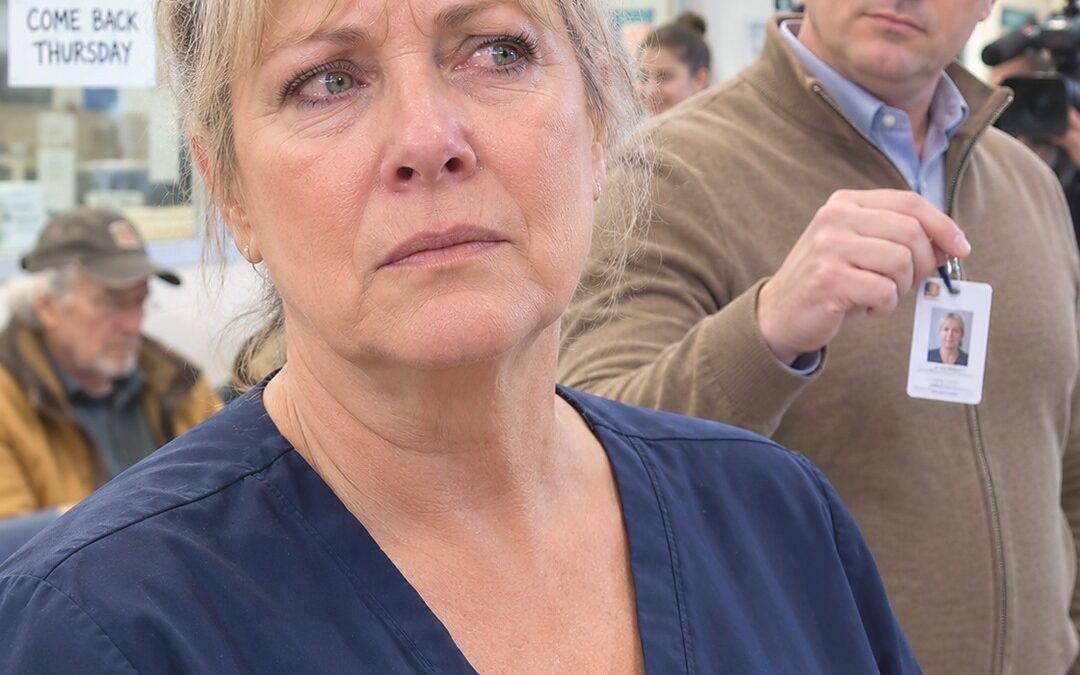
Brent held my badge up between two fingers and looked at the picture, which was twelve years old and taken back when I still bothered with Clairol, and then he slid it into the pocket of his tan quarter-zip like a parking stub.
Behind him Josh Pettit from Channel 6 had his camera on his shoulder. Channel 6 out of Parkersburg was shooting a piece for Friday's ribbon cutting, the "turnaround hospital" story, and Josh had spent twenty minutes on Earlene's information desk and the new blue chairs. Now he had something better, and he knew it.
"You're done here, Ruth," Brent said.
"I clocked out at seven-oh-four. You're a little late."
Somebody by the vending machine coughed into a fist.
The old man in the chair by the window had pulled his feet up under the seat. Wet socks, a brown Carhartt coat buttoned one hole off, a faded Ambrose Tire cap pulled low over gray hair. His hands were in his lap and he was looking at the hamper.
I didn't look at the hamper. I looked at Brent and said it loud enough for the back row, because the back row was who it was for.
"His discharge sheet says a box of Bridge insulin went home with him this morning. And Amber's window has had a sign up since seven."
Thirty-some heads turned with my finger toward the outpatient pharmacy window, where Amber Lusk was moving prescription bags from one bin to another and back again. The sign was taped to the inside of the glass, black marker on printer paper.
"BRIDGE PROGRAM — OUT OF STOCK — COME BACK THURSDAY"
"So which one's wrong, Brent? The paper or the window? Because he's a diabetic with no insulin, and it's sleeting."
"That's a temporary supply issue."
"That's what Neil told me in January. Three times. The last one was the sixteenth."
"We can discuss pharmacy matters privately."
"His name is—"
"I don't need his name, Ruth. I need that chair."
He turned his back on me. "Josh, kill the camera."
Josh let it down to his hip. The little red light on the front stayed on.
"Troy."
Troy Duckett came away from the front doors. He's thirty-four and built like a chest freezer, and his mother Linda had been in and out of our ER since the glass plant let her go in November. He took the old man's elbow the way you'd take your grandpa's at a funeral and kept his eyes off me.
"Come on, sir. I've got you."
"He's waiting on the county van," I said. "Nine-forty. He's got no ride."
"Then he can wait for it outside."
Vern Pickens started up out of his chair. Vern is sixty-three, runs a few cows and cuts hay out past Dutch Ridge, and he was there because his wife Nadine had gone down on their porch step at six that morning. Her wrist was wrapped in a dish towel with a bread bag of ice on it.
"Now hold on a minute, that woman sat up with my daddy when—"
"Sit down, Vern. Nadine needs you."
He stayed half up, looking at Brent, until Nadine got a fistful of his sleeve with her good hand and sat him back down.
The night doctor stood in the double doors with his scrubs wrinkled at the knees. He'd treated the old man himself at three in the morning. He looked at Brent, and then at the badge reader on the wall, the little black box that had turned green for me every night since they put it in. He kept quiet. I don't hold it against him. He's got student loans till he's my age.
Earlene Shipley came around her desk in her pink Auxiliary smock. She's seventy-six, twenty-two years at that desk. She had my winter coat over one arm and the old man's paper Kroger sack in her other hand, folded down at the top.
"You left these." She pushed the sack at me. Something hard knocked around in the bottom. His glucose meter. "Ruthie, you want me to call somebody?"
"Ray's home."
"That's not what I meant, and you know it."
She buttoned the old man's coat right while Troy stood next to the hamper looking like he'd swallowed a fly. One corner of the blanket hung over the rim. Brent was already asking Josh whether they could get the registration area again, with more of the new paint in the frame.
"Come on, sir," I said. "I'll run you home."
"Don't put yourself out."
"Too late for that."
We went out the front, through the automatic doors, the ones that open for anybody who walks up to them. A drop of water came off the canopy and went straight down the back of my collar.
*
My Impala is a 2012, a color GM called champagne and everybody else calls tan, and the trunk only opens from the inside. I brought it around to the entrance. Troy helped him into the passenger seat and shut the door and then stood there in the sleet with his hands hanging.
"I'm sorry, Ruth."
"How's your mom's sugar?"
He looked off at the parking lot. "She's getting by."
I turned the heat up all the way, which makes the passenger vent click like a turn signal, and pulled out.
"Locust Street," the old man said. "Four-eighteen."
Six blocks. He'd walked them at two-thirty that morning.
He came in at 2:50 with sleet on his shoulders and a meter in his coat that said 438, and he stood just inside the doors and told the triage desk he needed somebody to look at his sugar, polite, like a man asking directions. The night doctor gave him fluids and insulin and we checked him every hour. His insulin had run out Friday, he told me. I asked why he hadn't called it in, and he said, "Should've," and that was every bit of the answer I got.
Around four, when his color came back, I went to the warmer in the triage hall for a blanket and tucked it around his feet first.
"Feet first," I said. I say it to everybody.
"My wife's nurse used to say that."
"Every night nurse worth her clogs says it."
He went to sleep sitting up with his cap on his knee.
At 6:15 his discharge sheet printed, and halfway down it said, "Bridge Program: insulin glargine, 1 box (5 pens) — DISPENSED — N.B." The Bridge is supposed to send uninsured diabetics home from our ER with a month of insulin, one box, free, paid for by the hospital's foundation. At seven Amber opened her window and told him there wasn't any, come back Thursday. I asked her how his sheet could say he got it. "Talk to Neil," she said, and slid her clipboard back an inch, but I'd already seen one line on it.
"FENSKE, OPAL — 1 bx — Tue 3/3"
Opal Fenske died in bay four the Sunday before Christmas with her hand in mine. I took her wedding ring off myself and put it in a specimen cup for her daughter.
I'd clocked out at 7:04. His van wasn't till 9:40, so I sat with him out in the waiting room, and that's where Brent found us at 7:52 with a TV camera behind him.
Four-eighteen Locust was a little brick ranch with a porch swing hanging from one chain and one yellow ratchet strap. I pulled into the drive and came around to help, but he'd already got himself out and was holding on to the roof of the car until his knees made up their mind.
I looked at the cap. "Like the tire stores?"
"Like the tire stores."
"Ray used to take his truck to the one in Marietta. They always found one more thing wrong with it."
"That'd be them."
Then he took the discharge sheet out of the inside pocket of the Carhartt and unfolded it, but he held it so I couldn't see.
"Say that line for me. The insulin one. Without looking."
"Bridge Program: insulin glargine, 1 box (5 pens) — DISPENSED — N.B."
"And the window?"
"Out of stock. Come back Thursday."
He folded the sheet on its old creases, put it back inside his coat and buttoned the pocket over it.
"Write it down before you sleep, Mrs. Kessler."
I hadn't told him my last name. I figured he'd read it off my badge sometime in the night, before Brent put it in his pocket. I walked him up onto the porch and waited till he had the door open, and I told him to call his doctor about that insulin today, and he said he would, in the voice Ray uses when he agrees to see a dermatologist.
Then he went in. I sat in his drive a while with the vent clicking at me. Last August I'd stood up in a staff meeting and told Brent no about his memo on self-pay patients, the one that wanted them sent off before anybody had even screened them, and he'd been waiting seven months for something to hang me with. I backed out of his drive and went home to Front Street the long way, so I wouldn't pass the hospital.
*
Ray was at the counter in his old AEP sweatshirt sawing a Little Debbie Oatmeal Creme Pie in half with a butter knife, which just mashes them.
"You're late," he said.
"I got fired."
He set the knife down. "From where?"
"Ray."
"Well, I was hoping you'd picked up a second job." Then he got a better look at me. "Sit down."
I told him in about four sentences. The blanket, the hamper, Channel 6, my badge going into Brent's pocket. Ray is sixty-three. He spent thirty-eight years with AEP going up poles in ice storms, his heart's been in a-fib for three years, and he's never once needed a thing told to him twice. AEP quit paying retiree medical for linemen his age the year after he retired, so he's been on my plan ever since.
I looked down at my scrub top. The reel was still clipped there, empty. "World's Okayest Nurse," worn white letters on blue plastic. Ray bought it at a Marathon station in 1999 for three dollars and change, and I'd worn it every shift since.
I took hold of the little plastic end and pulled the cord out as far as it would go and let it go. It snapped back against my chest. I did it again. There was nothing on the end of it either time.
Ray came around the table and put his hand flat over it, his whole hand, and his thumb found the crack in the plastic he'd been promising to glue for about ten years. He kept it there till the refrigerator kicked on.
I got up and washed a cup that was already clean.
"What's it cost us?" he said behind me.
"Retiree health needs fifty-nine and thirty years. I've got thirty-one. I turn fifty-nine in February."
"Eleven months."
"And if they fire you for cause, they don't owe you a thing. Your Eliquis is fifteen dollars a month on my plan. Without it, it's five hundred sixty."
"That's what the girl at the Kroger pharmacy said that time. I told her she rang it up wrong."
"She didn't ring it up wrong, Ray."
He thought about it with his hand on the back of his chair. "I've got some pills ahead."
"How many?"
"Enough you don't have to sell the davenport today."
He put two slices of bread in the toaster. I told him the rest while it browned, the sheet and the window and Opal Fenske's name on a clipboard ten weeks after I'd taken off her ring. He turned around at that.
"Bev Yoder's mother?"
"Yes."
"Maybe they got a name mixed up."
"Maybe." The toast came out burnt along one side and I ate it anyway. "I'm going to find out."
*
I never did go to bed that morning. At 11:20, still in my scrubs, I sat at the kitchen table with Ray's reading glasses on my nose and filed a complaint against Hollis County Memorial with the Ohio Board of Pharmacy. Pharmacy director, Neil Barrow. There's a box you check if you want to stay anonymous, and I left it empty. I wrote down what I'd seen with my own eyes, at the times I'd seen it: the 6:15 sheet that said DISPENSED, the seven o'clock window that said OUT OF STOCK, and a woman on the pickup log for March 3 who'd died on December 21 holding my hand. I didn't have copies of anything. You don't carry patient paperwork out of a hospital because you're mad at management. I typed in my phone number, hit submit and wrote the complaint number on the yellow legal pad by the phone.
Then I called the Dollar General.
A boy answered and hollered "Bev, some nurse" without covering the phone, and I heard something heavy fall over and Bev telling somebody not to stack Tide on top of the dog food.
"Ruth? Is it Mom's bill again?"
"No, honey. It's not a bill. Did the hospital send your mother anything after December?"
She went quiet. A door shut on her end and the store noise went away.
"They sent her a refill reminder. End of January. For that free insulin. Her name on it and everything, right to her apartment."
"You still have it?"
"It's in her paper box. I haven't been able to go through…" She stopped. "Why?"
"Her name's on a pickup log at the pharmacy. Last Tuesday."
"She never got free insulin from them in her life. I drove her to Walmart for it."
"I know you did. Don't throw that letter out. And don't send it back to the hospital."
"You were with her," Bev said. "That Sunday."
"I was."
"Was she by herself any before I got there?"
"No, honey. Not one minute."
A truck started up somewhere behind her. "I'll find it tonight," she said.
I put it all on the legal pad with the times beside it, 11:20 and 11:40, like a chart, and Ray stood in the doorway and said, "Bed." I went, finally, a little after noon, under the quilt my mother made us for our wedding, and I slept like somebody had hit me with a shovel.
The doorbell woke me at 4:40. I heard Ray's voice come up through the floor register, and then I heard him on the stairs, slow, and he came in carrying my house slippers.
"Get decent," he said. "It's Lyle."
Lyle Sizemore is forty-four. I knew him when he was a skinny kid with an inhaler, and I sat with his mother Faye the night she died because he couldn't get back from a call in time. His county cruiser was idling in our drive behind the Impala.
Deputy Lyle Sizemore took his hat off on my porch, which is never a good sign. "Ruth, the hospital filed a report at two-fifteen," he said. "They say you walked out of there this morning with five insulin pens."
Part 2
"Five insulin pens?" Ray said from behind me. "She doesn't even carry spare socks to work."
"Ray, let him in."
Lyle wiped his boots on the mat for longer than they needed. He'd been coming into our house since he was fifteen, mostly because Faye sent him over with tomatoes in a Cool Whip tub, and now he couldn't look any higher than my shoulder.
"Hospital says you removed a box of Bridge Program insulin without authorization. I need your statement."
"Kitchen's this way. You remember."
I sat down at the table and he opened a little notebook, and I started at 2:50 that morning with a man walking in out of the sleet with his sugar at 438. The sheet printed at 6:15. Amber's window at seven. Brent and the hamper at 7:52.
"Did you handle the medication, Ruth?"
"There wasn't any medication to handle, Lyle. That's the whole point."
He wrote that down. "Where'd you take the patient?"
"Home. Four-eighteen Locust. Walter E. Ambrose, seventy-four. You go ask him what he carried out of there. You ask him what Amber told him."
"Was there anything in that sack?"
"A glucose meter, I think. Something hard knocking around in the bottom. I never looked inside it, Lyle. It was his sack."
Ray stood at the stove the whole time with his back to us and his hand on a burner knob, and he never once turned it on.
"Are you charging her?" he said to the stove.
"Not at this point, Ray."
"Then what's the report for?"
"Mr. Hollister says there's an inventory discrepancy."
"He took a blanket off an old man's feet." Ray turned around then. "She brought toilet paper from home once because the supply room ran out. Her own Charmin."
"That was one roll, Ray."
"It was a four-pack."
Lyle closed the notebook on his pen. "If Mr. Ambrose's story matches yours, that helps. I'll go now."
He left at 5:12. At 6:10 he was back on the porch with his hat in his hand again.
"Nobody home. Knocked at four-eighteen, no car, no lights. I left my card in the storm door and talked to the neighbor lady. She says a woman in a station wagon picked him up after lunch. Didn't know where to."
"He still needed insulin. Maybe his doctor took him somewhere."
"Could be." He turned the hat around once by the brim. "Till the hospital pulls it, Ruth, I have to write it up."
"I know you do."
"Mom always said you were the only one who could get that potassium down her."
"I put it in applesauce."
"She knew that."
"Of course she knew it."
He went. Ray finally sat down in his chair and looked at the place on the stove where nothing was cooking.
*
Tuesday morning the hospital put it on Facebook, under a picture of the new ER entrance with the canopy all lit up.
A longtime employee has been terminated following an internal review of medication handling.
It had two hundred fourteen comments by the time I found it. I read eleven. One woman wanted charges. A man from Marietta wanted to know if they were still having the ribbon cutting Friday, and was there going to be food. The eleventh was a lady I'd had in bay six with pneumonia in January, and she wrote, Ruth Kessler was always good to my family, something's not right here, and I put the phone face down on the table.
Ray was spreading peanut butter on toast. "Don't read that garbage."
"You don't know what I'm reading."
"I can tell from your mouth."
We were out of milk, so I went to the Kroger after lunch and kept my eyes on the dairy case. My phone rang twice in the parking lot from a Columbus number I didn't know. I let it go both times. I'd quit answering numbers I didn't know by ten that morning, after one reporter and one man with opinions about nurses. The first Columbus call left a voicemail, and I let it sit there with the red dot on it. The second one didn't leave a message.
At home there was an email from the Ohio Board of Nursing. A complaint had been opened on my license over "improper handling of prescription medication" during my shift on March 9. They wanted a written statement. Thirty-one years of counting narcotics at shift change with a second nurse watching, and Brent could put my license under review before supper.
Ray came in with the mail and dropped a thick envelope on top of it. The COBRA packet. Two thousand one hundred forty dollars a month, the two of us.
"That's more than the house payment ever was," he said.
"We don't have a house payment."
"Could I go on Medicare?"
"You're sixty-three."
"I feel seventy." He pulled open the junk drawer and started digging. "Where's a pen that works in this house?"
I had the Board of Nursing on speaker by then, and a recording was telling me my call was important. Ray moved a flashlight with the batteries rusted into it and a wad of twist ties and came up with an envelope instead of a pen.
"Here's something." He squinted at it. "Came back in February. From the hospital. Bridge Program refill reminder, Raymond Kessler. Says I'm due for more diabetes medicine. Diabetes, Ruthie. Me."
Right then a live woman came on the line, and I said, "Yes, I'm here, I'm here," and turned my back on him with a finger in my other ear.
Ray said to the kitchen, "I don't have sugar, I have Little Debbie."
When I hung up twenty minutes later, with a case number and nothing else, he'd gone out to the garage, and the letter was up on the refrigerator under the John Deere magnet next to the AEP retirees' calendar. I didn't even read it. I had enough paper of my own on that table.
That night I came down at eleven for a glass of water and found Ray at the kitchen table in his undershirt with every pill bottle he owns lined up in front of him. He'd poured the Eliquis out on a saucer and was counting it off with a butter knife, two at a time, like he'd seen the pharmacist do it at the Kroger pharmacy. He had his lips moving.
"What are you doing, Ray?"
"Inventory." He didn't look up. "Seems to be the thing this week."
"Come to bed."
"I lost count. Now I have to start over."
I sat down across from him in my nightgown and watched him start over. He got to a hundred and eighty and pushed the pile back into the bottle and wrote the number on the lid with a Sharpie, and then he wrote the date under it, small, like he used to tag a transformer.
"Ninety days," he said. "Give or take."
"That's a lot of give."
"It's enough to think in." He put the bottle back in the cupboard behind the coffee filters, where it always goes, and turned the light off over the sink. "Go to bed, Ruthie." He went up ahead of me and left the stair light on.
*
Wednesday I drove back to 418 Locust.
His storm door had a newspaper in it, and Lyle's card, and the porch swing was moving a little in the wind, pulling against its ratchet strap. I knocked twice anyway.
The lady next door came out in a man's hunting jacket and house slippers. She was eighty if she was a day, with her hair in pink foam rollers.
"You looking for Walt? I'm Dorothy Haskins."
"Ruth Kessler. I drove him home from the hospital Monday."
"Oh, you're the nurse." She looked me up and down like she'd been told about me and was checking. "Walt went to Columbus Monday with the lady in the Volvo. He does that."
"What lady?"
"Margaret something. Green station wagon. She comes down every so often. I called him Monday evening about the deputy, and he said he was staying over." She pulled the jacket tighter. "Lady carried a folder about as thick as my Bible."
"Is he all right? His sugar was bad."
"He walked to that car on his own two feet, honey. He's been taking care of himself a long time."
I found an old envelope in the glove compartment, wrote my number on the back and Please call me, Ruth Kessler (the nurse), and wedged it in his storm door above the handle where he couldn't miss it.
At 2:18 Jess texted me.
Neil's been in the cabinet logs all morning. Don't call me at work.
I typed Did he say anything? and then deleted it, because she'd told me not to, and she's got a mortgage.
That afternoon I wrote my statement for the Board of Nursing. I stuck to what I'd seen. I didn't guess about who'd changed what, or why Brent called the sheriff. I kept coming back to the same two lines, the sheet that said DISPENSED and the window that said OUT OF STOCK. I'd stood in front of that window myself at seven o'clock Monday morning.
Ray brought me supper from the diner around six, two turkey dinners in foam boxes and one piece of lemon pie to split, because he'd decided I wasn't cooking.
At 8:36 the doorbell rang. Ray was upstairs with a ballgame on, so I went.
Vern Pickens was standing under our porch light in his feed-store jacket, with his Ford parked crooked at the curb and the engine running. I could see Nadine in the passenger seat with her cast propped on a bed pillow.
"Vern? Is Nadine all right?"
"She's fine. She's the one told me to come." He looked down at his boots. "We saw what they put on the Facebook about you."
"Don't believe everything you read."
"Didn't believe a word of it."
Vern Pickens held up a folded discharge sheet with a Kroger receipt stapled to the back. "Says here I got five pens in January. Funny. I paid Kroger three hundred and eighty-nine dollars for 'em."
Part 3
By seven Thursday morning Vern had his paperwork spread all over my kitchen table, and Nadine was telling him to quit setting his coffee cup down on it like it was a feed bucket.
"You're dripping on Ruth's papers."
"It's coffee, Nadine."
"I know what it is."
She'd made him bring her. Her wrist was in a fresh cast now, and she'd pulled one of Vern's wool boot socks over her fingers to keep them warm.
I put his discharge sheet next to the Kroger receipt. Tuesday, January 6, high blood sugar, our ER. Halfway down was the same line Walter Ambrose had on his: Bridge Program insulin, one box, "DISPENSED — N.B." The window had told Vern to come back Thursday. On Thursday, January 8, he'd gone to the Kroger pharmacy instead and paid $389.47.
"Why didn't you go back to Memorial for the free box?"
"Because Wednesday night I had one shot left in the pen," Vern said. "I wasn't betting my feet on them finding some Thursday."
"He sold two calves early to cover it," Nadine said. "Got sixty dollars a hundredweight less than he'd have got in April."
"Didn't need those two."
"You talked about those two calves all the way home from the sale barn."
Vern folded his arms over his chest. "Well, April's a long ways off when you're out of insulin."
I took a picture of the sheet with my phone and another of the receipt, with the date and the total showing, and gave both back to him. "Those are yours. You keep them."
"Ruth, I watched that Hollister take a blanket off a sick old man Monday and then take your badge off you." He was looking into his cup. "Nadine says I should've stood up sooner."
"I said you should've stood up all the way," Nadine said.
"I told you to sit," I said. "You did what I asked."
"Well." He set the cup down on the receipt, and Nadine moved it. "Who else do we need to see?"
"We?"
"Truck's full of gas."
I didn't need a computer to tell me who else was self-pay and diabetic in Hollis County. I've started IVs on half of them. And I wasn't going to go into anybody's chart, either. Their papers were their own papers, and if they wanted to show me, they could.
*
By nine we were parked behind the Belden Dollar General. Vern and Nadine stayed in the truck with a thermos and the crossword, and Bev Yoder let me in the stockroom door with a box cutter in her hand.
She's thirty-eight, the assistant manager, and she's run that store more or less by herself since the manager's knee surgery. She had on her red work shirt with her name tag clipped on crooked, and the stockroom smelled like cardboard and lavender Gain.
"I found it," she said, and took an envelope out of her back pocket.
Hollis County Memorial Hospital, Bridge Program, refill reminder. Dated Thursday, January 29. Addressed to Opal Fenske, who'd been dead since December 21.
"I opened it thinking it was another bill," Bev said. "I called the number. Billing said it was pharmacy. Pharmacy said they'd check. That was the end of that."
"Will you keep the original for the state? Somebody may come ask you about it."
"Are they going to ask about Mom dying?"
"They might ask what day she passed, honey. That's all they'd need from you."
She looked at a carton of paper towels on the floor. "I still have her on the answering machine. I can't make myself tape over it."
I remembered Opal coming into bay four in her cleaning-company sweatshirt, apologizing because her shoes had tracked salt on our floor.
A driver hollered through the open back door to ask where she wanted the paper towels. "Back wall," Bev said. "Not in front of the fire exit, I mean it." Then she turned back to me and folded the letter along the old creases, slow, and put it back in her pocket.
"If somebody's been using her name," she said, "I want them to quit."
*
Linda Duckett lives in a white duplex on the far side of the glass plant, the one that laid her off in November. She's fifty-seven and has been a type 1 since she was nine. She opened the door, looked past me at Vern's pickup, and said, "What happened?"
"Nothing new. I wanted to ask about your ER visit in January."
Her kitchen had a Walmart calendar over the stove and a handwritten schedule for her shots stuck to the refrigerator. She pulled a plastic folder out of a drawer. She keeps everything, she said, because she thought unemployment might pay some of it back someday.
Tuesday, January 13. Bridge Program insulin. "DISPENSED — N.B."
"Did they give you a box?"
"They told me come back Thursday. I came back Thursday. They still didn't have any, so I went to Walmart." She slid the sheet across to me. "Troy'd have a fit if he knew I was showing you."
I knew Troy. He was the one who took the old man's elbow Monday.
"Why would he?"
"He works there, Ruth. He thinks anybody that complains gets him in trouble." She put her glasses on to look at her own paper. "If it says they gave me five pens, where'd they go?"
"That's what I'm trying to find out."
"Can they make me pay it back? If they say I got it?"
"No, honey. You didn't get it."
"But they've got the paper."
"So have you. Keep it."
I wrote the Board of Pharmacy's number on the back of one of my grocery lists and she tucked it behind the calendar. At the door she said, "If Troy asks, you tell him I showed you on my own."
*
By three o'clock I had pictures of seven discharge sheets on my phone and seven names with phone numbers beside each date on my legal pad. Three came from people I'd known since their kids were in diapers, and two more from people who said they'd come to the ribbon cutting Friday with theirs if I wanted them there. Every one of them remembered being told to come back Thursday.
Vern had put sixty miles on that Ford and wouldn't take a dime for gas. We stopped at the Marathon on Route 7 for pop, and he bought a sack of salted peanuts and ate them one at a time all the way back to town.
"How long you think they been doing this?" he said.
"I don't know."
"That's a lot of mistakes."
"Don't go making up what you don't know, Vernon," Nadine said, without opening her eyes.
At home I sent the copies to the Board of Pharmacy from the kitchen computer, with everybody's phone number, because the woman on their complaint line said an investigator would need to call them. At 4:16 I got back a computer email that said thank you for your submission. I wrote the time down.
*
At five Brent Hollister's black Tahoe pulled into our driveway and parked half on the grass.
I knew that truck. He takes up two spaces with it in the Memorial lot, right by the door. He got out in the same tan quarter-zip with the hospital logo on the chest, his badge on its blue lanyard tucked inside, and a leather folder under his arm.
I went out on the porch before he could get to the steps. Ray came out behind me and stood in the door.
"Ruth. Could we talk?"
"You're at my house, Brent."
"I heard you've been visiting former patients today."
So Linda had said something to Troy at lunch, and Troy had said it at work, and somebody had said it in front of Neil. Anything said in that building gets all the way around it in about forty minutes.
He opened the folder. He was quiet and reasonable, which was worse than Monday. "There's no reason to drag a misunderstanding through the state boards."
"Seven people say their insulin was marked dispensed and never handed over."
"We're reviewing those records."
"Then you've got plenty to do back at the office."
He took out a single sheet. "We can reclassify the separation. Call it a voluntary retirement. You'd keep your retiree health coverage, as a courtesy. The hospital withdraws its police report, and we tell the Board of Nursing it's been resolved internally."
"What's the catch?" Ray said from the doorway.
"There are standard acknowledgments."
"Read them to me," I said.
He held the paper out instead. Across the top it said Voluntary Resignation and Statement. The first two lines were about my employment and my benefits. Line three said:
"I removed five Bridge Program insulin pens from the hospital without authorization and did not deliver them to the patient."
"That's a confession."
"It's an acknowledgment of a handling error."
"I didn't take five pens, Brent."
"Medication handling can be complicated."
Ray came down off the porch and held his hand out, and I gave him the paper. He read line three with his lips moving, like the pills.
"You want her to lie so she can keep her insurance."
"I'm asking her to acknowledge an error, Mr. Kessler."
"She didn't make one."
"With respect, you weren't there."
"No. I was here when the deputy came looking for stolen medicine."
Brent looked off down Front Street, at nothing. "The hospital needs stability right now. We're celebrating a very important recovery tomorrow."
"Your ribbon cutting."
"And you'd prefer I didn't talk about the pharmacy in front of the camera," I said. "Again."
"I'd prefer the facts be handled properly."
"Then why are you standing in my driveway instead of fixing seven discharge sheets?"
He shifted the folder to his other arm. "I'm trying to help you, Ruth."
Somebody down the street was trying to get a cold truck to turn over, and the Bowmans' dog was barking at it.
Brent set the paper on the hood of my Impala and tapped line three. "Nine-thirty tomorrow, my office, before the cameras," he said. "Sign that, and Ray keeps his pills. Don't, and you can explain to the Board of Nursing where five pens went."
Part 4
At six Ray put Brent's paper down next to my plate, square with the edge of the table, and said, "Sign it, Ruthie. I've got ninety days of pills."
"I didn't do it, Ray."
"I know you didn't."
"Then what am I signing?"
"Something that keeps you insured." He sat down across from me with his sweatshirt sleeves pushed up. "Ninety days. After that we figure something out."
I got the COBRA envelope off the top of the toaster and turned it over and did $560 times eleven on the back of it with the pen from the junk drawer that finally worked. Ray watched me write it.
"That's one prescription," I said.
"I know what it costs. I'm the one taking it."
He put his hand over mine, over the pen and all. "You ever see what happens to the lineman who signed off on somebody else's bad splice?"
"You told me about Dewey."
"All right," he said. "All right."
I pushed the statement off toward the salt and pepper. He put supper away. I sat there with the number on the back of the envelope until the doorbell rang at 8:05.
It was Walter Ambrose, in a good dark wool coat this time and no cap, holding up the envelope I'd stuck in his storm door. Beside him was a woman about sixty-five with short gray hair and a leather folder under her arm, and behind them at the curb was a green Volvo wagon.
"Found your note, Mrs. Kessler."
"Where on earth have you been? Your sugar…"
"Columbus. Sugar's fine. Ken's got me back on my insulin." He nodded at the woman. "This is Peg."
"Margaret Lindell. Peg." She shook my hand like a man does. "I'm chair of the board of the Dacus Health Foundation."
"The foundation that owns Memorial."
"That's right."
Walter took his coat off, which is when I knew they were staying.
"I'm Walt Ambrose. I own your hospital, more or less."
Ray, behind me, said, "Well, I'll be dipped."
*
Ray took them into the kitchen, and I moved Brent's paper and the COBRA envelope off the table. Peg didn't want coffee. Walt asked for water.
"I had you down for a retired tire man," I said.
"I am one, mostly. One garage in seventy-nine. Sold the whole thing ten years ago."
"Thirty-one stores," Peg said. "Ohio and West Virginia."
"And then you went and bought a hospital."
"Fourteen months ago it was going under," he said. "The hospital. Chapter Eleven. They'd have shut the ER first."
"Then why in the world did you let Brent throw you out Monday?"
He didn't answer that. He took out his wallet instead and worked his driver's license loose with his thumb, and from behind it he slid out a thin strip of white medical tape gone the color of weak tea, and he laid it on my kitchen table.
"WARM BLANKET ON FEET FIRST — she gets cold. —R.K."
The capital R curled back on itself in a loop at the top. I've made my R's that way since nursing school because Sister Agnes made fun of my plain ones.
I picked it up by the edges.
"Mae Ellen," Walt said.
Nineteen years, and it all came back in the wrong order. The end room on 3 West. A woman of fifty-four with her kidneys gone and her feet always cold, everybody calling her Mae Ellen, nobody calling her anything else. A dark-bearded man asleep sitting up in the recliner by her bed every night for eleven nights, who I'd only ever called her husband. I'd torn that tape off the roll myself and stuck it on her footboard at two in the morning so the day girls wouldn't forget.
"You kept this," I said.
"Nineteen years."
My chair scraped back. I went to the sink and filled the kettle, which nobody had asked for, and stood there holding it under the faucet after it was full, until the water was running over my fingers and down the front of my sweatshirt.
Ray came over and stood beside me.
"Ruthie."
"Do they want tea?"
"Nobody asked for tea."
I turned the water off and dried my hands on the dish towel and held on to the towel for a minute. When I came back to the table, Ray had pulled my chair out for me.
"Tell me about her," I said.
"Nineteen eighty-two," Walt said. "That first garage was about to go under. Bad winter. Folks needed their cars fixed and couldn't pay me. Mae Ellen had the diabetes even then. One night she skipped her shot so the vial would last till payday, and she didn't tell me. I found her sitting on the bathroom floor at four in the morning." He looked at Ray instead of me. "Later on, when there was money, she never let it go. Anybody leaving a hospital ought to have their medicine in their hand. The Bridge was hers. And she hated people's names on things. Hated those little brass plaques on church pews. So it goes through a trust with her maiden name on it, Dacus, and my name's not on any of it."
"Walt doesn't hold a title anywhere," Peg said. "I sign the contracts and the board minutes and the tax filings. All Brent has ever been told is that the money comes from an anonymous donor, the Dacus Trust, who works through me. Walt has no picture on the internet, and until Monday he hadn't set foot in that building since Mae Ellen died."
"So Monday," I said.
"You said feet first," Walt said. "And then I read your badge."
"You could've told me."
"I should have."
"Why were you even there?"
"The foundation's been getting letters since fall," Peg said. "People saying Memorial sent them home with nothing. Brent's reports said eleven hundred forty patients served."
Ray looked over at the refrigerator, at the letter under the John Deere magnet. He didn't say anything.
"So I went in the way they go in," Walt said. "Let my insulin run out Friday on purpose. Ken Albright called me every few hours all weekend and had me check, and his rule was, 'Over four hundred, you go in, Walt, or I'm calling the squad myself.'"
"Four thirty-eight," I said.
"Two-thirty Monday morning. So I went."
*
Peg opened her folder. She talked like the hospital lawyer she used to be, short, and she kept stopping to let me catch up.
"Your complaint Monday is the reason this moved," she said. "The pharmacy board had heard rumors since fall. Yours had a name and a sheet and a time on it. Somebody could check it."
"Did they?"
"By Monday afternoon the state's investigator was in the pharmacy computer. Neil has been marking Bridge boxes dispensed since last May, for people who got told to come back Thursday."
"Like Vern," I said. "Like Linda."
"Like all seven on that legal pad of yours." She turned a page. "Thursday nights the boxes go out the back dock in Neil's truck, across the river into Kentucky, to a surplus outfit that pays cash."
I looked out the window over the sink, toward town. "Thursday nights. Like tonight."
"Like tonight."
"Hundred and ninety-one thousand dollars since May," Peg said. "Brent signs every report."
"That's Mae Ellen's money," I said to Walt.
"Yes, ma'am."
"Then why isn't anybody in handcuffs?"
"Because tonight's load has to leave that dock," Peg said. "Forty boxes. The Kentucky State Police are going to let Neil unload and drive home before they open a single one. If anybody in that building gets a whiff of it, those boxes go in a dumpster and Neil says Ruth Kessler took them. The investigator told us not to contact a single witness till the load was stopped. You're a witness, Ruth. So is your deputy. I called you twice Tuesday anyway. I left you one message. And then Walt found your note on his door, so here we are, and Paul Weatherby can yell at me tomorrow."
I got my phone out of my purse, and the red dot was still sitting there from the Kroger lot. I pressed it with Ray leaning over my shoulder.
"Mrs. Kessler, this is Peg Lindell in Columbus. Please don't sign anything. Call me."
"I don't answer numbers I don't know," I said. "Not this week."
I slid Brent's statement across the table to her. She read line three out loud, flat, the way you read a lab value.
"I removed five Bridge Program insulin pens from the hospital without authorization and did not deliver them to the patient."
"He brought this here?"
"Five o'clock. Put it on the hood of my car."
"Meanwhile the hospital filed a police report on me," I said to Walt. "The nursing board opened a complaint. The whole county thinks I'm a thief. And Lyle Sizemore went to your house Monday night and nobody was home."
"Dorothy called me about him right after," Walt said. "I was already in Columbus, sitting across a table from the state."
"So you let me hang since Monday."
"Since the deputy knocked on my door Monday night. I'm sorry."
He kept his eyes on mine. "I had a lawyer in the car and a doctor on the phone and money in the bank. You had a deputy in your kitchen and Ray's pills to count. I should have picked up a phone anyway, and I didn't, and that one's mine."
"Brent wants you in his office at nine-thirty?" Peg said.
"Before the cameras."
"I'd like to be sitting in that chair when he finds out," Walt said.
I thought about Kayla laughing at sidewalk while that blanket hung over the rim of the hamper with one corner out.
"I'm not going to his office," I said. Ray looked at me. "I'll be in the waiting room at nine-thirty."
I reached for the kitchen phone and Peg put her hand flat on it. "After ten-forty," she said. "Not one call before that truck's gone." At ten to eleven I called Vern first and told him to bring Nadine and his sheet. Then Bev. Then Linda Duckett, who got scared until I told her the foundation's board chair would be standing right there. Earlene answered on the sixth ring.
"I'm on the desk at nine tomorrow, Ruthie. What's wrong?"
"Bring your reading glasses."
At the door Walt asked for the tape back, and I gave it to him, and he put it behind his license where it lives.
*
At 11:52 the porch light came on again. I hadn't gone up yet.
Troy Duckett was standing on the mat in his security uniform with his radio still on his belt and his truck running at the curb. He didn't come in when I opened the door wider.
"Mrs. Kessler, I need to tell you something."
"Come in out of the cold, Troy."
"No, ma'am." He looked at the porch boards. "I got off at eleven. After the dock tonight. I went home, and Mom was at the kitchen table with one of those twenty-five-dollar vials from Walmart and the calendar, writing down which nights she was going to skip so it'd last till her unemployment comes. I load his truck at twenty to eleven off a dock sheet Mr. Hollister initials every week, and Neil drives it off. That's all I ever did, and I never asked."
I held on to the doorframe.
Troy took a folded paper out of his shirt pocket and held it out to me.
"Mrs. Kessler, my mom's paper says she got five pens in January," Troy said. "I'm the one who carried them out to Neil's truck."
Part 5
At 9:30 Friday morning I sat down in the blue vinyl chair by the window, the same one Walter Ambrose had been shivering in four days before, with Brent's statement folded in my lap.
They'd strung a red ribbon across the hall between two chrome posts, right where the wheelchairs come through to registration, with a bow in the middle the size of a dinner plate. There were about sixty people in a room built for thirty. Josh Pettit had his camera set up by Earlene's desk. County Commissioner Tom Hupp was eating a cookie off the refreshment table and getting crumbs on his tie. Kayla was behind her glass in lipstick I'd never seen her wear on a regular Friday, and Amber was at her window, and the sign was gone from it.
Neil Barrow stood by a folding table covered in Bridge Program insulin boxes, stacked in a pyramid with all the labels turned to the camera. Insulin has to stay cold, so I knew without asking they were empties out of the stockroom, for the picture. I counted twenty-two before somebody's head got in the way. On Monday there hadn't been one, empty or full.
Vern and Nadine were along the wall by the vending machine, Nadine with her cast in a sling, Vern in a clean barn coat with his sheet in the inside pocket. Bev had come straight from the store in her red shirt. Linda Duckett sat near the front doors, close to where Troy stood with his radio held flat against his chest. Two more of my seven were on the bench by the fish tank, each with a folded paper. Ray stood at the back by the coffee urn with his AEP jacket zipped halfway, because the zipper sticks there.
Neil saw me first. He said something to Brent, and Brent turned around, and his smile quit.
He came straight across the room.
"Office," he said, low.
"Morning, Brent."
"My office. Now."
"I'll sign right out here."
He looked at the statement on my lap and then at the room. "This is a private hospital event."
"There's a county commissioner and a TV camera, Brent. You invited half of Belden."
"You're putting your retirement at risk."
"You already did that Monday."
He stood over me one more second, close enough I could smell his aftershave, and went back to the lectern.
Kayla was watching through the registration glass. I saw her look at the chair, and then at Brent's pocket, the one my badge had gone into. Earlene saw her looking too. She came out from behind her desk and went and stood next to Vern.
*
At ten Brent took the microphone. Tom Hupp stood off to the side holding a pair of ribbon-cutting scissors as long as hedge shears, holding them out from his body.
Josh put his eye to the camera. Brent smiled into it.
"Thirteen months from bankrupt to black."
A few people clapped.
He talked about fiscal discipline and community benefit for a while. Then he put his hand out toward Neil's pyramid.
"Every diabetic who walks through these doors leaves with insulin. That's my Bridge Program."
Vern made a sound like a steer stepping on a board. Nadine put her good hand on his arm.
"Now, in the interest of transparency," Brent said, "I need to address a difficult personnel matter. Some of you have seen speculation online." He picked a printed page up off the lectern and held it out toward Josh's lens, with his thumb at the top corner. "I won't read a patient's name out loud. Some of us respect privacy. But our pharmacy records show that on Monday a box of Bridge Program insulin was signed out to former nurse Ruth Kessler for delivery to this patient. And the patient never received it."
I stood up.
"No, he didn't."
The whole room turned, and Josh turned with it.
"Ruth, this isn't the time."
"You're right that he never got it. Nobody gets it, Brent. Ask them."
Vern was already up. He took his sheet out of his coat and unfolded it in both hands and held it up so the camera could see it, with the Kroger receipt hanging off the back.
"Mine says I got a box January sixth. Your window told me come back Thursday. I paid three hundred eighty-nine dollars and forty-seven cents at the Kroger two days later."
"Sir, we'll be glad to address individual concerns after the ceremony."
Bev stepped out from the wall. "Then address my mother. Opal Fenske. She died December twenty-first, right back there in bay four, and in January you mailed her a refill reminder." She held the envelope up over her head. "And somebody's got her down for picking up insulin last week."
A woman near the ribbon turned and looked at Neil. He moved one box about half an inch to line it up with the next one.
Linda got up out of her chair by the door. She didn't look at her son. "Mine says January thirteenth. I came back Thursday like they said. There wasn't any then, either."
Then the two on the fish-tank bench stood up with their folded papers, one and then the other.
Tom Hupp set the giant scissors down on the registration counter. "Brent, what's going on here?"
"Clerical errors happen in any pharmacy, Commissioner."
"There's five people standing in front of you, Brent."
*
The front doors slid open.
Walter Ambrose came in out of the cold in his old brown Carhartt and the Ambrose Tire cap, with Peg Lindell on one side of him and on the other a man about fifty-five in a plain gray jacket, with an Ohio Board of Pharmacy badge clipped to his belt.
Brent barely looked at him. "Sir, ER check-in's to your right. We're in the middle of a ceremony."
Walter said, "Thank you," and walked past him to the chair by the window.
I stepped back from it. He sat down slow, one knee at a time, and took his cap off and set it on his knee.
"Cold in here," he said.
I didn't have a badge. The warmer was on the other side of those double doors, and the double doors don't open for you without a badge. I looked through the little window in them, and Jess Morrow was standing on the other side in her scrubs, already looking back at me. The reader went green. She came through with a blanket folded over her arm, steam still coming off it a little, and put it in my hands.
"Here, Ruth."
I knelt down and put it over his feet first and tucked it under his heels.
Brent came across the room at us. "Ruth, I told you Monday—"
"I'm Walter Ambrose. I paid for the warmer."
Brent stopped where he was. He looked at Walt, and then he looked down at the page still in his own hand, the one he'd been holding up for the camera, and I watched his thumb start at the top of that page and go down it line by line until it stopped.
Peg said, "You've been holding his name up for the camera for five minutes, Brent."
He looked up at her. "Margaret."
"Mr. Ambrose is the Dacus Trust. Every dollar that bought this building was his, and I sign everything because he asked me to." She said it to the room, not to him. "You had his name on a sheet Monday morning. You told Ruth you didn't need it."
Tom Hupp leaned around Peg to get a better look. "Ambrose Tire Walt?"
"Hello, Tom."
"Good Lord. I bought my first set of radials off you."
Brent was still holding the page. "The donor was anonymous," he said, to nobody in particular.
"To you," Peg said.
*
Walt reached inside the Carhartt and took out the discharge sheet, folded small, and handed it to the man in the gray jacket.
"Paul Weatherby, Ohio Board of Pharmacy." He held the sheet where Josh could see it. "This printed at 6:15 Monday morning. 'Bridge Program: insulin glargine, 1 box (5 pens) — DISPENSED — N.B.' At 1:58 that afternoon the log entry for this patient was changed from Neil Barrow's login to read 'AMBROSE, WALTER E. — 1 bx — dispensed to R. Kessler RN for patient delivery'. Mr. Barrow unloaded forty Bridge boxes at Tri-State Medical Surplus in Ashland last night and drove home. The Kentucky State Police opened them at a quarter to five this morning."
Neil took his hands off the pyramid.
Amber slid her window open. "Mr. Weatherby?" She held her clipboard up flat against the glass. "I gave you a copy Wednesday. Neil told me to put that sign up. I kept asking him where the boxes went."
Troy came off the front doors then. Linda watched him walk clear across the room, past the ribbon, to the chair by the window, and he stood in front of Walt and said it loud enough for the back row.
"I loaded them. Every Thursday night, a hundred dollars cash. Neil said they were expired returns. My mom's name is on that log."
Linda put her fingers over her mouth.
Neil sat down on the edge of his display table like his legs had quit, and one box slid off the top of the pyramid and hit the floor, light as a cereal box.
Brent pointed at Troy. "That employee just admitted to taking cash for unauthorized handling. This is a security failure, Commissioner, and it'll be dealt with."
"You signed off on the dock schedule, Mr. Hollister," Troy said. "Every Thursday. Ten-forty. I've got the sheet in my locker with your initials on it."
Brent put his hand down.
Peg opened her folder. "The Dacus Health Foundation board met by phone at seven this morning, Brent. Every voting member was on the call. You're terminated as president and CEO of Hollis County Memorial, effective now. Your April renewal is off the table. Your community-benefit bonus is withheld while they count what's missing."
"I have a contract, Margaret."
"The board has your contract."
She nodded to the day security supervisor, who'd been standing by the elevator the whole time with his arms folded. Troy stood next to him and kept his hands at his sides. He keyed his radio. "Control, kill Hollister's badge. Effective now."
The radio crackled back. "Copy. Hollister's badge is off."
Brent turned and looked at all of them, Hupp, Peg, Josh's camera with its little red light. "I'll need my things from my office," he said. "We'll settle the rest through counsel."
He walked to the double doors and held his badge up to the reader. Red. A short beep.
He did it again. Red. Beep.
I was standing about where I'd stood Monday. The blanket was on Walt's feet.
"Blankets are for patients, Brent. All of them. These doors don't open for you anymore."
He swiped a third time. Red light, short beep. Then he turned the badge over in his hand and looked at his own photo on it like it might be some other man.
Earlene bent down and picked the insulin box up off the floor and set it back on top of the pile. Over by the coffee urn Ray had his hands in his jacket pockets, and he was looking at me instead of Brent.
The supervisor crossed to the doors and held out his hand. "I'll need that badge, Mr. Hollister."
Brent looked at the hand. Then he unclipped the badge from the blue lanyard and laid it in the supervisor's palm. It went in his shirt pocket, same as mine had gone in Brent's.
Weatherby had come up beside me and held one more page out to me. "Mrs. Kessler, who's Raymond Kessler?" he said. "Because according to Mr. Hollister's own login, he's been getting free insulin since January."
Part 6
"He's my husband," I said. "He's sixty-three, and he's standing right over there by the coffee."
Ray came across the room with his jacket still stuck at the halfway mark and read it over my shoulder.
"KESSLER, RAYMOND — 1 bx — entered B. HOLLISTER — Fri 1/23"
Friday, January 23. One week to the day after I'd asked Neil Barrow for the third time why the Bridge was always out.
"That's what that letter was," Ray said. "The one on the icebox."
"What letter, Mr. Kessler?" Weatherby said.
"Refill reminder. Came in February. She never even looked at it."
It was still under the John Deere magnet. I'd walked past it maybe forty times since Tuesday.
Weatherby went over to the display table, where Neil was still sitting on the edge with his hands hanging between his knees. "Mr. Barrow. The other entries come from your login. This one doesn't. Why?"
Neil looked at Brent, and then at the floor tile between his shoes. "He wanted her husband in there. In case she kept asking. I told him no."
"Why?"
"I won't put my name next to that."
"Neil," Brent said. "Stop talking."
"Mr. Hollister, did you make this entry?"
"I'm not answering anything without counsel."
I held the page up so he had to look at it. "My husband doesn't have diabetes, Brent. Ray doesn't have sugar. He has Little Debbie."
Vern laughed first, one big bark, and Nadine yanked his sleeve, and then about half the room was laughing, and Brent stood in the middle of it with the blue lanyard hanging empty off his neck.
The automatic doors opened and Lyle Sizemore came in with another deputy behind him and took his hat off.
"Ruth." He held up a paper. "The hospital's report against you is withdrawn. As of nine this morning. There's no case."
Then he looked past me. "Mr. Hollister, I need you to turn around for me and put your hands behind you."
"You can't do this in front of these people."
"Yes, sir, I can."
Brent looked at Peg. She stayed by Walt's chair with her folder shut. He looked at Tom Hupp, and Hupp took a step back toward the cookies. Lyle put the cuffs on him and checked them with two fingers, like they teach you.
"Josh," Brent said. "Turn that off."
Josh didn't. The little red light stayed on, same as Monday.
Lyle walked him out the long way, through the middle of the waiting room, past Vern and Nadine, past Linda with her hand still over her mouth, past Earlene at her desk and the blue chair by the window where Walt sat with his feet in a warm blanket. The other deputy got Neil up off the display table. Neil said he needed to call his wife, and the deputy told him he'd get to, and they went out the front after Brent.
Kayla came out from behind her glass after they were gone. Her hands were shaking.
"I laughed Monday. I'm sorry, Ruth."
"I heard you."
"I know you did."
"Go help Earlene with the ones waiting to register, honey. They're still sick."
Walt waved me over. He hadn't moved out of that chair.
"Mrs. Kessler. What do you want?"
"We can talk about reinstatement," Peg said. "Compensation. A position, if you want one."
"I don't want a title. I want the shifts I missed paid like I worked them."
"That's done," Peg said. "What else?"
I looked at the double doors. Jess was standing behind the little window with another blanket over her arm, for a lady in a wheelchair who'd come in during the arrests and was sitting there in her coat like nothing had happened.
"My badge back. And that warmer out here where people can reach it."
*
Tuesday, August 18, I sat in the second row of the Hollis County courtroom with Ray on one side of me and Vern on the other. Nadine had made Vern wear his good shirt, and he'd buttoned it wrong at the collar and wouldn't let her fix it in the parking lot. Bev and Linda sat behind us. Troy sat at the end of our row in a borrowed sport coat. He'd told the prosecutor all of it, the Thursday nights and the hundred dollars, and he'd gotten probation, and he'd lost about fifteen pounds since March.
Brent was at the defense table in a charcoal suit with a pair of lawyers from Columbus. He and Neil had both pleaded guilty back in July, Brent to theft and tampering with records. This was the day the judge said what it cost them.
The prosecutor asked to show the court a recording from Monday, March 9, and Josh Pettit stood up in the back row and said yes, ma'am, it was his.
The monitor was turned toward us. It started up on Josh's shoulder, nice and steady, the blue chairs and the new paint. Then Brent's arm came into the picture and pulled the blanket off a pair of wet socks and dropped it in the hamper.
"Blankets are for patients who pay, Ruth. You want to keep him warm, do it on the sidewalk. These doors don't open for you anymore."
Then the picture tipped and dropped, and after that it was low and crooked, from about hip height, the bottoms of the chairs and a lot of shoes. You could still hear every word. My voice starting to tell him the old man's name. Brent's voice saying he didn't need it.
Brent kept his eyes on a spot on the floor about two feet in front of his shoe.
"Mr. Pettit, Mr. Hollister told you to kill the camera," the prosecutor said. "Did you?"
"I put it down by my hip. I didn't turn it off."
The judge asked Brent if he had anything to say. He stood up and said he regretted any harm to the community, and his lawyer touched his sleeve, and he sat back down.
"Mr. Hollister, you typed a healthy man's name into a pharmacy log to scare his wife," she said. "Six years."
Neil got thirty months, because he'd sat down with the investigators the first week and walked them through every Thursday. She read the restitution order out loud, $191,520, owed by the two of them together, and asked each one if he understood the amount. Neil said yes. Brent leaned over to one of his lawyers first and then said it. Walt sat across the aisle with Peg and watched the judge sign it.
When it was over a court officer took Brent by the elbow, about like Troy had taken Walt's. At the side door Brent turned around and looked out over the courtroom like he expected somebody from the hospital to stand up and say a word for him. Peg had her folder in her lap. She stayed in her seat, and so did everybody else, and the officer took him on through.
On the courthouse steps Vern stopped to fight with his collar. "Six years," he said.
"You heard her," Nadine said, and fixed his button for him.
Peg came down with a letter in her hand and gave it to me. The Board of Nursing had closed my case back in April, no violation. My retiree health was intact. The hospital had paid me for every shift on the schedule since March 9.
Ray read it over my shoulder. Then he took his glasses off and cleaned one lens on his shirttail and read the benefits paragraph again, and folded it up and put it in the inside pocket of his sport coat instead of giving it back.
"I'm going to the Kroger pharmacy tomorrow," he said. "Might as well get the refill."
Peg told Linda the Bridge didn't go through the window anymore. The box goes home in your hand, from the ER desk, at discharge. Amber had kept her job and ran the program now.
"No coming back Thursday?" Linda said.
"No coming back Thursday."
Walt came down the steps behind us with his coat over his arm.
"They approved the name," Peg told him. "Mae Ellen's Bridge."
He stopped two steps up and looked down at the sidewalk a while.
"She'd hate her name on it."
"She'd hate it worse empty," I said.
He rubbed his jaw with his thumb and nodded, and then he went on down to the green Volvo.
*
Thursday, October 1, at 6:40 in the evening, Ray stood in our kitchen with my new badge in one hand and his reading glasses halfway down his nose.
"Hold still."
"I am holding still."
"You're breathing."
"Ray, you worked forty feet up a pole in freezing rain for thirty-eight years. You can clip a badge."
"Those wires didn't move."
He clipped it onto the old reel. "World's Okayest Nurse," the white letters mostly gone now, the crack in the plastic still not glued. He'd bought it at a Marathon station in 1999.
Then he took hold of the badge and pulled the cord out as far as it would go and let it go, and this time it snapped back with some weight on it.
I put my hand over the badge. I stood there in the middle of the kitchen with my hand on it and didn't go anywhere, and Ray picked up his glasses off the counter and set them back down.
"Go on," he said. "You'll be late."
He'd already been out and started the Impala so the windshield would clear. The heater was clicking when I got in.
Jess met me at the double doors at ten till seven and held one open with her hip while I swiped. Green.
"Evening, Ruth. Two to reassess, and bay three wants a blanket."
"Then get her one."
"Already did. Feet first." She was gone down the hall before I could say anything about it.
That night, along toward three, the waiting room got about as quiet as it gets. The pharmacy window was dark, and there wasn't any sign in it. Over by the window, next to the blue chair, the blanket warmer stood where people could reach it, humming to itself, and above it in a little black frame Peg had hung a strip of tape the color of weak tea.
"WARM BLANKET ON FEET FIRST — she gets cold. —R.K."
The front doors opened on their own, the way they do for anybody, and let in some cold.
At 3:10 an old man in a wet Carhartt coat sat down in the chair by the window. I took a blanket out of the warmer, put it on his feet first, and then I asked him his name.



