My Manager Fired Me Before Two Busloads for Feeding a Hungry Man: “You Want to Feed Every Drifter on Route 39, Do It on Your Own Dime”—She Never Asked What He Wrote on Sunday Nights
Part 1
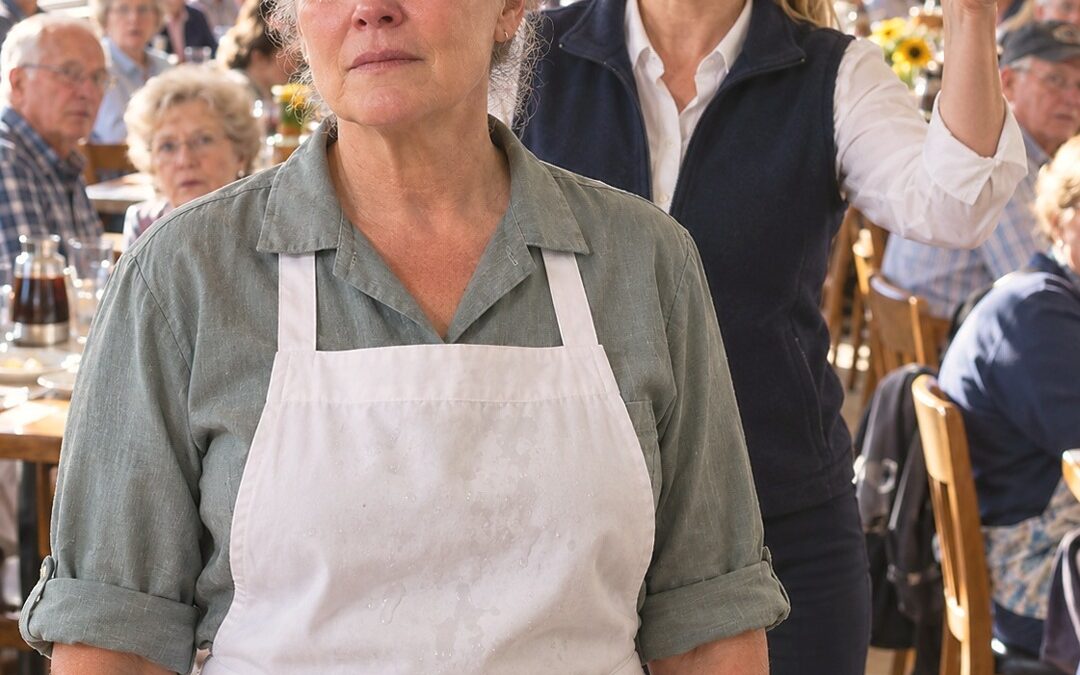
Jenna Spangler held my empty Cool Whip tub over her head in front of two busloads of tourists, rapped it twice on the glass of the pie case so the back tables would turn around, and said, "This is a restaurant, Bonnie, not a soup line. You want to feed every drifter on Route 39, do it on your own dime." I was sixty-one years old with $611 in checking, and after nineteen years at that dish sink she was about to fire me in front of a hundred strangers over half a plate of chicken and noodles I'd paid for myself. The drifter she meant was sitting on a milk crate out by the dumpster with a pocket notebook on his knee, and what Jenna didn't know was that he'd been writing down her Sunday nights for a month.
Then she brought the tub down to her chest and turned the lid out toward the long tables, so the Lutheran ladies from Fort Wayne could get a good look at my husband's handwriting.
"Bonnie's. Don't throw out." She gave it about as long as a commercial. "Somebody should have."
Some of them laughed. Not mean, most of them. She was the one in the navy Buckeye fleece with the clipboard, and when the woman with the clipboard makes a joke, people on a church trip laugh, and I don't hold it against them. One man by the window laughed and then checked on his wife, who went right on buttering her roll.
"Thirty-eight thousand four hundred and twelve dollars of food has walked out of this kitchen since April, folks."
"That's an awful lot of noodles for one lunch tub, Jenna."
That was Marv Schlabach, from his stool at the end of the counter. He didn't say it loud. Marv has ordered two eggs over easy and a coffee at that counter every noon since 1980, and in all that time I have never heard him use any voice but the one he orders the eggs with.
Jenna swung around on him. "I count that walk-in myself every Monday at six." And then she was back to the tables, because the tables were who she'd set this up for. "I warned her two weeks ago, right back there at the dish pit. We've been short hotel pans since spring, too, and do you know where they go? Out with the scraps. I've had her in that dumpster looking for them."
I didn't say anything. I don't argue in a dining room with the buses in.
"Friday after next Columbus drives up to see what this kitchen looks like when somebody actually counts it, and they're not seeing a soup line out the back."
Edna Troyer had quit cutting. She'd baked the pies at Stutzman's since 1974, white covering pinned square, flour clear to her right elbow, and her knife was standing straight up in a cherry pie halfway through a slice, where she'd let go of it. Marv laid his fork down crossways on his eggs. Cody Mast was by the swinging door with a bus tub on his hip, a tall boy I taught to load a dish rack when he was sixteen, and he had found something on the floor drain that needed all his attention.
Out back, past the walk-in and the screen door, Hank would be on his crate, facing the lot. He always faced the lot.
"So that's it, Bonnie," Jenna said. "You're done. Today. Payroll mails whatever's owed."
A lady at the Lansing table asked the man next to her, not quietly, "Is that the one?"
The Fort Wayne bus had come in twenty minutes late and the whole kitchen was behind, and I thought about the oven before I thought about anything else.
"The ham loaf comes out at one, Edna."
Edna pulled her knife out of the pie and nodded at it.
I reached behind me for the apron strings. They were wet through, and one had knotted under the other from a morning of leaning on a sink, so I stood there in front of a hundred people picking at a knot with my thumbnail until it gave. I folded the apron once and hung it on the hook by the swinging door, where it goes.
Jenna tossed the tub onto the counter. It bounced, rolled, and fetched up against Marv's saucer, and his coffee slopped over into the saucer.
Marv got down off his stool. His left knee doesn't like stools and it took him a second. He picked up the tub, wiped coffee off it with his napkin, pressed the lid down tight all the way around with his thumb, like a casserole going to a funeral, and held it out to me.
"I'll walk you out, Bonnie."
Jenna opened her mouth. Marv was already moving, short steps, favoring the knee, and a server I'd worked beside for six years swung a platter of fried chicken up over her shoulder to let us by. A woman from Lansing pulled her purse in off the aisle. I kept my eyes on the front windows, where a bus driver stood out on the gravel eating something out of foil.
At the door Marv stopped.
"You want me to run you home?"
"I drove myself."
"I know you did."
"Then what are you asking me for?"
He was looking down at my shoes, the white ones with the gum soles, gray now across the toes. "Because I sat there on that stool and let her," he said. "Dwayne would've…"
He quit there. People do that with Dwayne's name, six years on. They get partway into it and run out of road. I patted his sleeve and told him his eggs were getting cold.
*
My Impala was at the far end of the overflow gravel, where I park so the buses get the close spots. I put the tub on the passenger seat and sat with the key in my hand.
When Ada Stutzman opened this place in her farmhouse in 1966, she hung a light over the kitchen's back screen door and painted a board to go under it. IF THE LIGHT'S ON, KNOCK. The light has been on every night since, and whoever knocked got fed.
On Tuesday, September 1, a thin man in a moss-green Carhartt knocked on the frame of that screen door at a quarter to twelve. "Light's still on," he said, like he was apologizing for it. I gave him half my lunch. He went for his wallet and I told him, "Ada's door never took a dime."
Every day since, at 11:45, he'd eaten on that milk crate by the dumpster with his notebook open on his knee, facing the lot, and he was gone before the afternoon buses pulled in.
This morning the Fort Wayne bus was late, and Jenna went out back to check a delivery and found him there with my tub. I watched it through the screen with my arms in the sink to the elbows. She took it right out of his hands. She scraped what was left of my chicken and noodles into the dumpster, and she brought the tub inside.
From the car I watched a Holmes County cruiser turn in off Route 39 and roll around back. A few minutes later a gray Ford Ranger with a camper shell came out the other side of the building and turned toward Walnut Creek, and a young deputy pulled out behind it and followed it down the hill. The deputy was there for a man who'd eaten half my lunch.
I put the key in.
*
At one o'clock I was standing at my own sink in Charm with the hot water running, and it came to me that over at Stutzman's the ham loaf was coming out.
Dwayne wrote on that lid in 2009 with the black marker from the feed mill, at our kitchen table, with the Daily Record spread under it so he wouldn't mark the oilcloth. I kept leaving tubs at work and the night girls kept pitching them. "They aren't good tubs, Bon," he said. "They're good enough," I said. So he got the marker out of his truck and printed BONNIE'S. DON'T THROW OUT. in those big leaning capitals of his and pressed so hard it went down into the plastic. The D in DON'T is half gone now from seventeen years of dishwater. The rest you can read from across a dining room. Jenna proved that.
I washed the tub and the lid in Dawn and hot water and set the tub upside down in the rack.
Then I took the lid back out of the rack. There was water standing in the rim, so I dried it on the hem of my shirt, and then I didn't put it down. I stood at the sink holding it while the water heater ran in the utility closet, and I kept on holding it until the water heater kicked off and the house went quiet enough to hear the refrigerator. At some point I said "Well," out loud, to the kitchen, and didn't have anything to put after it.
I set the lid on the counter, face up.
Six hundred eleven dollars. The Impala needed tires before the snow and I'd been putting it off since August, figuring on two more paychecks. I'd have to file for unemployment, and I had a feeling a company with a payroll department in Columbus would have something to say about that.
I opened the freezer. There was a pound and a half of ground ham at the back, in white butcher paper from the sale at the meat counter in Walnut Creek, and I set it in the sink to thaw and got down the saltines.
I knew where I'd be taking it. Three or four times since September, leaving at close, I'd seen that Ranger's taillights going up the township road behind Stutzman's, and that road doesn't go anywhere up there but a pull-off at the top of the hill and an Amish farm that doesn't have electric. I never asked him about it. Some things a man will tell you if he wants you to have them.
My mother made ham loaf with cracker crumbs and one egg and a brown-sugar glaze, and mine has never looked as good as hers and tastes the same, which is the part that counts. I packed it into the loaf pan with the dented corner. I made enough for two plates and potatoes to go with it, and I put too much pepper in the potatoes, because Dwayne used to say, "Bonnie, these taste like wallpaper paste," every time I didn't, and eat two helpings anyway. I hadn't done it in six years. I didn't notice I'd done it till I tasted them.
*
At seven I pulled onto the gravel pull-off at the top of the hill. His Ranger sat at the far edge, nosed out toward the drop, with the dome light on and a blanket folded up against the back glass of the camper shell. He rolled his window down before I'd got my door shut.
"Evening, Bonnie."
"You eat?"
"Not to speak of."
I handed the plate through the window, foil and all, with a fork stuck through the top. He held it a second before he took it.
Hank Lindauer was sixty-six, though I'd have said older that first day. His beard had gone mostly gray and his face had gone narrow, and that Carhartt hung off him like it was waiting for somebody else to come back and fill it. There was a pen in every pocket I could see, and a couple I couldn't, I'd bet. His first week he'd fixed the spring on Ada's screen door so it quit slamming, and his second week he'd taken every knife in my station out to the dumpster corral and sharpened it on a stone he carried in his glove box, and when I tried to pay him for that he looked at me like I'd tried to tip the preacher.
"Deputy give you any trouble?" I asked.
"No. Polite young fellow. Said the manager didn't want me on the property, took my license back to his car, ran it, brought it back. Wished me a good day."
"Did he."
"He was doing his job."
"Everybody had a job today but me."
He took the foil off. He got out and ate standing up, leaning on the fender, and I leaned on my Impala and told him the rest of it. The two buses. The lid. The thirty-eight thousand four hundred and twelve dollars since April. The pans in the scraps. How she counts that walk-in herself every Monday at six, she said so to the whole room.
He stopped chewing about halfway through and didn't start again until I was done. Then he swallowed and set the fork down across the plate and stood looking down the hill.
From up there you could see right down onto the back of Stutzman's. The loading dock, the big steel back door shut beside it, the dumpster corral, and the little yellow bulb over Ada's screen door, burning against the white siding like it did every night.
"Then she's either counting or she's loading."
"What's that supposed to mean?"
"Means if that much food walked out and she counts it every week, she knows which way it walked." He picked the fork up again and pointed it down the hill. "You told me, back a while, they sold the extras to somebody."
"That's what she told the kitchen in April. 'My brother buys our overstock for his catering.' Stood right by the walk-in and said it."
"What's her brother drive?"
"How would I know what her brother drives?"
He didn't answer that. He set the plate on the hood, opened the driver's door, and took a little notebook off the dash, brown cover, a rubber band around it, the corners worn soft as a dollar bill. He slid the band off and turned pages with his thumb, not hunting, just going to it. The writing was small and square and didn't waste paper.
"I've been seeing a trailer down there," he said. "Sunday nights."
"Down there at Stutzman's?"
"Back dock."
I came around the hood and read it upside down over his arm, which I can do. I've been reading Jenna's schedule off her clipboard upside down for two years.
Sun 10/4. 2238. Wht Ram 2500, wht encl trailer, no plate lt. Blk Tahoe at dock. F unlocks back dr. Young M carries. Boxes, pans. Out 2319.
"F is a woman?"
"Female."
"And this is four Sundays?"
"Four I wrote down. Started my second week up here." He tapped the notebook against the steering wheel. "You'd told me it was a caterer buying extras. People load at odd hours when they've got an early job. I didn't think much of it."
"Then why'd you write it down?"
"Habit."
That was all I got on that, and I didn't push. He'd had that notebook out on the milk crate every day since September, writing down who knows what.
I knew exactly one black Tahoe that parked at Stutzman's back dock. It had a dent above the back bumper where she'd backed into the propane cage in March, and she parked it by the kitchen door on Monday mornings when she did her count, so everybody coming in from the far lot had to walk around it.
Down the hill the yellow light was still on over the screen door. She'd never touched it. She'd made her rule about tickets and she'd taken the tub out of a hungry man's hands, but she'd left Ada's board on the wall and the bulb burning, and I'd thought, all those months, that it was the one decent thing about her.
"Bonnie, that place is closed on Sundays," Hank said, and turned the notebook around so I could read it under the dome light. "If her brother's buying, why's she loading it in the dark?"
Part 2
The letter from Buckeye Table Group came Wednesday in the ten o'clock mail, and I opened it at the counter with a butter knife because that's what was in my hand. One page. Terminated for removing company food through the back door without authorization, and the company would say the same to the unemployment office if asked. It was signed by a man I'd never heard of, Doug Rennick, Vice President of Operations. Nineteen years, and they got it into four sentences.
I called Columbus. A young woman put me on hold to music that sounded like it was recorded through a kitchen exhaust fan, and came back to tell me Mr. Rennick already had Ms. Spangler's report.
"Has he got anybody else's?"
She said she'd add a note to my file, in the voice people use when they're writing nothing down.
At the IGA a woman I've sat two pews behind at church for fifteen years saw me coming down the bread aisle and turned around to the hamburger buns and stayed turned around until I'd gone by.
Edna called that afternoon from the old beige phone on the wall by the walk-in, with the dish machine going behind her and somebody banging racks too hard, which would be Cody. "Jenna's got her brother's trailer coming to feed the help when Columbus comes," she said. "The twenty-third. Pulled pork." There was a long breath on the line. "Marv asked after you." Then she hung up.
*
Thursday morning the unemployment office told me my claim was on hold because the employer was contesting it.
I spread the bills out on the kitchen table after that, with the bank balance on top, five hundred and ninety-some now. I put the electric at the top of the pile and crossed tires off the list on the back of an envelope. Then I put a sweater on instead of turning the thermostat up, and I made two ham loaf sandwiches, and at six-thirty I drove up the hill.
Hank was sitting outside the Ranger in a folding camp chair, sewing a strap back onto a canvas bag with a curved needle. He had a second chair folded against the bumper, like he'd been expecting company and was embarrassed about it.
"You're making a habit of this," he said.
"So are you," I said.
He set the needle in the canvas and took the sandwich and opened the second chair for me with one hand. I didn't sit yet.
"Company wrote it down," I said. "That I stole from them. Came yesterday on letterhead."
"Keep that letter, Bonnie."
"It's on my table."
"Keep it in a drawer." He set the sandwich on his knee without unwrapping it and went to the cab, and came back with the notebook, and opened it on the hood under his flashlight so I could see.
Four Sundays. September thirteenth, the twentieth, the twenty-seventh, October fourth. Same white Ram, same enclosed trailer, the same black Tahoe already sitting at the dock every time. A woman with keys. A young man carrying. They came in between twenty-five after ten and quarter to eleven, and they were gone by twenty past eleven or close to it, every week.
"Can you see a plate?"
"Trailer covers the truck's plate when it backs in. Trailer's got its own plate, but the light's burnt out."
"How do you know it's a Ram from up here?"
"Tailgate, when it swings around."
I can tell a four-inch pan from a six-inch under a quarter inch of gravy, so I let it go.
I put my finger on the word pans.
"We've been short four-inch hotel pans since spring," I said. "Stainless. Jenna's had me in the dumpster for them twice. And I'll tell you something about those pans, every one we've bought since 2007 I stamped myself. STUTZ, on the lip, with Ada's old nail set. She did the first ones. I took it over."
"So they'd come home."
"So people would quit borrowing them for church suppers and forgetting where from. And the Z punch has a nick in it, or I hold it wrong, Dwayne used to say it was me. Every Z I've ever done comes out struck twice. You can feel it when you're drying them. It catches the towel."
Hank wrote that down. I watched him do it. Small square print, the date in the margin.
"What time's she get in on Mondays?"
"Six, for her count. She parks that Tahoe right up against the kitchen door so the rest of us have to walk around it."
He wrote that down too. "And Sundays she's home."
"Far as anybody knows."
"Sunday," he said.
"Sunday what?"
"We watch from right here." He nodded down at the dock, which was dark except for the security light over the steel door. "Township road. Public right-of-way. Anybody can park on a public road and look at the scenery."
"At ten-thirty at night."
"Scenery's still there."
I sat down in the camp chair then and ate my sandwich, and he told me about a rattle under his dashboard he'd been chasing since Coshocton. He didn't say how long he'd been sleeping in that truck. I didn't ask.
*
Stutzman's has been closed on Sundays since the day Ada opened it. When the tour buses started lining up on Route 39 and men in sport coats drove down from Cleveland to tell her what she was losing, she gave them pie and sent them home. Buckeye kept the rule. Ada put it in the sale papers.
So there was no reason in this world for anybody to be at that back door on a Sunday night.
I pulled onto the gravel at 10:20 with my headlights off for the last hundred yards, which I felt foolish about and did anyway. Hank had backed the Ranger in under the trees so the windshield looked straight down at the dock. I got into his passenger seat with a thermos of coffee I'd made and then never opened, and he reached up and switched the dome light off before I'd pulled my door shut.
"You bring a coat?"
"I'm wearing a coat, Hank. I live in Ohio."
Down the hill the kitchen was dark, all but Ada's little yellow bulb over the screen door. A car went by on 39. The clock on his dash turned over twice, and I started to think about how I'd feel driving home at midnight after sitting in a pickup with a man I barely knew to watch a dumpster.
"Could be nothing tonight," I said.
"Could be," Hank said, and didn't move.
"You always this talkative?"
"Depends who's buying."
Headlights came along the service road behind the building.
A white pickup swung around the corner pulling a white box trailer, and it backed toward the dock slow, with somebody who knew how to back a trailer at the wheel. Then a black Tahoe came around the far end of the building and parked right beside it, nose to the dock, where it parks every Monday morning.
My mouth had gone dry. "That's her."
"You sure?"
"She backed it into the propane cage in March. You can see the dent from here if you know where to look." I didn't know if you could or not. I knew it was there.
A woman got out in a dark fleece. She went up the dock steps to the steel door and put her hand to the keypad beside it, and the little red light on the panel went green. Hank wrote without taking his eyes off the dock. She unlocked the door and went in, and the dock lights came on.
A young man came out with a cardboard case on his shoulder and walked it up into the trailer. Then another case. Then somebody inside handed him a stack of stainless hotel pans, six or seven of them nested, catching the dock light the whole way to the trailer. I leaned up close to the windshield.
"Those are ours."
"Can you tell from here?"
"I can tell the size."
Hank just said my name.
"All right. I can't read the stamp from here. They're ours."
It went on like that forty minutes, cases and pans, cases and pans. Once the woman came to the door and stood looking out at the service road with her hand on the frame, and Hank slid down in his seat an inch and so did I, and I felt ridiculous, and I stayed down.
"She can't see us," he said.
"I know she can't. She doesn't look at the dish pit when she's standing in it."
The young man kept his back to us. He carried with his elbows tucked in, which is how you carry hot pans if somebody taught you right, and something about it bothered me, and I couldn't get hold of what.
At nineteen past eleven the dock lights went off. The woman locked up, the green light went red, and the Tahoe pulled away first. Then the Ram pulled ahead slow to straighten out before the turn and stopped short, with the trailer's back doors still hanging open, and the long side of it sat there broadside to us in the light on the pole at the edge of the lot.
Red letters on white, the whole length of it.
SPANGLER SMOKEHOUSE — WEDDINGS · AUCTIONS · BENEFIT SUPPERS
"Spangler," I said.
Her brother. The one who buys our overstock. Somebody came down the dock steps at a trot with one more stack, and the Ram started rolling again before he'd got there.
The trailer swung out under the lot light, and the boy hoisting my four-inch hotel pans into the back of it was Cody Mast, who I'd taught to load a dish rack when he was sixteen years old.
Part 3
The deputy gave Hank's copied pages about as long as you'd give a church bulletin, and then he asked me whether Stutzman's did catering.
Monday, nine in the morning, the Holmes County Sheriff's Office in Millersburg. His nameplate said YODER, which in Holmes County narrows it down to about four thousand people. NATE, the line under it said. He had a cup of coffee on the desk that had grown a skin. I knew him when he came through the door, the young one who'd followed the Ranger down the hill on Tuesday. He knew Hank, too. Hank had copied the five Sunday pages at the library in Berlin when it opened, ten cents a page, and kept the notebook itself buttoned in his shirt pocket.
"Full name, sir?"
"Harold Lindauer," Hank said, and spelled the last name before he was asked. "No fixed address right now."
Nate turned back a page in his own folder. "Ms. Spangler's call on the sixth says a vagrant had been going through the restaurant's dumpster for a month. Says she caught him in it." He read it to the paper, not to Hank.
"He was sitting on a milk crate eating my noodles out of my tub," I said. "She took it out of his hands. I watched her."
Nate wrote something under that and underlined it. Then he was polite again, and he was polite the whole way through. "Restaurants sell to caterers every day of the week, ma'am. If it's on the books, it's not stealing."
"And if Columbus never heard of any books?"
"Then that's what I'd need to find out. I'll make a call."
"You mean you'll call Jenna."
"That'd be where I start."
I gave him my phone number. I didn't tell him what nineteen years at a dish sink teaches you about the difference between a pan that got lost and a pan that got took, though I had it ready.
Out in the lot Hank walked to his truck with his back straight as a yardstick. I'd noticed it inside. When Nate came in, Hank had stood up out of that chair so fast it rolled into the wall, and stood there till the boy sat down.
"You know something about police work," I said.
"I've been around it."
"You stood up in there like the flag was going by."
"Old habit." He opened the Ranger's door and tossed his library receipt on the dash. "Leave it be, Bonnie."
I left it be. He shut his door before I could decide not to.
*
Tuesday the phone didn't ring, or Wednesday. Thursday Marv came by with a sack of apples off his neighbor's tree, which was just a reason to come by, and stood on the porch with his bad knee on the lower step.
"Jenna had the walk-in emptied out yesterday," he said. "Edna told me. Every shelf wiped down, new labels on everything, and she stood there with her clipboard while Cody hauled the old cardboard out to the dumpster. Edna says it looks like a hospital in there."
"Before Columbus comes."
"Before Columbus comes." He held out the sack. "Dwayne would've wanted to know where those pans went."
"Dwayne couldn't find the ketchup in our own refrigerator," I said, and took the apples, and he laughed, and that was as close as either of us got to it.
*
Saturday the fire company in Mt. Hope had their benefit supper at the auction barn, and Edna had heard at church that Spangler Smokehouse was cooking it. I'd never been inside that barn for anything but a quilt sale. Hank came along and found a seat at the end of a picnic table under the tin roof where he could see the parking lot, and I bought a ticket for nine dollars like everybody else and went through the line.
Ham loaf and pulled pork, scalloped potatoes, applesauce, a dinner roll. The ham loaf came down the line in a four-inch hotel pan, and the girl with the spatula was scraping the corners of it the whole time I stood there waiting, and I couldn't see the lip from where I was, and I tried. The ham loaf was dry. I ate half of it standing up by a trash barrel, which is how I eat when I'm working out what to do next.
The trailer was parked outside the big doors with its serving window up and the red letters running down the side, and I walked around back of it like I was looking for the restroom. There was a gray bus tub sitting in the gravel by the rear steps, full of dirty four-inch hotel pans stacked crooked, with glaze baked into the corners because somebody hadn't soaked them. That alone would have made me mad on a regular day.
I picked up the top one and turned the lip into the afternoon light.
STUTZ. And the Z doubled, the second strike sitting a hair to the right of the first, the way it's sat on every pan I've done for nineteen years.
I ran my thumb along it, and it caught.
"That's my Z."
A man came around the corner of the trailer wiping his hands on a towel. Mid-thirties, a red smokehouse ball cap, a belly starting. The white Ram was parked nose-in beside the trailer.
"Help you, ma'am?"
I held the pan up so he could see the lip. "These are Stutzman's pans."
"These are my pans."
"It says Stutzman's right on them. I put it there."
He came over and took the pan out of my hand, not rough, just took it, and set it back in the tub. "I buy equipment all over," he said. "Auctions. Restaurant closeouts."
"From your sister?"
He picked up the whole bus tub and carried it up the steps into the trailer and shut the door behind it, and when he came back down he already had his phone out. He walked around to the far side of the trailer to use it. I could hear him talking low. I couldn't make out a word.
When I got back to the picnic table Hank had a paper cup of coffee and was watching the trailer over the top of it.
"Well?" he said, still watching it.
"Found my pans. A whole tub of them."
"You sure?"
"I stamped them, Hank."
"You get a picture?"
"I never thought of it." I'd stood there with my phone in my coat pocket the whole time, sixty-one years old and I still carry it like a pack of gum. "He put them away."
"Just as well," Hank said. "Picture of a pan in your hand, they'd only say you carried it there yourself." He took a napkin off the table and wrote on it, STUTZ, Z doubled, 5:10 p.m., bus tub, rear steps, and folded it into his shirt pocket with the notebook.
"Did he know who you were?"
"He does now."
Hank set the cup down. "Let's go," he said, and we went, and I didn't make a scene at the fire company's supper.
*
By eight that night Hank was at my kitchen table eating vegetable soup. It had turned off cold, and I'd told him there was no sense eating out of a can in a truck when I had a working stove, and his Ranger was parked in my driveway behind the Impala, where my whole road could see it. Let them look.
Headlights came across the front window and stopped.
"You expecting anybody?" Hank asked, and I said I wasn't, and went to see.
It was Deputy Nate Yoder standing on my porch with his hat in his hand and the porch light making him squint. He looked like he'd rather be just about anywhere.
"Evening, Mrs. Weaver. I'm sorry about the hour."
"What's happened?"
He leaned to see past me down the hall. "Is Mr. Lindauer here?"
"He's having his supper."
Hank came and stood in the kitchen doorway with his napkin still in his hand, and the two of them said "Deputy" and "Mr. Lindauer" at each other, and that was all the hello either one of them had in him.
"I called Ms. Spangler Tuesday," Nate said to me. "About the caterer. She told me her brother buys overstock off the restaurant and it's all on the books."
"Is it, though?"
"I'm working on that."
"Then what are you doing on my porch on a Saturday night?"
He didn't answer straight off. Ten after five, her brother behind his trailer with a phone to his ear. Three hours later, a deputy on my porch.
"Her brother called her," I said. "From Mt. Hope. I was holding one of our pans when he did it. I told him whose it was."
"Ma'am, I can't talk about who called who."
"You don't need to. I can count."
Hank came a step out of the kitchen doorway. "Deputy, those pans were sitting in a bus tub on his back steps at ten after five. Stamped. I wrote it down."
Nate didn't turn around to him right away. When he did, he was careful. "Sir, with respect, you're the man she had trespassed off that lot. You don't have an address. You've been parked on a hill over her restaurant at night." He didn't enjoy saying it. "I'm telling you how it reads."
Hank didn't say anything to that. He went back to the doorway and stood there with his napkin, and he put it in his back pocket, which is no place for a napkin.
Nate opened the folder under his arm and took out a paper, and he didn't hand it to me.
"Jenna Spangler swore out a complaint this afternoon, Mrs. Weaver," Nate said, and turned his hat around in his hands. "She says you've been carrying Stutzman's pans home since April, and I'm going to need to see your garage."
Part 4
Nate came back Sunday at half past eight in the morning to search my garage, and I made him stand in the driveway while I changed out of my slippers, because I'd been accused of a lot that week but I wasn't going to be searched in slippers.
Hank had slept in his Ranger in my driveway, because the pull-off was going to be twenty-five degrees by morning. Nate noticed the truck coming up the walk and again on the way to the garage.
"You can tell me no on the garage, Mrs. Weaver," he said at the side door. "That's your right. Then I'd have to go see a judge about it."
"There's nothing in there but Dwayne's junk and my mother's dishes. Go on in."
Dwayne's workbench is the first thing you see, built out of scrap lumber from the feed mill, with a folded square of cardboard under the short leg since 1998. Nate went through it drawer by drawer. He put a flashlight behind the shelves and into the chest freezer, which had nothing in it but sweet corn and a pork shoulder I'd been saving for I don't know what.
He found a box marked KITCHEN in Dwayne's printing and opened it, and lifted out one of my mother's Corning casseroles, the white ones with the little blue cornflowers on the side, wrapped in a dish towel.
"These from the restaurant?"
"Those are from Lazarus in 1971. My mother paid for them on time."
He wrapped it back up careful. After forty minutes he shut his folder.
"I haven't found anything that matches the complaint, Mrs. Weaver."
"I could've told you that and saved you the gas."
"I'll write up what I found."
"And then it's closed."
"It stays open till it's sorted out." He said it to my garage door, not to me.
"Her brother's driving around Holmes County with my pans in his trailer, and you've been through my sweet corn. What else does she get to say about me before it's sorted out?"
He didn't try to answer that one.
When we came back around to the porch Hank was standing in my kitchen doorway in his moss-green Carhartt with a cup of coffee, gray beard and all, and Nate stopped on the second step and stayed on him a second longer than you'd stay on a stranger. Hank stayed right back on him.
"Mr. Lindauer."
"Deputy."
Nate went down the steps. I watched the cruiser back out past my mailbox.
*
At noon Hank went out to the Ranger and came back with a shoebox.
A Red Wing box, brown, with packing tape on one corner where it had split, and two rubber bands around the lid. He set it on my kitchen table and moved the sugar bowl to do it.
"Should've showed you this before now," he said.
Inside were notebooks like the one on his dash, rubber-banded together by the year.
"How many of those are there?"
"Every year since '84. Rest are in storage." He went through the bundles with one finger like records at a yard sale and pulled out one marked 1996. He opened it most of the way to the front and turned it around and slid it across the oilcloth to me.
0310. Stutzman's, back door, light on. Lady at the dish sink gave me coffee + cherry pie. Wouldn't take my $2. Name's Bonnie.
I didn't say anything. I put my finger under the line.
"February seventeenth," Hank said. "My dad died at one that morning at Pomerene, in Millersburg. They'd called me down from Canfield the night before. After, I couldn't stand to be in that building, so I got in the car. I drove around a couple hours. Didn't have anywhere to be. Saw a light on over a back door."
And I remembered. Not all at once.
February, the windows over the dish sink frosted in the corners, Ada and me on the overnight pie bake with WKLM on the radio. A big young man at the screen door at three in the morning, dark hair, a brown coat, holding his car keys out in front of him like he'd forgotten what you do with them. He asked if we had coffee. I gave him coffee in one of the thick white mugs and cut him a piece of cherry off the cooling rack, and he tried to give me two dollars, and I pushed it back across the steel table at him with one finger.
I got up and went to the sink.
There were two breakfast plates in it and the oatmeal pan. I turned the water on hot and let it run over the empty side, over nothing at all, and stood there with my hand on the faucet. Then I shut it off.
Behind me Hank's chair creaked once and then didn't.
There was half a cherry pie in the refrigerator from the IGA, not Edna's, not anywhere close. I cut him a piece and put it on a saucer and set it down in front of him, and he turned his chair a little toward the window over the bird feeder and kept it there while I wiped my face on the dish towel.
"You could've said something," I said, when I could.
"Wasn't sure you'd remember. You fed a lot of people at that door."
"I remember now."
He picked up his fork and ate a bite of store pie like it was good.
"So why'd you come back?"
"Needed someplace to go."
"That's what a man says when he doesn't want to say."
He set the fork down. "My wife died in February. Two years of cancer. I sold the house in Canfield in May. Couldn't stay there."
"Where's all your things?"
"Storage unit up home. Furniture. My uniforms."
"Your uniforms."
"Twenty-eight years with the Highway Patrol, Bonnie. Canfield post, up in Mahoning County. Retired a sergeant in 2012. I never once worked this county, so nobody down here ever saw me in a hat."
I sat there with that. A state trooper. On my milk crate. Eating my noodles out of a Cool Whip tub.
"You don't have money for a room someplace?"
"I've got a pension."
"Then why on earth are you sleeping in a truck?"
"The house was paid for," he said. "I couldn't sleep in it."
He'd never needed my lunch. And now Jenna Spangler had a paper down at the sheriff's office calling me a thief.
Hank pushed the saucer back.
"I told you to leave it be," he said. "That was before she put your name on a complaint." He held out his hand. "Get me that deputy's number."
*
That night he went back up the hill and watched until after midnight. The dock stayed dark. He called and told me so at twenty after twelve, two sentences, and hung up.
Tuesday morning he knocked at six and asked to use my bathroom, and came out twenty minutes later with no beard, and I didn't know him for a second.
"Well," he said.
"You look about forty."
"Don't get carried away."
He'd driven up to his storage unit Monday for a white shirt still in the cleaner's plastic. At the front desk in Millersburg he took a card out of his wallet and laid it on the counter.
"Sergeant Harold Lindauer, retired. Ohio State Highway Patrol, Canfield post."
Nate Yoder was coming down the hallway with a coffee. He set it on top of a file cabinet and came the rest of the way without it, and took the card and turned it over and back.
"Sir, why didn't you tell me that last week?"
"Didn't see the need till somebody called her a thief."
It took an hour. Hank wrote out a sworn statement at a table in the back, five Sundays, times and vehicles, and signed it. Then Nate picked up his phone and called Cody Mast in.
I sat on the bench in the hallway. They didn't close the interview room door all the way.
"Jenna said Travis paid for it. Fifty bucks cash every Sunday to carry it out. I never saw a check."
Nate asked him something low.
"Monday, yesterday, Travis had me come out to his place to help unload. I was stacking the pans on his shelf, the ones with the stamp on them, and he's laughing. He says Jenna told him to dump every one of them in a ditch someplace." There was a pause. "He says new ones are thirty bucks a pan. He goes, 'A pan's a pan.' He runs every job out of those pans. He's doing the staff lunch Friday off that same trailer."
When Cody came out he stopped in front of my bench. He was still in his work clothes, he'd come straight from the dish pit, and he couldn't get his eyes up off the floor. His apron string was hanging loose down the back of his leg.
"Your apron string's undone," I told him.
He reached back and tied it, and went.
Nate called Columbus on speaker with the door shut, and a man named Doug Rennick came on sounding pulled out of a meeting. Nate asked what Buckeye had sold to Spangler Smokehouse since April. We listened to him type.
"Nothing," Doug said. "Not since April. Not ever. There's no account."
"Does your alarm company keep a log of codes?"
"Every entry. The archive takes a few days to pull."
"Pull it." Nate leaned toward the phone. "And Mr. Rennick, I'd ask you not to say anything to her. I'd like her brother's trailer on your lot Friday with those pans in it, and I'd like to hear her answer in front of some people."
*
Thursday at seven Doug Rennick drove up from Columbus and sat at my kitchen table in his overcoat. He was fifty-two, with the kind of haircut you get in a building with a parking garage.
"I signed your letter off her report," he said. "I never drove up."
"I know you didn't."
"The alarm company sent the archive this afternoon." He opened his briefcase. "Tomorrow's still on, twelve-twenty, the dining room, her numbers, her brother's trailer in the front lot doing the staff lunch. She hasn't canceled him. If she canceled now I'd ask why, and she knows I would. I'd like you there, Mrs. Weaver. And the Sergeant."
Hank was leaning on my counter with his arms folded, and he nodded once, at the printout and not at Doug.
Doug put the printout on my kitchen table and ran his finger down to the line. "Sunday, October eleventh, ten thirty-one p.m.," he said. "Disarmed. User one. Jenna Spangler."
Part 5
Jenna Spangler was saying the word drifter again when I came in the front door of Stutzman's at twenty after twelve on Friday, and she had her back to me, so she got the whole sentence out.
"Since April, Doug, that's thirty-eight thousand four hundred and twelve dollars. Out the back door to every drifter on Route 39. That's what I walked into when I got here, and that's what I cleaned up."
She had the help lined up by the pie case like a church choir, Edna on the end with her knife, Cody next to the swinging door in a clean apron, three of the girls in their green polos holding coffee pots because Jenna hadn't told them they could set them down. Marv was on his stool at the end of the counter with his two eggs. Two buses were eating at the long tables, a Methodist group from somewhere in Indiana and a load of retired schoolteachers, and they'd never laid eyes on me, which was fine. The people who'd watched her do it were all standing right there by the pie case.
Out the big front windows her brother's white trailer sat in the front lot with its serving window propped up, and her brother was in it, red cap on, handing pulled pork down to a lady with a paper plate.
Doug Rennick stood by the counter in his overcoat with his hands folded in front of him.
Hank came in behind me. "Twelve-twenty," he said, low, to himself, logging it. He'd shaved again that morning and he had on the white shirt, ironed, and a dark tie I'd never seen. His shoes were shined except for a scuff on the left toe that wasn't going to come out for anybody. Nate Yoder came in a step behind him and let the door ease shut.
One of the girls saw us first and stopped pouring with the pot still tipped, and the coffee ran over a man's saucer and into his lap, and him jumping up is what turned Jenna around.
She took in Hank first, then me, and then the uniform, and I watched her decide, quick, that the uniform was on her side.
"Bonnie, you've been let go. You don't come in here." She pointed at Hank with her pen. "And he's been trespassed. Deputy, I called your office about that man. Get them out."
Nate stayed where he was, with his thumbs in his belt.
"They're with me," Doug said.
Jenna laughed, a short one. "Doug, I don't know what she told you."
"Who's in this building on Sundays, Jenna?"
"Nobody. Just me, doing my count."
She had that one ready. I believe she'd kept it ready since April, in case anybody ever mentioned seeing a black Tahoe at the dock on a Sunday, because doing her count is the kind of answer people don't ask a second question about. The alarm company's monthly report came to her own email and no one else's. As far as she knew there wasn't another copy, and her brother's pans were in a ditch.
"Monday at six," Doug said. "That's what you told this whole dining room, I hear. Monday at six."
Marv's cup stopped about halfway to his mouth and stayed there.
Doug took a sheet of paper out of his coat, unfolded it, and laid it flat on the counter facing her, and smoothed the fold with the side of his hand. Then Hank stepped up beside him and took the notebook out of his shirt pocket, and slid the rubber band off, and laid it open next to the paper. Two things on the Formica, side by side, and a ketchup bottle somebody had forgotten to take away.
Jenna knew that notebook before she knew him. She'd seen it on his knee at the dumpster.
"That's the drifter I had trespassed, Doug."
"Hank Lindauer. Twenty-eight years with the Ohio State Highway Patrol, Canfield post. I'm the drifter, ma'am. I also write things down."
One of the coffee girls laughed. It got out of her before she could stop it, one note, and she put the back of her wrist against her mouth and turned it into a cough. Edna didn't laugh. Edna set her pie knife down flat on the cutting board, which in all the years I've known her I have seen her do maybe twice.
Jenna had the clipboard pressed against her fleece with her whole forearm. "So he's a retired cop who eats out of our dumpster. Doug, that's not a witness, that's a…"
"Sunday the eleventh," Hank said. "Twenty-two thirty-one, by your alarm company. I had you at the door at twenty-two thirty."
She didn't finish whatever it was.
"Buckeye never sold your brother a thing," Doug said. "Not a case. There's no account in Columbus with his name on it. I looked Tuesday."
"My brother…" Jenna started, and that was as far as she got. She'd said the rest of that sentence to the whole kitchen in April, standing by the walk-in, and every one of the people lined up by that pie case had heard her say it.
Doug turned to Nate. "Would you ask Travis to bring one of his pans in here, Deputy?" And Nate went out the front door and across the gravel to the trailer. Through the big windows you could see him say something up to Travis at the serving window. Travis shook his head. Nate said something else and waited. Then Travis came down out of the side door and around to the back, and opened the rear doors himself, and waved Nate up in with his towel.
The whole window table of schoolteachers had turned their chairs around to watch. One lady had her pie fork stopped in the air.
Nate came back across the lot with a four-inch hotel pan in one hand, down by his leg, and Travis came behind him wiping his hands on a towel. Nate set the pan on the counter beside the printout and the notebook. Now there were three things.
Travis didn't wait to be asked.
"That's my pan. I bought it."
I came around to the counter then. I'd been standing by the door all this while with my purse on my arm, and I set the purse down on a stool and picked up the pan. It was clean, cleaner than he'd kept the ones at Mt. Hope, and there was a dark line under the rim where somebody had scrubbed and quit. I turned the lip up to the light over the counter and set it back down and put my finger on the letters.
"Ada punched the first ones. I've punched every one since I came back in 2007, and I always hit the Z twice."
Doug bent down to look, and the coffee girls leaned in from the pie case, and Edna came the four steps down from her end without being asked and put her reading glasses on to see it, and took them off again. She'd watched me do it a thousand times.
Travis took one step back toward the door and stopped there.
Jenna didn't look at the pan at all. She was looking at me.
"Bonnie could've taken that home and sold it to him," she said. "She's been carrying our pans out of here since April. I filed…"
"Every plate that man ate was on my own dime, Jenna. Yours went out the back door on Sundays, when we're closed."
She reached across the counter and turned the pan over. Upside down, lip to the Formica, so the Z was underneath, and she held it there with her palm flat on the bottom like it might get back up. Her hand slid on the steel. It made a little squeal.
Edna reached over and turned it right side up again. She didn't say one word. She set it down with the stamp facing the room and went back to her end of the pie case.
Doug folded the printout once, along the crease it already had. "Columbus came up to see your count, Jenna. Edna counts that walk-in Monday at six. Leave the fleece on the counter and give Nate your alarm code."
Edna had picked up her pie knife again. She didn't look up from it.
Jenna stood there. Then she put down the clipboard she'd been holding all this while, and I don't believe I'd ever seen her hands empty before. She went for the zipper on the fleece. It stuck about halfway, like those Buckeye zippers all do, and she yanked it, and it came, and she worked one arm out and the sleeve turned inside out on her, and the other cuff caught on her watch, and she had to stand there in front of her own help, in front of the girls she'd lined up for Doug, turning herself sideways to get loose of it.
She laid it on the counter by the pie case. Navy, with the little embroidered Buckeye leaf, one sleeve still wrong side out.
Nate held out his notepad and a pen. She wrote four numbers on it without being told twice.
Then she turned toward the swinging door, and I knew who she was looking for before she said his name.
"Cody."
He was standing with his back against the door, in the clean apron. He'd been there the whole time. He didn't come any closer.
"I told Nate on Tuesday, Jenna. All of it."
She put her hand out toward him, halfway, like she might pull him over to her side by the sleeve, same as she'd moved all of us around that floor for two years, and then she brought it back and didn't know what to do with it, and put it in her pocket. Cody turned around and pushed through the door into the kitchen, and the door swung behind him three times and stopped.
"Ms. Spangler. Mr. Spangler," Nate said. "You'll both ride up to Millersburg with me."
Travis put his cap in his hand. Jenna reached for her fleece, out of habit, I think, and Doug slid it six inches down the Formica out of her reach and left his hand on it.
Nate's cuffs stayed on his belt. Nate walked them out the front door and across the lot, Jenna first, Travis behind, and on the way past the trailer Nate reached up and pulled the serving window down and latched it, right in front of the lady with the paper plate, who was still waiting on her pulled pork. Two busloads of strangers watched it all through the big front windows over their cherry pie and their coconut cream, and one schoolteacher got her phone out and then, I'll give her this, put it back in her purse.
At the cruiser Nate opened the back door for Jenna and said, "Watch your head, ma'am," the same as he'd say it to anybody. The cruiser pulled out past the white trailer and turned up 39 toward Millersburg.
Marv lifted his coffee cup about an inch off the saucer, toward me, and held it there, and set it down.
The girls went back to pouring. Somebody at the Indiana table asked for more gravy, because buses are buses. Doug stood looking down at the printout.
I was still standing at the counter with my hand on that pan when Edna wiped her hands on her apron and went over to the swinging door.
Edna took my apron down off the hook by the swinging door, where it had hung for seventeen days, and held it out to me. "Doug wants to know if you're putting this back on," she said. "I told him I'd ask you myself."
Part 6
I took the apron from Edna, but I didn't put it on. I held it folded over my arm while the dining room went back to being a dining room around us, and the strings were still stiff where they'd dried with that Tuesday's dishwater still in them.
Doug came around the end of the counter. "Mrs. Weaver, could we sit down somewhere?"
"I've been sitting down for seventeen days. We can talk right here."
The girls were pretending to straighten the dessert plates. Cody had come back out through the swinging door with an empty bus tub he didn't need.
"I'd like you to come back as kitchen manager," Doug said. "Not the dish pit. The kitchen. You know more about it than anybody on my payroll, and I didn't know that a month ago because I never asked."
"Does that include knowing how many four-inch pans we've got?"
"Yes, ma'am."
"Because I could've told somebody that in April."
"I know it."
I thought about it longer than I needed to, and let him stand there.
"I've got conditions," I said.
"All right."
"Ada's board stays where it is, over the back screen door, and the light stays on over it. And every lunch the dish pit holds back one plate for whoever comes to that door. Hot, on a real plate, not out of the scraps. On the restaurant's dime." I shifted the apron to my other arm. "Not mine. I'm done buying chicken for Buckeye Table Group."
Marv put his cup down a little harder than he needed to.
Doug almost smiled. "Agreed."
"And Cody stays in the dish pit with me."
That turned Cody around. Doug frowned over at Cody, who was holding his bus tub like a shield. "He carried that food out. Every Sunday since April."
"He did. And he believed her when she said her brother paid for it, because she was the boss and he's twenty-two. And he went in and told Nate the whole thing before anybody made him." I looked over at Cody then, and he couldn't hold it. "He's going to start by pulling the bottom screen out of that dish machine and cleaning it, which I doubt anybody's done since October sixth."
"Whatever the county decides for him," Doug said, "he keeps his job."
Then Doug took an envelope out of his overcoat and set it on the counter by the pan.
"I signed a letter that called you a thief without ever driving up here, Mrs. Weaver. I'm sorry."
I didn't pick it up right away.
"That's a correction to Columbus and one to the unemployment office," he said. "And your back wages, every scheduled hour. You'd start Monday, the twenty-sixth, if that suits you."
"It suits me." I picked up the envelope. "I'll read it before I sign anything. I've been reading things before I sign them since 1983."
Hank had been standing by the front windows all this time with his hands behind his back, watching the lot, because he can't help it. Doug went over to him.
"Sergeant. We need somebody on this lot at night. Somebody who notices things."
"Paid?"
"Paid."
"I'd want to see the hours wrote down."
"You'll have them."
Edna came around the pie case wiping her wrists on her apron. She stopped in front of Hank and looked up at him, because she has to look up at most people.
"My folks' dawdy house sits empty," she said. "Out at the farm. It's got a furnace and a good roof."
"Ma'am, I couldn't take your house."
"I didn't say take it. I said stay in it."
Hank turned to me for help, and I didn't give him any, and it about killed me.
"Could I come see it?"
"Tomorrow after breakfast," Edna said, and went back to her pies.
I hung my apron back up on the hook by the swinging door. I'd put it on Monday.
*
The Holmes County Courthouse was cold on Monday, November sixteenth, the way old stone buildings stay cold till about March, and I kept my coat buttoned the whole time we waited on the bench outside the courtroom.
Jenna came down the hallway in a gray cardigan, no fleece, her hair pulled straight back, carrying a manila folder against her chest. Travis walked beside her in a button-down shirt somebody had ironed for him. Neither one spoke to us. Hank said, "Sit still," without turning his head, and I hadn't known I wasn't.
Inside it didn't take long. The judge read the charges, felony theft, the both of them. Travis leaned over to his lawyer and the lawyer put a hand on his arm and sat him back. Jenna kept her eyes on her folder the whole time the judge was talking and answered when she was spoken to. The judge set the next date, and told the both of them to stay off Stutzman's property, the lot included, until the case was done. Jenna wrote that down in her folder. Then he called the next case.
On the way out Jenna turned and found me on the bench, and this time she held it, long enough that Hank shifted his weight beside me and her lawyer had to say her name twice.
Then she looked down at her shoes and kept walking.
Doug was out in the hallway with the prosecutor, a heavy man with a file under his arm, and I heard the prosecutor say it plain as anything: any plea deal either one of them took would include paying back the $38,412, all of it, no deal without it. Doug said that was Buckeye's position too.
Cody had gotten into the county's diversion program for telling the truth, Doug told me on the stairs. And the Spangler Smokehouse trailer was for sale on Facebook Marketplace, I'd seen it myself, the red letters and all.
Hank and I were halfway down the courthouse steps when Nate Yoder came up from the lower landing in uniform, taking them two at a time, and stopped on the step below me, so we were almost eye to eye.
"Mrs. Weaver. You got a minute?"
"I've got a kitchen to run at eleven."
"It's not about her." He had his hat in his hand and it was going around, and then he made it quit. "I knocked on that screen door a few times myself, Mrs. Weaver. Seventh grade. You always gave me the end piece of the ham loaf."
I stood there on the courthouse stairs and tried to find him.
A skinny boy with a bookbag, coming across the back lot from the road where the school bus let him off. Spring of 2008, maybe. His dad wasn't home much, he'd said once, through the screen, like it was the weather. He'd eat on the milk crate. He wanted the end piece because it had the most glaze.
"You never once said thank you," I said.
"I'm saying it now."
"You took long enough."
"Yes, ma'am, I did," Nate said, and he went on up the steps, and I went on down them.
*
Tuesday, December first, at two-thirty in the afternoon, Cody was holding a new four-inch hotel pan flat on the drainboard by the screen door while I tried, one more time, to hit a Z straight.
The case had come in that morning, twenty-four of them, stainless, still in their paper sleeves. Doug signed for them the week after Edna's first Monday count.
I set Ada's punch on the lip and hit it with the hammer. S. T. U. T. Cody had his tongue between his teeth.
The Z slipped. I hit it again, and the second one landed a hair to the right of the first, where it always does.
Cody ran his thumb along it. "Catches," he said, satisfied.
"Let me do the next one."
"Hold the punch like a pencil, not like a hammer." I put it in his hand and moved his fingers down where they go. "Hit it once like you mean it, and then quit worrying about it."
He hit the S on the next pan, and it came out clean and straight and better than any S I've ever done, and he was so pleased with himself I didn't tell him so.
Edna came through from the bake side with two cherry pies on a sheet pan and stopped long enough to see my Z on the first pan. "Twice," she said, and kept going.
Somebody knocked on the frame of the screen door.
Hank stood out on the step under Ada's light, which I don't bother turning off in the daytime anymore, and her board above that. He was clean-shaven, with his color back, and twenty pounds heavier than he'd been on that milk crate, in a jacket that finally fit him across the shoulders. He had my Cool Whip tub in his hand. I've sent supper up to the night watchman every evening since he started on the lot, and every afternoon he brings the tub back washed.
"You're early," I said.
"Lot was quiet." He held the door open with his boot and handed it in to me. "Nothing worth writing down."
I took the tub from him and set it on the drainboard, and the lid was on upside down, writing to the steel.
I put the nail set down first, careful, on a folded towel, so it wouldn't end up in the sink. Then I picked the lid up off the tub and turned it over.
Under Dwayne's DON'T THROW OUT, in that square trooper print of his, Hank had written NOTED.



