My Manager Dumped a Widower’s Wet Sweaters on the Laundromat Floor in Front of 12 Customers: “Eleven’s Out of Order, Pal. So Are You”—He Never Asked Who Had the Code to Make That Washer Talk
Part 1
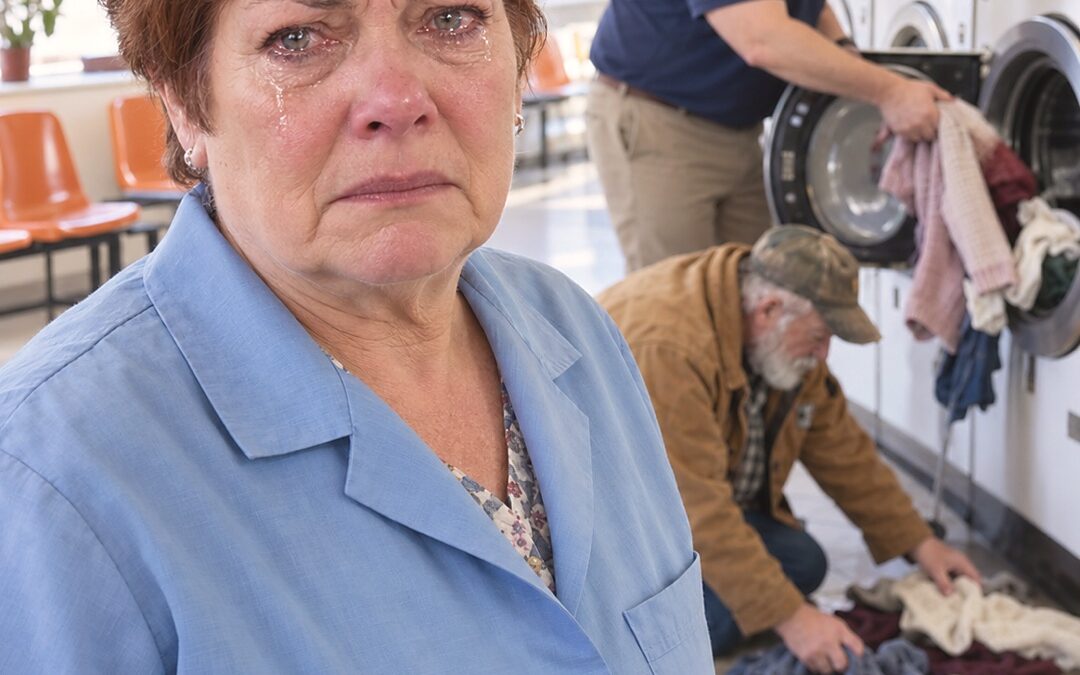
Dustin Reifsnyder yanked the plug on washer eleven halfway through the rinse, hauled the door open the second the lock let go, and raked a dead woman's wet cardigans onto the tile in front of a dozen Saturday-morning customers. Then he told the old man who'd brought them in, "Eleven's out of order, pal. So are you. Take your rags down to the creek." Five minutes later he had my smock, and at sixty, $1,450 behind on my rent, I was out of a job for feeding that washer twenty-six quarters from the roll I'd been saving for my landlord. Dustin had drawn that old man's paychecks for almost five years without once seeing his face. He never asked how a fellow who'd slept in a pickup in our lot knew the four numbers that make washer eleven tell you every quarter it ever took.
The rinse water ran out across the tile in a gray sheet and found the salt somebody had tracked in off Pine Street, and it kept going, under the folding table, toward the drain in the middle of the floor. Dustin reached back into the drum and came out with a blue cardigan. He held it up by two fingers, out away from his fleece vest so it wouldn't drip on the stitching, and let everybody have a good look at it.
"You expect my machines to handle stuff somebody pulled out of an attic?"
He let go. It landed on the rest.
The old man was already down there. He got onto his knees in that water in his paint-spattered Carhartt coat, five months of gray beard on him, and started picking the sweaters up one at a time, never two together, shaking the water off each one. A brown one with pearl buttons. A church dress. The blue one, which he wrung out a little and laid over his forearm.
"Watch your knee," I said. "There's a bobby pin under there since Wednesday."
He moved his knee and kept going.
Over by the front window Stella Wargo had stopped with one hand on her cart. She's seventy-nine and has had the orange chair by that window since the place opened in 1994, and I have never once seen her stop doing anything for Dustin.
"That wash is paid for," I said. "I put the quarters in myself. And eleven's fine, Dustin. I've run wash-and-fold through it every day for three years. My tickets say so."
Dustin looked at me a beat too long.
Ashley Moyer had come over from the dryers by then, still in her nursing-home scrubs from the night shift, her earbuds balled up in her fist. She crouched and picked a pair of nylon knee-highs out of the water, of all things, and held them out to the old man without a word, and he said thank you, miss, like she'd handed him his hat at a funeral.
The changer had spit the old man's twenty back three times at five after six, which it has done to every twenty since Christmas, so I'd broken open the roll I keep under the counter with RENT on it in pencil. It was mine to break. That's what I was thinking while Dustin went behind the counter, tore a flap off a detergent carton, wrote OUT OF ORDER on it in black marker and taped it over eleven's glass. Then he walked down the row and pulled the plug on seven, and then on twelve, and two more flaps of cardboard went up.
The old man had stood up by then with the sweaters over his arm. He put his free hand flat on top of eleven and bent to read the little metal plate on its side, the one with the serial number nobody but a repairman ever looks at.
"Get your hand off that," Dustin said.
"I used to fix machines."
"Not this one, you don't."
Stella had pushed herself up out of the orange chair. "I ran twelve Wednesday."
"Parts on order." Dustin turned to the room like he was making an announcement at a fish fry. "These three have been down since summer before last. Anybody asks you, that's what you tell 'em." Then he pointed out the front window at a gray Dodge Dakota with a cap on the bed and New Jersey plates, parked right under the NO OVERNIGHT PARKING sign he'd screwed into the blacktop last fall. "That's my lot. I decide who sleeps in it, and I decide who washes here."
"Since when?" said Tony Ruggiero. He runs the tire shop across Pine and washes his shop rags here before he opens at eight, and he'd had the same rag in his hands half folded since the cardigan hit the floor.
"Since the guy who owns it moved away."
Tony looked out past the Dakota at the black Ram 1500 in the RESERVED — MANAGER spot, the temporary tag still taped in the back window. "Nice truck."
"Paid cash. Some of us work."
Stella was squinting at the old man over the top of her glasses. "Do I know you, mister?"
"I get that a lot."
Dustin came back down the aisle and stopped in front of me. "Then you just ran your last one. Smock."
I untied it. My fingers did the knot fine, which surprised me. Before I handed it over I bent down and worked a cream-colored sleeve out from under the rubber foot of the folding table, where it had caught, and gave it to the old man. Then Dustin took the smock and hung it on the coat hook by the office door, neat, by the neck loop, like it was his.
"Out."
I got my coat from behind the counter and my blue laundry basket from under it. I'd bought that basket at Boscov's when the handle snapped off the store's old one, and I'd turned in the receipt, and nobody ever paid me back for it, so it was coming with me. I set it on the table and the old man and I loaded the sweaters in, the wet going straight through the plastic slats onto my shoes.
"That basket's store property," Dustin said.
"Then the store owes me eleven ninety-nine."
Tony made a noise into his rag. I carried it out.
It was cold enough out there to make your fillings hurt. There was slush along the curb the color of dishwater and a crushed Turkey Hill cup by the lot entrance that had been there since Tuesday. The old man let the Dakota's tailgate down, and we set the basket between two paint cans and a moving blanket. He took the blue cardigan off the top and tried to lay it flat. One sleeve slid off the edge. He fixed that and the bottom folded under itself, and he smoothed it, and it slumped again.
"She folded everything in thirds. I never got the hang of it."
"Nobody can fold a thing that's dripping," I said, and took it from him and rolled it instead, like a towel at the shore, and tucked it in a contractor bag. "St. Casimir's takes them wet, you know. They've got a dryer in the church hall. The drive goes till tomorrow."
"She'd never let me give away anything dirty."
I should have left it there. I didn't. "When did she pass?"
"Three weeks yesterday."
He looked back at the laundromat. Through the glass you could see Dustin pulling the shade down on the office window, which he only ever does when he's counting.
"How long's eleven been out of order?"
"Since about twenty to seven."
"That's what I figured."
I took it for a joke, and a pretty dry one for a man with his wife's things soaking through a garbage bag. He didn't smile, though. He asked how long I'd worked there and I said since May of '23, and he said he was sorry, and I said not to be, Dustin had been looking for a reason since I asked him for an advance.
"What's your name?"
"Irene Hudak."
"Augie."
That was all. No last name. I didn't think anything of it. Half the men in Schuylkill County go by one name and a truck. He had a scar across the meat of his thumb, an old white one. He said he had to be back in Jersey tonight. "Movers Monday."
"Then you'd better find a dryer. Pottsville's got one on Centre Street, opens at seven I think."
I had the rest of the rent roll in my coat pocket, fourteen quarters with the torn paper twisted around them so they wouldn't rattle. I held it out. He shook his head, and I said fourteen quarters weren't paying my rent either way, and I pushed it into his hand and closed his fingers on it before he could get going.
"I'll get your quarters back to you, Irene."
"Dry the sweaters first."
He put the bags in under the cap, the blue one on top with one cuff hanging out, and I tucked the cuff in for him. When he shut the cap and climbed in, the Dakota took two tries to start. Through the front window I could see Stella still in her chair. She was watching him, not me.
I carried the empty basket home.
My half of the double on Spruce Street is seven blocks from Pine. I rented it after Rudy died, when the hospital finished off what was left of our house in Shamokin. Thirty-five years Rudy drove for the beer distributor, and he was sixty-three when the lung cancer took him, and he used to point at the turnoff for the shore every time we passed it and say, someday, Reenie. There's no washer hookup in my half, which is a funny thing for a laundromat girl to admit.
Bob Shuey's notice was on the fridge under a magnet from the St. Casimir's fish fry. It was dated Monday, March 2.
"Rent owed: $1,450 (February and March). Pay in full by Thursday, March 12, or I file with the district judge. —R. Shuey"
Seven twenty-five a month. I took the Maxwell House can down off the top of the fridge. It still smelled a little like coffee though there hadn't been coffee in it since summer, just the rolls, and the loose bills under them, and the masking tape around the outside where I kept the running total in pencil, same as I used to keep my drawer at the bank. I counted it. I counted it again, because that's who I am. Two hundred twelve dollars. I wrote the new line under the old ones, and then the plastic lid wouldn't go back down. I turned it, and pressed it with the heel of my hand, and pressed it again. Then I sat down at the kitchen table in my coat.
Rudy used to leave the last swallow in his cup every morning because he said reheated coffee was worse than none, and I'd poured that swallow down the sink for thirty-five years. I kept buying Maxwell House two years after he was gone, just for the can.
Somebody next door was scraping a windshield. The furnace came on. Lisa calls Sundays from Allentown, and she's thirty-six and still asks me if I'm eating, which is what her father used to ask. I hadn't told her about the rent and I wasn't about to start on a Saturday.
What I kept going back to was the phone. Saturday's when Dustin pulls the coin boxes, before the crowd, and he'd come through the door at 6:38 with it pressed to his ear, talking to somebody while I wiped down the folding table. I only got his half.
"Starting today those three stay unplugged. The old man can come look at three dead washers, sign whatever Nancy puts in front of him, and go back to wherever he's been for five years. Guys like him roll up in a Lincoln with a golf tan."
Then he'd hung up and seen eleven going.
Thirty-one years at a teller window, you learn that when a man needs somebody to see a thing broken, it's because it's making him money working.
And a washer only makes money one way. It takes quarters. Somebody empties them out of the box in the back on Saturday mornings, and that somebody had a brand-new Ram in the RESERVED spot, and the man who was supposed to be getting those quarters had been gone five years and was coming home to look.
I'd heard of Nancy. Our paystubs come through her. I had never laid eyes on an owner, and neither had anybody I knew, and when I asked Dustin for seven hundred dollars against my check in February all he said was, "Payroll's Nancy's problem." My stub says Pine Street Coin Laundry LLC, c/o Ferrante & Co., Centre Street, Pottsville. No name. No phone. I've looked.
But I had the carbons.
Every wash-and-fold order I ever wrote up went on a numbered carbon pad, white copy to the customer, yellow copy to me, and every ticket has a little box that says MACHINE #. Two years ago in June Dustin told me to get my shoeboxes out of his office, I was turning it into a paper warehouse. My first year's box was already in the dumpster out back with the lint by the time he told me. I asked him where I should put them. "In the trash, Irene. Nobody's auditing you." He was eating a Tastykake at the time and brushed the crumbs off his vest onto my counter. I took them home instead.
I didn't touch them till after supper. I washed the egg pan. I wiped down the stove, which didn't need it. I called nobody. At 9:40 that night I carried the three shoeboxes out of my bedroom closet and set them on the kitchen table under the lamp and took the lids off.
I sorted them the way I used to strap bills. Seven to the left, eleven in the middle, twelve on the right, anything else back in the box. I didn't have bank straps anymore so I cut strips off a Giant bag and wrote the counts in pencil and snapped a rubber band from Rudy's old distributor receipts around every twenty-five. My glasses kept sliding. The oldest carbons were so faint I had to tip them to the bulb. A pillowcase order from the summer, W11, so light I almost missed it, and I remembered the woman, she'd paid in singles and apologized for every one of them.
The oldest ticket I had left was from that June, two summers ago, and I worked forward from there. By ten past ten I had washer eleven done. I added the bundle counts on the back of an envelope and then checked the envelope against the straps.
Four hundred thirty-seven tickets. Every one marked W11 in my own handwriting.
The seven pile and the twelve pile weren't small either.
I got out a sheet of good paper and wrote to the owner, whoever that was, care of Ferrante & Co. I put down what happened at 6:40, and who was standing there: Stella Wargo, Tony Ruggiero, Ashley Moyer, and nine or ten more I could find if anybody asked. I put down that I had fed washer eleven twenty-six quarters myself and it was running fine that morning and every week before it, and that 437 wash-and-fold tickets marked W11 since June two summers ago were enclosed, in copy, originals available on request. I didn't write anything I couldn't prove. That took longer than the counting. Monday I'd copy the tickets at the library at ten cents a page and send the copies. The originals were staying in my closet.
I had the envelope addressed and was reaching to turn off the lamp.
At 10:20 my phone buzzed on the table next to the tickets. "This is Dustin. Those ticket books are company property. Bring every one of them to me or Monday I call the cops and you can explain where they went."
Part 2
By the time I came out of nine o'clock Mass at St. Casimir's on Sunday, I'd been fired on Facebook too.
Stella Wargo caught me in the vestibule by the coat rack with her phone already out. Behind her the Lenten clothing drive boxes were packed full and taped shut, WOMEN'S on one of them in thick marker, and I looked for a blue cardigan without meaning to and didn't see one.
"You need to see what that man wrote."
"Let me get my glasses."
"I made the print big."
She'd made it enormous. You could have read it from the bottom of the church steps. It was in the Coldbrook Community Board group, where people sell snowblowers and fight about whose week it is for recycling.
"Yesterday we let go of an employee who allowed a vagrant to sleep on our property and gave away free services. She also walked out with company records. If she contacts you claiming to speak for Coldbrook Coin Laundry, she does not. —Mgmt"
About 140 comments. I scrolled through some of them standing there in my good shoes. Two people were arguing over whether a laundromat has to let homeless people use the bathroom. A woman I used to cash checks for in Shamokin said a business can't survive if the help gives everything away. One man wanted to know what a person was doing sleeping in a parking lot in March in the first place, like that was the part that needed explaining. My name wasn't in the post. It was all over the comments.
Stella took her phone back and said, "I told 'em what I saw. Nobody reads past the first line."
"What'd you tell them?"
"That he threw that man's washing on the floor. Then it was gone. Somebody took it down."
"Maybe the people running the group took it down."
"Then they did it twice, because I put it back." She pulled her coat closed at the neck. Stella's been a widow longer than I've known her and still buys the same detergent her husband used because it didn't bother his skin. "That old man. I keep thinking I've seen him somewhere."
"He told me he gets that a lot."
"Well, he does. From me." She put the phone in her purse and snapped it. "Dustin Reifsnyder never set foot in that place before six-thirty in his life. You think about that."
The doors opened behind us and Bob Shuey came out with his wife Rita. Bob's seventy-one and owns both halves of my double and three others on Spruce. He had on the brown Agway jacket with the name faded half off the chest, and when he saw me he stopped, which made Rita stop.
"Irene. I was going to come by tomorrow."
"About the rent."
He nodded. Rita had her bulletin folded in half and then in half again.
"I saw what happened at the laundry," she said.
"You saw the post, Rita."
"Well. Yes."
"He left some things out."
Bob looked off toward the cars pulling out of the lot. "I don't know anything about that business and I don't want to get into it. But the notice stands, Irene. Thursday the twelfth. I've got a mortgage on that double too."
"I know you do, Bob."
He put his hand inside his jacket like there was something else in there for me, and then he left it there, and Rita touched his sleeve, and they went down the steps together holding the rail.
"He's not a bad man," Stella said.
"I didn't say he was."
"She ought to mind her own business, though."
I went home and sat at the kitchen table with a pencil and did the same arithmetic I'd done Saturday, and it came out the same. Two hundred twelve in the can. Enough in checking for the electric and some groceries if I wasn't ambitious about either. I thought about calling Lisa and took my letter to the owner out of its envelope instead and checked the dates one more time.
About three I put my coat on and walked down Pine, because I couldn't sit in that kitchen any longer. The Sunday girl had it, not Dustin, and he never comes in Sundays. His Ram was in the RESERVED spot anyway, and the office light was on. I stood across the street by Tony's air pump and watched him come out of the office and walk straight to eleven and bend down behind it, checking the plug, and then do the same at seven and at twelve. When he straightened up he saw me. He didn't wave. He went back in the office and pulled the shade, and I walked home with my hands in my pockets.
Dustin's text was still there on my phone. He wanted every ticket. He hadn't once asked what was in them. That bothered me more than the part about the cops.
At eight-fifteen Monday morning, Officer Zach Wargo knocked on my front door with his cap in his hand. I knew Zach from when he was a skinny thing carrying his grandmother's baskets in from the car. He's twenty-six now and one of the Coldbrook Borough Police, all two of them.
"Morning, Mrs. Hudak."
"Is your grandmother all right?"
"Grandma's fine. Can I come in?"
He came into the kitchen and saw the shoeboxes on the table, and I watched him decide not to look at them. "I guess you know why I'm here. Mr. Reifsnyder called in a complaint yesterday. Says a former employee removed company records."
"Sit down, Zach."
He sat. I took the lid off the top box and laid a handful of yellow carbons in front of him. "That's my handwriting. Every wash-and-fold order since the June before last. He threw my first year's box out himself. Customer gets the white copy, I keep the yellow. Two years ago he told me to get them out of his office or throw them out. I didn't throw them out."
Zach turned one over with a finger like it might be hot. "Did he ask for them back before Saturday?"
"Not once."
"Well. He called." He rubbed his thumb along the brim of his cap and pushed the tickets back across to me. "Far as these go, it's a civil matter. Somebody saying a thing belongs to a business doesn't mean I get to carry it out of your kitchen. Not without a court order, and I'm not getting one."
He put his card on the table beside my letter. If there was another complaint, call the station. If Dustin filed something in court, don't ignore it. At the door he stopped.
"Grandma told me what happened Saturday. Twice. In order. She corrected me when I got the time wrong."
"That sounds like her."
"She says to tell you she's saving your chair for Wednesday."
"I don't have a chair there anymore."
"You can tell her that," he said. Then, with his hand on the screen door: "She says he dumped an old fellow's clothes on the floor and fired you for helping him pick them up. Is that about right?"
"That's exactly right."
"That's what she said." He put his cap on and went down the steps, and I watched him sit in the cruiser a minute before he started it.
The Coldbrook library opens at ten. By five after I was at the copier with a pocketful of dimes, and by eleven every sheet was in the envelope and every original was back in its box.
Then I drove to Pottsville, down 61 past the culm banks and the Sheetz, with the envelope on the passenger seat where Rudy used to put his lunch.
I reached Centre Street before noon and found Ferrante & Co. between an insurance office and a storefront with paper over the windows. Brass plate by the door. Inside it smelled like toner and somebody's microwave lunch, and a young receptionist sat behind a counter with her monitor tipped toward her.
"I need to leave something for Nancy Ferrante. It's for one of her clients. Pine Street Coin Laundry."
"Do you have an appointment?"
"No, ma'am."
"Mrs. Ferrante's with clients all day. It's March." She studied me. "Are you with the laundry?"
"I was until Saturday."
She looked at me properly then. I put the envelope on the counter. "It's for the owner. Through Nancy. That's the only address I've got."
She read the front, and the return address, and started to slide it into a wire tray by her keyboard, the regular pile.
"Please don't put it in with the mail," I said. "It's about money being collected at that laundry. The owner needs to see it, not just get it."
"I can't promise when anybody'll look at it without an appointment."
"I know you can't. I just don't want it lost."
She held it a second longer.
"I'll make sure Mr. Kasper gets it."
Kasper. In three years nobody had ever said a name to me. I said it back to her like I was checking a deposit slip, and she said that's right, and turned to reach for a folder, and I said thank you to the side of her head.
There was a stack of bills on her desk waiting to be entered, some clipped and some loose, and the top one was pink. Thirty-one years at Miners Bank and you can read anything upside down across a counter, because nobody in this world puts a check down facing the teller.
The first thing I saw was the number eleven.
Right on top was a pink invoice: KREIDER COMMERCIAL LAUNDRY REPAIR — Washer #11 — control board, backordered — $1,140.00. It was dated February 19. I'd had a wash-and-fold in eleven every day I worked that week.
Part 3
"Irene, a man charges eleven hundred dollars for a control board, I'd expect to see him carry one through the door."
Tony Ruggiero said that Tuesday morning at nine, fighting with the lid on his Turkey Hill coffee in the little office behind the counter at Ruggiero Tire. He'd bought me one too. From his window you could see straight across Pine Street to the old Acme building, the big front glass, the RESERVED spot empty this early.
"What date was the bill?"
"February nineteenth. Kreider Commercial Laundry Repair."
He stopped fussing with the lid. "Brandon Kreider."
"That's the name on it."
He moved a stack of tire invoices to make a clean spot on the desk and tipped the blinds with a finger. "Brandon's married to Dustin's sister Jolene, and that van of his parks behind the laundromat every other Thursday for about twenty minutes. I can see the back door from my alignment bay, and I've never once seen him carry anything in there but a coffee."
I took the rubber-banded packet out of my coat pocket and set it on his desk. "This is eleven."
"That's a fair amount of paper."
"Four hundred thirty-seven orders since the June before last." I found the week of the nineteenth and laid it out for him one ticket at a time, every day I worked. Saturday the fourteenth. Sunday, with a fabric softener stain on the corner. Monday. Tuesday. Ash Wednesday, two comforters for the Lutheran parsonage. Then Thursday and Friday, my days off, and then Saturday the twenty-first, eleven again. Every one W11, every one in my hand.
Tony picked up the Ash Wednesday. "So the day before he wrote that bill, you were washing the Lutherans' comforters in it. And the Saturday after."
"That's what I saw on Nancy Ferrante's desk."
"So take it to the cops."
I squared the tickets. "I don't have his books, Tony. I have laundry tickets."
"Still."
"The owner has the books. I gave him the tickets. Now he can count." I told him the name, Kasper, that I hadn't known it till yesterday. Tony sat back and said it over to himself.
"Sounds like I should know it. Stella keeps saying she knows that old guy from somewhere."
"Stella thinks she knows everybody."
"She usually does." He drank some coffee. "Saturday Dustin tells me he paid cash for that truck. Monday I hear he's telling people you stole his paperwork."
"Zach Wargo came by. He said it's civil."
"Then Dustin won't stop there." He looked out the blinds again. "First month he was here, he came over and asked me did I know anybody fixed washers. I gave him the outfit in Hazleton the old owners used to call. He never called them. I asked."
"Why'd you ask?"
"Because I'm nosy, Irene. Same as you." He walked me to the front. When I said I had sheets to wash he looked over at the laundromat and then at me, and I said there's one in Pottsville and there's one across the street, and I'm not buying new sheets because Dustin doesn't like me. He offered to come over. I told him I was going in there to buy a wash, not start a fight. He said he'd be in the second bay with the door up, and if he saw Dustin's arms going he was coming over whether I liked it or not.
"Call me if he gives you trouble," he said.
By three I was standing at those glass doors with my bedsheets in my blue basket and a fistful of fives, because I know that changer. Seven, eleven and twelve stood dark with their cords coiled on top. The cardboard was gone. Somebody had put up printed signs instead, centered, every corner taped flat:
"OUT OF ORDER — PARTS ON BACKORDER"
Each one with a Kreider Commercial sticker in the corner.
So somebody had been in since Saturday to put stickers on, and nobody had been in to fix a thing, because there was nothing to fix. I put my hand on eleven's lid. Cold. The drum was dry, and there was still a gray ring on the door gasket from the old man's rinse water that nobody had bothered to wipe.
The girl Dustin had hired to replace me was behind the counter. I'd never seen her before. She saw me and looked down at the register like it had done something.
"Afternoon. I just need to wash my sheets."
"Okay."
"Did the repairman come for those?"
She glanced at the office door. "I don't know. He said don't even touch them."
So I didn't. I took washer ten, and while I loaded it she knocked the change cup over reaching for a receipt, that's how hard she was trying not to watch me, and quarters went rolling under the counter. I picked up the one by my foot and set it on the counter and left her the rest. Ten took my money and started to fill. I sat in an orange chair by the window. The lost-cat flyers on the corkboard had curled up at the bottom and the price card on the soda machine was hanging crooked, and three days ago I'd have fixed both. Two men off a PennDOT crew came in with work shirts stiff with road salt and took a washer in the back.
At ten after three Dustin's Ram pulled into the RESERVED spot. Tuesday's when he drives the weekly sheets to Nancy's in Pottsville. He came in with a folder under his arm, asked the new girl if everything was okay, and then he saw me.
He stopped at the end of the folding table. "You went to Nancy's."
Both PennDOT men looked up. I stayed sitting.
"I dropped off a letter."
"To my accountant."
"To the owner's accountant."
"Receptionist says Irene Hudak left an envelope for Mr. Kasper." He set the folder on the counter. "What was in it?"
"A letter. And copies of my work tickets."
He looked over at eleven and then he came and stood between me and the three dark machines, close enough that I could see the stitching on the vest.
"Machines don't talk, Irene. And laundry tickets are whatever an old lady wrote down in pen."
"In carbon, Dustin."
One of the PennDOT guys shut his washer door. It took two shoves to catch. Dustin waited for it.
"You know I can file a private criminal complaint with the district attorney myself. I don't need Zach Wargo. Company records, taken off the premises."
"You told me to get those boxes out of your office."
"I told you to quit cluttering it. I didn't tell you to take company records home."
"You told me to throw them away. I didn't."
He put his hand on the back of the empty chair beside mine and leaned on it. "I called Bob Shuey Sunday. Small town. Fourteen-fifty, he says you owe him."
Behind us washer ten was still filling, the water running in. I looked at his hand on the chair because I didn't want to look at his face.
"You called my landlord."
"Bob and I know each other."
"Since when?"
"Since Sunday." He said the next part loud enough for the PennDOT men. "People who owe that kind of money shouldn't be walking off with their employer's property."
I got up and went to check my washer, though I'd set it right and knew I had. Behind me he told the new girl not to let anybody behind the counter who didn't work there, and she said okay. When I turned around he'd taken a sheet out of the folder.
"Your termination's being processed. Final wages go through Nancy."
"Payroll's Nancy's problem," I said.
That stopped him a second. "What?"
"That's what you told me in February. When I asked for an advance because I was behind on my rent."
He slid the paper back in the folder. "I could have had you removed Saturday."
"You did have me removed."
"I'm not a bank, Irene. You don't come to me for loans."
"I know you're not a bank. I worked at one."
He leaned in close. "Careful."
A dryer buzzed and the new girl jumped and went to help a woman unload it. Thirty-four minutes left on my wash. Dustin went over to eleven and got down on one knee behind it, the knees of his khakis right on the wet tile, and felt along the wall until he had the cord in his hand. He held the plug up so I could see it wasn't in anything. Then he got his phone out and took a picture of the printed sign, and one of seven's, and one of twelve's, close up, the Kreider stickers square in the middle, like a man getting his paperwork in order before an inspection. The PennDOT men watched him do it and then looked at each other. I put my empty basket under the folding table and went back to my chair, and the PennDOT men talked low over their machine, and Dustin stood by the counter and watched me not leave.
After a while he came across the room again and stopped by eleven, right about where he'd thrown the old man's sweaters, and tapped the edge of my basket with his folder.
"You want your problem with Bob Shuey to go away?"
"That depends what you're selling."
He bent down far enough that I could smell the coffee on him.
"Saturday, six-thirty. My office," Dustin said. "You bring me every one of those boxes, and I hand you an envelope with fourteen hundred and fifty dollars in it. Or you don't, and Bob Shuey reads about his thief of a tenant in the Republican Herald."
Part 4
Bob Shuey came up my porch steps at four o'clock Wednesday afternoon in his Agway jacket, and he didn't sit down on the glider, which is how I knew.
"Friday morning I'm at the district judge's. Rita read that post, Irene."
"Bob, the notice says Thursday."
"Thursday's tomorrow. I haven't heard how you're paying." He looked past me through the screen to the kitchen, where the three shoeboxes sat on the table with rubber bands around the yellow tickets. "I wouldn't be up here if I didn't have to be. I've got payments on this place too."
"I took mortgage payments across a counter half my life, Bob. You don't have to explain one to me."
He looked down at the porch boards. He'd fixed those back steps himself last summer because the carpenter wanted too much, and he'd brought Rita's pierogi over at Christmas, and now he couldn't get his eyes up past my knees.
"I'm sorry about your job," he said, and went down the steps holding the rail where the paint's peeled, and I shut the door.
I didn't take the coffee can down. I already knew what was in it. I sat across from the shoeboxes and read Dustin's offer over in my head like a loan I already knew I was signing. Bring every box. Fourteen hundred fifty. To the dollar what Bob wanted, because Dustin had asked him. Mr. Kasper, whoever he was, had had my envelope since Monday, and it was Wednesday suppertime now, and nothing. Maybe Nancy Ferrante had read it and put it in a drawer. Maybe a man who'd been gone five years didn't care what went on in his laundromat as long as the sheets came in on Tuesday.
If I gave Dustin the originals he'd shred them in that office, and I'd still have library copies with half my handwriting washed out. If I didn't, Bob would file Friday and Rita would tell the whole Altar and Rosary.
I fried the last of the potatoes and ate them out of the pan. At 6:50 I opened Dustin's text and typed:
"Saturday 6:30."
I sent it before I could fix the punctuation. Then I carried the three shoeboxes to the front door and set them on the mat beside my shoes, like something I was returning to the store.
At 9:05 my phone rang. A 609 number. Jersey. I almost let it go.
"Mrs. Hudak? It's Augie. From Saturday. The sweaters."
I sat down on the arm of the couch. "Did you ever get them dry?"
"Most of 'em. Can you come by forty-one Laurel Street tomorrow at ten? There's something I need to show you. And bring your boxes, would you?"
I knew the house. Brick, up the hill, a maple that drops its leaves in the road every fall. Nobody had lived in it since February.
"How do you know about my boxes?"
"Nancy Ferrante."
"Do you work for her?"
"No," he said. "Come tomorrow. I'll tell it right."
After he hung up I sat there with the phone in my lap. Then I got my paystub off the counter and read the company name again, Pine Street Coin Laundry LLC, c/o Ferrante & Co. And I looked at the 609 number on my phone, and I put the stub face down on the table and didn't let myself do the rest of it.
At ten Thursday morning the Dakota was in the driveway at 41 Laurel Street, Jersey plates gray with road dirt. The front door opened before I got to it and I almost walked right past the man standing there. He'd shaved. He had on a pressed flannel shirt buttoned to the top, and without the beard and the Carhartt you could see how much of him was gone.
"Morning, Irene."
"You're Mr. Kasper."
"Augie." He took the top shoebox from me. "Come in out of the cold."
The front room had a couch under a bedsheet and dents in the carpet where somebody else's furniture had sat. The heat was on. "Gas came back yesterday," he said. "Renters moved out end of February."
"That laundromat is yours."
"Mine and Helen's. We opened it in '94, in the old Acme. I put those eighteen washers in myself in 2019." He set the box down on a card table. "It's Pine Street Coin Laundry because Helen said our names on a sign would look like bragging."
"And Dustin doesn't know your face."
"Nancy hired him over the phone. I talked to him once, in 2021. I've lost forty pounds since then and I wasn't shaving."
He sat across from me. Before the laundromat he'd fixed bottling lines at Yuengling for twelve years. Helen kept the books. She got Parkinson's, and after a while the other thing came with it, and in the spring of 2021 he took her down to Wildwood, where her sister lives and where they'd honeymooned in 1981, and he took care of her himself. Five years. She died on Friday, February the thirteenth. She was sixty-six.
"We haven't buried her yet," he said. "Ground's still too hard up at St. Casimir's."
He went into the next room and came back with a green ledger, the old cloth kind, COUNTS lettered on the cover in black marker. He opened it on the card table. Columns of machine numbers and readings, every month, back and back, in small straight writing you could have set a ruler on. Near the end the figures started to lean. Some lines were crossed out and written again.
He turned to April 2021. At the bottom of the page:
"Augie — your turn. I can't hold the pen. H."
I put my thumb on the line. She'd pressed so hard on the A it had come through the paper. I picked the ledger up off the table like I was going to say something about it, and then I didn't have anything, and I handed it back to him. His thumb went right to the corner where her H was.
I'd had since Saturday to line up questions. I asked the first one before I got my coat off.
Why didn't you say who you were Saturday?
"If I'd said my name on that floor, he'd have had all weekend to wonder what I knew."
Why'd you let him call them rags?
"I wasn't doing it with Helen's things on the floor."
Why didn't you call me?
"I wasn't going to tell you over the phone that the man who put you out works for me."
He closed the ledger. "There's somebody in the kitchen you ought to meet."
Nancy Ferrante was at the kitchen table with her folders open, sixty-one, short brown hair, reading glasses on a beaded chain. She didn't get up. "Mrs. Hudak. I read your letter Tuesday night. Then I called him."
"So you know those washers work."
"I do now." She found a printout in the top folder. "This is what I sent Dustin on Tuesday, March third." She read it to me flat, like a weather report.
"Augie will be home at the end of the month. He wants to see the three down washers himself before we approve replacement quotes or talk to any buyers."
"That's who he was talking to Saturday," I said. "On the phone. That's the old man."
Augie nodded. "I opened the stack of Nancy's packets around the first of March. I'd let 'em pile up. Three washers down, week after week, ninety-one weeks. I called Nancy that Monday." He hadn't told her he was driving up Friday night. He wanted Helen's clothes in the St. Casimir's drive before it closed, and he wanted a look at his machines, and the house had no gas, so he slept in the truck.
"I asked Dustin about those three twice," Nancy said. "Both times, parts on backorder, and I let it stand. I should have driven up and looked myself. That's mine to carry."
"And I was feeding Helen with a spoon," Augie said, "and when Nancy called I said, 'Handle it, Nancy.'" Nancy let that sit.
Nancy turned a collection sheet toward me. "Tuesday afternoon, after you left that envelope, Dustin called me. A disgruntled former employee, he said, ignore anything she sends."
"What'd you tell him?"
"Noted." She took out two more sheets. "Ninety-one weeks, washers seven, eleven and twelve at zero dollars collected. And Kreider Commercial has billed this business eighteen thousand four hundred sixty dollars."
I took the rubber band off my W11 strap and spread the carbons across her collection sheets, yellow over white. "That's just eleven. Seven and twelve are in the other boxes."
"Every week?" Augie said.
"Every week."
Nancy picked up a ticket and matched its date to a sheet with her pen. Then another one. Augie tapped the ledger. Every machine keeps a lifetime count of every coin it ever took, he said, stored in the controller, and Helen wrote them down every month for twenty-seven years.
"Can Dustin change it?"
"Dustin's key opens the coin vaults. The code opens the count. He never had the code."
The distributor was sending a technician Saturday at six-thirty, the earliest they had. At one o'clock that afternoon Augie and Nancy were driving to the state police barracks in Schuylkill Haven, and a trooper wanted to see the machine read with his own eyes.
"Why not Zach Wargo?" I said. "He was decent to me."
"The borough has two part-timers and a county case this size goes to the state."
So I told them about Dustin. The envelope with my rent in it, the Republican Herald, and the text I'd sent him last night. Nancy listened to all of it and then pulled a sheet of her letterhead out of the folder and uncapped a pen.
"Don't take a dime from him. This is for your landlord. Back wages for a firing without cause, and your job back starting Saturday." She signed it. "Get it to Mr. Shuey tonight."
I folded it in thirds and put it inside my coat.
Augie got up, took the green ledger off the table, and set it on top of my shoeboxes.
"Bring Dustin his boxes Saturday, Irene," he said. "Six-thirty, like he wants. I'll bring the code."
Part 5
My landlord had read Nancy's letter Thursday night and put his district-judge forms back in the drawer.
At 6:25 Saturday morning I carried the three shoeboxes through the front door of Coldbrook Coin Laundry in my blue basket. The Ram was in the RESERVED spot with the temporary tag still in the back window. Inside, Dustin was working his way down the row pulling coin boxes, a canvas bank bag hooked over his shoulder and his phone against his ear. Seven, eleven and twelve stood dark under their printed signs.
"Quarter to seven. Bring the tool bag and pull the panels on all three so it looks like you've been in 'em."
He saw me and hung up. "Bring them in the office."
I walked past him and set the basket on the folding table beside washer eleven. "Here's fine."
"I said my office."
"I heard you."
There had to be twenty people in there, more than I'd ever seen before seven on a Saturday. Dustin's post had given half of Coldbrook a reason to come look. Stella was in her orange chair by the window with her clean towels stacked at the end of the folding table. Tony had brought his shop rags across from the tire shop. The girl in scrubs stood by the dryers with a Turkey Hill cup and took one earbud out when she saw me.
Dustin set the coin box down and spoke to the whole room. "Nothing to see, folks. Irene's returning some company property."
He took a fat white envelope out of his vest, and you could see the square ends of the bills in it, and held it out at arm's length. "Fourteen-fifty. Count it if you want."
"What's he paying you for, Irene?" Stella said.
"Private arrangement, Stella. Mind your laundry."
"Then don't do it in front of my laundry."
Tony had stopped folding. "Careful, Dustin."
"Why's everybody got something to say this morning?" He shook the envelope at me. "You agreed to bring the boxes."
"And I brought them."
I didn't take the envelope. I didn't move. Dustin took a step toward the basket and I slid it closer to eleven, and he looked at the clock over the office door, 6:31, and I watched him decide whether he was going to grab the boxes in front of twenty people.
At 6:32 the front door opened.
Augie came in first, shaved, in a dark church jacket with his gray hair combed back wet. Nancy Ferrante was behind him with two folders under her arm. Then a man from the washer distributor with a tool bag, and a state trooper in the gray uniform holding the door for him, his hat in his other hand.
"Nancy? What are you—"
She walked straight past him to my basket. "Dustin, this is Augie Kasper. Pine Street Coin Laundry. He's who you've been sending your sheets to for almost five years."
Dustin looked down at the envelope in his hand like he couldn't remember who'd given it to him. Then he folded it in half and pushed it into his back pocket.
Stella was halfway out of her chair. "Helen's Augie. I knew I knew you."
"Morning, Stella."
"You've gotten skinny." She looked at his face a while longer. "Your Helen?"
"February thirteenth."
Stella sat back down and pulled her cart in against her knees. Augie turned around to the machine.
"Plug eleven in for me, would you, Tony?"
Tony went around behind it. Dustin said hold on, that machine's out of service, and Tony said, "You heard the man," and pushed the plug in. The panel lit up green.
The technician pressed some combination on the buttons and a service menu came up. "I need the audit code."
"Oh-six-one-one. Helen's birthday."
He punched it in and stepped aside so the trooper could see. One screen. One number. The lifetime count, every coin that machine ever took since the day Augie bolted it to the floor in 2019. The trooper asked if a manager could reset it, and the technician said not with a coin-vault key he couldn't.
Nancy opened the green ledger to Helen's last reading, April 2021, and wrote the new number under it in pencil. She opened her other folder to Dustin's collection sheets and ran her finger down what he'd turned in on eleven since then. Her calculator clicked on the tabletop. She ran it again.
"Twenty-four thousand, eight hundred sixteen dollars and fifty cents that never made a collection sheet. That's eleven by itself."
A woman by the dryers set her basket down.
"It got fixed. Brandon fixed it last month. I just never changed the sheet."
Nancy didn't argue with him. She took the pink invoice out of the second folder and held it up where the trooper could read it. February 19. Control board, backordered. Eleven hundred forty dollars.
"When did Brandon get the part in?" she said.
"I'd have to look."
"Your sheet for the week of the nineteenth says eleven was down. So does every sheet back to June two summers ago. Ninety-one weeks of them."
"Then that's an office mistake."
"It's your office, Dustin."
So I took the rubber band off my W11 strap and fanned the carbons out on the table next to Helen's ledger, the week of February nineteenth on top. A ticket in eleven every week for ninety-one weeks. The technician picked one up and asked who wrote it, and I said I did.
"She's the one I fired," Dustin said. "She could've written those last night."
"You think Irene sat home and made up four hundred thirty-seven laundry orders?" Tony said. "Come on, Dustin."
Stella was on her feet again. "I ran twelve every Wednesday since the Acme closed." She pointed a finger at him. "I've got it wrote down in my checkbook, the time it ate four quarters in January. You want to see it?"
"That doesn't prove anything, Stella."
"Then what's that sign on it for?"
"Can we do the other two?" the trooper said.
Dustin stepped in front of seven. "Nobody's authorized anybody to open these machines."
"I have," Augie said, and Dustin moved.
Tony plugged in seven, and then twelve, and the technician put the code in each, and Nancy wrote and added while the trooper wrote in his notebook. When she was done she didn't look at Dustin. She looked at the trooper. "All three, it's about seventy-one thousand dollars in quarters. Plus eighteen thousand four hundred sixty in repair bills for parts on order."
Dustin turned to Augie. "Augie, listen. We never met. You're getting a bad introduction here."
"I saw you last Saturday. I came in a Dakota. No golf tan."
"That was a misunderstanding."
"You put my wife's clothes on the floor. You called them rags."
"They were soaking wet. I was worried about the machine."
"The one that works," Augie said.
Dustin looked over at Nancy. "Are we seriously doing this in front of everybody?"
"That's where you fired her," Augie said. "In front of everybody."
At 6:50 a white van came around the back of the building. A minute later Brandon Kreider came in through the rear door with a tool bag, a work jacket with KREIDER over the pocket, saying, "Dustin, I got the—" and then he saw the trooper. And Nancy with his invoices in her hand. And three washers lit up that he was supposed to have the panels off of.
Dustin started toward him. "Brandon, don't say anything till we talk."
"Let him answer," the trooper said.
Brandon set the tool bag down on the tile. His boots squeaked when he shifted his weight.
"I'll say this much before I ask for a lawyer. I never put a part in any of 'em." He looked at Augie, and then at me. "I'm sorry, Mr. Kasper. Ma'am."
"Then you'll give your statement at the barracks, sir," the trooper said.
Dustin came down the length of the table at me with his finger out, and everybody between us stepped back. "You set me up. You and this old—"
"Eleven's not out of order, Dustin. You are."
Dustin stepped back and sat down hard on the edge of the folding table, right on top of Stella's clean towels. He didn't notice.
Stella looked at her towels under him, then at me. "Those were clean."
Nancy took a letter out of her folder and laid it on the table beside him. "You said he'd sign whatever I put in front of him. This is what I'm putting in front of you." He read the top line, TERMINATION OF EMPLOYMENT, and turned it over like there might be more on the back, and there wasn't.
Augie peeled the printed sign off eleven's glass, Kreider sticker and all, and held it out to him. "Take it down to the creek, Dustin." Dustin didn't take it. Augie let go and it slid off the edge of the table and landed by the floor drain, right where Helen's sweaters had been a week ago.
The trooper asked Dustin to put the coin-vault keys on the table, please, and Dustin got up off the towels and dug the ring out of his pocket and laid it next to the ledger, and then the trooper pointed at the canvas bank bag still hooked on his shoulder, and Dustin set that down beside the keys. The trooper wrote me a receipt for my three shoeboxes and tucked them under his arm, and asked Dustin if he'd come down to the barracks in Schuylkill Haven and give a statement. Dustin unzipped the fleece vest with the laundromat's name stitched on it and took it off and hung it on the hook by the office door, the same hook where he'd hung my smock, and he walked out the front on his own. The trooper went out behind him. The bell over the door jangled after them.
Augie looked around at all of us, Stella and Tony and the girl in scrubs and the rest, and the wet salt on the floor, and said, "I drove up here in March to sell this place."
Part 6
"Nancy found me a buyer in Reading," Augie said. "Fellow owns four laundromats already. I was going to sign Monday."
Stella was pulling her towels out from where Dustin had sat on them and refolding every one. "Well, I hope you told him the dryers work."
"I haven't told him anything."
Nancy closed her folder. "The offer's still open, Augie."
"Tell him no."
She looked at him over her glasses. "No to the price, or no to selling?"
"No to selling. Not to him. Not to anybody." Then he looked at me, standing there with my hand on my empty blue basket. "I was hoping Irene would run it."
The shoeboxes were gone, out the door under the trooper's arm, and I had his receipt in my other hand. I folded it in thirds, the way you fold a check, and put it in my purse.
"Augie, I'm sixty years old."
"I'm sixty-eight. And I own the building."
"I don't know how to run a business. There's payroll. Insurance."
"Nancy does the books. I'm asking you to run the laundry, which you've been doing every morning for three years while he came in Saturdays to empty the boxes."
I looked over at the office. Dustin's vest hung on the hook with the stitched name facing the room and the empty arms hanging straight down. "I'm not taking a job for twenty-six quarters, Augie."
"I'm not offering it for twenty-six quarters. I'm offering it for four hundred thirty-seven tickets you kept when nobody asked you to. He told you to throw them in the trash."
Nobody was folding anything anymore. Tony had a rag in each hand. The girl in scrubs had sat down on top of a dryer to watch, which you're not supposed to do, and I let her. I thought about every Tuesday that folder went to Pottsville and I never once saw what was in it.
"Two signatures on every count," I said. "Every Saturday. Whoever pulls the boxes and whoever checks the totals, both sign, every time, no exceptions. Stella's chair stays where it is."
"Who said anything about my chair?" Stella said.
"Nobody. I'm making sure."
"Then put twelve in too. Wednesdays are mine."
"Twelve's everybody's, Stella."
"Not on Wednesday it isn't."
"Eleven stays on gentle," I said. "And I pay for my own wash like anybody else, so nobody can ever say I didn't."
Augie looked at Nancy. "Nancy, put that in."
She wrote it down. Then he reached into his church jacket and set something small down by my basket. A torn quarter wrapper with RENT on it in my pencil, still twisted shut around fourteen quarters.
"I never got to the dryer."
He counted out twenty-six more beside it, one at a time, in stacks of four, and two left over.
I picked Dustin's sign up off the floor by the drain and put it in the trash. Then I went into the office. My smock wasn't on the hook anymore. I found it balled up on the shelf inside the door, behind the bleach. I shook it out and tied it on, and the strings were where they always were.
Augie went over and lifted Dustin's vest off the hook. He tried to fold it and made a mess of that too, and finally he just rolled it up and dropped it in the lost-and-found box under the counter, on top of a single mitten and somebody's reading glasses.
"Well, if we're open," Tony said, "I've got rags that aren't getting any cleaner." And he went and put them in eleven, and fed it, and the girl in scrubs clapped and then looked embarrassed about it.
I called Lisa from the office that afternoon and told her all of it, rent included. She was quiet a second, then said, "Mom, are you eating?"
The night of the count, Stella posted the real story on the Coldbrook Community Board, and this time nobody took it down.
On the thirty-first Bob came up on my porch with his cap in his hands. I paid him his fourteen-fifty out of my back wages, and he counted it twice right there on the glider and said he was sorry. Rita sent over a plate of pizzelles nobody asked her for.
*
On Thursday, April 9, at nine-thirty in the morning, I sat on a bench in the district judge's office out on Route 61 for Dustin Reifsnyder's preliminary hearing. Stella sat on my left in the good navy coat she saves for funerals. Tony was next to her. Augie and Nancy had the bench across the aisle, and a reporter from the Republican Herald sat in the back with a notebook open on her knee.
Dustin came in wearing a sport coat beside his lawyer. Without the vest I almost didn't know him. He'd had his hair buzzed close over the ears and he kept looking at the door like somebody else might be coming.
"That coat doesn't fit him," Stella said.
"Stella."
"It doesn't."
The prosecutor went through the collection sheets and the invoices. A state police investigator explained how they'd read the counters against Helen's ledger. When he said washer eleven, Dustin turned around on the bench and looked for me, and I kept my eyes on the judge.
Brandon testified after that, in a plain shirt with the collar button open. His lawyer had already worked out his deal. He answered in the same voice you'd read a grocery list in. No, he never installed the boards. No, he never did the repairs. The prosecutor asked him where the money went.
"I never put a part in any of 'em. I kept two hundred a ticket for writing 'em up. The rest went to him." He didn't look at Dustin when he said it. He'd handed over the deposit slips in March, every one.
Dustin's lawyer stood up. "You're hoping for a lighter sentence in exchange for this testimony?"
"Yes."
"So you've got every reason to blame my client."
Brandon looked over at Dustin. "He told me what to write on the bills. I wrote them."
The lawyer checked his notes and sat down. The reporter in the back wrote something, and kept writing.
The judge held all of it for court. Theft by unlawful taking, theft by deception, criminal conspiracy. Dustin rubbed his forehead with the side of his thumb, and his lawyer got up and said his client wished to begin restitution, and the judge said that was a matter for the court of common pleas, and gave them a date in June. Dustin's lawyer had to point to it on the calendar before Dustin wrote it down. That was the end of the morning.
Out in the lot the sun was bright enough that Stella stopped on the steps to dig for her sunglasses. Dustin's black Ram was parked down at the end with a FOR SALE sign taped in the window, a phone number, and under it in marker, $46,500 OBO.
Dustin came down the steps behind us. For a second he looked right at me. Then he walked past without a word and got into his lawyer's sedan, and Stella watched it out to the road.
"Paid cash, did he?"
Augie offered her his arm for the walk across the lot, and she took it.
*
On the first Saturday in October I unlocked Coldbrook Coin Laundry at six in the morning. There was frost along the bottom of the front glass. I turned on the lights and walked the row opening every door, and seven was fine and twelve was fine, and eleven was sitting there by the folding table with the gentle cycle working like the day Augie put it in. The changer takes twenties now. I had a man out from Allentown in April.
Somebody tapped on the glass.
Augie was outside in the paint-spattered Carhartt from March with three black contractor bags at his feet. They'd been in the back bedroom on Laurel Street since spring. Helen went into the ground at St. Casimir's in May, once it softened, and the fall clothing drive was tomorrow. I let him in and took one of the bags, and neither of us said what was in them.
We sorted on the long table. Church dresses with little cloth buttons, nightgowns gone thin at the collar, the brown cardigan with the pearl buttons. Augie went through every pocket. I asked him if he wanted to keep anything back, and he held up a plaid church scarf for a while and then put it on the pile with the rest. In one dress I found a grocery receipt from the Acme in Pottsville and handed it to him, and he read the date and folded it and put it in his coat.
He fed eleven himself, out of his own roll, twenty-six quarters, and pressed gentle, and stood there and watched it fill.
"That the right setting?"
"You put it in, Augie."
"I've been away awhile."
At six-thirty Stella came in with her cart and found him in her chair. He got up. She sat. She asked if those were Helen's, and he said they were.
"She had a brown one with pearl buttons," Stella said. "Wore it every Easter."
"It's in there."
"Good. Somebody at the drive's getting a nice sweater." She opened her newspaper and didn't read it.
When eleven finished I moved everything to a dryer on low and went to take care of the morning. Augie stayed by the dryer the whole time like it might go somewhere. When it stopped he opened the door, and I brought my blue basket over, and we carried it all warm to the table.
The blue cardigan came out last. Every button still on. Augie laid it flat and tried to fold one side in, and the sleeve twisted under the shoulder and the whole thing slumped, same as it had on his tailgate in March.
"I bought it for her birthday," he said. "She told me it cost too much. Then she wore it to Mass the next Sunday."
I lined the hem up with the edge of the table.
Augie took one sleeve and I took the other, and we folded Helen's blue cardigan in thirds on the table next to washer eleven, and he laid it on top of the pile for St. Casimir's with the buttons up.



