My Niece Called Me “Too Old” in Front of 21 Relatives and Tried to Take My Granddaughter at Thanksgiving, but When Six Women Walked In, She FROZE
Part 1 of 5
“You’re too old to keep her!”
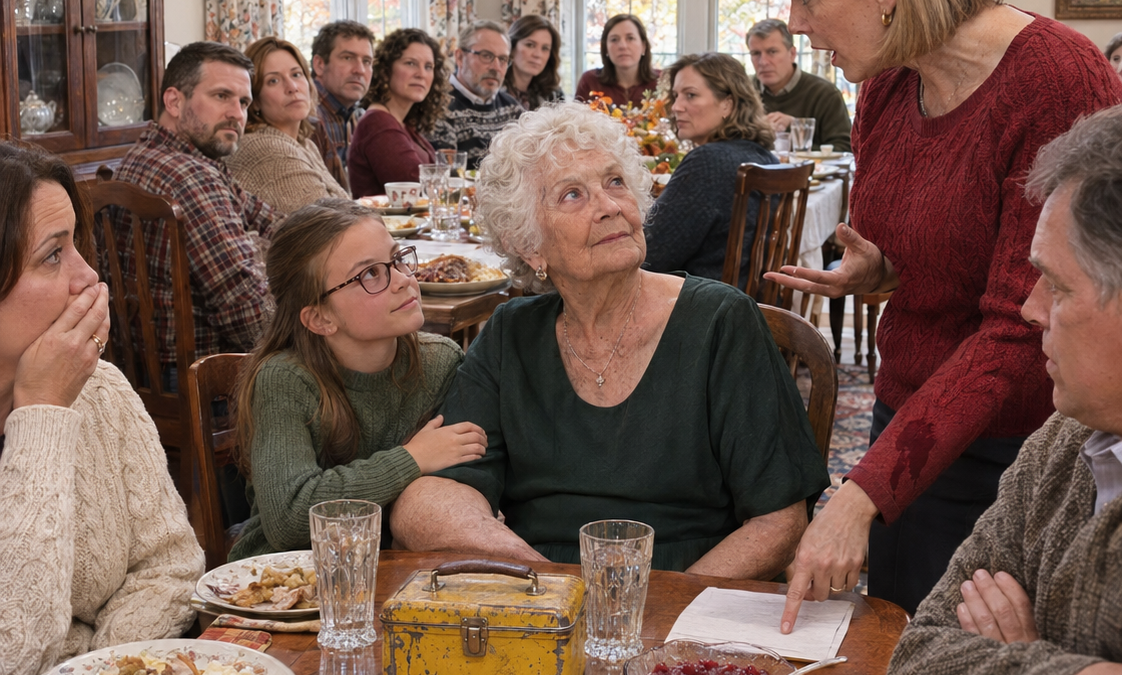
My niece Tricia Madden stood over me in my Lancaster, Pennsylvania, dining room.
Twenty-one relatives watched, with my granddaughter sitting beside my chair.
The battered yellow lunchbox rested between our water glasses.
Tricia’s blonde bob barely moved when she straightened her shoulders.
Her red sweater still carried rain along one sleeve.
“Read the real order,” I said.
Nobody reached for the gravy.
My granddaughter pressed her sneaker against my shoe beneath the table.
I kept my heel where it was.
Tricia placed a folded paper beside the cranberry sauce.
“This is an emergency custody order,” she said.
Someone’s fork clicked against a plate.
“Finish your dinner,” I told the child.
“I’m not hungry, Grandma.”
“You don’t have to finish.”
Tricia smiled toward the other end of the table.
“Please don’t make this harder than necessary.”
I stayed seated.
At seventy-one, I had learned that standing could suggest an argument.
I wasn’t offering one.
The paper remained folded, with its top corner curling upward.
Tricia flattened that corner with two fingers.
“I’ve already prepared a bedroom,” she said.
“Does she know that?”
“She’ll adjust.”
My granddaughter’s sneaker pushed harder against mine.
I rested my hand beside the lunchbox, without opening it.
Nine years earlier, I had bought that box for two dollars.
Its latch was crooked even then.
We used it for cookies on Thanksgiving, never for school lunches.
My husband had repaired the hinge before he died.
I was widowed now, and the hinge still held.
The paint had worn away beneath one yellow handle.
My granddaughter knew every dent.
That was enough history for the table.
“Her things can follow tomorrow,” Tricia said.
The turkey waited.
One relative pulled a serving spoon out of the potatoes.
Another put down a bread roll without breaking it.
I looked at the paper.
“Who gave you that?”
“The court.”
“Which office?”
“It’s Thanksgiving. You can ask questions Monday.”
Tricia was forty-six and sold houses for a living.
I had watched her explain water damage as “seasonal character.”
Now she used that same careful voice about a child.
“She needs stability,” Tricia said.
“She has homework upstairs.”
“Exactly. Stairs. That’s one of the concerns.”
My granddaughter looked toward the doorway.
I moved my chair an inch closer to hers.
“Your room is still your room,” I said.
Tricia gave a small laugh toward our relatives.
“You can’t promise that.”
The clock ticked.
A place card lay crooked beside my plate.
I had written every name myself that morning.
Tricia’s card had a little pumpkin beside the lettering.
She turned it facedown.
“I’m trying to spare you embarrassment,” she said.
“Then lower your voice.”
“I’m speaking clearly.”
“So am I.”
Outside, tires whispered over wet leaves near the curb.
Tricia didn’t turn toward the window.
Instead, she unfolded the paper completely.
There was a gray smear beneath the printed heading.
I had seen that smear before, on a different screen.
I left it alone.
“You’ll thank me when this settles,” Tricia said.
My granddaughter pulled her napkin into a narrow strip.
I smoothed my own across my lap.
“Leave her coat where it is.”
“The car is warm.”
“Then it can stay warm.”
The doorbell rang once.
Tricia’s mouth tightened.
“We’re having a family discussion.”
“So we are,” I said.
I had left the front door unlocked for expected guests.
Boots sounded in the hall, followed by quieter, measured footsteps.
My granddaughter stopped twisting her napkin.
Six women filled the doorway, a uniformed deputy at the front beside them.
They had taken off their wet outer coats.
Their leader stepped forward first.
Tricia looked from the doorway to the folded paper.
The woman at the front surveyed the table.
Ramona Salcedo stood beside the deputy in my dining-room doorway.
“Who thinks children come with account balances?”
Tricia froze with one finger still pressing the paper.
Ramona’s black veterans’ vest was buttoned over a clean blue shirt.
Her cropped brown hair was damp at the temples.
Nobody answered.
The deputy remained beside her, looking at the table rather than the child.
Ramona was fifty-nine, and she didn’t raise her voice.
“I’ll ask again,” she said. “Who here thinks this child comes with an account balance?”
Tricia lifted her chin.
“I don’t know what she’s told you.”
“Then speak for yourself,” Ramona said.
My granddaughter leaned against my arm.
I had volunteered at a women veterans’ clinic after retiring from pediatrics.
These six women had become friends through its Saturday appointments.
They had been invited for pie, at four.
The deputy’s arrival was different.
I had asked for help before the turkey went into the oven.
That morning, Tricia had sent a photograph with a warning.
Don’t make a scene when I collect her.
I had forwarded it rather than answered.
Now the deputy studied the sheet beside the cranberry sauce.
“Ma’am,” he said to Tricia, “please leave that where it is.”
“I have every right to be here.”
“You were invited to dinner,” I said.
My niece looked around for someone willing to improve that sentence.
No one did.
Ramona moved far enough aside to leave the doorway clear.
The other women stayed near the wall.
I wanted my granddaughter to see an open path upstairs.
Instead, the child reached for my sleeve.
“Do I have to go somewhere?”
“No,” I said. “You stay beside me.”
The deputy took a slim folder from his coat.
Tricia’s phone began vibrating against her empty plate.
Part 2 of 5
“Answer it if you need to,” the deputy said.
Tricia turned the phone facedown instead.
“My family is being manipulated,” she said.
I watched the screen go dark.
Her room is ready, the morning message had said.
There had been a photograph of a white bed beneath a pink canopy.
A suitcase stood open on its quilt.
My granddaughter had never chosen pink for anything.
She liked green notebooks, orange sneakers, and pencils worn flat.
The room was wrong.
I had shown that photograph to my attorney.
I hadn’t shown it to the child.
Now Tricia slid the picture across her phone screen for our relatives.
“Look at what I’ve done,” she said.
Nobody leaned closer.
“New mattress. New desk. Everything a girl needs.”
“She needs her glasses,” I said.
“They can be packed.”
“They’re on her face.”
Tricia looked at the child for the first time since the doorbell.
My granddaughter lowered her eyes to her plate.
Nine years was a long time to learn someone’s routines.
I knew which sock seam bothered her left foot.
I knew she ate the crust first to save the soft middle.
I knew the school nurse’s extension without looking it up.
Tricia knew the square footage of her spare room.
That was the difference.
Before retirement, I had worked thirty-eight years as a pediatrician.
Parents sometimes mistook a quiet doctor for an uncertain one.
I let them finish talking before I answered.
It saved time.
My name was Beatrice Winslow, and this house was mine.
So were the dining chairs with their scratched maple legs.
I had bought them one at a time from an estate dealer.
Forty dollars each.
Tricia had once suggested replacing them before listing the house.
I had never asked her to list it.
When my husband grew ill, I moved his chair downstairs.
When he needed help eating, I learned which spoons were easiest.
When he died, I kept the table large.
A smaller one would have been cheaper to heat a room around.
It would also have left less space for people who needed somewhere to come.
My granddaughter had needed that space.
I didn’t explain all of it in front of her.
The deputy introduced himself as Desmond Raines.
He asked Tricia for her full name.
She gave it slowly, as though correcting a reservation.
“Do you understand how upsetting this is?” she asked.
“Yes,” he said, looking toward the child.
Ramona stayed quiet.
One of the women moved an unused chair against the wall.
There was room now for everyone without blocking the kitchen.
Nobody crowded Tricia.
Nobody needed to.
“You’re too old to keep her!” Tricia said again.
This time the words struck the table without the force of surprise.
My granddaughter’s lips pressed together.
I reached for the water pitcher and filled her glass halfway.
One practical thing.
No shaking pitcher. No spilled water. No performance for the room.
“Small sips,” I said.
“Beatrice, stop pretending this is normal.”
“I’m giving her water.”
“You know what I mean.”
“I know what you said.”
Ramona looked toward the deputy.
He opened his folder but kept its contents turned away.
I had not asked him to make a holiday example of anyone.
I had asked what to do if someone arrived with questionable papers.
He had told me not to surrender the child or destroy anything.
He had also told me to have my own documents available.
Those were upstairs until that morning.
Now they lay in a blue envelope beneath my chair.
Tricia couldn’t see it.
She could see the yellow lunchbox.
“You’re encouraging her to cling to baby things,” she said.
“It holds cookies.”
“She’s ten.”
“Yes.”
“She should have more than cookies and old furniture.”
My granddaughter looked up.
“I have a telescope.”
Tricia blinked.
“And a library card,” the child added.
I put my palm flat on my napkin.
Across the table, a relative covered her mouth with two fingers.
“She’s missing the point,” Tricia said.
“No,” Ramona said. “She heard you.”
A clock chimed from the hallway.
Tricia glanced at the front window, where her car lights still glowed.
“You people don’t understand the arrangements.”
“Then explain them,” the deputy said.
“My attorney advised me.”
“May we have the attorney’s name?”
“I don’t have to be interrogated over dinner.”
The deputy waited.
I lifted the blue envelope onto my lap.
My granddaughter watched its edge appear above the table.
“What’s that, Grandma?”
“Something I kept.”
“Like the Christmas receipts?”
“More useful than those.”
Tricia made a small reaching motion, then stopped.
“Private papers shouldn’t be passed around.”
“You brought a paper,” I said.
“That’s different.”
The deputy asked whether I had identification.
I set my driver’s license beside the envelope.
He checked it without announcing my birth date.
That small courtesy nearly undid me.
I kept my voice level.
“Would you please look at mine first?”
“Certainly.”
Tricia’s chair scraped backward, although she had never sat down.
Her heel caught its front leg.
For once, she looked at the child before speaking.
“This doesn’t mean you won’t come with me.”
My granddaughter pushed the lunchbox closer to my elbow.
I slid one stiff page from the blue envelope.
“What does your paper actually say?” Tricia asked.
The page was my certified guardianship order, appointing me my granddaughter’s guardian nine years earlier.
The deputy checked the seal and the names.
“This is the document I asked you to have ready,” he said.
Tricia opened her mouth.
I set the remaining pages beside my plate.
“My attorney is waiting for your call.”
The deputy’s phone lit with Quentin Selig’s name.
Part 3 of 5
Desmond answered and placed the phone where all of us could hear.
“Mr. Selig, I’m at the residence.”
“Is Dr. Winslow beside you?”
“I’m here,” I said.
My granddaughter sat straighter when she heard my professional title.
She usually heard it only from former patients at the grocery store.
Quentin asked permission to speak about the order in front of everyone.
“Yes,” I said.
Tricia crossed her arms.
“This is inappropriate.”
“You displayed a custody paper at dinner,” Quentin said. “We need to establish what it is.”
His voice came through clearly over the little speaker.
He said he had checked the matter before the holiday closure.
He had contacted the appropriate court office again through the designated holiday channel after receiving my morning message.
“No replacement order has been issued,” he said.
Tricia looked at the phone rather than the deputy.
“You can’t know every emergency filing.”
“I checked the case identified on your document.”
“You weren’t there.”
“The case number isn’t a matter of opinion.”
I kept my gaze on my granddaughter.
Her water glass had left a circle on the tablecloth.
She traced the outside of it with one fingernail.
“Does that mean my bed stays here?” she whispered.
“Yes,” I said.
Quentin heard her.
“Your grandmother’s authority remains in effect,” he said gently.
Tricia pulled out her chair at last.
She didn’t sit. She used its back to steady herself.
“This is being deliberately confused with finances.”
Until then, nobody at the table had mentioned money except Ramona.
Desmond looked toward her.
“What finances do you mean?”
“Her education arrangements. Any responsible caregiver would ask.”
I had not told Tricia about the trust.
A statement had arrived while she was helping set out plates the previous Sunday.
I had left the envelope open on my kitchen counter.
She had asked whether the figure was a printing mistake.
That was when the spare-bedroom photographs began.
I told the deputy that much.
Tricia stared at the salt shaker.
“It was hardly confidential if you left it out.”
“It wasn’t an invitation,” I said.
Quentin asked me whether I wanted the amount discussed.
I looked down at the child.
She knew there was college money. She didn’t know the total.
I had planned to explain it when she was older, with a budget and a pencil.
Now a roomful of people had been made part of something private.
I wouldn’t let Tricia turn it into a rumor afterward.
“Yes,” I said. “Plainly.”
“The education trust holds approximately three hundred forty thousand dollars,” Quentin said.
A chair creaked near the kitchen.
My granddaughter turned toward me.
“Is that ours?”
“It’s for your education,” I said. “It isn’t spending money.”
“Can somebody take it?”
“Not by taking you to a different bedroom.”
Quentin confirmed that custody did not automatically give anyone access.
The trust had an independent trustee and specific distribution rules.
Tricia’s painted thumbnail slipped beneath the edge of her phone case.
“I never said I wanted access.”
“No,” I said. “You asked who signed the checks.”
I remembered the exact kitchen conversation.
Tricia had stood beside the dishwasher, holding the statement by one corner.
Who signs when she needs something?
I had answered, The trustee, for qualified expenses.
She had asked whether a new guardian could change that.
I had told her to leave the envelope on the counter.
At the time, I had hoped she was only being nosy.
Hope was not a safety plan.
Desmond asked whether those messages were still on my phone.
“They are.”
“Please preserve them.”
Ramona glanced at me but didn’t interrupt.
She knew I had started that fund with twenty-five-dollar deposits.
I had mentioned it years earlier at the clinic when a young mother said saving anything was pointless.
Twenty-five dollars wouldn’t buy college.
It would begin the habit of making room for it.
After my husband died, I sold a small rental property we had bought together.
I put much of those proceeds into the trust.
Later came regular contributions and investment growth.
There was no miracle hidden in the arithmetic.
There were years of packing my own lunch and driving the same car.
My granddaughter looked at the battered box.
“Was this your lunchbox first?”
“No, sweetheart. This one was always yours.”
The secret I had kept was not the dollar amount.
It was how completely I had rearranged my life to make sure the child would never have to earn her place in it.
Tricia had mistaken those arrangements for something available to whoever reached first.
Desmond moved her purported order closer to his folder.
“Did you bring the original?”
“That is what I received.”
“From whom?”
“My legal contact.”
“Please give me the name.”
Tricia rubbed a spot on the chair back.
Quentin spoke through the phone.
“Deputy, compare the lower margin with the image attached to our earlier complaint.”
Desmond opened his folder to a printed photograph of the same page.
Part 4 of 5
The gray smear appeared in the same place on both copies.
Desmond laid them side by side without letting the gravy touch either sheet.
Tricia leaned forward.
“Anyone could have copied that.”
“Yes,” he said. “That is part of what we’re checking.”
The earlier complaint had begun three days before Thanksgiving.
Tricia had sent me a cropped photograph of the document with a demand for my granddaughter’s school records.
She said the transfer needed to happen quickly.
I had called Quentin.
He had told me not to supply records on the strength of a photograph.
Together, we submitted the image and the messages for review as suspected fraud.
That was why Desmond had a copy.
There had been no lucky patrol car passing my driveway.
There had been a report, a morning threat, and a request for assistance.
Ramona knew only that I was worried someone wanted the child because of her college fund.
She had offered to bring the other women earlier than planned.
They had been together delivering holiday meals that morning.
I had said yes.
Now those ordinary arrangements stood around my dining room in damp shoes.
Tricia looked toward our relatives.
“You all know me.”
I did know her.
I remembered carrying her through a backyard after she stepped on a bee.
I remembered paying for her first professional headshot when she started selling houses.
Those memories didn’t make the paper genuine.
“Then tell us where it came from,” I said.
“I was helping.”
“Who sent it?”
“I don’t remember every person I speak to.”
“You remember closing dates.”
Her mouth tightened.
Desmond asked permission to move his phone away from the child while he spoke with the investigator handling the complaint.
I nodded.
He stepped into the hall, still visible through the doorway.
Quentin called my phone so Desmond could keep his own line free.
“Beatrice, keep the certified copy with you.”
“It’s here.”
“Do not give anyone your original trust documents.”
“They aren’t on the table.”
Tricia looked sharply at the blue envelope.
I closed its flap.
There was nothing in it she had a right to inspect.
My granddaughter whispered that she needed the bathroom.
I asked whether she wanted me to come.
She nodded.
Desmond looked back from the hallway.
“The child remains here,” he said. “You may certainly take her upstairs.”
Tricia moved half a step toward us.
Ramona did not block her. She simply watched.
Tricia stopped.
Upstairs, my granddaughter shut the bathroom door and spoke through it.
“Did I do something expensive?”
I leaned against the opposite wall.
“No.”
“Because of the telescope?”
“No. You didn’t do anything.”
Water ran briefly.
“I could sell it.”
I looked at the narrow strip of light beneath the door.
“You will not sell your telescope to fix an adult’s behavior.”
The faucet stopped.
“Is Aunt Tricia mad because I don’t want her pink room?”
“Your preferences are not the problem.”
“Can I say that downstairs?”
“You can say you want to stay home.”
She opened the door with her glasses slightly crooked.
I straightened them only after asking.
For years, I had told worried parents that children heard what adults thought they had hidden.
I had still failed to keep this from her ears.
I could at least refuse to make her responsible for comforting me.
We went downstairs together.
Nobody had resumed eating.
The six women had stayed along the wall, leaving the family at the table.
Tricia was speaking to a relative near the window.
“I’ve already spent money on the room.”
My granddaughter stopped at the foot of the stairs.
“I want to stay home,” she said.
Tricia turned.
“You haven’t even seen it properly.”
“I saw the picture.”
“You’d have your own television.”
“I have my own bed.”
The child walked back to my chair and sat down.
I sat beside her.
There would be no debate about what a television could buy.
Desmond returned from the hall.
He had a second image on his phone.
“Ms. Madden, I need you to listen carefully.”
Tricia’s arms dropped to her sides.
“The signature on this paper was compared with an unrelated public filing.”
On my phone, Quentin said nothing.
Even the refrigerator motor seemed distant from the table.
“The judge whose name appears here did not issue this order,” Desmond said.
Tricia looked toward the front hall.
I watched her eyes find the coat hooks.
Desmond kept his voice even.
“The signature matches an image lifted from that other filing, including a defect in the scan.”
He turned his screen toward Tricia.
I didn’t ask my granddaughter to look.
She had already seen enough adults treat paper as a weapon.
Tricia stared at the screen, then at the gray smear on her sheet.
Desmond named the source: a property deed Tricia had handled for a client last spring.
Part 5 of 5
“That order is forged; the child stays with her guardian.”
Desmond said it plainly, where everyone who had heard Tricia could hear him.
My granddaughter gripped the edge of her chair.
“Here?” she asked.
“Here,” he said.
Tricia’s lips parted, but no answer came out.
The deputy asked her to step away from the child’s chair.
She did.
It was a small movement, no more than two floorboards.
I would remember it longer than the shouting.
Quentin spoke from the phone.
“The trust remains under its existing terms. Ms. Madden has no authority over it.”
Tricia looked at me.
“You’ve made me look like a criminal.”
“I asked someone to check your paper.”
“You could have called me privately.”
“You sent the morning message.”
“I thought we could settle this as a family.”
“You brought it to the table.”
Nobody offered to soften that for her.
Desmond said the document and messages would remain part of the fraud investigation.
He was not deciding every possible criminal charge in my dining room.
He was deciding that a forged paper would not remove a child from her lawful guardian.
He asked Tricia to leave the document where it lay.
She reached toward her phone instead.
“May I take this?”
“Yes,” he said. “Do not delete the messages.”
Her screen flashed as she picked it up.
The pink bedroom appeared once more, bright and empty.
My granddaughter turned her face into my sleeve.
I rested my cheek briefly against the top of her head.
Tricia waited, perhaps expecting someone to tell her it had all gone too far.
One relative moved her chair away from the path to the door.
Another brought Tricia’s coat from the hall.
No one packed a bag.
No one fetched my granddaughter’s shoes.
No one touched the yellow lunchbox.
Tricia put on her coat with one sleeve twisted.
She pulled it straight and faced me.
“I spent nearly eight hundred dollars.”
I looked at the child beside me.
“Then return what you can.”
Ramona lowered her eyes to the floor for a second.
The deputy took down Tricia’s current address and confirmed her contact information.
He told her the investigator would follow up.
Then he accompanied her to the front door.
Through the window, I watched Tricia cross the wet walk alone.
Her car had been running all that time.
There was no child in its passenger seat.
When the door closed, nobody applauded.
I was grateful for that.
My granddaughter didn’t need a victory celebration built around an adult who had frightened her.
She needed the room to become a dining room again.
I asked a relative to pass the potatoes.
The spoon moved.
Someone carried the gravy to the kitchen to warm it.
Another person gathered the fallen napkin beneath Tricia’s empty place.
I thanked Quentin and ended the call only after he confirmed he would send written follow-up.
Desmond returned from the porch.
“Keep your certified order somewhere secure,” he said.
“I will.”
“And call if she returns or sends another demand.”
He gave me the complaint reference on a card.
I tucked it into the blue envelope, not the lunchbox.
Those were different kinds of keeping.
Ramona asked whether the six women should go.
“Your pie isn’t going to eat itself,” I said.
She pulled out a chair.
The others brought chairs from the kitchen, just as we had planned before the day went wrong.
My granddaughter watched them sit.
“Did Grandma ask you to come because of me?”
Ramona looked at me first.
I nodded.
“Your grandmother asked for company,” Ramona said. “We were glad to come.”
“Were you scared?”
“We knew she had asked the right people to check.”
That was an answer a child could use.
It did not make courage into a trick performed without preparation.
I opened the yellow lunchbox.
Its crooked latch resisted, then released with the familiar little snap.
Inside, wax paper covered the cookies we had baked before breakfast.
My granddaughter lifted the first layer herself.
There were maple leaves, uneven stars, and one turkey with an oversized tail.
She had insisted that a turkey should have somewhere to sit.
My husband used to say our cookies looked like things rescued from traffic.
I told her that, and she smiled against the rim of her glass.
“Did he really fix this box?”
“He did.”
“Can we keep fixing it?”
“As long as it can be fixed.”
She chose the crooked turkey and broke it into two pieces.
The larger half went onto my plate.
Around us, the same relatives who had watched Tricia’s announcement began passing plates again.
Nobody called me too old.
Nobody asked the child to be grateful for a room she had never wanted.
My granddaughter set the open lunchbox beside her glass.
“Next Thanksgiving,” she said, “I’m making everybody a cookie.”
“Then we’ll need a bigger batch.”
She reached for my pencil and added six names to next year’s list.
THE END
More stories
My Niece Felicia Declared My Little Boat OUT at Our Marina Meeting, but When My Attorney Walked In, She FROZE Before the Same Owners Who Had Watched Her Humiliate MeCecily Said I Stole $600 From Our Church Pantry Before 38 People, but When the AUDIT Arrived, My Red LEDGER Held a Secret She Never Saw ComingI Paid for the Engagement Dinner Sylvia Draper Turned Into My Wine-Serving Shift, Until the Restaurant Owner Asked One Question and Her Plan to Take My House CollapsedFelicity Keene Made My Daughter Kneel to Clean Wine at Her Engagement Party, Then Her Fiancé Recognized a Bracelet and Ended the Night Without a BrideMy Ex-Husband Bruce Took Away My Reserved Auction Seat, but the Blue Folder I Handed His Auctioneer Left Him $10,000 of the Waterfront Condo Money He Had Promised His FiancéeMy Daughter-in-Law Melanie Called Herself My Clothing Label’s Founder, Then Handed Me an Apron Before Sixty Buyers. My Paperwork Left Her Without the Brand She Expected to Own.
You Might Also Enjoy

My Daughter-In-Law Told Me To Stay Elsewhere While Strangers Took My Condo — Then I Pushed Back







