My Ex-Wife Called My Daughter’s Memorial a “Sad Little Tribute,” Then Went PALE When the Drive-In Manager Restored My Evening
Part 1 of 5
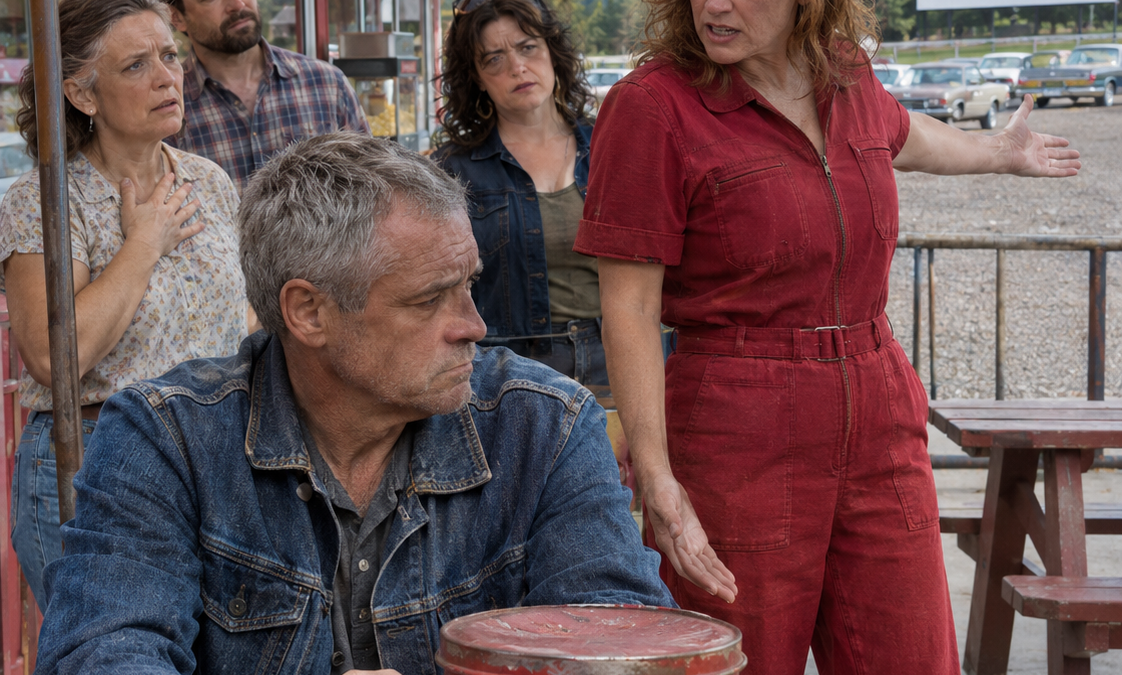
“Take your sad little tribute and leave!”
Marsha Kincaid said it across my picnic table at the Mesa Sky Drive-In in Pueblo, Colorado.
Forty-one early-arriving guests stood on the concession patio, watching her red jumpsuit brush my bench.
Our daughter’s dented red popcorn tin sat beside my elbow.
I stayed seated.
“Check your rental agreement.”
Somebody stopped stirring an iced drink. A folding chair scraped behind me.
Marsha looked toward the parking lot, then back at my jacket.
“This table is reserved.”
“For what?”
“Guests who understand an invitation.”
The afternoon sun caught the silver zipper on her jumpsuit. My denim cuffs still held pale dust from school shelving.
“Paying guests don’t need your sad little tribute.”
I moved my knee beneath the bench so she could pass.
She didn’t.
At fifty-six, I had learned that making room didn’t guarantee someone would take it.
My name was Floyd Dempsey. Most people around Pueblo knew me as the custodian who opened the elementary school before sunrise.
Marsha knew that, too.
She liked mentioning it when somebody else was listening.
“Your shift must be over,” she said.
“It is.”
“Then you can go home.”
Behind her, the restored concession windows reflected the big white screen. Nothing could play clearly on it until dark.
This was the daylight opening celebration. The movie came later.
Our movie.
For seventeen years, families had paid five dollars each for that evening. The proceeds bought school shoes through a local clothing closet.
Our daughter had loved this place. After she died, I kept bringing the tin she had painted at twelve.
When Marsha stopped coming, I set out the donation jar myself.
When Marsha wanted the photographs boxed away, I took them home.
When Marsha called the benefit dated, I ordered the tickets.
We had been divorced for eighteen years. There was no unfinished marriage for either of us to rescue.
Just a date.
Just a screen.
Just the thing we had promised to keep doing.
Marsha glanced at the tin again.
“It looks like something from a rummage sale.”
“It holds popcorn.”
“This is a launch, Floyd.”
“So I heard.”
Her company promoted luxury openings, the kind with rented glassware and invitations thicker than report cards.
At fifty-three, she could make a delivery entrance sound exclusive.
She had rented space for the reopening celebration. I had seen the announcement that morning.
I had also seen what was missing.
The memorial listing.
A new black panel covered the evening schedule beside the concession door. Gold lettering advertised Marsha’s private launch.
No family movie.
No five-dollar tickets.
No mention of our daughter.
I had sent the general manager a photograph before sitting down. The reply had been brief: Coming outside.
Marsha tapped one heel against the concrete.
“We’re doing twelve thousand dollars in hospitality here.”
“That’s a good deal of hospitality.”
“It requires an appropriate atmosphere.”
A woman near the railing lowered her phone. Two men beside the trash station stopped talking.
Nobody left.
Marsha leaned closer, keeping her voice pleasant now.
“I can have someone move that tin.”
“No need.”
“You’re making this difficult.”
“I’m sitting.”
She looked toward the concession door, where a staff member had disappeared after seeing us.
Then she swept one arm toward the lot.
“Your truck is still where you parked it.”
“So are the picnic tables.”
A brief sound escaped somebody behind her. Marsha turned, and the sound stopped.
The restored speakers on the fence clicked through a test tone.
Above them, the afternoon sky looked almost white.
I put both boots flat on the concrete.
“Does your rental include cancellation authority?”
“It includes the venue.”
“That wasn’t my question.”
She straightened the belt of her jumpsuit.
“You don’t need to concern yourself with the agreement.”
The concession door opened.
The general manager, Robyn Sneed, stepped onto the patio with a folder tucked beneath her arm.
Robyn stopped beside my table.
“We’re restoring your evening, sir.”
Marsha’s mouth closed. The color along her cheekbones thinned.
A guest near the railing lifted her head.
Robyn was forty-eight, with a black bob and an olive utility shirt. She had been checking the reopened projection booth.
That was why she hadn’t seen the changed board.
She looked from the black panel to the popcorn tin.
“Why has the memorial screening disappeared from the board?”
Marsha answered before I could.
“The schedule was updated for the launch.”
“By whom?”
“I gave your attendant the replacement panel.”
Robyn set the folder on an empty table.
“The attendant was told it was approved?”
“It was part of my event package.”
“That isn’t what I asked.”
Marsha’s heel stopped moving.
I had watched Robyn settle disputes over broken speakers, stalled cars, and customers who brought their own enormous speakers.
She never raised her voice. Most folks generally stopped raising theirs.
“Please bring the signed rental,” I said.
Robyn nodded.
Marsha folded her arms.
“Surely you aren’t letting him review my business arrangements.”
“I’m checking the reservation,” Robyn said.
“The guests are here.”
“I can see them.”
The forty-one people on the patio had gone still enough to hear the concession refrigerator kick on.
Marsha looked at me.
“You should have called.”
“I sent a photograph.”
“To her?”
“Yes.”
Robyn returned inside for the signed rental.
Part 2 of 5
Marsha watched the concession door settle shut.
“You always did this,” she said.
“Did what?”
“Made other people feel responsible for you.”
I looked at the tin. One painted star had lost a point where the metal bent.
Our daughter had dropped it on this very patio.
She had laughed, then insisted the dent made it easier to recognize.
I never fixed it.
Across the lot, sunlight flashed against the newly painted ticket booth.
Seventeen summers earlier, its roof had leaked onto the admission counter. The old owner had been ready to close.
The benefit almost ended before its second year.
I had spent that spring scraping gum from classroom desks, then coming here to patch benches after work.
Five dollars admitted a person. Children under three came free.
That price had stayed.
The first year, we bought twenty pairs of shoes. Last year, the clothing closet sent receipts for sixty-three.
Small numbers, Marsha would have said.
Children had worn them anyway.
“You could have asked me about tonight,” I said.
“I didn’t think you needed to supervise a professional event.”
“The screening was on the calendar.”
“Calendars change.”
“Families bought tickets.”
“They can be refunded.”
She said it toward the guests, as though explaining a minor shipping delay.
I kept my palms on my knees.
A breeze lifted the corner of a cocktail napkin beneath a glass. Nobody reached for it.
Marsha lowered her voice.
“I can make a donation.”
“To the clothing closet?”
“If that resolves this.”
“How much would you pay to make their plans disappear?”
Her eyes narrowed.
“Don’t perform for these people.”
I looked past her at three guests beside the nearest standing table.
One had a hand against her collarbone. Another stared at the red tin.
The third watched the concession door.
None of them looked entertained.
Marsha shifted sideways, blocking their view of me.
“I had a photographer coming here at four.”
“There’s room for a photographer.”
“There isn’t room for competing events.”
“The movie starts at dusk.”
“My clients were promised exclusivity.”
By you, I thought.
I didn’t say it.
The agreement was coming. There was no reason to argue with a promise neither of us had put on the table yet.
Marsha’s phone buzzed inside her pocket.
She silenced it without looking.
“You can take that,” I said.
“I’m handling something.”
“So am I.”
Across the patio, an ice cube fell from a drink dispenser into its tray.
The small crack made several people turn.
I remembered our daughter standing at that dispenser, counting coins before ordering a soda.
She had always bought a small so she could save money for popcorn.
She had painted the tin because refills cost less.
Her name was Betsy Cates.
Cates had been her married name, worn for eleven months before a winter collision took her at twenty.
I had been nineteen when she was born.
Thirty-nine when I buried her.
Marsha had asked the funeral director to remove the popcorn tin from the photographs displayed beside the flowers.
“It doesn’t belong,” she had said then.
I had carried it home rather than argue beside a casket.
This was different.
The ticket holders were waiting.
Families had arranged rides. Parents had traded shifts. A grandmother had called the school to ask whether folding chairs were permitted.
I had told her yes.
A man near the railing finally spoke.
“Are the family tickets canceled?”
“I’m addressing it,” Robyn said from the doorway.
She had returned with a second folder.
Marsha turned sharply.
Robyn carried both folders to the empty table, then opened the one marked by a blue paper tab.
I stayed where I was.
“May I see the signed rental?” I asked.
Robyn slid it across the tabletop toward me.
Marsha took one step closer.
“That contains confidential pricing.”
“The price isn’t the question,” Robyn said.
Twelve thousand dollars.
Marsha had already announced it to everybody.
I looked at the signature page without touching it.
Her name was there in the same broad strokes she had used on our divorce papers.
Underneath sat a smaller set of initials.
The page was flat.
The corners were clean.
Nothing had been added by hand.
Marsha looked toward the guests.
“This is a scheduling misunderstanding. Please enjoy the refreshments.”
Nobody reached for a tray.
Robyn turned back one page.
“Did you supply the replacement schedule yourself?”
“I already said I did.”
“And direct the attendant to cover the existing listing?”
“It looked untidy beneath the new panel.”
I glanced at the concession wall. The old white listing was still beneath that black rectangle.
Covered, not removed.
That was something.
Marsha leaned over the agreement.
“I was told I could decorate.”
“You could,” Robyn said.
“The board is decoration.”
“The board tells customers what is happening here.”
Marsha’s arm swept toward the parking lot again.
“Floyd, please wait outside while adults settle this.”
I was still centered on the bench. The dented red tin sat between my jacket sleeve and the table’s center seam.
Three guests stared.
I looked at Robyn.
“Please read the paragraph above her initials.”
Robyn read, “The annual Betsy Cates Family Movie Benefit is a protected event and may not be displaced, obscured, or canceled by the renter.”
Marsha’s arm came down.
Robyn continued.
“Displacement of a protected event permits immediate cancellation of exclusive use by venue management.”
The guest nearest the railing set down her untouched drink.
“I initialed the page,” Marsha said. “That doesn’t mean I approved every interpretation.”
Robyn placed one finger beside the clause.
“Your initials are directly below it.”
Part 3 of 5
Marsha pulled out the chair opposite mine but didn’t sit.
“The benefit can still happen another night.”
Robyn kept the agreement open.
“That would displace it.”
“Then call it a postponement.”
“It would still displace it.”
The words were ordinary. Their effect wasn’t.
Marsha looked around the patio for someone willing to share a smile with her. Nobody offered one.
I could hear a loose paper cup rolling beneath the next table. It stopped against a bench leg.
“Who put that protection in the contract?” Marsha asked.
“The standard rental terms have included it for years,” Robyn said.
“Who authorized it?”
I took my phone from my jacket.
Marsha saw the movement and straightened.
“Are you recording me?”
“No.”
I opened the saved ownership packet Robyn had sent when we updated the insurance after the restoration.
It contained the recorded deed, the state company record, and the current operating authorization. I kept it available for bank and insurance calls.
The loading circle turned once.
For seventeen years, the name on the property had been Screenhaven Holdings LLC.
Marsha had never asked who stood behind it.
Most people hadn’t.
I turned the phone so she and Robyn could see the screen.
The first page showed the drive-in’s address and the holding company. The next identified me as its sole member and manager.
Marsha bent closer.
Her eyes moved over my name.
“This is a company document.”
“Yes.”
“Plenty of folks form companies for all kinds of reasons.”
“Keep scrolling,” I said.
Robyn did, with my permission, to the recorded deed.
The purchase date was seventeen years old.
Marsha pressed her lips together.
“You bought it?”
“Yes.”
“The whole property?”
“Yes.”
Robyn looked at me.
“As the owner, would you like me to enforce the protected-date clause, Mr. Dempsey?”
A guest drew a breath through her teeth.
Marsha lowered herself into the chair she had pulled out.
For the first time that afternoon, we were at the same height.
I took the phone back.
“I’d like you to handle it according to the agreement.”
Robyn nodded.
“The agreement gives management that authority.”
Marsha stared at the tin.
“You let me stand here.”
“I asked you to check your rental agreement.”
“You could have told me.”
“You could have left the screening alone.”
A car passed on the road beyond the fence. Its tires hummed, then faded.
Nobody on the patio moved toward the exit.
Marsha looked at the white screen.
“You’re a school custodian.”
“I’m aware.”
“How could you afford this?”
That question had an answer. It just wasn’t the answer she wanted.
“My father left me his machine shop when he died. I sold the equipment and the building.”
Marsha knew about the inheritance. The sale had happened after our divorce, and she hadn’t asked what I did with it.
“The drive-in was going to close,” I said. “The seller carried part of the price. I paid it off.”
“With school wages?”
“With the down payment, the drive-in’s rent, and a lot of years.”
I had kept my school job for the insurance and the steady check.
An address on a deed didn’t replace either one.
Robyn ran the drive-in. A local operator had managed it before her. Their rent covered the loan, taxes, repairs, and eventually the restoration reserve.
Some years, the reserve had been a number I hated looking at.
I didn’t explain all of that on the patio.
Marsha wasn’t asking for a business lesson.
“You never put your name out front,” she said.
“It’s a movie theater.”
“You let everyone think you just volunteered.”
“I did volunteer.”
The first season after I bought it, I cleaned the restrooms during the benefit because the regular cleaner’s child was sick.
The second, I fixed a gate latch.
Ownership had never made those jobs disappear.
I closed the ownership packet on my phone, and Robyn returned to the contract.
Marsha leaned toward her.
“There has to be a way to preserve my evening.”
“The family screening stays,” Robyn said.
“I heard that.”
“It stays at the advertised time, for the advertised price.”
Marsha rubbed a spot on the table with one fingertip.
“I’ve invited people who don’t attend five-dollar events.”
A woman behind her lifted her chin.
“My grandchildren do.”
Marsha stopped rubbing.
That guest had watched from the beginning. Her drink still stood untouched beside the same folded napkin.
I didn’t know her name. I didn’t need it to understand what she meant.
Robyn looked at the clock above the concession window.
“I need a few minutes to verify the board instructions with the attendant.”
Marsha stood again.
“Good. Then we can stop doing this publicly.”
Robyn didn’t move toward the door.
“The correction will be public, too.”
My phone vibrated against the table.
A message from the clothing closet asked whether tonight’s benefit was still happening.
Part 4 of 5
I answered the message with one word.
Yes.
Then I set the phone face down beside the tin.
Marsha watched me do it.
“You’ve made your point,” she said.
“I answered a question.”
Robyn stepped just inside the concession doorway. Through the open window, we could hear her asking the attendant about the panel.
There was no argument inside.
The attendant explained that Marsha had delivered it that morning and said Robyn had approved the change.
Robyn asked whether any family ticket holders had been turned away.
Nobody had.
The gate hadn’t opened for evening admission yet.
That mattered more than the twelve thousand dollars. We still had time to honor what people had bought.
Marsha pulled the chair out again.
This time she sat carefully, arranging the fabric at her knees.
“We can share the property,” she said.
“That was possible before you covered the board.”
“You don’t have to punish me.”
“I’m not deciding your contract.”
“But she’ll do whatever you want.”
“Robyn has the agreement.”
Marsha looked toward the doorway.
For years, she had treated a calm answer as a door that hadn’t quite shut. She would try a different handle.
“What if I cover the shoe donation?”
“The tickets aren’t a price for moving families out of your way.”
“You’re twisting what I said.”
I ran my thumb over a flake of red paint on the tin.
“I’m keeping tonight where it was.”
A guest walked to the trash station and dropped in an empty paper wrapper. Everyone else remained within sight of the table.
The forty-one early arrivals had come for an opening celebration.
They were getting the truth about its schedule instead.
Marsha’s phone buzzed again.
She checked the screen this time.
“My lighting crew needs access.”
“Robyn can tell them where to park.”
“There won’t be a lighting crew if this becomes a disaster.”
I looked at the bright sky, then at the screen.
“The theater lights work.”
She gave me a look I remembered from the last year of our marriage.
I had once spent whole evenings trying to turn that look into a kinder one.
At fifty-six, I had a school alarm to answer before six the next morning. I no longer had evenings to spend that way.
Marsha put the phone away.
“Did Betsy know you wanted to buy this place?”
“She died before it went up for sale.”
“I know when she died.”
“You asked.”
Her eyes dropped to the tin.
For a few seconds, neither of us spoke.
Our daughter had painted uneven yellow stars around its rim. On the bottom, in small letters, she had written our names.
I didn’t turn it over for Marsha.
Those names weren’t evidence.
“You could have called the benefit something else,” she said.
“Why?”
“Folks ask questions.”
“About her?”
“About everything.”
I waited.
Marsha’s nails pressed into the edge of her chair.
“About why I’m not here.”
I looked toward the concession window. Robyn was reviewing something with the attendant, giving us a little distance without leaving the patio unattended.
“You could have come,” I said.
“That’s easy for you to say.”
“It wasn’t always easy to do.”
A small crease appeared between Marsha’s eyebrows.
I didn’t tell her about the years I sat in my truck until the opening credits finished, unable to face the empty place beside me.
There were guests standing close enough to hear us.
Our daughter’s life didn’t need to become another presentation.
“The invitation stayed open,” I said.
Marsha looked away.
Near the railing, the woman who had mentioned her grandchildren picked up her drink at last.
The ice had melted.
Robyn came back outside with the original schedule sheet.
“The attendant has confirmed the instructions,” she said.
Marsha stood so quickly the chair bumped the bench behind her.
“I paid for an exclusive launch.”
“You rented subject to the protected event,” Robyn said.
“I can bring you future business.”
“We still have to honor tonight.”
Robyn laid the original schedule beside the signed agreement.
The memorial screening appeared on both.
Same date.
Same time.
Same five-dollar admission.
Marsha stared at the papers without leaning over them.
“What are you proposing?”
Robyn looked at me, then at the people who had heard Marsha order me away.
“I’m going to state the decision where the incorrect announcement was made.”
“You mean embarrass me.”
“I mean correct the booking.”
The manager’s voice carried no farther than it needed to.
I stood, slowly enough that my knees didn’t catch on the table.
Marsha’s eyes followed me.
I was no taller than I had been when she first told me to leave.
The tin remained on the boards between us.
Robyn took the black panel off the memorial listing.
Part 5 of 5
The original white board had a clean rectangle where the panel had protected it from the morning dust.
Beneath the restored lettering was a shallow shelf for ticket envelopes.
Robyn set the black panel against the concession wall, face inward.
Then she turned toward Marsha.
“Your exclusive booking is canceled.”
Marsha’s jaw moved before any words came.
“You cannot cancel a signed agreement.”
“The agreement expressly permits cancellation for displacing a protected event.”
“I expect my money back.”
“The unused rental fee will be refunded under the cancellation terms. You are losing exclusive use, not being charged for an evening we won’t provide.”
Robyn kept the explanation short.
No lecture.
No raised voice.
Just the thing Marsha had signed and the consequence it allowed.
“The family benefit will open on schedule,” Robyn said. “Tonight is not available for a private launch.”
The woman beside the railing lowered her drink.
One man looked toward the uncovered board, checking the words for himself.
All forty-one guests were still on the patio or its adjoining walkway. The correction reached the same people who had heard the insult.
Marsha looked from face to face.
Nobody smiled.
That seemed to trouble her more than laughter would have.
“My guests need to be informed,” she said.
“Yes,” Robyn said. “You can tell them the exclusive launch is canceled. They’re welcome to buy tickets to the family screening.”
“At five dollars.”
“At five dollars.”
Marsha’s face tightened.
I picked up the tin.
For the first time all afternoon, she stepped aside without being asked.
I carried it to the concession wall and placed it on the shelf beneath our daughter’s restored memorial listing.
The dent faced outward.
Robyn checked that it sat securely, then looked back at the guests.
“The opening refreshments can continue through the contracted afternoon period. Evening admission will be handled at the gate.”
That was the whole announcement.
Marsha had not lost the right to finish the afternoon she had legitimately rented.
She had lost the exclusive evening she had tried to take.
Her phone came out again.
This time, she made the call.
“The launch can’t proceed here tonight,” she said.
She turned toward the parking lot while the person on the other end spoke.
“No. The evening wasn’t available under our terms.”
I looked down at the table where I had been sitting.
A pale ring marked the place beneath my water cup. One of the bench bolts needed tightening.
Ordinary things had survived the afternoon.
Marsha ended the call and came back.
“Are you satisfied?”
“The movie is back on the board.”
“That wasn’t what I asked.”
“It’s the answer I have.”
Her gaze went to the popcorn tin.
For a moment, I thought she might say something about the stars.
Instead, she adjusted her belt.
“I’ll arrange another venue for my clients.”
“That sounds sensible.”
She waited, perhaps for an offer. I had spent a long time making offers after she had already refused the first fair one.
I didn’t make another.
Robyn returned the signed agreement to its folder.
Marsha went to the edge of the patio and began speaking to her guests in pairs.
She didn’t announce my ownership.
She didn’t have to.
They had heard Robyn. They had seen the phone. More importantly, they could see the restored board and the tin beneath it.
The woman with grandchildren came over while Marsha was talking near the railing.
“Can I buy four tickets now?” she asked.
“At the booth when evening admission opens,” Robyn said. “We’ll make sure you have seats.”
“I’ll bring their jackets.”
“It cools down after sunset,” I said.
The woman nodded toward the tin.
“Did your daughter paint that?”
“She did.”
“She chose a good red.”
I looked at it properly then.
Under the fresh concession paint, beneath the straight lettering, its scratches showed plainly. The yellow stars weren’t evenly spaced.
Our daughter had done the work herself.
“Yes,” I said. “She did.”
Robyn asked whether I wanted a small sign explaining the tin.
“No. The listing says enough.”
Betsy’s name was there. So was the benefit, the price, and the time.
Families could read it without asking anyone’s permission.
I went back to the table for my water cup.
The three guests who had stared during Marsha’s sweeping gesture were still nearby. One moved a chair out of my path.
Nothing grand was said.
I preferred that.
Marsha finished notifying the people on the patio. Her lighting crew was redirected before unloading, and the private launch disappeared from the evening schedule.
Robyn stayed outside until every question had been answered.
Then she brought me a small maintenance pad.
“You mentioned that bench bolt last week,” she said.
“I can tighten it.”
“Tomorrow. You’re attending the movie tonight.”
I glanced at the red tin beneath the board.
For seventeen years, I had found work to do when sitting still became difficult.
There would always be another latch, another leak, another patch of gum under a desk.
Tonight, the work could wait.
Robyn opened the evening ticket window and set out the five-dollar roll.
THE END
More stories
My Niece Belinda Said I Didn’t Live There Anymore Before 32 Neighbors, but She Went PALE When a Biker Asked Who Changed My LocksMy Brother Ross Mocked My Cheap Key Before 34 Relatives, Then FROZE When a Uniformed Guest Walked In and Greeted MeMy Ex Blake Renshaw Mocked Our Daughter’s Purple Halter While Selling Her Mare, Until One Name on a Certificate Cost Him a $48,000 SALE in PublicMy Brother Raymond Said Someone “Respectable” Should Present My Father’s Flag at My Daughter’s Reception, but a Woman’s BUS STATION Remark Stopped His Smile Before Our Mother’s Instructions Cost Him the HonorMy Stepmother Veronica Told Me to Stay in My Place at Dad’s Grave, but Her Smile Vanished When the Cemetery Owner Asked to Let His DAUGHTER FinishMy Brother Mitchell Called Me an UNEDUCATED Driver in Front of 72 People, but He Went PALE When a Woman Walked In and Said, “Ms. Ralston, I’ll Take It From Here”
You Might Also Enjoy

My Daughter-In-Law Told Me To Stay Elsewhere While Strangers Took My Condo — Then I Pushed Back







