My Uncle Ordered Me Out of the Family Row at a Fire Station Tribute, but When a Man Gave Me the FLOOR, His Claim to My Father’s Rescue Began to Unravel
Part 1 of 5
“Get out of the family row!”
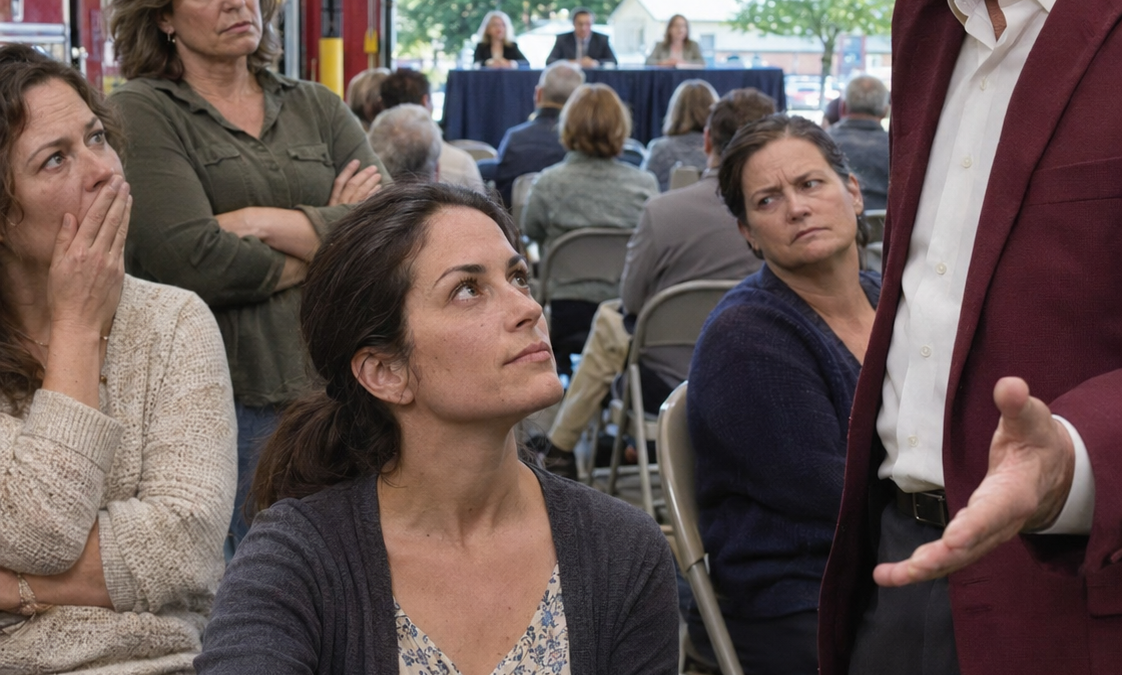
My uncle Roland Cates stood over my chair inside the Spokane fire station.
Seventy-three residents watched him block the aisle beside my seven-year-old son.
My father’s battered cassette recorder sat on the little table between our chairs.
“Your father ran from that fire; this tribute belongs to me.”
Roland wore a burgundy sports jacket over a white shirt.
At sixty-one, he still expected people to move when he approached.
My son tucked his orange shirt beneath his knees.
I kept my eyes on the recorder’s turning wheels.
“Let the recording finish.”
A woman stopped folding her program.
Someone near the open bay door lowered a paper cup.
Roland glanced toward the microphone, then back at me.
“That machine isn’t part of the ceremony.”
The wheels turned through a strip of blank leader.
I pressed pause before my father’s voice could begin.
Not yet.
The recorder had cost Dad twelve dollars at a garage sale.
Its battery cover stayed shut with a strip of blue tape.
Beside it lay the program for a nineteen-thousand-dollar rescue-history exhibit.
A covered memorial panel stood against the brick wall behind us.
The contrast needed no help.
“Those seats are for the people being recognized,” Roland said.
“My invitation says family.”
“Then you misunderstood the invitation.”
My son looked at the envelope beneath my chair.
He had watched me put our names on the reply card.
I moved my foot away so he could see it.
We belonged there.
I was April Hensley, thirty-eight, a veterinarian across town.
Usually, people argued with me about dental estimates and frightened dogs.
I knew how to wait without filling every second.
Roland disliked that.
He straightened the program on the empty chair beside him.
“You can watch from the back, April.”
“I can hear from here.”
A chair leg scraped behind us.
Nobody offered to exchange seats.
Good.
Dad had taken me to this station when I was fifteen.
He had promised we could return when the warehouse tribute was finished.
Then the project stalled, and his lungs grew worse.
When he stopped driving, I drove him to appointments.
When he couldn’t climb stairs, I moved his bed downstairs.
When he died, I packed the recorder without testing its batteries.
That was six months before the anniversary invitation arrived.
Now my son’s shoe pressed against mine.
“Are we leaving?” he whispered.
“No.”
Roland heard me.
He turned enough for the nearest rows to hear him, too.
“Some families know when to step aside.”
I set my handbag beneath the table.
Inside were copies, not originals, arranged with plain binder clips.
The recorder was the only thing I couldn’t replace.
Its handle had a melted spot near one hinge.
Dad never explained that mark to me.
I hadn’t asked soon enough.
Across the bay, the man running the ceremony watched our row.
He wore a black dress uniform, without a smile.
Roland followed my glance.
“He has a schedule,” my uncle said.
“So do I.”
My first appointment Monday was a terrier with a broken tooth.
I had traded Saturday shifts to bring my son here.
That ordinary fact helped keep my voice level.
I wasn’t borrowing this morning from Roland.
Neither was my boy.
“Please don’t make the station deal with family grievances.”
Roland said it softly, with the microphone close enough to catch him.
A few residents turned toward the sound system.
The insult had acquired speakers.
I watched my son flatten his program against his thigh.
The cover showed a drawing of the old warehouse.
Below it, a ribbon covered the proposed inscription.
Roland’s name appeared in the printed ceremony schedule.
Dad’s did not.
“Would you like me to explain why we came?” I asked.
“Not during my presentation.”
“You haven’t started.”
“That’s precisely the problem.”
He smiled toward the residents as though I had delayed dinner.
Then he reached for the microphone on its stand.
The man in black crossed the bay before Roland could begin.
My son sat straighter.
I left the recorder paused, my hand flat on my knee.
The man stopped beside our table.
“She has the floor.”
Roland’s smile disappeared before he turned.
The man in black stood between our row and the microphone.
His collar sat square against his neck.
My uncle’s face lost its color beneath the station lights.
“Simon, we agreed on the order.”
“We agreed families could speak.”
“That doesn’t mean every accusation belongs in public.”
“Nobody has made one.”
A program fluttered shut behind me.
The man looked at the recorder, then at my son.
“Would you like a little more room?”
My boy nodded.
Roland stayed where he was until the man repeated the question.
Then my uncle moved one step sideways.
Only one.
I recognized the man from the station website: Simon Ralston, fifty-four, the fire chief.
His office had sent our invitation after I asked about the exhibit.
We had exchanged emails about seating and access to historical records.
I had not told him what was on the tape.
I hadn’t wanted a private decision made around a public claim.
“Thank you,” I said.
Simon pulled an empty chair away from the table.
Now the recorder faced the aisle.
Roland watched that small adjustment as though furniture could betray him.
“We have invited guests waiting,” he said.
“The residents can hear a family contribution,” Simon said.
“Provided it’s relevant.”
“It is,” I said.
My son looked between us.
He knew Dad through photographs, bedtime stories, and a few taped messages.
He didn’t understand why a chair could upset a grown man.
Neither did several residents.
Their eyes had stopped following Roland.
They were watching the blue tape across the recorder’s battery cover.
Simon noticed the program beneath my son’s palm.
“Keep your place,” he told him.
Then he looked at me.
“Before we begin, I should explain what the exhibit currently says.”
Roland stepped toward him.
Simon didn’t move.
“The panel credits Roland with the warehouse extraction,” Simon said.
Part 2 of 5
I looked at the cloth covering the memorial panel.
The fabric reached almost to the concrete floor.
A red cord waited on a hook beside it.
“Is the lettering already finished?” I asked.
“The removable inscription plate is,” Simon said.
Roland adjusted his cuff.
“There’s no reason to discuss production details.”
“There is if the details are wrong.”
My son’s fingers stopped moving.
That was the first time I had said it plainly.
Wrong.
Simon looked from me to the recorder.
“Tell me what you brought.”
“A recording Dad made after the warehouse fire.”
Roland made a short sound through his nose.
“A man talking to himself isn’t an incident report.”
“No,” I said. “It isn’t.”
That answer seemed to disappoint him.
He had expected me to defend the tape before anyone heard it.
Instead, I checked the small speaker opening for dust.
I had cleaned it with a toothbrush the night before.
One practical thing.
The station had spent nineteen thousand dollars on photographs, display cases, lighting, and the memorial panel.
Dad’s recorder had cost twelve.
He had told that story whenever its buttons stuck.
“Still cheaper than taking you to the movies,” he used to say.
The machine had recorded grocery lists, birdcalls, and my school concerts.
After the warehouse rescue twenty-three years earlier, it had recorded something else.
I had found that cassette while sorting the last carton from his bedroom.
The label carried a date and two words: warehouse account.
Nothing dramatic.
Just his careful block lettering.
Roland tapped the back of his empty chair.
“Your father had years to come forward.”
“He did.”
“To whom?”
I looked at the covered panel.
“We’ll get there.”
A woman near the aisle shifted her purse onto the floor.
The room had settled into listening rather than waiting.
That difference seemed to bother Roland more than my refusal to leave.
“You’re a veterinarian,” he said. “This is fire service history.”
“I can read a date.”
“You cannot reconstruct an emergency from a family keepsake.”
“I brought other material.”
Simon’s eyes moved toward my bag.
He didn’t ask me to open it yet.
Neither did Roland.
The west entrance.
Those three words appeared in the printed exhibit description.
I had underlined them on my copy at home.
The underline remained folded inside my bag.
For now, I touched only the recorder.
My son leaned toward me.
“Is this the one with Grandpa’s voice?”
“Yes.”
“The whole one?”
“The part we need.”
He nodded and sat back.
Roland’s gaze sharpened.
“You played this for a child before bringing it here?”
“He asked to hear his grandfather.”
“That doesn’t make it evidence.”
Simon spoke before I could answer.
“It makes it a recording we haven’t heard.”
The bay door stood open behind the last row.
Outside, a delivery truck passed without slowing.
Inside, nobody reached for a phone.
I was grateful for that small courtesy.
Dad had disliked being filmed when he was sick.
He would have hated becoming somebody’s entertainment.
“Your father ran from that fire; this tribute belongs to me.”
Roland repeated the sentence more slowly this time.
He aimed it at me, but watched Simon.
My son’s chin lifted.
I put my hand on the edge of his chair.
“You don’t need to answer that,” I told him.
He pressed his lips together.
For once, he listened immediately.
Dad’s name had been Ernest Wexler.
Roland was his younger half brother; they had different fathers and different surnames.
Their faces had little in common except the shape of their ears.
When Dad became too breathless for phone calls, Roland sent messages through me.
Mostly, he asked whether Dad wanted old station photographs.
Dad always said yes.
When Roland appeared in newspaper features, I clipped them for Dad.
When Dad mailed corrections, I bought the stamps.
When no answer came, I helped him print another copy.
At the time, I thought somebody had simply mislaid his letters.
I understood misplaced paperwork.
My clinic had once lost a referral behind a printer tray.
But a missing answer could become a habit.
Years could hide inside it.
Simon looked toward the exhibit’s equipment cart.
“We have a microphone if that speaker is weak.”
“It works,” I said.
I had tested it at my kitchen table.
My son had asked why Grandpa sounded younger.
I had told him the tape was older than he was.
That was all he needed then.
Roland pulled his chair back.
“Before you embarrass yourself, tell everyone who verified this.”
“I’m asking people to listen first.”
“That isn’t verification.”
“No.”
I kept my answer short.
A man in the third row lowered his program to his lap.
Someone behind him whispered, “Let her play it.”
Simon raised his voice just enough to reach the open door.
“We’ll hear the recording, then compare it with our records.”
Roland’s chair stopped halfway out of the row.
For the first time, he looked toward the equipment cart.
There were archival copies there, supplied for the exhibit.
I had asked the station to bring them.
Simon had agreed because the ceremony included a historical presentation.
No ambush.
No stranger arriving with a magic envelope.
Just records the station already kept.
My son watched the recorder’s little square buttons.
“Can I sit close?” he asked.
“You’re close enough.”
I slid the machine toward the middle of the table.
Its cracked carrying handle rested against the wood.
Simon moved the microphone stand beside it.
Roland remained standing at the edge of the family row.
Every resident who had heard him dismiss me could still see his face.
I released the pause button.
Dad’s recorded voice said, “I went back through the south loading door because the rookie was still inside.”
A chair creaked somewhere behind us.
The tiny speaker crackled, then steadied.
“He’d answered once, down near the sorting cage. After that, I followed his air alarm. I told him, ‘Stay with me, Christmas.’”
Simon gripped the back of the empty chair.
My son looked up at him.
“Were you the rookie Grandpa called ‘Christmas’ because he arrived in July?”
Simon’s mouth opened, but no sound came.
I paused the tape.
Then Simon said, “That was me.”
Part 3 of 5
Simon lowered himself into the empty chair.
His knees remained apart, his palms resting on them.
Nobody moved the microphone.
“That’s Ernest,” he said. “I know that voice.”
Roland shook his head.
“You knew a lot of men back then.”
“I remember a voice that kept talking until I could crawl. I was told it was yours.”
My son studied Simon’s face.
“You really came in July?”
Simon nodded.
“I changed careers. I was thirty-one and brand-new to that station.”
Dad had called him Christmas because the station had needed another firefighter so badly.
A new pair of hands in July had felt like a holiday delivery.
Simon explained that himself, looking at my son rather than the audience.
“Your grandfather made the joke my first morning.”
“Did everybody call you that?”
“No. Just him.”
His voice caught on the last word.
He rubbed his mouth, waited, then looked at me.
“I blacked out at that cage. When I came around in the hospital, Roland told me he’d carried me out, and I believed him. I transferred to Boise that winter and only came back as chief last year. But only Ernest ever called me Christmas.”
Roland stepped closer to the table.
“Memory gets polished over twenty-three years.”
Simon looked up.
“So does a story.”
I didn’t let that become the whole case.
Recognition was powerful, but I hadn’t brought my son to watch two men argue about memory.
“There’s more on the tape,” I said.
Simon nodded.
I pressed play.
Dad described finding the trapped rookie beside a fallen wire cage.
He explained that the direct path had been blocked.
He had taken a longer route along the warehouse’s interior wall.
His voice was plain, almost apologetic about the amount of detail.
Then came a second voice, faint and strained.
“Ernest, don’t leave me here.”
Simon closed his eyes.
“That’s mine,” he said.
I stopped the tape again.
Dad had explained the second voice earlier on the cassette, in a short introduction I had played at home.
He had used the recorder during a hospital visit to capture Simon’s own recollection.
Dad had wanted a record while the details were fresh, even if Simon was too sedated to remember giving it.
The cassette label listed that visit beneath the date.
I turned it so Simon could see.
“I don’t remember that visit,” he said. “I only remember Roland at my bedside.”
Roland looked down at the concrete.
“Dad went twice that week,” I said.
Roland folded his arms.
“Then it’s two men agreeing after the fact.”
“Yes,” I said. “Which is why I requested the dispatch audio.”
Simon stood.
He had already had the historical files placed on the equipment cart that morning, as my email requested.
Now he crossed to it and brought back a laptop.
The station’s digital copies included the warehouse radio traffic.
An index sheet listed the incident number and timestamps.
I pointed to the time I had written in my request.
Simon found it without searching through unrelated calls.
Roland watched the laptop screen.
“Those channels were crowded.”
“They were,” Simon said.
He connected the laptop to the ceremony speaker.
The first sound was a dispatcher repeating the warehouse address.
Then came breathing, static, and a voice identifying its assignment.
Dad’s name.
The south loading door.
A request for help with a firefighter who could not get out alone.
Simon stopped the file.
“Play the answer,” I said.
He did.
The response directed the interior crew toward that door.
Dad answered that he was staying with the trapped firefighter.
The dispatcher repeated his name and location.
No nickname this time.
No family recollection.
A recorded exchange kept by the department.
Simon faced the residents.
“That places Ernest inside the warehouse with me.”
Roland lifted one shoulder.
“It places his radio there.”
“His voice,” Simon said.
“Radios get passed.”
I opened the folder in my bag.
My copies had tabs, but no dramatic red circles.
I had learned at work that a clear page was easier to trust than an angry one.
“Then let’s use the assignments,” I said.
Simon looked at Roland.
“Do you want the incident log read aloud?”
My uncle glanced toward the bay door.
The same residents occupied the same chairs.
Nobody had blocked his way out.
He stayed.
“Read the complete entry,” Roland said.
“That’s what I brought.”
I laid the copy beside the recorder.
Simon compared it with the station’s archival copy.
He checked the incident number first.
Then the page number.
Then the two lines I had marked with removable tabs.
I watched him do it.
The checking mattered more than the speed.
My son whispered, “Is that Grandpa’s writing?”
“No. It’s the station’s record.”
“Does it tell where he was?”
“It tells where the crews were assigned.”
Simon removed the tabs so everyone nearest the aisle could see an unobstructed page.
Roland’s arms dropped.
He looked older without the pose.
But I kept my attention on the paper.
I hadn’t come for the look on his face.
I had come for the line beneath the cloth.
Simon traced one entry without touching the ink.
Then he read the location aloud.
“Roland Cates: west entrance, exterior hose support.”
Part 4 of 5
Roland stared at the page.
“That doesn’t mean I stayed there every second.”
“No,” Simon said. “It records your assignment and check-ins.”
He read the following entry, then the one after it.
Both placed Roland at the west entrance during the rescue interval.
A supervisor had recorded a hose-pressure adjustment.
Roland had acknowledged it over the radio.
Simon returned to the dispatch file and played that exchange.
My uncle’s younger voice filled the bay.
The words were ordinary.
The timing was not.
While Dad reported a trapped firefighter inside, Roland was answering from another entrance.
There was nothing shameful about the work the log described.
Simon said so immediately.
“Exterior support helped get us out. That was necessary work.”
Roland’s eyes lifted.
For a second, I thought he might take the opening.
He could have said he had let an inaccurate story grow.
He could have named Dad.
Instead, he looked at me.
“You’ve spent a lot of time on this.”
“Yes.”
“Your practice must be doing well.”
I placed the final folder on the table.
“My staff covered two lunch hours.”
A woman in the second row made a small sound into her hand.
Roland heard it.
His collar had left a red mark above his shirt.
“You could have called me.”
“I did.”
“I mean before bringing all this.”
“I called before the program went to print.”
“You asked questions.”
“I asked you to correct the account.”
He turned toward Simon.
“Family conversations shouldn’t be part of a public ceremony.”
“They aren’t the record I’m about to show,” I said.
I slid out Dad’s written request.
Only then.
The recording had come first.
Then Simon’s identification.
Then dispatch.
Then the log.
I wanted no one to say a daughter’s letter had supplied the facts for everything else.
“This was Dad’s request to correct your public claim,” I said.
Simon looked at the date.
It was four years before Dad died.
The letter named the newspaper feature in which Roland had described pulling the rookie from the warehouse.
Dad had written a short correction.
He gave the entrance, the radio call, and the name of the rescued firefighter.
He asked that the station archive be corrected before future tributes used the account.
At the bottom was his signature.
Attached was the delivery receipt.
Roland’s eyes stopped there.
“You kept the receipt,” he said.
“Dad kept it.”
Simon read the request without speaking.
I laid a second copy beside him.
Dad had sent that one the following year.
The wording was almost the same.
The only addition was a request for acknowledgment.
Neither copy had an answer attached.
“Did the station receive these?” a resident asked.
Simon checked the delivery information.
“The receipts show delivery to the administrative office.”
“Then why wasn’t it fixed?”
“I don’t have an honest answer to that yet.”
He set the papers down carefully.
“But we have an honest correction to make now.”
Roland rubbed one palm over the other.
“I didn’t manage the mail.”
“No one said you did,” I told him.
His eyes came back to me.
“Then don’t make me responsible for everything that went missing.”
I took out the last page.
It was a photocopy of Dad’s own letter to Roland.
I had found it stapled behind the station copies.
Dad had asked his half brother to stop repeating the extraction claim.
He had offered to meet at the station and correct the account together.
No demand for money.
No threat.
Just a place, a date, and an invitation to tell the truth while both men were alive.
Roland recognized the page before Simon finished reading it.
His jaw moved once.
“I thought he wanted to embarrass me.”
“He asked you to come with him,” I said.
“He always made it sound easy.”
Dad had died before the correction was resolved.
I said that aloud because the residents needed the whole timeline, not merely the useful parts.
“He didn’t get an answer. He died waiting for one.”
My son leaned against my arm.
I kept the page flat beneath my fingers.
Roland looked at the covered panel.
“Ernest never cared about ceremonies.”
“He cared enough to write.”
The microphone carried that sentence farther than I intended.
I heard it return from the back wall.
Simon gathered the dispatch index, the incident log, and Dad’s request.
He placed them beside the recorder, not in front of it.
Nothing covered anything else.
Then he looked toward the panel.
The red cord still hung on its hook.
The ceremony schedule still named Roland.
All the printed confidence in the room had become paper.
Simon spoke to my uncle without raising his voice.
“Did you know Ernest had asked the station to correct the claim?”
Roland stared at the concrete between his shoes.
“Yes,” he said.
Part 5 of 5
Simon waited until Roland looked up.
“Did you tell the exhibit team?”
Roland’s lips pressed together.
“No.”
The residents heard both answers.
No one needed a speech after them.
Simon moved the microphone stand away from my chair.
He stood beside the covered memorial panel, with Roland still visible at the edge of the family row.
“The exhibit used an account we should have checked,” he said.
He rested his hands at his sides.
“Ernest’s recorded account is supported by the dispatch audio and the incident log. His written correction should not have gone unanswered.”
Roland took a step toward him.
“Simon, there are people here who donated.”
“Yes,” Simon said. “They deserve accurate history.”
“The plate is finished.”
“It’s removable.”
For the first time all morning, Roland had nothing ready.
His mouth stayed slightly open.
Simon looked directly at him.
“Her father gets the inscription—not you.”
My son’s shoe stopped tapping mine.
Across the aisle, a woman lowered the program she had been gripping.
The man behind her sat back.
Their faces remained turned toward the same uncle who had ordered me out.
Roland’s burgundy jacket looked too large across his shoulders.
“You can’t just erase my service,” he said.
“We won’t,” Simon said. “Your assigned role will remain in the exhibit.”
He pointed no finger.
He didn’t need to.
“But the rescue credit belongs to Ernest.”
Roland looked at me then.
I had imagined that look during sleepless nights.
In my kitchen, I had prepared arguments for it.
None of them seemed worth saying now.
I moved my son’s program away from the recorder so the speaker opening stayed clear.
“Will you play the rest?” Simon asked me.
He meant the pause button.
I nodded.
Dad’s voice returned, smaller than the room and steadier than anyone in it.
He described the way out.
He named the crew members who met them at the loading door, using the job assignments recorded in the log.
He said the exterior hose crew had helped keep the route usable.
Roland heard his work acknowledged in the account he had tried to replace.
My uncle sat.
Not in my chair.
In the empty seat at the end of the row.
He folded his program once, badly, and held it between both palms.
Simon asked the residents to remain while the inaccurate plate was removed.
Nobody got up.
Using the panel’s mounting key from the equipment cart, Simon opened the cloth just far enough to reach the lower fasteners.
He kept the wrong inscription facing the wall.
The covered display did not become another spectacle.
The plate came free with two quiet clicks.
Simon carried it to the cart and laid it face down.
Then he returned to us.
“The permanent replacement will name Ernest Wexler,” he said.
“The exhibit’s digital account will be corrected today. The panel will stay covered until its lettering is accurate.”
He looked toward the residents.
“Everyone who received this program will receive the correction.”
That included the people who had watched Roland block our aisle.
It included the donors.
It included the neighbors who would see my uncle at the grocery store.
There was no private version left for him to tell afterward.
“Does that finish it?” my son asked.
“The wrong part,” I said.
He considered that.
Then he looked toward Simon.
“Did Grandpa get you all the way outside?”
Simon crouched beside his chair.
“Yes.”
“Were you scared?”
“Yes.”
“Did he keep talking?”
“The whole way.”
My son nodded as though this matched someone he already knew.
It did.
Dad had talked me through driving on ice, changing a tire, and my first difficult week at veterinary school.
He had never sounded grand while doing it.
On the cassette, he sounded like a man explaining where the flashlight batteries belonged.
Roland sat without looking toward us.
Simon rose and addressed me.
“I’m sorry we made you bring this much proof.”
“You listened when I brought it.”
“We should have listened when he did.”
I watched the little wheels turn.
That was the apology Dad had asked for without using the word.
The tape reached its last recorded passage.
Dad said he wanted the account kept straight because someday the men who remembered that warehouse would be gone.
Then came a scrape, a brief cough, and his voice again.
“Make sure the boy knows we got out.”
He had meant the rookie.
My son heard it differently.
“We know,” he whispered.
The recorder clicked off beside the still-covered memorial panel.
Roland remained seated while Simon returned our invitation envelope to the little table.
My uncle did not ask us to move again.
Before the residents left, Simon wrote the corrected dedication on a plain display card and placed it beneath the cloth’s lower edge.
He read it aloud first.
Ernest Wexler.
For bringing a fellow firefighter home.
My son asked to carry the recorder to the car.
I let him use both hands.
Behind us, Simon replaced the ceremony schedule with the corrected dedication.
THE END
More stories
My Ex-Wife Called My Daughter’s Memorial a “Sad Little Tribute,” Then Went PALE When the Drive-In Manager Restored My EveningMy Niece Belinda Said I Didn’t Live There Anymore Before 32 Neighbors, but She Went PALE When a Biker Asked Who Changed My LocksMy Brother Ross Mocked My Cheap Key Before 34 Relatives, Then FROZE When a Uniformed Guest Walked In and Greeted MeMy Ex Blake Renshaw Mocked Our Daughter’s Purple Halter While Selling Her Mare, Until One Name on a Certificate Cost Him a $48,000 SALE in PublicMy Brother Raymond Said Someone “Respectable” Should Present My Father’s Flag at My Daughter’s Reception, but a Woman’s BUS STATION Remark Stopped His Smile Before Our Mother’s Instructions Cost Him the HonorMy Stepmother Veronica Told Me to Stay in My Place at Dad’s Grave, but Her Smile Vanished When the Cemetery Owner Asked to Let His DAUGHTER Finish
You Might Also Enjoy

My Daughter-In-Law Told Me To Stay Elsewhere While Strangers Took My Condo — Then I Pushed Back







