My Brother Alan Called Me the Daughter Who Contributed NOTHING at a Hospital Dedication, Then Went PALE When the President Put Me Back in the Photograph
Part 1 of 5
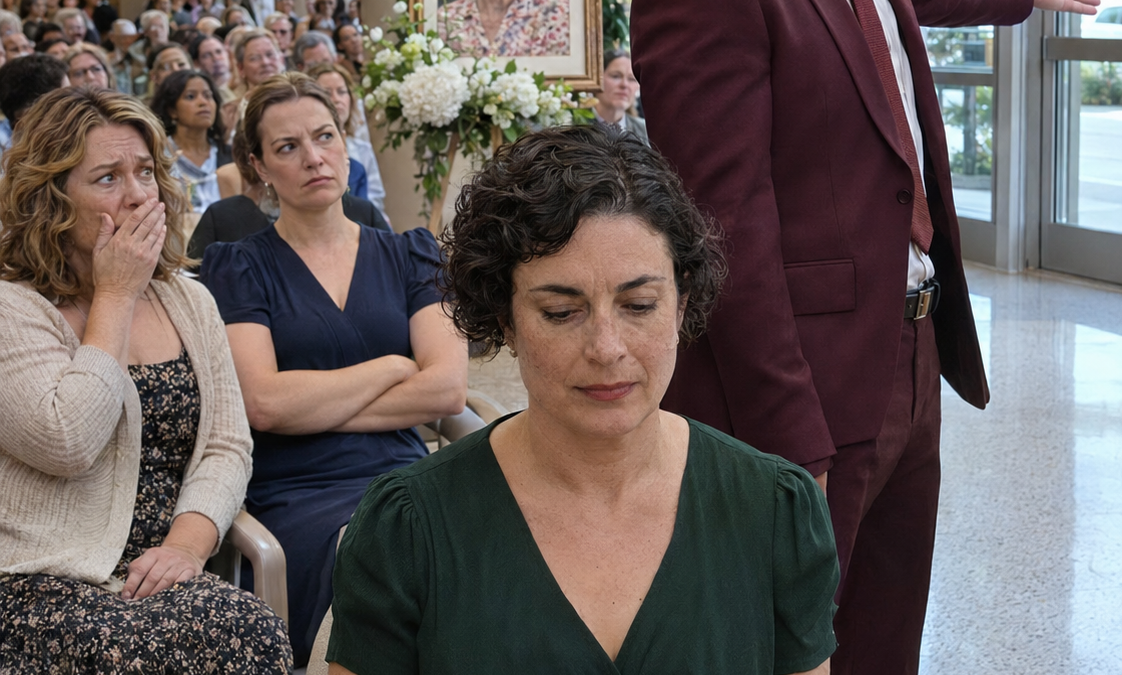
“Get out of the family photograph!”
My brother’s voice crossed the Cleveland hospital lobby.
All 64 donors watched him point toward the exit.
I sat beneath our mother’s portrait, holding her battered recipe tin.
Alan’s watch flashed above its dented lid.
He had told me the watch cost $7,200.
Mom had paid $2 for the tin.
“Check the original agreement,” I said.
A woman in the front row lowered her program.
Behind her, a man stopped straightening his tie.
Alan looked toward the photographer, then back at me.
“We’re arranging a family photograph, Christine. Try to keep up.”
“I’m keeping up.”
He bent closer without lowering his voice.
“You’re the daughter who contributed nothing.”
I set the tin on the little table beside me.
Carefully.
Its loose hinge caught if you pushed too hard.
I was Christine Redding, forty-seven, a prosthetist in Cleveland.
Most mornings, I helped people stand without watching their feet.
That afternoon, apparently, sitting in the wrong chair required correction.
Alan was fifty-three and dressed for the front page.
His burgundy suit matched the ribbon across the rehabilitation-wing entrance.
He had chosen both.
I knew because he had announced it at breakfast.
“Somebody has to make these things look professional,” he’d said.
Now he nudged my chair with the toe of his shoe.
“Staff can take a picture afterward.”
“I’m not here as staff.”
“Then don’t make this difficult.”
One short history explained why I had brought the tin.
Mom had packed suppers in it before buying proper containers.
When Alan bought his first office, I paid her heating bill.
When he flew to conferences, I drove her to therapy.
When he called Sundays, I stayed through Monday’s laundry.
After she died twelve years earlier, I kept the tin.
Inside were recipes, old grocery slips, and one folded paper.
That was enough history for a room full of strangers.
I closed the lid.
Alan turned toward the donors with an easy smile.
“My sister works with medical equipment. She gets particular about paperwork.”
“Prosthetic limbs,” I said.
“What?”
“I make and fit prosthetic limbs.”
“Wonderful. Then you understand why today needs to stay on schedule.”
A few programs rustled.
Nobody laughed.
The dedication marked the opening of a renovated rehabilitation wing.
Our mother’s existing memorial room stood just beyond the ribbon.
Her portrait had been brought into the lobby for photographs.
I had asked permission to put the tin beneath it.
Alan had asked for a microphone.
His request had apparently traveled faster.
Beside the podium stood a narrow object under gray cloth.
A fresh plaque.
Its outline showed through.
The old plaque remained on the wall behind the ribbon.
I could see the edge of Mom’s surname.
Alan stepped between me and the photographer.
“Let’s avoid another misunderstanding,” he said. “This picture is for contributors.”
“I heard you.”
“Then move.”
I stayed seated.
He glanced toward the covered plaque, checking its position.
Three donors in the second row exchanged looks.
One woman pressed her program flat against her knees.
Another looked at the tin, then at my brother.
A man studied the exit as though measuring the distance.
Alan noticed them noticing.
He lowered his voice by very little.
“You brought a rusty box to a formal dedication.”
“It’s a recipe tin.”
“Put it somewhere appropriate.”
“It is.”
He straightened, smoothing the front of his jacket.
“We’re recognizing the people who made this expansion possible.”
From the hallway, a staff member checked the clock.
The ceremony was already six minutes late.
Alan looked pleased to have that fact against me.
I opened the tin again.
Beneath Mom’s biscuit card was a folded transfer receipt.
A small label inside the lid carried a donor number.
I left both where they were.
No flourish.
No speech.
Just a lid standing open.
At the far end of the lobby, the hospital president appeared.
I recognized her from the printed program.
Bernice Goodwin, fifty-eight, silver braids, plum dress.
She had been delayed beside the new therapy gym.
A staff member had told us about an equipment inspection.
That explained her arrival now, rather than ten minutes earlier.
Alan lifted his chin toward her.
“Perhaps we can finally begin.”
I waited until Bernice reached the table.
“Would you check the donor number inside this tin?” I asked.
Her gaze dropped to the label, then rose to my face.
Then she stepped closer, until she stood beside my chair.
“You belong in this photograph,” Bernice said.
Alan’s mouth closed.
The color left the strip of skin above his collar.
The photographer lowered the camera instead of taking the picture.
Bernice looked at the open tin again.
“May I?”
“Yes.”
She leaned close enough to read the label without moving anything.
Alan gave a small, breathy laugh.
“There’s some confusion. My sister isn’t part of the presentation.”
“I can see that the presentation needs a moment,” Bernice said.
She turned toward the staff member beside the hallway.
“Please ask development to bring the archived gift file.”
“The new naming packet?” Alan asked.
“The archived file.”
His foot went still.
Bernice studied my face with her head slightly tilted.
I had seen that look from patients recognizing someone outside a clinic.
A grocery aisle could make familiar people seem briefly impossible.
“You worked evenings here once,” Bernice said.
“I trained here. Then I stayed nearby.”
“How long ago?”
“Twenty-four years.”
Her fingers settled against the seam of her skirt.
“Did you bring supper to a student nurse after her first shift?”
Alan looked from Bernice to me.
I looked at the tiny blue flowers along the tin’s rim.
“Yes,” I said. “I did.”
Bernice’s mouth trembled before she pressed it still.
“I was that student nurse.”
Part 2 of 5
For a moment, I could see the break-room doorway again.
A woman had sat beyond it wearing borrowed scrubs.
Her badge had been turned backward.
Now that woman stood before our mother’s portrait, running the hospital.
“You had cut your hair,” I said.
“And you had flour on one sleeve.”
“Mom’s dumplings.”
Bernice nodded.
Alan shifted toward the podium.
“Lovely connection. We should let everyone get to lunch.”
“Please wait,” Bernice said.
Quietly.
The words stopped him more effectively than mine had.
The donors remained in their chairs.
Someone near the windows turned a phone facedown.
Bernice looked directly at me.
“That first shift went badly. I thought I had chosen wrong.”
“You were learning.”
“I was thirty-four. I thought that meant I should know everything.”
She explained that nursing had been her second career.
That accounted for the age I remembered, and the years between us.
“You brought supper the next night,” Bernice said.
“And the next week.”
“Until you stopped hiding in the supply room.”
A few people smiled.
Bernice did, too.
Then she faced the seated donors.
“Those suppers kept me from quitting twenty-four years ago.”
Alan’s smile stayed fixed.
“You should certainly thank her.”
“I just did.”
I looked down at the tin.
Mom’s handwriting ran uphill across the biscuit card.
She had always written ingredients before quantities.
Flour. Milk. Enough salt.
Practical things first.
Bernice followed my glance.
“Was that her recipe?”
“Yes.”
“What was her name?”
“Jeanette Talley.”
Bernice turned toward the portrait’s small engraved plate.
Then back to me.
“The woman this room honors.”
“Yes.”
Alan stepped in beside the table.
“Our mother,” he said. “That’s why I’ve taken responsibility.”
There was the claim.
Polished smooth.
My brother had been saying versions of it for years.
After Mom remarried, her surname had become Talley.
Alan had kept Driscoll, the name we were born with.
I was divorced and had kept Redding for my patients and practice.
Different names had made it easy for him to describe us selectively.
He introduced himself as her son.
He introduced me as someone who worked nearby.
At the funeral, he had bought a $640 flower arrangement.
I had paid the $86 overdue electric bill at her apartment.
Neither purchase had belonged in a speech.
One had appeared in his.
“Your mother liked feeding people,” Bernice said.
“She disliked an empty chair at supper.”
“Mine was usually empty.”
I remembered paper plates stacked beside a hospital microwave.
I remembered asking whether she preferred noodles or rice.
I had not asked why she cried after changing out of scrubs.
That had been none of my business.
Alan checked his watch.
“We have donors waiting.”
“All sixty-four are still here,” Bernice said.
Her voice carried without a microphone.
That was useful.
The staff member returned with a man carrying a flat archive box.
He was new to the lobby, not one of the seated donors.
“Daryl Phelps, our development officer,” Bernice told me.
Daryl set the box on the table, away from the tin.
He read the number inside the lid.
Then he examined the tab on a folder.
His thumb paused.
Two identical numbers.
Alan saw the pause.
“What exactly are we checking?”
“The existing agreement,” Daryl said.
“My company’s packet is already approved.”
“Your proposed gift is in a separate file.”
“Your office accepted it.”
“We acknowledged receiving the proposal.”
Alan’s jaw worked once.
The covered plaque stood just behind his shoulder.
I wondered who had ordered it.
Not the hospital, judging by Daryl’s expression.
Bernice asked me whether I wanted a private room.
“No,” I said.
Alan had spoken in front of these people.
The answer could stay here, too.
I moved the recipe tin away from a water glass.
One practical thing.
The tabletop had a slight slope.
I folded a program underneath the tin to steady it.
Alan watched as though I were delaying a train.
“Christine, don’t confuse hospitality with investment.”
“I haven’t.”
“Everybody appreciates a casserole. Buildings require more.”
Daryl lifted the archive folder from its box.
Before opening it, he checked my identification.
I gave him my driver’s license.
He matched the photograph, then the name.
That was sensible.
A president’s gratitude should not substitute for verification.
Alan took half a step toward the exit.
“If this becomes a personal tribute, I’ll take my guests upstairs.”
Three donors looked at him.
None stood.
Bernice moved beside my chair again, beneath Mom’s portrait.
I sat centered at the table, with the tin before me.
Alan extended an arm toward the doors.
“We can still do this gracefully.”
Daryl placed a sealed sleeve beside my open tin.
“Do you have the corresponding receipt?” he asked.
“Under the biscuit recipe.”
I unfolded the paper and laid it beside the sleeve.
Daryl checked its date against the folder.
Then he looked at Bernice.
“May I read the controlling provision aloud?”
Alan reached for the gray cloth over his plaque.
Bernice said his name.
He stopped.
Daryl opened the original agreement.
“The donor is Christine Redding, and the signed agreement reserves naming approval to her,” Daryl read.
He placed my transfer receipt beside the hospital’s matching record.
“Both show the same completed gift, eleven years ago.”
Alan’s hand fell away from the cloth.
Daryl turned the agreement so Bernice could read the provision herself.
“The room’s protected name is the Jeanette Talley Rehabilitation Room.”
Bernice checked the signature beneath it.
Alan looked at me instead of the paper.
“You paid for the room?”
Part 3 of 5
“Yes,” I said.
My brother’s mouth stayed open for a second. Then he glanced across the donors, counting witnesses as though fewer might make the answer different.
“How much?”
Daryl looked at me before answering.
“The amount isn’t necessary,” I said. “The terms are.”
Alan pulled his jacket straight.
“Then this is some small contribution being exaggerated.”
I turned the receipt so he could see it without taking it.
The transfer was $180,000.
He bent over the table. His watch nearly touched the edge of Mom’s biscuit card.
For once, he did not tell anyone what it had cost.
“That can’t be right.”
Daryl laid a second page alongside the first.
“This is the hospital’s deposit record. The funds cleared eleven years ago. There was no pledge balance.”
I watched Alan follow the columns with his eyes.
The hospital had kept its records better than our family had kept its stories.
Eleven years earlier, I had sold the licensing rights to a small component I helped develop for prosthetic fittings. It reduced the time needed for an adjustment that used to leave patients waiting through repeated appointments.
My share had paid off the remaining equipment loan at my practice. After taxes, I had added savings to fund the room.
The money had not appeared overnight. Neither had the idea.
Mom had spent her final rehabilitation stay sharing a therapy space with a television that nobody could turn down. She could barely hear instructions over a game show.
She had asked whether there might someday be a quiet room for people relearning ordinary movements.
A chair. Parallel bars. A door that closed.
She had made it sound like a grocery list.
I told the donors only that much.
Nobody needed my tax history or an inventory of what I had gone without.
Alan pressed his lips together.
“You let me believe the hospital named it for her as a courtesy.”
“I never told you that.”
“You never corrected me.”
“You didn’t ask.”
He looked toward Bernice.
“Surely family members should have been consulted.”
Daryl tapped a line below my signature.
“The donor requested anonymity outside the staff needed to administer the gift. That request was honored.”
“Even from me?”
“Even from you,” I said.
The woman in the second row who had flattened her program relaxed her hands.
I knew the movement. Patients did it after realizing they would not have to defend their pain for another hour.
Alan pointed at the portrait.
“She was my mother, too.”
“Yes.”
“Then I have a say.”
“You have memories,” I said. “You don’t have my signature.”
He looked down again.
Daryl explained the clause in plain language. The hospital owned the room and operated it. My signed gift agreement gave me approval over any change to its memorial name.
The protection applied during renovations, expansions, and later gifts.
It had been written that way because a development employee eleven years earlier had warned me that buildings outlasted promises.
I had listened.
Bernice read the relevant paragraph once more.
Then she set the document flat.
“Your generosity to me years ago is separate from this,” she said. “The agreement would control if we had never met.”
“Thank you,” I said.
I needed that distinction made in front of everyone.
A supper should not buy an exception. A signed promise should not require a personal connection to survive.
Alan looked toward the staff member near the hallway.
“Where’s the packet I sent?”
Daryl opened another folder.
“Here.”
“And the correspondence?”
“Also here.”
“Then read the acceptance.”
Daryl sorted two pages and laid one on top.
“This acknowledges receipt and says naming is subject to review of existing restrictions.”
Alan reached for it, then stopped short of touching the paper.
“I had a conversation.”
“With whom?” Bernice asked.
“A fundraiser.”
Daryl looked up.
“With me. I said we could discuss recognition for your proposed support. I did not offer this room.”
The hospital clock clicked into the next minute.
Nobody checked a phone.
Alan had invited these donors to watch his business name go onto a hospital wall. I could see the planned sequence now: photograph, speech, cloth removed, applause.
I had been the only object he could move without asking permission.
Or so he had thought.
“Why bring the tin?” he asked.
“To put beneath her portrait.”
“Why put papers in it?”
“Because that was where I kept them.”
He waited for something larger.
There was nothing larger.
Mom had kept bus fare in an old tea jar and appointment cards beneath the sugar bowl. I had inherited her habit of putting important things somewhere familiar.
The tin had sat on a kitchen shelf through eleven years of ordinary Tuesdays.
This morning, I had checked its contents before leaving.
Daryl slid a third page out of Alan’s folder.
His expression changed.
He passed it to Bernice without reading it aloud.
“What is that?” Alan asked.
Bernice held the page by its upper corners.
“Your invitation promised an unveiling we never authorized.”
Part 4 of 5
Alan looked toward the rows of chairs.
The invitations had gone to those same sixty-four donors. Several people now reached for programs as though the promise might have been printed there, too.
“It was promotional language,” he said.
Bernice set the invitation beside the agreement.
“It named a specific room.”
“A reasonable expectation.”
“It also printed your company’s name above the word ‘unveiling.’”
He glanced at the gray cloth.
Daryl followed his eyes.
“Did you order that plaque yourself?”
“I handled production. Your office was moving slowly.”
“Because the proposed naming had not been approved.”
Alan drew a breath through his nose. It made a small, sharp sound that carried farther than he intended.
“We don’t need to dissect every email.”
“No,” Bernice said. “We need to correct what your guests were told.”
He stepped closer to me.
“Christine, tell them we can work this out.”
“What would that mean?”
“A combined name. Something recognizing the family and the company.”
I rested my forearms on the chair arms.
“The room already recognizes our mother.”
“Her name would still be there.”
“Where?”
“On a dedication line.”
“Below your business.”
He did not answer.
Beyond the glass doors, an ambulance crossed the driveway without its siren. Two hospital employees walked past carrying lunch bags.
The ordinary traffic outside made my brother’s burgundy suit look less like authority and more like clothing.
He lowered himself toward my ear.
“This is embarrassing.”
I kept my voice at its usual level.
“You can stop asking.”
He straightened before the donors could mistake us for agreeing.
Bernice asked Daryl to check whether any hospital payment had been made toward the replacement plaque.
He opened the production sheet attached to the proposal.
“None. The vendor invoice is addressed to his company.”
“That is my property,” Alan said quickly.
“Yes,” Bernice said. “You may take it with you.”
He looked as though she had handed him a wet coat.
The plaque was no longer a promise waiting beneath cloth. It was a thing he had purchased without permission.
A woman near the aisle asked whether the rehabilitation wing would still open that afternoon.
“Yes,” Bernice said. “The scheduled patient services are unchanged.”
That was the first question anyone had asked about the people who would use it.
I looked at the ribbon and thought about the patients waiting for Monday appointments. Someone would need a lower bench. Someone would be worried about stairs. Someone would pretend a socket did not hurt because a spouse had already missed work.
None of them needed Alan’s name or mine.
They needed the room.
Bernice asked whether I wanted to say anything before the dedication continued.
I shook my head.
Then I looked at Mom’s portrait.
“Actually, one thing.”
Alan watched me with his jaw set.
I stood beside the table. Sitting through his orders had been easier than giving a speech.
“My mother didn’t know about this gift,” I said. “It was made after she died.”
I wanted that clear. There would be no invented scene of her blessing a check or asking for a plaque.
“She did know what it was like to work hard at getting better in a room where nobody could hear.”
A man in the back lowered his head.
“That’s what I wanted fixed.”
I sat down again.
The photographer waited with the camera against her chest. Bernice asked her to hold a little longer.
Alan looked at me.
“You could have told me eleven years ago.”
“I could have.”
“Why didn’t you?”
“Because you would have made it a family announcement.”
For the first time that afternoon, he seemed to search for a reply he did not already have prepared.
I remembered a birthday dinner where he had announced my promotion before I arrived. A holiday when my divorce had become his example of how he helped people through setbacks.
He liked to stand beside news until people forgot whose life it belonged to.
I had kept one thing away from that habit.
Across the table, Daryl returned the receipt to me.
“Would you like a protective sleeve for this?”
“Yes, please.”
A staff member brought one from the registration desk. Daryl slipped the paper inside and laid it over the biscuit recipe.
Such a small courtesy, after all that noise.
Alan looked at the tin again.
His gaze stayed there long enough that I wondered whether he remembered carrying it anywhere himself.
Then he turned to Bernice.
“My proposed contribution can go elsewhere.”
“That is your decision.”
“You understand what you’re turning away?”
“We haven’t accepted a restricted gift in exchange for breaking an existing promise.”
There was no lecture in her voice. She sounded as she might when explaining that a locked door needed the correct key.
Alan glanced toward the donors again.
Nobody offered to leave with him.
Daryl closed the proposal folder and left the original agreement open.
Bernice stepped to the microphone.
She adjusted its height, waited for the soft squeal to stop, and looked directly at Alan.
“Before we begin, the naming announcement must be corrected.”
Part 5 of 5
Bernice did not ask Alan to join her.
He remained beside the covered plaque, standing taller than everyone seated and looking suddenly stranded by the height.
The sixty-four donors faced the podium.
I could see the same woman with the flattened program, the same man who had studied the exit, the same three people who had exchanged uneasy looks.
They had heard the first order.
They would hear the answer.
Bernice laid one hand flat on the podium.
“The Jeanette Talley Rehabilitation Room was funded eleven years ago through an anonymous gift from Christine Redding.”
My name sounded strange through the lobby speakers.
“The hospital’s original signed agreement protects that memorial name and requires her approval for a change. The development office has verified the agreement and the completed transfer independently.”
Alan opened his mouth.
Bernice turned toward him.
“Her mother’s name stays; your replacement plaque will not be installed.”
He shut it again.
No one clapped immediately.
The sentence needed somewhere to settle.
Alan looked at the gray cloth. A muscle jumped near his cheek. He tugged once at his cuff, hiding the bright watch beneath it.
Daryl moved the replacement plaque away from the podium and set it beside Alan’s production box.
The change took only seconds.
Its empty place beside the microphone seemed larger than the plaque had been.
A donor in the front row began to clap. Others joined, unevenly at first, then together.
I kept my hands in my lap.
Bernice let the applause finish.
“The dedication will continue under the correct name,” she said. “We are grateful for support that helps patients, and we will honor the commitments already made to them.”
Alan looked toward the photographer.
“Are we still doing the picture?”
“Yes,” Bernice said.
He straightened his shoulders.
“With Christine,” she added.
The photographer stepped forward and checked the light.
I rose, but Bernice glanced toward the chair beneath Mom’s portrait.
“Would you rather stay there?”
“Yes.”
My knees were fine. I simply liked that spot.
Alan remained at the edge of the group. No one ordered him out. Bernice left him enough room to decide whether he could stand beside the sister he had tried to remove.
He came over slowly.
“Let’s not make this worse,” he said under his breath.
I looked at the camera being adjusted.
“You can stand there quietly.”
He did.
The photographer took the picture.
There was no triumphant pose. Bernice stood nearby. Alan kept both arms straight at his sides.
I sat beneath our mother’s portrait with the recipe tin on the table.
Then the ribbon came down, and the donors entered the renovated wing.
The lobby doors stayed open. Nobody had to be ushered away from what had happened.
Daryl returned the protected receipt to the tin and gave me a clean copy of the agreement for my records. The original went back into the hospital’s archive folder.
“Your anonymity has been waived only for what you approved today,” he said.
“I understand.”
“Future publicity can still be declined.”
“I’d like that.”
He wrote it on the contact sheet.
A practical answer.
A box checked.
Alan watched from beside his plaque. The gray cloth had slipped just enough to show a polished corner, but nobody tried to uncover the rest.
“Did you plan this?” he asked.
“I planned to bring her tin.”
“You knew about the proposal.”
“I knew you wanted the name changed.”
“Then you knew I’d look foolish.”
I closed the tin, easing the stubborn hinge into place.
“I thought you might read what you were asking to replace.”
He glanced toward the open wing, where the donors could still see us.
“I was trying to do something substantial.”
“You could have.”
The reply left him without the argument he wanted.
He picked up the production box, set it down again, and asked a staff member where deliveries could be collected. The staff member directed him to the service desk.
He would have to arrange removal himself.
Bernice returned before he left.
She thanked him for attending in the same voice she had used for everyone else. He nodded without meeting her eyes.
Then he carried his company’s unused plaque toward the service desk.
The donor announcement he had staged never happened.
No speech about his business.
No unveiling.
No photograph without me.
Bernice waited beside the table until he was gone from the lobby.
“Would you have supper with me sometime?” she asked.
“This time you’re buying.”
“Yes,” she said. “This time I am.”
I opened the tin once more and removed the biscuit card. A brown crescent marked one corner where Mom had once set down a coffee cup.
Bernice looked at the handwriting.
“May I have a copy?”
“I’ll send one.”
I slipped the receipt into my purse and put the card back alone.
Then I carried the tin into the memorial room, with Bernice beside me and the donors gathered around the doorway.
Mom’s portrait had been returned to its place above a small glass display case. Her name remained on the wall, exactly as it had been before the renovation.
I set the battered tin beneath her unchanged portrait.
Daryl fastened the display case’s latch.
THE END
More stories
My Uncle Ordered Me Out of the Family Row at a Fire Station Tribute, but When a Man Gave Me the FLOOR, His Claim to My Father’s Rescue Began to UnravelMy Ex-Wife Called My Daughter’s Memorial a “Sad Little Tribute,” Then Went PALE When the Drive-In Manager Restored My EveningMy Niece Belinda Said I Didn’t Live There Anymore Before 32 Neighbors, but She Went PALE When a Biker Asked Who Changed My LocksMy Brother Ross Mocked My Cheap Key Before 34 Relatives, Then FROZE When a Uniformed Guest Walked In and Greeted MeMy Ex Blake Renshaw Mocked Our Daughter’s Purple Halter While Selling Her Mare, Until One Name on a Certificate Cost Him a $48,000 SALE in PublicMy Brother Raymond Said Someone “Respectable” Should Present My Father’s Flag at My Daughter’s Reception, but a Woman’s BUS STATION Remark Stopped His Smile Before Our Mother’s Instructions Cost Him the Honor
You Might Also Enjoy

My Daughter-In-Law Told Me To Stay Elsewhere While Strangers Took My Condo — Then I Pushed Back







