My Daughter-in-Law Gretchen Shouted That I Didn’t Make the Quilt Before 57 Spectators—but When the RIDER Walked In, Her Claim Unraveled and She Lost Her Shot at a $25,000 Contract
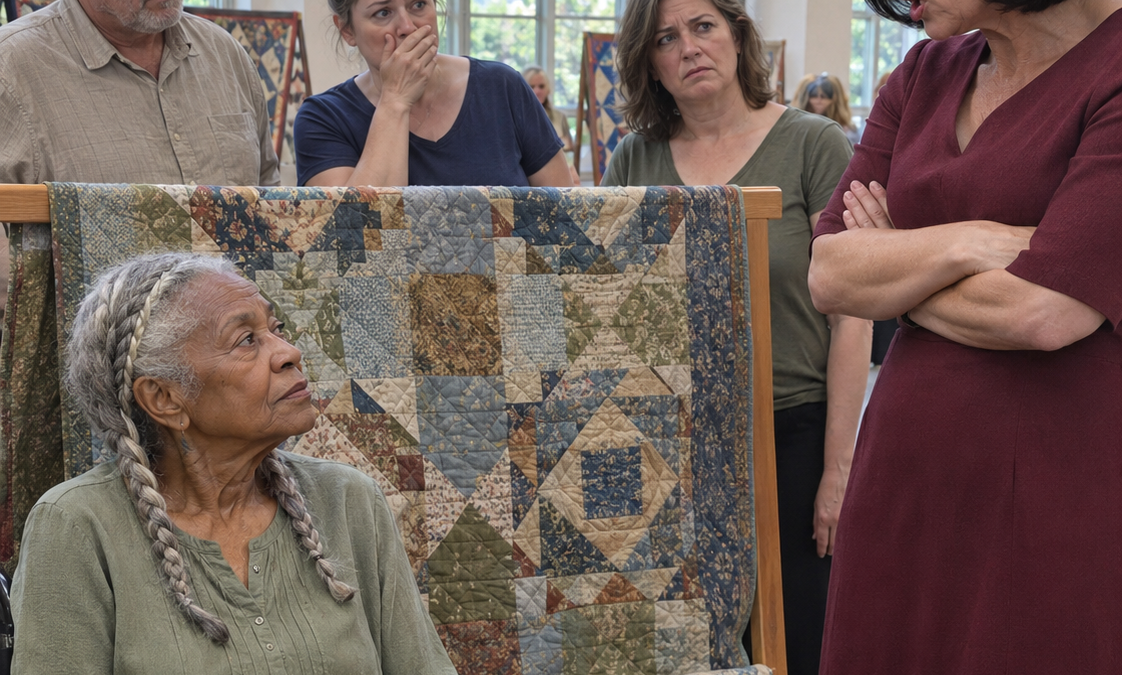
Part 1 of 5
“You didn’t make it!”
Gretchen Wescott’s voice crossed the Asheville exhibition hall.
All 57 spectators turned toward my wheelchair and the quilt.
My daughter-in-law stood beside its burgundy finalist ribbon.
Her black bob barely moved when she shook her head.
“She confuses watching someone sew with making something herself.”
Someone lowered a paper cup without taking a drink.
I looked at the attendant beside the display rail.
“Open the whole quilt.”
My voice carried without much help from me.
The attendant looked toward Gretchen before touching the fabric.
That pause told me where the difficulty would be.
“Please,” I added.
Gretchen arranged her mouth into a small, patient smile.
“We’ve already arranged it correctly for the judges.”
The quilt’s lower border disappeared behind the wooden rail.
A blue square near its center caught the sunlight.
I knew that square.
I kept my eyes on the attendant instead.
My name was Estelle Quimby, and I was eighty-two.
I had lived in Asheville for thirty-six years.
Retired geologists learn to wait while other people finish guessing.
Gretchen was fifty-four and considerably less practiced at waiting.
“Estelle, you’re interrupting the presentation.”
“I’m asking to see the bottom.”
“It’s a textile exhibition, not a bedding demonstration.”
A woman near the aisle moved her purse off an empty chair.
Nobody sat down.
The attendant’s fingers rested against his trouser seam.
He wore a small name tag: Terrance Bixby.
“Does the display come apart?” I asked him.
“Yes, ma’am. The lower section lifts free.”
“Then we have a simple problem.”
Gretchen gave a short laugh toward the spectators.
“We have a confused relative. That’s different.”
Still folded.
Three weeks earlier, Gretchen had borrowed something from my linen cupboard.
She said a textile specialist could assess its condition.
I had supplied a clean cotton sheet for wrapping.
I had also paid the $38 delivery charge.
My husband had died twenty-three years before this afternoon.
I was widowed, not absent-minded.
There were things I no longer lifted without help.
There were also things I could recognize across a room.
Now Gretchen’s name stood beside the quilt on cream cardstock.
The card described an original work completed that year.
Below it, the contract amount read $25,000.
I read that line once more.
“Who wrote the display card?” I asked.
“The exhibition office,” Gretchen said.
“From information you supplied?”
“That is generally how an application works.”
A few people looked down at their programs.
No one laughed.
Terrance shifted closer to the rail.
“I could ask the director,” he said.
“That won’t be necessary,” Gretchen told him.
“I would appreciate it,” I said.
He stayed where he was.
Behind Gretchen, the quilt’s corners rested at different heights.
One had been tucked tightly enough to pull the center crooked.
The other hung loose, with a tiny ridge beneath it.
I had spent years reading pressure in stone.
Fabric had its own evidence.
Gretchen bent toward me without lowering her voice.
“You came here to support me, remember?”
“I came because you invited me.”
“You said you wanted to see it displayed.”
“I do.”
“Then please stop making this difficult.”
Her dress was burgundy, almost the color of the finalist ribbon.
She smoothed its side seam with her palm.
“Some people contribute memories,” she told the room.
“Other people do the work.”
The attendant’s jaw tightened.
I turned my wheelchair slightly, clearing his path to the rail.
That was all.
No accusation.
No speech.
No raised voice.
A flat envelope rested in the basket beneath my seat.
I had brought it after seeing Gretchen’s exhibition announcement online.
Its flap was already open.
Gretchen noticed the basket and stopped smiling briefly.
“What have you brought with you?”
“Something that belongs with this.”
“Family photographs won’t establish authorship.”
“I haven’t shown you anything.”
She glanced toward the entrance, then back at the quilt.
Outside, an engine stopped.
Then another.
Gretchen straightened and spoke to the spectators again.
“The judges have already reviewed my work.”
Terrance took one step away from her.
“I’m finding the director.”
“Don’t delay the announcement,” Gretchen said.
He went anyway.
I watched sunlight spread across the empty doorway.
Boot soles sounded on the tiled vestibule floor.
Before leaving home, I had called someone listed in that envelope.
She had asked whether I needed a ride.
I had told her I needed a witness.
The woman had said she knew the building.
Now gray curls appeared beyond the glass entrance doors.
A black riding vest followed.
Gretchen saw my face and turned.
Roxie Treadwell reached the exhibition doorway.
“Which one of you called her a liar?”
Roxie stepped behind my wheelchair and stood still. She had heard enough of Gretchen through the open doorway.
Gretchen’s lips parted, but no sound came.
Two other women entered behind Roxie, wearing the same club patch.
They had not been among the 57 who heard Gretchen’s accusation.
One held the door while the other checked the aisle.
Roxie was sixty, with gray curls escaping a black hair tie.
She had answered my call from the club’s storage room.
That explained the dust on her boots and the quick arrival.
Gretchen looked from the vest to my face.
“This is a private exhibition.”
“The public entrance was open,” Roxie said.
“You can’t bring people here to intimidate me.”
“They’re standing,” I said. “You were speaking.”
A spectator near the front pulled her chair backward.
The sound scraped all the way across the room.
Roxie looked at the quilt, then at its folded lower edge.
Her mouth became a straight line.
“Has anybody opened that properly?” she asked.
“Not yet,” I said.
Gretchen reached toward the display card, then stopped herself.
Terrance returned with a woman carrying a narrow exhibition folder.
The director had brought Gretchen’s signed entry.
Part 2 of 5
The director introduced herself as Antonia Smedley.
She asked everyone to leave the center aisle clear.
Her folder stayed closed against her side.
“What needs to be resolved?” she asked.
“My mother-in-law is having a difficult afternoon,” Gretchen said.
Antonia looked at me rather than accepting that explanation.
“I asked to see the whole quilt.”
“Is there a reason it cannot be opened?”
“It was arranged for visual balance,” Gretchen said.
Antonia studied the uneven corners.
“Whose arrangement?”
“Mine.”
A small answer.
Roxie remained behind my chair without touching it.
I could hear the soft creak of her riding vest.
The other club members waited near the doorway.
They had not come as a surprise.
I had called Roxie at 11:20 that morning.
By then, I had found the announcement and read Gretchen’s description.
I had also found the envelope beneath my sewing supplies.
There had been no need for a dramatic plan.
I wanted people who could answer questions I should not answer alone.
“May I see what you brought?” Antonia asked.
“In a moment,” I said. “Please look at the cloth first.”
Gretchen folded her arms.
“She’s always preferred an audience.”
I had spent forty-one years working in geology.
Most of my audiences had been graduate students or road crews.
They usually wanted to know whether a slope would hold.
Nobody had ever awarded a contract for making it sound stable.
My husband, Morris Fenley, had understood that distinction.
We kept our own surnames when we married.
He had said paperwork was already difficult enough.
When he measured a shelf, I checked the level.
When he labeled a box, I dated the lid.
When he lost a receipt, I found the carbon copy.
Ordinary marriage.
Our kitchen table had cost $140 at an estate sale in 1987.
He repaired one leg with a dowel and too much glue.
We ate there, argued over maps there, and balanced bills there.
In 2002, we spent $26 on cotton backing at a local shop.
He had insisted on buying an extra half yard.
“For mistakes,” he had said.
I had told him we were allowed to make those without shopping first.
His old shirts had filled a cardboard box beneath that table.
There were cuffs polished thin by desk edges.
There were pockets gritty from field notebooks and trail dust.
I had not discarded them after he died.
That was the extent of the history I gave the room.
Antonia listened without interrupting.
Gretchen watched the folder instead.
“This isn’t about household memories,” Gretchen said.
“No,” Antonia said. “It’s about an exhibition entry.”
The uneven hem.
Terrance crouched enough to inspect the back of the rail.
“There are clips holding the bottom up.”
“Standard installation clips,” Gretchen said quickly.
“Did you install them?” Antonia asked.
“Yes. Yesterday.”
“Was anyone assisting you?”
“No.”
Antonia opened her folder but did not turn it toward the room.
I could see a corner of white paper inside.
Gretchen moved nearer the quilt.
“If you take it down, you could damage the presentation.”
Terrance looked at the clips again.
“The quilt won’t need to come down.”
“Then you’ll disturb the drape.”
“That’s the request,” I said.
A woman in the second row placed her program flat on her knees.
Another spectator glanced at Gretchen’s ribbon and then away.
Nobody left.
Gretchen turned toward those watching.
“She confuses watching someone sew with making something herself.”
The second time sounded rehearsed.
It also sounded smaller.
Antonia shut the folder halfway.
“Please address the question about the display.”
“I have answered it.”
“You’ve explained why you prefer it folded.”
Gretchen drew her arms tighter across her dress.
“Estelle, tell them you’ve been tired lately.”
“I’ve been tired since the parking lot.”
A man near the wall covered his mouth with his knuckles.
I did not look to see whether he was smiling.
My chair’s right brake had slipped slightly on the polished floor.
I pressed it down until it caught.
That was my practical contribution while Gretchen talked.
I secured the chair.
I cleared the aisle.
I waited.
Roxie leaned just far enough for me to hear her.
“I brought the club copy.”
“Thank you.”
Gretchen heard that much and looked at Roxie’s empty hands.
The copy was inside a large zippered pouch at her side.
She had not opened it.
“What club?” Antonia asked.
“The Laurel Switchbacks Women’s Motorcycle Club,” Roxie said.
“And your connection to this matter?”
“I can explain after you inspect the bottom.”
Antonia nodded once.
“Terrance, please release the installation clips.”
Gretchen stepped between him and the rail.
“You cannot alter an entry before judging concludes.”
“I direct this exhibition,” Antonia said.
“Then protect the finalists.”
“That includes verifying their entries.”
Gretchen’s gaze traveled around the original 57 spectators.
She seemed to be looking for one person willing to interrupt.
A woman near the windows moved her chair farther from the aisle.
Terrance waited with both hands visible.
Antonia did not repeat herself.
Finally, Gretchen moved aside.
The attendant found a second fold beneath the rail.
Part 3 of 5
Terrance loosened the outer clips while Antonia watched.
A strip of dark cotton dropped free.
Another layer remained turned inward, its stitching concealed against the wood.
Gretchen whispered my name.
I watched the last folded inch.
Terrance unfolded the border, revealing “Estelle Quimby & Morris Fenley, 2002” in small, even stitches.
The ampersand leaned left.
Morris had insisted on stitching that part himself.
For a few seconds, nobody spoke.
The blue square in the center had come from his Friday work shirt. The brown strip beside it had covered an elbow once.
Every patch belonged to a year we had shared.
Antonia moved close enough to read the border without touching it.
Then she looked at the display card bearing Gretchen’s name.
“Please don’t remove anything else,” she told Terrance.
Gretchen’s heel clicked against the floor.
“That could have been added later.”
Roxie unzipped her pouch.
“That’s why I brought this.”
She took out a thin exhibition catalog with a faded green cover. Antonia accepted it and looked at the date printed beneath the title.
The Laurel Switchbacks’ first charity auction had taken place in October 2002.
Morris and I had offered the quilt for the event while he was still well enough to finish it. A local donor bought it, then returned it to us as a gift when he learned Morris was ill.
The club had kept the auction proceeds.
We had kept the quilt.
That arrangement was written on the receipt inside my envelope.
Roxie had found her club’s archived catalog after my call. There was no sudden discovery, only a box in a storage room.
There were two old women who had kept their paperwork.
Antonia opened to the page Roxie indicated.
The photograph showed the same uneven blue square, the same narrow brown strip, and the same lower border.
Both signatures were visible beneath it.
“Which one of you called the woman who made our first fundraiser quilt a liar?” Roxie asked.
No one answered this time.
Antonia carried the open catalog to Gretchen.
“Is this the textile in your entry?”
“The pattern is common.”
“I asked about this textile.”
Gretchen stared at the photograph. A tiny white repair beside the blue square appeared in both the picture and the quilt.
I had repaired that snag before the auction photographer arrived.
Morris had caught it on his watchband.
Antonia looked from one repair to the other.
“The placement matches.”
“I restored it,” Gretchen said.
That was the first time she used that word.
Terrance glanced at the entry card.
“Should I change the label?”
“Not yet,” Antonia said.
She turned toward me.
“Do you have identification?”
I handed her my license from the pocket of my handbag. Then I gave her the receipt from the flat envelope.
The donor’s note was stapled to it, along with our original auction delivery slip.
Antonia compared my name with the stitched border.
“What permission did you give Ms. Wescott?”
“To have its condition assessed.”
“Anything in writing?”
“The messages are on my phone.”
Gretchen closed her eyes briefly.
I opened the conversation and passed the phone to Antonia.
Three weeks earlier, Gretchen had written that the specialist would check the fabric and recommend storage.
My answer said she could borrow it for that purpose.
There was no permission to enter it, sell it, or put her name on it.
Antonia read the exchange, then handed the phone back.
“Were any repairs performed?” she asked Gretchen.
“I researched appropriate methods.”
“Were any repairs performed?”
“No.”
The word hardly reached the front row.
Roxie stepped back from my chair, giving Antonia room.
Nobody cheered. The quilt was too quiet a thing for cheering over, and what had happened to it was not entertaining from where I sat.
Antonia opened her folder again.
“There is one more question,” she said.
Gretchen looked toward the doorway.
Her purse sat beneath a chair on the other side of the room. She took a step toward it, then stopped when Antonia spoke.
“Please stay until we finish verifying your entry.”
“Am I being detained?”
“No. You are being asked whether you wish to explain a signed declaration before I make a decision.”
Gretchen returned to the rail.
I had thought seeing the signatures would be enough.
But the signatures established our work. They did not establish what Gretchen had knowingly promised the exhibition.
That distinction belonged to the director.
Antonia laid the folder open on an empty display table.
“Did you submit this application?”
“Yes.”
“Did anyone complete it for you?”
“No.”
The spectators could hear every answer.
Roxie kept her eyes on Gretchen, while I watched the little stitched ampersand at the bottom of the quilt.
For years I had turned that edge inward when I stored it. I had not wanted to snag Morris’s stitches on the cupboard latch.
Gretchen had watched me do that.
I had mistaken observation for care.
Antonia placed one finger beside the declaration.
“Please read what you certified.”
Gretchen did not bend toward the page.
The director turned the signed declaration toward the spectators.
Part 4 of 5
“I certify that I conceived and constructed the submitted textile during the current calendar year,” Antonia read.
She paused at the next sentence.
“I certify that no other maker’s work is presented as my own.”
Below both statements was Gretchen Wescott’s signature.
The submission date was six weeks earlier.
Six weeks.
She had applied before she borrowed the quilt.
I looked at my daughter-in-law and saw her count the same weeks without moving her lips.
Antonia kept her voice level.
“You signed this before the date of the messages authorizing a condition assessment.”
“I intended to make an interpretation of the original.”
“Is there another quilt?”
Gretchen’s eyes went to the displayed cloth.
“No.”
“Did you disclose that this was made in 2002?”
“I thought the story would complicate the judging.”
“It would have made the entry ineligible.”
Gretchen rubbed her thumb along the seam of her dress.
The original 57 spectators remained in the hall. The club members stood apart from them, newly arrived witnesses to what had followed.
No one needed to move closer.
Antonia lifted the finalist card off its small stand.
“I’m going to ask you one final time. Is there information that would change what these records show?”
Gretchen looked at me.
“You know how long I’ve wanted a contract like this.”
I did know.
She had talked about studio rent, equipment, and buyers who wanted established names. She had shown me sketches at Sunday lunches.
I had paid for her first professional photographs.
I had offered to cover a class she wanted.
None of that had bought me the right to insult her. None of it had given her the right to erase us.
“I know,” I said.
“You could have let me explain privately.”
“You invited the room into it.”
Her eyes settled on the wheelchair.
“I didn’t expect you to take it so personally.”
I looked at the two names on the border.
“What part was supposed to belong to someone else?”
Gretchen’s lower lip pressed against her teeth.
Antonia closed the folder.
“Your entry is disqualified; the quilt goes back to its maker.”
The words were plain enough that nobody asked her to repeat them.
Terrance reached toward the finalist ribbon.
Gretchen’s hand rose halfway, then dropped.
“Wait.”
Antonia stayed beside the table.
“Do you have new information?”
“My reputation is tied to this.”
“The accuracy of your entry is tied to this.”
A spectator near the aisle folded her program into a narrow rectangle. The paper made a crisp sound.
Gretchen turned toward me again.
“Are you satisfied?”
I was tired of answering questions meant to move the blame.
“I want both signatures left visible.”
Terrance looked at Antonia.
She nodded.
“The border stays open,” the director said.
He removed the burgundy ribbon first. Its pin had gone through the display backing, not the quilt.
I was grateful for that small mercy.
Then he slid Gretchen’s name card out of the holder.
Her face had lost the color it carried during the first accusation. She watched the ribbon fold in Terrance’s hand.
No shouting now.
No patient smile.
No explanation for the spectators.
Antonia placed the card and ribbon inside the exhibition folder.
“The commissioning organization will receive the corrected finding today,” she said. “Your entry will not be considered for the $25,000 design contract.”
Gretchen looked toward the window as if the words might be less exact there.
“The contract hasn’t been awarded.”
“That is correct. It will be awarded through the remaining eligible entries.”
There was no check to seize, no prize money to claw back.
There was an opportunity Gretchen had tried to obtain using our work, and now that opportunity was gone.
Antonia asked Terrance to bring a clean table covering.
“The owner can choose whether to leave with it now or display it correctly until the exhibition closes.”
I did not answer immediately.
Roxie crouched beside my chair.
“We can help pack it,” she said.
Behind her, the quilt hung fully open for the first time that afternoon.
I could see the narrow green piece Morris had cut badly. He had wanted to replace it. I had kept it because the crooked seam looked like a creek on one of our maps.
The idea of folding it immediately felt too much like letting Gretchen’s arrangement stand.
“Leave it up until closing,” I said.
“Under whose attribution?” Antonia asked.
I gave her both full names.
Terrance wrote them on a temporary label while I watched.
Gretchen stared at the blank space where her ribbon had been.
“There’s something you don’t understand,” she said to me.
Antonia waited, but Gretchen’s next words were not about the application.
“Frederick said you wouldn’t notice it was gone.”
Part 5 of 5
“My son said what?”
Gretchen’s eyes moved from me to Antonia.
“He said you hardly opened that cupboard.”
That was different from saying I would not notice.
It was also enough to require an answer from him.
I took out my phone and called Frederick Fenley. He had his father’s surname, and he had always answered my afternoon calls.
This time was no different.
I told him he was on speaker before saying anything else.
“Your wife entered my quilt under her own name,” I said. “She says you told her I wouldn’t notice it was missing.”
A scrape came through the phone, followed by a door shutting.
“Mom, I told her you kept it packed away.”
“Did you know about this exhibition?”
“Yes. She said you’d agreed to lend it.”
“For what purpose?”
“To show alongside her proposal. She said she’d designed a new collection around it.”
Gretchen looked at the floor.
“Did you know she certified making it this year?”
“No.”
Frederick said my name, then stopped.
I let him have the time.
“I should have asked you,” he said.
“Yes.”
“I’m sorry.”
“Tell your wife what you actually said.”
His voice sharpened enough to reach the back row.
“Gretchen, I said Mom rarely takes it out. I never said she wouldn’t recognize it.”
Gretchen did not answer.
That was the old secret, finally given its proper shape. She had not merely borrowed something and then made a bad decision at the entry table.
She had planned around my silence.
Around my cupboard staying closed.
Around a wheelchair making my word easier to dismiss.
“Please meet us at my house this evening,” I told Frederick. “We need to discuss the key Gretchen keeps.”
“I’ll be there.”
I ended the call.
Gretchen’s house key had once been a convenience. After my knee surgery, she had brought groceries and helped carry laundry.
I would not rewrite those kindnesses to make this afternoon simpler.
I also would not leave a door open because someone had once entered it kindly.
Antonia moved the corrected label beneath the quilt.
It read both names, followed by the date.
She faced the same spectators who had watched the accusation.
“For clarity, the original makers have been verified through the stitched attribution, the dated catalog, and supporting records,” she said. “The incorrect entry has been removed.”
Then she turned toward Gretchen.
“You may collect your personal belongings. The quilt remains here with its owner’s permission.”
Gretchen retrieved her purse.
At the doorway, she stopped beside the two club members.
Neither blocked her path.
She looked back at me.
“I didn’t think you still cared this much.”
Morris had been dead for twenty-three years. Our last collaboration was twenty-four years old.
Those were measurements, not expiration dates.
“You didn’t ask,” I said.
Gretchen left without an answer.
The original 57 spectators had seen the ribbon come down and the corrected names go up. They had heard the decision where they had heard the insult.
There was nothing left for a private conversation to undo.
A woman from the second row approached but stopped far enough away to leave me room.
“I should have said something earlier.”
“Yes,” I said.
She nodded and stayed beside the display.
I did not make her feel better about it.
Terrance brought me a cup of water and asked whether the label was large enough.
“Large enough for both names,” I said.
“It is.”
Roxie stood near the blue square.
“We never had a photograph of you beside it after that first auction.”
“I was usually behind the camera.”
“Would you like one now?”
I considered the quilt, the open border, and the space Gretchen had left behind.
“Yes.”
Roxie asked Terrance to take the picture. He waited while I moved my chair beside the display, not in front of either signature.
There were no ribbons in the photograph.
No checks.
Just fabric, a wheelchair, and a woman who had not forgotten her own hands.
At closing, Terrance spread the clean cotton covering on a table. Roxie helped him lower the quilt without dragging it over the rail.
I showed them where to make the folds.
This time the signed border stayed outside.
The little leaning ampersand rested on top.
At home, Frederick met us on the porch. He carried the spare key in an envelope and had brought a locksmith’s appointment confirmation for the next morning.
I thanked him for arranging it.
Then I told him we would talk over supper, with no explanations supplied on Gretchen’s behalf.
He nodded and carried the wrapped quilt inside.
I put it on the kitchen table Morris had repaired.
One leg still wore a bead of old glue.
Before Frederick left, I asked him to lift one end while I checked the frame beneath it.
A loose screw needed tightening.
He brought a screwdriver without arguing about whether I could see it.
The next morning, the exhibition’s corrected catalog arrived with both our names.
THE END
More stories
My Stepmother Called Me an ABSENTEE Father Before 68 Wedding Guests—but When Two Marines Walked In and Greeted Me, She FROZE Beside My Daughter’s ChairMy Ex Duncan Called Me a “Discount Parent” at Our Daughter’s Roller Party—but His Smile Disappeared When the Man Beside My Bench Announced My Usual TABLE Was ReadyMy Son Glen Tried to Move Me Into His Spare Room Before 43 Picnic Guests, but My PAID Residency Agreement Was Only the First Paper He RegrettedMy Sister Offered Me MOTEL Money Before 67 Lodge Guests—but When the Owner Said My Right to Stay Stood, She Went PALE and Lost Her Management ContractMy Uncle Shouted “Stop Asking for Charity!” at Dad’s Memorial Luncheon—but When a Man in a Black Jacket Ordered Him Away From the Microphone, He Went PALEMy Brother Alan Called Me the Daughter Who Contributed NOTHING at a Hospital Dedication, Then Went PALE When the President Put Me Back in the Photograph
You Might Also Enjoy

My Daughter-In-Law Told Me To Stay Elsewhere While Strangers Took My Condo — Then I Pushed Back







