My Sister Ordered Me Away From the Piano Before 69 Guests, but She Went PALE When the Foundation Chairman Said, ‘Let the Little Girl Finish’
Part 1 of 5
“Get away from that piano!”
My sister Pamela Driscoll said it across the school auditorium.
Sixty-nine parents and donors watched from the folding seats.
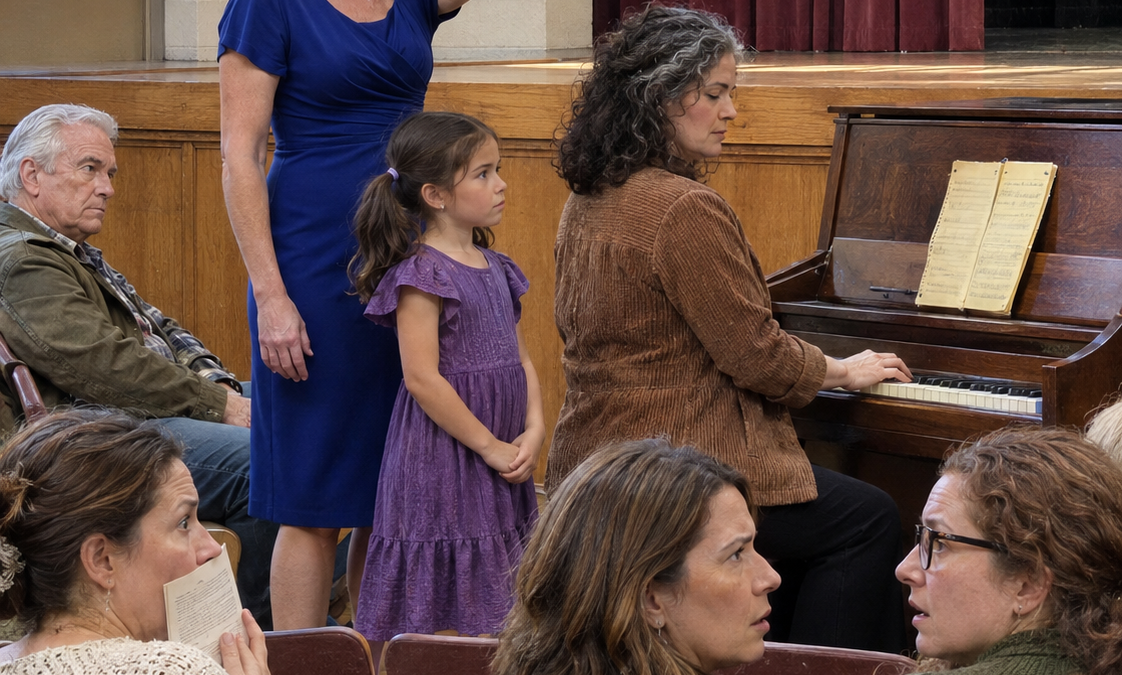
Sunlight crossed the piano where I sat beside my granddaughter.
A yellowed grocery-pad manuscript rested on the music rack.
Pamela pointed toward the aisle without leaving the stage steps.
“She was a lunch lady who liked to hum.”
My granddaughter’s purple skirt brushed the piano bench.
I kept my hands flat against my brown corduroy jacket.
“Then read the first manuscript.”
A woman in the front row lowered her program.
Somebody’s chair scraped the floor, then stopped.
Pamela looked at the yellow paper without approaching it.
“We have a printed program for a reason.”
I stayed seated.
My name was Rosalie Finch, and I was forty-six.
I worked emergency veterinary nights outside Muscatine, Iowa.
I knew the difference between noise and an actual emergency.
This was noise.
My granddaughter, Elsie Hodge, stood close against my knee.
At six, Elsie still believed grown-ups corrected obvious mistakes.
“Are we in somebody’s place?” Elsie asked me.
“No. You’re exactly where you were invited.”
Pamela’s blond bob barely moved when she shook her head.
Her cobalt dress matched the ribbon across the new wing.
At fifty-four, my sister knew how to occupy a doorway.
That afternoon, she had chosen to occupy the whole stage.
A camera waited near the aisle.
The photographer lowered it.
Our mother had worked in that cafeteria for nineteen years. She bought her grocery pads two for four dollars. When the music teacher needed help, Mom stayed after lunch. She tapped rhythms on overturned plastic tubs and brought pencils from home. After she died, I kept one grocery pad, her photograph, and a cardboard box. Pamela asked for the photograph for this dedication. I brought it, along with the pad.
That was all.
I hadn’t come to interrupt a ceremony.
I had come because the invitation mentioned our mother.
Her photograph stood on a narrow table near the piano.
Someone had placed a white paper doily beneath its frame.
Pamela looked toward the photographer.
“We’ll take the family picture after the presentation.”
“Elsie wanted to hear the song,” I said.
“She’ll hear it with everyone else.”
“The whole song?”
Pamela’s smile stayed in place.
“The appropriate version.”
Elsie looked down at the folded program in her hands.
One corner had softened where she kept rubbing it.
I had noticed the missing section during the rehearsal.
That was why I had called the district office.
The superintendent had asked me to bring the original papers.
He had said he would meet me here.
He wasn’t here yet.
Pamela stepped closer, lowering her voice without losing its reach.
“Please don’t make Mom into something she wasn’t.”
Three parents in the front row heard every word.
One covered her mouth with the edge of her program.
I looked at the photograph instead of my sister.
Mom had flour on one sleeve in that picture.
Pamela’s frame hid most of the sleeve.
“Move to the audience, Rosalie.”
“I’ll wait here.”
“You’re delaying people who made time for this.”
“The ceremony hasn’t started.”
“It starts when I say it starts.”
Elsie pressed the program against my jacket.
“Grandma, can I sing the bit we practiced?”
“Ask before you sing.”
The silver-haired man beside the stage turned toward us.
He wore an olive jacket and no ceremonial ribbon.
His name appeared above “Foundation Chairman” in the program.
Elsie had sounded out those words in the car.
“May I sing?” she asked him.
Pamela answered before he could.
“We’re not taking requests.”
The man looked from Elsie to the yellow paper.
I moved neither.
A wall clock clicked above the auditorium doors.
Pamela gave the room her practiced little laugh.
“Children don’t understand when a family story becomes a disruption.”
Elsie’s dark pigtails were tied with mismatched purple ribbons.
I had tied them after finishing an overnight shift.
One ribbon was shorter; Elsie hadn’t minded.
Now she folded the program along its existing crease.
“I know where to start,” Elsie said.
Pamela reached the piano’s side and stopped.
“Everyone is waiting for the presentation, not a child’s performance.”
The chairman rose beside the piano.
“Let the little girl finish.”
Pamela went pale above the collar of her cobalt dress.
The photographer brought his camera down against his chest.
Nobody clapped.
The chairman stayed standing, his attention on Elsie.
Pamela tried another smile, smaller than the first.
“Albert, we’ve arranged a very full program.”
“I can spare a minute.”
That was how I learned his first name aloud.
His printed name was Albert Crowell.
He pulled his jacket straight and looked at me.
“Does she need someone to accompany her?”
“She can sing without the piano.”
“Then we don’t need to move anyone.”
Pamela looked toward the empty microphone.
A parent unfolded her program again, carefully.
Elsie swallowed and leaned against my shoulder.
“Do I sing all of it?”
“Start wherever you want,” I said.
Pamela’s heel clicked once against the wooden floor.
“We should explain what the children have been learning.”
Albert glanced at her.
“After we hear her.”
My sister turned her head toward me.
This time she spoke too softly for the back rows.
“You knew he would be here.”
“His name was on the invitation.”
“You could have spoken to me privately.”
“I did.”
Pamela looked at the grocery pad again.
Then she looked toward the auditorium doors.
My phone lit against the bench beside my leg.
The superintendent’s message said he was seven minutes away.
Part 2 of 5
I turned the phone face down.
Pamela watched that small movement as though I’d raised a weapon.
“What did you send?” she asked.
“The material the district requested.”
“You had no permission to send school documents.”
“They asked for the originals.”
Albert remained beside the piano.
He hadn’t asked Elsie to sing again.
Instead, he was studying the two pages of the program.
“Before we continue,” he said, “why are there different versions?”
Pamela put one shoe on the bottom stage step.
“Songs change. Schools grow.”
That sounded reasonable.
It was meant to.
I had heard versions of that sentence for years.
When the cafeteria closed for renovation in 2009, Mom’s boxes disappeared.
Pamela said there wasn’t room for every keepsake.
When the school website was rebuilt in 2016, credits vanished.
Pamela said the old pages hadn’t transferred properly.
When Mom died in 2021, the memorial program changed again.
Pamela said nobody wanted a service cluttered with details.
I paid the printer seventy-eight dollars to restore one paragraph.
My sister never reimbursed me.
I hadn’t asked.
A parent near the aisle leaned forward.
“Was your mother on the music staff?”
“No,” I said.
Pamela gave a small nod, as if that settled everything.
“She worked in the cafeteria,” I continued.
“Exactly,” Pamela said.
“For nineteen years.”
“We’ve honored that service.”
I glanced at the photograph on its white doily.
The caption beneath it read, “A Friend to Our School.”
No name.
Not even hers.
I stood just long enough to bring the photograph closer.
Then I sat again, with Elsie beside my knee.
I didn’t touch the grocery pad.
Albert watched me place the frame on the piano’s top.
“Your mother’s name?” he asked.
“Sybil Wirth.”
He repeated it quietly.
“Sybil.”
Pamela looked at him too quickly.
Something about that name had caught his attention.
He examined the photograph, then the cafeteria doorway beyond the aisle.
“I remember her,” he said.
My sister stepped off the stair.
“Many people do. She was very kind.”
“She was a lunch lady who liked to hum.”
I repeated Pamela’s sentence without changing a word.
My sister glanced toward the front row.
“I don’t think repeating that helps.”
“It’s what you told them.”
“She also supplied cookies for concerts.”
“Sometimes.”
“And helped with costumes.”
“When she could.”
Albert lowered his program.
“Did she work with the children directly?”
“Yes,” I said.
Pamela spoke over my last syllable.
“Informally.”
The wall clock advanced another minute.
I could hear the ventilation fan inside the new wing.
Its door stood open beneath a ribbon nobody had cut.
The room was still waiting for music.
I remembered these chairs before they were replaced.
Albert’s foundation had paid for the new ones.
The school newsletter had shown him standing beside stacked cartons.
When he funded the chairs, I bought fundraiser dinners.
When he paid for instruments, I covered a child’s rental deposit.
When he sponsored transportation, I drove a borrowed van.
I had never met him.
There was no reason he should have known me.
The work had been small and usually done after dark.
It fit around emergencies, school pickups, and grocery runs.
Pamela’s work came with a lectern.
Mine usually came with a receipt.
I opened my jacket pocket and checked the envelope inside.
One envelope.
Two original sheets.
The district had scanned them that morning at my kitchen table.
Their records clerk had returned the originals before lunch.
I had been told to keep them with me.
Pamela noticed the envelope’s stiff edge.
“Is that necessary?”
“It was requested.”
“We have a dedication to finish.”
“Yes.”
“And donors who deserve a pleasant afternoon.”
Albert looked toward the rows of chairs.
“I think they deserve an accurate one.”
Pamela’s fingers tightened against her program.
For the first time, she didn’t have a reply ready.
Elsie lifted her folded paper.
“There’s a piece missing.”
Pamela bent toward her, smiling without showing her teeth.
“Some things are shortened for special occasions, sweetheart.”
“Even if that’s the important part?”
“Adults decide what belongs in a program.”
I moved Elsie gently back beside my chair.
“Ask him,” I said. “He said you could finish.”
That was the one practical thing I could offer her.
A clear place to stand.
A person willing to listen.
Permission to use her own voice.
Albert crouched slightly so he could hear her better.
“Which part do you mean?”
Elsie looked at the program, then at the yellow paper.
She didn’t know about my envelope.
She hadn’t heard my calls to the superintendent.
At home, I had taught her the version Mom taught me.
Elsie believed there was only one.
Pamela took a breath and turned toward the microphone.
Albert pulled an empty chair beside the piano.
Part 3 of 5
“Before anyone makes speeches,” Albert said, “let’s hear her question.”
Pamela stayed beside the stage steps.
I sat centered at the piano, the manuscript below my mother’s photograph.
Three parents in the front row watched Elsie.
One held her program against her mouth.
My sister gestured toward the aisle again.
Elsie stepped closer to Albert’s chair.
“Aunt Pamela, why did you take out the verse Great-Grandma wrote for the boy with hearing aids?”
Albert’s program slipped against his knee.
Elsie sang before Pamela could answer.
“If your hearing aids go quiet, watch my hands and find the beat.”
Her voice was small, but every word reached the front row.
Albert closed his eyes.
“She wrote that verse for a boy named Louis?”
His voice broke on the last word.
I kept my hand against Elsie’s back.
“Yes,” I said. “Mom always called it Louis’s verse.”
“Louis Peterman,” Albert said, looking at me now. “My younger half brother.”
That explained the different surnames I had noticed in Mom’s old notes.
Until then, I had known Louis through her stories and the notation on the page.
Albert took a folded handkerchief from his pocket, then left it unopened on his knee.
“He told me there was a song where nobody waited for him to catch up.”
Pamela stepped between the stage steps and his chair.
“Albert, I’m sure there were many classroom adaptations.”
He looked past her at Elsie.
“Will you sing that line again?”
Elsie glanced at me.
I nodded.
She sang it slower this time, tapping one shoe against the piano’s wooden base.
Albert watched the shoe.
“My brother did that,” he said. “Under the kitchen table.”
The welcome song had a cheerful first verse about open doors, coats on hooks, and room for one more chair.
Every student in the district knew it.
The second verse made the welcome specific.
It mentioned different ways of keeping time, reading lips, and following hands.
Twenty-six years earlier, Mom had added those lines during a stretch when the music teacher was out recovering from surgery.
Louis had been in the class she helped.
Albert told us that himself, without my prompting.
“I was working out of state,” he said. “Louis’s mother sent me a recording.”
He glanced toward the new wing.
“I’ve spent years paying for access in his memory. I didn’t know where that song began.”
I hadn’t known the foundation had been created for Louis.
His name wasn’t printed on the ceremony program.
Albert hadn’t known why I was there.
For the first time that afternoon, we were talking about the same person.
Pamela smoothed the front of her dress.
“The foundation proposal includes a history of the song.”
“Does it?” Albert asked.
“It was reviewed.”
“Then bring it here.”
A school employee came down the aisle with the presentation folder from the lectern.
Pamela accepted it before he reached Albert.
I didn’t reach for it.
My sister opened to a page marked with a blue tab.
She looked down longer than she needed to.
Albert held out his empty hand.
Pamela surrendered the folder.
He read while the room waited.
The promised award was $240,000.
It would buy instruments, fund accessible lessons, and pay for an after-school music program.
The proposal named Pamela as the program’s creative director.
Under “Original Curriculum,” she had claimed she composed the school’s welcome song.
Albert read that sentence aloud.
Pamela’s eyes moved across the audience, searching for a familiar face.
“I developed what the school uses today,” she said.
“That isn’t what this says.”
“It’s a summary.”
“Of whose work?”
My sister looked at me.
I took the envelope from my jacket and laid it on the piano.
“I brought what the superintendent asked for.”
Pamela’s mouth tightened.
“Rosalie collects things. She doesn’t always understand what they mean.”
I opened the envelope.
The first sheet was a district letter dated twenty-six years earlier.
The second was the original notation attached to that letter.
Both carried Mom’s name.
The yellow grocery-pad manuscript had been the draft.
I placed the clean notation beneath it so Albert could compare the notes.
Mom had drawn her staff lines with a ruler.
The ruler had slipped near the bottom.
A blue pencil mark corrected the last measure.
Albert touched neither page.
“May I read the letter?”
I turned it toward him.
The district had thanked Sybil Wirth for permission to perform and reproduce her welcome song for school use.
The final paragraph stated that authorship remained with her.
That sentence had been there all along.
Pamela looked toward the exit.
Albert read the date once more.
Then he looked at my sister.
“You signed the proposal certification.”
“The district prepared that application.”
“Your name is on the certification.”
I took out my phone only to silence its vibration.
The message on the screen was short.
Superintendent Joseph Guthrie had reached the auditorium doors.
Part 4 of 5
Joseph entered carrying a district folder, his coat still unbuttoned.
He was one additional person in the room, arriving after the sixty-nine invited guests had watched everything.
Pamela took a step toward him.
“We need to speak in the hallway.”
“Here is fine,” he said.
He didn’t raise his voice.
The photographer moved away from the aisle so Joseph could reach the piano.
“I’m sorry I wasn’t here at the start,” Joseph said to me. “The highway crew had traffic stopped.”
That accounted for the seven minutes becoming more.
I nodded toward the documents.
“Mr. Crowell has seen the originals.”
Joseph looked at Albert.
“The district verification is complete.”
Pamela folded her program into a narrow strip.
“You can’t complete a review in one morning.”
“We began yesterday afternoon, after Rosalie called.”
My sister looked at me.
I had called Pamela first.
That mattered to me, even if it no longer mattered to her.
I told Joseph the pages were now on the piano.
He opened his folder beside them, keeping the originals clear.
“We compared these with the archived school correspondence,” he said.
A photocopy showed the same letter, with the same faint fold through the date.
Another page listed the welcome song in an old concert program.
Beside the title was “Words and music by Sybil Wirth.”
Pamela leaned close enough to read it.
Her shoulders stayed lifted after she straightened.
“Those were informal programs,” she said.
“They were district programs,” Joseph replied.
“Printed by volunteers.”
“From information supplied by the school.”
Albert set the grant proposal flat on his knee.
“Have you corrected what the foundation received?”
“Yes. The correction has been delivered to your office and your phone.”
Albert checked his screen.
He read the message without speaking.
I watched the little muscle beside Pamela’s jaw.
For years, I had seen that movement across holiday tables.
It meant she had decided the conversation was over, whether anybody agreed or not.
This time, nobody moved on.
Elsie leaned close to my ear.
“Did I sing it wrong?”
“No.”
“Then why isn’t anybody talking?”
“They’re reading.”
She accepted that and stood a little straighter.
Joseph turned toward Pamela.
“Did you compose any portion of the original song?”
“I arranged the version we use.”
“That wasn’t my question.”
“I’ve spent years building this program.”
Albert laid his phone down on the closed proposal.
“Answer him.”
Pamela looked at our mother’s photograph.
The white doily was crooked beneath its base.
“No,” she said.
A chair creaked in the second row.
My sister looked down at the folded program in her hands.
“I didn’t compose the original song.”
Nobody cheered.
The woman with the program against her mouth lowered it into her lap.
Joseph closed his folder.
“Your mother gets the credit; you will not direct this grant.”
Pamela’s eyes fixed on him.
“You’re removing me in front of parents?”
“You claimed a role through work that wasn’t yours.”
“I’m the principal.”
“You remain responsible for the school’s daily operation while the district reviews your conduct. This funded position is separate.”
Albert stood.
“The foundation agrees. The $240,000 stays available for the children, subject to corrected project leadership and credit.”
Pamela’s lips parted.
Nothing came out.
Joseph kept his next words short.
“You won’t supervise the grant staff.”
A pause.
“You won’t receive its director’s stipend.”
Another pause.
“You won’t approve its materials.”
The consequences were plain enough for Elsie to follow.
My sister flattened the ruined program against her dress.
She looked at the photographer, who had turned his camera off.
Then she looked at me.
“You could have protected the family.”
I rested my hand beside the grocery pad.
“I did.”
Pamela glanced at Mom’s photograph again.
“She never wanted a fuss.”
“She wanted children to get to sing.”
“That isn’t the same thing.”
“No,” I said. “It isn’t.”
Albert moved his chair back from the piano.
He asked Joseph whether the ceremony could continue with the correction read aloud.
Joseph said it could.
The new wing would open.
The instruments would still come.
The children wouldn’t lose their lessons because one adult had put her name in the wrong place.
Pamela had not moved.
Joseph walked to the lectern and removed her introduction from the top.
He placed a corrected statement in its place.
Then he turned toward the audience.
“Please stay. You deserve to hear this finished properly.”
He looked at me.
“May we put your mother’s full name beneath her photograph?”
I opened my mouth, but Elsie answered first.
“She already has a name. You just have to write it.”
Albert sat down with his handkerchief pressed beneath one eye.
Joseph asked for a clean card and a black pen.
Part 5 of 5
The school employee returned with both from the office.
Joseph wrote “Sybil Wirth” in large, plain letters.
Below it, he added, “Composer of our welcome song.”
He showed me the card before placing it beneath the frame.
I checked the spelling.
That was all I had needed anybody to do the first time.
Pamela stayed beside the stage steps, no longer blocking the aisle.
The principal’s microphone stood a few feet from her.
Joseph took it from its stand.
He told the same sixty-nine parents and donors that the district had verified the song’s authorship.
He named Mom.
He named the date on the permission letter.
He explained that permission to use a song had never made the district its author.
The correction took less than a minute.
I thought about how much time had been spent avoiding those few sentences.
Albert went to the front without waiting for an introduction.
“My younger brother was Louis Peterman,” he said. “Sybil made room for him before our foundation existed.”
He glanced at Elsie.
“Today, her great-granddaughter showed me how.”
Elsie stood beside my knee and examined the hem of her purple dress.
Praise made her more restless than an audience.
Albert kept his promise to her.
He didn’t turn her into a speech.
“The foundation’s award will honor the correct composer,” he said. “The district will appoint qualified leadership for the funded work.”
He looked toward Pamela only once.
She stared at the ribbon across the music-wing entrance.
Joseph returned the microphone to its stand.
That should have been the end of the announcement.
Pamela stepped forward.
“May I say something?”
Joseph nodded, but he stayed near the lectern.
My sister didn’t touch the microphone.
“I maintained this song here for years,” she said.
The front row waited.
Pamela looked at me.
“I should have kept her name with it.”
I didn’t help her make that sentence larger.
Albert didn’t, either.
Joseph said, “Yes.”
My sister swallowed.
“I’ll send the corrected program to the school families.”
“The district will send it,” Joseph said. “You may provide a statement.”
Pamela’s gaze dropped to the program she had folded and unfolded.
She laid it on the stage step.
Then she moved into an empty seat at the end of the front row.
No one offered applause.
No one needed to.
The woman seated beside her shifted her purse to make room.
That ordinary little courtesy nearly undid me.
Pamela had hurt me in public.
She was still a person who needed somewhere to sit.
I could leave that space without giving back anything Mom had earned.
Joseph asked whether I would play.
“I’m rusty,” I said.
Elsie looked up immediately.
“You played it yesterday.”
“Your standards are generous.”
A few people laughed, gently this time.
I moved onto the center of the bench.
The grocery pad stood on the music rack, but its paper curled toward the keys.
I didn’t want the old sheet damaged by the music holder.
So I laid it flat on the piano’s top beneath Mom’s photograph.
The dated notation and permission letter went back into their envelope.
Joseph would use the district’s verified scans.
The originals were coming home with me.
Albert returned to his chair near the piano.
“Would you include the verse?” he asked.
“All of it,” I said.
I played the opening notes slowly.
The upright was slightly sharp in the upper register.
Mom would have noticed.
She would have played anyway.
Elsie started first, then stopped when the adults tried to catch up.
I held the chord.
“From the beginning,” I said.
This time, the room followed her.
The familiar verse went easily.
Parents who had attended the school knew where to breathe.
Donors watched the mouths around them until they found the tune.
Then Elsie reached the part missing from the program.
“If your hearing aids go quiet, watch my hands and find the beat.”
I kept the accompaniment simple.
Albert tapped his shoe against the floor.
On the second line, he joined in.
Pamela didn’t sing at first.
I could see her from the bench, sitting below the stage instead of above us.
When the chorus returned, her mouth moved with the others.
I didn’t look long enough to decide what that meant.
There would be other days for sisters.
This one belonged to our mother.
After the final chord, Joseph opened the music-wing door.
The same parents and donors stood, waiting while Elsie walked over to inspect the new practice rooms.
Albert stayed beside the photograph.
“May I have a copy of the original?” he asked.
“Yes.”
“For my brother’s album.”
“I’ll send the whole thing.”
He nodded and looked down at the grocery pad.
“Two dollars,” I said.
He glanced at me.
“That’s what the pad cost.”
Albert brushed one thumb beneath his eye.
“Your mother got a great deal of use out of it.”
“She generally did.”
Across the room, Joseph handed Pamela the corrected dedication card to read.
She read it without changing a word.
By the piano, Elsie had found the small pencil tucked behind Mom’s frame.
She set it beside the grocery-pad manuscript, neatly parallel with the edge.
Then Joseph cut the ribbon and said Sybil Wirth’s name first.
THE END
More stories
My Ex-Wife Ordered Me Out of the Theater’s Reserved Row Before 63 Patrons—but When a Gray-Haired Man Promised to Follow My INSTRUCTIONS, She Went PALEMy Daughter-in-Law Gretchen Shouted That I Didn’t Make the Quilt Before 57 Spectators—but When the RIDER Walked In, Her Claim Unraveled and She Lost Her Shot at a $25,000 ContractMy Stepmother Called Me an ABSENTEE Father Before 68 Wedding Guests—but When Two Marines Walked In and Greeted Me, She FROZE Beside My Daughter’s ChairMy Ex Duncan Called Me a “Discount Parent” at Our Daughter’s Roller Party—but His Smile Disappeared When the Man Beside My Bench Announced My Usual TABLE Was ReadyMy Son Glen Tried to Move Me Into His Spare Room Before 43 Picnic Guests, but My PAID Residency Agreement Was Only the First Paper He RegrettedMy Sister Offered Me MOTEL Money Before 67 Lodge Guests—but When the Owner Said My Right to Stay Stood, She Went PALE and Lost Her Management Contract
You Might Also Enjoy

My Daughter-In-Law Told Me To Stay Elsewhere While Strangers Took My Condo — Then I Pushed Back







