My Sister Veda Snapped, “We’re Not Opening a SHELTER,” and Blocked a Man’s Chair at Dad’s Memorial Setup—Then the Woman Who Controlled the Shed Keys Walked In.
Part 1 of 5
“Stop embarrassing this family!”
Veda said it inside a Duluth waterfront shed, before eleven volunteers.
The blue enamel lunchbox sat between us on a folding table.
My sister stood. I sat beside the volunteer supply lists.
At fifty-five, Veda still used height when a room stopped obeying.
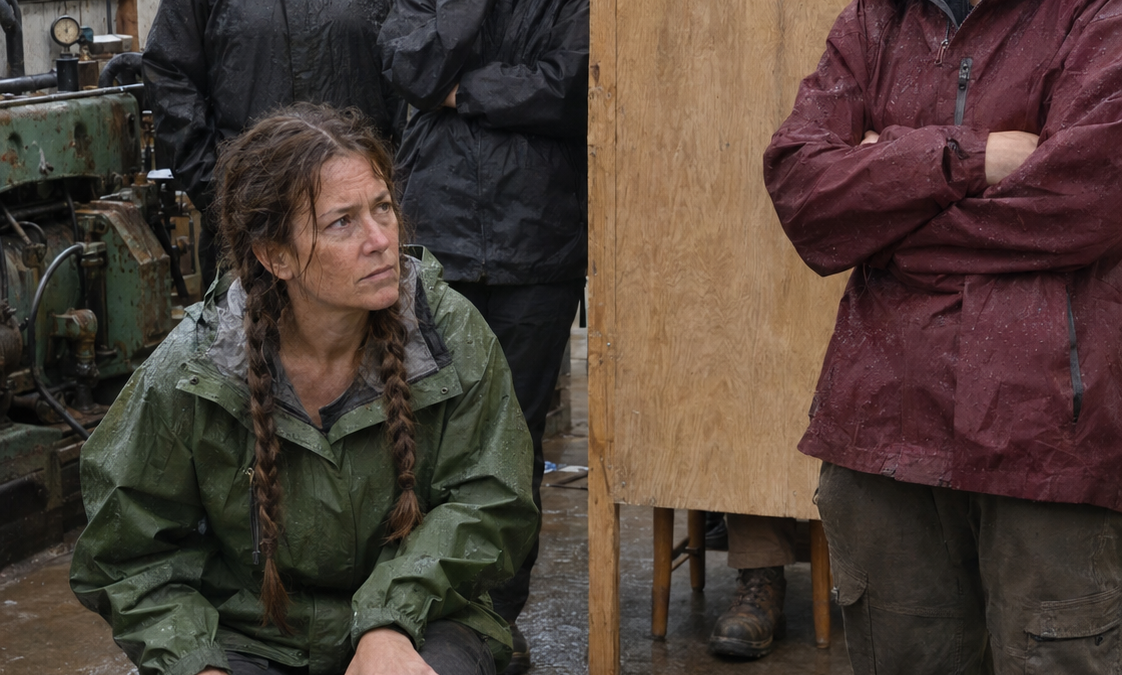
Her burgundy raincoat dripped onto the concrete beside my chair.
“Let him finish,” I said.
The man beside the door lowered his eyes to his boots.
One volunteer stopped winding a rope around her elbow.
Another set down a carton without letting its bottom strike.
Nobody laughed.
I kept my hands beneath the table, against my knees.
My green postal rain shell smelled faintly of wet canvas.
I was forty-nine, old enough to recognize Veda’s particular smile.
It meant she expected me to make myself smaller.
The man near the door had delivered that lunchbox all week.
Six mornings.
At exactly 7:12, he left it outside the closed repair shed.
I knew because my bus stopped across the street at 7:10.
I rode downtown before collecting my postal vehicle and route.
He always placed the handle toward the lake.
The building’s front sign said the business had closed permanently.
Yet somebody inside needed breakfast badly enough to accept his deliveries.
That was all I knew when I first asked.
“What’s your name?” I had said that morning.
“Leland Phelps.”
He had started explaining why the box mattered when Veda interrupted.
Now he waited with his cap tucked beneath his elbow.
Veda looked around, making certain everybody could hear her.
“You always did collect strays.”
I said nothing.
One woman studied the floor drain beside Veda’s polished boots.
The lunchbox had once been bright enough to find in darkness.
Now its corners showed gray metal beneath chipped blue enamel.
Our father had carried one just like it for years.
He bought his for three dollars at a rummage sale.
When he needed invoices delivered, I rode my bicycle downtown.
When he worked Sundays, I carried sandwiches to his bench.
When he finally sold the business, I helped sort his tools.
The sale brought $280,000, more money than he had ever imagined.
He promised us a proper family supper after the closing.
We got one.
We never managed another with everybody at the same table.
That was the whole memory I allowed myself that morning.
Veda tapped her printed memorial schedule with one clean fingernail.
“We have actual work waiting.”
The eleven volunteers had gathered to prepare Dad’s waterfront memorial.
The harbor association had rented this shed for display space.
Its repair benches would hold photographs instead of engine parts.
Veda had appointed herself the family contact.
I had come early, on approved leave, to help carry chairs.
“His box isn’t hurting your schedule,” I said.
“It isn’t his box.”
Veda answered too quickly.
Leland lifted his head.
Outside, a truck rolled over the loose dock plates.
I watched my sister straighten the edge of her schedule.
“Whose is it, then?”
“Old junk belongs to whoever picks it up.”
Her smile returned, thinner now.
“He’s a scavenger, Janine. Don’t make this your next project.”
A volunteer pulled out an empty chair for Leland.
Veda moved sideways, blocking his way without touching him.
“We’re not opening a shelter.”
I looked at the lunchbox instead of my sister.
A tiny copper loop showed beside its handle.
There was another along the back seam.
That didn’t belong.
Dad’s box had always been held together with stubbornness and tape.
This one had been repaired by somebody who expected another winter.
“May I ask one practical question?” I said.
Veda folded her arms.
“Does this involve us adopting him?”
“Does somebody use the back room?”
Leland glanced toward the side passage.
“Somebody has permission.”
“From whom?” Veda said.
He looked past her toward the open front doorway.
I stayed seated.
The woman who had offered him a chair stepped aside.
Water ticked from the gutter into a bucket outside.
Veda turned, already arranging another smile for whoever had arrived.
Myra Goodwin stood in the doorway, rain silvering her navy jacket.
“She has every right to stay,” Myra said.
Veda’s smile stopped before the rest of her face caught up.
The volunteer nearest me slid my chair farther from the doorway.
Nobody asked me to move again.
Myra directed the harbor association’s volunteers and controlled the shed keys.
She had invited both sisters, separately, to help with Dad’s memorial.
“I meant the stranger,” Veda said.
“You were looking at Janine.”
Myra’s voice stayed level.
Leland remained near the entrance, his shoulders bent beneath his coat.
I had seen that posture on customers waiting for overdue checks.
People trying not to occupy space somebody might charge them for.
“Can he finish?” I asked.
Myra nodded.
“He can.”
Veda gathered her schedule into a sharp little stack.
“We’re running behind.”
“The tables will wait,” Myra said.
Leland looked at me.
“The box comes back empty. Every morning.”
He spoke carefully, as though that explained why he returned.
I pictured the same blue lid on the pavement six times.
Until then, I had noticed only the arrival.
“The food gets eaten?” I asked.
“Usually all of it.”
“Who brings the empty box out?”
“He does. Before I leave work.”
Veda made a small sound through her nose.
Myra heard it and looked directly at her.
“Leland has my permission to enter the side room.”
He reached toward the table, then stopped himself.
I stood and moved my chair out of his way.
“Would he mind if I asked about the repair?”
Leland considered me for several seconds.
Then he said, “He asked me to bring you.”
Part 2 of 5
Veda’s papers slipped against one another.
“Absolutely not.”
She said it to Leland, but her eyes stayed on me.
I unzipped my rain shell and let it hang open.
“Why me?”
“He saw your picture on the memorial notice.”
Leland nodded toward the window.
A flyer hung there beside the association’s rental permit.
Veda had supplied a photograph of Dad with his two daughters.
“Asked if you were Janine,” Leland said. “Then asked if you still carried mail.”
That explained how he knew me.
It did not explain why he waited six mornings.
“Why didn’t he come out?”
“He wasn’t certain you’d want that.”
Veda stepped between the table and the side passage.
“My sister has a job. She can’t spend mornings chasing strangers.”
“I took leave.”
“You should save it for something useful.”
The volunteers stayed where they were.
I counted them again without meaning to.
Eleven people who had heard her call a working man a scavenger.
Eleven people watching her decide what counted as useful for me.
I took out my phone and photographed the lunchbox.
One calm thing.
The handle.
The hinge.
The copper loops.
“What are you doing?” Veda asked.
“Looking closely.”
I enlarged the photograph until the stitching filled the screen.
Small holes had been drilled along either side of the split.
Copper wire crossed them in pairs, each twist tucked safely underneath.
No sharp ends.
Somebody had thought about the hand that would lift that handle.
Dad used to say repairs told you more than sales pitches.
A seller could promise anything.
A hinge had to carry its own argument.
I lowered the phone.
“Can we go through?”
Leland nodded.
Veda spoke to the volunteers rather than answering me.
“She does this whenever she thinks somebody needs saving.”
A woman beside the rope rack stopped pretending to sort hooks.
Myra remained by the entrance.
“Janine asked a reasonable question,” she said.
Veda looked at me again.
“You always did collect strays.”
This time the words had nowhere soft to land.
Leland lifted the lunchbox by its repaired handle.
He didn’t hurry or apologize.
I followed him toward the side entrance.
The door opened onto a narrow strip of wet gravel.
A separate door led back into the building’s old machine room.
Myra sent two volunteers after us to check the leaking roof.
The other nine stayed with the display tables.
Veda followed all four of us outside.
“Janine, come back. We’re leaving this alone.”
I kept walking.
A gull stood on the roof ridge, pulling at something white.
Leland unlocked the side door with an ordinary brass key.
Inside, the air smelled of coffee and machine oil.
An open plywood partition divided the room.
I could see work boots beneath a chair beyond it.
Above them, a coat hung from the chair’s square wooden back.
The seated man’s face remained beyond the partition.
A lamp lit a low bench beside his knees.
Leland set the lunchbox there.
“Brought your visitor.”
The chair creaked.
Veda stopped just inside the doorway.
“This is private property.”
“Rented space,” Leland said. “With permission.”
He spoke without looking at her.
One volunteer examined the ceiling stain near the door.
The other stayed beside a stack of folded tarps.
Nobody moved closer.
I crouched beside the bench.
A latch had been polished smooth by years of thumbs.
Inside lay a folded cloth and an empty food container.
There was the proof of breakfast, ordinary and complete.
“He sends me soup when my back goes out,” Leland said.
“I bring oatmeal when his leg won’t let him stand.”
“You work together?”
“Used to. I still do deliveries.”
He stepped back, leaving me room beside the box.
The copper seam crossed the hinge in little slanted bridges.
I had seen work like it a long time ago.
I couldn’t place the last time without opening a door in memory.
My sister’s boots scraped behind me.
“We are leaving,” Veda said.
I touched neither the box nor its repair.
“Did you do this yourself?” I asked the man beyond the partition.
His answer came slowly.
“The hinge wouldn’t hold a rivet anymore.”
His voice had a rough lower edge, like a tool left outside.
“So you stitched it?”
“Wire gives a little when the metal pulls.”
Leland looked toward the hidden chair.
“You said you had a name for that.”
Veda drew one sharp breath.
The man shifted forward, but his face remained out of sight.
A copper curl caught the light.
I waited.
“It’s stormproofing,” the seated man said.
Part 3 of 5
“Edmund,” I said, naming my brother before he leaned into the light.
His face appeared around the partition, older and narrower than memory.
The right eyebrow still broke halfway across.
At sixty, he had more white than brown in his hair.
He looked first at me, then at the doorway behind me.
“Janine?”
Veda said, “This isn’t the place.”
I stayed crouched beside the lunchbox.
For years, I had imagined what I would say if I found him. None of those speeches fit between his work boots and that battered box.
“Stormproofing,” I said again.
Edmund pressed his lips together.
He had invented that word as a teenager, repairing our father’s fishing bucket with copper stripped from scrap wire. Anything broken could be stormproofed, according to him. A loose drawer. A bicycle basket. My cracked plastic sled.
Dad had teased him about making a trade out of stubbornness.
Then prison had swallowed his name in our house.
“I thought you wouldn’t come,” Edmund said.
“I didn’t know you were here.”
“I meant before.”
His fingers rested flat on his knees. There was a cane against the chair, placed within reach without being advertised.
“After I got out,” he said. “I wrote.”
My sister moved toward the door.
“Those were complicated years.”
I stood carefully. My knees had stiffened against the concrete.
“What letters?”
Edmund watched me as if a sudden movement might finish something already cracked.
“The ones you sent back.”
“I never sent anything back.”
“You wrote on the envelopes.”
“No.”
The word came out small and plain.
Leland pulled a chair from behind the bench and placed it near me. I sat because Edmund looked as though he needed me to stay at his level.
“Eighteen years,” he said. “I figured you were allowed.”
“Allowed what?”
“To be done.”
The two volunteers at the doorway looked away. Veda stood between them, her coat still buttoned to her throat.
I had been thirty-one when Edmund left prison after serving his sentence for stealing from an employer. He had admitted it. He had repaid what he could. Dad had called the theft a disgrace, then quietly kept Edmund’s old tools dry in the basement.
I had wanted my brother home.
Veda told me he wanted no part of us.
For years, I wrote anyway.
I wrote to the reentry residence. I wrote to an address Veda said belonged to his friend. I enclosed my phone number, then the new number after my divorce.
When my marriage ended, Veda had helped me pack, which was why she had access to the boxes where I kept returned mail.
“You never answered mine,” I said.
Edmund’s forehead drew tight.
“I never got yours.”
A small metal file box sat beneath his bench.
He nudged it toward Leland with one boot.
“Would you?”
Leland set it on the bench and opened the latch.
Edmund took out a thick envelope secured with a faded rubber band.
“I kept them because I didn’t understand,” he said.
Veda stepped forward.
“You don’t owe anyone a performance.”
Myra appeared in the doorway behind her.
One of the volunteers had gone to fetch her; I had heard the side door close but hadn’t looked around.
“Stay where you are, please,” Myra said.
Edmund passed me the bundle.
The first envelope carried his handwriting and my old apartment address.
Across it, in blue ink, someone had written: Refused. Do not contact again.
There was no official return label.
No forwarding sticker.
The envelope beneath it was addressed to Veda.
“You mailed through her?” I asked.
“After the first one came back. She said you’d moved.”
I looked at my sister.
Veda stared at the box instead of the envelope.
Edmund handed me another piece of paper.
It was a note in my sister’s neat, narrow handwriting.
I recognized the way she crossed a seven. She had done it on every permission slip she signed when Dad worked late.
“Read it,” Edmund said.
I did.
Janine wants a clean start. Please respect that. Send anything further through me.
My fingers tightened around the paper.
“Did you write this?” I asked Veda.
“You were finally doing well.”
“That wasn’t my question.”
“You had a postal job. An apartment. You were moving forward.”
“Did you write it?”
“Yes.”
Leland looked down at the open file box.
Myra remained in the doorway. Her presence kept the room from turning into a place Veda could rearrange with a smile.
Edmund swallowed before asking the question I had been trying not to hear.
“Then where did your letters go?”
Veda’s coat pocket began vibrating.
She silenced her phone without looking at it.
“The memorial boxes,” she said.
“What about them?”
“I put some family papers in storage.”
Edmund’s gaze moved from her to me.
“How many?”
Veda rubbed one thumb along her coat seam.
“All of them.”
Myra stepped clear of the doorway.
“Then we’re going to get those boxes.”
Part 4 of 5
Veda’s storage unit was six blocks uphill from the waterfront.
She offered to fetch the papers alone.
“No,” I said.
It was the easiest word I had spoken all morning.
Myra locked the public shed while the eleven volunteers took an early lunch. The two who had seen Edmund returned to the others without announcing what they had heard.
Leland stayed with my brother.
I rode with Myra. Veda drove ahead of us, stopping too long at every yellow light.
At the storage office, Veda entered her code while I watched the numbers disappear from the screen.
“I kept things because somebody had to,” she said.
Neither Myra nor I answered.
The unit held plastic Christmas trees, folded lawn chairs, and boxes from Dad’s last apartment. Against the back wall stood three cartons marked with the year of my divorce.
My handwriting labeled two.
Veda’s handwriting labeled the third: FAMILY CORRESPONDENCE.
I opened that one first.
On top lay greeting cards from people Dad had outlived. Beneath them was a grocery bag tied shut with its own handles.
Inside the bag, I found my letters.
The envelopes carried addresses Veda had given me, addresses Edmund had never lived at. Some had returned through the mail. Others were slit open, the pages folded back into place.
I recognized the cheap yellow stationery I bought after my divorce.
I had written that the apartment was small but there was room for Sunday supper.
I had written that Dad was slowing down.
I had written that I didn’t need Edmund to explain everything before calling.
Myra stood close enough to see the dates without reading over my shoulder.
“May I photograph the envelopes?” she asked.
I nodded.
Veda watched from the unit entrance.
“You don’t understand what it was like managing him.”
“You weren’t managing him,” I said. “You were answering for me.”
“He took money.”
“He served his sentence.”
“That doesn’t erase it.”
“No. It doesn’t give you eighteen years of mine.”
Veda shifted her keys from one hand to the other.
“I thought you’d thank me eventually.”
There were no tears in her eyes. She looked as though she were waiting for me to remember how hard she had worked.
Myra asked one question.
“Did you tell your father you were doing this?”
Veda’s gaze dropped to the grocery bag.
“He asked whether Janine heard anything. I said no.”
I sat on the edge of a closed carton.
Dad had asked me too. Usually while rinsing a coffee cup, keeping his face turned toward the sink.
Anything from your brother?
I had always said no.
Every answer had been true for us and useful to Veda.
I picked up another envelope.
It held the photograph I sent Edmund after buying my first house. I stood on the porch in my postal uniform, grinning beside a crooked porch light.
On the back, I had written my address again.
Myra photographed that too.
“We should bring these back,” she said.
Veda stepped away from the entrance, but not far enough.
“The memorial is tomorrow. You can’t drag this through it.”
I put the bag into the carton.
“You brought it into the memorial when you tried to throw him out.”
For the first time, Veda had nothing ready.
Back at the shed, Edmund had moved to a padded chair near the side door. Leland had warmed coffee in an electric kettle.
I put my envelopes beside his.
Two bundles.
Two sets of handwriting.
One person who had stood between them.
Edmund picked up the porch photograph.
“You got a house.”
“A little one.”
“With room for supper?”
I nodded.
He looked at the photograph until I stopped watching him look.
Then I sat beside him and opened the first letter aloud.
We did not read every page. There were too many lost birthdays to fit into one afternoon. I read enough for him to hear the voice Veda had told him was finished with him.
He showed me the letters he had sent.
One described his first steady job after release.
Another asked whether Dad still kept screws in baby-food jars.
The last simply said he would stop trying if that was what I wanted.
“I thought leaving you alone was the decent thing,” he said.
“I thought you’d chosen somebody else to be your family.”
He shook his head once.
Leland stood near the kettle, staring into his empty cup.
That plain man had carried oatmeal for six mornings because Edmund could not make himself ask a larger question.
I turned toward him.
“Thank you for bringing breakfast.”
“He brought me plenty first.”
Myra waited until Edmund had put the photograph safely inside his file box.
Then she addressed Veda, who had remained near the side entrance.
“I manage the memorial space. Your family decides who speaks for your father.”
Veda straightened.
“I’ve already arranged everything.”
“My brother and I will speak,” I said, looking at Edmund. “If he wants.”
Edmund nodded.
Myra took the memorial keys from the hook beside Veda.
“The family will hear this together tomorrow.”
Part 5 of 5
The eleven volunteers returned before nine the next morning.
Myra had asked them to come at their original time. Nobody had been replaced, and nobody had been added to soften what Veda would have to face.
Dad’s photographs stood along the repaired benches.
His old work apron lay behind glass borrowed from the association office. Beside it, I placed the blue enamel lunchbox.
It was not Dad’s.
Edmund had bought it at a secondhand store after his release because it reminded him of mornings when Dad still expected him at the shop.
That was why it looked familiar.
That was why he had kept repairing it.
Leland had washed the container inside and filled it with biscuits. The lunchbox was carrying breakfast again instead of evidence.
Edmund arrived through the front entrance.
He used his cane and took his time.
Veda stood beside the memorial display, wearing the same burgundy coat. Her schedule was tucked beneath her elbow.
I stepped away from the bench before she could speak.
“This is my brother, Edmund Hargrove,” I told the eleven volunteers.
Edmund looked at me.
I put my hand lightly against his sleeve.
“He worked with our father before the business grew. He also made serious mistakes, and he served his sentence.”
Nobody looked toward Veda for permission to listen.
“Yesterday we learned that we both spent eighteen years writing letters the other never received.”
Veda lowered her schedule.
“Janine, please.”
I placed the two bundles on the table, beneath a clear protective sheet Myra had brought from the office.
“The original envelopes are here. So is Veda’s note telling Edmund I wanted no contact.”
One volunteer stepped nearer.
It was the woman who had offered Leland a chair.
She looked at the dates, then at my sister.
“You said he abandoned you.”
Veda’s mouth opened.
My brother answered before I could.
“I believed they wanted me gone.”
He did not raise his voice. The room made space for it anyway.
Myra stood beside the table.
“Veda, you will not be organizing this memorial.”
The paper beneath Veda’s elbow slid halfway free.
“I paid the printer.”
“You’ll be reimbursed for the receipts,” Myra said. “Janine and Edmund are the family contacts now.”
“You can’t just erase everything I did.”
“No one is erasing it,” I said.
That was the line that stopped her.
She looked at the envelopes again.
Myra continued before Veda could turn the room into an argument about flowers or invoices.
“You are welcome to attend quietly as their sister. You will not handle their correspondence, their guest list, or their father’s belongings.”
The volunteer with the rope calluses held out a small basket.
“Your keys, please.”
Veda looked around the eleven faces.
Yesterday, she had used those people as a wall behind her.
Now nobody stepped forward to take her side.
She removed the shed key from her ring. It took several tries because her thumbnail kept slipping between the metal loops.
The key struck the basket with a thin sound.
Myra placed it in her pocket.
That was the whole transfer.
No speech about standards. No chance to call it a misunderstanding.
Veda turned to me.
“Are you really choosing him over me?”
“I’m choosing who answers my letters.”
Edmund’s hand settled against the top of his cane.
The woman holding the basket looked away long enough to give my sister a little privacy.
Veda took her coat from the chair.
She stayed for the memorial, seated near the back. Nobody sent her away. Nobody asked her to introduce the family.
When the doors opened to the public, I stood with Edmund beside Dad’s photographs.
I told people who my brother was.
I did it each time somebody approached us, until he stopped bracing at the beginning of every introduction.
There were questions afterward, and we answered what belonged to us.
Edmund told me the names of the shops where he had worked. I told him about my divorce, the house, and the neighbor who cleared my steps when the lake wind buried them.
We exchanged phone numbers ourselves.
Then we called each other while standing three feet apart.
His phone rang.
Mine rang.
Both numbers worked.
At the end of the afternoon, Leland offered to carry the lunchbox out.
Edmund shook his head.
“Think I can manage it today.”
He lifted it by the repaired handle.
The copper stitching held.
I asked him to supper on Sunday, giving the address out loud while he entered it into his phone.
Veda stood by the doorway, listening.
She did not offer to pass it along.
Before we left, Myra brought me the memorial guest book and the remaining family photographs. She handed Edmund Dad’s old tool inventory, which had been found behind one of the framed pictures.
His name was still penciled beside the copper wire spool.
Edmund ran one finger beneath that entry.
I locked the shed with the key Myra had given me, and my brother waited beside the door.
On Sunday, Edmund rang my doorbell at five.
THE END
More stories
My Sister Ordered Me Away From the Piano Before 69 Guests, but She Went PALE When the Foundation Chairman Said, ‘Let the Little Girl Finish’My Ex-Wife Ordered Me Out of the Theater’s Reserved Row Before 63 Patrons—but When a Gray-Haired Man Promised to Follow My INSTRUCTIONS, She Went PALEMy Daughter-in-Law Gretchen Shouted That I Didn’t Make the Quilt Before 57 Spectators—but When the RIDER Walked In, Her Claim Unraveled and She Lost Her Shot at a $25,000 ContractMy Stepmother Called Me an ABSENTEE Father Before 68 Wedding Guests—but When Two Marines Walked In and Greeted Me, She FROZE Beside My Daughter’s ChairMy Ex Duncan Called Me a “Discount Parent” at Our Daughter’s Roller Party—but His Smile Disappeared When the Man Beside My Bench Announced My Usual TABLE Was ReadyMy Son Glen Tried to Move Me Into His Spare Room Before 43 Picnic Guests, but My PAID Residency Agreement Was Only the First Paper He Regretted
You Might Also Enjoy

My Daughter-In-Law Told Me To Stay Elsewhere While Strangers Took My Condo — Then I Pushed Back







