My Sister Charlotta Said Mom Owned Nothing Worth Keeping Before Eleven Neighbors, but Mom’s RECORDING Stopped Her Piano Sale and Put Her Stolen Money Beyond Her Reach
Part 1 of 5
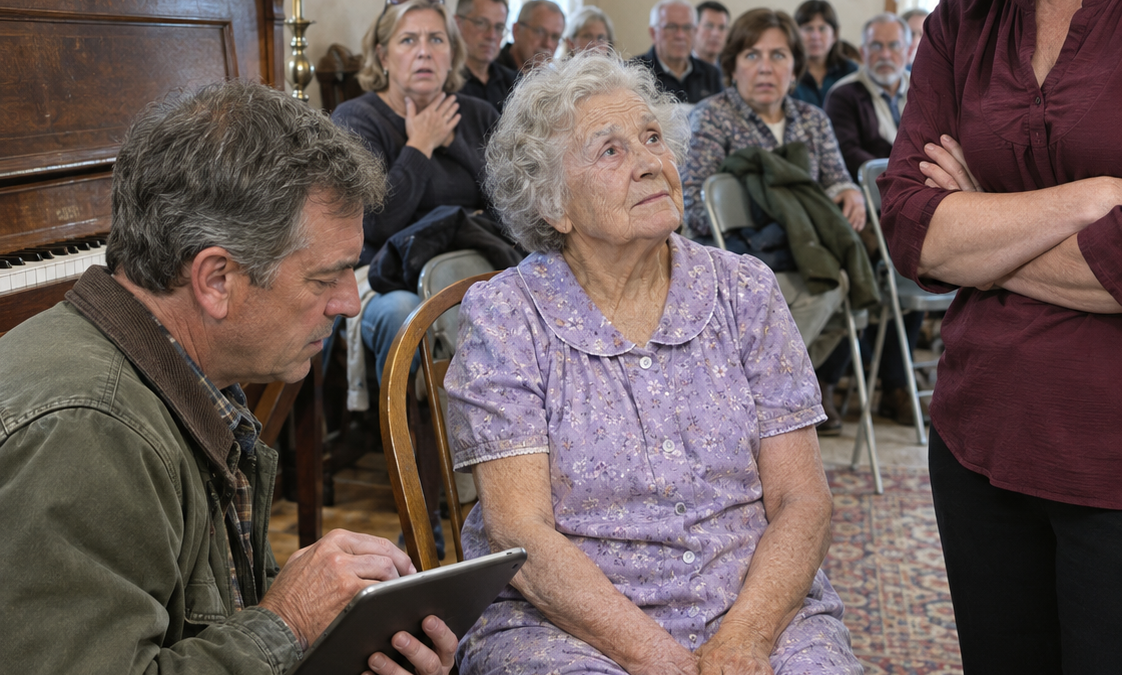
“You don’t own anything worth keeping!”
Charlotta Driscoll said it in Mom’s living room before eleven neighbors.
Our mother sat beside her upright piano, beneath an $8,000 sale card.
A brass metronome rested on papers near her elbow.
I heard my sister before I reached the doorway.
My field jacket still smelled of creek water and wet gravel.
Charlotta had arranged folding chairs along the wall.
Nobody sitting in them looked comfortable.
Mom’s bench carried a bright orange sticker.
Three dollars.
Mom wasn’t sitting on it. Charlotta had moved her into a kitchen chair.
“Here’s the son who never helps,” my sister said.
Several neighbors turned toward me instead of answering.
I set my overnight bag beside the door.
“Mom, do you want everyone here?”
Her fingers stayed folded over her lavender housedress.
“I’d like to finish a sentence,” she said.
“Then finish one,” Charlotta said. “We’re all listening.”
Nobody laughed.
I’m Steven Kincaid, fifty-seven, a water-quality engineer outside Butler, Pennsylvania.
I had finished upstream sampling a day early.
A washed-out access lane had canceled our final site.
Otherwise, I would still have been three counties away.
Charlotta hadn’t expected me until Friday evening.
Her black bob swung against her burgundy collar.
“This is a downsizing preview,” she said. “Try being useful.”
I looked at the piano’s empty music rack.
Mom usually kept a hymnbook there, open to whatever needed practice.
That afternoon, a sheet listed pickup windows instead.
Friday. Four o’clock.
For six years, my field assignments had meant irregular visits.
When Mom’s porch sagged, I paid the carpenter $2,400.
When her furnace quit, I drove down after midnight.
When Charlotta said she handled the weekdays, I believed her.
Mom had asked us both to leave the piano alone.
She’d bought it used in 1979 for $650.
Its lowest note buzzed whenever the house got damp.
That was the whole backstory I needed standing there.
The orange sticker said the rest.
“Eight thousand seems high,” one neighbor said.
“It’s an heirloom,” Charlotta answered.
Mom raised her eyes.
“A minute ago, it wasn’t worth keeping.”
Charlotta smiled toward the folding chairs.
“Sentimental value and resale value aren’t the same thing.”
I moved closer to Mom, without touching the sale card.
Her silver curls had flattened against the chair back.
“Did you agree to this?”
“She gets confused about arrangements,” Charlotta said.
“I asked Mom.”
A chair creaked.
Mom looked directly at me. “No.”
One word.
Charlotta picked up her clipboard, then set it down again.
“We discussed smaller living,” she said. “You can’t manage everything forever.”
“You brought people to price my dishes,” Mom said.
“People who care about you.”
One neighbor lowered a teacup without drinking.
Another stared at the little sticker on the bench.
I noticed the metronome’s door stood slightly open.
Under its base lay several narrow withdrawal slips.
A handwritten password showed along the top edge.
“Why is her bank password written under that?” I asked.
Charlotta’s smile held, but her eyes moved toward the table.
“Because I help her with things you don’t.”
Mom followed that glance.
Then she looked beyond Charlotta, toward the bookshelf.
A small black camera sat between two cookbooks.
Mom lifted one finger toward it.
Charlotta stepped sideways, blocking the shelf from the chairs.
“That’s for watching the front door.”
Mom lowered her hand.
“It watches this room.”
The wall clock ticked through several empty seconds.
“Do you want to hear what happened here?” Mom asked me.
Charlotta gave a short laugh.
“Please don’t start another production.”
I pulled the empty piano bench closer, leaving its sticker attached.
“Then we’ll listen together.”
Two neighbors straightened in their chairs.
Charlotta looked from me to the bookshelf.
“There isn’t anything to listen to.”
Mom smoothed the seam of her housedress.
The camera’s tiny light stayed steady beside the cookbooks.
All eleven neighbors waited for her answer.
“I kept the recording.”
Charlotta’s face lost its color.
Her mouth opened, but no sound came out.
A neighbor near the window stopped turning her house key.
Mom kept looking at me.
“You’ll need my tablet,” she said.
“Where is it?”
“Top drawer. Beside my chair.”
Charlotta reached the drawer before I did.
“I can get it,” she said.
“Leave it closed,” Mom said.
My sister stopped.
That was the first instruction Mom had given that afternoon.
It was also the first one Charlotta obeyed.
I opened the drawer myself.
The tablet lay beneath a clean cotton handkerchief.
Mom gave me the passcode quietly, without looking at Charlotta.
I entered it with the screen angled away.
“Everybody should go,” Charlotta said.
One neighbor glanced toward Mom instead.
“Would you like us to leave?”
Mom considered the question.
“Not yet.”
The brass metronome caught a stripe of afternoon sunlight.
Its little pendulum hadn’t moved since I came inside.
Charlotta’s sale card still leaned against the music rack.
I laid the tablet facedown on Mom’s lap.
“We’ll do this your way,” I said.
Mom nodded toward the hallway.
“My glasses first.”
I fetched them from the telephone table.
When I returned, Charlotta was checking her phone.
A message lit the screen before she turned it over.
The piano buyer was arriving Friday at four.
Part 2 of 5
“Tell him not to come,” I said.
Charlotta slid her phone into her pocket.
“There’s already a deposit.”
Mom fitted her glasses behind her ears.
“How much?”
“That isn’t important right now.”
“It’s my piano,” Mom said.
The neighbor beside the window stood, then waited.
Nobody wanted to be first out of that room.
I recognized every face from Mom’s block.
They had shoveled her walk, brought tomatoes, borrowed folding tables.
Charlotta had invited them as witnesses to her helpfulness.
Now their coats stayed draped over their knees.
“Sit, if you’re comfortable,” Mom told them.
The neighbor sat.
I knelt beside Mom’s chair rather than taking her tablet.
“Do you want me to open it?”
“Yes. But don’t erase anything.”
That instruction came quickly.
Too quickly.
Charlotta folded her arms.
“You’re making this sound like a crime scene.”
“I’m opening a tablet,” I said.
The kitchen refrigerator clicked on behind us.
Mom’s hands had begun rubbing the same seam again.
I remembered those hands sorting my school papers.
My father had left when I was small.
Mom later married and was now widowed.
Bixby was the surname she had kept after that marriage.
Charlotta and I had kept Kincaid until my sister married.
None of that gave either child ownership of this room.
For years, Mom had made room for everybody else.
When my work boots leaked, she mailed wool socks.
When Charlotta needed a sitter, Mom canceled piano lessons.
When the roof needed replacing, she said it could wait.
I had mistaken her quiet for having enough.
That afternoon, I stopped doing that.
“Did you buy this camera yourself?” I asked.
Mom nodded.
“Last month. The library had a class.”
Charlotta made a small sound through her nose.
“A class doesn’t make somebody competent.”
Mom looked over her glasses.
“It taught me to save a video.”
One neighbor’s hands tightened around her purse strap.
The orange sticker curled at one corner.
Three dollars.
I opened the camera application Mom indicated.
Several dates appeared in neat rows.
“Which one?” I asked.
“Tuesday. Eleven seventeen.”
Charlotta moved between the piano and Mom’s chair.
“You don’t want private family business spread around.”
“You invited the street,” Mom said.
My sister turned toward the neighbors.
“This was supposed to spare her embarrassment.”
Nobody offered the reassurance she wanted.
A man near the doorway examined his own shoes.
I kept my attention on the tablet.
One calm task.
Open the application.
Find the date.
Keep the original.
I had learned that habit taking water samples.
A number without a reliable source could mislead people.
So could a daughter speaking for her mother.
The withdrawal slips remained beneath the metronome.
I hadn’t touched them.
Their printed dates faced the wall.
The password faced the room.
“Mom, should that password be here?”
“No,” she said.
Charlotta shook her head.
“She leaves notes everywhere.”
“I don’t write my passwords on bank slips.”
The neighbors looked at the table.
My sister looked at me.
“You arrive once in a while and perform concern.”
I said nothing.
“Tell them what I do,” Charlotta told Mom.
Mom looked down at the tablet’s dark border.
“Do you want me to?”
My sister’s shoulders rose against her blouse.
“I’m the reason this place functions.”
A neighbor cleared her throat.
“Then why does she still have a sale sticker?”
Charlotta looked at the bench.
“The sticker is on the furniture.”
“Beside her,” the neighbor said.
I peeled nothing off. Not yet.
Mom had asked me not to change anything.
Charlotta’s clipboard lay open on the piano.
At the top, she had written “Family authorization.”
Below that was a blank signature line.
“That sheet,” I said. “Has Mom signed it?”
“It’s a standard permission form.”
“That wasn’t my question.”
Charlotta closed the clipboard.
Mom’s shoe tapped once against the floor.
The sound carried farther than it should have.
“You don’t own anything worth keeping!”
My sister repeated it with a brittle little smile.
“I meant we could replace the furniture.”
Mom looked toward the metronome.
“Some things aren’t yours to replace.”
The camera application displayed Tuesday’s thumbnail.
In the small image, Mom’s chair was empty.
Charlotta stood near the desk behind it.
I tilted the screen so Mom could see.
“Is this the one?”
“Yes.”
“Do you want them to hear it?”
Mom studied the eleven neighbors, one face at a time.
“These people came because they believed her.”
Charlotta put a hand against the piano lid.
“Mother, think very carefully.”
Mom’s gaze stayed on the screen.
“I have.”
I turned the volume up without starting the file.
The room contracted to that small glass rectangle.
Beside us, the metronome rested on the withdrawal slips.
Mom nodded, and I pressed play.
Charlotta’s recorded voice filled the room: “I authorize my daughter to transfer funds on my behalf.”
On the screen, Charlotta bent over Mom’s desk.
She tried the sentence again, slower, using Mom’s voice.
Then she signed a sheet and practiced Mom’s signature on scrap paper.
Part 3 of 5
The recording ran for another minute.
Charlotta held the signed sheet beside an older letter, comparing the bottoms of the pages. Then she lifted her phone and photographed the new page.
In the living room, nobody moved toward the door.
The woman on the screen had my sister’s blouse, my sister’s watch, my sister’s way of tucking her hair behind one ear. She also had a pen poised over a name that wasn’t hers.
“Stop it,” Charlotta said.
Mom’s voice stayed level.
“Keep going.”
Recorded Charlotta pulled a bank envelope from beneath the blotter. She laid it open, checked something on her phone, and wrote on a withdrawal slip.
Then the front door clicked on the recording.
Charlotta gathered the papers.
Mom came into view carrying a grocery sack. The file ended shortly afterward.
I stopped playback.
“That was practice,” my sister said.
“For what?” I asked.
“For helping her fill things out.”
Mom took her tablet from my hands.
“I wasn’t there.”
“You asked me earlier.”
“No.”
Charlotta looked toward the neighbors. “She forgets conversations.”
Mom pressed the tablet flat against her knees.
“I remember signing my name. I remember when somebody else does it.”
One neighbor stood and put on her coat.
“I think we should give you some space.”
Mom nodded.
“Thank you for staying long enough to see.”
The eleven neighbors left quietly, each passing the piano bench. One paused beside Mom and asked whether she needed groceries. Another offered to sit with her later.
Charlotta stayed near the music rack.
When the door closed behind the last neighbor, my sister reached for the tablet.
I stepped between them.
“Mom decides who touches that.”
“You’re turning her against me.”
Mom raised her chin.
“I’m sitting right here.”
I asked whether she wanted to call her bank.
“Yes,” she said. “Use the number on my statement.”
Charlotta went toward the kitchen.
“Where are you going?” Mom asked.
“Home. You two clearly have this handled.”
“Leave your key.”
My sister stopped at the doorway.
For a moment, I thought she might refuse. Then she took a brass house key from her ring and set it on the kitchen counter.
“This is cruel,” she said.
Mom didn’t answer.
After Charlotta left, I locked the door. Mom asked me to leave the metronome and papers where they were until she had photographs.
We took those first.
Then we called the bank together.
Mom identified herself, answered the security questions, and asked me to stay beside her on speakerphone. The fraud representative didn’t ask whether she was confused. He asked which transactions she recognized.
Mom opened the statement on her tablet.
A transfer of $24,600 had posted Wednesday.
She stared at the amount.
“That wasn’t mine.”
The destination account ended in four digits she recognized. She pulled a folder from the desk drawer and found an old canceled check payable to Charlotta.
The same account number appeared there.
I wrote down the case number the bank gave us. At Mom’s direction, the representative disabled her online access, flagged the transfer, and arranged a branch appointment for the morning.
He said the bank would contact the receiving institution.
No promise came with that sentence.
Mom thanked him anyway.
Only after the call ended did she open the rest of the folder.
Inside were fourteen years of checks, automatic-payment notices, and handwritten totals.
“What are these?” I asked.
“Your sister’s mortgage.”
I looked up.
“She told me she helped you.”
Mom slid one payment notice across the table.
“I know what she told people.”
For fourteen years, Mom had paid $1,140 each month toward Charlotta’s house. She had started after my sister lost a job and kept going after Charlotta found another.
The total in Mom’s handwriting was $191,520.
I checked the multiplication on my phone because I needed somewhere to put my eyes.
“Why didn’t you tell me?”
“Charlotta asked me not to. Then it got harder to explain.”
Mom closed the folder halfway.
“Don’t make me defend helping my child.”
“I’m not.”
“Help can become a habit,” she said. “So can being asked.”
The camera had come after $160 disappeared from her grocery envelope. Then another $240 vanished from the drawer where she kept repair money.
Mom hadn’t accused anyone. She had bought the camera, attended the library class, and learned to save clips outside the device.
“Did you know about the transfer?”
“Not until today.”
Her thumbnail worked beneath the edge of the folder.
“I thought the recording might stop her talking over me.”
I moved my chair beside hers.
“We need someone who investigates this.”
Mom looked at the sale card still on her piano.
“Before Friday.”
The county intake worker returned our call before supper.
Detective Darius McNulty wanted the original video and Wednesday’s bank statement.
Part 4 of 5
Detective McNulty came Thursday morning in a plain gray sweater and dark trousers. He introduced himself to Mom first, then asked where she preferred to sit.
“At my table,” she said.
He waited while she moved her tea.
I had called the county’s elder-abuse intake line because the bank representative recommended reporting suspected exploitation. The detective worked with that unit, which explained why our call had reached his desk.
He didn’t call Mom fragile.
He didn’t ask me to tell her story.
“Start wherever you want,” he told her.
Mom began with the grocery envelope.
She described where it had been, how much was missing, and why she had purchased the camera. When she reached Tuesday, she opened the saved file herself.
The detective watched without interrupting.
Afterward, he asked permission to copy it.
“Will the copy change mine?” Mom asked.
“No.”
“Then yes.”
He recorded where it came from and asked Mom to leave the original untouched. I recognized the care of that process. Samples and evidence needed the same thing: a history nobody had to guess at.
At the bank appointment, Mom authorized the release of records to investigators.
The branch manager showed her the transfer request. It included an uploaded authorization bearing a copied version of her signature.
Mom laid her real signature beside it.
“That loop isn’t mine,” she said.
The manager didn’t argue with her.
The transfer had gone to Charlotta’s account. The online session had used a device already associated with my sister’s access during an earlier, legitimate visit to the branch.
The forged authorization had been submitted to support the transaction.
Mom listened, asked two questions, and requested paper copies for her own folder.
On the way home, she bought a turkey sandwich at the grocery deli.
“Do you want to go straight back?” I asked.
“I want lunch before somebody else needs something.”
We ate at her kitchen table.
For the first time since I’d arrived, she took the chair nearest the window instead of leaving it for somebody else.
My phone buzzed halfway through the meal.
Charlotta had sent me a message.
Tell her I can explain the bank misunderstanding.
I showed Mom.
“Has she called you?” I asked.
“Seven times.”
“Do you want to answer?”
“Not while I’m eating.”
The detective called that afternoon. The receiving bank had restricted the transferred funds while the fraud claim was investigated.
Charlotta had tried to move the money again.
That attempt had been blocked.
Mom looked toward the drawer where she now kept the bank papers.
“Can she get into anything else?”
“We’re checking,” he said.
I helped Mom make a list of accounts. She changed passwords herself while I wrote down which customer-service departments we had contacted.
The mortgage payment was next.
Mom canceled the automatic transfer and requested written confirmation.
Her finger hovered above the final button.
Fourteen years didn’t disappear because one afternoon had exposed them.
“Are you sure?” I asked.
“I’m sure about next month.”
She pressed it.
That evening, Charlotta sent a different message.
Friday pickup is still happening. I’ve promised people.
Mom read it on my screen.
“She’s using promises now.”
I forwarded the message to the detective with Mom’s permission.
He called within twenty minutes.
“Has she said she’ll come herself?”
Mom opened a message on her own phone and read it aloud.
I’ll supervise pickup. Four sharp. Don’t make another scene.
The detective asked her not to answer yet.
By Friday morning, investigators had the bank records, the video, and the receiving account information. The detective called to say a judge had signed an arrest warrant.
He asked whether Mom wanted the planned pickup stopped by telephone.
Mom looked toward the living room.
“Those neighbors were invited back to collect things,” she said. “They should hear that none of this was mine to approve through her.”
“You don’t have to watch an arrest,” he told her.
“I want to stay in my house.”
He said officers would be nearby and nobody would be allowed to remove her property.
Then Mom asked me to telephone the eleven neighbors.
I used the list Charlotta had left on her clipboard. Every person who had attended the preview had also been given Friday’s pickup time.
I told each one the same thing.
“Mom hasn’t authorized a sale. She’d like you here briefly at four so everyone hears the correction together. There will be no pickup.”
All eleven said they would come.
The buyer wasn’t one of them. Charlotta had found him separately, and we had no contact information beyond the message I’d glimpsed.
The detective said he would handle that if the man arrived.
At three forty-five, Mom dressed in clean lavender.
She asked me to take the kitchen chair away from the piano.
I carried it back where it belonged.
Then I removed the orange sticker from the bench.
Mom sat down on the cushion and tested one quiet chord.
At three fifty-eight, Charlotta’s car turned into the driveway.
Part 5 of 5
The eleven neighbors were back in the same living room.
This time, nobody had brought a checkbook or a truck.
Mom sat on her piano bench. I stood near the doorway, where I had been when Charlotta first called me the son who never helped.
The brass metronome remained on the side table beside the photographed slips.
Mom had asked to put it back herself when everything was finished.
Detective McNulty waited in the kitchen, out of the traffic through the front door. A second officer stayed outside. Mom knew where both were.
Charlotta came in carrying her clipboard.
“Good,” she said, looking at the neighbors. “We can keep this moving.”
Then she saw Mom on the bench.
“I told you that needed to stay accessible.”
Mom rested both feet on the floor.
“It is.”
Charlotta glanced toward me.
“Where’s the buyer?”
“He hasn’t arrived,” I said.
“He’s bringing help. We can’t have people in the way.”
One neighbor stood from the folding chair nearest the wall.
“Nobody’s taking the piano.”
Charlotta gave her the smile she used for inconvenient questions.
“There seems to have been some confusion.”
Mom answered before anyone else could.
“I didn’t sell it.”
“You authorized me to manage things.”
“No.”
The detective stepped out of the kitchen.
Charlotta stopped beside the music rack.
He identified himself and showed his credentials at a distance where she could see them.
“The sale is canceled; you’re under arrest.”
Her clipboard struck the edge of the piano.
A few loose pages slid onto the rug.
“For what?”
“Forgery and theft involving your mother’s funds.”
Charlotta looked at Mom.
“Tell him.”
Mom’s hands stayed in her lap.
“Tell him what?”
“That I take care of you.”
The detective asked Charlotta to turn toward him.
She didn’t move at first.
Instead, she looked around the room, searching the eleven faces that had watched her price Mom’s belongings.
Nobody supplied the words she needed.
“Steven,” she said.
I bent to lift the fallen pages out of Mom’s walking path.
Then I stepped away.
The detective repeated his instruction. Charlotta complied. He secured her wrists without raising his voice, checked the fit, and explained that another officer would take her outside.
Her burgundy sleeve had caught under the clipboard clip.
She tugged at it before remembering she couldn’t use that hand.
The officer freed the fabric.
No one spoke while they walked her to the door.
Charlotta stopped at the threshold.
“You’ll regret making this public.”
Mom looked toward the eleven neighbors.
“You chose the audience.”
The door closed behind my sister.
Outside, a vehicle pulled up beside the curb. The piano buyer had arrived with another man.
The detective met them before either reached the porch. Through the window, I saw him speak briefly and point back toward their vehicle.
The piano stayed where Mom had placed it decades earlier.
The buyer’s deposit became part of a separate report. Mom had never received that money, and the detective made that clear to him.
Inside, the neighbors began collecting their coats.
Mom asked them to wait.
“I need to correct one more thing.”
She stood beside the bench without my help.
“Charlotta wasn’t paying my bills. For fourteen years, I paid her mortgage.”
A woman near the window pressed her lips together.
Mom continued.
“I did it willingly. The transfer this week was different. I didn’t give permission.”
That was all she said.
She didn’t pass around the folder. She didn’t ask anyone to choose a side.
One neighbor stepped forward and held out the folded sale list Charlotta had given her.
“I’m sorry I treated your things like they were already gone.”
Mom accepted the paper.
“Thank you for saying it.”
Before they left, each of the eleven neighbors heard the detective confirm that the house and its contents remained under Mom’s control. Anyone holding a supposed purchase agreement was to provide it to his office.
No property left that afternoon.
The bank returned the full $24,600 after its investigation. The restriction on Charlotta’s account had kept her from spending it.
Mom put the bank’s confirmation in her folder.
The mortgage payments stayed canceled.
Charlotta later pleaded guilty to the forgery and theft charges. The court ordered restitution for the missing cash and bank costs, imposed probation, and barred contact with Mom unless Mom agreed through the approved channel.
Mom didn’t agree.
I stayed through the next week, then arranged shorter field rotations. A locksmith changed the locks. Mom chose the appointment time and paid him directly.
On Sunday, she asked me to bring the metronome.
I removed the withdrawal slips from beneath it and filed them with the case papers.
Mom set the brass case on top of the piano.
She opened its little door and adjusted the pendulum.
The first measured clicks filled the room.
Then she put both hands on the keys.
A month later, an envelope arrived from the courthouse.
Mom opened it at the same table where she had canceled the mortgage payment.
Inside was the signed no-contact order.
THE END
More stories
My Sister Veda Snapped, “We’re Not Opening a SHELTER,” and Blocked a Man’s Chair at Dad’s Memorial Setup—Then the Woman Who Controlled the Shed Keys Walked In.My Sister Ordered Me Away From the Piano Before 69 Guests, but She Went PALE When the Foundation Chairman Said, ‘Let the Little Girl Finish’My Ex-Wife Ordered Me Out of the Theater’s Reserved Row Before 63 Patrons—but When a Gray-Haired Man Promised to Follow My INSTRUCTIONS, She Went PALEMy Daughter-in-Law Gretchen Shouted That I Didn’t Make the Quilt Before 57 Spectators—but When the RIDER Walked In, Her Claim Unraveled and She Lost Her Shot at a $25,000 ContractMy Stepmother Called Me an ABSENTEE Father Before 68 Wedding Guests—but When Two Marines Walked In and Greeted Me, She FROZE Beside My Daughter’s ChairMy Ex Duncan Called Me a “Discount Parent” at Our Daughter’s Roller Party—but His Smile Disappeared When the Man Beside My Bench Announced My Usual TABLE Was Ready
You Might Also Enjoy

My Daughter-In-Law Told Me To Stay Elsewhere While Strangers Took My Condo — Then I Pushed Back







