My Son Jason Told Me, “Take Your Things Out of My Diner!” Then a Biker Demanded RESPECT, and His Farewell Breakfast Cost Him Control of the Place
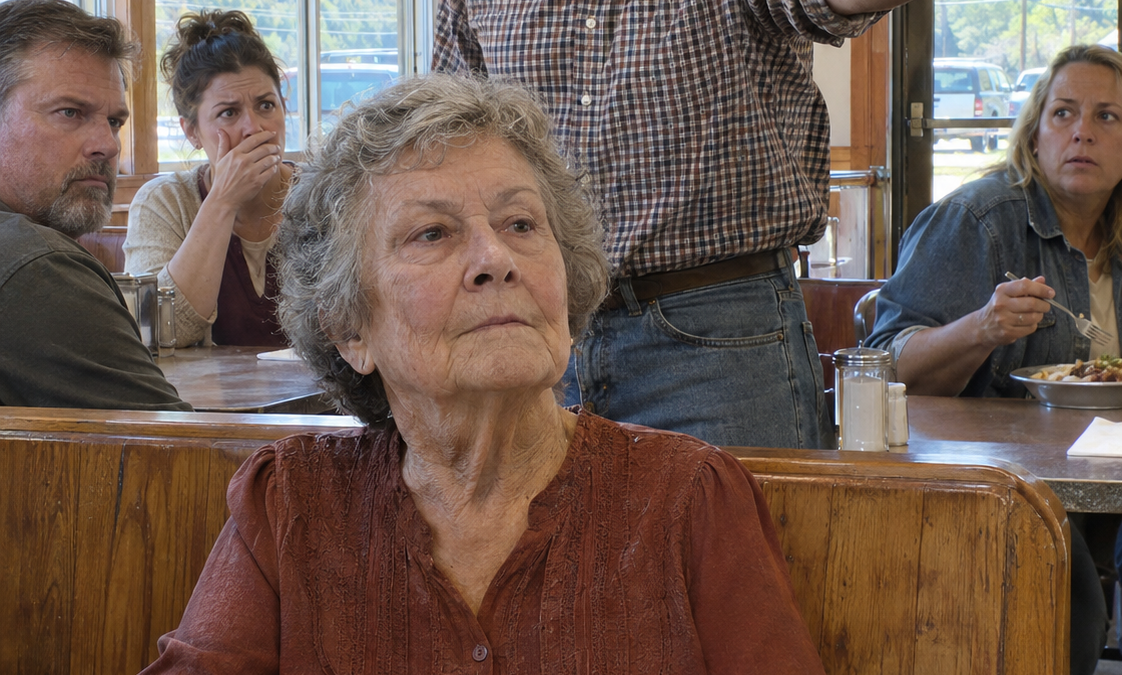
Part 1 of 5
“Take your things out of my diner!”
My son Jason shouted across our family diner in Wheeling, West Virginia.
Thirty-nine regulars watched him place a $5 cleaning voucher beside my blue cup.
The cup had a chipped handle and fresh coffee inside.
Jason’s checked shirt still had creases from its package.
His black hair shone beneath the hanging breakfast lights.
“Old women don’t get a vote.”
He smiled afterward, as though that made it kinder.
I stayed seated against the booth’s curved wooden back.
“You were hired to manage it.”
A fork stopped halfway to somebody’s mouth near the window.
Behind the counter, the cook turned down the griddle.
Nobody laughed.
Jason glanced toward the man standing beside the register.
That man wore a summer jacket despite the heat.
A leather folder rested against his ribs.
“We don’t need a history lesson, Mom.”
“Then don’t give one that leaves things out.”
He pushed the voucher closer to my saucer.
“It covers supplies. There’s a cabinet full of your stuff.”
“My things aren’t cleaning supplies.”
“Then hire somebody. I’m trying to help.”
The voucher advertised a discount on a cleaning service.
Five dollars toward erasing the place where I belonged.
I left it there.
For now.
My name was Vera Slocum, and I was seventy-two.
I had retired after forty-three years as a dental hygienist.
People sometimes mistook quiet hands for hands that couldn’t work.
Mine had steadied frightened patients through thousands of appointments.
They stayed steady around my coffee cup that morning.
Jason was forty-five and standing between me and the aisle.
He had advertised this gathering as a farewell breakfast.
The printed announcement promised pancakes, memories, and a fresh beginning.
Nothing on it mentioned throwing his mother out.
Nothing mentioned the little room beyond the kitchen, either.
My husband, Eugene Greeley, had built its booth himself.
He had measured my knees before cutting the table supports.
“For our anniversary,” he had said, showing me the plans.
After his death, I sometimes ate breakfast there alone.
I was widowed, not finished.
That morning, Jason had summoned me to the front booth.
“People want to see you,” he had said by telephone.
Now I understood which part of me he wanted displayed.
The part that would leave without making him look bad.
I folded my napkin.
Once.
“Tell them what you told the kitchen,” I said.
Jason pulled at one newly starched cuff.
“The sale is seven hundred ten thousand dollars.”
A spoon clattered against a bowl near the pie case.
He waited until every face turned his way.
“That includes finally getting Mom out of the back room.”
The man with the folder looked down at his shoes.
Jason mistook that movement for permission to continue.
“We can’t keep a museum in a working restaurant.”
“My husband built that booth.”
“Dad built plenty of things that needed replacing.”
I ran one finger around the cool saucer rim.
The cup remained where I had put it.
Across the room, a waitress stopped stacking clean plates.
“You said the booth would stay,” she told Jason.
“I said we’d discuss it.”
“You said that yesterday.”
“We’re discussing it now.”
He turned his back on her before she could answer.
Outside, sunlight flashed across a row of motorcycle mirrors.
I had heard the engines while Jason announced his price.
They had gone quiet together, beyond the front windows.
Jason hadn’t noticed.
He was explaining how much easier my life would become.
“No more opening early. No more coming through the kitchen.”
“I don’t open the diner anymore.”
“Exactly. You need something else to do.”
His voice had softened into the tone reserved for children.
I looked past him toward the man with the folder.
“Are you staying for breakfast?”
“Apparently,” the man said.
“Good. The eggs are usually worth waiting for.”
Jason gave a short, breathy laugh.
“This isn’t one of your little social mornings.”
A shadow crossed the glass entrance door.
Then another.
Ten motorcycle-club members came in from the parking lot.
Their boots slowed on the worn tile near the entrance.
They didn’t spread out or block anybody’s way.
A man in a brown leather vest stopped inside the doorway.
“You’ll speak to her with respect.”
Jason’s smile disappeared before the man finished speaking.
His cheeks lost the color they had carried all morning.
Several regulars turned toward the entrance, then back toward him.
The newcomer had a shaved head and a gray beard.
He was sixty-three, with sun-browned lines beside his eyes.
Jason knew him from the club’s monthly Saturday breakfasts.
I knew him for another reason, too.
That explanation could wait until people stopped staring.
“Rex,” Jason said, “this is a family conversation.”
Rex Dunlop looked at the occupied tables.
“You sold tickets to it?”
Someone near the window lowered a napkin over her mouth.
Rex didn’t smile.
Neither did I.
One woman among the riders wore a plain navy jacket.
Her gray braid lay over one shoulder.
She stayed beside the entrance, a flat case beneath her arm.
I had asked her to come.
The motorcycles were no surprise to me.
The rest of the club had already planned breakfast there.
Yesterday, I had asked their leader to arrive early.
I had not asked anybody to threaten my son.
I had asked for witnesses who would stay.
Jason stepped back from my table.
“There’s nothing here for you people to settle.”
“Then nobody needs to hurry,” Rex said.
The woman in navy looked at me.
I gave her a small nod.
She crossed to the counter without saying a word.
Jason watched her set the flat case beside the register.
Its brass catches faced the dining room.
Part 2 of 5
“Who invited her?” Jason asked.
“I did.”
The woman turned from the counter.
“Lenna Bixby,” she said. “Vera’s attorney.”
Jason’s eyes moved toward me.
“You brought a lawyer to breakfast?”
“You brought a buyer.”
The man with the leather folder finally straightened.
“Donald Cates,” he said. “And I’d appreciate understanding what’s happening.”
“So would everyone else,” I said.
Lenna took the empty stool nearest my booth.
Rex remained by the entrance with the other riders.
Nobody stood over Jason.
That seemed to bother him more than if somebody had.
He wanted a scene he could describe afterward.
He wanted fists, shouting, somebody he could blame.
I gave him my folded napkin and untouched voucher instead.
“Would you move those?” I asked.
“Move them yourself.”
“I meant your elbow. It’s on my napkin.”
A few shoulders relaxed around the room.
Jason lifted his arm.
Twenty-two years earlier, this diner had nearly closed.
The old owner wanted retirement, not another winter repairing pipes.
Eugene had wanted to run the kitchen since our first date.
We had argued over the price of everything then.
A replacement freezer cost $1,840.
The roof estimate came to $6,200.
Eggs were cheaper, but there were never enough clean pans.
When Eugene worked doubles, I packed supper in a cooler.
When Jason needed tuition, I picked up Saturday patients.
When the roof leaked, I brought buckets before opening.
Nobody put those things on a sign.
I hadn’t wanted a sign.
Eugene’s name belonged on the daily specials he wrote himself.
My name appeared where it needed to appear.
For years, that arrangement had suited us.
After Eugene died, Jason offered to keep the place running.
“I know what Dad would want,” he had told me.
I had wanted to believe that knowing was enough.
It wasn’t.
The wrong name.
That was what Lenna had said on the telephone yesterday.
She hadn’t explained it with adjectives or warnings.
She had asked me to describe the announcement exactly.
Then she had asked whether I had signed anything.
I had told her the truth.
Now Jason kept smoothing the front of his checked shirt.
Donald opened his folder and checked the first page.
“You told me the family issues were resolved,” he said.
“They are.”
“I’m sitting here,” I said.
Jason didn’t look at me.
“Mom gets sentimental. She says things.”
“What things?” Donald asked.
“That the coffee tastes different. That nobody cleans properly.”
“The coffee tastes the same,” I said.
The cook looked through the serving window.
“That’s because I haven’t changed it,” she said.
Jason shot a glance toward the kitchen.
I watched Donald instead.
His thumb had stopped moving along the folder’s edge.
“Was the back-room booth included?” I asked him.
“In the fixtures,” Donald said.
“Were you told what it was?”
“A staff eating area.”
“No,” I said. “It wasn’t that.”
Jason leaned closer to the table.
“Old women don’t get a vote.”
He said it more quietly this time.
Everybody still heard.
The waitress set down the plates she had been carrying.
“Don’t,” she said.
Jason ignored her.
“You’re making this ugly over a booth.”
“You made it public over a voucher.”
He looked toward the door, where Rex stood motionless.
“Are you going to let me conduct business?”
Rex shifted enough to leave the entrance completely clear.
“You’ve got plenty of room.”
Lenna’s case remained closed.
I lifted my blue cup, tasted the cooling coffee, and stopped.
There was a faint gritty place beside the handle.
Eugene had chipped it washing dishes after a holiday rush.
He had offered to buy me another.
I had told him that one fit my hand.
Jason knew that story.
He had heard it every time he suggested throwing it away.
“Put the cup down and listen,” he said.
I set it upside down on the clean saucer.
A brown ring spread beneath its rim.
Then I took a pen from my purse.
One practical thing.
On the voucher’s blank back, I wrote the time.
9:18 a.m.
Lenna watched without interrupting.
“What’s that supposed to accomplish?” Jason asked.
“It helps me remember accurately.”
“You’re turning breakfast into evidence.”
“No. I’m writing down the time.”
Donald closed his folder.
“Was there a reason your mother wasn’t at our discussions?”
“She doesn’t handle the business.”
“That wasn’t my question.”
Jason’s jaw tightened.
Outside, traffic passed along the street toward the river.
Inside, nobody reached for the check.
The same thirty-nine regulars were still watching.
My son had wanted an audience for my departure.
He had given me one for his answers.
Lenna slid her case closer.
“Donald,” she said, “please keep the agreement available.”
Part 3 of 5
Donald opened the folder across the edge of my table.
Jason moved as though he might close it again.
Lenna spoke before his fingers reached the cover.
“Leave it where Vera can see it.”
I looked at the signature page, then at the buyer.
“Whose signature appears on the sale agreement?”
“Jason Greeley’s,” Donald said, turning the page toward me.
His finger stopped beneath my son’s name.
Jason carried his father’s surname. I had kept mine throughout my marriage, which had occasionally confused strangers and never confused a legal document.
There was no signature of mine.
Rex stepped away from the entrance.
“Which one of you is evicting the woman who owns this place?”
Donald looked up sharply.
Jason said, “He doesn’t know what he’s talking about.”
Lenna opened her case.
She took out a certified copy of the recorded deed and laid it beside my upside-down cup.
“Vera Slocum,” she said, indicating the grantee line. “Recorded twenty-two years ago. This is the property you have agreed to purchase.”
Donald bent over the page.
Lenna turned it so he could see the recording information without reaching across me.
“The county clerk’s certification is attached.”
Jason didn’t look down.
“Dad ran this place.”
“He did,” I said.
“He put his life into it.”
“He did that, too.”
“You never told anybody.”
“I never told you something different.”
The first time Jason had signed a payroll authorization, I had explained who owned the building and the business.
After Eugene’s funeral, Lenna had explained it again.
Jason had nodded through both conversations.
Now he watched the deed as if it had arrived without a history.
Donald pulled out the chair opposite me.
“May I?”
“Please.”
He sat.
I told him about the inheritance from my aunt, the one I had received when I was fifty.
It had been enough to buy the diner outright, including the building, equipment, and business. No bank had carried a mortgage afterward.
Eugene had run the kitchen because he loved running a kitchen.
I had continued cleaning teeth because I liked my work and our insurance mattered.
We had never made a public announcement about whose money bought what.
That was a marriage arrangement, not a transfer of ownership.
“Your father knew,” I told Jason. “We signed the purchase papers together. Mine was the name on the deed.”
Jason pulled out another chair but didn’t sit.
Donald looked between us.
“You represented yourself as sole owner,” he said.
“I’m the one who runs everything.”
Lenna removed a second document.
“Here is the management agreement.”
Jason’s fingers curled around the chair back.
“You don’t need to read that here.”
“You offered the diner for sale here,” Lenna said.
She placed his signed agreement beside the deed.
The paper had softened at its folded edges. I remembered the afternoon we signed it, with a bowl of sugar packets between us and Eugene’s recipe cards still above the stove.
Lenna pointed to one short paragraph.
“Your authority covers staffing, purchasing, scheduling, and ordinary operating expenses. It expressly excludes selling or pledging the real estate or business assets.”
Donald looked at Jason.
“You signed this?”
Jason’s eyes went to the bottom of the page.
“Yes.”
That single word reached farther than his shouting had.
The cook came around the end of the counter. The waitress stood beside the pie case. Neither interrupted.
I remembered paying Lenna to write the agreement plainly.
No traps. No little words hiding large losses.
Jason had asked whether it meant I didn’t trust him.
I had said it meant neither of us would need to guess.
Apparently, he had preferred guessing.
“There must be another document,” Donald said. “A power of attorney?”
“There isn’t,” Lenna said.
“Written authorization?”
“None.”
Jason finally sat.
His chair scraped so loudly that somebody flinched.
“I was going to take care of you,” he told me.
“With a cleaning voucher?”
“That was a joke.”
I looked at the little rectangle beneath my pen.
“Then you had plenty of chances to stop telling it.”
He rubbed his mouth.
For the first time that morning, his checked shirt looked too large at the collar.
Donald turned back to the deed.
“I haven’t closed,” he said to Lenna. “The deposit is still in escrow.”
“I confirmed that with the closing agent this morning,” Lenna said. “No proceeds have been released.”
That explained why she had asked me to arrive before breakfast service ended.
Jason had wanted a public farewell before the paperwork caught up.
Lenna had wanted the paperwork there first.
“Can we do this in the office?” Jason asked.
I looked at the thirty-nine regulars whose eggs had gone cold.
“You told them I needed removing,” I said. “They can hear what needs correcting.”
Donald lifted his folder off my table.
“The closing agent is calling me now.”
Part 4 of 5
Donald answered without leaving his chair.
“Yes, I’m looking at the recorded deed,” he said. “No, that is not the person who signed our agreement.”
Jason stared at the phone.
Donald listened, then looked toward Lenna.
“She’s here. I’ll send the documents with her permission.”
Lenna nodded.
He ended the call and placed the phone beside his folder.
“The closing is canceled pending correction of the seller’s authority. They’ll return my deposit under the title contingency.”
“There won’t be a corrected seller,” I said. “I’m not selling.”
My son looked up.
“You could still get that money.”
“I could also keep my diner.”
“You don’t know what it costs to operate.”
I let that sentence sit between us long enough for him to hear it.
Then I asked, “Who paid the refrigeration repair in February?”
His gaze moved toward the kitchen.
“And the insurance renewal?”
“Those came through the reserve account.”
“Who funds it?”
He didn’t answer.
The reserve account had never been a secret from him. Its statements arrived with the operating reports every month.
Lenna moved the management agreement closer to Jason.
“Your salary and purchasing authority were real. Ownership was never part of either.”
“I made this place profitable.”
“You worked here,” I said. “That deserves honest pay. It doesn’t make the building yours.”
Behind the counter, the cook untied and retied her apron strings.
“Are we losing our jobs?” she asked.
“No,” I said.
The answer came easily because I had made that decision before leaving home.
“The kitchen stays open. Your pay stays the same. We’ll change who approves the orders.”
Jason shook his head.
“You can’t run it by yourself.”
“I’m not planning to.”
He gave a short laugh, but nobody joined him.
Lenna had helped me arrange temporary bookkeeping support the previous afternoon. The payroll company already had my signature on file. The bank already knew whose account it was.
For years, I had let Jason be the public face of decisions I quietly backed.
That courtesy had made him comfortable.
It had not made him owner.
Rex pulled out an empty chair near the entrance and sat. The other riders followed his example at the available tables.
The room stopped looking like a confrontation and started looking like a diner again.
That seemed to undo Jason more than the deed.
“Mom,” he said, lowering his voice, “please.”
I looked directly at him.
“What are you asking me to do?”
“Don’t embarrass me like this.”
I could hear the griddle beginning to hiss again.
“You placed a cleaning voucher beside my breakfast.”
“I said that was a joke.”
“The booth wasn’t.”
He looked toward the kitchen door, beyond which Eugene’s anniversary booth waited in its little room.
I had helped stain that wood. There was a pale patch under the table where my rag had missed the grain.
No buyer would have noticed it.
I would have.
Donald put the sale agreement back into his folder.
“I’m not purchasing anything from you,” he told Jason. “We’re finished.”
Jason’s shoulders folded inward.
Lenna waited until he looked at her.
“The sale is unauthorized, and your management ends today.”
Her voice was no louder than when she had introduced herself.
Jason blinked.
“You can’t just say that.”
Lenna tapped the termination paragraph.
“Your agreement permits Vera to end your appointment immediately for acting outside your authority. She has signed the notice.”
She placed it in front of him.
He read the first line, then the last.
His mouth opened once without words.
The waitress looked away, giving him a small privacy he had not offered me.
Lenna continued.
“Your earned wages will be paid. Your access to business banking and ordering accounts is being removed. Leave the diner keys on the table.”
“No police?” he asked.
“Nobody has called the police,” I said. “Put down the keys.”
He reached into his pocket.
The key ring caught on the lining. He tugged harder, and the chair legs shifted beneath him.
At last he set the keys beside the voucher.
The front-door key had a red plastic cap. Eugene had bought that cap so he could find it before sunrise.
I had forgotten Jason still used it.
“You can collect your personal things with Lenna present,” I said. “You won’t supervise another shift.”
“Today?”
“Today.”
He stared at the keys as though waiting for them to move back toward him.
Donald stood and buttoned his jacket.
“I’m leaving the sale folder with your attorney,” he told Jason. “Keep my number for any questions about the canceled agreement.”
Then he placed his business card beside the notice.
Jason’s phone buzzed with the bank’s access-removal alert.
Part 5 of 5
Jason looked at the screen, then turned it facedown.
The room had heard the sound without knowing what it meant.
He knew.
Lenna checked her own phone.
“The bank has acknowledged the change,” she told me. “The payroll authorization remains active under your signature.”
“Thank you.”
The cook returned to the griddle. A spatula scraped, followed by the familiar soft crack of eggs.
Those ordinary sounds had held my mornings together after Eugene died.
I had almost let my son turn them into something I needed permission to hear.
Jason stood slowly.
“Are you going to tell everybody I stole from you?”
“I’m going to tell the truth.”
“I didn’t get any money.”
“You tried to sell something that wasn’t yours.”
He looked toward Donald, but the buyer was speaking quietly with Lenna near the counter.
There was no rescue in that direction.
“What am I supposed to do now?” Jason asked.
It was the first question he had asked me all morning without supplying his own answer.
“Start by collecting your jacket.”
“And after that?”
“Find work you can explain honestly.”
His lips pressed together.
I didn’t soften the sentence. I also didn’t add anything to it.
He had enough to carry.
Lenna accompanied him toward the office. They were gone only a few minutes.
When they returned, Jason had a cardboard box with a phone charger, a sweatshirt, and a photograph from behind his desk.
The photograph faced inward.
I knew which one it was: Eugene standing beside him at the griddle, both wearing paper hats after a children’s charity breakfast.
I was glad he had taken it.
Remembering his father ought to involve more than inheriting permission.
At the entrance, Jason stopped beside Rex.
“You enjoyed this?”
Rex stayed seated.
“No.”
Jason waited.
Rex added, “Your mother asked us to keep breakfast peaceful. That’s what we did.”
That was the whole explanation for the motorcycles.
They had been coming anyway. I had called Rex because he had known Eugene, because he could fill an awkward silence without making it dangerous, and because Lenna rode with his club.
My son had mistaken familiar customers for people who would always take his side.
Jason shifted the box against his hip.
He looked back at me.
I remained in the booth.
He left without another word.
Through the window, the same thirty-nine regulars watched him put the box in his car. Nobody applauded. Nobody chased him outside.
The bell above the entrance settled.
Donald came to my table.
“I should have checked the title before treating this as finished,” he said.
“You had a closing agent for that.”
“I still should have asked more questions.”
“Yes,” I said.
He accepted that without arguing.
Lenna handed him the documents he needed to unwind the agreement. His deposit would return through escrow, not from the diner’s operating money.
He thanked her, then thanked me for letting him stay long enough to understand.
I asked whether he still wanted breakfast.
He glanced at the kitchen.
“If that offer stands.”
“It does.”
The waitress brought a fresh pot of coffee and paused beside my table.
“Can I take that?” she asked, looking at the voucher.
“Please.”
She lifted it by one corner, careful not to smear the time written on the back.
Lenna asked her to leave it with the other papers.
I had no interest in framing it.
I turned my chipped blue cup upright.
The coffee ring beneath it had spread across the saucer. The waitress replaced that, too, without being asked.
Then she poured.
“Everybody’s welcome to stay for breakfast,” I said.
The announcement did not need a printed card.
Forks moved. Chairs settled. The cook called an order through the window, and the room answered with the familiar shuffle of people making room for plates.
Lenna sat across from me.
“The staff will need someone approving deliveries tomorrow,” she said.
“I’ll be here.”
“Before opening?”
“I still know where the key goes.”
Her smile appeared over the rim of her cup.
I asked the cook to keep the anniversary booth exactly where Eugene had built it. She nodded from the serving window.
After breakfast, I would open that little room myself. The staff could eat there when I wasn’t using it. A place could hold a memory without being closed to everyone else.
My son would not run the diner again.
The canceled sale, terminated agreement, returned keys, and changed bank access had settled that in front of the same people who had watched him try to remove me.
Lenna slid the red-capped key across the table.
THE END
More stories
My Sister Charlotta Said Mom Owned Nothing Worth Keeping Before Eleven Neighbors, but Mom’s RECORDING Stopped Her Piano Sale and Put Her Stolen Money Beyond Her ReachMy Sister Veda Snapped, “We’re Not Opening a SHELTER,” and Blocked a Man’s Chair at Dad’s Memorial Setup—Then the Woman Who Controlled the Shed Keys Walked In.My Sister Ordered Me Away From the Piano Before 69 Guests, but She Went PALE When the Foundation Chairman Said, ‘Let the Little Girl Finish’My Ex-Wife Ordered Me Out of the Theater’s Reserved Row Before 63 Patrons—but When a Gray-Haired Man Promised to Follow My INSTRUCTIONS, She Went PALEMy Daughter-in-Law Gretchen Shouted That I Didn’t Make the Quilt Before 57 Spectators—but When the RIDER Walked In, Her Claim Unraveled and She Lost Her Shot at a $25,000 ContractMy Stepmother Called Me an ABSENTEE Father Before 68 Wedding Guests—but When Two Marines Walked In and Greeted Me, She FROZE Beside My Daughter’s Chair
You Might Also Enjoy

My Daughter-In-Law Told Me To Stay Elsewhere While Strangers Took My Condo — Then I Pushed Back







