At My Husband’s Probate Hearing, His Father Pointed at My Empty Chair in Front of Nine of Our Employees: “She Played Soldier One Weekend a Month”—He Swore the J on Our Trucks Stood for Him, So I Asked Him One Question About June 14, 1996
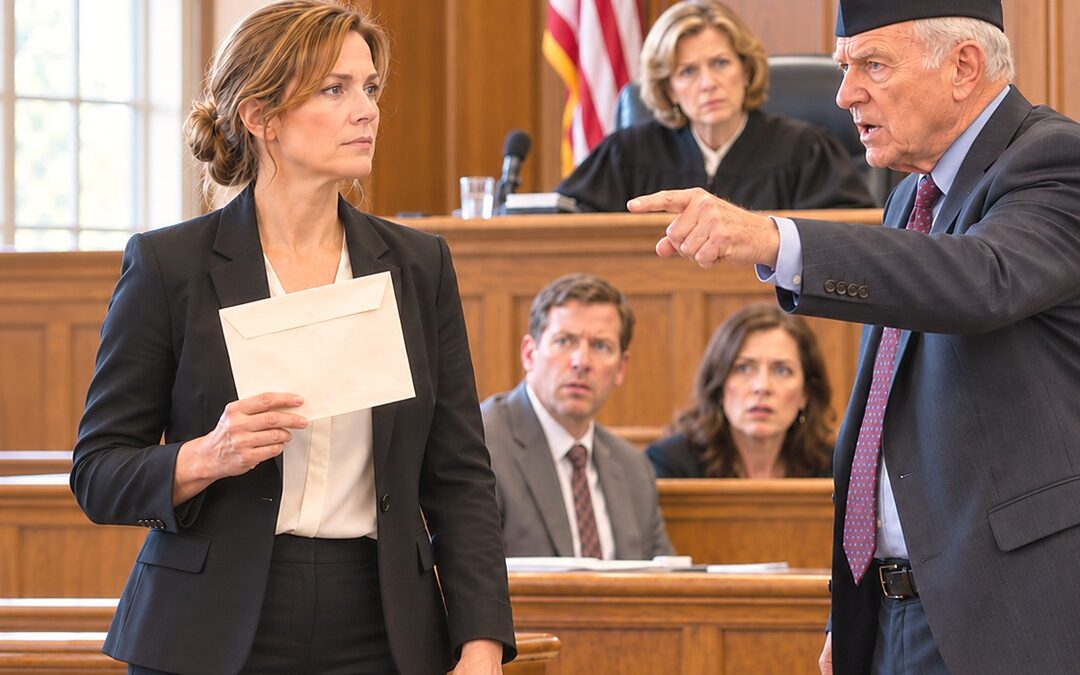
Part 1 — THE J ON THIRTY-ONE TRUCKS
PART 1 — THE J ON THIRTY-ONE TRUCKS
"She played soldier one weekend a month for twenty years. She can play lawyer for one morning."
Jerry said it at 9:04 on a Tuesday morning in probate court, loud enough for the clerk to look up, after pointing his Legion cap at the empty chair beside me where a lawyer would sit.
Glenn had been dead fifteen weeks, and thirty-one white J&G Mechanical trucks were out working that morning with the same red J on their doors while the court decided who controlled the company.
My thumb found Glenn's tape measure on my purse strap, a 25-foot Stanley with a dented yellow case and G.K. scratched into it with a roofing nail.
I pulled out six inches. The blade had a nick near four. I pressed the lock button until my thumb hurt, then let it snap back.
Tami glanced over.
Jerry didn't.
My black binder sat square in front of me, yellow tabs for J&G and red for things I didn't trust. There were plenty of red.
The chair beside me stayed empty. Three lawyers had quoted me retainers. The lowest wanted fifteen thousand dollars.
Across the aisle, Gordon Feeley had two leather cases and an associate carrying another one, Darrell wore a new gray sport coat with the vent threads still sewn shut and had left OWNER business cards at the shop, Jerry sat square at seventy-eight, Dottie had her purse on her knees, and Tami wore a navy blazer while checking her phone under the table.
Behind them sat nine J&G technicians in red company shirts.
Darrell called it paid "court day."
I had done payroll long enough to know what nine men off service calls cost.
One of them was Dylan Szabo, twenty, a first-year apprentice who owned more tools than furniture.
I had co-signed his $1,140 tool loan in March because no bank was impressed by a kid with six months of credit history and a 2012 Honda Civic.
On an easel near the witness stand stood a walnut plaque. The brass plate caught the courtroom lights.
"J&G MECHANICAL — FOUNDING PARTNER — JERRY KESSELRING — 1996"
I had seen that plaque every workday since 1998. It usually hung above the coffee maker, and there was probably still a clean rectangle on the wall.
Somebody behind me stood. I figured restroom.
Then Dylan crossed the aisle while Darrell turned around.
Dylan came all the way over and sat on the bench directly behind me.
"Morning, Mrs. K."
I opened my mouth. Nothing useful came out, so I read every arrow on the fire-exit map twice rather than look at anyone.
"Morning, Dylan."
Darrell's arm was hooked over the bench back, his body still turned around.
Dylan leaned forward. "You got your binder."
"I do."
At 9:18, the deputy called the room.
Judge Maureen Gaffney entered two minutes later. She was sixty-two and had the expression of a woman who had already heard every family explain why their family was different.
We stood, then sat.
Feeley did most of the talking first and called Darrell as executor.
Darrell took the witness chair.
Feeley asked, "After Glenn died, as executor, did you control the estate accounts and stop Mrs. Kesselring's bookkeeping pay?"
"Yes. Nineteen hundred dollars a month."
I wrote $1,900 on the inside cover of my binder, under the $15,000 retainer figure I had written there the night before.
Feeley asked, "On Wednesday, July 1, did your father assign his claimed fifty-percent interest in J&G to you?"
"Yes."
One of the red shirts behind him moved his work boot under the bench.
Feeley asked, "And when you signed Lakeway's letter on August 28, what title did you use?"
"Managing member."
Tami lowered her phone a little.
Then Feeley handed him the estate inventory.
Darrell said Glenn's will was from 2004. Half to me. Half to him.
That part wasn't disputed. The company was.
Feeley asked what Darrell found in Glenn's business records.
"Normal business stuff."
"What about an operating agreement?"
"Nothing."
Darrell corrected himself. "No written agreement."
"And the shop safe?"
"Nothing there either."
I wrote SAFE in the margin and underlined it once.
Feeley asked who had managed J&G after Glenn died.
"I did."
"Your role before that?"
"Service manager."
"Since?"
"Two thousand three."
He left out the car wash.
Darrell's car wash had lasted eleven months. Glenn hired him after it folded. Glenn blamed himself because he had encouraged the location.
If you slipped on ice in Michigan, Glenn would wonder whether he should have salted Ohio.
Feeley showed Darrell the Lakeway letter.
I knew the number. Four million two hundred thousand dollars.
Feeley didn't dwell on the sale. He moved to Jerry.
Jerry put his cap on the railing before being sworn. The cap had grease darkening the bill, and he had worn one version or another since I met Glenn.
Jerry gave his name. He said he'd retired from the Jeep plant, a line foreman for thirty-two years.
Then Feeley asked about J&G.
"Glenn and me started it."
My pencil stopped against the paper.
"How?"
"Handshake."
"Where?"
"My kitchen."
"When?"
"Nineteen ninety-six."
"What ownership did you agree to?"
"Half."
Jerry looked toward the red shirts. "Fifty-fifty."
Feeley asked if Jerry had contributed money.
Jerry touched the cap brim.
"I left my half in."
"What does that mean?"
"I never drew a dime."
Jerry said, "I left it in the business for my boys."
I stood before I had much time to improve the idea.
"In May 1996, Jerry refused to co-sign the thirty-thousand-dollar van loan."
Judge Gaffney checked the clock.
"Mrs. Kesselring, you will get your turn."
I sat.
Jerry's thumb rested on the cap brim before he let go.
Darrell kept his attention on the counsel table.
I knew Jerry's rhythms. Jerry could tell a story for forty minutes and forget the year twice.
Today he had percentages.
Feeley walked to the easel and touched the plaque.
"Do you recognize this?"
Jerry smiled. "Sure do."
"What is it?"
"Glenn gave it to me."
"For what occasion?"
"My fiftieth birthday."
"Why?"
"Because the J was me."
Feeley read the plaque aloud. He did it slowly.
The nine red shirts heard every word.
I didn't look back.
Judge Gaffney asked one question. "Was there a written agreement?"
— continue reading from here —
Jerry shook his head. "No."
Feeley asked about me.
Jerry said, "Jill did paperwork."
"What kind?"
"Books."
"For the company?"
"Yes."
"And she was also in the Army Reserve?"
Jerry gave a short laugh. "She did paperwork there too."
My pencil made a small black dent.
Feeley asked, "Did she work service calls, install furnaces or do plumbing?"
Jerry said, "No. She kept the checkbook."
That part was true. I also kept thirty years of receivables from eating us alive.
Feeley turned to me.
"Mrs. Kesselring, since 1996, you and Glenn filed the business through your joint tax returns?"
"Yes."
"And every company account was under the name Kesselring?"
"Yes."
Feeley faced the bench.
"There is simply nothing in those filings that contradicts Mr. Kesselring's account."
Judge Gaffney wrote something.
I wrote his sentence in my binder.
That took me back to May 1996.
May of 1996 smelled like wet canvas and diesel fuel, and I was twenty-four, a first lieutenant at Eagle Base in Tuzla.
Glenn needed thirty thousand dollars for two used Ford Econoline vans, but Jerry refused to co-sign and told him, "You'll be broke by Christmas."
Glenn gave me the news over a morale phone that crackled every fourth word.
I had $23,700 saved, and I wired it home.
On Friday, June 14, I signed three originals of the operating agreement on an ammo crate in the legal tent.
Captain Ingrid Ibsen notarized them, and SFC Delbert Odom signed as witness.
Ibsen had me sign all three and handed them back.
"Two is one, one is none."
Glenn filed the LLC papers in Columbus on Friday, June 21, 1996.
Nine days after I signed, on Sunday, June 23, Glenn called over another bad connection after dinner with his parents had gone sideways.
He told me what he'd said to his father.
"The J is for Jerome, Dad."
The J had been my letter when we named the company.
He asked if that was fine.
I told Glenn, "It cost me a letter."
At Jerry's fiftieth birthday at the American Legion in 1998, Glenn presented the plaque while Jerry cried in front of his Legion friends, and I pressed my palms against my knees while Glenn looked at me across the hall.
I let it go.
"It cost me a letter."
At 10:47, Feeley finished with Jerry and Judge Gaffney called a short recess.
Jerry came past my table and stopped beside the empty chair.
"You should've brought one of those Army clipboards."
I closed my binder. "A binder works."
Jerry said, "Paper's paper."
Then he walked out with Darrell. Dottie followed, and Tami was already typing on her phone.
Dylan remained behind me.
He did not offer advice.
At 10:50, court resumed.
Judge Gaffney checked the papers at my table.
"Mrs. Kesselring, you're representing yourself?"
"Yes, Your Honor."
"You understand I can't give you legal advice?"
"Yes."
"Proceed."
My knees worked, and I carried my binder to the lectern.
I asked to recall Darrell.
Darrell returned to the chair.
I opened the yellow tab.
"After Glenn died, you went into his office and used the safe?"
"Yes."
"What was in it?"
Darrell said, "Insurance papers, truck titles. Dad's old Bulova."
Jerry touched his wrist. I wrote BULOVA.
"Was there anything else in the safe?"
"I don't remember."
"Who had access to it before Glenn died?"
"Glenn. I knew the combination years ago."
"Did it still work?"
"No."
"Why not?"
"I don't know."
I turned toward the bench.
"Your Honor, there is a written operating agreement."
Feeley stood.
"Glenn signed it in 1996."
Darrell's head came up.
"His original was kept in the shop safe."
Feeley said, "There is no such document in the estate."
The judge looked over her glasses.
"Mrs. Kesselring, do you have another signed original?"
"Yes. Mine is at home."
A scan would not replace a thirty-year-old original.
Tami's fingers stopped over her phone.
Feeley said, "Convenient."
Judge Gaffney raised her eyes from her notes. "Mr. Feeley."
He sat down.
I opened my binder.
"The agreement names Glenn and me as the members."
Feeley stood again. "Mrs. Kesselring is now testifying from counsel's lectern."
"I'm not counsel."
I shut up.
Judge Gaffney wrote a line in the file and asked me to take the witness chair.
The clerk swore me.
Feeley started with the document.
"You didn't bring the agreement today?"
"No."
"Why?"
"I got your papers by email at 6:12 last night. I read them around eleven."
"I wasn't carrying a thirty-year-old original through a parking garage before I knew the court wanted it."
Judge Gaffney wrote again.
Feeley said, "You knew Jerry said the J stood for him."
"Yes."
"But you say you learned only last night that he was claiming fifty percent ownership."
"Yes."
"You worked on the company books for thirty years and never corrected Jerry or the plaque?"
"Correct."
"You let employees believe the J was Jerome?"
"Yes."
Feeley stepped closer.
"Why?"
I turned toward the plaque. "It cost me a letter."
Feeley moved on.
At 11:12, Tami's phone lit up.
She read something, leaned toward Darrell, and he whispered back.
At 11:15, she stood.
Feeley glanced over. "Mrs. Kesselring has a showing."
Judge Gaffney checked the courtroom clock.
Tami picked up her bag and slipped through the door.
I watched it close.
Feeley returned to me.
"Where is your original?"
"In my house."
"Where in the house?"
"I don't see how that concerns the estate."
Feeley checked his notes and withdrew the question himself.
Judge Gaffney made a mark in the margin and motioned for him to continue.
Feeley tried another direction.
"Glenn told his father the J stood for Jerome in June 1996?"
"Yes."
"And you didn't object?"
"No."
"So your husband represented to his father that he was a founder."
"He told him what the letter stood for."
Feeley lifted the plaque photograph.
"Then he gave him this two years later, while you were there."
"Yes."
"And you said nothing?"
"No."
Feeley returned to his table.
Judge Gaffney closed the file in front of her.
"I am continuing this matter."
Feeley rose. "Your Honor—"
"Thursday." She checked her calendar. "Nine a.m."
"Mr. Kesselring, bring everything removed from the shop safe after Glenn Kesselring's death."
Darrell opened his mouth.
Judge Gaffney continued. "Mrs. Kesselring, bring your original operating agreement."
"Yes, Your Honor."
Jerry stood before the deputy dismissed us and put his Legion cap back on.
"Make sure you bring the right Army folder this time."
One of the red shirts moved his boots while another picked up his lunch cooler.
Dylan was still behind me.
Judge Gaffney left while the clerk gathered papers and Feeley packed his cases.
Darrell leaned across the table toward me.
"You should take the family offer."
I had not heard of a family offer.
"What offer?"
Feeley looked at him.
Darrell zipped his case. "Forget it."
Jerry reached for the plaque.
The deputy told him it was still an exhibit, and Jerry let go.
I packed my binder.
Dylan followed me into the hall.
Darrell called his name. "Dylan."
Dylan paused beside the courtroom doors.
Darrell said, "Company people ride back together."
Dylan looked at me, then at Darrell.
"I drove."
Darrell yanked his case zipper hard to the end. "Fine."
Dylan walked with me to the elevators.
Neither of us talked about it.
On level three of the parking garage, I put the binder on the passenger seat and stood with one hand on the Escape's door.
There was one person I could still find who had watched me sign.
I had not spoken to Del Odom in years. Christmas cards stopped after Mom died.
He had called when Glenn died. I had let it go to voicemail.
I found his number in Paducah, Kentucky.
He answered on the fifth ring. "Hello?"
"Del, it's Jill Dietrich. I need you to tell a judge what you watched me sign in June of '96."
"What day?"
"June fourteenth, 1996. Legal tent. Ammo crate."
"When's court?"
"Thursday at nine. Toledo."
"I'll leave tonight."
I lowered the phone.
I got into the Escape and drove south toward Maumee, with traffic backing up near the Anthony Wayne Trail.
At 12:31, I turned onto my street.
Glenn had installed a Ring camera above that door in 2023 because somebody stole two Amazon packages and he took it personally.
I parked in the driveway.
The house was cool inside. I put my purse on the kitchen counter.
The basement door stuck at the top. It had always stuck.
Glenn kept promising to plane it.
I went downstairs.
My olive-drab Army footlocker sat beside the furnace, its front hasp empty.
I stopped halfway across the basement.
The padlock was lying on the basement floor, cut clean through, and the green folder with J&G #2 on the tab was gone.
Part 2 — THE SIDE DOOR
PART 2 — THE SIDE DOOR
At 12:40 Tuesday afternoon, I picked up the cut padlock with two fingers and set it on the basement step.
The steel shackle had been clipped straight through.
My footlocker stood open.
The old field jacket was still folded inside. Glenn's letters were under it.
Nobody had touched those.
Only the green folder was gone. J&G #2.
I checked the furnace and behind the footlocker, because people do stupid things when the answer is bad. Nothing.
Darrell had installed that furnace in 2019. He had serviced it twice since.
The footlocker sat three feet away every time, and every J&G truck carried bolt cutters.
I went upstairs. I did not call Darrell.
My iPad was on the kitchen counter.
I had never opened the Ring app myself. Glenn did that part.
He also changed the passwords every six months and wrote the new ones in a little spiral notebook.
The notebook was still beside the phone.
I found the password. The app opened.
The morning clips showed a squirrel, the mail carrier and a UPS driver before Tami appeared at 11:52.
I pressed it. Tami walked up my side path in sunglasses and the same navy blazer she'd worn in court.
A red J&G lanyard hung from her hand. There was a key on it.
She unlocked my side door. No knock. No hesitation.
The clip ended. I sat down.
The next motion alert showed Tami coming out twelve minutes later.
She had the green folder pressed against her chest. J&G #2.
She pulled the door shut behind her, then walked toward the driveway.
I replayed the clips once and watched the green folder leave against Tami's chest.
I saved both clips and printed two stills, Tami going in at 11:52 and coming out at 12:04.
I put both under a new red tab.
I called Maumee police.
Officer Kevin Mroz arrived with his notebook already open.
He stood in my kitchen while I showed him the video.
"She has a key?"
"Apparently."
"Did you give her one?"
"No."
"Could your husband have?"
"Maybe years ago. That's company property."
He looked closer. The red fabric had J&G printed along it.
"Anything else missing?"
"Not that I know."
"What was in the folder?"
"A signed operating agreement."
He wrote that down. "Value?"
"The paper?"
"The thing the paper controls."
I looked at him. "A company worth four-point-two million if my brother-in-law gets his way."
His pen stopped. "Okay."
He turned the page. "Family?"
"Sister-in-law."
"Do you want to press charges?"
"I want it written down."
He looked up. "That isn't quite what I asked."
"I know."
I slid the printed stills toward him. "Write everything down."
He did. Before he left, he gave me the report number.
I wrote it on the red tab.
Later that afternoon, Dylan called.
I almost didn't answer.
"Mrs. K?"
"Hi, Dylan."
His voice sounded wrong. Too careful.
"Darrell fired me."
"When?"
"Two o'clock."
"What did he give you for a reason?"
"He said I'm not a team player."
I asked what that meant.
"Sitting on the wrong side."
I closed my eyes just long enough to keep from saying something useful to nobody.
"What did you sign?"
"Nothing yet."
"Good. Give him the company keys if he asks, but don't sign anything until you've read it."
"He wants my keys."
"Then give him company property."
"Okay."
There was another pause on his end.
"Mrs. K?"
"Yes. I'm here."
"I'd sit there again."
I put my hand flat on the counter. "Go home, Dylan."
He hung up.
Near supper, somebody knocked at the front door.
Marcy Kunkel stood there holding a foil pan.
She had dispatched J&G calls since 1997 and wore the same reading glasses she had been losing on top of her head since approximately 2006.
"Stuffed cabbage. You look terrible."
"Come in."
She walked straight to the kitchen.
I set the pan down. It was still warm.
Marcy took off her coat.
"I need to tell you some things."
She sat across from me and opened her purse.
"Darrell had the safe drilled the morning after the funeral. Maumee Lock & Key. Nine in the morning."
She took out a folded yellow invoice.
"Two hundred eighty-five dollars."
The invoice was dated June 13, 9:00 a.m., safe drilling, $285.
"Why'd you keep this?"
"Nobody tells me anything, but I file everything."
"What did he take out?"
"A brown accordion file."
That was the first time I'd heard about a file coming out of the safe.
Marcy slid the invoice across the table.
"Some titles too. Your father-in-law's Bulova."
I put the yellow paper beside the Ring stills.
"Did you see what was in the accordion file?"
"No."
"Did Darrell?"
"He carried it into Glenn's office. Then he closed the door."
I opened the binder. New red tab. SAFE.
Marcy tapped the yellow copy once.
"Lakeway's been calling since August. Their deal needs the techs to stay."
I had seen that condition in the letter.
She pushed her glasses higher.
"And Jerry's been telling the Legion guys he'll own half a company by October."
I wrote nothing.
Marcy looked toward the binder.
"I also need to tell you something I should've said years ago."
"In 1999, I asked Glenn about the J."
My hand stopped above the binder.
"What did he say?"
"Ask my dad."
"Nothing else?"
"No."
"So you asked Jerry?"
"No. Jerry had that plaque hanging over my coffee maker."
I stood. "Wait here."
My home desk was in the little back bedroom.
Glenn used to call it accounting headquarters.
I kept old business papers in two metal file drawers.
The folder I wanted was at the bottom. Dust along the top edge.
SAFE CONTENTS — 2015.
I had not opened it in eleven years.
Glenn had been in the hospital that year.
Doctors had found a lump they feared was a tumor. It turned out benign.
Afterward I made him clean up the safe.
I brought the folder to the kitchen.
Marcy watched me open it.
Inside was the carbon. My typed hand receipt.
I set it in front of her.
She read down, then stopped at line four.
"Item 4 — Operating Agreement, J&G Mechanical LLC, Original #1, 6/14/96"
She read it again silently, then looked at me.
"You made a receipt for a safe?"
"I signed for forty trucks in Iraq."
Marcy pushed the paper back. "That sounds like you."
"So Glenn's copy was in that safe?"
"Yes."
"And Darrell had the safe drilled the morning after the funeral?"
"Yes."
Marcy folded the yellow invoice once and set it beside the Ring still.
I put the carbon behind the SAFE tab.
"Do you have the invoice copy at the office?"
"Original yellow stays with me."
"Why?"
"Because Darrell throws paper away."
Marcy heated the cabbage, and we ate at the kitchen table.
I got through half of one roll. She ate two.
Neither of us discussed the court case while chewing.
When she stood to leave, she put her coat on.
"You're going back Thursday?"
"Yes."
"You need anything?"
"Not tonight."
She stopped at the door.
"Your binder needs a tab for people who are full of crap."
After she left, two plates sat in the sink and half a cabbage roll waited under foil.
I washed both plates.
Then I opened the binder, where the safe receipt, locksmith invoice, Ring stills and police report number were together. No operating agreement.
The cut padlock was still downstairs on the basement floor.
Back in the kitchen, the phrase came to me because Ibsen had said it so many times in Tuzla that year.
"Two is one, one is none."
I had made three originals.
Glenn had one. I had one.
The third went to Mom.
June 17, 1996. Three days after I signed.
I remembered the envelope. Military mail. Heavy.
I had written a note telling Mom to keep it with my Bosnia letters.
Mom kept birthday cards and a Sears receipt from 1974.
When she died in 2020, Wes took her cedar chest.
It went to his house in Defiance.
The letters should have gone with it.
I checked the clock.
Wes started at five every morning at the GM casting plant.
Calling him after eight was like calling a normal person after midnight.
I called anyway.
Lori answered. "Jill?"
"Sorry. Did I wake you?"
"Wes is asleep."
"I figured."
Lori lowered her voice. "Everything okay?"
"No. I need Mom's cedar chest."
"The one upstairs?"
"Yes."
"What's in it?"
"Her letters."
Lori covered the phone for a few seconds. I heard a cabinet close.
"The chest is in the upstairs hall."
"Do you know if my Bosnia letters are there?"
"I'd have to look. Wes might know."
"Don't go digging tonight."
"Wasn't planning to."
I almost smiled. "Can I come tomorrow?"
"Sure."
I asked what time worked.
"Whenever."
"I'll call before I leave."
"Okay." She hesitated.
"Jill, is this about Glenn?"
"Yes."
Lori was quiet on the line.
"Come tomorrow."
We hung up.
I locked the side door, then the deadbolt.
Glenn's little password notebook sat beside the phone. I moved it into the kitchen drawer.
At 9:40, I was carrying my water glass toward the bedroom when the doorbell rang. Front door.
I set the glass down.
Nobody I wanted to see arrived after nine.
I checked the peephole and saw Dottie in her church coat, with no Jerry beside her.
I opened the door.
She stood under the porch light. Her hair was still pinned the way she wore it to church.
"Jill."
"Dottie."
She looked past me into the house.
"Can I come in?"
I stepped aside. She entered.
I closed the door.
Dottie kept her coat on and buttoned. Her hands stayed around the handle of her purse.
She faced me in the hallway.
"I know what the J stands for, Jill. Glenn told me the night before Jerry's fiftieth."
Part 3 — WHAT DOTTIE KNEW
PART 3 — WHAT DOTTIE KNEW
At 9:45 Tuesday night, Dottie Kesselring sat at my kitchen table with her church coat still buttoned.
She had not asked for coffee.
Dottie always accepted coffee. Even bad coffee.
She put her gray handbag beside her chair, then folded her hands over the table. "Friday night."
"March thirteenth, 1998." I knew the date.
Jerry's fiftieth was the next day.
Dottie kept looking at the salt shaker.
"Glenn came over after work."
"What did he say?"
"He said Jerry wasn't his partner."
I pulled out the chair across from her.
Dottie continued. "He said you were."
I sat down. "He told you that?"
"Yes."
Dottie said, "He said you put money in."
Her voice stayed flat. "He said you signed the papers from Bosnia."
The refrigerator kicked on.
I heard the compressor rattle. Glenn had meant to fix that too.
Dottie opened her handbag.
Before she took anything out, I asked one question. "What did you tell him?"
She stopped, then looked at me.
"Let your father have it."
Dottie straightened the salt shaker until it lined up with the pepper, then reached into her bag.
She pulled out two typed pages. Feeley's letterhead.
She set them between us.
"What is this?"
"A way to finish it."
I read the first page. DISCLAIMER OF INTEREST.
My name was already typed in.
The amount was $250,000.
Payment from the family.
My signature would disclaim any ownership claim beyond whatever I received under Glenn's will.
Deadline: before 9:00 Thursday morning.
Dottie watched me. "That's a lot of money, Jill."
"Not compared to four-point-two million."
"It isn't all yours."
"That's what Thursday is for."
She pushed the pages closer. "Jerry had a stent two years ago."
I said nothing.
"He doesn't need this."
Glenn hadn't needed any of it either. I kept that to myself.
"The Legion men will hear what happens in court."
"They usually do."
Dottie leaned forward. "He'll be dead in a year and you'll have your letter."
I pulled the disclaimer square with the table edge.
I took a pen from the binder and pulled off the cap.
Dottie slid the signature page toward me.
My name waited above the line.
I held the point over it without touching the paper.
The blue ink had pooled at the tip.
Dottie had already put Feeley's pages exactly square with the edge of my table, the way she lined up hymnals before church.
Two hundred fifty thousand dollars would have paid the retainer and left enough that I could stop wondering what Darrell had taken from the safe or what Tami had carried out of my basement.
The signature line was less than three inches long.
Then I saw Glenn across the Legion hall in 1998 while Jerry cried over that plaque, watching to see whether I would stop him.
I put the cap back on the pen.
Dottie looked toward the hallway. "Those men from the shop were there. Jerry knows them."
"Nine. So do I."
She pressed her lips together.
Dottie reached toward the disclaimer, then stopped.
"Glenn should've fixed this."
"Yes."
Dottie said, "He should've told his father. He tried."
Jerry had cut birthday cakes under that plaque while I ran payroll underneath it.
Dottie leaned closer. "You could take the money."
"I could."
"You'd still get under the will."
"If the agreement doesn't control."
Dottie said, "Jerry is seventy-eight. He has his pride."
I looked at the disclaimer again.
"Did you know about the safe?"
Dottie's fingers stopped. No answer.
"The shop safe."
She reached for her handbag.
"Dottie."
She stood and pulled on her gloves finger by finger.
Then she put the strap of her handbag over her shoulder. "I should go."
I stayed seated. "Did you know Darrell had it drilled?"
She walked through the hallway to the front door.
I did not ask a third time.
Dottie opened it. "Good night, Jill."
"Good night."
I locked the front door behind her.
The disclaimer stayed on the table.
I picked up the salt shaker from where Dottie had left it, then set it on Feeley's signature page.
The papers stayed there.
At 10:18, I turned off the kitchen light.
I went to bed without signing anything.
At 6:40 Wednesday morning, a maroon Buick Enclave with Kentucky plates stopped in front of my house.
I was already dressed in black slacks and a blue shirt.
No uniform. There hadn't been one in ten years.
Delbert Odom climbed out at seventy-one with a thermos and a small overnight bag.
He had driven seven hours from Paducah.
I opened the door before he knocked.
He checked the doorway and window before his attention settled on me. "Morning, Colonel."
My hand stayed on the door. "Morning, Del."
He held out his hand.
I took it. His grip had not changed, and he came inside.
I pointed toward the kitchen. "Coffee?"
He raised the thermos. "I planned ahead."
In Balad in 2005, Del had been my first sergeant.
One afternoon a dust storm shut down half the yard while a generator convoy waited for a pallet count.
Del came into my office with the count written on cardboard torn from an MRE case.
"Ma'am, your computer can disagree after the trucks move."
The trucks moved. The computer caught up later.
Now he sat at my kitchen table.
He looked at the binder. "Still doing tabs."
"Apparently."
At 6:58, a silver Honda Civic pulled into the driveway, its front bumper one shade different from the rest.
Dylan came in carrying two coffees.
"I didn't know what you drink."
"Black."
He handed me one. "Got lucky."
Then he saw Del.
"Mrs. K, did you hire security?"
"No."
Del opened his thermos. "Did she hire you?"
Dylan blinked. "No, sir."
"Then we're both cheap."
Dylan sat down. His red J&G shirt was gone.
He wore jeans and a brown work jacket.
"You don't have to come," I said.
"I know."
"You lost your job yesterday."
"I know."
"You should be looking for another."
He took the lid off his coffee.
"I don't have anywhere to be, Mrs. K."
I let him come.
At 9:25, we left for Defiance.
Dylan drove, Del sat in back, and I rode passenger with the binder on my knees.
At 9:50, my phone buzzed.
Darrell.
Offer's good till 9 tomorrow. After that it's Dad's word and a plaque against a weekend soldier with an empty folder.
I read it once, then took a screenshot.
Dylan glanced over. "Bad?"
"Useful."
I put the phone away. I did not answer him.
Del shifted in the back seat. "Jill."
I turned enough to hear him.
"I can tell that judge what I saw."
"I watched you sign on that crate."
His voice stayed plain. "I did not read those pages."
The binder sat across my knees.
My thumb rested against the empty red tab where the green-folder evidence should have been.
Del said, "I can tell her I saw Ibsen notarize it, and I can tell her I signed as witness."
He paused. "But if the paper's gone, I'm an old sergeant saying what happened thirty years ago."
Dylan kept both hands on the wheel.
Del continued. "Jerry has a plaque."
I pressed the red tab flat. "I know."
"That's all I'm telling you."
There wasn't another answer in the binder.
At 10:30, we pulled into Wes and Lori's driveway in Defiance.
Wes was at work.
Lori met us at the door.
She had slippers on. One was folded under at the heel.
"You brought a committee."
"Small one."
She let us inside.
The house smelled like toast.
Lori led us upstairs.
Mom's cedar chest sat in the hall, same scratches and same brass latch.
Wes had put one of Mom's quilts on top, and Lori moved it.
I opened the chest.
The cedar smell came up immediately.
There were quilts inside and Mom's old table linens.
My Girl Scout sash was tucked beneath them.
I lifted the sash out.
Six badges, one crooked. Mom had sewn that one herself.
I set it aside.
Underneath were photo envelopes and a stack of Christmas cards tied with yarn.
No Nike box.
I moved the top quilt and the cards.
Still no shoebox.
"Lori."
She crouched beside me. "What?"
"The Nike box."
"What Nike box?"
"Mom's."
I sat back on my heels. "Masking tape on the lid. Bosnia letters."
Her mouth opened, then closed. "Oh."
I stopped moving. "What?"
Lori stood up.
She hooked a finger under the folded-down heel of her slipper and pulled it back into place.
"After Glenn died, somebody called about pictures for the slideshow."
"Who?"
Lori looked down the hallway. "I mailed the box without calling you first."
I stood. "You mailed Mom's box away?"
"You never came for Mom's things, Jill."
"That's not fair."
"Six years."
"Wes took the chest."
"And it sat upstairs for six years."
She pointed toward the cedar chest.
"I thought I was helping with Glenn's memorial."
"What did you send, Lori?"
"The whole box. I never opened it."
Dylan studied the stair rail.
"You could've called me."
"I could've."
Lori's voice sharpened. "You could've come here once and gone through it yourself."
I picked up the Girl Scout sash.
The crooked badge was still hanging by two old stitches.
Mom had fixed everything else on that sash before she put it away.
I ran one finger under the loose edge and let it fall back.
Lori touched the quilt, then pulled her hand back. "I'm sorry."
I folded the sash once and put it back.
The space under it was bare cedar.
I closed the lid.
Lori stood beside me.
Neither of us fixed what we'd said about Mom's things.
"Who did you mail it to?"
"Tami Kesselring called in July for pictures for Glenn's slideshow," Lori said. "I mailed her the whole shoebox."
Part 4 — TAMI'S GARAGE
PART 4 — TAMI'S GARAGE
At 3:10 Wednesday afternoon, Brody Kesselring was doing fractions at the kitchen island when I knocked on his mother's door.
Kenzie sat beside him with a purple marker.
There were grocery coupons under her elbow.
Tami opened the door.
She wore jeans and a gray knit sweater.
Dylan had parked his Civic at the curb.
Del was beside it.
I had come to the porch alone.
"Tami."
She kept one hand on the door.
"What do you want?"
"My mother's letters."
Brody called from the kitchen. "Mom, is three-eighths bigger than one-half?"
"No."
"It looks bigger."
"Do your homework."
Tami stepped onto the porch.
I did not move.
"The Nike shoebox Lori mailed you in July."
"I gave that stuff back."
"To who?"
"You."
"No. I didn't get a box."
She looked through the doorway.
Kenzie had switched to green.
Brody was erasing something hard enough to wrinkle the worksheet.
"I put everything from the slideshow together. I don't have it."
I opened my binder.
The printed still was under the red tab. 11:52.
Tami at my side door, J&G lanyard, key in hand.
I held it where she could see.
Tami glanced back at the kids, stepped inside and pulled the door farther open for me.
I followed her to the kitchen.
I put the picture face up on the kitchen counter. No speech.
Tami looked at it.
Then at the hallway.
"Brody, take your sister upstairs."
"But I have to finish this."
"Upstairs."
Kenzie went first with the marker clutched in her fist while Brody followed with the wrinkled worksheet, dragging his pencil along the island before he let it go.
A bedroom door shut.
Tami was by the island.
I took the visitor's stool.
She did not sit.
"Darrell said it wasn't stealing. He said it was just your copy."
"He said Glenn threw the agreement out years ago and you were keeping an old version to cause trouble."
"When did he tell you that?"
"During. He texted me after you said yours was at home."
"What did he ask you to do?"
"Go get it."
"From my house?"
"Yes. I took a key from the key board at the shop."
The red lanyard in the still lay across her wrist in the picture.
Tami finally sat across from me.
"He said you'd make copies if we gave you time."
There was a school permission slip near her elbow.
She moved it away from the picture.
"He read the front page at our kitchen island Tuesday afternoon."
"All of it?"
"No. The first page and the names."
She picked at a corner of the permission slip.
"Then he flipped through the rest. He muttered, 'June of '96, the week before they filed.'"
The words sat there beside Brody's math quiz and the permission slip.
I knew the state filing had been in June. I did not say the date.
"What did he say after that?"
"That it was bad. He took it out to his truck after supper."
"You went with him?"
"Yes. I thought he was putting it somewhere else."
"What happened?"
"We drove to the shop."
The refrigerator clicked off.
A plastic cup with two crayons sat near the sink, and one cabinet door had a strip of clear tape where the child lock used to be.
"He went around back to the barrel."
I left the still face up between us.
Tami rubbed the heel of her hand across the counter and stopped at the edge of the photograph.
"He burned it in the barrel behind the shop Tuesday night. I watched."
The refrigerator motor came on.
I wrote nothing.
Tami pulled the school slip back toward her.
A math quiz was clipped beneath it.
There was a red 8/10 at the top and a pencil hole through one answer where Brody had erased too hard.
The edge of Brody's math quiz lifted in the refrigerator draft and fell back against the permission slip. A yellow pencil lay under the stool, sharpened down to half its length.
I looked at the still.
"Where is my mother's box?"
Her answer took longer.
"I don't know. I used the pictures for the slideshow."
"What happened to the box?"
She pushed the still away from her.
"I made Goodwill bags Saturday."
"The shoebox went in one?"
She nodded once.
"Did you open the letters?"
"No."
"The sealed envelope at the bottom?"
"What sealed envelope?"
"The box had letters in rubber bands."
"I only took the photos off the top. Six or seven."
"Did you go through the rest?"
"No. I was looking for Glenn."
She tapped the counter once.
"I didn't care about Army mail from 1996."
"And then?"
"I put the lid back."
"Who took the bags?"
"Darrell. Saturday."
I stood. Tami did too.
"He was supposed to drive them to Goodwill."
"Which one?"
"I don't know."
"Perrysburg?"
"Probably."
"Probably isn't an address."
"I don't know, Jill."
I picked up the still.
"Call him."
"No."
"Tami."
"I'm not calling him."
The garage door rumbled. Tami turned.
A truck engine came up the driveway. Glenn's F-250.
At 3:30, the blue truck rolled past the kitchen window and stopped outside the two-car garage.
Tami went straight through the mudroom.
I followed her.
Dylan leaned against his Civic.
Darrell climbed out of Glenn's truck.
He had his phone in one hand.
"What are you doing here?"
Tami walked past him.
She went to the tailgate.
There were six black garbage bags in the truck bed. Still there.
A pair of outgrown hockey skates lay on top.
One skate had no lace.
The concrete under the truck had a dark oil spot near the rear tire.
A red plastic gas can sat against the garage wall beside a stack of flattened moving boxes.
Tami dropped the tailgate.
Darrell stepped toward her.
"Tami."
She pulled the first bag toward her.
"What the hell are you doing?"
She opened it. Kids' coats spilled across the bed liner.
A cracked lamp shade rolled against the wheel well. No box.
Darrell reached for the tailgate.
Tami blocked it with her hip. "You said you were taking these Saturday."
Darrell put both hands on his hips.
"I forgot."
Tami tore open the second bag.
Shoes fell against the tailgate. Two towels followed.
She shoved them aside and grabbed the third bag.
An old Crock-Pot with no lid.
Under it sat a Nike shoebox.
Masking tape crossed the top. JILL — BOSNIA.
Mom's handwriting. Tami paused over the bag.
Darrell came up beside the bumper. I stepped closer.
Tami lifted the box out.
Darrell saw the label.
"That's Glenn's stuff, which makes it the estate's, which makes it mine."
"It was Edna's," I said.
"It was in Glenn's memorial things."
"It was my mother's box."
He turned toward Tami.
"You don't hand her anything."
Tami held it tighter.
Darrell took one step closer.
Del stood at the end of the driveway with his thermos tucked under one arm.
Dylan came off the Civic but did not cross the curb.
Tami turned the box so the label faced Darrell.
"The camera got me, Darrell. Not you. Me."
She held the box toward me.
I took it.
Darrell's phone dropped to his side.
He looked past me at Del, then at Dylan.
Dylan planted both feet at the curb while Del lowered his thermos to his side.
Darrell pointed at the box.
"There's nothing in there but old letters."
I walked to Dylan's Civic.
Darrell stood beside the open tailgate with one hand resting on the truck bed.
At 3:50, I sat in the passenger seat with the Nike box across my knees.
Dylan got behind the wheel.
Del sat in back.
The masking tape had yellowed.
Mom's printing slanted uphill. JILL — BOSNIA.
I lifted the lid.
The cardboard smelled faintly of cedar. One corner of the lid had been repaired with clear tape, and the bottom held the tiny brown crumbs old rubber bands leave when they start to go.
The letters were in date order.
The rubber bands had gone soft.
Some broke when I touched them.
Blue military envelopes lay between the letters Glenn had written to Edna from Ohio, with a few snapshots tucked among them.
One letter still had a Kroger coupon tucked inside. Mom did that.
She mailed coupons overseas as if Tuzla had a suburban grocery aisle waiting for me.
I worked through April and May until I reached June 1996.
There was the military envelope in my handwriting. APO AE 09789.
Postmark June 17, 1996.
The flap was still sealed.
Across it, in Mom's blue pen:
"Jill's paper — keep dry."
Dylan was motionless beside me.
I turned the envelope over.
The original flap was unbroken, with no tear or tape repair.
Under it was a Polaroid.
Twenty-four-year-old me stood in front of a sandbagged tent with a satellite phone, hair pulled back.
Uniform dusty at the knees.
The picture had a thumbprint in one corner.
I turned it over. Glenn's handwriting.
"My partner. —G."
I pressed the Polaroid face-down against the binder on my knees.
For a few seconds all I could see was the white border against the black binder and the old crease at one corner.
The steering wheel was inches from my left knee.
Del turned toward his window.
"You're not going to open it?" Del said.
"No. The judge is."
I put the envelope into a clear sleeve, then the Polaroid.
The box went on the floor by my feet.
Dylan started the engine, then reached for the radio knob and turned it down.
"Straight home?"
"Straight home."
Dylan pulled his seat belt across.
Behind us, Darrell's F-250 sat in the driveway with the tailgate down.
We drove back to Maumee.
At 8:40 that night, the old kitchen landline rang.
I answered. "Jill Kesselring."
"Gordon Feeley."
I looked at the clock.
"What do you need?"
"I filed a supplemental affidavit for Mr. Jerry Kesselring this afternoon. He now says there was a written agreement between himself and Glenn, and that the document was later lost."
I pulled the binder closer.
"Why are you telling me?"
"Because you're unrepresented, and the court rule requires notice before tomorrow's hearing."
"Go ahead."
"He says your involvement in the business was bookkeeping."
"I heard him yesterday."
"I am giving you notice, Mrs. Kesselring."
"Thank you."
Feeley said, "The family offer remains available until nine tomorrow."
"I'm not signing it."
"Mr. Feeley."
"Yes?"
"Have you asked Jerry whether he's sure?"
"I advise my client."
"That wasn't my question."
"I know."
"Tomorrow," Gordon Feeley said, "Mr. Jerry Kesselring will testify that he and Glenn signed the operating agreement at his kitchen table on Friday, June 14, 1996."
Part 5 — JUNE 14, 1996
PART 5 — JUNE 14, 1996
At 9:00 Thursday morning, every seat was occupied in the same probate courtroom.
Jerry and Dottie sat together across the aisle, with Darrell beside Gordon Feeley and Tami at the far end of their row, leaving space between herself and Darrell.
Eight J&G technicians wore red shirts behind them, including the man who still had boot covers stuffed in his pocket.
Dylan sat behind me with Marcy, and Del sat beside her.
Todd Varga from Lakeway had taken the back row in a quarter-zip with his phone in his hand.
The walnut plaque stood on the easel again.
"J&G MECHANICAL — FOUNDING PARTNER — JERRY KESSELRING — 1996"
My black binder was open.
The sealed envelope stayed inside a clear sleeve.
Judge Gaffney came in. We stood.
Then Darrell handed over the contents from Glenn's safe: insurance papers, truck titles and Jerry's Bulova. Nothing else.
The judge studied the small stack. "That's everything?"
Darrell said yes. I wrote the word EVERYTHING.
Feeley called Jerry. He walked to the witness chair in his Legion cap.
Jerry took off the cap and set it on the rail before the clerk swore him.
Feeley kept it short.
"Mr. Kesselring, did you and your son Glenn have a written operating agreement?"
Jerry looked straight ahead. "Yes."
I heard Marcy shift behind me.
Feeley asked about the signing.
"My kitchen."
"On what date?"
"Friday, June 14, 1996."
Feeley did not look toward me. Jerry continued.
"Glenn brought it over."
"Who signed it?"
"Me and Glenn."
"Was Jill Kesselring there?"
Jerry gave a small shake of his head. "No."
"Where was she?"
"Off somewhere playing soldier."
Feeley returned to his table.
The judge called my name. "Mrs. Kesselring."
I stood.
My binder was open.
I put one hand on the back of the empty chair at my table, the same chair Jerry had pointed his cap at on Tuesday.
"Jerry, where was I on June 14, 1996?"
He answered before Feeley could move.
"In Bosnia. Playing soldier."
I turned toward the bench.
"Your Honor, I would like the court to open something I mailed home from Bosnia three days later."
I took the envelope from the clear sleeve.
Dylan leaned forward.
Marcy did not move.
Del sat with his hands on his knees.
I carried the envelope to the bailiff.
Feeley stood. "Objection."
Judge Gaffney held out her hand.
The bailiff gave her the envelope.
She read the postmark, then the handwriting across the flap.
"Basis?"
Feeley answered, "Authenticity and foundation."
Feeley pointed toward me.
"Mrs. Kesselring has possessed this outside any documented chain of custody."
The judge turned the envelope over.
The original seal was intact.
She held it toward the courtroom light.
"Mr. Feeley, this envelope appears to be older than your associate."
His associate stopped writing.
Feeley sat.
"Overruled."
She picked up a letter opener.
The blade slid under the flap.
I watched Mom's handwriting split from the paper beneath it.
"Jill's paper — keep dry."
The seal opened, and the folded pages came out.
The envelope looked ordinary enough to have carried a utility bill.
A technician's steel water bottle rolled an inch under the bench and stopped against a shoe.
The judge flattened the pages on the bench.
"Members: Glenn R. Kesselring, fifty percent. Jill E. Dietrich, fifty percent."
She moved to the signature page.
"Jill E. Dietrich, 1LT, U.S. Army"
Jerry's fingers closed around the edge of the witness chair.
She turned one page. "Section 9."
"Upon the death of either Member, the deceased Member's interest passes to the surviving Member."
Darrell sat forward. Feeley put one hand on his legal pad.
The judge addressed Jerry.
"Mr. Kesselring, Glenn's signature is dated June 3, 1996, in Toledo."
She touched the next line.
"Mrs. Kesselring's signature is dated June 14, 1996, notarized at Eagle Base, Tuzla."
Jerry's shoe slipped off the brass foot rail and hit the floor.
She continued. "You have just testified under oath that you signed an operating agreement with your son at your kitchen table on that same Friday."
She turned the page toward him.
"Your name is not on it."
Jerry faced the document.
Then he turned toward Feeley. Feeley stayed seated.
The judge set the page down.
"Mrs. Kesselring, is there a witness to that signature?"
"Yes, Your Honor."
"Call him."
Then she told Jerry to step down.
He crossed to the bench beside the witness rail and put his cap back on.
I turned. "Del."
Del stood and walked down the aisle.
The clerk swore him in.
Judge Gaffney asked his name.
"Delbert Odom."
"Relationship to Mrs. Kesselring?"
"Former platoon sergeant."
"In 1996?"
"Sergeant First Class."
"Were you at Eagle Base in Tuzla on June 14?"
"Yes, ma'am."
She held up the document.
"Do you recognize this?"
"I recognize her signature."
"How?"
"I watched her sign it on an ammo crate."
Jerry's hand rested on the front bench.
The judge asked one more question.
"What was Mrs. Kesselring's rank then?"
"First lieutenant."
"And when she retired?"
"Lieutenant colonel."
Del straightened the seam of his trousers once and waited.
The judge dismissed him from the witness chair.
He returned to the bench behind me.
She addressed Jerry. "Mr. Kesselring, do you wish to reconsider any portion of your testimony?"
Jerry put two fingers on the brim of his Legion cap and left them there.
Dottie stood.
Jerry turned toward her. "Dorothy—"
Judge Gaffney raised one hand. "Mrs. Kesselring?"
Dottie stayed standing. Her church coat was buttoned.
"Glenn told me in 1998."
Feeley rose. "Your Honor, Mrs. Kesselring has not been sworn."
The judge told the clerk, "Swear her."
Dottie walked forward slowly.
The clerk administered the oath.
She sat in the witness chair as straight as she sat at the organ bench.
Judge Gaffney asked what Glenn told her.
Dottie's answer was quiet.
"That Jill was the other owner."
"When?"
"Friday night before Jerry's fiftieth birthday."
"And what did you tell Glenn?"
Dottie turned toward Jerry.
"Let your father have it."
Jerry turned his head away from her.
Dottie continued. "Glenn made the plaque anyway."
The judge did not ask for more.
Feeley did not either.
Dottie returned to the gallery.
Jerry sat beside the rail.
I stood at my table.
The walnut plaque waited on its easel three feet from Jerry.
"One weekend a month, Jerry? I signed for that J in Bosnia, and it's been mine every day since."
Jerry took off his Legion cap, held it crown-down in both hands, and set it on the bench beside him like a plate.
He didn't look at the plaque.
Darrell folded the top page of his legal pad under his palm until the paper creased.
The court took ten minutes.
At 10:05, we resumed.
I stayed standing. The binder was open to four tabs.
The judge pointed toward it.
"You have additional evidence?"
"Yes, Your Honor."
I started with the safe receipt and handed it to the bailiff.
She read the relevant line.
"Item 4 — Operating Agreement, J&G Mechanical LLC, Original #1, 6/14/96"
Darrell turned toward Feeley. Feeley wrote something.
I handed up Marcy's locksmith invoice, and the judge checked the June 13 date before setting it beside the receipt.
Marcy sat straighter behind me.
Darrell pressed his palms to the table.
Next came the Ring still from 11:52, showing Tami entering my side door with the J&G key.
The judge held the image.
Tami pressed the edge of her thumbnail into the bench rail.
Last came the screenshot with Darrell's text: Offer's good till 9 tomorrow. After that it's Dad's word and a plaque against a weekend soldier with an empty folder.
She read it silently, then looked at Darrell.
"How did you know her folder was empty?"
Darrell leaned toward Feeley.
Feeley did not answer for him.
The screenshot went down beside the agreement.
"Mrs. Tami Kesselring, come forward."
Tami stood.
Darrell said her name.
She kept walking.
Judge Gaffney said, "You do not have to answer questions that could incriminate you, and anything you say here may be referred to the prosecutor."
Tami faced the bench. "I understand."
"Did you enter Mrs. Jill Kesselring's home Tuesday?"
"Yes."
"Did you take a folder?"
"Yes."
"What happened to it?"
"I took it from her basement. Darrell burned it in the barrel behind the shop."
Darrell pushed his chair back.
The rear legs scraped the floor.
Feeley stood before Darrell could speak.
"Your Honor, I need to address representation."
The judge folded her hands on the bench.
Feeley closed the file in front of him.
"In light of testimony my clients did not disclose to me, I ask leave to withdraw from further representation after today's hearing."
Darrell looked up. "Gordon."
Feeley kept his attention on the bench.
Judge Gaffney said she would address that separately.
Then she made her rulings.
"Darrell Kesselring's powers as executor are suspended effective today, and Jill Kesselring is appointed special administrator pending the October 20 hearing on removal and concealment of assets."
Darrell's fingers curled around the table edge.
"The court finds no evidence that Jerome Kesselring was ever a member of J&G Mechanical LLC."
"Mr. Kesselring's affidavit and testimony, along with Mrs. Tami Kesselring's entry into the residence, will be referred to the county prosecutor."
Tami lowered her head.
The judge addressed Darrell.
"Before you leave this courtroom, you will turn over the company keys, the F-250 keys and the company checkbook to the special administrator."
Darrell stayed seated.
The judge kept one hand beside the order until he moved.
He reached into his coat and brought out the ring with the company and truck keys and Glenn's brass G fob.
Darrell put them on the counsel table.
The keys struck the wood once.
The technician with the boot covers stopped stuffing papers into his lunch bag and watched Darrell slide the ring across to me.
I left the keys where they were while Darrell reached into his briefcase.
The company checkbook followed.
Todd Varga rose from the back row.
His phone was already at his ear.
He walked through the courtroom door without looking at Darrell.
The bailiff collected papers.
Feeley closed both leather cases.
Tami moved to the far end of the gallery.
Darrell stood alone at his table.
I picked up Glenn's key ring.
The brass G fob was warm from Darrell's pocket.
Judge Gaffney gathered the agreement pages into one stack.
"Mr. Kesselring called this playing lawyer on Tuesday. Mrs. Kesselring brought me the document."
Jerry was still on the front bench with his cap on the bench beside him.
"Glenn asked me something in the hospital in 2015," he said. "I think I gave him the wrong answer."
Part 6 — LEAVE THE J
PART 6 — LEAVE THE J
At 7:00 Friday morning, all thirty-eight J&G employees stood in the shop bay around the coffee urn.
Every truck was still there, thirty-one white doors with thirty-one red J&Gs.
Darrell's new business cards were gone from the front counter.
Marcy had removed them before I arrived.
She had not asked.
Dylan stood near the tool cage.
He wore his old red work shirt.
His name patch had started peeling at one corner.
I stood beside the folding table where Glenn used to leave donuts on Fridays. No donuts today.
I had the company checkbook.
Glenn's keys were in my pocket.
People kept looking at me.
So I kept it short.
"Lakeway isn't buying J&G."
A few heads came up.
"Nobody here is losing a job because of yesterday."
Someone near the back let out a breath.
"Dylan is back. With back pay."
"Mrs. K—"
"Payroll closes at noon."
Marcy lifted her clipboard. "I already fixed it."
The tech with the boot covers from Thursday raised his hand halfway.
"Mrs. K, Darrell said you were gonna sell it yourself after court."
A few people stopped moving.
"He said Lakeway would cut half of us anyway."
I set the checkbook on the folding table.
"Payroll runs next Friday from the same account."
"So no sale?"
"No sale."
"What about the trucks?"
"Thirty-one leave this lot today on the schedule Marcy printed."
Marcy held up the clipboard.
The tech pulled the boot covers from his pocket and tucked them into his back pocket.
"I've got Sylvania at eight."
"Then you should probably beat traffic."
I looked over the crew.
"If you have a service call, go do it."
A socket wrench hung over an open toolbox.
I pointed at the dispatch board. "Seriously."
People started toward trucks.
A few stopped beside Dylan.
One technician bumped his shoulder.
Another handed him a set of channel locks he'd left in his locker.
The coffee urn dripped onto the counter.
At 7:20, Tami's SUV pulled into the lot.
She was behind the wheel when Darrell got out.
Officer Kevin Mroz pulled in behind them in a patrol car. Civil standby.
Darrell wore jeans and an old J&G jacket.
No gray sport coat.
Marcy had packed two boxes from Glenn's office.
They sat near the bay door.
Darrell came inside.
Officer Mroz was a few feet behind him.
"Those mine?" Darrell pointed to the boxes.
"Personal things," Marcy said.
He crouched beside the first one.
A framed photo was on top.
Darrell and Glenn at a Mud Hens game, both sunburned and holding paper cups.
Darrell put the photo facedown.
"He was my brother too."
I reached into the box, turned the Mud Hens picture face up and handed it to him.
The F-250 keys were in my pocket.
He tucked the picture between the side of the box and an old jacket.
"Can I at least have Glenn's truck?"
"No."
"He bought it."
"J&G bought it."
Officer Mroz spoke. "Mr. Kesselring."
Darrell stood.
Mroz said, "The prosecutor's office will be contacting you about Tuesday. Thursday's court referral is already with them."
Three technicians were close enough to hear.
So were the ones pretending to sort fittings.
Darrell looked toward me.
I didn't answer for the officer.
Mroz continued. "I'm here only for the property exchange today."
Darrell picked up one box, then the other.
He headed toward the parking lot.
Outside, he paused beside the empty spot where Glenn's F-250 usually sat.
The truck was parked next to mine now.
Then he carried his boxes to Tami's SUV.
She opened the rear hatch from inside.
He loaded the boxes and got into the passenger seat.
Tami drove them out.
At 7:30, Jerry and Dottie came through the lobby.
Jerry carried the walnut plaque under one arm.
The court had released the exhibit.
His Legion cap was on his head again.
He took it off when he entered the bay.
Dottie wore a tan coat.
A truck engine shut off outside.
One mechanic came back in, then another.
By the time Jerry reached the coffee urn, all thirty-eight employees were in the bay again.
A driver left his truck door hanging open outside.
Jerry stopped near the folding table.
The skin along his jaw sagged more than it had Thursday, and his shoulders rounded under his jacket.
He held the plaque against his chest.
Then he faced the employees.
"I never signed anything."
Marcy's pen stopped.
Jerry continued. "Glenn started this company with Jill."
The nail above the coffee maker was bare.
"And what I said in court Tuesday about her playing soldier was wrong."
He moved the plaque under his arm.
"She was in Bosnia when she and Glenn were putting this place together."
The tech with the boot covers lowered his coffee.
Jerry said, "She wasn't playing."
He turned the plaque in his hands.
"In 2015, Glenn was in the hospital."
Dottie stood beside him.
"He asked if I'd still be proud of J&G if the J wasn't me."
I remembered Glenn's hospital room.
The television had been showing a daytime court show.
Jerry had brought him a newspaper.
I had never heard Jerry's answer.
Jerry said, "I said, 'Don't be stupid.'"
He lowered the plaque.
"That was my answer."
He walked over to me and held the plaque out.
I looked at the brass plate.
"J&G MECHANICAL — FOUNDING PARTNER — JERRY KESSELRING — 1996"
For twenty-eight years, it had hung above our coffee maker.
Employees had read it while waiting for filters, and vendors had read it while signing invoices.
I took the plaque from Jerry.
Then I handed it back.
"Take it home."
"It was your birthday present."
"Jill."
"Glenn gave it to you."
Jerry looked toward the bare nail.
I left it bare.
Dottie came closer with a small paper bag.
"I brought the church directory Glenn borrowed."
"From 2022?"
"Apparently."
She handed it over.
I put it on the table.
"Your basement door sticks."
"I know."
"Get somebody to fix it."
"I know."
She followed Jerry out.
He carried the plaque to their car with the brass plate turned inward against his coat.
Del left not long after them.
At the lot, he put his thermos on the roof of the maroon Buick and held out his hand.
"Call me before another thirty years, Colonel."
"I will."
He got behind the wheel.
The Kentucky plate disappeared between two J&G trucks as he turned onto Dussel Drive.
By 7:45, the compressor was running, truck doors were shutting outside, and Marcy was arguing with a supplier about a thermostat.
I went into Glenn's office.
His desk was mostly cleared.
The floor safe stood open.
Drill marks scarred the lock.
The desk drawer still held six pencils.
Glenn sharpened all of them even though he used pens.
Under them was an old yellow service slip with his block printing across the top.
CALL BACK AFTER 4.
The last two letters ran uphill.
I sat in his chair.
The seat dropped half an inch under me.
Glenn had always kept it too low.
I put the company checkbook in the top drawer.
The key ring with the brass G fob went beside it.
My hand rested on the drawer front.
I pushed once. It moved an inch.
I tried again and left it open.
My phone buzzed.
Lori.
Mom's things are still here whenever you're ready. No rush.
I read it once.
Then I typed: I know. Thank you.
I put the phone facedown on Glenn's desk.
After a minute, I stood and closed the drawer with my hip.
I closed Glenn's office door behind me.
By Monday, October 12, the morning temperature had dropped to thirty-nine.
At 7:15, Dylan stood beside truck number 18 with a work order in his hand.
First solo call.
Lutheran church in Waterville.
No heat in the education wing.
Marcy had given him the call because she trusted him with old boilers and stubborn church trustees.
He checked the truck twice, making sure his meter and tool bag were aboard before checking the parts bin.
I stood near the driver's door.
Glenn's Stanley tape measure was still clipped to my purse.
I had carried it for four months.
The yellow case had another dent now.
Dylan shut the passenger door.
"You need anything else?" I asked.
"I think I'm good."
"Thinking is expensive on overtime."
I reached into my coat pocket and took out a roofing nail from the little jar on Glenn's workbench.
Dylan watched me unclip the tape.
G.K. was scratched into the case, crude letters from Glenn's work.
I put the point of the roofing nail under the G and scratched a J.
The plastic fought me.
The first line went crooked.
I corrected it and started the K.
Then I stopped.
My thumb pressed the lock button until it hurt.
I finished the K.
J.K. under G.K.
I wiped the yellow plastic against my coat and held it out.
"Mrs. K."
"You'll need one."
"I have a tape."
"Now you have a better one."
He took it.
I pointed at his belt. "Clip it."
The tape hung crooked.
Glenn had bent the clip years ago.
Dylan tried to straighten it.
"Don't."
"Leave that part."
"Okay."
He opened the driver's door.
"What if I mess up?"
"You will."
"So did Glenn."
Dylan climbed in.
The truck started.
Red J&G on the door.
He backed out slowly.
Marcy came through the lobby door holding her coffee.
"He leave?"
"Yes."
She took a drink.
We went inside.
The nail above the coffee maker wasn't bare anymore.
Marcy had hung a copy of the Polaroid there in a clear sleeve, the one I had given her Friday afternoon.
Twenty-four-year-old me held the satellite phone in front of the sandbagged tent.
I lifted the sleeve off the nail and turned it over.
I had copied the back too.
"My partner. —G."
Marcy checked the coffee pot. "Too much?"
"No."
My hand went to my purse strap and found the empty place where Glenn's bent tape clip had hung since the funeral.
I put the Polaroid back on the nail.
The shop door opened, and a man in paint-spattered work pants came in carrying a roll of masking tape.
Truck number 32 sat in the far bay, used and clean, with bare white doors.
The painter held up his work order.
"You Mrs. Kesselring?"
"Jill."
He walked toward the truck.
"Same logo?"
"Same red."
He unrolled the J&G MECHANICAL pattern against the driver's door and taped the top edge.
His thumb landed on the first letter.
He glanced once toward the old trucks outside, then back at the pattern.
Thirty old J&Gs remained in the lot.
He pressed the paper flat.
"Want me to change this one?"
I put my finger on the letter under his thumb.
"Leave the J."



