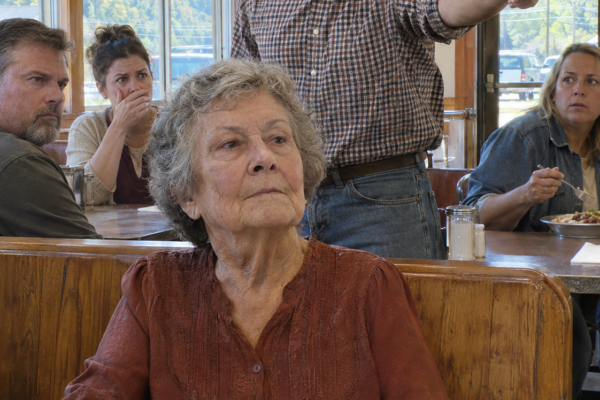
My Daughter-In-Law Told Guests I Married Into Money — But Every Truck Outside Belonged To Me

Chapter 1: The Chair Beside the Employees
My daughter-in-law introduced me as the woman who cleaned the offices at our trucking company’s anniversary dinner, then laughed when I corrected her.
I was still standing beside the chair she had chosen for me.
Outside the banquet room windows, a white box truck sat beyond the covered entrance. Its windshield caught the light from the doorway whenever someone came in.
My truck.
The others were farther down the lot.
I had noticed them before I saw Adam, and I had felt pleased that somebody had washed them for the dinner.
Now I was looking at Brooke.
“I never cleaned these offices, Brooke.”
She laughed.
“Oh, Gail. You know what I mean.”
“No, I don’t.”
She turned toward the nearby tables.
“Our cleaner married money. That’s her whole story.”
I lifted my chin.
“Your cleaner?”
Brooke stepped closer, still smiling.
“Please, you cleaned offices. Let us handle business.”
I looked toward my son.
Adam was beside the table, close enough to have heard every word. He adjusted the back of my chair instead of answering.
That small movement bothered me almost as much as what she had said.
He knew.
He knew where the money had come from, who had earned it, and whose name belonged on those trucks outside.
I own the trucks.
Not his company.
Adam owns the trucking company, and Brooke manages its operations. Being his mother has never made me an owner of that business, any more than being my son made him the owner of my equipment.
I had never sold him the trucks.
I had never given them to him.
Before the introduction, the evening had seemed ordinary enough. Brooke had spotted me near the doorway and lifted her hand without leaving the conversation she was managing.
“There you are.”
She pointed toward a chair beside the employees.
“Sit here. We’re almost ready.”
I had put my fingers around the chair back but stayed standing while she finished introducing someone nearby.
The room was polished and warm, with upholstered chairs that were heavier than they looked. Folded napkins stood at the place settings, and the windows reflected the tables once people moved away from them.
Adam had told me the dinner was about appreciating the employees.
I had liked that.
At 39, he had people depending on him for their wages, and I wanted him to remember that owning a business meant more than seeing his name on it.
Brooke was 36 and good at making an evening run on schedule. She noticed empty places, late arrivals, conversations that needed moving along.
I had watched her do it.
Until she introduced me, I had assumed she was simply busy.
Adam came over and kissed my cheek.
“Glad you made it, Mom.”
“Wouldn’t miss it.”
He looked pleased with the room.
I straightened my chair to make space, and Brooke turned toward the tables before I could sit.
“Before we get started, some of you haven’t met Adam’s mother.”
I smiled then.
I wish I hadn’t remembered that part so clearly afterward, but I did.
I had been ready to be introduced as his mother. There was nothing else I needed her to say.
Instead, she told them I cleaned the offices.
I waited because I thought she had explained my old business badly. Perhaps she meant I had worked in cleaning before retiring from it.
Then I corrected her, and she laughed.
That was when the room changed for me.
I built a cleaning business, sold it, and used $240,000 of my own money to buy four box trucks when Adam needed equipment. For seven years, I rented that fleet to his company below the rates he would have paid someone who wasn’t his mother. I wanted him to get established without spending everything on trucks before he had steady customers. Now Brooke wanted to use those same trucks on a later shift for another delivery route, and she expected my discount to continue.
I was 64.
I did not need to explain my whole working life beside a dinner table.
But I was not going to agree that I had married into money, either.
“That isn’t my story,” I said.
Brooke’s smile tightened.
“We’re celebrating the company tonight.”
“I understand that.”
“Then let’s not make this about you.”
She had introduced me.
I hadn’t asked for a speech, a thank-you, or a mention of the trucks. I had come to eat dinner with my son and see the people whose work kept those trucks moving.
I pushed the chair in a little.
It had been sticking out behind my legs, and I needed something ordinary to do with my hands.
Adam watched me do it.
I thought that might be when he spoke.
Instead, Brooke shifted her attention toward the rest of the room, ready to move on. The employees nearest us had stopped looking directly at me.
I understood that.
Their jobs were there. Mine wasn’t.
Nobody employed by my son should have had to correct his wife while he stood within reach of my chair.
I waited for him.
He leaned toward me.
“Please just accept the introduction.”
I turned my head.
“What?”
He lowered his voice further, as though the problem was that I had spoken loudly enough to be heard.
The white truck was still visible over his shoulder.
Seven years earlier, he had walked around that equipment with me before the company started using it. He had asked practical questions then, and he had listened to the answers.
He knew I had paid for it.
He knew the monthly rent did not represent a purchase.
He also knew the current arrangement was ending that month.
Apparently, he had never considered that I might let it end.
I looked at the empty place setting in front of my chair. The napkin was still folded, untouched, beside the plate.
“Adam,” I said quietly.
He glanced toward Brooke.
She was waiting for him to settle me so she could continue.
I gave him time to turn back and correct the introduction himself.
Instead, he bent close enough that nobody else would hear.
“Please don’t embarrass me in front of my employees.”
Chapter 2: The Space Behind My Chair
“You could tell them what I actually did,” I said.
Adam looked past me toward the tables.
“Mom, not now.”
That was his answer.
He wasn’t confused about what Brooke had said. He wasn’t asking for a moment to find a way to correct it.
He wanted me to accept it.
I put my hand flat against the chair back.
“You know I never cleaned your offices.”
“I know.”
“Then say that.”
“Please sit down.”
He touched my elbow and nodded toward my place.
I sat.
For a moment.
Brooke resumed talking about the company, using the pleasant voice she had used near the doorway. She thanked people for their work and turned toward the proposed second delivery route.
I could hear chairs shifting behind me.
There was no reason an employee should interrupt her. Adam owned the company, Brooke ran operations, and both of them were standing there as though the evening had gone exactly as planned.
She spoke about later deliveries.
The same trucks would work another shift, with additional drivers. That was the expansion she had been discussing for weeks.
Not more equipment.
More use of mine.
I had asked about service time when she first explained it. Trucks cannot be out on a route and in a service bay at the same time.
Brooke had treated that question as interference.
“We handle operations, Gail.”
“I’m asking about my equipment.”
“And we take care of it.”
I had not accused her of neglecting it.
I wanted to know what she intended to do with something I owned, under an arrangement I had not agreed to extend.
The request had come three weeks before the dinner.
Brooke brought it up while Adam was with us, speaking as if she were confirming a detail that had already been settled.
“We’ll just keep the truck arrangement the same.”
“For how long?” I asked.
“Another three years.”
I looked at Adam before answering.
He was watching her, not me.
“I haven’t decided.”
Brooke drew her hand back from the edge of the table.
“What do you need to decide?”
“Whether I want to keep renting them that way.”
She looked at Adam.
He gave her a little nod.
“We’ll work it out, Mom.”
“Nothing is settled yet,” I said.
Neither of them asked what I would need to consider. Brooke went back to describing the later shift and the deliveries she hoped to add.
I let the subject change.
I did not agree.
There is a difference, and I had been careful about it.
No promise over coffee.
No promise on the phone.
Nothing signed.
At the dinner, I listened while Brooke made the proposed route sound ready to begin. She did not say she was still waiting to find out whether the equipment would remain available.
Then she mentioned family support for the next stage.
She looked directly at me.
I set my napkin back beside the plate.
Adam noticed.
“Can we please get through dinner?” he asked under his breath.
“We can.”
I moved my chair back.
He reached toward it, then stopped when I stood.
Brooke paused in the space beside the tables. She gave me the same tight smile she had used after I corrected the cleaner story.
“Gail, we can discuss your concerns afterward.”
“This won’t take long.”
“It really isn’t necessary.”
“It is to me.”
I straightened fully.
“Let’s get this straight.”
Brooke glanced at Adam, expecting him to bring me back to my seat. He stayed beside my chair.
I faced the tables.
“I owned a cleaning business,” I said. “I sold it. I bought the trucks this company rents.”
Nobody needed the details of my marriage.
Nobody needed an account of every long day I had worked before I sold that business.
They needed the introduction corrected.
“Brooke, I own every truck you rent.”
Her smile faded.
She took half a step back.
It was not surprise at learning whose trucks they were. She had known that all along.
It was surprise that I had said it there, where the employees could hear me, instead of allowing her to describe my contribution however she liked.
“I own every truck outside,” I continued.
Adam looked at her.
Not at me.
“And I haven’t agreed to another three years.”
Brooke pressed her lips together before answering.
“We said we’d discuss it.”
“You asked. I said I hadn’t decided.”
“Gail, this is hardly the place.”
“You introduced me here.”
I kept my hands at my sides.
I did not reach for anything to show the room. The trucks were not a display, and the dinner was not a place where I intended to spread my business records across a table.
The fact was simple enough to say.
My company was gone because I had sold it.
My trucks were not gone because I had only rented them.
Brooke looked toward Adam again.
He did not contradict me.
That mattered to the people watching, even if it had taken him too long to do it.
She tried a different approach.
“We’re talking about plans that benefit the whole business.”
“I understand the plan.”
“And you’ve always wanted Adam to succeed.”
“Yes.”
“So we can work out the details privately.”
“The renewal isn’t a detail.”
I could see Adam looking toward my place setting, as though he could still get everybody seated before this became a decision.
But it already was a decision.
I had been considering the arrangement before I came to dinner. What happened beside that chair had answered the part I had still been uncertain about.
I would not spend another term being treated as if I had no say.
“The current rental ends this month,” I said. “I won’t renew it at the family discount.”
Brooke looked straight at me.
“Adam said you would renew.”
Chapter 3: The Figures Beside My Cup
“I didn’t,” I said.
Brooke turned toward Adam, and he rubbed his thumb along the edge of my chair.
“I thought we’d work it out.”
“That isn’t something you can promise for me.”
He looked at me then.
“I wasn’t trying to promise for you.”
“But you told her to count on my trucks.”
Brooke drew herself upright again.
She had lost the argument that I had already agreed. Now she wanted to make my refusal sound like a sudden change that could be corrected with a reasonable conversation.
“We planned around the current arrangement,” she said.
“The current arrangement ends this month.”
“You know what I mean.”
“I know what you requested.”
I had been careful about those words at home.
Requested.
Agreed.
Ends.
There was nothing complicated about them when I read the agreement without either of them talking over it.
Two weeks before the dinner, I had cleared a space on my kitchen table and taken out the records I kept for the fleet.
My coffee sat beside them until it went cold.
I read the end of the rental term.
Then I read the return requirements.
I went back through the rest to make sure I had not overlooked anything that gave Adam a right to keep the trucks after that.
There was no automatic renewal.
No required extension.
No purchase option.
No transfer of ownership hidden inside years of monthly payments.
I had known those things when we made the arrangement, but I checked them again because I did not want an argument based on what anybody remembered.
The company had the use of my trucks through the agreed term.
That was what I had promised.
It was also what I intended to provide.
I opened my notebook beside the agreement and wrote down the questions I needed answered before making another commitment.
What was comparable equipment renting for now?
Were the responsibilities for maintenance and insurance equivalent?
Was I looking at the whole fleet, rather than an attractive price for a different kind of truck?
Then I contacted two independent equipment lessors.
I gave each the information needed to compare the same kind of arrangement. I made sure the maintenance and insurance responsibilities matched closely enough for the figures to mean something.
I did not tell them I wanted a number that would frighten my family.
I wanted an actual comparison.
Both came back at $12,800 a month for a comparable fleet.
I checked the details again.
Then I put the quotes beside what Adam’s company paid.
$5,600 a month.
I did the subtraction on paper, then checked it.
The difference was $7,200 each month.
I sat there with my pen resting across the notebook.
I had known I was charging below commercial rates. I had not put the current difference beside another three years until Brooke asked me to continue it.
It came to $86,400 annually.
Over the term she wanted, it was $259,200.
That was money I would be choosing not to receive.
Not money the company had earned.
Not money already promised to Brooke.
My money.
I kept the quotes with the agreement and closed the folder. I had not yet decided whether I wanted another rental with them under different terms, but I knew I would not casually approve the old arrangement.
At the banquet table, Brooke was still waiting for me to soften my answer.
“You’re making this sound larger than it is,” she said.
“The difference is $7,200 a month.”
Her eyes stayed on mine.
Adam stopped touching the chair.
I let the number sit there without dressing it up.
“I checked comparable rentals,” I said. “Under equivalent maintenance and insurance responsibilities, the fleet would cost $12,800 a month.”
“We’ve taken care of your equipment,” Brooke said.
“That was part of the arrangement.”
“And we’ve paid you consistently.”
“That was part of it, too.”
I was not accusing them of failing to pay.
She was trying to turn compliance with the existing agreement into a reason I owed them another discounted term.
I would not do that.
“The company pays me $5,600,” I said. “Another three years at that rate would mean giving up $259,200 compared with those quotes.”
Adam pulled his hand away from the chair.
“You never told me it was that much.”
“You never asked what I was giving up.”
He looked down.
I did not enjoy saying that in front of his employees. I would rather have discussed every bit of it before the dinner, with my son listening instead of assuming.
But Brooke had publicly treated the trucks as secured.
The correction needed to be public, too.
She glanced toward the tables and lowered her voice.
“Can we speak privately?”
“Yes.”
“Now.”
“We can step aside.”
I was not going to keep discussing their operating costs in front of people who had come for dinner. They had heard the ownership corrected and the proposed renewal refused.
That was enough.
Adam moved his chair away from mine to let me pass. I picked up my purse from the seat and left the place setting untouched.
Brooke went toward the side of the room, where we could speak without standing between the tables.
She did not look at the white truck outside.
I did.
I had bought equipment, not a permanent obligation to fund whatever route my daughter-in-law wanted to announce.
Adam followed us.
Brooke waited until we were away from the nearest table before speaking.
“The later shift depends on keeping our costs where they are.”
I set my purse against my hip.
“You can’t make the route work at that price, can you?”
Chapter 4: The Route She Had Advertised
“Not the way we planned it,” Brooke said.
Adam looked at her before he looked at me.
We stood near the edge of the banquet room, away from the tables but still inside. I could hear dishes being moved behind us.
“Then the plan needs to change,” I said.
Brooke folded her arms.
“We can’t just change it tonight.”
“You don’t have to settle it tonight.”
“You’ve just told everyone the trucks won’t be available.”
“I said I won’t renew at the family discount.”
She glanced toward the employees.
The distinction mattered, but it did not help the figures she had built her expansion around.
Adam stepped closer.
“Can we finish the dinner and talk afterward?”
“Yes.”
Brooke opened her mouth, then stopped.
I went back to my chair.
I did not make another announcement. I unfolded my napkin and put it across my lap, although I had lost interest in the food.
Adam sat nearby.
Brooke continued the evening without giving the expansion speech she had been moving toward when I stood. She thanked people for their work and kept the rest of her remarks general.
I noticed that.
She was not careless when there was a business problem to manage. She understood that she could not keep presenting the route as settled after what everybody had heard.
I ate enough that nobody needed to ask whether I was eating.
My son did not try to explain the introduction while we were at the table.
He asked whether I wanted water.
I said yes.
It was an ordinary exchange, and I was grateful for the chance not to speak for a little while.
When the dinner was over and the room had begun to clear, Brooke approached my chair.
“Can we talk now?”
I picked up my purse.
Adam came with us to the area near the entrance, where the sound from the room was softer. Through the glass, the white truck was visible beyond the covered doorway.
Brooke stood facing me.
“We’ve already advertised the later route to a prospective customer.”
I kept my purse on my shoulder.
“Advertised how?”
“As something we were preparing to offer.”
“With my trucks.”
“With the fleet we operate.”
“The fleet you rent from me.”
“Yes,” she said.
It was the first time that evening she had said it without adding something meant to reduce it.
Adam looked toward the doors.
I asked the question that mattered.
“Have you signed a customer contract?”
“No,” Brooke said.
“Has the company promised a start it cannot meet?”
“We haven’t signed anything.”
“That isn’t quite what I asked.”
She uncrossed her arms.
“We’ve discussed the route and what we could provide. There isn’t a signed customer contract.”
I nodded.
“Then you need to correct the proposal before there is one.”
“You make it sound easy.”
“I didn’t say it would be easy.”
She rubbed at a crease in her sleeve.
“I put work into this.”
“I believe you.”
“We have to offer more if we want the business to grow.”
“Then you have to know what it costs.”
Adam stepped between the sides of the conversation without physically stepping between us.
“We all understand the cost now.”
“No,” I said. “You know what comparable rentals cost. You still have to decide what your company can afford.”
He nodded once.
Brooke looked at him.
“We weren’t going to buy equipment. That was the point of using a later shift.”
“I understand the idea,” I said.
The idea itself was not foolish.
Use the trucks later, hire additional drivers, bring in additional delivery work. If the expenses and equipment arrangements supported it, that was a business decision for them.
But the cheap trucks had been treated as certain before the owner said yes.
I had not approved the expansion.
I had not agreed to fund it by giving up another term of commercial rent.
Brooke tried again, more carefully.
“What if we separate the route from what happened tonight?”
“They’re already separate.”
“You’re refusing because you’re angry.”
“I’m refusing another discounted term.”
“So if the introduction hadn’t happened, you would have renewed?”
“I hadn’t decided.”
She looked away.
That answer did not give her a promise she could use.
Adam put his hands in his pockets.
“What about some time to get replacements?”
“You have until the existing term ends.”
“That’s next week.”
“The agreement has had the same ending the whole time.”
He knew that.
I could see him deciding whether to argue that being his mother should make the written term less important.
Instead, he asked about the practical problem.
“Commercial arrangements take time.”
“Then you need to start.”
Brooke looked through the door toward the truck.
“The proposed route isn’t the only issue. The current customers still need deliveries.”
“I expect you to finish your deliveries under the current arrangement.”
“And after that?”
“That’s a company decision.”
Adam exhaled.
He had spent the evening asking me not to embarrass him, then listening while his wife explained plans built around a renewal I had never promised.
Now he was finally asking me directly for something.
Not telling Brooke what I would do.
Not nodding while she treated it as settled.
Asking.
“Could you give us a short extension?” he said.
“On what terms?”
“Just to let us get through this.”
I waited.
He glanced at Brooke, then back at me.
“No additional rent while we sort out the replacement.”
I shifted the purse strap on my shoulder.
He had asked for more free use immediately after hearing how much the discount already cost me.
“Just let us keep them until we figure this out.”
Chapter 5: The Morning Email
“No,” I said.
Adam took his hands out of his pockets.
“Mom, I’m not asking for another three years.”
“I heard what you asked.”
“A short extension.”
“Without rent.”
He looked down at the entrance mat.
Brooke did not interrupt him. She was watching to see whether a smaller request would accomplish what the renewal demand had not.
I kept my answer about the equipment.
“The trucks stay with the company through the end of the current term. Then they come back as agreed.”
“We don’t even know what’s available yet,” Adam said.
“You need to find out.”
“Tonight?”
“Not tonight.”
I was tired, and I could hear it in my own voice.
We were not going to find replacement equipment standing in the entrance to a banquet room. We were also not going to resolve this by having me promise free time so they could stop thinking about the ending again.
“I’ll confirm the return arrangements in the morning,” I said.
Brooke pressed her lips together.
Adam asked whether I was all right to go home.
“Yes.”
He held the door.
I passed the white truck on my way out. Its side was clean, and there was a faint streak where water had dried under the mirror.
I did not stop beside it.
At home, I hung my clothes up rather than leaving them across the bedroom chair. Then I took the rental folder to the kitchen table.
I did not send anything that night.
I opened the agreement to the return provisions and read them again.
There would be no surprise collection during a delivery.
No shutting down a truck while somebody was using it for company work.
No announcement that the term ended earlier because I was offended.
I had an agreement.
I would keep it.
The next morning, I made coffee and sat down with the folder open beside me.
I drafted the confirmation in ordinary language.
The existing term would end as scheduled.
There was no agreed renewal.
The equipment was to be returned by appointment under the arrangement already in place.
I read it without looking at the paragraph about the dinner that I had almost added.
Then I deleted that paragraph.
The rental notice did not need an argument about Brooke.
It needed the ending, the return process, and a request to coordinate the appointment.
I sent it to both of them.
Afterward, I washed my cup.
I did not stay at the table watching for a reply.
When my phone rang, I dried my hands before answering.
Adam had the message in front of him.
“So this is final?”
“The discounted renewal is not happening.”
“And the free extension?”
“No.”
He was quiet.
I could hear him moving something across a surface.
“Brooke thinks you’re treating this like we’re strangers.”
“I’m treating it like a rental that ends.”
“I know what it says.”
“Then let’s arrange the return.”
We discussed the appointment rather than leaving it as an argument about whether I was serious.
The trucks would come back at the end of the term, after the company completed the work scheduled while it still had the right to use them.
We would inspect them.
The company’s insurance and responsibility for the vehicles would remain in place through the return, just as required.
I would not accept a vague promise to leave keys somewhere.
He did not ask me to.
“Send me the details you want confirmed,” he said.
“I will.”
I wrote them down while we spoke and sent the follow-up afterward.
There was relief in having something definite to do.
I cleared room in my equipment lot and checked that the place where we would walk around the trucks was accessible. I put the condition records with the return checklist.
Nothing about that work required me to decide whether I was a good mother.
It required me to know what I owned and what condition it was coming back in.
Later, Adam called again.
His voice was different.
Less embarrassed.
More concerned.
“I’m looking at commercial rentals.”
“Good.”
“The terms aren’t all the same.”
“I know. Compare the responsibilities, not just the rent.”
He asked whether the quotes I had obtained included the same maintenance and insurance responsibilities as our arrangement.
“Yes.”
“Could I see what you compared?”
I sent the relevant information.
Not as a new offer.
As information he should have gathered before deciding my answer was guaranteed.
When he called back, he did not dispute the difference.
Instead, he talked about the existing delivery work.
Those customers had nothing to do with Brooke’s proposed later shift. They expected the company to perform the work it already had.
“I’m not trying to save the expansion right now,” he said.
“All right.”
“I’m trying to protect what’s already running.”
“That makes sense.”
“I can reduce what we need if we postpone the second route.”
“You need to make those decisions.”
He hesitated.
Then he asked whether I would consider keeping part of the arrangement.
Not the whole fleet.
Not another announced expansion.
A smaller family rental, arranged quickly enough to spare him from having to replace everything he had assumed he could keep.
I looked at the return appointment on my kitchen table.
The question was more reasonable than asking for free use.
It was still another request to make his planning depend on my property before I had decided what I wanted to do with it.
“Will you at least rent us two?”
Chapter 6: The Replacement Work
“No, Adam.”
He did not answer immediately.
I could hear the disappointment in his breathing before he spoke.
“Even at a different rate?”
“I’m not making a last-minute family arrangement.”
“So you’ll leave them sitting?”
“For now, I’ll have them returned.”
“I’m trying to find a practical answer.”
“So am I.”
I sat down rather than continuing to stand beside the table.
This was the part I had expected to find hardest.
Not Brooke’s response.
His.
He had asked directly, and he had reduced the request. He was talking about existing customers rather than growth.
I could understand why he wanted the answer to be yes.
Understanding it did not require me to say yes.
“Use commercial providers to plan the business,” I said. “Don’t plan it around what you think I’ll eventually agree to.”
He let out a breath.
“That’s more expensive.”
“Yes.”
“It changes what we can do.”
“I know.”
I did not explain the $259,200 again.
He had the information.
The question now was whether he would act on it.
“I’ll keep the return appointment,” he said.
“Thank you.”
We ended the call without discussing Brooke.
I put the phone down and went through the maintenance records I wanted available for the returned fleet. The trucks had been in use for seven years, and any new arrangement would require an honest account of their condition.
That was work I could do without waiting for my son to accept my decision.
I sorted what belonged with each vehicle.
I checked that the records matched the equipment.
When I caught myself reaching for my phone to see whether Adam had called, I put it on the kitchen counter and finished.
He contacted me later with questions about the return process.
Not a demand.
Questions.
Could he confirm the arrival arrangements after he finished coordinating the replacement rentals?
Yes, provided the trucks were back as agreed.
Would the company’s responsibility remain in place while the vehicles were being brought to my lot?
Yes.
Would I inspect them with him there?
Yes.
I answered each one.
I did not add anything about how this could have been easier.
He already knew.
The next time we spoke, he had arranged a smaller commercially rented fleet for the work the company already had.
He sounded tired.
“It’s enough for the existing deliveries,” he said.
“Under the new rental terms?”
“Yes.”
“Insurance and maintenance sorted?”
“Yes.”
I stopped myself from asking more operating questions than I needed to ask.
His replacement fleet was not my equipment.
That distinction worked in both directions.
“I’m glad you have it arranged,” I said.
“It leaves less room.”
“For what?”
“For everything we thought we’d be able to add.”
“The proposed route?”
“Especially that.”
I looked at the open folder on my table.
The replacement arrangements were no longer a possibility he could use to bargain with me. They were becoming the way his company would operate.
He had made the decision himself.
That was what I had wanted him to do before promising my trucks to Brooke.
“Will you be able to finish the current deliveries before the return?” I asked.
“Yes.”
“Then we’ll keep the appointment.”
He did not ask for a free extension again.
Brooke called after that.
She skipped the dinner.
“Adam says you won’t rent us part of the fleet.”
“That’s right.”
“You’d rather have no rent than rent to us?”
“I’m taking time to arrange the next rental properly.”
“We know your trucks.”
“Yes.”
“We know how to operate them.”
“I haven’t questioned that.”
“Then what’s the business reason?”
“I don’t want another family equipment arrangement.”
She was quiet long enough that I checked the screen to make sure the call was still connected.
Then she tried the route.
“We could still make the later shift happen if you reconsidered.”
“I’m not reconsidering.”
“The prospective customer is interested.”
“Then don’t promise equipment you haven’t secured.”
“We never signed a contract.”
“I know.”
That was good news, not a point against me.
She could withdraw or revise what she had advertised without breaking a signed customer commitment. I was glad she had not gone further.
But she wanted me to hear the absence of a contract as proof there was still time to save the proposal with my discount.
There was not.
“You’re making us look unprepared,” she said.
“I didn’t prepare your proposal.”
She ended the call without saying goodbye.
I sat with the phone in my hand for a moment.
Then I opened the confirmation of the return appointment and checked the place and arrangements again.
There was no new message changing them.
Adam called later.
He had spoken to Brooke about postponing the second route. His company would use the smaller replacement fleet for existing work, not try to stretch it into the expansion.
“That’s the decision,” he said.
“Have you told the prospective customer?”
“Not yet.”
“Then you need to.”
He agreed.
Before he could say anything else, I heard Brooke nearby on his end of the call.
He did not move the phone quickly enough to keep her next sentence from reaching me.
“Are you really going to tell that customer we don’t have the trucks?”
Chapter 7: The Correction He Made
“I’m telling them we aren’t launching the route,” Adam said.
His answer was directed away from the phone, but I heard it.
Brooke said something I could not make out.
Then Adam came back to me.
“I’ll handle it.”
“That’s your business.”
“I know.”
He did not ask me to stay on the line while they argued. I was glad of that.
We confirmed that nothing had changed about the return, and I ended the call.
The next time he contacted me, the proposed route had been withdrawn.
He had told the prospective customer the company was not ready to offer it. There was no signed customer contract to unwind, but there was an awkward explanation to make.
He made it.
He did not say I had taken the equipment away unexpectedly.
I asked him that directly.
“No,” he said. “I told them we hadn’t secured the equipment arrangement we needed.”
“That’s accurate.”
“I should have secured it before we proposed anything.”
I put my cup down.
That was the first time he had said it without immediately asking me for a way around it.
Brooke would have to postpone the route she had planned.
The company would keep doing existing work with the smaller replacement fleet.
Those were real consequences, even without anybody being sued or losing the whole business. The expansion she wanted would not happen on the assumption that I would pay for part of it.
Adam was quiet.
Then he said he had something else to tell me.
“I spoke to the employees.”
“About what?”
“About you.”
I stayed seated.
He explained that he had made the correction privately after the dinner, without turning it into another public performance or asking them to take sides in a family disagreement.
He told them I had never cleaned the company’s offices.
He told them I had built and sold my own cleaning business.
He told them the trucks belonged to me.
Not as a technical arrangement.
Not until enough monthly payments had passed.
Mine.
“What did you say about the rent?” I asked.
“That we’d rented them below commercial rates for seven years.”
I looked at the folder across the table.
“And the introduction?”
“I told them it was wrong.”
“Brooke’s introduction.”
“Yes.”
He did not say she had meant well.
He did not say people had misunderstood a joke.
That mattered.
I had spent enough of the dinner listening to an ordinary correction get treated as a failure to cooperate.
“What did they say?” I asked.
“I didn’t ask them to respond.”
“Good.”
“They shouldn’t have been put in that position.”
“No.”
He paused.
“Neither should you.”
I pressed my lips together and looked toward the sink.
There was a plate there from my lunch, with the fork still lying across it.
I got up and rinsed it while he waited.
“Mom?”
“I’m here.”
“I wanted you to know I corrected it.”
“Thank you for telling me.”
He did not ask whether that earned him anything.
He did not mention the discount.
We finished the call discussing the return, which was coming up at the end of the month.
He had arranged the smaller replacement fleet so existing deliveries would continue. My trucks would remain insured and the company’s responsibility through their return.
No active delivery would be interrupted.
That was the sensible ending to the rental.
It did not need a scene in a parking lot.
After we hung up, I put the clean plate away and wrote a note beside the appointment.
Adam would attend.
That was all I needed to add.
Brooke called while I was checking the inspection materials.
I answered because the trucks had not yet come back, and she was still the operations manager responsible for their use.
“I hear Adam gave you a report,” she said.
“He told me the route is postponed.”
“I mean about the employees.”
“Yes.”
“You got what you wanted.”
“I wanted the truth corrected.”
“He did that.”
“Yes.”
She waited for me to offer something back.
I did not.
“The way you refused the renewal made it look like I hadn’t done my job,” she said.
“You had not secured the trucks.”
“I was handling the renewal.”
“You had asked for it.”
“We were discussing it.”
“And I had not agreed.”
She changed direction.
“I’m talking about the way you did it, Gail.”
“I understand.”
“You stood up in front of the whole room.”
“After you introduced me.”
“I’m not asking to go through that again.”
“Neither am I.”
I put the inspection papers down.
The call was no longer about the equipment. It was about whether I would apologize for saying no where she had said the trucks were effectively settled.
She wanted that apology to restore the position she had held before I stood up.
I could hear her choosing her words.
“I’ve had to postpone something I put a lot of work into.”
“Yes.”
“And now Adam’s correcting me with the employees.”
“He corrected what they were told.”
“It was an anniversary dinner.”
“I was there.”
She breathed out sharply.
I waited without filling the pause.
I would not list every sentence she had said, and I would not let the conversation become a debate about whether her intention mattered more than what everybody heard.
She finally made the request plainly enough that I could answer it.
“You could have told me no without doing it in front of everyone.”
Chapter 8: The Keys Coming Back
“You treated my yes as settled in front of everyone,” I said.
Brooke did not interrupt.
“I corrected that where you said it. I’m not apologizing for refusing the discount.”
“So that’s it?”
“The return appointment is still in place.”
“I wasn’t calling about the appointment.”
“I understand.”
I picked up my pen but did not write.
There was nothing more I needed to add about the dinner.
“If there’s a change affecting the trucks before return, let me know,” I said.
She ended the call.
I put the pen down.
It would have been easy to call Adam and tell him exactly what she had said. I did not.
He had his own marriage to manage.
The rental was ending, and I wanted the remaining days to be about completing it properly.
At the end of the month, I went to my equipment lot before the return appointment.
I carried the folder against my side and checked the area where the trucks would be parked for inspection. The pavement was clear, and there was room to walk around the vehicles.
I had set out what I needed without making the place look like I expected a fight.
Records.
Condition notes.
The agreed return information.
That was enough.
When the trucks arrived by appointment, Adam was there to go through them with me.
He greeted me without trying to turn the morning into a family conversation.
“Where do you want to start?”
“Outside.”
We walked around the white box truck that had been parked beyond the banquet room entrance.
There was ordinary wear from company use.
We checked it against the records rather than arguing from memory.
I looked at the body, the cargo area, the tires, and the places that needed attention in any rental inspection. Adam opened what needed opening and waited while I made notes.
He did not tell me I was being fussy.
He did not say the trucks were practically his.
At the dinner, Brooke had wanted me to leave business to them.
Here, my son was letting me handle mine.
We went through the rest of the fleet the same way.
No hurried handover.
No insistence that I sign before I had looked.
The company’s insurance and vehicle responsibility remained in place through the return. We confirmed the handoff rather than leaving either of us to assume when the other had taken over.
I checked the keys against the trucks.
Adam checked that he had not left company materials inside.
The existing deliveries had been completed under the arrangement that was ending. The smaller replacement fleet was in place for the company’s continuing work.
Nobody had been stranded during an active delivery to make a point for me.
That mattered.
I wanted the trucks returned because the term was over, not because I needed a dramatic scene to prove I could take them.
Adam stood beside me while I finished the notes.
“Anything else?” he asked.
“I want to check the records against the return once more.”
“All right.”
He waited.
I found what I needed, marked the handoff complete, and put the papers back in the folder.
The trucks were back.
I had expected to feel relieved immediately.
Instead, I noticed how quiet the lot was when we stopped talking.
For seven years, those vehicles had been part of Adam’s work almost every day. Now they stood where I could decide what happened next.
I closed the folder.
“Thank you for keeping the appointment.”
He nodded.
“We said we would.”
“Yes.”
He looked at the trucks.
“I should have listened when you said you hadn’t decided.”
I rested the folder against the hood long enough to adjust my purse strap.
“We can talk about that another time.”
“I’m not trying to start another rental conversation.”
“I know.”
He looked relieved that I had said it.
We checked that nothing remained to be transferred before he left. There was no purchase option to exercise and no ownership to argue over.
The company had rented equipment.
It had returned equipment.
That business relationship was complete.
I took the folder to the place where I kept the fleet records and came back out to make sure the vehicles were secure.
Adam was still there.
He had not returned to ask whether I might change my mind now that I saw them sitting idle.
He was looking at me instead of the trucks.
“Are you staying much longer?” he asked.
“Just finishing up.”
“Do you need help?”
“No, I’m all right.”
He nodded and started to leave, then stopped.
I waited beside the white truck.
There was room now for him to say something without Brooke managing the conversation and without employees close enough to make him worry about appearances.
He rubbed his palm against the side of his leg.
“I don’t want every time we talk to be about this.”
“Neither do I.”
He looked at the folder in my hand.
I put it down inside my purse.
The equipment had come back as agreed.
I did not need another promise from him that morning.
He asked the question I had wanted to hear before he mentioned money, routes, or the company.
“Can I come over without talking about the company?”
Chapter 9: The Visit Without a Folder
“Yes,” I said.
Adam looked at me for a moment before nodding.
He did not ask when I might be ready to discuss another arrangement.
We settled the visit without putting a business purpose beside it, and he left the lot.
When he came to my house, he arrived without a folder.
I noticed.
I had put the fleet records away before he came, not because I needed to hide them, but because I did not want them sitting between us.
He stood in the kitchen while I got cups.
“Coffee?”
“Please.”
He took his usual place at the table.
For a little while, we talked about ordinary things. He asked what I had been doing at the house, and I showed him a cupboard hinge I had finally tightened.
He opened the door and closed it again.
“That was bothering you for a while.”
“Yes.”
“I could have done it.”
“I did it.”
He smiled a little.
Then he looked down at his cup.
“Mom, I owe you an apology.”
I sat across from him.
“Go ahead.”
“At dinner, I was worried about being embarrassed in front of the employees.”
“I know.”
“I chose that over telling the truth about you.”
I wrapped my fingers around my cup.
He kept going.
“You asked me to correct it, and I told you not now. I knew Brooke was wrong, and I let you stand there by yourself.”
I looked at the cupboard instead of him.
The hinge held the door straight now.
“I wasn’t asking for praise,” I said.
“I know.”
“I wanted you to say what happened.”
“You shouldn’t have had to ask.”
He did not add a reason about how busy he had been.
He did not tell me Brooke had been under pressure.
He did not ask whether I understood how difficult the new rental costs were.
He apologized for the choice he had made beside my chair.
That was the part I needed him to name.
“I’m glad you corrected it with the employees,” I said.
“I should have done it while you were there.”
“Yes.”
He nodded.
We sat without talking for a little while.
Then he asked about the hinge again, and I showed him the screwdriver I had used because I had left it in the drawer.
It was not a dramatic visit.
He finished his coffee.
He carried his cup to the sink.
He left without asking for a discount.
Afterward, I went to the drawer where I kept the fleet folder and left it closed.
Over the following six weeks, I worked on the next rental myself.
An unrelated local distributor had a use for the trucks, and I considered the proposal the way I should consider any equipment decision.
I checked what work the fleet would do.
I checked who would be responsible for maintenance and insurance.
I made sure the proposed use matched the vehicles and that the ordinary ownership information was in order.
Nobody got to operate them because they sounded confident.
Nobody got a family rate because I liked hearing that they needed the equipment.
I read what was proposed, asked for missing information, and waited for it before agreeing.
There were practical details that took time.
Insurance needed to match the actual arrangement.
Inspection responsibilities needed to be clear.
The condition of the trucks needed to be recorded before the new rental began, not reconstructed after somebody found something later.
I used the records from the return to help prepare for that inspection.
The work was familiar.
I had run a cleaning business before I bought trucks. I knew how easy it was to agree to something friendly and discover later that the important details had never been discussed.
This time, I discussed them.
I visited the lot to check the vehicles and keep the records current while the rental was being arranged.
The white truck from the banquet entrance stayed with the fleet.
It did not become an object I showed people when I told them what Brooke had said.
Most days, I did not tell anybody.
I checked the equipment.
I returned calls.
I went home.
Adam visited again without bringing the company into it.
He still had work to manage and a smaller fleet than the one he had assumed he would keep, but he did not treat my kitchen as the place to solve that problem.
I appreciated the effort it took him not to drift into it.
Sometimes I could see him stop himself.
I did not make him explain.
When the distributor’s proposal was ready, I reviewed the final arrangements beside the insurance information and the inspection plans.
I had decided to rent the trucks at commercial rates.
That was a business decision I could explain without explaining my family.
Brooke called before the new rental began.
“I heard you found someone for the trucks.”
“Yes.”
“A local distributor?”
“Yes.”
She paused.
I waited.
“Are they paying what we paid?”
“No.”
“What are they paying?”
“Commercial rates.”
She did not answer right away.
Then she asked the question as though the answer might prove I had refused them only to be cruel.
“Did you give strangers the deal you wouldn’t give us?”
Chapter 10: The White Truck in My Lot
“No,” I said. “They’re paying commercial rates.”
Brooke let out a breath.
“So it really was about the money.”
“It was about my equipment and what I was willing to agree to.”
“And what happened at dinner.”
“That mattered, too.”
I did not pretend otherwise.
She had wanted another three years of cheap use, and she had expected to get it while speaking about me as though I had contributed nothing worth naming.
I had considered the figures before the dinner.
At the dinner, I stopped considering another family arrangement.
Both things were true.
“The distributor has an ordinary rental,” I said. “Insurance, maintenance responsibilities, inspections, and an agreed return.”
“We had those things.”
“Yes. And your agreement ended.”
She went quiet.
There was no useful attack left in suggesting that I had secretly given somebody else the family discount.
I had not.
“I shouldn’t have called you our cleaner,” she said finally.
“No.”
“I was trying to keep the evening moving.”
I looked at the phone in my hand.
“That doesn’t explain what you said.”
“I know it came out badly.”
“It was false.”
She paused again.
“I’m sorry for the introduction.”
It was a narrower apology than Adam’s.
She did not acknowledge the married-money claim directly, or the laugh, or the way she had treated my permission as something she could obtain through him.
I did not push her into a larger speech she did not mean.
“Thank you for saying that,” I said.
She waited.
I knew what she was waiting for.
I kept the business answer unchanged.
“The trucks are committed to the new rental.”
“I understand.”
“The old discount isn’t available.”
“I said I understand.”
“All right.”
We ended the call without another argument.
I did not call Adam to grade her apology.
She had said what she was willing to say, and she had received no renewed discount in return.
The proposed second route remained postponed.
There was no signed customer contract to break, and Adam had withdrawn the offer before creating one. Brooke still managed operations, but she had to work with the smaller commercially rented fleet the company could support.
The existing work continued.
The company did not disappear because I stopped subsidizing its equipment.
It became smaller than the expansion they had planned, with less room to add work before they had arranged what that work required.
Adam did not ask me to fix that.
When he came to visit, he left the equipment questions elsewhere.
At first, I found myself expecting them anyway.
He would pause after setting down his cup, and I would brace for a request about the trucks.
Then he would ask whether I wanted help moving something or tell me about an ordinary part of his week.
After a while, I stopped listening for the request.
That took longer than signing the new rental.
Brooke came with him on family visits, and we were polite without pretending the dinner had never happened. She did not introduce the postponed route as a reason I ought to change the arrangement.
I did not bring my quotes to the table.
We ate.
We cleared plates.
When business came close to the conversation, Adam moved it away himself.
“We’re not here for that,” he said once.
I kept passing the food.
It was a small thing, but it made the visits easier.
I could be his mother without being the person expected to make the company’s next decision affordable.
Before the distributor’s rental began, I went through the inspection arrangements again.
The ordinary checks were complete.
The insurance was in place for the new use.
The rental responsibilities matched what we had agreed, and the condition records were ready for the handoff.
I reviewed the information myself.
There was nobody to rescue me from work I already knew how to do.
On the handoff day, I went to the equipment lot with the folder on the seat beside me.
The white box truck stood where it had been parked after the return.
I recognized the faint mark beneath the mirror that I had noticed outside the banquet room. I checked it against the condition notes and kept moving.
There were useful things to look at.
Doors.
Lights.
Tires.
The cargo area.
I walked around the truck slowly, doing the same ordinary inspection I would have done if there had never been an anniversary dinner.
The new rental was not a reward for the distributor or a punishment for Adam.
It was the next use of equipment I owned.
When everything was ready, I completed the handoff details and checked that the keys matched the vehicles listed.
The records went back into the folder.
The company’s old use had ended.
The new renter’s responsibilities were clear.
Nothing remained for me to promise my son, take back from Brooke, or explain to the employees who had heard that introduction.
Adam had corrected the story with them.
He had apologized to me without asking for anything.
Brooke had offered what apology she could manage, and the rate had not changed because of it.
My phone lit up while I was putting the folder away.
Adam wanted to know whether a family visit would suit me.
There was no question about the fleet.
I answered him, put the phone in my purse, and finished the handoff beside the white box truck.
You Might Also Enjoy

My Daughter-In-Law Told Me To Stay Elsewhere While Strangers Took My Condo — Then I Pushed Back