He Laughed When I Paid $85 for the Piano He Called a Flower Stand — Then an 88-Year-Old Doorgirl Told Him to Lift the Lid
Part 1 — THE EIGHTY-FIVE-DOLLAR PIANO
PART 1 — 11:41
At 11:41 on the second Saturday of September, sixty people on the dance floor of the Odeon Ballroom laughed at me for eighty-five dollars.
Vern Haskitt leaned into the auction microphone from the third step of the stage and said, "Mr. Tilghman, you just bought the most expensive flower stand in Ohio, and I'll be glad to saw the legs off for you Monday."
The piano under that moving blanket was mine now, and if I couldn't get nine feet of it out of the building by Friday the twenty-fifth, the wrecking crew would take it out for me.
The insult came the instant Marcy Bellweather's gavel fell. I was also the only bidder in the room who had already lifted that stained blanket enough to see dry wood underneath and a small brass lock on the big lid.
Two minutes earlier, Marcy Bellweather had opened lot 31 with "no reserve," and the room had given her nothing. The old ceiling fan over the dance floor made a dry little tick every fourth turn. Vern sat three steps above us with his clipboard on one knee and the microphone loose in his hand.
Marcy raised the microphone again and said, "Concert grand. As is. Buyer moves it. Anybody?"
Before I lifted my hand, Vern leaned down from his stage step and crooked a finger at Marcy.
She came close enough that the microphone dropped below her hip.
I was standing near the first row of folding chairs, maybe twelve feet away. I couldn't hear his whole sentence over two men dragging a box of bar glasses toward the rear door, but I heard "no-value" and then, clearer, "move it fast."
Marcy's yellow pencil stopped over her sale sheet.
Vern said something else near her ear.
She wrote beside lot 31, drew a short line under what she'd written, and gave him one nod. Vern settled back onto the third step and put the microphone against his knee.
A folding chair scraped near the coffee urn.
I raised my hand. "Eighty-five."
Vern's smile widened, and he stood from the third step. The clipboard came off his knee and hung at his side.
Bev Lindgren laughed near the aisle. Mayor Gloria Pasternak covered her mouth with two fingers and turned toward the woman beside her. Dwight Amundsen, the trust officer, bent over a stack of sale sheets at the cash table and let out one short bark before he caught himself.
Marcy laughed too, one quick breath through her nose while she checked the room for another bidder.
Toby Ruiz stayed against the stage with a hand truck beside him, nineteen years old and long in the arms, wearing a gray Haskitt Estate & Salvage T-shirt with a grease mark near the hem.
Marcy lifted the gavel. "Going once. Going twice."
Nobody raised a number.
The gavel hit the table, and the laugh from the first line of this story started before the sound had finished crossing the ballroom.
Vern laughed into the microphone with everybody else.
Then he raised it again. "Forty years in this county, and I have never once been wrong about a dollar."
A man in a John Deere cap near the back gave him a grin.
Vern pointed the microphone at him. "Kessling gives Haskitt the exclusive appraisal. Nobody else gets to put a number on a Trust lot. City salvage comes to Haskitt too, and I've still got my seat on the Chamber board."
The man called, "Keep stacking them up, Vern."
"I intend to."
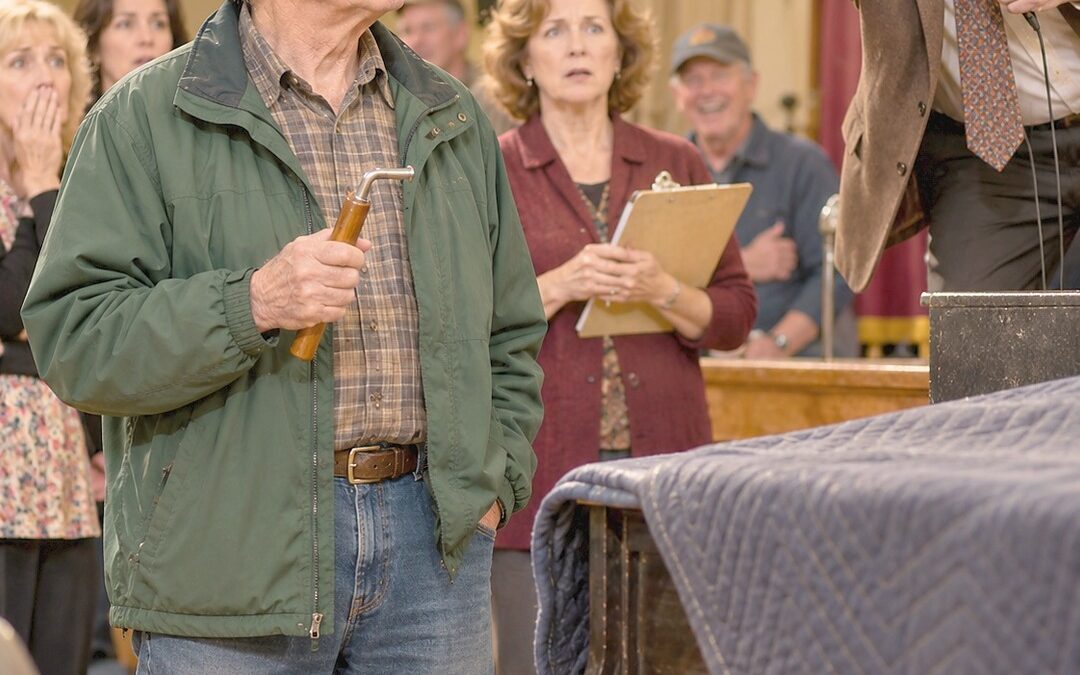
My right hand went into the pocket of my green rain jacket, where my fingers closed around Aldous Beck's old wooden tuning lever.
I had kept the jacket on from the cool morning. The lever's handle was dark from years of use, worn into one shallow place where Beck's thumb had rested. He gave it to me in 1982 after I passed my registered-technician exam.
Beck had been dead since 2004. I hummed the A I had used before checking pianos since I was twenty-one, and the first note cracked. I covered it with one cough and took my hand out of my pocket.
Vern was fifty-eight and had run Haskitt Estate & Salvage for years, with a Sunday spot on WDBN besides. I was sixty-six, retired two years after thirty-one years tuning pianos for the Dunmore Bend school district.
At 9:40 that morning, I had lifted one corner of the moving blanket. The brown flood stain stopped in the cloth, and the wood underneath was dry. I also found the small brass lock on the big lid. In 1981 Beck had told me the lid was locked at the wish of a man who died and that the key was taped under the bench. He never told me what was under the lid.
Marcy tapped her pencil against the sale book. "Eighty-five dollars to Gene Tilghman."
Vern twisted around on the stage step. "Marcy, you better say that slower. He may come to his senses."
Marcy checked the sale sheet and wrote my buyer number beside lot 31.
The gavel came down with a flat wooden knock.
Vern stood with his pen clipped in his shirt pocket. "Put it in the record, Marcy. Final, as is, no buyer's remorse, no seller's remorse, so nobody can say Vern Haskitt took advantage of an old man."
Marcy held her pencil above the page and glanced my direction.
"Repeat that slowly," she said. She waited for him to finish dictating, then wrote every word into the sale book.
The man in the John Deere cap called, "What's wrong with it besides being old?"
Vern pointed the microphone toward the covered shape on the stage. "Trust inventory has carried the same condition since the flood." He read the line off his sheet. "Piano, stage, flood-ruined, scrap."
"That's 1974, folks. Fifty-two years sitting right there under a blanket." Vern lowered the paper.
I watched Dwight at the cash table. He had a Dunmore Savings & Trust name badge clipped to his belt and kept sorting the sale sheets while Vern talked.
Vern checked the sheet again. "I checked it myself. Third step, flashlight, good enough to see what we had. The lid's locked, case has been sitting through God knows what, and the whole building took water."
"The water reached the lip of the stage," I said before I planned to.
Vern lowered the microphone a few inches. "Excuse me?"
"1974. Water reached the lip of the stage." I kept my voice even.
He gave me the patient expression he used on WDBN callers. "Gene, the inventory says flood-ruined."
"I heard you."
The blanket's brown edge hung over the front of the stage, its old flood stain ending above the case. I had seen dry wood underneath at 9:40 and said nothing.
The John Deere man pointed across the room. "My dad danced right over there every Saturday when he was young."
Vern followed his finger, then said, "Daddy had a saying for everything, rest his soul, and not one word about this place."
I had never heard Harlan Haskitt's name connected to the Odeon.
Marcy had already turned toward lot 32, a stack of bentwood chairs from the balcony bar, and buyers began doing auction arithmetic again.
Toby bent to move the hand truck out of a bidder's path. When he straightened, he gave me a small motion with his chin toward the piano, then went back to the truck.
I walked to the cash table.
"Gene Tilghman. Eighty-five even," Dwight said.
I took four twenties and a five from my wallet and put them down. He filled out the receipt and tore off the yellow copy.
"Removal deadline is Friday the twenty-fifth," he said. "Building comes down starting Monday the twenty-eighth."
"I know."
"Buyer handles removal. As is."
Vern had come down from the stage and stopped behind Dwight's chair. "Say it clean, Dwight."
Dwight faced me. "Cash in hand, receipt signed, as-is. Done."
I signed. The yellow copy went into my shirt pocket.
Vern leaned a shoulder against the table. "You're paying Columbus money to move scrap?"
"Looks that way."
"Gene, I'm trying to save you from yourself here."
"The sale is final."
I called Hoyt Piano Movers while I was still standing at the cash table. Kendra took the address and checked her schedule.
"Saturday, September nineteenth, four p.m. is my first opening. I need six hundred forty dollars down to hold it."
"I'll bring the six-forty Monday in cash."
She gave me the office hours and booked the slot.
The money would come from the two thousand dollars in the envelope marked OIL in my dresser.
Vern said, "You planning to put flowers on it in your garage?"
"No room. I keep tools there."
Vern's smile left.
Marcy's voice came over the other microphone from twenty feet away. "Lot thirty-four, two oak side tables. Ten dollars to start."
I folded the yellow receipt once and put it back into my shirt pocket.
Bev Lindgren came over carrying a foam cup of coffee with a brown drip running from the lid to her thumb. Some of the auction laugh was still hanging around her mouth, but she kept wiping the same spot on the cup with a napkin.
"Gene, you're really moving that thing?"
"Saturday."
"Next Saturday?"
"Four o'clock."
She glanced at the stage. "Garden Club's farewell tea is right here next Saturday at one. Mayor's doing the welcome. We'll have eighty, ninety people if everybody actually shows up after saying they will."
"I'll keep out of your sandwiches."
Bev rubbed the coffee drip again, although it was gone. "I didn't mean—"
"I know what you meant."
Vern came by us carrying the sale sheet.
He put one boot on the edge of the first stage step and struck the sole against the board twice.
"These old boards are good for dance shoes," he said. "Maybe chairs. Thousand-pound pianos are another discussion."
I looked at the piano, then at his boot.
"It has managed so far."
"Demolition buildings manage right up until they don't."
Bev shifted her coffee to the other hand. "The tea tables stay on the floor anyway."
Vern stepped off the board.
"I handle the building. You handle flowers."
Bev's cup stopped halfway to her mouth.
Vern walked toward the front doors.
She watched him go, then set her coffee on the cash table without drinking any more of it. "Saturday at one," she said.
"I heard you."
She went back toward the Garden Club women near the coat check.
I walked to the little office beside the coat check where Marcy had a roll of masking tape and a stack of copier paper.
I wrote SOLD – G. TILGHMAN with a black marker in letters big enough to read from the dance floor. Toby came over while I tore off tape.
"Want me to carry that up?" he asked.
"I've still got arms."
He stayed below while I carried the page toward the side steps.
The stage was three feet high, and the left rail had been removed years earlier. I went up carefully with the paper in one hand.
Up close, the covered rim nearly filled the stage space in front of me.
I laid the page on the big lid and taped all four corners. SOLD – G. TILGHMAN.
Vern called from below, "Make sure the wrecking crew can read it."
I pressed the last piece of tape flat. "Saturday at four."
He tapped his clipboard once against his thigh and headed toward the front of the ballroom with Dwight. Behind me, Marcy's gavel sounded and somebody bid twenty dollars on the side tables.
I stayed by the piano until Vern and Dwight reached the front.
The bench was a heavy old concert model with a leather seat cracked at the corners. I had checked underneath at 9:40 without lifting the seat because Vern was on the stage then, talking to a buyer about sconces.
Now the stage was clear except for me. I put my fingers under the seat edge and lifted.
The hinges gave one rusty complaint in B-flat territory. On the hinge side underneath, a small key sat under old yellowed tape.
I peeled the tape slowly, and it came off in two brittle strips.
The key was brass, dark around the teeth. I put it in the watch pocket of my jeans and lowered the bench seat.
The lock on the big lid was five feet away. I left it closed.
Marcy came around the end of the cash table as I stepped down.
"You found the bench tape."
"Yes."
She tucked the sale book against her hip. "After 'done,' it's your business."
"Fine by me."
She went back toward lot 34.
Toby had followed with the hand truck. By the time I reached the backstage hallway, he was ten feet behind me, one wheel squeaking every turn.
The green EXIT sign buzzed above the steel loading door.
He caught up and pointed at the SOLD sheet still visible through the stage opening. "I could've carried that."
"I noticed."
"I mean, it's paper."
"So far."
He put both hands on the hand-truck handles and rocked it back onto its wheels.
I reached for the push bar.
"Mr. Tilghman."
"Gene."
"Right. Gene."
He stopped the hand truck from rolling with the side of his shoe.
"My nana was Lupe Ruiz. She worked coat check here when she was young."
"I knew Lupe."
"You tuned the church piano for her funeral."
"Father Conrad told everybody."
Toby gave one small nod.
"She used to talk about this place. Mostly the coats. People losing claim tickets, men trying to leave in somebody else's overcoat because theirs was cheaper."
The loading door rattled against its frame when a truck passed in the alley.
Toby looked back through the hallway toward the stage.
"She said something once about that piano."
I kept my hand on the push bar. "What?"
He shifted the hand truck an inch so its bad wheel stopped squeaking.
"Mr. Tilghman, my nana worked the coat check in this room. She told me once that piano had a secret under the lid."
"I don't know what's under it. Beck only told me the lid was locked."
Toby stayed beside the door.
"I asked Nana what the secret was."
"What did she say?"
He looked back toward the covered grand.
"She said I'd have to lift the lid."
Part 2 — THE LOCKED LID
PART 2 — THE BASS HALF
At 8:30 Sunday morning, September 13, Toby Ruiz and I stood alone on the Odeon stage with the brass key between us and ten minutes more privacy than I expected to get.
Marcy Bellweather had let us in through the alley door because buyers were allowed to tag and measure their purchases before church. She had a paper cup of Speedway coffee in one hand and a ring of building keys in the other.
"I lock the back door at nine," she said. "If I have to come hunting for you, I charge mileage."
Then she went toward the office without waiting for an answer.
The ballroom felt bigger with the auction crowd gone. Sixty chairs were stacked against the west wall, and morning light from the bar windows showed their pale marks on the floor.
Lot 31 was exactly where we had left it. My SOLD – G. TILGHMAN sign remained taped to the moving blanket.
Toby stopped at the edge of the stage. "You really waited all night?"
"I slept," I said. "I made coffee at four."
"That's not what I asked."
He climbed up behind me.
I pulled the brass key from the watch pocket of my jeans. It had left a faint green mark against the denim overnight.
The little brass lock sat near the curved side of the big lid. Beck's screws were still straight.
Toby bent enough to see it better. "That thing's tiny."
I put the key in.
It entered halfway and stopped.
Toby reached toward the lock, then caught himself. "Want me to—"
"No," I said, backing the key out a fraction and changing the angle.
The cylinder moved with one click.
Toby's breath came out through his nose. I breathed through mine and turned the key until the bolt withdrew.
"That's been locked since seventy-four?" he asked.
"Beck opened it every year through January of seventy-four to tune it. After that, yes. Fifty-two years, give or take a few months."
We peeled the tape from my SOLD sheet and folded the moving blanket back together. The brown stain stopped above the case, exactly where I had seen it Saturday morning.
I put the key in my pocket and took hold of the lid edge.
The nine-foot grand had a lid wide enough to shade a kitchen table. Toby moved beside me, and between us we raised it carefully until the long prop could take the weight.
The prop stuck in its clip. Toby held the lid while I freed it and seated the end in the cup with a hard little knock. I tested it before he let go.
The underside of the lid faced us, pencil covering the dark wood.
Toby stood with his mouth open and his arms hanging loose beside him.
Pencil marks ran across the dark wood in every direction, some large enough to read from the rim, others cramped into narrow places between earlier signatures. Names ran through the pencil marks, with dates squeezed beside some of them. Different pencils. Different pressure. A few lines had faded almost to gray.
I took one step closer.
A carpenter couldn't have planned the spacing better. Whoever started it had chosen the bass end, and everybody after that had worked across the lid until nearly the whole underside was covered.
Toby said my name, then stopped. "No, I mean—"
"I see it," I said before he could finish.
He pulled out his phone.
"Before you touch anything," I said, "wipe that lens."
He used the hem of his shirt.
I leaned closer without touching the wood. The pencil marks had survived because the lid had spent most of fifty-two years shut, away from fingers and cleaning rags.
Near the lower bass side, a heavy hand had written a sentence larger than the names around it.
I read it aloud.
"Play her right or leave her be. — S.M."
Toby lowered the phone. "S.M."
"Sonny Marsh," I said.
Toby asked if I was sure.
"No," I said. "I'm sure that's what somebody wrote. I'm sure Beck locked this piano at a dead man's request. That's all I've got."
Toby kept the phone lowered, then raised it and started taking pictures.
I read Cal Hodge and Estelle Mercer while he worked.
He shifted toward the curve.
"Joan Kessling."
Toby stopped. "Kessling?"
"Keep taking pictures."
He did, and I found another signature near the rubbed spot. "Eddie Voss."
Then one smaller signature sat underneath it.
"L. Ruiz — coat check."
Toby's thumb stopped over the glass. He wiped the phone lens again without touching the letters on the screen.
"My nana was Lupe Ruiz."
"She was twenty in fifty-eight," I said. "I know."
He enlarged the photograph until the pencil strokes showed as little dark grooves.
"L. Ruiz," he said. "That's how she wrote her name on the recipe cards she kept in a metal box by her stove."
I let him have the phone to himself and moved toward the treble end.
The prop made a dry creak, and I stopped under it.
The treble half of the lid sat deeper under the raised panel and the morning light barely reached it. I could see more names, but the shadows from the prop and rim cut across them.
Toby raised the phone. "Flash?"
"Pictures first. Don't lean over the strings."
He photographed the bass half from two angles while I held the phone light. Below us, the soundboard was dusty and the strings dull, but the inner rim showed no flood damage.
Marcy's shoes struck the back hallway.
She appeared below the stage. "Gene, let's go."
I checked the prop, then lowered the lid with Toby. It came down steadily until the lock met the plate.
I turned the key.
The click sounded smaller with the lid closed.
Marcy watched from below. "Find anything?"
"Names," I said. Marcy asked whose, and I said, "People from the Odeon."
She waited, but I left it there.
At 9:20 we were sitting in Toby's 2014 Chevy Cruze in the alley behind the Odeon, using his phone because mine still had a cracked corner from a school gym floor in 2023.
He searched Sonny Marsh.
The first results gave us little, so Toby searched the title instead: Live at the Odeon.
A record listing came up.
He turned the screen toward me.
LELAND "SONNY" MARSH QUARTET — LIVE AT THE ODEON — 1959 PRIVATE PRESSING.
Below it: 300 copies pressed.
Further down sat the price on the one copy currently listed: $11,400.
Toby gave a short sound through his teeth. "Eleven grand for a record."
I told him $11,400 was the seller's ask.
He enlarged the cover image.
Four men in dark suits stood around a piano under the Odeon's old scalloped stage curtain. Sonny Marsh sat at the keyboard, turned halfway toward the camera, thin face and close-cut hair. The photo had been taken from somewhere near the place where Vern had sat yesterday with the auction microphone.
Toby scrolled until he found the session date. "Recorded October eleven, 1958. Says two sets."
I reached for the door handle, stopped with my fingers resting on it, and stayed in the car. That left six days before Hoyt came Saturday afternoon.
If Vern heard Sonny Marsh before Hoyt arrived, four men and a flatbed could have furniture equipment under a nine-foot grand before I reached the building.
Toby rubbed his thumb along the cracked edge of his phone case. "We should tell somebody."
"Don't tell anybody who tells Vern," I said.
"You think he'd mess with it?"
"He can't take it back, can he?" Toby asked.
"He sold it. Eighty-five dollars, receipt signed."
"So what's the problem?"
"The problem weighs close to a thousand pounds, and Vern owns dollies."
I reached over and tapped the phone screen dark. "Keep the pictures off social media. Don't send them to friends. Don't show your crew."
"My crew is Vern's crew."
"That's why I'm telling you."
His keys were still in the ignition. He started the car.
Toby backed out of the space. "Nana had a friend named Ottilie Fenn. She worked the door at the Odeon that night."
"Still living?"
"Maple Court. She's eighty-eight."
I knew Maple Court. Everybody in Dunmore Bend eventually knew Maple Court through a parent, an aunt, or a neighbor from church.
By 2:15 that afternoon, the Maple Court lobby smelled of tomato soup and floor wax.
Denise Okafor sat behind the reception desk in navy scrubs, working through a stack of meal cards.
Toby gave his name.
Denise came around the desk and pointed at me. "You're Gene Tilghman. You tuned St. Matthew's piano for Lupe's funeral."
She led us down the corridor. At the door to Room 118, she stopped. "She hasn't spoken to a visitor in eight months."
Toby planted one heel against the baseboard.
"Can she hear us?" I asked.
"Perfectly well when she wants to."
"Then we'll keep it short."
Ottilie Fenn sat in a wheelchair by the window wearing a blue cardigan over a white blouse. Her hair had been cut close around her ears. A half-finished glass of iced tea sat on the sill beside her, along with a local newspaper opened to the obituaries.
Denise touched the doorframe. "Miss Ottilie, you've got Toby Ruiz here."
Ottilie kept her attention on the parking lot.
"Lupe's grandson," Denise added.
Toby moved farther into the room. "Hi, Miss Ottilie."
He pulled a chair from beside the dresser and sat far enough away that she didn't have to crane her neck.
"It's Toby. Nana's Toby."
Ottilie's left hand rested on the blanket over her knees. One finger moved against the fabric.
Toby saw it. He stayed quiet.
I took the second chair.
Denise remained near the door.
"We found something at the Odeon," Toby said.
Ottilie's finger stopped against the blanket.
Toby unlocked his phone, opened the photograph, then stopped before holding it toward her.
I said, "My name's Gene Tilghman. I worked pianos for the school district."
Her gaze remained on the window.
"Aldous Beck trained me."
The finger on the blanket stopped moving.
"I bought the old Hallett & Rowe yesterday. The grand on the Odeon stage."
Ottilie blinked once.
"The lid was locked."
"Beck told me where the key was. I found it taped under the bench."
Toby had the photograph ready now, but neither of us moved it in front of her.
I told her, "We opened the lid this morning."
The room held the television noise from the lobby and the rattle of an ice machine farther down the hall.
"There's pencil writing underneath," I said. "Names."
Her fingertips curled under the edge of the blanket.
I told her, "Toby found Lupe's."
That brought her gaze away from the parking lot.
She found Toby first.
His phone remained against his leg.
He said, "Nana signed it."
Ottilie reached one finger toward the phone, then stopped before touching the glass.
Toby turned the screen toward her. The photograph showed the bass half of the lid with the signatures enlarged across it.
Ottilie stared at the screen.
I waited until she had taken in the picture.
Then I said two words, Sonny Marsh, and the old woman in the chair by the window turned her whole head.
Part 3
PART 3 — THE DOOR GIRL
At 2:07 Tuesday afternoon, September 15, Ottilie Fenn spoke her first words to a visitor in eight months.
Denise had phoned Toby Monday night because Ottilie had asked for him by name. "Show me the picture," Ottilie said, her voice rough from disuse but clear enough that Denise Okafor stopped in the doorway with a paper medication cup in her hand.
Toby Ruiz stayed in the chair beside Ottilie's window, his phone still showing the photograph of the bass half of the piano lid. I sat a few feet away. Nobody tried to make the old woman say anything else.
Ottilie pointed at Toby's phone. "Closer."
He moved the screen where she could see it.
She studied the pencil signatures, then touched the glass over one of them without dragging her finger across the image. "Lupita."
Toby leaned forward. "You knew Nana signed it?"
"I watched her," Ottilie said.
His lips parted, but he left the next question alone.
Ottilie kept studying the photograph. "You only opened half."
"The whole lid," I said. "We only had enough time to photograph the bass side."
I asked, "What is there?"
She gave me a look sharp enough to make Denise turn away to hide a smile. "Names, Mr. Piano Man."
"Gene," I said.
"I know who you are."
Denise set the medication cup beside the iced tea. "I'll be at the desk."
Ottilie waited until she had gone.
"Saturday night," she said. "October eleventh, nineteen fifty-eight. Sonny had two sets. Place was full for both."
She stopped and took a sip of tea.
"The engineer came down from Cleveland with a tape machine in two cases. Big ugly thing. His helper kept stepping over the cords after I told him twice where they were."
Toby asked, "Nana was working coat check?"
"She was working because your great-grandmother said rent did not care whether Saturday was fun."
That sounded enough like Lupe that Toby's mouth pulled sideways.
Ottilie went on. "After the second set, people stayed. Musicians and guests stayed behind with the Odeon staff. Sonny was at the piano. He told Beck to lift the lid."
I asked why.
"He wanted everybody who'd been there to put their name under it."
I asked, "Everybody from the room?"
"From the door to the stage."
She pointed to Toby's photograph again. "Lupe went before me. She had a pencil from the coat-check desk. I signed farther over, on the treble half."
"What happened after?" I asked.
"Beck locked it the next morning because Sonny asked him to. Said people would rub the pencil away if they knew it was there. Six weeks later Sonny died on the Zanesville road."
Ottilie watched the parking lot through the window, then returned to the phone.
"The other half has people you'll know. Some are dead. Some aren't."
A newspaper clipping lay on the sill under her tea glass, the auction photograph showing Vern with the microphone on the stage. Ottilie put one finger on his printed face for a second, then lifted it.
Toby asked who.
"You can open it Saturday and find out."
I sat back. "You planning to be there?"
"If somebody carries me."
Toby gave a quick laugh. "I can get you there."
"No, you can get me in a van. Somebody else can carry the chair up that awful ramp."
"I'll arrange it," Toby said.
She pointed toward me. "And you."
"What about me?" I asked.
"You knew that piano wasn't flood ruined."
The question landed close enough to the truth that I took my time answering.
"I knew the stain was on the blanket."
"You told that man?"
"No," I said, and Ottilie kept watching me.
"I liked being underestimated."
Ottilie's eyebrows lifted.
"I should have corrected him about the stain."
I put both palms on my knees and moved them apart.
Ottilie turned her attention back to Toby. "Saturday."
He nodded and said, "Saturday. One o'clock?"
"The tea starts then."
"I'll be dressed," Ottilie said.
We passed the Maple Court desk on the way out, and Denise looked up.
"Thirty minutes," she said. "You're showing off now."
Toby stopped. "She'll need transport Saturday."
Denise reached for a binder. "Maple Court van can do community trips with forty-eight hours' notice if her care plan allows it."
Toby asked, "Can you check?"
"I just heard her ask to go. I'll check."
Toby thanked her twice.
Outside, the afternoon sun had heated the Cruze enough that the steering wheel made him pull his hand back. He opened both front doors and waited.
"She remembers all of it," he said.
"Seems so," I said.
"You think my nana knew what was under there all those years?"
"Ask Ottilie next time."
Before that Tuesday visit, Vern had spent Sunday and Monday making sure the flower-stand joke stayed in circulation.
Sunday, September 13, at 10:30, I had been eating pancakes in the Lutheran church hall when Vern came past carrying a plastic daisy vase from one of the center tables.
He stopped beside me. He had no microphone with him and gave me no greeting.
He set the vase beside my syrup bottle.
Three plastic white daisies stuck out of it.
Across the room, Bev Lindgren stood at the coffee urn filling a foam cup. She saw Vern put it down, and her mouth opened into the same laugh I'd heard at the Odeon.
Vern continued toward the kitchen.
I moved the syrup bottle around the vase, cut another piece of pancake, and ate it.
Monday afternoon, I had stopped at Morrow Hardware for masking tape and found the piano waiting for me on the corkboard by the front register.
Vern had tacked up a photograph from the sale. My SOLD sign showed on top of the blanket.
Across the bottom, in thick black marker, somebody had written:
FLOWER STAND – PICKUP MONDAY.
I stood close enough to read the date printed by the store's photo machine. September 12.
Curt Morrow came out from behind the register.
"Vern put that up this morning."
"I figured."
"You want me to take it down?"
"Your board."
Curt kept the picture on the corkboard.
I bought my tape.
Wednesday at 3:18, Vern came to my porch himself.
I heard his truck stop on Alder Street. The driver's door shut, then his boots crossed the sidewalk with the uneven heel strike I'd been hearing from him since the nineties.
I opened the front door before he knocked.
He had his clipboard tucked against his ribs.
"Gene," he said. "Need a minute."
"Vern. You've got one."
That irritated him, though he covered it by checking the porch post.
"We've got a logistics problem Saturday."
I stayed in the doorway. "What problem?"
"Garden Club tea. Ninety people moving across that stage area, catering coming through, mayor doing her welcome. Your piano is close to a thousand pounds."
"I know about the tea."
"Stage-left plank gave under a caterer's cart last month. Your piano has to go to the loading dock before ninety people start crossing around it."
"It has been sitting there fifty-two years."
"My crew's moving it Friday. Two-thirty. Four men, proper dolly. Straight to the dock, and Hoyt can take it from there Saturday."
"No."
"The trust owns the building."
"The trust doesn't own the piano."
Vern shifted the clipboard against his ribs. "Gene, I'm responsible for that floor."
"You put flowers on my breakfast table."
"That was a joke."
"You photographed my purchase and posted it at Morrow's."
"People thought it was funny."
"I heard them."
Vern stood on the top porch step. "Friday at two-thirty."
"No."
He walked down the steps.
At the sidewalk he turned. "If Dwight says move it, it moves."
"Then have Dwight call."
Vern opened the truck door. "He will."
I went inside and shut mine.
Beck's old tuning lever was in the pocket of my green jacket on the hall hook. My hand stopped against the worn place in the handle. In 1981, when I rushed an octave at the high-school auditorium, Beck had taken the lever from me and made me sit in the sixth row until I could hear the beat he heard.
I put the lever back in the pocket and went into the kitchen.
The phone rang while the refrigerator motor was running, a low rattle Marian used to complain about whenever we ate at the kitchen table.
I picked up.
"Gene Tilghman."
"Gene, Dwight Amundsen. Vern reached me."
"He said you would call."
Dwight sounded different without an auction going on around him. His voice had a faint whistle on the S, something I had never noticed in the ballroom.
"Vern says the instrument blocks a traffic route and may put unnecessary load on weakened flooring."
"Did somebody inspect the floor?"
"Vern inspected the site."
"From the third step with a flashlight?"
Dwight breathed out. "I'm calling about the piano, Gene."
"So am I."
"He says a plank gave under a catering cart last month and he intends to relocate the piano inside the building."
"He sold it to me, and I told him not to move it."
Dwight moved a paper near his phone. "Gene, I signed off on Vern's inventory. I don't want a fight over an eighty-five-dollar item."
"Then don't move it."
He was quiet long enough that I could hear somebody speaking in his office.
"I'll review the sale terms," he said.
"Please do."
Paper moved again near the receiver.
Then Dwight said, "Mr. Tilghman, Mr. Haskitt says your piano is a hazard on a stage that ninety people have to walk across. He's moving it to the loading dock Friday."
Part 4
PART 4 — THE LOADING DOCK
At 7:18 Thursday evening, September 17, Toby Ruiz sat at my kitchen table with his laptop open and the bass-half photograph enlarged across the screen.
A yellow legal pad lay beside the laptop with the names we could read. Toby moved through the image once more, then stopped with his finger above the trackpad.
"We should send this to somebody who knows records."
"Harmon Institute," I said.
He nodded. Anybody who repaired school instruments in northern Ohio knew the name. The Harmon Institute of American Music in Cleveland kept collections, papers, studio logs, and donated instruments.
"They've got an archive contact," Toby said. "I checked."
"Miss Ottilie gets a vote," I said.
Toby picked up his phone and called Maple Court.
Denise answered after the third ring. A minute later she said she could take the phone to Ottilie.
We waited with the laptop glowing between us.
Then Ottilie's voice came through. "Yes?"
Toby sat straighter. "Miss Ottilie, it's Toby."
"I know your voice."
"We want to email the photograph to the Harmon Institute in Cleveland. They might know more about Sonny Marsh's recording."
Ottilie answered right away. "Send it. And tell them I'm coming Saturday."
Toby looked at me. We had counted thirty-seven names on the photographed bass half.
He attached the picture, sent it, and shut the laptop.
Friday at 2:30, Vern Haskitt had the piano halfway to the loading dock before I got inside the Odeon.
His four-man crew had placed it on a heavy piano dolly and rolled it through the backstage corridor. The moving blanket remained over the closed lid, with my SOLD – G. TILGHMAN sheet still taped on top.
The dolly's front casters were less than a foot from the lip of the dock when I came through the side door. The nine-foot tail had swung toward the open bay, and one of Vern's men was leaning on the lyre side to turn it. The left front caster sat crooked against a concrete seam, with close to a thousand pounds riding above it.
"Stop there," I said.
Two men kept their hands on the rim. The other two stepped away.
"Take your weight off the lyre," I told the man nearest me.
He straightened. "I'm just steering."
"Steer from the rim."
He moved his hand.
Another man had a web strap looped around the tail. I pointed at it. "Leave that loose until the casters are straight."
Vern started toward me, but the crewman loosened the strap first. The piano settled without moving another inch.
I went to the dock edge and checked the gap myself. The nearest caster was eight inches from open air.
Vern stood beside the dock with his clipboard. "Afternoon, Gene."
"You moved it."
"Site safety."
"I told you no."
"And Dwight told you I handle the building."
"The piano belongs to me."
Vern pointed at the concrete behind him. "And in ten feet it'll be sitting on level ground until Hoyt comes tomorrow."
I took out my phone.
His smile disappeared before Bev even answered.
"Gene?" she said.
"Vern moved the piano to the loading dock."
The line went quiet for a beat. When Bev answered, the coffee-urn laugh was gone from her voice.
"I laughed Saturday," she said. "Then Sunday I watched him put those plastic daisies on your table and laughed again. I don't much like the part I'm playing in this now."
I could hear women talking near her and metal chair legs knocking together.
"He's got four men here and the piano's at the dock edge."
"How far?"
"Close enough."
"Don't argue with him anymore. Stay with the piano."
"Bev—"
"I'm bringing chairs."
A car door shut on her end.
"Stay there," she said, and disconnected.
Vern watched me put the phone away.
"Bev runs the Garden Club, Gene. She doesn't run my crew."
"No argument from me."
A few minutes later, Bev's Buick came through the alley. A Honda Pilot and a Ford Escape followed it.
Twelve women got out, several carrying folding chairs from the Garden Club storage room. One woman brought a thermos. Another had a canvas knitting bag hanging from her shoulder.
Vern checked his watch. "What is this?"
Bev walked past him. "Friday, Vern."
She opened a folding chair directly in front of the piano.
The other women did the same. Within two minutes, twelve chairs formed a half circle across the space between Vern's dolly and the loading door.
Bev sat with the other eleven women. One opened her knitting bag, and another unscrewed the thermos.
Vern shifted his weight. "You cannot be serious."
Bev took a printed Garden Club calendar from her purse.
"We have business here."
"You came in three cars."
"We carpool."
She opened the calendar. "September twenty-six. Riverbank mums. Carol, you're bringing extension cords?"
A woman two seats down said, "Two."
Vern turned to his crew and told them to move the chairs.
One of the men pinched the loose web strap between his fingers, fed two inches back through the buckle, and then let both hands drop. Another checked the caster near the seam and stepped away from it.
Bev read on. "October third. Library planters."
Vern stepped into the middle of the half circle. "Ladies, this is a working loading dock." The knitting needles clicked behind him.
He pointed at the piano. "That thing has to come through."
Bev kept reading.
The crew did not move. The man nearest the tail kept one hand near the loose strap without picking it up, and the one at the keyboard end braced the dolly handle with the side of his shoe. A strip of sunlight from the open bay lay across the front caster and the concrete seam. Every time somebody shifted a chair, the caster gave a small metal tick against the joint.
I stepped between the piano and the dock lip. The moving blanket had slipped enough at one corner to show the black rim, so I pulled the cloth back over it and tucked the edge clear of the wheel. The lyre hung above the dolly frame with barely two fingers of space. If the dolly twisted, that was the first place I would have watched.
One of the crewmen reached for the strap, saw my hand on the rim, and stopped. He let the buckle hang. Behind him, another man rolled his shoulders once and moved away from the tail until his back touched the brick wall.
The Garden Club women settled into their chairs as if they had been assigned seats there. A knitting needle tapped a metal chair leg. The thermos cap came off and went back on. Nobody crossed the half circle.
Vern paced from the open bay to the corridor door and back. His shoes struck the concrete harder on the return trip. The piano stayed exactly where it was.
I stayed close to the rim. My palm rested on the blanket over the bass side while the nearest caster remained in the concrete seam. The crewman who had been steering from the lyre stood by the wall now, and the loose strap hung below his hand truck without anybody taking it up again.
Then Mayor Gloria Pasternak appeared in the backstage doorway carrying a folder.
She was there to inspect the floor and stage before Saturday's Garden Club tea.
She took in the piano, the women, the open dock, then Vern.
"What happened here?"
Vern answered, "Temporary traffic issue."
Bev kept reading the October calendar.
Mayor Pasternak walked to the piano.
"Gene's piano?"
"Yes," I said.
Vern said, "I'm relocating it for safety."
The mayor examined the narrow passage remaining beside the dolly. "You're taking it to the dock until four tomorrow?"
"Exactly."
Bev called from her chair, "It was safer on the stage for fifty-two years."
Vern spread one hand toward the women. "Gloria, would you ask them to move?"
The mayor checked her folder.
"I came to inspect the tea route."
"Exactly."
"Your piano is blocking it now."
Vern checked the open loading door, then the piano.
A little later, Bev's phone rang.
She listened, gave the caller the loading-dock address, and put the phone away.
Vern asked, "Who now?"
"Someone you didn't invite."
I stayed beside the piano.
Toby arrived through the alley wearing his work shirt. He stopped when he saw the chairs, put his backpack against the wall, and joined me without asking.
Then a dark blue Dunmore Savings & Trust sedan pulled into the alley.
Dwight Amundsen got out carrying a thin file folder.
Vern walked to meet him. "Thank God."
Dwight passed him and came directly to the piano.
"Has it been tilted?"
Toby answered, "No. Only raised onto the dolly."
Dwight inspected the covered lid without touching it.
Vern came up behind him. "Dwight, tell them to clear the dock."
Dwight opened the folder.
"Dr. Renata Obi called my office about twenty minutes ago."
Vern took the pen from his shirt pocket, turned it once between his fingers, and put it back. "Who?"
"Harmon Institute of American Music."
Toby glanced at me.
Dwight continued. "She asked that nobody move or tilt this piano until she can inspect something tomorrow."
Vern gave a short laugh. "Inspect what?"
"She declined to tell me."
"You don't even know why she's calling."
"No, and I dislike signing papers about things I don't understand."
He closed the folder.
Vern pointed at the loading door. "The stage isn't safe."
Dwight turned to Mayor Pasternak. "Gloria, did the city condemn the stage or issue any structural order?"
"No."
Dwight faced Vern again. "Wheel it back."
Vern pulled his pen out again, then pushed it into his shirt pocket without using it.
"You're taking the word of some woman in Cleveland over your own appraiser?"
"I'm taking responsibility for trust property and for a sale I signed."
"It's Gene's property now."
"Correct."
Dwight pointed toward the backstage corridor.
"Back to the stage. Lid closed. Same position it occupied this morning."
The four crewmen came to the dolly.
Bev's group rose and moved their chairs aside without being asked.
The wheels crossed the threshold one at a time.
I walked beside the piano through the backstage hall. Toby stayed at the opposite rim, watching the casters when they crossed the door saddle.
At the stage, the crew eased it into position near the front, leaving space around it for the tea tables.
Dwight checked the route.
"Chair beside it," he said.
Bev brought one from the floor and set it beside the piano. "For Ottilie Fenn."
Vern looked at her. "Who?"
"Ottilie Fenn."
Bev held up her phone. "Maple Court relayed her message. She wants a seat beside the piano tomorrow."
Vern took the phone and read the message. Then he handed it back and said in a mocking voice, "Ottilie Fenn wants her flower stand in the front row."
Bev put the phone in her purse.
Toby put the piano brake in place.
Dwight closed his folder and started toward the backstage door. After four steps he stopped.
"Gene."
"Yes?"
"Dr. Obi said she was coming because of names."
"Names."
"That's the part I don't understand."
He went out through the corridor.
Bev called the Maple Court van and asked it to be at the Odeon at one-fifteen. "No later," she said. "Miss Ottilie has an appointment."
Part 5
PART 5 — THE LID
At 1:00 Saturday afternoon, September 19, eighty people were sitting at round tables on the Odeon dance floor while my eighty-five-dollar piano waited on the stage under the same stained moving blanket.
The Garden Club had put white paper cloths on the tables, with wrapped mints in small bowls near the cream pitchers. The coffee came from two silver urns near the bar.
The piano sat six feet behind Mayor Gloria Pasternak's lectern.
Ottilie's chair waited beside it.
I stood near the side steps with Toby. He had changed out of his Haskitt work shirt and into a blue button-down that still had one crease from the package.
"You own an iron?" I asked.
"Technically," he said, checking the front doors again.
No Maple Court van.
At 1:05, Vern Haskitt took the microphone.
He wore a navy sport coat over an open-collar white shirt, and his clipboard was tucked under one arm. The pen remained clipped in his shirt pocket.
"Welcome to what may be the final proper event ever held in the Odeon Ballroom."
People applauded while Mayor Pasternak sat at the head table with Bev Lindgren and Dwight Amundsen. Marcy Bellweather occupied a chair near the aisle, wearing a green blouse instead of her auction jacket.
Near the last row, a woman I didn't recognize sat alone in a gray blazer. She had a leather folder on her lap.
Vern thanked the Garden Club. Then he thanked the city.
Then he thanked Haskitt Estate & Salvage and reminded the room that the Kessling Trust gave his company its exclusive appraisal work, the city trusted Haskitt with salvage jobs, and he still served on the Chamber board.
He turned toward the stage.
"And of course, some of you will remember our flower stand."
A few people laughed.
Fewer than last Saturday.
Vern grinned toward me. "Mr. Tilghman's famous eighty-five-dollar grand is still with us. Legs intact, I'm told."
I stayed by the steps.
He gave the microphone a little lift. "Gene, come say a few words about it."
"He asked," I said to Toby, and went up the side steps.
Vern handed me the microphone.
"Tell them why you bought it."
I set the microphone on the lectern. "I heard something I wanted to hear."
"In a piano nobody's heard in fifty years?"
"More or less," I said.
Vern smiled toward the tables.
"Folks, this is why I stick to numbers."
The front doors opened, and Toby moved before I did.
The Maple Court van had pulled to the curb outside, and Denise Okafor came through the doorway backward, guiding Ottilie Fenn's wheelchair over the threshold.
A spoon stopped against a saucer near the aisle.
Ottilie wore a dark blue dress and a small silver brooch shaped like a leaf. Her hair had been combed close to her head, and a folded tan lap blanket covered her knees.
Denise pushed her toward the stage.
Toby met them halfway.
Ottilie stopped beside the front table and looked at Vern's hands. "You're taller than your father."
Vern blinked before asking, "You knew my father?" Ottilie did not answer.
Toby rolled her chair to the place Bev had saved beside the piano.
Denise stood behind her.
I reached into my pocket.
The brass key felt warm from my hand before I brought it out, and Vern watched it as I crossed the stage.
"So we're finally opening it?" he asked.
"Yes," I said.
He stepped onto the stage.
"Well, then. Let's see what eighty-five dollars buys."
He came within arm's reach.
I put the key in his palm. "You wanted the room in this. Open it for them."
Vern looked at the key and asked, "Me?"
I picked up the microphone from the lectern.
The same chairs were on the same dance floor, and sixty of the eighty people facing the stage had heard him insult me there the Saturday before. Bev sat ten feet away, and Marcy had both forearms on the table.
I looked at Vern.
"You offered to saw the legs off, Vern. Lift the lid first, and then tell this room which part you'd like to start with."
The microphone cable lay in a loose curve between my shoes and the lectern. Vern shifted the brass key from his fingertips into his palm, then stopped with it there. Bev's coffee sat untouched ten feet away. Marcy's forearms stayed on the table beside the same sale book she had used the week before.
His thumb closed over the key until the teeth marked the center of his palm.
One spoon touched a saucer near the front table.
Ottilie spoke from beside the piano.
"Lift the lid, Vernon."
Vern made a half-turn toward her with the key still shut in his hand.
Toby came up beside me. Together we peeled the tape from the SOLD sheet and folded the stained moving blanket away from the lid. One strip of masking tape curled back onto Toby's knuckle before he shook it loose. The blanket dragged across the rim with a dry rasp, and we gathered its weight against the bass side instead of letting it fall. The brown water mark stopped in the cloth. Dry black wood showed beneath it.
Vern went to the lock.
He had to try the key twice before it caught. The little brass cylinder gave the same click I had heard Sunday morning.
He handed the microphone to me and put both palms under the lid edge.
He started the lid up and said, "Heavy."
"It's a nine-foot grand."
"I know what it is."
He lifted it alone.
At the prop, he stopped and asked, "Where's the catch?"
Toby pointed from the floor. "Under your right hand."
Vern found the prop and set it into the cup.
Then he saw the underside.
His head tipped back.
Pencil names covered the dark wood from bass end to treble, mixed with dates and short notes.
Eighty people saw it with him.
Bev stood without seeming to notice she had done it.
Mayor Pasternak came out from behind her table.
Dwight walked until he was three steps from me and stopped there.
Marcy left her chair.
Ottilie held out one hand toward Toby. "Take me closer."
He moved the wheelchair beside the piano.
Ottilie leaned forward enough to read.
"Arthur Mears."
Her finger stayed in the air without touching the wood.
"Miriam Cole."
Vern remained beside the prop while Ottilie moved her gaze farther along the underside and read, "Wesley Pike."
A man at one of the tables whispered something to his wife.
Then Ottilie read, "Lupe Ruiz."
Toby caught the front crease of his new blue shirt between two fingers and smoothed it once against his thigh. I said nothing.
She continued with Cal Hodge and Estelle Mercer, then stopped after the sixth name.
The gray-blazer woman in the last row had opened her leather folder. She was writing now, fast and small.
I stepped near the bass end.
"There's a line here."
Ottilie didn't need me to tell her where.
She recited it before I could read it.
"Play her right or leave her be. — S.M."
A chair leg scraped on the maple floor.
Marcy came closer to the stage. "Sonny Marsh?"
"Yes," Ottilie said, and the word reached the back of the ballroom without the microphone.
Vern stared at the initials.
He looked down over the rim into the piano, then up at the signatures again.
"Anybody could've written that."
Ottilie answered, "They could have."
He frowned at her.
"But they didn't," she said.
Vern shifted toward Dwight.
"You know what I mean. Old building, old wood, people write on things."
Dwight did not answer.
Vern pointed at the lid.
"And a name doesn't make a piano worth anything."
Ottilie leaned back in the wheelchair.
"Third from the treble end."
Vern turned toward her. "What?"
She lifted her chin toward the far side of the lid.
"Your daddy signed it too, Vernon. Third from the treble end."
Vern stayed beside the bass curve while Toby walked to the treble side and searched the pencil marks. After several inches, he stopped. "Here."
Vern crossed behind the rim.
I stayed where I was.
He bent closer to the underside.
His father's name sat between two smaller signatures, written in firm block letters that had gone brown-gray with age.
Below it was one line in pencil.
"H. Haskitt — stage. Never close a lid you haven't looked under."
His fingers trembled against the lid prop.
A woman at the nearest table knocked her spoon into her saucer.
Vern stepped backward and set his clipboard on the piano bench.
He reached first for one trouser pocket and then the other, searching for his pen while it remained clipped to his shirt. Marcy saw it, and Bev did too. Neither of them helped him.
He found it and held it without writing anything.
Ottilie watched him from the wheelchair.
"When did my father work here?" he asked.
"In 1958."
"He lived in Akron."
"Later," Ottilie said.
"He never said anything about this place."
Ottilie settled back against the chair. "Then he never said anything."
Vern put the pen back in his shirt pocket.
Mayor Pasternak had come within a few feet of the stage. "What was Harlan doing here?"
"Stage crew," Ottilie said.
Vern leaned over the rim with the pen in his hand. "He was twenty."
"Yes."
"My father would've told me."
Ottilie turned toward him. "Ask him."
Dwight spoke from beside the stage. "Do we know how many signatures?"
"Thirty-seven on the half Toby and I photographed," I said.
Vern turned to me. "So you've known about this all week."
"I knew there were names."
"You let me move this thing yesterday knowing that?"
"I told you not to move it."
Bev made a small sound into her coffee cup.
I stepped away from the rim.
The gray-blazer woman in the last row was standing now.
She had closed the leather folder.
Vern noticed her and asked, "Who is that?" Nobody near him answered.
She started up the center aisle.
Her shoes made four distinct taps before somebody moved a chair out of her path.
She reached the second row and stopped ten feet from the piano, opening the leather folder again. She set one corner of it against the back of an empty chair and kept both hands off the instrument. The room gave her a clear line to the underside of the lid.
Vern said, "Look, before everybody decides we've found the crown jewels, this was sold exactly the way the trust listed it."
Dwight turned to him. "Vern."
"I'm stating a fact."
Dwight answered, "So am I."
Vern's hand slid off the lid prop. Toby caught it. And from the second row a woman in a gray blazer said, "Before anyone closes that, I'm Renata Obi, from the Harmon Institute in Cleveland, and I'd like to see the underside of that lid before another person breathes on it."
Part 6
PART 6 — THE A
At 2:10 Saturday afternoon, September 19, Dr. Renata Obi stood beside my piano with eighty people watching and compared its serial number to a studio log she had brought from Cleveland.
Bev spread a clean tea towel over the corner of a table, and Dr. Obi laid the studio log on it. She checked the serial with one fingertip beside the line.
"Hallett & Rowe," she said. "Nine-foot concert grand. Built 1929."
Vern stood near the end of the stage.
Dr. Obi checked the number on the iron frame again. "Same serial."
Dwight Amundsen moved closer. "And the recording?"
She turned one page.
"October 11, 1958. Odeon Ballroom, Dunmore Bend."
Ottilie sat beside the piano. Toby stood behind her wheelchair.
Dr. Obi ran her finger down the page. "Sonny Marsh Quartet. Two sets."
"You knew about it?" Dwight asked.
"The session, yes. The piano, no."
Vern spoke from behind Dwight.
"That doesn't mean every name is authentic."
"No," Dr. Obi said. "It means we document them."
She checked the underside again. "I can't promise anything from this stage."
The room had not reset after the lid came open. Two Garden Club women still stood beside their chairs, and one of the silver coffee urns hissed behind them. Dr. Obi moved the towel six inches so the log sat flat, then bent near the plate long enough to check the stamped number again. She did not touch the pencil marks.
Vern stepped nearer. "So right now it's still an old piano with writing on it."
Dr. Obi turned another page. "Sixty-one inscriptions."
Vern stopped.
Marcy Bellweather had moved beside the lectern. The auction sale book was under her arm.
Dr. Obi turned to me.
"Mr. Tilghman, the Institute will put an offer in writing Monday."
Vern stepped around a chair and addressed Dwight.
"The trust inventory said scrap. I copied the trust line."
Dwight's head came up.
Vern kept going.
"I didn't invent the condition. That line was there before I ever touched this building."
Marcy opened the sale book. "Vern, you want to discuss what was written?"
"I know what was written."
"So do I."
Marcy carried the book onto the stage and stood where the room could see her.
Her voice lost the auction rhythm. She sounded tired.
"Last Saturday you told me to put this in the record."
She read it exactly as she had written it.
"Put it in the record, Marcy. Final, as is, no buyer's remorse, no seller's remorse, so nobody can say Vern Haskitt took advantage of an old man."
Vern's left foot caught the leg of an empty chair. The chair scraped six inches across the floor, and he planted himself beside it.
Marcy closed the book halfway.
"I laughed too, Gene. That was wrong."
She continued.
"And Vern told me to move fast anything he'd marked no-value. I did."
Dwight held out his hand for the book.
Marcy carried it with both forearms under it, keeping the spine from sagging. Dwight put his folder on an empty tea chair before taking the book. A loose carbon copy stuck out from the back and fluttered when the ceiling fan came around. He flattened it with the side of his hand and found the signed inventory behind the sale page.
"I signed this," he said.
"I signed an inventory without lifting one lid."
He read the line aloud.
"Piano, stage, flood-ruined, scrap."
Vern cut in. "Because that's what the 1974 inventory said."
Dwight kept the page open.
"And you copied it."
"Yes."
"After inspecting from the stage step."
"I inspected the item."
"You never opened it."
"It was locked."
Vern stayed close enough to read over Dwight's arm. His pen remained clipped to his shirt while Dwight traced the inventory line with one finger. Marcy stood beside them with her lips pressed together, and the people nearest the stage leaned forward in their chairs without getting up.
Dwight handed the sale book back to Marcy.
"A sale in front of sixty people at the price our own paper put on it. It stands."
Vern's shoulders pulled back.
"I never said it didn't."
"No. You said you copied the line."
Dwight removed a document from his file folder.
"I'm suspending Haskitt Estate & Salvage's exclusive appraisal agreement. Written notice comes Monday."
Vern stared at Dwight.
"You can't terminate forty years over one piano."
"Two hundred fourteen inventories are going back through review, and copies go to the state oversight office for trustees and appraisers."
The woman beside the coffee urn lowered her cup without drinking.
Mayor Pasternak came from the front table carrying a city folder.
"City salvage goes to council Monday."
Vern turned.
"Gloria."
"We've done city work for eighteen years."
"I know."
She closed the folder and went back to the head table. On the way, she stopped beside two city employees near the coffee urn and handed one of them the folder. He tucked it under his arm, and both men stayed standing.
Mayor Pasternak returned to the head table but did not sit. She remained standing behind her chair. Bev was already on her feet two places down, holding the back of hers while she spoke.
"I'm calling a special Chamber board meeting Monday."
Vern stepped back from her.
"Bev, don't pile on."
"I'm president of the Garden Club. I'm also on the Chamber board, and I am making the motion to remove you from it."
Several Chamber members were sitting in the room.
Vern knew exactly where they were.
Bev came to me.
"I laughed last Saturday. I'm sorry, Gene."
"Thank you."
She went back to her chair.
Dwight called Toby over.
Toby remained beside Ottilie's wheelchair until Dwight called him, then came around the piano by the same path the movers would use later.
"You're done with Haskitt today," Dwight said.
Toby glanced at Vern, then back to Dwight.
"I need the job."
"You have one. Trust maintenance payroll, starting Monday. Same hourly rate plus the trust health plan."
Toby's mouth moved before sound came out. "Seriously?"
"Yes."
Toby rubbed his palm down the side seam of his work pants before answering. Dwight took a business card from his folder and handed it to him. Toby read the address, turned the card over as if there might be more on the back, then put it in his shirt pocket. Vern watched the card disappear.
Vern stayed beside the chair he had caught with his foot earlier. His fingers tapped once against the seat back and stopped.
"Gene."
I was still three steps from Dwight.
Vern came close enough that he did not need the microphone.
"Six hundred, then. You walk out ahead. I'll take care of Hoyt."
I reached into my shirt pocket and brought out the yellow sale receipt. The fold from Saturday was still across the middle.
The yellow receipt had softened along its fold from a week in my shirt pocket. I opened it against my palm so the amount and Dwight's signature showed. Vern leaned close enough to read both. Behind him, the empty chair he had caught earlier sat crooked to the table, one front leg outside the white paper cloth's shadow.
Vern watched me hold it between us.
"The receipt says eighty-five."
He shifted his weight.
"Final, Vern. As is."
Dr. Obi had stayed at my elbow. She leaned close enough that only Vern and I could hear her.
"Monday's letter will say $94,000."
Vern's hand stopped at his side.
Dr. Obi added, "Conservation is on top. About $30,000."
Vern pulled the pen from his shirt pocket and clicked it three times without writing. On the fourth press, his thumb missed the button and the pen slipped from his fingers, striking the floor near his shoe. The people nearest us could not hear what Dr. Obi had said, but Marcy saw his hand. Dwight did too. Vern bent after the pen, came back up, and spent a few seconds fitting it into his pocket.
I folded the yellow receipt along its old crease.
"Keep the flower stand, Vern. Leave the saw home Monday."
He walked back to the empty chair he had caught earlier, moved it out of the aisle, and left it beside the table.
Dr. Obi opened her notebook again.
I went over.
"Doctor, there's one condition if the Institute wants the piano."
She closed her notebook.
"What is it?"
"I want it to stay in Dunmore Bend. My garage is dry, and I maintained school pianos for thirty-one years."
Dr. Obi checked the open lid once more. "I can recommend that."
"In writing?"
"Monday."
"The piano stays in my garage if the Institute agrees?"
"Yes."
"I can live with that."
"Good," she said, and wrote the terms down.
My tongue stuck to the back of my teeth.
At 4:00, the Hoyt truck backed up to the Odeon's front doors.
The Garden Club moved its tables away from the center aisle. People who had planned to leave after tea stayed instead.
The Hoyt crew wrapped the closed piano and worked the skid board under it one end at a time. One man called the lift, another watched the door jamb, and the third kept the wrapped tail from brushing the brass push plate. The folded stained blanket went out tucked against their equipment, the SOLD – G. TILGHMAN sheet wrinkled but still holding by two pieces of masking tape.
The crowd lined both sides of the front doors.
Ottilie waited near the entrance in her wheelchair. As the piano passed, she raised one palm and laid it flat on the closed lid.
The movers stopped.
She kept her hand there through one breath, then lowered it to her lap.
"Go."
They carried the piano through the doors.
Across the ballroom, Vern stood alone by the back door.
By 8:40 that night, the Hallett & Rowe sat on its dolly in my garage beside the workbench.
Hoyt's truck was gone. The only light from the house came through the kitchen window over the sink.
I switched on the two fluorescent fixtures above the bench. The piano's black case showed fingerprints from the day.
I unlocked the big lid.
This time I raised it alone, and the prop seated in its cup on the first try.
Sixty-one pencil names faced the rafters.
I found Beck's low by the hinge, written in the small hand I remembered from his tuning cards. My thumb stopped short of the pencil line.
My green rain jacket hung from a nail beside the bench. I reached into its pocket and brought out Beck's wooden tuning lever.
The handle settled against my palm in the place worn for Beck's thumb.
I set the socket on the A-string pin.
Then I played the A.
The note came up rough and low and bounced once off the closed garage door.
I hummed the A against the string, and this time my voice held.



