At the Hospital’s Honor Walk Dedication, My Daughter-in-Law Took the Microphone, Folded My Chair Herself Before 380 Guests and Said, “By Lunch You Won’t Remember Where You Sat”—She Parked the Ambulance Behind the Building and Put Me Beside the Medical Tent
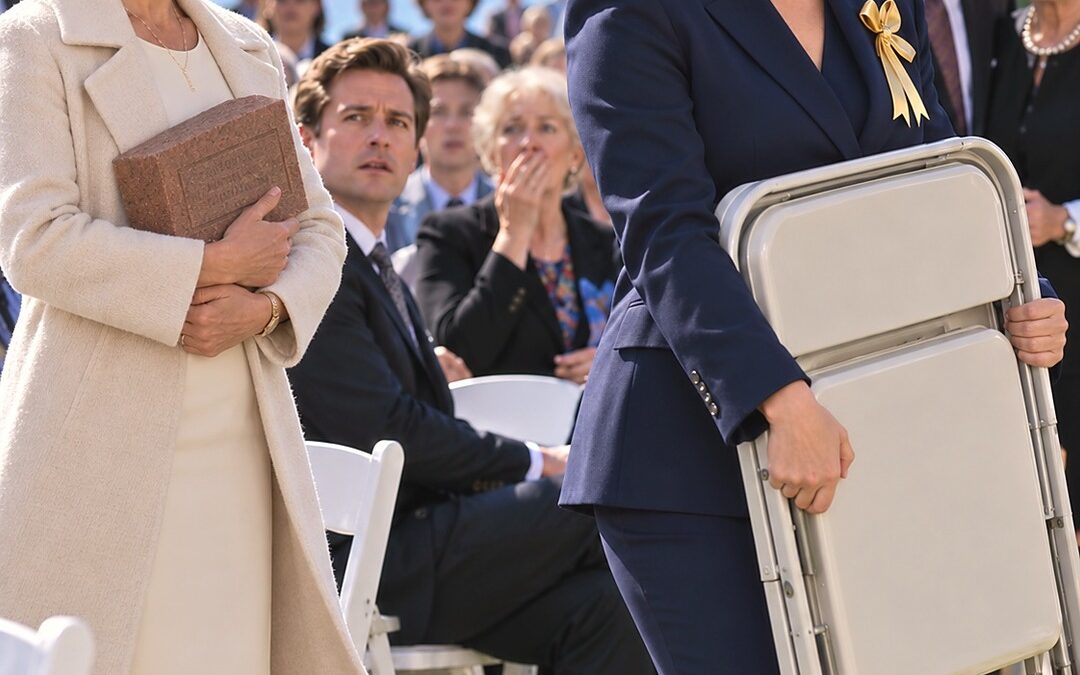
Part 1 — THE CHAIR BY THE FENCE
PART 1 — 10:21
At 10:21 on the morning of the hospital's Honor Walk dedication, my daughter-in-law stopped the program, lifted the microphone off its stand, and told three hundred and eighty people that she needed my chair for someone who had paid for one.
Then she smiled at me across ten rows of folding chairs and said, "It's a folding chair, Loretta. By lunch you won't remember where you sat."
She came down the row herself and folded my chair with a snap while I was still standing beside it, carried it to the fence, and my son, two chairs down, straightened the edge of his printed program.
The sound of that chair closing traveled better than it had any business traveling outdoors. It cracked across the lawn while the hospital flag pulled hard toward Lake Erie. Somewhere behind Row 8, somebody gave a short laugh and then stopped.
Whitney wore a navy blazer with a gold ribbon pinned high on the left side. EVENT CHAIR was printed down it in black letters. She had spent the morning moving between the podium and the front rows with the wireless microphone in her hand, checking photographers and telling Heather where the people worth photographing should stand.
I had arrived at 9:30 because Whitney told me to. Row 2, Chair 14. Heather was supposed to hold it for me, and she had done exactly that from the time I arrived until Whitney decided fifty-one minutes later that two Founders-level donors needed it more.
Phil and Joan Hadley were already crossing from the parking lot when Whitney reached my chair. Phil carried his suit coat over one finger. Joan wore black sneakers under a church dress and kept glancing between Whitney and the open place beside me, which told me nobody had warned her she was about to inherit an old widow's seat in front of several hundred people.
"Whitney, we can sit farther back," Joan said as she reached Row 2.
"Oh, absolutely not." Whitney gave her the smile she used on donor plaques. "We want our Founders where they belong."
A woman near the center said, "Oh, Whitney," with just enough volume to register disapproval without requiring her to actually do anything.
Whitney carried my folded chair across the grass toward the low east fence. She put it beside the white medical tent and turned it sideways so it wouldn't show much from the lawn. Then she walked back toward the microphone while I remained beside the patch of grass where my chair had been.
The Honor Walk ran straight through the center of the lawn toward a low platform at the north end. Six hundred and twelve memorial bricks were part of the dedication, though some hadn't been installed yet, and the newer sections of the path still showed pale mortar. Ten rows of folding chairs sat on both sides. The medical tent stood against the east fence beside a narrow lane left open for the medical team.
I had worked at Ottawa Shores for thirty-four years. I had seen that lawn used for blood drives, employee picnics and one disastrous summer fundraiser involving a rented dunk tank. I had never seen it hold three hundred and eighty people without at least four of them complaining about parking.
Marcus Delgado, the hospital CEO, sat in the first row with a program across one knee. Constance Aldridge, the Foundation board chair, sat beside him. Dr. Anita Rao was back in Row 6 wearing the good wool coat she saved for funerals and board meetings.
Anita started to rise.
I shook my head once.
She stopped with one hand on the back of her chair, watched me another beat, then sat.
Danny was two chairs from where mine had been. At thirty-six, he could still make himself look occupied when he wanted to disappear without leaving. He kept the program open on his knee and stared toward the podium.
I didn't call his name.
Whitney resumed the program. "Thank you, everyone, for your flexibility. This morning is about honoring the families who made the Harbor Heart Pavilion possible and remembering the people whose names will be part of Ottawa Shores for generations."
Metal chair legs scraped over the grass as people settled again. Phil Hadley remained standing beside the place Whitney had cleared until Heather brought another chair from the end of the row. Joan touched his sleeve and said something low enough that I couldn't hear it.
I could have remained right where I was and made everybody work around me. At sixty-two, I wasn't so delicate that standing on grass counted as an emergency. But Whitney had carried my chair to the fence in front of three hundred and eighty people, so I turned toward the fence and walked.
"One, two, three, four."
I count when things get noisy inside my head. On bad NICU nights, I counted ventilator breaths and chest compressions. On January 14, 2020, after Frank's heart stopped at home and there was nothing left for me to do except answer questions for people carrying equipment through my living room, I counted the square tiles between the kitchen and the front door.
"Five, six, seven."
My right heel sank into soft ground near the path. I stepped around fresh mortar.
"Eight, nine, ten."
At ten steps, Danny spoke from behind me. He hadn't left his row. He'd leaned just far enough toward the aisle to keep the people nearest him from turning.
"There's a car on the east drive if you want to go home, Mom."
I checked the little Timex on my wrist.
10:25.
Through a break beyond the medical tent, I could see the nose and front door of a black Lincoln parked on the east drive with its engine running.
"Thank you, I'll find it," I said.
Danny started to speak, but Whitney announced the next memorial family before he got anything out. He settled back into his chair.
I walked to the fence.
My folded chair was leaning against it. I left it that way.
The site plan called this Section C, the standing area for memorial families. There was no sign, no rope, nothing printed to tell a person where Section C began. I'd seen the map because Anita had shoved it under my nose weeks earlier while complaining that Development had put the coffee station too close to an electrical outlet.
The edge of my coat lifted toward the lake. I put the side of my shoe against one chair leg so the folded thing wouldn't tip.
Across the lawn, Whitney kept talking.
A little later, Heather Voss came along the brick path pushing a flatbed cart. A cardboard crate sat on it with HOLD written in thick marker above smaller words: memorial bricks, install next week. She moved quickly with both hands on the handle.
One cardboard flap bounced open.
I saw BANIK through the wooden slats.
"Heather."
She stopped the cart.
Heather was thirty-one and had worked for Whitney long enough to develop the expression of someone who expected every ordinary sentence to become a meeting invite.
"Mrs. Banik, I need to get these around back."
"My husband's brick is in there."
She glanced at the crate. "They're not being installed until next week."
"I can see that."
"Whitney ordered every non-donor family brick held until after the speeches." Heather shifted her grip on the handle. "She didn't want people carrying them around while the photographers were working."
"Frank's brick cost five hundred dollars."
Heather's lips pressed together.
I bent toward the crate.
The bricks were separated with torn pieces of cardboard so the faces wouldn't scrape. Frank's was halfway down. I knew it before I could read the whole inscription because I had argued with the engraver about whether there was enough room for the second line.
There was.
I lifted it out.
Four pounds of fired clay doesn't sound heavy until your dead husband's name is cut into it.
FRANK BANIK 1959–2020
HE HELD THE LADDER
I put my thumb against the L in LADDER and pressed until the nail went white.
"One, two, three, four, five, six, seven, eight."
Eight fence boards between me and the tent opening.
I counted them twice more.
Heather remained beside the cart. "Mrs. Banik?"
I eased my thumb off the brick.
"Whitney said hold."
"It's a brick, Heather. I'll hold it."
Heather gave a quick nod. "Okay."
I carried Frank's brick to the fence and placed it on the grass between my shoes, the inscription facing me. Heather pushed the cart toward the building. One wheel squeaked every time it turned, which seemed about right for equipment at a hospital fundraiser.
Three weeks earlier, on Sunday, September 13, Whitney had sat at my yellow kitchen table while Danny stood at the sink and told him, "She left the stove on twice."
I was sitting six feet away.
The stove had not been left on once, much less twice.
Danny turned from the sink. "Mom, just let us help."
On Saturday, August 22, Anita Rao had met me in a diner booth near Fremont and asked me to read a few words for Frank's brick at the dedication. She also offered me a front-row seat.
I said no.
She stirred one packet of Sweet'N Low into coffee she never drank and asked whether I was sure.
I said I was.
I kept the reason to myself.
On Sunday, September 27, Whitney came to my porch with a folder thick enough to require a binder clip. Durable power of attorney was printed across the top page.
I read until I reached the sections covering property and borrowing, closed the folder and put it beside me on the porch glider.
"Closing is October 5. Think faster," Whitney said.
I told her I'd think.
Then on Wednesday, September 30, my phone rang while I was cleaning the rubber gasket around the refrigerator door.
"Arrive at 9:30, Row 2, Chair 14. Heather will hold Chair 14 for you. It'll look lovely in the photos."
I wrote 2/14 on the back of a Kroger receipt and stuck it under the salt shaker.
At 10:36 that Saturday, I was still at the east fence with Frank's brick near my shoes when the man in the aisle chair closest to the medical tent reached inside his jacket.
I knew Walter Kerrigan by sight. Most people in Port Clinton did.
Kerrigan Marine Supply had sold half the docks along our side of the lake something they needed since before Danny was born. Walter also had his name on enough hospital donor walls that cleaning crews probably knew how to spell Kerrigan better than some of his relatives did.
He was seventy-nine. His chair had a clean route to the medical tent because he'd requested an aisle seat there on his cardiologist's orders.
His granddaughter, Mae, stood several feet away speaking to an older couple. Walter sat with his program closed over one thigh and brought a small brown bottle out of his jacket.
His hand shook.
I stopped following the speaker at the podium.
Walter turned the cap, tipped one tablet into his palm and put it under his tongue.
The clock over the hospital entrance showed 10:36.
His mouth looked gray around the edges. Sweat had gathered above his upper lip despite the fifty-two-degree air, and he was breathing through his nose with too much care.
I had seen that color in hospital hallways at three in the morning.
I watched his chest through ten breaths without moving my lips. He shifted in the chair and rested one forearm across his middle.
Mae returned. "You okay, Grandpa?"
Walter lifted one finger.
She crouched beside him. "Do you want me to get somebody?"
He shook his head and tapped the brown bottle.
From the platform, Whitney thanked Lakeshore Savings for sponsoring the printed programs. Applause moved through the rows.
I checked the medical tent.
Inside were a folding table, a navy equipment bag and one empty camp chair. No medic was at the opening.
I lifted Frank's brick and carried it several feet closer to the tent before setting it beside the fence again.
Walter's shoulders had dropped some. I watched another ten breaths.
Then I stepped inside the tent.
A young EMT I didn't know was kneeling beside an open supply case, counting packets.
"Can I help you?"
"Who's your paramedic?"
"Tyler's checking Row 9. Somebody got lightheaded."
"How long has he been there?"
She glanced toward the opposite flap. "Couple minutes."
"Tell him there's a seventy-nine-year-old gentleman in the aisle chair beside your tent. Gray around the mouth, sweating. He just took nitro."
She stood. "Mr. Kerrigan?"
"Yes."
"I'll get Tyler."
"Thank you."
She left through the opposite side at a fast walk.
When I returned to the fence, Walter was speaking to Mae too quietly for me to hear. She took a plastic bottle of water from her purse.
"No water yet," I said. "Give the tablet time."
Mae turned. "I'm sorry?"
Walter looked toward me. His eyes were clear.
"You're a nurse."
"Was."
"Same disease."
"Retired."
He gave one small nod.
Mae put the water away. "Do we need an ambulance?"
"He's awake and answering. Let's get the medical team over here."
Walter lifted his program. "I'm speaking at eleven."
"Then you have twenty-two minutes to behave yourself."
The corner of Walter's mouth moved. He checked the hospital clock.
The microphone popped at the podium. Whitney apologized and asked everyone to turn toward the north end of the path for a photograph.
Most of the front rows turned.
I remained near Walter.
A minute or two later, I saw the paramedic coming down the narrow lane from the far side of the tent. He wore navy EMS pants and a dark jacket, with a clipboard tucked under one arm.
Another guest intercepted him near Row 9.
He bent to listen.
Walter took two slower breaths.
I counted them.
The group photograph took longer than Whitney expected because half the people in Row 5 couldn't tell which photographer wanted them. She pointed toward a man near the platform.
"Right here, everyone. Eyes this way."
Mae had stopped making conversation with Walter. She stood beside his chair and watched his face.
At 10:42, I lifted Frank's brick and carried it into the medical tent.
The paramedic had just come through the rear flap. He put his clipboard on the folding table, saw me and stopped.
I knew him then.
"Tyler Brandt."
His eyebrows rose. "Mrs. Banik?"
Tyler had been about twenty-two when he did his NICU transport rotation at Ottawa Shores in 2015. He'd been all elbows and serious questions, the sort of trainee who checked the oxygen twice and then worried that checking it twice made him look unsure.
I hadn't seen him in years.
There wasn't time to catch up.
"Man outside. Walter Kerrigan. Seventy-nine. History of a stent if I remember the Foundation newsletter correctly. Gray at the mouth, diaphoresis, hand tremor. Took nitro at 10:36. Still alert."
Tyler reached for his equipment bag. "How's his breathing?"
"Regular. Too deliberate."
"Pain?"
"Didn't ask him to grade it. His granddaughter's with him."
Tyler picked up the bag.
Beyond the side flap, I noticed a low cart under a dark tarp near the fence.
"Your AED?"
He followed my glance. "On that cart."
"How far is your ambulance?"
He stopped.
I pointed toward Walter's chair. "I'm not asking because I enjoy event planning."
Tyler gave one short nod.
Outside, Whitney was introducing Constance Aldridge.
I stepped toward the tent opening.
"Retired RN. If you hear me counting out loud, bring the cart."
"Yes, ma'am."
Tyler slung the bag higher and went toward Walter.
I looked through the rear flap.
The medical exit lane ran from behind the tent toward the east drive. The space beside the building where I'd expect the ambulance was empty.
Tyler had taken three steps outside when he turned back.
"Mrs. Banik," Tyler said, "your daughter-in-law told us this morning she wanted the ambulance parked behind the building where the donors wouldn't have to look at it."
Part 2 — THE BRICK IN THE CRATE
PART 2 — SECTION C
Kayla called Tyler's name from Row 9 before I could ask why anybody running a hospital event would put its ambulance out of sight.
The woman who had gotten lightheaded earlier had gone down again beside her chair. Tyler turned toward the sound, took one quick look toward Walter Kerrigan, then said, "Stay with him."
"I wasn't planning a picnic."
Tyler ran across the grass.
Walter had his head against the chair and his coat open. Mae stood close enough to catch him if he leaned, though he was still sitting upright. The nitroglycerin bottle had disappeared back into his jacket.
I returned to the east fence and put Frank's brick between my shoes.
The program kept going.
A trustee thanked a local construction company. A photographer crouched in front of Row 1 and backed into a flower planter. Whitney crossed behind the podium with the microphone in one hand and her gold EVENT CHAIR ribbon flat against her blazer, keeping twelve pages of schedule moving while Row 9 had an EMT kneeling on the grass and Walter sat twenty yards away with sweat drying over his lip.
Hospitals are full of people who can ignore a bad sign if it isn't on their clipboard.
By 10:50, Anita Rao had left Row 6.
She crossed the lawn in her charcoal coat, taking the outside route instead of squeezing through seated guests. She stopped beside me, glanced down at Frank's brick, then at the folded chair Whitney had leaned against the fence.
"Development has finally found a clinical use for furniture."
That was Anita's joke.
"You should go sit down," I said.
"I was sitting down."
"You know what I mean."
"I do." She remained beside me and tucked one hand into her coat pocket.
Anita and I had worked nights together long enough to know when the other person had no intention of following advice. She became NICU medical director while I was still fighting Supply over why the smallest blood-pressure cuffs vanished every January. She also had a habit of buying yogurt on Monday and eating it the following Monday, which was not behavior I expected from a physician.
She watched the front rows. "Why did you let her do that?"
The question came without pity.
I followed Heather as she moved behind Row 8 with her clipboard. "In August, you asked me to sit in front."
"I did."
"I said no because I wanted to see whether Danny would save me a place without you giving me one."
Anita turned toward me.
"I found out."
A volunteer passed carrying a stack of programs. Anita let him go by before she reached into her coat and took out a folded run sheet.
"I got this yesterday afternoon."
She opened it against the fence.
Walter Kerrigan's name sat halfway down the page.
11:48 — MATCHING CHALLENGE.
Two lines below it was 12:00 — FOUNDATION ANNOUNCEMENT.
"The printed program says eleven," I said.
"I know. Walter asked me yesterday where he should wait afterward, so I checked."
"Who changed it?"
"This version came from Development."
Across the lawn, Whitney was talking to Constance Aldridge while Heather stood close enough to take instructions.
Anita touched the 11:48 line with one fingernail. "Forty-eight extra minutes is a lot for a seventy-nine-year-old man whose cardiologist gives him rules."
"Has he eaten?"
"I haven't asked."
"Neither have I."
I looked toward the aisle chair. Walter was speaking to Mae and seemed clearer than he had several minutes earlier, but his coat still hung open.
At 10:55, Tyler and Kayla came around the medical tent together.
The woman in Row 9 was upright now with a volunteer beside her. Tyler crossed directly to Walter and crouched in front of the aisle chair while Kayla opened the navy equipment bag.
"Mr. Kerrigan, I'm Tyler Brandt with Ottawa County EMS. Tell me what happened."
Walter touched the center of his chest. "Pressure here."
"When?"
"Ten thirty-five, maybe thirty-six."
Tyler asked whether he'd taken anything. Walter told him one nitro and said it had helped.
Kayla wrapped the pressure cuff around Walter's upper arm while Tyler took his pulse. Mae stood behind the chair.
"He has a stent," she said.
"2023," Walter added.
Tyler listened to his chest. "Any pain right now?"
"One. Maybe two."
"Out of ten?"
"That's what I meant."
Kayla read the blood pressure and gave Tyler the number too low for me to catch over the loudspeaker. Tyler listened, then rested his clipboard against one knee.
"I'd like you transported."
Walter looked toward the platform. "I'm speaking at eleven."
Anita held the revised run sheet where he could see it. "You're not. They moved you to 11:48."
Walter read the line. "Who did?"
"Development."
His attention shifted toward the platform, but he didn't ask for Whitney.
Tyler took a form from his clipboard. "Mr. Kerrigan, I still recommend transport."
Walter held out his hand. "After the match, young man."
Mae bent closer. "Grandpa."
"I heard him." Walter looked at her. "I know."
He signed the refusal form.
Tyler went through the consequences and orientation questions without rushing him. Walter named the hospital, gave the date and identified the president, then added enough information about the president that Tyler finally lifted one hand.
"All right. I believe you're oriented."
Walter returned the clipboard and tucked the pen under its metal clip.
I asked when he'd last eaten.
"Six."
"This morning?"
"I was told I'd speak at eleven. I don't like eating before these things."
Anita lowered the run sheet. "No one told you they changed it?"
"No."
Tyler reached into his jacket pocket, pulled out a granola bar and broke it in half. He handed one piece over.
Walter inspected it. "Medical cuisine?"
"Eat half slowly."
Walter took a bite, wrapped the rest and put it in his jacket.
Tyler rose. "We're staying close."
He crossed to the medical tent and pulled the tarp off the low cart. The AED sat on the top shelf with a red trauma bag underneath.
He rolled the cart to the fence post, two steps from Walter's chair. Kayla loosened the tarp so one pull would uncover the equipment, then took her place beside the medical exit lane.
Tyler keyed the radio clipped near his shoulder.
"Event medical to dispatch. Move the ambulance up to the east service lane."
Static snapped once.
A man's voice answered, one I recognized as Delgado's deputy from staff meetings even before he identified the event desk. "Negative. Site plan has the ambulance behind the main building until program end. That's the signed placement."
Tyler pressed the radio button again. "Medical is requesting it closer."
Another pause.
"Copy. Mr. Delgado is at the podium. We hold the signed plan unless command changes it."
Tyler released the radio.
I looked across the lawn. Delgado was near the north platform listening to the current speaker.
Tyler did not argue over the radio. He pulled the AED cart six inches closer to the fence post instead.
Walter watched him. "You planning something?"
"Planning not to."
Walter opened his program.
Anita went toward the center aisle to speak to Delgado, but a Foundation volunteer intercepted him before she reached the first row. Delgado was pulled toward the platform steps for the next introduction. Anita stood there for several breaths, then came back to Section C.
The applause from the lawn rose and fell twice while we waited.
Walter ate another bite of the granola bar. Mae kept the wrapper when he handed it to her.
One of the hospital photographers came close enough to Section C to photograph Walter from the side. I moved half a step so Frank's brick blocked the photographer's clean angle on me. He frowned at his camera and went somewhere easier.
Near eleven, the air off the lake cut through the opening beside the tent. I stepped around the rear canvas to get out of it.
The strip behind the tent was narrow, pavement on one side and grass on the other. Two unopened cases of bottled water sat beside an extension cord. The main building blocked enough of the lake air that I could finally feel my fingers again.
At 11:02, I heard Whitney's heels on the paving.
I started toward the corner.
Then she spoke.
"Gina, one o'clock, my house."
I stopped behind the tent.
Whitney had a phone to her ear as she passed the far edge of the canvas. Through the gap, I could see the lower half of her navy blazer and the gold ribbon on her chest.
"Yes, she'll be there."
She listened.
"No, Danny knows about the car."
My fingers closed around the inside of my coat pocket.
"She'll be too tired to read all of it."
The tent fabric tapped lightly against its frame.
"If she won't sign, the county already has the referral and Monday I file."
Two steps from me, Tyler was coiling oxygen tubing on the folding table.
He stopped.
Whitney's voice stayed low.
"By Monday we're on the water."
She listened again, then said the sentence clearly enough that Tyler's head came up.
"I made sure the whole front half watched her get moved."
Tyler set the tubing down.
Whitney kept walking. "Just be there at one, Gina."
Her heels crossed the paving and faded toward the platform.
Tyler turned toward me. "Mrs. Banik."
"Don't." I passed him and went back around the tent.
Frank's brick was where I'd left it, with the inscription facing the fence. Walter remained in the aisle chair while Mae held the granola wrapper and watched him finish another bite.
I stood beside the brick.
Anita looked at my face and then toward the rear of the tent. "What happened?"
"Later."
She accepted that.
Whitney returned to the platform and handed something to Heather. The gold ribbon was still pinned straight on her blazer. She spoke briefly to Constance, then went to the microphone stand while Heather headed toward Row 2.
Danny was sitting where he'd been all morning.
Heather bent near him and spoke too quietly to carry.
Danny looked toward Whitney.
Then toward Section C.
He stood and followed Heather to the platform.
Anita shifted her weight beside me. "What's this?"
"I don't know."
Whitney met Danny at the steps and spoke to him before he went up. He took his place several feet behind her.
At 11:10, Whitney lifted the microphone.
"We have a special family with us today."
People turned toward the platform.
She spoke about service and family support, about the people who carried other people through difficult years. Then she introduced Danny as "the son who carries this family."
Applause started in the first rows and spread toward the back.
Danny looked down and straightened the edge of his printed program.
I counted four fence boards.
One, two, three, four.
Whitney waited for the applause to settle. Then she smiled toward Section C.
"If you see my mother-in-law wandering, please bring her back to us," Whitney said into the microphone. "She gets disoriented in crowds, bless her."
Part 3
PART 3 — THE LINCOLN
Four minutes after Whitney told the whole lawn I got disoriented in crowds, people had started watching me instead of the program.
A man in Row 4 turned far enough around to see me beside the east fence and said, "Poor thing," to the woman next to him. Two women nearer the brick path looked at Frank's brick between my shoes, then back toward the platform when they noticed me watching them.
Constance Aldridge wasn't paying much attention to the speaker either. She sat near Marcus Delgado with her program open, but her forehead tightened while she studied Section C. When Whitney left the microphone to let the next speaker continue, Constance followed her movement instead of the podium.
Danny had returned to Row 2 after the applause. He sat with the program open on one knee.
Anita stood beside me at the fence. When she drew breath, I said, "Don't."
"I haven't said anything." She tucked her chin farther into her coat.
"You were about to."
"I was considering several things."
"Consider quietly."
She did, and the man at the podium continued talking about cardiac imaging while people in the back rows kept turning around to check whether I had wandered anywhere new.
A volunteer in a red hospital jacket came toward us carrying a paper cup. She was probably in her late fifties, somebody I recognized from auxiliary fundraisers without knowing her name. She slowed before reaching me and asked whether I'd like help getting inside because there were chairs in the lobby.
"No, thank you. I'm fine here."
She looked toward Anita as if a physician might need to verify that I'd understood the question.
Anita said, "She answered you."
The volunteer nodded and left with the cup still in her hand. Halfway back to the chairs, she stopped beside a woman from Row 7 who had also been looking my direction. The second woman glanced at Frank's brick, then came toward us and asked if she could carry it for me.
I told her I had it.
She gave me the careful smile people use when they've already decided what your answer means and returned to her seat with the volunteer. Between the two of them, they had offered me a chair and a brick carrier in under three minutes. Another five and somebody would have been checking whether my shoes were tied.
I counted the fence boards instead.
"One, two, three, four, five, six, seven, eight."
I did it twice more until I could hear the speaker clearly again.
Tyler stayed near Walter's aisle chair without hovering over him. Kayla had positioned herself beside the medical exit lane. Walter sat upright with Mae close by and the half granola bar tucked into his jacket.
Whitney passed behind the front row. Heather followed several steps behind with her clipboard, paused long enough to take in my folded chair and Frank's brick, then went on.
Danny turned around from Row 2.
For two heartbeats he met my face.
Whitney said something to him from the aisle, and he faced forward again.
A few minutes later, I bent and lifted Frank's brick from the grass. Anita shifted beside me.
"Where are you going?"
"To look at the car."
"You want company?"
"No. I'll come back."
Anita watched me start toward the east drive and didn't follow.
The black Lincoln was exactly where it had been earlier, clean enough to reflect the white medical tent along its side. The engine was running, and a Lakeshore Livery placard sat inside the windshield.
Leon Pruitt got out when he saw me approaching.
He was sixty-six, silver-haired, with a navy windbreaker zipped to the throat. He opened the rear passenger door before I'd said anything.
"Mrs. Banik?"
"That's me."
I stopped beside the door. "You were expecting me."
"Yes, ma'am."
"Who hired you?"
Leon hesitated.
I set Frank's brick carefully on the grass beside the curb. "I'm not asking for trade secrets, Mr. Pruitt."
His eyes flicked toward the lawn. "The booking came through yesterday."
"From whom?"
"Mrs. Whitney Banik."
I asked when. He said it had been a little after four in the afternoon.
The hospital clock showed 11:25.
"Where are you supposed to take me?"
"Quail Hollow."
That wasn't my address. Danny and Whitney lived at 61 Quail Hollow Drive.
Leon kept the rear door open. "I can call the office if there's been a mistake."
"There hasn't."
I got into the back seat.
The door shut with the heavy sound expensive cars make, and the inside smelled faintly of leather cleaner and peppermint. There was a folded newspaper in the passenger footwell and a phone charger wound neatly around the center console. Leon ran a tidy car. Frank used to leave wire nuts in every cup holder we owned.
Leon got behind the wheel but left the Lincoln in park.
"Quail Hollow, ma'am?"
I looked through the side window at the medical tent.
From the car, the Honor Walk seemed smaller. I could still see Whitney's gold ribbon whenever she moved near the platform. Danny was another dark coat among the chairs.
I had spent six years alone in the brick ranch on Elmwood Court after Frank died. The mortgage was gone. The gutters needed work. One cabinet door under the sink still required a little lift before it would close, because Frank had been saying he'd fix the hinge since 2017.
My pension was $2,310 a month.
The house was mine.
Whitney had brought me a paper that could change that. Now a hired Lincoln was waiting to take me to her house.
I closed my eyes.
"One. Two. Three, four, five."
Leon watched me through the mirror but didn't interrupt.
I counted to forty.
Someone crossed behind the car carrying two folding signs. Whitney's voice came faintly through the outdoor speakers. Leon kept both hands on the steering wheel and waited.
"Thirty-eight, thirty-nine, forty."
I opened my eyes.
The other rear door opened at 11:28.
Danny got in and shut it behind him, leaving the width of the middle seat between us.
Leon glanced into the mirror. "I can step out."
"No," I said. "You were hired to drive. You can hear why you aren't."
Danny looked down at his hands.
"Mom."
I turned toward him.
"It's one signature, Mom. Gina's a notary. It's just a power of attorney. If you ever had an episode—"
"How many episodes have I had?"
He rubbed one palm over his trouser leg. "That's not exactly the point."
"It was your point when you started the sentence."
"Whitney thinks you're taking risks."
"What risks?"
"Living alone."
"I've lived alone since your father died."
"I know."
I asked about driving. He said that wasn't what he meant. I asked whether I'd missed bills or appointments. He said no to both and then tried to tell me we were getting off track.
"So put me back on it," I said.
Danny looked past me toward the hospital lawn. "We just want things set up before there's an emergency."
"Whose emergency?"
"Mom."
"Mine?"
He didn't answer.
The printed program was still in his hand. He put it on the seat between us.
I said, "Did you read the paper she brought me?"
"Some of it."
"How much?"
"The first page."
"The first page says durable power of attorney."
"I know what it says."
"The borrowing authority isn't on the first page."
Danny looked directly at me.
"You didn't read that."
"I was going to."
"When?"
"Mom, Whitney handles this kind of paperwork all day."
"Whitney raises money all day."
"That's not fair."
Leon focused very hard on the windshield. He had the expression of a man who had spent enough years driving other people's families around to know that becoming invisible was sometimes part of the fare.
Danny said, "Can we not do this in the car?"
"You came into the car."
"Because I saw you get in."
"And?"
He looked toward the opposite window. "I didn't want you leaving upset."
"Where did you think Leon was taking me?"
Danny rubbed the seam of his coat pocket. "Home."
"Mine?"
He didn't answer that.
I let the question sit between us while Whitney's amplified voice drifted faintly through the closed windows.
Then I said, "Anita offered me a front-row seat in August."
Danny turned back. "At the dedication?"
"Yes."
"You never told me."
"No."
"Why?"
I looked through the windshield. "I wanted to see whether you'd make a place for me without somebody important telling you to."
He stared at me.
"Mom."
"I told Anita no in August. I wanted to see if you'd save me a seat."
Danny shook his head slowly. "You tested me."
"Yes."
"That's…"
"Petty?"
He lowered his gaze.
"Probably," I said. "I still did it."
He shifted toward me. "You could've asked."
"I could have."
"You know what Whitney's like when she's running an event."
"I do."
"She has donors pulling her everywhere. The board. Heather. Marcus."
"There wasn't a seating chart with my name on it."
Danny stopped.
He reached for the program on the seat but didn't pick it up.
"I wanted one thing from you," I said. "I wanted you to notice."
He stared through the windshield. "I thought Heather had it handled."
"Heather did."
The Lincoln's heater clicked off.
For years, Danny had handled insurance claims. He could sort photographs of hail damage from old dents, read repair estimates and catch the one number somebody hoped he wouldn't check. Put six contradictory statements in front of him and he could spend an afternoon deciding who had backed into whom.
He had read one page of Whitney's folder.
I picked up my purse.
Danny leaned forward. "Mom, don't leave like this."
"You didn't make room for me. You made a car."
His face went still.
I reached for the door handle.
"Mom, wait."
I got out.
Cool air hit the inside of the car. Frank's brick was still beside the curb, inscription facing up.
Leon stepped out from the driver's side.
I lifted the brick and said, "Go home, Mr. Pruitt, you've been paid."
He looked toward the open rear door. "Ma'am, I can take you anywhere you want."
"I know where I'm going."
Leon nodded.
I started toward the lawn.
Behind me, Danny said, "Leon, hold on."
I turned once.
Danny climbed out of the Lincoln. He stood beside the open door with the printed program in his hand.
Leon waited until Danny shut it.
Then the black Lincoln rolled down the east drive empty.
Danny remained beside the curb.
I continued toward Section C.
When I reached the fence, Anita looked past me toward the departing car, then at the brick in my hands.
"Did you go?"
"No. Danny got out too."
She nodded and left it there.
Walter Kerrigan was still in the aisle chair. His program was closed now, and Mae stood nearer than she had before. Tyler had moved close enough to reach him in a few steps, while the AED cart remained against the fence post.
The presentation had moved on to a local contractor. Whitney stood beside the platform with Heather, listening with half an ear while looking around the lawn.
Danny crossed the grass from the east drive.
He did not return to Row 2.
He stopped near the back row and remained there.
Whitney saw him.
Even at that distance, I could tell the change registered. Heather stepped close and spoke to her, and Whitney answered without taking her attention off Danny.
Tyler approached Walter and asked him something too low for me to hear. Walter pointed toward the podium.
Tyler went to the AED cart and checked its position.
I set Frank's brick beside the fence and watched the platform.
The hospital clock moved toward 11:38.
The air coming off Lake Erie had found the gap at my collar, so I headed for the sheltered side of the medical tent. Anita remained near Section C.
At 11:38, I rounded the corner.
A gold ribbon appeared at the tent flap.
Whitney stepped into my path, her smile still in place.
"There you are. Walk with me. Gina will be at my house at one, and I am running out of ways to be kind about it."
Part 4
PART 4 — THE AISLE CHAIR
At 11:38, Whitney stood behind the medical tent with the gold EVENT CHAIR ribbon pinned to her blazer and ten minutes left before Walter Kerrigan was supposed to be called toward the platform.
I held Frank's brick against my coat. Behind Whitney, the narrow strip of pavement ran toward the east drive. A roll of orange extension cord sat under the tent wall, and one unopened case of bottled water had split at a corner so two bottles had worked loose onto the pavement.
Whitney glanced toward the tent opening before she spoke. Anita was still at the east fence. Tyler was near Walter's aisle chair. Danny had remained behind the last row after getting out of the Lincoln.
"Do you know who gets sent to check on women like you?"
"The county, apparently."
Her smile stayed in place. "They take concerns about vulnerable adults seriously."
"So do I."
"You make everything harder than it needs to be, Loretta."
I lowered Frank's brick to the grass beside the tent wall, away from the flap. A tent stake had pulled half an inch out of the ground nearby. I pressed it down with the edge of my shoe.
"What did you tell them?"
"I told them I had concerns."
"About my stove?"
"Among other things."
"The stove I didn't leave on."
Whitney gave me the patient look hospital administrators use when they've already decided the meeting is over but you're still in the chair.
"You live alone," she said. "You refuse help."
"I refused your paper."
"You refuse a lot of things."
"That happens."
Applause came from the lawn. Through the thin canvas, somebody at the podium thanked another sponsor, and several chairs dragged over the grass as people turned toward the speaker.
Whitney lowered her voice another notch. "This can become very unpleasant."
"It already has."
She checked her watch.
"At noon I will be Vice President, and by Monday I will have a window on the water."
She said it without the microphone smile. No soft voice for donors. No "bless her." Just a statement she had apparently practiced enough to believe.
Through the opening behind her, I could see Walter Kerrigan in the aisle chair.
Mae stood close to his right side. Tyler was several feet away, his attention on Walter instead of the platform.
Walter leaned forward.
His hand went inside his coat.
It came back empty.
He planted that hand on his thigh and took one measured breath, then another.
"Look at the man in the aisle chair, Whitney."
She turned enough to see him. "Mr. Kerrigan is fine. He told me himself."
"He took nitroglycerin at 10:36."
"The medical team is right there."
"His speech was supposed to be at eleven."
"We had to move things."
"Forty-eight minutes."
"Event schedules change."
"Heart conditions are less flexible."
Whitney looked back at me.
I nodded toward Walter. "Did anybody ask whether he'd eaten?"
"What does that have to do with this?"
"He hasn't eaten since six."
"Then his granddaughter can get him something."
"Tyler already did."
Whitney glanced toward the medical tent. "So he's being looked after."
"The ambulance is behind the building."
That stopped her.
"It has access through the service lane."
"It also has a building in the way."
"Tyler knows where it is."
"He asked to have it moved closer."
Whitney's expression did not change, but she took half a step toward the lawn.
I had spent too many night shifts listening to people call a situation stable because the next number hadn't dropped yet. A person can make a lot of bad decisions while technically remaining stable.
Whitney straightened the microphone pack clipped at her waistband. "I have a program to run."
"You do."
"And you are standing exactly where the site plan says memorial families can stand."
I looked toward the folded chair leaning against the fence.
"I noticed."
She followed my glance, then looked at me again.
"Stay at the fence where you belong."
Whitney walked around the tent.
Her heels reached the brick path, then faded toward the platform. A few seconds later I heard her greet somebody in the polished voice she'd been using since morning.
I stepped through the tent flap.
Inside, Tyler was at the folding table with a roll of medical tape in one hand. A blood-pressure cuff lay open beside the navy bag. Kayla had left a pair of gloves on top of a plastic case, fingers hanging over the edge.
Tyler set the tape down.
He didn't ask what Whitney had wanted.
Instead, he reached into his back pocket and took out his wallet.
"What?"
He opened it and worked something loose from behind his driver's license.
The index card had almost stopped being a card. Its corners were rounded. The center crease had gone soft from years of folding, and the paper near one edge had thinned enough for blue ballpoint to show through.
Tyler handed it to me.
"Count out loud. Someone is always listening. —L.B."
My handwriting.
I took it with two fingertips. My thumb rested on the faded ink beside the initials.
"My handwriting was better then."
Tyler smiled. "You were working nights."
"That excuses the penmanship."
"You made me restart a compression count because I was doing it in my head."
"You were a student."
"I was twenty-two."
"Those can happen at the same time."
He took the card back carefully, folded it along the old crease and returned it behind his license.
"Why keep it?" I asked.
"Because you were right."
Kayla appeared at the opening. "Four minutes."
Tyler looked through the flap toward the hospital clock, then toward Walter.
"We're moving the cart."
He went out first.
I followed.
Walter was still seated, but Mae had taken his program and folded it against her chest. He had both feet square on the grass now, as if he planned to stand soon.
Anita was several feet behind his chair.
Tyler stopped beside Walter. "Mr. Kerrigan, we're taking the AED closer to the platform while you speak."
Walter glanced at the cart. "Put it wherever you can reach it."
Tyler nodded.
Kayla pulled the tarp loose. Tyler gripped the handle, and together they rolled the cart away from the fence.
One wheel caught in a shallow rut.
The AED case jumped against the metal shelf.
Kayla caught it before it shifted farther, then walked beside the cart with her palm hovering near the top while Tyler guided it toward the north end.
Ten steps from the podium, they stopped.
Kayla folded the tarp back completely.
The AED sat exposed on top. The red trauma bag remained strapped beneath it.
A man in Row 1 noticed the cart and leaned toward the woman beside him. She turned, looked at Walter, then faced forward again.
Whitney stood beside the podium with Heather.
Her attention settled on the AED cart.
Heather followed her gaze.
Whitney said something I couldn't hear. Heather looked toward Tyler, then down at her clipboard.
Neither woman came over.
I returned to Section C and set Frank's brick beside the folded chair.
The chair had begun to sink slightly into the soft ground on one side. I pulled the lower leg free with my shoe and leaned it flatter against the fence so it wouldn't fall over during Walter's speech.
Anita came up beside me.
"You going closer?"
"When he does."
She looked toward the aisle chair. "I'll stay near here."
Constance Aldridge reached Walter next.
"We're almost ready for you."
Walter held out his hand, and Mae helped him stand.
He stayed beside the chair while he got his feet under him. His shoulders rose with one careful breath. Mae kept a hand ready at his elbow without pulling him anywhere.
"I'm walking," Walter said.
"I know."
She stayed where she was.
Walter fastened one button on his jacket and looked toward the platform.
His mouth still had that gray edge.
I watched Tyler notice it too.
He moved closer to the AED cart and unzipped the top of the red bag about four inches, leaving it ready.
Kayla checked the path between the cart and Walter.
There were two folding-chair legs sticking farther into the aisle than the others. She crouched, shifted one chair back several inches and then did the same with the next. The guests sitting there moved their shoes without being asked.
Hospital people do certain things automatically when they expect trouble. Clear a route. Bring the equipment close. Figure out who is going to be in your way.
Whitney stepped to the microphone.
"Our next speaker needs very little introduction in Ottawa County."
Walter said something to Mae too low for me to catch.
She lowered her head, but whatever it was stayed between them.
Whitney continued. "For decades, Kerrigan Marine Supply has helped keep families, businesses, and visitors connected to the lake that defines this community. Its founder has supported Ottawa Shores through expansions, equipment campaigns, and patient programs."
Walter leaned toward Mae.
"If she reaches my kindergarten teacher, interrupt her."
Mae pressed her lips together and kept her place beside him.
Whitney continued without noticing.
"Today he is here to announce a challenge gift that can bring the Harbor Heart Pavilion within reach of its campaign goal. Please welcome Mr. Walter Kerrigan."
Applause moved across the lawn.
Walter started toward the platform.
Mae stayed at his elbow.
He walked slowly, putting each foot down before bringing the other one forward. Tyler followed several yards behind, far enough back that Walter was still walking to his own microphone and not being escorted by EMS.
Kayla remained beside the AED cart.
I left Section C.
Anita saw me go and stayed near the fence.
I walked down the brick path between the rows.
People shifted their knees as I passed. Several of the same faces that had turned around when Whitney called me disoriented now watched me head toward the platform without offering to escort me anywhere.
The man in Row 4 who had said "Poor thing" lowered his program into his lap.
Danny stood near the back.
"Mom?"
I kept moving.
He did not follow.
Near the front, I could see Walter more clearly.
His steps were shorter than they had been when he left the chair. Mae said something to him. He answered without stopping.
The AED cart was off to my right.
Tyler had one hand resting near its handle.
Walter reached the foot of the platform and stopped beside the podium. A folding chair had been placed a few feet away for him, but he remained standing.
Mae stepped aside for the photographer.
Walter took one breath with his lips parted.
Whitney offered him the microphone.
He took it.
At 11:48, the applause ended.
Walter looked over the lawn.
His free hand settled against the edge of the podium.
I watched the pulse move once at the side of his neck.
"Four hundred thousand dollars, and I'd like it to go to—"
Walter Kerrigan stopped in the middle of the word and sat down on the grass instead of the chair.
Part 5
PART 5 — THE CART
At 11:49, Walter Kerrigan reached the grass before the microphone did.
I was moving before Mae called his name. Walter's right hand opened beside him, and the microphone rolled once against the podium leg.
I went down on my knees and put two fingers to his neck. Nothing useful.
"Bring the cart. Get the ambulance up here."
Tyler turned toward the AED.
Kayla already had her radio in her hand. "Event medical to ambulance. Cardiac arrest at the north platform. Come now."
I put the heel of one hand in the center of Walter's chest and started.
"One, two, three, four."
The numbers carried over the lawn.
At ten, Mae dropped to her knees near her grandfather's head. At eighteen, somebody in the front rows stood too fast and knocked a folding chair backward.
"Twenty-eight, twenty-nine, thirty."
I stopped long enough for Tyler to get into position.
He checked Walter, then looked at me. "Go."
I started the second cycle.
"One, two, three."
Tyler handled the airway while Kayla dragged the AED cart over the uneven grass. One wheel caught near the edge of the brick path, and she hauled it free without slowing.
A little boy in Row 7 asked, "Is he okay?"
His mother pulled him close and turned his face toward her coat.
"Twenty-eight, twenty-nine, thirty."
Kayla dropped beside us and opened the AED case.
"Pads."
Tyler moved Walter's jacket out of the way while I started again.
"One, two, three."
Kayla placed the first pad, then the second between compressions. She had to move the wire clear of my wrist once.
The machine began analyzing.
Tyler said, "Clear."
I came off Walter.
Mae remained near his head with one hand pressed into the grass.
SHOCK ADVISED.
The words came from the machine loud enough for the first several rows to hear them.
Whitney stood beside the podium with one hand on the microphone stand.
Danny had come forward from the back rows and stopped near the brick path.
Constance Aldridge stood beside her chair.
"Charging," Tyler said.
Walter's open program had landed near his shoulder. One page kept lifting and falling against the grass.
At 11:51, Tyler called, "Clear."
One shock.
Walter moved under the pads.
I went back to work immediately.
"One, two, three, four."
Mae's breath caught once beside me.
I kept the rhythm.
"Twenty-eight, twenty-nine, thirty."
Tyler ventilated while I reset my hands and began another cycle.
"One, two, three."
Kayla spoke into her radio again. "Where are you?"
Static answered, then a voice said they were coming around the main building.
I counted.
At fifteen, the ambulance still wasn't visible.
At twenty-four, a man near Row 5 lifted his phone. The woman beside him caught his sleeve, and he lowered it.
"Twenty-eight, twenty-nine, thirty."
Tyler checked Walter again.
"No pulse. Continue."
I started the next thirty.
Somebody behind me was crying. A program dropped onto the grass near the first row, and a volunteer bent to pick it up before deciding to leave it there.
"Twenty-nine, thirty."
The ambulance finally appeared from behind the main building at 11:52.
It came down the service lane fast and stopped beyond the medical tent because the rows of folding chairs blocked a straight approach to the platform.
Two crew members brought the stretcher.
I kept counting.
"One, two, three."
The new crew opened equipment beside Tyler. Kayla gave them the short version while I worked.
"Twenty-eight, twenty-nine, thirty."
Tyler reached for Walter's neck.
"Hold."
I lifted my hands.
His fingers stayed at Walter's neck longer this time.
Mae leaned closer.
"Again," Tyler said.
I restarted.
"One, two, three."
The crowd had gone quiet enough that I could hear the AED fan and Mae breathing beside Walter's head.
At 11:53, Tyler reached in again.
"Stop."
I stopped.
Walter coughed.
Mae bent close. "Grandpa?"
His left hand lifted a few inches and landed against her wrist.
Tyler checked his neck again. "Pulse."
I sat back on my heels while the stretcher crew moved in.
Walter's eyes opened partway. He found Mae.
"I'm here," she said.
He tried to speak, but Tyler leaned closer. "Don't talk yet."
The crew transferred Walter to the stretcher. I backed away far enough to let them work and got one foot under me.
Anita was nearby.
She looked at Walter, then toward the route the ambulance had just taken around the building.
Danny stood several yards away with the printed program still in his hand.
Whitney had moved to the side of the platform.
The microphone was no longer in her hand.
Walter was on the stretcher by 11:58. Mae walked beside him as the crew pushed toward the medical lane.
Constance called, "Walter."
He lifted two fingers from the blanket.
The stretcher disappeared behind the tent.
People started speaking again, low at first. A volunteer righted the chair that had gone backward in Row 2, then checked the one behind it for damage as if Ottawa Shores might deduct the replacement cost from his check.
I went back toward Section C.
Frank's brick was still beside the fence. Dirt had gotten into the first R in FRANK, so I brushed it out with the side of my finger and left the brick where it was.
At 12:03, Whitney took the microphone.
I don't know who gave her permission to resume. She stepped onto the low platform with the gold ribbon still pinned to her blazer and waited until enough faces had turned toward her.
"Thank goodness." Her voice came through the speakers. "Loretta, you really shouldn't strain yourself, with your memory—"
A woman in Row 7 stopped halfway into her chair.
Tyler had been taking the AED cart back toward the tent. He stopped, turned it around and brought it to the open space in front of the platform.
Whitney lowered the microphone.
Tyler stepped forward.
"Ma'am, I'm a paramedic. She's a retired RN, thirty-four years in the NICU."
Someone in Row 3 turned all the way around to look at me.
Tyler pointed toward the cart.
"She told me at 10:42 what to watch for. I rolled the cart to the fence myself."
Whitney tightened her grip on the microphone.
Tyler continued. "At 11:02 I heard you say, 'I made sure the whole front half watched her get moved.'"
A murmur moved through the first rows.
Whitney raised the microphone. "Sir, this is not the time—"
Marcus Delgado stood.
"Let him finish."
Whitney turned toward him.
Delgado remained beside his chair while Tyler spoke.
"Mr. Kerrigan took nitroglycerin before we examined him. He refused transport while he was alert and oriented. We kept the AED close because Mrs. Banik saw the warning signs before I got there."
Joan Hadley looked toward the east fence.
The chair Whitney had folded was still leaning there.
Heather stood in Row 3.
She didn't have her clipboard anymore.
"Mrs. Banik."
Whitney looked toward her.
Heather stepped into the aisle. "You told me Wednesday to hold Chair 14 for her."
Joan turned toward Phil.
Heather took another step.
"You also told me to keep the Hadleys in their car until exactly 10:20."
Phil stared at Whitney.
Heather looked at me. "I'm sorry, Mrs. Banik."
Whitney brought the microphone closer. "Heather, we can discuss staffing later."
Heather sat down.
She didn't look at Whitney again.
Danny came out from near the back row.
He stopped beside the brick path.
The program was in his right hand. His thumb ran once along its edge and stopped.
Whitney said his name.
"Danny."
He looked at me instead of her.
"I knew the car was waiting."
A man near him shifted sideways in his chair so he could see.
Danny continued, slower. "I told myself it was transportation. I knew Mom hadn't asked for it."
Whitney lowered the microphone an inch.
Danny's mouth opened, and nothing came out.
He looked toward the grass.
That was all he had in front of three hundred and eighty people.
I walked toward the podium.
A photographer stepped backward to clear the path. The small red light on his camera went dark when he lowered it.
Whitney still had the microphone.
I held out my hand.
She gave it to me.
I stopped six feet from her.
The speakers picked up one breath before I spoke.
"I did forget where you wanted me to sit, Whitney. I haven't forgotten how to start a heart."
Whitney's right hand went to the gold ribbon on her chest and smoothed it flat twice, as if it were still pinned where it belonged. She did not look down at the three hundred and eighty faces.
Constance Aldridge left the first row.
She walked up the center aisle at an ordinary pace. A man pulled his knees in so she could pass, and Joan Hadley moved her purse off the aisle chair.
Constance held out her hand for the microphone.
I gave it to her.
She faced Whitney and unpinned the gold EVENT CHAIR ribbon from her blazer.
The pin clicked against the microphone.
Constance held the ribbon at her side.
"The announcement scheduled for noon will not be made today."
Whitney looked toward Marcus Delgado.
A program in Row 3 slipped from somebody's lap and landed faceup on the grass. The noon announcement was still printed there.
Delgado stepped into the aisle.
"You are suspended, effective now. Mr. Hargrove will walk you inside."
Ray Hargrove was already at the platform steps with his hospital security jacket zipped halfway up.
"This way, ma'am."
Whitney remained beside the podium.
"Marcus, I think we need to talk privately."
"We will."
"Today."
"Inside."
One photographer lowered his camera.
Whitney looked toward Danny.
He kept his place beside the brick path.
Ray moved one step toward the doors. "This way, ma'am."
Whitney came down from the platform.
The people in the front row pulled their feet back to clear the aisle. Two women on the end seats leaned toward each other as Whitney passed.
Heather watched from Row 3.
Joan Hadley did too.
Near Row 6, Anita moved aside and left the brick path open.
Whitney walked toward the main building with Ray several paces behind her. His hands remained at his sides.
At the glass doors, Whitney stopped.
She looked back across the lawn.
I was beside the podium.
The gold ribbon was in Constance Aldridge's hand.
At the east fence, Frank's brick sat beside the folded chair.
Ray opened the door.
Whitney went inside.
By 12:14, Constance had the memorial list on the podium and the ribbon beside it.
"We're going to finish what we came here to do."
People settled back into their chairs.
Constance read the first name on the Honor Walk.
Then another.
I walked back to Section C.
Anita returned to the fence. Tyler and Kayla were packing the AED cables back into the cart, and one of the empty pad wrappers was trapped under a wheel.
Danny followed me.
I bent and lifted Frank's brick.
The engraving faced up in my hands.
Constance read another name.
Danny stopped at my elbow and spoke low enough that the microphone could not catch him.
"Mom, Monday at nine a woman from the county is coming to your house. Whitney called it in Thursday. She told me Friday night. I knew."
Part 6
PART 6 — THE LEVEL
Monday morning, October 5, Renata Oyelaran from Ottawa County Adult Protective Services arrived at 9:00 and sat at my yellow kitchen table while Danny occupied the chair beside the stove and stared at an egg he had not asked for.
He'd been on my porch since 8:20 without a coat. I knew because I opened the curtain at 8:23 and found my thirty-six-year-old son sitting on the second step with a folder between his knees, his truck parked at the curb. Forty-eight degrees, bare forearms, no coffee. Claims managers apparently lose all knowledge of weather when their mothers are involved.
I let him sit until 8:31, then opened the door.
"Coffee?"
Danny looked up. "Please."
He came inside carrying the folder against his leg. I gave him coffee, put one egg in a skillet, and didn't ask what was in the folder.
Ms. Oyelaran arrived in a dark county sedan. She was forty-four, wore brown glasses, and showed me her identification before she took off her coat. Her clipboard held maybe six sheets of paper. Whitney could have learned something from that.
"Mrs. Banik, I'm going to ask a few questions that may sound basic."
"Basic is fine."
She asked the date and day. I gave her October fifth, 2026, Monday. When she asked where we were, I said, "One eighteen Elmwood Court, Port Clinton, Ohio. Yellow kitchen. Bad cabinet hinge under the sink."
Her pen moved.
Then she asked me to count backward from one hundred by sevens.
I put my coffee down. "Ninety-three. Eighty-six. Seventy-nine. Seventy-two. Sixty-five. Fifty-eight. Fifty-one. Forty-four."
She lifted a hand. "That's enough."
"I can keep going."
"I believe you."
Danny looked at the egg.
Ms. Oyelaran asked who handled my bills and whether I managed my own medication. I did both. She asked about the stove because the stove was in the report.
"Any incidents involving it?"
"No. The burner story isn't true."
Her pen stopped briefly.
Danny's fork was still beside his plate. He had not touched it.
Ms. Oyelaran said, "The referral also raises concerns about memory problems in public and about your ability to live safely without family supervision."
"My daughter-in-law told three hundred and eighty people Saturday that I was confused."
"I've been told there was an event."
"There was."
She asked my monthly income.
"Two thousand three hundred ten dollars pension."
"The house?"
"Paid off."
"Estimated value?"
"About two hundred eighty-five thousand."
Danny moved his chair an inch away from the stove.
Ms. Oyelaran noticed.
I gave her my date of birth, then added, because by then the testing had gotten under my skin, "The smallest baby I ever fed through a tube weighed one pound, fourteen ounces. Twenty-two milliliters every three hours when she finally tolerated it."
Ms. Oyelaran lowered her pen. "How long were you a nurse?"
"Thirty-four years. Ottawa Shores. NICU night shift."
She turned to Danny.
"Mr. Banik, tell me what you know about the report."
Danny put the folder on the table.
His blue shirt was the same one he'd worn Saturday, unless Great Lakes Mutual had finally found a bulk discount. He kept his eyes on Ms. Oyelaran.
"My wife made the report Thursday. The statements about my mother's stove were false. I did not know Whitney had called the county until Friday night. She told me then. I knew about the car for Saturday and the notary at our house, and I did nothing to stop either one."
Ms. Oyelaran wrote.
Danny rubbed his palms once against his trousers and then left them there.
"You'll give that in writing?"
"Today."
"You understand a knowingly false report can be referred for legal review."
"Yes."
"The prosecutor decides whether anything further happens."
Danny nodded.
Ms. Oyelaran asked me whether anyone else had access to my accounts. No. She asked whether I'd signed Whitney's power of attorney. I had not.
"Do your son or daughter-in-law have keys to this house?"
"Danny has one."
His hand moved toward his pocket.
I shook my head. "Keep it."
He stopped.
Ms. Oyelaran dated the bottom of her form and closed the clipboard.
"Based on what I have today, I'm closing this referral as unfounded."
Danny lowered his head.
I carried the skillet to the sink.
Behind me, Ms. Oyelaran put her coat on and handed Danny a card.
"I need your written statement before the end of today."
"You'll have it."
At the front door she told me that if another referral came in, the county might contact me again.
"I'll answer."
She walked to her sedan.
I closed the door after her and returned to the kitchen.
Danny was still sitting beside the stove. The egg remained untouched.
"Eat before it turns to rubber."
He picked up the fork.
After two bites, he said, "The house is gone."
I opened the refrigerator and took out the butter.
"Marsh Wren?"
"Yes."
"What happened?"
"The Foundation withdrew Whitney's pending-promotion letter at eight this morning. The lender wouldn't count the new salary without it."
I set the butter beside the toaster.
"So the closing failed."
Danny cut the egg in half. "Yes."
"The thirty-eight thousand?"
"Earnest money's gone."
I put bread into the toaster.
He stared at the plate. "We were forty-six thousand short."
I knew that number.
He didn't explain the rest, and I didn't ask him to.
The toaster popped. I put one piece beside his egg.
Danny looked at it for several breaths before taking a bite.
"Are you going to ask me to leave?"
"Finish breakfast first."
He ate.
Friday afternoon, October 9, the lobby clock at Ottawa Shores read 4:50 when Whitney came through the glass doors carrying a cardboard box.
Walter Kerrigan had been discharged earlier that day. Mae was pushing his wheelchair, and Anita stood beside him with her coat folded over one arm. About twenty nurses coming off day shift had slowed near the front desk because Walter Kerrigan had never learned how to enter a hospital quietly, even from a wheelchair.
He looked better than he had Saturday.
Mae had already caught him trying to stand once.
"Sit," she told him.
"I am sitting."
"Keep doing it."
Walter gave her a look and remained in the chair.
He was speaking with Marcus Delgado near the front desk.
"My challenge stays at four hundred thousand," Walter said. "The destination changes."
Delgado rested one forearm against the counter. "All right."
"I want an AED and trained compression people at every hospital event and every outdoor site you use."
The front-desk clerk stopped sorting visitor stickers.
Walter continued. "If you have three hundred people on a lawn, somebody there ought to know what to do before an ambulance drives around a building."
Delgado nodded. "We'll draw it up."
"Good."
That was when the outer doors opened.
Whitney came in wearing a gray coat and carrying a copier-paper box. One coffee mug handle poked through the hand opening, and a bundle of file folders was wedged crookedly under the lid.
The gold EVENT CHAIR ribbon was gone.
So was her Foundation badge.
She saw us before she reached the desk.
A few nurses near the elevators slowed.
Whitney crossed the lobby and put the box on the counter. Then she reached into her coat pocket and took out her badge and lanyard.
"I was told to return these here."
The clerk held out her hand. "Yes, ma'am."
Whitney placed the badge in it.
The clerk put it below the counter.
Whitney kept one palm on the cardboard box and turned toward me.
"You planned this."
I had my old navy jacket on and my car keys in my pocket.
"I stood at a fence you picked, Whitney. That's all the planning there was."
Her fingers pressed into the cardboard lid.
"You cost me thirty-eight thousand dollars."
"No."
"The house is gone."
"I heard."
"They fired me Wednesday."
A nurse by the elevator stopped digging through her tote bag.
Whitney looked toward Walter and then back at me.
"Do you know what a house means when you grow up without one?"
I didn't answer for her.
Her hand remained on the box.
"I was twelve when the bank took ours in Cleveland. Two men carried our sofa out and put it on the curb. My mother stood there arguing over a lamp table because she thought that was the thing she could save."
She looked down at the copier box.
"I decided I would never have my furniture on a curb."
Two visitors came through the glass doors behind her. One had to walk around us to reach the elevators.
I looked at Whitney.
"I'd have helped you with the down payment. You never asked me for anything. You only ever asked me to sign."
Whitney's fingers loosened on the box.
Anita stood beside Walter and gave her nothing.
The front-desk clerk reached under the counter and shifted Whitney's badge farther away from the edge.
Whitney lifted the box.
A nurse coming off shift reached the glass doors first and held one for her.
Whitney walked through without looking back.
The door closed behind her.
Walter cleared his throat. "Now, about those AEDs."
Mae released the wheelchair brake and rolled him closer to Delgado.
Saturday morning, October 10, the Honor Walk lawn was empty when I arrived at 8:00 with a trowel and a fifty-pound bag of sand.
I dragged the bag from the curb.
The hospital had installed most of the delayed memorial bricks during the week. At the end of Row 2, one rectangular space remained where Frank's brick belonged.
I knelt beside it.
The grass soaked through both knees of my jeans before I had the sand bag open. I poured some into the hole and worked it toward the corners with the trowel.
I lowered Frank's brick into the gap.
Too high on the west side.
I lifted it out and scraped away another layer.
Frank had owned three levels, two tape measures and approximately eleven screwdrivers that all lived in the wrong drawer. I had spent years asking why a man needed so many screwdrivers. I still had every one of them.
I lowered the brick again.
FRANK BANIK 1959–2020
HE HELD THE LADDER
The edge sat better.
A truck came up the service drive.
Danny's.
He parked near the curb and got out.
He had moved into Pete Lindqvist's spare room Thursday. He wore a brown work jacket this morning and held nothing in his hands.
He stopped beside the truck.
I turned back to the brick.
The east side needed more sand.
I scooped a little underneath and set the trowel down.
Danny had come halfway across the grass now.
He stopped again.
He didn't ask whether I wanted help.
That improved his odds.
I pressed my thumb against the L in LADDER until the nail went white.
Danny's shoes reached the brick path behind me.
He remained several feet away.
I checked the brick from one side.
Close.
Not level.
I pointed toward his truck.
"Bring the level."
Danny went back without answering.
He returned carrying Frank's old yellow carpenter's level.
The plastic window in the middle was scratched, and one corner still had a black mark from the year Frank dropped it behind the garage workbench and blamed gravity personally.
Danny knelt on the other side of the brick.
He placed the level across the top.
The bubble sat a little left.
I worked another pinch of sand under the corner.
Danny kept the level steady.
The bubble moved.
I pressed Frank's brick into its bed of sand with the flat of my own hand, and when my son knelt beside me and held the level steady, I let him.



