On the Busiest Morning of Soybean Harvest, the New General Manager Ripped the Pad Out of My Scale-House Window in Front of 31 Idling Trucks: “Pink Paper Is for People Who Can’t Read a Screen, Ardis”—An Old Farmer’s Late Wife Had Kept Every Copy in a Shoebox
Part 1 — THE PINK TICKET
PART 1 — 7:48
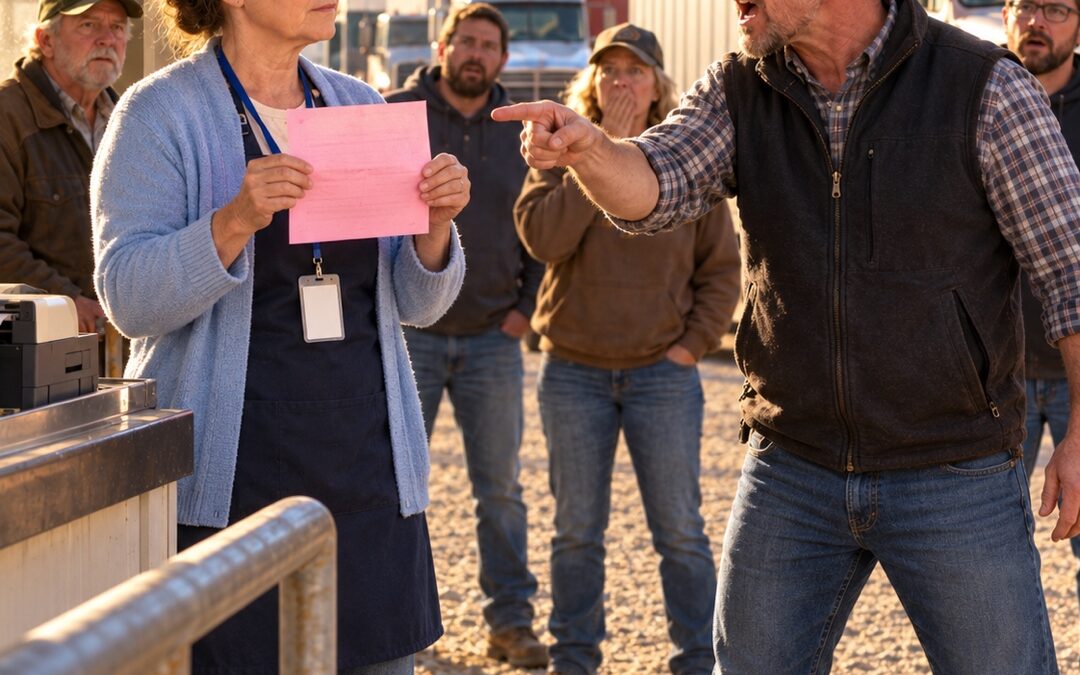
At 7:48 on the first big morning of soybean harvest, with thirty-one trucks idling down the gravel behind my scale house, Garrett Pelzer pulled the three-part pad out of my window, tore it in half, and sent the pages over the rail like a dropped deck of cards, saying, "Pink paper is for people who can't read a screen, Ardis."
Then he held out his hand for my keys and my lanyard and told the whole line, "Twenty-two years in a shed, folks, and she still thinks a carbon copy is the law. Effective this minute, Ardis Hovland doesn't work here."
What Garrett didn't know, standing there so sure of his two-hundred-twelve-thousand-dollar screen, was that an old man in truck fourteen had a boot box on the seat beside him, and that his late wife had kept every pink ticket I'd ever handed her.
The dot-matrix printer beside my elbow was still hot, its last sheet hanging halfway out while the fan above me rattled against its guard.
Beyond the sliding window, Garrett's green company pickup sat across the edge of the seventy-foot scale deck, because Garrett preferred parking where everybody else had to work around him.
Thirty-one trucks stretched from the terminal gate onto County Road 9, diesel engines bumping under the sound of the dryers, bean dust turning gold in the low October sun.
The torn forms moved through all of it. White and yellow sheets caught against the rail or went under Garrett's pickup, while pink copies skated face-up across the gravel.
Those pinks had real weights on them from earlier loads that morning, printer ink still dark, and I knew several of the truck numbers before the wind turned the sheets over.
Garrett kept his hand out.
"Keys, Ardis."
I unhooked the ring from the nail beside the scale indicator and pulled the blue co-op lanyard over my head.
The plastic badge turned backward against my shirt.
GARRETT PELZER was stitched across his fleece vest, with PRAIRIE BEND — GENERAL MANAGER below it.
He'd worked there twenty months.
I'd worked inside that twelve-by-sixteen steel box since 2003, but that wasn't going to improve either man's morning.
I put the keys and lanyard in his palm.
The cloth still held my neck heat.
Garrett tucked both into his vest pocket.
Three trucks farther down, Arlen Fitzke reached across his dashboard and shut off his radio.
Melvin Rautenberg sat in truck twenty-two with both boots planted under the steering wheel, studying a stripe of grain dust on the floor mat.
A driver farther back held his phone chest-high, while another scrolled with one thumb as if harvest had suddenly become somebody else's problem.
Colt Lindgren sat in truck nine with his left arm hanging through the window.
He kept his face on me.
Lavonne Kopecky opened the door of truck twenty-seven and climbed down, her masking-tape name tag curling at one corner.
LAVONNE.
She stayed beside the cab.
"Delphine will box your personal things," Garrett said.
The office window next to the scale house remained shut.
Through the glass, Delphine Ostby lifted one settlement sheet from the stack by her keyboard, held it there, then returned it to the pile.
Garrett turned toward the road.
"Let's keep harvest moving, friends."
He liked that word, friends, especially when he wanted thirty people to do the same thing before any of them had time to compare notes.
The first driver waiting near the scale didn't move because Garrett's pickup was still blocking part of the deck.
Garrett waved anyway.
"Come on. We can do two things at once."
The driver pointed through his windshield.
Garrett followed the finger to his pickup.
"Right."
He walked around the hood.
At 7:30, eighteen minutes before he tore the paper out of my window, Gerald Tesch had stopped Garrett at the gate.
I'd heard them through the open glass while trucks were already arriving from County Road 9.
Gerald got out of his white Ford wearing the Pioneer cap he had owned longer than Garrett had worked in Illinois.
Garrett stayed beside the green pickup.
Gerald pointed toward the terminal.
"Answer them in front of everybody or I call the board."
Garrett had smiled and said something I couldn't hear.
Gerald drove away.
That was the condition sitting underneath everything Garrett did after 7:30, whether he admitted it or not.
He moved the pickup off the deck and parked it beside the office.
A pink ticket scraped over the gravel under the rail.
I took one step toward the scale-house door.
Garrett turned.
"You're done."
"I heard you."
"Then don't touch anything."
The printer gave one small mechanical click behind me.
Garrett leaned through the open window from outside and reached toward the cord, but I stepped between his hand and the printer.
"Leave the machine."
He pulled his arm back.
"Ardis."
"It's wired to the scale."
"I know what it's wired to."
The printer had scared half the farm kids in Marsh County over the years because it screamed once whenever a ticket came through.
Children learned to wait for it before sticking their hands out the window.
Old farmers did too.
My pale-blue cardigan hung on the chair behind me, Leland's picture sat beside the phone, and my thermos was under the counter.
I left all of it where it was.
The steel step outside had a dent in the middle from twenty-two years of work boots.
Mine landed there one more time.
Garrett stood beside the gray rail.
"You can wait by your car."
The white stop line beside the scale deck was still Prairie Bend property, so I stopped there instead.
Garrett watched me choose it.
I watched the tickets.
At 7:56, the door of Orville Brannock's red 1996 International opened.
Truck fourteen had already crossed the scale once that morning, at about 7:20, with Orville's first soybean load.
He had already unloaded and crossed back over the scale before I could get his pink through the window, so I'd folded it into my apron pocket for when he came back.
Now he had returned with another load.
One boot came down from the cab, then his wooden cane, then the rest of Orville.
He was seventy-six and had hauled grain into Kellner longer than I'd been weighing it.
The red paint around his hood had gone dull enough to show every handprint.
Mallory sat on the passenger side in a yellow-brown hoodie, nineteen years old and already better with farm numbers than half the men who liked to explain them to her.
She opened her door after him.
"Grandpa."
"I see them."
Orville walked toward the first pink ticket on the gravel.
He planted his cane, bent at the waist, braced one hand against the International's fender, and picked it up.
Garrett came around the front of his pickup.
"Mr. Brannock, leave those."
Orville put the first pink against the fender and moved to the next.
I counted as he worked.
Two.
Three.
Four.
Each sheet carried printed numbers from a load that had already crossed that morning.
Garrett sped up.
"Those aren't yours."
Orville picked up another.
Five.
Colt was close enough to reach one from truck nine, but his arm stayed through the window.
Six.
An air brake released somewhere out on County Road 9.
Seven.
Mallory stepped around the red International.
"Want me to get them?"
"No."
Orville pulled his cane free where the gravel had swallowed the tip.
Eight.
One pink had blown almost to the scale rail.
He reached it.
Nine.
Another lay under the edge of the green pickup.
Ten.
The last one had folded against the tire.
Orville bent again.
Eleven.
He squared the tickets against the International's fender, the way farmers square receipts before putting them somewhere they swear they won't forget.
Then he tucked all eleven into his shirt pocket.
Garrett fixed him with both hands planted on his hips.
"Mr. Brannock."
Orville turned.
"Morning."
"This is a working terminal."
"I brought beans."
"I know why you're here."
Orville tipped his head toward me.
His cataracts bothered him most when light came sideways, and the sun was behind my scale house.
"You all right, Ardis?"
"Yes."
He started toward the white line with Mallory beside him.
Garrett cut across the gravel.
"You need to get that truck onto the scale."
"I've been there once already."
"This load needs to move too."
"It'll move."
Orville stopped, leaving a small round cane mark in the dust.
Garrett pointed toward the cab.
"Get back to your truck."
Orville checked the International behind him.
"I'm not lost."
Garrett pressed his lips together.
I reached into my apron pocket and unfolded the pink from Orville's first load, the one printed at about 7:20.
The paper had softened along the crease.
My blue Bic was still clipped inside the apron.
Garrett spotted it immediately.
"Ardis."
I took out the pen.
"You're off payroll."
I wrote OCT 5 in the top right corner, large enough for a man with cataracts to find without hunting.
My five leaned left.
It always did.
The date started with Leland the night before my first shift, November 16, 2003. "Write the date big. Old men lose paper in a pickup but they can find a big date." The next morning I wrote my first Brannock ticket, misspelled it BRANNICK, crossed it out, and fixed it. On January 2 this year, Garrett ordered paper tickets discontinued. On March 19, Orville asked me about thirteen missing bushels, and I saw his pink didn't match the Portal. I closed both drawers.
Garrett stepped closer.
"Put that away."
Orville reached the line.
I held up the ticket.
"Truck fourteen. Gross seventy-eight thousand four-twenty. Tare twenty-three three-eighty. Net fifty-five thousand and forty, Orville. Date's in the corner."
His first load had crossed at 7:20.
Those were the numbers the scale indicator had printed.
Orville held out his hand.
I put the pink into it.
Garrett came two steps closer.
"Give that back, Brannock. It's a souvenir."
Orville read the top half, then the bottom, keeping his thumb clear of the figures.
Garrett gave one short laugh.
"A pink is a souvenir. A screen is the only record that counts."
Mallory went to the passenger side of the International and reached inside for her phone.
She came back with the producer Portal open to load history.
The 7:20 entry was on the screen.
Orville took the phone from her.
"Mr. Pelzer, your screen says I hauled fifty-four two seventy. Ardis's slip says fifty-five oh forty."
Garrett read the Portal entry.
Then the pink.
"Handling."
Orville waited.
Garrett raised his tablet.
"Shrink. Moisture. Adjustments. That's why we spent two hundred twelve thousand dollars getting out of this paper mess."
"The scale printed fifty-five thousand forty," I said.
Garrett turned on me.
"And you were ordered January second to stop handing out paper."
"Friday you asked me to sign your reconciliation form."
"I asked you to acknowledge the process."
"I told you, 'I'll sign what I weighed.'"
A cab door slammed somewhere near the gate.
Garrett lowered the tablet a few inches.
"You also kept running forms for nine months after a written order."
Orville held up the pink.
"I asked her March nineteenth about thirteen bushels."
Garrett's eyes cut to him.
Orville continued.
"Same problem?"
I kept my answer plain.
"Same gap."
Garrett raised the tablet again.
"Friends, this is exactly what I'm talking about."
A truck engine coughed behind Colt.
Another driver leaned against his door with his phone lowered now.
Garrett held the screen above shoulder height.
"This system gives you one number."
Orville held the pink against his chest.
"I got another."
"Because she kept running obsolete paper after written instructions."
"Still got another."
Garrett faced me.
I could see the calculation on him, whether to get mad or act amused in front of Gerald's promised audience.
He chose amused.
"Ardis can print anything she wants on that old machine."
"I can't."
"The printer does what you tell it."
"The indicator prints the weights."
"Same difference."
"No."
Garrett shifted toward Orville.
"We're not holding up thirty-one trucks because you found an old receipt."
Orville lifted the fresh pink.
"It was printed this morning."
"Which makes the violation worse."
Colt leaned farther through the window of truck nine.
"What violation?"
Garrett pointed toward my scale house.
"She was instructed to stop issuing paper weight tickets."
"Why?"
"Because the Portal replaced them."
Colt's arm stayed on the window frame.
"Portal replace the scale too?"
Garrett's smile thinned.
"The certified scale feeds the system."
"Then why don't the numbers match?"
That landed harder than anything I could have said.
Garrett moved his tablet to the other hand.
"Because a raw net and a settled net are different things."
"Where's the percentage?"
Mallory asked it.
Garrett turned.
"What?"
"On the producer Portal."
She held her phone up.
"Where does it show the shrink percentage?"
Garrett took half a step toward her.
"The settlement process handles that."
"The load history only shows fifty-four two seventy."
"Correct."
"The pink starts at fifty-five oh forty."
"Correct."
"So where's the percentage?"
Garrett's jaw worked before he answered.
"On your agreement."
I knew that part.
The Portal showed the net after shrink.
It never showed the starting weight beside the percentage that got you there.
The starting weight was on the pink.
That was why two pieces of information had lived apart for nineteen months.
Mallory kept the phone up.
Garrett turned back to me instead.
"I tried to deal with this privately Friday."
"With a form I wouldn't sign."
"Because you refuse to follow procedure."
"Because it wasn't what I weighed."
His smile disappeared, then returned before he faced the road.
"We are not doing an employment hearing beside a scale."
"Then don't."
He scanned County Road 9.
Several drivers were outside their cabs now, while others stayed behind their steering wheels with their phones down.
Bean dust moved over the hoods.
Garrett pointed at Orville's ticket.
"One sheet."
Orville tapped his shirt pocket.
"I got eleven more you threw in the gravel."
Garrett's attention dropped to the pocket.
Those eleven weren't blank forms.
They carried truck numbers, times, gross weights and net weights from loads that had crossed before Garrett arrived at my window.
He knew exactly what was printed on them.
The driver closest to the gate stepped down from his running board.
Garrett checked the road again.
Gerald's condition from 7:30 was still sitting there.
Answer them in front of everybody or I call the board.
Garrett adjusted the tablet under his arm.
"Fine."
He stepped onto the scale deck.
His boots hit the steel plates hard enough for the sound to carry.
"Fine. Tuesday. Eight a.m., right here, in front of everybody. Bring every scrap of pink paper in Marsh County and I'll read each one out loud myself."
The driver by the gate stopped walking.
Mallory lowered her phone.
Garrett spread one hand toward the trucks.
"There. You want transparency, you got it."
Lavonne shut her cab door without climbing inside.
Garrett faced me.
"Now we're moving grain."
He pointed toward the gate.
"And you're leaving."
I clipped the Bic back into my apron.
"All right."
"Off the property."
"All right."
"Now."
It was 8:05.
I stepped away from the white line.
The gravel from there to the gate was forty yards, and I knew the distance because Leland had measured it in 2008 when Prairie Bend repainted the cattle guard.
He had worked maintenance then and spent two weeks complaining because somebody ordered thirty dollars too much white paint.
I passed truck nine first.
Colt pulled his arm inside and stared through the windshield.
A Farm Credit parking pass was tucked against the dash.
June 22.
I had seen that date before.
The operating-loan renewal.
I kept walking.
Orville had climbed back behind the wheel of the International.
His new pink lay across one knee, and the eleven rescued tickets filled his shirt pocket.
Mallory stood beside the passenger door with her phone down at her side.
Arlen lifted one hand from his steering wheel as I passed.
He didn't wave it.
He only kept it there until I went by.
Melvin sat behind his windshield, elbows close to his body.
Farther down the road, the trucks sat crooked along the shoulder wherever drivers had found room.
The engines made the gravel hum through my shoes.
At the cattle guard, Garrett called my name.
"Ardis."
I stopped.
He stood on the scale deck with the tablet against his chest.
"Delphine will have your things ready by noon."
"Fine."
"Don't come back onto the property for them."
"I heard you."
His vest pocket bulged where he'd put my keys.
The lanyard was in there too.
My gray 2004 Buick LeSabre waited in the gravel turnout across County Road 9, one hubcap newer than the other three.
Leland bought the wrong replacement at a salvage yard in 2017 and refused to take it back.
I stepped over the cattle guard.
Prairie Bend ended under my left shoe.
The county shoulder started under my right.
Behind me, Garrett waved a truck toward the scale, and the terminal began moving again.
I stayed on the shoulder while diesels rolled past.
Truck fourteen came around after unloading its second load and slowed near the gate.
Mallory lowered the passenger window.
"Ardis."
I walked closer.
Her phone was open again to the producer Portal.
She held up the 7:20 load history.
54,270.
Orville's pink from that same load rested on the dash.
55,040.
The difference sat there without needing help from me.
Orville reached one arm behind the seat, then stopped with his hand out of sight.
A yard horn sounded from the terminal.
Mallory turned toward him.
He brought his arm forward empty and put both hands back where they belonged.
The International needed to move.
"Tomorrow?" Mallory asked.
"Eight."
Orville eased the truck ahead, then slowed long enough for me to step back from the road.
Garrett was visible beyond him on the scale-house step with the tablet again, sending the next truck forward.
The scale-house window remained open.
My chair sat where I had left it.
The red International kept rolling toward County Road 9 while the rest of the line began moving behind it.
I stayed on the county shoulder.
Mallory left her window down until they reached the road.
"Tuesday at eight, then," Orville called through the open window. "Margie always said somebody would ask."
Part 2 — THE TURNOUT
PART 2 — THE TURNOUT
At 8:20 Monday morning, I sat behind the wheel of my Buick across County Road 9 and watched another man's tablet do my job.
Garrett stood on the scale-house step with the black-cased screen chest-high, waving trucks over the seventy-foot scale one at a time.
Truck fourteen had already gone through again, and Orville was somewhere past the bins while the rest of harvest kept crawling through Prairie Bend.
My keys were in Garrett's vest pocket.
My lanyard was gone with them.
My pale-blue cardigan still hung inside the scale house, one sleeve visible through the window whenever Garrett moved away from the glass.
The Buick's engine was off, both front windows cracked enough to let bean dust settle across my dashboard.
A combine came down County Road 9 with its header taking up half the pavement, and the driver lifted two fingers as he passed.
I answered too late.
Garrett waved another truck onto the scale, checked his tablet and sent it toward the dump lane without a printer screaming behind him.
Twenty-two years of that ugly printer noise had trained my ears badly.
Mallory Brannock crossed the road carrying two paper cups, waited for a grain truck to clear the gate, then stepped over the ditch toward me.
She held one cup through my open window.
"Gas station."
I took it.
"Thank you."
"It's bad."
"I've had worse."
She opened the passenger door.
"Can I?"
"Sure."
Mallory climbed in with dust on one sleeve of her yellow-brown hoodie and put her cup between her knees.
For a little while we watched Garrett work, his arm lifting and dropping while trucks rolled over the scale deck.
Mallory blew across her coffee.
"I did Grandpa's paperwork last night."
I turned toward her.
She kept her attention through the windshield.
"He gave me his pinks and statements."
"That sounds dangerous."
"He thinks Excel is a city."
I moved my coffee into the cup holder.
"How many?"
"Nine loads."
She reached into her hoodie pocket and brought out her phone.
"February seventeenth last year through Friday."
Friday was October 2.
Mallory unlocked the screen, opened a spreadsheet and enlarged the first rows with two fingers.
She had matched eight of Orville's nine pink tickets against the monthly settlement statements, and the Friday ticket against the Portal screen.
Before February 17, 2025, the old records in the box matched the settlements to the pound.
These didn't.
"Every one of these is short," she said.
I read the first row, then the next, while Garrett called for another truck across the road.
The pounds changed with each load.
The percentage didn't.
One point four.
Mallory moved the phone closer.
"I thought the formula was wrong."
"You checked it."
"Four times."
She scrolled to the bottom.
The ninth line was Friday, October 2, checked against the Portal.
Then she opened the producer Portal.
"This morning is separate."
Truck fourteen's first Monday load showed in the load history, time stamped around 7:20.
Portal net: 54,270.
The pink Garrett had tried to call a souvenir said 55,040.
That made ten loads we could see now: nine she had compared already, plus Monday morning's load in the Portal.
Mallory locked the phone.
"I haven't told anybody except Grandpa."
A truck horn sounded at the scale, and Garrett pointed toward the dryer lane until the driver moved.
Mallory held her coffee near her mouth without drinking.
"Did you know?"
I watched another truck stop near my white line.
The driver used to bring me tomatoes every August, too many of them, until my counter looked like somebody had opened a roadside stand inside a steel shed.
"Yes."
Mallory stopped moving the cup.
I turned toward her.
"I closed both drawers."
She lowered the coffee to her knee.
Outside, Garrett called, "Pull ahead, friend," and the truck moved.
Mallory drank until the cup was half empty before she put it by her boot.
"When?"
"March nineteenth."
"What happened?"
"Your grandpa came to the window."
I pressed my palms against my jeans.
"He said thirteen bushels were missing."
Mallory watched Garrett through the windshield.
"I put one of his pinks beside the Portal number."
"And?"
"I saw the difference."
Her thumb moved once along the cardboard cup seam.
"You tell Garrett?"
"No."
"Delphine?"
"No."
Mallory nodded and stared at the brown lid between her knees.
I rubbed at a spot of dried mud on the steering wheel.
It stayed where it was.
"I told Orville I'd look into it."
"Did you?"
"I looked."
She raised the cup but didn't drink.
"I didn't do the next part."
A green semi rolled through the gate, and its exhaust shook the Buick's side mirror.
Mallory steadied the cup against her leg.
"Grandpa wanted to ask you first. He didn't know how."
"He's had six months."
"He likes you."
"That makes it worse."
At 8:36, she opened the passenger door and stepped out.
Before shutting it, she leaned back toward me.
"We're bringing the box tomorrow."
I nodded.
She crossed County Road 9 while Garrett kept his tablet on the scale.
By 10:15, the line had shortened, though harvest traffic still kept me moving the Buick whenever farm equipment needed the turnout.
The second time I pulled forward, I parked crooked.
Leland would have complained.
He believed parking straight was part of being civilized.
Truck nine rolled off the scale and turned past the gate.
Colt Lindgren stopped on the shoulder, opened his door and came toward me with his work gloves stuffed into his back pocket.
He wore no hat.
Dust sat in his hair.
Thirty-one years old, and that morning the corners around his mouth made him seem older.
I got out before he reached the Buick.
He stopped by the hood.
"You knew."
"Yes."
His mouth worked once before he faced the terminal.
"Since when?"
"March nineteenth."
He turned back.
"June twenty-second."
"I know."
"No, Ardis."
His voice stayed low.
"June twenty-second."
"I remember."
"Marvin sat me down at Farm Credit."
A truck passed behind him, spraying gravel hard enough that we both waited before speaking again.
When the road cleared, Colt put one hand on the Buick's hood.
"He said my bushels didn't support the number."
I nodded.
"He had my projected yield."
"I know."
"He had my contracts."
Another truck rumbled toward Kellner.
Colt let it pass.
"I thought I screwed up."
The gloves in his back pocket shifted when he moved.
"I went home and figured that farm six different ways."
He pressed his palm harder against the hood.
"Hannah was at the table with Rowan."
I watched a grain truck downshift near the bend.
Colt stepped closer.
"What did you see in March?"
"Orville's pink."
"And?"
"His Portal number."
"How far off?"
"About thirteen bushels."
He exhaled through his nose.
"And you stayed there."
"Yes."
"Why?"
I turned toward the scale house, where Garrett stood in the place I had used since 2003.
"I owe thirty-one thousand four hundred dollars from Leland's treatment."
Colt listened.
"The co-op health plan matters."
He didn't rescue me from that.
"I had a new boss who'd already made it clear he wanted the old system gone."
Colt dragged his palm off the Buick.
"I was afraid he'd fire me."
He tipped his head toward Garrett.
"Worked out."
"Yes."
The scale deck rang when another truck rolled onto it.
Colt rubbed the back of his neck.
"My boy is eight months old."
"I know what Hannah's due on the first."
His hand dropped.
Hannah brought Rowan by the scale house most Fridays, usually parking near Delphine's office window.
By the time she carried him inside, Rowan generally had one sock missing and the other halfway off.
Colt turned toward truck nine.
Then he faced me again without offering forgiveness or another accusation.
He walked back across the gravel, reached the road and stopped.
A few seconds later he turned and came back.
His metal thermos sat on my Buick roof.
He grabbed it by the handle.
"Forgot this."
"I saw."
Colt left again.
At 11:40, Delphine Ostby came through the office door carrying a brown paper sack with my pale-blue cardigan showing at the top.
She waited until Garrett went toward the bins, then crossed the lot fast enough that the sack hit her leg with every other step.
I opened the Buick door.
"Don't get yourself fired."
"I'm on lunch."
"You never take lunch."
"Today I'm taking eleven minutes."
She handed me the sack.
My thermos was inside, along with Leland's framed picture from the 2018 co-op picnic.
The cheap black frame had one chipped corner.
Delphine kept talking before I could say anything else.
"Garrett said everything out by noon."
"Everything?"
"Anything of yours."
She checked the terminal.
"He asked me twice."
Her nephew lived with her, and Prairie Bend's employee education benefit was helping with his community-college tuition while he worked part-time in the parts room.
Losing her job would land on two people.
That was why the sweat along her hairline bothered me more than the sack.
"Why are you bringing it yourself?"
She wiped one palm against her slacks.
"Because if I leave it in the office, he'll go through it."
"Has he?"
"He asked what Mr. Brannock wanted Thursday."
That gave me the reason.
"What did Orville ask you for?"
Delphine fixed her attention on the Buick's door handle.
"'Ardis's pink.'"
"Those exact words?"
"Yes."
A diesel engine revved near the scale, and Delphine waited until it dropped.
"I repeated it to Garrett because that's what you do when the general manager asks who came to your window."
"I know."
"He asks what people ask."
"I know."
She rubbed her thumb along the seam of her slacks.
"He asks who stops by."
"I know."
Her eyes stayed on the handle.
"I told him Mr. Brannock wanted Ardis's pink."
"What did Garrett say?"
Delphine turned her head toward the green pickup.
"'Pink?'"
"That's it?"
"That's it."
A truck pulled onto the scale.
She stepped backward.
"I need to go."
"Delphine."
She stopped with one shoe already turned toward the office.
"Thank you for my things."
Her fingers tightened around the folded top of the sack before she let go.
"Eleven minutes."
She crossed the road.
I set the paper sack on the passenger seat and drove home.
At 12:50, the Buick clicked in my driveway on Sycamore Street while the engine cooled.
The third porch stair groaned under me, same as it had since 2019 when Leland promised to fix it and hospitals took over our calendar instead.
I carried the sack to the oak kitchen table and set it down beside the sugar bowl.
The house had that closed-up smell it got after a warm day with the windows shut.
I opened the refrigerator.
A bowl of potato salad sat behind half a gallon of milk, and neither one interested me.
I shut the door.
The cardigan came out first, bean dust still on one cuff.
My thermos followed.
Then Leland's framed picnic picture, where he was holding a paper plate with half a bratwurst gone and squinting hard into the sun.
I set the frame upright beside the sugar bowl.
When I lifted the empty sack to throw it away, something caught at the bottom.
I shook it once.
A folded settlement page fell onto the kitchen table.
It landed against Leland's picture frame.
One line was circled in pencil.
The rest of the page looked ordinary enough, account numbers and payment entries packed into the same narrow columns Delphine had worked with for fourteen years.
I opened the fold under the kitchen light.
The pencil circle sat halfway down the page.
Delphine left two spaces after a dash when she typed too fast.
This entry had two.
The circled line read: "FRT CR — HARTWIG GRAIN HAULING."
Part 3 — PAGE SIX
PART 3 — PAGE SIX
At 1:30 Monday afternoon, Gerald Tesch was under a combine with a wrench when I pulled into his farmyard.
His white Ford sat by the machine shed, Pioneer cap on the passenger seat, while a grain auger ran somewhere behind the building.
I parked the Buick beside a stack of seed pallets and carried Delphine's folded settlement page toward the combine.
Gerald's boots stuck out from underneath.
"Gerald."
The wrench stopped.
"You run me over?"
"Not today."
His creeper rolled across the concrete, and Gerald came out on his back with grease running along one forearm.
He sat up.
"What happened?"
"You know what happened."
"I know Garrett fired you."
"I found something afterward."
I handed him the page.
Gerald stood, wiped his hands on a shop rag before touching it, then opened the fold under the light from the machine-shed door.
His eyes moved down the settlement lines and stopped at the pencil circle.
FRT CR — HARTWIG GRAIN HAULING.
He read it again while the auger rattled behind us.
"Where'd you get this?"
"In my things."
"From Delphine?"
"I didn't see her put it there."
"Did she give you the sack?"
"Yes."
Gerald nodded and held the page closer to the daylight.
I pointed toward his Ford.
"Check your settlement statement tonight, and find your hauler copies."
"I've got the copies."
"Where?"
"Sun visor."
"All of them?"
"Been stuffing them up there forty years."
The driver's visor sagged visibly through the windshield.
"Match one against your statement."
Gerald folded the page along Delphine's crease.
"Why mine?"
"Your account isn't coded small."
His attention came off the paper.
"Whose is?"
"Orville's."
"Colt's?"
"Yes."
"Lavonne?"
"Yes."
Gerald rubbed grease off the side of his thumb.
"How many?"
"Forty-one accounts."
His shop rag stopped against his palm.
"Forty-one."
"That's what I remember from Garrett's rollout list."
Gerald faced the soybean fields beyond the yard, dry and tan under the afternoon sun.
A combine waited at the edge of them.
"How long had you known?"
I shifted the folded paper under my arm.
"I didn't know in February."
"All right."
"Orville asked me March nineteenth."
"And then?"
"I checked."
Gerald waited.
"The pink and the Portal didn't match."
"You went to Garrett?"
"No."
"Board?"
"No."
"Me?"
"No."
The shop rag hung from his hand.
"Why?"
"I still owe thirty-one thousand four hundred on Leland's treatment."
He stayed quiet.
"I pay four hundred twelve a month."
Gerald lowered the settlement page.
"The co-op health plan is what kept me from drowning while he was sick."
I stared toward his truck.
"When Garrett started on February third last year, I was fifty-six, still carrying that debt, and he was already calling me a legacy system."
Gerald leaned one shoulder against the combine tire.
"So I closed the drawers."
The auger shut off behind the shed.
Gerald didn't tell me I had done my best.
I hadn't.
He walked to his Ford, and I followed across the concrete.
He opened the driver's door and pulled down the visor.
Pink tickets slipped loose at one corner.
He caught them against the steering wheel.
"Forty years," he said.
He took out four from different seasons and laid them across the hood.
"You really want harvest stopped over this?"
"No."
"Because I'm not stopping harvest."
"I didn't ask you to."
Gerald held Delphine's page against the truck.
I nodded toward the pinks.
"Just check them tonight."
He slid the old copies back above the visor.
"Tuesday at eight was Garrett's promise."
I remembered his voice at the gate that morning.
"Answer them in front of everybody or I call the board."
Gerald shut the truck door.
"That still stands."
He opened the rear door and pulled out a Prairie Bend folder thick with board material.
Garrett's hiring notes were clipped inside.
Gerald flipped through several pages and stopped at one headed ACCOUNT SEGMENTATION.
Forty-one accounts were marked with an S.
"His pitch was those accounts cost too much staff time."
"Old farmers."
"Mostly."
Gerald tapped the page with one greasy fingernail.
"He said older producers wouldn't reconcile every digital adjustment."
I leaned over the folder.
"He actually said they wouldn't check?"
"He said they weren't going to do the math."
Gerald turned another page.
"And your account?"
"Ordinary."
"Your shrink?"
"Point four."
He nodded.
"So you'd never see what they saw."
Gerald closed the folder and wedged it under his arm.
"I hired a man because he said the word 'modernize' four times in one interview. I counted."
I handed him Delphine's settlement page.
He put it inside the folder.
"I'm keeping this."
"Fine."
"Go home."
"I have one more stop."
"Don't go near Garrett."
"I don't plan to."
Gerald picked the wrench up from the creeper.
"Harvest first."
"I know."
"Tonight I check my statement."
I walked back to the Buick.
At 4:50, Mallory Brannock sat at my kitchen table with her laptop plugged into the wall and the battery showing eleven percent.
She had brought no coffee this time.
I reached toward the place where I'd set Delphine's settlement page earlier, then remembered Gerald had taken it with him.
Mallory was already typing.
"I found Hartwig."
She rotated the laptop toward me.
HARTWIG GRAIN HAULING LLC filled the top of the Illinois business-search page.
I stood behind her chair and read over her shoulder.
Formation date: January 14, 2025.
Mallory clicked once, then scrolled.
"Rodney Hartwig owns it."
I leaned closer.
"Garrett's brother-in-law?"
"Yes."
She opened the formation record.
One line showed Tricia Pelzer had filed the company paperwork before Garrett's Prairie Bend start date.
I read it twice.
"January fourteenth."
Mallory tapped the date.
"Garrett started February third."
"He'd already accepted the job in December."
"Grandpa remembered the board announcement."
She typed Prairie Bend into another tab and pulled up the old newsletter.
Garrett Pelzer appointed incoming general manager.
Start date February 3.
I rested my hand on the back of Mallory's chair.
"He had them set this up before he walked into Prairie Bend."
Mallory stopped typing.
"That's what the dates say."
She opened the company address.
A mailbox store in Peoria appeared on the screen.
"No trucks registered to the company," she said.
"Could be leased."
"Could be."
She didn't make the evidence bigger than it was.
I appreciated that.
Mallory returned to the formation page and left it open.
Rodney Hartwig.
Tricia Pelzer.
January 14.
The names sat close enough together without either of us needing to explain them.
I walked to the sink.
"You okay?"
"Yes."
I ran water over a plate that was already clean, then shut it off.
Mallory's keyboard clicked behind me.
The Hartwig name stayed on the laptop screen.
I didn't say it aloud.
At 6:00, I drove past Prairie Bend and saw two men beside Garrett's green pickup at the gatepost.
One held a hammer.
The other held a bright white board while they nailed it up.
I slowed enough to read it.
NO PAPER TICKETS HONORED. NO TRESPASS: A. HOVLAND
My name took up the bottom line.
Garrett stood by the pickup and saw the Buick pass.
I kept driving.
County Road 9 still carried harvest traffic in both directions, though the morning crush had thinned.
I pulled onto the shoulder past the bend, parked, and walked back toward the trucks waiting to cycle through the terminal.
The first driver I reached was Arlen Fitzke beside truck three.
He was checking a tire with one knee bent.
"Arlen."
He straightened.
"You supposed to be here?"
"I'm on the county road."
He glanced toward Garrett's new sign.
"Fair enough."
"Do you still have your pinks?"
He wiped one hand on his jeans.
"Most."
"Where?"
"Cigar box."
"At home?"
"In the truck."
"Bring them tomorrow."
"Eight?"
"Eight."
Arlen went back to the tire.
Melvin Rautenberg stood beside truck twenty-two with one boot on the running board.
"Do you still have your pinks?"
"Somewhere."
"Find them."
"For tomorrow?"
"Yes."
He scratched his cheek.
"I'll look."
Lavonne Kopecky was near truck twenty-seven, the masking-tape name tag on her jacket curled at one corner.
"Do you still have your pinks?"
"My daughter has them."
"All of them?"
"She does my books."
"Bring what you can."
Lavonne nodded and reached into the cab for her thermos.
I kept walking.
One driver had three slips in his glove compartment, while another said his wife filed theirs by month in the kitchen.
A farmer near the bend thought his were under the truck manual.
They told me where the paper was.
I asked the same question each time.
"Do you still have your pinks?"
Some said yes.
Others weren't sure.
One driver called his wife from the cab while I stood by the running board, and I moved on before she answered.
Colt's truck nine was farther down the road after coming back for another load.
He stood beside the cab door with his metal thermos on the step.
I stopped.
He faced me.
I didn't ask him the question.
He didn't offer an answer.
A pickup passed between us and the terminal, throwing a strip of road dust against my jeans.
I walked to the next truck.
By the time I reached the Buick again, the sun had dropped behind the silos.
Garrett's new white sign caught what was left of the light.
My name could still be read from the bend.
I drove home.
At 9:40 that night, I was at the kitchen sink when the porch boards gave one heavy creak.
The motion light came on outside.
Then the third stair groaned.
I dried my hands on the dish towel and crossed the kitchen.
The porch went still before I reached the door.
I put my hand on the knob.
I opened the door. Orville Brannock was standing there in his church coat with the brown Red Wing boot box under his arm and his granddaughter behind him.
Part 4 — THE LID
PART 4 — THE LID
At 9:45 Monday night, Orville Brannock set the brown Red Wing boot box in the middle of my oak kitchen table.
Mallory pulled out a chair while Orville took off his church coat and hung it over the back of mine.
The water stain on one corner of the box was darker than the cardboard around it, and there wasn't a word written on the lid.
I put out three glasses of water, then sat across from him with the sugar bowl between us.
Orville turned the stained corner toward himself.
"You ever see this?"
"No."
"Margie kept it."
"I figured that much."
He put both hands on the lid and lifted it.
Pink paper filled most of the box, bundled with rubber bands by year, settlement statements clipped behind tickets wherever Margie had been able to match them.
Some pinks had faded at the edges.
Others still carried black printer marks sharp enough to read without glasses.
Mallory leaned over the box.
"When did Grandma start this?"
Orville reached past the newer bundles toward the bottom.
"First one she kept was Ardis's first week."
I knew the date before he found the ticket.
November 17, 2003.
My first Monday.
"She saved that long?"
"Longer than some people save tax returns."
He returned the old bundle to the bottom and took out the recent years first.
2026 went near Mallory.
2025 beside it.
The next rubber band said 2024 in Margie's block printing.
I recognized my own handwriting in the corners of the pinks, big dates leaning different directions depending on how fast harvest was moving.
One had a coffee ring.
Another carried a brown thumbprint near the tare weight.
Real farm paperwork usually looked as if it had survived farming.
Mallory opened the 2023 bundle.
"Careful," Orville said before she had done anything wrong.
She slowed anyway.
The April tickets were clipped together.
Behind them sat four small parking stubs.
I knew the Peoria logo before I read the dates.
April 4 and April 11 were on top, with April 18 and April 25 underneath.
Eleven dollars each.
Mallory picked up the first one.
"These yours?"
I took it from her.
The paper had gone soft at the fold.
April 4 came back as Leland's old Cubs blanket spread over Margie's knees in the Buick, even though Margie had never cared who won a baseball game.
On April 11 she brought chicken soup in a thermos and forgot the spoon, so we drank it from paper cups in the parking garage.
April 18 was level three, where I missed the same turn twice before finding the ramp down.
Margie slept against the passenger window most of the seventy miles home.
April 25, she told me to stop paying for parking.
I told her to complain to somebody who cared and put another eleven dollars into the machine.
I set the stub beside the others.
A plain bank envelope sat behind them.
No name or writing marked the front.
Orville pushed it toward Mallory.
"Count it."
She opened the flap and laid the bills on the table, four tens and four ones.
"Forty-four dollars."
I stared at the envelope.
"Parking."
Orville ran one finger along the edge of the boot box.
"She knew you paid it."
"Why didn't she give this to me?"
"She tried."
"No, she didn't."
"Not hard enough."
He moved the envelope toward me.
I sent it back across the oak.
"Orville."
He left it there.
"She said you'd turn it down twice. She was saving it for the third time."
Mallory bent over the April tickets again.
I stood because sitting had become inconvenient.
The sugar bowl was near my elbow, so I moved it farther down the table and picked up the blue pen beside my grocery list.
A white paper napkin sat under Mallory's glass.
Without thinking about it, I wrote 10/5 in the upper right corner.
Big.
The five leaned left.
Mallory pushed the sugar bowl back toward me.
"You need that?"
I saw the date on the napkin.
"No."
I put the pen down.
Good.
At least I hadn't written it on her homework.
The envelope stayed beside the April bundle.
I didn't take it.
Mallory dug farther into the box until she reached the oldest loose ticket beneath the rubber bands.
The pink had faded toward peach.
NOV 17 2003 sat in the corner in handwriting I hadn't seen in years.
The name line read BRANNICK.
I had crossed through the last letters and written BRANNOCK beside it in ballpoint.
Orville tilted the ticket toward the kitchen light.
"You weren't much of a speller."
"I got better."
"Margie kept that because you looked scared."
"I was scared."
"You made us weigh twice."
"The first number looked wrong."
"It was right."
"I know that now."
He put the ticket between us.
My twenty-two-year-younger handwriting had pressed hard enough to leave grooves on the back.
Margie had kept the mistake anyway.
At 10:30, Mallory cleared space for her laptop and began laying recent bundles across my table.
She put the most recent tickets nearest the computer and the older years farther toward Leland's picture.
Nine loads ran from February 17, 2025 through Friday, October 2.
Nine pink tickets.
Monthly settlement statements for the first eight, and the Portal screen for Friday.
Mallory paired the first one.
The weights didn't match.
She entered the difference, checked her formula, then moved to the next pair.
The pounds changed.
The percentage stayed at one point four.
Orville pulled his chair closer.
"All nine?"
"We're checking all nine."
She worked down the table without announcing every figure.
A smaller load lost fewer pounds.
A heavier one lost more.
Each landed on the same percentage.
Orville's Friday paperwork went last.
Mallory entered it and hit return.
"Nine."
Orville sat back.
"And this morning?"
"That's separate."
Mallory opened the producer Portal on her phone.
Monday's first truck fourteen load, the one that had crossed around 7:20, already appeared in load history.
54,270.
I reached into my memory without needing to.
The pink I'd handed Orville at 8:02 had printed 55,040.
"That's ten loads now," Mallory said.
"Nine checked through Friday. Monday makes ten we can compare."
"No settlement yet for Monday," I said.
"Right. Portal only."
Orville rested his forearms on the table.
"So every checked one is short."
"By one point four percent."
"And Monday starts the same way."
Mallory held up her phone.
"Seven hundred seventy pounds on that one."
I didn't need the calculator.
I'd known that gap since March.
Orville turned toward me.
I could have talked about Garrett's January order, the health plan or the bill that still came every month from Leland's treatment.
All of those facts fit on the table.
They didn't change what I had done.
"I saw it. I closed both drawers."
Mallory stopped typing.
Orville kept his hands away from the tickets.
"March nineteenth," I said.
"I remember."
"You asked about thirteen bushels."
"I did."
"I checked your pink against the Portal."
The refrigerator motor kicked on behind me.
"And I shut the drawers."
Orville studied the oldest bundle.
"Margie would have said you're no worse than the rest of us. And then she'd have charged you for the gas."
My mouth moved before I could stop it, close enough to a smile that Mallory noticed.
She opened another tab.
"What about everyone else's?"
"Arlen has a cigar box."
"Of course he does."
"Lavonne's daughter keeps hers."
"Colt?"
I touched the edge of the September settlement statement.
"He wouldn't speak to me this afternoon."
Orville adjusted his cane where it leaned against the chair.
"Can't say I blame him."
"I can't either."
At 11:50, I called Colt.
Hannah answered with Rowan crying hard enough behind her that the first "hello" came out twice.
"Hannah, it's Ardis."
A cabinet shut on her end.
"Hi."
"I need Colt for a minute."
"He's putting bottles in the fridge."
"I won't keep him."
She covered the phone, and Rowan's crying dropped to a muffled complaint.
Colt came on.
"Yeah."
"It's me."
"I know."
I ran my finger along the edge of one of Orville's September statements.
"I have something you should see."
Colt didn't answer.
"Bring your pinks to the window at eight."
Another cabinet closed.
"Hannah has them."
"Bring them."
Rowan started up again behind him.
"I'll bring them."
The line went dead.
I set the phone down beside the boot box.
Mallory closed her laptop and packed the charger while Orville put the recent bundles back under their rubber bands.
He left the forty-four-dollar envelope on my table.
I picked it up and placed it beside his coat.
"Take this."
"Third time hasn't happened yet."
"Then don't lose count."
He tucked it back into the box.
By 12:15 they were gone, and the third porch stair complained under Orville's weight on the way down.
He stopped and tested it with his cane.
"That thing's rotten."
"Leland said the same thing."
"Fix it."
"Get home."
I slept in my clothes.
At 5:40 Tuesday morning, the old kitchen wall phone rang hard enough to pull me upright.
I almost knocked a chair over reaching it.
"Hello?"
Gerald's voice was already awake.
"I can't stop a woman standing on a county road. Stand where I can see you."
"Gerald—"
He hung up.
I changed my shirt, kept the jeans and put on a brown coat because my pale-blue cardigan was still draped over my kitchen chair.
The Buick started on the second turn at 6:08.
Fog sat low over the soybean fields, making County Road 9 look narrower than it was.
I saw brake lights before I saw Prairie Bend.
Trucks were already coming back for the eight o'clock reading, arriving in no particular order because several had made trips through the terminal Monday and gone home for more beans.
Some parked along the road.
Others found room near the bend.
I drove past the gate.
Garrett's white sign still hung on the post.
NO PAPER TICKETS HONORED. NO TRESPASS: A. HOVLAND
I parked on the county shoulder beside the cattle guard, forty yards from my old scale-house window.
Gerald's white Ford was inside the property with four other directors' vehicles nearby.
Five board members were present.
A quorum was four.
Garrett's green pickup sat near the scale with its lights on, and he stayed outside the scale house as always.
At 6:34, truck fourteen was parked among the returning trucks.
Mallory sat in the passenger seat with the brown Red Wing box between her and Orville.
Arlen's truck three had its cab light on.
Through the windshield I could see the square shape of his cigar box resting on the seat.
Lavonne arrived in truck twenty-seven with her daughter following in a pickup.
Two pink tickets showed through a clear folder on the dashboard.
Melvin came back later with papers tucked inside his coat before he shut his cab door.
Around 7:12, another farmer pulled onto the shoulder carrying a manila envelope.
By 7:26, pink edges were showing in glove compartments, shirt pockets and clear plastic folders along the road.
Colt's truck nine appeared through the fog and found a place farther toward the bend.
He parked, shut off the engine and stayed behind the wheel.
A stack of pink paper rested on his dashboard.
I remained beside the cattle guard.
The cold worked through my coat while the terminal dryers cycled behind the silo.
By 7:40 the line of trucks ran from the scale all the way out to the bend in County Road 9, and one after another the farmers were climbing down from their cabs with something pink in their hands.
Part 5 — EIGHT O'CLOCK
PART 5 — EIGHT O'CLOCK
At 8:00 Tuesday morning, Garrett Pelzer stepped beside my old scale-house window with his tablet in one hand and thirty-one trucks parked along County Road 9.
They had come back for the reading in no particular order, some carrying fresh beans, others empty after an early run.
Garrett's fleece vest was zipped high, PRAIRIE BEND — GENERAL MANAGER stitched clean across his chest, and his green pickup sat crooked near the edge of the scale deck.
Delphine stayed behind the office glass next door.
Gerald Tesch and four other directors stood near the head of the gathering, hats on, jackets dusty from getting there before breakfast.
I remained on the county shoulder by the cattle guard.
Forty yards away.
Garrett raised the tablet.
"Morning, friends."
A cab door shut near Arlen Fitzke's truck three.
Garrett waited until the sound quit bouncing off the concrete silo.
"Let's get through this so we can move some grain."
Arlen held his cigar box against one hip.
Lavonne Kopecky had pinks inside a clear folder, Melvin Rautenberg kept his folded copies in his coat, and Colt Lindgren stood beside truck nine with paper showing from his shirt pocket.
Orville had the brown Red Wing box open on the hood of truck fourteen.
Mallory stood beside him with her laptop.
Garrett pointed toward Orville.
"Let's start with the famous one."
Orville removed Monday's pink, the ticket from his 7:20 load, and gave it to him.
Garrett read the date first.
Then the printed numbers.
"Gross seventy-eight thousand four-twenty. Tare twenty-three three-eighty. Net fifty-five thousand and forty."
He opened the producer Portal on the tablet and found the same Monday load.
"Portal net fifty-four thousand two seventy."
He set the paper beside the screen.
Seven hundred seventy pounds sat between those numbers.
Orville leaned his cane against the International.
Garrett handed the pink back.
"Next."
Arlen came forward with his cigar box open.
He pulled out one ticket, squinted at the top corner and read the date himself before placing it in Garrett's hand.
Garrett read the printed net, found the Portal figure and said the difference aloud.
Lavonne came up beside him next.
Her daughter kept the rest of the papers against her coat while Garrett read one pink and checked its matching digital entry.
Different pounds.
Same one point four percent.
A dryer cycled behind the silo, then dropped back to its steady hum.
Melvin did not say anything when his turn came.
He held his pink up until Garrett took it, read the weight, checked the screen and returned it.
Colt followed.
He handed his paper over without meeting my eyes.
Garrett read the fifth slip aloud, compared it with the Portal entry and gave it back.
The fifth mismatch ended the same way.
One point four percent.
Then Garrett stopped asking for papers.
Eighteen more hands were still up along County Road 9, pink tickets showing between work gloves, shirt cuffs and fingers stained dark from harvest dust.
He had promised every scrap.
He had read five.
Garrett lowered the tablet.
"Handling shrink is policy. Page six."
Gerald stepped forward with his own settlement statement folded behind a pink hauler copy.
"Mine says point four, Garrett."
Garrett turned to him.
Gerald opened both papers side by side.
The directors shifted closer.
Mallory set her laptop on the hood of truck fourteen and opened the spreadsheet showing Orville's nine loads from February 17, 2025 through Friday, October 2.
Nine pinks.
The percentage repeated.
Then she opened Monday's producer Portal load history beside them.
The 7:20 load showed 54,270.
Orville's pink showed 55,040.
Ten loads now told the same story, though Monday had not settled yet.
Garrett glanced from the laptop to the boot box.
Years of pink paper filled it.
A driver near the front reached into his cab and shut off the engine.
Another diesel went quiet farther down the road, then two more.
What remained was the dryer, gravel under boots, and the low mechanical tick of cooling engines.
Garrett raised his voice.
"Point four is the standard allowance."
Gerald held up his own papers.
"What about one point four?"
Garrett tapped the tablet.
"Could be classification."
"Forty-one classifications?"
He shifted the screen against his palm.
"Small accounts require more handling."
Gerald held his statement steady.
"Mine doesn't."
"Yours is a standard commercial account."
"Exactly."
Garrett pressed his lips together.
"Gerald, this isn't complicated."
"It looks simple from here."
One director removed his cap and rolled the bill between his fingers.
Garrett pointed toward Orville's box.
"We're mixing old paper with Portal records."
Mallory turned the laptop toward him.
"These nine are since February seventeenth last year through Friday."
Then she held up her phone.
"And Monday is right here."
Garrett faced her.
"I know what the Portal shows."
"So do we."
Orville put another pink on the hood.
Garrett scanned County Road 9.
"Friends, every agricultural system has shrink."
The farmers kept their papers raised.
Garrett turned back to Gerald.
"Page six permits four-tenths."
Gerald nodded.
"It does."
Garrett's shoulders settled under the vest.
"Thank you."
Gerald lifted his own statement.
"This got point four."
Then he pointed toward Orville's ticket.
"That got more."
"Different account class."
"Why?"
"Operational cost."
"Show me."
Garrett stopped tapping the screen.
Mallory's laptop fan whirred against the hood.
Lavonne called from beside truck twenty-seven.
"Mine matches theirs."
Arlen raised his ticket over one shoulder.
Melvin simply held his pink chest-high.
Colt kept his in one hand at his side.
Gerald pointed toward the eighteen people Garrett had not called forward.
"You promised to read those too."
Garrett lowered the tablet.
"You all want an audit over one percent?"
Gerald's head came up.
"I want the answer you promised."
Garrett finally found me on the county shoulder.
I had not moved from the place he sent me Monday.
The cattle guard sat between us.
Every truck along the road could see him.
I raised my voice.
"You said you'd read each one out loud yourself, Garrett. Go on. Read it to them."
His thumb pressed the tablet screen until it dimmed.
He turned toward the green pickup beside the scale as if somebody else had parked it there.
His mouth opened twice.
No words came.
Gerald stepped away from the other directors.
"This is a special meeting of the Prairie Bend board, called by the chair."
He counted the men beside him with a turn of his head.
"Five directors present. Quorum is four. Quorum met."
Garrett snapped around.
"Gerald."
Gerald kept facing the board.
"Motion to suspend Garrett Pelzer as general manager pending audit."
One director answered.
"Second."
A truck farther down County Road 9 released its air brakes with a long hiss.
Gerald called the vote.
Five hands went up.
"Five to nothing."
Garrett stared across the directors.
"This is harvest."
"So it is."
"You can't remove system access in the middle of intake."
Gerald turned toward Delphine's office window.
"Delphine, pull his access."
Her hands came up from below the counter.
Garrett moved toward the glass.
"Don't."
Delphine typed.
He checked the tablet.
The screen refreshed.
ACCESS SUSPENDED
Garrett pressed it once.
The red banner stayed.
Gerald walked over.
"Give me that."
Garrett kept his grip.
"Gerald."
"Board vote."
One director stopped beside Gerald.
Garrett counted the five men facing him, then released the tablet.
Gerald turned the screen toward County Road 9 and held it high enough for the drivers nearest the scale to see the red banner.
Several climbed farther out of their cabs.
Others stayed behind their steering wheels and leaned toward open windows.
Lavonne stood beside truck twenty-seven and called across the gravel.
"Ardis."
Garrett heard her.
His hand moved toward the front of his vest.
The key ring made a small metal sound against the zipper.
Gerald heard it too.
"Those."
Garrett reached into the vest pocket and pulled out the same ring I'd handed him Monday morning.
He put it in Gerald's palm.
The lanyard did not come with it.
Garrett still had that somewhere.
A truck engine near the bend shut down.
Thirty-one drivers had now seen the vote, the suspended screen and my keys change hands.
Garrett's green pickup still crowded the scale approach.
Gerald pointed toward it.
"Move that pickup."
Garrett crossed the deck.
His boots rang against the steel plates.
He started the truck, moved it beside the office and got back out.
The vest still said GENERAL MANAGER.
The tablet wasn't in his hand anymore.
At 8:25, Colt left truck nine and walked the forty yards toward the gate.
His work gloves were still shoved into his back pocket.
He stopped on the far side of the cattle guard, then stepped onto the county shoulder with me.
He held out his hand.
I let it stay there.
"Not yet. I owe you first."
Colt lowered it slowly.
"I know."
"I saw it in March."
"I know."
"I could've gone to Gerald."
"Yeah."
"I didn't."
A tractor approached the bend, so we moved farther onto the shoulder until it crawled past us.
Colt watched it go.
"Hannah found six pinks last night."
"Keep them."
"I plan to."
His voice remained hard.
It should have.
Gerald called from inside the gate.
"Come on in off the road, Ardis."
I faced the cattle guard.
Monday morning Garrett had ordered me over it in the other direction.
Now five directors stood near the scale while Garrett waited beside a pickup that no longer blocked anybody.
Colt stepped aside.
I crossed.
The bars sounded under my shoes.
I walked the forty yards toward my old window while drivers watched from their trucks and from the gravel beside them.
The fan still rattled inside the scale house.
The printer sat beside the indicator.
Garrett had not gone in there Monday, and he did not go in now.
I stopped outside the sliding window at the white line.
Eighteen unread pinks were still raised down County Road 9.
Garrett stood beside the green pickup.
I turned toward him.
"Pink paper is for people who can't read a screen."
I gave him his own sentence back.
His right hand tightened against the seam of his vest.
Then I gave him the other one.
"Twenty-two years in a shed."
Garrett stared past me toward the scale house.
I pointed down the road at the pink tickets he had stopped reading.
"You're five slips into your promise."
A cab door closed near the gate.
Gerald came toward the window carrying the suspended tablet under one arm.
"You don't work here yet."
"I know."
"Board hasn't met on that."
"I know."
He put my keys on the outside sill.
"Don't touch anything."
"I've heard that before."
Orville closed the boot box on his hood.
Mallory shut the laptop but left Monday's Portal screen open on her phone.
Arlen carried his cigar box back toward truck three.
Melvin returned his ticket to his coat.
Colt stayed near the gate.
Gerald told one director to keep the trucks parked until they knew who could legally resume intake, then sent another toward the office.
Garrett remained by his pickup with empty hands.
His vest still carried the job title the board had just suspended.
At 8:30, movement caught behind Delphine's office glass.
Delphine Ostby slid the window open from the inside, which she had not done in nineteen months, and held a manila folder out to Gerald Tesch. "Nineteen deposits," she said. "I typed every memo line myself. Somebody had better count them."
Part 6 — IN ORDER
PART 6 — IN ORDER
At 10:20 Wednesday morning, Renata Kuzak stood beside the scale indicator in an Illinois Department of Agriculture windbreaker with cutters in one hand and a printer cable in the other.
Gerald and four directors stood outside the scale-house window with me, close enough to see the lead seal and the wire threaded through it.
Renata bent over the indicator.
"This seal tells me nobody opened the certified weighing system without the state knowing."
Gerald pointed at the cutters.
"And you're the one allowed to break it."
"Today, yes."
She clipped the wire.
The piece of lead dropped into her palm, and she sealed it inside a small evidence envelope before connecting her equipment.
The printer started feeding out the scale's stored weighing records.
Paper curled over the counter.
Gerald took off his Pioneer cap and held it against his leg while Renata worked through the first pages.
She compared the indicator memory with Portal records, marking lines with a mechanical pencil and turning pages without explaining every difference.
Garrett was gone from the property.
His green pickup was gone too.
Delphine kept her office window open, the manila folder beside her keyboard where everyone could see it.
Renata stopped near noon and put one marked sheet on top.
"Across the affected accounts, I'm getting about two hundred seventy-six thousand pounds, with an average load around fifty-five thousand."
Gerald rubbed the bill of his cap against his jeans.
"So the scale itself agrees with the pinks."
"The certified memory agrees with the starting weights."
She slid another page toward him.
"The rest is where the money went."
Gerald put his cap back on.
"Then we'll ask that in a room with chairs."
Thursday at seven, every red board chair in Prairie Bend's meeting room was occupied, and sixty farmers stood behind the folding chairs because there weren't enough seats.
All seven directors were present.
I sat near the wall.
Garrett came in at 6:57 wearing a white shirt and dark jacket, carrying a plain folder instead of the black tablet.
He took the chair across from Gerald.
Delphine sat near the office door with her manila folder on her lap.
Renata stood at the end of the board table.
Gerald opened the special meeting.
"We're going to do this out loud."
A folding chair scraped near the back.
Renata set her preliminary reconciliation on the table.
She spoke once.
"The affected loss converts to four thousand six hundred two bushels, about forty-six thousand twenty dollars give or take market price."
Gerald pressed both palms against the table.
"That's enough for me."
Garrett leaned forward.
"The handling allowance is in the delivery agreement."
"Point four is," Gerald said.
Garrett opened his folder.
"The Portal allocation used classifications."
Renata turned one page toward him.
"The scale memory doesn't classify a truck after it weighs."
Garrett stopped moving the folder.
Gerald pulled a resignation letter from his own stack.
"The board attorney has reviewed this."
Garrett took out another sheet.
"I brought my own."
"Use whichever says you resign."
A man behind me shifted his boots.
Garrett read both papers.
Then he signed his.
Gerald took it without shaking his hand.
One director asked, "Anything you want entered into the minutes?"
Garrett rested the pen on the page.
"The policy allowed shrink."
Gerald answered immediately.
"Point four."
Garrett tapped the edge of his folder.
"The extra allocation was operational."
Renata shut her binder.
Gerald leaned back.
"Operational money went somewhere."
Delphine stood before Garrett could answer.
The manila folder came with her.
Her typed statement was three pages, but she didn't read all of it.
She opened to the middle.
"Garrett told me to type the freight-credit memo lines."
Garrett turned toward her.
"Routine entries."
"Yes."
She read the next sentence.
"FRT CR — HARTWIG GRAIN HAULING."
A farmer near the aisle took off his cap.
Delphine continued.
"Month after month."
Garrett leaned toward the table.
"You processed accounting instructions."
"I did."
"Then don't make it sound like something else."
Delphine closed her statement.
"I'm saying what I typed."
She put another sheet on the table.
"My resignation."
Gerald frowned.
"Delphine, you don't have to decide that tonight."
"I decided Tuesday."
Her fingers stayed on the paper.
Gerald let the page remain where she'd put it.
He turned toward Renata.
"What happens next?"
Renata answered him rather than the room.
"Your bank has already frozen the questioned account while the records are reviewed."
Gerald nodded once.
"And Gwen?"
"Gwen Ahlers has the records and my preliminary findings."
Garrett sat back.
One of the directors asked about the farmers.
Prairie Bend's attorney, seated along the wall, answered.
"Refunds to affected accounts are due by October 30."
Gerald turned toward the farmers.
"That goes in the minutes exactly."
Then he picked up page six of the delivery agreement.
"I signed this without reading it."
A man near the back said, "We know."
Gerald faced him.
"You know now."
He set the paper down.
"I voted to hire Garrett too."
A chair creaked near the wall.
Somebody coughed by the door.
Gerald reached for the next item.
I already disliked the shape of the paper.
"Ardis."
I stayed in my chair.
"What?"
"Come up here."
He handed each director a one-page motion, then gave me the last copy.
RETURN TO EMPLOYMENT — ARDIS HOVLAND.
A second page was clipped behind it.
WRITTEN REPRIMAND.
I read that one first.
It said I knowingly violated the January order discontinuing manual paper tickets.
True.
It said I kept doing it for nine months.
Also true.
The next paragraph said I failed to report the discrepancy I identified in March.
I stopped on that sentence.
Colt stood behind the folding chairs with his Farm Credit folder tucked under one arm.
He watched me read.
Gerald waited until I reached the bottom.
"Motion is to return Ardis to her weighmaster position with full back pay, subject to the written reprimand in front of her."
One director raised a hand.
"Second."
Gerald called the vote.
Seven hands went up.
"Seven to zero."
He pushed the reprimand toward the empty end of the board table with a pen beside it.
I walked over.
Sixty farmers could see the page.
So could Colt.
I signed ARDIS HOVLAND.
The pen skipped on the H.
I went back over it.
Gerald took the reprimand.
"You understand this goes in your file."
"Yes."
"You disagree with anything written there?"
"No."
Colt shifted closer to the aisle.
I asked Gerald, "What's my back pay?"
He named the amount.
I didn't keep it in my head.
"Send it to Colt's late fees."
Colt stepped forward.
"No."
I turned.
"Don't start."
"I'm serious."
"So am I."
He put his Farm Credit folder on the table.
"I'll take half."
I opened my mouth.
He pointed at me.
"Half."
I watched his finger until he lowered it.
"Marvin's seeing me again Wednesday, October fourteenth."
"Fine."
Colt picked up his folder.
Gerald reached for Garrett's signed resignation.
Garrett stood.
"Are we finished?"
"One thing."
Gerald held up a photocopy of one of Orville's pink tickets.
"Those were never souvenirs."
Garrett stared at the paper.
Orville stood beside Mallory near the back, the Red Wing box under her chair.
Garrett put his folder under his arm and walked toward the office door.
The room tracked him with heads turning one after another.
He opened the door.
The glass shook after it closed.
Monday morning came cold.
October 12.
I pulled into Prairie Bend at 7:32 and parked the Buick in the same place I'd used for years.
The wrong hubcap Leland bought in 2017 was still wrong.
Inside the scale house, somebody had cleaned my counter harder than necessary.
The new three-part forms from the Springfield print shop were stacked beside the printer.
White, yellow, pink and another unopened bundle sat under the shelf.
The printer was plugged in.
Above it, Gerald had taped up a sheet written with black marker.
PRINT EVERY TICKET.
His letters leaned downhill.
My pale-blue cardigan was folded over my arm.
Delphine appeared at the office window before I could ask about anything else.
She held up my blue co-op lanyard.
"Garrett left this in his desk."
She handed it through the window.
I put it around my neck.
My blue Bic was still in the apron I'd taken home Monday, clipped into the same pocket where I'd put it after reading Orville's weight aloud.
I pulled it out and tested it on the corner of an old shipping sheet.
Still worked.
At 7:47, a red International came through the gate.
Truck fourteen.
Orville drove.
Mallory sat beside him.
The brown boot box was between them.
He rolled onto the scale and stopped where he always did.
The indicator settled.
The printer screamed.
I tore off the form.
White stayed with Prairie Bend.
Yellow went to the office.
Pink was his.
I wrote OCT 12 in the top corner.
Big.
The pen slipped on the 1.
I scratched it straighter.
Orville rolled his window down.
"Morning."
"Morning."
I handed him the pink.
He checked the date before anything else.
"Margie always read the date first."
Mallory leaned toward the window.
"She'd have corrected your one."
"She corrected everything."
Orville reached behind the seat.
I expected the boot box.
He brought out the plain bank envelope instead.
Same soft crease.
Same flap.
He placed it on my window sill.
"Third time."
I left it there for half a breath.
Then I picked it up.
Forty-four dollars made a small lump under the paper.
This time I put it in my apron pocket.
Orville rested one hand on the steering wheel.
The truck behind him waited out by the stop line.
I reached below the counter and pulled out the pink sheet I'd found that morning face-down under the rail when I came back through the gate.
It was the twelfth sheet Garrett had scattered, left under the steel edge since October 5.
It had a real weight printed on it from an earlier load, mud dried on one corner.
I had set it aside that morning because somebody still owned it.
The truck number belonged to Arlen.
I put it in the tray for him.
Orville eased truck fourteen forward a foot, then stopped when Mallory touched his sleeve.
She opened the Red Wing box between them.
The rubber-banded years were still stacked inside.
Monday's October 5 ticket lay with the 2026 group.
The first ticket from November 17, 2003 rested at the bottom, BRANNICK still crossed out in my old ballpoint.
I stayed at the window.
Orville held the new pink.
Orville held the pink up to the light the way Margie used to, found the date in the corner, and laid it on top of the others in the box. "In order," he said. "She'd have my hide."



