My Station Manager Called Me a Thief and Made Me Dump My Cart and My Trash Bag on a Bench in Front of 31 Stranded Riders—Then He Picked Up the Little Notebook He Called My Diary and Read Entry 44 Out Loud
Part 1 — BENCH FOUR
PART 1 — BENCH FOUR
"Twenty-two years of mopping up after strangers, Ernest, and you finally decided everything on this floor was lost property."
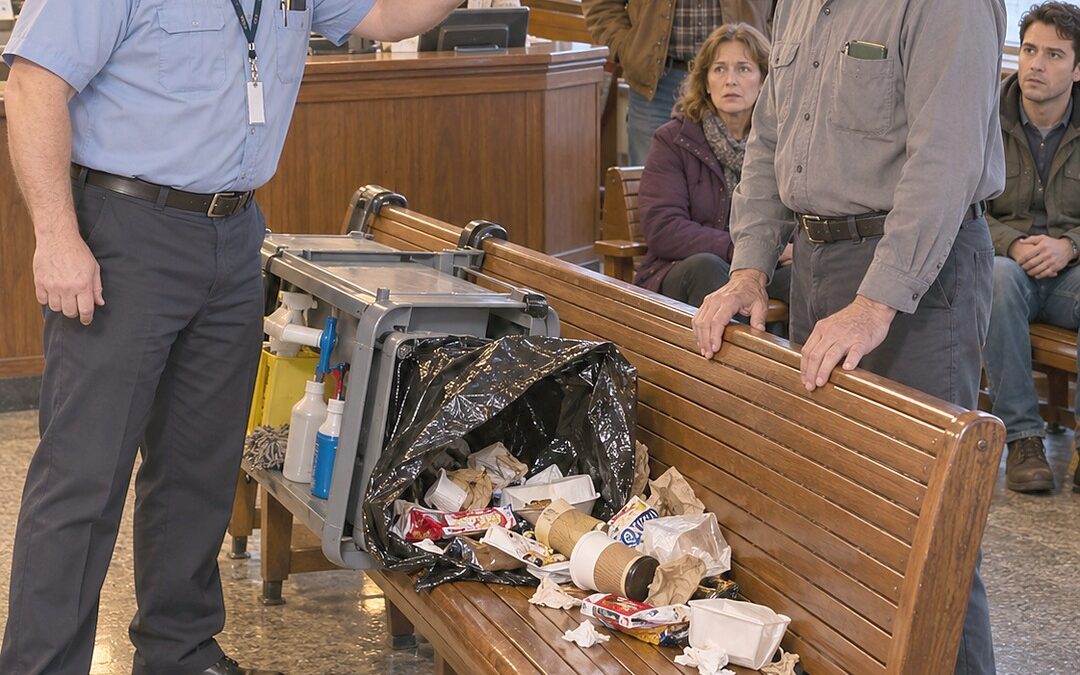
At 9:41 Tuesday morning, my supply cart lay tipped across Bench Four with the thirty-gallon trash bag dumped over it while all thirty-one riders in the Tallgrass waiting room watched.
Curtis Kratzer was accusing me of taking $380 from a passenger's wallet, putting my twenty-two-year job on the table, and the green notebook was still buttoned in my shirt pocket where the man who had just called me a thief had no idea to look.
At 9:34, freezing rain ticked against the depot windows at thirty-three degrees while wet boot prints held on the tile, the Bunn pot cooked the same coffee it had held since four, and the vending machine ate another dollar.
Merle Haverkamp came to Mia Kenyon's ticket window empty-handed.
He was sixty-three, from Cedar Falls, with a worn Lions Club cap bent hard at the brim.
"Merle Haverkamp. Brown wallet," he said. "Anybody turn one in?"
Mia's face tightened as she found me working the mop around the vending machine.
"I logged your wallet this morning, Mr. Haverkamp," I said, one hand still on the mop handle.
Merle turned all the way toward me.
"You did?"
"Yes, sir."
Mia pointed her chin toward Curtis Kratzer's office.
That office door opened before she called him.
Curtis came out carrying a brown leather wallet wrapped in a white paper towel, as if leather had recently become contagious, and he held it by two corners while he walked to the counter.
The corner of a plain white envelope showed from his breast pocket.
He patted that pocket, checked the wall clock, then set Merle's wallet on the counter.
"It came to me light, and it came from his hand at nine-twenty."
He said it to Merle, but he aimed it at the room.
The boy asleep on a duffel near the window kept sleeping, while a nurse in blue scrubs stopped watching the rain and held her bus ticket between two fingers.
Merle planted one hand on the counter.
I left the mop where it was, handle against my shoulder.
"I handed it to you at six-oh-nine and you signed."
Curtis laughed once.
"Then it's in your diary, right?"
He had been calling it my diary since June.
I kept calling it a notebook.
My hand went flat over the shirt pocket.
Merle opened the wallet where it lay on the paper towel.
He checked the bill compartment with one finger, then checked it again, slower, moving his Lions Club card and driver's license aside.
"There's no cash."
Curtis spread the paper towel flat on the counter.
"That's what I'm saying."
I put the mop in the yellow bucket and squeezed it once.
The rubber wringer squeaked.
"Ernest?" Mia said.
She was twenty-one and worked the morning counter around classes at Hawkeye Community College, four mornings most weeks, five when somebody's kid had strep or a radiator gave up.
She had heard what I said.
So had everyone else.
Curtis lifted Merle's wallet and held it where the driver's license showed.
"You told me you found it?"
"Under Bench Three."
"What time?"
Curtis answered before I did.
"Early."
Merle's mouth stayed open a little.
I took my rag off the cart handle and wiped a stripe of slush from the metal edge of the vending machine.
The machine ate another dollar behind me.
A man in a Carhartt jacket slapped the return button twice.
I had been at Tallgrass twenty-two years, and I knew the waiting-room noise well enough to hear when people stopped worrying about the bus and started listening to the counter.
Curtis laid the wallet down.
"Mr. Haverkamp, I can only tell you what reached my office."
Mia kept one palm on the counter.
"What reached your office had money in it."
Curtis didn't answer her.
A few minutes later, Curtis pointed at my supply cart.
My jacket hung from one side of the handle.
The tray held two spray bottles, a spare mop head, rubber gloves, a roll of paper towels, and Mabel's yellow pencil stub, chewed flat at one end, which I kept there because it still wrote if I held it sideways.
"Bring that over here."
I checked Bench Four.
A young mother had her tote on one end and a little girl was sitting on the other with both boots tucked under her.
"Bench Four," Curtis said.
The mother pulled her tote away and guided the girl up.
I pushed the cart across the wet tile.
One front wheel had been listing left since Labor Day, so the whole thing tugged that direction unless you leaned your hip into the handle.
Curtis came around the counter.
The riders nearest Bench Four moved their bags back under their knees.
He stopped by the bench, tapped the wood with one finger, and pointed at my cart.
"Tip it."
I kept my hands on the cart handle.
"What exactly do you want?"
"Everything on that cart where I can see it."
"On the bench."
"On the bench."
Then I took the spray bottles out first.
One had glass cleaner.
The other had the neutral floor stuff Tallgrass bought by the case, and it smelled faintly of lemon until it dried.
I set both on Bench Four.
The folded wet-floor sign went next.
Then the mop head.
I laid the rubber gloves beside it and set the paper towels along the back of the bench.
The pencil stub went on top.
Curtis pointed at the cart itself.
"Turn it over."
A coach driver had once backed into that cart in the bay lot and bent the top rail, so it never liked being lifted.
I got one hand under the side and eased it onto the bench.
The loose bucket clanged against a bolt.
A woman near the dispatcher glass pulled her feet back.
Curtis pointed at the black trash bag tied to the lower frame.
"That too."
It was a thirty-gallon bag from the waiting-room can, maybe half full, wet at the bottom where somebody had dumped coffee into a cup and missed the cup part, and I untied it from the lower frame.
"Dump it."
I turned the bag over above Bench Four.
Paper cups came down first, followed by candy wrappers, a crushed juice box and one small child's sock that had no business being as wet as it was.
A used bus schedule slid across the bench and stuck to a spray bottle.
Coffee ran through the paper towels and dripped from the front edge of the bench.
One cup landed inside my spare mop head.
The little girl's wet sock was not the one on the bench.
Her mother checked both of the child's feet anyway.
At 9:41 Curtis stood over the pile with a ballpoint pen and said, "Twenty-two years of mopping up after strangers, Ernest, and you finally decided everything on this floor was lost property."
My hands stayed on the empty black bag. The plastic crackled between my fingers, and a stripe of old coffee ran off the bench onto the tile by my boot.
He separated two cups with the pen and flattened a wrapper.
The little girl watched from beside her mother's coat until her mother turned her toward the windows.
"Nobody with nothing to hide minds being searched."
"You're searching trash," Merle said.
Curtis pushed the pen under a damp cup.
"Property at the scene. Mr. Haverkamp's money didn't walk out of here by itself."
At 9:44 he went back to the counter phone and dialed with the pen still in his hand.
"Possible theft by an employee. I'll hold the scene."
The boy on the duffel woke up.
Curtis gave the depot address and his name, put the receiver down, and came back to Bench Four.
— continue reading from here —
Merle stayed near the counter. Mia had not moved from her station, and the nurse in blue scrubs was still holding the same ticket between her fingers.
The pen caught the yellow pencil stub near the middle and flicked it off the wood.
The pencil rolled once under the bench.
I got down on one knee before I picked up anything else.
The floor was gritty through my work pants.
I reached under the bench and found the pencil by touch.
The flat little notch from Mabel's teeth sat under my thumb when I wiped the chewed end.
Then I stood and set it beside the paper towels.
Mia came out from behind the ticket window.
"He mailed a man his dentures to Sioux City on his own dime."
She had her Tallgrass badge clipped to her sweater and a paper cup near her elbow.
I had mailed the dentures because the fellow called from a motel and said he couldn't eat breakfast.
Postage had been nine dollars and change.
"Mia," I said.
Curtis set the pen on the bench.
"This is an employee matter."
"Then I'm an employee."
"Not anymore."
Curtis checked the wall clock.
It was 9:50.
"Punch out, Miss Kenyon. Take your coat and your opinion with you."
Mia's badge came off her sweater, and she set it on the counter.
Then she went through the staff door, came back wearing her navy coat, and walked to the end of the ticket counter instead of the front door.
"You were told to leave."
"I took my coat."
Mia tucked her hands into her coat pockets and remained at the counter.
Curtis pointed at the mess.
"Don't touch anything else."
"The floor's wet."
"Leave it."
I moved the yellow bucket six inches so a rolling suitcase wouldn't run into it.
Curtis caught the movement.
"Do you have trouble following instructions?"
"I have trouble leaving a wet floor unmarked."
Merle sat down at the far end of Bench Three without his wallet, his right hand opening and closing once on his knee.
He had come for the Des Moines coach, and through the window I could see the bus still at Bay Two with its wipers parked.
Freezing rain had put a clear skin over the metal railing outside.
Curtis spoke to Verlene Mostek through the slot in the dispatcher glass.
Verlene had been there nineteen years and knew every driver by his radio voice.
I missed the first words and caught only the last two.
"Good enough."
Verlene gave one small nod and returned to her screen.
Her headset cord brushed the counter as she reached for a radio switch, and Curtis left the window before she said anything else.
Curtis came back to Bench Four.
"Where were you at nine-twenty?"
"Office trash."
"You were in my office."
"Doorway."
"Same thing."
"No."
He did not ask me another question.
I could have told him exactly what had been in his trash can: two coffee cups, a torn fuel receipt, the peel from a banana, and a thick mailer with the top sliced off.
I did not.
Merle stood again with the wallet still on the counter.
"What happens to my wallet?"
Curtis answered him.
"It stays here until the deputy looks at it."
"Can I have my license?"
"Not yet."
Merle's fingers touched the edge of the paper towel, then came away.
The little girl by the window asked her mother if the bus was broken, and her mother said no, weather.
A few minutes later Verlene announced that the Des Moines departure remained delayed and that she still had no departure time.
The little girl pressed one palm to the cold window while her mother kept their tote between her shoes.
Curtis stood in the middle of the waiting room.
I stayed beside the cart.
The yellow pencil stub sat beside the damp paper towels with one dark spot near the chewed end.
This was notebook forty-one.
That morning I found Merle's wallet under Bench Three, wrote entry forty-four, and counted the cash before I carried it to the office.
Curtis was on his phone in the office doorway when I brought it in. I held out the notebook with my thumb over the amounts, the habit left from Arnold Bruhn saying, "I trust your count, Ernie," and Curtis scrawled C.K. on the "Rec'd" line without reading above it.
Later, on the trash run, I passed Curtis's black pickup and saw a Lund payment booklet on the passenger seat, open to an October slip from the boat dealer out on Highway 218.
Merle leaned against the counter.
Mia was still at the far end in her coat.
The man whose dollar the vending machine had eaten was now holding a package of pretzels.
The coffee stain under Bench Four had reached the grout, and my tipped cart was still balanced against the bench.
Curtis lifted the wet-floor sign, checked under it, then set it down on top of the trash.
A few minutes later Merle said, "You keep saying nine-twenty."
"That's when it came from him."
"I got here at nine-thirty-four."
"Yes, sir."
"So who told you nine-twenty?"
Curtis pressed one finger into a coffee cup until the paper side buckled.
"Staff saw him leave my office."
"With my wallet?"
"With property from my office."
Merle stared at the crushed cup.
I bent and righted one leg of the cart where it had wedged against the bench bolt.
Curtis stepped closer.
"Leave the cart."
"I'm getting it off the bolt."
"I said leave it."
I let go.
The wheel settled crooked.
He had been manager since May, and in those five months he had learned my schedule well enough to know I was in at five, the drivers had coffee by five-thirty, and I did the manager's trash after the lobby cans.
Curtis took another step.
"Don't touch the scene."
I stood.
The room smelled of cooked coffee and my floor cleaner.
The spray bottles were still on their sides.
A few minutes later I unbuttoned my shirt pocket and touched the green spiral edge.
Curtis saw it.
"Open it."
"The one you call my diary."
He stepped toward me and reached.
The counter phone sat between Mia's badge and Merle's wallet, and the trash from my route was still spread across Bench Four.
Curtis's hand stopped an inch short of my shirt pocket, because thirty-one people were watching it. I took the notebook out myself, found the next clean line for entry forty-five, and wrote the time, then: 31 present.
Part 2 — THE DEPUTY LEAVES
PART 2 — THE DEPUTY LEAVES
At 10:04, six minutes after I wrote the time in my notebook, Deputy Nolan Tiernan came through the depot door with freezing rain shining on his shoulders and a clipboard tucked under one arm.
His boots left two dark tracks across the tile before he stopped beside Bench Four, where my overturned cart and the waiting-room trash were still spread across the wood.
"Who called?"
"I did," Curtis said.
Tiernan was thirty-nine, broad through the chest, with a Black Hawk County Sheriff's patch darkened by rain and a radio clipped high on his coat.
He pulled a pen from the clipboard.
"Tell me what happened."
Curtis stood between the counter and Bench Four.
"Customer reported cash missing from a returned wallet."
Tiernan asked Merle how much was missing.
"Three hundred eighty dollars."
Curtis tapped the paper towel beneath the wallet.
"It came to me light, and it came from his hand at nine-twenty."
He gave it smooth, like a prepared line.
Tiernan wrote my name, my job, and twenty-two years at Tallgrass, then pointed his pen toward the overturned cart.
"Who put that there?"
"I did," I said.
"Why?"
"He told me to."
Curtis stepped in.
"I needed to preserve what was there."
Tiernan marked the clipboard.
The black bag sagged beside the cart, and cold coffee had made a brown stripe down Bench Four.
He asked Mia whether she had seen me find the wallet.
"No."
"Did you see him with it?"
"Not when he found it."
Curtis cut in.
"She wasn't here at that hour."
"I was asking her."
That held him for a few seconds.
Behind the dispatcher glass, Verlene Mostek had her headset on.
Tiernan walked to her window.
"Did you see Mr. Roesch around the manager's office?"
Verlene answered Tiernan, but she said it with her eyes on Curtis.
"I saw him come out of your office around nine-twenty."
"Carrying anything?"
"The trash can."
Curtis moved closer to the glass.
"He had access to my office."
Tiernan wrote that down, then asked me whether I had gone inside.
"I emptied his trash from the doorway."
"Anything else?"
"No."
The little girl by the window had climbed backward onto Bench Three so she could see over the backrest, and her mother turned her around.
Merle stood at the counter holding his cardiology appointment card.
Tiernan asked when he had noticed the money missing and whether he had called the depot.
"About six-fifty. I called."
Curtis said, "We receive a lot of calls."
"I remember mine," Merle said.
Tiernan came back to me.
"You have anything showing when you found the wallet?"
The green notebook was still in my hand.
"It's all in my book, Deputy."
"His diary," Curtis said.
Tiernan held out his hand.
I gave him the notebook.
He read the number 41 on the cover and put his thumb under the front page.
His radio cracked before he turned it.
The dispatcher reported a rollover on Highway 63 at the Airline overpass with possible injury.
Tiernan pressed the button.
"Tiernan."
Static came back.
He answered with his unit number, then closed the notebook and put it into my hand.
His fingers folded mine over the cover.
"Keep that book on you, Mr. Roesch. I'll be back for it, and nobody takes it but me."
Tiernan tucked the clipboard under his arm.
"Mr. Kratzer, don't dispose of anything here."
"I won't."
"Mr. Haverkamp, I may need to speak with you again."
"I'm not leaving without my wallet."
Tiernan nodded.
"Fine."
I stopped him before he reached the doors.
"I haven't been detained, have I?"
"No. Nobody keeps your things, Mr. Kratzer."
Curtis said nothing.
Tiernan pushed through the front doors.
Cold air came in around him with rain and diesel exhaust, and his cruiser pulled away from the curb with its lights going before the doors finished closing.
I tucked the notebook away.
Curtis spoke to the room.
"All right. The deputy will be back."
A woman near Bench One asked about the Des Moines coach, and Verlene used the microphone to tell everyone the 10:15 remained held.
A man with a roller bag muttered something about Omaha.
Merle walked over with the cardiology card.
The blue medical-group logo showed on the front.
His own handwriting covered part of the back.
"I talked to you."
Curtis held out his hand.
Merle gave him the card.
Curtis checked the front, turned it over, and read what Merle had written.
Then he handed it back.
"Phones are a mess in this weather, sir."
"You remember me now?"
"I remember speaking to several people."
"At seven-oh-two?"
"I don't keep a clock on every phone call."
There was a wall clock six feet above his head.
I had mopped beneath it for twenty-two years.
It worked fine.
Merle slid the card into his shirt pocket.
The brown wallet stayed on Curtis's paper towel.
A few minutes later Curtis went behind the ticket counter and opened the shallow drawer under Mia's register.
He took out a large manila envelope and wrote my name across the front.
Then he came back.
"Keys."
I took my key ring from my belt.
It held the janitor closet, supply room, rear service door, two padlock keys, and an old brass one that hadn't opened anything since Tallgrass replaced a vending cage in 2018.
The small brass key to locker 9 was not on it.
That one hung on a bootlace around my neck under my shirt.
I held the ring out.
Curtis dropped it into the envelope.
"Badge."
I unclipped my Tallgrass badge.
The plastic had a crack by the bottom corner from when I'd caught it on a mop handle the previous winter.
He put that in the envelope too.
Mia stepped away from the counter.
"Why are you taking his badge?"
"Company property."
"The deputy didn't say—"
"I fired you."
"You did."
"Then stop interfering."
Mia pulled her coat zipper higher.
Curtis left the notebook alone and went to my overturned cart.
He lifted my jacket from the handle.
One sleeve dragged through a wet coffee ring.
"That's mine," I said.
"You're not working."
"I'll need it when I leave."
"You aren't leaving."
"He just said I'm not detained."
Curtis folded the jacket over his arm.
"You're remaining here until this is resolved."
"Deputy said nobody keeps my things."
"I heard him."
He carried the jacket behind the counter and put it beside the manila envelope anyway.
Merle pushed himself up from Bench Three.
"He's sixty-eight years old."
"Mr. Haverkamp, I understand you're upset about your money."
"That's not what I said."
Curtis left my things behind the counter.
Tallgrass had rules for most situations.
Curtis seemed to be writing his own that morning.
A driver came in through the bay door with rain on his cap and stopped when he saw Bench Four.
Verlene told him the hold was still on, and Curtis sent him toward the staff hallway.
Curtis slid the envelope with my keys and badge under the counter.
Mia's badge remained beside it.
Then he came over.
"Ernest."
I raised my head.
"Sit down."
"Where?"
He pointed at Bench Four.
The cups and wrappers still covered most of it, with my cleaning supplies crowded against one end.
"There's trash on it."
"Move enough to sit."
"I was told not to touch the scene."
Curtis worked his mouth once.
"I'll move it."
He pushed two paper cups aside with the edge of the yellow wet-floor sign, then shifted the juice box far enough to make a space a little wider than my shoulders.
One cup dropped to the tile.
"Sit there."
I sat.
The bench was cold through my work pants, and the tipped cart leaned against my left knee with one wheel facing the ceiling.
The yellow pencil stub lay beside the paper towels.
Curtis stood in front of me.
"Hands on your knees."
Mia came away from the counter.
"Curtis."
He raised one hand toward her.
"Don't."
She stopped.
I put my hands on my knees.
The little girl's mother came over from Bench Three with her daughter tucked close against her coat.
"Mr. Roesch?"
"Yes, ma'am."
"My daughter wants her sock."
She pointed toward the little sock sitting among the trash.
The girl immediately shook her head.
"Not mine."
"I know," I said.
Her mother gave me the kind of tired expression parents use when their children have just corrected them in public for free.
"She means she wants you to pick it up."
Curtis heard that from six feet away.
"He isn't touching anything."
The mother turned to him.
"It's a sock."
"It's part of the scene."
She took that in, then bent enough to speak to her daughter.
"Okay. We don't touch the police sock."
The girl studied Curtis, apparently deciding whether police socks were a regular category of law enforcement equipment.
I kept my hands on my knees.
"Best leave it," I told her. "Might get promoted."
The mother pressed her lips together.
The girl didn't.
She giggled once, then covered her mouth because her mother did.
Mia lowered her head over the counter.
Curtis pointed toward Bench Three.
"Please return to your seat."
The woman put one hand on her daughter's shoulder and walked her back.
The girl twisted around once to check the sock.
It stayed exactly where Curtis had left it.
The notebook rested flat against my chest beneath my shirt.
My cart pressed against my left knee.
Across the room, the manila envelope with my name on it sat under the counter exactly where Curtis had put it after a deputy told him not to keep my things.
Part 3 — LOCKER NINE
PART 3 — LOCKER NINE
By then I was still sitting on Bench Four with my hands on my knees, my overturned cart against my left leg, and enough waiting-room trash around me to make the bench look condemned.
The nurse in blue scrubs checked the departure board while the little girl by the window drew circles in the fogged glass with one finger.
I kept my eyes on the cart wheel.
Curtis crossed the lobby again.
He had been making the same trip since Tiernan left, from counter to dispatcher window to office door, never quite reaching any place that required him to sit down.
His breast pocket bulged under his shirt.
He patted it, then checked the wall clock.
That made three times I'd seen him check it that morning.
He went to Verlene's window.
"I need to be out of here by noon — boat payment at Lund's on 218."
Verlene kept her headset on.
"You called a deputy, Curtis."
"I know who I called."
"Then he's coming back."
Curtis leaned closer to the glass.
"I have an appointment."
Verlene clicked something on her screen.
Curtis passed Bench Four without stopping, close enough that I could smell coffee on his shirt.
Merle sat on Bench Three with his attention going now and then to the brown wallet still lying on Curtis's paper towel at the counter.
His cardiology appointment card remained in his shirt pocket.
The 10:15 coach was still at Bay Two.
Rain ticked against the windows.
Mia was at the end of the ticket counter with her coat on.
A few minutes later she reached behind the counter for a spray bottle and a gray rag.
Curtis stopped halfway to his office.
"What are you doing?"
"Cleaning."
"You don't work here."
"You fired the ticket clerk."
"I know."
"Then who's cleaning the coffee?"
She pointed at a brown ring near the Bunn pot.
"Leave it."
Mia sprayed the rag instead of the counter.
"Health emergency?"
Curtis walked into his office and shut the door.
Mia wiped the coffee ring and worked her way along the counter in my direction until her shoes stopped near my right boot.
I reached under my collar.
The bootlace was warm from my neck.
I pulled it over my head, and the small brass key hung from the knot.
My regular key ring was inside the manila envelope Curtis had taken.
Locker 9 would be an easy next stop if he decided my locker needed the same treatment as my cart.
Without turning my head, I held the key beside my knee.
"Locker nine. The Folgers can. Take it to your car."
Her rag stopped.
"Why?"
"Because it's mine."
She took the key.
Locker 9 was the third door on the right down the staff hallway, and the can on its top shelf was an old metal Folgers can Mabel had once used for coffee.
Forty green notebooks were inside.
Mia folded the rag, put it beside the spray bottle, and walked toward the staff hallway.
I kept watching the crooked wheel on my cart.
Curtis's office door opened.
He came out carrying nothing.
"Where'd she go?"
Verlene spoke through the dispatcher opening.
"Restroom, maybe."
The women's restroom was the other direction.
Verlene returned to her monitor.
Curtis remained in the lobby.
Merle leaned toward me from Bench Three.
"You all right?"
"Bench needs sanding."
He studied the wood under me, then sat back.
That was as close as anybody had come to offering me furniture advice.
I moved my left foot away from the damp paper towels.
The book pressed flat against my chest.
In September 2004, less than a month after I started at Tallgrass, a woman said I had taken a ring she left beside the ladies' room sink.
The supervisor had me empty my pockets at his desk in front of two drivers. They checked my locker too, and near the end of the shift the woman found the ring inside her coat lining where a seam had opened. Nobody apologized.
That night I stopped at Walgreens on Franklin Street, bought a green three-by-five spiral notebook, and wrote my first entry at the kitchen table with a number one beside it: One umbrella, black, left at Bay One. Returned.
Verlene called through the dispatcher opening and asked whether Curtis was releasing the Des Moines coach.
"Police matter," he said.
"The deputy left."
"He's coming back."
She reached for her radio.
The trash bag beside me had started leaking where it rested against the bench, and a thin line of cold coffee worked down the leg toward the tile.
I could have stopped it with one paper towel.
My hands stayed on my knees.
Curtis passed.
"Don't touch it."
"I wasn't."
The coffee reached a grout line.
Merle watched it.
"You clean this place every morning?"
"Five to one."
"Every day?"
"Weekdays."
He tipped his chin toward Curtis's office.
"That guy always like this?"
"Tuesday's young."
Merle sat back.
A few minutes later he got up, went to the vending side of the room, and returned carrying a sandwich wrapped in wax paper.
He lowered himself onto the clear end of Bench Four, leaving the pile between us.
"Turkey," he said.
"I'm fine."
"You didn't ask what kind."
"I've cleaned under enough bus seats to know turkey when I see it."
Merle pulled the sandwich apart and held out half anyway.
I took it.
He ate his side without talking.
Mine sat on the clean corner of a paper towel beside my knee.
The little girl noticed it before I touched it.
Her mother gave Merle a small nod.
Curtis came out of his office and stopped when he saw us sharing a bench.
He said nothing.
Merle took another bite.
The sandwich stayed beside my knee.
A little later Curtis stopped directly in front of me.
"You give Mia something?"
"No."
I had given her the key earlier.
"She isn't an employee anymore."
"You covered that."
"She has no business in staff areas."
He called her name once.
The hallway stayed empty.
Curtis took two steps toward it and stopped, then returned to the counter and began moving papers into a stack.
The waiting room remained full.
A passenger near Bench Two asked Verlene why the Des Moines coach was still sitting outside, and she told him it was on hold.
The little girl had quit drawing on the glass.
She was watching Bench Four again.
Curtis went into his office.
The door stayed half open.
I heard him answer the phone.
"No, not yet."
He listened.
"Lund."
Another pause.
"I said I'll handle it."
Then, clearer than the rest, "Noon."
He pushed the door nearly shut.
Mia came out of the staff hallway with no key in her hand and her jeans wet from the knees down.
She stopped beside Bench Four.
"It's in my trunk."
Then she walked back to the counter, took up the gray rag, and started wiping where she'd stopped.
Curtis came out less than a minute later.
"Where were you?"
"Outside."
"I told you to leave."
"I did."
His attention went to her wet jeans.
"Then why are you back?"
"My car's outside."
"Take it home."
"I will."
She put the rag down.
Curtis opened his mouth, then shut it when a driver called through the dispatcher opening asking about Bay Two.
Verlene answered the driver herself.
Curtis went back toward his office.
The bench under me had one loose slat near the window end.
I'd tightened that bolt twice since August.
Merle finished his half of the sandwich.
He nodded toward mine.
"You planning to inventory that?"
I took a bite.
Turkey.
He had not lied about it.
The rain kept coming.
A woman near the bay door asked Mia whether she still worked there.
"Not since breakfast."
Mia set the rag beside the spray bottle.
A few minutes later Curtis came out carrying the manila envelope with my name on it.
He placed it behind the counter.
My keys made a small metal sound inside.
My folded jacket was beside it.
"Deputy should've been back," he said.
Verlene kept working.
"Rollover."
"I know."
The man with the roller bag asked, "Coming back?"
"This doesn't concern you."
"It concerns my bus."
Curtis walked away.
Mia remained at the counter.
Merle's right hand rested on his knee, but his attention kept returning to the wallet on the white paper towel.
The little girl leaned against her mother's coat.
The sandwich half was gone except for a corner of crust on the paper towel.
I folded the wax paper around it and put it on the end of the bench.
At 10:48 headlights swept across the wet front windows as a large black Suburban turned in from Fourth Street, a Tallgrass logo showing on the front door through the rain.
It parked near Mia's silver Corolla.
A woman in a charcoal wool coat stepped out carrying a thick folder under one arm and crossed the wet sidewalk without running.
On the white tab were typed letters: ROESCH, E.
Part 4 — THE WRONG FILE
PART 4 — THE WRONG FILE
At 10:48, Dorene Zielinski came through the front doors carrying seventeen complaint letters, six company memos, and a folder with my name typed on the tab.
She was twelve minutes early for the eleven o'clock station review Tallgrass had announced ten days before.
Curtis reached her before the door shut.
"Ms. Zielinski, perfect timing, I just caught your thief."
She said nothing to him.
She stamped freezing rain from one shoe onto the entrance mat, took in Bench Four with my overturned cart and the trash still spread across the wood, then found me sitting beside it.
Verlene leaned toward the opening in the dispatcher glass.
"He's been watching that clock all morning. Said he's got a boat payment due at noon."
Curtis turned sharply.
Dorene put one hand on the folder.
"Mr. Roesch?"
"Yes, ma'am."
"Stand up, please."
I stood.
Curtis moved beside her as if he'd been invited there.
Dorene was fifty-seven and had thirty-one years at Tallgrass. Her charcoal wool coat was wet at the shoulders, and the papers inside her folder were thick enough to bow the cardboard.
Mia was at the far end of the ticket counter.
Merle stood by Bench Three.
The riders closest to us had quit pretending not to listen.
Dorene opened the folder.
"Seventeen riders since June, Mr. Roesch. Every one of those wallets came through this depot, and Mr. Kratzer's memos name you."
She lifted the first complaint.
"Cedar Rapids man reported two hundred ten dollars missing."
Another sheet came forward.
"A woman in Mason City was short five hundred twenty."
She slid out one more.
"A couple traveling through Dubuque reported three hundred forty missing."
Dorene set those three on top.
"The total is four thousand two hundred sixty dollars."
Curtis stood with his hands loose at his sides.
His breast pocket still bulged.
The complaint letters had different stationery and different folding marks, some typed and some printed from emails.
My name was on six Tallgrass memos behind them.
"How long have you had those?" I asked.
"The complaints accumulated over several months."
"And the memos?"
"Mr. Kratzer sent them as incidents came in."
Curtis spoke toward the room.
"I reported what I had."
Dorene shifted the papers inside the folder.
The plastic tab with my name clicked against the cardboard.
"Did anybody call me?" I asked.
"No," Dorene said.
"Ask me?" I asked.
"No," Dorene said.
I had worked there twenty-two years.
Dorene lifted a work order from the stack.
"There's also a camera issue."
The dead black dome hung above the counter.
"I signed this repair order August twenty-seventh, and the technician was never scheduled."
Curtis said, "I was waiting on facilities."
Dorene returned the sheet to the folder.
The camera stayed black, with no red light or picture since the August storm.
"Mr. Roesch, effective now, you're on administrative leave pending investigation."
Mia shifted at the counter.
My jacket was folded behind the ticket window.
"Paid?"
"Yes."
"All right."
Merle stepped forward.
"This morning's wallet is mine."
Dorene angled the folder toward him.
"Your name?"
"Merle Haverkamp."
She checked the pages.
"You're not in these."
"I hope not. My money disappeared today."
Curtis stepped in.
"We have an active police matter on that one."
Merle's hand started toward his shirt pocket, stopped short, and dropped.
Dorene tapped the edge of the folder against her palm.
"You called law enforcement?"
"At nine-forty-four."
"Deputy was here," Verlene said from behind the dispatcher glass. "He got sent to the rollover."
"He's coming back?"
"That's what he said."
Curtis spoke immediately.
"I've held the scene exactly as I found it."
Dorene took in Bench Four.
A crushed cup was stuck to a paper towel, my spray bottles lay sideways near the child's sock, and the damaged cart still rested on its side with one wheel pointing up.
"Exactly?"
"I had Mr. Roesch empty his work cart."
"And the trash?"
"Part of the search."
"You agreed to that?" Dorene asked me.
"Curtis told me to do it."
The mother with the little girl had moved them both to Bench Two, but the girl still watched through the gap between two adults.
Dorene lowered her folder.
"Mr. Kratzer, step back."
Curtis moved one pace, not far.
"Mr. Roesch, I've got six memoranda with your name in them."
"I'd like to hear what they say."
Dorene opened the folder wider.
"Dorene, some of that is internal—"
She pulled the first memo free.
"I'm the regional operations director, Curtis."
He stopped.
Dorene read past the heading.
"Morning custodian E. Roesch handles every item before it reaches my desk."
She lowered the sheet.
"That's a line from the June memo."
"Before it reaches your desk, Mr. Kratzer. So it reached your desk."
"When I'm here."
"You were here."
Curtis took another step.
Dorene lifted the memo between them.
"What does the next one say?" I asked.
She checked the next sheet.
"Same allegation."
"Does either one say he saw me take money?" I asked.
"No," Dorene said.
"Any witness?" I asked.
"No witness statement is attached," Dorene said.
Curtis said, "Because theft usually doesn't come with an audience."
Merle's mouth tightened.
Dorene slid the memo back into the folder.
"I have seventeen complaints, Mr. Roesch."
"Yes, ma'am."
"And six reports naming you."
"Six reports written by him."
Curtis opened his mouth.
Dorene tapped the folder once.
He shut it.
I turned to Bench Four.
The yellow pencil stub was still beside the damp paper towels.
Coffee had dried around the base of one spray bottle.
I wanted my cart upright.
Mia came around the end of the ticket counter with a paper cup and two sugar packets pinched against it.
"I told you to leave," Curtis said.
She kept walking.
"Mia," Dorene said.
"Ma'am."
"Are you still employed here?"
"Curtis fired me at nine-fifty."
Dorene tapped one finger against the folder.
"For what?"
Curtis answered before Mia could.
"Insubordination during an employee investigation."
Mia put the cup into my hand.
"Light, two sugars, you always say you don't take two but you do."
The cup was hot.
My hands had been steady all morning through the cart, the trash bag, and the pencil rolling under the bench.
The heat hit my palm.
Coffee moved against the lid.
I started to tell Mia thank you the way you thank a child who finds the glove you dropped in a parking lot.
Instead I kept my voice low.
"It's out?"
"Trunk."
Dorene was already answering another objection from Curtis about the memos.
Mia stepped back.
"Ma'am, he has a book."
Dorene stopped with one page half out of the folder.
"What kind of book?"
"Found-property record."
Curtis laughed.
"His diary."
Dorene held out her hand toward me.
"Do you have anything in writing?"
I set the coffee cup on the clean end of Bench Three.
Then I took out the green notebook.
Number 41 was written on the cover.
I did not open it.
I placed it in Dorene's hands with both of mine, cover facing up.
"This is your record?" she asked.
"Yes."
"How long have you kept these?"
"This one since August."
Dorene closed her fingers around it.
"I'll hold it for Deputy Tiernan."
Curtis folded his arms.
"He writes down every gum wrapper he finds."
"No."
Merle moved closer.
Dorene opened the notebook herself.
Numbered entries filled the pages in my handwriting: sunglasses, a hearing aid, a child's backpack, keys, wallets, and the usual things people forgot when buses ran late.
She turned several pages.
"Does somebody verify these?"
"The person who receives the item signs the last line."
Curtis said, "That's his system, Dorene. Not company accounting."
"It's a custody record," I said.
Dorene stopped on one page.
"These initials?"
"Receiver."
She turned another page.
Curtis leaned closer.
"Half the time somebody signs without knowing what he's written above it."
I kept my hands down.
Dorene's thumb held her place.
"Mr. Roesch, what exactly do you want me to look at?"
"I'd like Mr. Kratzer to read entry forty-four."
Curtis laughed.
The sound carried to Bench One.
Dorene's thumb remained between the pages.
Behind her, a wet paper cup slipped another inch along Bench Four and caught against the sock.
Curtis's smile stayed.
"You're serious?"
"Yes."
Dorene asked, "Why him?"
"Because he's the one who said I took it."
Curtis held out his hand.
"Give me the diary."
Dorene kept the notebook.
Merle moved to the end of Bench Four.
Mia remained by the counter.
Verlene had taken one side of her headset off and left it hanging against her neck.
Dorene turned the book so the cover faced Curtis.
"You read the entry aloud. Then it comes back to me."
She handed it to him.
His fingers closed around the green cover.
"Which one?"
"Forty-four."
He opened near the middle.
The pages moved fast under his thumb.
He flipped past entries for mittens, an umbrella, and a set of keys, then came back with the same small grin.
"You're sure about this?"
"Yes."
He found the entry number.
His thumb stopped near the top of the page.
Dorene stood beside him with the complaint folder closed against her coat.
Curtis turned the notebook slightly toward the waiting room.
"Go ahead. Read the whole diary."
The nurse in blue scrubs had left her seat.
Merle stood where he could see Curtis's face.
Mia stayed behind the ticket counter.
Curtis opened the notebook wider, slid one thumb down the page, and stopped on entry forty-four.
Part 5 — ENTRY FORTY-FOUR
PART 5 — ENTRY FORTY-FOUR
At 11:01, Curtis Kratzer stood beside Bench Four with my green notebook open in his hand, my trash still spread across the wood behind him, and thirty-one riders close enough to hear every word.
He still had the small grin from flipping past mittens, an umbrella, and a set of keys.
Dorene Zielinski kept her folder against her coat.
"Read it."
Curtis lifted the notebook high enough for Bench Three to see the green cover.
He gave the first line in a mocking little sing-song meant for the room.
"Tue 10/13. 5:52a. Brown leather wallet under Bench 3. License: Merle Haverkamp, Cedar Falls."
Merle moved closer.
Curtis kept going.
"Cash $380: three hundreds—"
The sing-song snapped off.
The edge of the page began to shiver against the green cover.
Dorene's voice stayed level.
"Finish it."
Curtis swallowed once.
When he started again, his voice was flat, the way a man reads a parts list.
"Cash $380: three hundreds, four twenties. Lions card. To manager 6:09a. Rec'd: C.K."
The last three words were the quietest.
A roller bag settled against a bench leg.
Curtis stared down at his own initials.
"Anybody can write initials."
Merle took the cardiology appointment card from his shirt pocket and turned it over himself.
The blue medical-group logo faced his palm.
"7:02 — K. says nothing turned in."
He held the card where Dorene could see his handwriting.
Curtis shifted one foot.
"That doesn't prove—"
Dorene raised the memo.
"Verlene."
Verlene Mostek had both sides of her headset off.
Curtis stepped toward the dispatcher window.
"You told me that was enough."
Verlene put one hand beside the radio console.
"You said that was good enough. I saw him come out of your office with the trash can. That's all I saw."
Curtis stopped.
Dorene tapped the memo.
"So you wrote this after telling her that was good enough?"
Curtis pointed at me with the notebook.
"He had access."
Verlene's voice came through the glass.
"I'm sorry, Ernest."
I nodded once.
Curtis lowered the book.
My handwriting was pencil.
His C.K. was blue ink, big and careless under the entry.
I had seen that scrawl plenty of times while he signed the last line without reading what my thumb covered above it.
"These notes aren't official records."
"They're his records," Dorene said.
"He could've filled this in later."
"Lost things go back to whoever lost them, Mr. Kratzer. Forty-eight hundred and twelve times in twenty-two years. Read entry forty-four out loud and tell these people where the three hundred eighty dollars is."
Curtis said nothing.
My coffee sat untouched on Bench Three.
Merle carried his appointment card to the counter and laid it beside the brown wallet, which had stayed on Curtis's paper towel all morning.
Dorene took the notebook from Curtis.
She turned back several pages and stopped where the same blue initials sat below another entry.
"How often have you signed this book?"
"If Ernest put something on my desk, I signed for it."
"You signed without reading it?"
"I trusted the process."
Dorene turned the page toward him.
"Your initials are under the writing."
Curtis rubbed one finger along his cuff.
"I sign paperwork all morning."
"You signed for this wallet."
"That could've been anything."
"You just read what it was."
"Written by Ernest."
"Under your initials."
Curtis stopped answering.
Dorene closed notebook forty-one and kept it against her folder.
His right hand went to his breast pocket and lay flat over the bulge.
He stepped backward and sat on Bench Four, in the same place where my cart had been dumped, with thirty-one riders watching that hand.
Dorene stopped in front of him.
"Nobody with nothing to hide minds being searched, Mr. Kratzer. Show me what's in that pocket."
Curtis stayed seated.
"You're serious."
"Yes."
"This is ridiculous."
Dorene waited.
He got up.
The white corner of the envelope showed above his breast pocket.
Curtis removed his wallet from his back pocket and set it on Bench Four.
His phone went beside it.
His hand returned to the shirt pocket.
Dorene said, "Verlene told me you've got a boat payment due at noon."
Curtis's fingers stopped on the envelope.
"What was due by noon, Mr. Kratzer?"
"My payment is due."
The answer came fast.
"Boat payment?"
He did not answer.
"Show me."
Curtis pulled the plain white envelope from his breast pocket.
The flap sat open a fraction from the thickness inside.
"This has nothing to do with the depot."
"Put it on the bench."
He put it beside his wallet.
"Open it."
"It's my money."
"Open it."
Curtis tore the flap loose and tipped the contents onto Bench Four.
Three hundred-dollar bills slid out together.
Four twenties followed.
One twenty slipped halfway under his wallet.
Merle stepped forward.
"May I?"
Dorene nodded.
Merle separated the bills on the bench.
"One hundred."
He laid the first hundred flat.
"Two hundred."
The second went beside it.
"Three hundred."
He placed the third bill down.
Then the twenties.
"Three twenty."
Another bill.
"Three forty."
Another.
"Three sixty."
He pulled the last twenty from under Curtis's wallet.
"Three eighty."
"Three hundred eighty dollars," I said.
Curtis's mouth opened.
"You think because the amount matches, that makes it his?"
Merle rested one hand on the bench.
"It came out of an envelope in your pocket."
"It's a boat payment."
Dorene touched the empty envelope with one finger.
"Cash?"
"Yes."
"Exactly three hundred eighty dollars?"
Curtis stopped.
"My payment is due."
"Today?"
He gave no answer.
Dorene left the envelope beside the money.
Curtis said, "I was short on the regular payment. That's the balance."
Merle kept his hand on the bench.
"You were short exactly what I was missing."
"Coincidence."
Dorene pointed at his trousers.
"Both front pockets too."
Curtis stared at her.
"Do it."
He slid his hands into both front pockets slowly.
The white linings came out in his fists.
A folded gas receipt dropped onto Bench Four.
Two quarters followed and rolled until one struck the yellow wet-floor sign.
He held both pockets turned out.
The thirty-one riders saw it.
Mia saw it from the end of the counter where Curtis had fired her.
Merle stood less than three feet away.
Dorene crossed to the ticket counter and lifted the brown wallet from the paper towel.
She carried it to Bench Four and set it beside the cash.
"Mr. Haverkamp, license and Lions card are both yours?"
"Yes."
"And the cash amount matches what you reported?"
"Every dollar."
Dorene left the bills beside his wallet.
Curtis reached toward them.
"Don't."
His hand stopped above the bench.
He lowered it.
Dorene pointed at the mess around him.
"You dumped it, Mr. Kratzer. Put it back."
Curtis stared at the black trash bag.
"You're kidding."
Dorene did not answer.
I took the bag by its plastic tie and held the mouth open.
Curtis bent over Bench Four with bare hands.
He took the crushed juice box first and dropped it into the bag.
A candy wrapper followed.
He gathered the damp paper cups, and cold coffee ran from one of them into his cuff.
Then he took the child's sock and dropped it into the bag.
The little girl by Bench Two leaned around her mother's side.
Her mother let her watch.
Curtis gathered the used bus schedule and wet paper towels, swept the last loose wrappers into his palm, and put them in.
I held the bag open.
I said nothing.
Mia watched from the counter.
Merle remained beside his wallet.
When the bench was clear enough, Curtis gripped the cart frame.
The damaged wheel swung as he pulled.
He got the cart onto its wheels, then had to lean his hip into the handle when the front wheel dragged left across the tile.
It pulled half a foot before straightening.
Curtis let go.
Coffee darkened his cuff.
Dorene opened one of his six memos.
"These reports you sent me."
Curtis stood beside the cart.
"What about them?"
"You blamed Ernest."
"I reported a pattern."
"You wrote that he handled every item before it reached you."
"He did."
Dorene held notebook forty-one against the folder.
"Entry forty-four says otherwise."
Curtis rubbed his damp cuff.
"I don't know what he wrote in all those little books."
Dorene turned to me.
"All those?"
"This is number forty-one."
Her hand stopped on the folder.
"Forty-one?"
"Forty before this one."
Curtis's head came up.
Dorene closed the memo.
"Where are the rest of them?"
"Out in Mia's Corolla, in a Folgers can."
Curtis turned to the front glass and the silver Corolla in the parking lot.
Dorene shut my folder.
"Mr. Kratzer, you're suspended effective now."
Curtis turned back.
She continued before he could answer.
"Tallgrass is ending your contract."
His hand went to the cart handle, but he did not move it.
Dorene held out her palm.
"Office keys."
Curtis stared at her.
"Now."
He took the key ring from the bench.
The silver office key came loose after two tries.
He dropped it into her hand.
The station plaque was still hanging between Benches Two and Three.
Dorene pointed at it.
"That comes down too."
Curtis did not move.
The front doors opened behind him.
Deputy Nolan Tiernan came in with freezing rain across his shoulders and his clipboard under one arm.
He stopped beside Bench Four.
The cash, Merle's wallet, the empty white envelope and Curtis's turned-out pocket linings were all still there.
Tiernan took in the bench.
Dorene handed him notebook forty-one.
Curtis stood with coffee drying on his cuff.
Tiernan said, "Come with me."
Part 6 — NOTEBOOK FORTY-TWO
PART 6 — NOTEBOOK FORTY-TWO
At 11:46, Deputy Nolan Tiernan was still beside Bench Four after telling Curtis Kratzer to come with him when Mia Kenyon came through the depot doors carrying the old metal Folgers can against her coat.
Cold coffee had dried across one of Curtis's cuffs.
The black trash bag sat near his shoes, and Merle's wallet lay beside the three hundred eighty dollars on the bench.
Rain ran from Mia's sleeves onto the entrance mat.
She set the can on the ticket counter.
"These?"
"Yes," I said.
The lid had two dents near the rim.
Mia worked it loose.
Forty green spiral notebooks stood inside in order, number one worn soft at the corners and number forty still holding most of its green cover.
Dorene Zielinski took number forty from the can.
Notebook forty-one was already in Tiernan's hand.
Curtis spoke from Bench Four.
"Those don't prove missing money."
Dorene opened the Cedar Rapids complaint.
The man had reported $210 missing.
She found the matching entry in notebook forty, my pencil line showing Cash $210, the item going to the manager, and underneath it the same blue scrawl: Rec'd: C.K.
She set the complaint beside the page.
Tiernan opened notebook forty-one.
Dorene worked through the letters while he followed the entries.
Seventeen complaint letters matched seventeen wallet entries across the two notebooks.
The initials beneath them were the same.
Dorene closed notebook forty and put one palm on the complaint stack.
"Four thousand two hundred sixty dollars across seventeen riders, and every one will be refunded this week."
Curtis rubbed the dried coffee on his cuff.
"You can't put all seventeen on me because of initials."
Dorene lifted one of his memos.
"I'm not putting anything anywhere, Curtis."
She slid it back into the folder.
"You did."
Tiernan put notebook forty-one on his clipboard.
Curtis moved toward the manager's office.
Dorene pointed past him to the plaque between Benches Two and Three.
STATION OF THE QUARTER — CURTIS KRATZER, MANAGER.
I had dusted it every weekday morning.
"Take that down."
Curtis stopped.
"What?"
"The plaque."
"Why?"
"Take it down."
Tiernan remained by Bench Four.
Curtis went beneath the plaque and lifted it from its hooks.
For several seconds he held it against his chest.
Dorene pointed to the floor beneath the wall clock.
Curtis carried it over and laid it face down on the tile.
The metal hanger tapped once.
His office key was already in Dorene's possession from the order she'd given in front of the room.
She pointed behind the ticket counter.
"Bring Mr. Roesch's things."
Curtis walked behind the counter.
The manila envelope with my name on it was where he had left it, next to my folded jacket.
He took both.
My name faced outward when he carried the envelope across the lobby.
"Open it," Dorene said.
Curtis pulled the flap apart.
My keys dropped into my palm.
Then he handed me the badge.
I clipped it onto my shirt.
He held the jacket out last.
I took it and put it over the cart handle.
Dorene closed the folder with my name on the tab.
"You're not on leave."
"All right."
She kept the folder in both hands.
"I came in here with the wrong file. I'm sorry, Mr. Roesch."
"All right."
Tiernan stepped closer to the counter.
"Where's the other book?"
Dorene handed him notebook forty.
He took a clear evidence bag from his kit and slid both notebooks inside.
The green covers pressed against the plastic.
He sealed the top.
Curtis watched the bag.
Tiernan tucked it under his arm.
Curtis pointed toward the door.
"You already told me to come with you."
"I did."
"Am I under arrest?"
"I'm asking you to come with me while I sort out what I've got."
Curtis's phone was still on Bench Four.
Dorene lifted it and handed it to him.
He put it in his pocket.
Then Tiernan turned to Merle.
"You willing to sign a complaint?"
"Yep."
He gave Merle the clipboard.
Merle read the page before signing.
His name went on the bottom in blue ink.
He handed the clipboard back.
Before going toward Bay Two, Merle came to me with a twenty-dollar bill pinched between two fingers.
"For mailing dentures or coffee or whatever."
"That one's yours."
"So?"
"So put it away."
He folded the twenty once and returned it to his wallet.
"My wife says I tip too much."
I left that alone.
Merle put the wallet inside his coat.
Tiernan called after him.
"Mr. Haverkamp, stay where I can find you until the bus boards."
Merle raised one hand and kept walking.
Verlene came through the dispatcher door.
She stopped near my cart.
"I should've said the whole thing."
"Yes."
She gave one small nod, then went back behind the glass without touching me or adding anything.
Her headset went on.
Tiernan shifted the evidence bag under his arm.
Curtis stood where he had ordered me to dump my cart a little over two hours earlier.
The face-down plaque was behind him.
The thirty-one riders could see the cash on Bench Four and the empty white envelope beside it.
Tiernan motioned toward the doors.
Curtis walked.
He passed Mia at the counter and the plaque under the clock.
Then he went outside into the freezing rain with Tiernan beside him.
No one followed them.
Verlene reached for the microphone.
The 10:15 coach to Des Moines was boarding.
People stood and pulled bags from beneath the benches.
Merle joined the line for Bay Two.
The nurse in blue scrubs took her seat near the front.
At 11:50 the coach eased away from the curb.
Through the window, the nurse saw me beside Bench Four and gave one small nod.
The rear lights disappeared into the freezing rain.
I went to the bench.
Mabel's yellow pencil lay near the edge where I had set it after pulling it from underneath earlier that morning.
I picked it up first.
The flat chewed place pressed against my thumb.
I put it in my shirt pocket.
The child's sock went into lost property.
Somebody might come looking for it.
Mia came around the counter with her badge still lying where she'd put it when Curtis fired her.
Dorene was gathering the complaint letters.
"I'll need statements from both of you," she said.
"Fine."
"Anything else?"
"One thing."
Dorene reached toward her pocket, then left the pen where it was.
"What do you need?"
"Mia's name back on the schedule."
Mia stopped near the counter.
"Done," Dorene said.
Mia took her badge and clipped it onto her sweater.
"Does today count?"
"Today counts."
She went back behind the ticket window.
I carried the yellow bucket to the janitor sink.
The water came out cloudy for three seconds before it cleared.
When I returned, boot prints ran from the entrance across the waiting room in dark half-moons, some sharp at the heel and some already drying around the edges.
I lowered the mop into the bucket.
Near Bench Four, the empty white envelope remained where Curtis had left it.
Dorene took it for Tiernan.
The plaque stayed face down under the clock.
I worked from the entrance toward the benches.
Mia wiped the counter.
By the time I rinsed the mop again, most of the wet tracks were gone.
That evening, I sat at my kitchen table on Clark Street.
The refrigerator motor started, stopped, then started again.
Warm air came through the furnace vent under the sink.
One coffee cup sat by my elbow.
The chair across from me was pushed in.
I took the yellow pencil from my shirt pocket and laid it beside the sugar bowl.
The chewed end had one small flat place where Mabel's teeth used to catch it.
A new green spiral notebook sat on the table.
Number forty-two.
Notebooks forty and forty-one were with Deputy Tiernan.
I opened the new one.
The first page was blank.
Across from me was Mabel's chair.
"Mab—"
That was as far as I got.
I picked up the pencil.
The point was dull.
It still wrote.
I opened notebook forty-two to the first clean line, wrote the date, and under it, next to the number one, I wrote: One pencil, yellow, chewed on one end. Kept.



