“Trades Wait in the Cloakroom, Sir,” the HOA President Told Me Before 64 Neighbors, Sending Me to the Coat Room Where My Mother Spent 27 Years—She Never Asked Who Kept the Other Copy
Part 1 — THE CLOAKROOM
PART 1 — THE CLOAKROOM
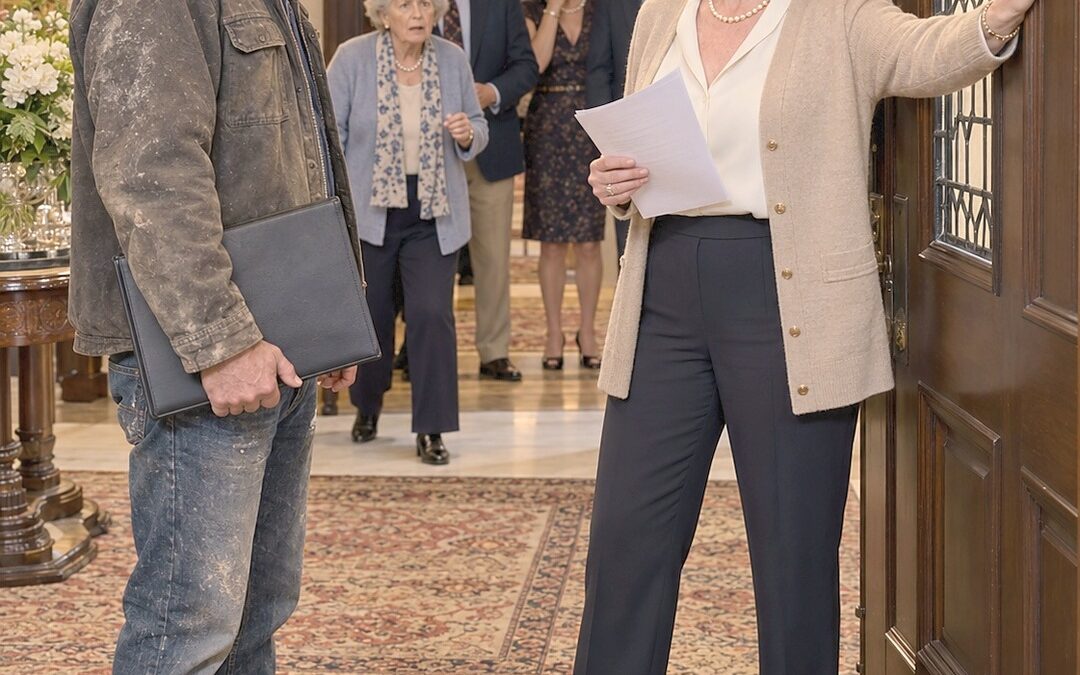
Judith Vandermeer put one hand flat against the front door of Eldridge Hall, stopped my work boots in front of sixty-four people, and said, "Trades wait in the cloakroom, sir."
"Mr. Voelker will present his little bid from the doorway," she told the ballroom, "and he'll feel at home. His mother kept that cloakroom for twenty-seven years."
My $41,300 bid, my father's name on that slate roof and the only thing my mother ever wrote down were all standing in that coat closet with me, and the one paper that could have saved us was sitting in a dead man's cellar that Judith Vandermeer didn't know existed.
It was 7:14 Thursday night, October 9. Rain had left the front stone dark, and every coat coming through the vestibule brought in wet wool mixed with the lemon cleaner Alder Point used on the old floors.
Inside, folding chairs filled most of the ballroom. Fifty-eight homeowners had come, with Judith, treasurer Lester Yount, vice president Gary Quade and secretary Winona Reinholt at the board table. Rex Hollenbeck had a chair off one end, and Randi Brandl sat behind them with a yellow pad.
Georgene Stroud was in the first row.
She was the reason I had been invited.
"Judith," Mrs. Stroud said, starting to rise, "I invited Arlen to—"
"The service people have always used the side areas."
Judith talked over her.
Mrs. Stroud remained half out of the chair.
"The roof contractor is here at the facilities committee's request."
"And he'll be heard."
Judith pointed down the east hall.
The room had heard all of it.
A man near the center aisle lowered the reading glasses he'd been holding over his packet. Two women in the third row stopped talking. Somebody near the fireplace shifted a folding chair backward until one metal foot squealed across the oak.
Rex leaned back and crossed one ankle over the other.
Randi's pencil had quit moving.
Mrs. Stroud straightened all the way.
"You invited Hollenbeck Exteriors into the ballroom."
"Rex is here as the board's selected contractor."
"No contractor has been selected."
"The board has a recommendation."
"And Arlen was invited to present the competing bid."
Judith gave Mrs. Stroud a flat little nod.
"He can present it."
"From a coat room?"
"From the doorway. He'll be heard perfectly well."
Mrs. Stroud turned toward Gary.
"You're comfortable with that?"
Gary put his packet down.
"Georgene, let's just get through the bids."
"That wasn't what I asked."
Winona pressed her lips together and pulled her chair closer to the table.
Nobody volunteered another answer.
A homeowner behind Mrs. Stroud said, "Why can't he just stand up front?"
Judith faced the chairs.
"Because this is an association meeting, not a trade show."
The man raised both hands and let them drop.
A woman farther back whispered something to her husband. He shook his head without taking his eyes off the front.
Then Judith used Ma again.
"His mother worked that cloakroom for twenty-seven years. I don't see why this is insulting."
My left boot shifted against the stone threshold before I told it to.
The muscle under my right shoulder pulled tight enough that I had to lower the bid folder from my chest to my side. My shirt collar suddenly felt one button too small.
Mrs. Stroud said, "Millie cleaned this Hall. She didn't belong to that room."
Judith's voice went sharper.
"I did not say she belonged anywhere."
"You just used her job to put her son there."
The woman in the third row turned fully around to see who was behind her.
Rex uncrossed his ankle.
I said, "Mrs. Stroud."
She turned toward me.
"I've got the bid."
Her mouth stayed open another beat, then closed.
That was enough.
I knew where the east hall went. Beige carpet ran to an old brass threshold under a plaque that said:
CLOAKROOM.
That plaque had not been there when Ma started working for Mrs. Eldridge.
"All right," I said.
Judith gave me a small smile.
"Thank you for understanding."
"I didn't say I understood."
Someone in the chairs coughed.
I went down the hall.
The cloakroom door stood open. The room was narrow, with an oak rail and iron hooks on the east wall, plus a newer freestanding rack that covered some of the old plaster.
I put my bid folder on a shelf.
A shallow dent was still in the baseboard near the corner.
When I was thirteen, I had kicked it because Ma would not let me take a Christmas cookie before Mrs. Eldridge's guests arrived. She made me work brown shoe polish into the mark and never told Dad.
At 7:20 Judith tapped the microphone.
"Mr. Voelker?"
I picked up my folder and stood in the cloakroom doorway.
From there I could see most of the ballroom. Rex had turned his chair enough to face me.
"Go ahead," Judith said. "Give us the little bid."
I opened the folder.
"Voelker and Son proposes repair of the east valley, replacement of failed flashing and individual slate work as required. Price is forty-one thousand three hundred dollars."
A woman in the third row leaned toward her husband.
"I inspected what I could safely inspect without walking old slate. I did not walk the roof. If the valley decking is rotten under the slate, the proposal has an allowance and a change-order provision."
Judith lifted her hand.
"So you don't know what's underneath it."
"Nobody does until it comes open."
I turned one page.
"The active leak is under the east valley. You've got some individual slate work elsewhere. I don't see a roof that needs to come off."
Judith said Hollenbeck Exteriors recommended full replacement with synthetic slate.
"The Hollenbeck proposal is two hundred twelve thousand dollars. The board considers that the responsible long-term solution."
Mrs. Stroud raised her hand.
"Did you provide Mr. Voelker the engineering material I requested?"
"There is no engineering material."
"I emailed you last Thursday."
"I checked the records."
Randi's pencil stopped over the pad.
Mrs. Stroud had copied me on her October 2 email. She had asked Judith to locate any prior engineering evaluation before the association replaced a historic slate roof.
On Monday afternoon, October 6, I had come by to measure the east elevation. Judith's Lexus was beside the service drive, the attic hatch was open, and Randi was coming down the folding stairs carrying a dusty file box.
A black marker seven took up most of one end.
At the time I figured somebody was finally sorting records.
A man near the aisle called out, "What report?"
Judith turned toward the chairs.
"The turnover binder was lost years ago. If anybody claims there is a report, it's a forgery."
Mrs. Stroud opened her mouth.
Then she stopped.
"I didn't say I had a report," she said.
Judith answered, "Then we agree."
"I asked whether one existed."
"We have answered that."
Randi resumed writing.
Judith addressed the room.
"We have a deteriorating roof over an association asset. We have continuing water intrusion. I have run this community like a business for six years."
I closed my folder halfway.
"Mrs. Vandermeer, if you're replacing all that slate, I'd like to know what failed."
"Age."
"Slate doesn't read calendars."
Rex shifted in his chair.
I opened the folder again.
"My price is for the valley, the flashing and the slate that needs work. If you want good slate torn off because it's old, that's a different job."
Judith said, "The board has professional advice."
"Then my bid is on the table."
She picked up the first page by one corner.
"Forty-one thousand dollars."
"Forty-one three."
She put it back down.
"We'll take questions after the board presentation."
I stepped farther into the cloakroom to let a homeowner pass through the hall. My shoulder brushed a wool coat, and my hand landed below the old hook rail.
My fingers caught on a shallow pencil groove.
— continue reading from here —
I moved two coats aside.
The writing was small and pressed hard into the paint.
"Mar 3 '83 – drip, hook 9"
My mother's hand.
Her 3 had the flat top she always gave it.
I ran my thumb underneath the words once, not over them.
More pencil showed behind the hooks: pieces of dates, short marks and arrows toward the same end of the wall.
Dad and I had worked part of Eldridge Hall in 1991, and I remembered the east valley leaking then. Mr. Fessenden kept an old galvanized bucket near this room when storms came from that side.
Judith's voice reached me from the ballroom.
"Mr. Voelker?"
I left the coats parted another moment before answering.
"Found an old maintenance mark."
She could see my hand near the wall.
"Please don't mark the property."
"Wasn't me."
I moved the coats back.
Rex's presentation went on, then the board moved into new business while I remained on a folding chair just inside the cloakroom doorway.
At 8:05 Judith shuffled the next set of papers.
"As I told Lester on Monday, the vote on the thirteenth is a formality. Rex has to order materials within eight weeks."
Lester's hand went once to the inside of his jacket.
The shape beneath the cloth was a business checkbook.
I opened my folder.
"You said the vote's a formality before the vote."
Judith answered, "The board expects the owners to approve the project."
Gary added that no final contract had been executed.
"Then why does Rex need materials ordered?"
Judith leaned toward the microphone.
"Mr. Voelker, you seem determined to imply misconduct."
"I asked about timing."
"No. On Tuesday afternoon you called me a thief in the parking lot."
Several people turned in their chairs.
I had said it beside her Lexus after she told me Rex's proposal was practically approved and there was no reason to waste the board's time with "old-roof men."
I had been mad and had no paper to back the word up.
Judith said, "You called me a thief."
"I did," I said. "That was wrong to say without proof."
Randi wrote it down.
Judith addressed her.
"Please note that admission."
Randi lifted the pencil.
"I'll put every word in the minutes exactly as spoken."
Judith sat straighter.
"Randi, you're paid twenty-one dollars an hour to prepare the board's minutes. I expect them to reflect the meeting accurately."
"They will."
"Your services are no longer required."
Randi stopped writing.
"Effective when?"
"Now."
Gary started, "Judith—"
"This is an employment decision."
Randi placed the yellow pad on the table, reached beneath her chair and slipped a small black notebook into her tote.
Judith noticed the notebook.
"Any association notes stay here."
"My personal notebook goes with me."
Randi stood.
Mrs. Stroud said, "You're firing her for keeping the minutes?"
Judith drew the agenda toward herself.
"Georgene, enough."
Randi put on her jacket and walked out.
The next item was a Service Entrance Policy.
Gary read it aloud. People doing paid work at Eldridge Hall would be required to use the east service entrance during association meetings unless the board approved otherwise.
A man near the back said, "Since when?"
Judith answered, "Tonight demonstrated the need."
Gary moved to adopt it.
Winona seconded.
All four board members voted yes.
Then Judith announced a special meeting for Thursday, November 13. The homeowners would vote on the roof project and a two-thousand-dollar assessment for each of Alder Point's 106 homes.
I pulled the first page of my proposal from the folder and took out my carpenter pencil.
Across the top I wrote:
Request: produce the engineer's report in the 2014 turnover binder.
The meeting adjourned at 8:34.
People began collecting coats while Judith remained near the board table with Rex. I found Mrs. Stroud near the cloakroom.
I showed her what I'd written.
"I want this in the record."
She read the sentence.
"I'll witness receipt."
Judith came over before I could find Randi.
"The binder is lost, Mr. Voelker."
"Put the request with my bid."
"You can leave it with the board."
"I'd rather give it to the person who was taking the minutes."
"Randi no longer works for us."
"She did when I made the request."
Judith held out her hand.
I kept the page.
Mrs. Stroud said, "I'll witness receipt."
Judith lowered her arm.
"This performance is unnecessary."
"So was the cloakroom."
She took a breath and said, "The new service policy applies at future meetings."
"I heard the vote."
"Then use the correct entrance."
I put the page back into my folder.
"Then I'll be at the front door on the thirteenth, seven o'clock."
I left.
Rain had started again outside, light enough to darken the stone without running down it.
Mrs. Stroud came through a minute later.
"Arlen. Randi's around back."
I went around the east side.
Randi stood near the back steps with her tote over one shoulder.
Ma had eaten lunch on those same steps during her twenty-seven years at the Hall.
I held out the page with my handwritten request.
"Would you keep this with what you wrote tonight?"
Randi read it and folded it once along the crease already in the paper.
"I don't work for them anymore."
"You did when the request was made."
She put it inside her tote.
The bag opened enough for me to see the small black notebook.
On the top page, beside the shorthand, she had written Thu 10/9.
"You wrote the meeting in there?"
"I write what I hear."
She put the notebook back inside.
Water ticked through the downspout beside us.
On the back steps, Randi Brandl zipped her tote bag shut and said, "She put box seven in the shred bin on Monday, Mr. Voelker. But she doesn't know what I wrote down on Thursday."
Part 2 — THE SHORTHAND
PART 2 — THE SHORTHAND
At 9:18 Friday morning, Randi Brandl opened the door of her nine-hundred-dollar apartment with a coffee mug in one hand and said, "You should see what she changed."
A gray laundry basket blocked half the kitchen table. Randi shoved it under a chair with her foot, moved a grocery circular off another seat and cleared space for Mrs. Stroud and me.
Her black shorthand notebook was already on the table beside a stack of printed pages.
Mrs. Stroud set her tea down. The cup clicked once against the saucer.
Randi opened the notebook.
"I wrote the whole meeting."
"You always take shorthand?" I asked.
"My grandmother taught me when I was in high school. I kept doing it."
The pages were full of cramped marks I couldn't read. Randi could.
She ran through the opening of the meeting without repeating it word for word, pointing out where she'd recorded Judith stopping me at the front door, my bid, Mrs. Stroud asking about the engineering records and Judith's answer.
Then she pushed the notebook aside.
"That's not the part you need first."
She picked up the clean draft of the October 9 minutes.
"I print every draft before I edit it. Habit."
"Useful habit," Mrs. Stroud said.
Randi handed me the first version.
My request was there.
Mr. Voelker asked that the engineer's report in the 2014 turnover binder be produced for the record.
Below it was the parking-lot admission.
Mr. Voelker acknowledged calling President Vandermeer a thief on October 7.
I put the page flat on the table.
Randi slid another copy beside it.
Red ink crossed through the paragraph about the engineer's report.
Above the deletion Judith had written:
Mr. Voelker screamed threats.
Mrs. Stroud read it once.
"How did you get this?"
"Judith came by around seven this morning."
"Here?"
"Front door."
Randi took a drink of coffee.
"She had the marked draft with her and wanted me to type it clean as the final minutes."
"After firing you?" I asked.
"She said I was still responsible for correcting work I'd already produced."
"What did you tell her?"
"That I didn't work for her anymore."
Mrs. Stroud sat back.
"And she left the marked copy?"
"She told me to keep it if I wanted. I think she expected me to replace the first draft."
Randi opened a manila folder and showed us the clean original still inside.
"I didn't."
I put the two pages beside each other.
"Did I scream?"
"No."
"Threaten her?"
"No."
"Follow her out of the Hall?"
Randi shook her head.
"You stayed until the meeting ended. Then you went around back."
Mrs. Stroud picked up Judith's version.
Farther down, the wording about the turnover records had been softened. The part where I asked for the engineer's report had disappeared completely.
"So she removes the report request," I said, "then adds threats."
Randi gave me a tired little shrug.
"That's what the red ink says."
She put the marked page, the first draft and the black notebook into one folder.
Mrs. Stroud said, "Make another copy of everything."
"I already have two sets."
"Make three."
Randi got up and fed the marked pages into the little printer on the counter.
The machine pulled the first sheet crooked, corrected itself and sent out Judith's red sentence again.
Saturday morning, Kyle and I were sorting slate at the shop when a Hudson police cruiser turned into the lot.
Kyle set down the piece he was holding.
"What'd you do?"
"Keep sorting."
Sgt. Walter Imhoff came through the bay door carrying a small notebook.
"Arlen Voelker?"
"That's me."
"I'm Walter Imhoff. Got somewhere we can talk?"
I pointed toward the office.
He sat across from my desk while I moved a supplier catalog off the chair beside him.
"I received a complaint from Judith Vandermeer this morning."
He opened the notebook.
"She says you shouted threats at her from the cloakroom Thursday night and followed her to her vehicle afterward."
"I didn't do either."
Imhoff asked where I had been during the meeting and what happened after adjournment.
"I was in the cloakroom doorway for most of it. Afterward I spoke with Mrs. Vandermeer inside, then went around back to give Randi Brandl my written request for the meeting record."
"Any threats?"
"No."
"Did you follow Mrs. Vandermeer outside?"
"No."
He wrote that down.
"She also reported something from Tuesday."
"That part happened."
"What?"
"I called her a thief in the parking lot."
Imhoff paused over the page.
"You remember the exact words?"
"You're a thief, Mrs. Vandermeer."
"Anything else threatening?"
"No. I told her the board should hear both bids before acting."
"Why call her a thief?"
"She told me Rex Hollenbeck's proposal was practically decided before mine was heard. I got mad and used a word I couldn't prove."
Imhoff wrote for a while.
"How many people were at Thursday's meeting?"
"Sixty-four besides me."
His pen stopped.
"That many?"
"Yes."
"Someone taking minutes?"
"Randi Brandl. Judith fired her during the meeting."
Imhoff raised his head.
"For what?"
"Randi said she'd put every word in the minutes exactly as spoken."
He wrote again.
"Does she still have notes?"
"She has shorthand and a printed first draft."
"Anything about threats?"
"Nothing in the first draft. Judith added that later."
"What wording?"
I gave him the exact line.
"Mr. Voelker screamed threats."
Imhoff asked how I knew.
"I saw Judith's red-penned copy yesterday morning."
He wrote down Randi's name and phone number.
I left box seven out of it. Randi had told me what happened to the box, and I wasn't going to volunteer her account to police before she had a chance to speak for herself.
"If Ms. Brandl has the drafts and contemporaneous notes, I'll contact her," Imhoff said.
He closed the notebook.
"Until I sort this out, don't contact Mrs. Vandermeer directly."
"Fine."
"If she contacts you, write down what was said."
"I will."
He left through the bay.
Kyle watched the cruiser back onto the road, then went back to the slate rack without asking another question.
Sunday afternoon, Mrs. Stroud served tea in cups with saucers at her kitchen table.
Rhoda came with me.
Randi brought copies of her shorthand transcription and both versions of the minutes, but Mrs. Stroud stacked them near the end of the table instead of opening them again.
"I've been thinking about the roof report," she said.
"So have I."
"March 2013."
Randi leaned forward.
"You're sure about the year?"
"Pretty sure."
Mrs. Stroud picked up her tea.
"Paul Tarver came to Eldridge Hall. I met him once. He parked behind Clarence's Cadillac, and Clarence complained about it through lunch."
"Did you see his report?" I asked.
"I saw a report afterward. I didn't read it."
"Was it part of the turnover?"
"It should have been."
She set the cup back on the saucer without making a sound this time.
"I signed some of the turnover papers in 2014. Judith signed too."
Randi reached for a pencil, then stopped.
Mrs. Stroud continued.
"Thursday night, when Judith started denying the report, I almost argued with her. I decided I'd better know what still existed before I gave her another thing to deny."
That explained the moment I'd seen in the ballroom when Mrs. Stroud started to answer and then stopped.
She turned toward the kitchen window.
"Your mother knew that Hall leaked long before Paul Tarver ever walked through it."
"I found her writing."
"Millie kept track of things people with nicer titles ignored."
Rhoda smiled into her cup.
Mrs. Stroud went on.
"She ate lunch on the back steps every day I ever saw her working there."
That put Ma right back outside the east end of the Hall for me, little cooler beside her, work shoes pointed toward the service drive.
Mrs. Stroud shifted her chair toward the pantry.
"Clarence handled legal work for Maddux Land Company when the common property transferred."
"What happened to his closing files?"
"He kept them."
"All of them?"
"Clarence tried to keep every closing set he ever touched."
She nodded toward the white-painted door beside the pantry.
Two steps were visible before the stairway dropped below the kitchen floor.
"After he retired, the old boxes went down there."
Randi's chair scraped lightly across the floor.
"Still there?"
"Some."
"When were you last down?"
Mrs. Stroud took her glasses off but did not clean them.
"Before Clarence's funeral."
Rhoda put her cup down.
I left mine where it was.
Mrs. Stroud got up and carried her tea to the sink. She rinsed the cup, set it upside down on the towel, then came back to the cellar door.
Her hand stopped on the brass knob.
"Clarence kept every closing he ever did. I just haven't been able to go down there since the funeral."
Part 3 — ITEM FOURTEEN
PART 3 — ITEM FOURTEEN
At 10:06 Monday morning, October 13, Mrs. Stroud opened the cellar door and stood on the top step with one hand on the light switch.
Cold air came up first, damp and flat, the kind that works through a work shirt before you have decided whether to put your coat back on.
The stairs were painted gray down the middle and bare wood along both edges. Clarence Stroud had put rubber strips on the treads sometime before his knees went bad, and a dehumidifier hummed below us.
Mrs. Stroud switched on the cellar lights.
"I know where he kept the Maddux boxes."
She went down first. Randi followed with a legal pad tucked under one arm, and I came last, leaving enough room that Mrs. Stroud didn't have to wonder whether I thought she needed help.
The basement smelled of concrete, old cardboard and furnace oil. The bulb over the worktable took a few seconds to reach full brightness, and dust showed in it whenever one of us moved a box.
Clarence's files took up most of the north wall.
Six Maddux Land Company boxes sat on the lower shelves, each labeled in his black block handwriting. The cardboard had softened at the corners, but every lid was still taped or tucked closed.
Randi stopped near the furnace.
"He kept all this?"
Mrs. Stroud surveyed the shelves.
"He threw away neckties."
"Good. I was worried about him."
Mrs. Stroud gave me half a smile and pointed to the first box.
The first wrong box was marked MADDUX LAND COMPANY — GENERAL CLOSINGS 2011–2012, too early for the turnover.
The second said ALDER POINT — COMMON PROPERTY, and ten minutes inside it produced nothing from Tarver.
Randi put the lid back on.
"Two down."
"Four left," I said.
"You're enjoying the arithmetic."
"It's warmer than the cellar."
She rubbed her hands together once and moved along the shelf.
The next two boxes had individual home closings and utility correspondence. We read the labels and left them shut.
That brought us to the fifth.
Its lid carried a pale stripe where another box had protected the cardboard from dust.
I pulled it forward.
Alder Point – HOA Turnover, October 18, 2014.
Mrs. Stroud stopped beside Clarence's old wooden chair.
"That's his handwriting."
Randi crouched next to the box.
"You want to open it?"
Mrs. Stroud lowered herself into the chair.
"You came downstairs. Open it."
The tape had dried until it broke under Randi's thumbnail.
One side came loose cleanly. The other tore a thin strip from the lid.
I held the cardboard steady while she opened the flaps.
Closing folders stood upright inside, packed tightly enough that their tabs were still straight. There was almost no dust below the lid.
Randi pulled the first folder and spread it across the top of the box.
"Inventory."
Twenty-nine numbered entries filled two pages.
Mrs. Stroud got up from the chair and stood beside her.
The basement furnace shut off. The sudden quiet made the dehumidifier sound twice as loud.
Mrs. Stroud read down the list.
Randi held the sheet flat under the hanging bulb.
Then Mrs. Stroud stopped.
"Fourteen."
Randi leaned closer.
Mrs. Stroud read the entry aloud.
"Tarver Engineering. Eldridge Hall slate roof evaluation. March 2013. Fourteen pages."
Randi's pencil stopped over her legal pad.
"There."
I kept my hands off the inventory.
"Find it."
Randi went into the box.
The first folder behind the inventory was thin.
The next was thicker.
The third packet had TARVER ENGINEERING printed across the top.
She lifted it out carefully and put it on the folding table.
Nobody said anything until Mrs. Stroud told me to open it.
The paper had yellowed slightly along the edges. The staple in the upper corner had gone dull, and one page had a little crease where somebody had once turned it down.
Paul Tarver's name sat below the company heading.
The first page showed the east elevation, a north arrow and a circle around the east valley directly over the cloakroom.
My hand stopped beside the circle without touching it.
Randi read over my shoulder.
"Localized leakage at east valley flashing."
"That's it."
Mrs. Stroud returned to Clarence's chair.
"Keep reading."
I turned the page.
Tarver's written inspection notes covered the slate field and the flashing, with a hand-marked detail beside the valley sketch.
The report said the existing slate remained serviceable.
Estimated useful life: approximately forty-five years.
Randi bent toward the page.
"Forty-five."
I moved lower.
The repair recommendation gave the number.
Eighteen thousand five hundred dollars.
Remove and replace failing east valley flashing, make limited decking repairs as discovered, reinstall salvageable slate and replace broken pieces individually.
No full replacement.
No synthetic slate.
Randi stepped away from the table.
"Rex wants two hundred twelve thousand."
"Thirteen years later."
"Still."
"Still a lot of roof."
Mrs. Stroud said, "Arlen."
I put the packet flat.
"It tells us what Tarver found in 2013. It doesn't tell us what's under that valley today."
Mrs. Stroud nodded.
"Good."
She lifted the inventory.
"Find the signature page."
Randi turned it over.
The acknowledgment lines were on the back.
Maddux Land Company had signed on one side. Association representatives were listed on the other.
Mrs. Stroud took off her glasses, cleaned them on the bottom of her blouse and put them back on.
Her own signature came first.
G. Stroud, Treasurer.
Above it sat another.
J. Vandermeer, Vice President.
Randi put both hands on the edge of the box.
"She signed for it."
Mrs. Stroud read the page again before speaking.
"So did I."
I held my hand just off the paper near Judith's signature.
"October eighteenth."
Mrs. Stroud read the date.
"Turnover day."
Randi said, "So when she said there was never a report—"
"Don't get ahead of the paper."
She stopped.
Mrs. Stroud studied her own signature.
"I don't remember every item."
"Neither would I after eleven years."
She gave me a dry look.
"You don't remember what you ate yesterday."
"That proves my point."
Randi pulled the Tarver packet closer to the inventory.
The two documents sat side by side on Clarence's folding table, one naming the report and one containing it.
Judith Vandermeer's signature sat on the inventory that listed Item 14.
Mrs. Stroud put the papers back in order.
"We make copies upstairs."
Randi returned the folders to the box in the same sequence she'd found them.
I carried the turnover box.
Mrs. Stroud carried the Tarver packet herself.
At the stairs she stopped once, not because she needed help but because the box under my arm blocked half the landing.
"You're taking up the whole staircase."
"Occupational problem."
She went ahead.
At the top, she switched off the cellar light.
The dehumidifier kept humming in the dark until the door shut.
Tuesday afternoon, October 14, Mrs. Stroud met me outside Eldridge Hall with a photocopy of Tarver's roof sketch inside a manila folder.
The Hall was locked.
That suited me.
I didn't want Judith.
I wanted the east wall.
Mrs. Stroud unlocked the service entrance, and we went straight to the cloakroom.
The room smelled faintly of wool even without coats hanging there.
I shifted the freestanding rack enough to expose Ma's pencil notes.
Then I held Tarver's sketch beside the wall.
The engineer's circle sat over the same end of the room.
Mrs. Stroud studied the writing.
"She wrote these for Fessenden."
"The caretaker?"
"He couldn't remember where the drips showed after the plaster dried."
An old paint edge stopped clean around the pencil marks.
Mrs. Stroud touched the painted section instead of the writing.
"Millie told the painters those were maintenance notes."
I raised Tarver's sketch until the roof line matched the wall.
The east valley on paper landed almost directly above hook nine.
Mrs. Stroud took one step back.
"One Christmas, Lucille Eldridge told her there was an empty chair in the ballroom for the music."
"What'd Ma say?"
Mrs. Stroud answered without turning.
"I'll hear it fine from the cloakroom."
The hallway outside was empty.
I folded the Tarver sketch along its existing crease and put it back in the folder.
Mrs. Stroud pushed the rack into place.
We locked the Hall behind us.
By Wednesday, October 22, the original Tarver packet was in a fireproof document bag at Mrs. Stroud's house.
Randi wanted Judith sent a copy.
I didn't.
"If we send it now, she gets three weeks to tell everybody Clarence's copy is fake before anybody sees the original."
Mrs. Stroud said, "She'll say she didn't read every item."
"She can say that."
Rhoda tapped my roofing proposal.
"And your number?"
I opened to the allowance clause.
"If the valley decking is rotten farther than I could see from the ladder, I could be about fourteen thousand low."
Randi leaned over the proposal.
"You'll tell them?"
"Before Judith does."
Mrs. Stroud closed the document bag.
Randi gathered her notebook while I slid my proposal back into its folder.
"If she says it's a forgery," I said, "it has to be in a room where she can't unsay it."
Part 4 — THE TAGS
PART 4 — THE TAGS
At 8:37 Tuesday morning, October 28, Lester Yount walked into my shop with rain on his shoulders and a business card pinched between two fingers.
Kyle was at the cutting table sorting replacement slate by thickness. I had a copper price sheet spread over my desk and a mug of coffee I'd forgotten to finish.
Lester stopped three feet inside the door.
"You open?"
"Since eight."
He held out the card.
LESTER YOUNT
TREASURER
His home number was printed across the bottom.
"What can I do for you?"
He watched Kyle move a stack of slate from one end of the cutting table to the other.
"Your boy work here full time?"
"Since he learned roofs don't care who his father is."
Kyle heard me and kept sorting.
Lester turned the business card over in his hand twice before borrowing the carpenter pencil beside my calculator.
On the back he wrote:
NOV 13
Then he wrote his home number again underneath it, larger than the printed one.
"You already gave me the number."
"I know."
He returned the pencil.
"What happens November thirteenth, Lester?"
He studied the blank space under what he'd written.
"The meeting."
"I know about the meeting."
He rubbed the edge of the card against the counter.
The furnace in the rear of the shop kicked on.
"If something comes up that night—"
He stopped.
"What kind of something?"
Lester opened his mouth again.
A delivery truck went past on the road, tires spraying water against the curb.
He turned the card face down.
"I shouldn't be here."
"You walked in."
"I know."
"Strong start."
He didn't smile.
"November thirteenth," he said again.
"Seven o'clock."
"After."
"After what?"
His jaw worked once.
"After the meeting."
He headed toward the door.
"Lester."
He stopped with one hand on the push bar.
"If you're trying to tell me something, this is probably the easy part."
For a few seconds he watched rain run down the glass.
Then he said, "Keep the card."
He left.
Kyle came over after Lester's car pulled onto the road.
"What was that?"
"A man who drove here to say less than he could've said on the phone."
Kyle picked up the card.
"He wrote the same number twice."
"I noticed."
"You calling him?"
"Not yet."
I put the card beside my calculator, writing side up.
Tuesday, November 4, at eight that night, somebody knocked on the glass door after I'd turned the OPEN sign around.
Kyle had gone home. Rhoda expected me by eight thirty.
Judith Vandermeer stood outside in a dark wool coat with a slim folder tucked against her side.
I unlocked the door.
"Mrs. Vandermeer."
"Mr. Voelker."
She came in and put the folder on the counter.
"I thought there might be a practical way through this."
"What kind?"
"Rex needs someone who understands old slate."
She opened the folder.
Hollenbeck Exteriors was printed across the top.
There was a consulting agreement underneath.
"Eight thousand dollars," she said. "Consulting. Slate expertise, maybe salvage work."
"If Rex gets the Hall contract."
"If the owners approve it."
She moved the paper toward me.
I read the first page.
Nothing in it mentioned the November thirteenth meeting.
Nothing said withdraw my bid.
Nothing said keep quiet.
Judith leaned one hip against the counter.
"Warren's plant cut almost sixty people in March. We've been living differently since then."
"I'm sorry."
"Rex has helped with referrals. He says there may be consulting work for me later too, once the Hall project is settled."
"Doing what?"
"Vendor coordination. Administrative work. Whatever they need."
"How much?"
"That hasn't been finalized."
She closed the folder halfway, then reopened it.
"What I'm offering you is separate."
"All right."
She waited for more.
I didn't give her any.
"You've made your objections clear," she said.
"Have I?"
"Painfully."
"Then what does eight thousand dollars fix?"
Her mouth flattened.
"Your time. Your expertise."
"And November thirteenth?"
She paused.
"The owners already have your proposal."
"That isn't what I asked."
"Georgene has made sure everyone knows your position."
"Still not my question."
Judith drew the agreement back an inch.
"Arlen."
First time she'd used my first name.
"Rex is offering legitimate subcontract work. You're a slate roofer. He needs slate knowledge."
"And you need me to stop pushing."
"I need Alder Point to get through one meeting without another scene."
The folder sat between us.
I tapped the top page with my knuckle.
"This doesn't say I stay home."
"No."
"You didn't put that part in writing."
Her eyes came up.
"What part?"
That answered enough.
I slid the agreement back across the counter.
"I'm sorry about Warren. I still won't."
Judith closed the folder.
"I was trying to give you an option."
"You did."
I unlocked the door.
She crossed the parking lot, started her car and waited under the light until the windshield cleared.
Then she drove away.
I took Lester's card from beside the calculator.
Under the NOV 13 he'd written, I added:
Nov. 4, 8:00 p.m. — Judith brought Hollenbeck consulting agreement, $8,000.
I wrote down the rest of what mattered while the conversation was still fresh and signed the bottom.
At 8:42 I was sitting at Mrs. Stroud's kitchen table.
Randi was already there with her black shorthand notebook beside a yellow legal pad. Mrs. Stroud had three coffee mugs out, though mine was the only one anybody was using.
I put Lester's card and my handwritten page on the table.
Mrs. Stroud read the first line.
"Eight thousand dollars."
"Consulting agreement."
Randi read the note over her shoulder.
"You kept the contract?"
"No. Judith took it."
Mrs. Stroud pushed my note back across the table.
"Police?"
I shook my head.
"I'm not calling it bribery when she was careful enough not to call it anything herself."
Randi rested her pencil on the notebook.
"She already made a police complaint against you."
"Which is one reason I'm going to be exact this time."
Mrs. Stroud reached into the drawer beside her refrigerator and took out a plain white envelope.
"Then we keep paper."
Randi opened her shorthand notebook to a clean page.
At the top she wrote:
Tue 11/4
Under it:
8:00 p.m.
I watched her write for the next minute, the pencil moving in small hooks and slashes that meant nothing to me.
"I can't read any of that."
"Good."
Mrs. Stroud took my note to the copier in the little room off the kitchen.
The machine warmed up with a low hum.
Randi kept writing.
When Mrs. Stroud returned, she put the copy into the white envelope.
Across the front she wrote:
NOV. 4
She sealed it and set it in the drawer where she'd been keeping the other meeting papers.
"Original stays with you," she said.
I folded my note once.
Randi drew a line under her shorthand entry.
"Mine stays with me."
I slipped the original and Lester's card into my inside shirt pocket.
Mrs. Stroud pushed my coffee mug closer.
"You drove over here. Drink that before it turns into furniture polish."
"It may already qualify."
Randi smiled without lifting her pencil.
I left at 9:16.
A week later, at 3:22 Tuesday afternoon, November 11, Mrs. Stroud opened her front door before I knocked.
She had a small paper grocery sack in one hand.
"Come in."
"I can't stay."
"You can stand in the foyer."
So I did.
She reached into the sack.
"I went to the Eldridge estate sale in 2010."
She pulled out a steel ring holding old brass coat-check tags, round and oval, the numbers worn smooth on some and sharp on others.
I knew them.
"Those were Ma's."
"She used them."
Mrs. Stroud held the ring out.
"I bought them for a dollar because the sale company had thrown them in a box of hardware."
I took them.
Nine sat near the end.
I rubbed that tag once with my thumb.
Ma had kept the ring near the cloakroom counter during parties. Somebody handed her a coat, got a brass number and came back after the music stopped.
Most people read the number before they raised their eyes to her.
I opened my mouth but didn't get anything useful out.
Mrs. Stroud waited until I put the ring into my coat pocket.
The weight made that side hang crooked.
"Keep them," she said.
I nodded.
She went to the little desk by her stairs and picked up one sheet of paper.
"Nineteen more homeowners say they're coming Thursday. None of them was at the October ninth meeting."
"They heard from neighbors?"
"About the assessment. Randi. The cloakroom."
She put the list down.
"The supplemental meeting notice went to all one hundred six homes on November third. It includes the assessment, board conduct and possible removal of the president and director."
"So Judith got the same notice."
"Yes."
"Does she know nineteen more people are coming?"
"Not from me."
Mrs. Stroud opened the drawer and put the list inside.
The brass tags knocked against my keys when I turned toward the door.
Wednesday night, November 12, Rhoda and I were watching the Cleveland weather at 9:40 when my phone rang.
Unknown number.
I answered.
"Voelker."
"Mr. Voelker."
Judith.
Rhoda muted the television.
"Mrs. Vandermeer."
"I'm calling regarding tomorrow night's special meeting. Attendance will be limited to homeowners."
"Mrs. Stroud invited me."
"That does not make you a homeowner."
"Where's the written attendance limit?"
A brief crackle came through the line.
"The board has authority to control access."
"Was a written limit adopted and mailed?"
"It will be posted on the door."
"So no."
"I'm calling as a courtesy."
"Mrs. Stroud says the bylaws permit owner guests."
"Georgene is mistaken."
"She usually reads things before quoting them."
Judith let that pass.
"I have spoken with Hudson Police. Sgt. Imhoff will be there."
"For what?"
"To maintain order and enforce association policy."
"The Service Entrance Policy?"
"It remains in effect."
"I'll be at the front door."
"You have been told you will not be admitted."
"So have you."
The weather map changed behind Rhoda, green rain moving east across Ohio with the television still muted.
Judith spoke again.
"Seven o'clock?"
"Before that."
There was a short pause.
"Then bring a coat," she said. "The front steps get cold."
Part 5 — THE FRONT DOOR
PART 5 — THE FRONT DOOR
At 6:40 Thursday evening, November 13, there were already twenty-three people on the front steps of Eldridge Hall when I pulled into Alder Point.
I parked along the curb instead of in the lot.
Mrs. Stroud was waiting beside her Buick with the Tarver report in a flat document case under one arm and a folded copy of the bylaws in the other. Randi stood near her with a manila folder.
Sgt. Walter Imhoff was at the top of the steps.
A white sheet had been taped inside the front glass sometime that afternoon. HOMEOWNERS ONLY was printed across it in thick black letters.
Mrs. Stroud started up the steps with me beside her.
Imhoff raised one hand.
"Hold there."
Mrs. Stroud opened the bylaws.
"Section 4.2 permits an owner to bring a guest to a special meeting."
Judith came from the registration table inside.
"The board established an attendance limit."
"When?" Mrs. Stroud asked.
"Today."
"Was it mailed to the owners?"
"It was posted."
"Tonight," Randi said.
Judith turned toward her.
Randi held out a printed copy.
"Here's the current bylaws."
Imhoff took it and read the marked section.
Judith said, "Mr. Voelker is a contractor. This meeting is for homeowners."
Mrs. Stroud answered before I could.
"He's my guest."
Imhoff handed the bylaws back.
"Was a written attendance limit adopted and sent out in advance?"
Judith's answer came quick.
"The board has authority over its meetings."
"That's not what I asked."
She paused.
Imhoff opened the front door farther.
"Not in writing, not in advance. Mrs. Stroud gets her guest."
Judith stepped aside.
I walked through the front door.
The cloakroom was immediately to my right. I didn't turn into it yet.
At 7:12, there were eighty-three people in the ballroom besides me and Sgt. Imhoff: the original sixty-four from October 9 and the nineteen additional homeowners Mrs. Stroud had told me were coming.
Randi sat in the second row.
Mrs. Stroud sat on the aisle with the document case across her lap.
Lester Yount was at the end of the board table with Judith, Gary Quade and Winona Reinholt.
Rex Hollenbeck had a chair near the fireplace.
Judith called the meeting to order and got through the required business before Mrs. Stroud stood.
"As facilities chair, I want the engineering question answered before anyone votes on a roof."
Judith said, "We've answered it."
Mrs. Stroud did not sit.
"Was there an engineering report in the turnover records?"
Judith turned toward the homeowners.
"The turnover binder was lost years ago. If anybody claims there is a report, it's a forgery."
Then she added, slower:
"I have never seen any report from any engineer in my life."
Mrs. Stroud said, "I yield my time to Arlen."
Judith gave me two minutes.
I went into the center aisle without taking any paper from Mrs. Stroud.
"I need to say two things before she does."
A few people shifted in their chairs.
I faced Judith.
"I called you a thief in that parking lot before I had one piece of paper to back it up. That part is true."
She started to answer, but I continued.
"My bid can also be low by about fourteen thousand dollars if the decking under that east valley is worse than I could see."
Rex leaned forward.
Judith said, "So even he admits his price isn't reliable."
"I said the hidden wood can change the cost. I said that the first night too."
A man in the third row raised his hand.
"How do we know what it costs, then?"
"We open the valley. You see the wood before I charge you to replace it."
That was the whole answer.
Mrs. Stroud stood again and opened the document case.
I spoke before she removed the first page.
"The trades waited in your cloakroom for twenty-seven years, Mrs. Vandermeer. Tonight you're going to read what one of them wrote on its wall."
Judith's chair scraped against the floor as she rose.
"What is this supposed to be?"
Mrs. Stroud carried the turnover inventory to the front table.
"October 18, 2014."
Judith did not reach for it.
"Clarence's papers are not association records."
"They were the developer's closing copies."
Mrs. Stroud opened to the inventory.
"Item fourteen. Tarver Engineering. Eldridge Hall slate roof evaluation. March 2013. Fourteen pages."
Judith shook her head.
"I never signed for any engineering report."
Mrs. Stroud turned to the acknowledgment page.
She read the association signature aloud.
"J. Vandermeer, Vice President."
Rex removed his cap and turned it once in his hands.
Judith took a half step toward the table.
"That was an inventory. I didn't inspect every piece of paper in every box."
"You just said you never signed for an engineering report."
"I signed turnover paperwork."
Mrs. Stroud laid the Tarver report beside the inventory.
"Here is the report listed under item fourteen."
Judith turned to Rex.
"This proves nothing about the roof today."
I said, "That's true."
She faced me sharply.
I continued.
"It proves the report existed. It proves the association received it. That's what we're talking about."
Randi rose from the second row carrying her black shorthand notebook and the two versions of the October 9 minutes.
She placed the clean first draft beside Judith's red-penned copy.
Judith said, "You were terminated."
Randi answered, "And I kept my own notebook."
Imhoff came to the table.
Randi showed him the two drafts.
"This was my first version. This is what Mrs. Vandermeer brought to my apartment Friday morning."
Imhoff put them side by side.
The original contained my request for the engineer's report.
The red version had crossed it out.
In its place was the line:
Mr. Voelker screamed threats.
Imhoff read it aloud.
Judith said, "Minutes get corrected."
Randi opened the shorthand notebook.
"My shorthand didn't."
Imhoff asked, "Did Mr. Voelker scream threats at the October ninth meeting?"
"No."
Judith turned toward him.
"Sergeant, I filed that complaint based on his conduct as a whole."
"We'll deal with the complaint separately."
Mrs. Stroud put her hand on the turnover inventory.
"Judith. Come read the signature."
"I can see it from here."
"Then come closer."
Judith did not move.
Mrs. Stroud picked up the inventory.
"Come read it, Judith."
The homeowners nearest the front turned in their chairs.
Judith finally came around the board table.
Mrs. Stroud carried the inventory down the east hall.
Winona got up and followed.
So did Gary.
I went after them but stopped near the cloakroom doorway.
Judith came last.
By then people in the ballroom had begun standing to see what was happening.
Winona opened the cloakroom door.
Coats covered the old wall.
She moved the first few onto the freestanding rack, then shifted the rack enough to expose the plaster behind it.
The pencil marks appeared along the east wall.
Mrs. Stroud stepped inside.
Judith stopped at the threshold.
"This is being staged."
Mrs. Stroud turned.
"No. This room was here before any of us."
People had filled the east hall behind Judith.
Mrs. Stroud pointed toward hook nine.
"Come in."
Judith entered.
The room that had held me by myself a month earlier barely had room for three people now.
I remained opposite the doorway while Mrs. Stroud stood beside the old hook rail.
"Read the first line."
Judith stared at the wall.
Mrs. Stroud waited.
"Read it out loud."
Judith's voice came flatter than it had in the ballroom.
"Mar 3 '83 – drip, hook 9"
A woman behind Judith leaned sideways to see around her.
Mrs. Stroud held Tarver's roof sketch beside the wall.
"The engineer marked the east valley directly over this room."
Judith said, "Old maintenance notes do not establish present roof condition."
"No," I said. "They establish where it leaked."
Mrs. Stroud faced her.
Then she gave Judith back the exact sentence she'd used at the front door on October ninth.
"Trades wait in the cloakroom, sir."
Judith's heel bumped the old wooden coat rail behind her.
Three empty hooks rattled against the board.
She said nothing.
Mrs. Stroud moved aside.
"Winona, let them through."
The first homeowners entered one at a time.
A man who had been at the October meeting bent toward the wall and read the pencil dates. His wife followed him, then a woman from the rear row who had not been there that night.
Each person saw the same wall.
Mrs. Stroud held the Tarver sketch beside it so they could compare the marked valley with the location of Ma's notes.
Judith stood inside the room while the line came past her.
There was no room for her to return to the ballroom without going through the people waiting in the hall.
A man stopped at the doorway and read the brass sign above it.
CLOAKROOM.
He turned toward Judith.
"Is this the room your new service policy sends contractors to?"
Judith answered, "The policy concerns building access, not this room."
"Same end of the building."
She did not reply.
Randi came down the hall carrying her notebook.
Mrs. Stroud said, "Tell them about box seven."
Randi kept it short.
"Mrs. Vandermeer searched the attic records after Mrs. Stroud asked for the engineering report. On Monday, October sixth, she told me to put box seven in the shred bin. The turnover binder was inside it."
Judith answered immediately.
"I told you to discard obsolete records."
"The whole box."
"I did not know every document in it."
Mrs. Stroud held the inventory up.
"You had just searched it."
Judith turned toward the hall.
"People need to return to the meeting."
Gary Quade spoke from behind her.
"We should go back in."
By 7:46 most of the room had passed through the cloakroom.
The line finally thinned.
Judith walked back down the same east hallway she'd sent me down on October ninth.
I followed several people behind her.
At the front table, Mrs. Stroud laid down the turnover inventory and Tarver report.
Randi placed her notebook beside the two drafts.
Imhoff remained close enough to hear.
I sat in the aisle.
Judith returned to the chair at the center of the table.
Lester Yount had been quiet through all of it.
He reached under the table and pulled out his checkbook.
Mrs. Stroud saw it.
So did Judith.
Lester opened it, found the carbon copy he wanted and pushed his chair back.
Lester Yount stood up from the end of the board table with his checkbook in his hand and said, "I need to say something before somebody else does."
Part 6 — THE MAT
PART 6 — THE MAT
At 7:48 Thursday night, November 13, Lester Yount rose from the end of the board table with his checkbook open in his hand and faced eighty-one homeowners.
People were still settling after the line through the cloakroom. Mrs. Stroud had brought the Tarver report back to the front table, and Randi's shorthand notebook lay beside Judith's red-penned draft.
Lester pulled out the carbon copy.
"On Monday, October sixth, I wrote Hollenbeck Exteriors a deposit check for twenty-one thousand two hundred dollars."
A woman near the fireplace turned in her chair.
Mrs. Stroud asked, "From what account?"
"The reserve fund."
Judith pushed her chair back.
"We discussed preliminary authorization."
Lester shook his head.
"You told me approval was settled and Rex needed to order materials."
Gary Quade shifted in his seat.
"We never authorized a deposit."
Winona Reinholt said, "Neither did I."
Judith answered them fast.
"You both knew the project was moving."
Gary set his pen beside the registration sheet.
"We knew there was a proposal."
Lester placed the carbon copy on the table.
"I should've said something October ninth."
Mrs. Stroud asked whether there was more, and Lester nodded before continuing.
"Mrs. Vandermeer told me Rex would pay her for consulting after the Hall contract went through."
Judith stood.
"That isn't what I said."
"You told me he had work for you after approval."
Sgt. Imhoff came closer to the table.
"Mr. Hollenbeck, was a consulting payment discussed for Mrs. Vandermeer?"
Rex lowered his head.
"Yes."
"How much?"
"Eighteen thousand."
A meeting notice slipped from a homeowner's lap in the fourth row and landed beneath the chair ahead of him.
Judith reached toward the microphone and stopped.
Mrs. Stroud placed the turnover inventory beside Lester's carbon copy.
"Rex, did you spend the deposit?"
"No."
"Then the association wants the twenty-one thousand two hundred dollars returned."
"It was a mobilization deposit."
"You haven't spent it."
"No."
Mrs. Stroud pushed the carbon copy toward him.
"Write that you'll refund it. Sign and date it."
Rex hesitated.
Lester handed him a pen.
Rex wrote the commitment across the bottom of the carbon copy and signed beneath it. Lester added refund due beside the amount.
The page remained in the middle of the table where the homeowners could see it.
Mrs. Stroud opened the bylaws.
"Article 6, Section 3 permits removal of a director at a special meeting with proper notice and a quorum present. The supplemental notice mailed November third included board conduct and possible removal. We have eighty-one homeowners registered tonight."
Judith gripped the back of her chair.
"You've wanted this position for years."
Mrs. Stroud kept the bylaws open.
"No."
She made the motion to remove Judith Vandermeer as president and director.
A homeowner near the rear seconded it.
Gary and Winona began handing out the ballots row by row. Mrs. Stroud asked the man seated in the third row beside the center aisle to serve as a third counter.
He came forward carrying his reading glasses in one hand and pulled an empty chair to the end of the table.
People bent over their ballots.
A woman in the second row put hers flat against her purse to write. Two seats behind her, a man borrowed a pen from his wife, filled in the line and returned the pen before folding nothing, just holding the ballot flat between his hands.
Judith stood behind her chair while the papers came forward.
No one passed a hat or a box. Gary carried an empty legal-size envelope down one side of the room, and homeowners slid their ballots into it one at a time.
Winona did the other side.
The third counter watched the registration list.
When the last ballot came in, Gary emptied the envelope onto the table.
The papers made a loose white pile beside the bylaws.
"Count once separately," Mrs. Stroud said. "Then compare."
Gary took one stack.
Winona took another.
The third counter moved his chair closer and made three columns on a blank sheet.
For several minutes the ballroom went down to ordinary noises: chair legs on oak, somebody clearing a throat, the furnace starting under the east wall.
I stood near the aisle.
Judith did not speak.
Gary counted his pile and wrote a number.
Winona finished next.
The third counter gathered all the ballots, squared them against the tabletop and counted them from the beginning.
At one point he stopped, backed up two papers and started that small section again.
Judith said, "Is there a problem?"
"No, ma'am."
He finished.
Then he read the totals himself before passing the sheet to Gary.
"Seventy-six in favor. Three opposed. Two abstentions."
Gary checked the three numbers against the registration sheet.
"Eighty-one."
Winona set her pen down.
Mrs. Stroud said, "The motion carries."
A man in the rear row pushed his chair back to make room for his wife to get past, then seemed to remember there was nowhere she needed to go and pulled it in again.
Judith smoothed the front of her cardigan once.
She reached for the wooden gavel.
For six years, that gavel had sat beside her microphone at every meeting I'd attended or bid into.
Now she lifted it and walked the few feet around the end of the table.
Mrs. Stroud remained beside the chair.
Judith set the gavel down directly in front of her.
The wood made a dull knock.
Then Judith reached into her purse and brought out the Hall's key ring.
There were old brass keys on it, newer silver ones and a plastic tag marked BOILER.
She lowered the ring beside the gavel.
The keys spread across the tabletop.
Mrs. Stroud did not pick them up.
Judith said, "You'll need the service-door key separated. It sticks."
Mrs. Stroud answered, "Winona knows which one."
Judith's hand withdrew.
For the first time that night she had nothing in front of her except the chair she'd been using.
Mrs. Stroud said, "A business, you said. Six years."
Judith walked to an empty chair at the end of the table and sat.
Gary stood.
He picked up the printed Service Entrance Policy adopted on October ninth and held it out where the front rows could see the heading.
"I wrote the motion that put this into effect."
He swallowed and continued.
"I knew who it was aimed at. Mr. Voelker had been put in that cloakroom, and instead of saying we shouldn't have done that, I voted to make a rule around it."
He turned toward me.
"It was wrong."
His thumb left a small bend in the corner of the page.
"I'm sorry, Mr. Voelker."
I said, "All right."
Gary faced Mrs. Stroud again.
"I move we rescind it tonight."
Winona said, "Second."
The voice vote rolled across the ballroom.
Mrs. Stroud called for opposed votes.
There were none loud enough for me to hear.
Gary laid the policy on the table beside the other papers and sat down.
Winona remained standing.
She had the small brass cloakroom key she'd used earlier.
"I seconded that policy."
She set the key beside the larger ring Judith had surrendered.
"I told myself it was a building rule. It wasn't."
She turned to me.
"I'm sorry."
Then she paused.
"And Mrs. Voelker."
Mrs. Stroud corrected her quietly.
"Millie."
Winona's eyes went toward the east hall.
"Millie."
She sat down and pulled her chair under the table.
Sgt. Imhoff brought Judith's red-penned draft beside Randi's original.
He spoke to Judith.
"Your amended version says Mr. Voelker screamed threats. Ms. Brandl's original draft and shorthand don't say that. I need a formal statement from you at the station tomorrow morning."
Judith said, "I believed his behavior was threatening."
"Then we'll put your account on the record tomorrow."
He told Rex he wanted a statement from him too.
Then he addressed Lester.
"Would you voluntarily turn over the checkbook and carbon copy so I can document the reserve payment?"
Lester handed them over.
Imhoff wrote a receipt on a department form and passed it back.
"The false-report complaint, the reserve payment and the destruction of box seven will be included with the material sent for prosecutor review Monday."
Mrs. Stroud turned back to the roof.
She lifted my proposal.
"Voelker and Son Slate Roofing submitted forty-one thousand three hundred dollars, subject to the allowance already written into the proposal."
Rex said, "He admitted that amount can change."
"It can," I said. "If hidden decking is worse than I could see, you see the wood before I bill you to replace it."
A man near the aisle called out, "And if the slate is good?"
"It goes back."
Mrs. Stroud made one motion: use reserve funds, hire Voelker and Son Slate Roofing under the submitted proposal and cancel the two-thousand-dollar assessment.
Hands rose across the room.
Gary counted with the third-row homeowner.
The motion carried.
Someone nominated Georgene Stroud as interim president. Several homeowners said aye, nobody offered another name, and Mrs. Stroud took the chair.
She slid the gavel several inches away from herself.
Then she turned to Randi.
Randi came up from the second row with her shorthand notebook in both hands.
"Would you come back Monday, November seventeenth?" Mrs. Stroud asked.
"At twenty-four an hour."
Mrs. Stroud paused, then nodded.
"Twenty-four."
Randi set the notebook at the administrator's place and sat down.
"Then yes."
At 8:40 Mrs. Stroud closed the bylaws and told everyone they were finished.
People took their time leaving. A few went through the cloakroom once more, and others stopped near Randi's table before heading for the vestibule.
Rex left by himself.
Judith put on her coat and walked out through the front door.
On Thursday, December 4, the new east valley was finished.
We had opened twelve feet of decking and found less rot than I'd feared. The original bid held inside the allowance, and two days of rain had left the plaster below the cloakroom ceiling dry.
Sgt. Imhoff stopped by before the meeting.
"Still reviewing it."
He left.
Inside Eldridge Hall, Randi was back at the administrator's table with her yellow pad and shorthand notebook.
Gary held the front door for neighbors carrying winter coats.
The cloakroom wall had been left uncovered.
I walked down the east hall with the brass coat-check ring in my coat pocket.
Hook nine was empty.
Ma's pencil date sat beside it.
Someone had polished the old wooden counter, while the hooks and marked plaster had been left alone.
I took the brass ring from my pocket there, standing in front of hook nine.
The tags settled into my palm, dull around the edges from years of coat checks and other people's hands.
I slipped the steel ring over the hook.
The brass tags knocked softly against the wall and stopped beside Ma's pencil mark.
Then I walked back through the east hall and out through the service door.
December air hit the side of my face.
I went around Eldridge Hall toward the front.
The stone wall ran beside me until I reached the corner and the front steps came into view.
Warm light filled the vestibule.
A couple from Alder Point went in ahead of me.
Gary held the door for them, then saw me coming and kept it open.
I climbed the steps.
The mat was dark at the center from winter shoes.
I hung my mother's ring of brass tags on hook nine, wiped my boots on the mat by the front door, and walked in the front way.



