The new manager threw a rain-soaked old man out of my diner for “scaring the investors”—he didn’t know my name was on the deed, the sign, and the first dollar bill framed above the register.
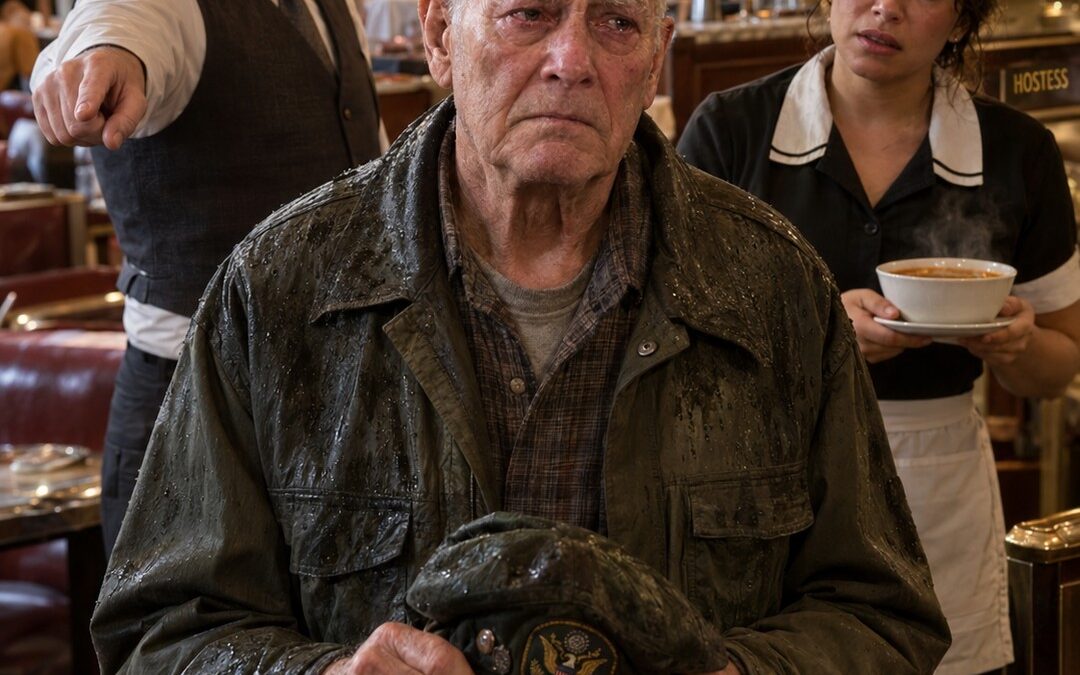
Part 1
“You need to leave. You’re scaring the investors.”
Tyler Grant said it loud enough for half the dining room to hear—in the diner I opened sixteen years before he was born.
Then he took in my soaked jacket, my muddy work boots, and the rain dripping off the brim of my old Army cap and added, “People are paying good money to eat here. They shouldn’t have to wonder if some homeless guy wandered in off the highway.”
A woman near the window laughed into her wineglass.
I stood just inside the front door, forty-seven years after June and I hung the first sign, facing the thirty-one-year-old manager who had decided I didn’t belong there. Behind him, a brass sign on the hostess stand said THE DAWSON ROOM in narrow black letters.
My last name.
I took off my cap. “I’m only asking for something hot.”
Tyler folded his arms over a charcoal-gray vest that looked too tight across his chest. “We’re reservation-heavy tonight.”
I glanced around the room and counted six empty tables.
Thursday rain had been coming down since late afternoon, the kind of cold Ohio rain that found its way through every seam in a jacket. I’d parked my Ford pickup at the far end of the lot because the spots near the entrance were marked VALET now. Valet parking, at a diner on West Fourth Street in Mansfield. June would have laughed until she had to sit down.
Tyler followed my eyes to the empty tables. “Those are reserved.”
“Every one of them?”
“Yes,” he said, without looking at any of them.
A couple at table twelve had turned in their chairs to watch. I recognized the man. His name was Jerry Mulford, and he’d owned an insurance office three blocks over for years. June and I used to give his boys free pancakes when they came in after Little League games.
Jerry stared right through me without a flicker of recognition. That bothered me more than the laughing did. The place had changed that much.
Six months earlier, the sign outside had said DAWSON’S DINER in red block letters. The booths were green vinyl. Coffee came in thick white mugs. A plate of meatloaf with mashed potatoes and green beans cost eleven dollars and change.
Now there were brass light fixtures hanging from the ceiling and little battery candles on every table. The green booths were gone, and so was the pie case June had picked out in 1984. Someone had painted the walls a dark blue that made the whole room feel smaller. A chalkboard near the bar advertised something called smoked bourbon gastrique. I didn’t know what gastrique was, but I did know the old diner had never needed a bartender.
“I’ve eaten here before,” I said.
Tyler smiled without warmth. “I’m sure you have.”
He meant before the place improved.
I put my cap under my arm. “Then a bowl of soup will do.”
“We’re not a soup kitchen.”
That got another laugh, from two tables this time. When I turned toward the sound, a young man in a sport coat quickly found something to study on his plate. Beside him, a woman with a gold bracelet lifted her eyebrows and whispered something to her friend.
I could feel water running from my hair down the back of my neck.
Tyler leaned closer and lowered his voice. “Sir, I’m trying to handle this quietly.”
“You announced to the room that I was scaring your investors.”
“I said you were making guests uncomfortable.”
“No. You said investors.”
A muscle worked in his cheek, and that was the first thing that really caught my attention. He hadn’t said customers. He’d said investors.
I had been wondering why a Thursday night had men in jackets sitting with folders open beside their plates. Near the back wall, three people I didn’t recognize sat with Brent’s favorite bottle of cabernet in the middle of their table. One of the men had a leather portfolio with a silver logo stamped on the front: HEARTH & CO.
I knew the name, but only vaguely. A restaurant group out of Columbus, maybe Cleveland too. Brent had mentioned them once at Christmas and said they were “changing the regional dining market.” I’d asked him if that meant they cooked food. Lisa had kicked me lightly under the table and said, “Dad.” Brent had smiled and changed the subject.
Now Tyler stepped sideways, blocking my view. “You need to go.”
I stayed where I was. “Tyler.”
Something flickered behind his eyes. It was small, but I saw it.
“You know my name,” he said.
“It’s on your name tag.”
He glanced down. It was: TYLER — GENERAL MANAGER. His shoulders loosened again.
“Great. Then you know who you’re talking to.”
“I do.”
“Good.” He jabbed a thumb over his shoulder at the door. “I’m asking one last time.”
Before I could answer, a woman’s voice came from behind him. “Henry?”
Tyler turned. Rosa Martinez stood beside the kitchen entrance holding a tray with two water glasses on it.
She had been working at Dawson’s for eleven years. I remembered the day June hired her. Rosa was twenty-six then, nervous, with a one-year-old named Mateo at home, and so worried about dropping plates that she carried every tray with both hands. June had taken her into the office after her first shift and told her, “Honey, everybody drops a plate. The trick is not crying over a plate that cost four dollars.”
Rosa dropped one the next morning. June applauded, and Rosa laughed so hard she cried anyway.
Now she stared at me across the dining room, and her expression went from surprise to worry. Then she saw Tyler.
“Mr. Dawson,” she said.
The room went still. Jerry Mulford turned around again. Tyler’s eyes went from Rosa to me and back to Rosa.
“Mr. who?”
Rosa hesitated. I could almost see her deciding how much trouble the truth was worth.
“Dawson,” she said. “Henry Dawson.”
A fork hit a plate somewhere behind me.
I gave Tyler a small nod. “Evening.”
His ears went red. I expected an apology. Instead, he looked angry, and that told me more than an apology would have.
“You’re Brent’s father-in-law.”
“I’m Lisa’s father.”
“Right.” He said it quickly, like he was rearranging the facts into something that made him feel better.
Rosa set her tray on an empty table. “Mr. Dawson, you’re soaked.”
“I noticed.”
“Sit down,” she said. “I’ll get you coffee.”
Tyler put one hand out. “No.”
Rosa stopped, and he turned on her. “We’re full.”
She looked around at the same empty tables I had. “We’re not.”
“We are for the evening.”
“Tyler, he’s seventy-four years old and he walked in out of a storm.”
“I don’t care if he’s a hundred and four.”
Rosa’s eyes hardened. I had seen that look before, usually when a customer snapped his fingers at her. She picked up a menu. “Table six is open.”
“Rosa.”
“I’m seating him,” she said.
“No, you’re not.”
I held up a hand. “Don’t lose your job over a cup of coffee.”
She pressed her lips together and said nothing, and that was when I remembered the letter.
It was folded in the inside pocket of my jacket, wrapped in a sandwich bag because the envelope had already gotten damp once. Rosa had mailed it to my house the previous Friday. She hadn’t called or texted. She had sat down and written it out by hand and put a stamp on it.
Henry,
I’m sorry to bother you. I don’t know if you know what has been happening at the diner. The Thursday veterans’ breakfast was stopped two months ago. Brent said it cost too much and “brought in the wrong crowd.” Some of the men still come by because nobody told them at first. I hate watching them get turned away.
I thought you should know.
Rosa
I had sat at my kitchen table with that note in my hand for a long time.
Free Thursday breakfast for veterans had started in 1979, three weeks after June and I opened the place. At first it was only coffee, eggs, and toast. I knew what it was like to come home from the Army and have people either stare too long or not look at you at all. Mansfield had plenty of men who’d served before me and plenty who served after, and Thursday mornings became ours.
Nobody needed paperwork, and nobody needed to prove anything. If you said you served, June poured your coffee and I put eggs on the grill. Over the years, some men paid anyway. Others slipped cash under the sugar jar. Some brought tomatoes from their gardens, venison in November, zucchini nobody asked for in August.
After June died, I kept the breakfast going. Or I thought I had.
I had not been inside the diner much during the last three years, and that was my mistake. The building was mine. The business was mine. The Dawson name was mine. But after June died, walking through those doors felt like stepping into a room where somebody had just stopped talking. Her handwriting used to be on the freezer labels. Her old sweater hung on the office chair. Her favorite coffee mug sat under the register until Lisa finally took it home.
So I backed away. Brent offered to handle more, and then all of it, and I let him. I told myself I had earned some quiet.
Now I was standing in wet boots in my own diner while strangers laughed at me.
Rosa disappeared into the kitchen. Tyler muttered something under his breath.
“What was that?” I asked.
“I said this is exactly what I’m talking about.”
“What are you talking about?”
“Old arrangements.” He gestured around the room. “This place is going somewhere now. Brent has a vision. We’ve got serious people looking at us. We can’t have random walk-ins expecting cheap coffee and free meals because that’s how things used to be.”
Over at the Hearth & Co. table, one of the men was watching us.
“Those the serious people?” I asked.
Tyler shifted to stand in front of me again. “That’s none of your concern.”
“It became my concern when you called them investors.”
“Henry.”
The way he used my first name irritated me more than “homeless guy” had. I kept my voice level. “Mr. Dawson will do.”
He gave a short laugh. “Okay. Mr. Dawson. Brent explained the situation.”
“What situation?”
“That you have trouble letting go.”
I studied him until he realized, too late, that he had said more than he meant to. I tucked my cap under my other arm.
“What else did Brent explain?”
His eyes slid toward the kitchen. “That’s between Brent and me.”
Rosa came back carrying a white bowl on a saucer, with saltines on the side. Tomato soup—June’s recipe, unless someone had changed that too. She set it on table six.
“Sit,” she told me.
Tyler stared at her. “Did you ring that in?”
“Yes.”
“Under what table?”
“Six. Where he’s sitting.”
“We’re not serving him.”
“I am.”
“Then who’s paying?”
Rosa reached into the pocket of her apron and took out a few folded bills. “I am.”
The room went quiet enough that I could hear rain hitting the front windows.
Tyler glanced at the money in her hand, and then he smiled. It was the kind of smile a man wears when he thinks he has finally found the person he can safely punish.
“Put that away,” he said.
“No.”
“Rosa.”
“He asked for soup.”
“He was told to leave.”
“And I’m paying for it.”
Tyler stepped closer to her. “This is a business.”
“Yes, it is.”
“Then start acting like it.”
“I am.” She slid the money onto the table beside the bowl. “Customer ordered soup. Server paid the check. Business got its money.”
A man at the bar coughed into his fist to hide a laugh. Tyler heard him, and the color in his face went darker.
I pulled out the chair. “Rosa, you don’t have to do this.”
“Yes, I do.” Her voice softened. “Sit down, Mr. Dawson.”
So I did.
The soup smelled exactly the way it had in 1988, when June started adding a little brown sugar to cut the acid in the tomatoes. I picked up the spoon.
Tyler stood over the table. “You’re really going to do this?”
“Eat soup?”
“You know what I mean.”
“I’m afraid I don’t.”
His nostrils flared. I took one spoonful. It was warm, with too much pepper, and still good.
Rosa put a coffee cup beside me. “Cream?”
“Black.”
She nodded. “I remember.”
That nearly got me. Tyler hadn’t done it, and neither had the laughter. It was those two words. I kept my eyes on the bowl until I trusted my face again.
Then Tyler grabbed the saucer. Soup sloshed over the rim.
“Hey!” Rosa stepped forward, but Tyler pulled the bowl away from me.
“We’re done.”
I set the spoon down carefully. He jerked his chin at the front door. “Out.”
Nobody laughed this time, but nobody spoke either.
I stood. Rosa reached for the bowl, and Tyler jerked it away from her. “Don’t.”
“Give it to me.”
“You want to make a scene, Rosa? Fine. We can talk in the office.”
“There’s nothing to talk about.”
He turned back to me. “Door’s right there.”
I put on my cap. “Keep the soup.”
“I intend to.”
Rosa came around the table. “Mr. Dawson, I’m sorry.”
“You didn’t do anything wrong.”
Tyler laughed once. “That’s debatable.”
“You should be careful with that word,” I told him.
His smile faded. “Is that supposed to mean something?”
“It means exactly what I said.”
I walked toward the front door, and nobody stopped me. That part stayed with me. Jerry Mulford stared down at his plate. The woman who had laughed earlier suddenly found her wineglass interesting. The young man in the sport coat looked embarrassed. They had all watched, and some had enjoyed it. Now they wanted it over so they could get back to dinner.
I opened the door, and cold rain hit my face sideways.
Behind me, Tyler said, “And next time, call before you come in.”
I turned around. “My diner never used to require a reservation.”
His eyes narrowed. Then he said, very quietly, “It’s not your diner anymore.”
I let two seconds pass. “That so?”
He didn’t answer, and I stepped outside.
By the time I reached my truck, my jacket was soaked through again. I got inside but didn’t start the engine. Through the rain-streaked windshield, the new sign over the entrance glowed white: THE DAWSON ROOM.
I took out my phone, opened the camera, and walked back out into the rain. I photographed the sign, and then the menu posted beside the door. Thirty-two-dollar chicken. Eighteen-dollar meatloaf. No veterans’ breakfast, no Thursday special, and no mention anywhere of the people who had kept that place alive for nearly half a century.
I got back into the truck, pulled Rosa’s letter from my jacket, and called Martin Feld. His voicemail picked up.
“Martin, it’s Henry. I need you at your office first thing tomorrow. Bring Brent’s management contract. Every page of it. Something is wrong at the diner, and I think Brent may be doing more than changing menus.”
I kept my eyes on the front windows while I spoke.
Tyler had Rosa cornered near the hostess stand. She still had her apron on. He was talking fast and jabbing a finger at the door, and Rosa kept shaking her head.
Then Brent stepped into view. My son-in-law. Dry coat, perfect hair, one hand in his pocket.
Tyler said something to him. Brent’s gaze moved to Rosa, and then to the bowl of soup still sitting on table six.
He nodded once.
Rosa untied her apron.
And I understood exactly what I was watching.
Part 2
By eight-thirty Friday morning, Martin Feld had Brent’s management contract spread across his desk and three yellow legal pads covered in notes.
Martin had been my lawyer for forty years, which meant he had spent four decades telling me when I was being stubborn and another four decades pretending he didn’t enjoy it. His office sat above a pharmacy downtown, in the same brick building where he had started practicing when Jimmy Carter was still president. The carpet had been replaced twice. The furniture had not.
He wore a navy suit, a red tie, and reading glasses low on his nose. I sat across from him with bad coffee in a paper cup while he peered at me over the top of the contract.
“Start from the beginning.”
“I already left you a voicemail.”
“I heard the voicemail.”
“Then why do I have to start from the beginning?”
“Because your voicemail said, ‘Something is wrong,’ which is a sentence people use before telling their lawyer something they should have told him six months ago.”
“That sounds judgmental.”
“It is,” he said, and didn’t look sorry.
I took a drink of coffee. It was worse than anything Dawson’s had ever served.
Martin pointed his pen at me. “Thursday night.”
So I told him. I told him about the rain and Tyler, the investors and the Hearth & Co. folder, Rosa buying my soup, Tyler throwing me out, and Brent standing beside him while Rosa untied her apron.
Martin stopped writing. “He fired Rosa?”
“I didn’t hear the words.”
“But you saw enough. Because she fed you.”
“That’s what it looked like from the parking lot.”
Martin sat back. “And you still haven’t called Brent?”
When I shook my head, he said, “Good.”
“You say that like you expected me to.”
“I expected you to drive to his house at midnight and ask him what the hell he thought he was doing.”
“I considered it.”
“I know you did.” He picked up the management agreement again.
Brent had signed it six months after June died. At the time, it had seemed simple. I owned everything, and Brent ran daily operations. He could hire staff, set schedules, negotiate with vendors, update menus, approve repairs under a certain amount, and handle payroll. He could not sell the building or the business, and he could not borrow against either one. He could not transfer ownership of the Dawson name, the recipes, trademarks, equipment, or any other major asset without my written approval.
At least that was what I remembered.
Martin flipped another page and went down the list like a man checking a parachute. I owned one hundred percent of Dawson’s Diner LLC. The building was in my name personally. The trade name Dawson’s Diner was registered to the company. The recipes were company property, the old ones too, because June and I had assigned them years ago. I answered yes to every one of them.
Martin nodded. “So Brent owns none of it.”
“Not a single share.”
“And Lisa?”
“She doesn’t own any of it either.”
“Good.” The word sounded colder this time.
I turned to his window. Main Street was drying after the storm. Cars hissed through puddles, and a delivery truck backed into an alley across the way.
Martin tapped the contract. “When did Brent change the name?”
“Six months ago, give or take.”
“Did you approve it?”
“He said he was modernizing the brand.”
“That was not my question.”
“No, I didn’t approve it. Not on paper.”
“Did you sign anything? Email? Text?”
“I told him I thought ‘The Dawson Room’ sounded like a funeral parlor.”
Martin almost smiled. “Helpful legally.”
“I wasn’t trying to be helpful legally.”
“That’s usually the problem.” He turned several pages. “What about the renovation?”
“I approved a budget of eighty-five thousand. New flooring, kitchen equipment, booths, paint.”
“Chandeliers? A bar?”
“No and no.”
“Valet service?”
“Definitely no.”
He wrote something down. “Did you receive monthly financials?”
“Every month, by email.”
“Did you read them?”
I stared at him, and he stared right back until I said, “No.”
Martin dropped the pen onto the desk. “Henry.”
“I know, Martin.”
“No, I don’t think you do.”
“I said I know.”
“You handed control of a business worth a substantial amount of money to a man you trusted because he married your daughter, and then you stopped checking the numbers.”
“I did not hand him ownership.”
“You handed him access.”
That one landed. I leaned back in my chair.
Martin’s voice softened. “June died. You were grieving. I understand that.”
“I don’t need an excuse.”
“I’m not giving you one.” He slid the contract toward himself again. “Tell me what happened after June.”
I rubbed my thumb along the edge of the coffee cup.
The diner had always been the two of us. June handled people better. I handled the grill, vendors, repairs, taxes, and anything that required getting dirty. She remembered birthdays. She knew who needed an extra biscuit because payday wasn’t until Friday, and she knew which couples were fighting before they knew it themselves.
When she died three years ago, I lasted eleven days before I walked into the diner and saw her handwriting on a box of pie crusts. I went home.
The next week, Brent came by. He brought bourbon I didn’t want and talked about taking pressure off me. At first he handled payroll, then suppliers, then scheduling. He had worked in restaurant consulting in Columbus for years, and Lisa said he knew the business. I wanted to believe her.
Six months later, Martin drew up the management agreement.
“I told myself I was protecting the place by putting it in writing,” I said.
“You were protecting it.”
“I should’ve protected it by showing up.”
Martin didn’t argue, and that was worse than if he had.
He stood. “I want bank statements, vendor agreements, payroll reports, insurance notices, and every email Brent sent you about Hearth & Co.”
“I don’t remember getting emails about Hearth & Co.”
“That concerns me.” He walked over to a filing cabinet. “I’ll call the accountant.”
“Don’t call Brent,” I said.
“I wasn’t planning to.”
“Don’t call Lisa either.”
Martin glanced back. “You worried she’ll warn him?”
“I don’t know what she knows.”
That hurt to say. Lisa was my only child. She was forty-four years old and still capable of making me picture the seven-year-old who used to sit on an upside-down milk crate in the diner kitchen and peel the labels off cans of peaches. She had loved that place, at least once.
Martin closed the drawer. “Where are you going now?”
“To find Rosa.”
“That actually sounds useful.”
“I’m glad I finally met your standards.”
“Don’t get excited,” he said, already reaching for the phone.
I left his office at nine-fifteen.
Rosa lived in a duplex off Lexington Avenue. I knew the neighborhood because June and I had dropped off Christmas presents there years ago, after Rosa’s husband disappeared. He had left when Sofia was still a baby. Rosa never said much about him. She worked, because that was what she did.
When I knocked, nobody answered at first. I knocked again, and the door opened three inches. Mateo peered through the gap. He was taller than I remembered.
“Mr. Dawson?”
“Morning, Mateo.”
He opened the door wider. “My mom’s here.”
“I figured she might be,” I said, and he stepped aside. The apartment smelled like coffee and cinnamon toast. Sofia sat at the kitchen table in pink pajamas doing math problems. Rosa stood at the counter in sweatpants and an old Ohio State sweatshirt, and her eyes were swollen.
“Henry.”
“Morning, Rosa.”
She looked embarrassed. “You shouldn’t be here.”
“That makes two places in twelve hours.”
She gave me a tired smile. Mateo took Sofia into the living room without being asked. I noticed that. Kids in hardworking homes learn when the adults need the kitchen.
Rosa poured coffee. “I’m sorry about last night.”
“You don’t owe me an apology.”
“I should’ve warned you before you came.”
“You did. You wrote me.”
“I should’ve written sooner.”
I sat down. “So Tyler fired you? For feeding me?”
“That was the excuse.”
“What was the reason?”
She glanced toward the living room before she answered. “Brent thinks I talk too much.”
I almost smiled. “Do you?”
“When people are doing wrong, yes.”
I nodded. “Tell me.”
Rosa sat across from me. For several seconds she just wrapped both hands around her mug.
“Things started changing after the remodel. Regulars complained about prices, so Brent told us not to encourage them to stay long if they only ordered coffee.”
“What does that mean?”
“It means Tyler would ask us why a table had been sitting forty minutes on a three-dollar check.”
“That’s not how Dawson’s works,” I said. Then I corrected myself. “Worked.”
She shook her head. “Works.”
She meant it, so I let her go on.
“The veterans’ breakfast was first. Two months ago.”
“What did Brent say?”
“That Thursday morning revenue was too low and the room needed a better demographic.”
I set my cup down. “Those were his words?”
“His exact words. I wrote them down that night.”
I could hear June answering that one. She would have had Brent standing on the sidewalk before he finished the sentence.
“Then Tyler started comping meals for people Brent called partners,” Rosa said. “Business people. Consultants. People from Columbus.”
“Hearth & Co.?” I asked.
She froze, and that answered me.
“You know the name,” she said.
“Yes. How long have they been around?”
“They’ve been coming in for weeks. Usually two or three at a time. Sometimes five. They taste the food, look at the kitchen, take pictures, and ask questions.”
“What kind of questions?”
“Recipe questions, mostly.”
I felt my shoulders tighten. “Which recipes?”
“Pot roast. Meatloaf. Chicken gravy. June’s tomato soup. The cinnamon apples.”
“Those are company recipes.”
“I know they are.”
“Did Brent give them copies?”
“I don’t know. But two weeks ago Tyler had me bring coffee into the back office. Brent was in there with a woman from Hearth & Co. and a man I didn’t know. They had a binder open.”
I didn’t like the sound of that. “What binder?”
“Your old recipe binder.” Rosa leaned forward. “I recognized June’s handwriting.”
That brought me to my feet. I crossed the kitchen, then came back.
“You’re sure?”
“I’d know her writing anywhere.”
“Where did he get it?”
“It used to be locked in the office cabinet.”
Brent had a key to the office. Of course he did.
“What else is going on?”
Rosa looked nervous. “Henry, I don’t know what’s legal and what isn’t.”
“That’s Martin’s problem, not yours.”
She took a breath. “Saturday night is a relaunch party.”
“I didn’t know there was a party.”
“I didn’t think you did.”
“A relaunch of what? I thought The Dawson Room opened six months ago.”
“This is bigger. Investors. Hearth & Co. executives. Local press, I think. Tyler said they’re announcing a partnership.”
“What kind of partnership?”
She met my eyes straight on. “Brent told him the Dawson name and recipes were going national.”
I sat back down. The refrigerator hummed behind us, and from the living room came the low sound of a cartoon.
“What exactly did he say?”
“I was by the service station. Brent and Tyler were talking near the bar. Brent said, ‘Once the letter of intent is signed, Henry can’t stop the relaunch without looking unstable.’”
“Letter of intent? You heard those words?”
“Yes. On Wednesday.”
One day before Tyler threw me out of my own diner.
That explained the investors, the secrecy, and Tyler’s confidence. It explained Brent telling him I had trouble letting go. A story had already been prepared about me: an old man, confused and emotional, standing in the way.
I stared out the front window for a while. “Why did you send the letter?”
Rosa’s eyes filled, but she blinked it away. “Because Thursday mornings used to mean something.”
I didn’t say anything, and after a second she went on.
“My dad served in Desert Storm,” she said. “You know that.”
“I remember him.”
“He came to the breakfast twice before he died.”
“I remember that too.”
“He told me once that Dawson’s was the only place where nobody asked him to turn his service into a story.” She rubbed her thumb across the mug. “When Brent canceled it, I kept waiting for somebody else to say something. Nobody did.”
“So you did.”
She nodded.
I stood, and she looked alarmed. “Where are you going?”
“Back to Martin.”
“Henry.” I stopped at the door. “Be careful.”
“I intend to.”
“No. I mean be careful of Brent.” She lowered her voice. “He’s scared of something.”
“Money?”
“I don’t know what.”
“He doesn’t strike me as scared.”
“He is. I’ve seen it.”
“How can you tell?”
“Because he keeps checking who’s listening.”
That stayed with me all the way downtown.
Martin had the contract open when I walked back into his office. He didn’t bother saying hello. “You were right about Hearth & Co.”
“So were you,” I said.
He held up one sheet. “Clause fourteen.”
I sat, and Martin pushed it across the desk. The paragraph was dense, but one sentence had been underlined.
Any attempted sale, assignment, licensing, encumbrance, or binding commitment concerning company assets, trade names, proprietary recipes, or related intellectual property without the owner’s prior written consent constituted grounds for immediate termination of the manager’s authority.
“You always write like this?” I asked.
“That one took me three hours.”
“It’s ugly, Martin.”
“It’s useful.” He reached for another document. “Especially because of this.”
He laid two pages on top of the contract. The top page carried the Hearth & Co. logo, and below it was a heading: LETTER OF INTENT.
My eyes moved down the page. Dawson name. Proprietary recipes. Brand licensing. Regional rollout. And at the bottom, Brent Kessler’s signature.
“Where did you get this?”
“Your accountant had a copy attached to a file Brent submitted for projected transaction expenses.”
“He signed it? Without me?”
“He did.”
“Does Hearth think he owns the business?”
“I don’t know what Brent told them.” Martin tapped the underlined paragraph in the contract. “But I know what this does.”
I read Brent’s signature again.
Martin’s voice was calm. “Clause fourteen lets you terminate him immediately.”
He let that sit, then took off his glasses.
“And Henry, this letter of intent is enough.”
Part 3
I left Martin’s office with three copies of the letter of intent in a manila folder and one question I had not asked him.
Why had Brent been so sure I would stay out of the way?
That bothered me more than the paperwork. Men make mistakes when they get greedy. They also make plans, and Brent had made a plan.
By Friday evening, I knew where I needed to go first.
VFW Post 1023 sat on Ashland Road behind a tire shop and across from a car wash that still took quarters. The building was low and square, red brick with a white metal roof, a flagpole out front, and a wooden sign that had been repainted enough times to make the letters look thick. I had spent a lot of Thursday mornings feeding men who spent Friday nights there.
When I pulled in, the lot was half full. Inside, somebody had a ball game playing too loud above the bar. The place smelled like beer, fryer oil, coffee, and floor cleaner, the same as it had for forty years.
A man near the door glanced up from a game of cribbage. “Henry Dawson.”
“Still alive,” I told him.
“Barely, from the looks of you.”
“That’s the welcome I get?”
“Depends. You buying?”
“I’m buying coffee.”
He made a face. “Cheap bastard.”
“Army pension,” I said.
That got a few laughs. I knew most of the men there, some from the diner, some from the old days, and some only by face.
At a long table near the back sat Walt Hollis, who had served in the Marines in Vietnam two years before I got there; Sam Jennings, Air Force; Lou Price, Navy; and Charlie Riggs, who had spent most of his Army years in Germany and still said he deserved combat pay for the winters.
Walt peered at me over his glasses. “You finally remember where we live?”
“I know where you live. You still owe me nine dollars from 1987.”
“That debt died with Reagan.”
Sam pushed a chair out with his boot. “Sit down.”
I sat. A waitress brought me coffee without asking. That happened a lot once you got old enough; people started assuming you wanted coffee and a chair.
Walt studied my face. “You look serious.”
“That’s because I am.”
“Then I don’t like it.”
Charlie leaned back. “What happened?”
I put the manila folder on the table but kept my hand on it. “Thursday breakfast is gone.”
Nobody spoke. Then Sam frowned. “What do you mean, gone?”
“Canceled. Brent did it.”
Walt set his cup down hard. “When?”
“Two months ago, and nobody told me.”
“That’s why Earl said they turned him away.”
I turned to him. “They turned Earl away?”
“Three weeks back. He showed up at seven-thirty like always. Said some kid in a vest told him breakfast service had changed.”
I gripped the edge of the table. “He didn’t call me.”
“Earl doesn’t call anybody. He goes home and complains to his dog.”
Sam shook his head. “I figured you’d stopped it.”
“I didn’t,” I said, and that landed hard. The men at the table traded glances. Lou put both hands around his coffee mug.
“We thought maybe after June…”
“No.” My voice came out sharper than I meant, so I slowed it down. “No. June started that breakfast with me. I wouldn’t end it without telling you.”
Charlie scratched his cheek. “So what’s Brent doing?”
“Turning the diner into something else.”
Walt snorted. “We noticed.”
“You’ve been in there?”
“Once. Meatloaf was eighteen dollars.”
“It still is, last I checked.”
“I can cook bad meatloaf at home for six.”
Sam nodded at the folder. “What’s in there?”
“Paperwork, mostly.”
“Good paperwork or government paperwork?”
“Depends who you ask.”
I opened the folder and slid a copy of the letter of intent onto the table. They read it in pieces, passing it hand to hand. Walt got halfway through before he lifted his head. “He’s selling Dawson’s?”
“He’s trying to sell the name and recipes to Hearth & Co.”
“What the hell is Hearth & Co.?”
“A restaurant chain out of Columbus.”
Charlie took the paper. “They buying the building too?”
“Not if I have anything to say about it.”
Sam stared at me. “You own the building.”
“Every brick of it.”
“And Brent?”
“Brent manages it. That’s all.”
Walt blinked. “That’s it?”
“That’s the whole arrangement.”
He leaned back and laughed once. “Then he’s either brave or stupid.”
“Could be both,” I said.
Lou handed the paper back to me. “What are you going to do?”
I folded my hands on the table. “Saturday night they’re having a relaunch party.”
Sam groaned. “A what?”
“Investors. Hearth executives. Local guests. People with expensive coats.”
Walt grinned. “You own an expensive coat?”
“Never have.”
“Good. Don’t start now.”
I let my eyes go around the table. “I want you there.”
That wiped the grin off Walt’s face. Charlie sat forward. “For what?”
“To eat. And watch.”
Sam squinted at me. “What are you planning?”
“Nothing illegal, Sam.”
“That is not an answer.”
“It’s the answer Martin Feld likes.”
Walt checked the others before he spoke. “Saturday night?”
“Seven o’clock.”
“You want twelve old veterans showing up at some fancy dinner?”
“Twelve would be good.”
He smiled. “You’re up to something.”
“I’m correcting something.”
Sam tipped his head at the folder. “With lawyers?”
When I nodded, he said, “Disappointing.”
“Safer,” I told him, and that got another laugh, and I let them have it. Then I said, “Come hungry.”
The table went quiet again. Walt took his glasses off and set them down. “You bringing Thursday breakfast back?”
“Next Thursday. Seven-thirty, same as always.”
He nodded once. “We’ll be there Saturday.”
One by one, the others agreed. There were no speeches and no chest-thumping, just yes all the way around the table, and that was all I needed.
I stayed another hour, because leaving too fast would have made it look like a meeting instead of Friday night. We talked about baseball, blood pressure medicine, bad knees, and a city councilman nobody liked.
I had just walked outside when my phone rang. The screen said Brent. I let it ring until the third ring before I answered.
“Henry.”
His voice was warm. Too warm. “Dad.”
He only called me Dad when he wanted something. “Hello, Brent.”
“I’ve been trying to get ahold of you.”
“No, you haven’t,” I said.
A pause, then a little laugh. “Okay. Fair enough.”
I walked toward my truck.
“I heard there was some confusion at the restaurant last night.”
“Confusion. Is that what Tyler said?”
“He said you came in upset and there was a misunderstanding.”
“Was I upset?”
“He said you seemed agitated.”
I stopped beside the driver’s door. Agitated was an interesting word for it.
“Did he tell you he called me homeless?”
Silence. Then, “He said there was confusion about who you were.”
“Did he tell you he threw me out?”
“He said he asked you to leave.”
“That’s the same thing in the rain.”
“Dad, I really don’t want this to become a bigger deal than it is.”
“I agree with you there.”
That seemed to relax him, and his voice softened. “Good.”
Then he made his mistake. “I’ve been worried about you.”
I stared across the dark parking lot. “Why?”
“You’ve been alone a lot since June passed.”
“I live alone, Brent.”
“That’s what I mean.”
“No, it isn’t what you mean.”
Another pause, but he recovered quickly. “Lisa worries too.”
“Does she now?”
“Of course she does.”
“What exactly are you worried I might do?”
“That’s not fair, Dad.”
“Neither is calling an old man confused after your manager throws him into the rain.”
“Tyler handled it badly.”
“That all?”
“He’s young.”
“He’s thirty-one years old.”
“To you, that’s young.”
“To the Army, that’s old enough to know who owns the ground he’s standing on.”
Brent exhaled, and some of the warmth went out of his voice. “I’m trying to run a business.”
“You’re running my business.”
“Our family’s business,” he corrected.
“No. Mine.”
He went quiet. I had never said it like that to him before. Maybe I should have.
“Legally,” he said, “sure.”
“There isn’t another kind that matters tomorrow morning.”
“What’s that supposed to mean?”
“It means ownership isn’t a mood.”
He took a breath, and the warmth came back. “Dad, can I be honest?”
“I wish you would.”
“I think you need less stress.”
I said nothing, and he filled the silence. “Lisa and I have talked about this. About whether staying in the house alone is good for you.”
Something cold settled in my chest. It wasn’t anger so much as recognition. This was the next part of the plan.
He kept going. “There’s a place outside town. Sunrise. Really nice. Independent living, mostly. You’d have your own unit.”
“You looked at assisted living for me.”
“It’s not assisted living exactly.”
“The name is Sunrise Assisted Living.”
“Well, yes, technically.”
“Did Lisa go with you?”
He hesitated too long. “That’s not the point.”
“It is to me. Did Lisa go with you?”
“No,” he said finally.
So Lisa hadn’t been there. I opened the truck door but stayed outside.
“So this was your idea.”
“I’m trying to help.”
“You signed anything there? Put down a deposit?”
“No. Neither.”
“Filled out any forms?”
Another hesitation. “Just preliminary information.”
I smiled without meaning to. “You’re getting sloppy.”
“What did you say?”
“Nothing worth repeating.”
His tone sharpened. “Look, I don’t appreciate being treated like I’m doing something wrong because I’m trying to protect you.”
“Protect me from what?”
“From making decisions you might regret.”
I leaned against the truck. “Like showing up at my own diner?”
“You know that’s not what I mean.”
“Then say what you mean.”
“I mean you’ve been emotionally attached to the old Dawson’s for years. That place is changing. It has to change.”
“Why does it have to?”
“Because sentiment doesn’t pay bills.”
“Neither does fraud.”
The silence went on long enough that I could hear traffic out on Ashland Road. When he spoke again, his voice was flat.
“What did you say?”
“I said neither does fraud.”
“Are you accusing me of something?”
“I didn’t say your name.”
“Henry.” He had dropped Dad. Good.
“Saturday should be interesting,” I said.
“What’s Saturday?”
“You tell me, Brent.”
Another pause. Then he laughed, too quickly. “The relaunch party?”
“Thought I was confused.”
“I didn’t say you were confused.”
“No. Tyler did that for you.”
“Henry, don’t come looking for a confrontation.”
“I’m coming for dinner.”
“You are not on the guest list.”
“That never stopped me in 1979.”
“This is exactly what I’m talking about. You don’t understand what’s happening.”
“Then explain it to me.”
“I have investors flying in.”
“I know you do.”
That caught him. “How?”
“It’s a small town.”
“Who have you been talking to?”
That was the fear Rosa had described. He didn’t ask what I knew. He asked who had told me.
I straightened up. “I’ll see you Saturday.”
“Henry—” he started, but I hung up. My hands were steady, and that pleased me.
I drove home without turning on the radio. The house felt different that night, less empty than unfinished, like a place where I had left too many things undone.
I heated canned chili and ate half of it standing at the kitchen counter. Then I went into the den, where June’s old cedar chest sat under the window. I had not opened it in nearly a year.
Inside were tax folders, photographs, Christmas cards, two of Lisa’s school drawings, and a tin box with a dent in the lid. I carried the box to the desk. The hinge squeaked when I opened it.
There were receipts and old insurance papers, and a Polaroid of June standing under the original Dawson’s sign in 1979, wearing white sneakers and holding up both hands because she hated having her picture taken.
Under that was a ring of keys. Most of them I didn’t recognize anymore. One was long and brass, with a flat head and a single worn tooth near the end.
I picked it up, and I knew exactly what door it opened.
The old storeroom behind the kitchen.
Brent had wanted to clear it out during the renovation, and I had told him no. That room held old files, the original business license, the deed copy, and the first dollar June and I ever made, still framed in cheap wood.
I turned the brass key over in my fingers.
Brent had the office key. Tyler had the front-door key.
But neither of them had this one.
Part 4
Saturday night, I wore the same brown work jacket Tyler had thrown me out in.
Martin had suggested a sport coat. I told him the jacket was the point. He studied me across my kitchen table, over the rims of his reading glasses, and said, “You understand clothing has no legal relevance.”
“I know.”
“Then I’m done arguing.” He went back to sorting copies into his leather case, which was how Martin had ended most of our arguments for forty years.
Rosa pulled into my driveway at six-thirty in her ten-year-old Honda. She wore black slacks, a blue blouse, and a dark coat I had never seen before.
“You clean up nice,” I said.
“So do you.” Then she took in the work jacket and smiled. “All right. You look exactly the same.”
“That was the goal.”
Twelve veterans met us at VFW Post 1023. Walt Hollis had talked all of them into wearing decent shirts. Charlie still had on his work boots, and Sam wore a tie that stopped halfway down his chest. Martin arrived last with his leather case, and Walt nodded at it.
“That where the fun is?”
“That depends on your definition of fun,” Martin said.
“Does it involve paperwork?”
“Yes.”
“Then no.”
When the laughing died down, I gave them the rules. “No one argues with security. No one touches anybody. We stay calm and let them make whatever mistakes they want to make.”
Charlie asked, “And if they throw us out?”
“They can try.”
We drove over in three cars. The parking lot at Dawson’s was nearly full. Two black SUVs idled near the entrance, and a silver sedan with Columbus plates sat in the valet lane. Through the front windows I could see white tablecloths, tall flower arrangements, and people holding drinks with their elbows out. The place looked expensive enough to make June suspicious.
I parked near the side of the building. Rosa came around from the passenger side, the veterans gathered behind us, and Martin fell in at my elbow. The brass key sat in my right jacket pocket. Copies of the deed, the management agreement, and Brent’s signed letter of intent were in Martin’s case.
As we crossed the lot, I searched the dining room windows for Lisa and didn’t see her. I had called her twice that morning and left one message asking her to call me before the party. She never did.
The valet opened the front door, and warm air rolled out at us, thick with perfume, seared beef, and the kind of soft jazz nobody in Mansfield had ever asked for. The green vinyl booths were long gone. So was the counter where truck drivers used to eat pie at two in the morning. In their place stood round tables set with gold-rimmed plates and napkins folded into little fans. The chandelier Brent had hung over the middle of the room threw a buttery light on everything, and somebody had lined the windowsills with candles in glass jars, right where June used to keep her African violets. Waiters in black vests moved through the crowd with trays of tiny crab cakes. A bartender I had never met was pouring something orange into glasses with stems as thin as pencils.
It smelled like money. It did not smell like my diner.
Tyler spotted me from the hostess stand and came straight over. “No.”
I stopped just inside the door. Rosa stood on my left, Martin on my right, and the veterans filled the entryway behind us.
Tyler lowered his voice. “This is a private event.”
“I’m here for dinner.”
“You’re not on the guest list.”
Rosa glanced around the room. “Neither was I Thursday.”
Tyler turned on her. “You definitely shouldn’t be here.”
Rosa folded her hands in front of her. “Firing me for feeding a seventy-four-year-old man was stupid.”
She didn’t say it loudly, and she didn’t have to. Several nearby guests heard her. The woman with the gold bracelet from Thursday was standing near the bar, and Jerry Mulford was a few feet away with a drink in his hand. Both of them recognized me. Tyler caught them watching and threw a quick glance toward the back of the room.
Brent was standing near a microphone beside a long table draped in white linen and lined with silver bowls of shrimp on ice. Behind him rose a large freestanding sign.
THE DAWSON ROOM
A NEW CHAPTER IN AMERICAN DINING
IN PARTNERSHIP WITH HEARTH & CO.
A man in his fifties stood beside Brent with a silver Hearth & Co. pin on his lapel. Two women near him carried folders with the same logo.
Brent saw me first, then Rosa, then the veterans. He handed his drink to the nearest person and walked over.
“Henry.”
“Brent.”
He glanced past me. “Gentlemen.”
Walt nodded. “Son-in-law.”
Brent let that go and turned to Rosa. “You shouldn’t be here.”
“So I’ve heard.”
He came back to me. “Can we talk privately?”
“Anything you need to say, say it here.”
People nearby had stopped pretending not to listen. Brent drew a slow breath and arranged his face into concern.
“Dad, this isn’t the right night for this.”
I said nothing, so he kept going, a little louder now, the way a man talks when he wants the whole room to hear how patient he is.
“My father-in-law has had a difficult few years since my mother-in-law passed. He gets attached to old routines, and sometimes he has trouble accepting change.”
Jerry studied the inside of his glass. The woman by the bar shifted her weight.
Brent swept a hand toward the tables. “This is a serious business event. There are investors here. Contracts. A lot of work has gone into tonight.”
I let him finish. Then I said, “Thirteen veterans.”
He blinked. “What?”
“You keep looking at twelve men behind me like I’m not one of them.”
Walt smiled. Brent’s eyes moved over the group again, counting this time.
“You wanted to explain me to the room,” I said. “Now they understand.”
His voice dropped. “Don’t make this ugly.”
“I didn’t throw anybody into the rain.”
Before he could answer, the Hearth & Co. man came over, and Brent turned quickly. “David.”
“Everything all right?”
Brent smiled. “Absolutely. Family business.”
I held out my hand. “Henry Dawson.”
“David Mercer.” His grip was dry and firm. His eyes went up to the sign and came back down to me. “Yes. I assumed.”
Brent gave a short laugh. “Henry founded the original diner.”
“Owns,” Martin said, and offered his own hand. “Martin Feld. Counsel for Mr. Dawson.”
David shook it, then turned back to Brent. “Counsel?”
Brent spoke before anyone else could. “This is being blown out of proportion.”
“What is?” David asked.
I kept my eyes on David. “Did Brent tell you I own the business?”
“Henry—” Brent started.
David raised a hand, his attention still fixed on Brent. “Did he?”
Brent hesitated. “Technically.”
Martin gave him a dry look over his glasses.
“Technically what?” David asked.
“One hundred percent,” Martin said. “Henry owns the company, the building, and the Dawson name.”
The woman from the bar had drifted closer, and Jerry was listening too. Brent glanced around like a man counting exits.
“This is a management structure. I have broad authority.”
“Operational authority,” Martin said.
Brent talked right over him. “I run the business.”
David turned to me. “Did you authorize the Hearth discussions?”
“Depends what discussions you mean.”
Brent stepped between us. “This is exactly why we should talk privately.”
“You mean because people can hear the answer?”
Tyler suddenly lifted his hand toward two young security guards standing by the wall. “Gentlemen, please escort Mr. Dawson and his group outside.”
The guards came over. One of them was maybe twenty-five, with a buzz cut and a radio clipped to his belt. His eyes went from me to the veterans to Brent and Tyler, and I could see him doing the arithmetic.
Tyler jabbed a finger at the door. “Please.”
Walt shifted one step forward. I raised my hand without turning around, and he stopped.
The young guard faced Tyler. “I’m not touching anybody.”
Tyler stared at him. “You work for me.”
The guard shrugged. “Not enough for this.”
A few guests laughed. Tyler went red to the ears.
“Enough,” Brent said.
I turned toward the kitchen, and Tyler stepped into my path. “You cannot go back there.”
Rosa slipped past him and pushed the service door open with her hip, the way she had done ten thousand times with a plate in each hand. “I can.”
We walked through. The veterans followed, and Martin came behind them with his case. Brent and Tyler came after us, then David and one of the Hearth & Co. women, then a handful of guests, Jerry and the woman from the bar among them.
The kitchen staff stopped working. A cook froze with a skillet in his hand, and one of the dishwashers pulled out an earbud. Steam drifted off a stockpot, and the air smelled like butter and garlic and the bleach they used on the floor mats.
The kitchen had changed since I last ran it every day. There were new stainless prep tables, new wire shelving, and new lights that hummed overhead and made everybody look a little sick. But the back wall was still gray cinder block, the walk-in cooler was still in the same place, and behind an old prep station stood a narrow brown door that looked older than everything around it.
Tyler frowned. “What is that?”
Brent knew. He had wanted that room cleared during the remodel, and I had told him no.
“Henry,” he said quietly.
I walked toward the door, and he followed me two steps. “What are you doing?”
“Checking something I own.”
He lowered his voice. “This is ridiculous.”
Martin stopped beside the prep table. “I’d choose your next few words carefully.”
“What exactly are you planning?”
Martin rested one hand on his leather case. “Henry is opening a door.”
David was watching all of us now, and the polite cocktail-party interest had gone out of his face. The Hearth & Co. woman moved in close to his shoulder. Tyler kept glancing back toward the dining room, where guests had crowded into the service doorway. I could see Jerry over Rosa’s shoulder, with the woman in the gold bracelet beside him. The same people who had watched Tyler throw me out Thursday were close enough to see everything.
I reached into my jacket pocket. The brass key came out warm from my hand, and both Tyler and Brent fixed their eyes on it.
Brent’s voice softened. “Henry, whatever you think you found, you don’t need to do this in front of everyone.”
“I’m not doing anything to you.”
I stepped around the prep station. The old storeroom door still had scratches near the knob from the night June tried to push a metal cart through without enough clearance. I had teased her about it. She told me if I wanted perfect walls, I could stop putting carts near doors.
I put the key into the lock, and it slid in cleanly.
Behind me, Brent said, “This proves nothing.”
“Then you have nothing to worry about,” Martin said.
I wrapped my fingers around the key. For the first time all evening, Brent had no speech ready.
I turned it.
The lock clicked.
Part 5
The door opened six inches and stopped against a stack of cardboard boxes.
I put my shoulder into it, and dust rolled out into the kitchen. Tyler covered his nose.
“You keep food records in there?”
“No,” I said. He looked relieved until I added, “I keep ownership records in there.”
That shut him up.
The storeroom was narrow, maybe eight feet by twelve, with unfinished shelves on both walls and one bare bulb hanging from the ceiling. Brent had tried twice to talk me into gutting it during the remodel. I’d said no both times, and now I was glad I had been stubborn.
I stepped inside. Rosa stayed by the door and Martin came in behind me, but Brent didn’t move. He stood out in the kitchen with David Mercer and half the party watching over his shoulder.
I reached past an old coffee can and pulled down a flat wooden box with a warped lid. Martin took it from me and set it on a metal prep table. Inside were papers in plastic sleeves. Old ones, ugly ones, useful ones.
Martin lifted the first document. “This is the original 1979 business license.”
He turned it around so everyone could see. My name was printed across the top, HENRY J. DAWSON, and June’s was right below it, JUNE MARIE DAWSON. The paper had yellowed at the edges.
David stepped closer. “May I?”
Martin handed it over, and David read it carefully, the way a man reads something he already suspects is going to cost him money.
Brent finally spoke. “That proves he founded the business. Nobody disputes that.”
Martin glanced at me, and I nodded. He drew out another document. “This is the deed.”
A muscle jumped in Brent’s cheek.
David read that one too. The woman from Hearth & Co. had come up beside him, and her name badge said ELAINE PORTER. She took the deed from David and ran her finger down to the parcel number.
“What is the current ownership structure?” she asked.
“One hundred percent Henry Dawson,” Martin said.
Brent shook his head. “This is ridiculous. We have a management agreement.”
“You do,” Martin said.
“A broad one,” Brent said.
“Broad enough to schedule employees.”
“Broad enough to operate the business.”
“Yes,” Martin said evenly.
“Broad enough to negotiate expansion.”
“Not without the owner’s approval.”
Brent turned to David. “This is a family disagreement.”
David’s expression didn’t move an inch. “You told us you had authority.”
“I do.”
Elaine opened the folder she had been carrying. “You represented yourself as controlling manager with transaction authority.”
“I am controlling manager.”
“Were,” Martin said.
Brent stared at him. Martin reached into his leather case, and Tyler took one step backward. I noticed because he had spent the last two nights stepping toward people. Now he was looking for room.
Martin laid Brent’s management agreement on the prep table and turned to the page he had shown me Friday morning. “Clause fourteen.”
Brent said nothing. Martin read only the important part.
“Any attempted sale, assignment, licensing, encumbrance, or binding commitment involving the company’s trade name, proprietary recipes, or other assets without prior written consent of the owner constitutes grounds for immediate termination.”
Every eye in the kitchen went to Brent. David’s, Elaine’s, the cooks’. Even the dishwasher had taken out his second earbud.
Brent lifted his hands. “A letter of intent is not a sale.”
“Correct,” Martin said, and Brent let out a breath. Then Martin added, “The clause includes binding commitments.”
He took out the Hearth & Co. document. “I have a copy of the letter of intent signed by Brent Kessler.”
Elaine’s head snapped around. “Where did you get that?”
“From Dawson’s accountant.”
Brent took a step toward him. “That is confidential.”
Martin didn’t move. “It belongs to Henry’s company.”
“You had no right—”
“I represent the owner.”
Brent stopped. That word again. Owner. I had let him get too comfortable forgetting it.
Martin handed the letter to David. The kitchen got so quiet I could hear the exhaust hood humming over the range. David read the first page, then the second, and turned to Elaine.
“Did legal review authority?”
She looked sick. “We reviewed the representation in the disclosure packet.”
“Which said?”
She hesitated, and Brent answered for her. “That I had operational control.”
David didn’t even turn his head. “That is not what I asked.”
Elaine paged through her folder and pulled out several sheets. “It says Mr. Kessler was authorized to enter preliminary agreements concerning brand licensing subject to standard final review.”
Martin held out his hand. “May I?” He read the page and passed it to me.
Brent’s name was at the bottom of a paragraph I had never seen. Above it, he had certified his authority.
“Did you write this?” I asked.
Brent had gone pale. “It was prepared by counsel.”
“Did you sign it?”
“Yes, but—”
“Did you tell them I approved the sale?”
“It wasn’t a sale.”
“Did you tell them I approved it?”
His eyes slid to the guests crowded in behind us. Jerry Mulford stood near the service doors with the woman from the bar beside him, and the young man in the sport coat had followed them in. Two nights ago they had laughed. Now they stood in a hot kitchen watching Brent run out of answers.
I asked him again. “Did you tell Hearth & Co. I approved it?”
Brent wet his lips. “I told them you had delegated management authority.”
“That wasn’t my question.”
“Henry, you’re simplifying something complicated.”
I tapped the letter. “No. I’m simplifying something simple.”
David handed the pages back to Martin and faced Brent squarely. “Did Henry Dawson authorize you to license the Dawson name and recipes?”
Brent said nothing. David let the silence run, and so did everyone else in that kitchen. Finally Brent turned to me, and his voice dropped.
“You were never going to agree.”
“That’s not authorization.”
“You’ve been stuck in 1979 since June died.”
Behind me, Rosa drew a sharp breath. I didn’t turn around.
Brent’s voice rose. “You stopped showing up. You stopped reading reports. You didn’t care what happened as long as nobody changed your precious breakfast and your cheap coffee.”
I kept my hands at my sides. “You canceled the breakfast because you wanted different customers.”
“I canceled it because it lost money.”
“Then say that.”
“I just did.”
“No. You told your staff those men brought in the wrong crowd.”
Brent shot a look at Tyler, the only man he would have expected to repeat it, and Tyler went white.
Rosa stepped forward. “He said it himself.”
Brent rounded on her. “You don’t even work here anymore.”
“No,” I said, and he swung back to me. “She doesn’t work for you.”
“Henry—”
“And neither does he.” I nodded at Tyler.
Tyler blinked. “What?”
“You’re terminated.”
His face twisted. “You can’t fire me.”
“I own the business.”
“Brent hired me.”
“Brent no longer has authority to employ anybody here.”
Brent laughed sharply. “You haven’t terminated me.”
Martin removed a single sheet from his case. “Yes, he has.”
He gave it to me. The paper felt lighter than I expected. Brent saw what it was, and the color drained out of his face.
I held it out. “Termination of management authority. Effective immediately.”
He didn’t take it. I kept my hand extended. “Take it.”
“Henry, don’t be stupid.”
The word hung in the kitchen. Martin’s eyebrows rose, and Walt muttered, “Bad choice.” I gave him a glance, and he shut his mouth.
Brent looked around and realized everybody had heard him. He took the paper.
“Clause fourteen,” I said.
He stared down at the notice. “You’re doing this in front of everybody?”
“Yes.”
“Why?”
Past him, through the service doors, I could see the dining room. The woman from the bar had moved closer, and Jerry was staring at the floor.
“Because Thursday night your manager threw me out in front of everybody.” I turned to Tyler. “He said I scared the investors.”
Nobody laughed this time.
“So if we’re correcting the record, we’ll correct it in the same room.”
I walked out of the kitchen, and they followed. Guests moved aside as I came into the dining room. The microphone Brent had planned to use still stood beside the decorated table, and the big sign behind it still promised A NEW CHAPTER IN AMERICAN DINING.
I stopped beneath it. Martin came to my right and Rosa to my left, and the veterans stayed near the front. Brent came out last, holding the termination notice like it had insulted him, with David and Elaine behind him.
I faced the room. “I’m Henry Dawson.”
A few people shifted uncomfortably in their chairs.
“I opened this diner with my wife, June, in 1979.” I tipped my head toward the kitchen. “The original license is still here. So is the deed. So is the first dollar we ever earned.”
Tyler muttered something.
“Say it louder,” I told him. He didn’t.
“Thursday night I walked in wearing this jacket.” I touched the front of it. “Tyler told me I was scaring investors. He called me homeless and threw me into the rain.”
The woman with the gold bracelet lowered her eyes. Jerry swallowed hard.
“I asked for soup. Rosa paid for it herself.”
Someone near the bar whispered, “Jesus.”
“Then Brent stood beside Tyler while Rosa was fired for feeding me.”
Rosa kept her eyes on the floor.
“Now you all know whose building you were sitting in.”
Nobody moved. I reached toward Martin, and he handed me the old frame. Cheap wood, cloudy glass, and inside it a faded one-dollar bill. I held it up.
“The first dollar June and I made. We nearly spent it that night,” I said. “We had twenty-three dollars left in checking and a milk delivery due Friday.”
Walt grinned, and a few people laughed softly. That was all right. It was the kind of laugh June would have liked.
Then David Mercer stepped forward. “Mr. Dawson.”
“Yes?”
“I owe you an apology.”
Brent turned sharply. “David.”
David ignored him. “Hearth & Co. was told Mr. Kessler had authority to negotiate licensing of the Dawson brand and recipes.” He let his gaze travel the room. “Based on what we have seen tonight, that representation was inaccurate.”
Brent walked toward him. “Don’t do this.”
David squared up to him. “We’re done.”
Brent stopped. Elaine closed her folder. “We will be withdrawing from the letter of intent immediately.”
Brent’s face went blank. “No.”
David didn’t argue. “We’re not investing.”
“You can’t pull out because of some family drama.”
“We can pull out because you misrepresented authority.”
“You’ve spent six weeks on this.”
“Yes.”
“And money.”
“Yes.”
“So have I.”
“That was your choice,” David said.
Brent’s voice cracked. “This deal was worth millions.”
That was the thing he had bragged about. The future, the expansion, the investors, all of it slipping away while he stood beneath my name.
Tyler started edging toward the side hall. I saw him. “Tyler.”
He stopped. I walked over to him, and the smirk was gone.
“Turn in your keys.”
“Henry, listen—”
“Mr. Dawson.”
His face reddened. He stood there long enough that I thought he might refuse. Then he dug into his pocket and laid them in my palm one at a time: front door key, office key, manager key card.
“I was doing my job.”
“No.” I closed my hand around the keys. “You were doing Brent’s bidding.”
“That’s not fair.”
“Thursday wasn’t fair.”
He searched the crowd for help. Some of those people had laughed at me two nights ago. None of them were laughing at him.
I stepped aside. “You can go.”
Tyler left through the same front door he had pointed me toward two nights earlier, and no one stopped him.
Brent stood near the bar with his relaunch sign towering behind him. The Hearth & Co. people were already packing their folders, and guests were setting down half-finished drinks. The party was over.
I walked over to Brent. He wore an expression I had never seen on his face before. The charm was gone, and so was the concern, and so was the polished son-in-law smile. All that was left was anger.
He leaned in close enough that only Martin, Rosa, and I could hear. “You think you won.”
“I think I stopped you from selling something you didn’t own.”
He worked his mouth like he was chewing on something bitter. Then he said, very quietly, “You’ll regret this.”
I held his eyes. “Why?”
He glanced toward the entrance.
“Ask your daughter what she signed.”
Part 6
Lisa called me before I made it home Saturday night.
Her name came up on the dashboard screen while I was stopped at a red light on Park Avenue, and I answered through the truck. “Lisa.”
Her breathing sounded wrong. “Dad, where are you?”
“Driving home.”
“Are you alone? Is Brent with you?”
“I’m alone. He’s not with me.”
There was a long silence, and then she said, “He called me.”
The light changed. I pulled into an empty gas station lot and parked under the bright canopy. “What did he tell you?”
“That you ruined everything.”
“I stopped a deal he wasn’t authorized to make.”
“He said Hearth walked.”
“They did. Packed up their folders and left.”
Another silence. Then, very small, “Dad.”
“What did you sign?”
She started crying. Lisa had cried when June died. She had cried when Sofia was born, because Rosa brought the baby into the diner for the first time and June held her like she belonged to all of us. But this was different. It was quiet and embarrassed, and that worried me more than any amount of noise.
“Where are you now?” I asked.
“Home. Brent’s not there.”
“Then lock the door.”
“He has a key.”
“Then come to my house.”
“I don’t know if I can drive.”
“I’ll come get you.”
“No. I can drive.”
“Lisa, listen to me.”
“I said I can drive.”
That sounded more like my daughter. “Fine. Drive slow.”
She arrived thirty-five minutes later. I was standing at the kitchen counter when her headlights swept across the front windows. She came in carrying a leather purse and a manila envelope, looking exhausted, her hair pulled back badly, like she had done it without a mirror. I took her coat. She held on to the envelope.
“What did you sign?”
She set it on the table. “A loan.”
“What kind of loan, and how much?”
“Personal.” She turned her face away. “Four hundred thousand.”
I stared at her. “Four hundred thousand dollars?”
“Yes,” she said, barely above a whisper.
“What on earth for?”
“Brent said it was temporary.”
“That isn’t what I asked.”
She sat down. I stayed standing, because I knew if I sat too soon I might say something I would regret. She opened the envelope and slid out a stack of papers.
“He said he needed liquidity before the Hearth deal closed.”
“What does that mean?”
“It means he needed money.”
“I know what liquidity means.”
“I’m trying to explain it the way he explained it.”
“Then don’t.” I pulled out a chair and sat across from her. “Explain it the way you understand it now.”
She rubbed her forehead. “He borrowed money against his consulting company last year. I didn’t know how much. Then there were renovation overruns at the diner.”
“Those were supposed to come from the approved budget.”
“He spent more. I don’t know how much more.”
“Did he use diner money?”
“I don’t know.” That answer came too fast.
I leaned back. “You suspect he did.”
She nodded without looking up.
“How long have you known?”
“I didn’t know. I suspected. Maybe two months now.”
Around the time the veterans’ breakfast disappeared. I turned that over for a while before I spoke again. “So he needed this Hearth deal to cover something he had already done.”
“I think so. Yes.”
I glanced down at the papers. “What did you pledge?”
She winced. “Our house.”
“Anything else besides the house?”
“My retirement account is listed as supporting financial information, but Martin needs to look at the documents. I don’t know what they can actually touch.”
“You signed this without a lawyer?”
“Brent said we couldn’t involve anyone because it would spook the investors.”
I closed my eyes for two seconds.
“I know how stupid that sounds,” Lisa said quickly.
“I didn’t say it.”
“You were thinking it.”
“I was thinking your husband knew exactly what to say to keep you from getting advice.”
That hit her harder than if I had called her foolish. Her hands folded together on the table.
“He told me the Hearth deal was guaranteed.”
“It wasn’t guaranteed. Nothing is.”
“He said once the licensing money came in, he’d pay off the loan in ninety days.”
“Did you ask whether I had approved the deal?”
Her eyes dropped to the table. “Yes.”
“What did he say?”
“He said you had.”
The kitchen went quiet except for the refrigerator. “Exactly what did he say?”
“He said you’d signed off on the business plan but that you didn’t want to get dragged into the paperwork.”
I nodded slowly. “You believed him.”
“At first, I did.” She wiped her face with the heel of her hand. “Then he started talking about you differently. Saying you were forgetting things.”
My mouth went dry.
“He said you repeated yourself. He said you weren’t reading your mail. He said Martin thought you were slipping.”
“Martin never said that.”
“I know that now. I called him from the car on the way here.”
Good. That was my daughter too, and I was glad to see her back.
She kept going. “Brent told me he was trying to protect you from embarrassment. He said if the Hearth deal went through quietly, you’d have more money and less responsibility.”
I thought about Sunrise Assisted Living. “Did he tell you he was looking at Sunrise for me?”
Her head came up. “What?”
“I guess that answers it.”
“No. He never said a word about Sunrise.”
“He told me yesterday that you and he had discussed whether I should move there.”
Her face went still. “I never discussed that.”
“I know you didn’t.”
“He said I did?”
“That’s what he told me.”
She stood so fast the chair scraped the floor. “That son of a—”
“Lisa, sit down a minute.”
“I’m forty-four years old, Dad. Don’t tell me to sit.”
“Then pace. Just don’t break anything.”
She did, back and forth between the refrigerator and the sink, saying it out loud like she needed to hear it. “He used me. He used you. He told people you were confused so he could push this deal through.”
Each time, I told her yes.
She stopped in the middle of the floor. “And I helped him.”
“Did you know he didn’t have authority? That he was lying to Hearth?”
“No. I swear I didn’t.”
“Did you know he canceled the veterans’ breakfast?”
Her eyes closed. “Yes.”
That one hurt, and I didn’t trust myself to say anything.
“I found out after it happened,” she said.
“And you didn’t tell me. Why?”
“Because every conversation in that house turned into a fight.”
“That’s not an answer.”
She pressed her lips together, and then she gave me one. “Because I was a coward.”
I let the word sit between us while she wiped her eyes again.
“I told myself it was only breakfast. That you’d retired. That maybe Brent was right and the diner had to change.”
I turned toward the dark window over the sink. “Your mother would’ve called me an idiot if I had done that.”
Lisa gave a broken little laugh. “She would’ve called both of us idiots.”
“She probably would have.”
She sat down again. “I’m sorry.”
“I know.”
“No, Dad. I am.”
“I heard you the first time, sweetheart.”
She stared at the papers. “What do I do?”
“First, Martin reads every page. Second, you don’t sign anything else.”
“Okay. I won’t sign anything.”
“Third, you decide whether you want to keep living with a man who used your name to borrow money and my name to sell something he didn’t own.”
Her chin shook. “I already decided.” She met my eyes straight on. “I’m filing for divorce.”
I nodded. I didn’t celebrate, and I didn’t lecture. She was still my daughter, and twenty-two years of marriage ending would hurt no matter how deserved it was.
“Then we do it properly,” I said.
She frowned. “What does that mean?”
“It means lawyer, documents, bank records, copies of everything. No screaming in the driveway. No throwing clothes on the lawn. No giving him a reason to make you look unstable too.”
She almost smiled. “You sound like Martin.”
“That’s insulting.”
“He’ll be thrilled to hear it.”
“Don’t you tell him.”
She reached across the table, and I took her hand. Her fingers were cold.
“I’m scared,” she said.
“I know you are.”
“What if I lose the house?”
“Then we deal with it.”
“What if the loan ruins me?”
“We deal with that too.”
“You can’t fix everything.”
“No.” I squeezed her hand. “But you don’t have to face everything alone.”
She started crying again, and this time she came around the table and hugged me. I held on to her. Neither of us said anything useful for a while.
Monday morning, Martin brought in a family-law attorney he trusted. By noon, Lisa had copies of every financial statement she could access.
By Tuesday, the accountant had traced sixty-one thousand dollars of diner money into Brent’s consulting company. Martin sent the file to the Richland County prosecutor before lunch, and Hearth & Co.’s lawyers sent Brent a letter about the six weeks and the money they had spent on his word. By Tuesday afternoon, Brent had counsel.
By Wednesday, he had stopped calling me. That was fine. I had other things to do.
Thursday morning started at five-thirty. The old Dawson’s Diner sign was lying across two sawhorses in the parking lot when I arrived. I had found it in a storage unit behind the building, wrapped in plastic and furred with dust. The red letters needed repainting, so I paid a local sign company to do it overnight.
By six-fifteen, two men were on ladders taking down THE DAWSON ROOM. Rosa stood beside me holding a cup of coffee, squinting up at them.
“You sure about this?”
“I’ve never been more sure.”
“The new sign probably cost Brent a fortune.”
“Then this is already a good morning.”
She laughed out loud.
At six-thirty, the old sign went up. DAWSON’S DINER, red letters on a white background. Simple, like it belonged there.
“I missed that,” Rosa said.
“So did I, Rosa.”
She had accepted the general manager job Tuesday. At first she thought I was joking. Then she thought I was being grateful. I told her neither one was a good reason to promote somebody.
“You know the staff,” I said. “You know the customers. You know the books well enough to ask questions when something smells wrong.”
“That’s your whole pitch?”
“It gets better. There’s a raise.”
“How much of a raise?”
I told her. She stared at me. “That’s too much.”
“No, it isn’t,” I said.
“It’s a lot more than I was making.”
“You’re doing a lot more.”
She crossed her arms. “What’s the catch?”
“You have to tell me when I’m being stupid.”
She smiled. “I was already doing that free.”
By seven, the first veterans were coming through the door. Walt was early on purpose. He stood under the sign, squinted up at it, and said, “Better.”
“Your opinion is not part of the renovation plan.”
“Well, it should be.”
Sam came in behind him, then Charlie, then Lou, then more. By seven-thirty, two long tables were full. Coffee mugs knocked against saucers, eggs hit the grill, bacon popped, and somebody was complaining about the Browns before he’d finished his first cup.
Around seven-forty, Jerry Mulford came in alone. He didn’t sit. He walked to Walt’s table, slid a folded twenty under the sugar jar the way men used to, and turned to me.
“I didn’t recognize you Thursday, Henry,” he said. “I should have. My boys ate free here for six years.”
“They did.”
“I sat there and let that kid do it.”
“You did.”
He nodded like he’d earned that. Then he took off his coat and asked Rosa if she needed somebody to bus tables. Rosa handed him a gray bus tub without a word.
Rosa had rehired two servers Tyler had cut loose, and she had brought back the old Thursday menu. Eggs, toast, bacon or sausage, home fries, coffee. Free for veterans. Same rule as 1979: if you said you served, we believed you.
I was carrying a coffee pot toward Walt’s table when the front door opened and Lisa walked in. She wore jeans, a gray sweater, and no makeup. She looked tired, but she also looked lighter.
She had filed for divorce the day before. Brent had moved into a hotel. Martin and Lisa’s attorney were challenging the loan based on misrepresentation and examining whether Brent had used marital assets without proper disclosure. It was messy, and it would probably stay messy for a while. But it was honest now.
Lisa took a stool at the end of the bar, and Rosa poured her coffee. “Breakfast?”
“Yes, please. I’m starving.”
“Veteran?” Rosa asked, her pen already on the pad. Lisa shook her head, and Rosa said, “Then you pay.”
Lisa caught my eye. “Dad, your new manager is tough.”
“I hired her for that.”
Rosa tapped the register. “Eight ninety-five.”
Lisa laughed. It was the first real laugh I had heard from her all week.
I turned toward the wall behind the register. The old frame was back where it belonged, and inside it was the first dollar June and I had earned in 1979. The glass had been cleaned, but the cheap wooden frame still had a scratch near the bottom from when Lisa knocked it off the wall at age nine. I left the scratch. Some things should stay.
Rosa came up beside me holding a second frame, smaller and new. Inside it was a one-dollar bill.
“What’s that?” I asked.
“The dollar from Thursday night.”
I frowned. “What dollar?”
She smiled. “The one from your soup.”
I stared at the bill. “You kept it?”
“I took it out of the register before Tyler could close my check.”
“Why would you keep it?”
She shrugged. “I was mad.”
“That’s your whole explanation?”
“It’s the honest truth.”
She handed me the frame, and I hung it on the wall beside the first one. Two dollar bills, forty-seven years apart.
Behind me, the diner was loud. Walt was arguing about whether the coffee had gotten weaker. Sam was stealing bacon from Charlie’s plate. Lisa was talking to Rosa. The grill hissed, and the front door opened and closed as people came in out of the Ohio morning and found a seat.
I looked at the first dollar, then at the new one. Rosa stood beside me.
“I paid for your soup, Mr. Dawson. Somebody in that room had to.”



