I walked into a car dealership in my work coveralls with a $41,500 check for my late wife’s old truck—the sales manager wiped the fender where I’d touched it and told 30 customers, “People who smell like motor oil use the service door.” He had no idea whose garage that showroom was built on.
Part 1
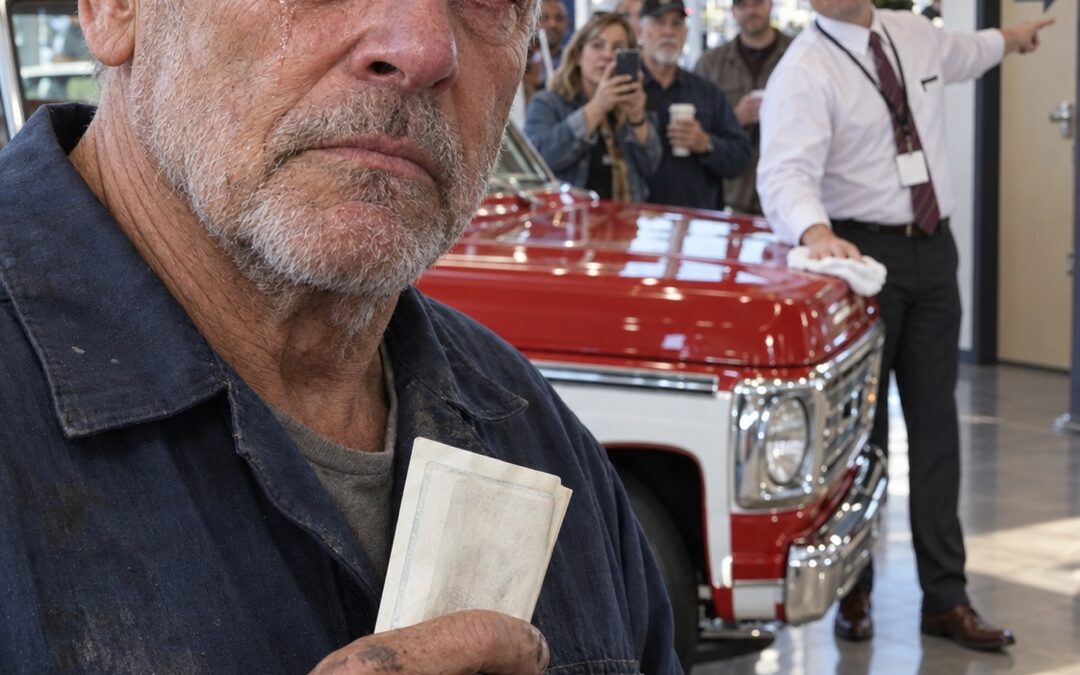
The sales manager took a white cloth out of his back pocket and wiped the fender of my wife’s truck where my hand had been, slow, the way you’d clean up after a dog, and then he turned around to the thirty-some people in that showroom and said, “Folks, don’t mind him. People who smell like motor oil use the service door.”
I had a cashier’s check for $41,500 in my shirt pocket, folded once, and grease under every fingernail I own.
What he didn’t know, and what I wasn’t about to tell him, was that the service door he was pointing at used to be the front door of my garage.
A few people laughed. Six or seven, maybe. Enough that the rest felt they ought to smile.
The kid next to him had his phone up and pointed at me. Twenty-nine or so, hair buzzed tight on the sides, a dealership quarter-zip you could have eaten off of. “Did you print that check at the library, Grandpa?”
That got a bigger laugh than the first one.
The truck sat on a turntable in the middle of the floor. Cardinal Red, white roof, fresh paint. Somebody had polished the chrome bumper until every balloon on the ceiling showed up in it crooked, and the passenger-side step still had the dent where Arlene caught it with a cinder block in 1983 and blamed me for parking near the cinder block. I’d put my hand on the fender before I thought about it. That was the print he wiped off.
I reached for the glove box. The kid slapped his palm down on the dash in front of mine.
“Hey. Don’t paw at it, bud.”
Over at the finance desks an older couple had stopped signing papers. The husband got real interested in a brochure about tire rotation.
I took the check back out and held it between two fingers. “Like I said. I’d like to buy it. Your post said forty-one five.”
The sales manager barely glanced at it. He was mid-forties, gold watch the size of a hockey puck, name tag that said TRENT WOLCOTT, GENERAL SALES MANAGER. “Facebook says a lot of things.” He folded the white cloth in half and gave the fender one more pass, like I might’ve gotten through the first coat. “That truck’s spoken for, pal. It’s going in my garage.”
“Your garage.”
“That’s right.”
“It’s sitting here with a price on the windshield.”
“Today it’s a display.”
“Yesterday it was forty-one five.”
“Things change, Grandpa,” the kid said, and swung his phone so he had me and Trent and the truck in the same frame. His name tag said CHAD DEMPSEY. I’ve known his kind fifty years. They can tell you the monthly payment on anything in the building before they can find the dipstick. “Come on. Show the camera that check.”
I folded it and put it back in my pocket. I was sixty-eight and I’d been called worse by a carburetor.
Trent nodded past me toward the steel door with the wired-glass window. Somebody had screwed a brushed aluminum sign over it since I’d last seen it, SERVICE, in letters a person could read from the highway. The handle was new. Everything else about that door I knew. I’d carried it into the old shop myself in 1979, took half a Saturday because the brick opening wasn’t square, and Arlene brought me a ham sandwich around noon and told me I’d hung the hinges backward. She was right. I fixed them before anybody else noticed and she never let me forget it anyway.
“Service entrance is right there,” Trent said, louder, for the room.
“I know where it is.”
That got its own little ripple. Big Mike Thompson from 98.3 The Valley lowered his microphone half an inch. I’d heard that voice every morning for twenty years and never seen the gray beard that went with it. Behind his table a vinyl banner said NEXT SATURDAY: CUSTOMER APPRECIATION DAY, FREE OIL CHANGES FOR A YEAR RAFFLE, MUST BE PRESENT TO WIN! and people had been dropping slips into a plastic drum all morning. A boy at the brat table had mustard down his sleeve. Saturday morning in Wisconsin, and the entertainment was an old man in coveralls.
The man at the finance desk finally lifted his head. Lyle Gunderson, thirty years at Grace Lutheran, retired dairy farmer, and Bev beside him in her good cardigan. Bev caught my eye. Then the finance manager, a young woman with her hair pulled back tight, touched a line on their papers with her pen, and Bev went back to signing. I didn’t call out to them.
I’d seen the post Friday night because Marv from Bible study shares anything with a truck in it. One picture had the glove box hanging open. I knew the latch before I knew the truck, and I didn’t sleep much after that.
“Son,” I said, “move your hand.”
He smiled into the screen. “Can’t let customers damage inventory.”
“I’m a customer.”
Trent laughed through his nose. “What’s your name, pal?”
“Roy Lindgren,” I said, and it didn’t mean a thing to him. Why would it? He’d been in town a year and a half. The LINDGREN’S GARAGE sign came down in 2010, and everybody who worked for Dale Brandt in the old days was retired, dead, or selling pontoon boats somewhere with no snow.
“Mr. Lindgren, I’m trying to be polite.”
“You’re working awful hard at it.” A woman by a Tahoe covered her mouth.
I wanted that glove box open bad enough that my fingers moved once at my side on their own. But Arlene had a rule, and she’d said it to me maybe four hundred times in forty-six years. We pay like everybody else, Roy. We don’t go waving your name around.
So I nodded at Chad’s phone. “You getting enough?”
“Plenty.”
“Good.” And I walked to the SERVICE door, and a few people laughed again because they figured Trent had won something.
The door stuck at the bottom. Still did that. I shaved it twice in 1981 and once in 1996.
On the other side was service bay one. My building. They’d built the glass showroom right up against the front of it in 2021 and painted the inside gray, but the bones were the same. Same brick, same high windows, same steel roof beams I’d cussed at while hanging fluorescent fixtures in 1984. Then I saw the door frame. Gray paint over all of it, but if you tipped your head and caught the light sideways you could see pencil lines under there, little dashes with writing next to them. Julie 4. Julie 6. Julie 8. Whoever painted it hadn’t bothered to sand. I touched the lowest one with the tip of my finger, the one where she’d stood on her toes and Arlene made her do it over.
Then I went out through the big overhead door and across the lot.
My green 1998 K1500 sat out by the road. Two hundred ninety-one thousand miles, rust coming in around the rear wheel wells, runs fine. I was halfway to it when somebody behind me called, “Mr. Lindgren?”
A skinny kid in a dealership jacket was jogging across the asphalt holding a Styrofoam cup out in front of him so it wouldn’t slop. Nineteen, maybe, brown hair sticking out under a Chevy cap. “Coffee. It’s from the employee pot. It’s not great.”
“Did I order coffee?”
“No, sir.”
“Then this could go either way.” I took it. It was not great. He said his name was Jesse and checked the showroom windows over his shoulder, where Chad still had his phone up. “I’m sorry about all that. And that truck really was listed at forty-one five. Mr. Brandt approved the price himself, in September. Tessa in marketing put the post up Thursday night off the price sheet.”
“So when’d Wolcott buy it?”
He looked right at me. “I didn’t say he bought it.”
“No. He did. In front of thirty people.”
Jesse shoved his hands into his jacket pockets. A napkin from the brat table skated across the lot between us. “They restored it here, in our shop. Company paid for all of it, body, interior, everything. Mr. Wolcott wanted it the day it came off the truck. Mr. Brandt told him no in September, said it was for the floor. I was driving a Traverse through the bay when they were going at it.” He swallowed. “But Mr. Wolcott tells everybody it’s going home with him Monday.”
The coffee stopped about halfway to my mouth.
“I shouldn’t even be talking to you. I’m gonna get fired.”
“Maybe,” I said. He stared at me. “You want me to lie to you, son?”
The corner of his mouth went up. “Guess not.”
Two rows over sat a black Silverado with a little silver sticker in the lower corner of the windshield. RIDGEGUARD APPLIED. Jesse saw me looking at it and quit checking the windows.
“Don’t let ’em sell you RidgeGuard,” he said, quiet. “I’m the guy who ‘applies’ it.” He did the quotes with two fingers. “It’s a sticker.”
“You a detailer?”
“Lot porter. Wash, vacuum, move cars. Mr. Wolcott hands me a roll of those and I put one on the glass. Not on that one, not on any of ’em, there’s no coating.”
I set the coffee on my tailgate, got the half bottle of water I keep behind the seat, and tipped some onto the Silverado’s hood. On real ceramic, water pulls up into tight little beads. This ran out flat in a wide sheet and slid off toward the grille. I ran two fingers over the clear coat. Nice paint. Bare.
“That’s it?” Jesse said. “Water?”
“Usually is.” I capped the bottle. “What are they charging folks for that?”
“Couple thousand, I think. Mr. Wolcott says finance handles it.”
He kept swallowing. I gave him the empty bottle and he caught it against his chest. “Keep doing your job, Jesse. Thanks for the coffee.”
I was in the truck with my hand on the door when he said, “Mr. Lindgren? I’m really sorry,” and I nodded once, and drove home.
The house is a one-story on the west side, close enough to the Chippewa that the spring mosquitoes think we’re family. The garage matters more. Two bays, old lift, and on the back wall a wooden LINDGREN’S GARAGE sign Arlene wouldn’t let me burn when it came down. Her chair at the kitchen table was still pushed in the way she left it. Fourteen months and I still walked around it instead of moving it.
I’d just set the check on the counter when Julie called.
“Dad. What did you do?”
“Had a cup of coffee. Bad one.”
“There’s a video.” She sent it while I was still standing there. Chad had put it on Facebook with a caption, Grandpa Grease tries to buy a $41K classic with a library check and a little skull. Twelve thousand views, and it wasn’t three o’clock. I watched six seconds of my own back walking toward that door and shut it off.
“Why’d you go in looking like that, Dad?”
I was still in the navy coveralls I’d put on at seven that morning for Saturday Fix-It at Grace Lutheran. We’d done front brakes on a single mom’s Impala and a battery for a seventy-seven-year-old man whose Buick had been dying in the same parking spot since Easter. “I was working.”
“You walked into a dealership covered in grease.”
“Mostly under the nails.”
She made the sound that means being forty-one and an ER nurse doesn’t stop a daughter from wanting to ground her father. “And forty-one thousand dollars? For an old pickup?”
I took Arlene’s reading glasses out of my shirt pocket and set them on the counter next to the check. “That red C10 is your mother’s truck.”
Julie went quiet on me.
“Mom’s truck was gone before Hailey was born, Dad.”
“June of 2009. I sold it for nine thousand.”
“Then how could you possibly know?”
“Dent on the step. The glove box latch.”
In 2009 GM went bankrupt and the bank was fixing to pull the floor-plan line on Dale Brandt’s store. Dale had been my friend since third grade. Arlene and I put in the garage, the 3.1 acres next to it, and the $240,000 we’d saved in thirty years of oil changes. Dale wouldn’t take it as a loan. “You’re saving my store, you’re owning it.” ARL Holdings ended up with sixty-two percent of Northwoods Motor Group, and Dale, later his boy Doug, kept the other thirty-eight and ran the place. Arlene wanted it quiet. So when the town decided Roy Lindgren had sold out to Dale and retired, we let the town decide. The C10 went too, to a collector from La Crosse. Arlene stood in the driveway a long time after he left. Only time I ever saw her cry over a machine.
“Dad? You’re not gonna make some big scene, are you?”
“No,” I said. “I already made a small one.”
“That’s not funny.”
“Little funny.”
She sighed into the phone. “Come for hotdish tomorrow. Hailey wants to see you. And change clothes before you go anywhere else.”
“Yes, nurse.”
At seven I was at the Gundersons’ kitchen table. Small ranch house, two plastic geese by the front steps that Bev dresses for the season. They were in raincoats. It wasn’t raining. Bev had the dealership folder out before I got my jacket off. “We think maybe we bought too much car.”
I put on Arlene’s glasses, which are too narrow for my head and scratched on the left lens, and Lyle slid the contract across. Vehicle price, $33,860, the sticker on the Equinox. Then three lines below it. RidgeGuard ceramic paint protection, $2,995. Nitrogen tire fill, $499. VIN etch, $399. Another $3,893 nobody had mentioned at the table until it was time to sign.
“What’s RidgeGuard, Lyle?”
“Kelsey said it was standard,” Bev said.
“No, now, that Wolcott fellow came over and said it was a state fee,” Lyle said. “Every vehicle’s gotta have it. I asked could they take it off and he said the computer wouldn’t let ’em.”
“Where’s the Equinox?”
“Garage.”
“Got a water jug?”
They both followed me out, Bev in her slippers. The new Equinox sat under the bare bulb, silver, clean enough that the three of us showed up in the hood. I found the RidgeGuard sticker on the windshield, opened the gallon jug, and poured a stripe down the middle of the hood. It went out flat and wide and ran off the front edge onto the floor. I did the fender. Same.
“Is that bad?” Lyle said.
“If you paid three thousand dollars for ceramic, it’s bad.”
Lyle went red from the collar up. Bev put both hands flat on the folder. I took pictures, the sticker, the wet hood, the VIN plate, each fee line close up. “Don’t call them tonight,” I said. “I want to know how many other people bought that sticker.” Lyle squinted at me and asked what exactly I thought I was doing, and I said trying to buy a truck, and he didn’t think much of that answer.
At eight-thirty I sat in the K1500 at the end of their driveway with the windows starting to fog and called Doug Brandt in Detroit.
“Mr. L?” He’d called me that since he was nine. Voices behind him, glasses, some hotel bar. “Everything okay?”
“Are you alone, Doug?”
“Give me a sec.” A door shut. “Okay. What’s going on?”
“Don’t tell anybody it’s me. I want every deal jacket since Wolcott started. Contracts, the add-on entries, repair orders, wholesale records. Everything I’ve got a right to look at.”
“Roy, what’s this about?”
“Start with something called RidgeGuard. Lyle Gunderson bought an Equinox this morning with thirty-nine hundred in add-ons on it. I just poured water on his hood. There’s no coating.”
I heard a chair scrape. “You sure?”
“I’ve been wrong about paint before. Not often.”
He breathed out. “Trent’s back-end numbers have been the best in the group all year. If he’s packing fees on old people I’ll have him out of that building by—”
“You fire him tonight, he walks out with every file in that building.” That stopped him. “Pull copies first. Don’t call the store.”
“Okay.” Keys clicking. “Is that it?”
“That red C10 on your floor. That’s Arlene’s truck, Doug.”
Nothing came through the phone for long enough that I thought I’d lost him. Then, a lot quieter, “Mrs. L’s?”
“Dent on the passenger step. I tried to open the glove box. One of your salesmen wouldn’t let me.”
“Oh, Mr. L.”
He cleared his throat. “I okayed it off the auction photos, Roy. Red and white C10, there’s a hundred of them. I never once opened the glove box. I approved forty-one five in September. Trent wanted to buy it and I told him no. We’ve got thirty grand and change in that truck, and it was supposed to bring people in all fall.”
“He told a room full of customers it’s going in his garage. Your lot porter says Monday. Look it up.”
He typed. I watched Lyle’s porch light through the fogged windshield, Arlene’s glasses folded on the seat beside me. Then the typing stopped, and started, and stopped again, and Doug said something to himself I won’t repeat.
“Roy,” Doug said, and I heard him set something down. “That truck went out the door Wednesday as a wholesale unit. Twenty-two thousand dollars, to a lot in Burnsville, Minnesota. I never approved it. And Roy—that lot belongs to Trent’s cousin.”
Part 2
By Sunday supper Chad Dempsey’s video had eighty-four thousand views.
Julie brought tater tot hotdish over at five-thirty and set it on my table hard enough to make the serving spoon jump. “You didn’t call me back all day.”
“I was at church.”
“Church is over by eleven.”
“People talk after. There’s bars.” Lemon bars, I meant, but she didn’t ask.
Hailey came in behind her with a bag of dinner rolls. Sixteen for six more days, long brown ponytail, a grease smudge on the knee of her jeans from the school auto shop Friday. She kissed my cheek, set the rolls down, and didn’t say a word. Most days you can hear Hailey from the driveway.
“Have you seen the comments?” Julie said.
“No.”
“Good. Keep it that way.”
“Mom,” Hailey said, pulling out a chair. “He’s gonna see them eventually.”
“I’d like eventually to mean never.”
I got the plates down. Julie had her phone out anyway and read off it in a flat voice. “‘Grandpa Grease needs to discover online shopping.’ ‘Somebody tell Jed Clampett the dealership takes financing.’”
“Jed had money,” I said. “That was the whole show.”
“I know who Jed Clampett is, Dad.”
“Then it’s a poor comparison.”
Hailey ducked her head, but I saw it. Julie didn’t. She put the phone face down by the hotdish. “Maybe they had a point. You can’t walk into a place like that in coveralls and expect a parade.”
“I expected them to sell me a truck they advertised for sale.”
“You could have changed.”
“I could’ve worn a tuxedo. I’ve got the one from your wedding. Still smells like the Elks hall.”
“Why do you do that? Every time I try to talk to you, you make it a joke.”
“Grandpa fixes cars for people who can’t afford it,” Hailey said, tearing a roll in half. “Why should he have to change clothes for some guy in a quarter-zip?”
“Because there’s a difference between helping somebody at church and walking into a dealership with forty thousand dollars.”
“Forty-one five,” I said, and Julie closed her eyes.
We ate for a while without much talking. The chair across from me stayed pushed in. Arlene always said my hotdish portions were too big and then ate half off my plate, so I took less than I wanted out of habit, and then sat there with nobody to eat the other half.
Julie saw where I was looking. Her voice came down some. “You really think it’s Mom’s truck?”
“I know it is.”
“And what are you going to do about it?”
“Pay for it. That’s the usual process.”
“Dad. Please don’t make this into some war with that dealership.”
Hailey’s head came up at that. I spooned more beans onto my plate and told her to eat her supper.
My phone buzzed by my elbow, twice, and Hailey grabbed for hers at the same second, which was all the evidence her mother needed. Julie reached across the table. Hailey got there first and held it against her chest.
“What did you do?”
“Nothing.”
“You’ve got the look. The one from when you cut your own bangs in seventh grade.”
“That was four years ago!”
I held my hand out, and Hailey thought about it, and gave me the phone. Chad’s video was up. Under it, from an hour before, a comment from Hailey Rasmussen. Her real name, her school picture for a profile, no initials, nothing hidden.
That’s my grandpa and he’s the best mechanic in Wisconsin.
I gave it back to her without saying anything. My throat wasn’t doing much right then.
“You put your name on there?” Julie said. “Take it down. People are awful online. You don’t hand strangers your full name.”
“So I’m supposed to let them make fun of Grandpa?” Hailey turned to me. “You mad?”
“No.”
Julie threw both hands up. “Wonderful. Two of you.”
I scrolled down the comments with my thumb while they argued about privacy settings. Mostly the same cheap stuff. Then one from mid-afternoon, a woman in Chippewa Falls.
my mom got charged for that RidgeGuard thing too??
Two below that somebody wrote wait what is RidgeGuard, its on my dad’s contract from May, and under that Mine says $2995. Thought it was required.
I quit scrolling.
After supper Julie loaded the dishwasher wrong, the way she always does. Hailey wandered out to the garage and stood under the old LINDGREN’S GARAGE sign a long time with her hands in her back pockets, looking at the tool chest like she was memorizing the drawers.
Monday at nine, Lyle Gunderson and I walked through the front doors of Chippewa Ridge Chevrolet. I wore coveralls. A clean pair. Lyle wore his tan church jacket and his church shoes and carried his contract folder in both hands.
The C10 was still on the turntable. Through the glass on the far side two men were backing a flatbed trailer up to the side doors.
Trent came out of his office, saw me, saw Lyle, and lost the smile. “Mr. Gunderson.”
“Morning, Trent. This here’s my friend Roy Lindgren.”
The name went right by him. He gave me the up-and-down. “The grease guy from the video. I thought I was clear Saturday.”
“You were loud,” I said.
“You need to leave.”
Lyle stepped in between us, all five foot seven of him. “He’s with me.”
“Then he can wait outside.”
“No,” Lyle said. Trent asked him excuse me, and Lyle said I said no.
The finance manager came out from behind her desk. Her name plate said KELSEY NOVAK. She saw the folder and stopped walking.
Lyle opened it on the nearest desk. “I paid three thousand eight hundred ninety-three dollars in fees nobody told me about. You said it was a state fee. You said the computer wouldn’t let you take it off. I want it off, and I want it in writing that I asked.” He’d written it out at his kitchen table Sunday night on a sheet of Bev’s stationery, a request to cancel the add-ons, and at the bottom, Contact: Roy Lindgren, with my home phone number and my address on Riverview, because Lyle doesn’t trust himself on the phone with salesmen. He laid it on top.
Something went across Trent’s face and then the showroom smile came back over it. “You signed it, Lyle. It’s binding.”
“I don’t care what I signed if you lied to me.”
“Mr. Gunderson, maybe if we all sit down and—” Kelsey started.
“Kelsey.” Just her name, about the volume you’d use to call a dog off the couch. She stopped, and I saw the pen in her hand going in tiny circles, shaking.
Trent turned to me. “This you? You soliciting my customers now?”
“I go to church with him. I poured some water on his hood.”
“Nothing on there,” Lyle said. “Ran right off.”
Trent laughed. “You’re testing ceramic protection with tap water? You got a certification?”
“Fifty years turning wrenches.”
“That’s not a certification.”
“Neither’s a sticker.”
Kelsey’s pen stopped. Then it started up again.
Trent reached behind the reception counter and came back with a white envelope that had MR. ROY LINDGREN typed across the front. “Had this drawn up this morning. Figured you’d be back.”
It was on Chippewa Ridge Chevrolet letterhead. It said I was no longer permitted on dealership property due to harassment, disruption of business, and interference with customers. At the bottom it was signed Trent Wolcott, General Sales Manager, and under the signature somebody had typed On behalf of ownership.
“Ownership,” I said. “You talked to ownership?”
“I represent ownership when I’m on this floor.”
I folded the letter on its creases. Lyle was standing up very straight. Kelsey said, “Trent, maybe we should look at the product disclosure,” and he turned his head toward her and she quit.
Then the side doors opened and the two men rolled the flatbed in.
I watched them hook the C10’s front end. Trent watched me watch.
“Where’s it going?”
“None of your concern.”
“Your garage?”
He just smiled. One of the men climbed up and cinched a strap, and the truck rolled forward onto the deck with the dent in the passenger step going by about eye level. Arlene used to say that dent ate the cuff of every pair of jeans she owned.
Lyle said, “Roy?” and I didn’t answer him.
Kelsey picked up the Gunderson contract to clip it, and the paper clip got away from her and bounced once on the desk. She bent to get it before Trent could see. He saw. So did I.
“You done?” Trent said.
“For this morning.”
I folded the trespass letter into quarters and put it in my shirt pocket next to Arlene’s glasses, and Lyle and I walked out the front door. The C10 came out behind us ten minutes later, on the trailer, headed north.
By noon, Jesse Nowicki didn’t have a job.
I found out at seven when somebody knocked on my garage side door. I had the Packers recap on low and was fighting a seized brake bleeder on a neighbor’s F-150. Jesse stood in the driveway light holding a backpack by one strap. “You busy?”
“Always. Come in.”
He looked around the place and stopped on the sign. “That’s yours? Like, an actual shop?”
“Mostly we sold ice cream.” He didn’t know what to do with that. “Mechanic shop. Thirty years.”
“I got fired,” he said. “Eleven-thirty. For leaving my post Saturday.”
“The coffee.”
“Chad’s video’s got four seconds of me handing it to you. Mr. Wolcott played it for me in his office. Twice.” He dropped the backpack by my workbench. “Then he asked what I told you.”
“What’d you say?”
“Nothing.”
“That true?”
“No, sir.”
“Good answer, then.”
He said he needed work, he had night classes in the automotive program at Chippewa Valley Tech, and his mom worked nights at the nursing home so he helped with rent. I told him I paid less than a dealership. He said they didn’t pay him anything now. I pointed at the broom, and he swept for five minutes before he leaned it on the wall and unzipped the backpack.
It was a green spiral notebook, the cheap kind, corners bent, an oily thumbprint on the cover. He set it on the bench. “I started writing down stock numbers. In March.”
“Why?”
He rubbed the back of his neck. “First couple stickers, I figured maybe the coating guys came in after I left. Then I asked Marcus in quick lube if he ever saw anybody putting it on. He said there aren’t any coating guys. So I started keeping track.”
Dates, stock numbers, models. Equinox, Silverado, Malibu, Trax, Silverado again. Sometimes a buyer’s name, if the deal tag was still hanging off the mirror.
“You told anybody?”
“I needed the job. And I kept thinking maybe there was something I didn’t get.”
“Usually a smart thing to think at nineteen.”
I put on Arlene’s glasses and reached for it. Jesse kept two fingers on the cover.
“Forty-one,” Jesse said, and slid the notebook across my workbench. “Forty-one cars since March. And eleven of ’em went to people older than you.”
Part 3
Tuesday morning Jesse and I started with Joyce Brandvold.
She lives in a little white house off State Street with two concrete rabbits by the walk and a Malibu in the driveway cleaner than most operating rooms. Joyce is seventy-nine and taught second grade long enough that a grown man still sits up straight when she uses his whole name.
“Roy Lindgren, why are you standing in my driveway with a milk jug?”
“Because I think you paid for something you never got, Joyce.”
She stopped halfway down the porch steps. “How on earth would you know that?”
“Go get your paperwork.”
She gave Jesse the once-over, and I told her he used to work at Chippewa Ridge, and she said used to? and I said since yesterday, and she nodded and held the screen door for us.
She had the contract in plastic sheet protectors. Of course she did. I put on Arlene’s glasses. Malibu, bought in August. RidgeGuard, $2,995. Nitrogen, $499. VIN etch, $399. Then the financing page.
“What rate did the bank quote you before you went in?”
“Six point nine.”
My finger went under the contract rate. Eleven point four. Joyce leaned over my shoulder and her reading glasses slid down her nose and she pushed them back up and her lips moved.
“The nice young man said it was the best they could do for someone my age.”
Jesse said, “Oh, come on,” under his breath, and Joyce turned on him. “Young man, not in my house.”
“I didn’t swear, ma’am.”
“See that you don’t.”
Out in the driveway I poured a stripe of water down the Malibu’s hood. It ran off in a sheet. Joyce said do it again. I did it again. She folded her arms and asked Jesse if he was the one who put that sticker on her windshield, and his ears went red, and he said yes ma’am, and she asked if he put anything on the paint, and he said no ma’am, and she studied him another few seconds and said all right.
I took pictures while Joyce went to find every other paper they’d given her. She said, “I taught seven-year-olds for thirty-six years, Roy. I know when somebody’s lying because they figure you’re too tired to check their work.”
Gene Halvorsen was next. Seventy-four, retired mail carrier, Silverado in May. He met us in the driveway in bib overalls and didn’t ask about the jug. “Joyce called,” he said. “Try the hood.”
Same sticker, same sheet of water, same three charges on his contract for $3,893. “Wolcott said everybody pays it,” Gene said. “The finance gal was sitting right there. Kelsey. She didn’t say much.”
Jesse opened the green notebook, and Gene read the stock number off a window sticker he’d saved in a kitchen drawer with a dog tag from a dog he’d had in the eighties. Jesse ran his finger down a page. “May twenty-third. There.”
Gene leaned in to see his truck in a stranger’s handwriting. “Why’d you write mine down, son?”
Jesse checked with me first. I let him answer it himself.
“Because I thought something was wrong.”
Gene nodded. “Good.”
Marian Tollefson was last. Seventy-one, widowed, retired school cafeteria cook, Trax in June. She has plastic geraniums in a planter by her door. Her contract had RidgeGuard at $2,995 and nothing else. “That Trent told me the protection was already on the car,” she said. “I didn’t ask for it. He never said I could say no.”
She asked Jesse if he put the sticker on. He said yes ma’am. She asked if there was any coating. He said no. Marian took it quieter than Joyce. She sat at her table without moving for twenty seconds, holding her coffee cup in both hands. Then she said, “My husband would’ve driven through their front window.”
“Let’s not honor his memory that way,” I said, and she laughed, a small one, and went and got her car keys so we could do the hood.
By four I had thirty-seven pictures and three contracts on my kitchen table, and Jesse had quit apologizing to people.
Paul Ostrander came at seven with a cardboard file box and a Kwik Trip bag. “Coffee,” he said. “Figured you weren’t sleeping.” Paul’s sixty-four and has done the company’s paperwork since Dale was alive. He set the box down and said, “Doug exported everything he could get out of the DMS from Detroit. The paper originals with signatures are still at the store.”
Forty-one deals. Jesse looked over at me. “Same as the notebook.”
“Exactly the same,” Paul said, and slid a printout across that matched Jesse’s stock numbers against the dealership’s. Forty-one for forty-one.
I got out a yellow legal pad. Jesse watched me add it up by hand and finally said, “You know your phone has a calculator.”
“So did my eighth-grade math teacher. I still checked her.”
Forty-one RidgeGuard charges at $2,995, that’s $122,795. Nineteen of those also had the nitrogen and the etch, $898 apiece, $17,062. I drew a box around the total. $139,857.
“That’s real?” Jesse said.
“That’s what people paid.”
Paul turned a sheet toward me. “Booked as an ‘internal exterior package.’ No vendor, no chemical bought. On the reports it just looks like fat margin, and Doug’s been bragging on him for it all year.”
Then Paul laid eleven pages out by themselves. Buyers over sixty-eight. Every one had the rate marked up past what the lender approved. I found Joyce’s. Approved 6.9. Contract 11.4.
Jesse rubbed both hands down his face.
“There’s more,” Paul said, and took out a thin folder with C10 written on the tab in his own block letters.
An internal repair order, HERITAGE DISPLAY, $11,400, parts and bodywork and upholstery. Bought at Northland Classic Auction in St. Paul in July for $19,200. Total company cost, $30,600. Then a wholesale record dated last Wednesday. $22,000 to North Star Auto Wholesale, Burnsville, Minnesota. Approved by Trent Wolcott.
“Doug never signed this.”
“Didn’t have to.” Paul tapped the operating policy. “GSM can wholesale any unit under twenty-five thousand without the dealer principal.”
“So he sold it eight thousand six hundred under cost,” Jesse said. “To who?”
“His cousin,” I said. “Wade Haugen. Doug looked it up Saturday night. Trent put him down as emergency contact on his hiring paperwork.”
“And Friday,” Paul said, “the title went from North Star to Trent Wolcott, personally. He registered it here in Wisconsin the same afternoon.”
Jesse sat back. “Why would anybody do it that obvious?”
“Because nobody was looking,” I said.
Paul had one more page, Trent’s pay plan. Base plus ten percent of back-end. I did that one in my head. Thirteen thousand nine hundred eighty-six, near enough, off old people’s paint that never got touched. And Trent had a GM interview in the Twin Cities for January, Paul said, and had asked Doug for a reference. “He doesn’t need it to hold up forever, Roy. He needs it to hold up till January.”
The refrigerator kicked on. Jesse was staring at the top sheet of the stack. “What’s ARL Holdings?”
Paul and I traded a glance. Paul raised his eyebrows about a quarter inch, which for Paul is a speech, and I nodded.
“Arlene. Roy. Lindgren,” I said.
He blinked. “Your wife?”
Paul slid the ownership page across. “ARL Holdings owns sixty-two percent of Northwoods Motor Group. Northwoods owns Chippewa Ridge Chevrolet.”
Jesse went down it once, then pointed at me, then out the window toward Highway 93. “You own the dealership. Trent threw you out of your own store.”
“Technically Doug runs it.”
“That’s what you’re going with?”
I took the glasses off. “Nobody at that store can know, Jesse. Not yet. If Trent figures out who’s digging, paper goes in a shredder.”
“I won’t say anything. I swear.”
Paul put the sensitive pages in a separate folder and snapped a rubber band on it. “One more thing. Wisconsin’s one-party consent, Roy. If he wants to talk to you, let him talk.”
“You think he’ll call?”
“I think a man with this much to lose does something stupid.”
Wednesday morning I met Kelsey Novak at the Kwik Trip on Clairemont Avenue. She’d called the number on the bottom of Lyle’s cancellation request, from her own cell, at six in the morning. She took the table farthest from the register and kept her coat buttoned. I bought two coffees. She didn’t touch hers.
“You can’t tell Trent I met you.”
“I don’t work for Trent.”
“You know what I mean.” She kept turning the cardboard sleeve on her cup. “Owen’s six. My son. I’m the only paycheck.”
“Why’d you put those fees in the contracts, Kelsey?”
She pressed her lips together till they went white. “Because he told me to. He said if I didn’t do what I was told he’d put somebody in my chair who would.”
“You know the coating wasn’t going on?”
She found something out the window to watch, a man pumping gas into a riding mower can. “By June. I couldn’t just walk out.”
“Didn’t say you could.”
She swung back on me. “You think you’re better than me? Because you own a garage or whatever?”
I almost laughed. I drank my coffee instead. “Would you tell somebody official what you just told me?”
“No.” It came quick. “I have Owen. I have rent. My insurance is through that job.”
“This isn’t going away, Kelsey. You’ve got a chance to get out in front of it.”
She pushed her chair back. “I can’t.” And she left the coffee there, full, with the lid still on.
That afternoon Steve Gunderson filed a complaint for his folks with the Wisconsin Department of Agriculture, Trade and Consumer Protection. Steve’s a CPA and attached a copy of everything, including the cancellation request with my name and number on the bottom.
At 9:40 Wednesday night the house phone rang. Nobody calls a landline after nine unless they’re selling something or somebody died.
“Roy.” It was Trent. “You’ve been busy.”
“Some.”
“Joyce Brandvold called my store this afternoon. Then Gene Halvorsen. Then Marian Tollefson.”
“Marian makes a nice bar.”
“This isn’t funny. You’re talking to my customers.”
“They’re grown people. People aren’t property, son.”
“You think that old-man routine is cute? You think you’re building some case because you splashed water on three cars?”
“Used a whole gallon.”
His breath came down the line, a couple of times. I could hear him walking. “I can have you arrested for harassment. You’ve already been trespassed.”
“By ownership, I hear.”
“That’s right.”
“Must be nice, knowing them.”
On the table in front of me sat the green notebook, three contracts, and Arlene’s glasses, folded, on top. He went quiet for half a second, and when he came back his voice had dropped down low and friendly, which was worse.
“You come near my customers one more time, old man,” he said, “and I’ll make sure Hailey gets to watch her grandpa go out in handcuffs on the six o’clock news.”
Part 4
“I’m not here to arrest you, Mr. Lindgren,” the policeman said. I was on my second cup of coffee and still had the mug in my hand. It said GRACE LUTHERAN FISH FRY 2011 and had a chip on the handle Arlene always meant to sand down.
His name tag said BREKKE. Thirty-something, one hand parked near his belt. A quarter after eight, Thursday. And Julie’s car came around the corner before he’d gotten two sentences in. After Trent hung up on me Wednesday night I’d called her, because when a man says your granddaughter’s name like that, her mother ought to know, and now she was stopping on her way to a nine o’clock shift to check I was still breathing.
She came up the walk fast, scrubs on under her coat. “Arrest him for what?”
“Ma’am—” he started, and she said, “I’m his daughter. What happened?”
Brekke showed her a palm. “Mr. Wolcott filed a complaint yesterday. He says your father’s been contacting dealership customers after he was served a trespass notice.”
“I’ve been talking to people I know,” I said.
“He says you’re harassing them about their transactions.”
“Ask the people,” I said, and he said, “I did.” That one got my attention, and he could tell. He shifted his weight. “Nobody I spoke with said you threatened them. Nobody wants charges. But there’s a trespass letter, and Mr. Wolcott says you’re interfering with business, so I’m telling you to stay off that property unless somebody with authority says otherwise.”
Julie turned on me. “You went back? After what they did to you?”
“Monday. Lyle wanted his money back.”
Brekke glanced between us. “I don’t really need the family part.” He turned back to me. “Mr. Lindgren, this is a warning. Another complaint, with you on dealership property, and somebody might make a different decision than me.”
I said I understood. He nodded to Julie and went back to his cruiser, and she held off until it turned at the corner.
“The police, Dad?”
“One policeman,” I said.
“That’s not better. Hailey’s friends sent her the video in gym class yesterday.” Her hands were shoved down in her coat pockets so hard the seams pulled. “She cried in the nurse’s office.”
I didn’t have anything for that. I set the mug on the rail.
“She didn’t tell me.”
“Of course she didn’t tell you. She’s in the comments defending you while half the junior class sends her that stupid clip with skull emojis on it. Her birthday’s Saturday. Seventeen. She should be worrying about cake and whether she passed her brake systems quiz, not whether her grandpa’s getting hauled off over a car dealership.”
“I’m not getting hauled off.”
“You don’t know that. And he said her name, Dad. Hailey was in my kitchen when you called last night. I had you on speaker because my hands were in the sink. She heard every word.”
That I hadn’t known. I ran my thumb down the porch rail where the paint had lifted.
“Please stop,” Julie said. “Just till this cools off.”
“People got cheated. Old people.”
“I know. So let the state handle it.”
“The state doesn’t have the paper.”
“They have a complaint.”
“One. And one’s not much if the paper disappears.”
“You’re sixty-eight. You’re not Dale, you’re not Doug, you don’t run a dealership.” She stepped closer. “So why are you acting like this is yours to fix?”
There wasn’t an answer to that without telling her more than Arlene and I ever had. Julie knew there was some kind of investment. She’d never asked how big, and we’d never offered.
“Because I can help,” I said.
She shook her head. “Hailey cried at school.”
I didn’t say anything else. At her car door she turned around. “Just stop making it worse.” Then she left, and I stood out there till the coffee went cold.
Jesse showed up at noon with two turkey sandwiches from Festival and swept a garage floor that didn’t need it.
At six-forty my phone buzzed on the workbench. Kelsey.
I can’t. I have Owen. He says he’ll make sure no store in this state hires me.
I set the phone face down next to a coffee can of drill bits. Jesse was running a rag through a socket set and didn’t look up. “Bad?”
“Kelsey backed out. All the way, looks like.”
He sat down on the stool. “Marcus texted me too. Trent stayed late last night pulling old deal jackets, March forward. Marcus doesn’t know if it’s all forty-one. He heard Trent tell Kelsey they need to clean out the finance office before Mr. Brandt gets back. Tomorrow night.”
That added up. Doug’s flight didn’t get in till eleven Friday night. Anything Trent wanted gone had to go before then. Doug had offered Monday to get on a plane. I told him if he walked into that store four days early, Trent would know why before he got his coat off.
The video had gone past four hundred ten thousand by then. Some people were laughing at me and some were asking what RidgeGuard was, and a fair number were doing both in the same comment. What I cared about was a locked finance office and forty-one folders Trent had the only key to. I called Paul and told him Kelsey was out.
“I figured she might.”
“Marcus says they’re cleaning out deal jackets tomorrow night.”
“Doug has the DMS export.”
“The originals have the signatures. Whatever got scribbled in the margins.”
“I know, Roy. Police won’t seize anything because we think he might run a shredder. DATCP can ask for records, but that takes weeks. And if Doug calls from Detroit and has that office locked, Trent knows exactly who’s asking, and he’s got the only key and all night.”
“Enough to investigate, not enough to stop him,” I said.
Trent could burn the paper, blame Kelsey for whatever was left in the system, call Jesse a sore kid and the water test a stunt. Then walk into a Twin Cities interview in a clean shirt with a funny story about an old man in coveralls. And keep Hailey’s name in his mouth the whole way. I could see that version just fine.
Friday I stayed home. I didn’t call customers or give Officer Brekke a reason to come back. At eleven Paul called.
“DATCP contacted the store this morning. Janet Olson called Trent personally. Steve’s a CPA, his packet had tabs. It may make him reckless, Roy.”
At four that afternoon a black Corvette Stingray turned into my driveway. Company demo. I knew whose before it stopped rolling.
Trent got out carrying a white envelope. Pressed khakis, dealership polo, no coat, though the wind had come around to the north after lunch. I was at the bench wiping down a half-inch combination wrench. My phone sat in my shirt pocket next to Arlene’s glasses.
Paul had said it at my kitchen table on Tuesday. Wisconsin’s one-party consent, Roy. If he wants to talk to you, let him talk. I pressed the screen through the fabric before Trent made it past the door frame. Red dot.
He walked around my garage with his hands in his pockets. The lift. The parts shelves. Then the old wooden sign over the bench, and he smiled.
“Cute. You had a little shop once.”
“Paid the bills,” I said.
“You’ve caused me a lot of trouble, Roy.”
“You drove twenty minutes to tell me that?”
“I drove here because you’re confused about your position.” He set the envelope on my bench. “Open it.”
I kept wiping. “You came all this way. You open it.”
He did. A personal check for five thousand dollars, drawn on a Burnsville bank, and two typed pages. “You sign this, take the check, quit bothering customers, and I withdraw the police complaint.”
“Thought I wasn’t charged with anything.”
“You want that to stay true?”
I set the wrench down and picked up the pages. Confidentiality. Non-disparagement. No contact with any customer of Chippewa Ridge Chevrolet. No complaints to any agency. No public statements. It was a nice job of typing.
“You write this?”
“An attorney did.”
“Paul?” That threw him, and he said, “Who?” and I told him never mind.
“Five grand, Roy. Today.”
I said no.
The smile went away. “You don’t even know what you’re turning down. You’re an old mechanic in a little ranch house.”
“House is paid off.”
“Point is, you walked into my showroom looking like you slept in a transmission pan, you got embarrassed, and now you want to punish everybody else for it.”
“You charged Lyle for something he didn’t get.”
“He signed. Joyce signed. Gene signed, Marian signed, they all signed.” He spread his hands. “Old people sign anything if you smile and call it a state fee.”
I didn’t move. He kept going, and I don’t think he heard himself, or if he did he liked it.
“That’s sales. They want the keys and a payment they can live with.”
“You charged them for a coating that isn’t there.”
“Prove who applied what six months ago. Jesse’s a nineteen-year-old I fired for leaving his post. Kelsey’s got a six-year-old and a car payment, she knows how jobs work.” He tapped the check on my bench. “And Doug likes my numbers. Best back-end that store’s had in years.”
“The owners might care.”
He laughed out loud at that. “The owners? Some LLC in a filing cabinet. Nobody at that store answers to anybody but me.”
My eyes went to the sign behind him, and his followed, and he smirked at it a second time.
“Take the money, Roy. You think the cops care about water running off a hood? I’ve got a trespass letter, a police complaint, and video of you making a scene on my floor. You’ve got a garden jug and a fired porter.”
Put that way it didn’t sound like much.
“You sign, this all stops.”
Five thousand dollars to go away. Thursday night, up late with the green notebook, thinking about Hailey in that nurse’s office, I’d wondered if going away was the decent thing.
“Still no.”
“Then I’ll see you in court.”
“I’ll see you Saturday. Customer Appreciation Day.”
“You can’t come in,” he said, and laughed, and tucked the papers under his arm and walked out to the driveway, and at the edge of the slab he turned around. “Service door, Roy.”
The Corvette was loud going down my street. Then I took the phone out. Nine minutes, eleven seconds.
At 9:40 that night it was raining hard enough to hear on the kitchen window over the furnace, and somebody knocked. Not the doorbell. Knocked.
Kelsey stood under my porch light soaked to the skin, hair stuck flat to her cheeks, both arms locked around a cardboard file box with the lid going soft at the corners. She checked over her shoulder at the street before she said a word. Through a split in the wet lid I could see dealership folders packed in upright. Originals. Dozens of them.
She wiped her face with the back of her wrist.
“He told me to run all of these through the shredder tonight,” Kelsey said, and set the box down on my porch. “I put them in my trunk instead.”
Part 5
Saturday, October third, I parked the K1500 in the first space outside the front glass at Chippewa Ridge, where Doug had told me to put it. Same green truck, same coveralls, a fresh grease mark on the left knee from Fix-It at church. Hailey climbed out the passenger side in jeans and boots and the flannel Arlene bought her the Christmas before the diagnosis. Seventeen years old that morning.
Jesse got out of the back of the cab. Lyle and Bev were waiting by the front walk, and Joyce Brandvold stood with them, purse clamped under one arm, wearing the look she must have used on second graders who swore the dog ate it. She’d phoned Gene and Marian Friday night, and both of them said they’d be there.
The Truck Fest banner was down. CUSTOMER APPRECIATION DAY hung over the glass doors now, and inside Big Mike Thompson was already on the air next to the raffle drum. Lot of the same faces too, since everybody who’d filled out a slip the week before had to be present to win.
Hailey bumped my elbow. “You ready?”
“Nope.”
“Good,” she said, and we walked in the front door at ten-fifty.
Trent spotted me before I’d gone five steps. He was standing by the turntable in the middle of the floor, empty now except for a little easel placard nobody had bothered to take down. FALL TRUCK FEST CENTERPIECE. His color went and came back in about two seconds, I’ll give him that.
“Service door, Grandpa.”
Chad Dempsey was ten feet off with his phone up and the little red LIVE in the corner. Hailey moved in close to my shoulder and Trent looked at her.
“And this must be Hailey.”
“Careful, son.”
“What, I can’t say happy birthday?”
“You’ve said plenty to her family.”
He pointed at the steel door on the side wall. “You’re trespassing. I gave you written notice.”
“Signed on behalf of ownership.”
“That’s right.”
“Good,” I said, and he didn’t know what to do with that, so he raised his voice past me toward the glass. “Officer!”
Nate Brekke had been out at the curb in a reflective vest waving minivans in. He came in, took one look at me, one at Trent, and sighed. “Mr. Lindgren. I warned you Thursday.”
“You did.”
“Remove him,” Trent said.
Brekke ignored him and turned to me. “Do you have permission to be here?”
The office door behind reception opened before I had to answer. Doug Brandt came out with Paul Ostrander beside him, Paul carrying his leather folder. Doug had landed from Detroit at eleven the night before and his shirt still had suitcase creases in it. He’d come by my house at six that morning for Kelsey’s box.
“Doug, perfect,” Trent said. “Tell Officer Brekke this man’s banned from the property.”
Doug walked right past him and stopped in front of me. “Morning, Mr. L.”
Big Mike’s mic still hummed through the speakers, and somebody’s kid was banging a balloon against a Tahoe. But the talking quit. Chad’s phone dropped maybe two inches.
“Mr. L?” Trent said.
“Trent, this is Roy Lindgren.”
“I know who he is.”
“No. You know his name.” Paul opened the folder. Doug kept his eyes on Trent. “ARL Holdings owns sixty-two percent of Northwoods Motor Group. Roy is ARL Holdings.”
A woman at the raffle table stopped writing in the middle of her phone number. Over by the Silverados somebody said, “What?” Trent laughed, one short bark that came out wrong.
“That’s ridiculous.”
Paul held out a document. “Operating agreement.” Trent didn’t take it, so Doug did, and opened it to the ownership page and turned it around. Roy and Arlene Lindgren in blue ink, 2009.
You could watch him run the week back in his head, the coveralls and the check and the white rag, and then the envelope he’d opened on my workbench yesterday afternoon, which I think is where it stuck. He looked over at the old steel door on the side wall with the wired glass and the brushed aluminum plate that said SERVICE.
I walked over and stood on the empty turntable, right where Arlene’s truck had sat, and pointed at that door.
“You told me people who smell like motor oil use the service door. Son, I hung that door in 1979.”
Nobody laughed this time. Big Mike moved his microphone away from his mouth.
“You expect me to believe this guy owns the store?” Trent said to Doug.
“The company. I own thirty-eight. Roy and Arlene wanted it quiet, so it was quiet.”
“Arlene.” He said it slowly, and I watched him put it together with a red truck and a glove box Chad wouldn’t let me open. Trent took a step back. “That doesn’t change the trespass notice.”
“Give it to me,” Doug said.
“I don’t have the original.”
Paul and Brekke and Doug all turned and looked at him. I reached into my shirt pocket, past Arlene’s glasses, and pulled out the letter, still folded in quarters from Monday.
“I do.”
Doug unfolded it. He read Trent’s signature and then the line under it, on behalf of ownership, and let out a long breath through his nose. “Officer, this letter is void.”
“You’re the one with authority over the property?”
“I’m dealer principal.”
“That’s good enough for me.” Brekke tore it in half, then in half again, and laid the pieces on the raffle table by the drum. “Far as I’m concerned, Mr. Lindgren’s welcome here.”
“This is a stunt,” Trent said.
“Part of it is.”
Jesse had already walked over to a silver Silverado with a RIDGEGUARD APPLIED sticker on the windshield. Joyce followed him, and Lyle and Bev, and then the customers started drifting the same way. Trent got in front of me.
“You’re not touching dealership inventory.”
“Move,” Doug said. Trent turned around, and Doug said it again, quieter, like he was asking somebody to pass the salt. “Move.” And he did.
Jesse set a gallon jug on the hood. Big Mike leaned into his mic and said, “Folks, I think we’re gonna hold the raffle a couple minutes,” and a few people laughed the nervous way.
“This proves nothing,” Trent said.
“Then you won’t mind.” I poured. The water spread out flat and slid off toward the grille in one piece. “RidgeGuard ceramic protection. Twenty-nine ninety-five.”
A man by the coffee urn said, “Hey. I paid for that!” A woman next to him said, “So did I.”
“Water behavior is not a certified test,” Trent said.
“No, it’s not. So here’s the other half.” Jesse pushed open the front doors. My K1500 was right outside the glass. I walked out and poured across the hood, and the water drew up into tight round beads and rolled to the edges like ball bearings on a tray.
“Hand wax. Every spring, every fall.”
“Well,” Big Mike said into the microphone, “that’s pretty easy to see.”
Kelsey came out of the finance office then, carrying the cardboard box. Doug had handed it back to her that morning so she’d be the one to carry it out. The lid still had a water stain from my porch. She set it on the Silverado’s hood beside the jug.
“Kelsey,” Trent said.
She didn’t turn her head. Doug opened the first folder, then a second, then a third. Signed contracts, disclosure sheets, Trent’s handwriting on yellow sticky notes. Customers were digging in purses and glove boxes and back pockets by then, unfolding paper. Joyce said, loud and clear, “Mine was two thousand nine hundred ninety-five dollars.” From farther back Gene Halvorsen hollered, “Mine too,” and Marian Tollefson held hers up over her head without saying anything at all.
Trent pointed at Kelsey. “F&I products are her department.”
Her voice shook once, then quit shaking. “You told me to load them.”
“Kelsey,” Doug said, “were you instructed to add RidgeGuard as a mandatory product?”
“Yes.”
“By who?”
She looked straight at Trent. “Him.”
Big Mike held the microphone out toward me. “Mr. Lindgren. Anything else you want to say while I’ve got you?”
I took out my phone. Trent saw it and put a hand down on the Silverado’s hood to steady himself, right in the wet.
“That’s illegal.”
“Wisconsin permits a party to record a conversation he’s part of,” Paul said, before I could.
I pressed play and held the phone to Big Mike’s mic, and Trent’s own voice came out of the radio speakers. Old people sign anything if you smile and call it a state fee. Joyce folded her arms. Bev put her hand on Lyle’s sleeve. Some LLC in a filing cabinet. Nobody at that store answers to anybody but me.
I stopped it there. Twenty seconds was plenty. A fella by the raffle drum started in with “You son of a—” and I held up a hand and he quit.
Trent looked toward the front doors. Brekke was standing in them. Doug stepped in close, not blocking him exactly.
“Badge.”
“Doug.”
“Employee badge. Now.”
Trent unclipped it and slapped it into Doug’s palm. Doug held out the other hand. “Corvette keys.”
“That’s my demo. I’ve driven it eight months.”
“It’s the company’s demo.” Trent dug the fob out of his khakis and dropped it on the raffle table, right on top of the torn letter.
Doug turned to Chad. “You. Keep filming. You’ve had that thing in Roy’s face for a week, don’t lower it now.”
Chad looked at me, then at his own screen. He turned the camera around on himself. “My name’s Chad Dempsey. I posted the video last Saturday.” His voice cracked and he cleared his throat. “I called Mr. Lindgren Grandpa Grease. I made fun of his check. I was trying to get views.” He looked up at me. “I’m sorry.”
“Delete it,” I said.
He tapped the screen a few times. “Deleted.”
Doug lifted the box off the Silverado and handed it to Brekke, and Paul added a fat envelope on top. “Company records. I want them preserved and sent to financial crimes.”
“I’ll call Detective Kubiak,” Brekke said.
Doug turned back to Trent. “In case anybody’s unclear. You’re terminated. Effective now.”
“Over this?”
“Over fraud, insubordination, selling a company truck to yourself through your cousin, and whatever the police decide to call the rest of it. Go.”
Trent stood there. The same thirty-some people who’d watched him wipe my handprint off a fender a week ago were watching him now, and none of them were looking at the floor. He started for the front doors. Brekke was still standing in them and didn’t move. Doug pointed at the steel door on the side wall. “Staff goes out through service, Trent. You know where it is.”
The white cloth was still hanging out of his back pocket. He went that way, past the empty turntable, with the whole room watching him go. At the door he turned around, and that little smile came back, meaner and not as steady.
“You came in here for the truck.”
“That’s part of it.”
He raised his voice so the whole showroom would have it.
“Keep the store, old man,” Trent said. “That truck’s titled to me. It’s sitting in my garage, and there’s not one thing in this world you can do about it.”
Part 6
Monday morning at seven-thirty I backed my 1989 Ford F-350 wrecker into Trent Wolcott’s driveway in Lake Hallie, beeping the whole way. The lettering on the doors is sun-faded down to almost nothing, but if you stand close in the right light you can still read LINDGREN’S GARAGE. I had never once driven it to Chippewa Ridge. It seemed like the morning for it.
Detective Ann Kubiak was at the curb with a folder, her car parked crooked behind Paul’s Buick. Paul stood next to her in a topcoat, hands in his pockets. Trent was halfway out of his own side door in a gray bathrobe and no socks. That alone was worth the diesel.
“What do you think you’re doing?”
Kubiak held up the paperwork. “Court-authorized seizure. A judge signed it yesterday afternoon.”
“No. That truck’s titled to me. It’s legally mine.”
“That’s what we’re here about. Step aside, Mr. Wolcott.”
“He can’t take it,” Trent said, pointing at me.
I reached into the cab and brought out the sheet Doug had signed Sunday night on my kitchen table. “Company property going back to the company. Doug authorized me to haul it.” Kubiak had explained it at the curb. Her photos first, VIN and odometer, and the DA was fine releasing it to the victim, which was the company, which this morning was me and a winch.
“You planned this,” he said, and I said, “I planned to buy a truck.”
The big door was already up. And there she sat in the middle bay of that three-car garage, Cardinal Red with the white roof, small as a toy between a workbench that had never had a vise bolted to it and a television on the wall big enough for a sports bar. He’d put tire shine on her. That got under my skin worse than the rest.
Across the street a woman in a fleece came out to her mailbox with a coffee cup and stayed out there. Trent saw her.
“Can we do this inside?”
“No, sir,” Kubiak said. “You made your choices in public.”
I backed in six more feet and let the cable run off the spool. Trent stepped toward me. “You touch that truck and I’ll sue you.”
I told him to get in line.
I got down on the cold concrete on one knee, the bad one, and hooked under the front crossmember where I’d hooked a thousand cars, and stood back up slower than I went down. His bathrobe belt kept coming loose and he had to retie it twice, with the woman across the street watching him do it.
I hit the winch. The C10 rolled forward an inch.
“It’s my property,” Trent said, and Kubiak moved herself between him and the truck. “I paid Wade,” he said.
“Wade Haugen spoke with me Saturday night,” Kubiak said.
He had his mouth open for a second before anything came out. “Wade what?”
“He confirmed the wholesale was done at your direction and the truck only went through his lot on paper.”
“You can’t prove intent.”
“That’s for the prosecutor.”
Paul cleared his throat. “The Eau Claire County District Attorney gets the file this morning. The company’s suit went in at the same time, to recover thirteen thousand nine hundred eighty-six dollars in back-end commission. And the dealer group in the Twin Cities called Doug yesterday.” He took one hand out of his pocket. “They’ve cancelled his January interview, and they won’t be rescheduling.”
Trent’s face went still. I shouldn’t have enjoyed that. I did, some.
I worked the lever and the C10 came out of his garage slow, past the bathrobe, past the spot on the slab where he’d planned on parking her for good. It’s going in my garage. Well. Then I ran her up onto the bed and checked my own straps, twice.
“This isn’t over,” Trent said.
“Turn around,” Kubiak told him, and when he said, “You said seizure,” she said, “And now I’m placing you under arrest. Turn around, please.”
The woman with the coffee quit pretending to look at her mail. Kubiak cuffed him on his own driveway and read him his rights. I pulled out onto the road. In the mirror he stood next to her in that robe, watching my wrecker carry Arlene’s truck away. The woman across the street had her phone up by then. That night it led the six o’clock news, Trent in handcuffs, robe and all. Julie told me later that Hailey watched it at her kitchen counter and didn’t say one word, just reached over and turned it up.
At noon Doug had the whole staff of Chippewa Ridge in folding chairs on the showroom floor. No balloons this time, no radio. A card table with forty-one envelopes, and Lyle and Bev in the front row. I stood by the SERVICE door with Jesse. Saturday Trent had gone out through it after all. Brekke held it open for him. On the way shut it caught at the bottom, the way it always has, and hung there a foot short, so thirty-some people got to watch him walk the length of bay one with that white cloth still hanging out of his back pocket. Chad was across the room in a fluorescent yellow lot vest.
Doug picked up the top envelope. “Three thousand, eight hundred ninety-three dollars,” he said, and handed it to me, and I walked it over to Lyle.
“You didn’t need to bring it yourself, Roy,” he said, and I said sure I did.
Bev opened it and looked at Doug over her glasses. “All of it?”
“All of it. And we’re fixing the rates where we can and paying the difference where we can’t. All forty-one customers. A hundred thirty-nine thousand, eight hundred fifty-seven dollars.”
Nobody clapped. Joyce, two chairs down, said, “Mine too?” and Doug said yes, hers too, and she nodded once like she’d graded it and it passed.
Kelsey got up from the side wall without being asked. “I need to say something.” She looked at the floor once and then made herself look up. “I put those fees in the contracts. Trent threatened my job, that’s true. I still did it.” She turned to Lyle. “I’m sorry.” And then to me. “I should’ve told you at the Kwik Trip.”
“You told it Friday night.”
“Late.” She didn’t look up for that one.
“Well. It got here.”
Doug said Kelsey was cooperating fully with DATCP and moving out of finance to the sales floor. “And you’ll deliver the refund checks to our older customers. Personally.” She said yes.
“You can start with me,” Joyce said, and that got a laugh, even from Kelsey.
Chad came forward next, still in the vest. “I was a jerk.”
I said yep, and that surprised him, and then he nodded. “Fair.”
Doug gave him thirty days of lot duty, under Jesse. Jesse didn’t say a thing. He pointed out the window at the wash rack, and after a second Chad went.
Then Doug turned to Jesse. “You’re not going back to porter. Apprentice technician, bay one.” He pointed through the steel door. “Twenty-one an hour, and the company covers your tuition at Chippewa Valley for two years.”
Jesse looked at me. I nodded at Doug. “He’s the one talking.” Jesse dropped his eyes to his shoes and kept them there a while. I knew that trick. Used it most of the day at Arlene’s funeral.
I went out to the wrecker and came back in with my red Snap-on top chest, 1983, RL scratched under the handle. “No,” Jesse said, and I said yes, and he said, “Roy.”
“I’ve got more tools than years left to use them.”
“That’s not funny.”
“Wasn’t kidding.” I pushed it at him. “Keep ’em clean.” He put both hands on the handle like it might get away.
I’d written out the new sign on the back of a parts receipt. Doug had it ordered by two. EVERYBODY WELCOME. MOTOR OIL AND ALL. That afternoon Jesse and I carried the old wooden LINDGREN’S GARAGE sign in from my truck and hung it on the brick in bay one.
By late afternoon the floor was empty. The C10 sat in bay one under the fluorescent tubes, and I took the cashier’s check out of my shirt pocket. Same one. Forty-one thousand five hundred, Chippewa Savings Bank, dated September twenty-sixth, soft at the fold now.
“You know we could just transfer it,” Doug said.
“No.”
“Roy.”
“We pay like everybody else.”
He smiled. “That’s Arlene talking.”
“Usually was.” He signed the company’s side and I signed mine. Paul said a judge would void Trent’s title inside a week, and the new one would come in my name and stay there till Hailey turned eighteen.
Then I called Hailey in. She came through the side door in her school jacket. “You said you needed a hand with something.”
I held up the keys and she stopped walking. “No.”
“Yep. Birthday present. Two days late.”
Her hands went to her mouth and then came down. “Does Mom know?”
“She’ll survive.” She would, too. Julie had called Saturday night, after Hailey made her watch the livestream twice. She never said sorry, exactly. She asked why I never told her, and I said it was your mother’s rule, and she said, “Mom’s rule was dumb, Dad,” and cried some, and then asked what time Sunday she should bring the hotdish.
Hailey went around that truck slow, roof and mirror and the passenger step with the dent in it, and ended up at the glove box. I already had Arlene’s glasses on. “Go ahead.”
The door dropped open. On the inside of the lid, under the new paint and forty-seven years, the scratches were still there. A+R 79.
She traced them with one finger. “Grandma did that?”
“With the house key.”
“She carved it into a truck?”
“Your grandmother had no respect for resale value.”
She laughed. I lifted the rubber liner, and there was a folded scrap of paper stuck flat underneath, yellow at the edges. Arlene’s handwriting. Roy — Tums. Eggs. Candles for J (9!)
Hailey read it over my arm. “J was Mom.”
“Yep. Her ninth, 1994.”
She took it from me and folded it back along the old creases and put it in her jacket pocket and didn’t say anything, and I didn’t either.
She pulled the dipstick before she so much as sat in it, because I raised her right, and wiped it on her fingers since neither of us had a rag. Four-speed on the floor. She knew how, I’d made sure. The engine turned twice and caught, the same lopey idle it had in 1979, and she rolled out of bay one past the little steel door I hung that year, under the big overhead and out onto the apron. She tapped the horn twice. Two short ones, the way Arlene used to coming up our driveway.
I had to look at the floor drain a minute. When I looked up she’d stopped out on the concrete with the door open, and she came around the front of the truck.
Hailey put her hand flat on the fender, right where mine had been that first Saturday, and left a print you could see from the street. I didn’t wipe it off.



