“We Don’t Keep Old Parts Around Here, Vee. That’s What the Dumpster Is For,” My Old Boss Told Me in Front of Forty People—He Never Knew I Kept the Pink Copies of Everything He Signed
Part 1 — LOT C
PART 1 — LOT C
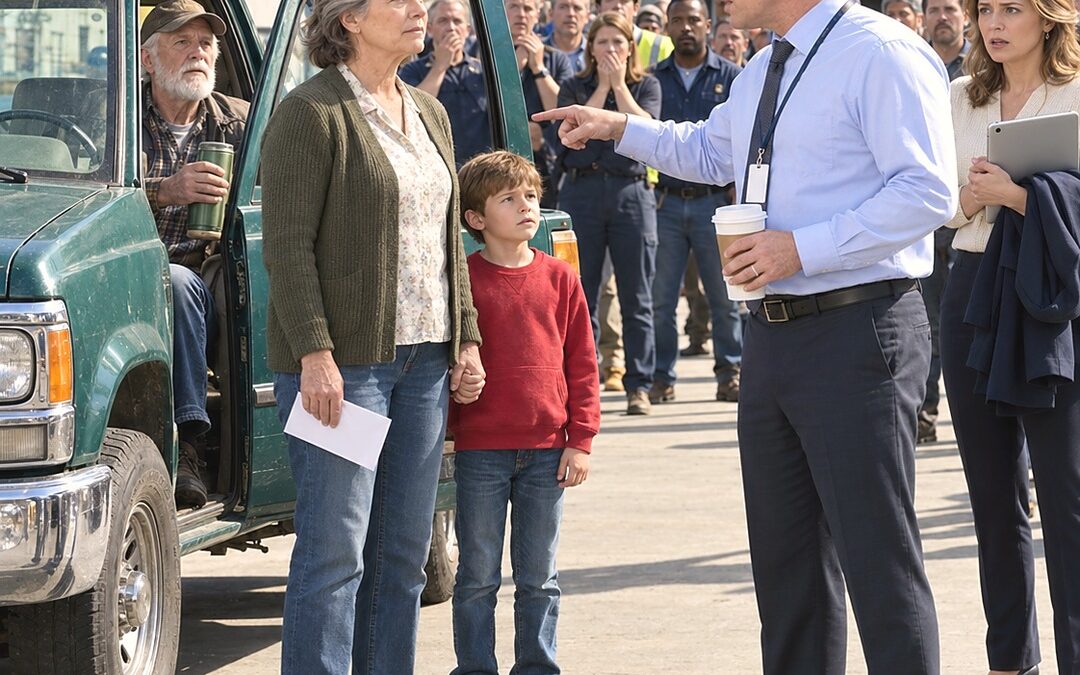
My old boss pointed his coffee cup at my 1994 Chevy in front of forty people on the front lot of the plant where I'd inspected parts for thirty-seven years, and said, "We don't keep old parts around here, Vee. That's what the dumpster is for."
My daughter was standing beside him holding his jacket and his iPad, and my nine-year-old grandson was beside her holding nothing, looking at my truck.
Eleven minutes away, in a Folgers can on a rafter in my garage, were fourteen sheets of pink carbon paper with Craig Halloran's signature pressed through every one, and he had no idea they existed.
It was 10:12 Saturday morning, September 20, 2025, at Harmon-Dietz Fluid Components' seventieth-anniversary Retiree Lunch.
I still had my foot on the brake.
Hank Bosworth sat beside me with his bad knee angled toward the dashboard. His green Stanley thermos was wedged between his shoe and the door.
"Let's be clear," Craig said.
He clicked his gold Cross pen once in the hand that wasn't holding his Yeti cup. His navy company jacket was over Jenna's left arm beside his iPad, so Craig stood there in a pale blue shirt with the plant-manager lanyard against his belt.
"You can't leave that truck here," Craig said.
I looked through the windshield at the painted number beneath my front tire.
"Space eight," I said.
"I can see the number, Vee," Craig said.
"Good," I said.
Craig lifted the Yeti cup and pointed it at the Silverado, from the faded hood to the dented right bed rail. Retirees were still coming across the lot behind him, and enough had stopped that the loose half-circle around space eight ran nearly to the anniversary banner. Jenna stayed beside Craig with his jacket and iPad against her chest. Owen kept his attention on the truck.
"We don't keep old parts around here, Vee. That's what the dumpster is for."
A man from the old machining department gave one short laugh before his wife touched his sleeve. Two people near the sign-in table dropped their eyes to the pavement.
I put my left foot flat on the asphalt and pushed the driver's door the rest of the way open.
The front lot had twelve numbered spaces along the building. Space one had a white sign that said PLANT MANAGER, and Craig's company Tahoe was backed into it.
Space eight had been empty.
I had driven Hank because he called at 8:17 that morning and said his Buick was making a noise he didn't trust. His knee was the better reason, and the invitation said parking was available in the front lot.
The photographer near the entrance adjusted his lens and motioned two retirees closer to the anniversary banner. Two maintenance men who had been helping straighten it stopped with one corner still loose. Behind Craig, retirees were getting out of their cars, some with spouses, some alone. I recognized people by how they stood before I got close enough to recognize their faces.
Craig shifted his weight toward my door.
"We need these spaces for active employees and invited guests," Craig said.
Hank braced one hand against the dashboard.
I kept my attention on Craig.
The invitation was lying faceup between the seats. I picked it up, opened my door, and stepped down. My Chevy sits high enough that at sixty-one I don't make that move gracefully anymore, especially when the driver's door catches halfway because the lower hinge has sagged.
The truck was forest green once. By 2025 the hood had faded chalky on top, and the right bed rail still carried a dent from a load of landscape stone I should have tied down better in 2008. The odometer had passed 212,000 miles that summer. It started every morning.
Craig scanned the row of people near the banner.
He had worked at Harmon-Dietz five years.
I had worked there thirty-seven.
"This says retirees," I said, holding up the invitation.
"It does," Craig said.
"And I'm retired," I said.
Craig tipped his chin toward the photographer.
"Technically, your position was consolidated," he said.
One of the men behind him coughed into his fist. I knew the sound. Harmon-Dietz had used that phrase on Friday, August 26, 2022, and quite a few people in that parking lot knew exactly what it bought a company instead of saying fired.
I folded the invitation once and put it in my cardigan pocket.
Craig pointed at the banner with two fingers. "This event is important to Margo. We have association photographs today. Customers may see these pictures. I'm trying to keep the front entrance presentable."
His eyes stayed on the Silverado.
Jenna stepped closer.
"Mom, just move it. Please," she said.
She said it low, though there were enough people standing around that low didn't buy much privacy.
My daughter was thirty-four, and she had worked as Craig's executive assistant since 2021. I had helped her get the interview. She had been separated from the rest of us that morning by half a step and an armful of Craig's things, his jacket folded over her left forearm, his iPad held against it.
Owen stood beside her in a red Bryan Bears sweatshirt.
Owen studied the rust spot over my left front wheel as if it had become the most useful thing in the parking lot.
"Grandma, is that getting bigger?" Owen asked.
"Probably," I said.
"Can you fix it?" he asked.
"I can slow it down," I said.
He nodded at that.
Craig checked his watch.
"Vee," he said.
Hank opened his passenger door about six inches, stopped when his knee hit the dash, and pushed it shut again.
"Craig, I can't walk from the back lot," Hank said.
Craig bent enough to see Hank through the cab.
"Then you can ride the cart, Hank. Behind the dumpsters," Craig said.
Hank set one hand on the seat beside him.
"You mean Lot C," he said.
"If that's what you call it," Craig said.
"I worked here forty-one years. That's what everybody calls it," Hank said.
Craig motioned toward the drive that ran around the building.
"It's where overflow parking is today," he said.
Lot C was gravel behind the dumpsters, the kind of place that left gray grit ground into the bottoms of your shoes.
Jenna moved Craig's jacket higher on her arm.
"Mom," she said.
Her thumb worked once along the edge of Craig's iPad cover.
I could have said several things.
So I opened the driver's door again.
"Get your leg in, Hank," I said.
"Oh, for crying out loud," Hank said.
"Leg," I said.
He worked his knee back under the dash. I climbed into the driver's seat, pulled the door twice before it latched, and started the truck.
Craig stepped back.
I eased out of space eight.
The people behind him separated to let me through. Some looked at the pavement. A woman from payroll whom I hadn't seen since before COVID lifted two fingers at me and then dropped her hand when Craig moved across her line of sight.
I passed space one on the way out.
The Tahoe shone white under a maple that had already started losing leaves. Somebody had wiped the wheels.
At the gate, the LED board flashed:
ZERO ESCAPES
1,114 DAYS
Then the board switched to HAPPY 70TH HARMON-DIETZ before returning to the count.
— continue reading from here —
I rounded the north side of the plant and pulled into the gravel behind the dumpsters.
The tires crackled over loose stone, and the right front wheel dropped into a shallow rut hard enough to make Hank catch the dash with his palm. A sour smell came off the blue dumpster nearest the wall.
A yellow golf cart was parked there for the retirees.
I parked beside the dumpster. Hank reached for his door.
"Sit," I said.
"I can get out," Hank said, bracing one hand against the seat.
"I know," I said, then shut off the engine.
The truck sat slightly downhill on his side, and when Hank pushed the door open, its weight started bringing it back toward his knee. I came around the hood and held it while he worked one foot down onto the gravel.
"You want me to go say something?" Hank asked.
"No," I said.
"I got a fair amount stored up," he said.
"I know," I said.
"Forty-one years' worth," Hank said.
"That would take us past lunch," I said.
He lowered his other foot, held the door frame until his knee settled, and then made his way across the loose gravel.
The golf cart had a paper sign taped to the windshield that said RETIREE SHUTTLE. Hank climbed onto the passenger side and shifted his bad leg forward before the driver started it.
I shut the passenger door.
The cart rolled past the end of the dumpster toward the front of the building.
I stayed in the truck.
The rearview mirror gave me half a dumpster and the brick wall of receiving. Through the windshield I had a pallet of scrap and a strip of gray September sky.
My mother used to call that kind of sky laundry weather, though she hung sheets outside in weather that would have sent most people looking for a dryer.
I reached up and flipped down the sun visor.
A square of yellowed lunch-bag paper was taped there at all four corners. The top-right corner had curled away from the vinyl.
The paper had been cut crooked from a brown grocery sack. The ink was blue and beginning to fade where summer heat had cooked it through the windshield.
Eat the sandwich before the cookie, Vee. —Mom
I pressed the loose corner flat with the heel of my hand.
The tape made a faint crackle under my skin. I ran my thumb once along the lifted edge, then took my hand away before I worried it loose again.
Edith had written a note on my lunch bag every workday she lived with me. She was eighty-six when she died on Sunday, March 14, 2021.
The note under the visor had been the last one I saved.
I put the visor back up.
The cab went gray again. Dust showed along the top of the dashboard where my rag had missed the seam by the windshield, and a dried maple leaf was trapped near the passenger-side wiper outside.
Eleven minutes if the light at High Street behaved. A Folgers can sat on the rafter above the canning shelf, where nobody had any reason to reach unless they were checking for mice or putting away Christmas lights.
Craig had never been inside my house or garage.
I opened the glove box and reached behind the owner's manual.
The business card was still there.
THOMAS REISINGER
SUPPLIER QUALITY MANAGER
DEERFIELD AG EQUIPMENT
FINDLAY, OHIO
I turned it over.
In blue ballpoint, written at a slight angle, was one sentence.
If anything ever looks wrong, call me before you call anybody else. —T. Reisinger
He had handed me that card during a supplier visit in November of 2021.
I had kept it because he told me to call if something looked wrong.
I unlocked my phone and entered his cell number.
The first message got too long, so I deleted it.
I typed with one thumb.
Mr. Reisinger, this is Vee Nygaard, Inspector 31. Do you still want to know why your Series 40s weep?
My thumb hovered over Send.
Outside, the cart motor started. I could see Hank through the windshield as it rolled past the end of the dumpster.
I pressed Send.
The message slid upward on the screen.
I put the card back in the glove box and shut it.
Then I locked the truck and stood on the gravel with my cardigan pulled closed against the wind.
The front entrance had landscaping and a flagpole. Receiving had dock bumpers with chunks missing and a rain gutter patched with two colors of metal. A stack of empty returnable totes sat against the wall.
I walked around the building.
The wind pushed leaves across the pavement ahead of me. I went past Dock Four, then the employee entrance I had used for most of my working life.
My old badge wouldn't open it anymore.
When I reached the front corner, the anniversary banner was finally straight.
HARMON-DIETZ
70 YEARS
The photographer had arranged retirees beneath it. A few people noticed me coming around the building.
Hank stood near the front doors with his paper name tag stuck crooked to his coat.
"Vee Nygaard," he said. "By land."
"Long trip," I said.
"You miss the cart already?" Hank asked.
I lifted one shoulder and kept walking with him.
Craig was near the entrance talking to Margo Dietz. He saw me and kept talking. Margo had her reading glasses hanging from the beaded chain around her neck, and she was listening with her head angled toward her good ear.
Jenna stood inside the doors now.
Owen spotted me first.
He pushed through the open doorway.
"Grandma, they have cupcakes," he said.
"Before lunch?" I asked.
"They said they're anniversary cupcakes," Owen said.
"Okay," I said.
He walked beside me toward the door. His shoelace was coming loose, and I pointed at it.
He bent to tie it.
Jenna came outside.
"Where did you park?" she asked.
"Lot C," I said.
She rubbed the edge of Craig's iPad cover with one thumb.
"I didn't mean for that to happen," Jenna said.
"You didn't park my truck," I said.
"Mom," she said, shifting the iPad against her side.
"I moved it," I said.
She tucked Craig's jacket more securely over her arm.
"He has people here from the association," Jenna said.
"I heard," I said.
"And Margo wants today to go well," she said.
I could see retirees signing in through the glass.
"Then we'd better eat the lunch," I said.
Jenna stood beside Owen while he finished tying his shoe.
Owen stood up after tying his shoe.
"Can I sit with Grandma?" he asked.
Jenna moved aside so he could reach the door.
"Sure," she said.
He took the lead through the doorway.
I followed.
Inside, the lobby smelled like coffee and floor wax, exactly as it had when I still carried badge 31. Someone had set out framed company photographs along the wall. Emil Dietz and Orrin Harmon were in the first black-and-white picture beside a lathe old enough to have an exposed belt.
Craig stood near the sign-in table.
He had his jacket back on.
As I passed him, he raised his Yeti cup toward the cafeteria.
"Lunch starts at eleven-thirty," Craig said.
"So the invitation says," I said.
"We're doing the tour first," Craig said.
"Hank will like that," I said.
Craig shifted one foot and checked his watch.
"Let's be clear, Vee. I don't want this morning turning into something," he said.
I stopped.
People moved around us carrying paper programs and Styrofoam cups. Jenna was close enough to hear. Hank was farther inside, talking to somebody from tool and die.
"What would it turn into?" I asked.
Craig stood with his hands at his sides.
"I know you were unhappy about how things ended here," he said.
"I asked what this morning would turn into," I said.
Craig watched the people entering behind me.
"We're celebrating the people who built this company," he said.
"Then you have plenty to do," I said.
I walked on.
The cafeteria doors were propped open. White paper tablecloths covered the long tables, and somebody had put small jars of mums down the middle. The vending machines along the far wall were newer than the ones I remembered.
Hank claimed two seats near an aisle.
I sat beside him.
"You send whatever you were going to send?" Hank asked.
"Yes," I said.
"To who?" he asked.
I took my paper program from Owen and flattened the bent corner against the table.
"Somebody who gave me his number," I said.
Hank loosened the cap on his thermos, poured coffee into it, and set it beside his plate.
"Fine," he said.
Across the room, Craig stepped onto the small platform beside the microphone and tapped it twice.
The first tap squealed.
Retirees winced.
Craig smiled toward the photographer.
"Welcome home, everybody," he said.
I set the program down.
A few minutes later, I checked my phone beneath the edge of the table.
The screen showed my message exactly as I had sent it.
Underneath it was one word.
Delivered.
Part 2 — ZERO ESCAPES
PART 2 — ZERO ESCAPES
At 10:40 Saturday morning, Craig Halloran led thirty-one retired Harmon-Dietz employees through the double doors to the production floor and told us to stay inside the yellow lines.
Hank Bosworth leaned close enough that I could hear him over the machines.
"First day they put those lines down, a foreman from receiving drove a forklift right over one," Hank said.
"Did anybody arrest him?" I asked.
"No. Different management philosophy." Hank faced forward again.
Craig walked backward ahead of us, talking over the machines. Jenna followed three steps behind with his iPad. Somebody had given Owen a blue visitor badge, and he kept checking whether it was still stuck to his sweatshirt.
The plant was running a light Saturday shift. Operators stood at machines I knew by number even when the paint had changed. A Cincinnati lathe near the west wall still made a high whine just before the spindle settled. Maintenance had finally replaced the cracked guard on press six.
Craig stopped beneath a wall-mounted television showing production metrics.
"Let's be clear. We've lightened the load, folks, and this plant has never run cleaner. The people here are carrying their weight, and that's what my team needs," Craig said.
Owen was close enough to Craig to hear him. He pressed one edge of his blue visitor badge back onto his sweatshirt after it started peeling loose.
Craig motioned toward the screen. The screen rotated through yield percentages and ship dates, with the safety count fixed along the bottom.
And the same number I'd seen outside.
ZERO ESCAPES — 1,114 DAYS.
"That's my team," Craig said.
A few current employees standing beside their machines looked over when he said it.
Margo Dietz had joined the tour near the front. At seventy-one she still wore low heels into a machine shop, though these had rubber soles. Her reading glasses hung on a beaded chain against her blouse.
She smiled at Craig.
"You've done a wonderful job keeping us alive," Margo said.
Craig dipped his chin.
"We made hard choices," he said.
His eyes passed over me.
Margo turned toward the retirees.
"We had a bad couple of years. Craig saved this company from some very expensive habits," she said.
Hank shifted his weight onto his good leg.
I watched a pallet jack cross the aisle.
Margo's hearing had gone some on her left side, so she leaned toward Craig when he answered her. He put his hand lightly at her elbow and steered her toward the next stop.
I followed the yellow line.
My old inspection area had been moved fifteen feet toward assembly. The gray bench was still there, though the steel drawers underneath had been replaced with a new cabinet.
Rick Sandoval stood behind it.
He was twenty-nine and had taken my old shift a few weeks after I left. Good inspector. Quiet. He checked twice before he stamped once, which is the correct order.
A Series 40 coupling rested on the surface plate. Rick measured it, rotated it, and measured again before writing the result on the traveler clipped to his bench.
His stamp sat upright beside the surface plate. 44.
Rick looked up. His hand stopped over a tray of couplings.
"Ms. Nygaard," Rick said.
"Rick," I said.
Craig heard us.
"Keep production moving, Rick," Craig said.
"Yes, sir." Rick picked up his micrometer.
I kept walking. The gauge crib was gone.
Hank stopped so suddenly the woman behind him nearly walked into his back. Two vending machines stood where his wire-mesh cage had been.
His old crib had held ring gauges and depth mics, plus a coffee maker nobody from safety had ever officially seen. Every tool had a numbered hook.
Now there were Doritos.
Craig raised his voice from farther ahead.
"The old crib took up valuable floor space. All calibrated tools are issued directly to work centers now," Craig said.
Hank turned.
"Who checks them back?" he asked.
"Our quality system tracks calibration electronically," Craig said.
"That isn't what I asked," Hank said.
Craig glanced toward the rest of the tour.
"Hank, we're trying to keep moving," Craig said.
I caught Hank's sleeve.
"Food," I said.
We followed the group.
At my old bench, Rick had stopped measuring. He was watching us leave.
By 11:27 the tour had returned to the cafeteria.
The tables were nearly full. Somebody from catering had put out sliced roast beef, macaroni salad, green beans, and rolls in foil pans. Owen had already located the cupcakes again.
Hank sat across from me this time because his knee needed the aisle.
Three retirees from machining sat with us. I remembered two names without help. The third wore a paper tag that said GENE.
Someone asked Hank what Craig meant by everything being electronic now. That was enough.
Hank put down his fork and broke his roll in half.
"They used to have IDRs for a reason. Three-part carbonless. Pink stayed with the inspector ninety days under QP-7.3," Hank said.
Gene nodded.
"I remember those," he said.
Hank used one fingertip to press an imaginary form flat beside his plate.
"Then it was supposed to go in the burn barrel, and I know three inspectors who never burned a thing," he said.
Gene pushed his paper cup aside and flattened a wrinkle in the tablecloth.
"We used to get them folded into job packets," he said. "You'd open one and the pink edge would be sticking out."
Hank picked up his fork again.
"Inspector kept that one," he said.
The machinist beside Gene had been listening while he buttered his roll. He stopped with the knife halfway across it.
"So if Production wanted something released, the inspector still had his copy?" he asked.
"For ninety days," Hank said. "After that, procedure said destroy it."
Gene went back to his macaroni salad.
I drank my coffee. It had been poured at least twenty minutes earlier.
Across the room, Denise looked at me.
She was fifty-two now. Her hair was shorter than when I left, and she wore the Quality and HR badge on a black lanyard.
Her hand closed around that lanyard. Then she turned toward the soda machine.
The man beside Hank asked, "They still use those forms?"
"Ask Quality," Hank said.
Denise moved to another table. I cut my roast beef.
On my right, Owen was separating frosting from cupcake with a plastic fork. Jenna had finally sat down beside him, though Craig's iPad was still on the table near her elbow.
"You have food?" I asked her.
"I'll get some," Jenna said.
"You've said that twice," I said.
"I'm working," she said.
"It's Saturday," I said.
Jenna set Craig's iPad flat on the table and pushed Owen's empty dinner plate toward the center.
Craig arrived at our table before she could answer.
"Everybody finding enough to eat?" Craig asked.
Hank looked at his plate.
"They got potato salad?" he asked.
"Macaroni," Craig said.
"Then no," Hank said.
Craig smiled because two people nearby were listening.
"Good to have you back, Hank," he said.
"Been right here all morning," Hank said.
Craig's smile held another second. Then he moved on.
Jenna rubbed her forehead.
"Please don't start with him," she said.
Hank looked offended.
"I asked about potato salad," he said.
She stood.
"I'm getting food," Jenna said.
She took the iPad with her.
Owen watched her go. Then he looked at me.
"Grandma, were you the boss here?" he asked.
"No," I said.
"Mom said everybody knew you," Owen said.
"That's different," I said.
"What did you do?" he asked.
"I checked parts," I said.
"For what?" Owen asked.
"The right size," I said.
He considered that.
"What if they were wrong?" he asked.
I picked up my fork.
"Then they were wrong," I said.
Owen scraped another strip of frosting from the cupcake with his plastic fork. I cut another piece of roast beef and ate it.
At 12:06, Craig put the guest book on a small table near the cafeteria entrance.
The cover was blue vinyl with a silver 70 printed on it. He signed first.
I could see the gold Cross pen from my seat.
He finished, capped the pen, and handed it to Margo.
When the line reached our table, Hank carried the book over instead of making me get up.
"Look at this," Hank said.
"What?" I asked.
He opened it flat.
Craig's signature showed on the page. Hank turned the sheet.
The pressure had dented the paper underneath.
I ran one fingertip across the impression.
He closed the book. Neither of us said more.
Craig started a slideshow about the company's history. The first photographs were worth watching, and by the later charts Owen had built a wall from sugar packets while Hank's eyelids lowered between clicks. Jenna stood near the platform answering something Craig asked her in a low voice.
Denise never came within ten feet of my table.
At 1:36 I went looking for air.
I used the hallway beside receiving and pushed through the loading-dock door.
The wind had picked up.
A row of trailers sat beyond the concrete apron. Lot C was visible past them, my Silverado still between the dumpster and the scrap pallet.
I stood with my cardigan closed at the neck.
The dock door opened behind me.
Rick Sandoval came out. He checked the row of trailers first.
"Checking a truck," Rick said.
"On Saturday?" I asked.
"That's what I'm doing," he said.
He walked to the edge of the dock and reached into his work jacket. His hand came out holding a Series 40 coupling.
He didn't hand it to me yet.
"Ms. Nygaard, you remember the old groove problem?" Rick asked.
"What groove problem?" I asked.
Rick met my eyes.
"Okay," he said.
He stepped closer and held it out.
The coupling was small enough to disappear in his palm. Machined steel, quick-connect body, fresh enough that the surface still had that clean dull shine before shop dirt got into it.
I took it. The laser mark showed a production date.
September 16, 2025.
I turned the coupling under the dock light.
The seal groove sat inside the body. My thumbnail found it.
Too shallow.
"Did you measure it?" I asked.
"Yeah," Rick said.
"What'd you do?" I asked.
"I rejected it," he said.
"Then why is it in scrap?" I asked.
Rick checked the dock door.
"Because that one is scrap," he said.
He scratched the edge of his badge with one fingernail, then stopped while I let the question sit between us.
"Same groove, Ms. Nygaard. It ships Monday," Rick said.
"Whose release?" I asked.
Rick glanced once across the employee lot.
"I have a mortgage," he said.
"So did I," I said.
He held my gaze.
"I never gave you anything," Rick said.
"All right," I said.
"And you didn't get it from inside," Rick said.
"Rick." I held the coupling between us.
He stopped.
"Don't make me lie for you," I said.
Rick rubbed his palm once against the side of his work pants.
The dock door opened behind him. Hank leaned out.
"There you are. They're cutting the cake, and Craig's giving another speech because apparently one didn't finish the job," Hank said.
Rick moved away from me.
Hank saw him. His eyes dropped once to the coupling in my hand.
"Good seeing you, kid," Hank said.
"You too, Mr. Bosworth," Rick said.
Rick went inside. Hank held the door with his shoulder.
"What is it?" he asked.
"Series 40," I said.
His face settled.
"Current?" Hank asked.
I turned the laser mark toward him.
"Measured?" he asked.
"Rick did," I said.
"What'd he get?" Hank asked.
"He didn't tell me," I said.
Hank studied the part.
"You know anyway," he said.
"I know what my thumbnail says," I said.
"Your thumbnail was right more often than half the gauges in my crib," Hank said.
"It's not traceable," I said.
"Still right," Hank said.
I closed my fingers around the coupling.
Hank put one hand on the doorframe and nodded at my closed fist.
"The old problem?" he asked.
"Rick said same groove," I said.
Hank tapped the doorframe once with his fingertips.
Then the cafeteria door opened farther down the hall, and voices spilled toward us.
Hank stepped back inside.
"Keep that coupling in your pocket," he said.
"In a minute," I said.
He let the door close.
I stayed on the dock.
Tom Reisinger still hadn't answered me.
I put the coupling in my cardigan pocket, and when I looked up Denise Albrecht was standing at the end of the dock with her car keys in her hand, watching me do it.
Part 3 — SYSTEM OF RECORD
PART 3 — SYSTEM OF RECORD
Sunday afternoon, September 21, I sat at Jenna's kitchen table with a glass of tap water while my grandson searched the mudroom for the second soccer cleat he swore he'd taken off beside the first one.
Mike was working a road project outside Defiance, so the house was quieter than usual. Jenna had gone into the pantry ten minutes earlier to find Owen a granola bar.
She had not come back.
"Mom?" I called from the kitchen.
"I'm here," Jenna said from behind the pantry door.
I got up.
The pantry was narrow enough that Jenna had to stand sideways between the shelves and a case of bottled water. She was wiping beneath one eye with the cuff of her sweatshirt, a granola bar still in her hand.
"I'm picking up Owen," I said from the doorway. "You said four."
"I know what time it is," Jenna said, folding the loose end of the wrapper under her thumb.
I rested one shoulder against the doorframe.
"Craig say something yesterday?" I asked.
Her head came around too fast.
"The system's clean, Mom, they audited everything."
I looked at her. She looked at me.
Neither of us had mentioned a system.
From the mudroom, Owen shouted that he had found the cleat under a jacket.
"What system?" I asked.
"You know. Quality. Everything. After you left," Jenna said.
"I didn't ask about Quality," I said.
"I know what you think," she said.
"What do I think?" I asked.
"That there was something wrong," Jenna said.
"Was there?" I asked.
"I don't know," she said.
"You just said it was clean," I said.
She stepped around me and carried the granola bar into the kitchen.
Owen came in wearing one cleat and one sock.
"Mom, what's dead weight?" Owen asked.
Jenna stopped.
"Where did you hear that?" she asked.
"Yesterday. Mr. Halloran said people had to carry their weight when I was standing by him at the plant," Owen said.
"He didn't say dead weight," Jenna said.
Owen shifted his socked foot against the tile.
"Is dead weight a kind of fish?" he asked me.
"It's what people call somebody they want to get rid of," I said.
Jenna put the granola bar on the table harder than necessary.
"Mom," she said.
"What?" I asked.
"He's nine," Jenna said.
"He asked," I said.
Owen took the bar.
"Put your other shoe on," Jenna told him.
He went back toward the mudroom, eating as he walked.
Jenna folded her arms.
"You could make this easier," she said.
"For who?" I asked.
She watched Owen disappear into the mudroom.
I put my glass in the sink.
"Did Craig ask you what I was doing outside with Rick?" I asked.
"No," Jenna said.
"Denise?" I asked.
"No," she said.
"Did you?" I asked.
"Should I?" Jenna asked.
I picked up my purse.
"That's up to you," I said.
Outside, Hank was sitting in the passenger seat of my Silverado.
I had picked him up on the way to Jenna's because his Buick was still making the noise he didn't trust, and his knee was no better than it had been Saturday.
As Owen climbed into the back, Hank settled one hand on his knee.
"Denise saw you with that coupling yesterday?" he asked.
"She saw me put it in my pocket from the end of the dock," I said.
Hank settled back against the seat.
I started the truck.
Jenna stood at the kitchen window while I backed out.
"Tell me," Margo Dietz said at nine Monday morning, September 22, after she closed the door of her office and motioned toward the chair across from her desk.
Her office overlooked the front lot.
Craig's white Tahoe sat in space one below us.
Margo still had framed photographs of Emil Dietz on one wall, including one where he was wearing safety glasses large enough to cover half his face.
"Coffee, Verna?" Margo asked.
"No, thank you," I said.
She sat down and put on her reading glasses.
So I did.
I kept it under four minutes.
I told her the Series 40 groove had been coming in shallow in 2022 and drawing revision D required at least .062 inch. Thirteen lots had REJECT in my handwriting.
One did not.
On February 24, Craig told me Deerfield had approved a deviation verbally, and I wrote:
Accepted under deviation per C.H. — customer OK verbal.
I initialed it VN31. Craig signed the production release, and the customer approval box stayed empty.
After that, when more shallow grooves came through, I wrote REJECT.
Thirteen times.
Craig released them anyway.
Margo slid her glasses down her nose.
"Why didn't you tell me?" she asked.
"I did," I said. "January 2023."
"I remember your letter," Margo said.
"You didn't answer it," I said.
"Denise did," Margo said.
I nodded.
Margo opened a drawer and pulled out a thin folder. She found the page quickly enough that I knew where it had been kept.
She read from it.
"Your concerns have been reviewed under the plant's quality system and are now closed."
"That's the one," I said.
She set it down.
"Denise told me they had reviewed the production history," Margo said.
"I know," I said.
"What exactly do you have, Verna?" she asked.
"Paper," I said. "My inspector copies. They're in a coffee can."
"Here?" Margo asked.
"No. Somewhere safe," I said.
Margo took off her glasses.
"Verna, I have known you forty years. I am not going to walk a coffee can into my plant manager's office," she said.
"I didn't ask you to," I said.
"Then what are you asking me to do?" she asked.
"Remember I came," I said.
She tapped one finger against the desk.
"If you believe there is an active quality problem, Denise has a process," Margo said.
"I used Denise's process," I said.
Margo put the January letter back into the folder.
I stood.
"Thank you for seeing me," I said.
"Verna," Margo said.
I stopped at the door.
"If you have evidence, I need to know what it is," she said.
"You know enough for today," I said.
I left.
The Folgers can sat on Carol Veech's desk at two Tuesday afternoon, September 23, after she locked the door of her Main Street law office and turned the little sign to CLOSED even though she normally stayed open until five.
Carol was sixty-four and had handled my divorce from Dale without once asking me whether I was sure. I had appreciated that.
She lifted the lid.
"That's your filing system?" Carol asked.
"It didn't leak," I said.
"Neither does a bank vault," she said.
"I had the can," I said.
Carol put on her glasses.
I took out the pink sheets one at a time.
She arranged them beneath her desk lamp.
She didn't rush.
The office clock clicked while she counted the sheets twice.
"Fourteen. Carbonless," she said.
She angled one beneath the lamp.
"His pen came through in box 6, and box 7 is blank on every one," Carol said.
She stopped at the February sheet.
"Your initials too?" she asked.
"VN31," I said.
She looked over her glasses.
"Why now, Vee? Three years," Carol asked.
"My position was consolidated," I said. "I went home and told myself the couplings only weep."
Carol kept her eyes on me.
"They don't kill anybody," I said.
"And Jenna works for him," Carol said.
She put the sheet down and pulled a yellow legal pad toward her.
"Originals stay in your hands until someone with no stake in that building touches them. And if the customer is going to take a retiree's word it has to be on their rules."
"Tom Reisinger from Deerfield gave me his number in 2021," I said. "I sent him a message Saturday."
Carol made a note on the pad.
"If he answers, you follow the customer's rules. Until then, you don't hand those originals to anyone in that plant," she said.
I returned every sheet to the can.
Hank sat at my garage workbench that evening while I put the Folgers can back on the rafter.
He had brought two cans of pop and a sack of peanuts from the Marathon station.
"What did the lawyer say?" Hank asked.
"Keep them," I said.
"Expensive advice," Hank said.
He opened his pop.
"Worth something," he said.
He tipped his chin toward the rafter.
"Craig really doesn't know?" Hank asked.
"If he knew, Saturday would've gone differently," I said.
Hank nodded once.
At 9:47 Thursday night, September 25, my phone buzzed on the kitchen counter.
Tom Reisinger.
I opened the message.
"I'll be in your building on Saturday, October 11, for the corrective-action audit. Your owner has to be standing there or it doesn't count. Bring everything. Don't hand it to anybody who works there."
Another text came in. His vice president had given him until Saturday, November 1, to find the root cause of the Series 40 failures or begin moving the part to a second supplier.
I put the phone down.
Then I went to the garage.
The light above the workbench took two pulls before it came on.
My Silverado sat with its nose toward the door. The Folgers can was above the canning shelf.
Rick's coupling lay in the top drawer of my toolbox.
I took it out.
September 16.
"Why don't I stop the next lot?" I said.
I set the coupling beside the open toolbox. Calling Denise would put it back through the same internal system that had already called the problem dealer error, and Tom's message said he could take the evidence only inside the plant with Margo there.
Three more lots could ship before October 11, about twelve hundred couplings.
I put Rick's part back in the drawer and shut it.
Then I stood under the rafter.
"He pulled us," Hank said when he called Friday evening, October 3.
I set the casserole dish I was scraping in the sink.
"Craig pulled the retirees off the October eleventh program," Hank said. "Mine came today. Gene's did too. No retiree remarks."
"Margo know?" I asked.
"I called her," Hank said. "Her secretary checked the old program cards while I was on the phone. Margo's got one in her purse that says 'Retiree Remarks.'"
I dried my hands.
"Whose name?" I asked.
Hank took a breath.
"Somebody wrote your name on it, Vee. Not me."
Part 4 — PINK PAPER
PART 4 — PINK PAPER
At 6:11 Wednesday evening, October 8, Hank Bosworth backed his Buick into my driveway because he said pulling forward into a garage was how people lost mirrors.
He came through the side door carrying his green Stanley thermos and favoring his right knee. The sun was down behind the houses on Lincoln Street, and my detached garage had already gone cold enough that I could see my breath when I turned on the workbench light.
"You need a better bulb." I reached up and gave the metal shade a tap when the light flickered.
"You need a better knee." Hank set it on the bench.
I shut the garage door behind him.
My Silverado took up most of the left bay. The right side held my mother's old canning shelf, a push mower, snow shovels, and more coffee cans than any household needed. Most held nails or screws. One didn't.
There was a strip of dried mud behind the Silverado's rear tire from Owen's soccer field, and two maple leaves had blown in before I shut the door. Hank nudged one aside with his shoe as he crossed toward the workbench.
Hank stood under the rafter and looked up.
"You never moved them?" he asked.
"Once. Roof leak in 2023." I pointed toward the darker patch in the plywood where Luis had helped me replace a bad shingle.
"Craig know where you live?" Hank asked.
"He could find out," I said.
He reached into his coat pocket. "I brought you something."
"That usually means trouble."
"Been keeping it three years."
He put a small brass tag on the workbench.
31 was stamped deep into the face. The hole at the top had worn smooth on one side from years of hanging on a steel hook, and a dark line of machine oil still sat along the lower edge. The brass was dull except where Hank's fingers had rubbed it clean near the hole.
The stamped numbers had gone dark in the grooves.
I didn't pick it up.
For forty-one years Hank had run the gauge crib, and every inspector had a hook on his board. You checked out a tool, and your brass tag went onto the empty hook until the tool came back.
My tag had been 31.
Hank moved the tag with one fingertip until the numbers faced me.
"Where'd you get that?" I asked.
"You know where," Hank said.
"Your board was gone Saturday."
"Board wasn't always gone."
Hank ran his thumb along the edge of the workbench.
"When they cleared the crib in the fall of 2022, Luis called me," he said. "He'd pulled the inspector tags and the old hook strip before the rest went to scrap. He left them wrapped in brown shop paper on the loading-dock desk with my name on it."
"The whole board?" I asked.
"Just what belonged to people," Hank said.
"Hank." I rested one hand against the workbench.
He put two fingers beside the brass tag without touching it.
"Three years that hook's been on my board so it wouldn't be empty," he said.
The workbench light buzzed.
I picked up the tag.
It was heavier than it looked.
There was still a dark smear along one edge where years of machine oil had worked into the brass. I rubbed it once with my thumb and stopped when the metal warmed against my skin.
Hank inspected the pegboard where I kept screwdrivers. He gave me enough time to put the tag in my cardigan pocket.
I reached for the wooden stepladder.
"I'll get the can," I said.
"Your ladder wobbles," Hank said, pulling it under the rafter.
I held it while he climbed two steps and reached over the canning shelf for the Folgers can. He brought it down slowly, and I took it from him before he stepped back onto the concrete.
Dust marked a clean circle on the rafter.
The plastic lid had faded at one edge. I carried the can to the bench and opened it.
Hank pulled his glasses from his shirt pocket.
"All right," he said.
"Don't count yet," I said.
He stopped with his glasses halfway to his face.
I took out the pink sheets and laid them across the bench. Hank kept his hands off them while his lips moved with the count. The paper had curled toward the center from three summers above the garage, so I smoothed the pages enough to read the dates.
When I reached the sheet from February 24, I put my palm over it.
"Hank." I kept my hand on the page.
"What?" He leaned closer to the bench.
"One isn't like the others," I said.
His glasses lowered slightly.
"I know there was a first one," Hank said.
"You don't know this," I said.
I moved my hand.
Box 4 carried my handwriting.
Accepted under deviation per C.H. — customer OK verbal.
VN31 beneath it.
Hank read it once.
Then he took off his glasses.
"He told you Deerfield approved it?" Hank asked.
"He did," I said.
"You believed him?" Hank asked.
"I did," I said.
"Did you call Deerfield?" he asked.
"No," I said.
I touched the edge of the February sheet.
"He was my plant manager," I said. "I wrote it."
Hank set his glasses beside the vise instead of putting them away. His fingertips rested against the bench edge, clear of the paper.
His eyes moved over the remaining sheets without touching them.
"And after that?" Hank asked.
"I stopped believing him," I said.
I gathered the papers.
The carbonless sheets made a dry slipping sound against one another. One corner caught under another, and I separated them carefully before squaring the stack against the bench.
He stopped me before I put them back.
"Vee," Hank said.
"What?" I kept the stack between my hands.
"When this comes out, Craig's going to point straight at that first sheet," Hank said.
"I know," I said.
"He'll say you approved it," Hank said.
"I did," I said.
"You had bad information," he said.
"I still wrote it," I said.
Hank put his glasses back on.
"You planning to say that?" he asked.
"Before he does," I said.
He watched me for a few seconds.
"Good," Hank said.
I returned the sheets to the can.
The stack sat high enough that I had to press the center gently before the lid would seat. I ran my fingers around the rim until every section snapped down.
Then I took the brass 31 from my pocket and set it on top before closing the lid. Hank saw that and didn't comment.
We carried the can back to the ladder together, me holding it against my cardigan while Hank steadied the ladder. This time I climbed. The second step gave me enough height to reach the rafter without stretching, and I slid the can behind the old box of Christmas lights until its red label disappeared from the garage floor.
Hank steadied the ladder until both my feet were back on concrete.
At 7:42 Thursday evening, Jenna rang my doorbell instead of using her key.
That told me enough to put down the dish towel before I opened the door.
She stood on the porch without Owen.
No coat, only a gray sweater and work pants. Her hair was still pinned the way she wore it at the office.
"Where's Owen?" I asked.
"Mike has him," Jenna said.
"Come in," I said.
She stepped inside and shut the door carefully.
I had soup warming on the stove. Jenna usually checked whatever I was cooking before she said hello. That night she stayed near the front door.
"Mom, you need to stop," Jenna said.
"Stop what?" I asked.
"Whatever you're doing," she said.
"That's broad," I said.
"I'm serious," Jenna said.
"So am I." I turned off the burner.
She walked into the kitchen.
Her purse stayed on her shoulder.
"I looked at his laptop in August," Jenna said. "There's nothing left in the records."
I watched her.
I left the spoon in the pot.
"How would you know what was there to be left?" I asked.
"I do reports for him," Jenna said.
"That's not what I asked," I said.
Jenna gripped the purse strap.
"I don't know. I came because I don't want you doing this," she said.
"Why?" I asked.
"Because Craig knows how to protect himself," Jenna said.
"From what?" I asked.
She shook her head.
"You're retired," she said.
"I am," I said.
"You have your pension. You have the house," Jenna said.
"I know," I said.
"Why can't you just leave it alone?" she asked.
Jenna pulled out a kitchen chair but didn't sit.
"Craig cleared his Monday morning," she said. "He had me print a packet for Margo and told me to leave it on top of everything else."
I turned the burner back on low.
The soup had started settling at the edges.
"What's happening Monday?" I asked.
Her head lifted.
Jenna sat down.
"Margo's supposed to sign something," she said.
"What?" I asked.
"It's a packet. I only print it," Jenna said, rubbing her palms against her work pants.
I took the chair across from her.
"What kind of packet?" I asked.
"An ownership letter," Jenna said. "Twenty percent. The printed copy is in a blue folder for Margo to sign Monday, and Craig's name is on the first page. He promised me a raise and Director of Executive Operations after it was done."
I said nothing.
"Mom, please," she said.
I got up and turned the stove off again.
There was no useful way to circle it longer.
"I'm not clean either, Jen. One of those is mine," I said.
She stared at me.
"One of what?" Jenna asked.
"The old deviation forms," I said. "I wrote Accepted under deviation on one after Craig told me Deerfield had approved it verbally."
"So he can blame you," Jenna said.
"He can," I said.
She stood.
"You don't know what he'll do," Jenna said.
"I worked for him," I said.
"You didn't sit outside his office every day," she said.
"I didn't," I said.
"He keeps everything," Jenna said.
I rested my hand on the back of the chair.
"What does that mean?" I asked.
"Nothing," Jenna said.
"Jenna," I said.
She picked up her purse.
"I have to go," she said.
"What's on the laptop?" I asked.
"Mom," Jenna said.
"You brought up the laptop," I said.
"I shouldn't have," she said.
"Probably," I said.
She made it halfway to the doorway.
Then she stopped.
"Do you have something?" Jenna asked.
"I have enough, and it isn't at the plant," I said.
"Does Craig know?" she asked.
"He doesn't know what I kept," I said.
"Don't underestimate him," Jenna said.
"I don't," I said.
"Owen wants you at the game Saturday," she said.
"I'll be there," I said.
"You always say that," Jenna said.
"I always go," I said.
She left without touching the soup.
At 9:50 Friday night, October 10, I packed the Folgers can, three sample couplings and Rick's coupling into the aluminum toolbox in the bed of my Silverado.
The garage door was open to the driveway, and cold air came in low across the concrete. Hank had parked his Buick along the curb so I could back straight out in the morning. Its chrome caught the porch light every time I crossed behind the truck.
Hank held the flashlight while I locked the toolbox. Then we went inside through the kitchen.
Before bed, I walked back out to the truck once more.
The overhead garage bulb left the cab dim.
I opened the driver's door and flipped down the sun visor.
Eat the sandwich before the cookie, Vee. —Mom
The paper shifted slightly when the visor came down. I held the edge of the visor steady with two fingers and read the note without touching the tape.
My phone buzzed in my cardigan pocket.
Jenna.
Mom please. Whatever you've got, he already knows it's gone. Don't make me watch.
I read the message while standing beside the open truck door.
Hank was inside my kitchen. I heard a cabinet door close through the garage wall.
I typed with one thumb.
Wear something warm. It's a tent.
Part 5 — THE GAUGE
PART 5 — THE GAUGE
At 9:40 Saturday morning, October 11, I drove past all twelve spaces in the front lot and parked my 1994 Silverado in Lot C on purpose.
The two dumpsters were exactly where they'd been three weeks earlier. Somebody had moved the pallet of scrap bar, and the yellow retiree cart was gone.
Hank sat beside me with his green Stanley thermos between his shoes.
"You really mean to park back here again?" Hank asked.
"I do," I said.
"All right." Hank braced one hand on the dash and started working his bad knee toward the door.
I shut off the engine.
The Folgers can and the box holding Rick's coupling rode on Hank's folding hand truck. He secured them, and we started around the building.
The white event tent covered most of the front lot now. Forty by sixty feet, with plastic side panels pulled down against the October wind. Folding chairs faced a small stage. People moved around inside carrying coffee and programs.
Craig stood at the gate in a navy quarter-zip and his plant-manager lanyard.
He saw the hand truck and started to speak.
Then a dark Buick turned through the gate.
Margo Dietz parked near the tent and stepped out with a blue folder tucked under one arm.
"Good morning, Verna," Margo said.
"Morning, Margo," I said.
Craig went back to checking people through the gate.
A gray Chevrolet Equinox was parked in space twelve.
Tom Reisinger stood beside it with a clipboard under one arm. A brass depth gauge showed from his shirt pocket.
He looked at me once. I looked back. That was all.
Above us, the LED board showed:
ZERO ESCAPES — 1,135 DAYS.
Inside the tent, current employees were mixed with retirees and families. Dolores Kesler from the Northwest Ohio Manufacturers Association sat near the front with two staff members, while Jenna sat in the third row with Owen beside her in a winter coat, kicking one heel lightly against the chair leg.
Jenna saw me. Then she saw the hand truck.
She looked away.
Tom disappeared into the plant at ten with Margo and two Quality people for the corrective-action audit.
Craig worked the tent. He shook hands and checked on the microphone while people settled into their chairs.
Before the program started, Tom came through the side entrance and took a chair near the front.
Craig found him immediately.
They spoke for less than a minute. Tom's hands stayed in his coat pockets.
Craig did most of the talking.
At 11:34, he stepped to the microphone.
"Let's be clear."
Craig smiled toward the audience.
"Zero escapes in eleven hundred and thirty-five days."
People clapped.
Craig lifted one hand toward the main gate beyond the tent.
He rested one hand beside the microphone.
"This plant runs because my team understands accountability. A plant runs on people who carry their own weight, and we have been honest about who didn't."
His eyes moved through the retirees.
They stopped on me long enough that several people turned.
I kept my hands in my lap.
Craig thanked Margo for trusting him through the hard years and talked about the choices his team had made to keep Harmon-Dietz running.
Jenna kept her eyes on the program in her lap.
At 11:48, Dolores Kesler came up carrying a plaque.
The photographer moved into the aisle.
Dolores spoke about regional manufacturing and growth. Then she turned the plaque toward the crowd.
MANUFACTURER OF THE YEAR 2025.
Craig took the plaque. He smiled wider than he had all morning.
An easel had been placed beside the lectern. He set the plaque on it himself and adjusted it until it was straight.
The photographer took several pictures.
Margo clapped from the front row. Tom Reisinger didn't.
Craig went back to the microphone.
"We also happen to have one of our valued customers with us today for a routine audit. Tom Reisinger from Deerfield Ag Equipment, would you say a word?"
Tom stood without bringing notes and raised the microphone from its clip.
"Thanks," Tom said.
The microphone was too low for him, so he lifted it.
"We've got eight hundred forty Series 40 field weeps that I cannot explain."
Programs stopped rustling. A paper cup hit the concrete under one chair and rolled.
Craig stepped closer.
"Dealer torque," Craig said.
Tom kept the microphone in his hand.
"That's what you've told us," Tom said.
"It remains the root cause," Craig said.
"We haven't established that," Tom said.
Craig gave a short laugh toward the audience.
"Tom and I spend a lot of time arguing about installation practices," Craig said.
Tom handed the microphone back.
"That's why I'm here," Tom said.
He sat down.
Craig adjusted the microphone.
"Manufacturing is a partnership," Craig said.
Margo opened her purse and took out the index card.
Craig saw it too.
"One last thing before lunch," Margo said as she stepped to the lectern. "We have a retiree remark that was apparently removed from the printed program."
Craig tightened both hands around the sides of the lectern.
Denise stood in the third row on the other side of the aisle. Her arms were tight against her coat.
Margo read the card.
"Retiree Remarks, Verna Nygaard, Inspector 31."
Hank bent down and released the bungee cord from the hand truck.
Craig smiled at me.
"Of course," Craig said.
I stood while Hank rolled the truck into the aisle.
"You have two minutes, Verna," Margo said.
"That's enough," I said.
I walked to the front.
Craig stayed beside the lectern.
I stopped near Tom instead.
"I wrote 'Accepted' on one lot, February of 2022. I believed a man who said the customer said yes. That's mine."
Craig took his hand off the lectern.
I faced Tom.
"Tom, would you read a groove for me?"
He stood.
I opened the small parts box and handed him Rick's coupling.
Craig took one step forward.
"Where did that come from?" Craig asked.
Tom already had the brass gauge out.
"Customer's measuring it," I said.
"That's company property," Craig said.
Margo put one hand on the lectern.
"Craig."
He stopped.
Tom set the gauge carefully into the seal groove and adjusted it once.
".055."
He checked the drawing sheet on his clipboard.
"Minimum is .062."
Then he turned the coupling under the light and read the laser lot code aloud.
I found Rick Sandoval near the rear tent wall. He was staring at his shoes.
Craig lifted one hand.
"A scrap part proves nothing. That's why it was scrap."
Tom held the coupling.
"Is that your current production code?" Tom asked.
Craig took too long to answer.
"Potentially," Craig said.
Tom put the gauge back in his shirt pocket.
"Then keep going, Vee."
I lifted the Folgers can from the hand truck. Hank took the lid.
I laid the pink sheets across the presentation table beside the lectern. Thirteen carried REJECT in box 4, Craig's signature showed through in box 6, and every customer-approval box was blank.
The last sheet was mine. I put it down with the others.
The brass tag stayed at the bottom of the can.
Tom checked the lot codes against the claims list on his phone while Rick came closer from the rear wall.
Tom set one pink sheet beside the screen and matched the code.
Rick bent enough to read it.
"That's one of ours," Rick said.
Tom checked the next sheet.
"Same customer claim group," he said.
Rick straightened and stepped back from the table.
Tom's thumb stopped.
"These lot codes are on our claims."
Craig leaned over the table.
"Those are forged," Craig said.
Margo turned toward him.
Craig pointed at the papers.
"The system of record says conforming. These could've been written yesterday."
Tom picked up one pink copy and tilted it under the tent light.
"Carbonless impression," Tom said.
Craig leaned closer to the table.
"You've been sitting on this for three years?" Craig asked.
"Three years. Against procedure," I said.
Three more lots had shipped while I waited for today, about twelve hundred couplings.
Craig tapped one finger beside the pink sheets.
"You expect people to believe you over the electronic record?"
I turned to Denise.
"Electronic records can be edited. Those carbonless impressions are still on the paper."
Craig fixed his attention on Denise.
"Tell them," Craig said.
Denise didn't move.
"Denise," Craig said.
She reached for her purse.
Craig stepped away from the lectern.
"Tell them the records were reviewed," Craig said.
Denise opened the zip pocket inside her purse.
Her hand shook once against the zipper teeth. She brought out a yellow square of paper.
Craig stared at it.
"What's that?" Craig asked.
Denise unfolded it and stepped into the aisle.
"I kept this," Denise said.
Craig moved toward her.
"Denise," he said.
She read the note.
"D — pull the 14 IDR whites. Shred them. Clear the system entries. Keep it quiet. —C"
The photographer lowered his camera.
Margo closed the blue folder under her arm and put one hand on the lectern.
Craig shifted beside the lectern.
"That isn't mine," Craig said.
Denise held the yellow note at chest height.
"I did it, Craig. I thought the inspectors' copies were gone."
His hand struck the lectern hard enough to knock the microphone sideways.
"I never told you to falsify anything," Craig said.
"You put it on my printed list," Denise said.
"You're trying to save yourself," Craig said.
"Yes." She folded the yellow note again. "Now I am."
Craig lowered his eyes to the pink sheets.
His finger landed on mine.
"Her initials are on one," Craig said.
I faced Margo before Craig could lift it.
"Lot 22-0388. I said it first."
Craig's finger stayed on the page.
Tom picked up one of the REJECT sheets.
"No one at Deerfield signed box 7 on any of these," Tom said.
Margo held out her hand to Craig.
"Craig, I'll take the lanyard."
Craig's hand dropped to the lanyard at his belt.
"Margo."
"The lanyard," she said.
"This is an accusation based on improperly retained documents and a scrap part," Craig said.
Margo kept her palm open.
Craig scanned the tent.
The same retirees who had watched him point his coffee cup at my truck three weeks earlier were sitting twenty feet away.
Jenna was standing now. Owen stood beside her.
Craig unclipped the lanyard and placed it in Margo's hand.
She closed her fingers around it.
"Your Tahoe key too," Margo said.
His eyes moved to the front lot.
"Margo, you cannot be serious."
"Please," she said.
He dug the fob from his pocket. It landed against the badge in her palm.
Dolores Kesler had walked to the easel.
She faced Margo. Margo nodded once.
Dolores lifted the Manufacturer of the Year plaque away and tucked it under her arm.
Craig watched her do it.
At 12:21, he turned toward Margo.
"Where am I supposed to go?"
I was still standing beside the pink sheets.
"We don't keep old parts around here, Craig. That's what the dumpster is for."
Craig moved to the easel as though the plaque were still there. He ran his palm across the empty crossbar again and again, trying to square it.
Luis Ocampo came up beside him and took his elbow.
Behind me, a chair scraped.
"Mom," my daughter said, standing up in the third row with Owen's hand in hers. "I knew."
Part 6 — SPACE ONE
PART 6 — SPACE ONE
At 12:25 Saturday afternoon, October 11, my daughter was still standing in the third row with Owen's hand in hers when Craig Halloran finally stopped rubbing the empty easel.
"I knew."
Craig watched her from beside the lectern.
Margo still held his lanyard and Tahoe key. Dolores Kesler had the Manufacturer of the Year plaque tucked against her coat. Denise stood near the aisle with the folded yellow note in her hand.
Margo pulled the blue folder from under her arm and opened it. The unsigned ownership letter was inside, Craig's name across the first page.
"Craig Halloran," Margo read.
Craig's eyes dropped to the paper before Margo had it all the way out.
"Margo, don't do this out here," Craig said.
The retirees nearest the aisle shifted in their seats. Luis was still beside Craig, and Tom had stopped over the pink sheets with his phone in his hand.
"Canceled," Margo said.
"You can't cancel a transaction because of an accusation," Craig said.
"I haven't signed it," Margo said.
"We had an agreement," Craig said.
"We had an unsigned letter," Margo said.
Margo held the first page where he could see his name.
Margo tore the letter in half.
The paper made a clean ripping sound under the tent.
Craig's shoulders jerked when the tear crossed his name.
Margo tore the two halves once more and put the pieces back into the blue folder.
Jenna let go of Owen and came down from the third row into the aisle.
Craig straightened.
"Jenna," he said.
She stopped beside the table where the pink sheets were still spread out, close enough that her sleeve nearly touched mine.
Her hands were empty.
"I was there Friday, March third," Jenna said.
Margo watched her.
"I was in the next office when the shredder ran," Jenna said.
Craig checked Denise.
"It ran once. Stopped. Then ran again," Jenna said.
"Jenna, be careful," Craig said.
"I heard you tell Denise to keep it quiet," Jenna said.
Craig's fingers closed around nothing at his belt where his lanyard had been.
"That's not what happened," Craig said.
Owen moved closer to her coat.
"Did you eat?" I asked.
Jenna blinked.
"What?" she asked.
"Breakfast," I said.
"No," Jenna said.
"There are rolls in the cafeteria," I said.
A chair creaked behind us. Hank coughed once into his fist.
Jenna pressed her lips together and nodded.
I pointed toward the cafeteria doors.
Margo stepped closer to Craig.
"I need you to stay on the property until we finish collecting company property," she said.
"You're removing me based on this?" Craig asked.
"Based on what I just watched," Margo said.
"My attorney will have something to say," Craig said.
"Then he can call mine," Margo said.
Craig shifted toward the tent opening.
His white Tahoe sat in space one thirty yards away.
Margo lifted the key fob in her hand.
"You won't be taking that," she said.
He stopped.
Luis Ocampo had already walked toward the parking spaces carrying a cordless drill.
"What is he doing?" Craig asked.
"Changing the sign," Margo said.
Luis put a small stepladder beneath the PLANT MANAGER marker at space one and climbed two steps. The drill whined while he backed out both screws, catching the second one in his palm before he stepped down with the sign under his arm.
People had begun leaving their chairs, but nobody went far. Current employees stayed near the tent edge. Retirees gathered behind them. The same people who had watched Craig send my truck behind the dumpsters on September twentieth were now watching Luis take the sign down.
Craig started for him.
"Craig," Margo called.
He stopped again.
Luis carried the sign to her.
"Here you go," Luis said.
Margo took it.
"Thank you," she said.
Then Luis walked to the gate panel, opened the metal cabinet with a maintenance key, and leaned inside.
The LED board still read ZERO ESCAPES — 1,135 DAYS.
Craig watched the board.
Luis pressed buttons behind the panel.
The number disappeared.
Then the board showed:
ZERO ESCAPES — 0 DAYS.
Hank reached into the open Folgers can, took out the brass tag marked 31, and placed it in my palm.
Luis shut the gate panel.
Behind us, Tom Reisinger was photographing the pink sheets one at a time while they still lay on the presentation table. Margo had asked first, and I had told him yes.
The originals stayed beside my hand.
Craig walked into the building under Luis's supervision.
He came back twelve minutes later carrying a Meijer box.
His Yeti cup and gold Cross pen lay inside.
Craig crossed the front lot. People moved apart without blocking or touching him.
He walked past space one, past the gate sign with its new number, and around the building toward Lot C.
Hank and I followed far enough to see him sit on the curb between the two dumpsters with the Meijer box at his feet.
The wind caught one loose flap. Craig pushed it down with his palm.
Then we went inside for lunch.
At 7:00 Monday morning, October 13, every chair in the Harmon-Dietz cafeteria was occupied.
All 112 employees had been called in.
I sat near the back with Hank because I was no longer an employee and had no intention of pretending otherwise. Margo had asked us to attend.
Rick Sandoval stood near the Quality table with his stamp 44 clipped to his shirt.
Jenna stood along the rear wall. She had turned in Craig's office key before the meeting.
Margo took the microphone. She didn't use a podium.
"Craig Halloran has been terminated for cause. The company is demanding repayment of Zero Escape bonuses totaling two hundred fourteen thousand five hundred dollars, and at 9:10 this morning our lawyer will file the documentation with the Williams County prosecutor."
A woman near shipping lowered her coffee while chairs scraped near assembly.
Margo continued.
"Deerfield Ag Equipment has issued a stop-ship effective Friday on all Series 40 inventory in its possession. Approximately sixty-eight hundred couplings will be held for inspection. NOMA has withdrawn the Manufacturer of the Year award."
Rick looked toward the floor.
Margo saw him.
"This is not on the inspectors who rejected parts," she said.
Rick's head came up.
Margo set one hand on the table.
"Verna wrote me on January ninth, 2023, and I let a form letter answer her. That one is mine."
Denise Albrecht stood from the first row.
It was 7:15.
She unclipped her badge and placed it in Margo's hand.
"I've submitted my resignation," Denise said.
Margo nodded.
Denise met my eyes.
"I wrote your name on Margo's Retiree Remarks card," Denise said.
I didn't help her with it.
She walked out through the cafeteria doors.
On the whiteboard behind Margo, the new deviation rule had already been written. The inspector kept a stamped copy under lock, and customer approval required the customer's authorized signature in box 7 before a deviation lot could ship.
Margo held up a small key.
"Mr. Sandoval," she said.
Rick walked forward and took it.
"That drawer belongs to Quality. The plant manager doesn't get one," Margo said.
"Understood," Rick said.
At the back wall, Jenna took off her badge and walked down the side aisle.
She placed it on the table in front of Margo.
"I need to give you mine too," Jenna said.
"You don't have to decide today," Margo said.
"I heard enough to ask better questions," Jenna said.
Margo looked at the badge, then left it on the table.
After the meeting, employees crowded around the coffee urns instead of leaving right away.
Hank stood beside Rick while Rick tried the key in the new locked drawer.
I found Jenna near the cafeteria exit.
"You have Owen's lunch?" I asked.
"In the car," Jenna said.
"Did you put the ice pack in?" I asked.
She stared at me.
"Yes, Mom," she said.
"Good," I said.
Her eyes settled on the old production floor behind me.
"What am I supposed to do now?" Jenna asked.
"Today?" I asked.
"Yes," she said.
"Take him to school," I said.
"And after?" she asked.
"You'll figure that out after," I said.
She rubbed her thumb across the mark where her badge clip had been.
I opened the door.
"Come on. You're blocking traffic," I said.
Jenna and Owen had been sleeping in my living room since Sunday, Owen on the sofa and Jenna on the folding cot I kept behind the hall closet. Mike was still working the road crew near Defiance and knew they were staying with me.
By Saturday afternoon, October 18, there was a traffic cone in space one.
Hank saw it before I did.
"Well, I'll be," he said.
He sat beside me in the Silverado.
The cone had a white plastic sign clipped to it.
RESERVED — V. NYGAARD.
I stopped in the lane.
"No," I said.
Hank read the sign through the windshield.
"Appears fairly specific," he said.
Margo was standing by the front entrance. She waved me in.
I eased the Silverado into space one with the hood pointing at the front doors and left the engine running until Hank tapped the dashboard once.
I killed it.
The faded hood filled the bottom of the windshield. Two employees carrying lunch sacks came through the front doors and walked past the truck.
Margo came to my open window.
"Verna," she said.
"Margo," I said.
"I want you here Tuesdays and Thursdays," she said.
"Consulting?" I asked.
"Paid," Margo said.
I rested one hand on the steering wheel.
"Tuesday," I said.
Margo gave the roof of the Silverado one light tap and walked back to the entrance.
Hank stayed in the passenger seat.
"You going in?" he asked.
"In a minute," I said.
The sun visor had sagged slightly over my side.
Hank reached across and touched the edge of it with one finger.
"Your thing's coming loose," he said.
"I know," I said.
I flipped the visor down.
The yellowed piece of lunch-bag paper was still taped there.
Eat the sandwich before the cookie, Vee. —Mom
Hank leaned enough to read it.
"Your mother still giving orders?" he asked.
"Every chance she gets," I said.
"She packed a good lunch," Hank said.
"Too much butter," I said.
"Good butter," Hank said.
I ran my finger beneath the edge of the visor. The paper had gone soft where the tape crossed the corners, and one crease near the bottom had darkened from years of being folded on lunch bags before I ever taped it there.
Hank unscrewed the cap of his thermos and took a drink.
"She ever put anything else on those notes?" he asked.
"Plenty," I said.
"Anything useful?" Hank asked.
"Mostly reminders that I already knew," I said.
I could see the front doors through the windshield. Rick passed behind the glass carrying a clipboard, stopped when somebody called to him, then disappeared toward inspection.
Hank screwed the cap back on.
"You keeping the parking sign?" he asked.
"It's Margo's sign," I said.
"Didn't ask whose," Hank said.
"I haven't decided," I said.
He pointed at the visor.
"Keep that one," he said.
"I planned to," I said.
The top-right corner had lifted again.
I pressed it flat with the heel of my hand.
Hank opened his door and stepped onto the pavement.
I shut the visor, opened my driver's door, and put both feet down beside the RESERVED — V. NYGAARD sign.
The truck door closed behind me.
I walked in the front door.



