“Nobody Ever Built a Thing by Borrowing, Gene,” My New Landlord Said, Nailing His Banner to My Store Sign Before 41 People in Line—He Never Looked Under the Claw of the Hammer in His Hand
Part 1 — THE FIRST NAIL
PART 1 — THE FIRST NAIL
The man who bought my building drove the first nail of his banner into my store sign with a framing hammer, in front of forty-one people waiting at the Borrow Board and a photographer from the Tyrone Daily Herald, and said, "Charity isn't a trade, Gene. Nobody ever built a thing by borrowing."
I had until noon on October 11 to get thirty-nine hundred tools off a wall I'd stood in front of since 1985, and no place to put them.
What he didn't know, because he had never once asked, was that the number stamped under the claw of that hammer was one I had punched myself, and the red-stitched leather loop through its handle was my wife's work.
It was 10:05 Saturday morning, September 27, and the line outside Wiesner Hardware had bent past the front window toward St. Matthew's next door. Saturdays did that when the weather turned cool. The line moved one person at a time. Mrs. Cramer was asking Teo Ibarra whether clay meant she wanted the post-hole digger instead of the auger.
"Thirty-eight," Teo called from the door as another person joined the line. "Thirty-nine."
Dot was behind the register inside, tearing open a carton of faucet washers with the little blue box cutter she'd carried in her apron since Reagan was president. I was at the wall taking down a masonry trowel when somebody outside said, "Gene."
I knew the voice. Brent Hollis had been in the building four times since his company bought it on August 1. Every visit started with him saying my name as if he were trying it out on a microphone.
I put the trowel on the counter and went outside.
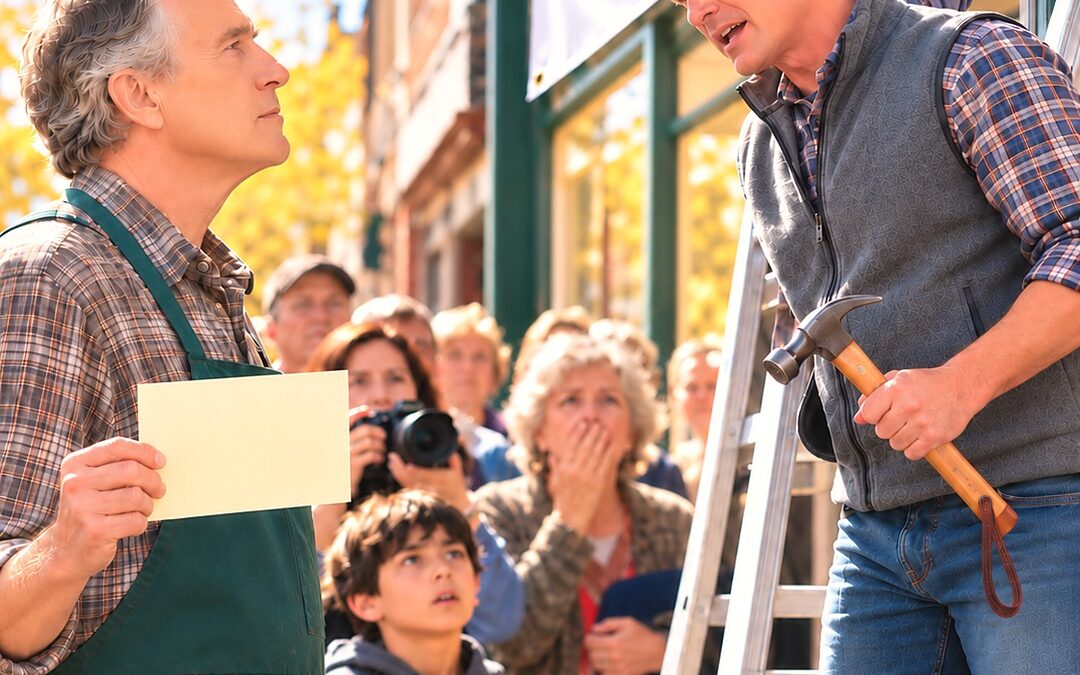
Brent stood beneath our painted wooden sign in a gray fleece vest and clean work boots. His black pickup was at the curb. Dana Pruitt, his project manager, had an aluminum stepladder open against the brick, and Joyce Lindahl from the Daily Herald had her camera raised.
The vinyl banner lay rolled on the sidewalk.
COMING SOON: HOLLIS CROSSING — LAUREL RIDGE PHARMACY.
Brent had paid $286,500 cash for the building after buying it on August 1. The notice came August 29, and Judge Alvarado later gave Dot and me until noon on the eleventh.
Dana climbed two steps and held one end of the banner against the metal bracket over my sign. Brent took a nail from his vest pocket.
Then he lifted the hammer.
I noticed the leather before I noticed anything else.
The loop through the hole at the bottom of the hickory handle had darkened almost brown from years of sweat and dirt. Along one edge, under the grime, ran the remains of red waxed thread.
Dot's stitch.
She had sewn those loops during the winter of 1986, sitting at our kitchen table after supper with a piece of leather across her knee and a jar of needles beside the salt shaker. I knew the spacing of those stitches better than I knew the pattern on our living-room curtains.
Brent set the nail against the upper edge of WIESNER HARDWARE — EST. 1979.
He hit it twice. The first blow dented the green paint, and the second drove the nail nearly flush.
Teo stopped counting.
Brent turned toward me with the hammer hanging at his side.
"Charity isn't a trade, Gene. Nobody ever built a thing by borrowing."
I had spent forty-six years behind that door. I knew which man had borrowed the same pipe cutter four times because buying one offended him on principle, and I knew whose husband had died in February.
A woman holding a yellow borrow tag lowered it against her coat.
Joyce took another picture.
Brent glanced toward her and gave a little half turn so the hammer-shaped Hollis Development patch on his vest faced her camera.
"Here's the thing," he said. "We're trying to improve this block. It's been underused for years."
The fellow with the wheelbarrow shifted it off the curb so a car could pass.
Brent pointed at the banner with the hammer.
"This will bring jobs. Pharmacy access. New housing upstairs. Frankly, Tyrone needs investment more than it needs a wall of free tools."
He always said frankly before something he'd already decided sounded better if nobody checked it.
Joyce lowered her camera enough to ask, "Are the Wiesners contesting the move-out?"
Brent took the paper coffee cup Dana had been holding for him.
"The tenants have signed off. We're just waiting on the date."
Dot had come to the doorway.
She heard it.
Her fingers tightened once around the cardboard washer box.
I had signed nothing.
Neither had she.
Brent drank his coffee and looked past me into the store, where six drawers of borrow cards sat behind the counter and several thousand tools hung on the back wall.
"Two weeks, Gene."
"October eleventh."
"That's right."
He gave Dana the hammer for half a second while he folded the loose edge of the banner back, then took it again before Dana came down from the ladder.
The handle crossed through a stripe of sun, and I saw the red thread near the bottom. The head was old steel, worn at the face. The claw had a nick near one point.
I leaned slightly, trying to see the underside.
Brent tucked the hammer beside his leg.
"Something wrong?"
"I was looking at your hammer."
He lifted it an inch.
"My father's."
"I know."
That seemed to please him.
"He started with this one. One hammer, one pickup, and whatever work he could get."
I kept my eyes on the claw.
The number, if it was the hammer I thought it was, would be underneath.
Brent slid it through the leather tool loop on his belt.
"See you around, Gene."
He and Dana walked toward the pickup. Joyce stayed to photograph the banner from across Fourth Street.
Teo had not resumed counting.
"Forty-one," he finally said.
Then he wrote it on the top corner of his clipboard.
At 10:25 I went back behind the counter and kept the line moving.
Mrs. Cramer took the post-hole digger. I wrote her name on a tag and hung it on the empty hook.
A man from Park Avenue returned a roofing shovel he'd kept since June and borrowed a come-along before he left.
Teo carried things to the door and checked hook numbers against his sheets.
Our rule was still painted over the back wall in letters Dot had touched up twice:
TAKE WHAT YOU NEED. BRING IT BACK WHEN YOU'RE DONE. IF YOU CAN'T, BRING SOMETHING ELSE SOMEDAY.
No deposit.
No ID.
If I knew your name, I wrote it down. If I didn't, I asked.
The system had survived people moving to Florida, people forgetting what they'd borrowed, and one snowblower that came back after seventeen years with a new carburetor and somebody else's dog hair in it.
At 10:42 Vern Akers reached the counter.
Vern was seventy-seven and still wore a carpenter's pencil behind one ear even though arthritis had retired him before he agreed to it. He set an old wooden folding rule on the counter.
"Found that in the bottom drawer of my bench."
I opened the rule. One brass joint had gone green.
"Number?"
"Should be sixty-eight."
It was.
I found his card, penciled Returned 9/27/25, and slid it back into the drawer.
Vern stayed at the counter, his gaze on the glass door where Brent had gone.
"You saw his hammer," I said.
Vern picked the folding rule back up, closed it carefully, then remembered he had returned it and put it down again.
"I saw."
"You recognize it?"
His fingers rested on the counter edge. He turned toward the sidewalk, took his carpenter's pencil from behind his ear, checked the point, and put it back.
Lloyd Fenner came up behind him, wearing an old PennDOT jacket that hadn't belonged to PennDOT in twenty years. Lloyd was seventy-nine and had been first through the Borrow Board when I started it.
He wanted a come-along.
Teo found one low on the wall.
Lloyd watched him lift it free, then jerked his chin toward the door Brent had left through.
"That's Ray Hollis's boy. Ray'd be sick."
— continue reading from here —
I wrote L. FENNER on the tag.
"Probably."
Lloyd carried the come-along out with both arms.
Dot passed behind me with a box of washers.
"Is it the one?"
"Looked like it."
I slid Lloyd's card into the Gray Box.
"A loop doesn't prove anything. The number does, and it's under the claw in Brent's hand."
Dot nodded once and went back toward plumbing.
At eleven, Joyce came in to buy two AA batteries for her flash unit. She paid cash and didn't ask me about Brent's statement.
I didn't volunteer anything.
At 11:30 the last person in the morning line left carrying a bow saw, and Teo swept a strip of dried mud off the front mat.
The banner outside pulled at its corners whenever a truck went by.
At 12:15 I stood in the back office with half a ham sandwich in one hand and drawer one of the Gray Box open in front of me.
Dot had brought her thermos back there.
"You planning to eat that?"
"I am eating it."
"You've been holding it six minutes."
I took a bite.
She poured coffee into the thermos cup and set it beside me.
The Gray Box was a six-drawer steel cabinet I had bought used from a State Farm office in 1985. It was gray in the same uncertain sense an old shovel is gray. The second drawer stuck in humid weather. The fifth had a dent from a hand truck accident in 1997.
Four thousand three hundred seventeen cards lived inside it.
I opened the first drawer.
Card number 1 was close to the front.
I pulled it out.
The pencil writing leaned right, harder at the ends of words because I used to bear down when I wrote.
1 — 3/8" drill — L. Fenner — 11/4/85 — Bring it back or don't. —G.
I held the card by one corner.
My own writing, thirty-nine years younger.
The drill had cost me twenty-eight dollars. Lloyd had needed it to put handrails in his mother's house after she fell on the cellar steps. I'd made the card because Dot said if I kept lending tools without writing anything down, we'd eventually own a hardware store with no hardware.
She had been right about the writing part.
I tapped the end of my worn 2B pencil twice against the edge of the card tray and set it back in its notch.
Dot put one hand flat between my shoulder blades.
Then she took it away.
"Find Hollis," she said.
I finished another bite of the sandwich and flipped forward through the H cards.
Hartman.
Hess.
Hollis.
Three cards.
The first was for a pry bar returned in 1986.
The next was a drywall rasp.
Then I found 412.
The card was darker along the top edge from thirty-seven years of being handled.
Ray's first writing took most of the upper half:
412 — framing hammer, Vaughan 20 oz. — R. Hollis — 4/12/88. House fire, lost everything. "Back when the roof's done." —R.H.
Below it, in my pencil:
Not returned. Don't chase. —G.W.
And below that, written years later with a flat-sharpened carpenter's pencil:
Boy carries it back himself. —R.H. 8/20/11
I set the sandwich down.
Dot leaned closer.
"That's his R."
"Yes."
Ray Hollis made his capital R with a little hook on the lower leg. He'd done it on invoices, work tickets, and the notes he left under my cash drawer when he'd repaired something and refused payment.
I read the last line again.
Boy carries it back himself. —R.H. 8/20/11
Ray had written it at my counter.
He died the next month.
I had never called Brent.
I had never mailed the card.
The Borrow Board did not chase people. That was written right there in my own hand, and I had meant it.
Dot unscrewed the thermos cap another quarter turn.
"Did Brent ever come in with Ray?"
"Not once."
"After Ray died?"
"No."
She looked toward the front of the store.
The hammer was somewhere in Tyrone now, probably on the passenger seat of Brent's truck or locked in whatever polished case he kept it in.
I set card 412 square with the top edge of the open drawer and pressed one bent corner flat against the steel.
"Eat."
I took the sandwich.
Card 412 stayed on top of the open drawer.
At one o'clock we had another line.
By two, the sidewalk was busy enough that Teo put the broom aside and went back to tags.
A woman brought in an electric hedge trimmer with a replacement cord. A retired teacher returned a brace-and-bit set her husband had borrowed before he died. She had wrapped it in a Giant Eagle grocery bag with one torn handle and put the tag inside so it wouldn't get lost.
I marked both cards returned.
At 2:40 a man asked whether the Borrow Board was closing that day.
"No."
"October eleventh?"
"Store has to be empty by noon."
He shifted a socket set under his arm.
"What happens to all this?"
"I don't know yet."
That answer stayed with me.
I had been answering questions one at a time since Brent bought the building. Where would we go. Whether the store would reopen. Whether the wall could be moved. Whether the cards mattered if the tools belonged to people now.
I had kept saying I didn't know.
At 3:22 I checked the sidewalk.
There were still people waiting.
Teo had his clipboard tucked under his arm and was helping a man fit a sledgehammer into the back seat of a Ford Focus.
Dot stood at the register totaling receipts on an adding machine we kept because she distrusted any machine that updated itself while she was asleep.
I went to the Gray Box.
Card 412 was still on top of the drawer.
I put it back in its proper place.
Then I closed the drawer.
At 3:30 I walked outside and stood on the front step.
"Teo."
He looked over from beside the Focus.
"Yeah?"
"How many still out?"
He flipped through two sheets.
"Six hundred twelve."
"Run me a clean list."
"All of them?"
"All of them."
He nodded and went inside.
I turned toward the people still waiting.
There were fewer than in the morning. Enough.
A woman near the front held a paint sprayer tag. Somebody farther back had a circular saw to return.
I kept it to what I knew.
"We have to be out of this building by noon Saturday, October eleventh."
A man near the curb shifted the saw against his leg.
"I'm not asking anybody to buy anything, and I'm not asking you to sign anything."
Dot had come to the doorway behind me.
"If you've got something from this wall in your garage or basement, I'd like it back here by noon on the eleventh so I can account for it."
The woman with the paint sprayer tag folded it once.
"Today, if you came to borrow something, you can still take what you need."
I stepped aside from the door.
"That's all."
A fellow at the back said, "Where do we return it?"
I turned toward Dot.
She was already moving.
She took an empty cardboard box lid from beside the register, laid it flat on the counter, and wrote two words across it with a black marker.
RETURN DESK.
She carried it outside, taped it to the front of a folding table, then shoved the table against the brick beside the door.
The first man to use it was Vern Akers.
I hadn't seen him come back.
He set the wooden folding rule he'd returned that morning on the table.
I stared at it.
"You already returned that."
"I know."
"Then why's it here?"
He rubbed one finger over the brass hinge.
"Thought you might need something on the table so people understand what it's for."
I left the rule where he put it.
Teo came outside carrying the first printed pages from his spreadsheet.
He had been scanning our cards since June, and he treated missing information as a personal insult. He stood at the Return Desk with his clipboard under the pages and started comparing names against hook numbers.
Dot went back to the register.
I stayed near the door.
People moved again. A man took a level while another brought back a plumber's snake, and I carried the returned tag inside to mark the card before coming back to the table.
A woman who had been waiting for the paint sprayer changed her mind, then came back ten minutes later and borrowed it anyway.
At 4:06 Teo was still working through the list.
He muttered numbers as he went.
I carried the returned folding rule inside, found its hook, then remembered it didn't belong on the wall anymore because Vern had returned it for good.
I put it under the counter instead.
When I came back outside, Teo had stopped counting and was checking the middle of the third page against the sheet beneath it. He ran his thumb down the list once, held it on one line, and looked up at me.
"Gene?"
"What?"
I stepped beside him.
He kept his place on the same line.
"Mr. Wiesner, number 412 is the only one on here that says, 'Not returned. Don't chase.'"
Part 2 — NO HANDOUTS
PART 2 — NO HANDOUTS
At 7:40 Monday morning, September 29, eleven people were standing on the Fourth Street sidewalk before Dot had turned on the store lights.
I saw them through the glass when I came from the back room with the register drawer.
One man had an aluminum extension ladder balanced against the brick. Mrs. Cramer had brought back the post-hole digger she'd taken Saturday, with Blair County mud packed around both blades. At the curb, a hand-cranked grinder sat in a milk crate beside somebody's boots.
Dot came up behind me.
"Did you tell them seven forty?"
"No."
"Good. I'd hate to think you were organizing things."
She unlocked the door.
Teo was already outside.
He had his blue hoodie on under a canvas jacket and a clipboard tucked against his chest. His mother had dropped him off early on her way to work in Altoona. By the time I pushed the RETURN DESK out beside the door, he'd written down four names.
A wet saw landed on the folding table hard enough to make one leg scrape the concrete.
"Careful," I said.
The man who'd carried it looked at the saw.
"Sorry."
I found his card in the Gray Box and wrote Returned 9/29/25 at the bottom.
The next woman had a pipe wrench with a fresh red coat of paint on the handle. The old leather loop was still there, although she'd painted neatly around it.
"Didn't figure paint counted as ruining it," she said.
"It doesn't."
She rubbed a thumbnail at a spot near the jaw.
"I kept this longer than I meant to."
I wrote the date.
She stayed at the counter while I put the card away.
"My husband died and I kept finding things of his. I knew this wasn't ours. I just got embarrassed by how long it'd been."
I slid the drawer shut.
"You brought it."
She nodded and carried her empty canvas bag out the door.
Teo called from outside, "Next one's the ladder."
A man and his daughter worked the extension ladder down between the doorframe and a rack of furnace filters. One end bumped a Rubbermaid trash can. Dot caught the can before it tipped, then pointed them toward the back wall.
The hook had been empty so long that the OUT tag had curled at one corner.
I found the card and penciled in the return date.
By eight fifteen, the folding table had disappeared under tools.
The man with the hand-cranked grinder came in carrying the milk crate by its wire handles. He set it on the counter and lifted the grinder out carefully, keeping one hand under the heavy base.
"Borrowed this when I was putting a new edge on mower blades," he said. "My boy was still in high school then. I kept meaning to bring it back after the next blade."
I found his card in the G section.
He turned the crank once. It squeaked and the stone made half a revolution.
"Didn't use it much after my knees went bad."
I wrote the date on his card.
He put the crank handle beside the grinder and carried the empty milk crate back outside.
I didn't make a speech.
People came in, found the right card with me, and went back outside with their hands empty. A few bought screws or light bulbs before leaving. Most didn't.
Teo kept writing.
At 8:37 he came behind the counter to sharpen his pencil.
"Mr. Wiesner."
"What?"
"Do you want me putting condition on the sheet?"
"Only if something's broken."
"What about painted?"
"No."
He glanced toward the red pipe wrench on the table.
"Looks better."
"Don't encourage them."
He gave me the pencil sharpener and went back outside.
At 8:50 a black pickup pulled to the curb.
Brent Hollis got out first.
His father's hammer rode in the leather loop at his right hip.
Stuart Bracken came around the passenger side carrying a brown accordion file. He wore a navy overcoat over his suit even though the sun was already on the sidewalk. Dana Pruitt got out of another car with a roll of clear tape.
The fourth man was Kurt Yoder.
I'd known Kurt by sight for years. He ran Yoder Auction Service down in Martinsburg and had sold everything from restaurant equipment to a widow's collection of ceramic cows. He carried a leather folder under one arm.
Dot saw them through the window.
"Company."
I put the card I was holding back in the drawer.
Brent came through the door without waiting for anyone to invite him.
"Morning, Gene."
"Morning."
Dana stayed by the glass.
She unrolled a sheet of white paper and taped it at eye level beside our hours.
NOTICE OF PUBLIC SALE OF ABANDONED TENANT PROPERTY.
A verification page was stapled behind the notice.
I came around the counter.
Stuart opened his accordion file.
"Copy for you."
He handed me the same two pages.
I read the first one standing near the register. Anything left in the premises after noon Saturday, October 11, was scheduled for sale at 12:30. The notice said the proceeds would go to the Tyrone Volunteer Fire Company after expenses.
I turned to the second page.
LANDLORD'S VERIFICATION.
Brent's signature was at the bottom, dated Friday.
Paragraph four read:
"The tenant has vacated the premises and abandoned all personal property remaining therein."
Behind me, a socket wrench clicked twice as somebody tested the ratchet before setting it on the Return Desk.
I looked through the window at the people carrying things into my store.
Then I looked back at the page.
Kurt Yoder took the copy from my hand.
He read the first page, moved the staple with one finger, and read the verification.
Dana pressed another strip of tape against the glass.
Kurt looked toward the rear wall.
Hooks were empty in patches now. Between them, tools still hung by leather loops and the handwritten OUT tags showed where others belonged.
He turned to Stuart.
"My license says I need clear title to what I sell. This says abandoned. It doesn't look abandoned."
Stuart adjusted the file under his arm.
"It will be by noon on the eleventh."
Kurt read paragraph four again.
He folded the pages without creasing them and handed them back to me.
Brent reached inside his vest.
"Here's the thing, Gene. I don't want this turning ugly."
He took out a check.
"I had accounting cut this."
He set it on the glass counter.
Five thousand dollars.
The memo line said RELOCATION INCONVENIENCE.
Dot could see it from the register.
She didn't move toward it.
"That's for you and Dorothea," Brent said. "No strings. Use it for storage, movers, whatever makes sense."
I left the check where it was.
Stuart tightened the strap around his accordion file and tucked the loose end beneath the buckle.
Brent tapped one corner of the check against the glass.
"Frankly, it's more than I have to do."
I pushed it back across the counter.
The paper slid until it touched his fingers.
He picked it up.
Kurt had wandered closer to the Return Desk. A man bringing back a hand plane moved around him and set it beside Teo's clipboard.
I watched Brent's right hand settle near the hammer.
"I'd just like to see the hammer a minute, Brent."
His hand closed around the handle.
"It doesn't leave my hand."
I stayed behind the counter.
Brent gave a small breath through his nose and looked toward Joyce Lindahl's Saturday photograph, which Dot had clipped from the morning paper and set beside the register.
"I don't hand my father's hammer to the Borrow Board, Gene. I don't need a history lesson from it either."
He lifted it free of the loop.
For a second I could see the worn hickory handle and Dot's red stitching. Brent turned the head toward himself before I had a view of the underside, then slipped it back against his hip.
Stuart closed the accordion file.
"Brent."
"We're done."
They went out together.
Dana followed after checking the tape on the notice.
Kurt remained inside.
He stood near the door until Brent's pickup pulled away, then read the posted notice once more through the glass.
"Saturday, huh?"
"That's what it says."
He put his leather folder under his arm.
"I'll be here before I set up."
Kurt left, and Dot came from the register as I put the next card on the counter. She lifted Brent's notice at one corner without peeling it loose.
"He signed that?"
"Friday."
She let the page fall flat against the glass.
Teo was outside shifting returned tools to make room on the table. When I stepped through the doorway, he tipped his pencil toward the notice.
"Mr. Yoder thinks Brent can't sell the wall?"
"He said he needs clear title to what he sells."
"So can Brent sell it?"
"I don't know what he'll try."
Dot opened the door behind me with the rejected check memo still on her mind.
"'Relocation inconvenience,'" she said. "Nice of accounting to diagnose us."
Teo looked at the crowded table, then wrote another return on his sheet while Dot smoothed one loose corner of the notice tape against the glass.
Tuesday at four in the afternoon, Teo came through the front door fast enough to ring the brass bell twice.
I was pricing furnace filters.
Dot was balancing the cash drawer.
Teo carried a glossy trifold brochure in one hand.
"Found this at Giant Eagle."
He put it beside my pencil.
The cover showed a rendering of Hollis Crossing. The old brick building was gone. In its place stood a Laurel Ridge Pharmacy with a drive-through, and the apartments above were clean boxes with black-framed windows.
I opened the fold.
Inside was a photograph of a hammer displayed in a glass case.
Same hickory handle, same dark leather loop.
Below the photograph:
Ray Hollis's hammer, 1988.
I moved the flyer closer to the window.
Teo leaned on the counter.
"Keep going."
The next panel showed Brent in a hard hat beside a Hollis Development sign.
Across the bottom was the line:
"Built the way my father built it: with one hammer and no handouts."
Dot came around from the register.
Her finger rested near the edge of the flyer.
"That's the hammer."
"Yes."
Teo pointed lower on the panel.
"Look at the logo."
Hollis Development's logo was printed beside the address for its State College office. A small hammer sat above a script signature.
R. Hollis.
I'd seen Ray Hollis write his name more times than I could count.
His capital R had a little hook at the bottom of the leg, a habit from forty years of job tickets and lumber orders. The hook on the flyer curved in exactly the same place.
I picked up the brochure.
The photograph caption caught me again.
Teo had noticed it too.
He was watching me instead of the flyer now.
I set the brochure flat.
"Get me the card."
He went to the Gray Box.
He knew which drawer.
I stayed where I was while he pulled it open and worked through the H section. His fingers passed one card, then another, before he lifted out 412.
He brought it to the counter and laid it beside the glossy flyer.
Ray's pencil was faded.
The printed signature on the brochure was black and clean, made for signs and trucks, but the little hook on the R was still there.
Dot picked up her reading glasses from beside the register.
Teo read the top of the card without touching it.
I looked from the date on Ray's old pencil line to the date printed beneath the photograph.
"Nineteen eighty-eight," Teo said. "April, Mr. Wiesner. That's what the card says too."
Part 3 — SIGNED OFF
PART 3 — SIGNED OFF
At 10:15 Wednesday morning, October 1, Teo was at the end of the counter scanning old cards when a gray Subaru pulled into the space Brent Hollis had been using as if it came with the deed.
A woman got out wearing a good gray coat and low black shoes. She stood on the sidewalk long enough to read Brent's public-sale notice through the glass, then looked at the RETURN DESK beside it.
Two people were there ahead of her. One had brought back a table saw. The other was waiting while Teo checked the tag on a long steel level.
The woman came inside.
"I'm looking for Eugene Wiesner."
"That's me."
She held out a business card.
Nan Whitcomb. Real Estate Director. Laurel Ridge Pharmacy.
I had seen the company name every morning since Brent nailed his banner over my sign.
She glanced toward the back wall.
Large bare spots had opened between the hooks. Returned tools were stacked in cartons behind the counter while we figured out where to put them next. Teo's scanner made a faint chirp every few seconds.
Nan put her card on the glass.
"I was told the tenants had signed off."
Dot had been writing a receipt at the register.
Her pen came off the paper.
"We signed nothing."
Nan turned toward her.
"You're Mrs. Wiesner?"
"Dorothea."
Nan took a small notebook from her coat pocket.
"He called me Monday night to say it again: 'They signed off Friday. It's paperwork.'"
Dot set the receipt on the counter.
I went to the coffee pot in the back and brought Nan a foam cup. I didn't ask whether she took cream. We had powdered creamer beside the register if she wanted to ruin it herself.
She accepted the cup.
"Thank you."
"What do you need to see?"
"The space, mostly."
I showed her, and she walked the main floor first, stepping around cartons and returned tools. At the back she tilted her head toward the old tin ceiling, then measured the distance between two support columns with her eyes.
"Pharmacy would be here."
"That's what the banner says."
She glanced at me.
"Drive-through would require the adjacent parcel."
"Three eleven is empty."
"I know."
Teo came around us with a stack of scanned cards.
"Excuse me."
Nan moved aside while he carried them to the Gray Box and filed them one section at a time.
She watched him put the drawer back.
"What are those?"
"Loan records," I said.
"For the tools?"
"Yes," I said, and closed the drawer he had just used.
She looked toward the wall again.
"You charge?"
"No," I said, and moved the empty coffee can we kept for loose screws farther from her sleeve.
"Membership?"
"No," I said, and set her business card beside the register.
"How do you know things come back?"
"Sometimes they don't."
She waited for more.
I gave her the rest of the store instead.
The basement had a furnace that objected loudly to February. One upstairs apartment needed a bathroom vent replaced. The rear loading door swelled every August and behaved again by October.
Nan wrote some of it down.
When we came back to the front, a man was carrying the table saw out again because Teo had discovered it wasn't ours. The man's brother had bought it at an estate sale and assumed the faded leather loop meant it belonged here.
Teo held the door.
Nan watched them get the saw into the trunk.
"Mr. Hollis told us the building would be delivered vacant."
"The judge gave us until noon on the eleventh."
"I have that date."
"We're here until then."
She wrote another line in her notebook.
I didn't ask what Brent had promised her. I didn't mention the paper taped to the glass behind her or his signature beneath paragraph four.
Dot rang up a box of picture hooks for a woman from Logan Avenue.
Nan finished her coffee.
At the door she folded the business card I'd left on the counter and put it back in her pocket.
"I'll ask him again."
She went to the Subaru.
Teo watched through the glass until she drove away, then turned back to his scanner.
"Do I put Laurel Ridge in the project notes?"
"No."
"Why?"
"Because you're scanning cards."
He sat down again.
The scanner chirped.
At 5:30 Thursday evening, Sheila Dornan sat on an upside-down five-gallon bucket behind my counter with the possession order balanced on one knee.
Sheila worked for Blair County Legal Services and had already learned that sitting in my back office meant sitting beneath a shelf that dropped plaster dust whenever a truck hit the pothole outside.
She preferred the bucket.
Teo was at the far end of the counter correcting file names on his laptop. His mother wouldn't pick him up until six.
Sheila read Judge Alvarado's order again.
"The possession date is final."
"I know."
"The tools are yours. That's the good part."
Dot was closing a carton of brass hinges.
"And the bad part?"
"At noon on the eleventh, whatever is physically left in the premises becomes the fight."
Sheila tapped Brent's sale notice with one finger.
"He intends to call it abandoned. If he sells property that isn't his, we can sue afterward. Afterward doesn't put a wall of tools back together very neatly."
"What does abandoned mean on his paper?" I asked.
"It means he plans to say you left the property behind and walked away from it. If a tool is still hanging here when the clock hits noon, he'll point to the verification and say it stayed because you gave it up."
"We're carrying things next door."
"Keep carrying them. The less sitting here at noon, the less he gets to argue about."
I leaned against the counter.
"Can you stop the sale?"
"I can challenge it. I can't promise an order before Saturday."
Dot pushed the hinge carton beneath the register.
Sheila looked from her to me.
"Why didn't you buy the building?"
I picked up my pencil without writing anything, and Sheila waited.
"Amos Teller offered it to me."
"When?"
"January last year."
Dot closed the register drawer.
"I said take it."
Sheila looked at me.
"What were the terms?"
"Two percent. He'd carry the note."
Teo's keyboard went quiet at the end of the counter.
Sheila put the possession order down.
"And you said?"
"We don't owe anybody."
Dot picked up her purse from beneath the register.
Sheila's eyes stayed on me.
"You said no to being helped, Mr. Wiesner."
I set the pencil in its notch.
Sheila gathered the court papers into her folder.
"Keep documenting returns. Keep copies of everything Hollis posts. Don't remove his notice from the glass."
Dot locked the register.
"I've been tempted."
"Don't."
"I said tempted."
Sheila got up from the bucket and carried it back toward the paint aisle where she'd found it.
At 6:08 the phone rang.
Nan Whitcomb was on the line.
She asked for me.
"I spoke to Mr. Hollis again."
"He still says we're agreed to leave?"
"He says the issue is handled and that there is no dispute over delivery."
Behind me, Teo was pulling on his jacket.
Nan continued, "I told him what Mrs. Wiesner said yesterday."
"What did he say?"
"Same thing, essentially. That your departure is agreed and the rest is paperwork."
I looked at the notice on the glass.
"All right."
"I'm noting the conversation."
"Did you tell him you were noting it?"
"Yes."
Teo zipped his jacket.
"Was that the pharmacy lady?"
"Yes."
He looked toward the banner outside, then picked up his backpack.
Marisol's car horn gave one short beep from the curb.
Teo left with his laptop under his arm.
At 9:00 Saturday morning, October 4, Pastor Ruth Halvorsen unlocked the Fellowship Hall at St. Matthew's and handed Dot a ring with two keys on it.
"You can use the whole room."
The hall smelled faintly of coffee and floor wax.
Folding tables ran down one wall. The opposite side gave us nearly a hundred feet of bare space, enough to put up temporary racks once we figured out how.
Teo walked the perimeter with a tape measure and wrote dimensions on his clipboard.
Pastor Ruth watched him.
"He always this busy?"
"Only awake."
She smiled once and went to open the church office.
At 9:26 Vern Akers backed his green pickup into the lot.
He had a small trailer behind it.
The trailer carried borrowed things.
I recognized our leather loops before I recognized half the tools.
Vern climbed out slowly and unlatched the tailgate.
"Garage needed cleaning anyway."
Teo came over with his clipboard.
"These all yours?"
"Some were Ray's crew's. Some wound up with me."
He looked at me.
"Coffee?"
We went inside.
Dot had started a pot in the Fellowship Hall kitchen.
Vern sat at one of the folding tables with his paper cup between his palms. He looked older indoors. His carpenter's pencil was still behind his ear.
"I ought to tell you why I didn't say anything last Saturday."
"You don't owe me that."
"I know."
He drank some coffee.
"I drove Ray to your store Tuesday, April 12, 1988. The fire on Cameron Avenue had been a few weeks earlier. Ray stood in the yard with a garden hose while the house went, and Brent was twelve that spring, watching from across the street."
"You came in with him?"
"Right to the counter. You lifted that framing hammer from hook 412 and gave it to Ray. Later Ray told Brent he'd bought it with his first paycheck. He hated having his boy see him ask."
Vern looked into his cup.
"I figured he'd told him later."
"He didn't."
Vern turned the paper cup a quarter turn between his palms.
Teo was at the next table, close enough to hear and wise enough not to pretend he wasn't.
Vern rubbed the paper seam on his coffee cup.
"I saw that Hollis Crossing flyer at Giant Eagle. 'No handouts.' That's when I understood the boy still believed the story."
"Why didn't you call him?"
Vern looked at me.
"He wouldn't know my number."
"Phones work both directions."
He drank the rest of his coffee.
"I didn't hide anything from him, Gene. I just never thought he'd still be carrying around something his father told him at twelve."
Teo lowered his pencil to the clipboard.
Vern stood and carried his cup to the trash can.
"I'll be here next Saturday."
"You don't have to."
Vern took the carpenter's pencil from behind his ear and tucked it into his shirt pocket.
He pushed open the hall door.
"I'm standing where Brent can see me. That's all."
Outside, he and Teo began unloading the trailer.
By noon, we had started lining returned tools along the Fellowship Hall wall.
Sunday evening, October 5, Dot slid the Tyrone Daily Herald across our kitchen table while I was finishing meatloaf.
"Page six."
I opened it to the half-page Hollis Development advertisement.
There was Brent in his gray vest, one hand resting on a rendering of the new building. Above him, in large type:
Join Brent Hollis at noon Saturday, October 11, as Ray Hollis's own hammer strikes the first swing of Hollis Crossing.
The ad had a photograph of the hammer.
The same leather loop showed against the pale background.
Dot took my empty plate to the sink.
On the counter, Teo's latest return list lay under the phone where I'd brought it home to check before Monday.
I read the ad twice at the kitchen table, and the second time I understood that on Saturday at noon Brent Hollis was going to stand on my sidewalk and hold up the one thing I could not take out of his hand.
Part 4 — BRING IT BACK
PART 4 — BRING IT BACK
At 7:18 Monday evening, October 6, Teo Ibarra sat at our kitchen table with his laptop open beside a plate of two untouched oatmeal cookies and asked whether I minded if Tyrone knew exactly how many tools were still out.
His mother, Marisol, stood behind his chair reading over his shoulder. Dot was at the sink rinsing coffee cups, and I had the latest return sheets spread beside Teo's computer.
"What are you putting up?" I asked.
"A picture of the Return Desk. Then the list."
"Names?"
"No names."
"Good."
Teo scrolled through what he'd written.
His post started with a photograph he'd taken Saturday afternoon. The cardboard RETURN DESK sign was crooked because the tape had pulled loose in the wind. Behind it, people were carrying things through the store door while Brent's Hollis Crossing banner hung above them.
Teo had typed a short explanation underneath. Wiesner Hardware had to be cleared by noon Saturday. Hundreds of tools had already come home. Six hundred twelve had been out when we started counting.
He had not written anything about Brent.
He had not written anything about the hammer.
At the bottom was one last paragraph.
"If you've got something from the wall on your shelf, bring it back by noon Saturday the 11th. St. Matthew's. Thanks."
Marisol leaned closer.
"Take out the exclamation mark."
"There isn't one."
"Then I've raised you correctly."
Teo looked at me.
"Okay?"
I read it once more.
"Post it."
He clicked the button.
Dot set a coffee cup upside down in the drainer.
"Now eat the cookies before they become antiques."
Teo picked one up, and the first response appeared before he took a bite.
A man on Pennsylvania Avenue wrote that he had a flooring nailer in his basement and would bring it Wednesday. Somebody else asked whether things could be dropped at the church after the store closed.
Teo answered that one himself.
By 7:31 there were eleven comments.
I folded the return sheets and put them back in their manila folder.
"You don't need to sit here counting them all night."
"I'm not."
"You just refreshed it."
"That was quality control."
Marisol reached over him and closed the laptop halfway.
He ate the rest of the cookie.
Tuesday morning, Teo came into the store before school with his backpack hanging from one shoulder.
"One hundred forty comments."
I was unlocking the Gray Box.
"That's too many comments."
"Some are replies."
"Still too many."
He grinned and left for school.
By noon, people had begun arriving because of the post.
A woman brought a coping saw she'd found behind paint cans in her garage. Two brothers carried in a tile cutter that neither one could remember borrowing.
"Which one of you had it?" I asked.
The older brother pointed at the younger one.
"He was the one redoing a bathroom."
"That was your bathroom."
"Then you had it."
Teo found the number on the base while I went through the cards. The borrower's name belonged to the older brother, dated from a spring neither of them remembered until he saw the address written under his name.
"Oh," he said. "That was Mom's place. We cut the kitchen tile too."
His brother set the cutter square on the Return Desk.
"You told me you owned this."
"I tell you a lot of things."
I wrote the return date while Teo carried the card back to the Gray Box.
A fellow from Bald Eagle came with a router case held shut by orange baling twine.
Teo returned after school and went straight to the Fellowship Hall.
He had made new labels for the temporary racks.
I stayed at the store and wrote dates on cards.
Wednesday, October 8, at four in the afternoon, Lloyd Fenner walked through the front door carrying a cardboard box against his chest.
The box had once been blue.
Forty years of shelf dust had turned it gray-brown around the edges. One corner was split, and somebody had repaired it with old masking tape that had dried almost transparent.
Lloyd set it on the counter.
I knew what was inside before he opened it.
The original Black & Decker logo was still visible under the dirt.
Teo came from the back with a bundle of empty tags.
"Is that it?"
Lloyd lifted the lid.
The three-eighths-inch drill lay inside with its cord wrapped around the body. The plastic housing was scratched, the chuck was dark with use, and there was a dollar bill taped flat to the inside of the lid.
Beside it was a small piece of paper.
Done. —L.F.
I took card number 1 from the drawer.
The first line was my younger writing from November 1985.
Lloyd wiped two fingers on his trousers.
"Still runs."
"I figured."
"Switch sticks once in a while."
"I've got switches."
He wiped the same two fingers on his trousers again and looked toward the drill.
"I was going to bring it back sooner."
I picked up the pencil and turned the card so the bottom line faced me.
"You did."
He didn't answer while I wrote:
Returned 10/8/25
Teo checked his sheet.
He made one mark beside the drill's number, then looked up.
"That's five hundred thirty-two."
Lloyd glanced toward the back wall.
"Out of?"
Teo told him.
Lloyd nodded.
He lifted the dollar bill by one taped corner.
"That was for a bit I broke."
"You broke a bit forty years ago?"
"Still broke."
I pressed the tape back down.
The dollar stayed with the box.
Lloyd took his old PennDOT cap from his coat pocket and put it on before he went outside. Through the window I watched him cross Fourth Street carefully, waiting for a pickup to pass.
Teo stood beside the open box.
"Are we putting that at the church?"
"Not yet."
"Why?"
I closed card number 1 inside the drawer.
"I'm keeping it here tonight."
Teo nodded and carried the next stack of returned tags to the back counter.
The drill box stayed beside the register until closing.
Thursday evening, October 9, Mark came to our house after his shift in Altoona.
Our son was forty-one and still opened the refrigerator before saying hello, although he had a wife and refrigerator of his own.
He took out a bottle of soda.
Dot was making pork chops.
I sat at the kitchen table with the return count and a legal pad. Teo had gone home an hour before after leaving me another updated list.
Mark saw the papers.
"How many now?"
"More."
"That wasn't my question."
"It's the answer you're getting."
He opened the soda.
Dot pointed at a glass.
Mark got one.
He sat across from me and read the top sheet.
"You could've taken Hollis's check."
I kept working through the card numbers.
"Here we go," Dot said.
Mark looked at her.
"I'm serious."
"So is he. That's the problem."
I put my pencil down.
Mark leaned back in the chair.
"Five thousand dollars would've paid for movers and storage."
"I know what five thousand dollars pays for."
"Then why send it back?"
"It wasn't mine."
"It was offered to you."
"He wanted it accepted."
Mark stared at me.
"That's generally what offering money means."
Dot turned one pork chop in the skillet.
"Mark."
He took a drink of soda.
"No, Mom. He's going to be carrying boxes into the church tomorrow night, and we're pretending refusing help is somehow cheaper."
I folded the top return sheet.
"He bought the building."
"Yes."
"He wants us out."
"Yes."
Mark set the glass down.
"Those facts don't make his check dirty."
Dot lowered the burner.
She didn't turn around.
Mark looked at me for another few seconds.
Then he said the thing he'd come to say.
"Mom told you to say yes to Amos. You said we don't owe anybody. Dad, you never ask."
The kitchen clock ticked over the stove.
I looked at the legal pad.
Amos Teller had come into the store in January 2024 wearing his old brown winter coat, though the day wasn't especially cold. He was ninety then. He put his cap on the counter and offered to sell me the building, carry the note at two percent, and let Dot and me pay him instead of rent. Dot said yes before he finished explaining it. I told him, "We don't owe anybody." Amos put his cap back on and bought a pack of picture hooks.
Amos died the following March.
His executor sold the building to Hollis Development on August 1.
Mark rubbed the condensation ring his glass had left on the table.
"Why'd you say no?"
"I thought owing somebody meant they owned part of your life."
"And now?"
I looked toward Dot.
She had her back to us, taking the pork chops from the skillet.
"It was pride."
Mark didn't say anything.
I moved the legal pad aside.
"Wasn't principle. I called it that because it sounded better."
Dot brought a plate over and set it in front of me.
One pork chop. Mashed potatoes.
The gravy had run into the potatoes along one edge.
She went back for Mark's plate.
Friday night, October 10, the stage outside Wiesner Hardware was finished before dark.
By 10:30 the street was mostly empty.
Brent's crew had built the platform against the curb and put a podium near the center. His vinyl banner stretched above the sidewalk under two work lights, bright enough that I could read HOLLIS CROSSING from inside my dark store.
The ceremony was at noon.
So was our deadline.
At St. Matthew's, the temporary racks were filling. Teo had spent the afternoon checking returns until Marisol came to get him. Before leaving, he placed the newest count beside my register with a circle around the remaining names.
I locked the front door after Dot went home to make coffee for the morning, then went to the Gray Box. The store looked wrong with so many hooks bare.
Forty years of dust had made little clean outlines where tools used to hang. Empty tags swung when the furnace kicked on.
I pulled open the H drawer, and card 412 was where it belonged.
I carried it to the counter and sat on the stool Dot usually used while balancing the books.
Ray Hollis's first entry filled the top.
My own note sat beneath it.
The final line was in the flat carpenter's pencil Ray carried late in his life:
Boy carries it back himself. —R.H. 8/20/11
I read it once while somebody from Brent's crew crossed the platform outside and tested one of the work lights. His shadow moved across our window, then disappeared.
The bell over the front door rattled, and Dot came inside carrying a thermos. She had her key and locked the door behind her.
"I thought you'd be home."
"Was headed that way."
She saw the card on the counter.
"Changed directions?"
"By a few feet."
She put the thermos beside the register and took the stool next to mine.
For a while she read tomorrow's event banner through the glass.
"Are you going to say anything first?"
"No."
"What are you going to do?"
"Ask him to turn the hammer over."
Dot looked at card 412.
"And after that?"
"I leave the rest to the number."
She reached for the thermos and poured coffee into its plastic cup.
I put card 412 back into the H section, pushed the drawer closed, and turned off the light over the Gray Box.
Across the street, the stage lights kept shining on Brent's podium.
I had never in my life wanted a man to turn something over as badly as I wanted Brent Hollis to turn that hammer over.
Part 5 — THE NUMBER
PART 5 — THE NUMBER
At 11:20 Saturday morning, October 11, the first man came down Fourth Street carrying a four-foot level under one arm and walked past Brent Hollis's stage without turning his head.
Behind him came a woman with a come-along in a plastic tote.
Then more people appeared from the direction of Pennsylvania Avenue.
By 11:30 they were coming from both ends of the block.
Some carried tools against their coats. Others had them wrapped in towels or old feed sacks. One man balanced a post-hole digger across his shoulder and walked around the stage the way you walk around a puddle.
The stage had been dressed for a ceremony.
A Hollis Development banner covered the rail. Folding chairs faced the podium. Joyce Lindahl stood near the curb with her camera, and Kurt Yoder had a microphone on a stand beside a table where auction forms were stacked beneath a clipboard.
A woman came past carrying a coffee can full of bent nails against her coat. Behind her, a man had a drill wrapped in a faded bath towel, one end of its cord hanging out near his wrist. Both went around the platform and headed toward St. Matthew's.
Nan Whitcomb sat in the front row.
She had a pen in one hand and a leather folder on her lap.
Constable Gary Mowrey stood near our front door with the replacement lock set in a cardboard box at his feet.
Dot and I were inside.
The store was nearly bare.
Most of the returned tools had already been moved into St. Matthew's Fellowship Hall. Teo was over there with the Gray Box, checking the last things against his sheets.
From the window I could see people crossing the church lot with what they'd carried home years before.
Dot closed a carton beside the register and looked toward the last section of wall.
"That brace staying?"
"Until Teo gets back."
"The one with the cracked handle?"
"Card says repaired."
She leaned over the carton and checked the handle without lifting the tool.
"Repaired by somebody who owned electrical tape."
"It holds."
"So does my kitchen drawer if you kick it shut."
I took the brace down and laid it on top of the carton for Teo to check when he came back from the church.
Brent stood beside Kurt and watched them go.
A man with a long two-man saw came along the sidewalk.
Brent leaned toward Kurt.
"Anything delivered to this sidewalk is the Fire Company's."
Kurt looked at the saw as the man carrying it stepped around the stage and crossed into the church lot.
"We'll see what you own at noon."
Brent turned toward Dana.
"Keep the sidewalk clear in front of the podium."
Dana moved one folding chair back six inches while another person passed carrying a long-handled tool toward the church.
Brent adjusted the front of his gray fleece vest.
At 11:42 Brent came inside.
His father's hammer hung at his hip.
He looked around the empty spaces on the wall.
"Busy morning."
"Making progress," I said.
He walked toward the back and glanced at the bare hooks.
Most of the tags had come down.
One remained where 412 had been empty for thirty-seven years.
OUT — RAY H.
Brent didn't see it.
He turned back toward me.
"Here's the thing, Gene. At noon, we're taking possession. Gary changes the locks, Kurt handles what's left, and everybody gets to move on."
Dot was behind the register packing the last rolls of receipt paper into a carton.
Brent looked toward her.
"Dorothea."
She kept packing.
Brent faced me again.
"You planning to be difficult?"
"No."
"Good."
He rested his palm over the hammer handle.
The leather loop showed beneath it.
"Because frankly, today is supposed to be positive."
Outside, another person carried a tool past his stage.
Brent watched through the front glass.
"What's all that?"
"Returns."
"Today?"
"They're still coming."
He walked back outside.
At 11:55, Teo came through the church door carrying one drawer from the Gray Box in both arms.
Lloyd Fenner followed him.
Vern Akers was already near the front of the gathering in his brown work jacket, carpenter's pencil behind one ear.
I crossed the store and opened the front door.
Dot came beside me.
"Ready?"
"Not especially."
"Good."
We stepped outside.
At noon, Dana Pruitt tapped the microphone.
The speakers gave a short squeal.
Brent climbed onto the stage.
People gathered along the sidewalk and near the church lot, leaving an open strip between the two buildings. More were still carrying things behind the crowd.
Joyce raised her camera.
Brent smiled toward her.
"Thank you for coming."
He stood with one hand on the podium.
"Here's the thing. My father started with his hands, a truck, and the work people would give him. He didn't wait for somebody to build his future for him. Frankly, that's how I was raised, and that's how Hollis Crossing is going to be built."
He reached to his right hip.
He pulled out the hammer.
He held it over his head.
"Ray Hollis built half of Tyrone with this and no handouts."
The leather loop swung from the hickory handle.
Then Brent gestured with the hammer toward the store window, toward the old sign above the wall inside.
Joyce's shutter clicked.
I walked to the foot of the stage.
Dot came with me.
Brent saw us and lowered the hammer to shoulder height.
"Gene."
"Brent. Turn it over and read me the number under the claw."
His mouth opened into a grin.
He looked toward the crowd.
"You want a serial number?"
"I want that one."
Brent gave a short laugh.
Then he turned the hammer over.
He angled the claw toward the people nearest the stage.
For the first time since September 27, I could see the underside clearly.
The old stamp was worn but readable.
Brent leaned close enough to make it out.
"WH 412."
Somebody in the second row lowered a foam coffee cup. A metal tool landed softly against the grass beside the church walk, and the man who had been holding it left his hand hanging where the handle had been.
Near the aisle, a woman folded both hands over the leather loop of the tool against her coat. Joyce's camera stayed raised, but her finger was no longer pressing the shutter.
Teo came forward carrying the Gray Box drawer.
He set it on the Return Desk.
Then he took out card 412.
Brent looked down at him.
Teo held the card near his chest and read from the top.
"'412 — framing hammer, Vaughan 20 oz. — R. Hollis — 4/12/88. House fire, lost everything. "Back when the roof's done." —R.H.'"
He moved to the next line.
"'Not returned. Don't chase. —G.W.'"
He did not read farther.
Lloyd Fenner walked to the wall just inside the open door.
He took the old tag off hook 412.
He brought it outside and held it where Brent could see.
"OUT — RAY H."
Brent looked past Lloyd toward Vern.
Vern Akers stood near the front and nodded once when Brent met his eyes.
Kurt Yoder stepped to his microphone.
He looked at the hammer in Brent's hand, then at the tag Lloyd was holding.
"I don't sell what's got somebody else's number on it."
His voice went through the speakers and across Fourth Street.
Kurt unplugged the microphone.
For a few beats, shoes scraped on the sidewalk as people shifted their weight. A truck rolled through the light at Pennsylvania Avenue, and the flag rope on St. Matthew's pole tapped twice against the metal while nobody near the stage reached for the microphone.
He closed his leather folder and put it under his arm.
Brent remained on the stage.
The hammer was still turned over.
His fingers had shifted higher on the handle.
I waited until he looked at me.
"Somebody built half of Tyrone by borrowing, Brent. Your father did. He just never forgot whose hammer it was."
His thumb went across the stamped number and back and across again, rubbing the worn steel until Joyce Lindahl lowered her camera to her chest.
Brent's other hand closed against the edge of the podium, and the hammer head tipped enough for the stamp to catch the daylight again. His thumb passed over the letters once more, slower now, while Teo stood beside the Return Desk holding the drawer against his stomach.
Teo reached into the drawer without anybody asking him and held card 412 out at arm's length.
Brent looked at it.
The hammer lowered as he came down one stage step and took the card carefully by the edge.
His eyes went to the top line, then moved lower to the place where Ray's capital R had the small hook on its leg.
The same hooked R was stitched into the history of Brent's company, printed on his trucks and signs beneath the hammer-shaped logo.
Brent brought the card closer.
He looked toward Teo, then at me.
"Did he write that?"
"At my counter. April 12, 1988, and the last line on August 20, 2011. Four weeks before he died."
Brent read the card again.
He had never asked me a question about the hammer before.
Behind him, Nan Whitcomb got out of her chair.
She carried her leather folder to the podium.
Brent noticed her halfway there.
"Nan, hang on."
She opened the folder.
A lease packet was inside.
Her pen lay clipped across the top.
"You told me twice they'd signed off."
Brent glanced at Stuart Bracken.
Stuart was standing beside the stage steps with his legal pad tucked under one arm.
"Nan, that's a separate issue."
She took her pen from the folder and held it above the packet, then placed it on the podium.
Then she closed the folder and walked toward her gray Subaru.
Brent watched her cross the curb.
"Nan."
She continued to the car and opened the driver's door.
Her car door shut.
The stage microphone was off, but everybody near the sidewalk heard it.
Brent looked down at card 412.
His eyes moved to the bottom line that Teo had not read aloud.
Boy carries it back himself. —R.H. 8/20/11
His lips moved over the writing before he read it aloud, his voice carrying only a few feet.
"Boy carries it back himself. —R.H. 8/20/11"
He stood there with the card for several seconds.
Then he handed it to Teo.
Brent came off the stage.
He walked through the space between the chairs and the Return Desk.
People moved enough to let him pass.
He crossed the sidewalk toward me.
The hammer hung low beside his leg.
At arm's length, he turned the handle toward me.
His hand was not steady.
I took the hammer.
The leather loop brushed the back of my wrist.
The hammer was heavier than I remembered, the steel head pulling against the old hickory handle. The face was worn smooth from years of work, and the nick near one point of the claw was still there. My palm covered part of the stamp underneath.
Dot's eyes went straight to the red stitching. She reached out without touching the hammer and followed the worn seam with one finger in the air, then lowered her hand beside her coat.
Brent let go.
Behind Brent, Stuart Bracken closed his legal pad.
"I drafted paragraph four of that verification. I should have asked one question."
Brent turned toward him.
Stuart did not move.
Kurt was carrying his microphone stand toward his truck.
Nan's Subaru pulled away from the curb.
Joyce raised her camera again, but Brent had already turned his back to her.
Mowrey stood in the store doorway beside the box of new locks.
Constable Mowrey took off his cap and asked Brent whether he still wanted the locks changed at noon, and Brent Hollis, who had an answer for everything, did not have one.
Part 6 — HOOK 412
PART 6 — HOOK 412
At 12:35 Saturday afternoon, October 11, Constable Gary Mowrey knelt at the front door of Wiesner Hardware with a Phillips screwdriver while Brent Hollis sat on the bottom step of his own stage.
Nobody argued with Gary.
He had the possession order folded in his shirt pocket and a new lock cylinder beside his knee. The deadline had passed. The store was empty now except for the wall frame and the old hooks. Pale strips of dust showed where shelves had stood that morning.
Dot and I waited on the sidewalk.
Hammer 412 was in my right hand.
I had not carried it far. Across the narrow strip of grass at St. Matthew's, people were still moving through the Fellowship Hall with returned tools. Teo had set the Gray Box on a folding table near the kitchen, and every few minutes he called a name so somebody could get a card matched to a hook.
Gary pulled the old cylinder free.
"Mr. Wiesner."
"Yes."
He held out the old key.
I looked at it, then at Brent.
"Give it to him."
Gary rose and walked the key over to Brent.
Brent took it without getting off the stage step.
His banner still hung over the sidewalk. One corner had come loose from the morning wind, and the vinyl knocked softly against the brick whenever a truck went by.
Gary installed the new cylinder, tested it twice, and handed Brent the new keys.
"That's the order carried out."
Brent put the keys in his coat pocket.
He stayed where he was.
At 12:47 Dot touched my elbow with the back of two fingers and pointed toward the church.
"You're blocking traffic."
I followed her across the grass.
The Fellowship Hall was louder than our store had ever been. Folding tables filled the center of the room, and returned tools covered temporary racks along the wall. People who had spent the morning carrying things in were now drinking church coffee from foam cups and arguing about which shelf took masonry tools.
Teo found me near the door.
"Count's done."
He had a pencil behind one ear and two sheets clipped together.
"How bad?"
"Five hundred eighty-two came home."
He looked down the page.
"Thirty won't."
I nodded.
Some of those thirty were probably under collapsed sheds or in houses several owners removed from the name on the card. A few had been lost in floods. One socket set had gone to Arizona with a man who left Tyrone in 1993.
Teo looked at the hammer.
"Where's that one going?"
"Find me an empty hook."
He took me to a temporary rack beside the far wall.
I wrote 412 on a strip of masking tape and pressed it above a hook.
Then I went to the Gray Box.
The old tag was still in the drawer where Lloyd had put it after taking it down.
OUT — RAY H.
I carried it back to the rack.
I slipped it off its wire.
The hammer went onto hook 412.
Its leather loop settled against the metal.
Near the kitchen, Mrs. Cramer had found a roll of blue painter's tape and was making labels for shelves nobody had asked her to label. Lloyd stood beside his old drill box, telling a younger man not to plug it in unless he wanted the switch to bite him. Teo heard that and wrote something on his inventory sheet.
I took the old OUT tag to the Gray Box and laid it inside the drawer instead of throwing it away. The paper had gone tan around the edges, with a deep crease where the wire had pulled against it. I closed the drawer with two fingers against the metal handle.
Dot came over with two cups of coffee.
She gave one to me and carried the other outside.
Through the Fellowship Hall window, I watched her cross the grass toward Brent.
He was still sitting on the stage step.
She held the cup near him.
"What do I owe?"
"Nothing. The card's closed."
Dot set the coffee on the step beside his shoe. Brent looked at the cup, then at the empty sidewalk, and left it where she put it.
Dot came back inside.
Gary Mowrey came past us on his way out carrying the old lock cylinder in the cardboard box. He paused at the church door and looked across at the banner still hanging over the storefront.
"Keys are his now," he said.
"I know."
Gary gave me a small nod and kept walking toward his car. His screwdriver was still tucked in the back pocket of his trousers.
At 1:26 Kurt Yoder drove away with an empty trailer.
Joyce Lindahl packed her camera into the back of her car.
By two o'clock, the sidewalk was clear except for Brent.
He finally stood, put his hands in his coat pockets, and walked to the black pickup.
The Hollis Crossing banner stayed nailed above my old sign.
Monday morning at 9:00, Teo sat beside Lloyd Fenner in the gallery of Judge Patricia Alvarado's courtroom.
Nine other people from the Saturday line filled the row behind them.
Dot and I sat with Sheila Dornan at the front.
Brent was across the aisle beside Stuart Bracken.
Stuart rose when the case was called.
"Your Honor, the landlord withdraws the complaint and the notice of sale."
Judge Alvarado looked over her glasses.
"Both?"
"Yes."
Sheila had one hand on a yellow legal pad.
Judge Alvarado turned a page in the file.
"And the verification?"
Stuart squared the top sheet against the edge of his file before he answered.
"Paragraph four contains a false statement."
The judge read the sentence from the paper in front of her.
"The tenant has vacated the premises and abandoned all personal property remaining therein."
She lowered the sheet.
"Mr. Bracken, you drafted this?"
"I drafted the form. Mr. Hollis signed the verification."
Brent stared at the edge of counsel table.
Stuart continued.
"The tenant had not vacated. The property had not been abandoned."
Sheila wrote one line on her pad.
Judge Alvarado ordered Brent to pay costs of $1,138.50. Then she said the verification would be forwarded to the Blair County District Attorney's office for review.
Her clerk marked the file.
Sheila slid me a photocopy of the order before we stood.
"Keep this one."
I folded it once and put it inside my coat. Teo was watching from the gallery, his knees close together because the wooden bench had been built for narrower people.
Brent never turned toward me.
Teo leaned close to Lloyd in the gallery, but Lloyd put one finger against his own knee and Teo sat back without speaking.
Outside the courtroom, Stuart caught up with Sheila near the metal detector.
"I'll send the withdrawal today."
Sheila nodded.
Brent came through the doors behind him carrying his folder.
He passed Dot and me without saying anything.
The courthouse door closed behind him.
Tuesday afternoon, Nan Whitcomb sent a letter to the store by certified mail.
There was no store to receive it, so the carrier brought it to the Fellowship Hall.
Dot signed.
I opened it at the same folding table where Teo kept the Gray Box.
Laurel Ridge Pharmacy terminated its agreement with Hollis Development for misrepresentation of the tenant-vacancy condition in the letter of intent. The $62,000 site-delivery deposit had to be returned, and the separate $30,000 misrepresentation fee was due under the agreement.
Nan had signed the bottom in blue ink.
I folded the letter back along its crease and handed it to Dot.
She put it in Sheila's file envelope.
By Friday, November 14, the leaves along Fourth Street had mostly gone brown in the gutters.
At 3:00 that afternoon, Dot and I sat on one side of Sheila Dornan's office. Brent Hollis faced us, with Stuart Bracken near the window and Ellen Teller-Vance beside the file cabinet.
Ellen had been Amos Teller's executor.
She kept her purse on her lap and a manila folder beside it.
On the desk between us lay the closing papers for 309–311 Fourth Street.
The buyer was Fourth Street Borrow Board, Inc.
Sheila turned the signature page toward me.
I didn't pick up the pen yet.
Across the desk, Brent sat with his coat buttoned.
He had listed the building on October 20 after Laurel Ridge terminated.
Now his sale price was $249,000.
He had paid $286,500 for the property in August.
Stuart checked the figures on the settlement sheet and slid it back.
No one read the difference aloud.
Ellen opened her folder.
"Gene, Dorothea, I owe you an apology."
Dot looked at her.
"For what?"
"When Amos died, I used the estate's standard form letter. I notified you the building would be sold. I didn't come down and ask what you wanted to do."
"You had an estate to close," I said.
"I still could've asked."
She folded her hands over the folder.
"I knew how long you'd been there."
I looked at Sheila.
The pen was waiting by my hand.
Fourth Street Borrow Board, Inc. had been formed after the October 11 mess. 1,906 people had put in $263,810.
Some gave five dollars.
Some gave more than I wanted to know.
I had spent most of that month trying not to ask who.
Dot had stopped answering me after the third time.
Sheila tapped the signature line.
"Gene."
I picked up the pen.
Brent watched while I signed.
Dot signed beside me.
Then Brent signed the seller's papers.
Stuart notarized them.
Sheila turned the last page toward Brent.
"That's it."
Brent put his pen down.
He stood and buttoned his coat again.
At the door, he looked back toward me.
His eyes went to the copy of the deed in Sheila's hands.
He left.
Ellen stayed long enough to give Dot the old building file Amos had kept in a brown accordion folder.
The original 1912 plumbing sketch was inside.
Dot held it up.
"You knew this existed?"
"No," I said, and took the folder when she held it toward me.
"Forty-six years and you never asked."
On the sidewalk after the closing, Dot opened the brown folder again and found an old rent receipt written in Amos's blocky hand. She tucked it back without reading the amount aloud.
Across Fourth Street, the store windows reflected us and the bare trees along the curb.
Saturday morning, November 15, I unlocked 309 Fourth Street at 7:12.
This time the key belonged to us.
The old green sign was still above the door, and the nail Brent had driven through WIESNER HARDWARE — EST. 1979 remained near the upper edge.
Inside, the wall was back.
The temporary racks from the church had come over first, and Teo had spent Friday evening matching hooks while Pastor Ruth supplied pizza. The Gray Box sat behind the counter in its old place.
Lloyd's drill was on a shelf in its dusty box. The dollar still clung to the lid under yellowed tape.
Teo came through the door carrying a broom.
"You're early."
"So are you."
"My mom dropped me."
He leaned the broom beside the register.
Dot arrived behind him with a small sewing tin.
She went directly to hook 412.
The corner of the hammer's leather loop had opened where the old stitching had worn through.
Dot took out a needle and a short length of red waxed thread.
"Last of this spool."
She sat on the counter stool and worked the needle through the old leather.
Teo watched for about ten seconds.
Then he remembered he was fifteen and found something else to do.
I opened the Gray Box and took one blank three-by-five card. With the same worn 2B pencil, I wrote:
G. Wiesner — #412 — back at noon
I tapped the end of the pencil twice on the edge of the card tray, set it back in its notch, and put my own card in the drawer.
Dot tied off the red thread and cut the end, then handed me the hammer. The repaired loop was warm from her fingers.
Outside, people had begun gathering before the lights were on.
I carried 412 to the front step.
Teo followed me with the broom still in one hand.
I set the claw behind the nail he had driven into my sign, looked at Teo, and said, "Hold the board for me, would you?"



