At our orchard’s 100th-anniversary supper, my husband set divorce papers on my pie plate in front of 80 guests and said, “You’ve got 48 hours to get out of my mother’s house.” His mother leaned into the microphone: “Thirty-one years you kept our books, Johanna. You were never once in them.”—For three years that farm had paid me $1,800 on the first of every month, and not one of them ever asked what for.
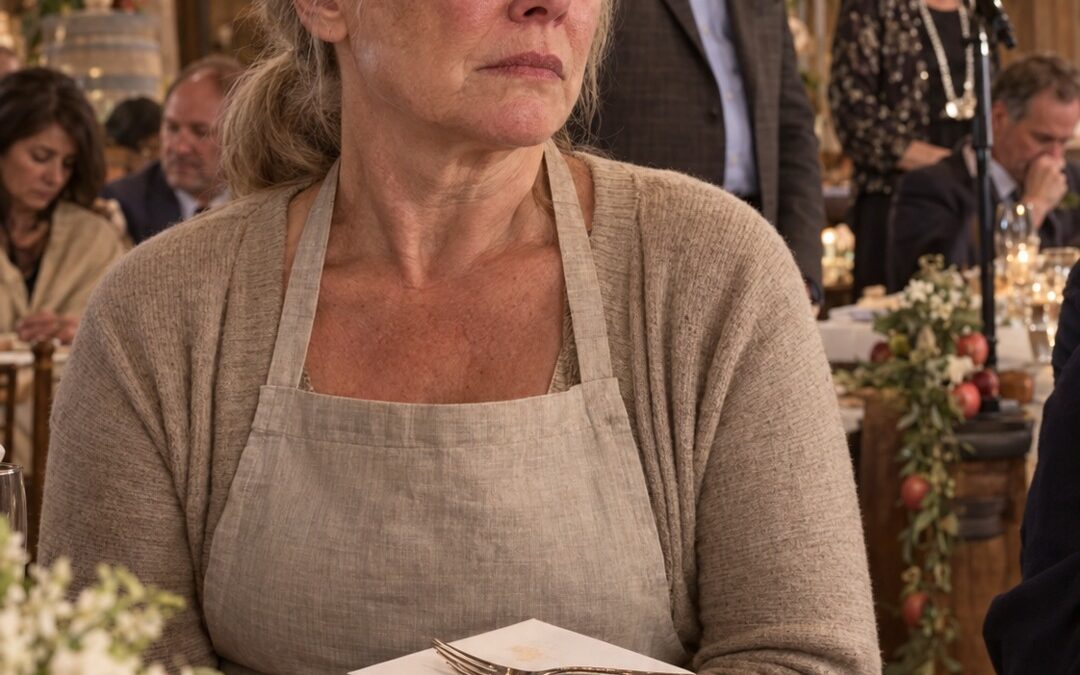
Part 1
My husband waited until Pastor Ed finished praying over the pie, then pulled a long white envelope out of his good sport coat and set it on my slice of Dutch apple. "I filed for divorce yesterday, Jo," Wes said, loud enough for all eighty people at our orchard's hundredth-anniversary supper to hear. "You've got forty-eight hours to get out of my mother's house."
Before I could touch it, my mother-in-law, Rika, leaned into the microphone I'd hooked up for her that afternoon. "Thirty-one years you kept our books, Johanna," she said. "You were never once in them."
She got my name right, at least.
Ten minutes before that, Wes's sister Kristen had walked up to the easel by the old cider press in her green church dress and pulled a tablecloth off it. Underneath was a painting of three hundred houses standing where our trees stand. VANDERMOLEN ESTATES, in gold letters across the top. Cobblestone Homes was buying the whole orchard, she said, and they'd close on October tenth "right here in this barn." A few people clapped. I think they didn't know what else to do with their hands.
I didn't get up. I said it from my chair, to Rika, loud enough for the head table and no louder. I've called her Mom since the week I married her son, and she's never told me to stop or to keep on.
"Mom, Dad said never for houses."
Dad was Gerrit, Wes's father. He ran this orchard for fifty years and he's been gone since February of last year.
Kristen took the microphone back. "She's been bleeding us eighteen hundred a month for three years on her little loan."
Then Rika asked Pastor Ed to pray before the pie. To settle everybody down, she said.
Nobody was settled. I'd typed that guest list of eighty myself, on the office computer with the sticky E key, so I knew where every one of them was sitting. Sharon DeVries, who always brings the scotcheroos to funerals, was at table four because of her hip and the restroom. She had her spoon in her coffee and wasn't stirring it. Craig Pettinga, the buyer from Cobblestone, a tall man in a blue quarter-zip with the company name stitched on it, was two chairs down from me at the head table because Kristen had insisted. He was looking at his pie.
The envelope had Hollander Law printed in the corner. That's the firm of Todd Hollander, Kristen's husband. The butter from the crumb topping was already soaking into one end of it, a dark spot about the size of a quarter.
Wes was still standing over me in the sport coat. I'd bought it at Meijer last Christmas, on sale, because his old one pulled across the shoulders every time he reached for the salt.
"Did you hear me, Jo?"
"I heard you, Wes."
Kristen leaned in to the microphone again. "I built this barn's business from nothing, and after three years of it sliding, the numbers don't lie. Cobblestone's keeping it for the clubhouse."
I knew those numbers. I'd typed every one of them, ninety-six thousand the first year and forty-five and change the last two, and I'd never figured out how, with the parking lot full every Saturday I could remember.
"Johanna." Rika had both hands on the microphone stand. "You'll not make a business of this. Wesley's decided."
I looked up at Wes. "Have you?"
He rubbed the side of his nose. He does that when the feed bill comes. "Jo. Don't start."
"I'm asking you."
"Yes. I've decided."
"All right."
That bothered Kristen more than if I'd thrown the pie at her. "That's it? After everything this family's carried you?"
Somewhere in the back a folding chair scraped on the concrete. That was the only answer she got.
I looked at the painting properly then. They'd started from the drone picture we paid four hundred dollars for, for the website. The driveway off 10 Mile Road was a street with sidewalks, and where our foreman Tomás parks the picking trailers every October there was a little blue pond with a fountain in it. Nobody had asked me if they could use that picture.
Then Abby came out from behind the cider-and-donut table by the barn door. She's Kristen and Todd's girl, twenty-four, flour up to her elbows, still in the black apron with the orchard logo on it. She walked the whole length of the barn, past table four and the cider press and her mother's easel, and stopped next to my chair. Her ponytail had caught in the zipper of her sweatshirt. She worked it loose while eighty people watched her do it.
"Abigail. Sit down," Rika said.
"No, Oma."
Oma's Dutch for grandma. She didn't sit. She stood beside me with her hands in her apron pockets, and I could smell the cinnamon sugar on her.
I lifted my fork off the envelope and laid it on my napkin. I folded the envelope once, grease and all, and put it in my apron pocket.
"Forty-eight hours," I said. "All right, Wes."
I pushed my chair back and walked down the center aisle, past the easel with the three hundred houses on it, and out through the big sliding door. The handle was sticky. Somebody had spilled cider on it before supper and I'd meant to wipe it down.
The lane was still wet from the rain. I walked home under the Northern Spy row, the oldest trees on the place, the ones Wes's great-grandfather Klaas put in when the farm was new. Our house is the first thing off 10 Mile Road, a white farmhouse from 1894 with a porch Wes has been promising to paint since the Clinton administration. The barn and the press and the store and the packing house are strung out behind it, and then the lane runs on half a mile through the orchard to Rika's ranch house at the very back.
I married Wes on June 13, 1992. I was twenty-four, a girl from Allendale who'd spent four years as a recording clerk at the Kent County Register of Deeds, stamping deeds and telling farmers which book their great-uncle's forty was in. Rika had wanted him to marry the Bylsma girl, who came with eighty acres next door and knew how to prune. At our reception I went to get more ice and heard Rika by the punch bowl, talking to somebody's aunt.
"Well. She'll keep your books, at least."
I did. Gerrit hired me in 1995, after his last bookkeeper had been writing checks and not entering them. Thirty-one years, after that.
Rika has a big Bible in her front room with a page at the front called Family Record. Births, marriages, deaths, most of it in her handwriting. When Kristen married Todd in 1996, Rika wrote Todd in and asked me to find her a pen that wouldn't bleed through. I found her one. My name isn't on that page. I asked her about it once.
"I know when you were married, Johanna," she said, and shut the book.
We never had children. We painted the little room upstairs yellow in 1994, and Gerrit built us a cradle with curved rockers. It's still in that closet.
Then the hail. Eleven minutes on a Thursday afternoon in August, three summers ago, like somebody pouring gravel on the roof, and most of the crop was on the ground by supper. A few weeks after that Gerrit was at my kitchen door at two in the morning with a letter from Lakeshore Farm Credit in his hand. He was eighty-one, and he'd driven himself down the lane in the dark, which Tomás had told him a hundred times not to do.
"Seven hundred thirty-eight thousand six hundred," he said. "Or they take all of it."
It was the loan for fixing up the barn. He'd put the whole farm behind it.
I made coffee. He didn't drink it. He kept running his thumb over one corner of that letter until there was a gray smudge on it.
"Jo, you're the only one in this family who'd never sell it for houses."
"Have you told Rika?"
"I'll handle Rika."
That October, Tomás drove us both to West Ridge Title in Sparta, because Gerrit's knees were bad by then. The girl at the front desk had a plastic pumpkin full of Tootsie Rolls. Gerrit brought his black Parker fountain pen. Halfway through the signing he looked at me over his glasses.
"Go get us coffees from the bakery on Division."
"We just had coffee."
"Get more. And one of those cinnamon things."
There was a line. I was gone twenty minutes. When I came back, Marcia Dykstra, the lawyer, was packing up her notary stamp, and Gerrit handed me a brown kraft envelope, sealed. On the front, in his square carpenter printing: For the hundredth. Jo reads it. Not before.
"Don't tell Rika," he said. "I'll tell 'em myself at the hundredth."
On Monday I drove the papers to the county myself. Old habit from behind that counter. If it isn't recorded, it didn't happen.
He passed in his sleep a year and four months later. He never told anybody. And I'd promised.
At 10:20 Wes came in our back door with a black duffel bag. Kristen came in behind him, and behind her was Todd, in a golf shirt and a navy jacket, with a leather portfolio under his arm. Todd does divorces in Grand Rapids. He has very white teeth.
Wes went upstairs without a word. I heard drawers.
Kristen stayed by the counter. "We need the office laptop."
"It's on the desk."
"And your keys. Office, barn, store. All of them."
I took my work ring out of the drawer by the fridge. Nine keys. "The little brass one's for the label cabinet. It sticks. Pull the door toward you first."
She dropped them in her purse without looking at them. "And your QuickBooks password."
I wrote it on the yellow legal pad. Then the payroll login under it, because she'd need that too and wouldn't think to ask until Tuesday, when nobody got paid. She stood behind my chair and read every letter as I wrote it.
Todd was looking up at the ceiling, where Wes was dragging something across our bedroom floor. "Jo, cooperation here makes this easier."
"For who?"
"For everybody."
"There's half a pot of coffee. Everybody can have some."
Todd checked his watch instead.
Wes came down with two shirts hanging out of the duffel and a pair of jeans under his arm. "You want your navy sweater?" I said. "Your mother keeps that house cold."
"Jo. Quit that."
"Quit what?"
"Acting like it's a regular Saturday."
"You're the one packing, Wes. I'm asking about a sweater."
He went back up for it.
Todd pulled out a chair without being asked and sat. "The envelope at supper is your copy of the complaint. Have you opened it?"
"It's in my apron."
"I'd suggest you open it."
"It got me home with butter on it, Todd. It'll keep till I've washed up."
Kristen had the laptop open on the counter by then, clicking through the shared calendar faster than I could follow. "Why are you still an administrator on Square?"
"Because I set it up. Seven years ago."
"That changes tonight."
"All right."
"No, Jo, not all right. You've been deciding things for this family for years and nobody asked you to. What gets paid, what doesn't, what Mom can sign. You act like you're the one who owns this place."
Todd was studying the window over the sink.
"We came for the passwords, Kris," he said.
She shut the lid. "And stay out of the event calendar. That was never your business."
I put the pencil down next to the pad.
On a Friday in August I had asked her about that calendar. Six Saturdays that summer were marked FAMILY HOLD, right in the thick of wedding season, while the barn money kept going down. "Church kids. Dad's rule," she'd said. And it was Gerrit's rule, I'll give her that. If a young couple from church couldn't afford the barn, he let them have it for nothing and they swept up after. Two summers back, when he was still alive, I'd asked him about a few of those Saturdays myself. He was in his recliner with the heating pad on his knee. "Kristen cleared it with me," he said. "Church kids." He was tired, and I believed him.
Wes came down with the sweater over his arm. He set his house key on the counter. Then he picked it up again.
"Should I leave this?"
"Keep it," Kristen said. "We may need to get in."
"Wes, you've lived here thirty-four years," I said. "You don't need your sister to tell you whether to keep a key."
"Can you two please just stop?" He put it in his pocket.
Todd took a card from his jacket and laid it on the table beside my legal pad. HOLLANDER LAW PLLC. "Have your attorney call me," he said. "If you have one."
"Thank you, Todd."
He stood there a second longer, waiting for more. I moved his card on top of the phone bill.
Wes's Red Wing boots were on the rubber mat by the back door, toes to the wall, where he'd parked them every night for thirty-some years. He'd worn his good shoes to the supper.
"Your boots, Wes."
"I'll get 'em."
He went out without them. I heard his Silverado start, then Kristen's white Tahoe, then Todd's Lexus last.
I sat down at the kitchen table with my own computer, an old MacBook with a crack across one corner, and plugged it in next to the toaster.
Kristen had my keys. She didn't have my login yet, and I'd run that Square account for seven years, every cider donut and every deposit and every refund. It opened like any other night. I picked the full date range and hit download, and then I exported the shared calendar too, every wedding and church supper I'd ever typed in.
While the bar crawled across the screen I got the envelope out of my apron and opened it, finally. Complaint for Divorce. Eleven pages. The butter had gone all the way through to page three. I flattened it under the sugar bowl so the corner would quit curling.
The files finished. I copied them onto the little USB stick I keep in the empty flour canister in the pantry, where I back up the books every Sunday night, and I had it back in the canister with the lid on when my email dinged. You've been removed as an administrator from Vandermolen Orchards.
I texted Marcia before midnight. Can you see me at 7? Bring the October file.
She wrote back before I set the phone down. My kitchen. Coffee's on.
There were empty boxes in the basement from the canning jars, and I knew exactly which drawer Wes keeps the packing tape in. I didn't go get either one.
I went upstairs instead, to the cedar chest under the front bedroom window. I lifted out two wool sweaters, the Christmas table runner, and the blue blanket my mother gave us when we got married. Underneath was a blue file folder with a bent metal clip.
I carried it down to the kitchen and opened it under the light over the stove.
Gerrit's envelope was tucked inside the front flap. For the hundredth. The hundredth was October tenth, two weeks off. I left it sealed.
The first page had the county's recording stamp across the top, book and page, the same stamp I used to ink myself at that counter when I was twenty-two. I didn't have to read the heading to know what it was. I smoothed the crease with my thumb anyway.
Grantee, it said, in the county's typeface: Johanna B. Vandermolen. And stuck to the corner, in Gerrit's square carpenter printing on a yellow note I'd forgotten was there: Not a loan, Jo. Don't ever let them call it one.
Part 2
Marcia Dykstra was at her kitchen counter at seven on Sunday morning, cutting a cinnamon roll into quarters with a butter knife.
"Cream's in the door," she said. "Don't touch the milk. It's turned."
She's sixty-six, she's done property and estates in Sparta for longer than Wes has had gray hair, and she chews nicotine gum because she quit the cigarettes but not the habit of having something in her mouth. I set my blue folder down next to her toaster. Her eyes went past it to the white Hollander Law envelope sticking out of my purse with the grease spot on one end.
"Well," she said. "That explains the midnight text."
We sat at her table. Out the window her neighbor was dragging his garbage can back up from the road in his bathrobe. I told her all of it, the easel and the houses and the pie, and Rika at the microphone.
"Into the microphone?"
"The one I hooked up."
Marcia stopped chewing for a second. Then she opened the folder and laid the papers out between our cups, one at a time, the way I used to at the county.
The deed went on top. Marcia tapped the words sole and separate with her gum wrapper. "That's you, Jo. Wes doesn't come into it, and neither does his mother."
"I know what it says, Marcia. I carried it up there."
"I'm saying it out loud because Todd Hollander seems to have missed it."
She set the appraisal beside it, and the statements from the account where my half of my mother's dairy money had sat since Mom's dairy sold, and then the bank's release, and she had to move the sugar bowl to fit them all. She put her finger on the release.
"A million-twenty for a seven-thirty-eight debt. Nobody lends that way, Jo. You bought it. The operating agreement gave Gerrit, as managing member, the say on any parcel sale. Fifty-one percent. Rika didn't have to be in the room."
"She wasn't."
"Mm." She slid the lease out last and found the rent line with her nail. "Eighteen hundred."
"I set it low."
"I can see that."
"It's still family, Marcia."
She looked at the ceiling. Then she tapped the survey sketch stapled to the back of the appraisal, the one with 10 Mile Road drawn along the bottom edge and nothing but neighbors and the old rail line around the rest.
"Jo, without your forty, nobody gets a cement truck onto that ridge. Rika can't get her Buick home without crossing your yard."
I hadn't ever thought of it that way. Thirty-four years I'd watched Rika's Buick go by the kitchen window twice a day.
"Their three hundred houses," I said.
"Need an entrance. Your forty's the only place to put one."
I turned my MacBook around and opened the books to October, three years back. Sale of Home Parcel, $1,020,000. She scrolled down through the rent checks, a row a month, and on to the vendor list at the back, and stopped where it said Landlords with my name under it.
"Who signs?"
"Gerrit did, till he passed. Mom's signed every one since February last year."
"Without asking what it's for?"
"She signs what I put in the folder. She always has." For sixty years Gerrit did the reading in that house and Rika did the signing, and when he died she just kept on with her half of it.
Marcia set her cup down.
"Then your books are right and their heads are wrong. Don't you breathe the word deed. The deed's recorded, it'll keep. The money won't."
I clicked over to the two files from last night. The Square reports. The calendar.
"Don't open those in anything that saves over them," she said. "What are you looking for?"
"I don't know yet. The barn numbers bother me."
"Then find out why. Quietly."
She wrote two paragraphs on a legal pad for me to send Todd from my own email. I live in my home. Any attempt to change the locks or shut off the utilities will be treated as an unlawful lockout under Michigan law. That was the gist. She made me copy it in my own words and then changed most of my words back.
At the door she touched the brown envelope where it stuck out of the folder flap.
"Still sealed?"
"Still sealed."
"Good. Read it on the tenth."
"That's two weeks."
"I can count, Johanna." She wrapped a piece of cinnamon roll in a napkin and pushed it at me. "Eat something before church."
Fruit Ridge Reformed smelled the way it always does on a Sunday, floor wax and the big coffee urn going in the basement. Wes's Silverado was parked next to Rika's Buick.
Kristen was in my seat.
Ever since Gerrit's knees went, I'd sat on the aisle end of the fourth pew on the left, next to Rika, so I could get her up for the hymns. Kristen was there with her purse and her jacket spread across the cushion beside her.
"Morning," I said.
Rika looked at her hymnal.
Kristen moved her purse about an inch. "Morning, Jo."
I sat two rows back, next to a couple from the supper. The wife gave me half a smile. Her husband read the bulletin front to back, twice, and there's not that much in it.
When Pastor Ed asked for prayer requests, Kristen put her hand up.
"Could we pray for my brother Wes? He's in a hard season, with a wife who won't let go."
Somebody coughed. Pastor Ed looked at Kristen for a second longer than he needed to.
"We'll pray for the family," he said.
I watched the back of Wes's neck for the whole sermon. He never turned around.
At coffee time in the fellowship hall there was banket on the long table, the Dutch almond pastry somebody always brings, and powdered donuts on paper plates. I stood by the urn I'd filled at eight-fifteen. Two women from the kitchen committee came toward me, saw me, and found something they needed on the other side of the room. A woman I've driven to her eye appointments for three years said "Oh, Jo," and went to get her coat.
Then Sharon DeVries came through all of them with a paper napkin in one hand. She didn't say a thing. She took my hand in both of hers. Her fingers were warm from her cup. She held on longer than people do, and then she let go and went to find her husband.
I threw my cup away and drove home.
The forty-eight hours ran out Monday night at twenty to nine. I was on the porch swing with a cup of coffee and Marcia's email printed out on two sheets, when Kristen's white Tahoe came up the lane with Wes in the passenger seat, and behind it a blue van that said Sparta Lock & Key.
Larry Kamps got out of the van. He's sixty-four and wears a Tigers cap over his white hair, and he's done every lock on this farm since before Abby was born.
"Evening, Jo."
"Evening, Larry."
Kristen pointed at my front door. "Those. Front and back."
Larry glanced from me on the swing over to Kristen.
"Kristen, whose name's on this house?"
"The family's."
"That's not what I asked you."
"My mother owns this orchard."
I drank my coffee. Larry put his toolbox back in the van and shut the door on it.
"I don't lock wives out," he said. "Not without paper."
Kristen held up the divorce papers. "Her husband filed."
"That's not paper for this."
Wes stood at the bottom of the porch steps holding a cardboard box. "Jo. Can't we work something out?"
"What's in the box?"
"Some of my things."
"Then bring them in."
"Wes," Kristen said. He stayed where he was.
She called the sheriff. It took twenty minutes. Deputy Josh Vanderwall was thirty-six and built like he still played Saturday softball, and he had a ballpoint clipped in his shirt pocket that he clicked while Kristen talked. When she ran out, he came up two steps.
"Ma'am, do you live here?"
"Since I got married."
He turned around to Kristen. "She lives here, ma'am. Civil matter. Get a court order."
"Her husband—"
"Filed for divorce. I heard. That's not an order to remove anybody." He handed me his card. "Anybody tries to change these locks without one, you call us."
Larry tipped his cap to me on the way out. "Sorry to be part of it, Jo."
"You weren't, Larry."
Kristen stood by the Tahoe with her phone lit up in her hand.
"Enjoy it," she said. "Twelve days."
Wes put his box back in her car. I didn't say anything about the boots. They were still on the mat inside the back door. He knew where they were.
At 11:02 that night my phone buzzed. Abby. Four pictures, nothing else.
The first was papers spread on Kristen's kitchen island, a coffee mug holding down one corner. I spread my fingers on the screen. Purchase Agreement. Cobblestone Homes. $4,600,000. All 212 acres, "including the Home Parcel (residence, cider barn)." Closing: October 10, at the Cider Barn.
The second page. Seller shall resolve all title objections prior to Closing. Seller shall deliver all residences vacant. Seller shall provide three (3) years of financial statements prior to Closing. And at the bottom, Rika's signature, which I'd know anywhere, because I'd watched her put it on my rent check every month since February last year. Friday, September 25. The day before the supper.
The third picture was an email Kristen had sent to Cobblestone, printed out. The Home Parcel is currently titled in Johanna Vandermolen's name as security for a small family loan, which will be paid off from proceeds at closing.
I made that sentence bigger and bigger until it filled the phone.
I called her. She picked up before it rang twice.
"Aunt Jo?"
"Where are you?"
"Upstairs. Mom left it all on the island and went to bed. Dad's in the den with the Lions game he recorded."
"She doesn't know you took these."
"No."
"Abby, the fourth picture."
The fourth was a sheet off a Lakeshore Farm Credit notepad in Kristen's round handwriting, the kind that dots its i's with little circles. 4.6 at the top. Under it, Wes 1.2 (house EMPTY), underlined. Me 1.5. Mom the rest.
"That's your mother's writing," I said.
She was quiet. I could hear the game through the floor.
"She did it at the island Friday night after Oma signed," she said. "Oma promised Uncle Wes one point two if the house is empty. Mom gets one point five."
I set the phone down on the table and turned on the speaker.
"Why are you sending me this, honey?"
"Because you taught me ledgers at the donut counter when I was nine," she said. "You said if two columns don't agree, somebody's got to go find out why."
"Don't delete anything," I said. "And don't fight with your mother tonight."
"Okay."
I sent all four to Marcia. Then I opened the second picture again and spread my fingers on it till there were only two lines left on the screen. Seller shall deliver all residences vacant. And under it, in the blue ink she keeps in her purse, Hendrika Vandermolen.
Part 3
Bernice Kuiper was eating a hard-boiled egg over the wastebasket when I came into the Register of Deeds on Monroe Avenue at nine Tuesday morning. She's seventy now, part-time, still in the tortoiseshell glasses on a chain she wore when she trained me.
"Jo Brinks," she said. "What do you need, hon?"
"Certified copies. My deed, and the lease."
She didn't ask why. That's the reason I'd driven down and not called. She brought the embosser down on each one with that little crunch I hadn't heard in thirty-four years, and then she sat looking at her screen with her pen in her mouth.
"A title company out of Grand Rapids looked up your land yesterday afternoon," she said. "Grand River. Somebody's buying something, Jo." She tapped the screen with her pen. "Bank's release is recorded right behind your deed, hon. Nothing on it since."
At three that afternoon I found Tomás Alvarado in the packing house, up on the platform with the side panel off the sorting line. He's seventy-one and he's been our foreman for thirty-eight years, and he keeps a little notebook in his shirt pocket so worn out it needs a rubber band to hold it shut.
"You're about to lose that screw," I said.
He looked down. It was rolling toward the edge. "Ope." He caught it and dropped it in a coffee can. "You came to help, mija?"
"In these shoes?"
"Good. You count every part I take off and then you tell me where they go." He climbed down slow, one knee at a time.
The line was quiet. Honeycrisp was done, and the Spies weren't ready.
"Kristen told the crew this morning," he said. "All eleven. They're done after the tenth. New owners don't need apple pickers."
"She told them that already?"
"Before coffee. They're asking me about last checks. Half of them have kids in school." He pulled his gloves off finger by finger. "I heard about Saturday."
"I think Grand Rapids heard about Saturday."
"Wes should've done that at home."
"That would've been nicer."
He took the notebook out of his pocket, looked at the rubber band, and put it back without opening it.
"I drove Gerrit to the title place that October. You remember."
"You sat in the truck."
"Mostly. When you went for coffee he called me in. I stood in the corner and held my hat." He worked his thumb at a split in his glove. "In the truck after, I asked him what all that was about. He said, 'When I'm gone they'll call it a loan, so I'm putting it on the TV.'"
"On the TV?"
"That's what he said."
"What TV?"
"Ask him. Then he told me to watch the road and mind my business, so I did."
I thought about the bakery line on Division, and how Gerrit hadn't touched his cinnamon roll. I couldn't make it come out to anything.
"There's another thing," Tomás said. "The year before the hail. You and Wes were up north that week. Mail came for Kristen to the office, big envelope from some house company, Personal, Kristen Hollander on it. Gerrit didn't have his glasses on. He opened it."
"What was in it?"
"I didn't see. I came back from the south block at noon and he was sitting in his truck with it in his lap. Sat there till four. Didn't eat. I asked did he want a sandwich and he said leave him be." Tomás folded his gloves together. "He never said a word about it after."
"Tomás. If somebody asks what you saw that day in Sparta. Would you tell them?"
"I'll say it in front of anybody, mija." He pointed his gloves at me. "Now go eat something. You've got your tax-time face on."
Abby came Wednesday at seven with a shoebox under her arm.
"Can we use the table?"
"That's what it's for."
She didn't smile. She took the lid off and laid nineteen contracts out in rows, the way I'd taught her to lay out invoices when she was nine and had to stand on a milk crate to reach the counter. Every one said Hollander Events LLC across the top. Wedding reception, Cider Barn, a Saturday. $6,500, paid in full.
"Hollander Events," I said. "Whose is that?"
"Mom's. Just hers."
She handed me her phone with a text already up. From Kristen, two summers back. Put the Saturday ones on the HE reader. Mark them FAMILY HOLD. Oma knows.
"HE reader."
"A second card machine. It goes into Mom's account, not the orchard's."
I opened the calendar I'd saved Saturday night and we went down the contracts one by one. Every Saturday on every contract was on the farm calendar as FAMILY HOLD, no charge. Church kids. Dad's rule.
And Sharon DeVries. In August, after church, she'd squeezed my arm and said Brooke's wedding was worth every penny of sixty-five hundred. I'd smiled and said I was glad. On the drive home I'd thought, that's funny, Brooke and Ben were a FAMILY HOLD. Then a hay truck pulled out in front of me and I forgot about it.
I found it in the stack. Hollander Events, Brooke & Ben, June 14, last year. $6,500.
Abby had already counted. Nineteen weddings in three summers that never got near my books. I did it on the calculator anyway, because I always do, and it came out $123,500.
I got out last year's barn report and wrote it in pencil in the margin, right next to the numbers Kristen had stood up with at the supper.
"Mom showed Oma the barn numbers," Abby said. "Said sell before it's worth nothing."
She was pulling her sweatshirt cuffs down over her hands. She does that. She's done it since she was little.
"Aunt Jo, I ran every one of those cards. Mom said Oma knew. I believed her because I wanted to."
I didn't say anything soft. She'd have heard right through it.
"You ran them," I said. "That's yours to carry too, Abby. So when it's time, you'll be the one who tells it."
She cried then, the quiet kind, with her mouth shut. I got her a box of Kleenex and didn't hug her, because she'd have stopped telling me things. She stayed. She took a pen and wrote the date and the card number from her own notebook at the top of every contract in her neat night-school printing, and I checked each one against the calendar.
At 9:10 I called Rika.
Five rings. "What is it, Johanna."
"Mom, I need ten minutes about the barn money—"
"Don't you call this house."
Click.
Abby looked at me. I set the phone face down on the table and went to warm up the printer. We made two full sets, contracts, calendar pages, her text from Kristen. One for Marcia in a big envelope. One in the kitchen drawer under the takeout menus, where nobody in this family has looked in twenty years.
Thursday at 4:30 Todd's silver Lexus came up the lane. Kristen was in the front seat. Wes was in the back, like a teenager.
I had the kitchen door open before they got to it. "Come in. There's coffee."
Nobody wanted coffee. Todd put a folder on the table and stayed on his feet.
"Grand River Title sent over their report." He read it the way lawyers read, a little too slow. "Home Forty. Vested in Johanna B. Vandermolen, sole and separate property, by Warranty Deed. Memorandum of Lease to Vandermolen Orchards LLC." He turned the page. "No mortgage of record."
"What does that mean?" Kristen said.
Todd took his glasses off.
"Kristen. There's no mortgage. It's a deed."
"Dad said security."
"That's what you told me."
Wes was leaning on the fridge, right in front of his old spray schedule I'd never taken down.
"A million and twenty thousand," I said. "What the appraiser said. The bank got its seven-thirty-eight, and the rest bought the trees you've been picking."
Wes said, "Why didn't Dad tell us?"
"He said he would. At the hundredth."
"You expect us to believe Dad sold his own house out from under Mom," Kristen said, "and never said a word?"
"I carried the deed to the county myself. Ask Bernice Kuiper."
Wes put his face in his hands a second. "Todd said do it at the supper so you wouldn't make a scene."
"Wes," Todd said.
I looked at my husband. "The pie was Todd's idea?"
"I didn't think it'd go like that."
Kristen talked right over him. "Visser has the books. He hasn't said a word about any sale."
I didn't know any Visser. "My books say sale, Todd," I said. "October, three years ago. Sale of Home Parcel. Every check after that is in Rent Expense, and I'm on the vendor list under Landlords."
"Your entries, your books," Todd said. "You were the only one writing in them."
Then he did something I didn't expect. He sat down.
"I saw your name on the county map in September," he said. "Kristen said security, and I let the title company do its job. I never pulled the deed myself. But your rent's eighteen hundred on a million-dollar parcel, Jo, and your own father-in-law labeled those checks 'J.B.V., Home 40' like a note payment, and Rika's signed every one since February. Every Vandermolen in that church will swear it was a loan."
"October first came and went," I said. "Nobody wrote the check."
"That's not my department."
"It's somebody's."
Kristen had her arms crossed so tight her rings were digging in. "Mom will testify."
"Is that what you want, Wes?"
He looked at the boots by the back door. He didn't answer.
Todd stood up and left the folder on the table. Kristen and Wes never touched the chairs I'd pulled out.
"You've got till the tenth to sign it back, Jo," Todd said. "Or I put every Vandermolen on the stand to swear it was a loan, and we'll see who that church believes."
Part 4
The man who served me had mud on one shoe and a clipboard with a broken clip, and he wouldn't come up past the second porch step.
"Johanna Vandermolen?"
"That's me."
It was four o'clock Friday afternoon. I'd been pinching dead heads off the geraniums, so I took the envelope with sticky green fingers. He was backing his Corolla down the lane before I thought to offer him coffee. My mother would have been ashamed of me.
Kent County Circuit Court. Vandermolen Orchards LLC and Hendrika Vandermolen versus Johanna Vandermolen.
I sat on the porch swing and read all of it, because that's what I do with paper. Todd had written that Gerrit never meant to sell the Home Forty. That what I'd paid was a family loan dressed up as a sale, and my deed was only Gerrit's way of making sure I got paid back. They wanted a judge to let the company hand me my money and take the land. He'd stapled copies of six rent checks to the back. J.B.V. — Home 40, every one, in Gerrit's words and my typing.
Then Rika's sworn statement. Gerrit had called it a loan many times. She had never agreed to sell the home place. She believed I'd taken advantage of his troubles.
I've seen that signature on church envelopes and birthday cards since I was twenty-four. Rika makes her H with one long stroke straight down. This one started fine. By the k it was wobbling all over the line.
I called Marcia. She'd already seen it. "Don't call Rika. Don't sign one thing Todd sends you." I said I wasn't going to call Rika. She said good, she wanted to hear me say it.
I hadn't hung up two minutes when Bernice called from the county.
"Hon, they just recorded something on you."
"What kind of something?"
"A notice that says your land's tied up in a lawsuit. Anybody who pulls your parcel sees it first thing."
I didn't say anything. I could hear her chair creak, and somebody behind her asking about a plat map.
"It doesn't touch your deed, hon," she said. "Your deed's right where you put it."
I thanked her and went in to make a fresh pot, because at six two cars came up the lane, and I knew both of them.
Harlan Mulder got out of the first one. He's seventy-four, one of the elders on our consistory, which is what the Reformed call the board that runs the church, and he taught Wes to drive a stick in the church parking lot. Gord Bylsma got out of the second. Gord is sixty-eight, and his little sister is the Bylsma girl Rika wanted Wes to marry. Of all the elders they could have sent.
"Evening, Jo. Could we have a word?"
"Sit. I've got coffee on."
They took the wicker chairs. Harlan asked for cream, then said no, plain, his doctor had been after him, and took his hat off and held it on his knee.
"We're here at the family's request."
"Which part of the family, Harlan?"
He looked at Gord. Gord looked at my geraniums.
"Rika's very troubled," Harlan said. "These things ought to be settled between Christian people before they ever get to a courtroom."
"She filed this afternoon. I've got it on the swing, if you want to see it."
"We're not here to look at deeds," Gord said.
"Then you don't know what's in them."
"We know you helped Gerrit, and we're grateful." Harlan turned his hat a quarter turn. "So maybe give back what Gerrit borrowed. Make your peace with Rika."
I set my cup on the railing. "Has either of you called Marcia Dykstra? She handled it."
Neither of them had.
Gord cleared his throat. "There's one more thing. The consistory feels it'd be best if you stepped back from setting up the communion table for a while. Just while there's trouble."
I've set out those little cups for nineteen years. I know which tray has the cracked one.
"Is that discipline?"
"Nothing formal," Harlan said.
"Then who's going to fill the cups Sunday?"
"The ladies will manage."
Neither wanted a warm-up. I told them my attorney said I couldn't talk about the land outside of court, and I was sorry they'd driven out for nothing. Gord said he'd pray I'd reconsider. I walked them down the steps anyway, because you do.
After they left I sat back down on the swing with the three cups. Harlan had left a half inch in his. Gord had left a wet ring on the arm of his chair. I sat there until the yard light over the packing house came on, and it's on a timer, so that was eight o'clock.
Wes came alone Monday, a little after seven. He parked the Silverado by the garage and walked up with a manila envelope, and he didn't go around back for his boots. I noticed that.
"Can we talk, Jo?"
"There's coffee."
"I don't want coffee."
I held the screen door anyway. He stayed out on the porch, so I came out to him.
Wes has never done paper. When we bought the Buick he signed wherever the salesman stuck a yellow arrow and asked me in the parking lot what the interest rate was. Now here he was holding one out to me.
"Todd drew it up."
A paper giving the Home Forty back to the company. Payment terms clipped to the front.
"Your million-twenty back, every penny," Wes said. "And two hundred of my share on top. Kristen drops the suit."
"Out of your one point two. If this house is empty."
He scratched at the back of his neck. "Kristen should never have told Abby that."
"You're spending money you haven't got yet, Wes."
"It's a good deal. You could get a place up north. You wouldn't have to work."
"I've worked since I was sixteen."
"That's what I'm saying. You could quit." He held out a pen from the feed store. "Sign it and we're done with all this."
I took it and held the paper flat on my knee.
"Your dad knew what he was signing."
"He was eighty-one."
"He was seventy-nine when he borrowed a million one for the barn. Nobody said boo about his judgment then."
"That's different."
"How?"
He sat down on the top step with his back to me. "Mom never thought you'd own it, Jo."
Every April for three years he'd signed our joint tax return with my rental income printed right there above his name, and he'd never turned back a page to see where it came from. I didn't say that.
"Your dad told her something that wasn't true," I said. "And now you want me to sign because of it."
"You're making this harder than it has to be."
Then he said it, still not looking at me. "You know why Mom never put you in the Bible. You never gave her grandkids."
The Northern Spy by the porch had dropped a few apples on the walk, and the deer had been at them. I looked at that tree a long while. In 1994 Wes held the ladder while I rolled yellow on the ceiling of the upstairs room, and Gerrit was already in his shop with the cradle. Wes knew what was in that closet. He knew why.
I put the pen down on the paper and set them both on the step beside him.
"Your dad trusted me with his signature, Wes. You never once trusted me with yours."
He folded Todd's paper without lining up the creases and stuffed it back in the envelope. "Then Todd handles it."
"That's up to you."
At the bottom of the steps he turned around. "You're really going to fight my mother in court?"
"She's the one who sued me, Wes."
He drove off. I put his pen in the junk drawer with the twist ties.
At nine another set of headlights came up the lane, and it was Abby's little Honda. She had a suitcase with one wheel that wouldn't turn and a Meijer bag with the handles stretched thin. She'd been crying in the car and then fixed her face in the mirror, you could tell.
"Mom read my phone. She saw I sent you the contract pictures." She held it out so I could see. If you love her so much, go live with her. "Dad was in the den. He didn't come out. I called Oma and she didn't pick up."
"Have you eaten?"
"I can sleep on the couch, Aunt Jo."
"You'll sleep upstairs."
I put the chicken soup on and took her up. The yellow room still had the curtains I sewed the summer we painted it. I opened the closet to make room for her clothes, and there was the cradle behind the extra blankets, the way it's been for thirty-two years.
Abby sat down on the edge of the bed. "Grandpa made that?"
"He did."
"Should I move it?"
"I'll get it."
I carried it down the hall to my room and set it under the window. It's lighter than you'd think.
"You're sure?" she said from the bed.
"You're twenty-four, honey. You get to say where you live."
Downstairs the soup boiled over and burnt onto the stove, and I let it.
Thursday at two Marcia had three folders open on her desk in Sparta and a piece of nicotine gum going. She'd filed our answer to Todd's suit that morning.
Then she opened her desk drawer and took out a little USB stick in an envelope with my name on it.
"They called it a loan," she said. "Under oath. Now I can tell you."
"Tell me what?"
"There's a video. Four minutes, from your closing at West Ridge. Deb Bosma shot it on the office iPad. Gerrit asked her to."
"While I was out getting coffee," I said. Gerrit had given me a twenty and told me not to hurry. And Tomás in the packing house, saying Gerrit was putting it on the TV. I'd thought Tomás was getting muddled.
"Gerrit's instructions," Marcia said. "You only get it if somebody in that family ever calls it a loan. And then he wanted it played where Rika can see it. His words." She pushed a paper across. "Deb's signed a statement. When she filmed it, who was in the room, that it hasn't been touched since."
"I can play it for you right now," Marcia said.
I picked up the little envelope off her blotter and set it back down.
"No. I'll see it when Mom does."
Marcia put it back in the drawer and locked it. I'd never seen her lock that drawer.
My phone went in my purse while I was getting my coat on. Sharon DeVries. She'd found Brooke's wedding contract in her husband's file box, the paid-in-full receipt stapled to it. Did I want it Saturday?
"The original, Sharon. Please."
Friday night Abby and I were doing the supper dishes when her phone buzzed on the counter. It was the church group text, and it was from her mother.
Tomorrow 6 PM at the Cider Barn, Jo will make things right with our family. Please come witness.
Abby scrolled. "She sent it to everybody from the supper. Everybody."
At nine my own phone rang. Craig Pettinga.
"Mrs. Vandermolen. Your sister-in-law insisted on the barn tomorrow. We've done stranger to close a deal. But the contract says three years of financial statements before closing, and hers still aren't in. She says they'll be on the table. I've told her if they're not, we don't sign." He stopped a second. "And if that parcel doesn't convey, we walk. Is she right about you?"
Abby was drying the same coffee mug for the third time.
"I'll be there at six, Mr. Pettinga."
After he hung up I got the guest list out of my blue folder and smoothed it flat on the table.
Kristen had invited all eighty of them back to watch me give up. I'd made that guest list myself. I knew every name on it.
Part 5
They'd put the check where my pie plate had been.
Same head table, same chair at the end. Two weeks ago it was a slice of Dutch apple with an envelope on it. Now it was a check for $1,020,000 made out to Johanna B. Vandermolen, and next to it, squared up with the table edge, Todd's paper giving my forty acres back. The man from Grand River Title sat in the middle of the table with three stacks of documents and a stamp pad. Craig Pettinga was two chairs down from my place, where Kristen had put him the first time.
Seventy-eight of the eighty came. I counted from the sliding door. I'd typed the list. The Wierengas stayed home, and Marv Kok is in the hospital with his gallbladder. Everybody else was in the same folding chairs. Sharon DeVries was at table four with a cream-colored folder on her lap. Harlan Mulder sat in the front row next to Pastor Ed and wouldn't look at me. Kristen's easel was still up by the cider press.
Rika sat at the head table in the chair beside the microphone stand. Wes stood behind her in the good sport coat with one hand on her chair. Todd had his leather portfolio open and kept turning his wrist to see his watch.
Kristen had the microphone.
"Thank you all for coming back. I know there's been some confusion in this family, and we're going to put it to rest tonight." She looked down the aisle at me. "Jo's here to give back what Dad lent her. And then we can all get on with the future."
I came down that aisle with Marcia on one side of me and Abby on the other, and Tomás a step behind in a clean blue work shirt and his orchard boots. Marcia had the scuffed brown case she's carried since the Reagan years. At table four Sharon put her hand flat on her folder. I nodded.
"Please sit down, Johanna," Kristen said. "We've got a schedule."
I sat. Todd slid the paper an inch closer.
"Sign, Jo, take your check, and we drop everything."
I picked the check up by one corner. Vandermolen Orchards LLC across the top. Rika's signature at the bottom. This one didn't wobble.
"Your money back, Johanna," Rika said. "Every penny."
I set it down face up.
"Before I sign anything, Dad asked me to read something at the hundredth." I looked at her. "It's the hundredth, Mom."
Rika's back came off the chair. "You'll not—"
"Rika." Pastor Ed didn't raise his voice. "Let her read."
Kristen turned to the title man. "This is a legal closing."
Craig answered for him. "Nobody's signed anything yet. I can wait."
I opened my blue folder and took out the brown kraft envelope. Three years under the sweaters had gone soft on the corners. Across the front, in Gerrit's square carpenter printing: For the hundredth. Jo reads it. Not before.
"That's Gerrit's hand," Rika said.
"Yes, Mom. He gave it to me in Sparta, the day we signed." I held it up so the head table could see the seal. Then I opened it. He'd used too much glue. It tore crooked.
Two sheets of lined paper, folded around a photocopy and a square of old cardboard. Marcia's notary stamp on the second sheet, October 13, 2:20 p.m. I set the other things aside and read the letter into the microphone, because that's what it was there for.
"Rika. If Jo's reading this, it's the hundredth and I didn't make it. I meant to.
"After the hail, I put us in a hole. I put the whole farm up for that barn, nobody made me, and the bank came for it. I sold Jo the home forty. Sold. She paid what the appraiser said, out of her mother's money, which I had no business asking for, and she never asked me for one acre. She asked was there enough left to keep the pickers paid and replant the Honeycrisp.
"I told you it was a loan. I told the kids the same, that Jo's name was on it for security. I lied because I was ashamed. My dad never lost an acre to a bank and I nearly lost two hundred and twelve. Jo told me more than once to tell you myself. I kept saying after the hundredth. That's on me, not her."
Rika had her water glass in her hand. She didn't drink.
The second sheet was pressed harder. You could feel the pen through the back.
"Here's the other thing. Kristen's been talking to house people since '22. A letter came for her the year before the hail, when Jo and Wes were up north. It said Personal. I didn't have my glasses on and I opened it thinking it was the co-op. I should have put it back. I made a copy instead. It's in here."
I unfolded the photocopy. Cobblestone Homes letterhead. Personal — Kristen Hollander. An offer of three million one hundred thousand for the farm, and a signature at the bottom.
Craig stood and held out his hand for it.
"That's mine," he said. "May of '22. You told us your family was talking about selling, Kristen."
"It was a preliminary conversation."
"Your father wasn't talking about selling."
"He didn't know what he wanted," Kristen said.
I found my place again.
"I told Kristen no that summer and I didn't tell Rika, because I didn't want the fight in the kitchen. Another mistake. I picked Jo because she's the only one of you who never once asked me what the ground was worth."
The last lines were small and crowded at the foot of the page, the way his printing got when his hand was tired. I tried them twice and they swam on me. I tilted the page to the light. It didn't help.
Abby came around the table and took the page out of my hand.
"She's been in my books since 1995, Rika," she read. Her voice went up on Rika and she had to stop and start again. "Put her in the Bible. I should have done it myself."
Somebody in the back blew their nose.
The cardboard was an apple crate label, the paper gone the color of weak tea. Red apple, dark green letters. VANDERMOLEN — FRUIT RIDGE — NORTHERN SPY. 1926.
Rika put her hand to her mouth. "We looked for that when they tore the old shed down. Gerrit said it was gone."
"He kept it, Mom." I slid it across the cloth to her. She picked it up by the edges, careful of the torn corner.
Kristen had come around beside the easel. "This is a letter. Dad wrote a lot of things when he was sick."
"There's four minutes more," I said, and nodded to Abby.
Marcia handed Abby the USB stick out of her case, and Abby plugged her laptop into the projector we use for the wedding slideshows, and the screen over the head table came on.
The conference room at West Ridge Title. Gerrit at the table in his blue flannel shirt, a stack of papers under his left hand and his black Parker lying by a Styrofoam cup. He looked straight into the camera, the way he looked at the co-op buyer.
"Deb says it's going. It's October thirteenth. I'm Gerrit Vandermolen, managing member, and I'm doing this while Jo's out after coffee, because she'd tell me not to." He glanced off to one side. "Tomás, quit turning that hat."
Up front Harlan Mulder had his coffee cup halfway to his mouth, and it stayed there.
"A million and twenty thousand, what the appraiser said. The bank gets its seven-thirty-eight, the rest goes in the trees." He tapped the top paper with one thick finger. "This is a sale. It is not a loan. There's no buying it back."
"That doesn't prove—" Kristen started.
"Kristen." Rika didn't turn around. "Sit down."
Kristen didn't sit. She did stop talking.
On the screen Gerrit rubbed his forehead. "Rika, if you're watching this, somebody called it a loan. I'm sorry I let you think so." He looked off to the side. "All right, Deb. That'll do."
The screen went blue.
"I drove him," Tomás said from the aisle. He was holding the same hat. "I was standing in that corner when he said it."
Marcia had her case open. "Deb Bosma filmed it. Her affidavit's in my bag, if anybody wants it."
Rika set the label down and turned in her chair, all the way around, to Todd.
"You put a paper in front of me and said Johanna took Gerrit's land."
"Rika, we relied on what Gerrit told the family."
"Gerrit read the paper. I signed it." She put two fingers on the copy of her sworn statement at Todd's elbow. "Sixty years I signed what that man put in front of me, and then I signed what you did. Take my name off it."
"The suit is already—"
"Take my name off it, Todd."
Todd closed his portfolio and sat back down.
I stood up. "One more thing, Mom. Then I'm going home."
Sharon DeVries was already on her feet at table four.
"My Brooke married Ben right here, June fourteenth, the summer before this one," she said. She held the folder in both hands to keep it still. "Kristen did everything. Hollander Events. Six thousand five hundred dollars, paid in full. I've got the card receipt stapled to it."
I held up the page I'd printed from the farm calendar. "That same Saturday, on the orchard's books. FAMILY HOLD. No charge."
Kristen's hand went to the microphone. "Those were my private clients—"
Abby stepped out from behind my chair and walked right past the microphone to her mother, close enough to touch.
"Mom. I ran the card. Nineteen Saturdays." She was holding the shoebox against her stomach. "You told me Oma knew. I put FAMILY HOLD in the calendar because you told me to type it."
"Abigail, this is family business."
"It's Oma's money." Abby set the shoebox on the head table and took the lid off. Nineteen contracts, the dates and card numbers across the top of each one in her night-school printing. "I should have asked her. I didn't, because I didn't want to know."
Rika looked down at the box. "How much?"
"A hundred twenty-three thousand five hundred," I said. "It never came into your books, Mom. I know, because I keep them."
"I booked those weddings," Kristen said. "I did the work. I built this barn's business from nothing."
Sharon DeVries was still standing.
"From nothing?" she said. "Kristen, honey, I paid you sixty-five hundred dollars to rent your mother's barn. With Gerrit's lights on, and Tomás's boys setting up my tables on orchard time." She looked around table four, and then the rest of the room. "I thanked the wrong woman for that wedding. I'd like that on the record too."
Somebody at table six laughed, one short bark, and put his hand over his mouth. Nobody else did. Marlys Vos, who sang "O Perfect Love" at Kristen's own wedding, turned her chair a quarter turn toward the cider press, so she was looking at the painting and not at Kristen.
Kristen turned to her mother. "You saw the numbers. The barn was dying. I showed you."
"You showed me forty-five thousand," Rika said. "Where's the rest of it?"
Kristen didn't answer that.
Craig had a stapled report in his hand, the one Kristen had laid on the table at six. He stood.
"These came to me at six, before any of this," he said. "Your own accountant, Mrs. Hollander. Page four says 'Sale of Home Parcel.'" He set it in front of Rika.
"We can move the entrance," Kristen said.
"Where?"
She looked at her painting. There wasn't anywhere.
"Hendrika, we're terminating," Craig said. "The parcel doesn't convey, and I'd have liked to know your husband said no."
Kristen's mouth opened. She looked at Wes. "You said you'd help me."
Wes kept his hand on his mother's chair. "I didn't know about the wedding money, Kris."
I took the green ledger out of my folder. I bought it at Staples the week after we signed, and I've kept it in my own desk for the rental income on our taxes. J.B.V. — Rental on the cover in marker. I opened it to the first page and laid it in front of Rika, on top of Craig's report.
Tenants.
Vandermolen Orchards LLC — Gerrit Vandermolen, Managing Member, with a line through it in my blue pen. Under that, in the same pen, Hendrika Vandermolen, Member. Then thirty-five rows. $1,800. Paid. $1,800. Paid. Fifteen under Gerrit's name and twenty under hers, and a blank where October should have been.
Rika bent close to it. I put my finger on Gerrit's name, where I'd crossed him out the week after the funeral.
"You said I was never in your books, Mom. You've been in mine every month since February last year. Under 'Tenants.'"
Rika put her own finger on the line under mine. Her name, in my pen.
"I signed those," she said. "Every one of them." She kept her finger there. "I didn't know what they were."
Kristen sat down in her chair at the end of the head table. Nobody at table four picked up a fork.
Rika stood up. She took the microphone off the stand herself, the same one I'd hooked up for her, and it squealed, and somebody in the back reached over and turned the speaker down.
"Two weeks ago I said a wicked thing in this barn," she said. "I'll say this one louder."
"Johanna bought that land honest. Gerrit said so in his own voice. I put my name on a paper calling her a thief and I never read it. She kept our books thirty-one years, and I signed her rent every month and never once asked what it was for." She stopped. "We did her shameful. I did."
Wes let go of the chair and turned around to the room.
"I put those papers on her pie," he said. "I never read one page of what I handed her."
"Your boots are by the back door, Wes. They've been there two weeks."
He looked down at his good shoes.
Kristen was by the sliding door with her purse. "So it's all on me now."
"Tomorrow," Rika said, "you'll bring me every receipt. And then Marcia and I are going to the bank."
I've seen Rika use that voice once before, on a buyer who shorted her a load of Spies, and she had him in small claims by the Tuesday.
Nobody got up to hold the door for Kristen. She had to set her purse on the floor to drag it open, and it stuck halfway the way it always does. She got it open herself, on the second try. Todd put the check in his portfolio and followed her out with his hands empty. They went out together.
I put the ledger and the letter back in my folder and left the label by Rika's water glass. People moved their chairs to let me by. At table four Sharon caught my hand and held it a second.
Out on the gravel, Craig Pettinga pressed his card into my hand. On the back he'd written $2,000,000, just for the forty, and underlined it twice.
Part 6
The brass sign was still up at the top of the loft stairs Monday morning. Kristen Hollander — Events Director. I'd polished it myself the week the barn opened, because she asked me to, and because I'm the one who knows where the Brasso is.
I stood at the bottom of those stairs at nine o'clock with a bakery coffee whose lid didn't fit. It was my barn. I didn't go up.
Rika had let Kristen go Sunday night, after a whole afternoon at Marcia's with the bank statements, and before she went to bed she signed a complaint with the sheriff. Abby heard it from her Oma on the phone, standing in my kitchen in her socks.
Detective Sergeant Amy Lubbers had come at a quarter to nine. She was sitting at the head table now, where the check had been on Saturday, with a navy jacket over the back of her chair and a little recorder going. Abby sat across from her. At breakfast she'd asked if she ought to wear something nicer for a detective. I said clean jeans were fine.
On the table between them was a black card reader with HE on a strip of label tape, Abby's spiral notebook, and the shoebox.
"In your own words," Lubbers said. "Start with the first one you remember."
"Mom said Hollander Events was her own booking business. Some couples paid her direct. She had me run them on that reader and put FAMILY HOLD on the farm calendar." Abby turned a page. "Nineteen. Six thousand five hundred each. I knew it went to her account and not the orchard's. She told me Oma knew."
"Did you ever ask your grandmother?"
"No, ma'am. I should have."
"Were you paid?"
"Mom paid me for those Saturdays. It's all in there, the hours and what she gave me. I want to pay it back."
Lubbers wrote that down. Then she held open a plastic evidence bag, and Abby put the reader in it herself, and then her notebook, and pressed the seal shut with her thumb.
That's when Kristen came down the stairs with a box that said OFFICE SUPPLIES in my handwriting.
She stopped two steps from the bottom, her eyes on the bag in Abby's hands.
"You're handing my business records to the police."
Abby stood up. She didn't come around the table, but she stood. "They're not your business, Mom. That was Oma's barn and Oma's lights. I ran the card. I'm not going to say I didn't."
"After everything I did for you."
"You told me Oma knew," Abby said. "You looked right at me and said it."
Kristen came down the last two steps and set the box on a folding chair. "Enjoying this, Jo?"
"No."
"You could have stopped it."
"Mom asked you for the receipts Saturday, Kristen."
The side door opened and Todd came in. No briefcase, no tie, and his good shoes were gray from the lane. He didn't look at his wife first. He looked at Marcia, who'd been sitting by the projector with her case on her knees since before I got there.
"The suit's dismissed," he said. "I filed it at eight-oh-one. The notice at the county's released." He handed her a copy.
Kristen turned around. "You dropped it? Without calling me?"
"Rika took her name off it Saturday night, Kris. In front of the whole church. There's no client."
"There's me."
"You were never a party." He said it tired, to the floor. "And I can't represent you on the other thing. I didn't know about Hollander Events. I didn't know there was an account."
"You're my husband."
"I found out from your daughter's text messages," Todd said.
Kristen sat down on the folding chair, right on top of her box. The lid caved in. She stayed there.
Todd turned back to Marcia. "I'm off Wes's divorce too. As of today."
Marcia nodded and put the paper in her case. Then she took out two stapled sets and held them out to him.
"Our motion for sanctions, Todd. You had Grand River's report saying no mortgage of record, and you still had Rika swear it was a loan. You didn't call West Ridge or me." She tapped the second set. "And my copy of what went to the Attorney Grievance Commission this morning."
Todd took them. He read the first page standing there, and he kept his mouth shut. Then he went and sat in the front row, by himself, about where Harlan had sat Saturday.
Kristen got up off the crushed box and went back up the stairs. I heard her open the desk drawers one at a time, then a screwdriver going in the wall. She came back down with the brass sign in one hand. Up there on the white pine was a clean rectangle where it had kept the sun off for five years.
"I worked every Saturday in this barn for five years," she said. "You know I did."
"I know you worked hard at it."
"Every bride who couldn't find 10 Mile Road called my cell phone. Not yours."
"That's true, Kristen."
She put the sign in the crushed box. Then she dug in her purse and came out with a key ring, and I knew it before she held it up. My work ring. Nine keys. Barn, office, store, the press room, and the little brass one for the label cabinet that sticks.
"Here. This is what you wanted."
I took it.
"You did this," she said.
"You did. I just wrote it down."
I turned around and held the ring out to Abby. She took it in both hands.
"The brass one's the label cabinet," I said. "Pull the door toward you first."
Lubbers had her jacket on. "Mrs. Hollander. Your mother signed a complaint yesterday about a hundred twenty-three thousand five hundred dollars. I'd like you to come down to the station with me and go through those accounts. The prosecutor will decide on charges after that. Embezzlement, most likely. And restitution either way. The Hollander Events account was frozen at nine this morning."
Marcia handed Kristen an envelope. "From your mother. One hundred twenty-three thousand five hundred dollars back to Vandermolen Orchards, in full, by November thirtieth."
Kristen held it without opening it.
"Am I under arrest?"
"I'm asking you to come in."
Kristen looked at Todd in the front row. He stayed in his seat.
"Get your own lawyer, Kris," he said. "I'll give you some names."
She put the box in the back of the white Tahoe herself. Then she walked across the gravel to Lubbers's car and got in the passenger side. Nobody touched her. I want that said. Abby watched from the big sliding door until the car turned onto 10 Mile Road, and then she went and washed the coffee cups.
I walked home up the lane about ten.
Wes's Silverado was parked by the garage. He was on the back step putting on his Red Wings, the old ones, laces broken and knotted in two places. He'd had them on that mat by the door for sixteen days.
He stood up when he saw me. He had the house key in his hand, the one with the red plastic tag I put on it years ago so he'd quit grabbing the packing house key by mistake.
"I'm not going to need this," he said.
He didn't hand it to me. He set it on the porch railing, right by the Northern Spy, and took his hand away.
"I'm sorry, Jo."
"I know you are."
"Todd said before he quit me it'd be a couple months yet. The divorce."
"Michigan makes you wait sixty days. I'm not fighting it, Wes. I just want the forty."
"It's yours." He came down off the step. "It was always yours. I just never read anything."
He didn't go back to his mother's. He drove out the lane to the north block, where Tomás had the crew on the ladders, and nobody had told him to.
The key sat on the railing all afternoon. I didn't pick it up until supper.
At four o'clock I stood in the packing house with all eleven of our men and Tomás and Abby, and called Craig Pettinga back on speaker.
"Mrs. Vandermolen. Any thoughts on my number?"
"No, Mr. Pettinga. You could put another zero on it and I'd still be standing in this packing house."
He laughed a little, not mean. "Understood. I won't call again."
I put the phone in my pocket.
"Nobody's getting laid off," I told them. "Same pay, same insurance. The orchard isn't sold and it isn't going to be."
Rudy Salinas, who's run the sorting line nineteen years, put his hand up. "The Honeycrisp block too? Kristen said that one was going first."
"The Honeycrisp block too, Rudy."
Then I heard the golf cart. Rika came down the lane from her place, the way she has to, across my forty, with a Meijer bag on the seat beside her. She parked by the loading dock and carried the bag in herself.
"Banket," she said. "I didn't know how many."
"Fifteen, with you."
"Then we'll cut it small."
Out of the same bag she took a frame wrapped in a dish towel. It was the 1926 label. She'd had it put behind glass in Sparta that morning.
"It goes where people see it," she said, and gave it to me, not to Tomás.
She stood there with her hand on the back of a folding chair. "I want you to run it, Johanna. All of it. The books, the store, the barn."
"I'll keep the office and the books," I said. "Tomás has the trees. Abby can learn the barn, as long as every deposit comes across my desk."
"And Wesley?"
"He came and found me at eleven," Tomás said. "Asked for a ladder. He can still prune."
Rika looked out the loading door at the lane. Her ranch house is half a mile up it, and every trip she makes to town goes through my yard. I knew what she was about to ask, and she knew I knew, and she still couldn't get it out.
"That lane's yours to drive as long as you want it, Mom."
"Ja," she said. "Well." And she went looking for a knife.
While she was cutting the banket my phone buzzed. Harlan Mulder, to say the consistory had been wrong to send him out on my porch without knowing the facts, and would I set up the communion table Sunday. I said I'd be there at eight.
Tomás had a nail already in the office wall from the feed calendar. I hung the label on it and Abby stood back and told me it was crooked, and it was.
Saturday morning I drove up the lane at nine, past the barn, past the press and the last row of Spies, all the way to the end.
Rika had called Friday night. "Coffee time tomorrow, Johanna. I have something."
Her LaCrosse was by the garage. The kitchen hadn't changed since they built the place in 1978. Yellow oilcloth on the table. Oak cabinets. The clock over the stove that runs three minutes fast, because Gerrit said it got him to church on time and then never let anybody fix it. She had the percolator going and a plate of banket cut in uneven pieces, and the family Bible was already on the table, open.
"Sit down."
I sat. She poured me coffee and put the cream by my hand without asking.
The front pages were crowded. Births, deaths, marriages, a hundred years of them in four or five different hands, Kristen married Todd Hollander, 1996. Abby squeezed in between two older lines because Rika wanted the dates in order. My name wasn't anywhere.
Rika took the black Parker out of her apron pocket. "I had it cleaned at the shop in Sparta. It was leaking."
"It always leaked when he pressed too hard."
"He pressed hard on everything." She tried it on the margin of the church bulletin. It wrote fine.
I ran my finger down the marriages. "Wes and I are getting divorced, Mom. You know that."
"I know it."
"Even now?"
She took her reading glasses off and folded them.
"It happened. It goes in."
She pushed her cup back from the edge of the Bible. "You had those little buttons down the back of your dress. Your mother sat up half the night taking up the hem."
"She did."
"And I stood by the punch bowl and said what I said." Rika looked at the page, not at me. "I knew you heard me. I was glad you did. Thirty-four years I was glad. That's mine to carry."
I didn't tell her it was all right.
Rika turned the Bible around on the oilcloth so it faced me and slid Gerrit's fountain pen across. "You write it," she said. "Your hand's steadier than mine." So I wrote it, right under Gerrit's name. Johanna Brinks Vandermolen. Married June 13, 1992.



