My Husband Said “We’ve dragged my wife around nine holes”—Then I Asked to Count His Score
Part 1 — LAST PLACE
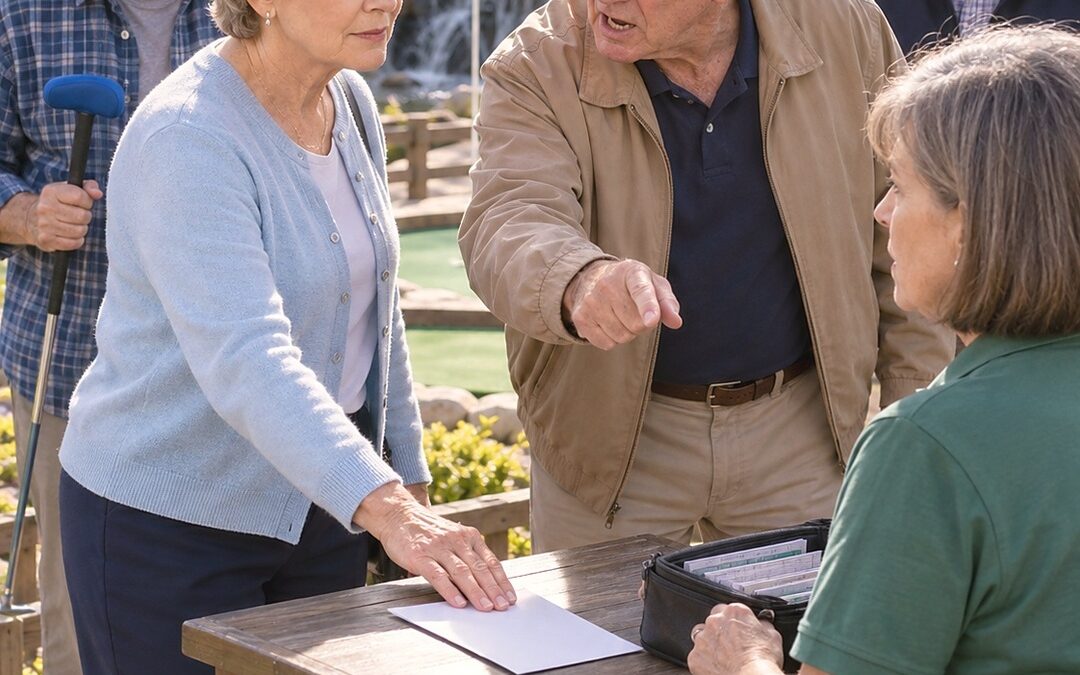
Fletcher tapped my name on the score sheet and said, "We've dragged my wife around nine holes, and that explains last place."
If I challenged him, my own missing stroke could void our team’s final entry and cost Gus the round he had waited all month to play.
I slid the sheet toward Nellie and said, "Count mine, Fletcher. Then count yours."
Fletcher reached toward the square badge box beside Nellie as she closed the lid. His finger caught the unopened pin through the foam slot, and he lowered his hand.
It was 11:00 Monday morning at Pebble Bend in Ames.
All twelve of us stood around the score table beside hole nine.
Fletcher was sixty-six and had appointed himself family captain before we left the parking lot. Nobody had objected. That included me.
I was sixty-four, retired from a school cafeteria, and still bad enough at miniature golf to celebrate a ball that stopped within a shoe length of the cup. Fletcher preferred numbers. Especially his.
He had spent breakfast practicing how he would accept the lowest-score badge, and I had heard the little speech twice, once by the toaster and once beside our coat closet.
The closed box stayed near Nellie Baird’s elbow. It held one individual badge, and it belonged to nobody yet.
Our team result was separate.
Nellie had explained that before the first ball rolled.
She was the club scorekeeper, not a referee imported from somewhere grand.
At Pebble Bend, her job covered the house rules and the score table.
Every ball contact counted.
Any downward correction before submission needed the opposing captain’s initials.
Nellie had also collected each original card after every hole, so she already had all of them.
There was nothing left for Fletcher to hand over or for me to produce.
The cards were stacked in her score pouch by player. Fletcher knew that.
He also knew I knew it.
He just expected me to leave them there.
Fletcher’s sister, Irma Voss, stood beside him with the unchecked summary sheet she had read aloud five minutes earlier.
She had laughed when my number came up, then covered her mouth with two fingers and kept reading. One short bark was enough.
Her husband, Gus, had bent to gather our clubs while she read. Gus was seventy-one and had talked about the final since early October.
He had even cleaned the little grooves in his putter head with an old toothbrush. That was Gus. He cleaned things before he trusted them.
Across the table, opposing captain Wade Pritchard stayed near the rail while Fletcher tapped my name. Beverly Pugh stood beside him.
Eldon Vane leaned on the rail while Mona Trask held her score pencil behind one ear.
Prudence Dow and Chester Ault stopped comparing the mud on their shoes. Doris Peake, already buttoned for the parking lot, stayed by Beverly.
Fletcher tapped my name again. "Look at it." I did.
His summary showed our team in last place.
My total was the worst.
That part did not surprise me.
I had missed short putts all morning.
I had clipped two rails.
On hole four, I sent the ball backward.
Beverly had laughed at that one. So had I.
I could laugh when my ball went backward.
I stopped laughing when Fletcher used my number to explain the whole team.
Fletcher put one finger on his own total.
His was the lowest.
"That’s what happens when somebody keeps count."
Wade shifted closer to the table.
"You saying Corinne didn’t?"
"I’m saying the sheet says what it says."
He gave me the smile he used when company was present.
It showed no teeth.
Fletcher liked a sentence that could retreat later.
Irma touched his sleeve.
"You did carry us."
Gus stopped gathering clubs.
He had one in each hand.
The blue-covered putter was Gus’s, though he had let me use it during the round.
I had sewn the cloth cover last winter, and the seam was crooked near the thumb.
I could see it from the table.
Fletcher looked at Nellie.
"So we can do the badge now."
Nellie did not touch the box. "Not yet."
His hand stayed open. "What’s left?"
Nellie said, "Corinne asked for a check."
Fletcher said, "Of hers."
Nellie answered, "Of everyone’s."
That brought his eyes back to me.
He had expected a smaller request.
I could tell because he glanced at my score, then at the badge box.
I kept my palms on the table edge.
I said, "Every player."
Fletcher said my name. "Corinne."
I said, "Every player."
Fletcher stepped closer. "This is ridiculous."
Nellie said, "It’s nine cards each."
Fletcher pointed at my line. "She’s in last."
Nellie said, "That isn’t the question."
Fletcher gave a little laugh.
He looked toward Wade.
Wade did not return it.
Nellie pulled the score pouch closer.
"I already have the originals."
Fletcher’s fingers drummed once.
Fletcher said, "You collected those all morning."
Nellie answered him. "Yes."
Fletcher said, "So there’s no issue."
Nellie said, "We’ll see."
That annoyed him more.
Fletcher liked agreement stated early, and he liked it better when other people did the stating before he had to press them.
He turned to me.
Fletcher said, "You want to make everybody stand here because you had a bad round?"
I answered him. "No."
"Then what do you want?"
I said, "I want every score counted."
Fletcher asked, "Mine too?"
I said, "Yours too."
He took a breath through his nose.
Irma looked down at the summary.
Gus set one club against the rail.
The grip cover slipped an inch.
I noticed that instead of Fletcher.
That cover was from an old blue dish towel.
Gus had almost thrown the towel out.
I had cut the least worn strip and stitched it around the handle because the rubber rubbed his palm.
He never asked me to.
He just kept using it.
Fletcher pointed at my total.
"You know where this goes if you start arguing cards." I did.
He knew I did.
Our four-person team still had a final entry despite finishing last in this qualifier.
Pebble Bend used qualification status, not placement alone, for that round.
A deliberate omitted stroke by any team member voided the team result.
That was my problem. I had one. One stroke.
Nobody at that table knew yet.
Fletcher did not know the detail. He knew me.
That was close enough.
He knew I hated being the reason other people lost something, and he had counted on that before whenever a smaller family plan needed somebody to give way.
Before that Monday, the stakes had been dinner reservations or one family photo.
Today it was Gus’s final.
I could have asked Nellie to check Fletcher only.
I could have tried to step around my own card.
That would have made my request cleaner.
It would also have made me exactly as selective as he was.
Nellie opened the score pouch.
The badge box stayed closed near her elbow.
Fletcher said, "While you’re doing inventory, just give me that."
The badge stayed inside. It had never been his.
"The individual badge is on hold."
Fletcher rubbed the side of his finger. "Because Corinne’s upset?"
"Because she requested a full check."
"That’s not a rule."
Nellie said, "It’s a score check."
Fletcher said, "Same thing."
Nellie kept the pouch under her hand. "No."
Mona took the pencil from behind her ear.
She did not write anything.
She just held it. Fletcher saw her.
Fletcher nodded at the pencil. "What?"
Mona kept holding it. "Nothing."
Fletcher said, "Then don’t make a face."
Mona said, "I’m standing here." That was Mona.
She could make a plain sentence sound like furniture. It almost helped.
Nellie lifted my first original card. "Corinne first?"
I heard Fletcher exhale.
He thought that was good news.
So did part of me.
If Nellie started with mine, I had maybe thirty seconds to decide whether to let ink do the talking.
That was too long.
I had already waited nine holes. "Yes," I said. Gus looked up.
I kept watching Nellie.
She checked hole one. Then hole two.
The numbers matched Fletcher’s summary. Hole three matched.
Hole four matched too.
Fletcher rested his forearms on the table. "See?"
Nellie did not answer. Hole five matched. Hole six. Hole seven. Then eight.
She put those cards in a neat stack.
Only hole nine remained.
My throat tightened around nothing.
I knew what the card said.
I also knew what happened on the green.
The two were not the same.
Nellie picked up hole nine.
I stepped away from the table.
"Before you read that, I need to show you something." Fletcher frowned.
"Show her what?"
Gus still held the club with my stitched cover.
I pointed toward hole nine.
"Over there."
Nellie kept my card in her hand.
"All right."
Fletcher pushed off the table.
"Corinne, we are not doing another tour."
"We’re walking twenty feet."
Wade came with us.
Then Beverly.
The rest followed because there were only twelve of us and no one had anywhere useful to hide.
*
At 11:20, we stood beside hole nine again.
The ninth hole had a shallow rise before the cup.
My ball had stopped on that rise.
I remembered the exact spot because a leaf had stuck to the felt.
The leaf was still there.
Brown edge.
Wet middle.
I pointed beside it.
"Here."
Fletcher crossed his arms.
"What about it?"
I looked at Nellie.
"On my first try, I touched the ball."
Gus’s club stopped moving.
Nellie waited.
I made myself finish.
"I called it a practice tap."
Fletcher’s head came up.
"Now you’re adding things?"
I looked at him.
"I’m correcting mine."
He did not answer that.
I faced Nellie again.
"The putter touched it."
"Did the ball move?"
"Yes."
"How far?"
"Maybe two inches."
Nellie nodded once.
"That counts."
"I know."
Fletcher stepped toward the rail.
"Hold on."
I kept going.
"I left that stroke off."
The words came out rough.
I cleared my throat.
"I did it on purpose."
Gus looked down at the club.
The blue cloth cover had twisted around the handle.
My seam sat across his knuckle.
I had to stop once before I could speak again.
"Thank you for carrying the clubs."
That was as far as my voice got.
Gus kept the club in his hand and let me finish.
I pointed at the grip.
"And I’m sorry."
His mouth flattened.
"That stroke costs more than your score."
"I know."
"You knew this morning?"
"Yes."
"Before Fletcher said anything?"
"Yes."
He looked at me then.
That hurt worse.
Fletcher seized it.
"So there you go."
I turned toward him.
"No."
"You just admitted it."
"I did."
"Then maybe don’t lecture everybody else."
"I’m not asking out of my part."
He gave a short laugh.
"You just did."
"No."
I pointed back toward the score table.
"Count mine correctly."
Then I looked straight at him.
"Count yours too."
He stared at me.
The whole group had heard me confess first, so there was nowhere for me to stand above Fletcher or pretend my own number had been clean.
That was not why I had done it.
I had done it because my name was on the wrong number.
Nellie checked the hole-nine card.
"What did you record here?"
"Four."
"What should it be?"
"Five."
She looked at Wade.
He had been opposing captain that morning.
"Did you see the contact?"
"Yes."
Fletcher turned on him.
"You never said anything."
"I thought she counted it."
That was fair.
So had everyone else.
Nellie held my card against the rail.
She did not erase anything.
"The original stays as submitted."
I nodded.
She looked at the group.
"Corinne has disclosed a deliberate omitted stroke."
Fletcher started to speak.
Nellie lifted one hand.
"Team qualification is separate from the individual badge."
That shut down the sentence he wanted.
She looked at me.
"You understood the team rule?"
"Yes."
"You understood it when you submitted?"
"Yes."
Gus shifted the club to his other hand.
The cloth grip squeaked against his palm.
Nellie did not soften it.
"Then the Whitlow-Voss team result is void."
Irma made a small sound.
"Gus had the final."
"Yes," Nellie said.
"Tomorrow?"
"The team entry is canceled now."
Gus stared at the cup.
I could see the line where he had polished his club head.
He had done that for the final.
Fletcher pointed at me.
"So she knocked us out."
I said it to Gus. "Yes."
That answer belonged to Gus, not Fletcher.
Gus pressed his lips together.
"You did."
"I did."
Irma stepped closer.
"Can’t she just add the stroke?"
"No."
Nellie kept her voice plain.
"The omission was deliberate."
Irma looked at me.
"You knew?"
"Yes."
Her face tightened.
She glanced toward Fletcher.
He had already turned toward the table.
Of course he had.
His individual badge was separate.
My team violation did not cancel his individual eligibility.
That fact suited him just fine.
Nellie walked back first.
We followed.
At the score table, she took the team board from its stand.
Our row still showed last place.
She drew one firm line through the qualification mark.
Then she wrote VOID beside our team name.
Gus watched the whole thing.
So did I.
At the bottom of the same board, our four names were listed for the final.
She drew one line through that entry.
Gus’s name disappeared under the same line as mine.
He did not look at me.
Fletcher did.
"You happy now?"
"No."
"Could’ve saved everybody this."
"I could’ve counted the stroke."
"Exactly."
"That part is mine."
He waited.
I left the rest sitting there.
He did not get to use my confession as a receipt for his sentence.
Nellie returned the team board to its stand.
"The team matter is finished."
Fletcher pointed toward the badge box.
"Then mine isn’t affected."
"Your individual claim is separate."
He smiled.
"Good."
"Still on hold."
The smile stopped.
"Why?"
"Because the full individual check was requested."
"She’s already admitted the bad score."
"Her score is not your claim."
He looked at me.
I could almost hear the argument he wanted.
My guilt should have purchased his clearance.
It did not.
Wade leaned one elbow on the rail.
"When do you check the rest?"
Nellie glanced at the clock.
"I can finish Corinne’s set now."
Fletcher tapped the table.
"And mine?"
"Tuesday at nine."
"Why Tuesday?"
"Because I have the senior group at noon."
"You could do it in five minutes."
"Then you can wait until nine."
He gave me the look he saved for locked doors, the same one I had seen at the pharmacy and our bank when a clerk said no.
He always tried the handle again.
Gus gathered the clubs again.
He picked up the blue-covered putter last.
The blue cloth cover had slipped almost to the metal.
I reached to fix it.
He moved the club away just enough to keep my hand off the cover.
"I’ve got it."
I let my hand drop.
"I know."
He carried the clubs toward the return rack.
Irma went with him.
She did not laugh this time.
Prudence and Chester moved toward the parking lot.
Doris stayed near Beverly.
Eldon asked Wade something about lunch.
I took two steps toward Gus at the return rack. I had another apology ready.
"Gus—"
He kept sorting the clubs. "Later, Corinne."
I stopped beside the rack, then went back to the table while he slid the next club into place.
Nellie put my nine checked cards back in her score pouch.
Nothing else changed.
Then she put the team materials away.
Fletcher stayed.
So did I.
He leaned closer.
"You made sure Gus paid for your point."
"Stroke."
"What?"
"It was a stroke."
"Fine."
I looked toward the return rack.
Gus was sliding our clubs into place.
The blue cover was still crooked.
"I’m going to apologize to him again."
"That won’t put him in the final."
"I know."
"You always do this."
"Do what?"
"Turn one little thing into a whole production."
I almost laughed.
He had given a speech rehearsal for a plastic badge.
Instead, I looked at the closed box.
"Tuesday at nine."
"What about it?"
"You should be here."
He stared at me.
"For what?"
"Your score."
He pushed the summary sheet toward Nellie.
"It’s right there."
Nellie did not take it.
"I’ll use the originals."
His hand stopped on the paper.
For the first time that morning, he did not have an answer ready.
I picked up my jacket from the chair.
Gus was waiting by the exit.
He was not smiling.
He was still waiting.
That was enough for me to walk toward him.
Behind us, Nellie laid Fletcher’s nine original cards beside the closed individual-badge box for Tuesday’s nine o’clock check.
Part 2 — TWO STROKES
At 9:00 Tuesday, Fletcher was already at the score table, with Nellie's closed badge box beside the pouch where it had stayed since Monday.
The Whitlow-Voss team was still void.
My omission had already cost Gus his final, and nothing we found Tuesday could give that opportunity back to him.
That was mine to own.
Today was about Fletcher's separate claim.
Wade stood across from Nellie while I took the chair by the rail and Fletcher remained on his feet.
He had brought his summary sheet again.
Nellie did not need it first because she already held every original card collected after each hole.
Fletcher flattened his summary anyway.
"Let's finish this."
Nellie opened his first original.
The first holes matched.
The middle ones did too.
Fletcher kept glancing at the badge box while I watched the cards move from one side of Nellie's hands to the other.
Then Nellie stopped.
The earlier digit was still visible beneath a lower one, clear enough that nobody had to guess what had been changed.
She turned the card toward Wade and asked whether he had initialed the downward correction.
He said he had not.
Fletcher leaned across the table.
"That was a counting fix."
Nellie asked who made it.
"I did."
She asked why Wade's initials were missing.
Fletcher said Wade had walked away.
Wade shook his head.
"I was beside you."
"You were talking to Beverly."
"I was still there."
Nellie placed that card by itself, then reached the next changed card and found the same kind of lower replacement over a visible earlier number.
Again, Wade's initials were missing.
She put both cards together.
"Two downward corrections."
Fletcher folded his arms.
"They were corrections."
The house rule had been announced before play, and any downward change needed the opposing captain's initials before submission.
That rule had not changed overnight.
Fletcher called the initials paperwork.
Nellie called them required.
He looked at me.
I stayed in my chair.
My missing stroke remained mine, and his cards could not erase what I had done Monday.
Nellie pulled the summary closer and followed Fletcher's column until her finger stopped at mine.
The same two strokes appeared there.
They had been added to my total.
Fletcher pushed the paper an inch.
"The team total had to balance."
Wade looked straight at him.
"You moved your strokes to Corinne?"
Fletcher said he had fixed the summary.
Nellie asked whether he had changed his originals and whether he had added those strokes to my total.
He answered yes to both.
Fletcher kept one hand on the summary.
"She still omitted a stroke," he said.
"I did," I answered.
He tapped my column. "And that doesn't disappear?"
"No."
"Then neither should mine."
I looked at the two changed cards. "That's why we're here."
Nellie pointed toward the team board.
"That result was voided yesterday."
Fletcher looked at the badge box.
"Then this doesn't matter."
"It matters to your individual claim."
He rubbed his thumb along the table edge.
"My actual score was lower."
Nellie tapped the changed cards.
"Your submitted originals have two unsupported reductions."
"I explained them."
"You admitted making them."
Fletcher turned to Wade.
"You know those holes."
Wade only nodded toward the cards.
Nellie left the badge box closed and told him his individual claim was invalid.
He stared at her long enough for the practice bell outside to ring once.
"Over initials?"
"Over the unapproved reductions."
"That's ridiculous."
"You can disagree."
He disagreed without moving.
The ruling did not move.
Nellie corrected the attribution on the summary, taking the two strokes off my column and putting them back under Fletcher's name.
Fletcher watched Nellie's pencil.
"Happy now?"
"No."
"Your number's fixed."
"Gus still lost the final."
"Because of you."
"Yes."
"You're making this look like I cheated."
"I'm recording what you admitted."
He looked at me next.
"This what you wanted?"
"I wanted the count checked."
He picked up his summary, then set it down again when Nellie reached for her phone.
All twelve players were already in one club thread.
She sent the corrected facts immediately, stating that Fletcher's individual claim was invalid because the two reductions lacked Wade's initials.
She also returned those strokes to Fletcher's attribution and noted that Monday's team void remained unchanged.
Fletcher heard the send tone.
"All twelve?"
"All twelve."
His eyes settled on me.
"I'll see you at practice."
The words were ordinary.
His hand on the shared bag was not.
*
At 10:00, Fletcher carried that bag across the practice area with the strap high on his shoulder.
Our four-person group had bought it together.
Irma stood beside the first lane.
I was near the ball rack.
Gus had not arrived yet.
Fletcher stopped in front of me and demanded that I withdraw the claim that he had blamed me falsely.
I told him he had blamed me.
He said I had cost the team its final.
I told him that was true too.
Those facts could stand together.
He wanted one erased.
"Call it a family scoring mess."
"I won't."
He lifted the bag higher.
"Then I'm taking this home."
Irma turned toward him.
"That's shared."
"Exactly," I said.
Fletcher looked at me.
"Then take back what you said."
"No."
He started toward the parking lot.
I pulled out my phone.
"Who are you calling?"
"Gus."
Fletcher told me not to make another production, so I called Gus before he could turn the same sentence into another bargain.
When Gus answered, I told him Fletcher had taken the shared bag and that our practice plan was gone.
I did not ask Gus to fix Fletcher.
Gus was quiet briefly.
Then he said he had two clubs in his trunk.
Both belonged to him.
He kept them separate from the shared bag.
"I'll bring those."
"Thank you."
"I'm not doing this for Fletcher."
"I know."
Fletcher heard enough and gave the strap one hard tug before walking away with the bag.
Irma stayed beside the lane.
Our reserved practice hour was already running.
Gus arrived twelve minutes later with his two clubs, set them on the bench, and looked once toward the empty place where the bag should have been.
"No bag?"
I shook my head.
He looked at the lanes.
"So we rotate."
That was our only workable choice.
Two clubs served three people.
One of us waited while the others practiced, then we changed places before the next turn.
The clock kept moving.
With five minutes left, Irma started to pass me a club.
I shook my head and pointed toward Gus. "His turn."
"You haven't had as many," Gus said.
"Neither have you."
I stepped behind the line.
Gus took the last turn.
When the bell sounded at eleven, the booked hour was gone and each of us had practiced less.
We had not paid for another hour, and the shared bag was still gone with Fletcher.
Gus collected his two clubs and nodded toward the bench.
"Sit down, Corinne."
I followed him over.
*
At 11:00, Gus took the far end of the bench and left one empty seat between us.
Irma remained by the rail.
Fletcher had already left.
The shared bag had gone with him.
Gus kept both of his clubs beside his shoe, and the blue cloth grip cover on one had twisted until my crooked winter seam showed near his thumb.
I did not reach for it.
"I owe you an apology."
Gus kept looking toward the lanes.
"You gave me one yesterday."
"I owe you a better one."
That got his attention.
I told him I had known the stroke counted and had left it off anyway.
His final was gone because of that choice.
I did not mention Fletcher's two edits because they could not buy back the Tuesday Gus had expected to play.
He rubbed one shoe against the concrete.
"I'd been looking forward to that final."
"I know."
"I practiced for it."
"I know."
He turned toward me.
"Don't keep saying that."
I stopped answering him.
Gus leaned back against the bench.
"You think Fletcher doing worse makes yours smaller?"
"No."
"Good."
He looked away again.
"I'm mad at him."
I nodded once at that.
"I'm mad at you too."
"You should be."
That answer stayed between us.
He did not tell me it was fine, and he did not shrink my deliberate omission into a little mistake.
The practice lanes clicked behind us.
A ball hit a rail and rolled back.
Gus picked up one club and turned the blue grip in his palm until the crooked seam faced him.
"You sewed this crooked."
"I was watching television."
He looked at the seam.
"That explains the seam."
His mouth almost moved.
Then he looked at me.
"You're practicing tomorrow?"
"Yes, if you'll have me there."
"That's not what I asked."
I looked down at my shoes.
"Yes. I'm practicing."
Gus held the club toward me.
I almost asked whether handing it over meant we were fine.
The words reached my teeth and stopped.
He was still holding the club, not smiling, with the crooked seam under his thumb.
"Are you sure?"
"No."
I looked up.
He kept his arm extended.
"I'm still mad."
"I heard you."
"You should."
I took the club, feeling the cloth grip press into my palm while Gus stood with the other one.
"I'll be here tomorrow."
Then he walked back toward the lanes.
I followed with his club in my hand.
Part 3 — SAME RULE
At 9:00 Wednesday, Fletcher came onto the practice area saying Nellie had added him wrong.
His individual claim was already invalid.
Our team result was still void, and Gus still had no final to play.
Fletcher knew all of that.
He wanted another nine holes anyway.
He stopped beside our lane while Gus was setting down his two clubs.
Irma came behind him with her jacket unzipped and her reading glasses still hanging from one cord.
Nellie was checking the practice board near the score table.
Fletcher pointed toward her.
"I want to play it again."
I kept the ball under my shoe.
He said the old numbers had been handled wrong and a clean round would show what he really scored.
Still, I wanted to hear what he meant by clean.
I took my foot off the ball.
"Against who?"
Fletcher nodded toward the course.
"Same people who watched Monday. Nine holes."
Gus rested one club against the bench.
He did not offer an opinion.
Fletcher continued before anyone could answer.
He wanted Wade there.
He wanted Nellie keeping score.
He wanted everybody to see his number without what he called Tuesday's mess around it.
Nellie had heard enough to walk over.
"This would be a new round," she said. "Monday and Tuesday stay where they are. Friday doesn't restore either result or create a badge claim."
Fletcher shifted his weight.
"Then what's the point?"
"You asked to show your score."
"In front of everybody."
"That's what you asked for."
He glanced toward me.
I knew that glance.
He wanted me to object first.
If I refused, he could spend two days saying I feared a clean round.
If I agreed carelessly, he could turn Friday into another argument about what the new score restored.
Nellie touched the cap of her pen but did not mark the board.
Fletcher pointed his club toward me.
"So are you playing or not?"
Gus moved his shoe off the bench leg.
He kept both clubs close and did not answer for me.
Gus slid the blue-covered club toward my side of the bench, then stopped it with two fingers.
"Today is today."
"I know."
"You hand it back when we're done."
"I will."
"Friday, you ask again."
I nodded.
Gus set his second club between his own shoes and left the space beside mine empty.
Gus stayed quiet beside me.
Fletcher watched the club move between us.
"Well?"
I picked up Gus's club.
The blue cloth grip sat crooked under my palm.
"I'll play."
Fletcher's mouth lifted at one corner.
I kept going.
"Every contact counts. Same rule for everybody."
The corner dropped.
Gus turned his head toward me.
He rested his other club against the bench and left the borrowed one in my hand.
Fletcher rubbed the heel of one shoe against the floor mat.
"Obviously every stroke counts."
"Every contact," I said.
Nellie nodded.
"Then Friday."
Fletcher lifted his club from the rack.
"Fine."
Nellie marked Friday on the practice board, then capped her pen.
Fletcher carried his club to the first lane and set down a ball.
*
At 10:00, I was alone at the practice tee for six minutes before Gus came back from the water fountain.
Six minutes was enough.
I knew Wade would be there Friday if the old group returned.
Wade had seen my Monday round.
He had also seen my ball go backward on hole four.
I wanted one decent stretch before he watched again.
So I set down a ball.
My first shot clipped the left rail.
I pulled it back.
The second ran too far.
I started over.
The third stopped near the cup.
That one pleased me.
I played from there and finished the hole in three contacts.
Then I stood at the tee doing arithmetic that had no business being called a score.
Three sounded respectable.
I had needed several starts to get it.
I knew the difference.
Gus came around the partition carrying a paper cup of water.
He stopped when he saw the extra balls beside my shoe.
I moved one with the club head.
He set the cup on the bench.
"What are you counting?"
"Three."
He studied the balls on the mat.
Then he studied me.
That was plenty.
I picked up the extras.
Gus said practice was practice.
If I wanted several tries, I could take several tries.
If I wanted a score, I got one start.
He did not say it sharply.
That made it worse.
I hooked one extra ball toward the tray with the club head.
Another rested beside my shoe.
I almost told Gus the first two tries should not count because I had not meant to start yet.
The words got as far as my teeth.
I bent down, picked up the extras, and dropped them into the tray.
One ball stayed in my palm.
I set it at the tee and moved both shoes behind the line.
Gus waited with his own club resting against his leg.
"Call that practice."
He nodded once.
I put the last ball down.
"This one counts."
My first stroke hit the right rail.
The ball came back past my shoe.
I followed it.
The second shot made the corner and stopped short.
My third ran around the cup.
I tapped again and missed.
The fifth went in.
I stood over the cup with the club resting against my leg.
Five.
I had needed every one of them.
Gus took his turn.
He needed three.
I watched his ball drop and went back to the tee.
The next hole took me four.
Then six.
One shot barely crossed the starting line because I caught the ball on the toe of the club.
The old excuse came up fast.
I could have called it setup.
Instead, I walked to the ball where it stopped and counted the contact.
Gus watched me reset my feet.
He did not praise me for doing what the rule already required.
By the time Irma joined us, my good Wednesday practice score had become what my actual playing usually became.
It was ordinary and sometimes lousy.
Irma watched me miss a short one.
I marked the contact by holding up one finger before moving the ball.
She did not laugh.
Gus handed me the next ball.
"Again?"
"One start."
He moved aside.
That round was worse than the one before it.
I finished it anyway.
*
At 11:00, Gus, Irma, and I reached the group table near Nellie's station.
Nellie was putting the practice board away.
Fletcher arrived from the opposite lane and set his club against the rail.
He had spent most of the last hour playing alone.
Irma sat first.
Gus stayed standing beside her.
I took the end chair.
Fletcher started talking about Friday before Nellie finished with the board.
He said nobody needed the old cards dragged out again because those scores had already been thrown out.
Nellie corrected that immediately.
"The originals are still the record of what was submitted."
Fletcher waved one hand.
"That's what I mean. We don't need Irma bringing those totals up again."
Irma's chair scraped backward half an inch.
Fletcher turned toward her.
"You already read them Monday. Leave them there."
Irma took the glasses from their cord.
She folded them once.
Then she placed them beside her elbow.
"I read what you gave me."
Fletcher stared at her.
"What is that supposed to mean?"
Irma faced Nellie instead.
She said Fletcher had handed her the totals Monday and she had added them as written.
She had not checked his originals.
She had not checked mine.
She had assumed Fletcher had checked his own work before handing her the summary.
Fletcher reached for his club.
"You knew I kept the score."
Irma shook her head.
"I knew you gave me numbers."
She said being his sister did not make those numbers hers to defend after Tuesday.
Fletcher pulled the club closer to his leg.
He picked up the club.
The rubber end struck the rail once.
"So now you're changing your story too?"
Irma left her glasses on the table.
"I'm correcting mine."
I kept my hands in my lap.
She had read my bad total out loud Monday.
She had laughed after it.
One corrected sentence at a smaller table did not erase that.
Irma turned toward me, then stopped before saying whatever she had started to say.
I did not help her finish it.
Nellie asked one question.
Had Irma verified the totals before repeating them?
"No."
Fletcher tapped his club against his shoe.
Irma went on.
She said she could no longer tell anyone his summary proved he carried the team.
She had only repeated numbers he supplied.
Monday, she had made those totals sound settled because she read them aloud without checking.
She faced Nellie.
"I won't repeat that claim."
Gus pulled out the chair beside her and sat down.
He still did not rescue anybody.
Fletcher looked from Irma to Nellie.
"This is getting ridiculous."
Nellie slid the practice board under the table.
Fletcher pointed toward the course.
"Fine. Then we'll play it."
I asked if he still wanted every contact counted.
His grip tightened around the club shaft.
He had room to back out.
Nobody stopped him.
He picked up his jacket instead.
"Same rules," he said.
Then Fletcher walked toward the exit with the Friday round still on the board under Nellie's table.
Part 4 — BORROWED CLUB
At 9:00 Friday, Gus stood by the club rack with his two putters and the blue cloth grip I had sewn crooked last winter.
The shared bag was still with Fletcher.
My first thought was to go home.
Gus had lost his final because of me, and now he was carrying extra equipment so I could still play the round Fletcher had demanded.
I opened my mouth.
“I’ve caused enough—”
The rest was ready.
Gus set one putter against the rack.
He did not finish the sentence for me.
The blue cloth had shifted under his thumb, leaving my crooked seam where I could see it.
I stopped talking.
Then I tried the question I actually needed.
“Can I borrow that club until one o’clock?”
Gus kept his hand over the blue grip.
“I’m still mad.”
“I know.”
He tipped the club toward the first lane.
“I’m using it first.”
“That’s fair.”
At 9:05, he carried it to the mark while I stayed behind the line beside his other putter.
He finished his turn and walked the covered club back to me.
The cloth was warm from his palm.
I almost thanked him with another apology.
Instead, I took the handle and carried it to the mark.
One ball waited there.
My first contact pushed it wide.
I followed it without asking Gus where to aim.
The second hit the rail and came back far enough that I had to step around his spare club before playing again.
Gus moved the spare club with his shoe and went back to the line.
He did not tell me what I had done wrong.
I finished the turn and kept the putter in my hand while I reached toward the ball tray.
Gus was already standing at the mark.
I stopped.
The club stayed between us for a beat.
Then I turned the handle toward him.
He took it and went back to work.
I sat on the end of the bench while he practiced.
“Gus—”
He set his next ball at the mark.
I stopped there.
When Gus finished, he brought the club back without looking for thanks.
I took my next turn.
We worked that way for the rest of the morning.
I had to watch for his place in line instead of assuming the club stayed with me once it reached my hand.
Once, I reached for another ball before noticing Gus beside the tee.
I set the ball back in the tray and held the club out.
He took it.
I stepped behind the line.
At 9:42, Irma arrived with coffee and stopped near the bench.
Gus was already on the little practice hole.
His first shot took the bend cleanly.
The next stopped short.
His third went in.
Irma lifted her cup toward him.
“Three?”
Gus picked up the ball.
“Three.”
He carried the blue-covered club back and held it toward me.
I took it.
Irma stayed by the bench while I set one ball down.
My first contact ran wide enough to make me move around the rail.
The next brought it back toward the cup.
I played from where the ball had stopped, but my third contact slid past the cup.
I followed it around the lane and put the fourth beside the cup without dropping it.
The blue cover twisted under my palm.
My crooked seam slid against the side of my thumb.
I turned the cloth only enough to move the seam off the rubbing spot.
I did not stop to fix the cover for Gus.
He was waiting for the club.
My fifth contact dropped the ball.
Irma looked from the cup to me.
“Five?”
“Five.”
She took a sip of coffee.
She did not laugh.
I picked up the ball and started to say Gus’s name.
He was already holding out his hand for the club.
I put the handle into it instead.
He took his next turn while I stood beside Irma with my hands empty.
Irma rolled the paper cup once between her palms.
When Gus finished, he came back and offered the club again.
I took it.
The cover still sat crooked.
I waited for Gus to clear the lane.
Then I played.
*
At 10:00, Fletcher walked onto the practice area carrying the shared bag he had taken home Tuesday.
He set it beside the rail where all three of us could see it.
I recognized the strap.
I also recognized the putter I usually reached for inside, the one whose weight I knew before I ever started borrowing Gus’s.
Fletcher rested one hand on the bag.
“I brought it back.”
Irma looked at him.
Gus kept the covered club.
Fletcher had not taken the bag Tuesday because he changed his mind about practice.
He had taken it after I refused to withdraw what I said about his blame, and now he wanted a different sentence before he loosened his grip on it.
He looked at me.
“Call the old thing a counting mistake.”
I glanced at the bag.
“That isn’t what happened.”
“It was a mess.”
“You changed two scores downward.”
He pressed his lips together.
“I corrected my count.”
“And put the two strokes on mine.”
“We already went through this.”
“Yes.”
That was exactly why I was not changing the words.
The handle of my familiar putter showed above the bag opening.
My hand almost went toward it.
Friday’s round was coming, Wade would be beside me, and I knew how that club sat in my hands on the short hills.
Fletcher saw me notice it.
Getting the club back now meant repeating his version of what he had done.
I left my hand at my side.
He nudged the strap with his shoe.
“Say it was a counting mistake, and we use the clubs.”
Irma stared at the floor mat.
Gus turned the covered putter once in his hand.
I could have had my familiar club back in ten seconds, before a Friday round that would put Wade beside me again and count every ugly little contact.
I wanted that club.
I wanted one less awkward thing before eleven.
Fletcher knew it.
“No.”
His fingers closed around the strap.
“You’d rather make everybody swap clubs again?”
“I’d rather say what happened.”
“You admitted your own stroke.”
“I did.”
“So maybe stop acting like mine was different.”
“My stroke was mine.”
I pointed at the bag.
“Those two were yours.”
Nellie had come over from the score table while Fletcher was talking, and she stopped beside the rail without touching the equipment.
Fletcher turned to her.
“Tell her the new round fixes this.”
“No,” Nellie said. “Friday gives you a new result. It does not change the old one.”
Fletcher pulled the bag upright.
For one second I thought he might leave it.
Instead, he reached inside for the club he planned to use, closed the bag again, and kept the strap looped over his wrist.
The shared bag did not change hands.
He looked at me.
“You can keep borrowing Gus’s.”
Gus shifted his second putter against the bench.
“We have enough.”
That was true.
Enough was less convenient.
It was still enough.
Fletcher carried his own club and the shared bag toward the far lane, leaving my familiar putter inside it.
I did not follow.
Gus held out the blue-covered club when my turn came.
I took it.
*
At 10:30, Fletcher followed us to the score table with the shared bag still beside him.
Nellie had the Friday sheet ready.
It was blank.
That seemed to bother him.
He stood where the closed badge box had been on Monday.
The box was now behind Nellie’s chair.
Fletcher pointed toward the blank sheet.
“Fine. Then people can watch this one.”
“They should,” I said.
His eyes narrowed.
I took out my phone.
The club thread still held all twelve names, and Tuesday’s corrected facts were already there for every one of them to read.
Nobody needed a surprise about scores.
What remained was personal.
Fletcher had blamed last place on me in front of all twelve, and he had never withdrawn that sentence in front of the people who heard it.
Irma had corrected her part Wednesday before four of us.
That was not the same audience either.
I opened the thread.
Fletcher watched my thumb.
“What are you doing?”
“Inviting everybody to the table.”
“They’re already coming for the round.”
“At eleven.”
He stepped closer.
“For what?”
I looked at him.
“To hear you correct what you said Monday.”
“We already handled the numbers.”
“Yes.”
“Then there’s nothing else.”
“There is.”
He glanced at Nellie.
She stayed behind the table because this was not a new score ruling for her to invent or a paper question that needed another check.
It was Fletcher’s sentence.
Only Fletcher could withdraw it.
I sent the message to all twelve.
I told them to meet at the score table before the new round, with the old rulings finished and no score issue waiting to be discovered.
I said Fletcher had been asked to correct his Monday statement in front of the same group who heard it.
Fletcher had the same notice everybody else did.
He picked up his club.
“You’re making a show out of this.”
“I’m making the audience the same.”
Gus looked at the clock.
Twenty-four minutes remained.
Irma sat on the rail bench.
Fletcher paced once to the end of the table and back, but the correction still did not come out of his mouth.
People from Monday began coming through the gate and taking their old places around the table.
Nobody asked Nellie to explain the numbers again.
Mona joined the rail side while Wade and Beverly came in together.
Gus placed his spare club against the rail.
Irma stood.
I kept the borrowed club beside my shoe.
Fletcher stayed beside the blank Friday sheet as the last few came in.
By 10:58, all twelve of us were there.
I did not ask him again.
Nellie looked at the clock.
Then she looked at Fletcher.
He had two minutes before the meeting began, and the sentence he still refused to withdraw was waiting with all twelve people around him.
Part 5 — THE SAME TABLE
At 11:00 Friday, all twelve of us stood around the score table beside hole nine.
Fletcher still had the shared bag.
Gus's blue-covered putter rested beside my shoe on loan until one.
The Friday score sheet was blank.
Nothing about Monday or Tuesday was waiting to be decided again.
Nellie stood behind the table.
Wade and Beverly took the rail side.
Eldon, Mona, Prudence, Chester, and Doris filled the space behind them.
Irma stood with Gus.
Fletcher stayed near the shared bag.
I faced the same people who had heard him blame me Monday.
I started with my own part.
"I left off one stroke."
Gus looked at the table.
I did not soften it.
"I knew it counted. I left it off anyway. That voided our team result and cost Gus the final."
The team board already showed that result.
Nellie did not reach for it.
There was nothing new to mark.
Fletcher shifted beside the bag.
I looked at him.
"On Monday you said, 'We've dragged my wife around nine holes, and that explains last place.'"
His hand stopped on the strap.
Everybody there had heard the sentence the first time.
Tuesday, everybody had received Nellie's corrected facts too.
Fletcher had admitted changing two of his originals downward without Wade's initials and adding those two strokes to my total.
That had already invalidated his individual claim.
He still had not corrected the insult in this group.
I kept my voice level.
"Count mine, Fletcher. Then count yours."
His thumb slipped off the strap.
The plastic buckle hit the table leg once, and he caught the bag before it tipped.
Fletcher cleared his throat.
"Corinne's stroke was her fault."
"Yes."
He looked at Gus.
"So was losing the team final."
Gus answered before I could.
"Yes."
Fletcher had wanted that agreement.
He got it.
It did not finish the sentence.
I pointed once toward him.
"And your two strokes?"
He pulled his hand from the strap.
"They were mine."
Mona shifted her weight against the rail.
Fletcher kept going.
"I changed those two scores. Wade hadn't initialed the changes."
Wade gave one small nod.
Fletcher looked at me next.
"I put the two strokes on Corinne's summary total."
I asked him about Monday.
He pressed his lips together.
Then he faced the group.
"I should not have said Corinne explained last place."
He paused.
"She didn't."
Nellie kept the old rulings where they belonged.
"The team result remains void from Monday. Fletcher's individual claim remains invalid from Tuesday."
Fletcher looked toward the course.
Nellie closed the subject.
"Now we can play the new round you requested."
*
At 11:20, we started at the first hole.
Fletcher used his own club.
I used Gus's borrowed putter.
The shared bag stayed with Fletcher.
Wade went ahead of me.
His first ball stopped short of the cup.
He finished cleanly.
Mine struck the side rail and rolled behind my shoe.
I counted the contact and walked around it.
My second was better.
My third was not.
By the fourth hole, Wade was ahead.
That was familiar territory.
I did not need another miracle added to the week.
On hole five, my ball kissed the club face while I was settling my feet.
It moved less than an inch.
I stared at it.
Wednesday had given me the practice version of that choice.
Friday gave me the public one.
"That's one."
Nellie marked it.
Fletcher looked away.
I played from the new spot.
The hole took me five contacts.
Wade needed four.
He waited beside the rail while I pulled my ball from the cup.
"Still counting the little ones?" he asked.
"Especially those."
Wade rolled his ball once under his shoe before moving on.
I followed him to the next hole without touching mine again.
On the next hole, Fletcher set his ball and took a short practice motion over it.
The putter clipped the ball.
It rolled several inches.
He stepped after it.
"That was practice."
Nellie did not move from the scoring stand.
"Contact counts."
Fletcher pointed back toward the tee.
"I wasn't making the stroke."
"The club contacted the ball."
He looked at me.
I kept my hands on Gus's grip.
Fletcher reached toward the ball as if he might put it back at the tee.
Wade stayed by the rail.
Nellie did not move her pencil.
Fletcher stopped, set the putter behind the ball where it had rolled, and played from there.
He counted the contact.
We kept playing.
Irma missed a short putt and counted it.
Gus sent one into a corner and needed two more to get out.
Beverly laughed when Chester bounced off the same rail twice.
The round finally sounded like people playing again.
Then I reached hole nine.
The same shallow rise waited before the cup.
Monday's leaf was gone.
I put Gus's club behind the ball.
My first shot stopped below the rise.
The second climbed too far.
The third rolled back.
Wade had already finished.
I could hear Fletcher on the next lane asking Nellie to confirm his running total.
I ignored him.
My fourth shot stopped beside the cup.
I tapped it in.
Five.
Nellie marked the contact.
Wade's final count sat one stroke below mine.
He had beaten me by one.
I looked at his line, then mine.
"Good round."
Wade smiled.
"You made me work for one stroke."
That was generous.
I had still lost.
Across the table end, Nellie finished Fletcher's count.
He leaned over the sheet.
His Friday total did not reach the low score he had advertised Monday.
He read it once.
Then again.
"This course is playing different."
Wade looked toward the rails.
"They haven't moved."
Fletcher picked up his club.
Nellie left the Friday number where it was.
*
At noon, all twelve of us returned to the same score table.
The shared bag was still beside Fletcher.
Gus stood beside me while Nellie finished the Friday sheet.
I had promised one o'clock.
He got it early.
I passed the blue-covered putter handle-first.
"Thank you."
Gus took it, checked the grip cover with his thumb, then set the club beside his other one.
Irma stayed standing.
She looked toward Mona, then Beverly.
"I need to fix my part too."
Fletcher turned toward her.
Irma did not look away.
"Monday, I read totals I hadn't checked."
She touched one finger to the table edge.
"I laughed when Corinne's number came up."
Irma kept her eyes on me.
"I shouldn't have done either."
I nodded once.
Gus looked down at his clubs.
Irma took the chair beside him.
Fletcher remained standing.
He reached toward the Friday sheet.
"So what happens next time?"
Nobody answered immediately.
He had asked the question as if captain still came attached to his name.
I looked at Gus.
Irma did too.
Gus noticed.
"What?"
"You organize the next outing," I said.
He frowned.
"Why me?"
"Because you want to play."
Irma leaned toward the table.
"And you check before you read."
Gus looked at Fletcher.
Fletcher gave a short breath through his nose.
"This is a family outing, not an election."
"Then it should be easy," Irma said.
I kept my eyes on Gus.
"I want Gus to coordinate it."
Irma agreed.
Gus rubbed his shoe against the table leg.
He asked, "You mean the time and who starts where?"
"That works for me," I said.
Irma nodded.
Gus looked toward Fletcher.
"I'm not chasing anybody down."
Fletcher picked up the shared bag.
"If Gus is running it, I'll decide."
Gus nodded.
"That's your choice."
Fletcher looked at me.
I did not bargain for his attendance.
Gus said he would handle the time and group order.
Fletcher did not object again.
Nellie reached behind her chair.
She brought out the square badge box.
She checked that the lid was shut and placed the box back on the shelf beneath the table.
Fletcher watched the box disappear.
Then he lifted the shared bag onto his shoulder.
The familiar putter was still inside.
Wade gathered his ball from the tray.
He rolled it once between his palms and looked at me.
"We're taking a few ordinary turns before we leave."
I looked toward hole nine.
No score sheet waited there.
Wade held the ball out.
"You want another one?"
Part 6 — ONE MORE STROKE
At 12:20 Friday, Fletcher carried the entire shared bag to the club-return counter.
All twelve of us were still there.
The strap crossed his shoulder.
My familiar putter was still inside.
Gus already had both of his own clubs back.
The blue-covered one stood beside his shoe, exactly where he had put it after I returned it at noon.
Fletcher stopped in front of the rack.
He looked at me first.
I waited beside Wade.
He shifted the bag off his shoulder and held it by the top handle.
“You wanted this back.”
“Yes.”
He left his hand there.
For a second, I thought another condition was coming.
Tuesday had started that way.
So had Friday morning.
The bag had become useful to him because he could make access sound like agreement.
I did not reach for it.
Fletcher looked toward the counter.
“You’re not going to say anything?”
“I said yes.”
“That’s it?”
“That’s it.”
He gave the bag a small lift.
“You’ve made your point.”
I looked at the rack.
The open space where the bag belonged was two feet from his hand.
“I’m not trading anything for it.”
Nobody stepped between us.
Irma stood beside Gus.
Beverly had her jacket over one arm.
Mona was turning a ball in her palm.
Nellie remained near the counter, but there was no ruling left for her to make.
Fletcher looked down at the strap.
Then he set the whole shared bag onto the rack.
The bottom landed crooked.
He pushed it back until it sat flat.
The familiar putter handle showed above the opening.
He did not hand it to me.
I did not ask him to.
Fletcher kept his own club in his right hand.
He looked at me again.
“So what now?”
Wade answered from behind me.
“We play a few holes.”
Fletcher frowned.
“The round is over.”
“Yes,” Wade said.
“This isn’t another round.”
Gus picked up both of his own clubs.
The blue cloth cover stayed under his hand.
Irma stopped at the rack before taking a ball.
“I’m getting one too.”
I moved aside from the opening.
“Pick whichever one you want.”
She opened the shared bag and chose a different putter herself.
I kept my hands off it while she lifted it free.
Irma set the club against her leg, took one ball from the tray, and headed toward the course with the others.
I stayed beside the rack.
The shared bag sat where any of the four of us could reach it.
I turned the zipper toward me and opened it myself.
My familiar putter was where Fletcher had left it.
The rubber grip had a worn smooth patch near my right thumb.
I wrapped my hand around it and lifted the club free.
Fletcher did not offer it.
I did not wait for him to.
I closed the bag and pushed it back against the rack upright, leaving the opening clear.
Wade paused near the first rail and looked back.
“You coming?”
I stepped around the rack without touching the bag again.
I took the putter with me.
“Yes.”
Fletcher was already walking toward hole nine with his own club.
I followed the group.
*
At 12:40, we were back at hole nine without a score sheet.
Wade stood ahead of me.
Gus stayed in line behind my left shoulder.
Fletcher was farther back carrying his own club.
The twelve of us had divided into loose turns.
Nobody called it a final.
Nobody called it a test.
Nellie had put her pencil away.
Wade rolled his first ball and missed right.
He finished his turn, picked up the ball, then stepped behind the rail.
He held it toward me.
“Your turn.”
I took the ball.
The familiar putter felt almost too familiar after two days of borrowing Gus’s.
I placed the ball below the shallow rise.
My first stroke ran straight.
It stopped short of the cup.
Wade leaned on the rail.
“Take your time.”
I moved around the ball.
The next putt looked easy.
That had been dangerous all week.
I swung.
The ball touched the rim and rolled past.
My right thumb stopped on the worn smooth patch of the grip.
The ball was only a little beyond the cup.
Nellie’s pencil was away.
Wade was waiting by the rail.
I almost walked after the ball as if the rim touch had been close enough to finish the turn.
Instead, I kept the putter in my hand and looked at where the ball had stopped.
“That’s another stroke.”
Fletcher shifted behind Gus.
“You don’t have to announce every one now.”
I kept my eyes on the cup.
“I know.”
I walked to the ball.
My thumb settled on the worn patch again.
I set the putter behind it.
The next stroke went in.
I picked up the ball.
Wade stepped away from the rail.
“My turn?”
I looked at the club in my hand.
The ball rested in my other palm.
For an instant I almost kept it and took one more ordinary try, just because nobody was keeping a sheet and the line had loosened into whoever was ready.
Wade stayed nearest the rail.
Gus waited behind me with his two clubs.
Fletcher stood behind him with his own.
I turned the ball once under my fingers, then held it toward Wade.
He took it.
Then I moved out of his lane.
Gus stayed where he was in line.
Fletcher came up behind him with his own club.
Wade placed his ball on the mark.
I counted my extra stroke, stepped aside, and gave him the turn.