At My Granddaughter’s Scholarship Dinner, the Vice President Pointed Me to the Kitchen: “The Help Eats After the Donors”—He Didn’t Know the Scholarship He’d Just Taken From Her Was Named After My Breakfast Window
Part 1
"Kitchen's through the back, hon. The help eats after the donors." Craig Whitlock pointed his seating chart toward the service hall when he said it, loud enough for a whole line of $150-a-plate donors at the ballroom doors to hear, and then he plucked the dinner ticket out of my fingers and dropped it on the foil over my sandwiches. His office had already cut the last $6,400 of my granddaughter's Window Scholarship, and he had no idea the window it was named for was mine.
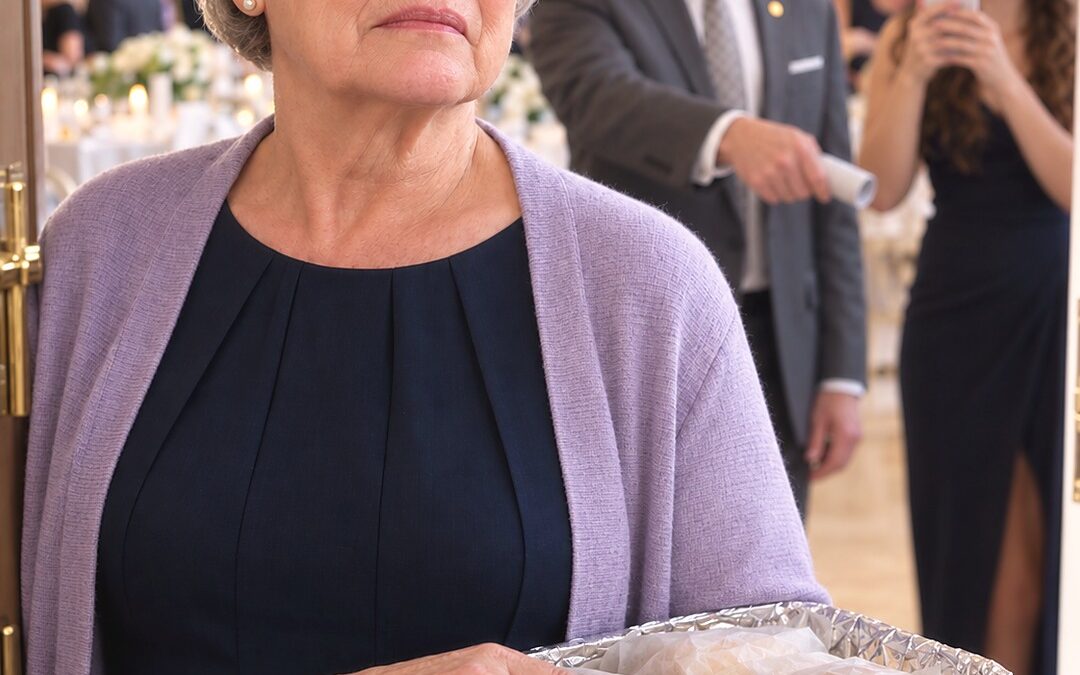
Without that money Hannah's nursing diploma sat in the registrar's office with a red HOLD on the file. I was seventy-four, in my black work shoes, holding forty egg sandwiches in wax paper, the same two eggs on rye I used to hand out of a window on Oak Street every morning for twenty years.
I picked the ticket back up off the foil. Hannah had gotten two free ones for the scholarship dinner, one for me and one for Eddie, and Eddie's hip had said no around three o'clock. "That's a dinner ticket, hon. Same as theirs."
"Catering's downstairs."
"I'm not catering. They're for the kids. Half of them came straight from clinicals and haven't eaten since lunch." I peeled back a corner of the foil. "You want one? Fried egg, rye. I don't charge."
A girl behind him had her phone up, in a pink case with little rhinestones on the corners. I could see myself on her screen, small and gray, with little hearts floating up the side.
"Sloane, honey," he said. "Give us a minute."
She didn't give him a minute. She had his chin, so I took her for his.
"I'm Rose Mazurek," I said. "Hannah Brandt's grandmother."
He tucked the seating chart under his arm and looked at me properly, top to bottom.
"Then she can walk across that stage with an empty folder."
I'd read the letter from May 4 four times at my kitchen table. St. Elizabeth's had Hannah starting on the floor June 1, diploma in hand, or they'd give the job to the next girl on the list. Nobody had warned me he'd say it to my face, holding a seating chart, with a gold pin on his lapel. I put my left hand in my cardigan pocket. There was a pale stripe on my ring finger where my wedding band had been until Wednesday.
Across the doorway Hannah stood in her blue dress. Her mouth opened.
Craig had already turned to the man behind me. "Mr. Patterson. So glad you could make it."
I set the foil pan down on the registration table, because my arm had gone numb from it. "Excuse me, hon. I'm not finished talking to you."
Craig turned back with the seating chart still under his arm, and the girl with the phone drifted closer. "Financial Aid handles hardship cases, Mrs. Mazurek. This is a donor event."
"Then why is your office on the letter?"
He looked over my head at nothing in particular. "Could somebody please help this lady find the service elevator?" A woman in a headset stepped over, MARCY on her badge, and said, "Ma'am, would you come with me?"
"Is Hannah allowed to come?"
Craig answered before Marcy could. "Miss Brandt has a seat with the scholarship students. Please don't interrupt the program."
Hannah had reached us by then. "Grandma." She looked at the pan. "Oh, Grandma. You brought sandwiches?"
"You told me you hadn't eaten since eleven."
"I said I might not get dinner until late."
"That's late."
Hannah glanced at the phone Sloane was holding and looked away fast. "Just go with Marcy, okay? Please." The side seam of her dress had a row of stitches that didn't match the rest, where she'd fixed it herself Tuesday night under the bright light over our sink, with the thread in her teeth.
"All right, sweetheart. You go on."
She touched my elbow and wanted to say something else, but Craig had already put a hand on the back of the next guest and steered. Marcy picked up the pan. "Elevator's this way, Mrs. Mazurek." We went past a hallway of photographs, university presidents shaking hands with men who held oversized checks, and at the elevator I turned around. Hannah stood alone beside the ballroom doors. Sloane had her phone pointed at me again.
The Harlan Hall kitchen had a floor drain in the middle and a sheet cake going soft on a rack. Marcy set my pan on a steel counter and called, "Bev? Mr. Whitlock wants this guest seated in here," and a woman with short gray hair came around a rack of sheet pans wiping her hands on a dish towel.
"I'm Bev Sokol. Real fried eggs?" She'd already peeled back a corner of the foil. "Good. The ones upstairs came in frozen." Marcy touched her headset and went back out, and Bev dragged a chair beside the staff table. "Sit, honey. You look ready to throw that pan at somebody."
"Wouldn't waste good eggs."
She laughed once and brought me coffee in a paper cup. I took a sandwich, and Bev said the other thirty-nine could go to Hannah's classmates, she'd see to it. When I picked mine up she was watching my left hand, so I put the hand under the table.
"That's a pale mark you've got there."
"Had a ring on it fifty-two years. Sold it Wednesday, with my mother-in-law's brooch. Gold Rush Buyers on Market Street gave me eleven hundred forty dollars for both. Nursing school. I still need fifty-two sixty."
Bev lowered herself into the opposite chair. "Hannah Brandt? The Window Scholarship girl? She comes down here some nights when she's studying late and buys a cup of soup. Always puts her tray away."
"That's Hannah." I unfolded the letter from my cardigan pocket. The crease across the middle had started to split. It said the final-semester award was being withheld "under review for misrepresentation of household income," which meant the money I used to make at the breakfast window. Cash sales, thirty years ago, receipts in pencil.
Bev put on her glasses and read down the page. "That's Deb Sorensen's signature. And that's Craig's office on the letterhead."
"Financial Aid says it came from Advancement."
Bev took the glasses off. "New president's auditing every fund come June," she said, and went to check an oven. She came back with a second coffee and told me to eat and go home. I said I'd rather stay. "There's a little window in the door. Stand to the left and you can see the stage."
I had to go up on my toes to see through the little window in the door. Every water glass in the room had been set on the left of the plate instead of the right. Hannah sat near the front with the other scholarship students, and she'd taken her napkin out of its folded triangle and laid it over her knees. Nobody had brought her dinner yet.
Bev came up beside me as Craig took the microphone under a university banner. "Ladies and gentlemen, welcome to Mahoning Valley State University's annual scholarship dinner." He thanked the trustees and the corporate sponsors and named donors one at a time, leaving a pause after each for applause. Then he spread his arms. "Every dollar in this room, I went out and got."
The tables nearest the stage clapped fast.
"Is that so?" I said.
Bev set her cup down. He told the room the graduating class would walk Saturday at ten in Beecher Arena, and that he'd see his valued supporters in the Donor Circle, and a few people raised their glasses.
Then a slide came up on the big screen behind him. THE WINDOW SCHOLARSHIP. The back of my neck went stiff.
"There's your girl's award," Bev said.
I moved closer to the glass. Craig adjusted the microphone. "This year marks the tenth year of awards from one of the most remarkable gifts in MVSU history. Eleven years ago, an anonymous benefactor established the Oak Street Trust with a gift of one million, two hundred thousand dollars."
"The trust created the Window Fund to support students whose commitment to service reflects the generosity that inspired the original gift. And tonight, for the first time, the trust has allowed us to share its words." He lifted a printed page and read. "Established anonymously in gratitude to the woman at the Oak Street window, who fed a barefoot boy every morning for two winters and never asked his name."
I put my hand flat against the kitchen door.
"Rose?" Bev said.
"Wait."
Craig let the applause run, and a few people stood. I stared at the screen. The market had a walk-up window on its side, under a green tin awning, and I'd opened it at five-thirty every morning from 1976 until 1996, when the city bought the building for the highway on-ramp. My prices were on a chalkboard. Eighty-five cents for an egg sandwich in 1978, twenty-five cents for cocoa. Plenty of boys had come through that window in twenty years. I wiped my palm down the front of my cardigan and kept my eyes on the screen.
"He's reading about my window," I said.
"What?"
"That's my breakfast window he's talking about."
Bev put her face up to the glass. Craig had moved on to the next page of his program. "While we celebrate this beautiful history, our Window Scholar's recognition has been postponed pending a routine review."
Hannah was standing near the stage steps. I hadn't seen her get up. One hand rested against the skirt of her dress, and a man from the university staff stood beside her holding a blue folder. Craig gave a short wave toward the student tables. Hannah stayed where she was, so he waved again, harder, and the staff man leaned in to say something to her and carried the folder away. She walked back to her seat with her hands empty. At the nearest tables people watched her go by, and one woman moved her chair to let her through. Hannah sat and picked up her water glass, and her hand shook enough to knock it against the plate.
"Oh, sweetheart," Bev said.
I pushed the kitchen door open.
"Rose, where are you going?"
"To ask that man a question."
"Let me come with you."
"No, hon. You've got a kitchen to run." I was through before she could get her hand on my sleeve.
I took the narrow path between banquet tables toward the head table. A server with a tray of water glasses stopped me. "Ma'am, are you on the program?"
"I've got a question." I went around him.
Craig had stepped away from the microphone and was talking to a trustee with white hair, the printed dedication still folded in his hand. I stopped beside his chair. "Mr. Whitlock."
He turned, and I could tell he'd recognized my shoes before he got to my face. "Mrs. Mazurek. I thought we'd arranged somewhere comfortable for you."
"You read something up there. Who gave that money?"
"The donor has chosen to remain anonymous."
"Then I'd like to know who wrote the dedication."
He looked at the paper in his hand. "That information is confidential. I'm in the middle of a program, and I really don't think this is appropriate."
I turned to the trustee. "Sir, did you hear what he read about the Oak Street window?"
"I did, ma'am."
"I had a breakfast window on Oak Street. Side of the Oak Street Market, under a green awning. My husband Eddie ran the market and I cooked breakfast."
The trustee set his fork down. "What years?"
"Seventy-six through ninety-six."
"Many businesses operated on Oak Street, Mrs. Mazurek," Craig said.
"I know. I fed half their employees."
Craig signaled to a woman near the stage with two fingers. The trustee said, "Craig, perhaps Mrs. Mazurek could speak with someone from the trust," and Craig's shoulders pulled back. "All donor communications go through my office."
"Then your office can tell me."
The nearest tables had stopped eating, and a server stood with a bread basket held in the air. Hannah stood up from her chair. "Grandma?"
"I'm only asking him who gave your scholarship money, sweetheart."
"Miss Brandt, I suggest you return to your seat," Craig said.
"She's my grandmother."
"Then you understand the difficulty she's creating."
Hannah pressed her lips together. She'd made the same face at eleven, when a girl at school made a joke about her mother being dead, and she'd spent the whole ride home picking lint off her coat. I wasn't going to keep her standing there.
"All right, sweetheart. I'll go."
A campus security man with a lanyard and a radio had come up behind us. Craig pointed at the ballroom doors. "Please escort Mrs. Mazurek from the building."
"Craig, is that necessary?" the trustee said.
"She's been asked repeatedly to leave."
"Once," I said. "At the door. And I was asked to go to the kitchen." I touched Hannah's cheek. "Go sit down, honey. Eat something."
Hannah didn't say anything. She wiped under one eye with the side of her finger and went back to her chair.
I followed the officer toward the doors. Sloane was waiting by the entrance with her phone up, reading from her own screen. "Sandwich Grandma. She's getting kicked out." A couple at the registration table turned to watch.
"Young lady, your father ought to have taught you better."
She smiled into the phone. "She's talking to me now."
In the hallway Marcy stood by the elevator, studying her clipboard. "Ma'am, your food is still in the kitchen. Would you like somebody to bring it?"
"Ask Bev to keep it. She's got people to feed."
The officer rode down with me. Outside Harlan Hall the air had cooled, and I sat on a concrete bench to dig out my car keys. My feet had swollen until the right shoe rubbed a blister on my heel. Then I drove home.
Eddie was awake. The ballgame was on low, a game he couldn't see well enough to follow anymore, so he listened to the announcers and argued with them about the strike zone. "Rosie? That you?"
"Who else would it be?"
"How was our girl's dinner?"
I hung my cardigan on a kitchen chair. "She looked beautiful."
"They give her the award?"
"No."
He found the remote and shut the television off. I told him about Craig Whitlock and the kitchen and the folder that got carried away, and he kept his hand on the arm of the recliner the whole time and only stopped me once, to ask if I'd eaten. "One sandwich. Bev made me."
When I got to the dedication he leaned forward. "Read it again."
I'd picked up a gala program from the table by the kitchen door before I crossed the ballroom, and the dedication was printed inside it. I read it to him off the page, and he held out his hand and brought the program up to his eyes and pushed it out again. "Can't make out the little print. But I heard you."
"Remember Socks?"
Eddie looked up. "Course I remember Socks."
"Let's go downstairs."
Our basement smelled like laundry soap and the cardboard Eddie kept promising to throw out. He went down first, gripping the rail. The old market records were in a box beside the furnace, green cloth ledgers, all pencil. Eddie dragged the box to the workbench. "Which one?"
"Seventy-seven. He started in November."
The spine said 1977-78 in my handwriting, and there was a coffee ring near the bottom of the cover. I opened to November and found him on the first page. "Socks — 2 eggs on rye, cocoa. Paid: —" I ran my finger under the line.
Nine or ten years old. That first morning he stood behind the newspaper rack with his feet tucked out of sight, and I figured he'd spilled something on his shoes. Then he stepped out. Only socks, one with a hole under the heel.
"Where are your shoes, hon?"
He shrugged. "Lost 'em."
"Both?"
"Yes, ma'am."
I made him two eggs on rye and a cocoa, and he held the cup with his sleeves pulled down over his hands. "Blow on it first. And don't thank me. Eat."
He came back the next morning, and the one after, five-forty, waiting by the newspaper rack. I never got his name. Eddie started calling him Socks after watching him run to the window across the icy sidewalk in them. Every day I wrote his breakfast down. Then in February of 1979 he stopped coming, and I watched the rack until the weather warmed.
"Somebody told us he'd been taken to Akron," Eddie said at my shoulder. "Foster people."
"That's what I heard."
"You think he grew up and started that fund?"
"I think somebody remembers the window."
"You ought to show Hannah."
"She wouldn't look at me when I left."
"She'll call." He pulled out the chair beside mine, slowly, on account of the hip. "You going to see that Whitlock fellow?"
"In his office in the morning."
"With what?"
I tapped the ledger, and put it in a Giant Eagle bag, and set the bag at the bottom of the basement stairs. Eddie switched off the extra light over the workbench, and I sat a minute longer with the old pencil marks.
Somebody had named a scholarship after my window. And the man holding its checkbook had just told me to my face that my granddaughter would walk with an empty folder.
Part 2
At eight o'clock Friday morning I walked into the Advancement office on the third floor of Harlan Hall carrying a breakfast ledger from 1977 in a Giant Eagle bag. The girl at the reception desk looked up from her monitor. "Can I help you?"
"I'm here to see Craig Whitlock."
"Do you have an appointment?"
"No, hon. I have a question."
"Mr. Whitlock doesn't take walk-ins."
"He didn't ask me for an appointment at the ballroom door last night, either."
She studied me, and then her eyes dropped to my shoes. "Your name?"
"Rose Mazurek."
Her fingers stopped over the keyboard. "Oh." She picked up the phone and turned her chair a few inches away from me.
Half a dozen people worked at desks behind a glass wall. The plant on the reception counter was plastic, and somebody dusted it every week. A skinny boy in a university polo was loading paper into a copier, and he turned when the girl said my name.
Craig appeared behind the glass wall of his own office and stopped when he saw me. "Mrs. Mazurek. What are you doing up here?"
"I came to ask who established the Window Fund."
"We discussed that last night."
"You told me the donor was anonymous. I'm asking if you can reach the trust."
He saw the green ledger sticking out of my bag. "What's that?"
"My records from the Oak Street breakfast window."
"Why would you bring those here?"
"Because the dedication you read described somebody I fed."
He stepped into the hallway and pulled his office door nearly shut. "Put that away. Donor communications don't go through reception."
"I'm not asking your receptionist." I opened the book to the November pages and held it out. "There's a boy in here. Came every morning. Never paid because he didn't have it."
Craig took one step back. "I am not reviewing private documents with you."
"Somebody remembered that boy well enough to start a scholarship over him."
The receptionist's eyes slid to Craig's closed door, and the copier stopped feeding paper. "Get Sergeant Pierce up here," Craig said.
I shut the ledger. "You're calling the police because I asked about a donor?"
"When she gets here, she can walk you out. You disrupted a university function last night, and now you're up here."
"I walked through the front door."
"You were told last night."
"Last night you told me to eat in the kitchen. Does the trust know you stopped Hannah's scholarship?"
His hand came down on the receptionist's counter. "Her award is under review."
"Since May fourth. Deb's signature, your office on the letterhead."
"Keep this up, Mrs. Mazurek, and it gets harder for your granddaughter."
I put the ledger back in the bag. "Then you can explain to her what I did wrong." He told me to wait there, went inside, and shut the door, and through the glass I watched him lift the desk phone.
Sergeant Luann Pierce took seven minutes by my watch. She was a solid woman with short brown hair and a badge clipped to her belt. "Mrs. Mazurek? Mr. Whitlock has requested that you leave the building. He says you were involved in an incident here yesterday evening."
"I attended a scholarship dinner."
"Ma'am, I'm not here to decide what happened at the dinner."
I shifted the Giant Eagle bag to my other arm and said nothing.
Craig came out holding a printed sheet. "Sergeant, write her a trespass warning. She was removed last night and she came back."
Pierce took the paper and read it to the bottom before she spoke to me. "Ma'am, this notice bars you from all MVSU buildings and facilities, including Beecher Arena, for one year. If you come onto them after receiving it, you could be arrested for trespass."
"I have a granddaughter graduating tomorrow."
"The notice speaks for itself," Craig said.
"Then it says I can't watch her walk."
Pierce looked at him, and then at me. "It says what I read you, ma'am. If you want it reviewed, that's the conduct office, not me."
"Fine," Craig said. "And she is not to return to this office." Pierce wrote on the warning, handed me the copy, and had me sign for it.
"Does signing mean I agree with him?"
"No, ma'am. It means you've received the notice."
She walked me past the staff desks, where a woman stood with a coffee mug stopped halfway to her mouth. The skinny boy stepped back from the copier to let us through. His badge said TEDDY NOVAK. He looked at the ledger in my bag, and I gave him a small nod, and he nodded back.
At the elevator Pierce pushed the button. "I'd suggest handling any future questions through the proper channels."
"Which channel?"
"Financial Aid, maybe."
"They sent me to Advancement."
She breathed out through her nose, and the doors opened. "I'll walk you downstairs."
I called Hannah from the Buick outside the pharmacy on Market Street, waiting on Eddie's prescription, and got voicemail. "Hi, sweetheart. It's Grandma. Call me when you can. I've got something to show you."
A little after eleven I opened Facebook, and Sloane's video was right at the top. The account said SloaneSays, forty-eight thousand followers, give or take. The clip opened on Craig pointing toward the kitchen, then jumped to me walking across the ballroom, and somebody had laid big yellow letters over it. SANDWICH GRANDMA CRASHES SCHOLARSHIP GALA. Sloane laughed behind the camera, and the clip ended with me going out beside security. I closed the app and went in for Eddie's pills.
At noon the Giant Eagle lot was full of people squeezing oversized SUVs into spaces made for the cars we drove thirty years ago. I parked by the cart return. Tina came out through the automatic doors in her red vest with her phone in her fist, wearing the face she gets when somebody argues about an expired coupon. I handed her a sandwich in wax paper. "Egg on rye."
"I said I wasn't hungry."
"You've got twenty minutes. Eat."
She leaned on the Buick with the sandwich still wrapped in her hand. "Ma, you embarrassed her. Hannah's getting messages from people she doesn't even know."
"She's getting them because a man took her scholarship and sent her back to her chair with nothing in her hands."
"You walked right up to the head table."
"He wouldn't answer me at the door." I reached through the window for the bag and gave her the ledger. "Open it."
She turned the pages carefully. She'd been small when I ran that window, and she remembered the green awning, and the chalkboard where I wrote the price of coffee. "Why are you carrying this around?"
"Because somebody gave the university money in honor of that window."
"Your window?"
"That's what I'm trying to find out. He had campus police walk me out."
Tina closed the book. "Oh, Ma."
"I'm not making it up."
"I know you're not." She handed it back. "Don't call her until she calls you."
"Eat that before it goes cold."
She peeled the wax paper down and took a bite. A few spaces over, a young man climbed out of a dented silver Chevrolet and stood beside it facing us, and then he came across the lot. "Mrs. Mazurek?"
It was the skinny boy from the copier. "My mom's on register six, next to your daughter," he said, before I could ask. "Tina told her you'd be by with lunch."
"Teddy, isn't it?"
"Yes, ma'am. Teddy Novak."
Tina looked from him to me. "Who's this?"
"He works at the university."
Teddy looked back over his shoulder. "Could I talk to you for a minute? Maybe where people can't hear?"
"I've got eight minutes left," Tina said.
"Go on in, sweetheart. I'll be fine."
She took his name again, made him recite his phone number, and typed it into her contacts before she went back toward the store with half a sandwich. Teddy waited until the doors slid shut behind her. "My grandfather was Stan Novak."
I knew that name. "Republic Steel."
"Yes, ma'am. The furnaces."
"Coffee, two sugars. Never wanted a lid, said it made the coffee taste funny."
Teddy smiled. "That's him."
"How's Stan doing?"
"He passed three years ago."
"I'm sorry, hon."
"He used to talk about your window. Said you opened at five-thirty even when the plows hadn't come through."
"I had customers who couldn't be late."
He took out his phone. "I probably shouldn't have done this." He opened a photograph of a computer screen, columns of numbers. "That's the Window Fund's disbursement ledger. I help organize files for the annual audit, in the records room."
I put on my reading glasses. "Are you allowed to photograph that?"
"Probably not. But you asked about the donor, and Mr. Whitlock got so worked up."
The dates ran down one column and the amounts down another, the spring semester's payments. I pointed. "What's this line?"
"Student awards." He didn't say the rest. The amount beside it was $0.00, and so was every row above it back to January. I ran my finger down the column and up again, the way I check a short cash drawer.
"A routine review," I said. "On a fund that's paying out nothing."
"And these?"
"Payments to an outside organization." He enlarged the picture. OAK STREET MENTORING PARTNERS LLC, line after line, the same name beside regular checks. I took my glasses off and wiped them on my cardigan.
"Does Hannah get mentoring from them?"
"I haven't found any student records connected to it."
"Then why are they getting scholarship money?"
"That's what I wanted to ask you." He texted the pictures to my phone so I'd have them, put his away, and took it out again. "There's one more thing. The checks go to a mailbox in Canfield, so on my way over here I drove down Oak Street, in case the name meant something."
I let him get there on his own.
"Mrs. Mazurek," Teddy said, "there's no Oak Street Mentoring anything. I looked. The only thing on Oak Street is an on-ramp."
Part 3
Hannah came home at two-fifteen Friday afternoon with her laptop under one arm and a half-empty bottle of Diet Coke in the other hand. She walked past me in the kitchen. "Hi, Grandma."
"There's chicken soup on the stove."
"I'm not hungry."
"Your aunt said that too. She ate her sandwich."
Hannah set the laptop on the table without opening it. "I saw the video. People from my nursing class keep sending it to me."
"So did half of Youngstown."
"They put Mr. Whitlock in it for about two seconds." She pressed her palms on the table. "Four years, Grandma. Three point nine four. And now I don't know if I'm even speaking tomorrow."
"I know how hard you've worked, hon. I watched you do most of it at that table." I stirred the soup and put the lid on. "Somebody gave that university a fortune to help students like you, and Mr. Whitlock won't say where it went."
"It's probably tied up in the review."
"Then he ought to be able to show us. I ran a breakfast window. When somebody paid eighty-five cents for a sandwich I put eighty-five cents in the book." I took my phone off the counter and held it out with Teddy Novak's pictures open. "Type that company name into the state website. The one he showed me."
Hannah's thumb stopped on the bottle cap, but she took the phone and looked at the screen, and then she opened her laptop and typed the name into the Ohio Secretary of State's business search. The first try came up empty. The second, without LLC, brought up the same name in capitals, and she clicked and scrolled to the registered agent and turned the screen toward me. Carla Whitlock. Under it, the filing date: six years ago in March.
"Tenth grade," Hannah said. "I was doing geometry homework at this table."
I pulled out the chair next to hers. "Craig's wife?"
"I don't know." She opened a second tab. A photo from a university fundraiser showed Craig beside a woman in a green dress, and the caption called her his wife, Carla. Hannah went back to the filing. "Same name. The address is in Canfield." She clicked it. "It's a commercial mailbox."
She dug the May 4 letter out of her files, saved as a PDF, and read down the page. "'Under review for misrepresentation of household income.' What household income could they possibly mean?"
"My breakfast window."
"That closed before I was born."
"I told Financial Aid that."
"And you cooked at Chaney after." She pushed the laptop toward me. "Why are they checking your old cash records when they haven't paid a single student this semester?"
"Maybe they needed a reason on paper."
She looked at the screen for a while. Then she got up, and came back with a pencil and a sheet torn from her nursing notes, and wrote down the registration number herself, slowly, twice. "Grandma. I'm sorry about Thursday night."
"You had a day, hon. Eat some soup."
The Friday fry didn't start till after five, so I let the afternoon go by. At twenty to six I folded the business registration printout into my handbag and told Eddie I was going to St. Casimir's. He sat in his chair with the Buick keys on the side table, and he said, "Pierogi fry?"
"Yes."
"Bring me a dozen potato."
"You're supposed to watch your salt."
"Then bring six."
"I'll bring twelve." He'd have come, but his hip was bad that week, so I took the keys, and the Buick pulled to the right the whole way down Market Street, the way it had since March. Hannah stood by the refrigerator with her arms folded. "Deb Sorensen volunteers at the Friday fry," I told her. "I can do two things in one trip."
"Ask her nicely."
I put the lid back on the soup pot and went to find my good handbag, the one with the zipper that still worked.
St. Casimir's hall smelled of fried onions before I reached the basement stairs. The fry had run so many years that the women in the kitchen knew who wanted potato and who wanted sauerkraut without asking. When I came into the hall Deb Sorensen was at the far end stacking takeout containers, reading glasses on a cord around her neck. I waited until she carried an empty cardboard box out into the hallway.
"Deb? Can I have a minute?"
Her apron had flour down the front, and her knuckles were red from the fryer oil. She looked at the crowded hall and said she was volunteering. I said I wouldn't keep her.
"Carla Whitlock is the registered agent for a company the Window Fund pays. Craig's wife." I held the printout out to her, and she looked at it and didn't take it. "Did he tell you to stop Hannah's scholarship?"
She stepped closer and her voice dropped. "I signed what I was told to sign."
"Will you say that to the president?"
"Please don't ask me. I'm not getting into a public argument." Somebody called her name from the hall. She picked up the box and went through the door, and I folded the printout and bought Eddie's dozen potato at the counter from a woman who didn't meet my eye. Everybody in that kitchen had seen the video.
Teddy called a little before seven. I was in the kitchen dividing Eddie's pierogi onto plates, Hannah had her laptop open at the table, and Eddie was trying to pry the lid off the applesauce. "Mrs. Mazurek, I got fired."
I put the spoon down. "From what?"
"My work-study job. Mr. Whitlock called me into his office at four. He pulled the card-swipe log for the records room, and it showed I went in Friday morning, right after you left. He asked why I accessed the Window Fund files. I said I was organizing records."
"Was that your job?"
"Yes, ma'am. The auditors were in the records room Wednesday and we'd been told to get the fund records in order. Then he asked if I took photographs, and I said I had. He already knew somebody had them. He asked if I showed you." He stopped. "He said my work-study was terminated effective immediately."
Hannah had come around the table, so I put the phone on speaker. "Teddy, this is Hannah Brandt."
"Oh. Hi."
"Did he say you violated a written policy?"
"He said I accessed confidential financial information without authorization."
"But you were assigned to those records."
"Yes."
"Keep your work schedule," Hannah said. "And any message that gave you access to those files. Don't delete anything."
"I won't." The line hissed, and then he said, "Mrs. Mazurek, I'm sorry. Maybe I should've handled it different."
"You showed me what was in the book, hon. That's all."
"I have to tell my mom. That job paid for my books."
"Tell her what happened." He thanked me and hung up.
Hannah stared at the phone. "He's nineteen. Craig fired him for showing us those payments."
"For showing me," I said. "Not you. Keep that straight if anybody asks."
"Grandma."
"He's got a mother and a book bill, and I've got an old woman's nerve. Put it on me."
Eddie cleared his throat from the chair. "Stan Novak never once paid for coffee on a Friday, Rosie, because you wouldn't let him. That boy's books are on us."
"We'll find something," I said.
I set the plates on the table. Eddie was watching us from his chair. "What did that boy find?" Hannah turned the laptop so he could see the business record, and before she could explain, the landline rang. The house phone rang twice a week at most, and one of those was Eddie's sister in Struthers, Sundays, calling to report who had died. Eddie picked up. "Mazurek residence." He listened and held the receiver out to me. "Rosie. It's Whitlock."
"Mrs. Mazurek, this is Craig Whitlock. I'm calling as a courtesy."
"Mr. Whitlock."
"I understand you've been contacting university employees about confidential financial records."
Deb Sorensen was a decent woman and a scared one, and she'd have phoned him from the church parking lot before I got the Buick started.
"Deb Sorensen signed my granddaughter's letter."
"I'd advise you not to approach staff again. The conduct office takes that kind of thing seriously."
"Then answer what I asked you."
"Tomorrow is commencement. The trespass order covers the arena. If you enter Beecher Arena, campus police will act on it."
Eddie moved up beside me, and I tilted the receiver so he could hear. "Does President Reese know?"
"Dr. Reese is aware of the university's procedures."
"Did you tell him about your wife's company?"
The line stayed quiet long enough for me to hear him moving papers. "I'd be careful what you say about people's families."
"Carla Whitlock. Canfield mailbox. It's public information."
"If those photographs leave your household, I'll refer Hannah Brandt to the student conduct board. Her aid is already under review, and a finding could affect her employment eligibility. I doubt St. Elizabeth's would want to proceed."
Hannah had stood up from the table. I put a hand up to keep her where she was. "She's worked since she was eighteen for that diploma."
"Then you should consider her future."
Eddie had a hand on the back of a chair, and Hannah stood where I'd stopped her, watching the receiver. I said, "Mr. Whitlock, are you threatening my granddaughter because I asked about your wife's business?"
"I'm explaining consequences."
"Put that in writing."
He ignored that. "You come near my commencement tomorrow," Craig said, "and the last picture your granddaughter has of college is you in the back of a squad car."
Part 4
The email came at 9:17 Friday night. Hannah was at the sink washing two plates, and her phone buzzed itself halfway across the counter before she picked it up.
"Grandma."
I was at the table with the May 4 scholarship letter flattened under my hand, where it had been since supper. She turned the phone around. Commencement Program Update, the subject line said, from the Commencement Committee, and I got my glasses on while she stood there dripping on the linoleum.
Dear Ms. Brandt,
Due to an ongoing administrative review, your selection as student commencement speaker has been withdrawn pending review. The university will proceed with an alternate speaker for Saturday's ceremony.
Your scheduled participation as a graduating student remains unchanged.
We appreciate your understanding.
She took the phone back before I got to the bottom.
"Four years," she said. "I've never gotten below a B-plus. I worked every weekend I wasn't at clinicals. They picked me out of the whole class, Grandma."
"I know."
She opened her laptop on the table. Commencement Address — Hannah Brandt, the file said. "I already wrote it. I thanked Mom in it. Page three, right there, you and Grandpa."
Our Lisa went off Route 11 when Hannah was six. Thirty-one years old. Hannah had only lately started saying her mother's name in front of strangers without stopping to hunt for another word.
"Maybe they'll reconsider," I said.
"Commencement is tomorrow."
"I know what day it is."
"Then stop saying maybe." She shut the laptop, harder than she meant to, and the salt shaker walked an inch.
Eddie came in from the living room on his cane, one slipper on and one off. "What's going on?"
"They took Hannah off the speaker list. Pending review. Everything's pending review."
"Can we call somebody?"
"At nine-thirty on a Friday night?"
"Somebody's working."
"Grandpa, Mr. Whitlock is working. He's working very hard making sure I don't graduate with my diploma."
She went to the sink and turned the water on over a plate she'd already washed. I watched it run until I said her name and she shut it off.
"Grandma, please don't come tomorrow."
Eddie turned his head to me. She kept her back to us. "I'm scared for you. He told you on the phone he'd have you arrested if you set foot on the grounds, I heard him, and you're seventy-four, and you were on your feet all night Thursday, and I can't be up there looking for you in the crowd and not know."
"Honey, I wouldn't make trouble at your graduation."
"I know you wouldn't. It's not you I'm worried about."
She wrung the dish towel out, though it was dry, and hung it over the faucet. "Please. Let me just walk across and get through it."
Her blue gown hung on the pantry door. Her cap sat on top of the refrigerator, where she'd put it so nobody would flatten the cardboard. I looked at the two of them for a while.
"All right. I won't come in."
"You promise?"
"Yes."
Eddie slid his cane out from under the table. "Rosie…"
"It's Hannah's day."
She rubbed the side of her nose with her wrist and said thank you, and she was halfway up the stairs, one hand on the rail, when she stopped. "I don't even know what they're going to hand me." Then her door closed.
Eddie stayed put. "You gave your word."
"I did."
"That man doesn't deserve to keep you from watching her graduate."
"Nobody asked me what he deserves."
He nodded at the scholarship letter. "Want me to put that away?"
"Leave it."
He went up around ten-thirty. I switched off everything but the light over the stove and followed him.
At three I heard a chair scrape across the kitchen floor. Eddie was asleep, breathing with the whistle he gets when his nose is stuffed. I found one slipper by feel, the other under the dresser, and went down.
Hannah was at the table in the Chaney High sweatshirt she'd borrowed off me years ago and never returned, her hair up in a rubber band and a mug of tea gone cold at her elbow. The green ledger from 1977 and '78 lay open in front of her, and the Giant Eagle bag I'd carried it around in all Friday sat slumped on the chair beside her. She'd lifted it out of there herself. I hadn't heard her.
"Couldn't sleep?" I said.
She shook her head, so I sat across from her. The ledger was open to December, a grocery receipt holding her place.
"Grandpa told me about this book. He said you might've found the boy from the dedication."
"I said I might know who the dedication was about. Finding him is another matter."
She turned a page and read it out loud. "Socks — 2 eggs on rye, cocoa. Paid: —" Then she flipped through the mornings after, one, two, a dozen of them. "You wrote the same thing every day."
"That's what he ordered."
"And you never charged him."
"He didn't have money."
"You could've given him one egg."
"He was growing, hon. One egg is a snack."
"How'd you know he wasn't working you?"
"I didn't."
"Didn't you wonder where his parents were?"
"Course I did."
"Did you ask?"
"Once. He looked down at his feet and asked if there was any more cocoa." Hannah laid a fingertip on the penciled dash in the Paid column. "Why Socks?"
"No shoes when he first came. Your grandfather saw him running down the sidewalk in his socks, and that was that."
"What happened to him?"
I shut the 1978 book on my thumb instead of answering.
That January was cold enough to freeze the drain under the window. His socks were soaked through by the time he got to me every morning, so one afternoon I took the bus downtown to Strouss' and bought a pair of red high-top Converse, size four, $11.99. The next morning I put the box through the window with his breakfast. He opened it and said, "These are new," and I said I knew, and he said, "Are they really mine?" He sat down on an overturned milk crate and shoved his feet in. He never had learned to tie them right, so I showed him, two loops, cross them, tie them again so they wouldn't come loose walking. He kept at it until the knots held.
He came every morning in those shoes for a few weeks. Then one Monday in February he didn't. I figured he was sick and kept his plate off to the side until the Republic Steel men finished their coffee. Tuesday, when I unlocked at five-thirty, there was a piece of plain brown paper bag folded small into the corner of the window frame, with a note written on it in pencil.
I never saw him again.
Hannah had quit turning pages. "Where's the note?"
"In the 1979 book. That one's down in the basement, in the box."
"You kept it?"
"Of course I kept it."
I went down for it myself, because she'd have gone through the whole box. The basement bulb took two pulls on the string. The 1979 ledger was near the bottom, under 1980, and I carried it up and set it by her mug and opened it to February. The brown paper was folded small, brittle along one corner, with a grease spot that had come through from whatever he'd carried it in. I unfolded it on the table. Capital letters, uneven, pressed hard enough to dent the paper. "THANK YOU FOR THE SHOES. I HAVE TO GO TO AKRON. I WILL PAY YOU BACK." I could have said it with my eyes shut, and had, in a few bad years.
"Read it," I said.
She took it by the edges. "Thank you for the shoes," she read. "I have to go to" She stopped there, with her fingertip above the word, where he'd spelled it ACRON first and written the K right over the C.
I had my thumb on the edge of the table. I said, "Go on," and it came out wrong, so I coughed and said it again.
"Akron," she said, smaller. "I will pay you back."
She set the paper down flat.
"He thought he owed you," she said.
"I told him he didn't."
"He wrote it anyway." She pulled the ledger closer. "This was a Tuesday?"
"Tuesday."
"Where'd he go?"
"Somebody told your grandfather he'd been taken into foster care in Akron. That's all we ever heard."
She touched the corrected word with one fingernail, then took her hand back before the paper could shift. "How old was he?"
"Eleven when he left, I'd guess. Maybe ten. He never told me his birthday."
"The dedication said the donor was barefoot. For two winters. And your window was on Oak Street."
I nodded. She picked up her phone.
"What are you doing?"
"Looking something up."
She pulled up the MVSU website and searched for President Daniel Reese. A man in glasses and a dark suit stood in front of the campus library, hair neatly combed, a crease beside his mouth. "Dr. Daniel Reese," she read. "Fifty-eight. President since July first last year. Came here from a university in Pennsylvania. He's got degrees from places I've never heard of."
"Does it say where he grew up?"
"Wait." She scrolled farther, and stopped. "Grandma."
In a paragraph about his commitment to students from disadvantaged backgrounds, the biography said he had been raised in foster care in Akron.
"Read that part again."
She did. I studied the photograph. The boy at my window kept his head down so much I remember the top of it better than his face.
"Could be him," Hannah said.
"Could be. A photograph won't prove it."
"The events page says he was in Columbus for a budget hearing. He got back last night."
"Then he's asleep somewhere."
She searched the Oak Street Trust next and got annual giving reports and the scholarship page, no donor name. "Anonymous. Whoever he is, he's been paying for me since I was eighteen."
"Helped pay. You earned the rest."
"Grandma. Stop correcting everything."
"Then stop leaving things out."
She almost smiled. I got up and filled the kettle, because the girl had been sitting with cold tea long enough.
"Tomorrow they hand me an empty folder," she said. "Everybody else gets the real one handed to them up there."
"I've sat through a few of those."
"They told me the diploma's on hold."
"Then you'll know exactly what you're carrying."
"And if he isn't the boy?"
The kettle started ticking. I took it off before it could whistle, on account of Eddie. When I turned around Hannah had the note up again.
"What if the paper tears?"
"Fold it on the old creases."
She did, slowly, keeping the worn corner inside. I reached across the table and took her hand, her fingers cold from the mug, and put the note in it, and closed them over it one at a time.
"Put it in your gown pocket," I said. "And give it to whoever hands you the empty folder."
Part 5
At nine-forty Saturday morning I was standing behind a metal barricade outside the north glass doors of Beecher Arena, handing egg sandwiches to parking attendants.
One of them was a boy with sunburned ears and a yellow vest that hung almost to his knees. "How much?" he said.
"Nothing, hon. Take two. You're skinny."
He took them and hollered across the sidewalk, "Hey, she's got breakfast!"
Forty sandwiches again. Eddie had helped me wrap them before sunrise, sitting at the kitchen table with his bad hip stretched out, and he hadn't asked where they were going. He'd only said, "Rosie, you gave Hannah your word." I said I knew.
Through the glass the lobby monitors were playing the program. Sergeant Luann Pierce stood just inside, saw me, and came out.
"Mrs. Mazurek. You got a trespass warning yesterday."
"I'm on the public sidewalk."
"Behind the barricade."
"That's where they told me to stand."
She eyed the pan. "You're distributing food?"
"To parking attendants. They're hungry."
"Please don't block the entrance."
I moved the pan a foot to my left, off the doormat.
She had barely gone back to her post when I heard, "Sandwich Grandma's back." Sloane Whitlock was a few feet away in a black graduation gown, the hood over her arm, her phone held low against her hip and pointed up at me as if I couldn't tell. "Guys, remember the woman from Thursday? Same lady."
"Good morning, Sloane."
"Didn't they kick you out?"
"They asked me to leave."
"So why are you back?"
"My granddaughter graduates today."
She swung the camera toward the arena. "She's standing outside because they won't let her in." I held the pan out to her and asked if she'd like one. She said no thanks. I said suit yourself.
A marshal in a maroon sash came down the sidewalk with a clipboard. "Graduates, the line's forming at the east doors. You're late."
"One sec," Sloane told the phone.
"Now, miss." He took her by the elbow and walked her off, and she went talking at her sleeve.
On the monitor behind the glass the procession started, and Craig Whitlock came down the aisle carrying the university mace, a tall ceremonial staff with a polished metal head. Eleven commencements he'd carried it. He'd said so in an interview on the school's website, along with how proud he was to lead the procession. He held it straight up in front of him.
The nursing graduates came past the inside of the glass on their way to the floor, and Hannah, third in her row, saw me. She didn't wave. She touched her gown pocket and kept walking.
"Ma!"
Tina was crossing the sidewalk in her Giant Eagle jacket with a paper cup of coffee. "Switched shifts," she said. "I put cream in it."
"You know I drink it black."
"Then don't drink it." She watched the doors a minute and picked at a spot on her sleeve. "Ma, I shouldn't have said you embarrassed her."
"Well, you did say it."
"I know what I said." She took a sandwich out of the pan. "Come on. Let's get you somewhere you can see a monitor."
From the left end of the barricade I could make out the nearest screen through the glass, and Tina stood next to me and read the captions aloud when the announcements got garbled. The Donor Circle filled the reserved rows up front. I picked out Mr. Patterson, the one Craig had been so glad to see at the ballroom doors Thursday, and the woman beside him who'd moved her chair when Hannah walked back empty-handed. The white-haired trustee from the head table was there too.
A little before eleven they got to the nursing graduates. "There she is," Tina said.
Hannah came across the screen in her gown and the blue-and-white nursing cord she'd earned that spring, her cap a little crooked. "Lisa's smile," Tina said. I put my fingers on the barricade. The metal was cold.
Dr. Daniel Reese stood at the front of the stage shaking hands and passing out folders. He gave Hannah his hand, then a blue folder. She opened it. Even on a monitor you could tell there was nothing in it.
He had already turned to the next graduate when she stopped him. She reached into her gown pocket and took out a small folded square of brown paper bag and laid it across the empty folder. He unfolded it while the student behind her waited. He read it, and then he just stood there, and the microphone by the diploma table caught him saying, "Where did you get this?" Hannah answered, but the microphone didn't get her. She turned and pointed at the north doors. At me.
Reese handed the next folder to an official, said something to the woman at the podium, and walked down the stage steps and up the center aisle. The camera operator tried to keep him in frame and lost him behind the standing graduates.
Tina grabbed my elbow. "Ma. He's coming this way."
He appeared at the far end of the lobby still in his academic gown. Pierce stepped over. "Dr. Reese, is there something you need?"
"That woman." He pointed through the glass. "Please open the barricade."
Pierce looked back at me. "Mrs. Mazurek?"
"Yes."
She unhooked the section and walked it aside, and Reese came through the doors. "Are you the woman from the Oak Street breakfast window?"
"Used to be. Building's gone now."
His eyes went to the foil pan. "Did you make those?"
"Egg sandwiches. I've got a few left."
"Do you remember a boy who came in without shoes?"
I set the pan on the barricade. "Yes."
"He sat behind the newspaper rack."
"Until I told him to come around where I could see him."
He reached inside his gown and took out the folded brown note. "You never asked my name."
"You never told me, Socks."
He put a hand over his mouth. Then he laughed once, a short sound that quit before he could finish it. "I looked for you."
"Market was torn down in ninety-six."
"I found the demolition records. They had Ferrante's name."
"Sal Ferrante owned the building. Eddie and I rented."
He took my hand. "Mrs. Mazurek, would you come inside with me?"
I looked at the open doors. I'd told Hannah at her sink that I wouldn't come in, and here I was on the sidewalk with my hands empty.
I turned to Pierce. "Am I allowed?"
"She's my guest," Reese said, and Pierce moved the barricade farther aside. Tina picked up the foil pan. "I've got this, Ma." Reese offered his arm and I took it.
The center aisle ran a lot longer from the floor than it had on the monitor. We passed the Donor Circle rows, and Mr. Patterson turned in his seat with his hand stopped halfway to his program. The woman beside him looked at my work shoes, then at Reese. The white-haired trustee who'd listened to me Thursday got to his feet. Hannah was waiting at the top of the stage steps with her empty folder.
"Grandma?"
"Hello, sweetheart."
"You said you wouldn't come in." Her mouth was doing the thing it does when she's trying not to.
"I didn't. I was sent for."
Reese helped me up the steps.
At the podium six thousand people were still shifting in their folding chairs.
"This is Rose Mazurek," he said. "When I was ten, I ate breakfast at her window on Oak Street every morning for two winters. I didn't have money. Most of that time I didn't have shoes. She never once asked me for either one."
He held up the square of brown paper bag with his own pencil capitals on it, and the big screens showed it to the whole arena, AKRON with the K written over the C.
"She bought me a pair of red Converse at Strouss' for eleven dollars and ninety-nine cents. I know the price because I read the tag about a hundred times." He looked at the front rows. "Eleven years ago, with money from a business I sold, I set up the Oak Street Trust to pay her back. I just didn't know where to send it."
I looked over at Hannah. She was holding that empty folder flat against her gown.
Craig came off the line of chairs with the mace held across his body.
"Dr. Reese, this woman is under a trespass warning—"
"I'm aware of the warning, Craig."
"She disrupted a donor event Thursday night. She walked into a restricted office yesterday. There's a procedure."
Dr. Reese lifted the microphone off its stand and held it out to me.
I'm not a microphone person. I've talked into exactly one before, at a Chaney High retirement lunch, and I told them where the good ladle was. I looked across the podium at Craig Whitlock and the gold pin on the front of his gown.
"You told me the help eats after the donors. Honey, I've been feeding your donor since he was ten."
Craig shifted the mace to his other hand, and its metal head knocked the microphone stand, one hollow clang that went around the whole arena and came back. He looked down at the Donor Circle rows for somebody to look back at him. Mr. Patterson closed his program and set it on his knee.
Out in the student section one phone was up over the caps, a pink case I'd have known anywhere. Sloane Whitlock was filming me. Reese took the microphone back and opened the folder he'd left on the podium. "The audit memorandum shows $412,000 moved out of the Window Fund over six years to Oak Street Mentoring Partners LLC. The registered agent is Carla Whitlock. I have referred it to the Mahoning County Prosecutor."
"My wife runs a legitimate consulting business," Craig said.
"And Hannah Brandt's award was held on your order."
A woman stood up in the staff section with her reading glasses hanging on her blouse and one hand on the back of the chair in front of her. "Dr. Reese? I'm Deb Sorensen. Financial Aid."
"Yes, Ms. Sorensen."
"I signed the notice stopping Hannah Brandt's award."
"Deb, sit down," Craig said into the nearest microphone.
She stayed standing. "I signed it because he told me to."
The man next to her moved his program off the empty seat in case she wanted it. She didn't.
Harold Ames, the board chair, stood up from his seat at the end of the trustees' row with his copy of the memorandum. "Mr. Whitlock is relieved of his duties, effective immediately, pending investigation."
Dr. Reese turned to Craig. "Mr. Whitlock, hand Mrs. Mazurek the mace and leave my stage."
On the big screens Craig's thumb went to the gold pin on the front of his gown and pushed at it until it sat crooked. He took one step toward me, then another, and stopped two steps short. Then he held it out. I took it. The metal head was still warm from his hands.
"Thank you, hon."
He let go. Sergeant Pierce met him at the head of the side steps and took him down them, a half step off his elbow, and stopped him at the bottom.
Reese called Hannah to the podium. The registrar had come forward with a document case, and Reese signed the paper she held out, checked the name on the diploma she took from the case, slid it into a blue cover, and put it in Hannah's hands. "This one has something in it."
She opened it and ran one finger over the raised seal. "Thank you," she said.
"Congratulations, Nurse Brandt."
Her arms went around my shoulders. I held the mace out to one side. "Grandma. Look."
"I see it, sweetheart."
Reese turned to the arena. "Miss Brandt was selected as your student commencement speaker." Then to her: "Have you brought your remarks?"
"They're on my phone."
"Then I believe your classmates should hear them."
She took the phone up to the microphone and thumbed down the screen. "I'm Hannah Brandt. I wrote four pages, and I'm going to read you one."
I stood the mace on its end and leaned on it like a mop handle. Nobody had told me where to put my other hand, so I rubbed the bare place on my ring finger.
"Page three says thank you to my mother, Lisa, who went off Route 11 when I was six and didn't get to see any of this. It says thank you to my grandparents, Rose and Eddie Mazurek, who raised me on Shirley Road and fed me before they fed themselves. Grandpa's home. He can't see the screens anymore." She looked at me. "Grandma's up here holding a mace."
Somebody in the upper deck laughed, and then a lot of people did. "That's page three," she said. The other three she folded away into her pocket with the phone.
At the end of the center aisle I could see Tina, holding our empty foil pan.
Dr. Reese walked us down to the side steps, where Craig still stood at the bottom with Sergeant Pierce beside him. He looked at the diploma in Hannah's hands, then at me.
"You think this is over because he likes your sandwiches?" he said. "Check your mail Monday."
Part 6
The courier came at ten past eight Monday morning, while Eddie was scraping burnt toast into the trash. A stiff white envelope, a law office in Cleveland, three pages dated Sunday and signed by the attorney for Craig Whitlock. It said I had made false statements about Mr. Whitlock's professional conduct at Saturday's ceremony, that I was to retract them, stop discussing his financial affairs, and keep every document and photograph connected to the Window Fund. The last paragraph said defamation.
Eddie read the first page over my shoulder with his good eye. "Didn't the president read the audit?"
"Right into the microphone."
"So why's Whitlock sending this?"
"So I keep my mouth shut until his lawyer talks to Channel 27 first." I slid the pages back in the envelope. Hannah was coming down the stairs in jeans and her old nursing-school sweatshirt, and she read the letter standing up, then laid it flat. "Please don't call him."
"I'm not calling him. I'm taking it to Dr. Reese."
She shut her eyes. "Grandma."
"The man mailed a lawyer to our house. The president ought to see it."
"Then I'm coming," Eddie said, and I told him his hip was bad, and he said a car seat was a car seat. Tina called off her first hour at Giant Eagle and drove us in the Corolla. She let us out at the front of Harlan Hall and went to find a space.
At nine the elevator opened on the third floor of Harlan Hall. Eddie stayed down in the lobby on a bench with his newspaper. I walked toward Advancement with the envelope under my arm. The receptionist from Friday was on her feet behind her desk. Every other employee in sight had come out of their office and was standing in the hall.
Craig Whitlock stood in the middle of them in a gray suit, with Detective Mike Cerny of the Mahoning County Prosecutor's Office on one side of him and Sergeant Pierce on the other. His briefcase sat on the floor next to the receptionist's desk, with two framed diplomas and a desk plant sticking out of a copier-paper box beside it. Cerny was a broad man with thinning dark hair.
"I've cooperated fully," Craig said.
"Then it'll be a short morning. My car, not yours."
Pierce saw me first. "Mrs. Mazurek. That trespass warning was withdrawn Sunday night. Dr. Reese signed it himself."
Craig turned around and he looked straight at the envelope. "What are you doing here?"
"Delivering your mail."
Cerny held up his identification. "Mrs. Rose Mazurek? Detective Mike Cerny. We'll need to talk to you about the Window Fund. Somebody from our office will call."
"I've got the old ledgers at home."
"Keep them. We'll arrange to document whatever's relevant."
"Those records have no bearing on this," Craig said.
"Mrs. Whitlock is talking to us downtown."
Craig bent for his briefcase, and the strap slid off his fingers. He bent again. "About what?"
"We'll get to that downtown."
Pierce went ahead and pressed the elevator button. The receptionist stood by her chair holding a stack of unopened mail against her chest.
"Let's go," Cerny said, with two fingers on Craig's elbow. They went by me, two feet away, and the envelope slid out from under my arm and hit the carpet. Craig looked at it and kept walking.
The elevator took its time. Somewhere a printer ran out a whole page, and the girl from the mailroom came down the hall and said, "Mr. Whitlock, your coffee," and held out a paper cup, because it was Monday and nine o'clock and that was what she did. He took it. Cerny took it out of his hand and gave it back to her.
The doors opened, and the three of them went behind them.
I bent for the letter, and somebody said "Mrs. Mazurek?" Teddy Novak was standing outside Craig's office with a screwdriver in his hand.
"Teddy! What are you doing up here?"
"Got my job back this morning. Dr. Reese called yesterday, said work-study was reinstated and I'd be paid for the hours I missed." He nodded at the door. "They asked me to take this down."
A brass nameplate was fixed beside the frame. CRAIG WHITLOCK, VICE PRESIDENT. Teddy set the screwdriver in the first screw and turned it. The plate tilted when the second came out, and he caught it before it dropped. The receptionist brought a cardboard box, and he laid the plate in it brass side up.
When I turned around Sloane was waiting by the elevator. No makeup that I could see, hair pulled back, an oversized sweatshirt. "Mrs. Mazurek? Can I talk to you?"
"If you're going to film me again, I'd rather you didn't."
She took her phone out of her pocket and held it up with the screen dark. "I'm not filming."
"All right."
"I came to apologize." She stared at the floor tile a second. "I took the video down Saturday night." She opened her account and turned the screen to me. It was gone. "After the ceremony your daughter gave me one of your sandwiches. It was cold. I'd said no to you that morning, so I ate it behind the arena where nobody could see."
"There's pepper in them."
"I noticed." She put the phone away. "Your granddaughter gave a good speech."
"She practiced."
"Tell her I'm sorry too?"
"You can tell her yourself."
She nodded and stepped aside so I could get to the elevator.
Dr. Reese's secretary told me he was expecting me. His office was on the top floor, with windows over the campus and a brass clock on the desk that ticked loud enough to hear from the doorway. He stood when I came in. "Mrs. Mazurek."
"Rose, hon. You've known me longer than most people around here."
"Rose, then."
I handed him the envelope. He read the first page on his feet, then picked up the telephone and told his secretary to send a copy to university counsel. "Do you want this back?"
"Keep it," I said. "I've got a basement full of paper."
He pulled out a chair for me. "I owe you an apology for Thursday and Friday."
"You weren't there Thursday."
"It was still my university."
"Well, now you know what went on."
"The Window Fund gets its $412,000 back."
"She starts work June first."
"I know. She emailed me a thank-you yesterday."
I looked around the room until I got to a wooden cabinet against the far wall with a glass case on top. "Can I ask you something? Did you really keep those shoes?"
He didn't answer. He opened a drawer, took out a key, and unlocked the glass.
Red high-tops. Size four. The canvas had faded to pink at the toes, the white rubber had gone yellow, and one shoe had a dark scuff along the outside. The laces were still double-knotted.
I bent closer. "You never took those knots out."
"I loosened them enough to pull them off."
"That's not what I showed you."
"No, ma'am."
He lifted one from the case and turned it so I could see the knot. My thumbnail found the place where the loops crossed, and I picked at it, once, as if it were a twist of dough that hadn't set right, and it didn't give. It was hard as a pea. I picked at it again.
"You oil these?" I said. "Canvas rots."
"Saddle soap. Once a year."
"Well. It shows."
The window light was on my left hand. The pale band where the ring had been showed up white on the finger, and I turned the hand over on the glass and laid it flat.
"After they took me to Akron I wore them till my toes bent," he said. "A foster mother bought me another pair. I wouldn't let her throw these out. I kept them through every move."
He put the shoe down on the desk, gently, laces up, then set it back in its place and sat across from me. "I'd like to put another scholarship in your name. The Rose Mazurek Scholarship."
"Daniel. I don't need my name on a scholarship. Saturday filled my telephone with calls from people I haven't heard from since Christmas."
He laughed. "Is there anything you'd accept? Something for you and Eddie?"
"No money for us. But I would take a window."
"A window?"
"Somewhere on campus. Open early, so the kids coming off night shifts can get breakfast before class. Staff too."
He leaned forward. "What kind of window?"
"Walk-up. Green awning. Little chalkboard with the prices."
"Like the old market."
"Like the old market. I'll run it. Bev Sokol knows how to keep a kitchen going, and I'll want somebody for the heavy pans."
"Agreed," he said.
It took them two weeks to build a window.
At five-thirty Monday morning, June first, the lobby of Harlan Hall smelled like fried eggs and coffee. A green tin awning hung over the new walk-up counter, and under it was the chalkboard. ROSE'S WINDOW. I'd written the prices myself, over Dr. Reese's argument that we ought to give everything away. "People can pay what they can," I'd told him. "The university can cover the rest. But I want a proper price on the board."
Bev stood at the griddle in a fresh apron. "Rose, you've got twelve eggs ready."
"Crack another dozen."
Bev cracked them, two at a time.
Tina was wrapping sandwiches in wax paper behind the counter. Eddie sat on a stool by the lobby windows, tracking the customers by their voices. Teddy came in with a carton of paper cups, and I told him to stack them under the counter, hon.
Hannah came through the lobby doors in navy St. Elizabeth's scrubs with her hospital badge clipped to the pocket. "Grandma, I can't stay. My first shift starts at six."
"Then quit talking and eat."
She didn't reach for one. She set a small white box on the counter between the wax paper and the cash tin, GOLD RUSH BUYERS stamped on the lid. Tina kept wrapping and studied the wax paper. "They hold things thirty days," Hannah said. "We went down Saturday."
Inside were the ring and Eddie's mother's brooch, the little garnet one, still in the tissue the man had used.
"I'm sorry I made you swear to stay home, Grandma."
I wiped my hand on my apron, front and back, and held it out. She slid the ring on over the pale place, and it was loose, the finger having gone thin since Lent. I turned it with my thumb, twice. Then I cracked an egg one-handed on the griddle edge and looked at nobody.
She reached for a sandwich. "How much?"
"Get out of here."
She laughed and took two. Eddie stood up carefully and kissed her cheek. "First day, sweetheart." She held her badge out and he brought it up close to his good eye and tapped the letters. "Hannah Brandt, BSN."
She hugged Tina, thanked Bev, and hurried for the doors. "Call when you get off!" I said, and she said she would.
Dr. Reese was first in line. He'd been standing out there since before I flipped the lights on, in a plain blue shirt with the sleeves rolled, the way men stand outside a hardware store waiting for it to open. Behind him were two nursing students coming off an overnight shift, a custodian who'd been buffing the second floor since four, and a man in a good suit I recognized from Thursday. Mr. Patterson. He still had his donor-circle lanyard around his neck.
"Is there a separate line for donors?" he asked.
"This is the line, hon."
He looked at the custodian in front of him, and at the president in front of the custodian, and he stayed where he was.
The red Converse hung from a hook next to the chalkboard by their double-knotted laces. A man asked about them, and Eddie told him whose they were and went back to stacking cups.
"Two eggs on rye?" I said.
"No cheese," Dr. Reese said.
Tina slid a fresh foil pan onto the counter beside me. Forty. I took the first one off the top, folded the wax paper over twice the way I always have, and set it down in front of him. He reached for his back pocket. I pushed his hand off his wallet with mine, and the ring, loose yet, ticked against the rim of the foil pan.
"Blow on it first," I said. "And don't thank me. Eat."



