My Daughter-in-Law Turned My Pocket Inside Out at the Antique Market: “Check Your Own Pockets Before You Get on That Plane”—She Forgot I’d Written Down Every Table for 38 Years
Part 1
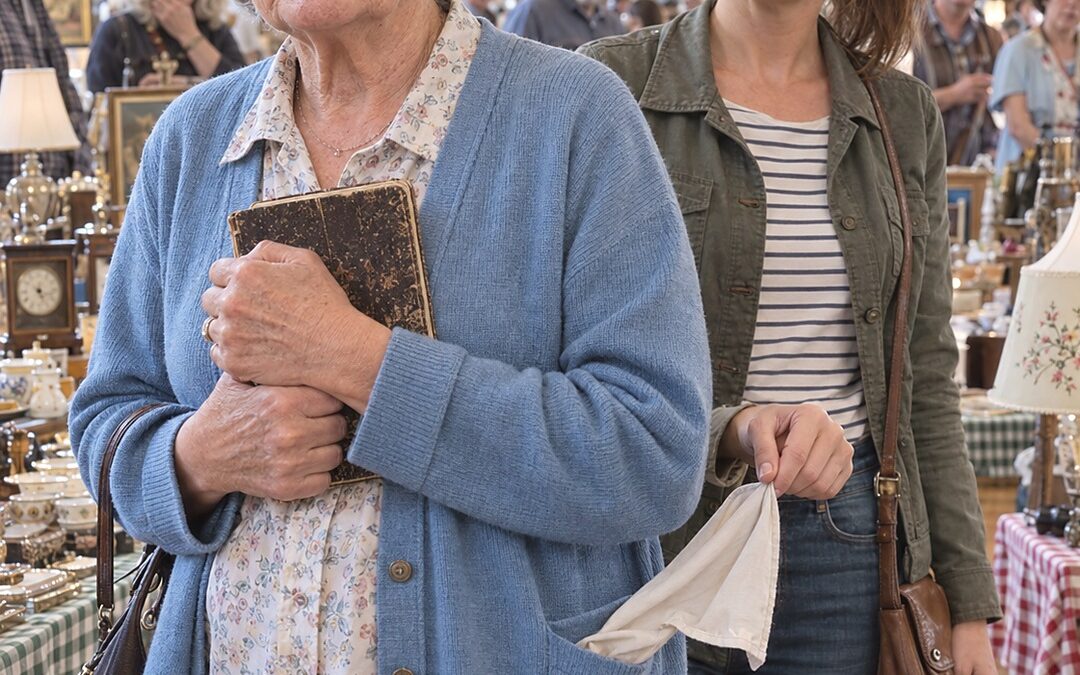
My daughter-in-law turned my cardigan pocket inside out in front of every table at the Rink Market and said, "Three things walked out of our museum this month, Phyllis, so check your own pockets before you get on that plane." Twenty-six people stopped pricing to watch, dealers I'd been buying this county's history back from since the rink had skaters on Saturdays, and my granddaughter Ellie stood at my elbow with a sack of mini donuts she'd quit eating. What Kristen didn't know was that I'd gone home from every antique market for thirty-eight years and written down what was on every table, and this spring some of what I'd written down belonged to the county.
My soft pencil hit Patsy Rudd's checked oilcloth first. The loupe came after it and rolled until a chipped Fiesta saucer stopped it.
"Kristen, take your hands off my cardigan."
She let go of the lining. Then she picked my loupe up off the oilcloth between two fingers like something she'd fished out of a sink trap.
"She brings a jeweler's loupe to a flea market."
Over by the skate counter somebody laughed, one short bark. I knew whose it was. I've bought hand planes off that man for years and never argued him down a nickel.
Kristen had her museum badge on its blue lanyard, the photo from the week she got her hair foiled, and she turned so it faced the floor. "Mind your tables, everybody. She's had the run of that basement since before I was born."
That much was true. I went to work at the Wapsie County Historical Museum six years before Kristen was born and kept its records most of my working life, and when the board hired a gift-shop manager I told them to take the other applicant. They took Kristen. Rosalie said I'd come around.
All I'd done that morning was ask Patsy what I ask at every table, every second Saturday, whether the dealer likes me or not.
"Anything from Wapsie County this month?"
Patsy had been laying out a tray of little silver and brass things behind her butter dishes, and she reached under the table for a dish towel and threw it over the tray like she was keeping bread from drying out. I hadn't touched anything. I'd barely bent over.
"I've had a table in this rink since the day Hap opened it, and nobody's ever had to ask where my things come from."
Then Kristen came around the end of the table, and then my pocket was hanging out of my cardigan like a dog's tongue.
Vonda Schramm has the quilt table next to Patsy's, and has had it longer than Ellie's been alive. She started around the corner with a Log Cabin quilt still over her arm. "Vonda, this is museum business," Kristen said, and Vonda stopped with her mouth open and then shut it, which I had not seen anybody manage with Vonda since about the Carter administration. The Lions Club man at the donut machine kept turning his basket and watching us over his shoulder.
Hap Vesely came across the maple floor from the skate rental in the canvas apron he used to wear fixing wheels for birthday parties. I've bought railroad timetables off Hap since his beard was brown. When his wife passed I took him scalloped potatoes in my good Pyrex and never asked for the dish back. He looked at Kristen, and at the towel on Patsy's tray, and then he said it to me.
"Maybe go on home, Phyllis. Let it cool off."
I had several things to say to that. But Ellie had the donut sack pressed against her stomach and was watching my face to see what it was going to do, so I picked up my pencil and held my hand out for the loupe. Kristen set it in my palm. I pushed the lining back in with one finger and put them both where they belonged.
"Come on, sweetheart."
We walked out across the middle of the rink under the mirror ball. My shoes squeaked on the maple. Somewhere behind us a man went back to dragging a folding table, and by the time we reached the side door the whole place sounded like any other second Saturday. Ellie looked back. I got my keys out.
Outside, the sun was just clearing the beans across Highway 3. Patsy's dark red Astro van sat by the loading door with a cardboard box pushed up against the back glass.
Ellie buckled herself into my LeSabre before I'd got my own door open.
"Grandma, did you take something?"
"No."
"Mom said three things are gone."
"Some things are gone. I didn't take them."
She studied the sack. "She's been mad all week. She told Dad nobody at the museum listens to her."
At the four-way stop by the elevator a hay wagon had dropped its hitch pin, and the farmer was down on one knee in the road squinting at it. Ellie didn't ask me anything else. She unrolled the top of the sack, tipped it over my open hand, and poured out the cinnamon sugar from the bottom. That's the part she always shakes straight into her own mouth. She's been fighting me for it since she was small enough to get it up her nose.
I closed my hand on it and watched the hay wagon. Two cars went around it before I remembered I could turn right.
"Are you still going on your airplane?" Ellie said.
"Monday."
"Good." She pulled the last donut in half and gave me the bigger piece, which is not like her at all.
The trouble had started the Tuesday before. An insurance appraiser came to renew the museum's policy and asked to see the silver railroad watch, the hunting case with the locomotive on the lid and the little dent by the crown, carried by a Milwaukee Road engineer from Clement his whole working life. I'd catalogued it myself, a long time ago, with a ruler and the good pencil. I took the appraiser down to the basement, where we keep the small things in acid-free boxes, and Kristen unlocked the storeroom and stood in the doorway with the key still hanging in the lock. The watch box was empty. So were the boxes on either side of it.
Rosalie Klostermann, our board president, came down and stood there with her reading glasses pushed up in her hair and said we would count every box in the building the next Tuesday. Kristen said the inventory had been a mess for years. She looked at me when she said it.
That night I got my green spiral notebook out of the kitchen drawer, paged back to April, and wrote "Ask K." in the margin beside one line. I didn't sleep much.
Monday I was flying to Washington and back in a day as a guardian on the Honor Flight, for a Korean War veteran who was ninety-three and had already told me at orientation that the coffee was worse than the Navy's. He called me Kiddo, because by his arithmetic I was born after he got home. I'd been waiting on that flight since February.
Saturday night I packed my little green rolling bag. A sweater, my pills in a baggie, the spare walking shoes, and a sleeve of Ritz for the veteran, who'd warned me he got peckish. Then I hooked the bag on the hanging luggage scale I keep on a nail inside the hall closet. I've weighed every bag I carry since the years I rode along with traveling exhibits, when a crate that came home light meant a phone call nobody wanted to make, and I wrote it down on its own line under the market, same as always.
"Carry-on 16 lb 10 oz."
Then I set the bag at the top of the stairs, where I'd trip over it if I tried to forget it.
Sunday around supper Kristen knocked at my back door with a pan of ham balls under foil, and Ellie came up behind her hugging a sack of dinner rolls.
"For good luck tomorrow," Kristen said.
She was pleasant. She talked about the road construction out by Mount Vernon and whether the Honor Flight would get decent weather, and she put the ham balls in my oven to keep warm without asking which rack. I've known Kristen since she was a Rudd and she had not brought me supper one time in all of it. I set three plates.
"Bag all packed?" she said.
"Since last night."
"Good for you. I'm always throwing stuff in at the door."
After we ate she asked could she use the upstairs bathroom, since the downstairs one runs if you don't jiggle the handle, which is true, and I said go ahead. The green bag was standing at the top of the stairs where I'd left it. Ellie and I did the dishes. She washes and I dry, and she runs the water hot enough to scald a chicken because she thinks hotter is cleaner. I reached over twice and turned it back. Kristen came down while we were on the silverware.
At the door Ellie put her arms around my middle. "One of the ham balls came out flat. I made that one."
"I ate that one," I told her.
"Bring me something from Washington."
"What kind of something?"
"Something you can only get there."
"I'll see what the Smithsonian's got in the gift shop," I said, and Kristen, out on the step with her keys, laughed at that like we were people who laughed together.
A little before four Monday morning I came down dressed, put the coffee on, carried the bag downstairs, and before I zipped my coat I did what I always do. I hooked it on the scale.
17 lb 1 oz.
I took it off the hook and hung it again so it swung free, and the needle went back to the same place. Seven ounces over what I'd written down Saturday night, and I hadn't put so much as a cough drop in that bag since.
"Now that isn't right," I said, to the closet door, since there wasn't anybody else up.
Check your own pockets. It went around in my head once, in Kristen's voice, and then I let it go.
I opened the bag on the kitchen table the way I used to open a loan crate that came in with a broken seal. One thing out at a time, laid down in order, and you stop the minute you find something that isn't on the packing list. Sweater. Pills. Ritz. The left walking shoe was empty. The right one had something packed hard into the toe.
Lavender tissue paper, with a round gold seal sticker pressed over the fold. Only one place in Wapsie County uses that paper. Kristen orders it for the gift shop by the case, and she keeps a stack in her purse to wrap things for her mother's table.
I didn't open it any further than I had to. One corner, lifted with my fingernail. Silver, a hunting case, the locomotive on the lid, and the dent by the crown right where I'd measured it for the catalog card. Somebody had snipped the museum tag off the bow and left a little knot of white thread behind.
I sat down. The coffee maker finished and clicked off.
I thought about calling Kurt, and didn't, because my son would have called his wife before he called anybody else. I took the kitchen phone off the wall and dialed the sheriff's non-emergency line in Fenton, and the dispatcher put me through to whoever was on call. It was Nick Fiala. He came through the museum on one of my school tours once and spent the whole hour trying to touch the buttons on the Civil War coat. Later he wrestled for Clement, in one of the skinny weights.
"Mrs. Kopecky? You okay?"
"I'm at 17 lb 1 oz this morning, Nick, and I haven't packed a thing since Saturday."
He let me explain it, slowly, and then told me not to touch anything else.
He was at my back door not long after in a gray hoodie with a tablet under his arm and a camera around his neck. He photographed the scale, the bag, the shoe and the paper before he laid a finger on any of it, and then he sealed the watch and its wrapping in an evidence bag and photographed the empty shoe one more time.
"You can keep the shoe," he said. "We'll do your statement when you're home."
"Should I stay home?"
"Don't touch it again. Go fly your veteran to Washington. This stays with me."
He handed me his card before he left. "Somebody went to a lot of trouble here. If anybody at that airport wants to look in your bag, you give them this." TSA hunts for things that can hurt an airplane, he said, not for things that got stolen, so a call like that goes to the airport police, and they have to ask you first.
Vonda's pickup came up the drive while he was carrying the evidence bag to his car. She'd insisted on driving me. She looked at the bag, and at Nick, and at me on the back step in my yellow guardian shirt, and then she leaned across and pushed the passenger door open. There was a kolache from the Kwik Star on the seat in a napkin.
"Eat that," she said. It was the only thing she said till we could see the lights of Cedar Rapids.
By five the Eastern Iowa Airport was all blue T-shirts and yellow T-shirts and wheelchairs, and a high-school band from somewhere around Marion playing the Marines' Hymn a little fast. My veteran was parked by the check-in desk with a blanket over his knees that he'd already told two people he didn't need.
"Kiddo. Thought you stood me up."
"I wouldn't dare."
He looked at me harder than a man that age ought to be able to at five in the morning. "You look like you been up since three."
"Since before four."
"Something wrong?"
"Nothing that's coming with us," I said. He looked at me a second longer and then asked was that a Ritz cracker sticking out of my bag.
We went through security with the group, one line, and the TSA people clapped for the veterans, which I hadn't expected and had to look at the ceiling over. At the gate, with boarding about to be called, an airport police officer in a navy uniform came up to me in front of the whole group.
"Ma'am, we had a call about your bag. Would you mind if I took a look?"
Every yellow shirt at that gate turned around. I handed him my green bag and Nick's card.
"Investigator Nick Fiala, Wapsie County. He has what you're looking for."
He stepped over by the window and made a call with one finger in his other ear. When he came back he asked whether he could look anyway, and I nodded. Sweater, spare shoes, the Ritz. He zipped it shut and handed it back. "I'm sorry for the trouble, ma'am."
My veteran had wheeled himself around to see. "Kiddo, I've had my bag searched by better than him."
The guardians around us laughed, and the officer had the grace to laugh a little too before he walked off. I hung my bag on the handles of the wheelchair and pushed my veteran down the jet bridge.
Somewhere over Illinois, with a ham sandwich on my tray, the old man handed me his phone and asked me to read him his granddaughter's message because the print was too small. The plane had wifi, which I hadn't known about until then. She'd sent him a picture of a friend's phone, a post from Patsy Rudd that her friend had shared at 6:48: "Prayers for our museum this morning. Phyllis Kopecky got stopped at the airport with county property in her bag. Kristen tried to warn everybody Saturday." Under it his granddaughter had written, "Grandpa, isn't that your lady?"
Part 2
By Tuesday afternoon Patsy's post had three hundred comments, and one of them was from the woman at the Rink who sold me a butter crock in May with a hairline crack she swore was part of the glaze. Well you just never know about people, she wrote. I know about her.
I got home from Washington a little before midnight with my feet in no condition to discuss anything. My veteran had stood at the Korean War Memorial a good while longer than the schedule allowed, out among those steel soldiers in their ponchos, and I'd stood back far enough to let him. He never brought up the post again. Coming down the jet bridge at home he held my elbow harder than he needed to, and at the curb he told his granddaughter, in front of me, "She's the one I told you about," and that was all.
Rosalie came to my back door after lunch with her purse held in front of her in both hands, and I knew before she sat down. She sat across from me with it on her lap.
"We finished the count this morning."
"How many?"
"Fourteen. All small. All off the shelves Kristen looks after." She said that last part to my sugar bowl. "Kristen cried at the board table. Said she'd been telling us for a year the basement was a mess and nobody listened."
"Had she?"
"She'd said it." Rosalie turned my sugar bowl a quarter turn so the chip faced the wall.
"And the watch?"
The investigator had shown her a photograph of it, she said, with the wrapping off, and told her it had been found and turned in. "Found and turned in," she said again, like she was reading it off a label. "He asked me to keep the rest to myself. I don't even know what the rest is."
I didn't tell her. Nick had asked me to keep it to myself too, and Rosalie filled my blood-pressure pills at the Hy-Vee for half my adult life and was the kindest woman in that pharmacy, and she'd have told her husband by supper with the door shut.
"Insurance says I have to take everybody's keys until it's settled," she said. "Everybody's."
"Kristen's?"
"She's on paid leave. She keeps the badge. The county only takes those back when you're let go." She almost smiled. "You're on leave too, I suppose. Only you were never paid."
I went to the hook inside the pantry door and worked the museum keys off my ring. The front-door key is worn so smooth you have to jiggle it, and I'd have told her that if she'd asked. I laid them on the table. Rosalie looked at them a while before she picked them up.
"I don't believe it of you, Phyllis."
"You're still taking them."
"I'm still taking them." She put them in her purse and snapped it shut, and then she sat there with her hand on the clasp like it might come open on its own.
"Call me if you need anything," she said at the door.
"I need the collection back."
"I know it." She went down my steps sideways, on account of her knee, and didn't look back up at me till she was in the car.
That evening Nick called. The woman who'd phoned the airport police, he said, phoned back later in the morning to ask whether they'd got me, and the officer on the desk told her one thing.
"I can't discuss a passenger."
"Was it Patsy?" I said.
"I can't discuss that either, Mrs. Kopecky." I could hear him eating something crunchy. "And please don't discuss your shoe. Not with anybody."
Thursday evening I drove Ellie's birthday present over to Kurt's on Cedar Street. A beginner's watercolor set from the Michaels in Cedar Rapids, wrapped in paper with little bluebirds on it, because she'd told me in May she was going to paint the courthouse in Fenton and I'd said she'd want better brushes than the ones from school.
Kurt's propane truck was at the co-op for the night but his pickup was in the drive. Kristen opened the door before I'd got to the bell.
"You could've called."
"I did."
She let me in. Kurt was at the refrigerator still in his work shirt, and he smelled of propane, like a gas grill that won't light. He hugged me with one arm.
"Did you tell your mother what you told the investigator?" Kristen said to him.
"Kris. We've been over it."
"She should hear it from me." She leaned back against the counter and folded her arms. "I went up to use the bathroom and it was right there in her shoe. I panicked and called Mom."
Kurt looked at me. "Is that true, Mom?"
I could hear Ellie walking around upstairs. One board by her door squawks every time you cross it, and it squawked twice. Everything I knew was sitting in an evidence bag in Fenton, and the man who had it had asked me not to say one word about my shoe.
"I've talked to the investigator," I said.
"That's it? That's all you're going to tell me?"
"For now."
Kristen opened a drawer and shut it hard enough to rattle the forks. "See? That's what she does."
"Did you take anything from the museum?" Kurt said.
"No."
He looked at the floor. He did that at fifteen when he backed my old Pontiac into the garage door frame and stood in the kitchen waiting to find out what it cost.
Ellie's voice came down the stairs. "Is that Grandma?"
"Stay up there, honey," Kristen called. "We're talking."
"But I want to…"
"Ellie Jo."
A door shut upstairs. Kurt looked at his wife a long second, and then he took his keys off the counter and walked me out to the Buick. The neighbor's sprinkler was ticking against their curb.
"Kristen doesn't want you at the party, Mom. Just this once. Let it blow over."
I unlocked my door. "What are you going to tell Ellie?"
"I don't know yet."
"Don't tell her I didn't want to come."
"I wouldn't do that." He looked back at the house. "She's under a lot of pressure, Mom. People are saying things to her at the gas station."
"They're saying things to me at church."
"I know. I know they are." He rubbed the back of his neck where his collar had rubbed it raw. "Can you just give us a little time?"
I handed him the present with the bluebirds on it. He stood there holding it under one arm like a football while I backed out, and he didn't wave, and neither did I.
Saturday I drove past their house at three. Balloons on the mailbox, cars parked up on the grass, somebody's bike lying across the sidewalk. Through the front window I could see heads moving around the dining-room table I'd helped Kurt strip and refinish the summer before he married, the one with the rough corner we never could sand smooth. I went around the block once and came back when the porch was empty.
I'd brought a second present. A little green notebook, the same kind as mine, blank inside, with Ellie's Market Book printed on the cover in my best registrar hand. She'd been asking me all spring what I wrote in mine. I set it on the porch swing, tucked under the arm so it wouldn't slide off, with a soft pencil in the spiral that I'd sharpened with my paring knife so it would have some lead to it, and a woman I know from church came out the front door with a paper plate of cake, saw me, and went back in.
I didn't go home. I drove to the museum lot and parked under the cottonwood where I've parked every Tuesday since I retired, and I sat there looking at the basement windows of the old Carnegie library. My key ring was in the cup holder with two keys left on it, the house and the car. A volunteer came out at four to lock the front door and saw the Buick.
"You doing okay, Phyllis?" she called from the top step. She didn't come down.
"Just sitting," I said, and she went back in and locked it behind her.
That evening I heated a can of soup and didn't eat it. Then I got the market book out of the drawer, opened it to April under the kitchen light, and read it slow, the way you'd read a stranger's.
"Table 9, silver match safe, signal-lamp shape, $140. Looks like ours."
I remembered that match safe. It was sitting on a folded feed sack next to a brakeman's lantern, and the railroad man at table 9 told me it came out of an Iowa estate. Ours has a twist in the hinge. I'd asked to hold it and he'd said he'd rather I didn't.
Three days later, in the same pencil:
"Asked K. about the match safe. Says she dusted it this week."
And next to the two of them, darker, pressed in hard enough to dent the page, from the night of the empty box:
"Ask K."
When I wrote those April lines I'd thought there were two match safes in the world. Railroad things came in sets. Lots of things look like ours. I sat there with my reading glasses on and the soup going cold.
I turned to May. Second Saturday, in my own handwriting, a line I hadn't given a second look when I wrote it: "Patsy's girl carried a box to table 9 before the doors opened."
Part 3
Nick Fiala sat at my kitchen table Sunday morning in the same gray hoodie, with a cup of my coffee he hadn't touched and my green notebook open in front of him, and he licked his thumb to turn the pages. If he'd done that to one of our accession ledgers I'd have taken the book away from him. I let it go. He was reading April. Then May. He didn't hurry, and he didn't skip, and when he got to the line about Patsy's girl and the box he looked up at me over the top of the book.
"Patsy's girl is Kristen."
"Patsy only has the one."
He started over at the beginning of April with his tablet open beside him, and we went through it together. I'd point at a line, he'd ask what it meant, I'd tell him what the museum's one looked like and where the mark was. It took most of the morning and more coffee than he drank.
"Tell me about the dusting," he said, and put his finger on the April line.
So I told him. The Tuesday after that market I'd gone in for my volunteer shift, and Kristen was behind the gift-shop counter folding lavender paper into squares for the summer rush, and I asked her, easy, had she looked in on our match safe lately.
"I dusted it this week, Phyllis." She didn't stop folding. "It's right where it's supposed to be."
"The one with the bent hinge?"
"Is there another one?"
I'd gone home and written it down, because I write things down, and then I let it go, because she was my son's wife and I'd already told the board once not to hire her.
Nick typed a while. "Did she know you'd seen one at the Rink?"
"I don't tell people what I've seen at the Rink. That's half the point of the book."
"She ever read it?"
"She's watched me write in it at her own kitchen table for two years and never asked to see it. She calls it Grandma's junk diary."
Nick almost smiled. "Good. Let's keep it junk." He went back through the spring one more time with his finger. "How many tables, all told?"
"Five I'm sure of." I put my finger on the last one. "And this one I'm not. I'd want to see the catalog photo before I swore to it."
"And the fella here?" He tapped a line from April. "Sold it to a picker from Dubuque?"
"That's what he told me. I wrote it down because I didn't like the picker."
He photographed every page from the spring, holding the book flat with the edge of his tablet, and then he sat back and told me something he had from the court file in Fenton. Kristen had a collection judgment against her, credit cards and a loan, $17,900, and the bank was going to freeze the checking account she shared with Kurt on the first of July. Kurt didn't know. He would.
I put the lid back on the coffee can and kept my hand on it.
"Why do it at the rink?" I said. "Why not just tell Rosalie I took them?"
"Because Rosalie knows you." He turned the notebook toward me. "Those dealers bought from Patsy. If any of this shows up on their tables, she wanted them to have heard your name first."
Dealers keep receipts, he said, the honest ones anyway, and dealers will read a stolen-property notice if it comes from the sheriff with pictures on it. The next Rink Market was in July. Until then, nothing.
"Don't tell anybody about this book, Mrs. Kopecky. Not your son, not your pastor."
"Vonda?"
"Not Vonda." He had the decency to look sorry about it. "If Patsy hears you wrote down where her things went, she goes around those tables with cash and buys it all back before I get there."
"Then arrest her. She's had a week."
"Then she empties that storage unit and I get one watch instead of fourteen." He rubbed his eyes. "I already asked a judge for the unit, Mrs. Kopecky. He sent it back. A watch in your shoe and a notebook full of pencil isn't enough yet, he says, not for Patsy's things. So a deputy who lives across from that Casey's keeps an eye on the orange door, and so far nothing's gone in or out."
I knew the unit. Out on Highway 3 behind the Casey's, an orange door. I helped her identify a church pew in there once for a bag of sweet corn that was half worms, and the door sticks unless you kick it.
At the back door he turned around with his camera bag on his shoulder. "And Mrs. Kopecky? Don't go talking to Patsy. Or Kristen. Whatever they say to you."
"I'm staying home until you tell me otherwise."
"That'd be best." He looked down at my porch steps. "I mean it about your son too. I know that's the hard one."
He left a damp thumbprint on the corner of my May page. I set the book open on the windowsill to dry.
Tuesday he came back with the catalog photographs of all fourteen on his tablet, from the insurance file, and left me a printout to keep in the drawer with the book. I spent that afternoon at the kitchen table with my reading glasses and the loupe, holding each square of paper up next to my own handwriting. It's the work I did for thirty-seven years, and my hands knew it before I did. The sixth table, the one I hadn't been sure of, was a sterling napkin ring I'd written down in May as dented, initials worn, probably somebody's wedding. In the photo, under the loupe, the dent was on the same side, and you could just make out an S and a K.
I called Nick and read it to him.
"You're sure?"
"I'm sure now. And I wrote down in May that Patsy bought it back off that table before noon. I thought she was just being a dealer."
"Put that in the drawer with the rest," he said, and I could hear him writing.
That week I found out how many people in Clement were on Facebook. At the Hy-Vee on Wednesday a woman I've known since we were both room mothers saw me coming down the cereal aisle and turned her cart around and went back the way she'd come, past the Cheerios, with a jar of pickles rolling around loose in the basket. At checkout the man behind me looked at me and then moved his things to the next lane over, where the line was longer.
Thursday I took a reference book back to the museum, the one on Iowa railroad timepieces I'd had out since March, and there on the lobby corkboard was the Tuesday volunteer calendar with my name lined through in red marker, every Tuesday through August. A woman from the historical society came out of the gift shop, saw me looking at it, and offered to take the book. I gave it to her. I went out to the car and sat with my hands on the wheel until the lady from the Lutheran church across the street came out to water her geraniums and I had to pretend to be looking for something in the glove box.
Saturday Vonda brought rhubarb bars and didn't take her cardigan off, which is how I knew she had something.
"Don't ask me about the Lions pancake breakfast," she said.
"Then why'd you bring it up?"
She sat down. "Patsy was at the long table with half the Rink. Somebody asked would you be coming in July." She looked at the rhubarb bars through the plastic wrap. "She won't dare show her face at the rink again."
"That's what she said?"
"That's what she said. Hap was down at the other end."
"And?"
"And he had another pancake." Vonda pulled the plastic wrap off and folded it into a square, and then a smaller square. "I should've come around that table anyway, Phyllis. Kristen or no Kristen."
"You had a quilt on your arm."
"I've put a quilt down before."
We ate a rhubarb bar apiece standing up at the counter. "Are you going to go in July?" she asked me, with her mouth full.
"I haven't decided."
"Well, if you do, I'm saving you the chair behind my table. Patsy can look at the back of your head all morning."
She stayed for supper. We had leftover chicken and she told me about a lady from Anamosa who brought back a finished quilt because the binding wasn't the green she'd pictured in her head. I listened to the whole thing. I never said one word about the notebook, and it sat in the drawer about four feet from her elbow the whole meal.
Kurt didn't call. I saw his propane truck once out on the county blacktop, turning into a farm lane north of town, and I knew it was his by the dent over the back wheel. He didn't see me. I put my blinker on to follow him in and then turned it off again, and I pulled onto the shoulder anyway and sat there till the dust settled.
On Thursday, the second of July, I was out on the front porch deadheading petunias when Kristen pulled up to the curb. She left the car running. Her exhaust has had a rattle in it since spring.
She came up the walk with a folded paper in her hand and didn't say hello. She set the paper on the porch rail, under the edge of my petunia pot so it wouldn't blow, and looked at me, and I looked at her. I had a fistful of dead blooms.
Kristen went down the porch steps and turned around at the bottom. "Sign the paper by the Fourth, Phyllis, or you'll be watching Ellie grow up off Facebook like everybody else."
Part 4
The paper on my porch rail said I acknowledged removing an item of county property from the Wapsie County Historical Museum without authorization and taking it into my home through an error in judgment, and it had a line at the bottom for my name and a line for the date. It didn't say which item. It didn't say anything about a shoe. Nobody from the museum had written it, either. Rosalie signs everything the board sends out, and this had no name on it anywhere but the blank one waiting for mine.
I took a picture of it with my phone, both sides, and sent it to Nick. He called back inside ten minutes.
"Don't sign it. Don't throw it out. Put it somewhere it won't get coffee on it."
"It's going in the drawer with the book."
"That's the place."
The Fourth came and went. I watched the fireworks over the ballfield from my back step with a bowl of cherries, and when the last one went up I went in to bed. Vonda had me out to Quarry Road the next day for potato salad and her guinea hens, and I didn't say a thing about that paper out there either.
Wednesday afternoon the phone rang while I was at the sink with a towel in my hand, and by the time I'd dried off enough to pick it up it had gone to the machine. Kurt. I could hear the propane truck idling behind him and the co-op's feed mill rumbling somewhere farther off, so he was in the lot on his lunch.
"Sign the paper that says you took it home by mistake, and Mom says the museum drops it."
That was the whole message. Mom is Patsy. He's called her that since the wedding, because she asked him to at the rehearsal dinner in front of everybody, and Kurt has never in his life been able to say no to somebody in front of everybody.
I played it again sitting down. He sounded like a man who'd been lying awake doing arithmetic. I knew what the arithmetic was. Nick had told me in my own kitchen when the bank would freeze that account, and it had frozen it a week ago, and my son was sitting in a propane truck in the co-op lot being told by his mother-in-law that the museum would make all his trouble go away if his mother would just put her name to a lie.
I called him back. It rang until his voicemail came on, which is his own voice saying he's out on a delivery and to leave the address, and I hung up before the beep, because the only thing I could have said was the thing I'd promised Nick I wouldn't.
So I texted him instead. I'm slow on that phone and it took me two tries to get the apostrophe.
"I'll sign anything that's true, Kurt."
It said Delivered. It never said Read. I sat at the kitchen table with the phone in my lap and the towel still over my shoulder, and the shadows of the maple came across the floor and up the cupboard doors, and I didn't get up until the streetlight on the corner buzzed on.
Thursday evening I was out on the porch swing with a glass of iced tea when my phone made the little noise it makes for Ellie. She messages me on her iPad. She spells everything right and capitalizes everything right and signs every one of them like a letter going overseas, which she got from me, because I sign my texts too and Kurt says it's like getting mail from the bank.
"Grandma, Mom says you can't come to the rink anymore. Is that true? Love, Ellie"
I put my glasses on to answer. It took a while.
"It isn't true, sweetheart. I'll be there Saturday by the donut machine."
The answer came back before I'd set the phone down.
"I saved you the sugar from the bottom. Love, Ellie"
I put the phone face down on the swing cushion. Then I went inside and wiped down the kitchen counter, which I'd already wiped after supper, and rinsed the rag and hung it over the faucet and straightened it so the ends were even. Then I went back out and sat down and turned the phone over and looked at it again.
Across the street the Hendersons were grilling and I could smell the lighter fluid. A boy went by on a bike with no hands. I wondered whether Ellie had found the green notebook on the swing, and whether her mother had let her keep it, and I didn't ask, because she's eleven and she already had one grown-up asking her to carry messages.
A little after eight Hap Vesely's pickup pulled up to my curb.
Hap dresses like a man who might have to fix a furnace before lunch. That night he had on a pressed plaid shirt tucked in, and a clean seed cap, which meant he'd thought about coming for a while. He came up the walk carrying something wrapped in a shop rag and stopped at the bottom of my steps.
"Evening, Phyllis."
"Hap."
"Mind if I sit? Vonda said you'd be out here. She said if I didn't come tonight she'd drive me over herself."
I moved over on the swing and he took the wicker chair instead, which creaked. He held the rag on his knee and didn't open it right away.
"That Fiala kid came by the rink this afternoon," he said. "With the notice he's handing out Saturday. Pictures of what's missing out of the museum. He asked me could I give one to every dealer at the door." He turned the bundle over. "I took it back to my office behind the skate counter to read it with my good glasses. And I sat down at my desk and I looked up at my own wall."
He unfolded the rag. A brass switch key, the old Milwaukee Road kind, with the railroad's mark on the bow and the shank worn bright from some brakeman's thumb. I knew it before he turned it over. It came to us in a Folgers can with a dozen like it, and I'd tagged every one.
Hap held it out in the porch light.
"I bought it off Patsy in May for eighty-five dollars, and I'm the one who sent you home."
I kept my hands in my lap.
"Don't give it to me, Hap. It isn't mine to take."
"I know whose it is." He looked at it in his own hand. "I've hung railroad junk on that wall since the day I bought the place. Half of it looks like something. I never asked her where it came from."
"Did she give you a receipt?"
"In my desk. Estate lot, Benton County." He wrapped the rag back around it. "I'm taking it to Fenton tonight. Him and the receipt both."
He sat a minute with the bundle on his knee, and then he told me what else he knew, and he told it in order, the way a man reads off a parts list.
Patsy had been telling anybody who'd stand still that I wouldn't dare come back to the rink. She'd been telling it at the diner, too, along with how the bank had made a terrible mistake and frozen the checking account Kristen shares with Kurt and her poor daughter couldn't get at her own money.
"And Tuesday she asked me for a dock pass," Hap said. "For Saturday. Fella from Chicago coming at ten to pick up a box. Wants to back right up to the loading door so he doesn't have to carry it across my floor."
"Did you give it to her?"
"I told her I'd see." He rubbed his thumb along the rag. "Fiala says a judge signed a warrant this morning. Her table and her van."
"Does Patsy know?"
"Not from me."
"Why would she bring it at all?" I said. "With the sheriff handing out pictures at the door?"
"She doesn't know about the pictures. Fiala asked me to sit on them till Saturday morning, and I'm sitting on them." He looked out at the street. "She'll have that table set up Friday night like always. She's never missed a month since I opened, Phyllis. Not once. She'd tell you that herself."
"She told me."
"Fiala says leave her table be till he's done with it," Hap said. "So I'll leave it be. Then it's my building again."
He was quiet a while. Somebody's screen door slapped down the block.
"I owed you better than what I did that morning," he said. "Ellie standing right there."
"She asked me in the car if I'd stolen something."
Hap took his cap off and held it on his knee next to the rag. He didn't answer that, and I didn't help him.
"She still talk about the roller skates?" he said after a while. "She used to ask me every month could she take a pair out on the floor."
"Every month."
"Tell her she can. After. Any Tuesday night she wants."
When he stood up to go I went in for my cardigan, because the evening had turned, and I checked the pocket out of habit. Pencil. Loupe. He watched me do it from the door.
"You don't have to come Saturday," he said. "Nobody'd blame you."
"Ellie's expecting me by the donut machine."
"That's what Vonda said you'd say."
He went down the steps and partway down the walk and turned around under the streetlight.
Hap put the switch key in his shirt pocket and buttoned the flap over it. "Doors at seven, same as always," he said. "You stand right where she made you stand."
Part 5
Hap was at the side door of the Rink Saturday morning before the sun was up, with a stack of paper on a clipboard and his reading glasses on a cord around his neck, and every dealer who came through that door with a tub or a dolly got a sheet off the top.
"If you bought one of these from anybody, bring it to the skate counter. Nobody's in trouble for buying."
He said it the same to every one of them, word for word, the Lions Club men and the button lady and the fella who sells nothing but Fiestaware, and he said it to me too when I came in, out of habit, and then he heard himself and handed me a sheet anyway.
The sheriff's notice had the museum's catalog photos on it, fourteen little squares with the accession numbers under them. I'd taken about half of those pictures myself on a card table in the basement with a gooseneck lamp.
Over at the skate-rental counter Nick Fiala stood with a deputy I didn't know, a big quiet boy with a mustache he was still working on. Rosalie sat beside them on a folding chair in her navy board-meeting skirt with her purse on her lap and her ankles crossed.
Table 17 was already set. Patsy had laid her red-and-white checked oilcloth on it Friday evening before Hap locked up, with the butter dishes along the front and the dish towel folded square on top of the tray. A cardboard box sat under the table, taped shut, with CHICAGO written on the side in black marker in Patsy's big loopy hand.
I went and stood where I'd stood in June, at the corner of the table by the DJ booth, with my pencil and my loupe in the same pocket.
Vonda was hanging quilts at table 16. She came over with two paper cups of coffee and handed me one and reached behind me and pulled my cardigan collar out from where it had folded under.
"You look nice," she said.
"I look like I always look."
"That's what I mean."
Patsy came in the side door a little after the dealers had finished carrying in, with Kristen beside her in a sleeveless top and the museum badge still on its blue lanyard, and behind them came Kurt in his co-op jacket with two of Patsy's big plastic tubs stacked in his arms, because she'd asked him to haul her heavy things and Kurt does what he's asked. He wasn't on the truck Saturdays. I looked behind him for Ellie and the door swung shut on nothing.
Patsy saw me at her table and stopped so short Kristen walked into her heel.
"Didn't think you'd have the nerve."
Kurt looked past Patsy at me over the tubs. "Mom? What are you doing here?"
"Shopping," I said. "Same as always."
Hap handed Patsy a notice. She read it standing there and folded it in half, and then in half again, and pushed it into her back pocket. Her eyes went to the box under her table, and then to the deputy, who had moved over to stand by the side door with his thumbs in his belt. Kristen had spotted Nick at the counter by then. Her fingers went up to her lanyard and found the clip and let go of it.
At seven Hap propped the big front doors open and the regulars came in with their coffee and their canvas bags, and the Lions men got the donut machine going, and the whole rink started to smell like cinnamon and hot grease.
The railroad man from table 9 came first. He walked the long way around the floor, past table 17, with something in a cardboard tray held out in front of him like a collection plate, and set it on the skate counter in front of Nick. A silver match safe shaped like a signal lamp. Even from where I stood I could see the twist in the hinge.
He looked over at me before he said anything to Nick.
"She asked me about this in April. Stood right there with that pencil. It's in her book."
"That junk diary?" Kristen said, louder than she meant to. Patsy turned around and looked at her.
Then he dug in his shirt pocket and put a scrap of paper down beside it.
"Patsy wrote me a receipt. Estate lot, Benton County."
Nick photographed the receipt where it lay. Patsy said, "That was a perfectly legal sale," to nobody, and Nick said, "Stay by your table, please, Mrs. Rudd," and she stayed.
The button lady from table 14 came next with a little pewter christening cup wrapped in a hankie.
"Mrs. Kopecky came by my table in May and wrote this cup down. I figured she was just being Phyllis." She turned around and found me. "Sorry, hon."
"I remember it," I said. "You had it out front by the thimbles."
The tool man from table 22 brought something wrapped in a shop rag and set it down and stepped back. "She wrote mine down too," he said, "the month I bought it," and he didn't say what it was, and Nick didn't ask him to in front of everybody. He just wrote.
Customers had stopped shopping by then. They stood along the edge of the maple floor with their coffee going cold, and most of the people standing there were the ones who'd been standing there in June.
Then Nick reached under the counter and handed Hap a sealed plastic sleeve. Inside was the brass switch key Hap had driven to Fenton Thursday night, brought back for the morning.
Hap carried it around to the front of the counter and set it down with the others, square to the edge of the counter.
"Bought that from Patsy in May," he said, loud enough for the back rows. "Hung it in my office. Didn't ask."
Patsy came around the end of her table then. "I bought every one of those at estate sales, and you can ask anybody." She pointed across the floor at me. "And that woman had the watch in her own bag."
Nick took a paper out of his folder and walked it over to her. "Mrs. Rudd, this is a warrant for your table and your vehicle."
"You can't take my table apart. I've got customers."
The deputy lifted the edge of the checked oilcloth. Patsy reached for it and he waited, polite, until she let go. He slid the CHICAGO box out from underneath and set it on top of the table and cut the tape with a pocketknife, and folded the flaps back.
Small things. Every one of them wrapped in lavender paper and closed with a round gold seal. The second bundle the deputy opened was a sterling napkin ring with a dent in one side, the one I'd matched on my kitchen table.
Nick opened his folder again and took out the evidence bag from my kitchen, the one with the watch in it and the lavender paper it came wrapped in, and he laid it on the oilcloth next to the box. The same lavender. The same gold seal, and the same little crimp in the edge where somebody presses it down with a thumbnail.
Kristen took a step toward the evidence bag and put her hand out, and then pulled it back before it got there. She looked at her mother. Patsy was watching the deputy.
Rosalie had come up out of her folding chair. She bent over the box with her purse hanging off her wrist and looked once.
"That's our shop tissue. Lavender with the gold seal. Kristen orders it, and nobody else in this county uses it."
Kristen turned to me. A red blotch had come up on her neck above the lanyard. "She had that watch in her suitcase. Ask her. Ask her what was in her shoe."
I was standing right where she'd turned my pocket out. I didn't have to go anywhere.
"You told Kurt you found it in my shoe, Kristen. You told the whole county it was in my bag. Which one was it?"
Kristen looked at Kurt. Kurt was looking at the evidence bag.
"You told me to check my own pockets before I got on that plane, Kristen. I did. Seven ounces heavy, and the only thing in that bag that wasn't mine came wrapped in your paper."
Kristen's hand went up to the museum badge on her lanyard and covered it, the way you'd cover a stain. Her other hand found the edge of Patsy's table and held on.
The railroad man at table 9 took his reading glasses off and folded them. The button lady put her hankie over her mouth. Over at the donut machine a Lions man had stopped with the scoop in the air, and the sugar was running off it back into the bin. Hap stood behind the counter with both hands flat on it.
"You found it before the airport," Kurt said. He was still holding one of Patsy's tubs.
"Before four in the morning. In my kitchen. I called Nick before I called anybody."
Kurt looked at his wife. "You told me you found it when you went upstairs."
"I told you what happened," Kristen said, to the floor.
Kurt set Patsy's tub down on the maple. He took off his co-op jacket and folded it over his arm. Kristen lifted her hand toward him from across the table, and he turned away from it and came around the end of the table in front of all of them and stopped beside me, and turned around to face the room. His ears were red to the tips.
"I told my mother she couldn't come to my daughter's birthday."
He said it to the dealers and the customers and Hap, and to Vonda, who had a quilt half folded in her arms and quit folding it. Then he stood there. He didn't go back to table 17. A woman by the door whispered something to her husband, and Kurt heard it, and stayed where he was.
Hap came around the counter and over to table 17 and took hold of the corner of the checked oilcloth.
"Patsy."
"You've got no right."
He set the butter dishes on the next table over. Then he pulled the cloth off and started rolling it. Patsy grabbed one corner and tried to spread it back out across the bare folding table, and Hap caught the edge and rolled it in again, and then he put the whole roll in her arms.
"Since the day I opened. Roll it up and take it home, Patsy."
Out past the big front doors a pickup with an Illinois plate had pulled up by the loading entrance, two hours ahead of his ten o'clock. A man who pays cash for a whole box likes to be gone before anybody gets a good look at him. The driver sat there with his engine running and looked in at the deputy, and the box, and the man from the sheriff's office photographing it. Then he backed out, and the deputy stepped outside and wrote his plate number on the back of his hand. Patsy walked to the front doors with the oilcloth under her arm and put her free hand flat on the glass and watched him turn out onto Highway 3. When she came back she stood behind her empty table and didn't seem to know what to do with her hands.
Rosalie stood up straight, put her back to Kristen and spoke to the room.
"The board meets Tuesday at seven in the library basement, and it's open to the public."
Kristen looked at the people who'd heard it. Table 9. The button lady. Vonda with her quilt. The Lions men. One table at a time, all the way around the rink, and every one of them looked back at her.
Nick came and stood in front of Patsy and Kristen.
"Nobody's going home with that box. The county attorney will be talking to whoever you hire."
Then Hap came across the floor to me, with all the same people watching who'd watched him send me home, and took off his seed cap.
"Next spring table 17's the museum's, Phyllis. No charge, long as I own this rink. I'm sorry I sent you home."
"Talk to Rosalie about the sign," I said. "She'll want the lettering right."
By the skate counter the Lions had the donut machine going, and Kurt bought a sack without asking anybody and held it out to me. "Ellie's at Patsy's sister's," he said. "Can I bring her by tomorrow? I don't know what I'm going to tell her."
Part 6
Kurt's pickup sat in my driveway Sunday afternoon a good while with the engine off before anybody got out of it. I watched from the kitchen window with my hands in the dishwater. Then the passenger door flew open and Ellie came up the back steps two at a time with her hair still wet from a shower, and hugged me around the middle hard enough to get soap on her shirt, dropped her backpack on my kitchen table, and went straight past me and up the stairs to the spare room where she keeps her things. I heard the closet door, and the bedsprings.
Kurt came in behind her with a bakery box from the Hy-Vee and set it on the table and didn't sit down.
"Cherry turnovers," he said. "The lady said they were your kind."
"They are."
He pulled out a chair and sat on the front edge of it like he might have to leave. Kristen was at her aunt's in Waterloo, Patsy's sister's, he said. Ellie was with him at the house on Cedar Street, for now, and she'd made him buy the turnovers. He'd found out about the $17,900 when the bank froze their checking on the first of July, he told me, and the rest of it standing on the rink floor Saturday with everybody else. Kristen wouldn't come out of her aunt's house to tell him any more than that.
I filled the kettle. I didn't ask him anything. When Kurt was little you could get the whole story out of him if you just kept your back turned and did something with your hands.
"I kept Ellie from you on her birthday."
I turned around. "You did."
He looked at the ceiling, where his daughter was walking around over our heads.
"She asked for you when she blew out the candles."
The kettle started to tick. Kurt rubbed his thumb back and forth along the edge of the bakery box, the corner going soft under it.
"You told me you didn't take anything," he said. "In my own kitchen, you told me. And I…" He stopped and started again. "I should've believed you, Mom. I just stood there. I let her send Ellie upstairs."
"You did that too."
"I know." He laughed, but not really. "She won't let me forget it. Last night she asked me was I ever going to say sorry to you or did she have to do it for me."
Ellie came back down the stairs then, unzipped the backpack on the table, and slid something out onto the table in front of me between the turnovers and my cup. The little green notebook from the porch swing. The cover was bent from somebody's backpack. She opened it to the first page.
The Rink. Table 17. In pencil, in her best printing. Under that she'd written red and white checked cloth and Grandma asked her question and, at the bottom, smaller, donuts (ask Dad).
"I didn't know any other prices," she said. "Is that okay?"
"That's how you start," I said. "You write what you know and leave the rest blank."
She sat down next to me with a turnover and started drawing the mirror ball in the margin. Then she looked up at her father with the pencil still going.
"Did you say it yet?"
"I said it, El."
She looked at me. "Did he?"
"He did."
"Okay." She went back to the mirror ball. Kurt watched her a while, and then he reached over and took a turnover too, the one that had leaked.
Tuesday night the board met in the library basement. The folding chairs were full of Rink dealers, the button lady in the front row with her knitting, and Kristen's chair at the end of the staff table stayed empty while they voted to let her go. Rosalie brought my keys back in her purse afterward and stayed for coffee. At my back door she put both arms around me, which in forty years of board meetings she had not done.
"I'm sorry I took them, Phyllis."
"You had to."
"I know I had to," she said, and held on a while longer.
"The front-door key sticks," she told me, setting them by my cup. "You have to jiggle it."
"I know, Rosalie."
On Thursday the twenty-third I drove to Fenton, because the county's victim-notification letter had the date on it and I wanted to hear it in the room and not in the cereal aisle at the Hy-Vee. Kristen was charged with felony theft, and Patsy with felony theft and with making a false report to a public safety agency, because the airport police's caller ID put the 5:40 call on the landline in Patsy's kitchen. They'd turned themselves in at the jail's intake door on Tuesday, and that morning the magistrate set their next date for October. When the sheriff finally got his warrant for the orange door behind the Casey's, the week after the Rink, all he found was half a case of the gift shop's lavender paper and Patsy's receipt book.
The hallway outside the magistrate's courtroom smelled like floor wax and a coffee maker nobody had cleaned since the Bicentennial. I sat on the bench by the drinking fountain with my purse on my knees. A toddler was working on a cracker under the next bench over.
Kristen came out of a side room with her lawyer, a young man in a suit that was too warm for July. She had on a plain gray blouse and no lanyard. She saw me and stopped, and then she walked over, and her lawyer came half a step behind her.
"I'm…" She looked at the courtroom door and back at me. "I'm sorry about the birthday, Phyllis."
Her lawyer put his hand on her arm. "Kristen. Don't."
I looked at her. She'd chewed the polish off one thumbnail.
"So am I."
She opened her mouth again, and the lawyer turned her by the elbow toward the courtroom door, and she went. Patsy came out of the restroom a minute later and walked right past my bench with her purse held up in front of her in both arms, and kept her eyes on the floor tiles the whole length of that hallway.
I stayed on my bench until the clerk called them in. The toddler had finished his cracker and started on the one under my bench, and his mother said, "Ope, sorry," and I said he was welcome to it. Then I went in and sat in the back row, where I could see the backs of both their heads.
The Honor Flight asked me back in September as a guardian for the fall trip. My veteran from June sent word through his granddaughter: tell Kiddo to bring Ritz. By then Kristen had an apartment in Waterloo and Kurt had a lawyer of his own, and the papers were filed at the courthouse in Fenton. Friday night Kurt and Ellie came for supper, and Kurt found my green bag standing packed at the bottom of the stairs and picked it up by the handle and set it down again.
"The co-op's running Saturdays for the corn dryers. I took the day off anyway," he said. "I'm driving you this time."
"Vonda offered."
"Vonda can sleep in." He looked at the itinerary on my refrigerator. "What time do they want you?"
"Five."
"Then I'll be here at a quarter after four, and you be standing on the step."
He was there at a quarter after four with the heater running. Ellie was in the back seat in her pajamas with a blanket around her shoulders and her hair standing up on one side, and when I went to put the green bag in the bed of the pickup she said, "No, give it here," and held it on her lap the whole way to Cedar Rapids with both arms around it. "Did you weigh it?" she asked me, around the time we passed the Kwik Star outside of town.
"Last night."
"Good," she said, and held on to it tighter. A grain truck went by the other way. Kurt had the farm report on low and kept checking her in the mirror. Somewhere past Atkins I heard the zipper on the front pocket of my bag go, and then go again, slow, the way you'd open a door on a sleeping baby. I didn't turn around.
At the curb he got my bag out and set it on the sidewalk and hugged me longer than he does. Ellie climbed down in her blanket and put her arms around me and looked up.
"Check your pockets when you get to the gate, Grandma."
"I'll do that."
Inside it was blue T-shirts and yellow ones again, and a different band. My veteran this time was an Army man from Vinton who'd been at Inchon and wanted to know right away if I'd brought anything to eat.
"I've got Ritz," I said.
"Ritz," he said, like I'd offered him a cigar, and ate a whole row of them in the security line. A TSA lady with a gray braid sent my bag through the machine, looked at the screen a while, and sent it out the other end.
At the gate I got him settled by the window with a newspaper, and I set my bag on the seat beside me and unzipped the front pocket.
There was a sandwich bag in it, folded over twice and taped. Inside was cinnamon sugar, a good inch of it, scraped from the bottoms of more donut sacks than one girl had any business eating since July. Under the bag was a piece of notebook paper torn out of a little green book, folded small.
"I CHECKED YOUR POCKETS FOR YOU. ONLY SUGAR. LOVE, ELLIE"
My veteran looked over his newspaper. "Everything all right, ma'am?"
"My granddaughter packed for me."
"They do that," he said, and went back to the box scores.
I folded Ellie's note and slid it into the sleeve with my boarding pass, where I could get it out again without digging. Then I peeled the tape off the sandwich bag. The last time somebody poured that sugar into my hand I was sitting at a four-way stop in my Buick, watching a man look at his hay wagon.
I tipped the bag into my palm right there at the gate, and it was nothing but sugar.



