“Reading Is Optional, Mrs. Tull. Paying Isn’t”—He Forgot the Training Call He Ran Every Monday Was Being Recorded
Part 1 — THE TIN ON THE TILE
PART 1 — THE TIN ON THE TILE
At 9:17 Monday morning, Garrett Pyle swept my dented Maxwell coffee tin off his desk with the heel of his hand, watched fourteen months of statements hit the tile, and said, “Reading is optional, Mrs. Tull. Paying isn’t.”
I had $212.40 to last until Wednesday, and a $1,214.60 county bill had to be paid by certified check by Friday or my house went delinquent.
Behind Garrett, the little red lamp on the lobby phone stayed lit, the same light he told new hires to ignore because the recording system was always armed.
The tin hit on one edge, its lid spun toward window 2, and fourteen months of paper slid over the gray tile until October stopped near my knee and older statements reached the shoes of people waiting behind me.
My black bobby pin rolled farther.
It stopped under Garrett’s left shoe.
“Leave those,” Garrett said, but I was already kneeling with one knee on the tile while the last pages settled around the lobby chairs.
My hand stopped a hand’s width from the pin.
Then I reached for October.
MEMBER SHIELD — $14.00.
A gray streak from the tile crossed the charge.
Frank Hosler spoke from behind me.
“You all right, Genie?”
“I’m fine,” I said, and reached under the edge of Garrett’s chair for September.
Garrett stepped back.
The edge of his sole caught the pin and sent it skittering toward the wall behind his desk.
I heard the little metal tick once against the baseboard.
Then I lost it among chair legs and the bottom edge of the radiator.
Dale Kramer moved one boot so I could reach June.
Nobody in line stepped on a page.
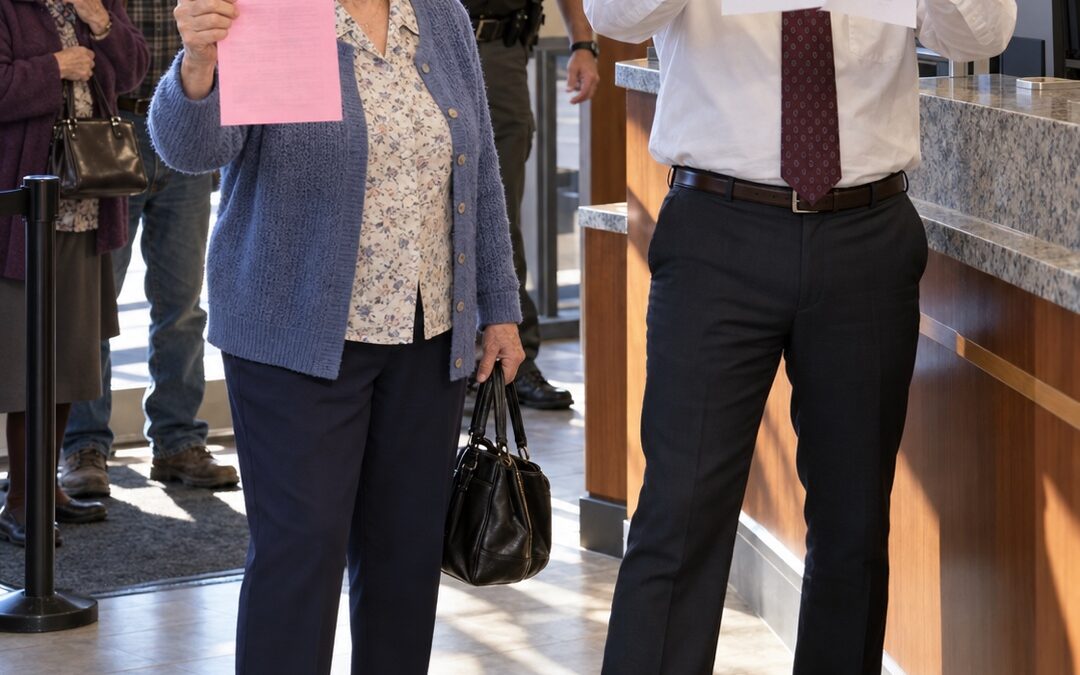
Twelve minutes earlier, I had walked through those same doors at 9:05 with the tin under one arm and a two-copy carbon dispute form in my purse, white on top and pink underneath.
Seven members were already in line.
Frank stood first, Dale waited behind him, Opal Rinehart came next, and four others filled the space toward the entrance.
Garrett’s desk sat in the open lobby beside his glass office, whose door was open that Monday morning.
I set my form in front of him.
My dispute was for $301.
Fourteen Member Shield charges came to $196, and three $35 overdraft fees added another $105.
After the third overdraft, I had read the small print at the bottom of my statement and found the sentence saying a member could decline in writing.
I had never opened the August 2025 mailer.
I threw it out with junk.
I placed the October 9 county notice beside my form.
Garrett read the $1,214.60 amount and the Friday, October 16 deadline.
“The money came out here,” I said.
“It comes with the account.”
“Show me where basic checking requires it.”
Garrett slid the white dispute copy back toward me.
“I’m asking for the $301 back.”
“No.”
I pushed the form toward him again.
“Then give me that answer in writing.”
Beside Monday’s cookie tray, a paper sign read STAFF TRAINING — 11:00 TODAY.
His staff call normally ran at 9:00 every Monday.
The little red lamp beside his phone kept burning.
Garrett left the form between us.
“We’re done here.”
“Stamp it declined.”
“No.”
“Sign it.”
“No.”
“Then write no on it.”
He rose.
A few minutes later, the tin was on the floor.
Now I put September under October, slid August beneath both, and reached farther for July while the line curved around me.
Dale moved another half step.
Frank bent enough to see where one statement had gone under the chair.
“There’s one by the leg.”
“I see it.”
I pulled the page free.
Amber Sutter came from window 2 long enough to retrieve the tin lid.
She was twenty-nine, with a three-year-old daughter named Lacey, and her teller vest was buttoned over a white blouse.
She carried the lid to the edge of Garrett’s desk.
“Thank you.”
Her lips moved.
Nothing came out.
Garrett turned toward her.
“Amber.”
She went back behind window 2.
I reached for March.
My right knee caught when I changed position, so I braced against the lobby chair and kept stacking papers until February and January were back inside the tin.
Lyle had borrowed that black bobby pin from my hair in 1979 and used it to clip statements because he could never find a paper clip when he needed one.
He used it for forty years.
After he died in 2019, I kept using it.
Frank stepped closer.
“Need a hand?”
“No, thank you.”
I pressed the lid into place and got to my feet.
The empty brass hook on the wall behind Garrett waited above a small card that read BRANCH EXCELLENCE AWARD 2026.
The plaque had not arrived.
Garrett had already told Frank that morning the award carried a $9,000 bonus.
He pulled his chair closer to the desk.
“Mrs. Tull, I need you to leave.”
“I need my dispute accepted.”
“I declined it.”
“Then put that on the form.”
“I’m not creating correspondence because you failed to read your mail.”
I knew that tone.
Adults used it on children.
For thirty-three years, I had stood at Main and Mill in an orange vest with a hand-held STOP paddle, and I knew every child who crossed there by name.
Some adults saw the vest and still tried to roll through the turn.
I opened my purse far enough to see the pink carbon sheet.
“My pink copy stays with me.”
Garrett stopped tapping the desk.
“You’re refusing to leave.”
“I’m waiting for a written answer.”
“I’ve asked you to leave.”
“And I asked for $301 back.”
At 9:22, Garrett lifted the lobby phone.
The red lamp glowed beside his thumb.
Frank leaned against the rope divider while Dale moved his boot off the crushed edge of a green-frosted tractor cookie.
The four people behind Opal kept their places.
At window 1, a teller counted twenties into a tray, and the bill counter buzzed twice before Garrett finished dialing.
“Garrett Pyle, Tri-County Farmers Credit Union.”
He gave the branch address.
Then he said, “I have a member refusing to leave the premises.”
I set the tin on my lap and sat in the lobby chair nearest his desk.
Garrett listened.
“No, there’s no weapon.”
He glanced at me.
“She’s being disruptive.”
The person on the other end spoke long enough for Garrett to turn slightly away.
He gave his name again and ended the call.
Frank stepped out of line.
“Garrett, what’s this Shield thing costing me?”
“This isn’t the time.”
Dale raised his statement.
“I got it too.”
Garrett motioned toward the rope.
“Please remain in line.”
Opal took out her own statement.
“Fourteen dollars.”
Garrett faced her.
“Mrs. Rinehart, we can discuss your account privately.”
Opal put the statement away.
The line did not move.
A teller at window 1 stapled a receipt and passed it beneath the glass.
Dale went back behind Frank without putting his paper away.
One of the four other members bent to read the bottom of his own statement.
Garrett noticed.
“This is not a group account review.”
Frank answered him.
“Then don’t make it one.”
Garrett pulled the cookie tray farther toward the wall.
The green tractor cookie Dale had stepped on left a smear of frosting near the rope post.
A man carrying a deposit bag entered, saw the line around Garrett’s desk, and sat near the door with the bag between his boots.
Garrett lifted my county notice again.
“You can still take care of this Friday.”
“With what?”
“Your account.”
“My account has $212.40.”
“You have a deposit coming.”
“Wednesday.”
My Social Security was $1,386.
Once it posted, almost all of it would go straight to the county.
The $204 pension that had arrived October 1 was already going toward ordinary October bills.
Garrett put the notice down.
“Then I don’t see the emergency.”
Frank spoke from the line.
“That sounds like an emergency to me.”
Garrett faced him.
“Mr. Hosler, please let me handle this.”
Frank went back behind the rope.
Garrett straightened the papers on his desk.
I sat with the tin on my lap.
Window 1 kept serving members.
Amber worked at window 2.
The red recording light remained on.
Garrett lifted the desk phone again, listened to the receiver, then set it down.
“The deputy is coming.”
“I heard you call.”
“You can wait outside.”
“I’ll wait here.”
“You’ve been asked to leave.”
“I heard that too.”
Dale unfolded his statement and showed the bottom section to Frank.
Garrett saw them.
“This is a private account matter.”
Frank lowered the page.
“You called the sheriff in the lobby.”
Garrett sat.
The man with the deposit bag crossed one ankle over the other.
One of the four members behind Opal moved forward when window 1 became available, but the person ahead of him did not move, so he stopped too.
Garrett turned toward window 1.
“Next member.”
Nobody from our line answered him.
The teller waited.
Then she began organizing the slips beside her register.
Garrett leaned toward me.
“Mrs. Tull, if you walk outside now, we can end this without making it worse.”
“Accept the dispute.”
“No.”
“Write that down.”
“I’m not doing that.”
“Then I’m sitting here.”
He pushed his chair back.
Frank lowered his voice.
“You mailed complaints before?”
“I’m mailing mine this afternoon.”
Garrett heard me.
“Mrs. Tull.”
“Yes?”
“You need to think carefully before you start making accusations to outside offices.”
“I wrote down what happened.”
“That does not make your interpretation correct.”
“The numbers are correct.”
He did not touch the form again.
The white copy was still on his desk.
The pink copy was in my purse.
Amber finished with the member at window 2 and closed her cash drawer with a metal click.
Garrett glanced toward her station.
She kept her attention on the next deposit slip.
The doors opened at about 9:30.
The deputy who came inside was broad through the shoulders, gray starting near his temples, and familiar enough that I knew him before he finished wiping one shoe on the entry mat.
He saw me.
“Miss Genie?”
Ron Lutz had been eleven in 1985 when he came too fast down Main on a blue Huffy, caught the curb at Mill, and tore one trouser knee open badly enough that I sat him beside my crossing post and bandaged him with my own scarf while he kept asking whether his bicycle wheel was bent.
He was fifty-two now.
Garrett came around his desk.
“Deputy.”
Ron kept his attention on me.
“Miss Genie, what happened?”
“Mr. Pyle called you.”
“I heard.”
Garrett stopped beside him.
“She refuses to leave after being told repeatedly.”
Ron nodded and pulled a lobby chair away from the wall.
Then he sat.
Garrett did not.
Ron indicated the tin.
“You have something I can read?”
“Yes.”
I opened it and handed him October, September, and August.
Ron read October first.
His finger stopped near the small print at the bottom.
He turned the page over and then read September.
Garrett stood near his open glass-office door.
“This is a civil account dispute.”
“I know,” Ron said.
“She’s disrupting business.”
Ron read August before raising his head.
Frank was inside the rope.
Dale stood behind him with his statement out.
Opal waited next.
The man with the deposit bag was still in his chair.
Window 1 was open.
Amber was serving another member at window 2.
Ron handed October back.
“Where’s your dispute?”
I indicated the white sheet on Garrett’s desk.
“There.”
Ron stood.
“Can I see it?”
Garrett took the paper.
“This was never accepted.”
“I’d still like to see it.”
Garrett held the form by the top edge.
Then he tore it in half.
The sound carried through the lobby.
Frank turned.
Amber stopped typing.
Garrett put the halves together and tore them again.
“No copy, no complaint.”
Ron watched him.
Garrett dropped the four pieces into his wastebasket.
I opened my purse and took out the pink carbon copy.
Garrett’s fingers stopped on the desk edge.
“I brought two.”
Ron held out his hand.
I gave him the pink sheet.
He read my name, 402 Ferry Street, the $301 disputed amount, and my request to remove Member Shield and refund the charges.
Then he handed it back.
“Keep that.”
“I plan to.”
Garrett gestured toward the trash.
“That document was never accepted into our process.”
I put the pink copy back in my purse.
“I’m mailing a complaint to the state regulator this afternoon.”
Garrett’s chair bumped the desk.
“On what grounds?”
I nodded toward the wastebasket.
Ron followed my glance.
Garrett took the four torn pieces from the trash, crushed them once, and pushed them below the other paper without examining them.
“This is getting ridiculous.”
I fastened my purse.
“Your call.”
Garrett stepped toward me.
“Mrs. Tull, you should be very careful about making accusations.”
“I’m careful crossing streets.”
Frank lowered his chin.
Dale studied his statement.
Ron moved nearer the aisle.
Garrett’s tie had slipped slightly to the right.
He straightened it.
“I want it documented that she was asked to leave.”
Ron opened a small notebook.
“It will be.”
“And that she refused.”
“I heard you.”
Garrett faced him.
“She has been sitting here for over ten minutes after I asked her to leave.”
Ron turned to a clean page.
“What time did you first ask?”
“Approximately nine-seventeen.”
Ron wrote it.
“What happened immediately before that?”
“I ended the account discussion.”
Ron kept his pencil on the page.
“And the papers on the floor?”
Garrett glanced at the tin.
“She knocked over her things.”
Frank came out from behind the rope.
“No.”
Garrett turned to him.
Frank did not add anything.
Ron wrote another line.
“Mr. Hosler, you saw it?”
“Yes.”
Dale raised his statement.
“So did I.”
Opal nodded from behind him.
Ron wrote again.
Garrett pulled his chair toward his desk.
“This is turning into a spectacle.”
At window 1, a teller passed a receipt beneath the glass.
The member took it and left.
Cold air crossed the floor when the doors opened.
Ron finished his note.
“Miss Genie, are you ready to go?”
“Yes.”
I stood with the tin against my side.
Ron stood beside me.
Garrett motioned toward the doors.
“I want it clear that her account dispute has not been approved.”
“I heard that too,” Ron said.
The pink copy remained zipped inside my purse.
My October statement rested under the tin lid.
The black bobby pin did not.
I walked past Frank.
“Genie.”
“Morning, Frank.”
Dale moved enough to clear the rope opening.
Opal drew her purse closer so I could pass.
The four members behind her watched me go.
At the cookie table, the broken green tractor sat in two pieces.
Ron opened the front door.
Cold October air came through.
Outside, I carried the tin across the parking lot toward Lyle’s 2004 Chevy Silverado while Ron walked beside me.
The truck still had mud along the rocker panel from the week before.
I unlocked the driver’s door.
Ron stopped near the front fender.
“I’ll put in the report that he tore the original.”
“White copy.”
“White copy.”
“And I still have pink.”
“You do.”
Through the credit-union windows, Garrett was visible beside his open desk.
Ron said, “I went past Main and Mill yesterday.”
“Still there?”
“The corner?”
“Yes.”
“Last I checked.”
I opened the truck door.
Ron rested one palm on the roof edge.
“You bandaged my knee with your own scarf.”
“You were bleeding on my corner.”
“I remember.”
He stepped back.
“I’ll finish the report.”
“Thank you.”
Ron headed toward his cruiser while I put the tin on the passenger seat myself.
The statements moved inside when it settled against the upholstery.
I climbed behind the wheel.
My purse sat beside me.
I put the key into the ignition but did not turn it yet.
Through the windshield, I could still see the branch entrance.
Frank remained inside.
Dale and Opal were behind him.
Garrett crossed from his desk toward the glass office, then came back into the lobby.
Amber served the next person at window 2.
I checked the time.
10:13.
The credit-union doors opened.
Amber came outside without a coat.
Her teller vest was still buttoned over her blouse.
She walked quickly across the lot with one arm held close against the October air.
I lowered the driver’s window.
Amber stopped beside the front fender and checked the lobby glass once.
Garrett was no longer at his open desk.
“Mrs. Tull.”
“Yes?”
“Ask for the October fifth call. The whole thing.”
I kept one hand on the steering wheel.
“What call?”
Amber was already walking back inside.
Part 2 — THE PINK COPY
PART 2 — THE PINK COPY
At 1:42 Monday afternoon, I had $212.40 in checking and four days to keep my house off the county’s delinquent list.
My Social Security would post Wednesday, and the county wanted $1,214.60 by Friday.
I sat at the kitchen table with the notice on my left and October’s statement on my right, then wrote one line on the back of an old grocery envelope showing how Wednesday’s $1,386 deposit would meet the $1,214.60 sewer assessment.
Lyle’s chair was across from me, where I had stopped moving it years ago.
The tin sat near the salt shaker with fourteen months of statements loose inside, their bottom edges leaning toward one side because the black bobby pin was gone.
I had noticed that Monday, and I told nobody.
My $204 pension had posted October 1, and enough of that had already gone to electricity, gasoline, and groceries that Wednesday’s Social Security deposit had to carry the county payment.
I opened my purse and took out the pink carbon copy.
Garrett had torn the white copy into four pieces in front of Ron, Frank, Dale, Opal, and everyone else near his desk, but the pressure from my pen had gone straight through to the sheet I still had.
I put the pink copy into a fresh envelope with photocopies of four statements and a copy of the county notice, then sat with a plain sheet of paper until I had the complaint down to three sentences.
I did not ask Tri-County to enroll me in Member Shield.
I was charged $196 over fourteen months and $105 in overdraft fees.
On October 12, Branch Manager Garrett Pyle tore the credit union’s copy of my written dispute after I asked for a refund.
I signed Imogene Tull beneath it, checked the address on the envelope, slid everything inside, and pressed the flap closed along the edge of the table.
At the post office on Walnut Street, the clerk weighed the envelope and turned it over twice.
“Tracking?”
“Yes.”
She added the label, fed the receipt through her machine, and passed it across the counter.
I tucked it behind my driver’s license.
“Anything else?”
“That’s it.”
By three, the complaint was on its way.
I had made a photocopy of the pink sheet before mailing the original, and that copy went beneath October’s statement when I got home.
At 4:15, Frank Hosler’s truck stopped outside.
He came up the walk carrying six brown eggs in a cardboard carton, one with a short white feather stuck near the narrow end, and knocked with the side of his fist.
I opened the door.
“You brought eggs.”
“Ruth had extra.”
“Come in.”
Frank had known Lyle before I did, so he went to the cabinet where the cups had been for twenty years and took one down while I poured tea.
He sat across from Lyle’s chair.
Small pieces of dried mud came loose from his boots.
“After you left,” Frank said, “Garrett moved that broken tractor cookie out of the way and told Amber to call the next member.”
“She call one?”
“Eventually.”
Frank reached into his shirt pocket and unfolded a statement across the table.
His Member Shield charge was there.
Fourteen dollars.
“I asked about this before I left. Garrett said we’d discuss my account privately.”
“Did you?”
“No. I went home and checked backward.”
“How far?”
“Last September.”
“Same charge?”
“Every month.”
Frank drew another statement from his jacket and set it beside the first.
The same fourteen-dollar line sat halfway down the page.
“I mailed two complaints before Monday,” he said. “One last winter and another after this kept showing up.”
“What happened?”
“I got no answer to either one.”
I turned his statement so the small print faced me.
“In January, you asked Garrett too?”
“Yes.”
“What did he tell you?”
“He said it came with the account.”
I ran my eyes down the bottom of the page.
“I didn’t read this part until my third overdraft.”
“Neither did I.”
“You get the August mailer?”
“Yes.”
“Open it?”
“No.”
I set my cup down.
“I never opened mine.”
Frank nodded.
“Nobody did.”
He folded both statements and put them back into his jacket.
“You mailed your complaint?”
“This afternoon.”
“To the state?”
“Yes.”
Frank carried his cup to the sink and set the egg carton beside it before he left.
At the door, he stopped long enough to pull his jacket closed.
“You want me to bring my statements Saturday?”
“Bring what you have.”
“All right.”
He went out to his truck.
Tuesday morning, the furnace kicked on before six and the vent beside my bedroom dresser started rattling.
I dressed, went downstairs, and checked the account even though Wednesday had not arrived.
The screen still showed $212.40.
I closed the laptop.
At nine-twenty, I drove to Kroger for milk and sale bread, paying with cash from the coffee can in my pantry so the checking balance stayed untouched.
One handle on the Kroger bag had already started tearing by the time I reached the truck.
When I got home, Dale Kramer’s white Ford was at my curb.
Drywall dust had worked into the seams around both doors, and Dale stood on the porch holding a statement.
“Frank tell you?”
“Yes.”
“Come in.”
Dale sat at the kitchen table while I put the milk in the refrigerator.
He was sixty and ran a drywall crew, and the brim of his work cap had a pale stripe of joint compound across it.
“My charge started last September.”
“So did Frank’s.”
“I called some men from church.”
“How many?”
“Nine men at Thursday breakfast all got it.”
“That breakfast only has nine men.”
“Saved me calling ten.”
He laid his statement beside mine.
Four of those men had thought Member Shield was insurance.
One had asked Garrett about it months earlier.
“What did Garrett tell him?”
“Came with checking.”
Dale turned the statement around so the bottom print faced me.
“He never saw this decline line.”
“Neither did Frank.”
“Neither did I.”
I took the Kroger bag from the counter.
The damaged handle gave way, and the bread dropped flat onto the kitchen floor.
Dale bent forward.
“I’ve got it.”
“So do I.”
I lifted the bread and set it on the counter.
Dale folded the statement once.
“Saturday meeting?”
“Yes.”
“You going?”
“Yes.”
“So am I.”
He put the paper inside his jacket.
Before leaving, Dale checked the bottom of my October statement against his once more.
“Same print.”
“Same place.”
He gave the page back and headed for the door.
Dale left for a drywall job near Sidney.
At 11:40, the old kitchen phone rang.
Lyle had refused to cancel that landline, and it still hung on the wall with a cord that twisted itself into knots no matter how many times I straightened it.
“Hello?”
“Genie?”
“Opal?”
“Yes. I found it.”
“What?”
“The August envelope.”
I sat in the chair beside the phone.
“The Member Shield mailer?”
“It was in the drawer with appliance warranties.”
“Opened?”
“No.”
“Leave it that way.”
Paper moved on her end.
“My statements show fourteen months.”
“Mine too.”
“I used my magnifying glass on the bottom.”
“And?”
“It says you can decline in writing.”
“I found the same thing.”
Opal paused before asking, “So I shouldn’t open the August envelope?”
“Keep it sealed.”
“All right.”
“Bring it Saturday.”
“To the annual meeting?”
“Ten o’clock.”
“I wasn’t planning to go.”
A drawer opened on her end and closed again.
“You still there?”
“Yes.”
“Ten o’clock.”
“I heard you.”
“Will you come?”
“I’ll put it by my purse.”
We hung up.
I had attended Tri-County’s annual meetings for most of my fifty-one years as a member, and twenty people counted as a respectable crowd if somebody brought good pie.
I opened the tin and laid my photocopied dispute beneath the October statement.
Without the bobby pin, the pages leaned against one side.
I straightened them and pressed the lid back into place.
The old grocery envelope with my arithmetic was under the county notice.
I reached for the pencil, then put it back in the drawer.
Wednesday would come in the morning.
I opened the refrigerator and saw Frank’s eggs on the shelf.
One still had the feather on it.
The carton went behind the milk so I would not knock it down reaching for something else.
At the kitchen table, Dale’s visit had left a faint white line of drywall dust near the chair leg.
I wiped it away with a damp dishcloth.
The wall phone rang once while I was at the sink.
I turned.
It stopped.
I waited long enough to hear the refrigerator motor start, then went back to the table.
At 7:20, I found my Tri-County member card in the front pocket of my wallet.
The plastic had a crack near one corner.
I slid it back into place.
Saturday’s annual meeting would be at the Grange Hall on Mill Road.
Marge Dill would run it.
There would be folding chairs, printed agendas, and the usual coffee.
Garrett Pyle had never attended one.
I knew because Marge mentioned it every year.
I cleared two envelopes from the kitchen counter.
Amber’s parking-lot words came back while I worked.
“Ask for the October fifth call. The whole thing.”
I stopped with the envelopes in my hand.
“October fifth,” I said.
The date itself gave me nothing.
I set the envelopes aside and checked the wall clock.
At 8:37 Tuesday night, my cell phone rang.
UNKNOWN CALLER.
I almost let it go to voicemail, but my thumb stopped above the screen and then pressed the answer button.
“Hello?”
A woman breathed on the other end.
“Mrs. Tull?”
I knew the voice.
“Amber?”
“Yes.”
Something small played in the background, a child’s television turned low.
I sat at the kitchen table.
“Are you all right?”
“I’m fine.”
“What is the October fifth call?”
A cabinet door closed on her end.
Then her voice dropped.
“I kept it. Can I come after my shift tomorrow?”
Part 3 — THE OCTOBER FIFTH CALL
PART 3 — THE OCTOBER FIFTH CALL
At 6:30 Wednesday evening, Garrett Pyle stood in my living room holding a release form with my name already typed on it.
My Social Security had posted that morning, and the county still wanted $1,214.60 by Friday.
Garrett wanted my signature before supper.
He had parked a silver Buick at the curb and come up my porch carrying a leather folder under one arm, without an appointment or a phone call before he knocked.
I let him inside, and he took the chair near the sofa while I sat in Lyle’s chair with the tin resting on the shelf beside the old radio.
“Mrs. Tull, I wanted to resolve this personally.”
“You had that chance Monday.”
“I understand Monday became unnecessarily tense.”
“You called the sheriff.”
“You refused to leave.”
“I was waiting for my answer.”
“You received one.”
Garrett opened the folder and removed two stapled pages, then passed them across to me.
My name appeared at the top.
IMOGENE TULL.
The document offered to cover the county penalty from what it called the branch goodwill fund.
It said nothing about refunding the $301.
Another paragraph required me to withdraw the complaint I had mailed to the state regulator and agree not to make any further Member Shield complaint arising from the same charges.
Near the bottom, one phrase sat inside quotation marks: “member misunderstanding.”
Garrett’s signature was already there in blue ink.
I read both pages while he watched from the other chair.
“What did I misunderstand?” I asked.
“The product.”
“Then explain it.”
“The important thing is we’re prepared to help with the county penalty.”
“And the $301?”
“That’s a separate issue.”
“You said no Monday.”
“Our position on those charges hasn’t changed.”
I went back to the first page and read the county-payment language again.
“If I sign tonight?”
“I can process the goodwill payment tomorrow.”
“And I call the regulator?”
“You tell them the matter has been resolved.”
“Which matter?”
“The county penalty.”
“My complaint is about Member Shield.”
“The release addresses the entire situation.”
I laid the pages across my knee.
The county payment would come from the branch goodwill fund.
The $301 would remain unpaid.
The complaint would have to be withdrawn.
“Why would I withdraw something I mailed on purpose?”
Garrett leaned forward.
“We’re trying to prevent this from becoming larger than it needs to be.”
“It went into the mail Monday.”
“That can be corrected.”
“By me?”
“Yes.”
I turned to page two.
The release did not say Tri-County had added Member Shield without my consent.
It also left out Garrett tearing the white copy while Ron watched.
It did include my promise not to complain again.
Garrett sat back.
“I heard you’ve been speaking with other members.”
“Members spoke with me.”
“Frank Hosler?”
“I’m not giving you a list.”
“This is exactly how rumors start.”
“What rumor?”
“That members were enrolled improperly.”
“Were they?”
“Member Shield was disclosed.”
“In six-point print?”
“That’s still disclosure.”
I raised the release enough for him to see the page.
“Then why bring this to my house?”
Garrett stood and crossed two steps toward the front window.
His Buick sat under the maple with wet leaves stuck along the windshield.
“Twenty people and potluck on Saturday, Mrs. Tull. Think about who's going to listen.”
“The annual meeting.”
“Yes.”
“You’re attending?”
“I’m presenting the branch report.”
“That’ll be new.”
“The regional office is attending.”
“Lorraine Kettering?”
“Yes.”
I knew the name from Tri-County mail.
Regional vice president of member services.
I had never met her.
“She’s presenting the award?”
“Yes.”
“The Branch Excellence Award carries a $9,000 bonus, doesn’t it?”
“Yes.”
“Who decides that money?”
“The regional office and the board. Not a potluck.”
I set the release on the small table beside my chair.
“So Saturday matters.”
“It’s an annual member meeting.”
“That wasn’t my question.”
Garrett took his keys from his coat pocket.
“Mrs. Tull, I came here with a practical offer.”
“You came here with a paper that pays the county penalty and leaves the $301 where it is.”
“The penalty is the immediate problem.”
“The charges caused it.”
“We disagree on that.”
“No, you disagree on paying it.”
The wall clock moved past quarter to seven.
Garrett glanced at it, then back at me.
“If you sign tonight, I can still get this handled quickly.”
“I’ll think.”
“The offer isn’t indefinite.”
“I heard you.”
I walked him to the door.
Before stepping onto the porch, Garrett tucked the leather folder against his side.
“I really do hope you make the practical choice.”
“I’ll think.”
He left with the unsigned form still in my house.
The Buick backed away from the curb, and I locked the door after its taillights disappeared past the maple.
I carried the tin into the kitchen, set it near the bread box, pulled Lyle’s old laptop from the drawer, found its charger behind a stack of takeout menus, and plugged the machine into the wall beside the table.
It took nearly four minutes to start.
The fan began whining before the screen fully lit.
Garrett’s release lay beside the computer with “member misunderstanding” facing up.
Rain started later, tapping the kitchen window while I cleared yesterday’s mail from the counter.
I checked the laptop battery.
Fourteen percent.
“Come on,” I said.
The charging symbol finally appeared.
I left one clean cup near the sink and folded Garrett’s release along its existing crease.
The pages went beside the tin.
By the time the rain strengthened, the kitchen had gone quiet except for the laptop fan and the refrigerator motor cycling on and off.
At 9:15, someone knocked.
Amber stood on the porch with rain on her jacket and one hand gripping the handle of a child’s car seat.
Lacey slept inside.
She was three and had one sneaker partly off her heel.
“Come in.”
Amber carried the seat into the kitchen and set it carefully on the floor beside her chair.
Lacey moved under a pink blanket and kept sleeping.
Amber removed her jacket, draped it over the chair back, and placed a small black USB drive beside the laptop.
Her dark work slacks were damp near the cuffs.
“That’s it?”
“Yes.”
“When did you save it?”
“Tuesday, October sixth.”
“The day after the call.”
“Yes.”
“How long is it?”
“Forty-one minutes.”
I drew the laptop nearer.
“Who was on it?”
“Staff. And Lorraine Kettering.”
I plugged the drive in.
The computer took its time finding it while Amber sat beside Lacey and watched the little spinning circle on the screen.
When the folder finally opened, two files appeared on the USB: the October 5 training call and a short file containing the Shield fee total.
I opened the call.
A frozen video filled the screen.
Garrett sat at his desk beside the glass office with a headset over one ear, Amber appeared in a smaller square from window 2, and two other employee windows sat beside hers.
Lorraine Kettering filled another square, blond hair at her shoulders and a dark jacket over a light blouse.
The timestamp began at 9:00:03.
I pressed play.
Garrett greeted the staff, moved into month-end numbers, and shared his screen while Amber sat at window 2 in the recording with the lobby behind her.
A slide about Shield enrollment appeared.
His voice came through the old laptop speakers thinner than it sounded in person, but nobody could have mistaken whose voice it was.
A few minutes in, the discussion turned to members who resisted the package.
One teller asked what staff should say.
Garrett leaned toward his camera.
“Tell them it comes with the account. If they argue, tell them it's the law.”
I stopped the video.
Rain ticked against the glass.
Amber kept watching the paused screen while I moved the cursor back and played the line again.
“Tell them it comes with the account. If they argue, tell them it's the law.”
Amber told me she had asked Garrett afterward what law he meant because she could not find one.
His answer had been short.
“Stop overthinking the script.”
I pulled the laptop nearer.
A little later, Lorraine Kettering spoke from her square.
“Enrollment by the thirty-first, Garrett. Ninety.”
Garrett nodded on the recording.
The meeting moved into another subject, and I stopped the video before six minutes had passed.
The kitchen clock read 9:29.
Amber reached over and lowered the laptop volume.
“That’s enough of it.”
“For tonight.”
I asked whether Garrett, Lorraine, or anyone else knew she had copied the recording.
Amber said no.
“Why save it?”
She opened her purse, took out a crumpled tissue, and put it back without using it.
“I knew it was wrong.”
Lacey breathed softly through her mouth beside the table.
“I kept thinking somebody would complain.”
“People did.”
“I know.”
“Frank twice.”
“I know.”
I sat straighter.
“Garrett handles the written complaints?”
“Yes.”
“He handled mine.”
“I saw.”
Amber adjusted the edge of the pink blanket where it had slipped near Lacey’s shoulder.
“I need this job, Mrs. Tull, and Lacey’s daycare is $188 a week.”
“You don’t owe me an explanation.”
“I should’ve said something sooner.”
I left that with her.
Amber turned back to the laptop.
“The file deletes automatically after thirty days.”
“When?”
“November fourth.”
“Garrett ever opened it?”
“No.”
“You can tell?”
“The shared drive keeps access history.”
Amber rotated the computer slightly and opened a small history panel.
The October 5 file showed the automatic save and the later shared-login access from Tuesday when she copied it.
No Garrett login appeared.
“He’s never played it.”
“And your download?”
“Shared login from the admin station.”
“So your name isn’t attached.”
“No.”
I read the access entries while the rain moved harder across the kitchen window.
“Does he know somebody opened it?”
“He could see that the file was accessed if he checked.”
“Does he check?”
“He hasn’t.”
Amber closed the history panel.
Then she moved the USB across the table.
“This copy is yours.”
“You have another?”
“Yes.”
“I’ll keep this one here.”
Amber nodded.
The USB sat between the laptop and the tin.
I slid Garrett’s release across the table.
“He came at six-thirty.”
Amber read the first page, then the second.
“He offered goodwill money?”
“For the county penalty.”
“And nothing for the charges.”
“Nothing.”
She placed the release back on the table.
“He’s worried about Saturday.”
“He told me Kettering is coming.”
“She’s presenting the award.”
“That’s what he said.”
Amber read Garrett’s blue signature again.
“He’s been talking about that bonus since August.”
“Nine thousand.”
“Yes.”
I folded the release along its existing crease while Amber pulled her jacket from the chair and checked Lacey before lifting the car seat from the floor.
The child did not wake.
Amber settled the handle against her forearm.
“Mrs. Tull, I don’t know what you’re planning.”
“I don’t either.”
“You won’t tell him I gave you this?”
“No.”
Amber moved toward the kitchen doorway.
“Thank you.”
I walked her to the front door.
The rain had eased to a thin line under the porch light.
Amber carried Lacey toward the car while I stood inside with the door open.
She set the car seat inside, closed the rear door, and got behind the wheel.
Her taillights disappeared down Ferry Street.
I went back to the kitchen.
The laptop screen had dimmed.
The USB sat where Amber had left it.
Garrett’s release lay beside the tin.
I set the release form beside the tin, placed the USB on top of the folded pages, and shut the laptop.
Then I said, “Saturday. Ten o'clock.”
Part 4 — THE PAID STAMP
PART 4 — THE PAID STAMP
At 9:18 Thursday morning, my checking balance was $1,598.40.
By lunch, $1,214.60 of it would belong to the county.
I parked Lyle’s 2004 Chevy Silverado outside Tri-County and carried only my purse inside, while Garrett’s release and the USB were at home beside the tin.
Window 2 was open, and Amber saw me before I reached the rope.
She wore the same green teller vest from Monday, with her hair pulled back tighter than it had been at my kitchen table the night before, and she kept working while I crossed the lobby.
Garrett sat inside his glass office with the door shut and a phone pressed to his ear.
His chair turned halfway when I approached Amber’s window.
He saw me and turned back toward his desk.
I took the county notice from my purse and placed it beneath the slot with my identification.
“I need a certified check for $1,214.60.”
Amber read the notice, entered the amount, and pulled the withdrawal slip toward her while Garrett’s voice carried faintly through the glass behind us.
“From checking?” she asked.
“Yes,” I said, and signed the slip before pushing it back beneath the opening.
One of the four people who had been in Monday’s line stood near window 1 with a deposit envelope tucked under his arm, and when he recognized me, he watched Amber compare my signature with the screen.
The empty brass hook remained on the lobby wall above the small card that read BRANCH EXCELLENCE AWARD 2026.
The plaque still had not arrived.
Amber fed the certified-check paper into the printer.
The machine pulled it in with a short mechanical whine, stopped, then sent the check back out.
Amber checked the amount twice.
I could see the numbers upside down through the glass.
$1,214.60.
She stamped my transaction receipt and slid the envelope beneath the opening.
“Anything else today?”
“No,” I said, and she handed my identification back with the receipt beneath it.
Inside Garrett’s office, his chair turned again.
For a few seconds I could see the side of his face through the glass while he listened to whoever was on the phone.
Amber slid the certified check closer.
“Your receipt is behind it.”
“I see it.”
Garrett turned his chair farther away from the lobby.
I tucked the certified check into my purse while Amber lined the duplicate slip with the other papers beside her keyboard.
The member near window 1 moved his deposit envelope from one arm to the other and gave me one small nod as I passed.
I reached the lobby doors just as Amber’s printer started a second time.
Pages kept coming.
I stopped with one hand on the door.
“Saturday?”
“Yes.”
Amber separated the fresh pages into two piles.
One was the stack of annual-meeting handouts.
The other held the Shield fee-total sheet she would take with her Saturday.
A corner curled from the printer heat.
Amber pressed it straight against the counter and added it to the second pile.
Garrett continued his phone call behind the glass.
I went outside.
The county treasurer’s office occupied the first floor of the old courthouse.
Six people waited ahead of me, and the plastic number display above the counter clicked forward one person at a time while I kept the certified check inside my purse.
When my number came up, the clerk with red reading glasses took the check and the October 9 notice.
“Name?”
“Imogene Tull.”
“402 Ferry Street?”
“Yes.”
She entered the parcel number and compared the address on the notice with the screen.
The printer beside her started.
She ran one finger down the page and stamped it.
PAID.
OCT 15 2026.
“Keep both,” she said, sliding the receipt and stamped notice back through the opening.
I read the receipt before putting it away: 402 Ferry Street, $1,214.60, payment received October 15.
The deadline printed on the notice was tomorrow.
“So that’s posted?” I asked.
“Yes. You’re paid.”
I put the stamped notice behind the receipt and zipped my purse.
At home, the paper had bent slightly where it pressed against my wallet.
I opened the laptop and checked the account balance.
$383.80.
“All right.”
I wrote that number once on the old grocery envelope, folded it around the pencil line, and put it in the kitchen drawer beneath the electric bill.
Then I opened the tin.
The county receipt went behind October’s statement.
The stamped notice followed it.
I closed the lid and set it back near the cookbooks.
Friday morning, I woke before the furnace came on.
At eight-thirty, I opened the hall closet upstairs and pushed two winter coats aside until my old crossing-guard vest appeared behind them.
The orange fabric had softened, the reflective strip had gone gray, and the zipper still ran.
Above the vest was the empty hook where my hand-held STOP paddle used to hang, with a pale rectangle in the paint behind it where the sign had covered the wall.
I took the vest down and held it against the light from the hall.
IMOGENE TULL was stitched over the chest.
My thumb pressed the name patch until one loose thread worked free beneath the nail.
I bit my lip.
Mikey Barlow used to reach Main and Mill walking backward because he was busy telling whoever came with him what had happened at recess, so I learned to call his name before his heel left the curb.
“Turn around, Mikey.”
I could still hear myself saying it.
One year he had shown up with a backpack zipper that would not close and spent the whole crossing holding the top shut with both elbows.
I ran the vest zipper down three inches.
It caught once near the bottom.
I eased it free and ran it back up.
The loose thread curled against the orange fabric.
I did not pull it out.
Inside the old pocket were no Band-Aids now, no tissues, nothing except the fabric lining and a little grit caught in one corner.
I turned the pocket out enough to shake it clean.
Then I pushed it back inside.
“Thirty-three years,” I said.
The closet gave me no answer.
I hung the vest on the same wooden hanger.
One sleeve turned inward against the wall.
I left it that way and shut the closet.
At 10:26, a dark Honda, not a cruiser, pulled up in front of the house.
Ron Lutz got out wearing jeans and a plain blue shirt, carrying a casserole dish wrapped in foil with a strip of masking tape across the top that said GENIE in black marker.
I opened the door.
“What’s that?”
“My wife made chicken casserole.”
I took it from him and carried it to the kitchen.
Ron followed me inside, and I made room in the refrigerator beside the milk so the casserole dish would sit flat.
When I turned around, he was near the table.
He reached into his left shirt pocket and brought out my black bobby pin.
The bend near the middle was still there.
“Found this Tuesday morning.”
“Where?”
“Under the radiator by Garrett’s desk.”
I stood beside the kitchen table while Ron held it out.
“I went back to finish the report after my shift changed over, and when I was standing where his desk meets the wall, I saw something black under the radiator.”
“The pin.”
“I remembered it falling out of your papers.”
He turned it once between his fingers.
“I put it in my shirt pocket, and then I got sent straight from the branch to a wreck out on County Road 18.”
“You’ve had it since Tuesday?”
“Yes.”
Ron lowered his arm.
“I worked late Tuesday, Wednesday ran into another shift, and this morning was the first time I could get over here without the uniform or the radio going off.”
He offered the pin again.
I could have taken it.
Instead I said, “Keep it until after Saturday.”
“Why?”
“Because I asked.”
Ron put the pin back into his left shirt pocket.
I opened the refrigerator again and moved the casserole dish half an inch so the door shelf would clear it.
Ron pulled out a chair.
“You still have your copy of the dispute?”
“The photocopy.”
“And the original pink one went to the regulator?”
“Monday afternoon.”
He nodded.
“My report says Garrett tore the white copy while I was standing there.”
“That’s what happened.”
“It also has Frank and Dale as witnesses.”
“Opal saw it too.”
“I wrote that down.”
I shut the refrigerator.
Ron sat at the table while I took the county receipt from my purse and showed him the stamped notice.
“Paid yesterday.”
He read the stamp without taking the paper from me.
“House okay?”
“The check cleared the deadline.”
I put the notice back into my purse.
The kitchen phone rang.
I answered while Ron sat back in the chair.
“Marge?”
“Genie, I have the annual register in front of me.”
I sat across from Ron.
“How many?”
“Eighty-six signed.”
A page turned on Marge’s end.
“Nineteen came last year, so I asked June to have extra chairs brought over before the doors open.”
“Garrett’s still doing the branch report?”
“After the treasurer.”
“And open floor comes after him?”
“Yes.”
Marge continued.
“Lorraine Kettering confirmed again this morning that she’s coming to present the Branch Excellence plaque.”
“I know she’s coming.”
“Garrett told you?”
“Wednesday.”
Her pen moved against paper.
“Amber has the projector and handouts, same as every year, and she called this morning to make sure the hall has the right cable.”
Ron’s chair came forward onto all four legs.
“Amber?” I asked.
“Yes. She has the same job she always has.”
“And Garrett is listed exactly how?”
“Branch report.”
Marge moved another sheet.
“Doors open at nine-thirty. Meeting starts at ten.”
“I heard you.”
“Bring your member card.”
“I have it.”
“All right.”
She hung up.
I put the receiver back on the wall.
Ron glanced at the phone.
“Eighty-six?”
“That’s what she said.”
“How many last year?”
“Nineteen.”
He sat with that while I opened my purse and found the cracked Tri-County member card.
I placed it on the table beside my keys so I would not have to hunt for it Saturday morning.
“Still cracked?” Ron asked.
“Same corner.”
I set the purse down.
Ron got up and went as far as the kitchen doorway before stopping.
“You need anything else from me tomorrow?”
“Sit down.”
“That I can do.”
“And listen.”
“I can do that too.”
I opened the refrigerator one more time.
The casserole dish had not moved.
Ron walked back to the table and touched the back of the chair he had used.
“What about the pin?”
“You keep it.”
“Until after the meeting.”
“Yes.”
He nodded and pushed the chair beneath the table.
I put my member card into the front pocket of my purse, then took it back out and set it beside the keys again.
Ron watched me do it.
“You’re going to forget that card if you keep moving it.”
“I know where it is.”
“Right there.”
“Right there.”
He started toward the living room.
I followed.
At the front door, his Honda sat at the curb under the maple tree that had dropped half its leaves overnight.
I opened the door.
“What time tomorrow?” Ron asked.
“Ten.”
“I’ll be there.”
He stepped onto the porch.
I could see the shape of the bobby pin beneath the fabric of his left shirt pocket.
“Don’t lose it.”
Ron stopped at the top step.
“It'll be in my shirt pocket, Miss Genie. Left side.”
Part 5 — THE OPEN FLOOR
PART 5 — THE OPEN FLOOR
At 10:00 Saturday morning, eighty-six names were on the annual-meeting register at the Grange Hall on Mill Road.
The seven people from Monday’s line sat in row 2, with Frank Hosler on the aisle, Dale Kramer beside him, Opal Rinehart holding a sealed envelope in her lap, and the other four members filling the remaining chairs.
Ron sat three rows behind them in a plain blue shirt.
The left pocket held a small black shape.
The tin rested on my lap while people finished settling into folding chairs, and every few seconds another chair leg scraped across the floor as somebody made room in an aisle that had never needed this many seats before.
Up front, an easel held the Branch Excellence plaque Lorraine Kettering had carried in from her car that morning.
Dark wood.
Brass plate.
TRI-COUNTY FARMERS CREDIT UNION.
BRANCH EXCELLENCE AWARD 2026.
Garrett sat ten feet away in his navy tie.
Lorraine occupied a chair near the board with her leather folder beside her, while Amber sat near the screen where she handled the projector and handouts every year.
The projector belonged to the branch.
Garrett had arrived early carrying it in its padded case and had told two board members he had “bought it for the branch” out of the branch budget because the Grange Hall machine was too old.
Amber connected his laptop before the meeting.
A paper coffee cup sat on the podium beside his presentation folder.
Marge Dill opened the meeting and adjusted the microphone until the brief squeal stopped, then moved through the minutes without comment.
The treasurer came next.
At 10:32, he finished and went back to his seat.
Marge checked the printed agenda.
“Branch report.”
Garrett stood, buttoned his jacket, and crossed to the podium while Amber brought his laptop image onto the screen.
TRI-COUNTY FARMERS CREDIT UNION appeared behind him.
“Good morning.”
A few people answered.
Garrett thanked Lorraine for coming and began with account growth, then moved into what he called member engagement while the slides changed behind him.
I kept the tin on my lap.
Frank sat at the aisle.
Dale had one folded statement inside his jacket.
Opal’s sealed August envelope rested on her skirt.
Garrett clicked forward.
SHIELD ENROLLMENT 91%
He stepped aside so the number remained fully visible.
“This has been a major success.”
Lorraine nodded from her chair.
Garrett saw her.
In row 2, Frank moved his attention from the screen to Garrett.
Dale did the same.
Opal kept the sealed envelope against her skirt, while one of the four unnamed members beside her reached into a handbag, removed a folded statement, and opened it across one knee without speaking.
Garrett continued through the slide.
He mentioned exceeding the enrollment goal before October 31.
A few people clapped.
Two stopped after seeing row 2.
Garrett advanced through the remaining branch slides, talking about branch performance while the screen changed behind him, and nothing on those pages covered my $301 dispute or Frank’s unanswered complaints.
Other members had found the same fourteen-dollar charge.
Garrett ended beside the easel.
Lorraine stood and crossed to the microphone.
“This recognition reflects strong branch performance.”
Garrett turned toward the plaque.
Lorraine continued.
“This branch has delivered excellent enrollment results.”
Camera phones came up.
Three that I saw.
Maybe more.
Lorraine touched the top corner of the plaque while Garrett stood beside it with his jacket buttoned.
When she finished, Garrett thanked the staff and the board, then sat while the plaque stayed on its easel.
Marge stepped to the microphone.
“Open floor.”
I stood with the tin.
Garrett saw it before I reached the aisle.
The smile he had worn beside Lorraine disappeared.
I started forward.
Frank cleared the aisle.
Dale watched me pass, and Opal kept the unopened August envelope in her lap.
The room was crowded enough that my purse brushed one chair back on the way up.
I reached the podium and set the tin beside Garrett’s paper coffee cup.
The metal made one small knock against the wood.
“My name is Imogene Tull.”
People in the first rows turned fully toward me.
“I’ve been a Tri-County member fifty-one years.”
I opened the tin and lifted October’s statement.
“I was charged for Member Shield fourteen months at fourteen dollars a month, and I had three overdraft fees after that.”
I raised the page near the podium light.
“The decline language is at the bottom.”
Several people in row 1 leaned forward.
Then I said, “I never opened the August mailer either.”
Garrett stopped with his fingers on the edge of his presentation folder.
He sat straighter.
“I threw mine away with the junk.”
Garrett leaned toward Lorraine.
She did not speak.
I lowered October’s statement.
“Opal?”
Opal rose from row 2 and carried the envelope to the front.
The August 2025 postmark showed near the top, and the flap was still sealed from one end to the other.
She stopped beside the podium and gave it to me.
Frank turned toward Dale.
Behind them, somebody set a foam cup beside a chair leg.
Garrett stood.
“This is highly irregular.”
Marge faced him from beside the microphone.
“Sit down, Garrett.”
He stayed standing.
Lorraine touched his sleeve.
Garrett sat.
I held Opal’s envelope where people in the nearest rows could see the unbroken flap, then worked a finger beneath one corner.
The glue held harder than I expected.
Paper tore along the edge before the flap released.
Inside was the folded Member Shield mailer.
I opened it carefully and flattened one crease against the podium.
Most of the page described benefits and account monitoring.
Near the bottom sat the smaller print.
I brought the page closer to my face.
Then I read the six-point line aloud.
“A member may decline in writing.”
Opal stood beside me.
Garrett reached for the microphone near his chair, but Marge had already switched it off.
He pressed the button anyway.
Frank rose from row 2.
“So why were we told it comes with checking?”
Marge turned toward him.
“Frank.”
He sat.
Opal took her opened mailer and returned to her seat.
Amber rose beside the projector.
She met my eyes.
I looked back.
Amber reached into the pocket of her teller vest and took out a small black USB drive.
A second copy.
The first one was still at my house.
Garrett saw it.
“Amber.”
She disconnected Garrett’s laptop cable from the branch projector, moved his computer aside, and plugged the USB into the same machine he had used for his Branch Excellence presentation.
A file folder appeared on the screen.
Garrett stood again.
“What are you doing?”
Amber opened the recording.
October 5.
The video started at 9:00:03.
Garrett’s recorded face filled the center of the screen, with Amber visible in a smaller square from window 2 and two other employee windows beside hers.
Lorraine Kettering appeared on that same screen while the real Lorraine sat only twelve feet away.
Amber moved the recording forward.
The staff discussion came through the hall speakers.
Garrett’s recorded voice filled the room.
“Tell them it comes with the account. If they argue, tell them it's the law.”
A chair leg scraped against the wall.
Frank turned toward Dale.
Dale took his folded statement from his jacket and opened it across his knee.
Opal raised the August mailer slightly.
One of the four other Monday witnesses leaned forward.
Garrett stood fully.
“Stop that.”
Amber left the controls alone.
The recording continued.
Lorraine’s voice came through the speakers.
“Enrollment by the thirty-first, Garrett. Ninety.”
The real Lorraine stood.
“This needs context.”
Amber paused the video.
Garrett’s gaze went to the small red recording light on the hall speakerphone beside Amber’s laptop.
Then he faced me.
I stood beside the podium with row 2 directly in front of us.
Frank could see both of us.
Dale could too.
Opal held the opened mailer where Garrett could see it from the front.
I said, “Reading is optional, Garrett. Hearing isn't.”
His hand came down flat on the podium.
The paper coffee cup tipped.
Coffee spread across the printed agendas and ran over the edge to the foot of the easel.
Garrett caught the cup and set it upright.
Lorraine stepped away from her chair.
“This is a staff training session. It was never meant for members.”
Marge moved beside the microphone.
“Members paid for the projector, Lorraine.”
A few people laughed.
Marge did not.
Lorraine opened her leather folder.
“You’re taking internal material out of context.”
Amber stood beside the projector.
“It’s the full recording.”
Garrett turned toward her.
“You copied company information?”
“Yes.”
“You had no authority to remove that file.”
Marge raised one hand.
“Garrett.”
He stopped.
Marge took the bylaws from beside her agenda and opened them to a tabbed page.
“Members present may direct the board on staff bonuses and referral of disputed practices to the state regulator.”
She closed the booklet.
Lorraine moved nearer June Haskins and Harold Beck.
“This meeting cannot adjudicate personnel matters.”
June pushed her chair back.
Harold stood beside her.
They walked to the easel while Garrett remained near the podium.
Harold took one side of the plaque.
June took the other.
They lifted it from the easel.
Garrett followed the plaque with his head as it passed in front of him.
Coffee darkened the agendas on the podium.
The empty easel stood beside the screen where his recorded face was frozen.
Frank watched from row 2.
Dale had his statement open across his knee.
Opal held the opened mailer against the torn envelope.
The four other Monday witnesses followed the plaque as June and Harold carried it toward the board.
June turned it face down.
The brass plate disappeared.
Garrett took one step toward them.
“What are you doing?”
Harold kept one hand on the edge of the plaque.
Lorraine closed her folder.
“We should recess.”
Marge stepped to the center microphone.
“No recess.”
Garrett stared at her.
Marge opened the bylaws again.
“Then members will decide.”
Part 6 — THE SHOW OF HANDS
PART 6 — THE SHOW OF HANDS
At 11:18 Saturday morning, all eighty-six registered members were still inside the hall.
Garrett Pyle’s Branch Excellence plaque lay facedown on the board’s table, coffee had dried across his printed agendas, and the projector still showed his recorded face above the first rows.
Marge Dill stood at the microphone with the bylaws open.
“Members have heard the recording.”
Garrett pushed his chair back hard enough for the metal legs to drag against the floor.
“This is absurd.”
Marge kept one finger on the page.
“We’re proceeding.”
She read the motion slowly enough for the people near the kitchen to hear it: members would direct the board to strike Garrett’s $9,000 Branch Excellence bonus and refer the Member Shield practices to the state regulator.
Garrett stood beside his chair.
“You cannot vote on my employment.”
June Haskins answered from beside Harold Beck.
“We know.”
Marge continued.
“This vote concerns the bonus and referral.”
Amber stood beside the branch projector with the second USB copy still connected.
She opened the other file she had preserved.
The screen changed.
Shield fees collected:
$71,512
Frank removed his cap and stared at the number before saying, “Seventy-one thousand?”
Garrett stepped toward the screen.
“That’s gross program activity.”
Dale opened his statement across his knee.
“Mine was fourteen dollars.”
Marge raised one hand, and Dale stopped.
Lorraine Kettering closed her leather folder.
“This meeting has become improper.”
June faced her.
“You were on the call.”
“The recording reflects an internal performance discussion.”
Garrett moved one pace toward Lorraine.
“Lorraine.”
She lifted her coat from the chair.
“You’re leaving?”
“Yes.”
“Now?”
Lorraine put on the coat, trapped the folder against her side, and started down the aisle while people moved their feet out of her path.
She passed row 2.
Frank watched her go while Opal kept the opened August mailer on her lap.
The doors shut behind Lorraine before Marge began the vote.
Her resignation reached Tri-County the following Tuesday.
Marge laid the bylaws beside her tally sheet and moved closer to the microphone.
“All in favor.”
A man near the center aisle raised his voice before anyone moved.
“Both things together?”
Marge leaned toward the microphone.
“The bonus and referral are one motion.”
“Can we separate them?”
“Not unless someone moves to amend.”
No one did.
Marge waited until the man lowered his hand.
“Then we vote on the motion as read.”
Hands began rising across the hall.
Frank raised his from row 2.
Dale unfolded his arm from his chest and put his hand up beside him.
Opal raised hers while the opened August envelope rested across her skirt, its torn flap sticking out toward the aisle.
The four other members who had watched Garrett scatter my statements Monday raised theirs too.
Three rows back, Ron put up one hand.
I raised mine.
Garrett stood near the aisle with both arms down.
June took the left side of the room.
Marge counted the right.
A woman near the kitchen called, “Do we keep our hands up?”
“Yes,” Marge said. “Until we finish the count.”
Dale’s arm stayed raised.
Opal changed the envelope to her other hand without lowering hers.
Garrett watched row 2.
June reached the back wall, checked her sheet, then walked toward Marge.
The hands came down after both women compared their figures.
“Opposed,” Marge said.
Two hands rose.
One came from near the kitchen doors.
The other appeared in the first few rows.
June marked them.
Marge looked over the room again.
“Abstaining.”
Three hands went up.
A member near the wall asked, “That counts separately?”
“Yes.”
Marge waited until June finished.
Then she returned to the microphone.
“Eighty-one yes. Two no. Three abstain.”
She placed the tally sheet beside the bylaws.
“The motion carries.”
June rose and stepped into the open space near Garrett.
“The $9,000 bonus is struck.”
Garrett turned toward Harold.
“Harold, you know my numbers.”
June continued.
“The board will refer the matter to the state regulator.”
Garrett looked from her to Harold.
“This isn’t a personnel hearing.”
June stopped beside him.
“The board is suspending you effective immediately pending review.”
“You can’t do that here.”
“We can.”
Harold came around from the other side.
The facedown plaque sat several feet behind them, and Garrett’s leather case was beside his chair with one corner of his presentation papers still damp from the coffee.
“Come on, Garrett,” Harold said.
“I can leave myself.”
“Fine.”
Harold and June went with him anyway.
Garrett bent for his leather case.
His branch-report folder slipped from the chair and hit the floor.
Several printed pages slid halfway into the aisle.
He stopped.
June bent, gathered the pages, and put them on the empty chair.
Garrett did not take them.
His name was still visible across the top sheet.
BRANCH REPORT — GARRETT PYLE.
He lifted the leather case and started down the center aisle.
Ron sat three rows back.
Garrett passed row 1 and reached the seven people from Monday.
Frank did not turn away.
Neither did Dale.
Opal moved her purse enough to clear the aisle, while the four other witnesses watched Garrett pass the same row from which they had heard his recorded voice.
One of them had Monday’s statement folded across her lap.
Garrett stopped beside row 2.
Frank spoke first.
“You told me it was part of checking.”
Garrett faced forward again.
Harold said, “Keep moving.”
Garrett walked on.
I was still near the podium.
He reached me and stopped.
“You’ve caused a lot of trouble.”
“I mailed a complaint.”
His eyes dropped once to the dented tin beside me.
June touched his elbow.
“Garrett.”
He walked on, leaving the branch-report pages on the chair behind him.
Harold opened the hall door, and Garrett stepped onto the gravel with June and Harold beside him.
Through the tall window, we could see him cross toward the silver Buick, open the rear door, and put his leather case on the back seat.
Then he climbed behind the wheel.
June waited near the driver’s side until the engine started.
Harold stood several feet away.
The Buick backed out and turned toward Mill Road.
June and Harold came inside.
Harold slid the facedown plaque beneath the board’s table.
Marge checked the agenda.
“We still have business.”
Amber stepped away from the projector and into the open space near the first row.
The USB was still in her hand.
She faced the members.
“I told people Member Shield came with the account.”
Several heads turned toward her.
“I said what Garrett told us to say.”
Amber took a breath and continued.
“I knew people were complaining, and I should have spoken sooner.”
She glanced at the projector screen, where Garrett’s recorded face was still frozen.
“I saved the October fifth call because I knew what was on it.”
Her voice caught on the next sentence, but she finished it.
“I’m sorry.”
Frank sat with his cap in both hands now.
Dale left his statement open on his knee.
Opal held the torn August envelope against the mailer.
Amber faced me.
“Mrs. Tull.”
I stood beside my chair.
“I’m sorry I let him tell you the package came with the account.”
She swallowed and tried again.
“I’m sorry I watched what happened Monday and didn’t say anything then.”
Her fingers closed around the USB.
“I should have.”
I answered her.
“All right.”
Amber went back to the projector and set the USB beside her laptop.
Marge opened the floor again, and Frank raised his hand.
“What happens to Member Shield?”
June answered from up front.
“The board begins review today.”
“And the charges?”
“The review includes disputed charges.”
Frank lowered his hand.
Another member near the wall raised hers, and somebody closer to the kitchen followed before Marge called on them.
The meeting continued.
By 12:37, the formal business was finished.
Opal came over with the opened August envelope.
“What do I do with this?”
“Keep it.”
She put it in her purse and headed for the doors with Frank.
Dale followed, and the other four people from Monday went out behind them.
All seven passed through the same doors Garrett had used.
Ron was near the wall in his plain blue shirt.
His left pocket faced me.
When the aisle cleared, he crossed the room and stopped a hand’s width away.
“You still want this?”
I glanced at the pocket.
“Yes.”
Ron reached into the left side of his shirt and brought out the black bobby pin.
Gray dust still clung inside the bend where it had lain beneath the lobby radiator, and the slight crook in the middle was the same one I had seen for years among Lyle’s statements.
He opened my hand and placed the pin in my palm.
My fingers closed around it.
My thumb pressed once against the bent metal.
I opened my mouth to thank him.
Then I closed my hand.
“Well.”
Ron nodded and walked toward the wall.
I stood beside the podium while Amber wound the projector cable and Marge gathered the remaining agendas.
The coffee stain had dried brown along the foot of the empty easel.
I opened the tin.
The lid was still dented from Monday.
The loose statements moved when I placed the bobby pin on top.
Marge came past with the agenda stack.
“You headed home, Genie?”
“In a minute.”
I pressed the lid down until the rim caught.
The hall door opened as another member left, then closed again.
I carried the tin myself.
On Monday, November 2, the statement dated November 1 came in my mailbox at 402 Ferry Street.
I carried it inside with a grocery flyer and sat at the kitchen table.
Lyle’s chair was across from me, and the tin sat near the cookbooks.
I opened the statement.
My $204 pension had posted.
Member Shield did not appear.
Farther down were two credits after the board reversed my disputed charges.
$196.
I moved my finger to the next line.
$105.
I read the rest of the statement from top to bottom, then checked the small decline language near the bottom.
I opened the tin and took out October’s statement.
November went on top.
The black bobby pin lay near the dented edge of the lid.
I clipped the two newest statements together and added the older pages beneath them until the stack pressed close to the rim.
Fourteen months no longer fit neatly.
I took January out and held it above the table, then put it back beneath the stack.
The lid still closed.
I carried the tin toward the cabinet above the refrigerator, reached up, and lowered it before I had it halfway onto the shelf.
I set it on the lower shelf beside the cookbooks.
November stayed clipped at the front.
I closed the cabinet door.
Lyle's bobby pin holds the new statements now, all of them, and they come the first of every month with nothing on them I don't recognize.



