My Husband Left Me at the O’Hare Curb in a Blizzard, His Girlfriend in My Seat Wearing My Mother’s Scarf, and Said, “Figure It Out Yourself, Diane. Take a Cab.”—He Forgot What I Did for a Living Before I Retired
Part 1
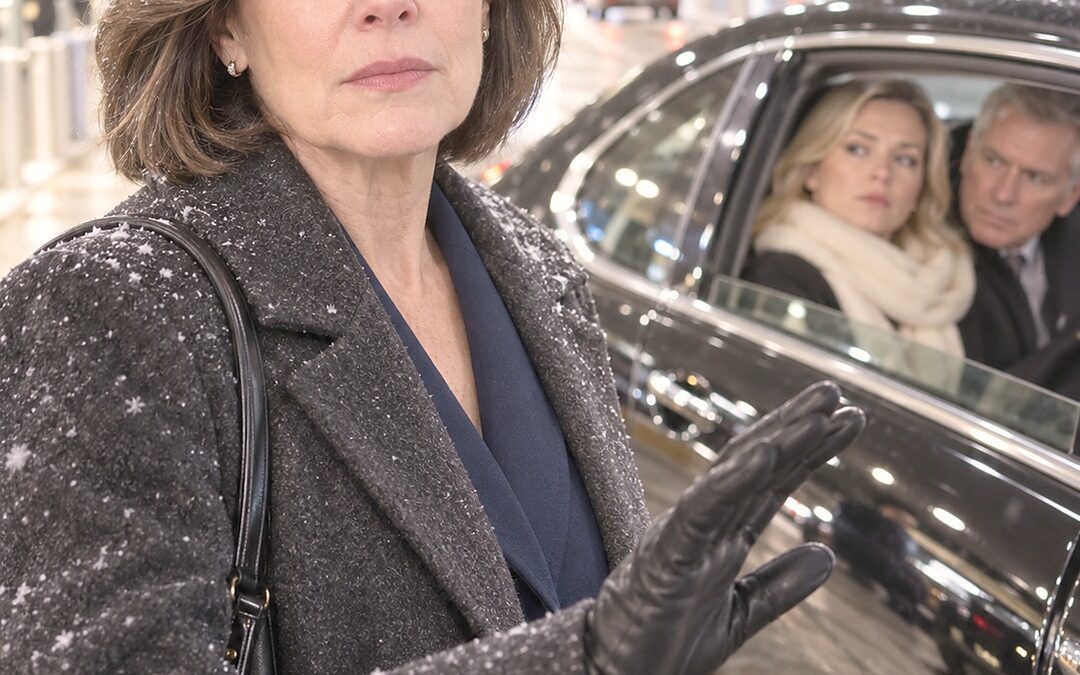
My husband rolled the window of his black Mercedes down four inches at the O'Hare curb, in a blizzard, with my suitcase in his trunk and his girlfriend in my seat wearing my mother's cashmere scarf, and said, "Figure it out yourself, Diane. Take a cab." Then he drove off. My phone was at nine percent, the emergency account we had built over thirty-one years was $186,000 lighter than it had been at lunch, and the man who left me on that curb had forgotten that for fourteen years, before I retired, I caught people who moved money exactly the way he had been moving ours.
I was on the upper level because he told me to be. His text came in while I was still on the jet bridge.
"Upper level, Door 3E. Lower level is a parking lot tonight."
Door 3E is where he always pulls up for his own flights, right outside the American priority counter, and I'd told myself that meant he was coming straight to me. So I stood there under the little heater that doesn't work, with a crowd of people waiting on rides and an airport traffic officer in a yellow vest, torn at one shoulder seam, blowing his whistle at anybody who stopped longer than a minute.
The trunk popped open from inside before the Mercedes quit rolling. I took that for ordinary Stuart, too comfortable to come around in the snow. I hauled my own suitcase over the bumper, forty-some pounds of Boston with my blood-pressure pills zipped in the outside pocket, because the gate agent at Logan had made me check my carry-on when the flight filled up. I left the lid up for him to close, and walked up to the passenger door with my glove already on the handle.
There was a woman in my seat.
Blonde and thirty-something, in a camel coat. Around her neck was the cream cashmere scarf my mother wore to church every Christmas until she died, the one with the coffee spot on a corner of the fringe from Peggy's wedding. It had been in the cedar drawer of my dresser when I left for Boston, under my slips and the good stockings, which meant somebody had gone through my underwear drawer to get it.
The window came down four inches. Stuart leaned across her to say it. She touched the scarf with two fingers and looked out the windshield like she was waiting on a light.
An Uber driver behind us leaned on his horn. The traffic officer waved the Mercedes forward, and it went. The trunk lid started down on its own as the car rolled, with that electric hum Stuart liked to show people, and I took two steps after it with my hand out before it clicked shut on my suitcase. Then the car went around an airport shuttle and into the snow.
A man in a Northwestern hat moved his rolling bag a foot farther from me, as if whatever I had might be catching.
Somebody else came the other way. He was a skycap, older, gray in his mustache, and he left his luggage cart at the curb and kept coming.
"Ma'am. You need to get inside."
"My suitcase is in that car."
"Yeah. I saw."
He was already shrugging out of his coat, a brown Carhartt gone soft at the cuffs, and he put it over my shoulders. It was warm from him and smelled like diesel and spearmint. Before I'd said thank you I'd read the name tape over the pocket, L. GAINES.
"Thank you, Mr. Gaines."
"Lamar. Come on before you lose a finger."
I turned back once at the doors. There was a dry rectangle on the pavement where the Mercedes had idled, already going white at the edges, and the traffic officer was waving a minivan into it.
"Twenty-eight years on this curb," Lamar said, mostly to himself. "Seen people dropped off mad and picked up mad. Never saw a man pop the trunk first so he wouldn't have to get out."
The doors shoved snow across the tile behind us. Without the coat he was down to a gray sweater thin enough that I could see his uniform collar through it, and he walked carefully on his left knee.
"You got somebody else coming?"
"I thought I did."
"That was him?"
"That was my husband."
He thought about that and let it go.
"Phone?"
"Nine percent."
"Then that's first."
He took me past a family trying to fit four duffel bags onto one cart, to a vending machine by the escalators with an outlet beside it, and dug a short charging cord out of his pants pocket. There was electrical tape wrapped around it near the plug.
"Don't bend it there. My grandson."
A woman with a Southwest boarding pass stuck in her paperback lent us an adapter without being asked and went back to her book. The lightning bolt came on. Ten percent.
"Water," Lamar said, and went to get some before I could tell him I was fine.
I sat in a metal chair in his coat and opened the banking app.
I'd seen it first at 3:17 that afternoon, Boston time, at Peggy's kitchen table, paying the Nicor gas bill for the Hinsdale house while my sister slept in the next room with a bag of frozen peas on her new knee. A pending withdrawal from our joint emergency account. $186,000.
I texted Stuart. "I see the transfer. Call me."
Eleven minutes later he wrote back. "I'll be there."
He didn't call. I tried him twice from Logan and got voicemail twice, and I told myself that driving out to O'Hare in a storm was his answer, that a man who drives forty minutes through a blizzard to pick you up is a man who means to explain something.
Now the transfer had posted. Joint Emergency Savings, outgoing, $186,000.00. Available balance, $4,812.63. Initiated 2:52 p.m. Eastern.
At 2:52 I'd been in Peggy's bathroom, holding her walker steady with my hip while she said a word our mother never let either of us say.
That account was the one thing about money Stuart and I had ever agreed on. A year of living, put away, don't touch it. We dipped into it when his father went into assisted living and filled it back up after my father's roof gave out, and Stuart had emptied it while I was walking my sister from her recliner to the bathroom one step at a time.
The app gave me a reference number and a receiving bank shortened to four letters. No name. I took screenshots of everything and emailed them to an old AOL address of mine that Stuart had never had any reason to know about.
Then I called him. It rang once and went to voicemail, which is not how voicemail works unless somebody sends you there. "You've reached Stuart Whitfield, Chief Operating Officer of Northgate Medical Systems." He'd re-recorded the greeting the week he got the title and hadn't touched it since.
My phone buzzed. Stuart.
For about one second I thought he was turning around.
"Maybe this will teach you not to question me."
A man at the vending machine was fighting the card reader over a bag of Doritos. I watched him lose. Then I took a screenshot of the message with Stuart's name and 9:49 p.m. above it, and I sent that one to the AOL address too.
Lamar came back with a bottle of water and a sleeve of peanut butter crackers.
"Machine ate my first dollar."
He glanced at my screen and looked away again, at the escalator.
"He coming back for you?"
"No."
"Okay." He sat down one chair over, enough room that I didn't feel watched. "Then we need a better plan than this chair."
I ate one of the crackers to have something to do with my hands. It broke in half and dropped crumbs down the front of his coat, and I brushed them off carefully, one by one, as if he might want it back in the condition he'd lent it. He watched me do it and didn't tell me to stop.
The clock above the escalator said 9:54. The Mercedes had been gone fourteen minutes. I once spent longer than that letting Stuart explain which dishwasher detergent we were going to buy.
He'd been practicing that tone since October.
We were at the kitchen table in Hinsdale with leftover rotisserie chicken from Mariano's and his phone propped against the salt shaker, and I asked about three small withdrawals marked investment transfer that didn't match anything we'd bought. Stuart laughed through his nose and kept cutting his chicken.
"Investments, Diane. I'm handling it."
"Then show me the statements."
He put his fork down. "You should be grateful I handle the serious financial decisions."
"I handled financial decisions for a living."
"You haven't worked in four years, Diane. Nobody downtown remembers your name."
He carried his plate to the sink and left the chicken bones on the table for me.
I was a forensic accountant at Halsey & Crane Forensic in Chicago for fourteen years. I spent most of them in conference rooms with lawyers, showing them why a payment that said reimbursement on it was really a theft with good manners. I retired in 2021. These days I keep the books for my church as a volunteer, and at Northgate parties Stuart introduces me as the church bookkeeper.
He'd been chief operating officer of Northgate Medical Systems in Oak Brook since 2020. The job came with the black S-Class, which belonged to the company and was washed every Friday on the company's account.
What Stuart didn't know was that in 2019, when Howard Kemp's fund bought thirty-eight percent of Northgate, Howard hired Halsey & Crane to design the company's internal controls. He'd been my client for years by then, and the closest thing I ever had to a mentor, and he asked for me personally. I signed a nondisclosure agreement. I never brought any of it home. When Stuart got the job the next year and told me over dinner that Northgate's controls had been "set up by the consultants," I said that sounded about right and passed him the green beans.
Lamar nodded at my phone. "You gonna call somebody, or you gonna look at it?"
"I'm going to ask for my suitcase first."
I typed it plain. Please leave my suitcase with airport security. My medication is in it.
I didn't mention his passenger. The word Delivered came up under it, and then nothing else did.
Stuart had driven me to the pharmacy for that prescription in December. He knew which pocket I kept it in.
I opened a hotel app and found a room at the Palmer House, and then I pictured how a downtown room on a credit card would sound in some lawyer's conference room in March. Diane got upset and ran up the cards. Stuart would say it gently, with his hands folded on the table. I closed the app. Peggy texted while I was at it. Home safe? Did Stuart get you? I wrote back Landed, talk tomorrow, because she'd had her knee sawed open eight days ago and didn't need to spend her Thursday night on the phone yelling about my husband.
The woman with the Southwest boarding pass stood up to go and tipped her head at the adapter. "Keep it. My husband has a drawer full."
"Thank you."
"Hope you get home okay."
I started to answer and found I didn't have the next word.
Home was the yellow-brick house in Hinsdale. My father, Frank Mercer, bought it when I was twelve and planted the maple by the driveway himself, too close to the foundation, and my mother told him so every fall until she died. When Dad died in 2019, the house stayed in his trust with me as the beneficiary, and Stuart and I moved in that spring. He never read a page of that trust. In 2022 he co-signed a renovation loan for the kitchen and had been calling it his house to contractors ever since.
He was probably pulling into that driveway right about now. With her.
My mother's scarf had been the only piece of her clothing I kept. I'd had it cleaned after the funeral and left the coffee spot alone, because she'd fussed about that spot through an entire wedding reception and it seemed wrong to take it from her.
Lamar stood up. "I gotta check my carts. You good for ten minutes?"
"I'm fine."
"That's not what I asked." He tapped the pocket of the coat I was wearing, and something rattled. "Tums in there if you need 'em. Don't eat the cherry ones, they're terrible."
I watched him go back out through the doors and help a woman wrestle a suitcase onto the scale, careful on that left knee, in a sweater, in a blizzard. Stuart was somewhere on the Tri-State in a heated leather seat with my house keys and a blue tin of butter cookies Peggy had made me promise not to share.
Sixteen percent.
The money had gone somewhere, and wherever it went, it had left a reference number and four letters of a bank behind it. I'd spent fourteen years following thinner tracks than that, left by people who were smarter than Stuart and a good deal more careful.
But I couldn't do any of it from a metal chair with nineteen dollars of cash and no house key.
I scrolled to Paula Brenner. Paula is fifty-nine and a divorce attorney. Stuart has called her "your boring lawyer friend" for twenty years, usually while she was in the next room. Two weeks before, she'd helped me carry plates after a dinner for six that Stuart walked into forty minutes late, and asked me whether he was all right. I told her he was under a lot of pressure at work. She said, "Mm," and dried a platter that was already dry.
Lamar came back in stamping snow off his boots and stopped by my chair.
"Your ride coming?"
"I'm working on it."
"Listen. You don't owe me a story." He took a pen from his shirt pocket, held out his hand for my boarding pass, and wrote a phone number across the back of it. "That's me. When you're done with the coat, you call. My shift's got another hour, and that phone isn't gonna make arrangements by itself."
I tried out ways to start. The money first, or the woman. I couldn't open with the scarf, because Paula would think I'd lost my mind, and the scarf was the only part I actually wanted to say out loud.
I took the cord out of the phone and pressed Paula's name.
Paula answered on the second ring. "Diane? It's ten o'clock in a blizzard."
"I need a hotel, a coat, and an emergency filing," I said. There was a pause, and then I heard her pick up a pen.
Part 2
I took a cab after all. The driver had the heat on high and a Bears bobblehead on the dash that nodded at me the whole way down the Kennedy, and he never asked about the Carhartt.
At twelve minutes past midnight Paula Brenner came through the revolving door of the Palmer House with a navy wool coat over one arm and a yellow legal pad under the other. She's five-foot-one and was still in her courthouse shoes.
She stopped in front of me. "Where's your luggage?"
"Stuart has it."
"Your pills?"
"Also Stuart."
She took in the brown coat, the name tape, the snow still melting off the hem onto the lobby carpet.
"And whose is this?"
"A skycap named Lamar Gaines. He wrote his number on my boarding pass. I promised I'd bring it back."
"Good. Keep that boarding pass." She held out the navy coat. "This is mine. You'll wear it until we get yours back."
The night clerk had started explaining the incidental deposit. Paula put her own card on the counter without waiting for him to finish.
"Everything under my name."
"Paula, I can pay for a hotel room."
"You can pay me back when your husband's done stealing from you."
Upstairs, she waited until the door clicked shut behind us.
"Who is she?"
"Tara Voss. I found her in the cab." I held up my phone. "Stuart's tagged in half her pictures."
The newest one had gone up that afternoon. Stuart standing behind a blonde woman at a restaurant table with his hand on the back of her chair, and a caption about being grateful for a wonderful man who supported her dreams. She was thirty-four, according to her business page. Voss Strategy Group, marketing consultant.
Paula spread the picture wider on the screen. "She's wearing your mother's scarf."
"That was this afternoon. She was still wearing it tonight."
Paula handed the phone back and pointed at the bathroom.
"Shower. I'll order food."
"I need to show you the transfer."
"After you can feel your feet."
In the shower I stood with my forehead against the tile until the water started going lukewarm, and I counted the grout lines across, forty-one, and then down, because counting is what I do when the other thing wants to happen. My nightgown was in the suitcase, so I came out in the hotel robe. Paula had turkey club sandwiches waiting next to her legal pad, and she'd already written THURSDAY JAN 15 across the top of the first page in block capitals.
"Sit. Are you safe?"
"I'm in a hotel room with a divorce attorney."
"Does Stuart know where you are?"
"No."
"Then tell me what happened. Leave in the embarrassing parts."
I started with the delay in Boston. She stopped me at the departures level.
"Why upstairs?"
"He texted that the lower level was a parking lot tonight. Door 3E."
"Did you ask to be picked up on the upper level?"
"I'd texted him I'd wait at arrivals."
She made a small mark in the margin and nodded for me to go on. I told her about the trunk opening before the car stopped, and the woman in my seat. When I got to what Stuart said, Paula wrote it down word for word and turned the pad around so I could check it.
"Figure it out yourself, Diane. Take a cab."
"That's it exactly."
"Witnesses?"
"A traffic officer. An Uber driver laying on his horn. A man in a Northwestern hat who moved his bag away from me. And Lamar, who saw the whole thing from his cart."
"Airport curbs have cameras." She underlined something. "Now the bank."
She put on her reading glasses, the pair with one arm held together by clear tape, and went through my screenshots one at a time.
"Joint account."
"Yes."
"And then this." I showed her the text.
"Maybe this will teach you not to question me."
Paula took one bite of her sandwich, chewed it, and put the rest down.
"Well. He's helped us with intent." She tapped the screenshot. "The bank could honor his transfer. That doesn't mean he gets to keep it."
She circled the receiving-bank abbreviation with her pen.
"Find out whose money it became."
"There were three withdrawals in October, too. Small ones, marked investment transfer. I asked him about them over supper."
"What did he say?"
"Investments." I pulled the toothpick out of my sandwich. "And I left it there."
Paula wrote OCTOBER in the margin and drew an arrow from it to the $186,000, and didn't say anything about the rest.
"I'm a joint account holder. I can get the records tomorrow without doing anything you'll have to explain to a judge."
"Then tomorrow." She turned to a clean page. "One more thing, and you're not going to like how I ask it. The house."
"Dad's house."
"Is it still in Frank's trust?"
"It is. I'm the beneficiary."
"Stuart's been calling it his."
"Since the kitchen loan. He co-signed it in 2022, and now he thinks he owns the cabinets."
"Where are the trust papers?"
"In the file cabinet in my study. And a scanned copy in a folder he doesn't have the password to."
"Don't go near the cabinet." She wrote TRUST in capitals and boxed it. "First thing in the morning I'm sending letters to both banks to preserve the records. Then I file a petition for dissolution of marriage, with an emergency motion freezing the accounts."
"Will Stuart know?"
"Eventually he'll be served."
"When?"
Paula capped her pen. "We serve him when it'll do the most good."
I'd known her twenty-six years. She had already picked a day, or at least a kind of day, and she wasn't going to tell me until she was sure.
"You're enjoying this," I said.
"I enjoy golf. This is work." She pushed the other half of her sandwich across the desk. "Eat. I'm next door."
I managed half of it. Then I lay in the dark in a hotel robe and listened to a snowplow scrape its way up State Street, and at some point, which I don't remember, I fell asleep.
At 7:13 Friday morning she knocked on the connecting door, already dressed, carrying two coffees and her laptop.
"The letters are drafted. I need account numbers. And Marty Feld is calling your prescription in to the Walgreens on State Street, so go get it before you do anything brave."
Marty is her internist. Paula did his custody case in 2011.
I put her navy coat on over yesterday's sweater and sat down at the desk with her laptop. As a joint account holder I could log in to the bank's website the same as Stuart, and under the January activity there was a link that said View wire confirmation. I clicked it. A PDF opened, one page, with the bank's logo on top and our account number masked down to the last four digits.
Amount, $186,000.00. Initiated by online banking, user STWHITFIELD. And halfway down, in capitals, the beneficiary line.
VOSS STRATEGY GROUP LLC.
I downloaded it and saved it to two places. Paula leaned over and put her finger on the name.
"Voss."
"Yes."
"So your girlfriend from Instagram—"
"Stuart's girlfriend, Paula."
"Sorry. Long night."
The letters to both banks went out by eight-thirty. She filed the petition at 9:40, from the desk by the window, with her coffee going cold beside the keyboard. I listened to her spell Whitfield for somebody at the DuPage County clerk's office and went back to the bank statements.
"You still don't want him served," I said when she hung up.
"The banks have the letters. If Stuart hears about this today, he goes and hides whatever he's got that isn't in those accounts."
I wasn't going to get far on one large payment. What I wanted was a reason the money had to go there on that particular Thursday.
Paula read over my shoulder. "Could it be legitimate?"
"I'd love to see the invoice."
"That's not a no."
"It's an accountant's no."
I opened the Illinois Secretary of State's business search and typed in Voss Strategy Group LLC. Active. Organized the previous spring. Tara Voss, manager.
Paula took off her glasses. "So he moved your emergency savings into his girlfriend's company."
"The transfer went to her company. That's what we can prove this morning."
"That's your accountant voice."
The state filing had a registered address. Ogden Avenue.
Stuart and I had driven down Ogden a thousand times on the way to friends in Downers Grove. New condo buildings had gone up there in the last couple of years, wedged between a tire shop and a dentist's office, with balconies nobody seemed to stand on.
I put the address into a search engine, and the first thing that came up was a real estate listing. Two bedrooms, fourth floor, a gold banner across the top photo. Pending since December. List price $930,000.
"A condo," Paula said. "For a business."
"For a registered address."
I did the twenty percent on the hotel notepad, because I wanted to see it in my own handwriting. $186,000.
"Is our money the down payment?" Paula said.
"I'd need the closing papers to say so in front of a judge."
"I'm not a judge. Say it to me."
I didn't. I was looking at the photographs on the listing. White kitchen cabinets. Brass pulls. A narrow balcony over a parking lot.
I'd seen that kitchen before, on Stuart's phone, propped against our salt shaker, the night he told me to be grateful. He'd been scrolling through the pictures when I brought up the withdrawals, and he'd tipped the screen toward me and said values on that stretch were climbing and a smart man would get in early.
I checked the street number against the Secretary of State's page. Then the unit number. Somewhere in there I'd started chewing the end of Paula's pen, a habit I'd broken years ago for a partner at Halsey & Crane who said it made the clients nervous.
"Diane?" Paula said, and I turned the laptop toward her.
Voss Strategy Group's registered address was a condo on Ogden Avenue. Stuart had told me in October that he was looking at it as an investment.
Part 3
Inez Padilla called me at 8:26 Saturday morning from the laundry room of my own house. I knew where she was because I could hear the dryer squeaking. It had squeaked for six years, and for six years Stuart had been about to replace it.
"Mrs. Whitfield, are you somewhere you can talk?"
"Inez, you've called me Diane for nineteen years."
"Not when I'm upset."
Paula had gone down to the lobby for coffee and a phone call with a colleague about the petition she'd filed the day before. I sat up against the hotel pillows.
"What happened?"
"That woman is sleeping in your bed."
Outside the window the snow was still banked along the ledge, but somebody had plowed State Street down to wet black.
"Since when?"
"Thursday night. I came Friday morning and her things were all over your bathroom. Makeup everywhere. A little refrigerator, for face cream."
"A refrigerator."
"On your father's dresser."
I reached for my glasses on the nightstand, as if that would help me hear better.
"She told me the guest bathroom needed cleaning," Inez said. "I told her I did it Thursday, before you came home. She said she wasn't a guest."
Inez started with us when she was forty-three. She knows which upstairs window sticks in August and where Dad hid the key to the fuse box. When Stuart's mother was dying, Inez drove her to chemo because Stuart was in Phoenix and I had a case in Milwaukee.
"You don't have to stay there," I said. "If she's giving you orders—"
"Wait. The glasses."
"What glasses?"
"Your grandmother's crystal. The little ones from the dining room cabinet. She took four down last night for some kind of drink with a lemon peel in it. Two were on the counter this morning. One's on the nightstand in your room."
The cordial glasses. Grandma used to put peach preserves in one for me after Sunday dinner and tell me I was eating dessert like a lady.
"I washed the two on the counter," Inez said. "By hand."
Somewhere beyond the laundry room a door closed. Inez stopped talking, and I listened to the dryer squeak a few more times before she came back, quieter.
"She was taking pictures in your kitchen yesterday. She moved your father's breadboard off the counter. She said it looked old."
"It is old."
"She put it under the sink. My niece found the pictures. I'm sending them."
Three screenshots came through while she was still on the line. Tara at my kitchen island, holding a mug I'd bought at a church rummage sale for a quarter. Tara leaning on my refrigerator. The caption said she was settling into a beautiful new chapter. In the second picture, folded over the back of a kitchen chair behind her, was my mother's scarf.
"Is Stuart there?"
"Upstairs. He came down for coffee and went back up. Last night they had sushi brought to the door, and he gave the boy that black card from his work. He pays for everything with the black card now."
"Has he said anything about me?"
"Not to me." The dryer squeaked. "To her, at breakfast. Loud, so I'd hear it from the pantry. He said, 'She'll crawl back when her credit card stops working.'"
Stuart has made a lot of predictions over the years. He said his sister's second marriage wouldn't last two years, and she's been married eleven. He said my church would close inside five years. It's still there.
"Don't fight with her. I need you in that house, if you can stand it."
"And if he asks me where you are?"
"If he ever asks where I am, tell him the truth."
"He won't ask."
"No," I said. "Probably not."
"She asked me where we keep the good silver."
"What did you tell her?"
"That I didn't know what she meant."
Inez has polished that silver every Thanksgiving for nineteen years and keeps the cloth for it in a Ziploc bag in the second drawer. I laughed out loud and had to hold the phone away from my face.
A woman's voice came faintly from upstairs. Inez said she had to go and was gone.
I opened the credit-card app. The card we used for the house, the one paid out of joint checking, said Account Closed. I called the number on the back. A man in what sounded like Arizona confirmed that the primary cardholder had closed the account at 6:12 p.m. Friday. I was only an authorized user.
I'd bought a toothbrush and a travel shampoo with that card in the hotel gift shop Friday morning. By supper he'd shut it off, and he'd expected me to find out at a register somewhere with a line behind me.
Paula came back with two coffees and a bakery bag.
"Why are you dressed?"
"He canceled the household Visa. My own Mastercard still works."
"Forward me the confirmation." She set the bag down. "What else?"
I told her about Inez and the bathroom and the face cream refrigerator. When I got to the part about Tara sleeping in my bed, Paula stopped with one arm still in her coat.
"Two nights. He couldn't wait two nights."
"She's rearranging the kitchen."
"Does she know whose house it is?"
"I doubt she's read the trust. Stuart hasn't."
Paula got her other arm out of the coat and sat down with the legal pad.
"The petition's filed and the motion's in. I'm adding the card to it."
She looked up before I could open my mouth. "And no, we're still not serving him."
She pushed a cinnamon roll at me. I tore off a corner and held it without eating it.
"Paula, I need to talk to Howard Kemp."
She put her coffee down. "Northgate's chairman."
"In 2019 Howard hired my firm to design Northgate's internal controls when his fund bought in. He asked for me. I did the work under a nondisclosure agreement, and I never told Stuart."
"Not once? In seven years?"
"He never asked what I was working on."
Paula wrote HOWARD on her pad and looked at it.
"Why him, why now?"
"Because Voss Strategy Group is Tara's company, and Stuart runs a company that pays a lot of vendors. I'd like to know if Northgate has ever heard of her."
"One line," Paula said. "Email. Nothing about Stuart, nothing about the money. And you see him Monday, not before."
I wrote it on the hotel stationery first, as I used to draft anything that might end up as an exhibit. Howard, I need to discuss a possible control issue at Northgate. In person, Monday if you can. Diane Whitfield.
He answered in four minutes. 9:00 Monday. My office.
I spent Sunday at the hotel desk with the joint statements, a hotel pen, and a Blackhawks game on the television with the sound off.
Monday morning I walked into Kemp Hollow Capital on LaSalle Street at a quarter to nine. Howard's assistant, Ellen, came around her desk before I reached it.
"Diane. He said send you straight in."
Howard was seventy-one. He'd kept the same enormous walnut desk since the day I met him, through two office moves, and a photograph of his wife still stood next to a coffee mug with a chip out of the handle. He came around the desk and hugged me, one quick pat between the shoulder blades. His general counsel, a long-faced man in a gray cardigan, was already in the corner chair with a legal pad on his knee, and he wrote something down before I'd even sat.
"You look tired."
"I've had a weekend."
"So have I." He sat down and turned his monitor so we could both see it. "Your email ruined my Saturday. I had our people pull Northgate's vendor files Sunday. Before I show you anything, is there something personal I need to know?"
"My husband is Northgate's chief operating officer."
"I know who your husband is, Diane."
"On Thursday he moved $186,000 out of our joint savings into a company called Voss Strategy Group."
Howard took his glasses off, put them back on, and clicked a tab.
A payment ledger filled the screen. The same vendor name ran down it in capitals, invoice after invoice, going back to the fall. VOSS STRATEGY GROUP LLC. The descriptions changed every month. Executive brand consulting. Regional expansion advisory services.
"Show me the approval trail."
He opened it. Every invoice had come through Northgate's expense system and been booked under vendor reimbursement.
I added the column myself on the desk calculator by his keyboard, because I have never once in my life trusted a total somebody else's software gave me.
$740,000.
"That's what our people got too," Howard said.
Nine hundred thirty for the condo, less our one eighty-six. I did that one in my head, twice. It came out within four thousand dollars of the number on Howard's calculator.
"These aren't reimbursements. Nobody reimburses brand consulting."
"No."
"Open the control log."
He did, and I found the line before he could point to it.
"I wrote one rule: any payment over fifty thousand dollars goes straight to the audit chair. Somebody turned it off."
"When?"
"October," I said. "When Stuart started telling me he was handling the serious financial decisions."
Howard opened the change record. The administrative credentials belonged to Stuart's office, which still didn't put Stuart's own hands on the keyboard.
"Is there board approval for that change?"
"None."
"Preserve the logs. The originals, untouched."
"Ray Tolliver has copies locked up."
"You remember signing off on that rule?" I asked.
"In this building," Howard said. "You made me read it out loud."
Howard leaned back. I thought he was going to say something about Stuart. Instead he said, "I hired you to find exactly this, Diane. Seven years ago."
"I'm retired, Howard. And Stuart is my husband. Your lawyers set my limits, not you."
"They will. Outside forensic counsel takes the investigation. You tell them how the controls were built and how somebody got around them." He turned the monitor back toward himself and tipped his head at the corner chair. "This afternoon our counsel makes a report to the U.S. Attorney's office. I'd like you in the room."
"Does Stuart know any of this?"
"He knows I asked for routine audit material. He thinks I'm an old man who signs whatever he's handed." Howard picked up his coffee.
"There's something else, isn't there."
"Friday morning he presents an expansion to the board. He's been building it since summer."
"How large?"
Howard set his coffee down without drinking it. "Diane, can you prove it by Friday? Because Friday morning your husband is going to stand in my boardroom and ask us for forty million dollars."
Part 4
On Thursday, January 22, seven days after he left me at O'Hare, Stuart texted at 7:18 in the morning.
"Enough games. Come home Sunday and sign the papers."
I was at the desk in my room at the Palmer House, going through a spreadsheet Howard's outside counsel had cleared me to see. I sent a screenshot to Paula. She called back in three minutes.
"Don't answer him."
"I wasn't going to."
"His lawyer emailed me last night. There's an offer. I'll bring it."
"What papers is he talking about? Nobody's sent me papers."
"His. He thinks he's the one getting divorced."
She came at 9:40 with a manila envelope and slid out three pages.
"Stuart offers you the old SUV."
"The one with the heater that only works on the passenger side."
"And forty thousand dollars. Source unspecified." She turned a page. "And three months of temporary permission to live in a rented apartment in Westmont. He keeps the Hinsdale house."
I read the third page myself. Mr. Whitfield shall retain sole possession and ownership of the marital residence, subject to the existing renovation loan.
When we had the pantry door replaced during the renovation, Stuart wanted to throw out the old one with my pencil heights on it, from age twelve to sixteen, in Dad's handwriting. I'd had the contractor take it off the hinges and carry it up to the attic instead.
"Dad's house," I said.
"He thinks a 2022 loan made it marital property."
"Did his lawyer look at the trust? Or the title?"
"There's no sign he looked at anything." Paula turned the letter so I could see the date. "He sent this five days after I filed. Our petition has been on the DuPage County docket all week, and he never checked it."
"So Stuart still doesn't know."
"Not a thing." She put the pages back in the envelope. "I'm going to tell his lawyer no, in one line, on letterhead. And our emergency motion is up tomorrow at nine in Wheaton."
Paula stopped at the door with her coat half on.
"Friday's going to be hard to sit through."
"Howard told you."
"He told me why. Northgate's counsel wants Stuart on the record in front of the board before anybody confronts him. Every number he gives them, every promise."
"So Stuart gets to make his speech."
"He gets to make his speech. Don't count on enjoying it."
I spent the afternoon with the vendor records. The first Voss invoice was dated October 6, which was eleven days before Stuart told me over leftover chicken that nobody downtown remembered my name. The alert had been switched off on October 2, four days before that. I wrote both dates on the hotel notepad and drew a line between them and sat with that line for a good while.
Then I asked Ray Tolliver, through Howard's general counsel, for the Oak Brook building's badge records for October 2. They came back just after four. Stuart's card opened the fourth-floor door at 7:51 that night, no other card touched that floor until six the next morning, and the alert was switched off at 8:12. I wrote it up in two pages, and the general counsel had it before dinner.
At 8:06 Friday morning, January 23, he wrote again.
"You have nowhere else to go."
I was downstairs in the hotel dining room with toast and orange marmalade, and I put the phone face down beside the plate and finished my breakfast, both slices, and sent it to Paula on my way upstairs. At 9:31 she sent back a picture from the courthouse in Wheaton, the judge's signature on our emergency order, and under it, Banks have it by noon.
By 10:45 I was on LaSalle Street, in the office of Howard's general counsel, two doors down from the boardroom. He had the boardroom's conference line running into the speaker on his desk and a fresh legal pad squared up in front of him. He offered me coffee and the good chair and asked me not to make a sound, in that order.
At 10:57 the speaker clicked. Howard's voice, close and low. "We're on."
The counsel uncapped his pen.
A door, and somebody asking if the coffee was fresh. Then Stuart.
"Morning, everybody."
He has a voice he uses at dinner parties right before he explains something nobody asked about. I could pick it out of a crowd at Soldier Field.
He talked for forty minutes. I'll spare you the slides. At the end of it a board member asked about outside consulting costs, and Stuart said they'd been folded into the preliminary budget. Another one asked whether internal audit had raised any concerns.
"Nothing material," Stuart said. "The vendors are positioned, and our controls remain robust."
I wrote that sentence down on the hotel notepad I'd brought in my purse, under the two dates, and my pencil point broke on the word robust.
Somebody asked who the outside marketing firm was.
"A boutique shop," Stuart said. "Very responsive. They've been worth every penny."
Then a man with a big, comfortable voice said he'd like to move that the board release the first tranche today. "Four million. We start the build-out in March, not June."
"Second," somebody said.
The counsel's pen stopped. I had the edge of his desk in one hand and didn't know it until later, when my fingers ached.
"Let's table the vote to Monday," Howard said. "I'd like the audit committee to have the weekend with it."
"Howard, it's four million on a forty million deal."
"Monday, Phil."
There was some grumbling. Stuart didn't argue. Then Howard thanked him, and the applause started.
It went on long enough that I heard a chair push back.
Somebody near the speakerphone said, "Enjoy Cabo, Stuart. You earned it."
Stuart laughed. "I'll send you a picture of the water."
The speaker clicked off. The counsel finished his line, tore the sheets off his pad, and went down the hall with them. I sat there with my own handwriting on the notepad and a broken pencil. Howard didn't come. I took a cab back to the Palmer House, and somewhere on Wacker Drive my phone buzzed.
"Not yet."
Up in my room I put the phone in the desk drawer and shut it.
After a while I took Lamar's coat out of the closet, where it had been hanging next to Paula's, and carried it down to the bell desk and asked if the hotel could have it cleaned by Monday. The young man behind the desk held it up by the shoulders and read the name tape. "Is Mr. Gaines staying with us?" I told him Mr. Gaines was the only person in this whole business who'd behaved like a gentleman, and he wrote RUSH on the ticket without asking me what I meant.
Somebody knocked just before two. Inez was in the hallway in her navy cleaning cardigan under her winter coat, with snow melting on one shoulder and a dented tin box held against her chest with both arms.
I knew it from the doorway. Cream-colored tin, little red flowers around the lid, one corner pushed in from the day Mom dropped it carrying it into the Hinsdale house.
"Where did you get that?"
"The kitchen trash." Inez came in and set it on the desk. "Miss Voss was cleaning out the cabinet over the microwave. She said it was clutter. It was under some old measuring cups. I got it out before the truck came."
I opened the lid. Mom had kept her cards more or less alphabetical. She never did decide whether chocolate chip cookies went under C for chocolate or K for cookies, so they were in both places, two different cards with two different amounts of brown sugar.
The first card was Banana Bread.
Her handwriting ran downhill across the lines, the oven temperature in blue ink and the baking time corrected in pencil. Near the bottom there was a round, see-through butter stain the size of a dime. I remembered the afternoon it happened. Peggy was home from college, and the two of them were arguing about walnuts, and Mom set the card down next to the butter dish while she scraped the bowl.
I turned the card face down on the desk.
Then I took every card out of the box and started putting them back in order. Baking Powder Biscuits before Banana Bread. Beef Stew after both. I put the chocolate chip cookies under C, both of them, and I didn't stop until I got to Zucchini.
Inez let me do it. She went to the refrigerator and unpacked a container of chicken soup she'd brought from home, and she didn't say anything until I had the lid back on.
"Eat," she said, and I did.
"Mr. Whitfield hasn't asked about you," she said. "Not once. He told me to keep the guest room made up, in case of company."
"Is she still there?"
"Still there." Inez looked around the room, at the stacks of statements and my sweater over the chair. "Where do you go all day?"
"LaSalle Street. Mr. Kemp's office."
Inez nodded and took my bowl. Before she left she put her hand flat on the lid of the recipe box.
"Keep it somewhere he can't reach, Diane."
On Sunday, January 25, the tenth day, she called in the afternoon. I could hear drawers opening behind her.
"I think they're going somewhere. There's luggage in the front hall. She asked if the car service could come early tomorrow, and he said he'd drive them himself. He told her, '3E, same as always.'"
"Door 3E?"
"That's what he said. I don't know what it means."
"I do. Cabo?"
"She said beach. She keeps complaining about her boots."
I wrote it in the margin of the Sunday Tribune. Monday, January 26. Then I called Howard, who didn't sound surprised. He said the board would be on the phone at nine that night, all of them, and he'd text me after. Then I called the number on the back of my boarding pass.
"You working tomorrow morning?"
"Five o'clock," Lamar said. "Upstairs, 3E. Why?"
"I have your coat."
"Ma'am, I got another coat."
"Not that one, you don't."
At 9:17 that night, with Howard's board seventeen minutes into its call, my phone rang again. Inez, whispering from the pantry. Stuart had kept her past supper to iron his shirts for Cabo, and behind her I could hear drawers yanked open and a man swearing about his passport.
"He asked."
On Sunday night, the tenth day, Stuart finally stood in my kitchen and asked Inez, "Where has my wife been?" And Inez, who had ironed his shirts for nineteen years, folded the dish towel and said, "With Mr. Kemp, sir. All week."
Part 5
At 5:15 Monday morning, January 26, I was standing at Door 3E on the upper departures level of O'Hare, under the same little heater that doesn't work, holding a brown Carhartt coat folded over my arm.
Eleven days earlier my husband had left me on this curb in a blizzard. This morning the snow was light, small dry flakes drifting through the headlights, and the airport traffic officer working the lane had a yellow vest with a seam torn at one shoulder. On January 15 I'd turned around once at the doors and watched that vest wave a minivan into the dry spot where the Mercedes had idled.
I'd been awake since three. I'd put on Paula's navy coat and the earrings Dad gave me when I passed the CPA exam, and I'd eaten half a banana in the cab and thrown the other half away.
Lamar came out through the doors pushing an empty cart, saw me, and stopped.
"You're early."
"So are you."
"I'm on at five. You're just early." He eyed the coat. "That's not my coat. My coat had a coffee stain on the cuff and smelled like the tollway."
"The Palmer House disagreed with your coat."
He took it from me, shook it out once, and put it on over the thinner jacket he was wearing. Something in the inside pocket crinkled. There was an envelope in there, a thank-you card I'd rewritten three times, and under my name a line in Howard's handwriting promising two seats to a Packers game from his season tickets as soon as the schedule came out in May. Lamar patted the pocket without opening it and went back to his cart.
I didn't tell him about the letter. Two pages on Palmer House stationery to the Department of Aviation, addressed to whoever supervises the skycaps at Terminal 3, with his name spelled the way it was on the tape. I'd mailed it Saturday.
He nodded down the curb. "Those folks with you?"
"Some of them."
Ray Tolliver, Northgate's head of security, stood by the concrete pillar closest to the lane in a charcoal overcoat, holding an envelope and a set of title papers. Gloria Ames, the process server Paula had hired, fifty and patient-looking, waited near the terminal doors with a canvas tote bag and a folder in a plastic sleeve to keep the snow off. Another woman in a dark coat stood farther back by the pillar marked 3E, drinking coffee and not looking at anybody in particular. I didn't know her name yet.
"His flight's at seven-forty," Ray said, checking his watch. "He'll be early."
"He's always early when it's his trip."
My phone buzzed in Paula's coat pocket. Paula, from her kitchen in Evanston, where she'd promised to stay so nobody could say she'd set anything up. Gloria's there? Let her finish before you open your mouth. Then, a minute later: I mean it, Diane.
I wrote back OK and put my hands in the coat pockets so I'd stop checking the time. Paula's gloves were in there. One had a hole at the thumb, and I worked my thumb through it and back out again, over and over, until Lamar came by with his cart and stopped beside me.
"You doing all right?"
"Ask me again in ten minutes."
"I can do that." He looked down the lane, then back. "For the record, I'd have kept the coat."
At 5:31 the black Mercedes came up the ramp behind a hotel shuttle, and I knew the headlights before I could see the grille. It pulled to the curb twenty feet past Ray's pillar. Before it had quit rolling, the trunk lid popped open from inside.
Tara got out of the passenger side in her camel coat and my mother's cream scarf, a leather carry-on over her shoulder.
"Stuart, can you get the big bag? It's heavy."
He got out. That was new. He was wearing the navy cashmere overcoat he'd bought at Nordstrom in November and complained about for two days, and he came around the back of the car with his eyes on his phone.
Ray stepped in front of him. "Morning, Mr. Whitfield. I need the keys."
Stuart lowered the phone. "Ray?"
"The board removed you for cause last night. Notice went to your email at four fifty-eight." Ray held out the envelope. "The car is Northgate's. Our driver's taking it back."
Stuart thumbed down through his mail and back up to the top. "There's nothing here. The board applauded me Friday."
"Yes, sir. I need the keys."
Stuart put his phone on speaker. "I'm calling Howard." It rang four times, and I could hear Howard's voicemail from where I stood, the same flat Chicago greeting. Stuart hung up without leaving a message.
"Is this funny to you, Ray?"
"No, sir. It's my job."
Stuart tore the envelope open and read the first page standing at the open trunk, one hand on the lid. I could see the board's letterhead over his arm, and two words in bold near the top, FOR CAUSE, and the blue ink of Howard's signature at the bottom. The traffic officer came down the lane toward them blowing his whistle.
"Folks, you can't leave this vehicle here."
"Company vehicle recovery." Ray showed him a Northgate ID and the title papers. "He's handing me the keys, and our driver will move it."
The officer looked at the Mercedes, then at Stuart, and stepped back onto the curb.
"Make it quick," he said.
Stuart took the fob out of his right coat pocket and put it in Ray's hand. A woman waiting for a ride with a toddler on her hip turned so the boy could see the man giving away his car, and the boy waved at him.
Gloria was already walking over. "Stuart Whitfield?"
"Who are you?"
"Gloria Ames. I'm here to serve you." She put the folder against his chest so he had to take it. "Petition for dissolution of marriage, filed January 16 in DuPage County, and an emergency order entered January 23 against concealing or disposing of marital assets. You've been served, Mr. Whitfield."
"My lawyer is handling the divorce."
"This one's your wife's, sir. Her attorney is Paula Brenner."
Stuart actually laughed. "Her boring lawyer friend."
Gloria wrote the time on her form, 5:36 a.m., and stepped back out of the way.
Tara had her phone out. "Stuart. Our reservation says canceled."
"It's a glitch."
"It says canceled. Both of us." She came around the trunk. "Divorce papers? You said she was only staying at the house till spring."
"We'll talk about it on the plane."
"What plane, Stuart?"
He opened the American Airlines app with his thumb, found the same two seats, and tried his own debit card. The wheel turned and stopped. Payment declined. He tried it again, and while it was turning he looked down at Gloria's folder under his arm, at the word Emergency on the top page. Declined. He didn't try a third time.
"Don't bother with the Northgate card," Ray said, not unkindly. "It was shut off at five, same as the travel authorization."
That was when Stuart looked up from his phone and saw me.
He looked first at Paula's navy coat, because he didn't know it, and then at my face, and then at Lamar, who was standing at his cart in a brown Carhartt coat with his name over the pocket.
"Diane?"
"Good morning, Stuart."
"What are you doing here?"
"I came for my suitcase."
His eyes went to Lamar again. "Who's he?"
"The man who gave me his coat the night you drove off with my pills."
Lamar didn't say anything. He just kept his hand on his cart and let Stuart get a good long look at the name tape.
Stuart held up the folder. "You did this."
"I filed for divorce. Howard did the rest."
"Howard." He shook his head and said to Ray instead of me, "Kemp's seventy-one and sentimental. She's begging for a job."
"Fourteen years at Halsey & Crane, Stuart. I wrote the alert somebody turned off."
He stared at me. "The consultants set those up."
"Yes."
A shuttle bus pulled away from the curb behind him, and he turned to watch it go, the folder of court papers in one hand and the termination letter sticking out of his coat.
"Diane." He lowered his voice. "How am I supposed to get home?"
"Figure it out yourself, Stuart. Take a cab."
His hand went to his right coat pocket for the key fob. Then it went to the left one. Then it stayed there, both hands in his pockets, in the snow, at Door 3E.
A man waiting for an Uber with a ski bag between his feet took out one earbud. Lamar stood at his cart and kept his eyes on Stuart.
Ray walked to the back of the Mercedes and lifted the trunk lid the rest of the way.
Tara's suitcases and Stuart's golf bag took up most of it. Pushed against the back seat, where I'd set it down eleven days earlier, was a dark blue Samsonite with a red ribbon on the handle and the Boston baggage tag still on it. Peggy had tied that ribbon, because she said every dark suitcase at O'Hare looks the same. The bow was still crooked.
"Mrs. Whitfield," Ray said. "Is this yours?"
"Yes."
Lamar was already there. "I got it." He lifted it out and set it on his cart and turned the tag toward me so I could see it. BOS to ORD.
The combination lock was on the zipper pulls, still on the same three numbers I'd left it at.
I unzipped the outside pocket. The amber bottle was right where I'd put it, with the pharmacy's sticker from December, and I put it in my purse. Stuart watched it go in.
Tara was reading her phone, the cancellation email, scrolling slowly with her thumb all the way to the bottom. Then she put the phone in her coat and reached up and unwound the scarf from her neck.
She held it out to me, but she was looking at Stuart. "You told me she was your ex. You told me it was final."
I took it. The cashmere was warm from her. The coffee spot was on the corner of the fringe, where it had been since Peggy's wedding. I put it around my neck. It smelled like somebody else's perfume, something with vanilla in it.
Tara picked up her carry-on, left the big bags in the trunk, and walked down the curb to the rideshare line without looking at Stuart, and took her place behind the man with the ski bag.
"Tara," Stuart said.
She didn't turn around. The man with the ski bag slid it over a few inches to make room for her.
"She'll be back," Stuart said. Ray waved the Northgate driver forward.
Stuart took his phone out again, and for a second I thought he was going to call Tara. Instead he scrolled for a number, and I heard him say under his breath, "Howard will fix this."
The woman in the dark coat set her coffee on the ledge by the pillar at Door 3E and walked over to him. She had a leather folder under her arm. She opened a black wallet and showed him a badge.
"Mr. Whitfield? Special Agent Dana Ruiz, FBI Chicago."
Stuart's thumb stopped on the screen.
She looked past him at me, and at Lamar beside his cart. "Mrs. Whitfield. Sir. I need you both to step back about twenty paces, please. Over by the doors is fine."
Lamar took my elbow, and we went. I counted. Twenty-two, because his knee shortens his stride and I wasn't about to get ahead of him. From there I could still hear every word.
"You're not under arrest this morning, Mr. Whitfield."
"I have a flight."
Agent Ruiz held out her hand, palm up, the way you'd ask a child for something he shouldn't have, and said, "I have a warrant for the phone, Mr. Whitfield. You won't be needing a boarding pass."
Part 6
The next time I saw Stuart was Thursday, February 19, in a federal courtroom on Dearborn Street.
He was wearing the charcoal suit I bought him for our twenty-fifth anniversary. The left sleeve had always been a quarter inch too long. I'd offered more than once to take it to the tailor, and every time he told me nobody notices those things.
I noticed. It came down over his knuckles when he sat.
Paula sat beside me on a bench near the back. She wasn't anybody's lawyer in that room, and she'd come anyway, with her legal pad, because she knew I wasn't going to walk into a federal courthouse by myself and pretend I was fine.
"You all right?" she asked.
"That depends on the next hour."
Agent Ruiz came down the aisle before the judge took the bench, in the same dark coat, and stopped at the end of our row.
"Mrs. Whitfield."
"Agent Ruiz."
"I wanted you to know the phone was very helpful." She said it like a nurse telling you the shot is over, and went to sit behind the prosecutor.
She'd taken the phone off him at Door 3E and let him walk away. I never did find out how he got home. He had turned himself in at the federal building that morning with his lawyer, by appointment, and surrendering his passport was what let him sleep at home that night.
Stuart came in through the side door with that lawyer, a heavy man with a heavier briefcase. There was no Northgate badge clipped to his jacket. He'd worn that badge everywhere for six years, to the hardware store, to church on Easter. I used to fish it out of his pants pockets before I ran the wash.
He was there on a criminal complaint charging wire fraud. The prosecutor, a young woman with her hair pulled back hard, walked the judge through it invoice by invoice, which is how I would have done it. Voss Strategy Group. Vendor reimbursement. An approval alert switched off from credentials assigned to the chief operating officer's office. $740,000.
I'd known that number for a month. When she said it out loud, I pressed my thumbnail into the edge of the bench.
"Your Honor, my client disputes the government's characterization of those payments," his lawyer said.
"Mr. Whitfield will have every opportunity to contest the allegations," the judge said. "Today we're dealing with the complaint and conditions of release."
Then the prosecutor told the judge, "A third party is cooperating," and didn't say who. Stuart turned in his chair to say something to his attorney, and the attorney put one thick finger on a paragraph of the complaint and kept it there until Stuart turned back around.
Paula leaned over. "Did you know she'd flipped?"
"Howard said they'd talked to her."
"That's a lot more than talking."
I thought about Tara in the rideshare line in January, bare-necked in the snow behind a man with a ski bag, holding her carry-on against her stomach.
The clerk slid a form across the defense table, and Stuart signed it without reading it. He said "Yes, Your Honor" and "No, Your Honor" in the right places, and nothing else.
When it was over, he stood by the defense table while the clerk sorted papers. Then he turned around and found me, three rows from the back.
He looked at me for a long time.
I didn't look away, and I didn't nod.
His lawyer touched his elbow, and he went out the side door with that sleeve down over his knuckles.
On Tuesday, April 14, I walked into the DuPage County courthouse in Wheaton with a certified copy of my father's trust in a blue folder.
It had rained all morning, and the courtroom smelled like floor wax and wet wool. Paula had on the reading glasses with the taped arm, which she'd decided were lucky now and refused to replace.
Stuart was already at the respondent's table with his lawyer, a different one from January. He didn't turn around when I came in.
Inez sat in the back row in a lavender sweater she'd knitted herself, with a small insulated lunch bag between her shoes. She had never stopped working at the Hinsdale house, with Stuart in it or without him. I was the one who'd moved back, in February, after the court gave me exclusive possession and Stuart took an apartment in Downers Grove.
Stuart's lawyer started with the house. Six years of contributions, he said, and a 2022 renovation loan Mr. Whitfield co-signed.
Paula stood up. "Your Honor, the residence is held in the Frank Mercer trust, established by the petitioner's father. Mrs. Whitfield is the beneficiary. Co-signing a renovation loan didn't make Mr. Whitfield an owner."
The judge read for a while. I thought about Dad making me sit through his lawyer explaining that trust line by line, in 2017, while I told him I could read it perfectly well by myself. He made me sit there anyway.
"Mr. Whitfield's name doesn't appear anywhere in this instrument," the judge said. "The residence remains in the trust. It is not marital property."
Then Paula handed up one more thing. Stuart's financial affidavit, signed in March, under oath. On page two he'd listed the Hinsdale house as a marital asset he'd paid for. On page four, where the form asks for every brokerage account in either spouse's name, he'd written None. Behind it Paula had clipped a Schwab statement her subpoena had pulled from Schwab in the divorce, an account in Stuart's name alone, where his November retention bonus from Northgate had gone instead of our checking. $52,000.
The judge turned to the Schwab statement, then back to page four, and looked over her glasses at him. "Mr. Whitfield, you swore to this?"
Stuart leaned toward his lawyer and didn't lower his voice enough. "My old lawyer filled it out."
"Not me, Mr. Whitfield," his new lawyer said, without turning his head.
The judge made a note, then added the $52,000 to my share of the division and said she was sending the affidavit to the U.S. Attorney's office.
Then the money. The condo on Ogden Avenue had sold in March, after Tara signed it over as part of her agreement with the government. The closing statement had one line I cared about. $186,000 went back into the joint account it left on January 15, and the judge awarded it to me. Everything else from that sale went to Northgate, because it had come from Northgate.
"Your attorney tells me you're not asking for any of the remainder, Mrs. Whitfield," the judge said.
"I never wanted a dollar that wasn't mine."
Stuart stared at the closing statement until his lawyer slid another page over it. Behind me I heard Inez unzip her lunch bag, take out a sandwich in wax paper, think better of it, and zip the bag shut.
Afterward I found her by the courtroom doors.
"Did it go how it was supposed to?" she asked.
"Most of it."
"Is the house safe?"
"The house is safe."
"Good. I did the guest bathroom yesterday."
Stuart came out of the courtroom behind his lawyer and stopped a few feet from us. His lawyer kept walking, then stopped too and waited by the elevators.
"You could have just talked to me, Diane."
"I did. In October. At the kitchen table, over the chicken."
He started to say something and then looked down at the blue folder instead.
"Nobody downtown remembers my name, Stuart. You told me so." I tucked the blue folder under my arm. "Howard remembered it."
His lawyer said "Stuart," once, from the elevators. Stuart went.
I took the cream tin with the red flowers out of my tote bag. I'd photographed every card in it at the Palmer House, front and back, on the desk under the lamp, so I could do this. Inez knew the tin before I handed it to her.
"What's this for?"
"For the Thanksgiving pie."
She opened the lid and walked her fingers back through the cards to A, to Mom's apple pie in Mom's downhill handwriting, and read it right there in the hallway with people stepping around her.
"I always put too much cinnamon," she said.
"So did she."
Inez shut the lid and held the box against her chest the way she'd carried it into the Palmer House, and didn't give it back.
In May I had the old pantry door brought down from the attic and hung back on its hinges, Dad's pencil marks and all. Inez came in that Monday, saw my name at twelve years old about level with her shoulder, and laughed until she had to sit down on the step stool.
Stuart pleaded guilty in August to one count of wire fraud, and Paula says not to expect him home before 2030 once he's sentenced in November. Tara pleaded to something smaller, lost Voss Strategy Group, and pays Northgate back every month on a schedule a judge wrote out for her.
This past Thursday I flew home from Boston again. Peggy's off the cane and back to telling the cashier at Market Basket what everything used to cost. She sent me home with another blue tin of butter cookies and said, "Don't let anybody drive off with these."
I called Inez from the jet bridge. "Upper level," I said. "Door 3E."
"Upstairs? Diane, it's a Thursday. Lower level is wide open."
"I know. Humor me."
She sighed into the phone, and I heard her keys. I got my suitcase off the carousel and rode the escalator up past the vending machine by the outlet, where somebody had left a Starbucks cup on the floor, and walked out through the doors into the cold.
The heater still doesn't work. The traffic officer has a new vest.
Lamar was at the curb in the brown Carhartt with L. GAINES over the pocket, and he saw the scarf before he saw me.
"That's a good scarf."
"It was my mother's."
"I know whose it was." He patted the inside pocket where the envelope had been. "Packers, November. My granddaughter's had it circled on the calendar by the fridge since the schedule came out. She's already asking me what you wear to Soldier Field."
Inez's Buick was at the curb, trunk already up. She leaned across the front seat and pushed the passenger door open for me from inside.
Lamar lifted my suitcase into Inez's trunk himself, and Inez asked whether I wanted the radio on, and I figured that one out in about one second.



