At Our Company’s 30th Anniversary Picnic, My Husband’s Girlfriend Cut Through My Face on the Cake and He Told 62 Employees, “Labels Get Changed”—For Thirty Years He’d Signed Me a One-Dollar Check Every January and Never Asked Why
Part 1
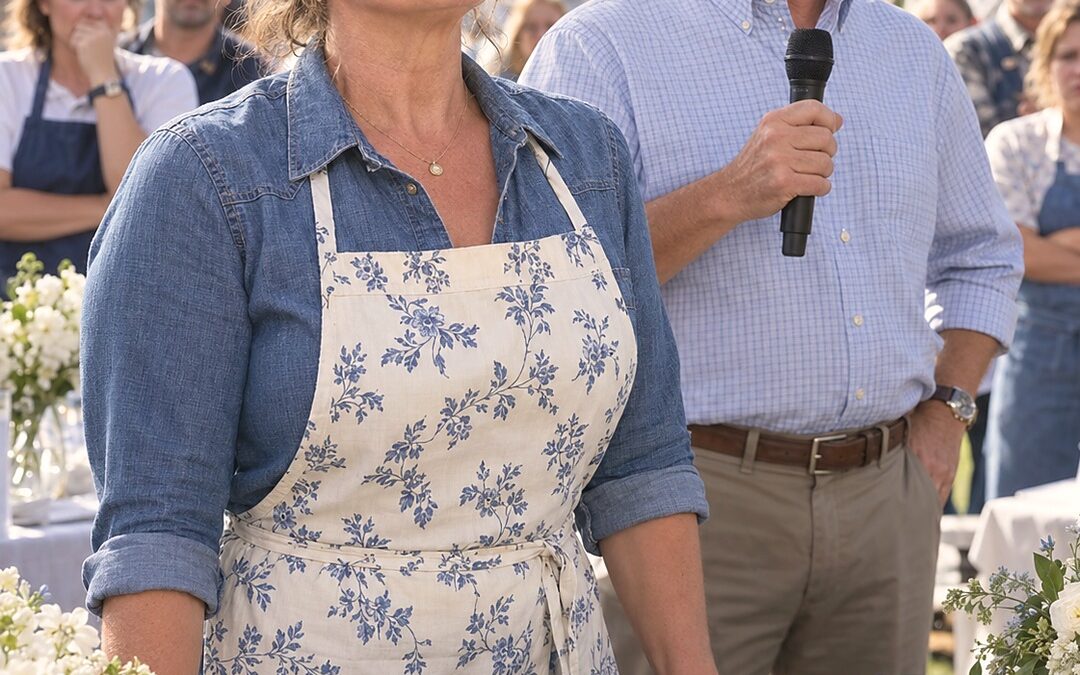
My husband took the microphone at our company's thirtieth anniversary picnic, pointed at the sheet cake I'd frosted with my own face, and said to sixty-two employees, "You were a picture on a label, June. Labels get changed." Then his girlfriend took the cake server out of my hand and cut the first piece right through my eyes. Forty minutes before that, his lawyer had handed me papers that gave me $180,000 to be out of my own house by Halloween. Wade had signed a one-dollar check to me every January for thirty years, and not once had he asked me what it was for.
His eighty-six-year-old mother, who I'd fed and driven to every eye doctor in Pettis County for seven years, was going to Maple Glen Care either way. That was in the envelope too.
Brooke Lassiter slid the slice onto a paper plate and my blue frosting eye went sideways into the buttercream bandana. "First piece for the birthday boy," she said, and carried it over to Wade, who was sixty-one and had not cut his own cake once in the thirty-six years I'd been married to him.
Two minutes before that he'd yanked a blue tarp off Truck 1 like he was unveiling a bass boat. Where my face had ridden up and down Highway 65 since 1996 there was only the word Junie's in skinny modern letters, the kind they put on candles at the mall, and Haskell Provisions underneath. Brooke had designed it. She was thirty-nine, our vice president of brand for two years now, and as far as I could tell the job was picking fonts and riding around in Wade's Tahoe.
Wade had leaned into the microphone. "Thirty years ago this company was my wife's face on a pickle jar. Starting Monday, it's Haskell Provisions, a company with a future."
Some of the line crew laughed. The young ones mostly, who'd been with us two summers and thought it was a joke about an old picture.
Earl Tubbs had been driving our forklift since 1997, and he was working the pork steaks at the grill with a toothpick parked in the corner of his mouth. When Wade said labels get changed, the toothpick quit moving. Rhonda Kimes, our packing line lead, was right beside me at the cake table holding a stack of napkins she'd forgotten she had. My son Cody, thirty-three years old and production manager of this plant, was looking at his phone.
"Wade Allen, put that microphone down."
That was Bernice, from her folding chair under the awning with her walker parked beside her. She couldn't see much past the end of her arm anymore, but there has never been one thing wrong with her mind.
Wade kept the microphone. "Now, June understands business," he said. "June's always been supportive." Two of the office girls clapped, I think because they didn't know what else to do with their hands.
I'd baked that cake at my own kitchen table the night before, two half-sheets of vanilla and close to four pounds of powdered sugar, and outlined the face with a toothpick before I piped it. I'd been putting that face on picnic cakes for so long I could do the bandana with my eyes shut. The painting on the jars came from a picture Mama took of me the summer of 1994, twenty-six years old in her yellow kitchen, holding a pint of chow-chow. The painter gave me straighter teeth than God did.
The company turned thirty on the twentieth, a Sunday, and Wade wasn't about to give up a Sunday tee time, so we had the picnic eight days early.
At 3:35 that afternoon, out in the parking lot of our old dairy building on South Limit Avenue, a man in a suit too nice for a loading dock had walked up to my Equinox and said his name was Trent Gaither, from Kansas City, and that he represented my husband. He handed me a manila envelope. Then he said, "For the record, Mrs. Haskell, I told him not to do this today." He kept looking back at the building while I read, like he'd parked somewhere he'd get towed.
Wade had filed for divorce Friday in Pettis County. He'd been living at our place on Truman Lake since the seventeenth of August, to think, and I guess he'd finished. He kept the house at 412 West Sixth Street and the lake house. He kept the company. I got my 2016 Chevy Equinox and $180,000 and had until Saturday, October thirty-first, to be out. The offer was good until five o'clock Friday the twenty-fifth. On page six there was a paragraph saying that Wade, holding his mother's power of attorney, had arranged her placement at Maple Glen Care.
Nobody had asked Bernice. I'd have heard about it.
Rhonda touched my elbow. "June, honey. You want me to…"
"No, ma'am. Thank you."
I took a clean napkin off her stack and laid it over what was left of my face. Then I picked up the envelope from the corner of the table, went over and unhooked Bernice's pocketbook from her walker, and asked her if she was ready to go home.
"Ready since the speeches," she said.
Wade was still talking when I got her down the ramp. I didn't say one word into that microphone. I'd promised sixty-two people cake, and most of them hadn't done a thing to me.
*
Our kitchen door on West Sixth sticks when it's humid, and it was humid. At six o'clock I got Bernice's walker over the threshold and found my granddaughter standing by the refrigerator with a paper plate under plastic wrap. Megan had let her in with the spare key.
Avery is eight, in third grade, and that day she had on a pink shirt with a crooked hem because she'd insisted on shortening it herself. Cody's truck was idling in the driveway. Megan was out there talking to him through the window.
"Grandma." She lifted the plate up to me with both arms straight, the way you'd hand somebody a baby.
Under the plastic was a squashed square of white cake with one blue frosting eye on top, a little smeared where her thumb had held it on.
"I saved your face, Grandma."
I took it from her and set it on top of the refrigerator, up where Bernice couldn't knock it off reaching for her Raisin Bran. Then I kept hold of the refrigerator handle. The motor kicked on. Avery stood there watching me, waiting to see if I was going to eat it, and I held that handle a good while longer than anybody needs to hold a refrigerator shut.
"You want a grilled cheese?" I said.
"Can I have two?"
"You can have two."
She climbed up on her stool and told me about a girl in her class who brought a live caterpillar to school in a Paw Patrol lunchbox and it got out during spelling. I buttered bread. Down the hall Bernice's walker caught the corner by her door, the same corner it's caught for seven years, because she won't let me move the little table there.
"Did Grandpa fire you?" Avery said.
The butter knife stopped on the edge of the skillet.
"No, honey."
"Daddy told Mommy you don't have to get up early on Sundays anymore."
"Well, I'll be." I flipped the sandwich. Cheese ran out one side and burned to the pan. "Your daddy's got some things mixed up."
By the time she finished the first sandwich Cody's truck was gone. He hadn't come in. I made her the second one anyway, and at seven Megan came to the door for her, kissed my cheek and said she'd told Cody he should have talked to me first. I said I expected she had.
Bernice called me in after they'd gone. She was sitting on the edge of her bed in her housecoat with one slipper on.
"Wade called Tuesday," she said. "Asked did I still have my blue suitcase."
"What'd you tell him?"
"Told him Floyd bought that suitcase in 1988 and it's got a busted wheel." She felt for my hand. "Then he asked about my pills. Maple Glen's a nursing home, June. I may be blind, I'm not stupid."
She'd come to live with us after her hip surgery in 2019, a year after Floyd passed. That was when she signed her power of attorney over to Wade so somebody could pay her light bill. Seven years of breakfast trays and arguing over whether dish towels have to be warshed separate from bath towels. I could hear her walker at six every morning without listening for it.
"Nobody's going anywhere," I said.
I had no business promising that and she knew it. She patted my hand twice and told me there was peach cobbler in the icebox and not to let Cody have any.
When she was settled I got up on the step stool, took Avery's plate down off the refrigerator, made a place for it in the freezer next to a bag of Green Giant peas and shut the door.
*
At nine o'clock Harold Beasley opened his back door in a brown cardigan with a button missing.
"June Ann." He looked at what I had under my arm. "Something happen to Wade?"
"He's alive."
"Well, come in, then."
Harold was seventy-four and had been Daddy's law partner from 1985 until Daddy died in 2009. He still kept a glass dish of peppermints by his kitchen phone, the same dish that was there when I was in high school. His wife was at her sister's in Warrensburg and the TV was going low in the den.
I set Daddy's accordion folder on his table. I'd dug it out of the cedar chest at the foot of my bed, under the Christmas tablecloths, and it still smelled like cedar. I told him about the envelope, and about the cake, and he said "Good Lord" at the cake part and asked if I'd signed anything. I said no.
"Good." He put on his reading glasses and read the settlement first, all eleven pages, licking his thumb to turn them. "He keeps the company. What about your Sundays?"
"What about them?"
"Thirty years you've been out there at five-thirty mixing their spices. He ever pay you for it?"
"At first we couldn't afford to. After that nobody brought it up." I turned my coffee cup around by the handle. "I get a dollar every January."
Harold didn't smile at that. He wrote something on the back of a light bill and said, "What's in the folder?"
Old tax notices. A letter from the bank about a CD. The trademark certificate with the gold seal. And two pages held together with a paper clip that had rusted a brown line into the corner.
Harold read the heading out loud. "'Junie's Name and Recipe License.'" He turned to page two, then went back to the start. "Well, now."
"You never saw it?"
"I saw your trademark. I filled out your renewals, 2008 and 2018, you signed them right at your kitchen table." He held the paper closer to the light. "This one I never saw. Walt handled that one himself."
"The firm doesn't have a copy?"
"I cleaned out his files after he passed. I'd remember. Does the company?"
I had to think. Then I didn't have to. "They did. Basement flooded Friday, May twentieth, 2011, a pipe let go behind the old milk room. Everything from '96 to 2005 went in the dumpster. I made the list for the insurance man."
"And Wade let it go."
"Wade said it wasn't worth drying out."
Harold took a peppermint and didn't unwrap it. "Tell me about the day you signed."
I remembered it fine. Sunday, September twenty-ninth, 1996, after church, at Daddy's kitchen table. Mama had been gone since the August before, 1995, and Daddy still set out three glasses for iced tea and then put one back. The company had been incorporated nine days earlier, on the Friday, and Wade was wound tight about jar lids that hadn't come. Daddy had cleared a spot between the Sunday paper and a sack of tomatoes some neighbor left on his porch, and he set out a stack of papers. Wade had borrowed $30,000 from him to buy the dairy building after the carpet store went under in '92, so he figured every paper Daddy put in front of him had something to do with that loan.
"This one's Ruth's recipes and the Junie's name," Daddy said. "There's a dollar a year in it. To keep it legal."
Wade uncapped his pen and laughed. "Fine by me, Walt. It's her face."
He signed where Daddy pointed and never turned a page. I signed under him. Then we had iced tea on the porch and Wade talked for twenty minutes about the price of commercial refrigeration. He paid Daddy off in 2003, and after that, as far as Wade was concerned, there weren't any old papers.
Harold had been listening with his eyes on the license. "That dollar of yours. It still comes?"
"Every January. Lois types them now. I never cashed one."
He looked up over his glasses. "How many?"
"Thirty. They're in Mama's recipe box."
He didn't say anything to that. He turned back to the first page and ran his finger down it, past the name and the fourteen recipes, and stopped.
"Article Four," he said. "'The annual fee of one dollar is paid when the check is delivered each January.'" He tapped the line. "Delivered. Doesn't say cashed."
He turned to the second page, put his finger under a paragraph and read it out slow, one word at a time, like he was reading a contract to a farmer who didn't trust lawyers.
"'This license is personal to Haskell Foods, Inc. It cannot be assigned or sold, and it ends automatically if the company or substantially all of its assets are sold, or its ownership changes, unless the Licensor agrees in writing.'"
"Well, that doesn't matter," I said. "He's not selling anything."
"He tell you that?"
"He's changing the label. Calling it Haskell Provisions. Brooke drew it up."
"Who's Brooke?"
"The one who cut my face."
Harold finally unwrapped the peppermint. He put the license back in the folder and pushed it across the table at me with two fingers.
"Don't sign anything. And don't tell him you've got this."
"Not even Cody?"
"Cody works for Wade." He walked me out and turned on the porch light. "Put that back where you found it, and call my office Monday."
At home Bernice's lamp was still on. She was asleep with the remote on her pillow. I put Daddy's folder back under the tablecloths and set my alarm for 4:45, same as every Saturday night for thirty years.
*
The parking lot was empty at 5:25 Sunday morning except for Truck 1 under the security light, wearing Brooke's wrap. Four trucks, and that was the first one in thirty years without me on it.
The hallway smelled like Pine-Sol and yesterday's pork steaks. My green steno notebook lives on the shelf over the steel table in the test kitchen, between the scale and a coffee can of pencils, so I didn't carry anything but my keys and a Thermos.
I put my key in the test-kitchen door. It went in about halfway and stopped.
I pulled it out and tried again, and then I bent down. The lock was brand new, shiny brass, not a scratch around the hole. Through the glass the fluorescent lights were already on over the steel table.
Cody was in there.
He looked up when he heard my key scrape. He came over and stopped on the other side of the door, and he looked at the new lock instead of me.
"Cody, honey. Open up. I've got the Sunday batch."
He didn't touch the handle.
Cody said through the glass, "Dad says you don't work here anymore, Mom. He says you never did."
Part 2
He'd missed a spot shaving under his chin. I could see it through the glass, a little patch of whiskers he's been missing since he was sixteen.
"Your daddy doesn't get to change my Sunday because he's mad at me," I said. "Open the door."
"Mom, I can't." He glanced back over his shoulder, and that's when I saw the other man.
He was heavyset, fifty or so, in a blue fleece vest with Prairie Larder stitched on the chest in white thread, standing at my steel table with his phone held flat over my green steno notebook. He'd press a page down with the side of his hand, take a picture, turn the page. Press, picture, turn. He had a little clip-on light on the phone.
"Who is that?"
"He's documenting the process."
"Whose process?"
Cody looked at the floor. "The company's."
The man turned another page. I knew which one by the coffee ring. Those were my measurements, some of them copied off Mama's pencil cards when I was twenty-six, some of them changed over thirty summers when the cucumbers came in watery or the cabbage needed less salt. When Cody was little he called that notebook Grandma Ruth's book and stood on a milk crate to watch me measure mustard seed out of it.
"Tell him to put that down."
"Mom, it's company property."
"Who changed this lock?"
"I did. Last night." He swallowed. "Dad told me to."
"And that man came at five o'clock in the morning on a Sunday."
"He's got to drive back to Lenexa today. They need the process documents for the…" He stopped. "Nobody thought you'd come in."
"I've come in every Sunday for thirty years, Cody. Who on earth thought I wouldn't?"
He didn't have an answer for that. The sanitation crew comes in at six on Sundays, and that hallway carries sound clear to the packing floor. I could have made a scene that half of Sedalia would hear about by church. Wade was counting on me not to. He'd been right about that for thirty-six years.
So I read the blue letters on the man's chest until I had them straight, and then I took the ballpoint out of my coat pocket and wrote PRAIRIE LARDER across the back of my left hand. The ink skipped on the knuckles and I went over it again, pressing harder than I needed to.
Cody watched me do it. "What's that for?"
"So I don't forget it."
The man had gotten to the chow-chow pages, including the note in the margin from a bad batch in 2011 that just says NO. Never again with Kroger cabbage. I tapped on the glass.
"Cody. Tell him the next page is upside down."
Cody turned around and said something. The man rotated the notebook and kept right on going.
I put my pen away. I walked back out past the time clock, past Truck 1 sitting under the light without my face on it, and I drove home and didn't make the Sunday batch for the first time since Bernice broke her hip.
*
On Wednesday afternoon Wade came for his golf clubs.
The black Tahoe pulled into the driveway a little after three. Brooke stayed in the passenger seat with the engine running and her phone up in front of her face, and I stood at the sink and watched exhaust curl up against my garage door.
Wade came in through the kitchen like he still lived there. Haskell Foods polo, reading glasses hooked in the shirt pocket, and some new cologne. Thirty-six years he wore Old Spice because I bought it at Walgreens two at a time.
"Where're my clubs?"
"Behind the lawn spreader."
He went out to the garage, banged around, came back dragging the bag by the strap. One of the head covers was missing and I knew good and well it was under the back seat of my car since July, and I didn't tell him.
"I hear you gave Cody a hard time Sunday," he said.
"I asked why a stranger was taking pictures of Mama's recipes."
"That's quality documentation. They're required."
"Who requires them?"
"Prairie Larder."
"Who's Prairie Larder?"
"A pickle supplier." He said it too fast, and he picked at the zipper on the golf bag while he said it. "We're modernizing, June. People modernize."
"Why'd you do it at the picnic, Wade? In front of everybody."
"Brooke wanted the launch at the picnic. It was her launch." He took his glasses out of his pocket, looked through them at nothing, put them back. "Look. Folks were going to talk either way. You've never made a scene in thirty-six years, Junie."
He said it almost fond, the way you'd tell a dog it's a good dog.
I pulled out a kitchen chair and sat down, because my knees had something to say about it. "That's what you were counting on."
"Trent says you haven't called him."
"I've got till the twenty-fifth."
"Don't drag it out." He hitched the bag up on his shoulder. "And Maple Glen called. They've got Mama's bed Monday, October twelfth."
"Her doctor never said one word about a nursing home. She walks to the supper table. She tells me when I've overcooked the green beans."
"She nearly fell in the bathroom last month."
"She caught her walker on the bath mat. I threw the bath mat out."
"They won't hold a Medicaid bed, June, the next one could be spring. I've got Mama's power of attorney. It's handled."
"Then you go down that hall and tell her it's handled."
Down the hall, Bernice's walker clicked once on the floor and stopped.
Wade heard it. He looked at the hallway a long second. "Mama?"
Nothing came back.
"I've got a tee time," he said, and went out the door, and Brooke leaned over without looking up from her phone and opened the back hatch for him.
When the Tahoe was gone I turned around and Bernice was standing at the end of the hall in her housecoat with both hands on the walker.
"That boy get his golf clubs?"
"Yes, ma'am."
"Good. I'm tired of hitting my shins on them." She turned the walker around one little step at a time. "What's for supper?"
"Chicken and noodles."
"Put plenty of pepper in mine."
*
Lois Pettibone knocked on my kitchen door at eight o'clock Friday night with a Hy-Vee sack folded over twice at the top.
She'd been our bookkeeper since November of 1997. She's seventy-one now and works three days a week, still runs her own adding machine with the paper tape because she says the computer rounds things when you're not looking. She wouldn't take her coat off.
"Wade doesn't know I'm here," she said, before I'd even poured the coffee.
"I figured that from the hour."
She stirred in two sugars and looked down the hall. Bernice was in her room with a Royals rerun turned up loud. Lois talked anyway like somebody might hear.
"Those men who came through the plant the sixth of August. Wade said equipment consultants."
"I remember."
"Prairie Larder. From Kansas." She tipped her head at my hand, where PRAIRIE LARDER was still faint in the creases after five days of dishwater. "Then all August he has me pull three years of books. For the bank, he says. It wasn't for any bank. And Cody's been promised vice president of operations over there. A hundred and forty thousand a year."
I set my cup down too hard and coffee went over the side.
"Cody knows about all this?"
"He's known since August, hon."
I thought about him on the other side of that glass with his hands in his pockets, watching a man from Kansas flatten his grandmother's handwriting. His daddy never once paid him half that. I wiped up the coffee with my hand, for something to do with it.
Lois looked at me over her glasses. "Now you tell me something. Why don't you ever cash your dollar?"
"I like to keep them."
"Twenty-nine years I've typed that check. Wade did the first one himself." She took a breath. "Memo line says 'Annual license — per 1996 agreement.' I put it under Misc. in the books, one dollar, every year. Their auditors only pulled anything over a thousand dollars. And since you never cash it, every December when I reconcile, it rolls over into voided and stale with the rest of them." She shook her head. "Nobody from Kansas ever asked me what that dollar was for."
"Did Wade ever ask?"
"I hand him forty checks every January and he signs them all in one sitting while he talks on the phone. I figured he knew."
"He thinks it's left over from Daddy's loan."
"That loan was paid off in 2003."
"I know it."
Lois unfolded the top of the Hy-Vee sack and took out one sheet of paper and laid it on my oak table, face up, and smoothed it with the side of her hand.
"Came off my printer the third of September. After hours. He told me to delete the file and I did."
Letter of Intent. Prairie Larder Brands, Lenexa, Kansas. The proposed acquisition of Haskell Foods, Inc. Closing date, Friday, October ninth.
I went to the bedroom and brought back what Harold had picked up at the courthouse Thursday, the sworn statement of property Wade had filed with his divorce petition, and laid it next to hers. Haskell Foods, Inc., fair market value: $2,900,000.
Lois put her finger on the price on her page and then moved it over to his number and back again. She took her glasses off. Her hand was shaking a little and she put it in her lap.
"Sixteen and a half million dollars, June. And he swore to the judge it's worth two point nine."
Part 3
Harold's office is on the second floor over Ohio Avenue, above what used to be a shoe store and is now a place that sells vape juice, and the stairs are so narrow that if somebody's coming down, one of you has to back up. By the time I got to the top Monday morning with Daddy's folder and Lois's page in a Dillard's bag, I was breathing harder than I'd admit to anybody.
"You could've called from the street," Harold said. "I'd have come down."
"I'm fifty-eight, Harold. I can climb a flight of stairs."
"Didn't say you couldn't."
He read Lois's page and then Wade's sworn statement, and then he read Lois's page again with his lips moving on the numbers. "Eight days after he signs a letter to sell it, he swears to Judge Moll the whole outfit's worth two point nine." He set his glasses on the desk. "I've known Wade since he sold carpet. I never figured him for this kind of stupid."
"Can he sell it?"
"The plant and the trucks? He owns all the stock, so yes." He slid Daddy's license out of the folder and turned it so I could see. "Your mama left you that name and those recipes when she passed, so they're yours and not the marriage's, and under this paper of Walt's, the day Wade sells, the license is over and Prairie Larder owns a pickle plant with nobody's name on the jars."
I sat with that. Out on Ohio Avenue somebody laid on a horn for a good long time.
"Wade signed it without reading it, Harold. I was sitting right there."
"That doesn't make his name come off the page."
"Does Prairie Larder know?"
"I'd guess not, or we wouldn't be sitting here. I want to find out what he's told them before anybody makes a move." He wrote something on a yellow pad. "So here's what you're doing. Nothing. You sign nothing. You tell nobody about this paper. Not Lois, she's done enough. Not Cody."
"Rhonda's got a mortgage, Harold. Earl's wife is on that insulin that costs four hundred dollars a month. I don't want sixty-two people out of a job because Wade's acting a fool."
"Then let's keep him from finishing a bad sale." He got up and carried the folder over to the gray safe in the corner, the same safe that was there when Daddy had the front office, and knelt down on one knee to work the dial. It took him three tries. "Go home. Don't call Wade."
"I wasn't fixing to."
"You're a Kessler," he said to the safe. "I've known your family too long to believe that."
*
Tuesday after school I had Avery, because Megan had a crown put on, and Avery informed me in the car that she could find anything on a computer. I decided to see about that.
The public computers at the Sedalia Public Library are along the wall by the large-print mysteries. Harold had written the government website on a flattened peppermint wrapper, and I got as far as a page with more boxes than a tax form.
"Grandma, you're typing in the wrong box."
"Because I started before you told me."
She took the mouse out from under my hand and typed Junie's with two fingers. Junie's hair salon in Texas, Junie's dog treats. She scrolled with her lips moving, clicked, and put her finger right on the screen at the bottom of a plain government page.
"Owner: June A. Haskell, Sedalia, Missouri," she read. She turned around in the chair. "Grandma, it says you."
"Yes, honey. It does."
"But Grandpa said it's his company."
"Grandpa owns the factory."
She got the same crease between her eyebrows Cody used to get over long division. "Did Grandpa forget?"
"I think he forgot a few things."
The librarian printed two copies at ten cents a page, and Avery counted the forty cents out of the bottom of my purse, out loud. I folded one copy for Harold and put the other in the glove box with a bag of Werther's.
*
Friday the twenty-fifth came in with rain.
Trent Gaither called at 4:50 to ask if I intended to sign, and I said no and that I'd talked to a lawyer, and he asked which lawyer and I said he could ask. Then I hung up and watched the minute hand on the kitchen clock go past five. The settlement sat on the counter by the bread box with a ballpoint on top of it. I hadn't uncapped it.
I made Bernice meatloaf and mashed potatoes with enough gravy to drown the meatloaf, which is how she likes it, and she told me Floyd used to eat his cold to save on electricity.
"Did Wade call?" she said.
"His lawyer did."
"Well, that's the same thing now, near enough."
At seven o'clock headlights swung across the kitchen window. The Tahoe again, Brooke in the passenger seat again with the motor running. Wade came to the door with a thin blue folder.
"We need to talk."
"Your mother's in the dining room."
"This is business."
"She's still in the dining room."
"Wade Allen, if that's you," Bernice called, "I want to know who keeps calling about my suitcase."
"In a minute, Mama."
"That's what you said Tuesday."
He stayed in the kitchen and put the folder on the counter. "You didn't sign."
"I've been told I'm making things difficult."
He took out a single sheet with Exhibit C typed at the top and slid it at me across the Formica. The first line read, "I, June A. Haskell, assign to Haskell Foods, Inc. all my rights in the name JUNIE'S and the label portrait."
I kept my hands on the edge of the sink.
"Why would I sign that?"
"It's an old paperwork thing. Your daddy registered the name to you back when. Prairie Larder ran a trademark search and it came back Thursday with your name on it." He rubbed his eyes under his glasses. "That's Walt's old creditor trick. Put the name in the wife's name so the bank can't touch it. He did that kind of thing all the time."
"Prairie Larder," I said. "The pickle supplier."
He let out a breath through his nose. "They're buying the company, June. It's done. The closing's Friday the ninth, right there on Dock 3. Their lawyer, Elaine Voight, won't close without your signature on that. She's got it in her head there's some kind of ownership problem. And I told them in writing there's no license, no side deal, nothing, and that you'd sign the assignment."
"Before you asked me."
"I know you."
I thought about Harold down on one knee at that safe. I kept that to myself. I kept the number Lois had put her finger on to myself too, though it was right behind my teeth.
"And Mitch Kerrigan, he's the CEO, he wants you there. His marketing people love the story. The lady who started it in her mama's kitchen. They want you in the picture for the Sedalia Courier as the founder."
"Mama started it at a booth at the State Fair."
"Same general idea."
"Not to Mama it wasn't." I looked out the window at Brooke's face lit blue by her phone. She had her shoes off and her feet up on the dashboard of my husband's car. "Two weeks ago I was an old picture on a pickle jar."
"Brooke's label's got nothing to do with this. Mitch is keeping her on to run the brand for them after the closing. He wants a story for the newspaper, that's all." He tapped Exhibit C. "I told them you'd cooperate."
"You told them I'd do whatever you put in front of me."
He straightened the corner of Exhibit C with one finger. The walker bumped the baseboard in the hall.
"Wade? You coming in here or not?"
"In a minute, Mama."
But she didn't wait for his minute. The walker came on down the hall, push and step, and stopped in the kitchen doorway, and Bernice stood there in her housecoat with her chin up, looking somewhere past his shoulder, which is as close as her eyes get anymore.
"Who keeps calling about my suitcase, Wade Allen?"
"Nobody's calling, Mama. Maple Glen needed your medicine list, that's all."
"I'm not sick."
"I know you're not sick. It's a nice place. They've got a beauty shop right in the building, and a bus that goes to Walmart on Thursdays."
"I've got a beauty shop. June takes me Tuesdays." She tapped the walker on the linoleum once. "You didn't ask me. Your daddy would've asked me."
"Daddy's not here, Mama, and I've got the paperwork. Go on back and sit down. I'll come say good night."
She stood there a while longer, long enough that he had to look at her. Then she turned the walker around one step at a time and went back down the hall, and her door shut harder than she usually shuts it.
Wade rubbed his forehead with the heel of his hand. "See? That's what I'm talking about. She can't keep living like this."
"Like what? In her own bed?"
He looked at his watch.
I pushed the paper back across the counter. "Take it to your lawyer."
He didn't pick it up. He came around the end of the counter and stood close enough that I could smell the new cologne, and he dropped his voice so it wouldn't carry down the hall.
"You'll sign it on the dock on the ninth, in front of Mitch and the newspaper, and you'll smile for the picture. Or Mama goes to Maple Glen on the twelfth, and you can visit her on Sundays."
Part 4
Saturday morning I got Mama's recipe box down from the cabinet over the stove.
It's red tin, about the size of a loaf of bread, with a rooster on the lid that has lost most of his yellow paint, and there's a dent in one corner from when Cody was eleven and tried to make snickerdoodles without asking and dropped it on the linoleum. Inside are fourteen cards in Mama's pencil, soft and gray at the edges from being handled, with her corrections crowded up the margins. Less clove. Ask Dot about the jars. Ruthie, NO.
Behind the cards were the checks. Thirty of them, held together with a rubber band that broke when I touched it.
I laid them out on the oak table in rows of five, oldest at the top. Then I counted them again, which I didn't need to do. The bottom one, January 1997, wasn't typed. It was Wade's handwriting, blue ballpoint, the big loopy H he puts on everything, and on the memo line he'd written, "For the prettiest jar in Missouri — W."
He'd set it next to my coffee cup one morning before the sun was up. Cody was four and had spilled cereal milk down Wade's sleeve, and Wade held his arm out dripping while I wiped it with a dish towel, and with the other hand he pushed that little check across the table at me and said, "Your first royalty payment, Mrs. Haskell. Don't spend it all in one place." He'd been up half the night with a capper that kept jamming. He smelled like vinegar and WD-40. It was a joke to both of us then, Daddy's little dollar. By 2003, when the loan was paid off, it wasn't even a joke to Wade anymore, just one more check Lois put in front of him.
I turned that check face down on the table.
I drank the rest of my coffee. It had gone cold a while back and I drank it anyway, all of it, down to the grounds that get past the filter. Then I turned the check back over and went on counting.
Twenty-nine more. All typed by Lois, all signed by Wade. The newest one was from this January, when he was still eating breakfast at this same table and asking me to remind him about his dentist.
Bernice came in on her walker and asked what all the paper was.
"Old checks. From Wade."
"How much?"
"A dollar apiece."
"Mercy," she said. "Don't go spending it foolish." She lowered herself into the chair across from me and sat while I put the checks back in order behind Mama's cards. "June. If that boy thinks he's going to send me off so he can get you out of this house, he's going to have a mighty unpleasant mother."
"He's already got one asking questions."
She laughed, one short bark, and found my wrist across the table and held it. "You get your business settled. I'll see about mine."
I didn't know what she meant by that. Later that afternoon I went by her door with clean towels and she was on the phone with it shut, talking loud like she does. "Tuesday's fine. You tell him I can get up those stairs if somebody gives me time." I figured it was the eye doctor and went on to the linen closet.
*
Wednesday the thirtieth I drove out to the plant with a letter from Trent Gaither that said I was permitted to collect personal belongings from Mr. Haskell's mezzanine office between nine and eleven a.m., provided I did not interfere with operations. I'd been interfering with operations every Sunday morning since 1996.
My debit card had been declined at Hy-Vee the day before, over a gallon of milk and a loaf of bread, six dollars and thirty-eight cents. The girl ran it twice. The bank told me the other account holder had restricted the card. I paid with the emergency twenty out of my coat and sat in the Equinox in the parking lot and counted my change on the steering wheel before I drove home.
Truck 1 was backed up to Dock 3. I went up the metal stairs to the mezzanine and Cody was coming down. He stopped two steps above me.
"Dad said you'd be here."
"I've got a letter."
"I know." He looked at the envelope in my hand. "You need help carrying anything?"
"Maybe."
Wade was at his desk on the phone. He held up one finger at me, like I was a waitress. There was a cardboard box by the door with my things already in it, two framed photographs, my good measuring cups from the test kitchen, a Royals mug with a chip out of the handle, something blue folded under it, and the clothespin reindeer ornament Avery made for her grandpa in kindergarten.
"Why's this in here?"
Wade hung up. "Brooke cleaned out the office."
"It's Avery's."
"Then take it."
Brooke came in right then with a jar and set it on Wade's desk, dead center, turned so I'd see the label. Haskell Provisions. No face. The chow-chow inside was chopped so fine you couldn't have told cabbage from pepper with a magnifying glass.
"Perfect timing," she said. "That's our lab batch. Same profile, better shelf stability. Prairie Larder's food scientists started on it from the photographs the twenty-first, and it came off their line this morning." She gave the lid a little tap with one fingernail. "Nine days, June. That's how long thirty years takes in a real lab."
Mama chopped hers by hand on a board Daddy made her out of a piece of maple. She'd say a person ought to be able to tell what vegetable they're eating. I didn't say that. I looked at the jar and kept my mouth shut, and Wade watched me over his reading glasses.
"Sign the paper, Junie."
"Which one?"
"You know which one." He leaned back and the chair creaked. "Don't make a thing of it in front of Cody."
Cody was standing by the door. "It's just a test batch, Mom."
"Did you taste it?"
"Not yet."
"Well," I said, and left it there.
Mama's apron was in the cardboard box by the door, on top of the Royals mug, where Brooke had dropped it with the rest of what she'd cleared out of the test kitchen. Blue cotton washed nearly gray, one pocket sewn on crooked because I sewed it. I'd worn it every Sunday for thirty years. I took it out of the box and folded it over my arm.
"Anything else?" he said.
"No."
"Good luck, June," Brooke said. I didn't answer her.
Cody carried the box down and loaded it in the back of the Equinox. When I shut the hatch he was still standing there with his hands in his pockets.
"Maple Glen confirmed Grandma for Monday the twelfth," he said. "Dad told me yesterday."
"And you waited till now to tell me."
"I thought you knew."
"Cody, your grandmother lives in my house. Has anybody in this family asked her one single thing?"
He looked at the asphalt. "There's more going on than you understand, Mom."
"You're right about that," I said, and got in the car.
The apron rode home on the passenger seat. I kept one hand on it at the red lights.
*
That night, a little past eleven, I sat at the kitchen table with Exhibit C in front of me and a pen beside it.
Harold had said the same thing on the phone that he'd said Monday. Don't sign. Don't tell Wade. He was getting papers ready to stop the sale and wanted them airtight before he filed. I understood that. What I couldn't work out was how to keep Bernice in this house when Wade held her power of attorney and Maple Glen was expecting her in twelve days with her blue suitcase and its busted wheel.
I read the first line again. "I, June A. Haskell, assign to Haskell Foods, Inc. all my rights in the name JUNIE'S and the label portrait."
I thought about a two-bedroom over by the State Fair Community College, and what $180,000 is after a lawyer, and whether a place like that would let me put a hospital bed in the front room. I uncapped the pen.
The kitchen clock ticked. The refrigerator kicked on. And then I heard the walker coming down the hall, the rubber feet catching on the runner, slow, one push and one step, and Bernice came around the corner in her housecoat and her terry slippers.
"You still up?"
"Yes, ma'am."
"Good." She got herself to the table and fished in her housecoat pocket and came out with a paper folded in thirds. "Set that where you can see it."
It had Harold's name at the bottom and his notary stamp pressed into it, crooked. Revocation of Durable Power of Attorney. Under that, a new one, naming June A. Haskell. Dated Tuesday, September twenty-ninth.
"Lois drove me yesterday," Bernice said, before I could ask. "To Harold's."
"You went up those stairs?"
"Took me twenty minutes. Harold wanted to come down. I told him I was already halfway and I wasn't about to waste it." She felt for the edge of the table and sat. "I told him not to tell you. I wanted to bring it home myself."
"Bernice, you know what this means?"
"Means nobody packs my suitcase but me." She tapped the paper with one finger, near enough to where it said my name. "Wade still thinks I take the blood-pressure pill they took me off three years ago. You know which ones make me sick. That's why."
I set the paper next to Exhibit C. I put the cap back on the pen.
She tipped her head toward the counter. "That the thing he wants you to sign?"
"Yes."
"Don't."
"I'm not going to." I looked at the two papers side by side. "And I'm not going to tell him I've got Daddy's license, either. If he finds out tonight, he's got nine days to lean on me and move money around and fix that sworn statement. He can find out on the ninth. On his dock, where he does his talking."
Bernice thought about that. Then she pushed herself up on the walker, slow, until she was standing all the way straight, which she doesn't do much anymore.
She said, "I'm eighty-six, June. I'm not furniture. Now call that boy and tell him you'll be on his dock on the ninth. I want a chair in the front row."
Part 5
Thursday morning I called Wade at the plant and told him I'd be there on the ninth.
"Bring a pen?" he said. He sounded like a man who'd just found a twenty in his jeans.
"You said you'd have one."
"Three-thirty. Don't be late, Junie." He hung up before I could.
For eight days after that I made supper and drove Bernice to her eye appointment and let him think whatever he wanted. When he called to ask if Mama was packed for Maple Glen, I said she was seeing to her own things. He didn't ask what that meant. He never did ask Bernice anything.
Friday, October ninth, at 3:25 in the afternoon, I parked the Equinox in the same spot I'd parked it for the picnic.
They'd set up Dock 3 just like before. Same folding tables. Same oil stain shaped like Florida by the bottom of the ramp. Truck 1 was backed up behind everything in Brooke's wrap, and on the cake table there was a Hy-Vee sheet cake with her faceless label printed right onto the frosting, Haskell Provisions in that candle-shop writing. At least nobody had stayed up Thursday night piping a face on it.
Most of the sixty-two were there, because Wade had called it a mandatory company announcement. Earl at the bottom of the ramp, toothpick going. Rhonda in her work shoes, straight off the line, with her hairnet still on. Lois sitting in the second row with her pocketbook on her knees. Cody in a folding chair by Truck 1, on his phone. Avery in the third row with Megan, school just out, her purple backpack between her feet, and when she saw me she half stood up and Megan caught her by the sleeve.
Bernice was in the front row in her good navy dress, right on the aisle. She'd made Lois get her there at three.
"June?"
"Right here."
"Am I in front?"
"Any closer and you'd be on the table."
"Good." She found my arm and squeezed it once. "I want to hear every word."
Harold stood at the very back by the Coke machine in his cardigan with a peppermint going. He'd been at the courthouse at eight that morning filing papers to freeze any sale of the company. Wade didn't know. Trent Gaither wasn't there at all. He handled divorces, not company sales, and Harold said he had a hearing in Kansas City that afternoon.
At the signing table Wade had Mitch Kerrigan on one side, fifty-five and silver-haired in a gray suit, holding a brown leather signing folder, and Elaine Voight on the other, Prairie Larder's head lawyer, short dark hair and reading glasses on a beaded chain. A young man from the Sedalia Courier had a camera with a lens as long as a Pringles can. Brooke stood at Wade's elbow in a white jacket and kept looking back at Truck 1.
At my place on the table there was Exhibit C with a pen lying across it, and nothing else.
At 3:40 Wade tapped the microphone. He talked about thirty years of hard work and the future and opportunity for our people. He thanked Brooke for her vision. He said "partnership" four times. Then he turned around and found me.
"And here's where it all started, folks. June, come on up and make it official."
*
I walked up past the front row and sat down in the chair he'd pulled out.
He leaned over me with one hand flat on the table. "Right there, Junie. Thirty seconds and it's done. Everybody's waiting on you." He said it loud enough for the first two rows.
Mitch came around and shook my hand. "Mrs. Haskell. We've heard so much about your mother's kitchen. After, we'd love a picture of you by the truck."
"All right."
Elaine sat down across from me. "We just need the assignment first."
I looked down at it. "I, June A. Haskell, assign to Haskell Foods, Inc. all my rights in the name JUNIE'S and the label portrait." I'd read that line so many times that week I could read it upside down.
I didn't touch the pen.
"I brought something my daddy wrote," I said, and I took Walt's accordion folder out of my tote bag and set it on the table. "It's two pages."
Wade's smile stayed on but went stiff around the edges. "June, this isn't the time."
I took out the license and handed it across to Elaine.
"That's old loan paperwork," Wade said to her. "Walt Kessler had a whole drawer of that stuff."
Elaine read the heading. She turned to the second page, and Wade reached over to take it from her, and she moved it about six inches out of his reach without looking at him. "I'd like to finish reading before you explain it." Mitch pulled out the chair beside her and sat down. The young man from the Courier stepped in closer.
Then Elaine read Article Seven out loud, in a voice that carried to the back of the dock without the microphone.
"This license is personal to Haskell Foods, Inc. It cannot be assigned or sold, and it ends automatically if the company or substantially all of its assets are sold, or its ownership changes, unless the Licensor agrees in writing."
Mitch took his hand off the table.
Elaine turned the last page around and slid it toward Wade with one finger. "Is that your signature, Wade?"
He took his reading glasses out of his shirt pocket and put them on and bent over the page. He looked at it a good long time.
"That's Walt's old creditor trick," he said.
"Is it your signature?"
"I signed a stack of papers that day. That was all tied up with the loan, and I paid that loan off in 2003."
"It doesn't say anything about a loan." Elaine took her glasses off and let them hang. "You represented to us in writing there was no license, Wade."
He started to say something, and I opened Mama's tin.
I set the rooster lid off to one side, lifted out the fourteen pencil cards and laid them on the lid, and then I took out the checks and fanned them across the table in front of Elaine, January 1997 down at my end and this January up at hers. Thirty of them. It took a while. I didn't hurry it.
Wade said, "What is that?"
"Your checks," I said.
Elaine picked up the newest one and read the memo line out. "Annual license — per 1996 agreement." She looked at Wade over the top of it.
"Lois does those," he said.
Lois stood up in the second row, holding her pocketbook in front of her with both hands.
"I typed twenty-nine of those. He signed every one."
Then she sat back down. Somebody behind her let out a long low whistle.
Mitch picked up one of the typed checks and turned it toward Wade. "You signed thirty of these."
"Lois puts them in front of me every January. I sign forty at a time, Mitch. It's a dollar."
"And you never once read what it was for."
Wade pushed his glasses up his nose with one finger and kept them there.
Elaine went down the row and picked up the last one, the one that wasn't typed. She held it toward the light so she could make out the handwriting. "For the prettiest jar in Missouri — W."
Wade reached for that check, and Elaine set it down on her side of the table.
*
Harold came up the aisle from the back with a single paper in his hand. He didn't put it on the table. He held it out to Elaine and she took it, and he stood there beside my chair with his hands folded on his cardigan.
"Sworn statement of property, filed September eleventh in Pettis County," Harold said. "Mr. Haskell's valuation of the company."
Elaine read it. She handed it to Mitch without a word. Mitch read it, and the young man from the Courier lifted his camera, and Wade stepped sideways to get between the lens and the paper.
"That's a private court filing."
"Then why'd you swear to it?" Harold said. The shutter went off about four times.
Mitch lowered the page. "Two point nine million."
"There's debt, Mitch. There are adjustments, the accountant…"
"You signed our letter on the third. You swore to this on the eleventh." Mitch set the paper back in Harold's hand, not on the table. "You invited all these people out here. Now you want me to go upstairs and pretend I didn't see that?"
Wade turned to me then. He put his hand on the back of my chair and bent down, and up close his upper lip was wet.
"June. If you want a better settlement, we'll work out a better settlement. Just sign it and we'll talk."
"You offered me a hundred and eighty thousand dollars."
"That was a starting number."
Mitch closed his eyes for about a second.
"We were buying Junie's, Wade."
I put my hand flat on the rooster lid. Then I looked up at my husband, standing on the same concrete where he'd held the microphone four weeks before, with sixty-some people behind him who'd heard every word of it.
"Labels get changed, Wade. Names don't. You've been renting mine for thirty years, a dollar at a time."
Wade went to put his reading glasses back in his shirt pocket and missed. They hit the concrete by his shoe and skittered under the table. He looked down at them, and then he left them there.
Mitch opened his leather folder, put his own heavy silver pen inside, and closed it. "We're not closing today. Elaine." Then he looked over at Brooke, who still had one hand on Wade's chair. "Ms. Lassiter, your position with us was tied to this closing. I'm sorry." She took her hand off the chair.
Elaine stood. She told the young man from the Courier, polite as church, not to describe anything that happened here as a completed sale. Then she turned to me. "Mrs. Haskell, our office will be in touch with your lawyer."
They went down the ramp. Wade went after Mitch as far as the bottom of it, saying give me till Monday, Mitch, let's go upstairs, and Mitch kept walking to his car.
Brooke picked up her purse off the cake table. She didn't look at the truck with her label on it. She walked past Wade, close enough that her jacket brushed his arm, out across the lot toward her white Lexus, all by herself.
"Brooke," Wade said.
She opened her door, got in, and backed out. He stood there watching the empty space.
At the bottom of the ramp, Earl took the toothpick out of his mouth and put it in his shirt pocket, which in twenty-nine years I had never seen him do. Two of the young ones from the line who'd laughed at the picnic were standing together by the time clock door. One had her phone up, filming.
*
Cody pushed his chair back so hard it fell over.
"Dad."
"Not now, son."
Cody wasn't looking at Wade. He was looking at the line crew, and then at me.
"I took pictures of Mom's notebook for them. Dad said it was company property. It's in her handwriting."
He held his phone up where the first two rows could see it. "I opened the test kitchen for them Sunday morning. I knew she didn't say they could." He swallowed. "I'm sorry, Mom."
Then he went down the ramp at a run. Elaine was just reaching for her car door. He caught her there, said something I couldn't hear, and put his phone in her hand, with the pictures of Mama's notebook still on it. She scrolled with her thumb. She took her own phone out and made a call, standing right there by the bumper.
Bernice leaned forward in her chair.
"Wade Allen."
He turned around.
"Pick up your glasses."
He got down on one knee on the concrete, slow, and felt around under the table till he found them. One lens had popped out. He came up holding the frames in one hand and the lens in the other, and he didn't seem to know which pocket either one went in.
The camera clicked again.
Over by the cake table, beside Brooke's frosting label that nobody had touched, Rhonda Kimes put her hand up like she was in school. "June? Who are we working for on Monday?"
Part 6
Rhonda still had her hand halfway up when Wade got to the microphone ahead of me.
"Everybody just calm down," he said. "Nothing's changed about Monday."
He was holding it in the hand with the broken glasses, and the loose lens fell out again and rolled under a folding chair. A girl from the office picked it up and didn't give it back to him.
I didn't go anywhere near that microphone. I sat right where I was at the signing table, and I turned Exhibit C over to the blank side, and I picked up the pen Wade had laid out for me. It was one of the cheap ones from the front office with Haskell Foods printed down the side. I wrote one line on the back in the same handwriting that's in the steno notebook, and I signed it.
"Haskell Foods can keep using my name until the judge says otherwise. —June A. Haskell"
I held it out to Rhonda. She came over and took it, read it, and then looked past me at Harold, because she's been on a packing line twenty years and she knows to ask the man with the folder.
Harold said, "The license still stands as long as nobody sells. This just tells them it's safe."
Wade put the microphone down on the table, slow, like it might go off. "You can't come out here and take over my dock."
"Wade Allen." Bernice hadn't moved from her chair. "Go call Maple Glen and give that bed to somebody who wants it."
He looked at his mother a long time. Then he picked his keys up off the table and went inside, up the metal stairs to the mezzanine, and shut the office door.
Rhonda folded my paper in half against her chest. "I'll put this up by the time clock where the line can see it."
Earl had come up from the grill. "Five-thirty Monday, June?"
"Five-thirty."
*
At 5:25 Monday morning, October twelfth, Cody was standing outside the test-kitchen door in his Carhartt with a key in one hand and my green steno notebook in the other. He wasn't by himself. Earl was coming down the hall with his lunch cooler, and Rhonda was right behind him tying on her hairnet, and they both slowed down when they saw who was standing there.
Cody saw them too. He didn't wait for them to pass.
"This was in Dad's bottom drawer," he said, loud enough for the hall. "I took it out of your kitchen and I let a man from Kansas copy every page. I'm giving it back." He held out the notebook. "And Prairie Larder's guy called Saturday. That job's gone."
I took the notebook. I didn't take the key.
"You hang onto that," I said. "You open this door for me at five-thirty every Sunday, and you stand there while I work, and you write down what I tell you to write down. Till I say different."
"Yes, ma'am."
Earl went on by to the floor without a word, and Rhonda patted Cody once on the arm going past.
Cody unlocked the door and held it. "Megan says I'm an idiot."
"Megan's right," I said, and went in.
Somebody had wiped down the steel table and put my measuring cups back on the shelf. Bernice was already there on the tall stool by the sink, in her housecoat over her church dress, a Styrofoam cup of breakroom coffee in both hands. That was the morning she was supposed to be checking into Maple Glen. She'd made Cody pick her up at five.
"This coffee is a sin," she said.
"Then quit drinking it."
I opened the notebook to the page with the coffee ring and set the scale to zero. The batch sheet on the clipboard says SUN at the top, it's said SUN for thirty years, and I crossed that out and wrote MON over it. Then I started weighing mustard seed. At 9:10 Harold called the plant to say Judge Moll had signed the order stopping the sale, and I wrote the time on the corner of the batch sheet in pencil and went back to the turmeric.
*
On Thursday, November nineteenth, we were in Judge Patricia Moll's courtroom in the Pettis County courthouse, with a radiator that knocked like somebody wanted in.
It was the emergency hearing Harold had asked for the Tuesday after the dock, when he filed Wade's letter of intent right next to Wade's sworn statement. It wasn't the divorce trial. That was set for February. This was about my name and whether Wade could sell it. Wade had Trent. I had Harold. Lois and Bernice sat on the bench behind us, and Cody had taken the morning off.
Trent stood first. "Your Honor, my client signed that license in 1996 as part of a family loan arrangement with Mrs. Haskell's late father. He understood it to end when the loan was repaid in 2003."
"Show me where it says that," Harold said, not getting up.
"Mr. Beasley." Judge Moll looked over her glasses. Then she looked at Trent. "Well? Show me."
Trent turned pages in his copy. It took a while. "It doesn't say so in terms, Your Honor."
"No, it doesn't." She had Daddy's original in front of her, and Mama's will, and the trademark certificate with the gold seal. "Mrs. Haskell's mother left her the name Junie's and those recipes in 1995. That's an inheritance. It's her separate property, and it was never part of this marriage. The company has used it for thirty years under a license that ends if the company is sold. Mr. Haskell, did you know about the license when you signed the letter of intent?"
Wade stood up. "I knew there was a paper. I thought it was dead."
"Did you tell Prairie Larder in writing there was no license?"
"Yes, ma'am."
"And on September eleventh you swore to this court the company was worth two million nine hundred thousand dollars. Eight days after you agreed to sell it for sixteen and a half million. Did you tell your wife about that sale? Did you tell this court?"
Wade looked at the table. "No, Your Honor."
She wrote for a while. Then she took her glasses off. "Nobody sells anything until this divorce is decided," she said.
Behind me Bernice said, "Well," loud enough for the back row, and Lois put a hand on her sleeve.
The name and the recipes were mine, Judge Moll said. I kept the house on West Sixth until trial and Wade the lake house, and he would file a corrected sworn statement in ten days. "And $38,500 toward Mrs. Haskell's attorney's fees. Today, Mr. Haskell, not after the holidays."
"Your Honor, I started that company," Wade said.
"Nobody is taking that away from you today, Mr. Haskell," Judge Moll said. "What you can't do is sell somebody else's name along with it. Sit down."
Trent touched his sleeve. Wade sat.
Out in the hallway there's a long wooden bench with initials carved in it from about 1950 on. Wade sat down at one end of it. Trent stood over him with two pages Harold and he had typed up at the clerk's counter during the recess, and a pen. It said Wade would keep out of the plant until trial and that I'd run it, and that Haskell Foods would not use the name Haskell Provisions, on a truck or on a jar.
Wade put the pages on his knee. The first stroke of his name came out crooked, and he stopped, and squared them up, and signed the rest. Trent handed it to Harold. Harold read every line, like Daddy taught him, and handed it to me. I held it by the edges.
Harold put his peppermint in his cheek. "Judge's clerk sent a copy of that sworn statement over to the prosecuting attorney this morning," he said, to nobody in particular. Wade heard.
Cody came over and stood next to me. "Prairie Larder pulled Brooke's job. She's back in Overland Park. She left that jar of theirs on Dad's desk, the lab batch. Nobody's touched it."
Bernice got her walker turned around and stopped in front of the bench. "Wade Allen. I've got meatloaf thawing at home. You can call me about supper."
He didn't look up from the floor. "Yes, Mama."
*
Saturday, December twelfth, we had the company Christmas party on Dock 3.
Same folding tables. Truck 1 came back from the wrap shop in Warrensburg the Wednesday before with my face on it again, the old painting, me at twenty-six in the red bandana, and under it Mama's line, "Nobody rushes the vinegar." The other three trucks are next. Up by the time clock, in a plastic sheet protector Rhonda found somewhere, the back of Exhibit C is still taped to the wall.
I'd baked the sheet cake Friday night at my own kitchen table, vanilla, two half-sheets, close to four pounds of powdered sugar, and I'd piped the face on with a toothpick outline first, same as always. I took my time on the eyes this year.
Earl had the pork steaks going. Lois was telling Cody the filing system was a disgrace and Cody was agreeing with every word. Bernice sat in the front row in her navy dress with a plate already on her lap, waiting on a corner piece. Rhonda brought me a pint off the first run with the old label back on and turned it in her hand so I could see. The bandana came out a shade darker than it used to. "Printer says that's as close as he can get," she said.
"It'll do."
And the paper plate Avery carried home to me in September is still in my freezer, behind the peas.
At four o'clock Cody tapped the microphone and said Mom wanted to say a few words, and held it out to me.
I shook my head. "Y'all go ahead and eat," I said, plain, from where I was standing, and the ones in the back heard me fine.
Avery was already at the cake table in a red sweater with her hair in two braids she'd done herself. She looked down at the frosting a while.
"Both eyes are straight this time," she said.
"I worked on them."
She picked up the cake server off the tablecloth. She held it a second, turning it to see which end was which.
Avery held the cake server out to me handle first, the way I taught her, and I cut the first piece from the corner, nowhere near anybody's face.



