At Church, My Son Held Out His Hand for My Keys: “A Man Who Mails $1,150 a Month to Some Girl With a Baby Doesn’t Get to Drive Anymore”—He Didn’t Know Who the Girl Was
Part 1
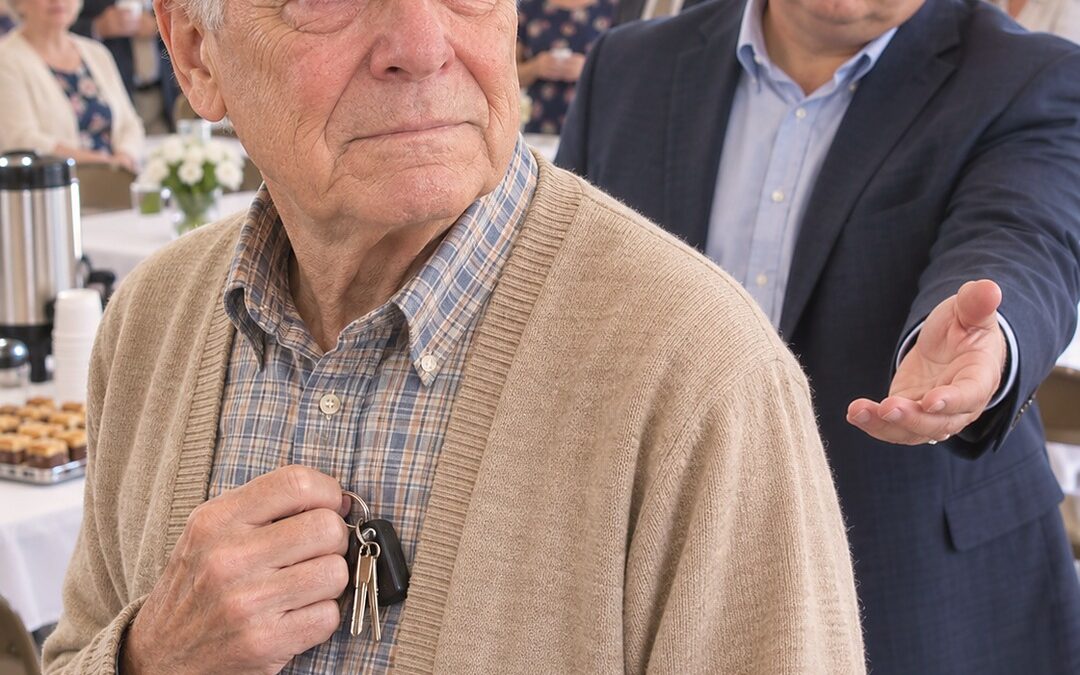
My son held his hand out, palm up, in the middle of the fellowship hall at Prairie Hills Presbyterian and said, loud enough for forty people to hear, "Keys, Dad. A man who mails eleven hundred and fifty dollars a month to some girl with a baby doesn't get to drive anymore." Without those keys I couldn't get to Pleasant Hill that afternoon, where a fourteen-month-old had been standing at the window in her shoes since noon, and her mother's October rent was riding on a check I'd mailed the day before. She was his own daughter, Lacey, who he hadn't spoken to in four years, and the baby on her hip every Sunday was a granddaughter he didn't know he had.
I had a Styrofoam cup in one hand and half a scotcheroo on a napkin in the other, and I honestly thought at first he wanted the napkin.
"Dad. I'm not going to ask twice."
Over at the long table Arlys Petersen had stopped pouring with the pot still tipped. Coffee ran over the lip of somebody's cup and down the paper tablecloth toward her pan of scotcheroos, and she didn't notice until it got there.
Darrin turned around so he was talking to the tables instead of me. He's a sales manager at Midwest Commercial Flooring, and he knows how to turn a room toward him the same as I know how to set a bearing.
"I've kept a roof over this man's head for three years."
I let the roof part go.
"Two weeks from today Pastor Tim installs me as an elder, and an elder manages his own household. So I'm managing it."
Pastor Tim Garrels was over by the upright piano with a scotcheroo on a napkin, same as me, and he looked down at it like it might have an idea. "Darrin," he said, "maybe not here."
"LaDonna's already told half this room. I'd rather they hear it from me."
LaDonna Hansen sat at the table by the piano where she and Merle sit every Sunday of the world. She set her cup in the saucer hard enough to slop it. "Now I never said she was taking his money, Darrin. I said what Norma saw."
Norma Kline is LaDonna's sister. She moved over from Boone in June, and the one time I'd met her, at the Hansens' Christmas open house, she told me about her furnace for half an hour. I knew she'd taken a unit at Cedar Ridge. I hadn't put together until right then that hers was the door across the breezeway from Lacey's.
Merle, beside her, put his scotcheroo down and folded the napkin over it.
"Eleven hundred and fifty dollars," Darrin said. "Every month, Dad. Sheryl saw the carbons."
Sheryl was at the Bible study table by the windows in her pearl-button blouse, next to Gloria Wendt, and she had both hands around her cup. "Lowell, honey, we know you've got a soft heart," she said. "That's what worries us."
"I didn't know you did the desk," I said. "I thought you just did the laundry."
Gloria Wendt found something interesting in her coffee. Jim Mohr and Randy Tiarks, the two men getting installed with Darrin, had drifted over by the coat rack like they'd both remembered something in their coats.
Then Josie stood up.
She'd been sitting next to her mother, twenty years old, her Iowa State sweatshirt pulled on over a church skirt because she'd been cold in the sanctuary. Her chair scraped back on the tile and her mouth was already open. I knew what was in it. Josie had ridden along with me to Pleasant Hill every Sunday for a year.
"Grandpa—"
I set the keys in Darrin's hand before she got the second word out.
The Firestone twenty-five-year fob was on the ring. Thirty-nine years I worked at the ag-tire plant on Second Avenue, and that fob had ridden in my pants pocket next to my change for twenty-six years now, long enough that the brass had worn through to copper on one side. Darrin closed his fingers on it.
Josie sat back down. She sat down slow, the way you sit when your legs decide for you.
"And the checkbook."
"No."
He stood there with his hand closed, waiting for the rest of the sentence. I didn't have any more sentence. Arlys came around the end of the table with the pot and filled my cup to the brim even though I hadn't drunk any, and wiped the side of it with a paper towel.
"There you go, Lowell."
"Thank you, Arlys."
Darrin said we were leaving. He and Sheryl had come in the F-250, and Josie had come with me in the Impala, which meant Josie and I were going home in the back seat of his truck and my car was staying in the north lot by itself.
Merle caught my sleeve as I went by the piano. "Thursday?"
"Thursday."
He let go.
*
The registration envelope was sticking out of the glove box of that truck, the corner of it, and I could read my own name on it from the back seat. White 2023 F-250 Lariat. The loan's in my name because Darrin's isn't any good for loans, not since the deck business went under, and he was going to cover the payments himself once his commissions came in. That was thirty payments ago. I've made every one of them.
"Nobody's driving my truck around either, Dad, while we're on the subject," he said to the windshield.
Sheryl said everybody had seen how well I took it. Josie watched Ankeny go by out her window and picked at a thread on her sweatshirt cuff till she'd pulled it loose.
Sheryl had put the pot roast in before the 8:30 service, and the house on NW Ashland Drive smelled like onions and beef all the way out to the garage. We ate at 12:30. Darrin carved with the electric knife he won in a church raffle, which rattles like a hedge trimmer and which he will not replace.
Sheryl passed the potatoes to me and held on to the bowl a little too long. "Is it somebody we'd recognize?"
Josie's fork stopped.
"It's family business."
"Family business." Darrin put the knife down. "You're writing a stranger eleven hundred dollars a month and that's family business. Six hundred a month doesn't make you a partner here."
The six hundred is what I pay him for the basement. Here's what nobody at Prairie Hills knew. The house is mine, deed and mortgage both, in my name alone since we bought it in June of 2016, because after the deck business went under nobody would lend Darrin a dime. His family lives upstairs. On the first of every month Darrin puts the mortgage payment in my checking and I send it on to the credit union, and I write him a check for six hundred for the basement, because he asked for it the week I moved down there three years ago and I didn't want to argue money in front of Sheryl. In nine years I never once brought up whose name was on the house. I didn't bring it up at that table.
"How long have you been paying her rent?" he said.
I cut my meat.
"Every Sunday for a year and a half you tell us you're out at Glendale sitting with Mom." He sawed off another slice nobody had asked for. "Cemetery. Every Sunday."
"We do go see Gram," Josie said. "I go with him."
"Not all summer you didn't. You were at Dairy Queen."
"Dad, stop talking about him like he isn't sitting right here."
Darrin hadn't been out to his mother's grave on a Sunday once since we buried her, five years ago this November, so nobody had ever thought to check who went and who didn't.
Josie set her fork down. "You don't even know where Lacey is."
"Lacey's in Omaha with that Pierce boy, last we knew, and she can stay there."
"We don't take her calls," Sheryl said, and passed the gravy.
Upstairs, at the end of the hallway, there's a square of paint lighter than the rest of the wall. Lacey's Ankeny High senior picture hung there till four years ago this October, when she quit Iowa State in her last year and moved in with Shane Pierce in Des Moines. She came by to tell her folks herself. She stood in that kitchen with a duffel bag at her feet and asked if she could still come to Sunday dinner, and Darrin said, "Not as our daughter." The picture went to the garage that week. Nobody painted. I sat at that same table the whole time it happened and told myself a man doesn't step into his grown son's house and tell him how to run it.
I finished my potatoes. I couldn't tell you what they tasted like.
After dinner Sheryl drove Darrin back up to church in her Malibu so he could bring my car home, and I went downstairs.
*
At 3:30 my phone buzzed on the bed.
"You ok Pop? CJ's had her shoes on since noon."
I typed, "Coming. Car trouble." Then I deleted "car trouble" and sent just the first word.
My green Plano tackle box sits on the bottom shelf by the walkout door. I've had it since I used to fish Big Creek with Clara's brother, and the top tray still has the size 6 hooks in their paper packet and a couple of red-and-white bobbers rattling around loose. The spare Impala key was under the bobbers where it always is. Under the key was the card.
"It's a Girl! Clara Jo Ackerman — 6 lb 2 oz — 7:14 p.m. — Mom: Lacey"
Pink paper, a little bent. It was taped to the end of the bassinet at Methodist that Thursday night in July, and Lacey peeled it off and gave it to me when they went home. I remember the waiting-room chair had a split in the vinyl that kept catching my pants, and the vending machine took my dollar and kept the peanut butter crackers. When the nurse came out she asked was there anybody else she should bring back. I told her no. She looked at the two empty chairs beside me and wrote something on her clipboard.
I sat down on the bottom step with the card. The washing machine started up over my head, Sheryl doing towels.
After a while I put the card in my wallet, behind my credit union card, where nobody doing laundry was going to run across it. I put the spare key in the pocket of my brown work coat on the hook by the door. I closed both latches on the tackle box, and then I opened them and looked at the empty spot under the tray, and closed them again.
My Impala was home by then, nosed right up against the garage door. Darrin had parked the F-250 square behind it, close enough you couldn't have walked a dog between them. On the left was the garage wall. On the right was the corner of Sheryl's hosta bed.
I backed across the corner of the hosta bed.
Something snapped under the rear tire. Sheryl split those hostas off her mother's in Newton the spring we moved in. I cut the wheel, cleared the F-250's bumper by about the width of my hand, and when I looked up at the house Darrin was standing in the front window with the TV remote still in his hand.
*
It's twenty-five minutes from Ankeny to Pleasant Hill if the interchange isn't backed up. It was 4:40 when I parked at Cedar Ridge, building 4, and went up the outside stairs to the breezeway on the second floor.
Clara Jo was at the window of 4B with her pink shoes on. She smacked the glass with her whole hand.
"Pop!"
Lacey opened the door in an Iowa Cubs T-shirt that came to her knees, hair up in a rubber band. She's been blonde since April. I still look for the brown-haired girl sometimes and get a little start when I don't find her.
"Five hours, Pop."
"I know it."
Clara Jo came around her mother's leg and put her arms up, and I picked her up, and she went straight for the top button of my shirt like she has every Sunday since she figured out buttons. The walnut step stool I made her stood against the kitchen counter. I routed CLARA into the top of it down in the basement one weekend Darrin was at a flooring convention in Kansas City, and rounded every edge so she wouldn't skin her shins.
I set Clara Jo down by the stool, and she climbed up on it to supervise.
"What happened?" Lacey said.
"Nothing that won't keep."
"Pop." She stood there with the dish towel over her shoulder and didn't sit down, and she didn't let me look at the baby instead of her. Lacey has always been able to do that. She did it to her grandmother.
So I told her. The fellowship hall, the carbons, Norma across the breezeway, the keys.
"He did that at church? In front of everybody?"
"By the coffee."
"Did he say my name?"
"No."
"What did he call me?"
I could have gone around it. I've been going around things in that family for four years, and I was tired of the route.
"Some girl."
She took the towel off her shoulder and folded it in half, and then in half again, and set it on the counter very square.
"Lacey, I want you to let me tell them."
"No."
"He's going to keep digging. Sheryl's already telling people I've been taken."
"Let her." She turned around. "Don't you dare tell them for me. If they want to know me, they've got my number. They always had it."
Her rent's eleven hundred and fifty, due the first. She works seven to three-thirty in the lab at Methodist, and the Civic she bought used has two hundred thirty-eight thousand miles on it. When something on it breaks she picks up an extra shift instead of calling anybody. I wasn't going to march her in front of her father so I'd look better at coffee hour. But I'd sat at that table four years ago and kept my mouth shut, and I didn't care for how that had turned out.
"Here's what I'll do," I said. "I'll keep it till Sunday the fifth."
"Why the fifth?"
"That's the day they make your dad an elder." She made a little sound, not quite a laugh. "After that I tell them. With you there or without you. I'm not asking permission for that part. I'm telling you so it isn't a surprise."
Clara Jo banged two wooden blocks together on the floor, hard, and looked up at us to see if it counted.
Lacey sat down across from me. She was twenty-two the day she stood in that kitchen with the duffel bag. She's twenty-six now, with dried applesauce on her table that she was picking at with her thumbnail.
"Then give me till the fifth."
"All right."
"You want a sandwich? I've got turkey or I've got ham."
"Whichever's oldest."
When I left, Clara Jo walked me to the door and Lacey held the back of her shirt so she wouldn't pitch down the stairs. Across the breezeway, the door of 4C was open about four inches. There was a light on inside and the sound of a television, and nobody standing in the gap that I could see.
Lacey shut her own door before I got to the bottom step.
I drove home without stopping at Casey's.
At 7:10 I turned onto NW Ashland Drive. Darrin was standing in the driveway next to the flattened hostas, still in his church pants, with his hands in his pockets. Sheryl was up on the porch with her arms crossed.
I parked and got out. He looked at the spare key in my hand and then at the hostas and then at me.
"You went behind my back."
"I went to Pleasant Hill. It's on the map."
He came a step closer, and he didn't raise his voice at all, which with Darrin is worse. He said, "You've got till Sunday the fifth to tell me who she is, Dad. Or you can find somewhere else to sleep."
Part 2
I didn't sleep much Sunday night, and somewhere around two in the morning it came to me that Darrin and I had picked the same Sunday. I'd picked it at Lacey's kitchen table at a quarter to five. He'd picked it in the driveway at ten after seven. He didn't know that, and I didn't see any reason he should.
Find somewhere else to sleep. In a house with my name on the deed. Nine years he'd been calling it his and I'd let him, and somewhere along the line he'd come to believe it. I could have gone down to the bank and laid the papers on the hood of his truck. Then I'd have had to say what I was fighting for, and I'd promised Lacey till the fifth.
Monday at seven Sheryl had a chicken casserole on the table and Josie and I were already eating when Darrin came in from the garage. He didn't take his jacket off. He stood behind his chair with both hands on the back of it.
"I called that apartment office this morning. Cedar Ridge."
I kept eating.
"Asked who's in 4B. The girl on the phone said they don't give out information on residents." He said it like he was reporting a flat tire. "So after work I drove over there."
Josie put her fork down.
"Sat at the far end of the lot about twenty minutes. Building four." He pulled the chair out and sat. "Bleached blonde in a ball cap. Carrying a kid on one hip and a laundry basket on the other, right up those outside stairs. Couldn't have been thirty." He frowned at his plate. "Something about how she went up those stairs, two at a time with that basket. Reminded me of somebody."
"Who?" Sheryl said.
He shook his head. "Nobody. Half the girls in Polk County are bleached."
Monday's Lacey's day off. The dryer in her building eats quarters, so she takes the wash to the laundromat on Hubbell, and Clara Jo rides in the basket on the way back if there's room. I knew all that, sitting there. I had my hands under the table, on my knees, and I kept them there.
"Did you talk to her?" Sheryl said.
"No. I'm not standing in some breezeway in Pleasant Hill arguing with a girl. I'll just close the tap. Starting with that checkbook. You don't write another one to that place."
"October's already in the mail."
"I know it is. Sheryl saw the carbon." He didn't look at her when he said it, and she got very busy at the stove with a casserole that was already on the table.
"I only went down to put towels away, Lowell. It was lying right there open."
"It was closed when I went up to supper Saturday," I said, and that's all I said about it.
He took his key ring out of his jacket and set it on the table next to the casserole, like he was setting down a receipt. The big black Ford fob. My Firestone fob. And next to them, on the same ring, the spare Impala key with the little nick I filed into the bow so I could tell it from the other one in the dark.
"That was in your coat downstairs," he said. "So that's done."
I'd hung that coat on the hook by the walkout door the same as every night for three years. It hadn't occurred to me that my son would go through a man's coat pockets. It should have.
"Also had your line taken off the family plan this afternoon. You can use the house phone if you need something."
"Darrin," Sheryl said. "You didn't tell me that."
"I'm telling you now."
He turned to Josie and held his hand out across the table, fingers open. "Corolla keys."
"Are you serious?"
"It's in my name, I pay the insurance. Keys."
"I've got class at eight tomorrow in Ames. How am I supposed to get to Ames?"
"Your mother can run you up. Or you can ride the bus with everybody else."
"There's no bus from here to Ames, Dad."
"Then you'll figure something out." He kept the hand there. "Where do you two go on Sundays?"
"Glendale. To see Gram." Josie looked straight at him. "And then he drops me at the library."
"And then?"
She dug the keys out of her sweatshirt pocket and dropped them on the table instead of in his hand, so he had to pick them up. They slid into the casserole dish and he had to fish them off the edge.
Sheryl came around behind me and put her hand on my shoulder. She smelled like the hand lotion she buys at Hy-Vee in the big pump bottle. "We're doing this because we love you, Lowell."
I didn't move my shoulder out from under her hand. Josie went upstairs, and her door shut hard enough that the light over the table swung on its chain.
I looked at the chain a while. I'd been thinking all day about the duplex ads in the back of the Register, and right then I quit thinking about them. He'd taken her car because she stood next to me. She was twenty years old and she had to live in this house till May, and I wasn't going to go off somewhere and leave her in it by herself with him. Besides, at seventy-four you don't find a place in a week, and walking out now would be the same as telling forty people Darrin had me figured right.
*
Tuesday morning I walked the mile and four-tenths to the Walmart on SE Delaware, and a young fellow with a ring through his eyebrow sold me a TracFone for $39.88, called me "boss" five times, and set it up while I stood there.
The first call I made on it was from the bench out front, to Central Plains Credit Union. I asked for Deanna Frey, who did our loan back in 2016. I told her I'd be in Thursday morning for box 118, and I asked her to print me the current statement on the house and the loan papers on the truck.
"Is everything all right, Mr. Ackerman?"
"Going to be," I said. Then I texted Lacey. "New number. This is Pop."
She called at 3:52, which is twenty-two minutes after her shift. I could hear the car running and the turn signal ticking. She was in the lot at Clara Jo's daycare.
"What happened to your other phone?"
"Your dad decided I'd been talking enough."
"He cut you off? Pop. You're seventy-four years old."
"So I'm told. I walked to Walmart this morning. Got a fellow with an eyebrow ring to set it up."
"You walked." I heard her put her head back against the seat. "Hang on. Somebody back here heard you."
There was a lot of breathing near the phone, and then Clara Jo, very loud: "Pop! Pop pop pop."
"Hello, Clara Jo."
She told me something long about a dog, or a duck. It might've been a sock. Lacey came back on.
"She's had that duck all day," she said. "Pop, you don't have to do this."
"We said the fifth."
"I know what we said."
She didn't hang up right away. I could hear the turn signal ticking the whole time, and then she switched it off and said she'd better go before the daycare lady came out to see why she was still sitting there.
*
Wednesday night at 7:12 I was at my desk downstairs with a table lamp in pieces on a sheet of newspaper. The cord had worked loose at the switch. I had the little brass screws lined up along the edge of the paper so they wouldn't roll.
Josie came down the stairs with her phone in her hand. She'd gotten a ride home from Ames with a girl from her chemistry lab who lives out by Saylorville. She stopped on the bottom step and stood there with her thumb on the screen.
"What is it, honey."
She held the phone out. The subject line said "Prayer Request." It came from Sheryl's address. Sheryl runs the prayer chain at Prairie Hills, two hundred and fourteen people, I know because she printed the list once and left it on the kitchen counter for a week.
"Please pray for Darrin's dad, Lowell Ackerman, 74. He has been sending money every month to a young woman with a baby who is taking advantage of him. Pray for wisdom for Darrin and me as we protect him. —Sheryl"
I held the phone till the screen went dark. Then I gave it back.
One of the brass screws had rolled off the paper. I got down on my knees, which took some doing, and felt along the baseboard under the desk till I found it, and put it back in line with the others. Then I stayed down there a little while with my hand flat on the carpet.
"Grandpa?"
"I'm all right. It's a long way down and a long way back."
She sat on the edge of my bed. "Half the church is going to read that tonight."
"More than half. Sheryl's thorough."
"Why can't we just tell them? It's been four years."
"Because it's Lacey's to tell. Till the fifth."
"And then what?"
"And then it's mine."
She looked at her phone again and scrolled down, and her lips moved a little, like when she's doing math in her head. She scrolled up. Then back down to the list of addresses, the long gray list at the top of the email nobody ever reads.
Josie turned her phone around so I could see the top of it. She said, "Grandpa, Mom never took Lacey off the prayer chain."
Part 3
I'd called Merle Wednesday night on the TracFone, after Josie went back upstairs. I asked if he could run me somewhere in the morning, and he said what time, and that was the whole call.
Thursday at ten sharp his beige 2008 Grand Marquis came up NW Ashland Drive at about eighteen miles an hour and stopped at the end of our driveway. He tapped the horn once. Merle is seventy-nine and raised hogs up by Polk City for forty years, and he drives that Mercury like there's a man in the back seat grading him.
I came out the walkout door with a big brown envelope under my arm. Sheryl had picked the broken leaves off her hostas, but one of them was still lying over on its side like it had given up.
"Where to?"
"Central Plains. On North Ankeny Boulevard."
He nodded and backed out, checking both mirrors twice. We'd gone about three blocks before he said anything else.
"LaDonna talks. I drive."
That was as close to sorry as Merle gets, and it was close enough. I've played pinochle with the man every Thursday for thirty years, and I know how he and LaDonna divide up the work. She handles the news. He handles getting there.
At the credit union Deanna Frey had a long envelope waiting for me at the front desk with the printouts I'd asked for. Then a young man with a lanyard took my driver's license, had me sign the card, and walked us back to the little room with no window. He brought out box 118, turned his key and mine, and left us alone with it.
There were only two things in it I wanted. The first was a manila folder, the expanding kind, and the label on it was in Clara's handwriting, the round, careful print she used for anything she thought was going to be important later.
"DARRIN'S HOUSE — 2016"
I laid Deanna's printout of the current statement on top of it and read one line off it.
"Borrower: Lowell E. Ackerman — Maturity Date: 07/01/2031"
Under the folder were the loan papers on the white F-250 and a copy of the registration, with Lowell E. Ackerman on every page. The credit union keeps the title itself till the loan's paid. That truck's had thirty payments made on it, $1,037.06 apiece, and every one of them came out of my checking account while Darrin waited on his commissions.
Merle had his reading glasses on by then. He looked at the statement and the truck papers for about as long as it takes to read them, and he didn't ask a thing.
"Huh," he said.
Clara wrote the label on that folder because she said someday somebody would come looking for it and she wanted them to know which one it was.
I put both papers in the brown envelope.
Merle took his glasses off and folded them.
"Tim brought something to session Monday night," he said. Merle's been clerk of session at Prairie Hills longer than Pastor Tim has been pastor. "Darrin had called him. Wanted to know would we have you prayed over at the eleven o'clock on the fifth. Said you'd been having trouble with your decisions."
"What'd session say?"
"Said we'd take it under advisement. That's what we say." He put the glasses in his shirt pocket. "Darrin also told Tim you'd be moving up to your sister's in Fort Dodge that same afternoon."
"First I've heard."
"Figured it might be."
In the car I called Darla. She's seventy, widowed, up in Fort Dodge with a spare room nobody has used since her Ron passed. She picked up on the sixth ring like always.
"Lowell. Well, Darrin said you might call."
"Did he."
"He called me Tuesday. He told me about the woman." She lowered her voice like somebody in Fort Dodge might be listening. "He said she's been bleeding you dry and you won't hear a word against her. I said of course you can come here. I've got the room all made up. I put Mother's quilt on the bed."
"Darla, did he say I asked to come?"
There was a pause on the line.
"He said you'd be too embarrassed to ask."
I told her thank you for the quilt, and that I'd call her back, and I hung up. Merle drove me home at eighteen miles an hour and didn't turn the radio on.
Downstairs, I put the envelope in the bottom drawer of my desk under my tax returns. On the calendar on the wall, October fifth already had a square around it in blue ballpoint. I wrote "church" inside the square.
*
Saturday night Darrin told me to skip a week. He said it while I was rinsing my plate.
"People have been asking about you. Better if you stay home tomorrow and rest."
"Who's asking?"
"People who care about you, Dad."
So Sunday morning I stayed downstairs while the three of them went to the 8:30 and on to lunch at the Hy-Vee after. At 12:15 Merle pulled up at the walkout door. At 12:40 we were at Cedar Ridge, and he parked by the stairs to building 4, folded the Register to the crossword, and clicked his ballpoint.
"Take your time."
Lacey opened the door before I got my second knock in. She had her Cubs cap on backward and a dish towel over her shoulder, and she'd been crying at some point that morning and washed her face after.
"I got the email," she said.
Sheryl put her on the prayer chain the year she turned sixteen, and nobody ever took her off. She'd read it on her phone Wednesday night, sitting on the edge of the tub while Clara Jo splashed.
"Taking advantage." She said it flat, like a word off a lab label. "Two hundred and fourteen people, Pop."
"I know it."
She went to the junk drawer by the stove and dug under the rubber bands and the dead batteries and the takeout menus and came out with a long white envelope, bent across one corner.
The return address was in Lacey's handwriting, small and careful, every letter fitted on the little lines. "c/o Pierce, 4410 Maple Street, Omaha, NE." And across the middle of it, over the top of her handwriting, in the block capitals Darrin used to put on deck estimates:
"REFUSED — RETURN TO SENDER"
"February sixteenth. A Friday," she said. "I mailed it from Shane's mom's house. She got it back about a week after Shane left and sent it on to me in March. I've never opened it."
"Why not?"
"Because it wasn't for me." She laid it on the table. "I wrote it for them."
The envelope was still sealed. There was a little bump in the middle of it where something stiffer than paper was folded inside.
Clara Jo climbed down off her CLARA stool backward, the way I'd shown her, and walked across the kitchen floor on her own, swinging her arms for balance, and walked straight into my knee. I picked her up. She went for my top button.
"Lacey. Let me tell them before Sunday. Let me do it at the house, at the table, no church, no anybody."
"I said the fifth, Pop."
"I know you did."
"Then that's what I said."
"You hanging on to that for the fifth?"
"I haven't decided what I'm doing with it." She took the envelope back and put it in the drawer. She didn't close the drawer all the way.
When I left, she came out onto the breezeway with Clara Jo on her hip and waved down at the lot. Merle looked up from his crossword. He lifted two fingers off the steering wheel.
We were about to the interstate before he said anything.
"That little one's got Clara's chin."
I watched the road. He put his blinker on a long way before the ramp.
"LaDonna doesn't need to hear about chins," he said.
*
Tuesday at a quarter to seven I came upstairs for supper and my TracFone was sitting in the middle of the kitchen table, all by itself, next to the salt and pepper.
Sheryl was at the counter. Darrin was at the head of the table with his reading glasses on and the Register open, and he didn't look up. Josie had just come in from Ames and was still in her jacket.
"It was in your khakis," Sheryl said. "I almost washed it."
"I appreciate you not washing it."
"Lowell, Darrin took you off the plan for a reason."
"I figured he did. That's why I bought one."
Darrin folded the paper, took off his glasses, and pushed the phone across the table to me with two fingers.
"Call whoever you want. You'll be in Fort Dodge by Sunday."
Josie stopped with one arm out of her jacket. "Fort Dodge? Dad, Aunt Darla's got one bathroom and a cat that bites."
"Josie," Sheryl said. "Not now."
"LaDonna told me Merle drove you somewhere Sunday," Sheryl said. "While we were at lunch after church."
"He did."
"To that apartment."
"Yes. And while we're on it, Sheryl." I turned my chair so I was square to her. "You put my name and my age in an email to two hundred and fourteen people without asking me. Don't you ever do that again."
She opened her mouth and shut it, and looked at Darrin.
Darrin will yell at the Hawkeyes through a television set. He laid both hands flat on the newspaper like he was keeping it from blowing away.
"I talked to Aunt Darla. Her room's ready." He looked at Josie, who still had the one arm out of her jacket, and then back at me. He said, "Sunday after church I'm driving you up to Aunt Darla's in Fort Dodge with your boxes in the back of my truck. And if Josie rides anywhere with you before then, her spring tuition doesn't come out of my account."
Part 4
Saturday at one o'clock I went out to the garage for a quart of oil and found six boxes lined up along the wall under Darrin's pegboard, all taped, all the same size. Sheryl buys real moving boxes from U-Haul when she means to do a thing right.
"DAD — FORT DODGE"
She'd written it on every one in black Sharpie, on two sides, and drawn arrows so whoever loaded them would know which end was up.
One box was my winter clothes. One was books off the basement shelf, the Firestone retirement booklet on top with the picture of the plant on the cover. The third one wasn't taped yet, and in it, right on top of a stack of my flannel shirts, was Clara's blue Royal Dansk cookie tin.
There haven't been butter cookies in that tin since Josie was in diapers. It's where Clara kept her sewing things, and it has a dent in the lid from the Christmas she dropped it down the basement stairs carrying ornaments. I would know that dent in the dark.
Sheryl came out the kitchen door with a moving blanket over her arm. "Careful, Lowell, there's glass under that."
"This was in my dresser."
"I was trying to help. Darrin wants the truck loaded tonight so we can go straight from church." She looked at the boxes, not at me. "Darla's got the room all ready."
"So I hear."
She went back in. I waited until the kitchen door clicked, and then I pried the lid off the tin.
It smelled like her sewing basket always smelled, a little like cedar and a little like the hand cream she bought at Walgreens. Embroidery thread wound on squares she cut out of cereal boxes. Buttons in an old prescription bottle with the label scraped off. Her good scissors with the rubber band still around the handles so nobody would use them on paper.
At the bottom there was a square of tissue paper folded into a neat packet, and in it was a baby's cap. Cream-colored yarn, a little folded brim. There was a paper tag tied to it with white thread, and the handwriting on the tag was Clara's.
"For the first great-grandbaby, whoever you turn out to be. Love, Gram"
She knit it the summer before she died. She sat in the recliner with the box fan aimed at her feet because her ankles swelled, and I asked her who in the world that was for, since none of the girls was expecting and none of them was even married. "I can count, Lowell," she said. "It's for whoever."
There was a gray hair caught in the fold of the paper. One of hers. I tried to lift it off and it stuck to the rough skin by my thumbnail, and I had to work it loose, and then I didn't know where to put it. I laid it back in the fold with the cap.
I stood there at the workbench a good while. In the house the furnace kicked on, and ran, and shut off again, and I was still standing there.
Then I folded the paper back around the cap and put it in the inside pocket of my coat. I put the lid back on the tin and set it in the box where Sheryl had packed it, on my flannel shirts. The other five boxes I didn't touch. I wasn't going to help load them, and I wasn't going to fight over cardboard either. I just looked at my name on them a while.
"Grandpa?"
Josie was standing in the kitchen door in sweatpants and her socks, with her phone. I don't know how long she'd been standing there. She came down the two steps and walked along the row of boxes reading them.
"She labeled both sides."
"Your mother bought the good boxes."
Josie crouched down and took a picture of the nearest box. Then she backed up to the garage door and took one of the whole row.
"What's that for?"
"Somebody should see this." She looked at her phone and not at me. "You're not really going."
"Your dad's made up his mind. I haven't."
"That's not the same as no."
"No, it isn't."
She stood there a while longer and then went back in. I found a drill bit Darrin had left lying on the workbench next to a box of deck screws, and I put it back in the drawer where it goes, and shut the drawer.
*
Supper was at 5:30. Pork chops, applesauce, the green beans with the onion things on top.
Darrin had a manila folder of church papers beside his plate, and he laid out tomorrow for us like it was a sales meeting. The 8:30 service. Fellowship hour. He'd say a few words there, to thank everybody, because people had been praying. Then the 11:00, and Pastor Tim would do the installation. Home by noon, a sandwich, on the road to Fort Dodge by one.
"You're going to make a speech about Grandpa," Josie said. "With Grandpa standing there."
"I'm going to thank people."
"For praying he'd quit giving La—" She stopped and looked at her plate.
"For what?" Sheryl said.
"Nothing. For praying."
Darrin looked at her a second too long and went back to his pork chop.
I'd brought the brown envelope up from downstairs. I took out Clara's folder and set it on the table next to my plate with the label facing him.
"DARRIN'S HOUSE — 2016"
He stopped cutting. He knew the handwriting. He knew what was in the folder too. He sat there with his knife resting on the edge of the plate and read his mother's printing like it was a long sentence.
"What's that?" Sheryl said.
"Some papers."
Darrin looked up at me. He said it quiet, almost polite, the way a man asks you not to lean on his car. "Don't, Dad."
"Don't what?" Sheryl looked from him to me. "Darrin, don't what?"
He didn't answer her.
I had my hand flat on the folder. I'd brought it up meaning to settle one thing, just between the two of us, so he'd know before morning I wasn't a box he could put in the back of a truck. But I'd given Lacey my word till tomorrow, and tomorrow was close enough I could hear it.
I left the folder closed. "All right," I said.
Darrin picked his knife back up. Sheryl passed the applesauce to nobody in particular. Josie looked at her father, then at me, then took a bite of green beans she didn't want.
After supper I carried the folder downstairs and put it back in the envelope with the truck papers and put the envelope in the bottom drawer. Through the heat register I could hear Sheryl upstairs asking what the folder was, and Darrin saying "Old house stuff," and her asking why that made him put his fork down, and then the faucet running so I couldn't hear the rest.
*
At 8:40 the TracFone rang. I had it on the desk beside the lamp I'd fixed Wednesday.
"Evening, honey."
"Pop." Something in how she said it made me sit down on the bed. "Josie sent me a picture."
"Of the boxes."
"Six boxes. Mom labeled them on both sides." I heard a cupboard door, and Clara Jo saying something firm about it. "CJ, those are Mommy's measuring cups. Here. Take the big one." There was a clatter on the linoleum. "She's in the cupboards now. Everything below my knees is hers."
"Give her the colander. She can wear it."
Lacey almost laughed. She didn't quite get there.
"They're really taking you tomorrow."
"That's their plan."
"Did you say yes?"
"I didn't give them an answer."
"Pop, that's how you say yes in that house."
She was quiet. On her end the refrigerator opened and shut, and Clara Jo asked for something, and Lacey told her the milk was for breakfast.
"Josie forwarded me the email again," she said. "I already had it. I've read it so many times I could say it in my sleep." Her voice went flat. "Two hundred people are praying I quit taking advantage of you, Pop."
"Two hundred and fourteen," I said, and she said, "Thanks, Pop. That helps."
"Your grandmother would've corrected you."
"Gram would've driven over to Mom's with a casserole and a Bible and corrected everybody." She breathed out. "Is he going to say something tomorrow? At coffee hour?"
"He's going to thank the prayer chain. Then they'll make him an elder at eleven, and then we leave for Darla's."
"And tomorrow you're going to tell them."
"I am."
"Without me." She didn't make it a question, so I didn't answer it like one. I said if that's how it went, that's how it went.
I could hear her walking. Kitchen to living room and back, like she used to walk the upstairs hall on the cordless when she was in high school and didn't want her mother to hear.
"I found something of your grandmother's today," I said. "Sheryl packed it. A little knit cap, cream-colored. She made it the summer before she died. There's a tag on it in her writing."
"What's it say?"
I told her what it said.
The walking stopped. I heard a chair pulled out from the kitchen table and somebody sit down in it, and Clara Jo's bare feet slapping across the linoleum and then stopping, and nothing else for long enough that I took the phone away from my ear to make sure the call was still going. It was. The little clock on the screen said 8:47.
"You still there?" I said.
"I'm here."
I stayed where I was and held the phone and let her take as long as she wanted.
Lacey didn't say anything for a while. Then she said, "What time's fellowship hour, Pop?"
Part 5
Sunday morning at 9:40 my son stood on the same square of floor tile where he'd taken my keys two weeks before, with a name tag clipped to his shirt pocket that said "DARRIN ACKERMAN — ELDER-ELECT".
Sheryl had made the name tag on the label maker. She'd pressed his shirt Saturday night while the pork chops were resting, and she'd pressed it again that morning because he sat on the sleeve putting his shoes on.
I had my brown work coat on over my church clothes, and I kept it on indoors.
"Dad, it's seventy degrees in here. Take your coat off, you look like you're waiting on a bus."
"I'm fine."
He let it go. He had more important things that morning than my coat.
Pastor Tim came over with his coffee before the room filled up. "Lowell. How are you holding up?"
"Coffee's good."
He looked at the coat and then at me, and he lowered his voice. "If there's anything you want to tell me before eleven, my office door's open. I mean that."
"I know you do, Tim. Maybe after."
Everything in that hall was right where it had been on the twenty-first. LaDonna at the table by the piano. The Bible study table by the windows, the same five or six women, with Sheryl's chair empty because Sheryl was standing next to Darrin. The forty-cup urn on the long table, the red light on, a fresh pan of scotcheroos cut in squares next to it. The other two elders-elect over by the coat rack again, like that was their spot now. Pastor Tim with his coffee. Through the north windows you could see the white F-250 parked broadside to the building with a blue tarp over the bed, and under the tarp my six boxes.
Most of those people had gotten Sheryl's email Wednesday night. You could tell which ones. They came by and touched my arm and asked how I was doing in the voice people use in a hospital room, and two or three of them told me Fort Dodge was a lovely town.
At 9:48 Darrin picked up a plastic spoon and tapped it on his cup. It didn't make much noise, being plastic, so he said "Folks?" and that did it.
"I just want to say thank you. To everybody on the prayer chain. Sheryl and I have felt it this week, we really have." He put his hand on my shoulder. The coat was thick enough I barely felt it. "As most of you know, Dad's been going through a hard time. Somebody's been taking advantage of his good heart, and as a family we've had to make some decisions. Dad's moving up to Fort Dodge this afternoon to be near family."
Somebody at the Bible study table said, "Oh, that's good, that's good."
"My aunt's got a room all ready for him. And then at eleven." He smiled at Pastor Tim. "Well. Big day."
He asked if I wanted to say anything. I said I'd just as soon finish my scotcheroo, and a few people laughed, not sure if they were supposed to.
At 9:50 Josie touched my elbow and went out the side door to the north lot. Darrin was explaining to the room how love sometimes means making the hard call, and he didn't see her go. Lacey had been sitting in her Civic at the far end of the north lot since twenty after nine, running the engine for the heat. I found that out later.
I had my hand in my coat pocket, on the paper around the cap.
*
At 9:55 the side door opened again.
I heard Clara Jo before I saw her. "Pop!"
Lacey came in with Clara Jo on her hip and Josie right behind her. She had on dark jeans and a navy blouse I'd never seen, probably bought Saturday night, the tag maybe still in it. Her hair was down. Clara Jo was in a yellow dress with white socks that had already crawled down inside her shoes, and she was leaning out of Lacey's arms toward me with both hands.
Darrin stopped in the middle of a sentence.
Sheryl turned around from the urn with a cup in her hand and set it down without looking, half on the edge of the scotcheroo pan, and it tipped, and she didn't reach for it.
"Lacey?"
Somebody at the Bible study table said it out loud, to nobody, like it had been meant for the inside of her head. "Sheryl said Phoenix." Then, louder, to the woman next to her: "She told us Phoenix. A lab job in Phoenix. Four years she's been telling us that."
LaDonna had half stood up from her chair by the piano. "Norma said she was blonde."
Lacey looked right at her. "Since April."
Then she walked across that room to me, between the round tables, and didn't look at her father once on the way.
I took the cap out of my pocket. I unfolded the paper and set the cap on Clara Jo's head and pulled it down over her ears. It was snug. Clara knit it for a newborn and Clara Jo is fourteen months old, and it sat up on the top of her head like a little cream-colored bowl, and she reached up with both hands to feel it.
The tag hung down by her ear on its white thread.
Sheryl had come up behind Lacey. She bent and read it, and put two fingers out and touched the paper.
"That's Clara's hand," she said. "That's Mom's writing."
"It is."
Darrin had come around the table. "What is this? Dad. What is this."
I turned around so I was talking to the room, the way he had. Same forty people, give or take. Same coffee.
"This is the young woman with the baby."
Somebody's folding chair creaked over by the Bible study table.
"She called her mother from level three of the Methodist parking ramp at eleven o'clock at night, five months along, after a double shift, with a dead battery. Nobody picked up, so she called me, and I drove twenty-five minutes with a set of jumper cables. I've paid her rent since the baby came, and I've driven over every Sunday."
Clara Jo pulled the cap down over one eye.
"Her name's Clara. After your mother."
Darrin looked at the baby. He looked at her a long time. Then he looked at Lacey like he was trying to find the brown-haired girl under the blonde.
"I thought you were in Omaha," he said. "With Shane."
"Shane left a year ago February. I came home. I got my job back at Methodist on March fourth." She said it like she'd practiced it in the car, and she probably had. "I live in Pleasant Hill, Dad. Twenty-five minutes from your house."
Darrin's mouth opened and nothing came out.
"I told myself for four years it wasn't my place," I said. "I was wrong about that."
Lacey reached into the diaper bag on her shoulder and took out the long white envelope, bent at the corner, and laid it on the long table next to the pan of scotcheroos, with the front side up so everybody standing near the table could see Darrin's capitals across the middle of it.
"I mailed you that in February," she said. "From Omaha. It's been in my junk drawer ever since. It was about her."
Sheryl looked at the envelope, and then at Darrin.
"We never got a letter."
"We got it," Darrin said. He was looking at the envelope too. "I sent it back."
"You sent back a letter from our daughter," Sheryl said. "And didn't tell me."
"It came from Omaha. From his mother's house. I figured she wanted money." He rubbed his forehead with the heel of his hand. "Lace, I thought you'd picked that Pierce boy over—"
"I picked an apartment, Dad. I never quit being your daughter. You're the one who said that part."
Josie had come around beside her sister. She said it to her father, not loud. "There's still a square on the wall upstairs where her picture was. You walk past it every night."
*
He pulled himself together then. I watched him do it. He put his shoulders back and took a breath through his nose and came around the end of the table toward me with his hand out, like he was going to take my arm and walk me to the car.
"Dad. Not here. You're coming home and we'll talk about it under my roof—"
I held out my hand, palm up, right where he'd held out his.
"Keys, Darrin. A man who won't drive twenty-five minutes to meet his own granddaughter doesn't get to drive my truck."
He looked at my hand. Then he got his key ring out of his pocket and worked the big Ford fob off it, and then both my Impala keys, the Firestone one and the spare with the nick in the bow, and set all three in my palm, and his own hand stayed out there after, palm up and empty, a beat too long, while behind him Arlys's urn clicked over to ready.
Every one of them saw it. The Bible study table. The two men by the coat rack. LaDonna, with her hand on the back of her chair. One of the elders-elect looked out the window at the white truck with the blue tarp on it, parked where everybody had watched Darrin park it that morning, and then back at Darrin's hand.
I put the keys in my coat pocket, where the cap had been.
"It's in my name. So's the mortgage on your house, till 2031. I never once brought it up."
"Darrin?" Sheryl said.
He didn't answer her. He looked down at the floor tile between his good brown shoes.
Pastor Tim set his coffee down on the piano, which nobody is supposed to do. He looked over at Merle, who is clerk of session, and then at two more of the session standing by the windows, and each of them gave him the same small nod. Then he came over. He spoke quietly, but in that room it carried.
"Darrin, I think we'll hold the installation."
Darrin took the folded card out of his shirt pocket, the one he'd been touching all morning to make sure it was there. "Order for Ordination and Installation of Ruling Elders". He laid it on the long table next to the scotcheroos, next to the envelope. Over by the coat rack, the other two elders-elect still had theirs. One of them looked at Darrin's card on the table and then slid his own back into his inside jacket pocket.
Sheryl was standing very still with both arms at her sides. She turned around to the Bible study table, to those women she'd sat with every Tuesday morning for eleven years, and she said it to them, not to us.
"She called me from that parking ramp at eleven o'clock at night. I watched it ring. And I'm the one who sent that email."
One of the women put her phone face down on the table.
LaDonna had sat back down by the piano. "Sheryl, honey, I only told you what Norma said she saw."
"I know what you told me, LaDonna. I'm the one who typed it up and hit send."
LaDonna picked up her cup, found it was empty, and set it down again.
Darrin turned and looked at the side door like it was a long way off. He started walking. He went past the piano, past LaDonna, past the coat rack, and he didn't look at anybody, and Lacey stood there and watched him go with her mouth pressed shut.
Then she turned to me and held Clara Jo out.
Darrin walked out the side door into the parking lot without a car key in his pocket, and Lacey put the baby in my arms, picked the envelope up off the long table, and went after him.
Part 6
It was cold out for October, with the wind coming straight across the north lot off the bean field on the other side of the road. I carried Clara Jo out the side door in Gram's cap, and Josie came behind me with the diaper bag.
Darrin was sitting on the curb next to the F-250, which he couldn't have gotten into if he'd wanted to. He had his elbows on his knees and his good brown shoes in a little puddle of oil some other car had left, and Lacey was sitting on the curb beside him, a couple of feet off, with the envelope in her lap.
She held it out to him. He didn't take it right away.
"Go on," she said. "I wrote it to you."
He took it. He turned it over to the side with his own printing on it and looked at that a while, and then he turned it back and got his thumb under the flap and tore it open along the top, not neat.
There was a sonogram picture inside, the slick black-and-white kind, curling at the edges. And one sheet of notebook paper folded in half. He unfolded it.
"It's a girl. I'd like you to meet her."
That was the whole letter, that and her name at the bottom. He read it and then his lips moved and he was reading it again, and he held the sonogram by one corner like it might get away from him in the wind.
Clara Jo, on my hip, had found the button on my coat.
Darrin put the picture down flat on his knee and kept his hand over it.
"I sent it back without opening it, Lace. I'm sorry."
Lacey didn't say it was all right. She looked out at the bean field for a while.
"I checked the mailbox every day for a month," she said. "At Shane's mom's. I thought maybe you'd write back on the same envelope."
"Lace, you'd known that boy since spring. You quit a semester short of your degree. What was I supposed to do, throw you a—" He stopped himself, but not soon enough, and he heard it too.
"You were supposed to pick up the phone, Dad."
He sat there with his hand flat on the sonogram. A car went by out on the road. When he talked again it was to the asphalt.
"I said 'Not as our daughter.' In my own kitchen. I've walked past that wall every night for four years and heard myself say it." He shook his head once. "The letter, I didn't open it. That other thing I said looking right at you."
Lacey didn't answer that right away either. Then she moved over on the curb, the couple of feet, so her shoulder was against his.
He looked up at me then, standing there in my work coat with his granddaughter on my arm, and I saw him look at the coat, the same one he'd gone through for the spare key.
"You paid for the roof and I charged you rent. I'm sorry, Dad."
I nodded.
"Would she let me say hi."
I crouched down, which at my age is a decision, until Clara Jo was about level with him. She studied him. She studied his name tag. Then she reached out and took hold of the button on his shirt cuff and tried to turn it, same as she does mine. Darrin sat very still and let her.
"Hi, Clara," he said.
When he stood up he took the name tag off and put it in his pocket. "Tell Tim I'm asking for it," he said to me. "The postponement. Everybody in there watched him do it. I'd like the eleven o'clock to hear I asked."
I unlocked the truck. Before the eleven o'clock, Darrin and Josie carried my six boxes off the bed, out from under the tarp, and stacked them inside the side door. Darrin carried four of them.
At eleven Pastor Tim stood up in the pulpit and, before the call to worship, said it plain, in the voice he does announcements in.
"At Darrin Ackerman's request, his installation as elder has been postponed."
That was all he said about it. We were in the fourth pew on the left. Darrin sat on the aisle, next to Lacey, and he didn't say the responses any louder than anybody else.
During "Great Is Thy Faithfulness" Clara Jo started kicking her shoes against my knees. Sheryl leaned across and asked Lacey, with her eyebrows, and Lacey nodded, and Sheryl took her. By the second verse Clara Jo had her head down on her grandmother's blouse and was working on one of the pearl buttons.
*
Sheryl sent her email from the kitchen table Monday night at a quarter past nine, to the same list. Josie showed it to me on her phone Tuesday morning in the credit union parking lot before we went in.
"Correction to the prayer request I sent on September 24. The young woman is our daughter, Lacey Ackerman, and the baby is our granddaughter, Clara Jo. Nobody was taking advantage of Lowell. He was doing what Darrin and I should have done. I am stepping down from the prayer chain and from Tuesday Bible study. —Sheryl"
Inside, at Deanna Frey's desk, Sheryl only said she'd called Pastor Tim too, and that it was done. She kept her purse in her lap the whole time. Lacey had swapped shifts with Tasha to be there. Merle had driven Josie down from Ames.
Deanna turned her screen so Darrin could see it. "Starting November first, this comes straight out of your checking, Darrin. Same amount, same day."
I'd boiled down what I had to say over the weekend.
"It stays in my name. You'll pay the credit union every month, same as any renter would. When it's paid off in 2031 we'll sit down about it, and Lacey and Josie will be at the table when we do."
Darrin looked at his girls. Lacey had her arms folded. Josie was looking at the carpet. "Okay," he said, and signed where Deanna had put the little yellow flag.
Then he took a check out of his shirt pocket, folded once, and laid it in front of me. Twenty-one thousand six hundred dollars, made out to Lowell E. Ackerman, and on the memo line, in his capitals, "RENT, 36 MOS."
"That's every six hundred you ever wrote me," he said. "Sheryl and I went through the bank statements Sunday night. Most of it's the savings."
"I don't want it, Darrin."
"I didn't ask if you wanted it, Dad."
I looked at it a while. Then I slid it across the desk to Deanna. "Put that against the truck loan," I said, "and print me what's left."
"Spring tuition goes in like always," Darrin said to Josie. "I shouldn't have put that on the table."
Out in the lot I'd parked the F-250 by the drive-up. I took the fob out of my pocket and held it out to Darrin, and he understood what I wanted him to do with it. He walked it across the lot himself to where Lacey was buckling Clara Jo into the back of the Civic.
"Car seat fits in the back."
Lacey looked over his shoulder at me.
"That Civic's got two hundred thirty-eight thousand miles on it and my great-granddaughter in the back seat," I said. "The truck stays in my name and I'll keep paying what's left on it. You buy the gas and put it on your own insurance."
She took the fob from her father. Darrin lifted the car seat out of the Civic, Clara Jo in it, carried it over to the F-250 and ran the belt through it, pulling twice to see that it held. Then he handed Josie her Corolla keys, which he'd brought from the dresser at home that morning, and didn't say anything with them, and she didn't either.
Lacey went around to the driver's side of the Civic and took her keys out of the ignition and held them out to her father.
"You'll need something to get to work," she said. "Don't trust the gas gauge under a quarter."
Darrin looked at that Civic, with the rust coming through over the back wheel. He took the keys.
Merle was leaning on his Grand Marquis two spaces down with the crossword folded in his hand. He waited till Darrin had come back across the lot.
"Session met last night, Darrin. They've postponed you a year. Your name can go back up next fall."
"I know, Merle. Tim called me after."
I took my wallet out and found the pink card behind my credit union card, and walked over and gave it to him. He held it in both hands and looked at it there in the parking lot a long time. Then he put it in his shirt pocket and buttoned the pocket.
*
Sunday, November second, after church, we had pot roast at the house on NW Ashland Drive.
I'd moved into the duplex on Oakwood the day before, six minutes from Lacey's, and the landlord had let me put my workbench in the garage. Merle and Josie carried the bed in, and Josie set my green tackle box on the shelf in the new garage next to the workbench without being told where it went.
When I came in the front door I went up the stairs first, I don't know why.
Lacey's Ankeny High picture was back on the wall at the end of the hallway, covering the light square. It's the one she always hated because the photographer wouldn't let her smile with her teeth. The pink card from the bassinet was tucked into the bottom corner of the frame. Darrin had put it up there, Sheryl told me later, high enough that a toddler couldn't reach it.
I straightened the frame. It wasn't crooked.
Then I went down to the kitchen and washed my hands at the sink. I washed them for a good long while, with the dish soap, and scrubbed around my nails, and stood there with the warm water running over them after they were clean.
"Pop," Lacey said. "Dinner."
Sheryl had borrowed a high chair from somebody at church and set it up next to Lacey's place, and Clara Jo would not sit in it. She sat in Lacey's lap instead and reached for everything. Darrin carved with the electric knife, which still rattles. He gave Lacey the first slice. Josie was telling Sheryl about a chemistry professor who'd scheduled an exam the Monday before Thanksgiving.
I passed the potatoes.
Clara Jo leaned around the gravy boat toward me and put her hand out, palm up, the little fingers going.
"Pop. Keys."
She'd seen the ring when I hung my coat up. I dug it out of the coat pocket and put it in her hand. She turned it over, looked at the worn brass, put the corner of it in her mouth, and took it out again.
Then she twisted around in her mother's lap toward the head of the table, where her grandpa had stopped carving, and held the keys out to him.
Darrin put his hand out, palm up, and waited for her to let go.



